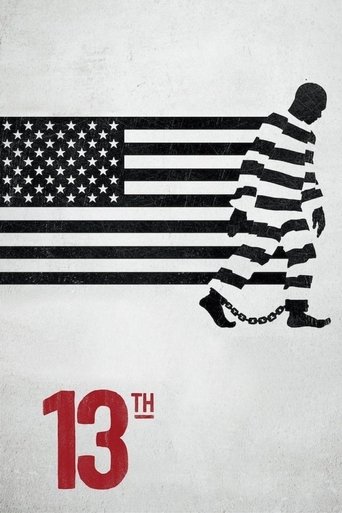
13th
2016 · Film · documentary · 101 min
Directed by Ava DuVernay
An in-depth look at the prison system in the United States and how it reveals the nation's history of racial inequality.
38 positive1 negative8 neutralfrom 47 commenters
Where to watch
No streaming data for this title.
50 comments on Hacker News
Hoss, if you cared you'd know about all the many, many efforts at things like "Restorative Justice". Hell, you'd know what the statistics are around recidivism in the US versus other countries and be able to tell us why other places in the world have such different outcomes.
There are plenty of reasons. Mass incarcertaion is a strategy, and it's unique to the US.
If you're really curious, a good entry point is the film "13th".
As a third person observing this conversation, you seem neither curious nor interested in learning why someone might think of US mass incarceration in such strong terms.
The answers are out there, if you actually cared to find them.
Hey, turns out there's a whole book about this!
https://en.m.wikipedia.org/wiki/The_New_Jim_Crow
And if moving pictures are more your thing, there's a movie, too!
https://en.m.wikipedia.org/wiki/13th_(film)
> won't be free of occasional abuse or over-enforcement
Another way of saying this is that unacceptable tyranny will roll in on a tread of acceptable compromises.
> I very much understand and share the fears of a surveillance state.
I'm not convinced you do, as "over-enforcement" is a totally inadequate term for the extant systemic oppression even organic policing imposes. Have you read The End of Policing, yet, or The New Jim Crow, or even watched the documentary 13th?
> the technology in question can save something
Maybe it can, but maybe so can something else. Something less costly, less constricting. You seem to be under the misapprehension that only surveillance can reduce violence. Well, that's one set of social relations, but can you think of any others?
>Prison labor has been a part of the U.S. economy since at least the late 19th century. Today it's a multi-billion dollar industry. Incarcerated people do everything from building office furniture and making military equipment, to staffing call centers and doing 3D modeling.
https://www.npr.org/2020/06/29/884989263/the-uncounted-workforce
>13th is a 2016 American documentary film by director Ava DuVernay. The film explores the "intersection of race, justice, and mass incarceration in the United States";[3] it is titled after the Thirteenth Amendment to the United States Constitution, adopted in 1865, which abolished slavery throughout the United States and ended involuntary servitude except as a punishment for conviction of a crime. DuVernay contends that slavery has been perpetuated since the end of the American Civil War through criminalizing behavior and enabling police to arrest poor freedmen and force them to work for the state under convict leasing; suppression of African Americans by disenfranchisement, lynchings, and Jim Crow; politicians declaring a war on drugs that weighs more heavily on minority communities and, by the late 20th century, mass incarceration affecting communities of color, especially American descendants of slavery, in the United States. She examines the prison-industrial complex and the emerging detention-industrial complex, discussing how much money is being made by corporations from such incarcerations.
https://en.wikipedia.org/wiki/13th_(film)
There's a reason Ava DuVernay's documentary is called 13th.
According to the 13th amendment it never really ended. The film 13th
It's a US constitution problem. Slavery of prisoners is still legal.
There's a film on it https://en.m.wikipedia.org/wiki/13th_(film)
To be completely honest - my memory for films is terrible, so I struggle to remember why I loved many of these. Also, many of them take unexpected twists and to say why I loved them so much risks ruining part of the surprise. I've watched countless documentaries and in order for them to make this list I have to _really_ enjoy them, and for the most part they require no interest in the subject matter in my opinion - they're just objectively good. So, I'd recommend literally any to start with, but with all that being said, some favourites amongst the favourites:
The Crash Reel - an amazing tale of a person preparing for the olympics, with an unexpected turn and just a very heartwarming/impressive journey - very very highly recommended.
The Cove - follows a whaling event that happens every year, and exposes the savagery of it. However, it's filmed almost like a thriller, in how the team set up to expose the event. Very eye opening, if a little sad, but very very good.
Drew: The Man Behind the Poster - just an amazing documentary about a man who makes amazing film posters - incredible, you'll see that he's responsible for so many recognisable posters from your childhood.
Being Elmo - lovely film about the puppeteer behind Elmo - really heartwarming
13th - very good film about racial injustice in the legal system.
The Netflix documentary "13th" comes to mind. At about the 19 minute mark:
Speaker 1: The election of ronald reagan was in many ways transformative in a negative sense
Speaker 2: President Richard Nixon was the first to coin the term "a war on drugs" but president ronald reagan turned that rhetorical war into a literal war
Reagan: It's back to school time for america's children, and while drug and alcohol abuse cuts across all generations, it's especially damaging to our young people on whom our future depends
Speaker 2: The modern war on drugs was declared by ronald reagan in 1982
Reagan: As we mobilize for this national crusade, I'm mindful that drugs are a constant temptation for millions:
Speaker 3: Popular opinion polls of the day show that it wasn't an issue for most people in the United States. But reagan was determined to put this onto the agenda to define it as a problem
Reagan: A war against drugs is a war of individual battles
Speaker 3: Reagan used his wife for example in this "just say no" campaign
Reagan: She has helped so many of our young people to say no to drugs. Nancy, much credit belongs to you
Clip of 80s anti drug commercial: This is your brain. This is drugs (cracks egg into pan). This is your brain on drugs.
Speaker 4: I joined it. And some people said...
I think that's a pretty decent example
I love documentaries, and these are my favourites. All very worth a watch.
- The Crash Reel
- McConkey
- Buck
- Apollo 11
- Carts of Darkness
- The Wild and Wonderful Whites of West Virginia
- Samsara
- Baraka
- Brooklyn Castle
- Spellbound
- Drew: The Man Behind the Poster
- Crumb
- The Jinx
- The Art of Flight
- King of Kong
- Indie Game: The Movie
- Capturing the Friedmans
- OJ: Made in America
- The Barkley Marathons
- The Seven Five
- Murderball
- Unbranded
- Gringo: The Dangerous Life of John McAfee
- Big River Man
- Hoop Dreams
- Word Wars
- Free Solo
- Long Shot
- Meru
- Being Elmo
- All This Mayhem
- Jiro Dreams of Sushi
- The Cove
- Project Nim
- Alone in the Wilderness
- Behind the Curve
- The Dawn Wall
- Grizzly Man
- 13th
- Winnebago Man
- Man vs Snake: The Long and Twisted Tale of Nibbler
- Get Me Roger Stone
- Icarus
- 13th
- Koyaanisqatsi
- The Thin Blue Line
- An Inconvenient Truth
- Oklahoma City
- Virunga
- The Staircase
- Evil Genius
- Undefeated
- Betting on zero
This one? https://en.m.wikipedia.org/wiki/13th_(film)
Although if we're talking about the US even more so than any country on earth, the police and judicial system were precisely designed to keep slaves in check. So it's absolutely mad but absolutely aligned with stated/designed goals (see also the documentary about the 13th amendment *not* abolishing slavery).
If you want to have a bad day watch this documentary about the 13th amendment and slavery in the prison-industrial complex. https://en.wikipedia.org/wiki/13th_(film)
If you're sincerely interested, I found the documentary "13th" to be informative and thought-provoking.
https://www.netflix.com/title/80091741
I learned from the documentary 13th (which I HIGHLY recommend) that something like 97% of people incarcerated in the US have never had a trial, because they're persuaded, manipulated or otherwise cajoled into making plea bargains.
97%!
Just to raise awareness about this (not trying to be nitpicky, sorry) labor in american prisons is typically unpaid (or might as well be, sometimes paying less than $1/hr) and not optional as the 13th ammendemnt specifically allows slavery as a punishment. JCPenny uses american prison labor to market their jeans as made in america, and I believe mcdonalds uniforms are made with prison labor. Netflix has a very good documentary on this, I'd recommend it (as long as you're willing to be very sad about it for at least a few days) https://www.netflix.com/title/80091741
For reference the 13th ammendment reads "Neither slavery nor involuntary servitude, except as a punishment for crime whereof the party shall have been duly convicted, shall exist within the United States, or any place subject to their jurisdiction."
But the rest of your post is correct.
> Because I worked at Palantir
Well that's a good reason.
The point I'm making is that I don't agree on Palantir's approach and strategy. If you watch the Ava Duvernay's documentary '13th' you'll see that systemic oppression of black bodies never ended. The school-to-prison pipeline guarantees exploitation and incarceration of the US's dark history of slavery and genocide.
So instead of Palantir pushing for systemic change, I see their technology as regressive and focused on giving power to unjust causes.
If you want to read more about how algorithms recreate bias, there's quite a lot of material that has come out recently. Here is an important point from Algorithsm of Oppression:
※ Those who have the power to design systems--classification or technical [like library, museum, & information professionals]--hold the ability to prioritize hierarchical schemes that privilege certain types of information over others.[1]
There's also another book called Automating Inequality, among others.
[1] https://www.goodreads.com/review/show/2206336831?book_show_action=true
Its not just slavery, its jim crow, segregation, black people being systematically disadvantaged through racist policies like getting higher rates on loans despite having the same risk. Also:
- the New Deal excluded black people
- The GI Bill excluded black people
etc...
Slaves built a huge part of the economy for free and americans benefit from that work for which they were not compensated, so yes there absolutely should be reparations. I think this should be done in several ways:
- monetarily: by funding scholarships and other projects to remedy the injustices perpetrated and help black americans accumulate some of the generational wealth they have been denied. Although at the end of the day, no amount of money will ever compensate for the hurt, death and atrocities, its a start.
- education: teaching kids at school what slavery was really like, instead of what some of the schoolbooks teach (that slavery wasn't that bad for example). Teaching kids about systemic racism that persists to this day.
- policing, housing, prisons: watch 13th documentary (https://www.youtube.com/watch?v=krfcq5pF8u8) its free on netflix
(edit: spelling and formatting)
>I have been trying to educate myself about the topic recently, though, and would strongly recommend looking into some of the excellent work on systemic racism in the US if you’re interested in learning more.
The fact that people write about this doesn't make it necessarily true. You should bear in mind that people are at least partly incentivised to write about this topic because it gives them soft power over individuals and society when it enters the mainstream - regardless of whether it's true. In other words you should recognize that you are potentially consuming propaganda.
>The documentary “13th” (available for free on YouTube at the moment), the 2nd season of the podcast Scene On Radio (“Seeing White”), and the book How to Be An Anti-Racist are three things I can recommend based on what I’ve read/heard from them so far.
All of this theory is based on the assumption that any two demographics with different cultures (i.e. with different notions of good/evil and just/unjust, varied attitudes toward the prioritization of work/study/sport, gender roles, etc) are equally suited, on average, for any field where we expect demographic parity. This is a fundamentally unproven modern assumption - and it doesn't make much sense when you consider how much influence culture has over individual interests and practiced abilities.
Now we are extrapolating from this unproven (and I suspect unprovable) assumption and using it as justification for discrimination against whites. Not only that, but we don't even have valid metrics for the degree to which racism influences society - because again there is no scientific justification for equal representation of all demographics in groups of individuals selected by merit.
>What you’re calling the “recent forced redefinition of racism” is not especially recent. I first heard this argument around 30 years ago, and at the time dismissed it, but now understand why people want to emphasize that over the definition I recall learning as a child which was structured along the lines of a belief in superiority of one group over another.
If you want to emphasize a new concept, you create a new word, you don't hijack an existing word and use it to denigrate or gain social power over others.
>Having a system that is designed and reinforced to encourage disparate outcomes is far more impactful to that group as a whole
Even if it were true, that all, or even the majority, of outcome disparity in modern western society is due to a broken system, that doesn't change the fact that this movement is effectively labeling white people as implicitly, innately, and inescapably evil. Where does it end? Isn't this literally the foundation for violence and atrocity?
I haven’t read White Fragility and couldn’t read the entirety of the article linked here due to the paywall, so I cannot comment on those.
I have been trying to educate myself about the topic recently, though, and would strongly recommend looking into some of the excellent work on systemic racism in the US if you’re interested in learning more.
The documentary “13th” (available for free on YouTube at the moment), the 2nd season of the podcast Scene On Radio (“Seeing White”), and the book How to Be An Anti-Racist are three things I can recommend based on what I’ve read/heard from them so far.
What you’re calling the “recent forced redefinition of racism” is not especially recent. I first heard this argument around 30 years ago, and at the time dismissed it, but now understand why people want to emphasize that over the definition I recall learning as a child which was structured along the lines of a belief in superiority of one group over another.
Having a belief may impact how you feel towards someone and how you act towards them, and may even have an impact on that person if you are in a position to influence the course of their life.
Having a system that is designed and reinforced to encourage disparate outcomes is far more impactful to that group as a whole.
I’m not going to argue that both aren’t harmful, but I’ve certainly come around to the conclusion that systematic or policy-based racism (if you’re uncomfortable calling it racism, feel free to disregard the name and come up with something you’re more comfortable with) has disproportionately affected Black and non-black people of color in the US.
It seems the comments about iraq, yemen, afghanistan them have been downvoted / flagged. I guess this one too. There's a documentary on netflix showing the 13th amendment's relation to the labor camps, shocking to say the least.
I don't think there is anything new in the article. It's the standard rhetoric used by UK/US media. Also notice the conspicuous absence of Saudis, they too are involved in messy labor practices. Oddly enough not a single of these pointless articles will mention that its another country in some sense - Turkestan ... because if thats the context of the debate then US will have to give up puerto rico, california and indian territories and UK ireland and France guiana and so on .... Here's the irony of the whole situation, from their standpoint the chinese too are liberating the places from feudalism and they have made some progress in the regions as opposed to the reckless military interventions of other nations.
The fact of the matter is literally none of the allied powers cared for the genocides in WWII, they even welcomed it. The POWs were also completely ignored post war which is one of the unspoken tragedies. In democratically elected nations it seems the only way to go to war is to paint the other side as a dictator go to war with it. The lies are just tiring at this point.
"You're making a lot of (intentional or not) dogwhistles."
And you're not, of course...
"races in the US continue to be relatively segregated[0]."
Yes, similar groups, culturally or otherwise, tend to want to live among their own. Is this a problem?
"crimes, even violent ones, are usually committed within-community."
Of course.
"So the meme around "black on black violence" is a bit of a distraction unless you also are concerned about "white on white" violence."
I disagree. The most logical thing to do, is to look closer at the groups that actually commit the most crime, if you want to fight that crime. You have to remember that the decision to do something illegal is individual, so you have to put the blame where the blame is due. You can't blame the system, because it's equal for everyone. And if it's not, well, then you have to prove that it's unfair, and so far haven't really been very persuasive. This doesn't make white-on-white violence unimportant. Only less important thatn black-on-black violence under this discussion.
"organizations like stop the violence[1] do exist to address specifically violence within the black community."
Has it helped? I think we both agree on the answer here.
"So you start by stating true, but ultimately misleading claims that are often used to justify racial prejudice."
Make up your mind, please! Are the facts "true" or not? Facts are just facts, man. It's how you respond to them that matters. And by the way, facts aren't "claims." The fact that blacks kill most blacks isn't a claim; it's a fact! The proof is in the pudding, as it where, or in this case in the FBI statistics.
Look, if one group pesters you daily, and tries to steal your candy, then yeah, you're probably justified in being somewhat prejudiced against them, no matter the colour of their skin...
But guess what, if one groups steals and murders way more than another group, then probably this will cause the authorities to look closer at that group. Sadly this will also lead to more false positives being produced when the police finally starts doing their job. Of course, it's easy to label that as "institutional racism," especially when there's political power and money in it, but let's face it, it's really just an excuse, and a poor one at that.
"you justify this opinion with two videos from black people."
Of course I do. Otherwise you'd just call me a racist. I assume you're now going to do your best to discredit these two gentlemen instead of answering the facts...
"Neither Larry Elder nor Denzel Washington is an expert on incarceration or the US justice system."
But you are, of course...
"Larry Elder, in fact, is a right wing political pundit, so his income relies on his viewership. This calls into question his reliability."
Yes, only left wing pundits like yourself have the monopoly on truth, I see... Look, I have no horse in this race, but I can only assume that you're a flaming Democrat. :D
"I'd suggest you watch the documentary 13th[2] or read up on these issues from actual experts."
Thanks, I might look into it.
> He starts by noting that white men and black men are killed by police at around the same rate. This is, again true. But this means that Black people are killed at around 5 times the rate of White people. > These racial differences show more police violence towards minorities.
Naturally. Don't you think it's completely logical that people who also commit far mor crimes, also get into far more tussles with the police? Probably find a way for your community to become more law abiding and peaceful, and this will stop being an issue all by itself!
One way to do it, is to ask for policies that open up for more social community work, where the first responder to economical, drug related or abusive behaviour stops being the police, but rather a social worker, or some other community representative. It's just a suggestion. Should be right down your lane since you are a left winger!
If you can get democratic traction for something like this, which is far more fruitful than playin the blame game, I think it would help crime go down greatly. It's basically what is done in my own country, and while the system isn't perfect, it's preferable to storming communities with police all the time; a thing that naturally causes some legitimate outrage, though it's not necessarily due to racism.
This way of doing things isn't free, however—and let's face it, Norway is filthy rich—so you can assume there will be pushback on how it should be funded, especially from the Right. Then there's the fact that Norway is a far smaller and more close-knit society in general. But then so are most ethnicly homogeneous neighbourhoods. I still think it's an idea to at least explore. And I also think these ideas are far more preferable to the Right than tearing down statues.
> Elder then notes that police forces can be diverse, which is true but ultimately a distraction.
No, it's not. I means there's a far less chance that the police are racist.
> He mentions the NYPD as an example of a highly diverse police force, but neglects to mention that the NYPD's Stop and Frisk policy was so problematic that it was deemed unconstitutional due to its discriminatory nature[4].
Dude, what has the obviously political and administrative policy of "stop and frisk" to do with the racial composition of NY cops? I'll tell you: Nothing! They'd have to carry out that policy whether they were all black, all white, or diverse to the point of employing martians!
Either way, don't you think it's a little unfair to try to pin political policies on the police force? In fact, then Mayor Bloomberg (D) had the power to stop the frisking policy in New York at any point, but instead he chose to defended it.[1] And for good reason, because AFAIK it was wildly successful, and made New York a lot safer for most people.
> He then mentions that the Police-Public contact survey shows no evidence of police abuse against black people, but the Fryer paper Elder cites manages to reach the opposite conclusion: that based on the Police-Public contact survey, there is statistically significant evidence of greater police use of force against minority populations, even when controlling for a number of factors.
That's because there is no opposite here... Abuse ≠ Legitimate use of force.
> He then mentions his movie, Uncle Tom, which contains a number of "conservative thinkers", who are mostly pundits. It contains no academic experts.
Of course. All academic experts of the Right are just pundits. I get it...
> [It] ignores the Southern Strategy[5], an explicit Republican strategy to gain support in the south by appealing to white fears about race in the wake of the civil rights movement. 13th goes into detail on this.
Were these fears unfounded then? Obviously the numbers show that blacks do indeed kill far more whites than whites kill blacks, both per capita and in pure numbers. Again, facts, not claims. Do you think that shouldn't be a cause for consern? Man, lives are literally at stake!
You're making a lot of (intentional or not) dogwhistles. So let's dive in to a few of them:
> Blacks kill more blacks than any other race or ethinicity.[1] Blacks also kill more whites, than whites kill blacks in pure numbers.
Indeed, let's rephrase this: races in the US continue to be relatively segregated[0]. And crimes, even violent ones, are usually committed within-community. So the meme around "black on black violence" is a bit of a distraction unless you also are concerned about "white on white" violence. And if you are, organizations like stop the violence[1] do exist to address specifically violence within the black community.
So you start by stating true, but ultimately misleading claims that are often used to justify racial prejudice.
Then, you justify this opinion with two videos from black people. Neither Larry Elder nor Denzel Washington is an expert on incarceration or the US justice system. Larry Elder, in fact, is a right wing political pundit, so his income relies on his viewership. This calls into question his reliability. I'd suggest you watch the documentary 13th[2] or read up on these issues from actual experts.
But I'll spend some time breaking down his video:
He starts by noting that white men and black men are killed by police at around the same rate. This is, again true. But this means that Black people are killed at around 5 times the rate of White people. Then he restates the whole issue of black on black crime, which we've already discussed.
He then cites a paper from Roland G. Fryer[3], which I happen to be familiar with. It concludes
> On non-lethal uses of force, there are racial differences – sometimes quite large – in police use of force, even after accounting for a large set of controls designed to account for important contextual and behavioral factors at the time of the police-civilian interaction.
These racial differences show more police violence towards minorities.
Elder then notes that police forces can be diverse, which is true but ultimately a distraction. He mentions the NYPD as an example of a highly diverse police force, but neglects to mention that the NYPD's Stop and Frisk policy was so problematic that it was deemed unconstitutional due to its discriminatory nature[4].
He then mentions that the Police-Public contact survey shows no evidence of police abuse against black people, but the Fryer paper Elder cites manages to reach the opposite conclusion: that based on the Police-Public contact survey, there is statistically significant evidence of greater police use of force against minority populations, even when controlling for a number of factors.
He then mentions his movie, Uncle Tom, which contains a number of "conservative thinkers", who are mostly pundits. It contains no academic experts. Compare to 13th, which includes interviewees from both political parties, as well as non-political subject matter experts. Uncle Tom peddles ultimately irrelevant facts, such as that the democratic party was historically in favor of slavery. This is true, but ignores the Southern Strategy[5], an explicit Republican strategy to gain support in the south by appealing to white fears about race in the wake of the civil rights movement. 13th goes into detail on this.
But you can see some of it in things like this[6] Lee Atwater quote (Atwater was a republican political strategist), where he essentially admits the racism at the core of the southern strategy, and the need to, over time, move from explicit and overt racism to more systematic changes that, while not explicitly racist, help white people at the expense of black people.
Edit: I actually forgot one thing Elder mentions, that no one cares when unarmed white people are shot by police. This isn't actually true: The Black Lives matter movement has a reasonably well documented history of raising some awareness about cases of police killing unarmed white people. For example, during BLM protests in the wake of Michael Brown's murder in 2014, Christian Roupe[11], a white kid from Georgia, was among the names of people killed by police violence mentioned at the protest. More recently, in the wake of Daniel Shaver's murder, BLM voices raised awareness[12].
Which leaves one more thing that Elder discusses: "black fathers", which is also what Denzel Washington discusses. So once again, go watch 13th, I'm basically repeating the things it says here.
In the Nixon/Reagan era, "Law and Order" politics[7] became a central issue. Most notably, the "War on Drugs". Through this, laws were passed that disproportionately keep black people in prison, notably around crack vs. powder cocaine. But even with other drugs like marijuana, where white and black people use and historically used cannabis at the same rate, but black people are 3x more likely to be arrested for cannabis use[8] even today, and as a result literally tens of thousands of young black men are in prison for things that aren't a crime.
Those disproportionate arrest rates, combined with some of those other crime laws from the "Law and Order" era mean that someone who never commits a violent crime can end up a felon or even behind bars for life. Those people are disproportionately likely to be black men, especially young black men. Young black men who should be forming families but who can't because they're being put behind bars for crimes that white people commit at equivalent rates.
That, combined with historical issues like redlining[9] and housing policies that prevented black communities from building generational wealth[10] mean that it's difficult, if not impossible, for black fathers to create stable homes. They don't have the generational wealth that white households do, not as a result of their actions, but instead due to years of explicit government policy that directly prevented their parents generation from accumulating wealth. Then, of course, they're overpoliced and sent to prison which can prevent them from doing important and economically stabilizing things like attending college, or even in some cases completing high school, and acquiring decent jobs.
And this cycle is self-reinforcing. Without the ability for the current generation to create stable households, the next generation won't have wealth to build off of and will continue to be unstable. And so the cycle will continue. That's why we call it "systemic".
Hope that helps inform you about these issues. I'm also happy to break down why some of the things you've done generally won't engender you much sympathy and will result in you being accused of "dogwhistle" racism. But I'll only dive into that rhetorical analysis if you specifically request it.
[0]: http://racialdotmap.demographics.coopercenter.org/
[1]: https://en.wikipedia.org/wiki/Stop_the_Violence_Movement
[2]: https://www.youtube.com/watch?v=krfcq5pF8u8
[3]: https://scholar.harvard.edu/files/fryer/files/empirical_analysis_tables_figures.pdf
[4]: https://ccrjustice.org/home/press-center/press-releases/landmark-decision-judge-rules-nypd-stop-and-frisk-practices
[5]: https://en.wikipedia.org/wiki/Southern_strategy
[6]: https://en.wikipedia.org/wiki/Lee_Atwater#%22Southern_strategy%22, https://www.thenation.com/article/archive/exclusive-lee-atwaters-infamous-1981-interview-southern-strategy/
[7]: https://en.wikipedia.org/wiki/Law_and_order_(politics)
[8]: https://www.aclu.org/report/tale-two-countries-racially-targeted-arrests-era-marijuana-reform, see page 28 of the report
[9]: https://en.wikipedia.org/wiki/Redlining
[10]: https://youtu.be/AGUwcs9qJXY?t=240, covers redlining and generational wealth issues, but the whole video is great and, it should be noted, is made by a Christian who I believe identifies as conservative. It overlaps a lot with 13th, but 13th covers a few more recent things about the US prison industrial complex and contains more firsthand accounts and interviews.
[11]: https://newsandletters.org/thousands-chicago-ny-ferguson-stop-killer-cops/
[12]: https://www.commondreams.org/news/2017/12/09/black-lives-matter-supporters-call-attention-graphic-video-arizona-shooting
With respect and goodwill (appreciate that you actually seem to be coming to the comments to learn), it's very hard to read your comment in that way when you say things like:
> Society pretending that there is massive racism when there isn't is itself structural racism
I'm not sure where is best to start here because there are so many things that have to go into actually believing that, and so many combinations, but there are tons of resources floating around so I truly do encourage you to seek those out.
A basic starting point list beyond police brutality: public school funding systems, household wealth inequality and lack of reparations + exponential investment growth, medical treatment differences (go look up the guides for black people in the US to get proper medical treatment from a doctor), the prison industrial complex, the criminalization of drugs in the US + its history, crack vs powder cocaine sentencing laws, parole laws
If you prefer movie format: 13th, I Am Not Your Negro, The House I Live In
> I am saying that the level of racism is low
This sums up why your comment go downvoted so far. The social media world is overflowing with resources showing the opposite right now with extensive evidence and research. It has always been there but it has never been more accessible.
You can find the source via audio clip from a netflix special called "13TH", which is about racial injustice and the prison system, I'm almost certain this was quoted in the documentary.
EDIT: It's about 18 minutes into the documentary, but I'm finding out their source is Harpers.
You are using the word "fact" where its patently obvious that "opinion" is the correct word, after your mistake was already explained to you.
> prison labor for the public good is a good thing.
is an opinion.
> Prisoners owe the public
is an opinion
> for their malfeasance,
is an opinion
> breaking the social compact
opinion or debatable fact.
> I am a very far right ultra-traditionalist,
Yes, slavery is traditionalist.
Here are some facts you might find enlightening https://en.wikipedia.org/wiki/13th_(film)
The 13th amendment to the constitution (emphasis mine): “Neither slavery nor involuntary servitude, except as a punishment for crime whereof the party shall have been duly convicted, shall exist within the United States”
I think it’s important to frame any discussion of criminal justice reform in the US in the fact that our modern legal system is built on laws and loopholes, beginning with the 13th amendment, that exist solely to criminalize and reenslave huge portions of the population.
I highly recommend the documentary “13th” on Netflix for more info.
I would recommend reading The New Jim Crow or watching 13th to better understand the argument and comparison being made.
There’s a documentary on Netflix called 13th that discusses this very point in much more depth. Despite the somber and serious nature, it’s a surprisingly light watch.
Check out “13TH” on Netflix https://www.netflix.com/title/80091741
That's pretty much Ava DuVernay's argument on her documentary "The 13th": https://www.youtube.com/watch?v=V66F3WU2CKk
I'd suggest the documentary 13th as well.
Can we please keep the reddit style hysterics on reddit? I pretty much left reddit to escape the fake political nonsense. And with all due respect, you are doing exactly what you claim cambridge analytica did. You are pushing extreme fear and agenda. But for what end?
> As I browse, my interests are accumulated into basic interest groups, demographic data, and maybe recently visited websites that use tracking.
You are forgetting installing cookies and fingerprinting ( amongst others ) to track across platforms. You are forgetting using that data to target customers with tailored fearmongering news articles to better clickbait.
> Through that, Republican campaigns also access my grandmother's account, with all of her photos, likes, and comments. They use that data to learn her deepest fears.
I hate to break this to you but everyone does this. Obama did this. The democrats did. Hillary's campaign did this.
I love how you excuse news websites when they cause hysteria and panic over nonsense like campus rape crisis and pay gap in male and female sports. Not to mention the hysteria over cambridge analytica. Seems like the news has done far more harm to you than facebook did to your grandmother, assuming your story is legit and not made up.
I recommend you go watch the 13th on netflix to see how news and media can be dangerous. The problem now is that news has access to tons of data about us ( just like facebook ). The biggest difference is that facebook was pretty much "neutral" whereas the news/media are highly biased. Facebook allowed both trump and hillary political ads.
I wouldn't be so definitive, but if anyone wants to see an excellent documentary on the subject, watch 13th (after the 13th Amendment):
https://en.wikipedia.org/wiki/13th_(film)
I'll add a couple of common arguments that at least get you thinking, even if they aren't as powerful as evidence.
First, note that mass incarceration began after segregation and other civil rights abuses were outlawed. One ramped down and the other ramped up. Many believe that one tool of oppression merely replaced another.
Second, the legal and prison system have always been used, since the Civil War, to oppress black Americans. Mass incarceration wasn't a new tool, but an expansion of an old one. And it extends into today, as has been well-publicized recently. Or I'm sure everyone has heard the phrase, 'driving while black'. I've personally witnessed that kind of abuse.
> It's the protestant puritan spirit.
Have you watched the documentary "13th"? If so I'd be curious to hear what explains the delta in your opinion.
If not, I can recommend it.
[Edit to clarify] For the sake of folk who haven't watched it, my rough TL;DR would be that it paints an apparently clear continuum from slavery to mass incarceration based on the 13th amendment's allowance of "involuntary servitude" for convicts.
Have you watched the documentary the 13th? It covers severe issues with the incarceration rate in the United States, for example, the high proportion of black people incarcerated for the same crimes white people are completely let go of or otherwise not charges. How the justice system is very selective on what laws to enforce along racial lines. Stop and frisk turned out to mean “stop all the black people exclusively and search them”. How people are pressured to take plea deals even though they may indeed be innocent. How the police have been known to literally plant evidence or incite violence within communities or protests to force arrests.
Not sure why you're being downvoted (+1 from me) but this is essentially the basis of the Netflix documentary 13th [1]. The thesis is that slavery was replaced by excessive incarceration of African Americans, which were then used as cheap or free labour... much like slaves were.
[1]: https://en.wikipedia.org/wiki/13th_(film)
I recommend that everyone watch the Netflix documentary "13th." The central theme is that slavery has never stopped being legal in the United States it just moved to the prison system. Below is the text of that amendment.
Section 1. Neither slavery nor involuntary servitude, except as a punishment for crime whereof the party shall have been duly convicted, shall exist within the United States, or any place subject to their jurisdiction.
There are several similar stories in https://en.wikipedia.org/wiki/13th_(film)
13th is a Netflix documentary about this. Warning: It may be quite difficult to watch.
https://www.netflix.com/title/80091741
If you haven't, Netflix's has a documentary called 13TH[1] where a loop hole in the slavery abolishment act was used to mass incarcerate blacks in the USA. As indicated in other threads, USA is inhabited with just 5% of the world's population but runs 25% of all prisons.
[1] https://www.netflix.com/in/title/80091741
Netflix has a documentary called 13th that (amongst other things) lays out exactly how America has driven a coach and horses through that particular loophole.
You can draw a straight line from the 13th Amendment to the private prisons of today. After all, the southern states whose economy was ruined by the Civil War had to get cheap labor somehow, so they arrested all those former slaves for random bullshit like loitering, had them convicted by all-white juries, and sent them to work in chain gangs.
Netflix produced a great documentary about all of this - 13th - and it's well worth the watch.
"Black History": https://www.youtube.com/watch?v=WUtAxUQjwB4 -
Probably the best, most eye opening talk on any topic, but especially on the roots of institutionalised racism, and perhaps the cause of a lot of issues today.
It is by "Akala", an English rapper, poet, and journalist at the Oxford Union and is is a shining example that you can gain a great amount of knowledge, if you are only willing to.
If you liked the Netflix documentary "13th" you will like this.
Although not directly related to crime rates in Chicago, 13th by Ava DuVernay is a wonderful documentary on Netflix regarding mass incarceration of minorities as a new means of racial segregation.
If you find this topic interesting, I would recommend that you check out the documentary "13th" on Netflix:
https://www.netflix.com/title/80091741
Does a death sentence make us a better society for justice? I don't have an answer to that question. However, it is a question I prefer to not have experimented on in our justice system.
I recently watched the documentary 13th from Netflix. It really puts into perspective our pro-incarnation justice system. While capital punishment and death row is a section of our justice system, it has the highest stakes in outlining where our ethical limits reside as a society.
Watch 13th on Netflix, slavery is still here in the US. The Constitution legalizes it for people convicted of crimes and there is a big business built around it.
https://en.m.wikipedia.org/wiki/13th_(film)
It never left. In the US, the Constitution has an exception that allows slavery for people convicted of crimes. I recently learned this after watching the netflix documentary 13th. As a US citizen I felt a bit ignorant that I didn't know this. Would guess that most people don't. Very insightful film. https://en.m.wikipedia.org/wiki/13th_(film)
Here is the text of that amendment: "ARTICLE XIII. Section 1. Neither Slavery nor involuntary servitude, except as a punishment for crime; whereof the party shall have been duly convicted, shall exist within the United States, or any place subject to their jurisdiction"
And globally, human trafficking is a huge problem. It is another term for modern day slavery. https://www.unodc.org/unodc/en/human-trafficking/what-is-human-trafficking.html
After watching the documentary "13th" on Netflix recently, I wondered about how the US prison population affected this. Something like 1 out of 100 people in the US are in prison, which must be close to 2 out of 100 men. And another chunk of people who's function in society is to monitor those in jail. Plus the difficulties of getting a job as a felon. Seemed like all put together must have a serious impact on productivity.