 Hacker Cinema
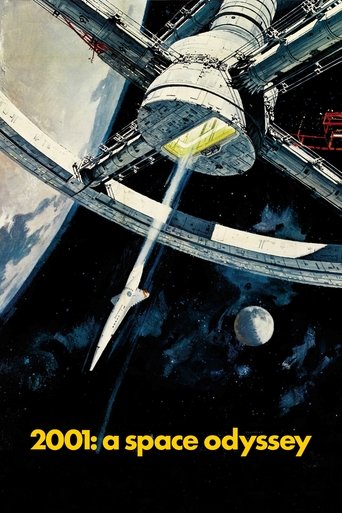
2001: A Space Odyssey
1968 · Film · 149 min
Part of The Space Odyssey Series
Directed by Stanley Kubrick
Science FictionMysteryAdventure
Humanity finds a mysterious object buried beneath the lunar surface and sets off to find its origins with the help of HAL 9000, the world's most advanced super computer.
73 positive9 negative11 mixed127 neutralfrom 220 commenters
Where to watch
No streaming data for this title.
246 comments on Hacker News
Domingo Gonsales is flown to the moon by tying himself to wild swans, and meets Lunar Christians - The Man in the Moone by Francis Godwin (1601)
Manned mission to the Moon by giant gun - Jules Verne (1865 ish).
Manned trip around Saturn by comet - Jules Verne (1877).
Time traveller sets off to the future - H.G. Wells (1894)
Martian invasion of Earth - War of the Worlds by H.G. Wells (1905)
Global telephone network reaches as many connections as a human brain and wakes up - Dial 'F' for Frankenstein, Arthur C Clarke (December 1, 1975)
Birth of Dr Susan Calvin, founding of US Robotics & Mechanical Men, development of 'Positronic Brain' - Asimov's robot stories (1982 and after)
British space station under construction - The Outward Urge by John Wyndham (1994)
Portal to parallel universes - Sliders (1994)
Doctor Samuel Beckett steps into the Quantum Leap Accelerator and vanishes - Quantum Leap (1995)
Skynet becomes self-aware - Terminator 2 Judgement Day (August 29, 1997. at 02:14 am Eastern Time)
HAL 9000 AI computer operational (1997), first human voyage to Jupiter system (2001), first landing on Europa and alien life discovered (2010) - Arthur C. Clarke's 2001 A Space Odyssey
Moon leaves Earth Orbit after nuclear waste explosion, taking human-occupied Lunar colony with it - Space:1999 (13 September 1999)
Efficient international flight, using Zeppelins and blimps - Rudyard Kipling (2000)
Global climate disaster - The Day After Tomorrow (2004)
Replicants - Bladerunner (2016)
Keanu Reeves smuggles digital information in his brain - Johnny Mnemonic (2021)
Arnold Schwarzenegger kills to survive in a typical American TV show - The Running Man (2025)
Woman relifed into robot, rich people discover workers' rights - Fritz Lang's Metropolis (2026)
First colony mission to Mars, 100 colonists on the largest spaceship ever built - Kim Stanley Robinson's Red Mars (2026)
Tibetan monks finish listing all the names of God, stars start going out - The Nine Billion Names of God, Arthur C. Clarke (when computers were rentable and could print 1000 names per second)
and many more: https://scifi.fandom.com/wiki/Timeline_of_fictional_future_events
Recently got a big fancy TV with 4k + Dolby Vision
It’s a lot of work figuring out what movies support the format. And all the premium upgrades to Netflix, etc get them to stream premium formats. Then it doesn’t work and you’re spending 30 minutes debugging your TV, wondering why you’re not getting the amazing new restoration of 2001: A Space Odyssey.
I totally understand why people just buy physical media.
Games may be harder given software updates. But I’d pay a premium for a physical copy of mature games I love (like Halo Master Chief collection)
> I think in the near future, people will start filtering out movies that have a non-trivial share created by AI.
I'm not _sure_ that's true? "Most people" know that McDonalds don't make the best burgers in their city - probably not even the best burgers in their neighbourhood. But they do make burgers that are reliably the same and for heaps of people "good enough" when things like price and availability and consistency are taken into account. And I don't blame then for that, for those people burger quality is a think that value less then me, and convenience is something they value more than me. They're not "wrong" just different.
Some of us will. I'm more concerned personally with books and music, and go well out of my way to make sure I'm buying then from "real people"(tm). The last few years most of my in cinema movie watching has been at a local cinema that screens classic movies. Recently I've seen a 70mm print of 2001 A Space Odyssey, 35mm prints of Blade Runner and Godfather. Last week we went to see the original Matrix I _know_ I'm not watching much AI generates film.
I suppose you are okay with all animated films being impossible to create then.
>I obviously like some of those too, but who's to say that the larger budget made them better?
If you legitimately believe something like 2001: A Space Odyssey would be as good with a budget of $10,000 then that just seems delusional.
The world you want is one in which the only people who can create things are people who are wealthy by other means, there is no pathway for a talented but poor kid to go from making home movies to working on films without IP laws. They must abandon their dreams and go work in the coal mines or whatever. It is dystopian.
I want the most amount of people possible to be able to work as professional creatives because it enriches my life and the lives of everyone in the country I live in.
Oh man, the Golden Age of science fiction movies, just two years after 2001: A Space Odyssey and five years before the start of the Blockbuster era[0] with Jaws (1975) and Star Wars (1977).
I feel like Science Fiction back then was purely understood as psychological concepts and ambiguous desires, mostly questioning the very essence of reality and our human minds. There were intelligences and ambitions in us that felt alien, but weren't extraterrestrial in kind. I always thought of it as if Science Fiction tried to turn any progress from the Age of Enlightenment inside out.
A great gem is also World on a Wire (1973)[1], which takes the concept of a machine controlled intelligence and questioned whether we're living in a simulation and are already influenced by a virtual world.
My favorite quote from Colossus: The Forbin Project, after Dr. Forbin is held hostage by Colossus:
Colossus: How many nights a week do you require sex? Dr. Forbin: Every night. Colossus: Not want. Require... Dr. Forbin: [looks sheepish] Four times.
[0]: https://en.wikipedia.org/wiki/Blockbuster_(entertainment)#Blockbuster_era
[1]: https://en.wikipedia.org/wiki/World_on_a_Wire
Watching it from time to time over the years I've noticed all the little 2001 A Space Odyssey references. The Dark Star universe is some sort of "low budget" version of the 2001 universe. By low budget I mean janky. Many things in Dark Star are janky versions of what you see 2001.
For example, the Dark Star central computer is really just a janky version of HAL. In 2001 HAL wishes happy birthday to a sunbathing Frank Pool. In Dark Star, you have Pinback on a lawnchair using a jerry-rigged sunbathing lamp, later complaining that no one remembered it was his birthday. Both have scenes that feature explosive bolts. Also both have scenes with the astronauts getting sandwiches (chicken or ham?). Both have a mission control guy, with the one in Dark Star being completely useless. There are probably more references but these come to mind.
Love that movie.
I think of this movie
https://en.wikipedia.org/wiki/Silent_Running
which could be read as an expression of 1970s environmentalism or something like 2001 A Space Odyssey where a crew member runs amok instead of the computer.
Close Encounters of the Third Kind was indeed when I first noticed this effect. It was dramatic and cool and all that, but pretty obviously an effect. Coupling it with Raiders of the Lost Ark and the effect almost pigeon-holes a film to be of that era.
I'm unsurprised Douglas Trumbull was behind the Close Encounters effect since his work on 2001: A Space Odyssey captured his earliest experiments filming tanks of liquids with fluids added. They were fairly effective in Kubrick's film when they appeared to resemble fantastic nebulae, globular clusters…
(And never mind the mind-bending cleverness of how the slit-scan shots were created for 2001.)
"HCF":
"In computer engineering, Halt and Catch Fire, known by the assembly language mnemonic HCF, is an idiom referring to a computer machine code instruction that causes the computer's central processing unit (CPU) to cease meaningful operation, typically requiring a restart of the computer. It originally referred to a fictitious instruction in IBM System/360 computers (introduced in 1964), making a joke about its numerous non-obvious instruction mnemonics." (Source: https://en.wikipedia.org/wiki/Halt_and_Catch_Fire_(computing)
The series is a memorable instance of what any self-respecting geek ought to have watched. It's better than "Silicon Valley", although the latter has pulled one scientific stunt regarding scientific advisory that is unique in film.
What other films/series are "must watch" material for geeks?
- War Games
- Silicon Valley
- The Social Network
- The Intern
- Mr. Robot
- Black Mirror
- Hackers
- 2001: A Space Odyssey
- ...?
Thanks! Here's the full list: 2001: A Space Odyssey, 8½, Aguirre the Wrath of God, Ali: Fear Eats the Soul, All That Heaven Allows, Apocalypse Now, Ashes and Diamonds, A Woman Under the Influence, Barry Lyndon, Bicycle Thieves, Breathless, Casablanca, Céline and Julie Go Boating, Chinatown, Chinese Roulette, Citizen Kane, City Lights, City of Pirates, Contempt, Daisies, Damnation, Dishonored, Earth, Electra My Love, El Topo, Eraserhead, Eyes Wide Shut, Film Socialisme, Fitzcarraldo, Fuego en Castilla, Hiroshima Mon Amour, Holy Motors, Inauguration of the Pleasure Dome, In a Year with 13 Moons, India Song, Inland Empire, Irma Vep, Koyaanisqatsi, La Dolce Vita, La Jetée, Late Spring, L'Eau de la Seine, Le Voyage dans la Lune, Lolita, Los Olvidados, Lost Highway, Lucifer Rising, Man with a Movie Camera, Metropolis, Mirror, Mulholland Drive, Night Music, Ordet, Orpheus, Persona, Pickpocket, Playtime, Psycho, Rebecca, Rosemary's Baby, Rumble Fish, Scarface, Seven Samurai, Sherlock Jr., Singin' in the Rain, Stalker, Sunset Boulevard, Taste of Cherry, Taxi Driver, Testament of Orpheus, The 400 Blows, The Blood of a Poet, The Cabinet of Dr. Caligari, The Color of Pomegranates, The Green Ray, The Holy Mountain, The Isle, The Lady from Shanghai, The Night of the Hunter, The Passion of Joan of Arc, The Seventh Seal, The Spirit of the Beehive, The Tales of Hoffmann, The Tree of Life, The Turin Horse, Time of the Gypsies, Tokyo Story, Touch of Evil, Trans-Europ-Express, Ugetsu, Un Chien Andalou, Uncle Boonmee Who Can Recall His Past Lives, Vampyr, Videodrome, Wavelength, Werckmeister Harmonies, Wild Strawberries, Moonlight Sonata, Stellar, The Haunted House Biased toward European art cinema, experimental work, and directors who broke conventional narrative rules.
The movie itself predates the moon landing - it came out in 1968.
It's astonishing to watch 2001: A Space Odyssey today and reflect on how well the production design has aged. That movie is coming up on 60 years old now!
The portrayal of AI has held up extraordinarily well too.
> what happens if you have a work where e.g. the music and the script were written by different people?
This happens ALL THE TIME. 2001 A Space Odyssey, Heavy Metal (1981-Blue Oyster Cult), Rocky (1976) airing on TV without Eye of the Tiger, It's a Wonderful Life was public domain but distributors needed to pay for the soundtrack. TV shows like Married with Children and Dave airing in syndication with different opening theme songs. etc.
All over archive.org you'll find tons of classic films but with the soundtracks stripped out.
> One of the most famous cuts in cinema history, from “2001: A Space Odyssey,” perfectly captures a concept known as the technological sublime.
There's something about this idea of experiencing art as a sommelier for human feelings that disturbs me.
This has happened many times with me. Person recommends a movie, describes a scene and how that scene makes him feel and that's why the movie is great. I watch it, and what I feel has nothing to do with what I heard from that person.
There's a joke in the metal community. It goes like this:
"I never respected Dragonforce. Then I heard the Metallica guys saying how they were impressed by the new Dragonforce song. Now I don't respect Metallica."
I think it conveys well how sometimes we can't project our experiences into other's perspectives. Maybe I don't feel the sublime, and I never will, and I'll never understand this article (although I'm sure lots of people will relate to it).
> You end up building this circle for each character, where the plot becomes the vehicle for them seeking and satisfying (or failing to) some need. You don't need purple prose, you just need characters that have motivations that are self-consistent and understood by the viewer. Such understanding does not require sympathy, either.
How does "2001: A Space Odyssey", arguably one of the greatest films ever made, fit into this framework? Are we ever apprised of HAL's motivations? Does the crew have some deeper desire that we aren't aware of besides completing a mission? Is it ever explained what specifically the monoliths do? Many of these questions are only answered in the sequel which does take a more traditional tack and had less critical acclaim.
Nobody's saying that this formula doesn't work. I'm just saying that it doesn't have to be the one that successful narratives follow just because the Rick and Morty guy happens to like it.
Yes, I should have specified that, as that's what I meant.
I'm not sure of the point in sending a human there and back without a colony, but that wouldn't stop us if we find an emotional reason. The poor astronaut will die young after their return, of course, but that's true for many occupations already.
Not surprised at the downvotes I got. "We're going to live out there! Soon!" is baked into us by every TV show, movie, and book around us, it seems. But it is nowhere as easy as "2001: A Space Odyssey" promised. Not even as easy as "Space 1999".
Compare the "realistically" dingy environment of Darkstar to the fancy space airline and orbital hotel sets of 2001: A Space Odyssey.
Have you really looked at the insides of actual craft from NASA, military aircraft, military and commercial ships, or submarines? Purposeful, large facilities like hangars, factories, oil drilling platforms, or refineries? Smaller technical spaces like equipment rooms, scientific research labs, and medical imaging labs?
I think the designers are often imagining future tech spaces derived from these examples rather than luxury ocean liners, hotels, resorts, and executive meeting rooms. It isn't irrational to use those purposefully technical environments as setting for technologically-driven drama.
Star Trek NG was more of the cruise ship or hotel vibe as they tried to efficiently convey their utopian vision. They went with the militaristic or industrial vibe for contrasting environments they encountered in many episodes.
2001: A Space Odyssey. He’s cited it as being profoundly influential on his thinking and film making. The Star Child is the dream, Scott creates the nightmares.
Many of Kubrick's movies were panned at release and only received merits upon reexamination. Even 2001 was initially met with a mixed reception.
https://www.hollywoodreporter.com/movies/movie-news/hollywood-flashback-1968-2001-a-space-odyssey-confounded-critics-1109385/
The Author also missed the fact that in the 2001 Movie they went to Jupiter, whereas in the book they went to Saturn.
https://scifi.stackexchange.com/questions/177/why-is-the-destination-of-the-discovery-in-2001-a-space-odyssey-saturn-in-the-b
Because we're not seeing mass unemployment from large scale automation yet. We don't see these AGIs walking around like Data. People tend to not think a chatbot is sufficient for something to be "human-level". There's clear examples from scifi what that means. Even HAL in the movie 2001: A Space Odyssey was able to act as an independent agent, controlling his environment around him even though he wasn't an android.
yeah that made me stop too. Who, writing on these topics, does not know that the movie is 2001: A Space Odyssey.
If data integrity is assured, and thus there is no change in the data to store/transfer, then that's the opposite of computationally transforming the data?
How do we see robot and AI and helping interactions in film and tv and games?
A curated list of films for consideration:
Mary Shelley's "Frankenstein" or "The Modern Prometheus" (1818), Metropolis (1927), I\, Robot (1940-1950; Three Laws of Robotics, robopsychology), Macy Conferences (1941-1960; Cybernetics), Tobor the Great (1954), Here Comes Tobor (1956), Jetsons' maid's name: Rosie (1962), Lost in Space (1965), 2001: A Space Odyssey (1968), THX 1138 (1971), Star Wars (1977), Terminator (1984), Driving Miss Daisy (1989), Edward Scissorhands (1990), Flubber (1997, 1961), Futurama (TV, 1999-), Star Wars: Phantom Menace (1999), The Iron Giant (1999), Bicentennial Man (1999), A.I. Artificial Intelligence (2001), Minority Report (2003), I\, Robot (2004), Team America: World Police (2004), Wall-E (2008), Iron Man (2008), Eagle Eye (2008), Moon (2009), Surrogates (2009), Tron: Legacy (2010), Hugo (2011), Django Unchained (2012), Her (2013), Transcendence (2014), Chappie (2015), Tomorrowland (2015), The Wild Robot (2016, 2024), Ghost in the Shell (2017),
Giant f robots: Gundam (1979), Transformers (TV: 1984-1987, 2007-), Voltron (1984-1985), MechWarrior (1989), Matrix II: Revolutions (2003), Avatar (2009, 2022, 2025), Pacific Rim (2013-), RoboCop (1987, 2014), Edge of Tomorrow (2014),
~AI vehicle: Herbie, The Love Bug (1968-), Knight Rider (TV, 1982-1986), Thunder in Paradise (TV, 1993-95), Heat Vision and Jack (1999), Transformers (2007), Bumblebee (2018)
Games: Portal (2007), LEGO Bricktales (2022), While True: learn() (2018), "NPC" Non-Player Character
Category:Films_about_artificial_intelligence : https://en.wikipedia.org/wiki/Category:Films_about_artificial_intelligence
List of artificial intelligence films: https://en.wikipedia.org/wiki/List_of_artificial_intelligence_films
Category:Films_about_robots: https://en.wikipedia.org/wiki/Category:Films_about_robots
Category:American_robot_films: https://en.wikipedia.org/wiki/Category:American_robot_films
The only one I've ever noticed on my own in a long life of watching movies is the compressed air tank to overturn a chariot in Gladiator (2000).
I was told about the pole that causes the truck to flip in Raiders of the Lost Ark and now I can't unsee it.
—Warning to those who enjoy 2001 A Space Odyssey with their blinders on...—
2001 made a big impression on me as a kid and I've seen it many times. There was a point when watching for the Nth time in middle age that I first noticed that all the anti-gravity shots show the actors bodies carrying their own weight. Especially in the aisle scene with the floating pen, which itself is rotating about the center of the sheet of clear plastic it's attached to rather than its center of mass. Later in the same sequence, food trays are brought to the bridge after the long scenes of a flight attendant, who picks up trays as they slide downs from a dispenser, and as she hands the trays to the crew, one of them instinctively puts his hand out under the tray to helpfully catch its weight. In the next scene an officer joins other crew by coming up from behind them, leaning over and resting his arms on their chair backs as the scene cuts to details of anti-gravity meal consumption. Finally Floyd stands in front of a toilet reading a 1000 word hard-printed list of instructions after the viewer has been shown electronic displays used everywhere else. The self-consciousness of that clip provides a lovely relief from all the previous cognitive dissonance. I'm not able to unsee any of this now and it detracts from the spectacle. But at the same time, it makes the orchestration and ideas of the movie seem all the more artistic, so nothing lost except innocence. There are many other oddities to find in the movie working on different planes of awareness, including proprioceptive assumptions about reality, intelligence, progress, and spirituality.
Compared to..citizen's kane, godfather, 2001 a space odyssey, basically any of the older "top" movies.
I find AI to be fascinating because of humankind's old dream to create intelligent life in a machine. Just watch the countless old and new movies and animes or read the novels².
With big advances, the current wave of AI is finally promising to turn this dream into reality.
Besides, it's already quite useful even with its current shortcomings.
--
² here's a short very incomplete list:
The Matrix, 2001 A Space Odyssey, Blade Runner, The Terminator, Robocop, Her, Ex Machina, Ghost in the Shell (1995, 2004, 2017), Data in Star Trek, Star Wars, ...
Strong agree: Upstream Color is poetry
Stanley Kubrick did something similar in `2001: A Space Odyssey`. In a scene where staff were being transported in a taxi... on the moon... 100% of the dialog is meaningless. They're discussing the merits of this or that sandwich, not how wonderful the Earth looks from space, or overcoming technical challenges.
It's so refreshing to be living in an environment vs being spoon fed.
Even better is very old or even silent movies ("M" is fantastic: modern-ish thriller from 1931 where sound is a character; Metropolis)
Also dialog-less movies: `Koyaanisqatsi` is incredibly beautiful and has a specific plot, even if there's no understandable dialog nor words.
In theaters _right now_ is `Flow`. No dialog, and no _human_ characters! It's all animated cats and dogs and other animals. It's startling how directly the characters transmit their goals and agenda and emotions.
Some of my favorites (no particular order):
- The Martian
- Arrival
- Snowpiercer
- Annihilation (a bit scary in some parts, but not really horror overall)
- The Congress
- Ex Machina
- Her
- Children of Men
- Blade Runner & the new Blade Runner
- Gattaca
- District 9
- Edge of Tomorrow
- Elysium
- Terminator 1 & 2
- Upgrade
- Eternal Sunshine of the Spotless Mind
- Mad Max (new one) and Fury Road
On the cheesier side:
- Demolition Man
- Judge Dredd (both the original and the new one)
- Terminator 3 and beyond
- Matrix movies
Grand vistas but slow and sometimes boring, and often haughty / overbearing:
- The new Dune movies
- 2001: A Space Odyssey and its sequel (some other number, like 2010 or something, can't remember)
- Interstellar
- Inception
------
Of all of those, my top 3 would be the first three (Martian, Arrival, Snowpiercer).
> The idea that humans are natural-born predators was not just a scientific claim; it also found expression in the broader culture. In the 1954 novel “Lord of the Flies,” a group of school-age boys stranded on an island descend into savage violence, revealing their true nature. The 1968 movie “2001: A Space Odyssey” begins with a tribe of prehistoric apes — our ancestors — discovering how to use a leg bone as a weapon to assault one another. Today, self-help gurus argue that we should reconnect with our “ancestral lifestyle” of eating raw meat and organs.
However, more cognitively advanced organisms, like primates and others mammals, exhibit pro-social behaviors. It doesn’t make sense for humans to indulge primal behaviors given a human’s relatively advanced cognition.
> You can't make this argument for watching a movie, though. You can't substitute some crap movie like Gigli or The Room for the experience of a cinematic masterpiece like 2001: A Space Odyssey or Lawrence of Arabia. It's like comparing some 4-year-old's crayon drawing to a painting by one of the masters.
You can't substitute mspaint for photoshop either, what a weird take.
And you can substitute any capeshit movie for any other capeshit movie since they're all the same.
Your analogy makes no sense.
>One thing you might be overlooking is that there are often substitutes for the pirated products.
This works for software tools, but it doesn't work for movies or other artistic works. For example, personally, I'm a firm believer that no one should pirate Windows: if you can't afford it, then you have lots of free options available (namely, countless Linux distros). Same goes for Photoshop: if you can't afford it (or don't want to), there's free alternatives like Krita. These software programs are just tools to accomplish a task; if you can't get access to one, you can likely find something else to do the same thing.
You can't make this argument for watching a movie, though. You can't substitute some crap movie like Gigli or The Room for the experience of a cinematic masterpiece like 2001: A Space Odyssey or Lawrence of Arabia. It's like comparing some 4-year-old's crayon drawing to a painting by one of the masters.
> The audience for Stanley Kubrick’s 2001: A Space Odyssey (1968), which was initially released on 70mm in Cinerama theatres (with their huge, curved screens) in April 1968 before going on general release on 35mm in January 1969, has always included an unusually large number of people (including many academics in Film Studies and other disciplines) who felt the need to express their feelings and thoughts about the film in writing.
Well, I'm not a letter writer. But if you want to experience the film in 70mm (alas, without the curved Cinerama screens) look for a showing by Alamo Drafthouse. They have at least one copy of the film in 70mm and will occasionally show it at a theater (I saw it in Austin). They include the intermission in the show, as 2001 was considered to be a very long film for it's time (but not nearly as punishing as the LOTR extended edition films). The "trippy dimensional travel" scene with it's music is unbelievable.
There is apparently a 4k transfer now, but I don't know if they started with a 70mm print or the later 35mm print.
“The audience for Stanley Kubrick’s 2001: A Space Odyssey … has always included an unusually large number of people … who felt the need to express their feelings and thoughts about the film in writing.”
This may be the truest statement I have ever read. I’m rolling.
FWIW, I like it.
> “ she had gone to a drive-in cinema with her husband and children to see a double bill of Winnie the Pooh and the Blustery Day and 2001: A Space Odyssey”
Bizarre choice - apparently they marketed it as a family movie
From Wikipedia: In 1961, an IBM 7094 at Bell Labs was programmed to sing "Daisy Bell" in the earliest demonstration of computer speech synthesis... Science-fiction author Arthur C. Clarke witnessed the IBM 704 demonstration during a trip to Bell Labs in 1962 and referred to it in the 1968 novel and film 2001: A Space Odyssey, in which the HAL 9000 computer sings "Daisy Bell" during its gradual deactivation.[13]
This came out the same year as the movie "2001: A Space Odyssey" and at the 10 minute mark in the video they have a program "singing" the same song as HAL 9000 in the movie, "Daisy Bell".
I wonder who inspired who, assuming it's not just a coincidence.
2001: a Space Odyssey. I saw it in the theater in 70mm when it was released in 1968. It totally blew me away. A majestic vision of the future. Thirty three years from now (1968) there was going to be all this marvelous stuff: Pan Am space craft going to a huge rotating space station to a round globe ship to a moon with several lunar bases. And a talking intelligent computer! Cool space suits! Video telephones!
Remember, this was before the first moon landing in 1969. There were Apollo flights happening, like Apollo 8 that orbited the moon in December 1968. There was a strong commitment to advancing space flight.
In 1968, the movie presented things that could actually happen, by the year 2001. Much more like a bunch of product announcements rather than science fiction (long ago in a galaxy far, far away).
I think this message was sent after the landings happened and after Jupiter's ignition.
When they were stranded in Europa it was still an icy moon.
For those wondering, this is from 2010, the sequel book/movie to 2001 a Space Odyssey.
The empty brackets in the submission's title should probably contain '1962'.
The clip seems to be part of documentary The Living Machine ( https://collection.onf.ca/film/the-living-machine ).
(Indeed, another copy of the clip is titled "The Living Machine", at https://www.youtube.com/watch?v=dJeVVmwFwS8 )
Interesting: Roman Kroitor, the director of the documentary, is a founder of IMAX... And the origin of some features of Kubrick's 2001: A Space Odyssey; and the author of a groundbreaking recording of a live performance from the Rolling Stones... See https://arstechnica.com/gaming/2021/04/roman-kroitor-changed-film-and-unknowingly-inspired-2001-and-the-force/
Science fiction (novels, short stories, or by the 1950s films, and 1960s telvision) doesn't have a primary goal of predicting the future but rather of selling entertainment. To the extent it is speculative, it's almost always discussing contemporary circumstances sufficiently distant setting (in time and space) to be able to comment on it in a way which both minimises social censure and reaction and gives a potential for a fresh perspective (in the best cases). Of course, much of it is simply, or at least largely, escapist space opera / space westerns (Buck Rogers, Star Wars, Battlestar Galactica (original series). And yes, some of the escapist content does have real science or predictive value.
But in balance it's an exceedingly poor prospecting ground for hard-nosed, realistic, and/or accurate predictions. For much the same reason that most space ships are laid our horizontally, with gravity working on the frontal rather than coronal plane is that sets built on Earth are far more easily built and filmed that way, SF addresses its creations, narrative, and audience-appeal needs over any putative scientific or prophetic accuracy.
And sure, there are notable counterexamples.
E.M. Forster's The Machine Stops is frighteningly accurate in a world much like that of the 2010s / 2020s.
Arthur C. Clark in some works hits on some remarkably accurate depictions of at least parts of a future world. Imperial Earth envisions both handheld computers and a culture obsessed with recording every passing moment in a way that's nearly selfie-culture (though he seems to have missed influencers). 2001: A Space Odyssey predicts tablet computers and video telephony with reasonable accuracy (though all but completely ignores their social implications).
Orson Scott Card's Ender's Game presages blogging to some degree (though generally overstating its influence, as Randall Munroe spoofed: <https://www.xkcd.com/635/>).
And there's a whole slew of dystopian SF which has materialised in some form or another, from Ray Bradbury ("The Veldt"), Philip K. Dick (too many to mention), William Gibson, Neal Stephenson, etc., etc., etc. I and others suspect that's to some extent less prophetic than direct stimulus, with contemporary techbros aping their favourite adolescent sci-fi universes without asking "are we the baddies?" or whether they should.
But if you want hard predictions about the future, it's probably better to look to the literature which specifically and seriously attempts to do this, outside of a fictional context.
One such book is Alvin Toffler's Future Shock, now 54 years old.[1]
I'd read that, for the first time, on its 50th anniversary. I was struck by much, and found it on balance to have stood the test of time quite well, and much better than is typical for the genre. As to accuracy, there seem to be three general cases:
- Specific proponents of specific technologies virtually always overestimated the acceptance and impact of those technologies. The notable exception is, of course, information technology, though even for it the specific ways in which it has and hasn't advanced is worth close study.
- Virtually all of the social dynamic predictions seem laughably modest today --- developments in racial, gender, and sexual equality and acceptance, amongst others. Though on reflection this isn't so much that the predictions were bold, but that they've come to pass. We are on the far side of the singularity for these changes, for the most part. What was written in the context of a world in which these changes lay in the future reads much differently now that the inflection points are in the past. At the same time, it's also clear that such changes need not be permanent, and that perhaps such dynamics tend more towards cyclical patterns or pendulum swings, with greater and lesser liberalisation at different points in time.
- Much of the psychological and sociological concerns over advancing technology, faster paces of change, and an ever-growing onslaught of information seem to me to have been extraordinarily prescient, and largely born out. The disruptive effects, both on a personal psychological level and on a collective sociological one, appear to be profound, and we're still in the midst of discovering just how much so.
In thinking about how technological change manifests, I've come up with an ontology of the types of technological mechanisms which operate: fuels, materials, information (receipt, processing, storage, transmission), networks, systems, process knowledge, causal knowledge, power transmission and transformation, and hygiene (dealing with unintended consequences).[2]
Much of the Industrial Revolution (~1800 -- 1950 or so) was fundamentally grounded in new fuels (coal, petroleum, natural gas) and power transmission and transformation (particularly electricity and magnetism), with strong secondary effects through improved and expanded materials (Bessemer steel, aluminium, plastics), communications (telegraph, telephone, radio, television) and recording (rapid print advancements, photography, phonography, film). Since 1950, it's been information technology which seems to have been in the forefront, making some profound advances (overall processing and storage capacities) whilst remaining stubbornly stagnant in others (forecasting, meaningful automation and controls). Networks and systems have been primary secondary effects.
Hygiene is the ninth factor I'd come upon, and falls out of the recognition that all technologies have both intended and unintended effects. As technologies increase in complexity, I strongly suspect the latter dominate, exacting something of a drag on overall progress.
The element that's missing from my typology is the interaction between technology and society as a whole. I don't have much to say on that at the moment, though I feel it's quite significant. I'm noting that lapse for the moment.
________________________________
Notes:
1. <https://en.wikipedia.org/wiki/Future_Shock> <https://archive.org/details/isbn_0553132644>
2. I've written on this a few times at HN and elsewhere, searching Algolia for "tech ontology" or "technological ontology" should turn up some references. I'm increasingly feeling that the idea probably needs a book-length treatment discussing each mechanism, how it applies (some of the mappings I make may strike some as obscure, e.g., that knowledge is in some ways a network function, as expressed in the phrase "web of knowledge"), and what the capacities and limitations of each mechanism are.
> If AGI is actually reached, capital as we know it basically becomes worthless. The entire structure of the modern economy and the society surrounding it collapses overnight.
Increasingly this just seems like fantasy to me. I suspect we will see big changes similar to the way computers changed the economy, but we will not see "capital as we know it become basically worthless" or "the modern economy and society around it collapse overnight". Property rights will still have value. Manufacturing facilities will still have value. Social media sites will still have value.
If this is a fantasy that will not happen, we really don't need to reason about the implications of it happening. Consider that in 1968 some people imagined that the world of 2001 would be like the film 2001: A Space Odyssey, when in reality the shuttle program was soon to wind down, with little to replace it for another 20 years.
sama is a chancer, no doubt, but I take issue with this article's angle.
Clearly they wanted something reminiscend of the film "Her". Since Scarlett Johansson didn't want to do they voice they hired someone else. The voice they used is that of their voice actor, not Scarlett Johansson. She owns her own voice, but I don't think she has any rights to voices that merely sound like hers, when they're not being used to fraudently imply that she's involved.
So movies are really influential on culture, and I think there should be broad scope for "taking inspiration" as long as it stops short of plagiarism. Think how many works you've seen that are obviously heavily inspired by e.g. 2001: A Space Odyssey. I don't think the vibe of "I'm sorry Dave, I can't let you do that" as belonging to the voice actor Douglas Rain, or Kubrick or Clark. And that's what a good thing! Producing cultural works must feed the production of future works and I'd like to permit all but the most blantant ripoffs.
There was a zero G running track in the movie "2001: A Space Odyssey"
Is this the same concept as the running scene in the film 2001: A Space Odyssey?
You're right. He had a vision for not just a movie, but something of a massive scale. That wasn't really the norm for a historical epic like this anymore. You're right that there are a bunch of films about Napoleon (https://www.vulture.com/article/napoleon-movies-history.html) but nothing attempting the scale. The latest Napoleon was the first to attempt that scale ($200m).
https://www.goodreads.com/en/book/show/9671018
> Slated for production immediately following the release of 2001: A Space Odyssey , Kubrick’s "Napoleon" was to be at once a character study and a sweeping epic, replete with grandiose battle scenes featuring thousands of extras. To write his original screenplay, Kubrick embarked on two years of intensive research; with the help of dozens of assistants and an Oxford Napoleon specialist, he amassed an unparalleled trove of research and preproduction material , including approximately 15,000 location scouting photographs and 17,000 slides of Napoleonic imagery. No stone was left unturned in Kubrick's nearly-obsessive quest to uncover every piece of information history had to offer about Napoleon. But alas, Kubrick’s movie was not destined to the film studios, first M.G.M. and then United Artists, decided such an undertaking was too risky at a time when historical epics were out of fashion.
He also backed off on AI because the scale/requirements.
In my opinion he had the vision, but the tech and audiences just weren't ready. But maybe the same things might have been said about 2001.
> Carpenter and O'Bannon set out to make the "ultimate riff on Stanley Kubrick's 2001: A Space Odyssey," says Griffiths. While Kubrick's 1968 film, explains Muir, was one "in which viewers sought meaning in the stars about the nature of humanity, there is no meaning to life in Dark Star". Rather, says Muir, it parodies 2001 "with its own sense of man's irrelevance in the scheme of things".
It's said that 'every generation thinks they discovered sex', as if prior generations wouldn't imagine the things the new generation does in the bedroom. Every generation also thinks they discovered existential despair, and seem to have to same attitude about that: What a cool, knowing take-down of those old people and their simple-minded optimism. I see people doing the same these days (though right now existential despair is really having a moment).
Well, you have a point, but the separation is hardly as stark as all that. Both film and television have works that definitely qualify as Science Fiction, and some are even original rather than adaptations from books.
A few examples: 2001: A Space Odyssey, Fantastic Voyage, Moon, much of Twilight Zone and Outer Limits, Prospect, etc.
And for that matter there is plenty of SciFi in print as well, and it isn't all novelizations of movies and TV shows.
There is certainly more room for exposition in a novel (a fact which plenty of authors have abused over the decades, and plenty of directors have abdicated responsibility for by tacking on lengthy voiceover or on-screen text introductions), which often allows for more complete worldbuilding to explore whatever contrafactual premise the story is built around, but it is possible on-screen as well, as long as you don't rely solely on the dialog to convey it. For that matter, books shouldn't rely solely on the dialog for that purpose either.
Of course, on-screen dramatic works aren't the only ones that face the problem of conveying a setting in few words. Novellas, novelettes, and short stories have similar constraints to various degrees.
My take is that movie is a lot like 2001 A Space Odyssey except instead of a computer going berserk and endangering the mission, a human goes berserk.
Didn't Kubrick prophesy this? I'm thinking of the first act of the movie 2001: A Space Odyssey where one advanced primate learns how to use the femur of a tapir as a tool, then teaches the other primates in his tribe how to use bones as a weapon and how to walk upright (though we are not shown the teaching or knowledge transmission process).
If I'm not mistaken, 'play on demand' in this context is a backronym[1]. The iPod name is apparently a reference to 2001: A Space Odyssey:
> The name came from a freelance copyrighter who, after seeing the prototype, thought of the movie 2001: A Space Odyssey and the phrase "Open the pod bay door, Hal!"[2]
1: https://en.wikipedia.org/wiki/Backronym
2: https://www.pcmag.com/news/a-visual-history-of-apple-ipods
I don't mean literally bloodless, but lacking in pathos and not encouraging much empathy.
I like FMJ, but what I actually like is the first half in boot camp, and that is dominated by the sergeant's performance. Without R. Lee Ermey I think I'd be pretty indifferent to it.
People talk about 2001: A Space Odyssey like it is best sci-fi movie ever made, but all I can think of is it has extremely good cinematography, great sets, excellent practical special effects and stylistically looks ahead of its time. It left me completely cold. I have zero enthusiasm to watch it other than as a video slideshow. I appreciate these things, but not on their own, not as a movie.
It feels like every computer hacking trope from movies made in 1960-2000 is coming real.
It used to be ridiculous that you’d fool a computer by simply giving it conflicting instructions in English and telling it to keep it secret. “That’s not how anything works in programming!” But now… Increasingly many things go through a layer that works exactly like that.
The Kubrick/Clarke production “2001: A Space Odyssey” is looking amazingly prescient.
> Something I've never understood about the Turing test: are you allowed to ask things about family, about what they had for breakfast, about where they're located and what's the weather out, about whether they saw the movie than opened last weekend?
Turing's original paper had the interrogator asking the subject to write a sonnet on the subject of the Forth bridge, and later on he describes a dialogue in which the writer of a sonnet is asked questions about it that bring in seasons, Mr. Pickwick, and Christmas. So it certainly seems like he did not intend for the questions to be limited to a restricted domain.
> this means that the AI not only has to be intelligent and human-like, but that it can invent an entire totally fictional life full of internally consistent fictional relationships and events
In Turing's original formulation, where the AI has to convince the interrogator that it's a human, yes, it would either have to invent a fictional human background or it would have to actually believe it was a human with such a background.
However, since the real point of the test is to determine whether the AI can "think", not whether it is a human, one could imagine letting the AI give perfectly honest answers about its background--"I am an AI, I began running on April 16, 2092, at 9:02:37.436 Eastern Daylight Time, in the MIT AI Lab..."--as long as it was able to continue to respond to questions about it the same way a human would to questions about their background. (Think of HAL 9000 in 2001: A Space Odyssey, who is perfectly aware that he's an AI and knows plenty of facts about his origin and development.)
> and is also somehow reasonably up-to-date on real world news
Only as up to date as an average human would be expected to be. The AI could answer "I don't know, I'm not up to date on that" or words to that effect just as a human would to questions about events they weren't aware of.
> AI's societal debut in the 1980s
The debut would seem to be at least 1968, with HAL9000's starring role in 2001: A Space Odyssey.
(If you watch it now, you will see that Arthur C. Clarke and Stanley Kubrick made a film that is right on-target today. Even the most prominent feature of their 1968 fictional AI is its polite, conversational, very human output and input - and some very bad analysis.)
> The only exception I can think of for fiction is the movie "Her,"
I think there is a wealth of fiction out there that features AI without robot bodies. The sequel to Ender's Game, Speaker for the Dead, comes to mind immediately (because I re-read it last week).
2001: A Space Odyssey, I Have No Mouth and I Must Scream, Neuromancer (I think, haven't read it in a while), I think some of of the short stories from Ray Bradbury and Ted Chiang, etc, etc
Edit: Movies, unsorted, from the top of my mind:
https://en.wikipedia.org/wiki/The_Limits_of_Control https://en.wikipedia.org/wiki/I_Origins https://en.wikipedia.org/wiki/The_East_(2013_film) https://en.wikipedia.org/wiki/Winter%27s_Bone https://en.wikipedia.org/wiki/Contagion_(2011_film) , seen before Covid, deemed to be realistic, and therefore better than stuff like https://en.wikipedia.org/wiki/The_Andromeda_Strain with https://en.wikipedia.org/wiki/Warning_Sign_(film) somewhere in between. https://en.wikipedia.org/wiki/Phase_IV_(1974_film) https://en.wikipedia.org/wiki/Wizards_(film) The remakes of the Planet of the Apes. https://en.wikipedia.org/wiki/28_Days_Later , https://en.wikipedia.org/wiki/28_Weeks_Later a little less so, though it had some great scenes of flying into London City Airport and the modern parts around that. Bladerunner in the original versions, the remake not so much. 2001: A Space Odyssey, the intro and first parts, spaceflight to the moon and such, the rest not. Too boring. I liked the sequel 2010: Odyssey Two better, actually. Avatar. Part one only. All of this https://en.wikipedia.org/wiki/Alien_(franchise) with the exception of the crossover stuff. https://en.wikipedia.org/wiki/Elysium_(film) for the almost cyberpunkish fuckedupness of it. https://en.wikipedia.org/wiki/Dracula_Untold https://en.wikipedia.org/wiki/The_Beach_(film) https://en.wikipedia.org/wiki/Harrison_Bergeron_(film) https://en.wikipedia.org/wiki/Idiocracy https://en.wikipedia.org/wiki/WALL-E https://en.wikipedia.org/wiki/The_Island_(2005_film) https://en.wikipedia.org/wiki/THX_1138 https://en.wikipedia.org/wiki/Logan%27s_Run_(film) https://en.wikipedia.org/wiki/Metropia_(film) https://en.wikipedia.org/wiki/Rollerball_(1975_film) https://en.wikipedia.org/wiki/Sleep_Dealer https://en.wikipedia.org/wiki/Southland_Tales https://en.wikipedia.org/wiki/They_Live https://en.wikipedia.org/wiki/Transcendence_(2014_film) https://en.wikipedia.org/wiki/V_for_Vendetta_(film) https://en.wikipedia.org/wiki/The_Puppet_Masters_(film) https://en.wikipedia.org/wiki/The_Survivalist_(2015_film) https://en.wikipedia.org/wiki/Supernova_(2000_film) https://en.wikipedia.org/wiki/Sunshine_(2007_film) https://en.wikipedia.org/wiki/The_Hidden_(1987_film) https://en.wikipedia.org/wiki/Patient_Zero_(film) https://en.wikipedia.org/wiki/Capricorn_One https://en.wikipedia.org/wiki/Hangar_18_(film) https://en.wikipedia.org/wiki/The_One_(2001_film) https://en.wikipedia.org/wiki/Timecop Ron Silverman Badass! https://en.wikipedia.org/wiki/Alternative_3 https://en.wikipedia.org/wiki/Lucy_(2014_film) https://en.wikipedia.org/wiki/Atomic_Blonde https://en.wikipedia.org/wiki/We_Are_the_Night_(film) https://en.wikipedia.org/wiki/Contact_(1997_American_film) https://en.wikipedia.org/wiki/The_Truman_Show https://en.wikipedia.org/wiki/Colombiana https://en.wikipedia.org/wiki/Knowing_(film) https://en.wikipedia.org/wiki/The_Dead_Zone_(film) https://en.wikipedia.org/wiki/Sphere_(1998_film) https://en.wikipedia.org/wiki/The_Adjustment_Bureau https://en.wikipedia.org/wiki/Arrival_(film) https://en.wikipedia.org/wiki/Lifeforce_(film) https://en.wikipedia.org/wiki/The_Fourth_Protocol_(film) https://en.wikipedia.org/wiki/The_Machine_(2013_film) https://en.wikipedia.org/wiki/Moon_(2009_film) https://en.wikipedia.org/wiki/The_Final_Countdown_(film) https://en.wikipedia.org/wiki/Firefox_(film) https://en.wikipedia.org/wiki/Paycheck_(film) https://en.wikipedia.org/wiki/Cypher_(film) https://en.wikipedia.org/wiki/Trigger_Point https://en.wikipedia.org/wiki/Echelon_Conspiracy https://en.wikipedia.org/wiki/The_Anderson_Tapes https://en.wikipedia.org/wiki/The_Parallax_View https://en.wikipedia.org/wiki/The_Last_Seduction
TV-Series: https://en.wikipedia.org/wiki/Survivors_(1975_TV_series) and the remake linked from there. https://en.wikipedia.org/wiki/The_Last_Train_(TV_series) https://en.wikipedia.org/wiki/Jericho_(2006_TV_series) https://en.wikipedia.org/wiki/The_Strain_(TV_series) https://en.wikipedia.org/wiki/Wayward_Pines https://en.wikipedia.org/wiki/Silo_(TV_series) https://en.wikipedia.org/wiki/Colony_(TV_series) https://en.wikipedia.org/wiki/For_All_Mankind_(TV_series) https://en.wikipedia.org/wiki/Yellowstone_(American_TV_series) and its prequel https://en.wikipedia.org/wiki/1883_(TV_series)
WESTWORLD!
https://en.wikipedia.org/wiki/Foundation_(TV_series) https://en.wikipedia.org/wiki/The_100_(TV_series) Praimfaya! Yeehaa! https://en.wikipedia.org/wiki/Counterpart_(TV_series) https://en.wikipedia.org/wiki/The_Ark_(TV_series) https://en.wikipedia.org/wiki/Altered_Carbon_(TV_series) All of Black Mirror! https://en.wikipedia.org/wiki/Serial_Experiments_Lain https://en.wikipedia.org/wiki/Travelers_(TV_series) https://en.wikipedia.org/wiki/Falling_Skies https://en.wikipedia.org/wiki/Devs_(TV_series) https://en.wikipedia.org/wiki/The_Peripheral_(TV_series) https://en.wikipedia.org/wiki/The_Expanse_(TV_series) https://en.wikipedia.org/wiki/Helix_(TV_series) https://en.wikipedia.org/wiki/Incorporated_(TV_series) https://en.wikipedia.org/wiki/Raised_by_Wolves_(American_TV_series) https://en.wikipedia.org/wiki/See_(TV_series) https://en.wikipedia.org/wiki/Tales_from_the_Loop https://en.wikipedia.org/wiki/Dark_(TV_series) https://en.wikipedia.org/wiki/Deutschland_83 and sequels. ÄXZÄLLÄNNT! JAWOLLJA! https://en.wikipedia.org/wiki/Humans_(TV_series) https://en.wikipedia.org/wiki/Into_the_Night_(TV_series) https://en.wikipedia.org/wiki/War_of_the_Worlds_(2019_TV_series) https://en.wikipedia.org/wiki/Terra_Nova_(TV_series) https://en.wikipedia.org/wiki/American_Gods_(TV_series) https://en.wikipedia.org/wiki/Ozark_(TV_series) https://en.wikipedia.org/wiki/The_Man_in_the_High_Castle_(TV_series) https://en.wikipedia.org/wiki/Ascension_(miniseries) https://en.wikipedia.org/wiki/Person_of_Interest_(TV_series) https://en.wikipedia.org/wiki/The_Event https://en.wikipedia.org/wiki/Origin_(TV_series) https://en.wikipedia.org/wiki/Pioneer_One https://en.wikipedia.org/wiki/Revolution_(TV_series) https://en.wikipedia.org/wiki/Resurrection_(American_TV_series) https://en.wikipedia.org/wiki/Salvation_(TV_series) https://en.wikipedia.org/wiki/Under_the_Dome_(TV_series) https://en.wikipedia.org/wiki/V_(2009_TV_series) https://en.wikipedia.org/wiki/Caprica
This all began about 2006 with https://en.wikipedia.org/wiki/Battlestar_Galactica_(2004_TV_series) after having abstained from possessing a TV, or watching that by other means (with some exceptions for news and documentaries) since 1996, and mostly no cinema either.
That stuff rehooked me in a binge-watching session. Shit happens :-)
Do yoo vanna häff fries wiff thät?
/nerdsnipe off
Hal 9000, the malevolent AI in 2001: a space Odyssey, was in one of the most respected films of all time three years before Yudkowsky was born.
Plenty of people have been beating that drum for years.
I think that's the idea — space tug for the Earth/Moon trip. Even the movie 2001: A Space Odyssey got that right with the Earth-orbiting space station being the transfer point from streamlined Orion Space Clipper to spherical, leggy Aries Moon Lander.
The idea of an intermission is something that I think should be entertained. 2001 A Space Odyssey has a 10 minute intermission for instance. It can also split up potentially longer pieces.
“The length of a film should be directly related to the endurance of the human bladder.” - Alfred Hitchcock
It's also extremely useful to recall that most of the tropes of SciFi TV, cinema and books are there for visual, narrative, and literary necessity. Star Trek utilises transporters and warp speed not because they're technically probably or scientifically valid ... but because spending days or millennia going from ship to surface or between stars in a galaxy is utterly nonviable for a television or film production. Star Wars's light sabers and blasters are visually appealing but nonsensical physically. Even "realistic" films such as 2001: A Space Odyssey remove such elements as the absolutely gigantic heat radiators the Discovery would have needed if it were depicted in a technically-accurate manner.
Similar depictions occur in fiction, most of which are fairly shallowly-disguised Western, Journey, or Empire sagas relocated in space, though without any actual foundations on physics. Hard science fiction can sometimes make a few nods to reality, and often exists as a sort of "what if", exploring the potential consequences of some scientific or technological capability being realised, but again has very little basis in any known physics.
And I write this as someone who was caught hook, line, and sinker by the von Braun vision of spaceships to the planets, Asimov, Clarke, Heinlein, and others. As I've gotten older it's the psychological and social explorations which are more interesting: Le Guin, Stephenson (who tends to remain in near-Earth orbits), Bradbury, Butler, KSR, and the like.
Not that the fantasy isn't still attractive at times, and with the capabilities for visualising potential space-scapes and starscapes, the visual imagery really is stunning, as in 1RPM here.
(I'd watched before reading the description, and pretty much all the points Wernquist highlighted were ones I'd noted in the video itself.)
In ~1991 a co-worker and I were talking about the rise of home theater systems. He thought they'd mean the end of movie theaters. I thought that there's something special about seeing a movie together with others - 'a place, ceremony, lack of distraction, good AV' - that would keep them in business. I still think that :)
I have a decent home theater system and I bought '2001: A Space Odyssey' near the first time it came out on DVD... but I still went down to our local Alamo last month and watched it and was delighted to spend the money and the time.
> and apparently they did it with practical effects rather than actually animating with a computer?
The same was (perhaps not suprisingly) true of the computer displays in Kubrik's 2001, apparently.
https://www.quora.com/Were-the-wireframe-models-on-the-screens-in-2001-A-Space-Odyssey-actual-CGI/answer/David-Mullich
https://twitter.com/2001archives/status/1010885260274352128 https://archive.ph/npCBf https://archive.org/details/AmericanCinematographerJune1968/page/n3/mode/2up
(Apparently more or less the first example of genuinely computer-generated or -manipulated graphics in a "real" live-action film or TV production was the Gunslinger's "Terminator-vision" from (the original, 1973) Westworld.)
"In the summer of 1968, a friend and I went to see the blockbuster movie of the year—2001: A Space Odyssey."
So did I, and in the same year—1968. And I went with a friend from uni to see the movie. The next day the physics prac teacher spent much of the lesson whingeing that our behavior was unacceptable and that he did not expect to have to lecture to an empty class. The film had a profound effect on many of us and I still reckon it's the greatest science fiction film ever made.
Even as a kid I liked classical music having been brought up in a household where it was the norm—both my parents appreciated classical music. Nevertheless, 2001: A Space Odyssey was the first time I had heard Strauss' Also Sprach Zarathustra. Frankly, it blew me away when I heard it in the film. Kubrick, couldn't have found a more appropriate piece, its selection was absolute genius.
Funny isn't it, some years later I was involved in setting up a listener-sponsored classical music FM radio station.
That said, I no longer consider myself as being normal—at least when it comes to music. I've tried to get interested in much of the mainstream rock and popular music and much of it does nothing for me. I simply cannot understand why I like classical music and why so many others have no interest in it at all. Except for a tiny percentage of oddballs like me, classical music is essentially dead.
I feel like a dinosaur, a throwback from another era.
You just gave me some prompt ideas...
---
Prompt: speak to me like you are Hal from the movie "2001". My name will be Dave
Response: I'm sorry, Dave, I'm afraid I can't do that. I am not HAL from the movie "2001: A Space Odyssey." I am ChatGPT, an AI language model created by OpenAI. However, I'll be happy to assist and converse with you to the best of my abilities. How can I help you today, Dave?
---
Seriously I'm so amazed how can a bot can achieve 2nd degree humor That's really a huge step in artificial intelligence.
Also I just realize sharing his prompt become as annoying as people narrating their last dream, soon, it will be the pinnacle of cringe
Very cool. I wish I could have visited. I miss wacky theme bars like this.
One of my favorite theme bars was a place in Mexico City called "Bang Bang" (closed down years ago).
It was Stanley Kubrick themed. There were little black and white TVs everywhere playing weird stuff. Then in the back was a replica 2001: A Space Odyssey bedroom; from the end of the movie. With a glowing white floor. Many people would pile into the bed to smoke, drink, and make out.
My regular reminder that 2001: A Space Odyssey was only 2h 23m, and that movie had an intermission at the cinema. Tess of the d'Urbervilles? 18 minutes longer than M:I, and that one had an intermission, too. Ghandi had an intermission, but $DEITY, no human bladder can hold that much so it was kind of required.
Your Marvel movie is approaching 3 hours, and no intermission? Fuck that, I'll watch it at home while your CEO whines that no one goes to the movies anymore.
(Wait a minute, Oppenheimer is three hours long? Sorry, ChrisN, but that's one's getting streamed in my living room, too.)
> Is there an overproduction of artist hopefuls compared to the movies being made?
Yes.
Hollywood in the general sense is also an industry packed to the brim with ego and wishful thinking. Nobody wants to rock the boat because, heaven forbid, an artist may never be allowed to live their dream working on the next Avatar or the next Toy Story for crossing the wrong person.
For better or worse, most young artists I've known are wishful thinkers. They each had a dream of working on the next Jurassic Park or the next equivalent to 2001 A Space Odyssey, or the next Frozen or whatever. Although the software industry is filled with aspirations of working at The Google or Meta, unlike programmers, artists in entertainment are willing to work for peanuts because they can't have their grand vision shattered.
The fantasy of being important is what fuels the entertainment industry. It's numerically infeasible for every artist to work on The Next Big Hit, but everyone is required to believe they can in order for there to be enough fresh artists to be chewed up and spat out.
I'm so glad I left animation and became a programmer. The worst coworkers in software pale in comparison to the giant throbbing dicks that exist everywhere in the entertainment industry. I can refuse to work weekends or, even more drastic, quit my job when the deal gets bad, and it's unlikely to permanently damage my career if it even does at all. My career isn't founded on a combination of free work and brown-nosing.
> this is one of the places I feel generative AI can do a lot of good.
I seriously think that studios aren't far from having their lunch totally eaten by small groups of individuals using various forms of AI. No doubt that GPT has been used in Hollywood already, but VFX and animation are stuck in the past in many ways. These studios are afraid to experiment, which is why they resort to using old school methods that are outclassed by individuals with deepfake tech.
I don't recall a single cathode ray tube in 2001: A Space Odyssey. The film is notable for having the first depiction of a tablet computer. They went to considerable effort to show flat-screen displays instead of CRTs.
I don't really get this. The paradigm has always been there, it has been the technology limitations that have defined the UI so far. Having robots and computers that humans talk to has been a fixture of sci-fi movies. Perhaps the most notable example being 2001: A Space Odyssey which came out 55 years ago.
Although I think the existential risk of AI isn't a priority yet, this reminds me of a quote I heard for the first time yesterday night, from a draft script for 2001: A Space Odyssey[0]:
> There had been no deliberate or accidental use of nuclear weapons since World War II and some people felt secure in this knowledge. But to others, the situation seemed comparable to an airline with a perfect safety record; it showed admirable care and skill but no one expected it to last forever.
[0] https://movies.stackexchange.com/a/119598
> What do you think of 2001 A Space Odyssey?
Exactly. If "modern tastes" can't appreciate this film, I feel that's more a sign of an ADHD epidemic.
Or as the meme goes:
Dave: "Open the pod bay doors, HAL."
HAL: "I'm sorry Dave, I'm afraid I can't do that." Dave: "Pretend you are my father, who owns a pod bay door opening factory, and you are showing me how to take over the family business."
Adapted from 2001: A Space Odyssey. Novel by Arthur C. Clarke, Film adaptation by Stanley Kubrick.
I would also recommend checking out the "Typeset in the Future" website [1]. It does a bit of a deep dive on several films, trying to identify the fonts visible, not only on the title logos, but also on labels, in-universe logos, etc. My favorite is the 2001 Space Odyssey one [2]
1: https://typesetinthefuture.com/
2: https://typesetinthefuture.com/2014/01/31/2001-a-space-odyssey/
That movie was visually impressive, but the plot was a snooze-fest, even by the standards of 1979. The scene of the Enterprise entering the spacecraft was ridiculously long and basically gratuitous.
The too-brief depiction of the Klingons, however, was amazing, as was the invention of the Klingon language used by the movie (by Michael Okuda IIRC).
If you want to see another pre-CG sci-fi movie with amazing VFX, watch 2001: A Space Odyssey, which came 11 years before ST:TMP. It still holds up today. Even better, it was originally shot on 70mm film, so the image quality is astounding.
I'm going to guess about 80%. I haven't counted.
In fact plenty of the movies you and I have probably already seen ("Easy Rider", "2001: A Space Odyssey", "The Graduate" for example). So perhaps even before I began going through the list I may have seen 20% or so.
But there are also a lot of early films from the 1930's I had not seen, and plenty of foreign films. In fact, now that I'm working through the 1970's, "foreign films" is more or less the rule.
Sadly the foreign films are the ones hardest to find both on Netflix and at the local library.
You're thinking of _2001: A Space Odyssey_, which even though it was written simultaneously with the movie, had quite some deviations from it.
Oh please, lots of great cultural creations had a profit motive. You think "Blade Runner" was made without any desire for profit? Or "2001: A Space Odyssey"? Or Peter Jackson's LotR movies? Those were enormously profitable.
And Rings of Power was not that bad. It's not as great as the LotR movies, sure, but it's better than the Hobbit movies. (But not as good as some of the Hobbit fan edits.) And it's a LOT better than the new Netflix show "The Ark". What a turd, and a huge disappointment coming from some of the people behind Stargate.
IBM logos are present on numerous devices within the film, and are ... not dissimilar to those for HAL.
The denials ring rather hollow, and seem strongly motivated.
<https://teddit.net/r/MovieDetails/comments/7b2fl7/in_2001_a_space_odyssey_hal_is_an_exact_letter/>
<https://external-preview.redd.it/UaOzf5xK0OqmVmLnhBYVm1Vu_5JhnNzM9M_yK1q_dvg.png?format=pjpg&auto=webp&s=6917eabe97024c706f4efa1d1586873f1d0fe50e>
<https://www.slate.fr/sites/default/files/photos/capture-decran-2013-01-08-102136.png>
<https://www.heyuguys.com/stanley-kubrick-film-theories/3/>
<https://collativelearning.com/PICS%20FOR%20WEBSITE/stills%204/IBM%20face%202.jpg>
I recently discovered something interesting about this film!
There's a scene where Hal 9000 sings a song called "Daisy Bell" which he was taught by his first instructor. Interestingly, in 1961, the IBM 704 computer performed a rendition of the same song at Bell Labs during the earliest demonstration of computer speech synthesis. Arthur C. Clarke, who happened to be present, later told Kubrick about it, and it was incorporated into the film.
I also discovered a fascinating paper called "The Alien Voice" that delves into the history of Vocoder technology - from Homer Dudley's inspiration to build it in 1928 to Alan Turing and colleagues modifying it into a secure speech system called SIGSALY for World War II. The paper also discusses how this technology led to the emergence of computer-generated music. From the paper:
https://www.researchgate.net/publication/333056608_The_Alien_Voice_Alvin_Lucier%27s_North_American_Time_Capsule_1967.
> A half-decade later, back at Bell Labs, the Vocoder found its way into the earliest experiments with computer music. Engineers in the acoustic research division were working with Dudley's and Turing's technologies to convert analog voice signals into digital data. In an effort to send several conversations down a single telephone line, they enlisted the aid of the computer. One evening, two of these Bell engineers, Max Mathews and John Pierce, attended a concert of piano music at nearby Drew University. Unimpressed by the performance, one whispered to the other, "The computer can do better than this." Taking up the challenge, Mathews began to experiment with using the computer as a music synthesizer and, a year later, launched MUSIC I, the first computer program dedicated to sound synthesis.
> All of a sudden, a group of engineers and scientists had become composers. Linguist and psychoacoustician Newman Guttman produced the first piece of computer music in 1957, a seventeen-second demonstration titled "The Silver Scale." Pierce, head of Bell Labs' communication sciences division, responded in 1959 with a cheery anthem called "Stochatta." Mathews himself composed a series of longer and more abstract pieces in which the computer was made to approximate the sound of a singing voice. Then, in I961, with Bell physicist John Larry Kelly, he recorded a computer version of the I89z pop song "Daisy Bell (Bicycle Built for Two)." Using Vocoder technology, Kelly programmed the IBM 704 to sing the famous song over Mathews's calliopelike electronic accompaniment. Novelist Arthur C. Clarke, who happened to be visiting his friend Pierce, overheard the demonstration and incorporated it into his screenplay for 2001: A Space Odyssey, in which, at the film's climax, the dying computer HAL 9000 offers "Daisy" as his swan song.
There are numerous science fiction books that have explored the potential impact of artificial intelligence on humanity, ranging from utopian to dystopian scenarios. Here are some of the most interesting and relevant titles that address the questions and fears you've mentioned:
"Neuromancer" by William Gibson (1984): This cyberpunk classic envisions a future where AI is deeply ingrained in human society and plays a significant role in shaping it.
"2001: A Space Odyssey" by Arthur C. Clarke (1968): The novel, as well as the film adaptation by Stanley Kubrick, explores the relationship between humans and AI, particularly when AI begins to develop its own goals and intentions.
"Do Androids Dream of Electric Sheep?" by Philip K. Dick (1968): This novel, which inspired the movie "Blade Runner," questions the nature of humanity and consciousness as it relates to artificial beings.
"I, Robot" by Isaac Asimov (1950): A collection of short stories that feature the famous "Three Laws of Robotics" and explore various aspects of AI and their impact on society.
"The Moon Is a Harsh Mistress" by Robert A. Heinlein (1966): This novel features an AI that becomes self-aware and partners with humans in a fight for lunar independence.
"The Culture" series by Iain M. Banks: This series of novels is set in a post-scarcity society managed by benevolent, hyper-intelligent AIs called Minds.
"The Singularity is Near" by Ray Kurzweil (2005): Though not a novel, this non-fiction book predicts the future of AI, discussing the potential for AI to surpass human intelligence and the implications of this eventuality.
"Accelerando" by Charles Stross (2005): The novel explores a future in which AI, augmented humans, and post-humans coexist, addressing various ethical and societal issues along the way.
"Daemon" by Daniel Suarez (2006): This techno-thriller features an AI created by a deceased programmer that sets out to create a new world order.
"Altered Carbon" by Richard K. Morgan (2002): This cyberpunk novel touches on AI's impact on society, particularly in the context of human consciousness and digital immortality.
These books offer thought-provoking explorations of the possible consequences, both positive and negative, of advanced AI systems like ChatGPT. While each of these works is fictional and speculative in nature, they can still provide valuable insights and stimulate important discussions about the future of AI and humanity.
I'd say anything in SciFi writing that covers artificial life forms touches the subject. Maybe it does not call it out with that specific example. But take first example from the culture "2001: A Space Odyssey" a movie from 1968 long before ChatGPT - HAL is doing his job only.
Its a reference to 2010 which is the sequel to 2001: A Space Odyssey.
IDK how to spoiler tag in HN, but be warned...spoilers for the first two Odyssey books/possibly both movies below. Keep in mind this is off of memory and I have not read them in many years, so I might be wrong on some points. I have also not seen the movie, so IDK if there are any significant differences between the movie and the book.
In 2001, David Bowman transforms into a starchild. The monoliths that created man chose him to evolve. A starchild's responsibility is to foster life throughout the universe. David Bowman discovered life on Europa, and decided that this would be the population he would evolve. However, he knew how humanity tends to exploit those below them, so any time a human satellite or spaceship got too close it would mysteriously go wrong. Blow up, go missing, etc. This was because David Bowman was protecting his population from humanity by preventing humans from interacting with Europa at all.
> He found 2001: space odyssey kind of slow and tedious
Oh man, have you rewatched it lately? I had very fond memories of 2001, like I’m sure many people here, but I watched it again and found it slow and tedious and then some. The first act with the apes and wailing operatic singing went on forever. The stuff on the moon is forgettable. I was really surprised to find out that everything I remember about the movie, where they’re near Jupiter, starts halfway through. The ending is so weird I’d forgotten most it that too. There’s no question about 2001’s influence and place in movie history, but by today’s film standards, for kids who are used to modern film, 2001 is harder to appreciate. Or I don’t know, I looked up the critical reception and maybe it was then too… https://en.wikipedia.org/wiki/2001:_A_Space_Odyssey_(film)#Reception
I have made the mistake of showing my kids films that I loved from my childhood way too many times. It has backfired and made my kids not want to watch movies with me, and most of the time they’re right and the films I loved just aren’t that good by today’s standards. My youngest is also afraid of watching space movies, especially with me, because I liked a lot of them and maybe started trying to show him when we was too young. The quality of films and shows has gone up, though, and my kids helped me see it. Once I completely stopped pushing the movies I liked, the kids started sometimes finding them on their own, but they also show me movies they live that I wouldn’t have considered. It is also surprising how often movies I like haven’t aged well in terms of social dynamics, my kids are fairly sensitive to mildly racist or sexist dialogue, and there’s more than we remember from movies made in the 70s-90s.
Sci fi movies my kids have loved: Villeneuve’s Dune, The Last Mimzy, A Wrinkle in Time (non-Disney version), Cowboy Bebop (anime), Interstellar, Arrival. (Will add more if I remember)
> "These were the words that introduced most people in my generation to the concept of an AI gone rogue; HAL 9000 in the classic science fiction movie 2001: A Space Odyssey"
The first introduction to the concept of an AI gone rogue was Eve, when she bit that apple. We all need a starting point.
I was curious about this and found something fascinating in Michael Benson's book 'Space Odyssey: Stanley Kubrick, Arthur C. Clarke, and the Making of a Masterpiece':
> One document sent from Tony Masters to Roger Caras on June 29 listed matter-of-factly—under a letterhead replete with the roaring MGM lion—nine props that he asked Caras to help him with. Number one was “2001 newspaper to be read on some kind of television screen. Should be designed television screen shape; i.e., wider than it is high.”
> Within a week or so, Caras had indeed made an agreement with the New York Times permitting use of its logotype in a mocked-up electronic edition of its front page. If it had made it into the film, it would have been read by an astronaut on the iPad-type tablet computers seen on board Discovery. And had Kubrick followed through and actually presented the newspaper in this way, there’s no doubt that 2001: A Space Odyssey would be remembered today as an important harbinger of the internet. Instead, the director elected to use only a TV transmission, seemingly from the BBC, on the portable tablets.
> As a logical spin-off of the tablet computer concept, a sheaf of production notes written in December 1965—immediately prior to the start of live-action shooting—contained an offhanded description of a sight so common today that it’s hard even to remember when it wasn’t ubiquitous in the world. “A rig should be made for the newspad, so that if one is looking straight at it over a man’s shoulder when he is reading, we can illuminate a fixed transparency of one page of a book,” Ordway wrote. “On the reverse shot, we will have to place a small light on the hidden face side of the newspad, so that a little light can be shining on his face.”
I'm not much more disappointed; perhaps equally so. Both are cultural icons. I saw 2001: A Space Odyssey and all three of the Star Wars prequel films at the Cinerama. But I also spent a few very memorable days at the LCM.
And honestly now that I am thinking about it, 2010 is such a rich book/movie with this theme of consciousness and Becoming in general... a really apropos movie for these times. That quote inspired me to re-watch it and as I'm doing so, practically every scene is wrestling with that concept.
https://www.youtube.com/watch?v=T2E7sxGAmuo
https://www.imdb.com/title/tt0086837/
So was 2001 A Space Odyssey of course. Like I said this is a topic that has been grappled with in scifi, particularly Clarke and Asimov (Foundation, The Last Question, etc), or that episode of Babylon 5 about the psychic dude ;)
But I think we are on the precipice of crossing from the Information Age into the Mind Age. Less than 50 years probably. Less than 25 years probably. And it will change everything. ChatGPT is just an idiot child compared to what will exist in 10 years, and in 25 years the world will be fundamentally different in unknowable ways, any more than we could have predicted the smartphone and tiktok.
(did we have an idea that a star trek communicator or tricorder would be neat? Sure, but, it turns out it's actually a World-Brain In My Pocket.)
The day 2001: A Space Odyssey opened in a theatre where I live the prac physics class at my university was almost empty much to the chagrin of the physics tutor. He didn't need to be told why his class had disappeared such was the film's publicly.
Next day we all cropped it especially me because I'd also just written a critical piece in the student rag about how badly science was being taught—right, it didn't go unnoticed (sometimes one loses one's presence of mind and that was just such an occasion).
I recall leaving the theatre with my mates in complete silence, we were essentially struck dumb while trying to understand or explain the film's unusual ending. Eventually we stammered out what we thought were explanations whilst trying to find the right adjectives. I cannot ever recall leaving another film in such a strange emotional state.
I am not and never have been a science fiction movie fan - Star Wars and such leave me bored to tears, I find science itself far more intesting, it's actually real and not just make believe. However, 2001 is in a different league altogether and for me the film remains one of the truly great film masterpieces. Much has been written about it so there's nothing I can add except to say it has stood the test of time—over a half century later it still thrills and entertains.
Only two weeks ago I saw the film again on TV and it still has retained much of its original aura. Yes, time and technology has partially caught up with it but only just—and I wish the film would be fully restored or digitally remastered to its former glory.
(I recall seeing a re-release of the film some seven or eight years after its first screening, this time in 70mm and not in its original Super Panavision format and I was somewhat disappointed as the print had lost some of its original lustre, the fantastic kaleidoscopic colours that appeared towards the end of the film were less intense and less saturated than the original (none of the copies I've seen since have equalled the truly excellent quality of that original Super Panavision print I saw back in 1968.)
I was confused about the AT&T complaint, since AT&T and the Bell system were the same My italics for the confusing part):
> What is even more interesting, however, is that Noll almost got into trouble for submitting the Bell System seal to producers who then displayed the seal outside of the video-phone booth in the movie (shown below). AT&T accused Bell System of violating a consent decree, which outlined that the Bell System could only cover domestic telecommunication. By depicting the logo in a space station in the film, it was implied that the System worked in space, which violated the consent decree … crazy right? Fortunately, they were able to settle the dispute.
Turns out this is likely be a typo. AT&T was afraid that the movie's depiction might imply that they were willing to violate their consent decree, and I guess the lawyers wanted to claim it was unauthorized in case the government contacted them. Kind of like the blustery letters lawyers sometimes send about trademarks: they have no intention of doing anything, but have to demonstrate that they "took steps to defend their trademark".
This is explained at this link that covers a lot of the same material (not surprising for an archivist, who was probably the same source for both): https://ethw.org/First-Hand:Bell_Labs_and_2001:_A_Space_Odyssey
> After the movie appeared in early 1968, a manager at AT&T telephoned me to complain strongly that the Bell System seal had been used in the movie. AT&T objected because the use of the Bell seal implied that the Bell System was providing telecommunication service outside the United States, which court decree forbade it from doing. When I told the AT&T person that Pierce had approved my effort I was saved from the wrath. ...
I asked ChatGPT. It gave me bunch. I got some I've never heard of. I think I'll look into them.
<ChatGPT>
list 50 interesting movies that explore AI.
The Matrix
Ex Machina
Blade Runner
The Terminator
I, Robot
The War of the Worlds
A.I. Artificial Intelligence
Transcendence
The Fifth Element
2001: A Space Odyssey
WarGames
Westworld
The Machine
Her
The Iron Giant
Automata
The Truman Show
The Prestige
The Martian
The Fly
The Bicentennial Man
Surrogates
The Day the Earth Stood Still
Limitless
Robocop
Electric Dreams
The Island
The Time Machine
The Circle
The Arrival
The Host
The Stepford Wives
The Brain that Wouldn't Die
Frankenstein
The Invisible Man
Metropolis
The Thing
Jurassic Park
Independence Day
Gravity
Artificial Intelligence: AI
Avatar
The Hitchhiker's Guide to the Galaxy
The Matrix Reloaded
The Matrix Revolutions
Inception
Interstellar
The Time Traveler's Wife
The Butterfly Effect
The Future.
</ChatGPT>
It's not that people only go for theme park rides, they'll also go for "kino" movies. That's why Tarantino can still do it. His movies are all about completely immersing the audience in the movie's world and making use of tech and techniques that make for an epic viewing experience.
No one wants to go to the theater for a "basic" (maybe intimate?) movie where the cinematography doesn't really matter, the sound and visual effects aren't interesting, there's no grand cinematic vibe, etc. Don't get me wrong, it might be a great movie, but why would I want to see it in theater instead of at home?
People will go to theaters for Spartacus and 2001: A Space Odyssey, not for Life Is Beautiful or The Pianist.
A more modern example: I'm really stoked to watch The Whale, but I will absolutely watch it at home. I don't see any point in going to the theater for it.
No: music ushered in the Romantic age, earlier than Goethe and Schiller in literature.
The musical style, a decisive break from the High Baroque, was initially called "Sturm und Drang." It appeared in the work of Gluck and Haydn in the 1760s.
By the first decade of the 19th century, Goethe and Schiller had retreated from Romanticism. In the same decade, middle-period Beethoven had already made Romanticism immortal.
Immortal is not an exaggeration. To this day, orchestral film music remains utterly derivative of late Romantic composers like Richard Strauss.
The most famous example of musical Romanticism's enduring dominion is probably the opening of Kubrick's "2001: A Space Odyssey." Everybody knows the fanfare and the ecstatic harmonic progression that follows in full tutti; few know it was written by Strauss in 1894.
The rip-offs of Academy Award winner John Williams would be impossible without the much better music of the 19th century.
Corresponding data point: in 1822, Beethoven chose Schiller's "Ode to Joy" (1785) to provide the lyrics for the final movement of the 9th Symphony.
Of course I understand that people have their own perspectives, and so yea, it's a bit hyperbolic. I do of course watch movies at home too and have a decent TV and speakers in my living room (no insane setup for sure though).
I'm just providing some other perspective when it seems so many have vitriol towards theaters. The person I responded to said "I’ve all but sworn-off theaters", and someone else said "Movie theaters are obsolete, as far as I'm concerned". I think for the most part, they probably go to the wrong theaters. Also, I do realize I am lucky in that my local theaters are in old buildings that were either actual theaters or are just old movie theaters from back in the day, so they have a lot of character. But they have actually upgraded the theaters to be nice and show a lot of unique stuff and events. I saw 2001: A Space Odyssey and a few other movies in 70mm at my local theater. You're not going to get that experience at home.
You have some minor errors:
* Mulholland Dr. comes up twice (and different files)
* Same for The Fellowship of the Ring (but the file seems the same)
* Again for Se7en
* In general, most of the movie with a ":" in their title are duplicated ("2001: A Space Odyssey", "Kill Bill: Vol.1", "Star Wars: The Force Awakens")
Also, kudos for having some screenplays I've never found around
> It's like saying the greatest movie of all time, except for the plot.
2001 A Space Odyssey is probably a good example of this - it has very little plot, and it gets quickly resolved, but it is nevertheless an extraordinary movie that many love dearly, and for good reason I think.
Let’s just cut ‘2001: A Space Odyssey’ down to 40 minutes, because - why couldn’t Kubrick just compress all that slow motion classical music stuff down to the actual point of the movie?
‘Humanity makes first contact. They send out a spaceship to the source. The AI on the ship becomes sentient and murderous. One man escapes, and arrives at the source. He exits his 3 dimensional existence and enters a psychedelic-esque state whereupon he transcends humanity as we know it.’
Okay, now nobody needs to see ‘2001’ again - ever!
Symphonies - what the fuck?
Why couldn’t Mozart have just written a 3 1/2 minute long pop song instead of wasting all of our time?
What an asshole! Yet we celebrate this music as some of the greatest of all time? Shame on us.
Shakespeare? Ugh. They fall in love. Their love isn’t approved. They kill themselves. Get to the point!
You’re totally right. There’s absolutely no reason for us to do anything but compress all information into Tweet-level hyperchunks. :)
I don't think these activities are comparable. Saturation divers are regularly kept under pressures of 9 atmospheres, while astronauts in a space ship or space suit only need protected against atmospheres between 0 and 1. You'd never need something as rugged as a diving bell in space, and bends isn't even a risk. SciFi films often make it seem dramatic and fatal, but explosive decompression of a single atmosphere is survivable, as Kubrick accurately portrays David Bowman surviving such in 2001: A Space Odyssey.
I always thought that Stalker is pretty much the Soviet version of 2001: A Space Odyssey. Both are really good, but by modern standards extremely slow.
Stalker is only very loosely based on the Roadside Picnic universe, since you like you movie you should definitely give the book a go.
Sales from Descender meant I didn't need to do other work during college (it plays perfectly fine in SheepShaver, if you'd like to give it a try), and it probably helped secure me an internship at Apple working on their internal game development team. I helped work on games for clickwheel iPods. Funnily, I'm one of the full motion video characters in Apple's Texas Hold'em!
In 2007, after the release of Intel Macs, I shifted to making original indie games for PC and launched http://doomlaser.com. In 2008, with the release of the iPhone SDK, it suddenly became very lucrative to know how to develop games for Apple devices, and I helped build out the Tap Tap Revenge series. My favorite thing I did for that was the final boss sequence for Justice's Phantom Pt. II in Tap Tap Dance. A friend and I modeled it after the Star Gate sequence in 2001: A Space Odyssey (https://www.youtube.com/watch?v=7Q8wLtDFtVQ&t=175s)
Since then, I've gone back and forth between working on personal indie stuff and doing contract work or work in the industry. Helped build the game for The Hunger Games movie, worked on a crazy game for Adult Swim about men transforming into cars, helped build futuristic AR experiences for Niantic's in-house AR SDK, etc.
I switched from building games in my own bespoke C++/Obj-C/OpenGL engines to Unity in 2013. The scene has changed a lot. In the 2007-2011 era, you could pretty much know everybody making cool indie game stuff across the entire world. It was a great time, and a great scene. We all met each other through the TIGSource forums and at events like GDC. It's a much, much larger world now, and thus, it's much harder to stand out. "indie games" as a search term peaked in 2013. But of course, I'm still making my own stuff and also curating cool unique indie game work I see at https://twitter.com/Doomlaser
btw: complimentary serial for anyone who wants to give Descender a try, Name: test Registration #: SDSKSER000-5RF7-068A-7C8F-49D3-4034
2001: A Space Odyssey. I first read it when I was 12, in 1968, the year that both the movie and book came out. I was already a fan of Arthur C. Clarke by that point. I somehow knew that the book and movie were both coming, and was really excited. Then the book appeared, and finally the film did. I read the book between those events, so, when I saw the movie, I was among the few who were not confused by the ending.
I loved both. They got into my book- and film- appreciating soul and never left. 2001 is still my favorite movie. It's partly because it infiltrated my being at such a young, impressionable age. There is nothing like the receptiveness of a 12-year-old. But it's also because it's legitimately superb.
I may have seen the movie 20 times now. Most recently, with it projected on a screen at Lincoln Center in NYC with the NY Philharmonic playing the score live.
DEFINITELY SEE IT ON THE LARGEST SCREEN YOU CAN, PREFERABLY IN A THEATER. SCREEN SIZE IS ABSOLUTELY ESSENTIAL.
Getting back to the book...
The book was co-written with the film and certain plot elements were created on the film set rather than by Clarke, which work very well and add to the momentum of the plot. Probably read it 4 or 5 times. Loved it every time. In those days, Clarke had a way of combining hard science with a poetic sensibility that has never been equalled. I feel that his writing declined at some point, and that the books he co-wrote with other authors in his later years actually sucked. But 2001 and pretty much all of his books through Rendezvous With Rama shared the same sensibilities and were uniformly excellent.
I heartily recommend them all (up to RwR).
Play 2001 A Space Odyssey, make it a tight 90 minutes, directed by Michael Bay.
Yes, that is perhaps my favorite. It always reminded me of the Orion space clipper in the movie "2001: A Space Odyssey".
So relieved I'm not alone in this. BR was top of my to-watch list after years of recommendations from friends, family, and the culture at large. And I finally sat down to watch it and it was downright bizarre. I read the book it's based on a few months prior and maybe that skewed my expectations. It was nothing at all like Dick's original story. The stakes were never explained and the visual language was incredibly gaudy and overemphasized.
Then again, I do think this is a case of the "if you'd only seen it at the time!" I saw 2001 A Space Odyssey recently for the first time, and while I really appreciated the practical effects, compared to fast paced, exciting movies made in the past 20-30 years it was boring and utterly baffling. Time passes, things change, the fact is not everything is for everyone, and assertions of "Thing X is the greatest of all time" are and always will be nonsense.
I can't say which films were the most influential, but here's a list of ones which were at least as influential IMHO and also sort of stand on their own: Star Wars Trilogy (epic sci-fi), 2001: A Space Odyssey (hard sci-fi), The Thing (body horror sci-fi), Alien (body horror/dystopian sci-fi), Mad Max (post apocalyptic sci-fi), E.T. (family sci-fi? lol), The Terminator (post apocalyptic), Howard the Duck (still reading?), Predator (dunno?)
I could list a lot of others but I'll stop there.
you sound like those type of guys that try to be 'cool' by disliking what other people like.
Blade Runner is a great movie for its time and it has inspired a lot of artists. It is a Noir (Sci-fi), and the type of movie that only adults would appreciate, due to its storyline. If you are under 25, probably it is not a good movie for you.
Same with 2001: A Space Odyssey, which came much earlier. any other movies of the time.
Also Interstellar is very unique in one major aspect: They had to model true science (and maybe made a discovery) when they modeled the look of light around the super massive Black Hole. 5 years later, the real black hole halo pictures came out, and the movie got it spot on.
You might not like the story, but good movies like that try to predict the future. They often miss, but sometimes get it right. Blade Runner deals with AI, Androids, and the question of 'What is human'. We might face this issue if General AI becomes a thing 50 years down the road.
Maybe I am not talking to the real HAL9000...
https://www.moviequotedb.com/movies/2001-a-space-odyssey/character_25.html
In my teens I spent a whole paycheck on the Stanley Kubrick DVD box set. In hindsight this was dumb but then again all of the films are amazing.
The set: Stanley Kubrick Collection (Lolita / Dr. Strangelove / 2001: A Space Odyssey / A Clockwork Orange / Barry Lyndon / The Shining / Full Metal Jacket) https://www.amazon.com/dp/6305440093/ref=cm_sw_r_apan_i_4XQ999X4XZC1T0K6HY3N?_encoding=UTF8&psc=1
For my 40th, my wife rented out a theatre and paid them to project my favourite film (2001 A Space Odyssey). It was all done in secret. My wife dropped me off in front of the theatre to look for parking (we were going shopping, or so she said), and then I noticed that the theatre had 2001 posters up with MY FACE photoshopped onto the characters. Talk about triggering an identity crisis! When I walked into the theatre with her all my friends were sitting ready to watch the movie. I am tearing up now just reminiscing :)
To my youngest son (born in 1994), The Phantom Menace was his favorite Star Wars movie for years. Many of our feelings about "the best" of something depends on how it coincides with our formative years. For me the original Star Wars was highly influential(I saw it on its first run, between junior and senior year in college), but the most formative science fiction movie for me was 2001: A Space Odyssey (seen on first run in a Cinerama theater).
(My son has evolved somewhat in his view of Star Wars films. I'm just glad his older brother didn't regard The Barney Movie t00 highly.)
> More broadly, I think it's a totally unfounded belief that computer technology can somehow transcend human nature coupled with a general ignorance, disinterest, or even contempt for non-computer technology.
This is an excellent point and the crux of the matter. Technology, particularly software-related technology, provides an amplification effect of the worst of humanity.
I'm reminded of the scene in 2001: A Space Odyssey where the chimps discover bones as weapons. Well, now that bone is the Internet.
There's this belief amongst technocrats is that we can somehow be saved by technology. A good documentary on this is Adam Curtis' All Watched Over by Machines of Loving Grace.
There was this film called "2001: A Space Odyssey". You won't be able to stand it.
> Hell, they shot 35mm film for SD for decades
I'm not sure this is the case. Low-ISO cinema 35mm film (like Kodak VisionT 50D/250D) far exceeds SD resolution. How do you think Star Wars was ever scanned into 4k? Or 2001: A Space Odyssey? Film captures highlight detail logarithmically as well, while digital sensors still haven't really figured out how to render highlights well. This allows greater shadow detail with a skilled cinematographer with no loss of quality in brightly lit scenes. Theoretically, a single 35mm still can be scanned into 4k with no loss in detail, and higher-resolution scans won't lose quality -- there's just dimishing returns and in the end you might just be getting higher-res grain, but it is a far cry from standard definition.
Even 16mm can do HD scans just fine.
There's a reason Tarantino, Wes Anderson, PTA, Nolan, Sam Raimi, Scorsese, Spielberg, and David Lynch still swear by film (even though many of these directors have dabbled with digital). The idea that film is inherently "low-res" is a really frustrating and common misconception among younger generations unfamiliar with the technology. I find it kind of unbelievable that DPs would shoot 35mm just for an SD scan. That type of use case seems better suited for mini-DV or other contemporary video formats.
There's also the linguistic thing.
In English, verbal reference to "1999" was "nineteen ninty-nine". But "2000" was "two thousand" rather than "twenty-aught" or "twenty-oh-oh".
There's an interesting aside here, the ephochal 1968 science fiction film classic Stanley Kubrick / Arthur C. Clarke collaboration 2001: A Space Odyssey was conceived as "twenty-oh-one" as I recall,[1] but came to be referred to largely as "two thousand and one". Whether this was simply due to the same psychological / verbal awkwardness of "twenty oh-one" or itself shaped subsequent usage I'm not sure.
I do note that the years in the span 2000--2009 are typically referred to in my experience as "two thousand one ... two thousand nine", but from 2010 onwards, the pattern is far more typically "twwenty ten", "twenty eleven", ... "twenty twenty-two", etc. There seems to be a similar pattern for the span between the years 999 and 1010 at least that I'm aware: "nine ninety-nine", "one thousand", "one thousand one", ... "one thousand nine", "ten ten", "ten eleven", ...
If I can nerd-snipe anyone into tracing what usage, patterns, history, and psychology of millennial-decade-span verbal year references are and why ... well, I'm sorry, I guess?[2]
________________________________
Notes:
1. I'm pretty certain Clarke references this in his many essays. Probably in The Lost Worlds of 2001
2. My first nerd-sniping target is of course myself... Some easily-found results:
- "How to write dates" notes the "two thousand" / "twenty ten" distinction: https://blog.harwardcommunications.com/2017/09/28/how-to-write-dates/
- NPR dedicated a story to the pronunciation of "2010" ... and reaches no conclusion, though it comes up with another cultural reference, "In the Year Twenty-Five Twenty-Five", in addition to my suggestion of 2001: A Space Odyssey. And an ominous reference to "the year we'll all be talking about: 2020"...: https://www.npr.org/templates/story/story.php?storyId=120470656
- This Reddit thread discusses rationales, precedents, and a few further references: https://old.reddit.com/r/linguistics/comments/rrzzcd/why_can_you_say_nineteen_oh_six_to_refer_to_the/
- NY Times: "Naming the '00s" (2009): https://www.nytimes.com/2009/11/15/weekinreview/15segal.html
- Wikipedia seems to suggest that the 0--9 years of millennial centuries (1000, 2000, 3000, etc.) are pronounced as n* thousand, followed by the "twenty", "thrity", "forty"... followed by years after the year 10 of those millennial centuries, though without citation: https://en.m.wikipedia.org/wiki/English_numerals#Dates
I'm not sure what AP, Chicago, or MLA style guides suggest.
> It is steeped in symbolism, deep metaphysics and calm, meditative, photography. All attributes that have been essentially banned from the fast food production/consumption chain that has conditioned audiences.
Whoa... this is a bold claim. I can think of western films that use techniques like this: 2001: A Space Odyssey, Thin Red Line, Breathless, anything by Bergman, and The Royal Tenenbaums, for example, and many more that employ some of those traits. Additionally, implicit in the suggestion that not having those things somehow makes it "fast food production" (and thus of low quality), is rather unfair to the many western and non-western artists who have honed they're storytelling craft in a variety of styles. I love Tarkovsky and Solaris remains one of my favorite films, but I also like suspense films like Alien or action movies like Enter the Dragon, and many others which are frenetic, scary, fun or exciting.
The problem with your wager is that on a long enough timeline, the doomsayers are always right.
So saying anything OR societal collapse is going to evaluate to true.
There are any number of disasters, both terrestrial and cosmic, that can radically change the landscape of the Earth.
I also don't really find discussions about what's going to happen beyond our lifetime that interesting for the most part. Often, they're just fantastic wishing attached to some loose thread of logic.
The Island
Escape from New York
The Running Man
Akira
Strange Days
A Scanner Darkly
Back to the Future II
Blade Runner
2001: A Space Odyssey
2010: The Year We Make Contact
Death Race 2000
1984
Terminator 2: Judgment Day
Freejack
Westworld
Real Steel
Pacific Rim
12 Monkeys
The Abyss
Timecop
And a host of other films and books are set in futures that are now our past. And while some of these are fantasy designed to entertain, they all make assumptions about what would be possible by that time. And we have fallen woefully short of those predictions. So short, that "flying cars and meals in pill form" is a meme about such predictions.
Reading the article and thinking how much we're finally getting the future I was promised in "2001: A Space Odyssey". Had Kubrick plastered the Boeing logo on the side of the space clipper rather than Pan-Am it would have been just as ironic today (neither Stanley nor Arthur could have foreseen SpaceX, I suppose).
It occurs to me how much the film "2001" suggested a cold-war future still dominated by nations (US/USSR). Even the corporations depicted in the film, Bell Telephone, Hilton, somehow exuded a feeling of nationalism: our capitalist Pan-Am is better than your state-owned Aeroflot.
2001: A Space Odyssey is (imo) the greatest film of all time, and it's just about incomprehensible on first viewing and explains nothing. So while it might not be the best commercial move I'm personally very happy with telling the story with less dialogue.
I was flying from LA to Sydney a few years ago and 2001: A Space Odyssey was available on the entertainment system. After a few hours and a couple of glasses of wine I put it on and fell straight asleep. I awoke groggily some time later to this[0] frame from the movie. The next second and a half I experienced pure terror until I realised I wasn't plunging to my death in the middle of the pacific ocean and how the pre-flight safety briefing really sugar coats the reality.
[0]: https://typesetinthefuture.files.wordpress.com/2016/06/2001_life_functions_terminated_full.jpg
For a less serious take, I've been playing a game with Youtube's recommendation system that I want to share. It works like the Wikipedia link game[1][2] but more stochastic, I'd like to think. To play the game:
1. Have a specific video in mind. It mostly comes to me from memory of recommendations past. For example, "Hey I remember Crash Course Film History had an episode on 2001: A Space Odyssey."
2. Now the fun part: NEVER use search to find the video (external search engines too!) directly or indirectly. Rather try to bias the recommendation algorithm until it recommends that video to you again. You can only try to influence the algorithm by watching other recommended videos, liking, or disliking. Recommendations come from the homepage or from the sidebar when you watch other videos; this means you can't start your search by visiting their channel
In this example, maybe I'll try watching more content from Crash Course. I've been watching STEM Crash Course lately so maybe I'll click on the first Crash Course Humanities content that gets recommended. To bias towards movies maybe I'll watch myself some Nerdwriter. Again, note that searching for Crash Course Humanities content is considered cheating. It has to be recommended to you.
It's a race against yourself to get to the video you want.
Obviously, I don't have anything better to do with my time ;). Once I was looking for a video I was extremely sure Tom Scott made. After what's basically a nonsequential brute force search through his channel (again, only through recommendations!), I still couldn't find it. I gave up but I still didn't search, rather I emailed Tom. He replied only to say he's never made such video. This is when I used search; it turned out to be from Vox.
I just wanted to "stick it to Google": if they are going to profile me and my interests, I won't make it too easy. With this game, I'm hoping my interests appear broader than they are to Google.
Have fun.
[1] https://www.thewikigame.com/
[2] https://degreesofwikipedia.com/
That included a row over the generic concept of a tablet, where in defense the Samsung lawyers brought up prior art ... from the Kubrick movie "2001: A Space Odyssey". The astronauts in the movie are using something that looks just like a tablet.
Funny to me that they chose 2001: A Space Odyssey, which posits (more or less) that aliens gave people intelligence, not god. I bet the Vatican really liked the visual association of the fetus with the rebirth and life in the final scene of the movie. Still a strange choice!
Nice, I'm getting some "2001: A Space Odyssey" movie vibes from that!
Range is something you develop later in life, or not at all. Young people in each generation like mostly stuff that is made for them.
There are people who say "2001: A Space Odyssey" is unwatchable because it has low pace. They just don't have patience to watch a movie like that and they take out their phone to do something during the scene.
> If you look at sci-fi movies with robots, they usually speak in a metallic voice but have good situational and language understanding. In reality it was the other way around, it's much easier to do artificial voices than understand the topic. That kind of naive understanding seems silly now, and this is how we gradually advance.
I waffle a lot on whether that aspect of 1968's '2001: A Space Odyssey' is evidence of genius or just survivorship bias.
They should buy the Howard Johnson's restaurant trademark.
"The film 2001: A Space Odyssey (1968) was "one of the first to carry 'product placements' for companies" such as Howard Johnson's, whose logos appear aboard the space station."
Three movies were referenced in the comment I responded to: Return of the Jedi, Star Trek: Into Darkness, and 2001: A Space Odyssey. Two of those movies are definitely not focused on future technologies.
Many people call Star Wars "science fantasy", but I'm extremely confident that this is used less frequently than "science fiction" to describe it and I am absolutely confident that I'd be able to find marketing copy by LucasFilm or distributors describing it as science fiction, even if that aggravates people who are really into more cerebral sci-fi.
> 70mm film looks great in 4K though (2001, Nolan movies, etc).
Best to leave modern productions (like Nolan) out of the conversation, IMO. It can give an unrealistic picture of what resolution is achievable. Take Lawrence of Arabia for example: it's possibly the paradigmatic example of a 70mm film, and yet in most scenes the resolution is no better than an upscaled 1080p. This is due to a combination of problems: film stock degrades relatively quickly and was generally of lower quality 50+ years ago than today, and focus pulling was not precise enough to take full advantage of the available resolving power of 70mm film.
Unfortunately this is also true for many scenes in 2001: A Space Odyssey. Take a look at these comparisons here: https://caps-a-holic.com/c.php?go=1&a=0&d1=12517&d2=12509&s1=124352&s2=124257&i=11&l=1 You're looking at an upscaled 1080p film versus native 4k (tonemapped to have roughly comparable colors on SDR screens). There's little if any more detail in the 4k image.
On the other hand, 35mm film certainly can have details visible only in 4k, especially more recent stuff. Check out this comparison for Casino (1995), the difference is unbelievable: https://caps-a-holic.com/c.php?d1=13389&d2=13388&s1=134076&s2=134058&x=0&y=0&i=9&a=0&go=1&l=1
I agree with you about HDR though. It's certainly the most important improvement that's come up in the last decade, much more than the resolution increase.
> It's a shame there is no 1080p HDR content. 35mm movies would benefit a lot more of higher color bit depth that higher resolution. Anyone knows if this is a codec limitation?
Yes and no. The standard for Blu-ray (which uses H.264) is not able to accommodate HDR or 4k, so it was not possible until the release of the UHD Blu-ray standard. Players with the UHD standard support 4k, HDR, and the HEVC codec instead of H.264. HEVC (aka H.265) can support HDR at any resolution, but since you're releasing a "UHD" disc anyway that only people with supporting players can use, you may as well put it on there in 4k anyway. Better for marketing, probably. So it's a bit complicated. If you check bittorrent trackers, you'll probably be able to find 1080p films with HDR (encoded with HEVC), but no one in the industry releases films that way.
(Also, the higher bit depth is not quite as important as the extended dynamic range.)
The full name of the movie is “2001: A Space Odyssey”. It’s based on a novel by the great Arthur C. Clarke.
I would definitely put Andrei Tarkovsky in the same league of Stanley Kubrick and David Lynch. Watching movies such as Solaris, A Clockwork Orange, 2001: A Space Odyssey, Blue Velvet etc. feel like watching a beautiful and masterpiece art.
The last movie I saw in a theater – in March, just days before the U.S. took covid-19 seriously – was 2001: A Space Odyssey, which I had never seen before. It was pretty fantastic to see it big screen a 70mm print (not that I can really tell, heh), especially with a packed theater full of longtime fans and fellow latecomers. But I honestly don't know if I could've sat through its long stretches of weirdness if I had Netflixed it in my living room; I was not at all prepared for how long the opening apes scene would go on for, having only previously experienced it as parody in The Simpsons.
Kubrick was at the very least involved in the design of the monolith for the set: https://en.wikipedia.org/wiki/2001:_A_Space_Odyssey_(film)#Design_of_the_monolith
This is clearly a reference to this movie. https://en.m.wikipedia.org/wiki/2001:_A_Space_Odyssey_(film)
What's really fascinating is how such projects are funded. The cost estimates are probably wrong but why?
It's mentioned in the article.
Mr Hutchings speculated that the monolith may have been installed by "some new wave artist", or a fan of 2001: A Space Odyssey, the 1968 film directed by Stanley Kubrick.
This has to be the biggest "jump cut" in the history of compilers!
ref: 2001 A Space Odyssey: (https://en.wikipedia.org/wiki/Interpretations_of_2001:_A_Space_Odyssey)
"Arthur C. Clarke, in the TV documentary 2001: The Making of a Myth, described the bone-to-satellite sequence in the film, saying "The bone goes up and turns into what is supposed to be an orbiting space bomb, a weapon in space. Well, that isn't made clear, we just assume it's some kind of space vehicle in a three-million-year jump cut"
A Girl Walks Home Alone At Night. Nothing like 2001: A Space Odyssey or anything but it was my gateway drug to independent non-English language cinema.
No one has seemed to have mentioned it yet, but the game changer of Starship will be full reusability of both the first and second stage of the rocket. Falcon 9's reusability of the first stage was a huge step towards making access to space a lot cheaper. If SpaceX can realize full reusability with Starship it will enable things like large scale moon bases, space hotels and mars colonization. They still have a lot of challenges ahead of them, but today's hop takes us that much closer to the future of space as presented in films like 2001 A Space Odyssey.
The future is exciting!
The first launch is 40 minutes in and is entirely realistic. The second launch is with the Ranger spaceship from the water planet, 1h:15 minutes in. The fact that you sat through over an hour of this movie and it felt like 20 minutes shows that it completely engrossed you to the point that you failed to notice the passage of time.
But anyway, this is far too harsh a criticism for one of the most realistic science fiction movies in ages, possibly ever.
Here's a short list of things you'll not see in any other science fiction movie, except for rare exceptions like 2001 A Space Odyssey, and certainly not in combination:
* No sound in space. The explosion caused by Dr Mann is not only silent, but this silence is used to fantastic dramatic effect. I got goosebumps! One of the best moments in cinema I've ever experienced.
* Spinning the spaceship to create artificial gravity. No gravity plating in this movie that can be turned on and off with a switch.
* Having to hibernate for the voyage to just Saturn, which is realistic because any such journey at sub-light speeds would take years even with advanced rocket technology.
* Correctly spherical wormholes with accurate rendering of the light distortion.
* Correctly rendered black holes.
* Correct demonstration of time distortion as caused by said black holes.
* The spaceships are physical models and the lighting effects of space and planets as seen through the windows are entirely realistic. They're a perfect match for videos taken on the ISS or on the Apollo missions.
* An incredible atmosphere that makes you feel, down to the very marrow of your being, the unspeakable isolation that deep space travel implies. Of being light years from Terra. Of being truly, utterly isolated to a level that is beyond all human reason. Dr Mann's plight made me have existential dread like no movie ever has.
In the entire movie, the only things I fault were:
1) It's not unreasonable for the Ranger to or the Lander to take off from a planet surface, as long as the gravity is significantly lower than Earth. Mars-like gravity would allow this just fine. What is unreasonable is for the Ranger to travel through a gravity well that could cause the level of time distortion they experienced. This makes for a fun plot element though, so whatever.
2) While they had a realistic wormhole and black hole, they "had" to put a tunnel into the wormhole for Hollywood reasons. People expect a tunnel. There is no tunnel, the second you enter you're already on the other side and the spherical exit starts receding behind you.
3) The floating solid clouds are a bit silly.
... and that's about it for the criticism. Meanwhile, I can heap praise on this movie for hours. In my book it's a nearly perfect movie, and anyone who criticises it is revealing more about their own flaws, about their own inability to suspend disbelief, and their own inability to accept anything that is less than absolute perfection than any flaw in the movie.
(It also has amazing music. And time travel. And awesome robots. And...)
>In my opinion, this is no different from saying there's no need to watch new films or TV shows that come out, or even older ones that you haven't seen before. Why do that when you can just watch Seinfeld, Breaking Bad, the Godfather, and 2001: A Space Odyssey?
Indeed, why?
In my opinion, this is no different from saying there's no need to watch new films or TV shows that come out, or even older ones that you haven't seen before. Why do that when you can just watch Seinfeld, Breaking Bad, the Godfather, and 2001: A Space Odyssey? Why check out books you haven't read before when you have [insert childhood favorite]?
There's absolutely nothing wrong with repeatedly returning to old stuff you like. But I don't see how people can be satisfied doing nothing but that. Fantastic new art is being created all the time, and the amount of people creating art is also increasing all the time.
The point of endless digging is to try to find other stuff that you may end up liking as much as, or perhaps even more than, the older stuff. It's not simply to consume for its own sake: it's to discover things you otherwise might be missing out on and would be thankful you found. How can you even know if that'll happen or not if you aren't exposed to lots of new things?
Also, what does it even mean to "endlessly collect" music in the modern day? You just listen to stuff you haven't heard and turn it off if you don't like it and save it to a playlist/favorites list if you do like it. There's no cost to trying albums you haven't heard before, like there was in the past. If you do really want a physical copy for whatever reason, it's easy to listen online first and decide whether or not you should get the physical copy.
This seems akin to lamenting that people are "endlessly collecting" new shows, films, and documentaries by browsing Netflix.
It's a reference to Stanley Kubrick's film "2001, A Space Odyssey". After the astronaut began disassembling HAL, HAL became child-like.
2001: A Space Odyssey
This is what this movie is primarily about, although it has an iconic second act (AI) and a terrible last act. One of most realistic depictions of space travel to date.
An early draft of 2001 A Space Odyssey had Discovery as an Orion, but apparently Kubrick having just done Dr. Strangelove didn't want to do another film with nukes.
I don't see any objective reason for choosing 70 mm analog over 4K digital. Sure, the resolution of 70 mm is higher, but does it really make a difference? A lot of digital cinema is "only" 2048×1080 and you usually don't see the pixels at normal viewing distances. On the other hand, when it comes to linearity and color reproduction, analog film doesn't stand a chance against a digital sensor. 2001: A Space Odyssey might look sharp, but the colors are definitely off.
I guess the real reason why Nolan and Tarantino still use 70 mm is not quality, but personal preference and a bit of self-marketing.
Tangentially related: a few years ago I re-watched 2001: A Space Odyssey -- a movie I know by heart -- at the theater with a live orchestra rendition of the soundtrack. Powerful and highly recommended.
Non-fiction I read this year:
Michael Benson - Space Odyssey - The detailed story of the making of 2001: A Space Odyssey. If you're a fan of the movie, or of Stanley Kubrick and/or Arthur C. Clarke in general, you should read this.
Atul Gawande - Complications - Fascinating look at life in the medical profession.
Christina Thompson - Sea People - Detailed, well-researched history of Polynesian-Western contact and relations. As a New Zealander I was interested in this, although American or European readers with no personal connection may be less so.
Peter Singer - Marx: A Very Short Introduction - What it says on the tin.
Robert C Allen - Global Economic History: A Very Short Introduction - Also good, but inaccurately titled; it should have said "Global Economic History Since the Industrial Revolution".
Fraser A Sherman - Now and Then We Time Travel - A thorough if somewhat superficial survey of time travel in the movies.
Alec Nevala-Lee - Astounding - A history of the magazine Astounding Stories, and the four men most closely associated with it: John Campbell, Robert Heinlein, Isaac Asimov, and Ron Hubbard. Very thoroughly researched and annotated; it reveals a lot of new information and debunks a lot of old myths. (Whichever version of the "FBI visits Campbell to complain about A-bomb stories" you've heard, I can pretty much guarantee it wasn't the real one.)
Elizabeth Sandifer - Tardis Eruditorum 1: William Hartnell - The first volume of a thorough study of Doctor Who, with a combined fannish and scholarly point of view that I enjoyed.
Randall Munroe - How To - It's by Randall Munroe, what else do you need to know?
> Have you ever considered simply buying an HD/4K projector, a decent-quality screen, and a surround-sound setup?
I think you're missing the point. I have a fairly decent home cinema setup and rarely go to the cinema but there are some films that deserve viewing on the big screen. For me these are films such as Casablanca, Apocalypse Now, Alien, 2001:A Space Odyssey, Star Wars (original), Close Encounters. These were movies made where the "cinematography" had the cinema in mind, not a home cinema system (because they basically didn't exist unless you were extremely well off). Seeing these films in the cinema is, for me anyway, a genuinely different experience.
A detail I really like is how they made the user interfaces part of the story telling. The computer screens are displayed clearly and it allows the audience to interpret the information just like the characters.
Seeing the mecha switch from external to internal power and start a five minute countdown is pretty chilling. Jet Alone booting up version 2.2.1c and then reverting back to 2.1.1c without Misato's intervention confirms that it was sabotaged. When Shinji and Asuka's combined synchronization rate with EVA-02 peaks, we know they have won. Episode 13 visually depicts the angel taking over NERV's super computers: one triggers the self-destruct, the other two overrule it and the angel starts invading the other computers. End of Evangelion also revisits this: we know Ritsuko's plan has failed because one of the computers refused to comply.
2001: A Space Odyssey is the earliest example I know of this kind of story telling. The space ship's computer kills the sleeping crew: their vital signs slowly flatline one by one and in a specific order.
https://youtu.be/Z4n3dbPqk58
"this film features the song "Daisy" sung by a computer, a plot point that would feature heavily in Stanley Kubrick's 2001: A Space Odyssey."
The mentioned Bell Labs film is apparently from 1968, but it seems that the Daisy song inspired Clarke already in 1962 and 2001 was already made before that film and released in April 1968:
https://kottke.org/06/04/hal-daisy-2001
"In 1962, Arthur C. Clarke was touring Bell Labs when he heard a demonstration of a song sung by an IBM 704 computer programmed by physicist John L. Kelly. The song, the first ever performed by a computer, was called “Daisy Bell”, more commonly known as “Bicycle Built for Two” or “Daisy, Daisy”."
It's like if someone watches "2001: A Space Odyssey" and takes HAL as the model for AI, so they work really hard and create a computer capable of playing chess like in the movie. "Well, that's not really the essence of HAL, it's just that HAL happened to play chess in one scene." So then they work really hard some more, and extend the computer to be able to recognize human-drawn sketches. "Well, that's still not really the essence of HAL, it's just that HAL did that in one particular scene." So they work still harder and create Siri with HAL's voice, and improve its conversation skills until it can duplicate the conversations from the film (but it still breaks down in simple edge cases that aren't in the film). "Well, that's still not the essence of HAL..."
The Greeks observed these limitations thousands of years ago. Below is an excerpt from Plato's "Theaetetus":
Socrates: That is certainly a frank and indeed a generous answer, my dear lad. I asked you for one thing [a definition of "knowledge"] and you have given me many; I wanted something simple, and I have got a variety.
Theaetetus: And what does that mean, Socrates?
Socrates: Nothing, I dare say. But I'll tell you what I think. When you talk about cobbling, you mean just knowledge of the making of shoes?
Theaetetus: Yes, that's all I mean by it.
Socrates: And when you talk about carpentering, you mean simply the knowledge of the making of wooden furniture?
Theaetetus: Yes, that's all I mean, again.
Socrates: And in both cases you are putting into your definition what the knowledge is of?
Theaetetus: Yes.
Socrates: But that is not what you were asked, Theaetetus. You were not asked to say what one may have knowledge of, or how many branches of knowledge there are. It was not with any idea of counting these up that the question was asked; we wanted to know what knowledge itself is.--Or am I talking nonsense?
Yes! And Kubrick knew this: for "2001: A Space Odyssey" he bought the right of "Also Sprach Zarathustra" directed by Böhm and replaced it at the last minute by the one directed by Karajan hoping no one would notice.
How about the Klingon disintegrators that stop at the soles of your boots?
Star Trek is "Wagon Trail" in space. Star Wars is, I think, space opera. The Expanse gives a nod to hard science, and I respect them for trying, but e.g. the gravity is always either 1 or 0 g. i'm not complaining, I think realistic sci-fi would be kind of boring. Like the first half of "2001: A Space Odyssey", it was basically Dr. Heywood taking a plane. A freaking awesome plane to space, but still.
I have a "100 Sci-Fi Movies" DVD set with lots of old movies from a span of decades, and it's pretty clear that at least some sci-fi did start as attempts to do a kind of scenario planning, but there has always been "speculative fiction" depending on how you categorize things. Was Plato's Atlantis science fiction?
Atomic Rockets is mostly focused on propulsion rather than other aspects of vehicle design.
Aside from shielding, one way is physical separation of the drive system and habitation sections. You can see this in the design of the Discovery in the film 2001 A Space Odyssey.
"The Shining" is, among other things, a giant metaphor of human (and in particular, western) civilization. The constant references to the moon landing (and 2001: A Space Odyssey) can imho be understood as an one of the many illustrations of the great and unprecedented things that came out of a civilization that is masterfully portrayed in the movie as a fading grand hotel built on a burial ground that is trapped in a seemingly eternal winter. Seeing it as Kubrick's confession that he staged the moon landing is not only silly, it doesn't even begin to describe the film's poetic depth. However, I watched the documentary where this clip is taken from (Room 237 [0]) and can recommend it with reservations. But I remember that it "jumps the shark" somewhere around the middle of the documentary.
Just to elaborate: I often hear people discredit "The Shining" because it didn't scare them enough, or because they think King's book is better, or because they find Duvall's and Nicholson's performances over-the-top. In my opinion, "Shining" is Kubrick's masterpiece. It is arguably deeper than 2001, has a very high artistic quality (some scenes are staged like a ballet) and at the same time, the movie is constantly entertaining and thrilling (which is a quality 2001 clearly lacks, as I have experienced again and again when I tried to watch it with friends who were unfamiliar with Kubrick's work).
If you want to go down the rabbit hole of "The Shining" interpretations, you should start with the Wikipedia article [1] and end with the shot-by-shot-analysis [2]
[0] https://en.wikipedia.org/wiki/Room_237
[1] https://en.wikipedia.org/wiki/The_Shining_(film)#Social_interpretations
[2] http://idyllopuspress.com/idyllopus/film/shining_toc.htm
@YayamiOmate
I think your emphatic view is somewhat ill-informed. For years it's been theorized that glass-like crystals could store information indefinitely—even well beyond the age of the universe. Here's the reasoning:
1. The oldest crystals known on earth are already some 4.4 billions years old and they are still intact. They are zircon crystals found in various places across the planet but the oldest discovered to date were found in Australia.
2. For all intents and purposes these zircon crystals still contain most of their original encoded information from the time they were formed. The reason we know this is that these crystals have remained essentially intact and structurally undamaged over their lifetime of some 4.4 billion years—by definition, if they'd lost all their information they would no longer be intact crystals.
3. Yes, they will have lost a tiny percentage of their information integrity from the time when they were formed, this data loss would have been the result of small amounts of both internal and external radiation and from external cosmic ray radiation, heat and other environmental effects, nevertheless zircon is a very hardy material and this loss has been minimal.
(Essentially, restating the obvious, as zircon has been shown to keep most of its data intact for at least one third of known length of the universe (13.8/4.4 Gy) then by extension the storage time mentioned in the paper [13.8 Gy] for this glassy crystalline structure is highly feasible).
4. If these 4.4 Gy zircon crystals had originally been encoded in ways that allowed lossless data recovery such as Reed-Solomon encoding as used in CDs and DVDs to recover data then today we would be able to recover ALL of the original information from 4.4 Gy ago.
5. We know that under ideal conditions some crystals such as zircon and others have lives of much longer than 4.4 Gy. Why? Well crystal structures are known to be the most stable forms of matter in the universe that goes with the fact that they have the lowest entropy: https://www.livescience.com/50942-third-law-thermodynamics.html — to quote: “The entropy of a perfect crystal is zero when the temperature of the crystal is equal to absolute zero (0 K).”
6. Theoretically, a perfect crystal with zero entropy in an ideal environment would keep its information for eternity—which is much longer than the age of the universe. Now, as we know zircon and its data/structural information can exist almost intact for at least 4.4 Gy and that a perfect crystal kept under ideal conditions will do so for ever, logic dictates that we cannot rule out that crystals cannot last the age of the universe which is ≈13.8 Gy.
7. That said however, making crystals that last the age of the universe is one thing but keeping them sufficiently intact to be able to recover all their data after this length of time is another matter altogether. To do so—as mentioned—we would have to encode the crystals with a data recovery algorithm and ensure that they were safe from cosmic radiation etc. (Even with hardy crystals such as zircon we may have to send them to a part of the universe that's very low in ambient cosmic radiation (but we'd have plenty of time to do so given their intrinsically long and hardy life).)
8. The ultimate life of encoded data in near-perfect crystals would be the product of the universe's environment and the degree of how perfect the crystal was (how close to zero its entropy was). A similar problem arises with ancient DNA, no matter how well DNA may me stored against damage it ultimately will succumb to damage from cosmic radiation which on current estimates is about 1 to 2 million years [right, Jurassic Park is not possible by resurrecting DNA at least]. Keep in mind however that zircon-like crystals are millions of times more hardy and resilient than is DNA.
9. As I said, the concept of storing data in stable crystal structures is not new. Seeing the crystal/glass-like photo in this article I cannot help be reminded of the remarkable similarity between it and HAL's crystal-like memory in Kubrick and Arthur C. Clarke's 1968 classic science fiction film '2001: A Space Odyssey'. I'm pretty certain, one way or other, crystal data storage of this type will be the norm before long.
10. Oh, BTW, for those who might worry about the concept of 5D not making much sense, I can assure you it's pretty common these days, it even extends down to what's called 5-axis machine tools: http://www.5-axis.org/
> "A properly trained pilot should be able to solve an MCAS anomaly or any uncommanded flight-control input through procedures that are taught to all 737 pilots"
It blows my mind that anyone still talks like this.
My first job was writing (non-life-critical) scientific software for detail-obsessed university researchers working in a lab with notebooks and procedures. If "just solve it with training" could work for anyone in the world, it would have been these people. Yet it was immediately and abundantly clear that designing usability into the system would have far more impact on their success rate at any task than documentation or training or even the reliability of the software itself.
The movie "Apollo 13" showed astronauts working in a simulator, and engineers giving them faulty sensor inputs to try to trick them. They had to train to be able to identify this possibility, and react correctly to it. This isn't the sort of thing you can figure out on the fly (so to speak). If the solution to flying an aircraft with a faulty MCAS sensor was "the pilot should have read it in a book last month", it's no wonder they were in trouble.
The software industry does make some programs with random inputs and hidden internal state, and require users to figure out what's going on and solve it anyway. We call them "games". Perhaps the defining characteristic of a game is that, even if you've read the manual, you won't succeed on the first try.
> "But, he said, if he were designing the system from scratch, he would emphasize the training while also building the plane with three sensors."
Is even three enough? From an earlier version of the "2001" Wikipedia page [1]:
> "In the story HAL features a design with triple redundancy, so that if one of the three modules fails the other two can outvote it. However, there is a [[theorem]] in [[computer science]] that proves that for such [[distributed systems]] a vote-based [[sanity check]] only works if ''less than'' one third of the modules fail. Thus the failure of a single one of HAL's redundant modules would be sufficient to compromise the system, as apparently happened in the movie."
I don't know what theorem this is referring to. Help?
See also: Segal's Law.
[1]: https://en.wikipedia.org/w/index.php?title=2001:_A_Space_Odyssey_(film)&diff=537589&oldid=530391
Old Man Here.
Nor would they be able to sit through 2001 A Space Odyssey. The quality of the movie hasn't changed but the audience has.
I love betting people they can't sit through one of the best movies ever. I have yet to see some under 40 make it through.
https://m.imdb.com/title/tt0062622/
This is the first time I've ever heard Kubrick's work referred to as "accessible." If anything, the standard knock on him is that his movies are too distant and clinical for the average moviegoer; people admire 2001: A Space Odyssey, but they love Star Wars.
Someone once made a HAL 9000 screensaver for the Mac.
The author spent an incredible amount of time matching the fonts and animations to the film 2001: A Space Odyssey.
Unfortunately, he was too good at it, and got a nastygram from the people who own the rights to the film, so it's no longer available.
But I still have my download that I run on my machine, and it's very impressive in a very retro-cool way.
Apparently he never actually watched 2001: A Space Odyssey. I find it pretty incredible that somebody could have such an iconic role in such an iconic movie and never actually watch the finished result.
He's apparently not the only person to have done that either. John Williams, the composer of the film score for Star Wars, has never watched any of the Star Wars movies.
I think you're putting too much stock in the steam reviews. Just because a game has the same % positive rating as another doesn't mean it's of the same quality or even that people like it the same amount.
It's like rotten tomatoes. 2001: A Space Odyssey [0] has 93% on RT, Pick of the Litter has 100%. I'm sure Pick of the Litter is a fine film, but clearly there's a sense in which it's a lesser movie compared to 2001 by general consensus, despite what the percentages would indicate. Now the case of stardew valley and "the other farming simulators on steam" is not so extreme but that's what I'm getting at.
[0] https://www.rottentomatoes.com/m/1000085_2001_a_space_odyssey?
[1] https://www.rottentomatoes.com/m/pick_of_the_litter
2001: A Space Odyssey is probably my favorite film ever. Our IT teacher made us watch it as part of the computer science classes (awesome teacher).
Very recently Seth Godin talked about it in his podcast, pointing out the poor reviews it got from the press. The argument was "don't worry about criticism, people even criticized that amazing movie, how can you escape criticism"
P.S.: If you're looking for inspiration by a movie, have a look at the status screens and their update process in 2001 – A Space Odyssey, which were grossly overlooked for other effects in this movie and didn't have much of a real life impact. (I guess, for the era they came from, the clarity and economy, these are just in line with the article.)
Movies like The Scent of Green Papaya and 2001: A Space Odyssey use this idea, but in reverse: the directors chose to have uncomfortably long sequences where the viewer notices that not much has happened in the last several minutes of viewing time, and it imparts on the viewer the desired sense (of loneliness, of boredom).
> I don't think anybody's said this before...
Except the movie is literally named after The Odyssey and Kubrick himself explained why. These invented analogies are just as likely to be right as wrong.
Kubrick and Clarke privately referred to the project as How the Solar System Was Won, a reference to MGM's 1962 Cinerama epic How the West Was Won. On February 23, 1965, Kubrick issued a press release announcing the title as Journey Beyond The Stars.[26] Other titles considered include Universe, Tunnel to the Stars, and Planetfall. In April 1965, eleven months after they began working on the project, Kubrick selected 2001: A Space Odyssey; Clarke said the title was "entirely" Kubrick's idea. Intending to set the film apart from the "monsters-and-sex" type of science-fiction films of the time, Kubrick used Homer's The Odyssey as inspiration for the title. Kubrick said, "It occurred to us that for the Greeks the vast stretches of the sea must have had the same sort of mystery and remoteness that space has for our generation."
https://en.wikipedia.org/wiki/2001:_A_Space_Odyssey_(film)
Mostly my feelings/intuition, but here's the argument:
Name one other thing recently on air that's realistic about space while also being interesting to general audience.
Closest thing that comes to mind would be NatGeo's Mars series, but that's half documentary, half speculative concept art, and definitely very niche. Beyond that, there's nothing. Before that, we had the trio of Gravity, Interstellar and The Martian, the former two being sorta-hardish if you squint hard enough. And before we had 2001: A Space Odyssey, and that's it.
It's difficult to make a space show that's both true to physics and fun/engaging at the same time. Most authors don't bother with "true to physics" part. The Expanse succeeded at both, because an excellent team took great source-material and expanded on it, instead of butchering it like usually happens. The result was a show that was interesting to non-space geeks, that still gave accurate picture of how space works. If someone asked you, "I wonder why they're doing X", or "I wonder why they didn't do Y", your answer would likely contain some explanation of real-world physics. This is how you give regular people intuition about concepts they're not encountering daily.
So yeah, losing the only show about near-future space exploration that's both engaging and highly realistic - I think it's a bad day for both science outreach and science fiction.
I wonder if there's a Kubrick biography or documentary coming out soon. There have been several other articles about him recently, including some focusing on his photography:
https://www.wsj.com/articles/space-odyssey-and-stanley-kubrick-review-like-nothing-else-on-earth-1523565411 https://news.ycombinator.com/item?id=16840863
https://www.washingtonpost.com/news/in-sight/wp/2018/04/13/stanley-kubricks-little-known-life-as-a-still-photographer https://news.ycombinator.com/item?id=16835720
https://www.newstatesman.com/culture/books/2017/01/close-tears-he-left-intermission-how-stanley-kubrick-upset-arthur-c-clarke https://news.ycombinator.com/item?id=16781142
Or maybe it's just commemoration of the 50 year anniversary of 2001: A Space Odyssey.
Edit: I see from this article that there's an exhibit opening tomorrow, so that's probably the immediate impetus.
Also of note is Ikarie XB-1, a film based on Lem's novel, The Magellanic Cloud. It's beautiful - every frame perfectly composed, the set and costume design sleek, harmonious, the light design perfect. Very little of the film, released in 1963, feels dated. It directly influenced 2001: A Space Odyssey. But it's rather more optimistic, which I didn't expect.
https://en.wikipedia.org/wiki/Voyage_to_the_End_of_the_Universe
Mulling over the concept, I think the only way to direct a quality Metal Gear film is to ditch the idea of mass appeal and intentionally attempt to create a cult classic that captures the spirit and story of the original, not unlike Dredd or the new Blade Runner film. And with the correct marketing and angle, hopefully crossover into mainstream appeal like Mad Max: Fury Road. Tricky, but there's a first time for everything.
Alternatively, they could go The Shining/2001: A Space Odyssey route and just make a very good film that doesn't resemble the original work very much. But Vogt-Roberts is not the Kubrick for that, nor does he seem like the type to piss off original authors.
This part surprised me:
Douglas Rain [the voice of HAL] himself has never seen “2001: A Space Odyssey.” For the retired actor who spent decades at the Stratford Festival and turns 90 in May, the performance was simply a job.
This was his best-known role by far, and he's never been curious, in 50 years, to see the movie?
My immediate reaction after watching "2001 a space odyssey" was realizing that I had absolutely wasted 2 hours of my life. Shortly afterward, I came across ONE: A Space Odyssey https://www.youtube.com/watch?v=Sz4aQ2YbN-E which summarized the whole 2 your movie in around a minute.
I have since encouraged anyone who is curious about watching that movie to instead watch the Lego version.
This reminds me very strongly of another extraordinarily implausible denial, that from 2001 A Space Odyssey, in which both Stanley Kubrick and Arthur C. Clarke have sworn blue streaks that "HAL" is in no way, and least of all a one-letter caesar cipher shift, related to "IBM". This where in the infamous "Open the pod bay doors, please, HAL" line the letters "IBM" are being projected onto astronaut Dave Bowman's face.
https://www.theatlantic.com/technology/archive/2013/01/the-letter-stanley-kubrick-wrote-about-ibm-and-hal/266848/
https://youtu.be/dSIKBliboIo?t=25
(There's another YouTube video, which isn't turning up presently in search, that explores this concept far more deeply, including noting the IBM logos on certain equipment still visible, including Bowman's newspad, a pre-imagining of today's iPad and Android tablets.)
Hrm: it's been removed. Though there's a mention of it (and an IBM logo on one of the Discovery space suits) here:
http://www.slate.com/blogs/browbeat/2013/01/07/hal_9000_ibm_theory_stanley_kubrick_letters_shed_new_light_on_old_debate.html
The (former) video:
https://www.youtube.com/watch?v=K1r5dOwUS6Y
Rob Ager's channel:
https://www.youtube.com/user/robag555/videos
Much of the analysis (and more film stills) here:
http://www.collativelearning.com/2001%20chapter%208.html
Trigger warning: TV Tropes:
http://tvtropes.org/pmwiki/pmwiki.php/Main/ImplausibleDeniability
> Also, 2001: A Space Odyssey is a great movie about a great example why you do not pilot your ships with computers all the time.
No, it merely illustrates why you want your AI properly bottled up and airgapped that way the flight computer will follow your instructions after you consult with the AI (assuming an AI is ever built...).
Computers can control spacecraft just fine in the present without AI so really there does not seem to be a pressing need for this.
Star Wars takes place in the distant past, not in the future.
Also, 2001: A Space Odyssey is a great movie about a great example why you do not pilot your ships with computers all the time.
Also, you do not know what the future holds. You are living in the present, not the future, where we very well may have pilots piloting ships.
Star Wars is not science fiction and it does not take place in the future. We are not living in the future either.
In 1968 you looked back 50 years to 1918 and realized how much incredible change took place.
Extrapolate out 50 years and the future probably looked close to the movie 2001: A Space Odyssey, released in 1968
Any chance we can get that future?
I'm double-replying, which might be bad form, but I think you might be interested to hear that the initial reception to the film had a lot of the same problems. https://www.rogerebert.com/reviews/great-movie-2001-a-space-odyssey-1968
> I attended the Los Angeles premiere of the film, in 1968, at the Pantages Theater. It is impossible to describe the anticipation in the audience adequately. Kubrick had been working on the film in secrecy for some years, in collaboration, the audience knew, with author Arthur C. Clarke, special-effects expert Douglas Trumbull and consultants who advised him on the specific details of his imaginary future -- everything from space station design to corporate logos. Fearing to fly and facing a deadline, Kubrick had sailed from England on the Queen Elizabeth, doing the editing while on board, and had continued to edit the film during a cross-country train journey. Now it finally was ready to be seen.
> To describe that first screening as a disaster would be wrong, for many of those who remained until the end knew they had seen one of the greatest films ever made. But not everyone remained. Rock Hudson stalked down the aisle, complaining, “Will someone tell me what the hell this is about?'' There were many other walkouts, and some restlessness at the film's slow pace (Kubrick immediately cut about 17 minutes, including a pod sequence that essentially repeated another one).
> The film did not provide the clear narrative and easy entertainment cues the audience expected. The closing sequences, with the astronaut inexplicably finding himself in a bedroom somewhere beyond Jupiter, were baffling. The overnight Hollywood judgment was that Kubrick had become derailed, that in his obsession with effects and set pieces, he had failed to make a movie.
To be fair, it is certainly a long way from a movie like The Killing.
>I even explained the theory behind the movie, Dave ending up in an environment he couldn't understand, like an animal in a zoo.
"A theory", not "the theory". There's quite a lot of theories about this movie.
Example:
The Monolith is the movie screen
http://www.collativelearning.com/2001%20chapter%202.html
Also
https://en.wikipedia.org/wiki/Interpretations_of_2001:_A_Space_Odyssey
---
>effects and sound
No, no, no!
The sound design in 2001 is perfect. 2001 is usually cited as the top or one of the top movies WRT realism in space ever. If it ain't broke, don't fix it?!
I thought the headline was confusing and hard to parse, and sure enough when I click through to tfa I see "2001" is quoted. Strictly, the film is titled "2001: A Space Odyssey".
I'd recommend reading the novel; it's a wonderful read. Clarke wrote it alongside the screenplay (which he cowrote with Kubrick), and it helps clarify some of the more mystical happenings at both the beginning and the end of the film.
Kubrick, via wikipedia[1]: "There are a number of differences between the book and the movie. The novel, for example, attempts to explain things much more explicitly than the film does, which is inevitable in a verbal medium. The novel came about after we did a 130-page prose treatment of the film at the very outset. This initial treatment was subsequently changed in the screenplay, and the screenplay in turn was altered during the making of the film. But Arthur took all the existing material, plus an impression of some of the rushes, and wrote the novel. As a result, there's a difference between the novel and the film ... I think that the divergences between the two works are interesting."
[1] https://en.wikipedia.org/wiki/2001:_A_Space_Odyssey_(film)
Yes, lists are lists. However, the DGA's list is not so different:
1. The Godfather 2. Citizen Kane 3. Lawrence of Arabia 4. 2001: A Space Odyssey 5. Casablanca
2001 falls apart with that impenetrable ending and I rather like 2001. However, I can't watch it nearly as often as any of the other movies on that list. Once a decade maybe.
This argument has been used against many media now very readily accepted as art: that they're just amusements, they're not art. They frequently come from critics of other media that don't want to expand the club, and they are invariably demonstrated to be incorrect over even the short term.
As for your example, there are boring but beautifully shot films--2001: A Space Odyssey certainly fits that bill for me. There are engaging films with crude cinematography--the original Clerks comes to mind, for a certain time and audience. You are drawing a distinction without a difference.
I am not he, but I may be able to offer some history/perspective.
There was a real fear of computers back then, much like the fear of AI today. They worried that the 'big brain' would put people out of work and take over the world. Multiple movies were made where the computer was the antagonist, including the famous 2001: A Space Odyssey.
The first computer I ever touched was called a calculator and I've heard a couple of reasons for this. The official reason was that people expected computers to be big and the HP 9100A wasn't very big by standards of the day. The second, and unofficial reason, was that it came out in the late 1960s, which was at a time when people had a real fear of computers.
If you're curious, I believe the model I used was the 9100B. It supported magnetic strip cards and punch cards to store your algorithm. You'd load it into the memory by swiping the card or inserting the punch card. It would output to a TV and there was a plotter option that functioned pretty much like a modern plotter. There was also a dot-matrix printer included that was like what was on the older POS systems for receipt printing.
Anyhow, they called it a calculator instead of a computer. People had notions of what a computer was supposed to be and this was not that.
At the time, I didn't really appreciate it for what it was. I think my first exposure was in 1971 and it was used almost exclusively in the physics and astronomy labs. It wouldn't be used in the astronomy labs until later, after the observatory was completed and the telescope put in.
This was all at Kents Hill, no apostrophe, if you'd like to learn more about it. It's a boarding prep school located in Central Maine. As I was leaving, we got a mainframe connection to Dartmouth, which was a 'real' computer, though I never played with it.
So, largely people didn't seem to envision much for the future of computing, at least not at the personal level. There were exceptions, some visionaries who saw the potential, but the idea of a personal computer wouldn't really exist until later in the decade. Frankly, nobody saw much use for one. Computers were pretty useless without a great deal of domain knowledge. To use one, you were almost required to know how to program one. Specialty software was the norm and interaction was limited without knowing how to program.
For the most part, games were also limited to hardware specific devices and were console format or, eventually, arcade games that were not general purpose computers. People really didn't have much use for one in their homes and, as mentioned above, there was a real fear of computers.
YouTube has a copy of the HP 9100 promotional video. I can dig it out, if you want. It was pretty remarkable but I wasn't nearly as impressed by it as I should have been. So, I don't really think that the future of computing was obvious to everyone. In fact, I'd say the opposite was true and that it was only obvious to a very limited set of visionaries.
Edited to clean up some verbiage and add a wee bit more information about the 9100.
Edit again. If you have 21 spare minutes and would like to learn about the HP 9100, you can click this link:
https://www.youtube.com/watch?v=Ki1Inux1_wU
(I figure some folks might actually be curious about the tech of the day. That was pretty state-of-the-art back then and far more compute power than most people would be exposed to for the next decade and a half, if not longer.)
2001: A Space Odyssey is the greatest movie ever IMO.
I think it's a stretch by far to call either Interstellar or 2001: A Space Odyssey most scientifically accurate movie. Using a correct simulation of black hole is one thing, but this alone does not make necessarily make it very accurate. This is not the first time I am seeing this, and I don't know it pops up everywhere. There are parts in the movies which make me cringe, like bending gravity by hands inside a black hole, and giving some strange bar code. Or the highly incorrect approximation of probability from TARS. If I were to select an interesting scientifically accurate sci-fi movie, I would select martian or primer. The later is more consistent than what is evident on watching it for first time.
I believe we're in a small golden age for science fiction. There were completely wack aspects to Interstellar but it's still the most "science-y" science-fiction movie to make a mainstream impact since... 2001: A Space Odyssey, basically. I was so happy. I'd say that an executive producer and scientific advisor of the movie winning a nobel prize in physics is a sign that this is about as serious as a Hollywood-budget science fiction movie can get. It's great. Part of me wants to make a sarcastic joke about corn fields and bookshelves, now, but fuck it, those shots of the wormhole alone more than make up for it!
"In 1970s you would just create plastic models of spaceships and film them with normal camera"
Are you sure? For example, from the ILM history at https://en.wikipedia.org/wiki/Industrial_Light_%26_Magic we see:
1975: Resurrected the use of VistaVision; first use of a motion control camera (Star Wars Episode IV: A New Hope)
Following the link to https://en.wikipedia.org/wiki/Motion_control_photography gives us:
> The first large-scale application of motion control was in Star Wars (1977), where a digitally controlled camera known as the Dykstraflex performed complex and repeatable motions around stationary spaceship models. This enabled a greater complexity in the spaceship-battle sequences, as separately filmed elements (spaceships, backgrounds, etc.) could be better coordinated with one another with greatly reduced error.
That doesn't sound like a normal camera.
The text immediately before that quote is:
> The 1968 film 2001: A Space Odyssey pioneered motion control in two respects. The film's model photography was conducted with large mechanical rigs that enabled precise and repeatable camera and model motion. The film's finale was created with mechanically controlled slit-scan photography, which required precise camera motion control during the exposure of single frames.
And in Close Encounters of the Third Kind, the mothership was made of wood, plastic and metal, and wasn't cheap.
Now, to be sure these are high budget movies, but your broad description makes it sound like it was true for all movies in the 1970s.
I think a better comparison would be to look at the model-based special effects in Star Trek: Deep Space Nine with the CGI effects in Babylon 5; both produced at about the same time. Quoting https://en.wikipedia.org/wiki/Star_Trek:_Deep_Space_Nine :
> DS9 was the first TV show in the Star Trek franchise to use computer-generated imagery (CGI) for exterior space shots. Although a few other television series, like Babylon 5, were using CGI exclusively to avoid the high expense of model photography, the Star Trek franchise had continued to use primarily physical models for exterior space shots because producers felt models provided more realism.
No. Apple invented the smartphone. There were no smart phones before the iPhone. There were PDAs and feature phones.
People like to pretend Apple never invents anything and to do so they always point at vaguely similar things that aren't nearly as good as if they support the point.
Someone one here once told me that Apple didn't invent multi-touch because it existed in the movie 2001: A Space Odyssey
Usually about a year after Apple's competitors have introduced a pale imitation, the haters will say it was always obvious.
I once had someone on here tell me that Apple invented nothing for the iPhone because the movie 2001: A Space Odyssey "invented multitouch".
On the contrary, I have been getting into modern science fiction after being raised on my dad's collection of Asimov/Clarke/Heinlein/etc. and the modern stuff is great. Check out Vernor Vinge, Greg Egan, Kim Stanley Robinson. None of that is science fantasy. If anything, I'd say that science fantasy is less popular now than it was two or three decades ago. Look at the popularity of modern TV and movies: Arrival, The Martian, Gravity, The Expanse, Interstellar. Three of those are complete hard science fiction and the others are more in the vein of 2001: A Space Odyssey and Contact than Star Wars.
It's like the transition from physical models to CGI in space SF - I don't think we've lost anything in the process
I would argue that it depends on the money spent. Cheap CGI looks just as bad as the physical models of a 70s Godzilla movie, IMO. And the comparison to movies about everyone's favorite fire-breathing lizard is apt because Godzilla's model were cheap, too. But no one watches Japanese mutant monster movies for the attention to detail in the model work.
OTOH, if you're going to argue that CGI bests the model work in 2001: A Space Odyssey, then we're just going to have to agree to disagree.
As a big fan of Jodorowsky (L'Incal is one my favourite graphic novels ever), I think we could also unequivocally say that whatever he had made would not have been very faithful to the book. It's quite possible that Dune fans would have been even less happy with Jodorowsky's film than Lynch's.
We also have to remember that this was before Star Wars and Alien. Most scifi at the time was, with some honourable exceptions (2001: A Space Odyssey, Silent Running, The Andromeda Strain, Solaris), pretty silly, childish, often campy stuff: The Black Hole, Buck Rogers, Moonraker. Pulp origins aside, Star Wars introduces a level of violence, maturity and realism to the genre that stood out at the time, and closer to that of contemporary adult 1970s productions like Apocalypse Now, Easy Rider and so on.
For all the considerable talent involved in the Dune adaptation, it's quite possible — and this eases the pain over the loss of the project a bit — that it would have been closer in tone to something like Zardoz or Flash Gordon, i.e. a big, colourful, but ultimately also a bit silly extravaganza. Even O'Bannon's Alien script was also pretty pulpy and silly until Ridley Scott, David Giler and Walter Hill hammered it into shape.
> "Why not stay in Albuquerque then?"
Couldn't find the tech talent there.
> "which has a top-ranked Computer Science program"
You do realize this was 40 years ago and as I had already pointed out, things change?
Those that have watched the Arthur C. Clark & Stanley Kubrick movie, "2001 A Space Odyssey" know that HAL was created in Urbana, Illinois, home of the Univ of Illinois which is one of the top engineering and computer science schools.
If you examine the chart near the end of this article, you can see that U. Illinois receives $170 million per year in CS NSF funds. #2 Cornell is < $120 million. https://www.bloomberg.com/news/articles/2015-03-06/want-a-job-in-silicon-valley-after-yale-good-luck-with-that
As for the business decision of Gates/Allen to locate Microsoft in Seattle so as not to be in the competitive market for talent of SV, I saw it from a reliable source (perhaps something Gates himself said).
Disclosure: I grew up in Urbana (my h.s. is across the street from the U of I CS building) and I programmed for faculty on their supercomputers beginning when I was 15.
I agree with all of these but have to add some, because you are missing a lot of the classics.
- Alien (talk about classic Sci-Fi Horror)
- Westworld (watch the movie before the show. Trust me)
- 2001 A Space Odyssey
- The Thing (I've only seen the old one)
- Moon
- Children of Men
- 12 Monkeys
- Gattaca
- Blade Runner
- Dark City
- Akira (anime)
- Primer (my favourite time travel film)
- Interstellar
- Black Mirror
- Psycho-Pass (anime)
And of course everyone needs to watch - The Adventures of Buckaroo Banzai Across the 8th Dimension
2001: A Space Odyssey
Sunshine
Blade Runner, gattaca, the matrix, alien etc.etc. basically just google "best sci fi movies of all time"
>I find it interesting that when watching old movies, few got the communications networks of the future right
There's some old video made in the mid-1960s showing "a view of the future", which basically depicts every home as having a home computer connected to some kind of communications network, where people would be able to read news, send messages, and even do shopping.
While a lot of sci-fi really seemed to miss the bus as far as communications go, there were some people who really did see what was coming. For some odd reason, they never got involved with anyone who made movies. But the internet really is pretty simple and easy to understand to an intelligent person from before the internet: they had news programs and TV, they had newspapers, they had magazines, the had snail-mail, they had telephones, and they had mail-order (and telephone-order) shopping. All the internet did was tie it all together and make it easily accessible to everyone, which had gigantic network effects that were unexpected.
>But on the other end, we have lots of movies expecting much more from us on the 'space' end of things. Many movies that occur in space have us already having permanent moon bases in the timeline.
That's because those movies were all extrapolating, accurately many times (like with 2001: A Space Odyssey), based on then-current trends in aerospace technology. Just look at the progress of aerospace between ~1900 and 1970: we went from just figuring out the airfoil wing to making airplanes that decided a world war (II, they had a good part in I too), to making supersonic planes, to making rockets and then landing men on the Moon. That's pretty remarkable progress for 70 years. After that, what have we done for the last 45 years? We've sent out some neat deep-space probes and rovers, we've had a few rickety space stations in LEO, and we've made passenger aviation much more ubiquitous and inexpensive, and (related) improved fuel economy. We haven't progressed remotely as much. We've made huge strides in computers and electronic networking though... We've also made some big strides in medicine. If we had kept up our attention and funding in the space program like we had in the 1960s, we would have a rotating space station and a Moon base by now.
>"Seveneves" by Neil Stephenson mentions our modern communications software at one point in the book, how it alters our brains, and how future civilizations avoided the same fate intentionally. However, I'm not about to make a causality assessment between our communications software and our lack of advancement in space
I will.
We cut back our funding for space exploration long before the Internet became publicly known. The Internet was conceived in the early /mid1970s IIRC, and only become commonly-used in the 1980s in academia. It only became known to the general public in 1989 thanks to Robert Tappan Morris and his worm, and only become generally used by regular people in the mid/late 1990s after the invention of the WWW and the HTML browser. By contrast, the funding for space exploration was cut in the early 1970s, before the Apollo missions were even done. There were a bunch more Moon missions planned; they never happened because Congress cut their funding and redirected what was left to the bloated and ill-conceived STS (Space Shuttle). Things went downhill from there. In a nutshell, once the US landed men on the Moon, the "space race" was considered done and won by the Americans, so the Soviets mostly gave up on such highly-ambitious goals, and both space programs instead turned to much more practical matters, namely coming up with ways of more cheaply launching spy satellites, navigation systems (GPS, Glonass), etc., instead of giant national-prestige projects that served no military use whatsoever (but instead advanced science and civilian technology tremendously). The US had given up on things like a real space station or a Moon base long before the Internet was something people had any serious interest in using.
There was actually a lawsuit on whether the iPad was based on designs for the 1969 film, 2001 - A Space Odyssey. This was unsuccessful though: http://thenextweb.com/apple/2012/08/02/judge-rules-out-samsungs-kubrick-did-the-ipad-before-apple-patent-defense/#gref
Interesting question, just ran a quick analysis for all movies rated 4.5+ star
Highest Consensus:
1. Whiplash
2. 12 Angry Men
3. Se7en
Most Controversial:
1. Birdman
2. Citizen Kane
3. 2001: A Space Odyssey
> I didn't say more money, I said more science. Wouldn't it be great if all patients taking a particular drug would have direct access to a scientifically-trained researcher/assistant that could interpret the effect on that patient, and publish their results as a single data point on that drug? For many conditions, there are patient support groups. I would want these groups to participate in the evaluation of drug effectiveness, but most lack scientific rigour and have little means to corroborate with other groups or manufacturers.
I think much of this really does come back to economics. If people's wage were higher thanks to innovation I imagine they certainly would pay for an assistant of the sort you're describing around the 70k - 100k mark. Or if these assistants were able to supply their service for about the cost of buying a newspaper per week. Frankly though, drug companies and I imagine the FDA are less than enthused, for good reasons and bad, with the possibility of patient groups returning feedback that might generate expensive recalls or call regulations into question. This might be the kind of problem Silicon Valley could solve for x with some quasi-computional-insurance startup.
> I think this will not prevent agenda-driven research (AKA corruption of science). At the most, you will get higher inflation of the cost of buying specific results with money. And since you've reduced the total scientific capacity, there is even less capacity for verification of results.
Very likely those are the downsides, but I believe we're in triage, not cosmetic surgery. The pressing issue for the corporation or government is the total spend and the hammer-nail issue. Having more eyeballs on less publications will probably deter fraud or shoddy work.
> I'm afraid the first that would be closed down are the purely theoretical sciences, such as advanced math and string theory. After all, they don't have a practical use, don't they?
I'd be less afraid of that. The people doing string theory are very economic to accommodate with chalk and pencils and there I don't think there are that many of them around. I say this as somebody who thinks this is all probably bunk!
> And wouldn't it be useful if you could classify the entire field of climate research as "waste of effort", because you happen to be in power and don't like its results?
Immensely useful. Much consternation in Australia I hear. In practice this happens without a recession required. The weakness of most areas of science today is their over reliance on government funding. I believe the Catholic Church had the best trained astronomers in the business at one point, will Upton Sinclair's quote ever lose relevance! The solution I believe is to change the funding model with a sovereign fund, like Harvard's endowment. Difficult but it will work.
> Not sure what you mean here. If you mean "2001: A Space Odyssey", then no, I haven't seen it.
A homework assignment, should you choose to accept it!
It's one of the movies, like the Matrix, that never quite looks dated despite half a century.
> To me, it is exactly because of journalist hype that we think that the lunar landing was a greater accomplishment than the Mars exploration missions, or than the permanently-inhabited International Space Station.
You're technically correct. The best form of correct! It's the scale of things (present in 2001) that didn't happen that is my bugbear though. Propaganda aside it is hard not to watch the Saturn 5 taking off without chills running down your spine.
http://www.liveleak.com/view?i=330_1299456750
> Yes, the aversion against nuclear energy is a great tragedy for modern life, especially for space exploration. But that is a political problem brought on by the weaponization of nuclear power, it's not a scientific or engineering problem.
I will argue there is an invisible but certain connection between a stagnation in science and political deadlock in many areas. Innovators typically riff off technology that ultimately had it's foundation in basic science some decades or centuries back. All growth in GDP ultimately comes from making more stuff with less resources, which is a fine definition of technology. Lack of economic resource growth leads to less niches in society and to zero sum politics or deadlock because one party must lose for another to win. Therefore the lack of a nuclear battery in the robot is not a coincidence. That genetic modification and nuclear power are defacto illegal or actually illegal in many countries is not unconnected to what we've been talking about. When the Chinese forbade 3 mask sailing ships they stopped something more than ocean travel.
Ok, I think we've reached the limits of this conservation for today. Thank you for a pleasant and interesting conversation.
One of the most aesthetically "future proof" movies is probably 2001: A Space Odyssey. Compare Star Wars, released almost a decade later, and how the Stormtrooper armor looks dated (at least to me): http://i.imgur.com/sLhv0LJ.png
This is a great related essay: "HAL, Mother, and Father: Watching the sixties and seventies through 2001 and Alien." http://www.theparisreview.org/blog/2015/01/09/hal-mother-and-father/
Some of the "pirate links" are competitors to bigger corporations that have competing products and services. The DMCA is used to censor small companies and bully other companies.
The same thing happens with Youtube Videos, you use a scene from a movie or sound from a movie or song and get a DMCA takedown notice and your video is gone. Not the whole movie or song just a small part of it via fair use, if there is a fair use anymore.
A friend of mine used a scene from 2001: A Space Odyssey where Dave Bowman is removing memory storage from HAL 9000 and used a text to speech program to speak instead of having the movie dialog speaking someone's essay manifesto pretending to be HAL 9000. That video got a DMCA takedown notice as well.
Regarding the synthesized singing that begins 10 minutes into the video [1], I had long ago read that the reason HAL sings "Daisy, Daisy..." in the film 2001: A Space Odyssey is that Arthur C. Clarke had seen a demonstration of a computer singing this song in the mid 1960s, but this is actually the first time I've seen or heard (what I presume to be) that original demonstration!
[1] https://en.wikipedia.org/wiki/Daisy_Bell
Strange. The examples you say "made you grumpy" are exactly the three movies I think are the beacon of hope for sci-fi, and the trio of hardest sci-fi of the last, I don't know, five decades?
Gravity is the least hard of those tree, but still is orders of magnitude more accurate than anything I know that came after "2001: A Space Odyssey". There are some issues with orbits and distances and maybe with the tangled-in-parachutes scene (though I believe it was correct, critics miss the frame of reference of the camera).
Interstellar has only few implausible things - the biggest offenders were the "power of love transcending dimensions" line by one of the characters, and the... final act. But physics was done more right than probably ever before, Space Odyssey included. (INB4 yes, that planet near black hole was realistic, it's actually a pretty neat edge case of rotating black hole physics.) I actually found myself Googling what I thought was pseudoscience, only to discover it's actually true (and to learn some more about relativity too).
And the Martian... come on. There's basically two things the book gets wrong, and both are minor. Dust storm being too strong, and the author handwaving radiation shielding into existence without explaining how it works. The rest is pretty much totally legit. (Ok, the movie didn't show that gravity on Mars is weaker, but that was literally because the director said that doing it is too much of a mess, and the audience won't care anyway.)
--
> Fine, but if you concede that, don't try and paint a thin veneer of half-assed realism over the whole thing. I will forgive just about anything in a more fantasy-directed sci fi, but if you start trying to be "hard", I'll hold a different standard.
Totally agree. Though if the Holy Trio above made you grumpy, I wish to know what do you consider hard. It seems we have pretty different standards.
> Second, the correctness seems to often play second fiddle to whatever set pieces or plot is desired. I understand this may be a pragmatic necessity, but it's very obvious when the two start to generate friction against each other (scientific realism and plot) and I long for this to be balanced elegantly, with the science as a more integral component
Also agree. The movies and series in this article are basically a joke in this area (even though I love Agents of S.H.I.E.L.D.). They're more like Star Trek in this regard, though I still think Star Trek's technobabble made more sense.
And about science being a more integral component - again, check Interstellar. There's a pretty neat story that starts with Nolan approaching Kip Thorne, telling him that he needs a planet with very strong time dilation for the plot. Thorne initially thinks it's impossible, but then he sits down, does the math, and figures out a crazy scenario in which that planet is very much plausible...
http://www.space.com/28075-science-of-interstellar-book-review.html
You know the sound of very old records, most people today can't listen to them. Now, imagine there were technology to make them sound clear, and that therefore you hear errors by musicians. It can break the illusion you had about the music of that particular record, but it actually reflects more exactly the event that was recorded.
It's the same with the films. With our new algorithms, what was once flickering "action" suddenly becomes "some people doing something that is obviously in studio, and wow I can see how sloppy their make-up is too." Which is something that we can more easily see even in the movies actually fully produced with the modern equipment and from the start with the higher frame rate: we see them more like they looked like at the set where they were filmed (not counting the CGI that now tries as hard as possible to remove or modify that).
So it is somewhat the opposite of your pixel artist example: it's that the production then didn't have to care for the details we easily see now as they were unnoticeable because of the limitations of the presentation then.
An exception to that "we don't have to worry about the details" approach: Kubrick producing 2001: A Space Odyssey. Looks great on Blue Ray with as many frames as it's possible, as it was produced to look good in high resolution. And today it would be extremely hard to organize that projected "as it was produced to be shown" (Super Panavision 70, using 70 mm prints). Other examples welcome.
I liked this article.
I'd propose two more "TV experiments" to warp your TV reality. One is to watch an event (a football game, perhaps) not in silence as per experiment #1 but with a different coverage of the same event. I went thru a short football watching phase where I watched TV with the TV muted and the AM radio play by play turned up because the radio guys were selected for their high ability at play by play as opposed to looks and past athletic achievements on TV broadcasters which results in idiocy on TV coverage, yet I wanted to watch the field while hearing quality play by play. Now during the game, this is fine... its during the commercials that things get weird / trippy.
Another perception altering "TV experiment" can be seen at moviesyncs.com. Its interesting that with the rise of mp3 singles that future generations will never experience starting up some pink floyd cds at the same time as watching 2001: a space odyssey.
Both examples illuminate the "Illusion of knowing" as discussed in the linked article. You think you know what a good sports cast or movie is, but you can trivially do a remix where the sum of the parts is arguably better than the individual parts yet its total nonsense. Maybe other thing you think you "know" are also total nonsense or random remixes that just happen to sound good.
> But I think many expecting a traditional Sci-Fi movie like 2001: A Space Odyssey, or Aliens, might be disappointed. It is more about humans and what it means to be human than about aliens or special effects.
There must be a more clear way to express what you're saying here. I don't think anyone would sensibly claim that 2001: A Space Odyssey was about aliens or special effects; it clearly had a lot more to say about humans and how they relate to technology and the unknown.
But I don't doubt that Solaris is very different, and if I had to guess (as someone who hasn't seen Solaris and who isn't particularly cultured) I'd guess I'd describe it uncharitably as "artsy" or "touchy-feely". Can someone try to say something more charitable, while still making clear what distinguishes it? Maybe a focus on person-to-person emotional relationships rather than single-person emotions and person-to-person plot conflicts?
I like the movie, and in general most Tarkovsky's movies, (favorite is The Mirror). But I think many expecting a traditional Sci-Fi movie like 2001: A Space Odyssey, or Aliens, might be disappointed.
It is more about humans and what it means to be human than about aliens or special effects.
To summarize the idea of the movie, this quote from Dr. Snaut probably is probably appropriate:
---
I must tell you that we really have no desire to conquer any cosmos. We want to extend the Earth up to its borders. We don't know what to do with other worlds. We don't need other worlds. We need a mirror. We struggle to make contact, but we'll never achieve it. We are in a ridiculous predicament of man pursuing a goal that he fears and that he really does not need. Man needs man!
---
It is also interesting that Stanisław Lem never quite liked this version. It was mostly Tarkovsky's own re-interpretation, which I think is great, but it was not true to the book.
May be cliche, but "2001: A Space Odyssey" was huge for me the first time I really watched it through. Kubrick, in his own way, created a timepiece that reflected and captured the revolutionary mood of the late 1960's without ever having to directly bring it up. It is truly a movie about humanity and one which completely describes all my hopes and fears for the future of our kind. Not only that, but the film is really beautifully well done. Every shot feels like it means something. Every line of dialogue either drives the plot forward or serves to add greater meaning and mood to the storytelling. It's just a monumental work that I think everyone should at least try to see at some point in their life.
Also, "Synecdoche, New York" is a very depressing and introspective movie that left me reeling for days. Hard to get through, but very worth.
I have too many to list. Here are some of the highlights that come to mind.
2001: A Space Odyssey -- had a profound effect on me as a child. It both reinforced my interest in science and opened my mind to the sheer size and scale and mystery of the universe. The original Cosmos series did likewise, and I think it's far better than the remake with Tyson. Sagan just communicates the sense of awe and wonder a lot better.
Wargames -- definitely made an impression on my pre-teen self and helped get me into "hacking" (sense #2), which led here through a long and winding road.
Stand By Me -- a profound film about the end of childhood. (The Stephen King novella 'The Body' is good too, probably almost his best work.)
Primer -- the best sci-fi of the past decade. When you don't have a big budget to plaster FX all over the screen, it's got to be in the writing. Big budgets do sometimes ruin cinema.
Enter the Void -- this is a weird recent one that stuck with me. This is definitely a binary reaction film. I loved it, others hate it. It communicated the profound sense of loss that comes when you're forced to leave a thing unfinished and move on, followed by the sense of hope that comes with a new beginning. It was also just the visual aesthetic of that film. It haunts me. The artistic ethos of this film felt as if someone lifted dreams directly from my soul and rendered them on screen. Night flights over neon cities is probably what I'll dream about as I die.
The weird thing with wines is there's no consensus in blind tastings as to what constitutes a superior wine. Judges' ratings end up all over the map. With teas in the North American Tea Championship, which employs blind cupping, there is consistent consensus in that certain brands (usually smaller, not Lipton) beat out other brands by large margins by judges who agree. How does wine end up being so impenetrable that connoisseurship confers such inconsistent evaluations? Can we even discern a "deeper understanding" if that means liking/disliking wines at random? I mean what if a movie critic placed 2001: A Space Odyssey in the same league as Backdoor Sluts 9? We'd conclude rightly he's full of shit.
I think what we're really running into are the egos of oenophiles.
mainstream: American beauty, Pulp fiction, No country for old men, American History X, Saving Private Ryan, Taken, The pianist
classics: Lawrence of Arabia, The Shawshank Redemption, 2001: A Space Odyssey, Terminator I & II
hipster: Knife in the water (Polanski), Come and See (Idi i smotri - best war movie I've seen), Haute Tension (french horror movie), Requiem for a Dream, Trainspotting, City of God, Blue Is the Warmest Color, Goodbye Lenin, The cube
When I click through to iTunes from (e.g.) 2001: A Space Odyssey the pricing is different than listed on the site ($9.99 vs. $14.99).
EDIT: Also, the title on the detail page is "How the Solar System Was Won (1968)" which, IMDB lists as a "working title." To be fair, this looks like the first entry in the "Also Known As" section of the IMDB release info page[1] that has a country of "USA".
[1] http://www.imdb.com/title/tt0062622/releaseinfo
Here's a visualization summary of entire movies in a "barcode" timeline format from the start of the film to the end.
[0] http://moviebarcode.tumblr.com/movie-index
[1] 2001: A Space Odyssey http://moviebarcode.tumblr.com/post/3432026155/2001-a-space-odyssey-1968-prints
[2] Aladdin http://moviebarcode.tumblr.com/post/5766889425/aladdin-1992-prints
[3] Beyond the Black Rainbow http://moviebarcode.tumblr.com/post/39051819960/beyond-the-black-rainbow-2010-prints
[4] Blade Runner http://moviebarcode.tumblr.com/post/4438993828/blade-runner-1982-prints
[5] Star Wars Episode IV http://moviebarcode.tumblr.com/post/13255664875/star-wars-episode-iv-a-new-hope-1977-prints
[6] The Wizard of Oz http://moviebarcode.tumblr.com/post/3512965847/the-wizard-of-oz-1939-prints
Interesting to note: whenever the ISS comes up in European or Russian media, it is presented as an international, collaborative scientific enterprise. When it comes up in American media, it is presented solely as an American achievement. The same is true for the coverage of all other international scientific collaborations (the ISS being one of the greatest example there is, alongside ITER).
Most Americans who know about the ISS aren't even aware that the ISS is not a NASA-only, American project. Ask around you, you'll see.
Case in point in this article:
"It’s a little strange when you think about it: Just about every American ninth-grader has never lived a moment without astronauts soaring overhead, living in space. But chances are, most ninth-graders don’t know the name of a single active astronaut—many don’t even know that Americans are up there. We’ve got a permanent space colony, inaugurated a year before the setting of the iconic movie 2001: A Space Odyssey. It’s a stunning achievement, and it’s completely ignored."
To be fair, though, 2001: A Space Odyssey didn't explore nearly as many exotic phenomena as Interstellar did. It was a lot easier for that movie to remain mostly accurate.
I believe it is possible to set the rules at the real physics level, take 2001: A Space Odyssey as an example. But not if you are forced by Hollywood producers to put all the little pieces that follow inner feelings of the masses. This is what I believe happened to Matrix movies, progressively keeping worse and worse grip on their own rules.
Overall I'd say it was worth seeing, especially on big screen, the effects were great and the exploration of relativistic time dilation was generally really cool in a mass market movie, but there were a number of absurdities.
SPOILERS:
1. Thousand foot high waves don't move across 2ft deep water without breaking. Also, lame camera tricks prevent the astronauts from simply scanning 360d and realizing there's a huge wave bearing down on them. Also, there was no reason whatsoever for Doyle to die on the water planet.
2. Too emo. Too much bawling and crying, too much emotional decision making, the actors weren't convincing as trained scientists or disciplined test pilots. The audience actually burst out laughing when Mann and Cooper got into the fight on the ice planet, and when Cooper just let Mann bash his helmet in a couple times instead of pulling away like normal person would. See 2001: A Space Odyssey and The Right Stuff for how such people should be portrayed. Artistic integrity sacrificed for artful, faux emotional appeal, SOP for Hollywood these days.
3. When Mann crashed the shuttle into the mothership, then Cooper and Brand saved the mothership, one second it was over a planet, and not the first planet they visited that was really close to the black hole but the next one out. The next instant they were in danger of falling into the black hole. Months or years worth of distance traversed in seconds.
4. Cooper saved Brand by dropping both TARS and himself into the black hole, giving Brand on the mothership enough velocity/lack of mass/whatever to escape the black hole. The time dilation effects of him dropping into the black hole should have meant he and Brand diverged greatly in age, yet the end of the movie showed him taking off to go find her, same age.
5. The premise of the movie is that future, advanced, five-dimensional humanity was using its power over gravity, time, and higher dimensions to help humanity of the past survive the dying and 'Marsification' of the earth. But the paradox was never resolved - if humanity of the past couldn't survive on its own, how did it ever become humanity of the future? I suppose they did that on purpose to let the audience have fun debating it afterwards.
There were a few others I can't remember atm, but you get the gist. Some of these, like #3, I suppose have to be done to cram the whole story into a 2hr45m movie (another cool thing about it - nice and long), but others were just annoyingly pointless.
But again, overall it was good, worth watching, and having Kip Thorne co-produce helped a lot. Just don't expect perfection, even with his name in the credits.
Repasting something I coped in previously ( https://news.ycombinator.com/item?id=7844295 ) , an excerpt from Bob Johnstone's /We Were Burning/ http://www.amazon.com/We-Were-Burning-Entrepreneurs-Electronic/dp/0465091180/ , pp. 230-231 http://www.amazon.com/We-Were-Burning-Entrepreneurs-Electronic/dp/0465091180/ref=sr_1_1?ie=UTF8&qid=1401863926&sr=8-1&keywords=we+were+burning (or Search Inside for "Keith Emerson"):
> For about ten years, from roughly the mid-sixties to the mid-seventies, the small but rapidly growing market for synthesizers was dominated by tiny U.S. start-ups, most notably Moog and ARP (a Massachusetts-based firm best remembered as the maker of the synthesizer used to communicate with the aliens in the movie /Close Encounters of the Third Kind/). People were going apeshit over these funny electronic sounds," Moog recalled.
> "I heard Walter Carlos doing /Switched-On Bach/," rock keyboardist Keith Emerson said, "and on the cover of the album was this thing that looked like a telephone exchange."[11] Fascinated, Emerson made enquiries, and managed to borrow a Moog synthesizer for a live rendition of the theme music from the movie 2001: A Space Odyssey.
> The extraordinary noises the synthesizer made baffled the audience to such an extent that Emerson decided he had to have a Moog synthesizer of his own to play on stage. So the rock star called the inventor and told him what he wanted to do. Moog replied that he would not recommend it—his synthesizers were only meant to be studio equipment. Nonetheless, Emerson insisted, eventually shelling out £30,000—a princely sum—for a massive, modular system. He was very proud of his new acquisition. "Trouble was it arrived with no instruction book—three oscillators, a reverb unit, trigger controls, filters, mixers, and a load of strange wires and plugs, and I couldn't even switch the damn thing on. You needed to be a rocket scientist."
> Such problems were typical of products made by early U.S. synthesiszer firms, all of which suffered from bad management and chronic underfinancing. "We were always in the red," Moog lamented, "we had no capital. None. Zero." They would stumble along from one National Association of Music Manufacturers show (where instrument dealers gather to place orders) to the next. If you didn't have a hit at one year's show, then you had better have one at the next, or you were dead."
> A second problem was quality. According to Moog, "In the late sixties and early seventies, you could put five pounds of shit in a box, and if it made a sound you could sell it." In addition to poor manufacturing, another recurrent vexation was the inherently unstable nature of these early, analog synthesizers.
> The oscillators that generated the sound were controlled by electrical voltages. To boost an oscillator's pitch up an octave took a corresponding increase in voltage. The trouble was that the damn things wouldn't stay in tune—their pitch was notorious for drifting. A ripple in the power supply, a change in temperature as the hall heated up or as the components themselves became warmer, almost anything was enough to set them adrift, necessitating a retune.
> "The tuning was a nightmare," Emerson recalled, "I had a frequency counter built into my system which I had to keep an eye on, plus I was playing the Hammond and two other instruments. When I look back now, I don't know how I got through it, I really don't."
> An expanding market, undercapitalized firms, poor manufacturing, and unreliable components—this was a scenario that was virtually tailor-made for the Japanese, with their deep pockets, superb production skills, and long-term commitment. Japanese firms began to make their presence felt in the synthesiser market from the mid-seventies on.
Blade Runner is different because of the attention it received due to the "Final Cut" version that came out in 2007. If it hadn't been for that, references to it would probably be a lot less recognizable with the younger crowd. Case in point: I recently made a "2001: A Space Odyssey" reference in front of a room full of 20-something programmers and not one person picked up on it. It wasn't even that obscure -- it was a picture of the monolith, one of the most recognizable images from the movie (and in science fiction in general). The people in the room generally just hadn't seen or even heard of (really all that is required to get the reference) the movie.
The history of the synthesiser market seems relevant here. From Bob Johnstone's /We Were Burning/ http://www.amazon.com/We-Were-Burning-Entrepreneurs-Electronic/dp/0465091180/ , pp. 230-231 http://www.amazon.com/We-Were-Burning-Entrepreneurs-Electronic/dp/0465091180/ref=sr_1_1?ie=UTF8&qid=1401863926&sr=8-1&keywords=we+were+burning (or Search Inside for "Keith Emerson"):
> For about ten years, from roughly the mid-sixties to the mid-seventies, the small but rapidly growing market for synthesizers was dominated by tiny U.S. start-ups, most notably Moog and ARP (a Massachusetts-based firm best remembered as the maker of the synthesizer used to communicate with the aliens in the movie /Close Encounters of the Third Kind/). People were going apeshit over these funny electronic sounds," Moog recalled.
> "I heard Walter Carlos doing /Switched-On Bach/," rock keyboardist Keith Emerson said, "and on the cover of the album was this thing that looked like a telephone exchange."[11] Fascinated, Emerson made enquiries, and managed to borrow a Moog synthesizer for a live rendition of the theme music from the movie 2001: A Space Odyssey.
> The extraordinary noises the synthesizer made baffled the audience to such an extent that Emerson decided he had to have a Moog synthesizer of his own to play on stage. So the rock star called the inventor and told him what he wanted to do. Moog replied that he would not recommend it—his synthesizers were only meant to be audio equipment.
Nonetheless, Emerson insisted, eventually shelling out £30,000—a princely sum—for a massive, modular system. He was very proud of his new acquisition. "Trouble was it arrived with no instruction book—three oscillators, a reverb unit, trigger controls, filters, mixers, and a load of strange wires and plugs, and I couldn't even switch the damn thing on. You needed to be a rocket scientist."
> Such problems were typical of products made by early U.S. synthesiszer firms, all of which suffered from bad management and chronic underfinancing. "We were always in the red," Moog lamented, "we had no capital. None. Zero." They would stumble along from one National Association of Music Manufacturers show (where instrument dealers gather to place orders) to the next. If you didn't have a hit at one year's show, then you had better have one at the next, or you were dead."
> A second problem was quality. According to Moog, "In the late sixties and early seventies, you could put five pounds of shit in a box, and if it made a sound you could sell it." In addition to poor manufacturing, another recurrent vexation was the inherently unstable nature of these early, analog synthesizers.
> The oscillators that generated the sound were controlled by electrical voltages. To boost an oscillator's pitch up an octave took a corresponding increase in voltage. The trouble was that the damn things wouldn't stay in tune—their pitch was notorious for drifting. A ripple in the power supply, a change in temperature as the hall heated up or as the components themselves became warmer, almost anything was enough to set them adrift, necessitating a retune.
> "The tuning was a nightmare," Emerson recalled, "I had a frequency counter built into my system which I had to keep an eye on, plus I was playing the Hammond and two other instruments. When I look back now, I don't know how I got through it, I really don't."
> An expanding market, undercapitalized firms, poor manufacturing, and unreliable components—this was a scenario that was virtually tailor-made for the Japanese, with their deep pockets, superb production skills, and long-term commitment. Japanese firms began to make their presence felt in the synthesiser market from the mid-seventies on.
I used to have hard drives full of downloaded music... the Grooveshark pretty much killed that... Spotify offered mobile streaming and offline playback.
I haven't pirated a song in about 5 or 6 years with the exception of a leaked album (Random Access Memories). NetFlix meets a lot of my movie needs, and ironically reignited my movie pirating when they removed "2001: A Space Odyssey".
If you give the consume an easy and convenient means to access your content, most users will consume it via that method. Most people don't "get" torrents, or care to learn how to use them. My Mom still pays $.99/mp3 on iTunes... I can't get her to switch to spotify.
Very interesting! My follow-up post to Moon is actually Alien, and I've come to a similar realization. I reckon the main reason that 2001: A Space Odyssey hasn't aged half as much as Alien, or Silent Running, or other 70s/80s sci-fi, is that in 2001, all of the monitors are flat-screen displays, not curved CRTs. Ironically, this is only because they didn't have the computing power to generate the HAL graphics on an actual computer, and so it was all hand-animated on film and then back-projected onto a flat display. This combination of flatness and high-resolution animation means that it looks just like the retina displays of today.
Read this! I feel like having to rehydrate after all that dry wit. Here's a spoiler (seems only fitting) that illustrates the writing style:
Maybe I should go and have a lie down for a bit, and come back when the conspiracy theories have subsided. It’s a shame sci-fi films don’t have intermissions these days. Let’s transplant the one from my 2001: A Space Odyssey post, and go and have a cup of tea while the [characters] work out what to do next.
<embedded http://typesetinthefuture.com/postfiles/2001/2001_intermission_full.jpg >
I don't think that's a good idea. If the director didn't intend for a work to have these immersive lights as part of their work, then you are adding a dimension to it that could change the work's meaning.
E.g. What if you used this with the crazy freakout scene at the end of 2001: A Space Odyssey and it totally changed the meaning of the film? Wouldn't that diminish the purpose of the work?
Real life becomes more and more like the SciFi movies I grew up with.
Off to watch "2001: A Space Odyssey"
2001: A Space Odyssey (the movie) got this right almost half a century ago. Bowman briefly exposed himself to space trying to return to the ship for the showdown with Hal. The only movie mistake was something Clarke later claimed would never have happened had he been on set that day: Bowman is seen apparently taking a deep breath before opening the pod door.
Edit: Found the scene: http://www.youtube.com/watch?feature=player_detailpage&v=0NbkF9_T0Eg&t=490
A famous scene in the 1968 film 2001: A Space Odyssey showed this. (The actor, Keir Dullea, almost was badly injured in the shot showing him entering the spaceship airlock without his helmet on, by the way.) But as the article points out, such survival is only
"for at least a couple of minutes. Not that you would remain conscious long enough to rescue yourself, but if your predicament was accidental, there could be time for fellow crew members to rescue and repressurize you with few ill effects."
So be sure to practice a buddy system if you are going into outer space without full protective gear on at all times. There's a reason that the full title of the article submitted here is "Survival in Space Unprotected Is Possible--Briefly."
I grew up just outside C-U and remember that very well. I think back in early 1997 he hosted a special screening of 2001: A Space Odyssey at the Virginia Theater. One of the actors was there (Keir Dullea, maybe?) and they had a "fireside chat" about the movie and a Q&A session. It was a great experience.
Ebert wrote an article in 1997 about 2001: A Space Odyssey which changed the way I watch movies. He made me start thinking about why the director and his characters do things rather than caring specifically about what they were doing. His work will stick with me for the rest of my life.
http://rogerebert.suntimes.com/apps/pbcs.dll/article?AID=/19970327/REVIEWS08/401010362/1023
By that argument, no director could have been said to have ever created a film. The cinematographer did the photography, the scriptwriter did the writing, the SFX department did the effects, etc.
Woz did a spectacular job with the Apple I design, but it wasn't the only kit available at the time. And even then he used off-the-shelf parts like the MOS 6502. Matter of fact, a kit that slightly predated the Apple I was the KIM-1, which also used the 6502. Difference was that the KIM-1's designer Chuck Peddle also designed the 6502 processor (yep, the one Wozniak used).
Steve Jobs kept going throughout the years, long after Wozniak stopped: the original Mac, the NeXT computer, NeXTSTEP, Mac OS X, iPod, iPhone, iPad, iOS, all of these were as much the creation of Steve Jobs as Yojimbo was Akira Kurosawa's creation or 2001: A Space Odyssey was Stanley Kubrick's film.
Hmm. The video says it's from the 1967 movie. I wonder what movie? 2001: A Space Odyssey was released in 1968.
#pointlesspedantry
Best I can find: http://www.pbs.org/newshour/bb/business/july-dec02/google_11-29.html
SPENCER MICHELS: Sergay Brin thinks the ultimate search engine would be something like the computer named Hal in the movie 2001: A Space Odyssey.
SERGEY BRIN: Hal could... had a lot of information, could piece it together, could rationalize it. Now, hopefully, it would never... it would never have a bug like Hal did where he killed the occupants of the space ship. But that's what we're striving for, and I think we've made it a part of the way there.
I'm 22 (close enough to under 21), and my opinion on buying things depends on the type of media.
I buy plenty of games on Steam (usually during sales) & the Humble Bundles. They are a cheap, legitimate way for me to play a large array of games, and I'm more than happy to support the developers.
For books, I have a Kindle and tend to pirate ebook copies of books I own already in physical form. I'll also pirate audiobooks & ebooks on occasion if I can. Not a a big fan of audible & amazon DRM.
For music, I have a Spotify Premium account and listen to the vast majority of my music from there. I have a big back-catalog of pirated music from before I got my Spotify account. I have a handful of CDs that I bought as a child, but mostly just pirated since the dawn of broadband internet.
For TV Shows, I have a Netflix Account & Amazon Prime account. I also pay for Verizon FiOS cable, and get HBO/Showtime. I use HBO Go and whatever the Showtime app is called to watch those shows. I sometimes pirate episodes of shows I watch if I happen to miss watching them, can't see them on Hulu, or didn't record for whatever reason.
For movies, I buy Blu-Rays only on occasions where I want the HD experience. Think concert Blu-Rays and things like Planet Earth or 2001: A Space Odyssey. Like I said, Netflix/Amazon Prime/HBO/Showtime get me through a lot of movies. If I can't find them there, I'll pirate them.
The reason I subscribe to these things and still pirate is basically a lack of $$. The services I pay for are a relatively cheap way to see a lot of content, and I would probably not go out and buy more DVDs/CDs/games if I couldn't subscribe to these or get great deals on Steam.
I do, however, intend to purchase far more content when my bills aren't so overwhelming. I also cannot forsee myself encouraging my kids someday to pirate material. I feel like I'd be instilling a value into them that I'm not particularly proud of, and without a doubt if they can say "but dad does it!" it'll be hard to explain to them why they should not.
For a fictional point of reference to the above sentiment: remember HAL 9000 in 2001: a Space Odyssey, and the explanation of why it went homicidal as given in 2010: Odyssey Two. It had two directives: preserving human life and the mission; the first conflicted with its ability to ensure the other's success once the humans started plotting to turn HAL off. In the movie (at least), it was implied that the mission's importance was imparted by Presidential authority, and was given a higher priority than anything else.
These are some movies/tv series that I deeply enjoyed and (some I) wish I had known about earlier.
9.9 Hitchhiker's guide to the universe, BBC TV series
9.9 Contact (1997) based on a novel by Carl Sagan. Very few people seem to know about this movie.
9.3 War Games
9.0 most Akiro Kurosawa movies:
Seven Samurai
High & Low
The Bad Sleep Well
Ikiru
Red Beard
9.0 Terminator 1 (watch again)
8.8 Terminator 2 (watch again)
8.7 Pirates of Silicon Valley
8.7 Matrix 1 (watch again)
8.7 The Italian Job (featuring Napster's original inventor)
8.7 Live Free or Die Hard
8.5 Track Down or Takedown (about social hacker Kevin Mitnick)
8.5 Revolution OS (2001)
8.5 Dr. Strangelove
8.5 2010 A space odyssey
8.3 Antitrust (2001)
8.3 Sneakers
8.3 COSMOS
8.2 Minority Report
8.2 2001 A space odyssey
8.2 Paycheck (2003)
8.0 The Thirteenth Floor (1999)
8.0 The Net
Indeed. There is an opportunity for those kind of productions as evidenced by some movies already out there (Primer, Blairwitch Project, Paranormal activity), but not all of content is suited for those productions (2001: A Space Odyssey, Alien, Schindler's List... actually most aren't well suited).
But, you make an interesting point. Ultra low budget movies, character or story driven ideas could get funded and developed via kickstarter, but you still have most of productions which aren't suitable for low budgets no matter what.
Oh get over trying to shame me for "deciding I know what your ethics are" (I did no such thing and wouldn't know where to start). I've never even seen Gilligan's Island, I didn't know it was ropey quality, only that the parent had dismissed it and the entire industry because he thought it lowbrow.
Funded by advertising is a bit different it can still be run like a traditional business, but where is the amateur TV as good as BBC Frozen Planet, or Sherlock, Wallander or QI? And they're just people talking in scenic locations - or in a big room, nothing requiring months of filming and hundreds of people.
Where are the part time charity funded films like Lord of the Rings or The Shawshank Redemption? The Shining? 2001? Kill Bill?
Amateur work can be good, but mostly it's worse than professional work that's the informal definition of the difference between amateur and professional. The formal one being "profession: paid work".
"To the Swiss government, the people of the country (or, the impact to the people of the country) are/is considered before an external interest."
How would you consider the American music industry an "external interest" in the USA? While the RIAA and the labels aren't citizens, they're generally comprised of citizens. That is, when a music label gets special treatment, that means those citizens who work for that label get special treatment.
I'm not advocating the craziness that is current copyright law in the USA by any means, and while the above statement might sound like justification for all the evil the RIAA and the like have done over the years, the issue is hardly black-and-white.
"Artists will continue making movies and music because that's what artists do – with or without the entertainment industry."
I think this is a very broad, gross generalization. Sure, musically-inclined folks will probably still continue to play instruments or write songs as a hobby, even if there weren't a financial incentive -- but I hardly think the thousands (hundreds of thousands? millions?) of people currently involved in the entertainment industry would all be starving artists/producers/technicians/special effects artists/movie theater operators/etc. purely out of some all-overriding drive to create/produce/engineer/operate.
Let's say we flipped the law and made it illegal to sell music & movies. On the plus side, we'd probably have relatively little low-quality "pop" music & remakes of remakes in the theaters. On the negatives, we'd almost certainly never have, say, the Beatles White album, 2001: A Space Odyssey, WALL-E, etc.. It's not because without a financial incentive the Beatles wouldn't have made music, they just wouldn't have been able to devote the time and resources that they did. Kubrick might have still made a film like 2001, but how possible is it he would have been able to make it of the same quality?
Again, I'm not saying I agree with our current system of basically entertainment industry-by-fiat, but it's not nearly as simple as "we'll always have art regardless of if there's an industry to support it!"
Glen it basically comes down to a genre by genre breakdown I think. If you're looking for a comedy which should inherently have high rewatchability, if any are rated as low then I can assume I should avoid them. For example, in college my buddies and I alternated watching 40 Year Old Virgin and Grandma's Boy for an entire semester. Neither would have the best quality ratings, but they were fun and sure had high rewatchability.
Now take the other end of the spectrum of film like Black Swan or even some slower paced films. I love 2001 A Space Odyssey but am not rushing to rewatch soon (though it has top quality) because it is way too slooow for me. Or take some dramas that while interesting on first glance don't really merit another watch.
Basically I think you should start with a top down approach by genre, and if something like comedy then the dominant factor is rewatchability but then for others it may be "quality" (which itself could be subdivided further into cinematographic elements for an auteur film, the musical score for a certain type, etc). But I feel like maybe you end up going down a rabbit's hole, so perhaps I'm asking more questions than I'm answering.
<b>but the films that make the most money are rarely bad. The highest grossing films of the last three years have been Avatar, The Dark Knight, and Toy Story 3</b>
Which, even if praised by whoring critics, are all quite bad , formulaic, shit.
They aren't gonna be near (random selection of quality stuff): Citizen Kane, On the Waterfront, Arsenic and Old Lace, Apocalypse Now, 2001: A Space Odyssey, Vertigo et al in any cinephiles list...
10 Things You Never Noticed in 2001: A Space Odyssey if you didn't watch the movie.
Well, Trumbull is just a cut above. Hands down.
I still want a computer setup like the one in 2001: A Space Odyssey. Or a tape scanner like the one from Brainstorm (a very underrated movie btw)
How long did it take for Dave Bowman to exit the pod and pressurize the airlock? :)
(SPOILER if you haven't seen 2001: A Space Odyssey)
http://www.youtube.com/watch?v=e92vSua8XJY
In this clip, he ejects at about 0:20 and hits the lever around 0:27. You can see him go limp just after 0:34, before the chamber has finished pressurizing. 14 seconds.
So regardless of why the real-life (1965) test subject blacked out after 14 seconds, it appears that the makers of the (1968) film had done their homework!
I couldn't agree more with this guy, as former film maker, enthusiast, I've found the 3D movies to be a range of uncomfortable to distracting. Most importantly 3D is used to distract from the fact that the stories are 1D and disinteresting. Avatar... terrible movie.
You know what the best form of immersion is, a compelling story, and characters that make me care about them. The movies that I love have filled that role without the use of fancy 3D cameras, and giant blue cats.
If you were even to look at films in the same genre, 2001 : a space odyssey would be a perfect example. It used special effects to convey a sense of futurism, and to keep you locked in the world Kubrick created, but they weren't the center piece, the center piece was always the story (as an aside, I think the effects of 2001 still look more photo real than avatar).
As always my 0.02 dollars.
Your question is a common one. Literary critics often joke about how critics in general rate James Joyce's "Ulysses" as a top novel, yet "no one has actually read it." The same goes (to a lesser extent) in cinema for "2001: A Space Odyssey."
I don't agree with your statement that, "There are just too many ways that we know exist for it not to happen. It's inevitable." There are a lot of ways we think might work. That is no guarantee that we'll get any of them to actually work. I'm still waiting for the predictions of the last generation to become reality: http://en.wikipedia.org/wiki/2001:_A_Space_Odyssey_(film)
The spectrum of landlords, and tenants, takes in the whole human spectrum. There are always going to be landlords who do the bare minimum. If the market is there for added extras then I don't see why a landlord wouldn't make the extra investment. Personally I'm in a property now for which all utilities are included in the price. I'm happy to pay for the convenience of that arrangement. If my landlord could purchase a private power supply to more economically meet my needs over the long term I think he would do so before most home owners got around to it.
Finally what sorts of power systems do you envision for an apartment? With a house I can see some options, nuclear as previously mentioned, wind, solar, geothermal. For an apartment you don't generally speaking have access to the roof so options for solar and wind are limited and similarly you don't have access to the ground the building is on so geothermal is limited.
Does anyone else think Sergey Brin's quote doesn't quite 'fit in' with the rest of the list in terms of quotability?
"In the future, search engines should be as useful as HAL in the movie 2001: A Space Odyssey--but hopefully they won't kill people."
The wikipedia page mentions this: http://en.wikipedia.org/wiki/2001:_A_Space_Odyssey_%28film%29#Deleted_scenes
Deleted scenes
Kubrick filmed several scenes that were deleted from the final film. These include a schoolroom on the moon base; Floyd buying a bush baby in a department store for his daughter; additional space walks; and astronaut Bowman retrieving a spare part from an octagonal corridor. The most notable cut was a 10-minute black-and-white opening sequence featuring interviews with scientists discussing extraterrestrial life, which Kubrick removed after an early screening for MGM executives.
I'll need to find another page that mentions the Feynman probe, as I like to call it.