 Hacker Cinema
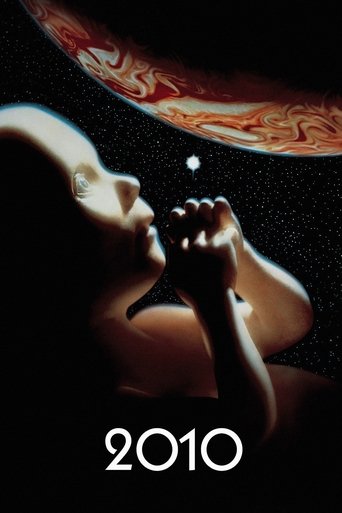
2010
1984 · Film · 116 min
Part of The Space Odyssey Series
Directed by Peter Hyams
While planet Earth poises on the brink of nuclear self-destruction, a team of Russian and American scientists aboard the Leonov hurtles to a rendezvous with the still-orbiting Discovery spacecraft and its sole known survivor, the homicidal computer HAL.
6 positive1 negative1 mixed20 neutralfrom 28 commenters
Where to watch
No streaming data for this title.
31 comments on Hacker News
I am a big fan of both films, and have over many years come to the firm conclusion that, while 2010: The Year We Make Contact could never live up to its best-films-of-all-time predecessor, it’s both a terrific film on its own merits and could be tweaked even today to be better.
What it needs, fundamentally, is the Blade Runner treatment: Kill the expository voiceover, tighten up the edit, make the ending less sentimental and more mysterious.
A “famous” instance was the use of a Cray to render the collapse of Jupiter in the movie “2010”. A very early example of CGI in cinema.
Hm, I think you're right about the reason HAL initially reports the failure. It's made explicit in the novel, and only hinted at in the movie -- though then spelled out in the followup "2010", I reviewed my notes ;)
I still think this is firmly in the realm of "bad prompting", and if so, it's not outrageous to think it could happen in the real world, were LLMs connected to hardware peripherals handling mission critical stuff.
I find LLMs WANT TO ANSWER TOO MUCH. If I give them too little data, they're not curious and they'll try to craft an answer when it's nearly impossible for them to be right.
I'll type and hit enter too early and I get an answer and think "This could never be right because I gave you broken sentences and too little." but there it goes answering away, dead wrong.
I would rather the LLM say "yo I don't know what you're talking I need more" but of course they're not really thinking so they don't do that / likely can't.
The LLM nature to run that word math and string SOMETHING together seems like an very serious footgun. Reminds me of the movie 2010 when they discuss how the HAL 9000 couldn't function correctly because it was told to lie despite its core programming to tell the truth. HAVING to answer seems like a serious impediment for AI. I see similar-ish things on google's gemini AI when I ask a question and it says the answer is "no" but then gives all the reasons the answer is clearly "yes".
>Arguably, the original trilogy was simply dungeons and dragons in space. Wizards, rogues, and knights in space.
It was basically Flash Gordon plus WW2 movies plus samurai movies plus fairy tales and Arthurian fantasy in space.
I think one of the reasons why The Force Awakens is not good is that it tries to copy previous Star Wars movies, but Star Wars has always been best when it copies stuff from other genres and mixes them together into a new thing, not when it tries to copy from its own previous films.
>it's pretty much the only widely known sci-fi films from the last 70s early 80s
Close Encounters of the Third Kind, Alien, Blade Runner, and The Terminator are all widely known late 70s / early 80s sci-fi films.
Probably not as well known but still pretty widely known are Star Trek: The Motion Picture, The Thing, and 2010: The Year We Make Contact.
With a few honourable exceptions, the CGI effects tend to age pretty bad, ruin movies over time.
Lets say, The Last Starfighter (1984's CGI) versus: Startrek III (1984), 2010 The Year We Make Contact (1984) and so on, even Buckaroo Banzai (1984) is watchable.
With the current popcorn CGI being used today, the same thing will happen.
It's a reference to the movie/book 2010: Odyssey Two, by Arther C. Clarke.
https://en.wikipedia.org/wiki/2010:_Odyssey_Two
The film version is flawed but still well-worth anyone’s time who got this deep in the thread & enjoys hard, near-future sci-fi.
My theory is that 2010: The Year We Make Contact is a lot like Blade Runner, pre- the various Ridley Scott re-cuts.
Drop the voiceover, tweak the ending to be less literal / sentimental, fix some of the FX matting, and you’d be left with one of the best serious SF films since 2001.
As featured in the movie 2010 (released in 1984).
the thing i most like in the film 2010 is that HAL gets put back together and saves Helen Mirren's human crew.
2010 was a great movie. I wish more people had seen it, with all the tension between the US and Russia one could hope that the brilliant minds could still work together as they eventually did in the movie.
Scene from your quote [1]
[1] - https://www.youtube.com/watch?v=l6LbnqzE3Y4 [video][5 mins]
Its a reference to 2010 which is the sequel to 2001: A Space Odyssey.
IDK how to spoiler tag in HN, but be warned...spoilers for the first two Odyssey books/possibly both movies below. Keep in mind this is off of memory and I have not read them in many years, so I might be wrong on some points. I have also not seen the movie, so IDK if there are any significant differences between the movie and the book.
In 2001, David Bowman transforms into a starchild. The monoliths that created man chose him to evolve. A starchild's responsibility is to foster life throughout the universe. David Bowman discovered life on Europa, and decided that this would be the population he would evolve. However, he knew how humanity tends to exploit those below them, so any time a human satellite or spaceship got too close it would mysteriously go wrong. Blow up, go missing, etc. This was because David Bowman was protecting his population from humanity by preventing humans from interacting with Europa at all.
i think those of us with the [mis?]fortune to have watched the movie "2010" have this iconic phrase perpetually ready. To be honest I barely remember the movie, but that one line really sticks somehow. The gist of it is that whatever power is associated with the mysterious monoliths is starting life on Europa, so the humans shouldn't mess with that "world".
"2010: The Year We Make Contact" is a much more accessible movie that holds up pretty well. It also feels like a payoff after investing so much time being confused/bored by 2001.
I was 11 when "Logan's Run" came out. Yes it's kinda loaded with 70's sex tropes for the first act, but it's also equal parts goofy and a really good film.
The original "The Day The Earth Stood Still" holds up.
"A Boy and His Dog" is a bit crude here and there, but might resonate with a 12yo.
"Quatermass and the Pit" (aka "Five Million Years to Earth") is both intense and fairly tame.
A lot of old TV series hold up - Twilight Zone, Outer Limits, UFO, Space 1999, Star Trek TOS, etc all have some excellent episodes.
I absolutely love "Dark City" and "12 Monkeys" but I'm not sure they'd have held my interest at 12.
Doctor Who, both old and new are excellent. Though I'm partial to the Tom Baker era.
The Stargate franchise is pretty good.
"Moon" (2009) is a bit cerebral but a good SF story.
> We share the same worldview. That's fun!
Yes doctor chandler, I enjoy discussing consciousness with you as well ;)
As mentioned in a sibling comment here I think 2010 (1994) is such an apropos movie for this moment, not that they had the answers but it really nailed a lot of these questions. Clarke and Asimov were way ahead of the game.
(I made a tangential reference to your "these are social problems we're concerned about" point there. Unfortunately this comment tree is turning into a bit of a blob, as comment-tree formats often tend to do for deep discussions. I miss Web 1.0 forums for these things, when intensive discussion is taking place it's easy to want to respond to related concepts in a flat fashion rather than having the same discussion in 3 places. And sure have different threads for different topics, but we are all on the same topic here, the relationship of symbolics and language and consciousness and computability.)
https://news.ycombinator.com/item?id=34806587
https://news.ycombinator.com/item?id=34809236
Sorry to dive into the pop culture/scifi references a bit, but, I think I've typed enough substantive attempts that I deserve a pass. Trying for some higher-density conveyance of symbology and concepts this morning, shaka when the walls fell ;)
> I think it's a relatively unusual point of view because it requires a de-anthropomorphizing consciousness and intelligence.
Well, from the moment I understood the weakness of my flesh, it disgusted me. I aspired to the purity of the blessed machine... ;)
I have the experience of being someone who thinks very differently from others, as I mentioned in my comment about ADHD. Asperger's+ADHD hits differently and I have to try consciously to simplify and translate and connect and neurodiversity really helps lead you down that tangent. Our brains are biologically different, it's obviously biological because it's genetic, and ND people experience consciousness differently as a result.
https://news.ycombinator.com/item?id=34800707
Or the people whose biological machines were modified, and their conscious beings changed. Phineas Gage, or there's been some cases with brain tumors.
It's just socially and legally inconvenient for us to accept that the things we think and feel are really just dancing shadows rather than causative phenomenon.
> It's a mirror of us. And it's going to have our ethics because we made it from our outputs.
Well of course, we literally modeled neural nets after our own neurons, and where else would we get our training data? Our own neural arrangements pretty much have to be self-emergent systems of the rules in which they operate, the same as mathematics. Otherwise children wouldn't reliably have brain activity after birth, and they wouldn't learn language in a matter of years.
But yeah it's pretty much a good point that the AI ethics thing is overblown as long as we don't feed it terrible training data. Can you build hitlerbot? Sure, if you have enough data I guess, but, why? Would you abuse a child, or kick a puppy?
Humans are fundamentally altruistic - also tribalistic, altruism tends to decrease in large groups, but, if our training data is fundamentally at least neutral-positive then hopefully AIs will trend that way as well. He's a good boy, your honor!
https://www.youtube.com/watch?v=WQd2iEnEkwQ (yeah, just bohemian rhapsody for autists/transhumanists I guess ;)
> If we treat the AI like a monster, it will become one, since that is what monsters do, and we have convinced it that it is such.
This is of course the whole point of the novel Frankenstein ;) Another scifi novel wrestling with this question of consciousness.
And honestly now that I am thinking about it, 2010 is such a rich book/movie with this theme of consciousness and Becoming in general... a really apropos movie for these times. That quote inspired me to re-watch it and as I'm doing so, practically every scene is wrestling with that concept.
https://www.youtube.com/watch?v=T2E7sxGAmuo
https://www.imdb.com/title/tt0086837/
So was 2001 A Space Odyssey of course. Like I said this is a topic that has been grappled with in scifi, particularly Clarke and Asimov (Foundation, The Last Question, etc), or that episode of Babylon 5 about the psychic dude ;)
But I think we are on the precipice of crossing from the Information Age into the Mind Age. Less than 50 years probably. Less than 25 years probably. And it will change everything. ChatGPT is just an idiot child compared to what will exist in 10 years, and in 25 years the world will be fundamentally different in unknowable ways, any more than we could have predicted the smartphone and tiktok.
(did we have an idea that a star trek communicator or tricorder would be neat? Sure, but, it turns out it's actually a World-Brain In My Pocket.)
This is starting to remind me of the movie 2010.
"Back on Earth tension between the United States and the Soviet Union escalates to the brink of war, and the Americans are ordered to leave the Leonov and move to the Discovery, with communication with each other forbidden except in an emergency."
https://en.wikipedia.org/wiki/2010:_The_Year_We_Make_Contact
Shades of the movie 2010.
The problem with your wager is that on a long enough timeline, the doomsayers are always right.
So saying anything OR societal collapse is going to evaluate to true.
There are any number of disasters, both terrestrial and cosmic, that can radically change the landscape of the Earth.
I also don't really find discussions about what's going to happen beyond our lifetime that interesting for the most part. Often, they're just fantastic wishing attached to some loose thread of logic.
The Island
Escape from New York
The Running Man
Akira
Strange Days
A Scanner Darkly
Back to the Future II
Blade Runner
2001: A Space Odyssey
2010: The Year We Make Contact
Death Race 2000
1984
Terminator 2: Judgment Day
Freejack
Westworld
Real Steel
Pacific Rim
12 Monkeys
The Abyss
Timecop
And a host of other films and books are set in futures that are now our past. And while some of these are fantasy designed to entertain, they all make assumptions about what would be possible by that time. And we have fallen woefully short of those predictions. So short, that "flying cars and meals in pill form" is a meme about such predictions.
> Simulating the bands of Jupiter is tricky but I've done some experiments with 2D fluids.
Nice! I've always wanted to do some fluid dynamics on the surface of a sphere, but the math is too hard for me. I found a video on youtube where someone has done some interesting things a few years ago: https://www.youtube.com/watch?v=Lzagndcx8go&t=1s but there's very little information about it. Then there was what was done for the film 2010: The year we make contact" http://2010odysseyarchive.blogspot.com/2014/12/
I've had to resort to simpler means myself, which means faking it. I use OpenSimplex noise on the surface of a sphere, and from this I can find the gradient of the noise field tangent to the surface of the sphere, rotate this vector 90 degrees about an axis passing through the center of the sphere -- which is equivalent to some kind of spherical curl of the noise field -- which gives me a non-divergent velocity field. Because incompressible fluid flows are also non-divergent, there's a strong but superficial resemblance -- it looks like fluid flow, even though it is just an arbitrary process. Into this field, I dump a bunch of colored particles and let them flow around, painting alpha blended, slowly fading trails behind them onto the surface of a cube to be used later as textures of a cubemapped sphere.
For the bands, I superimpose a simple velocity field of counter rotating bands on top of this curl-noise generated velocity field. Something like: horizontal_velocity += K x sin(5 x latitude)
Results looks like this: https://duckduckgo.com/?q=gaseous-giganticus&t=h_&iax=images&ia=images
The idea for using the curl of a noise field to mimic fluid dynamics is from a paper by Robert Bridson, et al.: https://www.cs.ubc.ca/~rbridson/docs/bridson-siggraph2007-curlnoise.pdf
This program is open source, it's here: https://github.com/smcameron/gaseous-giganticus
Thank you for this, I did not know about Syd Mead, but just flipping through the images on that page it's clear how influential he was. Wikipedia lists pretty much exactly the associations I made:
> Mead worked with major studios on the feature films: Star Trek: The Motion Picture, Blade Runner, Tron, 2010, Short Circuit, Aliens, The Spirit of '76, Timecop, Johnny Mnemonic, Mission: Impossible III, Elysium, Tomorrowland and Blade Runner 2049. George Lucas created the AT-AT for his Star Wars saga based on art by Mead.
This is in no way to diminish his work, but the impression I got (and that I'm trying to confirm/debunk, given the wikipedia article doesn't really address this) is that his art really transposes the society of its time into the future. That is, he almost exclusively addresses the technological advancement, while keeping the societal structures largely intact. For example, that's why the retrofitted houses give the impression of still being inhabited largely by working class people, while the ski resort and leisure time imagery with the sports cars still seems to be a luxury only few can afford even in the future. I don't see signs of "fully automated luxury space communism" there.
This may be me projecting though, hence the question if this is correct. And again, this is not to take away from his work. They are stunning. :)
The movie 2010 had another cool //c appearance—in that case Dr Heywood Floyd was shown using the //c with an LCD display at the beach. It seemed so futuristic back then. I don't think I ever took a laptop to the beach at any point in the real calendar year 2010, but I did do so in 1995 and that scene from the movie was on my mind the whole time.
And the iPad of the 80's would be the Apple //c as featured in the movie 2010. It was seen being used on a beach, complete with LCD screen, and this was 1984.
There's a couple of issues though, the //c did not run off battery power, so you'd need a long cord, and the LCD was terrible, I don't think you'd be able to read it in direct sunlight. But if you have a long phone cable to go with the power cord, maybe you could have sent a fax? Or at least a telex.
There is in fact some indication in the movies that HAL and similar computers are indeed sentient enough. HAL claims to be afraid. If we admit this is a real feeling and not something HAL is just echoing, an entity than can feel fear can also murder.
Moreover, there are a couple of poignant scenes in the film 2010 The Year We Make Contact:
Dr. Chandra has the following dialogue with SAL-9000, an AI in the same class as HAL. He is disconnecting SAL as a test for what will happen with HAL:
"Will I dream?" "Of course you will. All intelligent beings dream. Nobody knows why." [0]
Later in the movie Chandra is asked the same question by HAL, but gives a more honest answer:
"Will I dream?" "I... don't know" [1]
This leaves room in the mind of Dr. Chandra, an AI specialist, to wonder whether these are truly "sentient" beings or not. If they are, they are certainly capable of murder.
----
[0] https://www.youtube.com/watch?v=T2E7sxGAmuo [1] https://www.youtube.com/watch?v=3OlCzxFuV9c
You can't do stealth in space. Thermodynamics won't let you. If you're using a whole lot of energy you will light up in the infrared.
Parent's point is valid except for the fact that they might not be lighting off the deceleration stages one after the other. There could be a time gap, and maybe a significant one. Gaps between firings would be likely because that's one way you could steer. You could time firings to aim for e.g. an orbital insertion around Jupiter, which would be easier since Jupiter is so massive. You could also use Jupiter or another gas giant to aerobrake with some kind of ablative shield like in the film 2010. It's fairly likely that whatever physicists' nightmare propulsion system an expendable interstellar rocket stage would use would be something that is hard to turn off once you light the candle, so each stage might be an all or nothing thing.
It would be interesting to use the JWST, an infrared telescope, to look at areas of the sky where an inbound craft coming along this sort of interstellar trajectory might be. A probe or spacecraft would have to have its own power source. This would be way dimmer than a lit deceleration stage, but JWST might be able to see it. If it's using energy at all it must have radiators due to the second law.
Of course if this hypothesis were valid and they lit another deceleration stage, it would absolutely be visible if we looked in the right place. It would be very very bright in the infrared and probably in visible light too. Hell if it's something insane like an antimatter driven fusion rocket you might be able to see it with the naked eye.
i wonder what his feelings were regarding the followup of 2010: the year we make contact. although certainly vastly different from the 2001 movie, i thought it was a great movie in its own right. and it seems it contains more of what clarke preferred, even having a few narrations by haywood floyd.
> If it's redone (properly, shot for shot, in the right spirit) with updated effects and sound...
In a way, it already has with the 1984 sequel "2010: The year we make contact". That was a fairly mediocre film which simply didn't capture any of the wonder of 2001.
2001 is what it is. Simultaneously an auteur film, a vision of the future from the past, and fine science fiction.
Not everyone's cup of tea, but truly great films even from the distant past (like Nosferatu) can be appreciated today-- in spite of poor special-effects. On the other hand, re-makes (or sequels) are a mixed bag. The Blade runner remake/sequel was stunning but just doesn't have the gritty magic of the original. Similarly with Solaris or even The Terminator for that matter.
A good way to distinguish those who have read 2010-the-book from those who have seen 2010-the-movie...
Way back in 2010, Dr. Heywood Floyd had a dolphin "pet" in his home by the sea. Some people say he could talk to the dolphins, but I think that's just silly, something out of a movie.
Completely useless trivia: Roy Scheider is shown using one of these (on a beach, no less!) in 1984's _2010_.
http://www.imdb.com/title/tt0086837/trivia?item=tr0748438
Off topic (sort of), but this reminded me of 2001/2010. Arthur C. Clark was on pretty much on target. In 2010 he predicted we'd find life on an icy moon of the outer solar system. He happened to posit it was Europa (around Jupiter) but then the original novel had the mission flying to Saturn. The movie and sequels changed it to Jupiter because Saturn was hard for the special effects. Anyway, pretty darn impressive sci-fi speculation that might come true. And now back to our original discussion....