 Hacker Cinema
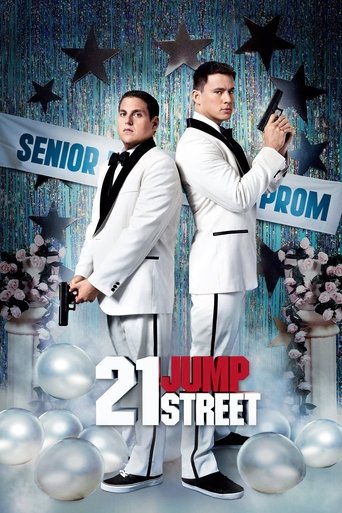
21 Jump Street
2012 · Film · 109 min
Part of Jump Street Collection
Directed by Phil Lord, Christopher Miller
When cops Schmidt and Jenko join the secret Jump Street unit, they use their youthful appearances to go undercover as high school students. They trade in their guns and badges for backpacks, and set out to shut down a dangerous drug ring. But, as time goes on, Schmidt and Jenko discover that high school is nothing like it was just a few years earlier -- and, what's more, they must again confront the teenage terror and anxiety they thought they had left behind.
3 negative8 neutralfrom 11 commenters
Where to watch
No streaming data for this title.
11 comments on Hacker News
Am curious, do you personally feel mdma would be more therapeutic with friends or at a therapy clinic? I find the use of mdma or lsd or shrooms weird in a formalised environment. Some of the stuff makes sense (like drugs used to desensitise people with PTSD to certain triggers (when it doesn't backfire spectacularly; guessing we don't hear as much about that just the not-formalised experiences of it)) to me, but I don't see how it translates for a lot of people (eg, people not in a semi-predictable environment; people in wartime generally either are around bombings or shootings or not, whereas people with other sorts of PTSD have more trust issues; I could see drug use backfiring for almost anyone but the former group. Generally non-complex PTSD responds better, yet it is fairly rare).
Still surprised tv hasn't brought us a show like Breaking Bad but with designer drugs (the newer 21 Jump Street movies don't count).
I might check that site out but more because I like reading case studies about outlying things than any particular interest in drugs. Thanks.
21 Jump Street (2012 remake)
“ A pair of underachieving cops are sent back to a local high school to blend in and bring down a synthetic drug ring.” https://www.imdb.com/title/tt1232829/?ref_=nm_knf_t_1
I never thought casual homophobia, some of which I regrettably gleefully took part it in, would stop so quickly when I was a late-teen in 2000 - granted a lot of people did a lot of work to make it stop being acceptable and I'm sure for many it didn't feel 'quick' but as far as societal attitudes, at least in major cities, it seemed fast. My favorite, albeit dumb, illustration of this is the remake of 21 jump street with Jonah Hill and Channing Tatum, they're mid-20s posing as high schoolers and to try to fit in, one calls the other gay, expecting to be an easy way to get in with the cool kids, but rather than join in the insulting, they congratulate the target of the slur for being true to themselves. You never would have seen that in a movie from ten years prior.
Paul Graham and I haven't been in high school for a loooong time.
My suspicion is that things have changed somewhat. That the youth are somewhat more tolerant and mature than they were back in my day. The kids I meet seem way ahead of where I was in high school.
Like in the movie 21 jump street, where 2 cops go undecover at a school, jock and unpopular kid. Only the jock learns his ways are no longer 'cool'.
Quote: "One could quibble about creativity, but it’s generally thought in Hollywood that the last great comedy franchise to launch was The Hangover, created in 2009. There have been a few others, like Pitch Perfect and 21 Jump Street, but those both came out around the same time, in 2012. There effectively have been no comedy smash hits in for nearly a decade."</endquote>
Are you kidding me? Last great comedy was The Hangover? Does the author of the article ever heard of Toy Story 4 (now in theaters), Secret life of pets 1 & 2, Ralph Breaks the Internet, Zootopia etc etc? Granted, they are animated movies versus live action like The Hangover but they are movies, big ones, made by Hollywood, with a plethora of A list actors voicing the characters. The fact that they are animated is irrelevant, because the taste of the public always evolves. That's why action flicks of the '80s are no longer enough to entertain us, and they seem a cliche instead. We, the consumers, became more sophisticated, our taste evolved and demanding better quality for our money. Therefore the creativity went where was required, where the public demand it, not to be stuck in the same style of movies. Otherwise John Wayne's style of Western movies would still roll on big screen. Tell me, when was the last time such a Western made it big on box office? I tell you instead that HBO's Westworld is very much a Western style show that I deeply enjoy. That's where the creativity went! To be in the same pace as our modern, more subtle, taste.
I thought 21 Jump Street hit the nail on the head w.r.t. (modern?) high schools, a lot of the most popular kids in that movie were also the smart, "nerdy" types. Could be a regional thing though, who knows.
The picture painted by the classic sitcom universe and essays like Paul Graham's "Revenge of the Nerds"—the one described so casually that it's almost as if agreement about it is expected to be a foregone conclusion—is something I found totally unrelatable growing up. It was something I always just chalked up to bad tropes that were holdovers from from sitcoms from an era past.
I was brainy in school, but none of the axes that groups split on resembled the ones you see in the movies, so most of my friends weren't. No jocks vs nerds. Nobody was intimidated or otherwise pressured as a result of doing well in class. More often than not, people were likely to be down on themselves for feeling dumb or when they felt they weren't keeping up. The best predictor of clustering habits was usually outgoing vs timid, and then those in the middle. But mobility within those clusters meant that even those were pretty fluid.
The type of humor my class most valued was, if not intelligent, then at least quick. Contrary to what the article lays out, in my view, Matthew Perry's Chandler Bing is probably one of the biggest influences there.
Aside from standard relationship drama, most everybody in my class got along. I wore glasses for a year starting in 4th grade after I began getting headaches at the end of the day. Once shortly after getting my prescription, a classmate called me "four-eyes" after lunch, and I just laughed in his face. He'd really meant for that one to sting, and he was a lot tougher than me, but that just wasn't a thing.
Anti-intellectualism was something that I noticed became a big thing after 9/11, to the point that I found it genuinely alarming, but it showed up clearer in the world I was seeing than the one I was living. Thankfully, the insanity died down (at least from where I'm standing), but we have Idiocracy and American Dad as artifacts. I've tried referencing that era since then, but I have difficulty, especially in regards to using words to recreate the world at that time in order to have a conversation about exactly why something like Idiocracy was originally made. My family and acquaintances who lived through it seem to just see the last 20 years as one homogeneous blur. "Shit was crazy" is what I've resigned myself using and is how I described it a few weeks ago to a friend of mine from Iraq.
After I'd graduated and moved out of state for school, I read a longform article about the death of irony that I thought was on-point in describing the world I grew up in vs the world I saw on TV growing up, but it's none of the ones that show up when I search for it now. The best and most direct treatment of the topic that I've seen since then is in the scene in 21 Jump Street when Jonah Hill and Channing Tatum first run into Dave Franco and his friends on the first day of their assignment (even though they fudged the timeline a bit).
My high school graduating class was something like 40 people, and I graduated in 2007. This all happened in a public school in a small town in North Texas (Collinsville).
I was fairly sure that my hometown wasn't special and this was just the way the world worked now, compared to the sitcom holdovers. Went to the University of Oklahoma (it's ranked first in National Merit Scholar enrollments for a public university, and they give out lots of money). Freshman year I was mostly weirded the fuck out, especially by the other people on my floor in my dorm and in the CS program. ("This isn't how people act in real life anymore, right? Nobody really buys into these tropes, do they?") Ended up having a pretty bad time there for as long as I stayed, and I left less sure about how the much the world differed from TV after all. I'm in neither Oklahoma nor North Texas anymore. What I've seen since suggests that Norman, Oklahoma is an anomaly; every now and then I'll meet someone with the same alma mater and the weirdness comes back. As far as predictors go, that has turned out to be a pretty good one for whether I'll be able to get along with someone or be totally at a loss for how to interact and connect with them. (Some false positives about whether someone will pass, but zero false negatives so far, unfortunately.)
> But do we really think that inadequate incentive to create new drugs or new movies is a major problem right now?
I found this line in Krugman's text surprising, because there actually are a lot of questions about incentives in both drug and entertainment markets.
In drugs, pharma companies are focusing on high-margin "lifestyle enhancing" drug categories like erectile dysfunction, blood pressure management, and various mood and mental management. Basically, the drugs that rich healthy people will pay a lot of money for. Pharma companies are not focusing on low-margin but highly useful categories like antibiotics, pests, and vaccines. Basically, the problems that affect poor people in 2nd and 3rd world countries.
In entertainment, companies are focusing on iterating well-known and well-used franchises for which they know they can drive immediate demand with marketing. Highly original hits like Inception are not nearly as common as they were in say, the 1970s or 1980s. Instead we get Furious 7 and a two remakes of 21 Jump Street.
Don't get me wrong, the drug and entertainment industries are making a lot of money. But the issue is how they are making it. Drug companies stick to first world problems because first world countries protect their IP, so that is where they'll get a return. Entertainment companies stick to movies that will pack the theater on opening weekend because the movie will be heavily pirated within a few days after that.
I'm not crying for the poor drug or movie executives. I'm saying that the rest of us have to live with the consequences of how we incentivize companies to do business.
edit: word fixes
From paragraph one: "the hero dressed down by his mentor in the first 15 minutes (Star Trek Into Darkness, Battleship); ... the moment of hopelessness and disarray a half-hour before the movie ends (Olympus Has Fallen, Oblivion, 21 Jump Street, Fast & Furious 6)."
Paragraph 10: "Look at January’s Gangster Squad. After an opening image that sets up the conflict between Josh Brolin’s hard-charging cop, Sgt. John O’Mara, and the criminal forces of mob boss Mickey Cohen (Sean Penn), O’Mara is called in to see his gruff police superior. “We got rules around here, smartass,” the chief growls. “Do yourself a favor. Learn ’em.” That’s Snyder’s second beat, theme stated. And it’s right at the seven-minute mark, almost exactly when it’s supposed to happen in a 110-minute movie....an all-is-lost moment—including a death—between the 75- and 80-minute mark..."
Did you guys read the article, or just skim it looking for a table of data? The examples are there, with the minutes. You actually have to read numbers written as words (gasp!).
> Recent films have started focusing more on the roller coster ride of the visuals, and will do any distortion of the story necessary to motivate a visceral impact on the audience. Good storytelling takes a second seat to putting the audience into the most intense situations possible.
I thought that all of the movies listed (Star Trek Into Darkness, Battleship, The Dark Knight, The Avengers, Skyfall, Star Trek Into Darkness, Olympus Has Fallen, Oblivion, 21 Jump Street, Fast & Furious 6) had awful plots, but for some of those movies the visual spectacle made them tolerable.
None of the movies listed (well, I haven't seen 21 Jump Street) obeyed the rules of physics, which is a huge turn-off for me because it breaks the suspense. The best suspenseful movies they tease you into thinking that you can predict what is going to happen next, as if they were a puzzle.
I'm not saying that I don't enjoy every movie that can't be taken literally; I just don't like movies that are logically inconsistent. Star Wars doesn't follow the rules of physics, but at least it does so consistently; you understand the capabilities of the technologies that they use and can reason about how the characters might use them. I find movies that violate the rules of physics inconsistently to be intolerable; if you don't know what behavior characters are capable of, you lose your sense of immersion because you can't relate to the characters, and can't predict what they are going to do at all.
That's just my opinion, though, and obviously enough people don't agree with me because those movies (listed in article) made lots of money.
Yup, nobody buys b-movies, documentaries or anything like that. People simply only wait for "MPAA-Approved" content to come out because it will be the only thing ever to be worth purchasing. Things like 21 jump street are so good in fact that my unworthy eyes won't even go see it.