 Hacker Cinema
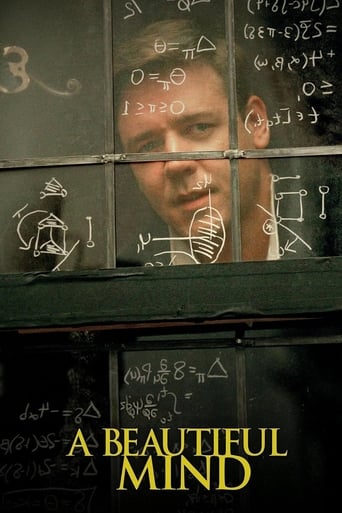
A Beautiful Mind
2001 · Film · 136 min
Directed by Ron Howard
From the heights of notoriety to the depths of depravity, John Forbes Nash Jr. experiences it all. As a brilliant but socially awkward mathematician, he made a groundbreaking discovery early in his career and stands on the brink of international acclaim. But as the handsome and arrogant Nash accepts secret work in cryptography, he becomes entangled in a mysterious conspiracy. His life takes a nightmarish turn and he soon finds himself on a painful and harrowing journey of self-discovery.
23 positive4 negative3 mixed42 neutralfrom 72 commenters
Where to watch
No streaming data for this title.
83 comments on Hacker News
> That's mostly because a movie about someone who's an expert at building organizations is boring.
Still issue (seriously).
He might be an expert at building organizations in real life, but there is no rule that a movie about him has to focus on that part. Movies are not documentaries.
Examples: Oppenheimer, A Beautiful Mind, The Imitation Game, Jobs, Social Media, and literally every movie that sells tbh.
I stopped going sometime mid-2000s, not because of the cost or the quality of movies, but because of the quality of my fellow movie watchers, who were pretty awful to be honest (at least in Silicon Valley at the time):
- Lord of the Rings: a family came in after the movie started with a cluster of helium balloons, each of which eventually got loose and floated around the theatre. A small balloon creates an outsized shadow on the screen when it floats in front of the projector (e.g., sometimes a third of the picture would disappear).
- A Beautiful Mind: Several guys, in different spots in the theatre, would wait for a quiet moment in the movie and say loudly "Oh my beautiful mind". One guy had a squeaky seat, so each time he said his bit, he would squeak his chair 5 times.
- Panic Room: Two people directly behind us just laughed hysterically at seemingly every line in the movie.
Also, the advertisements went on too long (20 minutes maybe?) and were also rock-concert loud.
Last night, I watched Wolfs (Apple TV) in my living room with my spouse and we enjoyed it. It's not a great movie, but it's good, there are no ear-splitting advertisements, and the audience is well behaved.
Edit: Later in the 2000s I did see a few Coen brothers films in the theatre, and those were good experiences, but I still avoided the theatre for the most part.
Correct, most mathematicians, at least the ones I know, do not actually spend time thinking about Good Will Hunting, but it's the kind of stuff that science writers eat up.
If you want to know a movie that I actually heard mathematicians discussing, it would be "A Beautiful Mind", and then only because some people were complaining about how the minor characters misrepresented the mathematicians and especially how the Princeton Math department was unfairly caricatured in order to create dramatic tension (you need an antagonist, after all).
In reality Nash was treated with incredible generosity and kindness, and was given extreme affordances. For example, he visited Nirenberg at Courant and gave him a stack of hundreds of pages of dense, hand written notes that were the proof of the embedding theorem, and Nirenberg took enormous time to go through it and try to understand what Nash did, and then championed the proof. With no renumeration or credit, just as a professional courtesy and desire to see if the proof is correct. Nash was not easy to work with, but because so many people were willing to devote time to reviewing and correcting the proof -- which took 5 years -- it was eventually published. Moser, Gromov, Chern, and Kuiper all played a massive role, donating huge amounts of their personal time in order to help Nash.
But, as is usually the case with real life, it doesn't make for a good 2 hour dramatic story. It's a shame, because the real story is a great story.
I don't think they do hate it, any more than they hate "A Beautiful Mind" which is a pale shadow of Nash's real life, or "The Man Who Knew Infinity" about Srinivasa Ramanujan, or Breneditch Cumbersome's interpretation of Turing in "the Imitation Game" or any other mathematician in film. "Hidden Figures" was a wreck. So what!
They think "yea, thats not very real" and then in a Gell-Mann Amnesia moment pass over the other aspects of film which are utter bullshit, but filmicly necessary like camera pans through walls, 32 year old people playing high school kids, you-name-it.
"that artifact should be in a museum" my arse. Archeologists would be lamenting the lack of contextual work mapping the scene before you disarm the rotating knives, the implicit cultural burdens mis-understood, the grim reality of funding to get a crystal-scull hunting project up in the first place.
Back in 2001 I was the math consultant for "A Beautiful Mind". One spends a lot of time waiting on a film set. Eventually one wonders why.
The majority of wait time was the cinematographer lighting each scene. I imagined a workflow where secondary digital cameras captured 3D information, and all lighting took place in post production. Film productions hemorrhage money by the second; this would be a massive cost saving.
I described this idea to a venture capitalist friend, who concluded one already needed to be a player to pull this off. I mentioned this to an acquaintance at Pixar (a logical player) and they went silent.
Still, we don't shoot movies this way. Not there yet...
I'm very hopeful that the problem is simply lack of general awareness of these games, and that once there's enough content surrounding them, we'll have a healthy population of people playing more abstract strategy games.
Fun story regarding Hex. It nearly reached what I would call a "mainstream" audience with the movie "A Beautiful Mind" about John Nash starring Russel Crowe. Unfortunately, the Hex scene was cut from the movie! You can watch the cut scene at https://www.youtube.com/watch?v=pTZ3nn2Bge4
> I became the math consultant for A Beautiful Mind in part because I was such an Apollo 13 buff.
Cool, awesome job, as far as i can tell as a fan of the movie!
So you did what was best for yourself... and the group.
And David Scott, commander of Apollo 15, was the technical consultant. As Ron Howard explained this to me, he sees reality as more interesting and detailed than any fiction. No one would grasp the details were correct, but he felt they would contribute an irreplaceable texture to the film.
I became the math consultant for A Beautiful Mind in part because I was such an Apollo 13 buff. In my first call with Todd Hallowell, the executive producer, we spent an hour's aside discussing Apollo 13. This actually was part of the interview: Making a movie is intensely boring unless you're really engaged, and I demonstrated the required interest in detail.
There are a lot of really amazing TV and movies from the last 60 years. It seems we never have time to get around to finishing what we want, but I am genuinely curious what my wife and kids think about various scenarios presented in shows like Black Mirror.
Likewise, despite their inaccuracy, movies like The Imitation Game or A Beautiful Mind led me to look at the life of Alan Turing beyond just what I learned in college.
Consuming content is very much a time-blocked thing for me. I have some YouTube content I consume to stay up with various AI/ML groups, etc. but that is closer to work-related and not something I will put on during a break from work as that will defeat the purpose of recharging my brain.
It's also interesting to see how movies or shows capture small details that change over time.
Consulting for "A Beautiful Mind" was in part an exercise in mathematical fiction. The later math is imagined to fit the story. John Nash even wrote me to ask what the math on the clipboard meant, as his film self recovered on a porch.
In various venues, I explained that mathematicians don't have a lot of experience writing fiction. Other than grant proposals...
Isn't this a main idea in the film A Beautiful Mind?
If rates of psychosis are going up, why? It seems very worrying when rates of depression, suicide, psychosis, and other mental illnesses are increasing with what seems like no understanding of why or what to do to prevent the increase.
In psychiatry, the concept of insight is used to describe an individual's ability to view their actions, beliefs and overall situation with what would be considered a normal perspective. It's probably best exemplified in popular culture by the movie "A Beautiful Mind". In the movie, a loss of insight is shown as one characteristic of schizophrenia, but it is by no means limited to that disorder.
I'm just a rando on the internet, and this isn't a diagnosis, and you shouldn't diagnose either, kids; but given the relatively sudden onset of Mr. Mullenweg's public situations, and the associated seeming complete loss of insight, I can't help but wonder if there is a known or unknown mental health challenge in the background underlying all of his actions. Such things are invariably complicated by a person being "post-economic", with the lack of the usual checks and balances that come with that state of privilege.
John Nash is portrayed by Russell Crowe in the movie "A beautiful Mind"
https://www.imdb.com/title/tt0268978
I've seen Casablanca more times than A Beautiful Mind, and I worked on that movie.
My first viewings were indeed from the balcony of the Brattle Theatre, where one could get books of ten tickets cheap as a grad student. My last viewing was just before the pandemic, in the Stanford Theatre.
I vowed to let go of all inhibitions, and let the movie guide my emotions. That's how Casablanca deserves to be seen.
The Man Who Knew Infinity is pretty good, more accurate than some of the others on here. It focuses on Hardy (Jeremy Irons) and Ramanujan (Dev Patel). I'd recommend it to anyone looking for a good period drama with a good cast and nice sets. It's a very pleasant movie all around. It's not perfect but far better than others I've seen, like A Beautiful Mind, which I found painful to watch all those years ago.
I’m bipolar and when I was first diagnosed with bipolar disorder I was 19 and in my first ever manic episode I dropped out of college and went deep down this particular rabbit-hole in an attempt to solve the Riemann Hypothesis to win the prize. I spent 3 months on it gradually driving myself crazier and crazier. My second company had collapsed out from under me when a sociopathic employee with a gambling addiction had conned me into thinking they were my best friend and meanwhile skimmed all of our profits so it looked like we were barely breaking even right under my nose. (To be fair I was 19) That in combination with a semester of Intro to Philosophy where I read Aristotle and Socrates and a Algebra class I became obsessed with led to me stumbling into the Riemann Hypothesis, and going deep down a rabbit hole in what ultimately turned into my first ever and most intense manic episode and led to my bipolar diagnosis.
I hadn’t even finished college Algebra at the time. I basically spent months playing around with equations on Wolfram Alpha.
The funny thing is this ultimately was kind of a life-changing moment for me, as I learned programming through it which in combination with a family member dying is what finally pulled me out of the mania, and then I changed my major to Computer Science re-enrolled in college and have since actually gone on to get a degree in CS and a minor in math, sometimes I look back at the giant set of Google Docs I created during that time, mostly in amusement but to this day some things I look at and don’t even understand if it is meaningless or not. A part of me wants to pick it back up, but then I tell myself it isn’t worth the risk, I’ve always felt I am uniquely qualified to understand how the guy in the movie “A beautiful mind” felt when he stopped talking/engaging with the hallucinations.
Here’s some links to random Google docs from my ~2017 rabbit hole if anyone is interested. There’s a lot of fairly interesting usage of the Euler-Mascheroni constant and honestly it goes a bit all over the place.
I kind of doubt there’s anything here, but if you’ve ever wanted to peek into unchecked mania.. have fun. It was months of insanity. (Sharing these in good faith!)
https://docs.google.com/document/d/1CERdyZMlGj76EmMJXt5Zr3pMcBeTeI7uFmIp0aRmX2M/edit
https://docs.google.com/document/d/1LpKqgCzjo8LrxB547WY5YdVPVsSm6mpw4RT6WGunhGs/edit
https://docs.google.com/document/d/1JvV5NJTYaTHn3eSAShcUtE8Jnn95Eof7raNtRfO87QQ/edit
https://docs.google.com/document/d/1Ej0bNIpYNT30M31pCxx-LDoe5x3ZJ5OnwP7APcvBT64/edit
https://docs.google.com/document/d/13nlw3vbxyRGd6pYeAre8c7e5OKmPjjksGaKL422pFfE/edit
https://docs.google.com/document/d/1WChBcGtaUdLckPDqNBVGpP9xaYqpP02GflFMyWbl_IQ/edit
https://docs.google.com/document/d/1_bQbgJ5HIyv_D5ex9TWK2XxH1RDBZx3tTIoZMJeX8zk/edit
https://docs.google.com/document/d/1AomtTAP4GBXpOuArvBYQsHiPRfyAzWZGC-E37v5-Fhw/edit
https://docs.google.com/document/d/1QO8iQ2OmPZkQ7lNS0uUB0uyyWAf2NID85fqfTP9a7Fs/edit
https://docs.google.com/document/d/1zzedxz1Ya9rT8N4RZZNtpsrrNkLLPfEtOqZBqapNNR0/edit
https://docs.google.com/document/d/1vB0Qbqe0yiO0tcxswl2jniYcXjfzTewWEMfXXU0J8rw/edit
https://docs.google.com/document/d/1K4upBz2awHnKlr5JE1xocntpQCuu7IWJW7iuevJTJXk/edit
https://docs.google.com/document/d/1XhOIy0RO59CrZEXXPK-QAR_smBhRPewq0LINUw6pAU0/edit
https://docs.google.com/document/d/1rJx2KHQ0GqZfESqyFzXGLmN_5H0iRxIhJbLJLr9fj5M/edit
https://docs.google.com/document/d/19kZrg8HvxZ31-goiwL0XLyPCh3XPVCXaBDmW_67-fHw/edit
https://docs.google.com/document/d/1F8c_gVy47bRw5zZVWKb7x5SVR0vruNk2XbTnOH5vAz0/edit
https://docs.google.com/document/d/16JolkQcHD3eviZuakfT7iam7zCot3QPoVkD-2jbg7Xs/edit
In the movie "A Beautiful Mind" one scene, quite brief and irrelevant, was quite interesting. Our protagonist, genius beyond measure, was in a courtyard amongst a flock of pigeons. He was intently studying his subjects, implicitly determined to solve the riddle, crack the pattern, of their behaviors and movements.
It leads to an interesting thought. Could you actually crack the riddle of pigeon movement given access to the entirety of humanity's resources? Be those resources manpower, computation, or funding? I really doubt it. It's going to be a chaotic interdependent system, rife with individual variation, and a good deal of randomness and chaos thrown in for good measure. All with no reason to expect any sort of remotely normal or measurable distribution.
I really don't think my opinion there is especially controversial. Yet, if not - then how is it we might instead imagine we can delve into the patterns of the human mind and psyche? Where complexity, chaos, and interdependence is many orders of magnitude greater? It just doesn't really make any sense to me. We only take it as a given because we're born into a society where this is a given. From astrology to phrenology history is littered with examples of "science" that weren't really science at all, just fields perpetuated by bias confirmation, lack of falsifiability, and so on. I often think we're stuck with some 'arrogance of the present' where, due to our advanced knowledge, we imagine we could surely never repeat the same mistakes of the past. Of course people of the past thought the exact same as well.
> How were you convinced that you were hallucinating?
To be honest, some things were easier to spot than others. I used to have olfactory hallucination and it drove on ex girlfriend nuts cause I was always smelling things that were not there. I just invited she was not smelling anything.
I also have closed eye visions. These appear as faces and scenes when I close my eyes, mostly in the evening that are quite visually crisp. Most of the faces are frightening. I did not know I was dealing with this till I started Zyprexa and they stopped.
The visual hallucinations were easier since I would say "Did you see that cat?" and I would get strange looks or someone else there would not see them. And seriously, watching "A Beautiful Mind" helped me with this.
The thing that helped me most was Buddhism and meditation. Buddhism lead me to thinking more about the nature of perception and meditation allowed me to perceive without reaction so I can judge things better.
A also have perceptual changes, like being on psychedelics, but these are not hallucinations. I feel like I can see around things or everything has light trails or colors are really intense. When I was early in mediation the floor would always start waving like an ocean. When I was young I saw the faces of people on the TV change and I thought I was seeing them as they really were.
I get a lot of the talk that your girlfriend has, and that is hard an I still deal with it but mostly by ignoring it. It is by far the most difficult. Its base is paranoia I feel because those voices are always saying negative things, like I did not pay for my coffee right. Ha! Just happened today!
By the way, COVID threw me into my worst psychosis ever.
I do not know what to say about helping her. I was in her space and I know how it feels. No one could convince me of anything. I thought the water was "too blue" coming out of my faucet that I called the water department twice for them to check it.
1) Don't take things she does personally. That eases your stress. 2) Do not directly contradict her hallucinations but try guided questioning about them. That is what 30 years of therapy taught me. I question everything now. 3) You can call her doctor and leave a message. 4) I do not recommend ever having her involuntarily committed unless she is a serious danger.
But this is not something anyone else can force her into, it is a process of self discovery, a Shaman's journey. And maybe phrase it as that; A Shaman's Journey.
I lost my whole family, but frankly they were not good for me anyway. And I still have episodes, as you can see if you go through my history here, but I am much more stable now than ever and no longer need medications.
Good luck and if your want to email me: followingdao@proton.me
In 1999 on MG Road, it was more likely a roadside vendor with pirated books, Higginbotham, or unlikely, Gangarams. Blossom’s (Church St) wasn’t yet open IIRC.
Late 90s and early 2000s, I recall that Intel Inside, Lee Iacocca’s book, Who Moved my Cheese, Seven Habits of Highly Successful People, Jack Welch’s book, etc were commonly sold, in addition to the latest novels. I even remember buying Sylvia Nasar’s A Beautiful Mind (was popular because of the movie then) from a roadside vendor.
Reminds me of the movie 'A Beautiful Mind' - https://youtu.be/GmlSSSN7C78?t=14
I'm not saying superhero movies are directly attributable, just that their decline might be a moment for a shakeup. I'm not particularly convinced it will happen because I think streaming and prestige TV have also had a strong effect on what the movie industry does and doesn't do.
In terms of the kind of movies I'm thinking of, looking back through past best picture winners I'm thinking of things like A Beautiful Mind, No Country for Old Men, American Beauty. But also "frat pack" type comedies like Knocked Up, Dodgeball etc etc, they were their own mini industry for a time!
Obviously it's difficult to say which of those would be affected today (effectively asking which movies do we not know about that haven't been made today) but the mid-budget decline is a well documented thing.
Ha! Erdős–Bacon numbers originated in a 2002 Telegraph article by Simon Singh, referenced by Wikipedia as [1]:
https://web.archive.org/web/20121112081753/http://www.telegraph.co.uk/science/science-news/4768389/And-the-winner-tonight-is.html
I came up with this game after realizing I had an Erdős–Bacon number. He credits me, but spun the article to make this sound like a "thing" other people cared about.
I was written out of that Wikipedia page long ago. Very little of what survives on that page stands up to close scrutiny.
Combining these numbers is an obscure amusement, but people take the separate numbers seriously. For Erdős numbers, should one count posthumous papers? My "2" via Persi Diaconis goes to "3" if one doesn't.
The original intent of the Bacon number game was to count actors in fictional speaking roles. My "2" here is from a speaking role in "A Beautiful Mind". The "Oracle of Bacon" replaced this intent with whatever their database could easily report. Appearing as oneself in a documentary on Erdős had the obvious hilarious effect.
One understand these links better by studying IMBD credits. Daniel Kleitman's "2" depends on a "Thanks" credit from "Good Will Hunting", and few of the other low Bacon numbers on the Erdős–Bacon Wikipedia page can be confirmed at all.
Adding a type system to an existing language that was never intended to have that type system is not simple. And in Go, the language seems designed to largely eject its type system at the earliest opportunity that doesn't negatively impact the compiler. This will naturally constrain the capabilities of the generic programming constructs, much as it did in Josh Bloch's Java generics implementation.
Go is going to be torn between the minimalism of its creators, and the desires for modern capabilities expressed by its vocal user base. If this were a movie, it would be "A Beautiful Mind".
Hacker Culture, to me atleast is somewhat broad.
Here are some places where I found good representations:
1. Halt and Catch Fire: 70s/80s tech scene. Full stack hackers building products, companies. Depicts the hackers, code monkeys, visionary types, managers, financers- everyone. Also shows the transition of the business scene from analog to digital.
2. Westworld (Season 1 only) is brilliant. It depicts the ambition, the hubris involved in creating something new and grand.
3. The Travelling Salesman: P vs NP is solved. What are the implications, what are the uses, how will the State react? What is the role of the people imvolved?
4. Primer: Mind bending movie on time machine.
5. and 6. Imitation Game and A Beautiful Mind: I believe most people on HN will like these.
7. Agora is a hidden gem not many know about. It is anout Hypatia.
8. Dangerous Knowledge is a documentary about paradigm changing science. Godel, Turing, Boltzmann are covered.
9. Fractals is also a nice documentary with interviews from Mendelbrot.
10. Codebreaker is a mich more accurate biography of Turing that covers other aspects of his, not limited to his codebreaking and homosexuality.
11. Internet's Own Boy: The Story of Aaron Swartz: very nice and left a deep impression in me.
____
I am yet to watch:
1. Hidden Figures
2. Stand and Deliver
3. I'm In
4. TPB: AFK
5. Pirates of Silicon Valley
6. Triumph of the Nerds
____
Harvard Professor Oliver Knill has a list and clips from movies where math appears: https://people.math.harvard.edu/~knill/mathmovies/
____
I came to know a lot of these movies through Kagi search and Reddit search. "Best movies for mathematicians and computer scientists" and similar searches.
Wow. That takes me back.
John Nash independently invented hex in grad school. A sequence of scenes involving hex were cut from the movie "A Beautiful Mind".
The first day that Russell Crowe joined the production, he was occupied with hours of makeup tests for his aging progression. Ron Howard had me meet him during a break, to discuss the hex and go scenes to come. The first dozen of a crew that would be hundreds hadn't met him either, so they hovered nearby as we talked.
To my surprise, Russell asked me what mathematical truths drew Nash to this game. Never underestimate people; I went for it. Rather than explaining the proof Nash liked that the first player could always win, I decided to explain why some player had to win. As I talked, Russell drew me in with fascinated, understanding facial expressions.
When I was done he looked at Ron, "Can you get me the Parker Brothers rules? They're for 8 to 80, I didn't understand a word this guy just said!" Peals of laughter from the room.
Months later we're filming a roomful of grad students playing hex, and Russell doesn't like what the script has him saying. He gets permission to ad lib. "Think of the black stones as water, the white stones as land. Either you can swim across this way, or there's a land bridge that way..."
My longest day shooting, I woke at five, and was an actor in the pen ceremony that evening. Close to 24 hours awake, I found myself nodding off high at a party in Russell's room, everyone singing various national anthems. I learned much later that Russell had been kidded as a child for not knowing the New Zealand anthem. By the party he knew them all. He likes jokes only he gets, jokes with long fuses.
I was chatting about him with a friend and pointing out all the things in the room influenced by him. Of course he led a pretty normal life, so no one is going to make a "Beautiful Mind" type movie about him. Other than playing his record player too loud in his office and having wild martini happy hours with his wife and friends, I can't find anything controversial about him.
> As luck would have it, a widely circulated publicity still showed Russell Crowe intent behind "0 < Pi < 1" taken straight from that paper.
That's funny. I see this as the first image in the gallery here [1]. I wonder if Nash deliberately used pi for that variable name, just to have this little joke.
[1]: https://amblin.com/movie/beautiful-mind/
One of John Nash's first papers deliberately used every Greek letter.
For the film "A Beautiful Mind" I used this paper for writing on his dorm room window. As luck would have it, a widely circulated publicity still showed Russell Crowe intent behind "0 < Pi < 1" taken straight from that paper.
Suffice to say this was divisive within the math community. Half of us can't imagine Pi meaning anything besides, um, Pi. The other half didn't even blink.
Someone shared with me a hilarious email exchange within the Berkeley math department, wondering if the math consultant was deliberately trying to make Russell Crowe look bad.
I got the chance to edit an interview with John Nash for the DVD extras, where he bragged to Ron Howard about using every Greek letter. I left that in.
I also found Imitation Game, Molly’s Game and Queens Gambit galvanizing. It’s interesting that those movies elicit that kind of response despite their ostensible message being the human cost of pursuing goals at the expense of everything else. In a similar vein a Beautiful Mind and The Social network also were motivating for me.
I’m not sure if I’m just taking away the wrong message (like the people who read Liar’s Dice and wanted to go into banking) or if the writer’s own subconscious admiration of these people permeated into the medium (or maybe they made it intentionally ambiguous). There is probably some deeper insight into how we all struggle with reconciling society’s veneration of individual success (monetary and/or reputational) with the social expectation that we conform to the norms of society (being social, not abusing drugs, placing social cohesion above everything else)
Part IV
(14) Advanced Calculus
This topic is also part of calculus but concentrates on surfaces, volumes, and maybe the math of flows of heat, water, etc.
Commonly this part of calculus makes heavy use of vectors and matrices.
Also covered can be Fourier series and integrals.
A pure tone in music, say, from an organ, has a fundamental frequency, say, 440 cycles per second and also overtones at natural number multiples of that fundamental frequency. Each of the overtone frequenciess works like an axis of orthogonal coordinates and is a terrific way to analyze or synthesize such a tone.
The Fourier transform is closely related and has an orthogonal coordinate axis for each real number.
Engineering is awash in linear systems that do not change their properties over time -- time invariant linear systems. Such systems merely adjust some Fourier coefficients. This is a powerful result.
(15) Measure Theory
This topic develops integral calculus with a lot more generality.
(16) Probability Theory
In probability we imagine that we do some experimental trials and observe the results. We have a sample space, our set of trials.
We regard the set of all trials like a region with area, and we say that the area is 1.
Maybe we flip a coin and get Heads. The set of all trials that yield Heads is one event Heads.
The event Heads has area, probability
P(Heads)
With a fair coin we have
P(Heads) = 1/2
A random variable X is some outcome of a trial. Usually X is a number. In this case we can write
P(X >= 2)
for the probability that random variable X is >= 2.
Events A and B are independent provided
P(A and B) = P(A)P(B)
In probability we can have algebraic expressions with random variables, have a distance between random variables, have a sequence of random variables converge to a random variable, etc.
Given a real valued random variable X, for real number x we can let
F_X(x) = P(X <= x)
Then F_X is the cumulative distribution of X, and
f_X(x) = d/dx F_X(x)
is the probability density of X.
One of the major results is the central limit theorem that shows a distribution converging to the Gaussian bell curve.
Two more results are the weak and strong laws of large numbers that show convergence to average values (means, expectations).
One more result, amazing, is the martingale convergence theorem.
The Radon-Nikodym theorem of measure theory provides an amazing general theory of conditional expectation which is one way to look at the value of information.
In statistics we are given the values of some random variables and try to infer the values of something related.
The more serious work in probability and statistics is done on the foundation of measure theory.
(17) Optimization
We have a furniture factory and a new shipment of wood. We have some freedom in what we do with this wood. An optimization problem is how to use the freedom to make the greatest revenue from the wood.
More generally we have some work to do with some freedom in how we do the work, and an optimization problem is how best to exploit the freedom to have the best outcome, profit, for the work.
If the profit is linear and if the work and freedom are described by linear equations, then we have the topic of linear programming.
Linear programming has played a role in the Nobel prizes in economics.
The main means of solving linear programming problems is the simplex algorithm which is a not very large modification of Gauss elimination.
In practice the simplex algorithm is shockingly fast; in theory its worst case performance is exponential.
In the furniture making, we can't sell a fraction, say, 1/3rd, of a dining room chair. So, we want our solution to consist of integers. The simplex algorithm does not promise us integers. So we have a problem in integer linear programming.
In practice from the simplex algorithm we may get to make 601 + 1/3rd dining room chairs and round that to 601 or just 600. No biggie.
If we insist on integers, then, surprisingly, even shockingly, we have one of the early examples of a problem in NP complete.
In practice there are still ways to proceed; often we can get the optimal integer solutions we want easily; sometimes such solutions are challenging; sometimes we have to settle for approximations; often the approximations can be quite good, like forgetting about 1/3rd of a chair; in theory the ways have worst case performance that is exponential and nearly useless.
One integer linear programming problem I attacked has 600,000 variables and 40,000 constraints. I wrote some software that in 600 seconds on a slow computer found an integer solution within 0.025% of optimality. The solution made heavy use of the simplex algorithm, non-linear duality theory, and something called Lagrangian relaxation.
In addition to optimization, the simplex algorithm and related math make nice contributions to geometry, e.g., prove theorems of the alternative used in proving the famous Kuhn-Tucker conditions necessary for optimality.
Since it is possible that the work we are trying to optimize is complicated, its mathematical description may also be complicated and the optimization effort, difficult.
Optimization problems are common in animal feeding, cracking crude oil, transportation problems, and much more.
Game theory can be regarded as a special case. One proof of the famous Nash result (featured in the movie about Nash, A Beautiful Mind) is via linear programming.
Some problems are to find curves, say, how to climb, cruise, and descend an airplane to minimize fuel burned or the best curve for a missile to attack an enemy fighter jet. Newton found the brachistochrone curve solution to the problem of the frictionless curve that would let a bead slide down in minimum time.
Relevant fields are calculus of variations and deterministic optimal control. One famous result is the Pontryagin maximum principle.
Some problems have uncertainty; so the optimization may be to find the solution with the best expected outcome. For such problems there is the field of stochastic optimal control.
There is Artin's approach, and then there is a more abstract approach by Grothendieck relating to the fundamental group of algebraic topology.
In the movie Beautiful mind there is a scene, where a student tells John Nash that he can proof that 'Galois extensions are the same as covering spaces'. This follows from the Grothendieck's approach. However the analogy between Galois extessions and the fundamental group was known even before Grothendieck.
Then there are even more general approaches in the category theory setting.
Today these generalisations are taught indeed without much regard to the computational spirit of 19th century mathematics. They have their merit as you say, but I agree understanding the computational aspects are instructive in fully appreciating the generalisations and analogies.
I liked "A Beautiful Mind" https://www.imdb.com/title/tt0268978/ too, but it is not about Physics, but Mathematics.
Also "Tesla" - https://www.imdb.com/title/tt5259822
I'd also recommend Genius, a mini-series focused on Einstein.
Let's do a mathematics movie list too. I'll start:
+ The Man Who Knew Infinity - Ramanujan and Hardy + A Beautiful Mind - John Nash + The Imitation Game - Turing
That's a great mathematician movie. I would add A Beautiful Mind.
A Beautiful Mind was a great movie, congrats for participating in such a nice contribution to popular culture. Do you write on window glass? ;)
Few thing pop to my mind about subject Tibetan Buddhism “tulpa”:
1. If I remember correctly, one of Thinking Techniques I read long time ago (not sure Edward de Bono) is to create distinctive quorum of distinctive characters you look up to, each having a different hat (book "Six Thinking Hats"). So when we think about problem, we should talk with each person to get its view.
2. Improving Chess ability can be done by playing on both sides.
3. In the movie "A Beautiful Mind" mathematician John Nash had vivid hallucinations indistinguishable from reality. (edit: it looks like rogue "tulpa")
4. Nikola Tesla had ability to imagine any object so intensively on demand they would float like a hologram, with eyes wide open.
What is amazing is that brain can do so much, and our knowledge about its abilities is so small. It would be nice if we knew techniques how to wake up some parts of the brain on demand, the same way one would learning hot to read or write.
As math consultant to "A Beautiful Mind", I started when perhaps a dozen people were working pre-production. I enjoyed how the catering improved as the production grew. I also learned to take in the best spirit being the butt of jokes as the obvious "outsider". Everyone meant well, but dined on me for entertainment.
First day of actual shooting, I taught my classes in New York then drove down to Princeton. Arriving in a blur, I noticed the catering had jumped another league, as I grabbed a snack.
"You're eating props!"
Months later, I was mountain biking on a day off. Cell phone rang, they realized they needed me on set after all. As it turned out, after props had me make some fake cigs as a gag for Russell Crowe with a "Dingos will eat your baby" warning, Ron and Akiva realized I was good at Photoshop. They had some work to do overnight, too late to dare ask the art department.
Everything happens at a glacial pace on a film, plenty of time to get home, shower, and drive over. Outdoor shoot, a dozen production assistants ringing the property with secret service headsets, to find people quickly. They chat when nothing is happening. A woman recognizes me, "Dave is on set" standard announcement. She asks about my mountain biking, somehow knows. I explain. It goes out over the radio:
"Dave gained a freshman fifteen on the film!"
I used to work at a lottery company and I can confirm your hypothesis. Numbers below 31 and magical numbers like 7 or 13 are picket more frequently. In a game where we draw 5 numbers out of 90 the combination 1,2,3,4,5 was played 4-5000 times a week on average, which means 1 lottery ticket in every 3000. Which is a bad strategy in games where the pot is splitted up equally between the winners. You could have statistically duoble your expected win (return on investment) picking unusual numbers. But ROI was still at 70%.
[Edit] We had a lot of funny stories dealing with obsessed players. One of them accused us of cheating because he found the winning numbers in the newspapers of the last week, in the section of financial news. He also sent us copies of the newspapers, filled with encirceld numbers. It remembered me of one scene in the movie A beautiful mind where John Nash does the same with words.
Reminds me of https://yts.mx/movies/a-beautiful-mind-2001
Not the OP, but I'm guessing that Syzygies is Professor David Allen Bayer. [0][1]
>Bayer was a mathematics consultant for the film A Beautiful Mind, the biopic of John Nash,
"Syzygies" appears to be a reference to a construct in abstract algebra. [2][3]
Dave Bayer is referenced on the version of the Wikipedia page Erdős–Bacon number dated 03:25, 9 February 2013. [4]
>For a time, the person with the lowest known Erdős–Bacon number was Dave Bayer, mathematical consultant to A Beautiful Mind who was on screen in a minor role in the movie. Rance Howard was also in A Beautiful Mind and in Apollo 13 with Kevin Bacon to give Bayer a Bacon number of 2. Bayer wrote a paper with Persi Diaconis, who has an Erdős number of 1 due to a jointly authored 1977 Stanford University technical report, later published in a 2004 compilation. As such, Bayer's Erdős–Bacon number is 4. ...
But there is a tsunami of deletions [5] by Wikipedia User:Cresix [6] on that day, and the text above plus a table that references Dave Bayer is gone.
[0] https://simonsingh.net/media/articles/maths-and-science/erdos-bacon-numbers/
[1] https://en.wikipedia.org/wiki/Dave_Bayer
[2] https://www.math.columbia.edu/~bayer/papers/
[3] https://en.wikipedia.org/wiki/Hilbert%27s_syzygy_theorem
[4] https://en.wikipedia.org/w/index.php?title=Erd%C5%91s%E2%80%93Bacon_number&oldid=537328352
[5] https://en.wikipedia.org/w/index.php?title=Erd%C5%91s%E2%80%93Bacon_number&offset=20130209091114&action=history
[6] https://en.wikipedia.org/wiki/User:Cresix
Erdős–Bacon numbers got their start when Simon Singh (reference 1 archived) was having lunch with me, and I observed that mine was 4. He writes for a living, so he wrote a column.
Oddly, I was long ago written out of this Wikipedia article.
There is a reasonable ambiguity about Erdős numbers, as people do publish posthumously with him, based on collaborations while he was alive.
There is also an ambiguity about Bacon numbers. One can take the spirit of the original dorm room bull sessions that started Bacon numbers, or one can take the idiosyncrasies as gospel of the web site that now reports Bacon numbers. For example, a mathematician can appear as themself in a documentary, and gain a Bacon number according to this web site. They defend this by observing that these mathematicians did experience film sets (so do caterers) but the reality is that it's too hard to clean the data. I've been interviewed multiple times for documentaries, and the experience bears no resemblance whatsoever to that of working on and acting in "A Beautiful Mind". The original intent was to count actors with credited speaking roles.
I'm not sure. Are we talking about stories where the author is a genius, or where one of the characters is a genius?
For example, the film "A Beautiful Mind" is about character who's clearly a genius, but I don't recall the script showing signs of its writer having rare intelligence.
Whereas stories like Deathnote have some plot twists that make me think the author is highly intelligent, regardless of the IQ of most of the characters. I'm guessing I'd put a story into this category if there were plot revelations at the end which in retrospect I could have figured out my self, but didn't until the moment chosen by the author.
I was going to bring up the quaternions if no one had. When I was asked to bring in a fictional approach to the Riemann Hypothesis for the film "A Beautiful Mind", the quaternions were my first thought.
There's a pecking order here.
I was at a tech party in Berkeley last fall. When various gamers (such as the founder of "Second Life") learned that I was a mathematician, they fawned over the octonions.
I'm sure there's something there (the octonions seriously screwed with my first research idea in college) but I can't say what it is.
Is it really a biopic though? Just not sure that was the objective of the film with respect to Turing's story. You could argue it would have seemed...gratuitous?? to allot significant time to his personal life in a movie primarily focused on telling the story (albeit with historical inaccuracies/omissions) of Turing's contributions to computer science (and more specifically to solving the enigma).
Honestly though I see your point, because they did show the flashbacks to his childhood as some sort of vague attempt at character development. Might it have been best to just not discuss it altogether? You could argue the story is "dramatic" enough without it (winning a war!). To try to do both in 1.5 hours or whatever is asking a lot.
There is precedent for all of this...it can be done and done well. The obvious comparison is "A Beautiful Mind" which takes a similar sort of framing story (brilliant academic's personal and professional life). They pulled it off there IMO and just weren't able to balance both here.
It doesn't matter if you consciously know something is false if your brain still presents it as true.
Think anxiety. Or like on the movie A Beautiful Mind (I know it's a movie but it happens IRL too). Or being under the influence of some psychedelics (you know you're under the influence but it still feels like reality).
I recall seeing in the movie A Beautiful Mind a scene where a group of colluding men improved their dating outcomes by instituting and honoring one rule: "nobody goes for the best one". Nash demonstrated his game theory concept, and it worked the exposition into the screenplay without going too deeply into the math.
So females should probably collude to enforce dating-monogamy, to encourage males to clearly commit or reject. Polygamy works only when females judge 1/Nth of the attention of the best males to be worth more than 100% of a lesser male. Polyandry doesn't work well, because the males have negative incentive to participate--why compete over one woman when those men could just compete on the same terms for all women?
I can envision a system wherein all the women establish a ranking of their top prospects, and an algorithm deconflicts their preferences, such that only one woman can contact a given man through the system at one time, until one or the other publicly repudiates the match. If a woman expresses her preference for only alphas, she may be in a situation where she cannot contact any of them, because they're all "busy" at the time. If she tags a bunch of betas--or even omegas--she might be able to date several of them concurrently. It forces the males to judge based on "good enough for me, or not" rather than "better or worse than potential alternatives". The women would always be dating "the best available that does not compete with the other women".
It's just not realistic to implement a symmetric experience on dating apps.
> I often wonder myself how I would handle schizophrenia, and if the heroic mental gynmastics it creates are merely a product of a large ego, unwilling to admit one can be wrong in their judgement...or are genuinely organic/structural in the brain.
I don't know how accurate the movie was, but the movie A Beautiful Mind explored the topic of thinking your way out of schizophrenia. Its well worth a watch if you haven't seen it.
As a high school student, I heard the word "algorithm" for the first time I could recall in the movie "A Beautiful Mind". I had been playing with computers and writing small BASIC programs for years, but had never been formally introduced to the concept.
I wasn't able to infer the meaning of the word from the film, and it wasn't until a couple years through my CS degree that I remembered the use of the word in the movie and the meaning of the scene in which it was used clicked for me.
My anxiety and depression kicked in in 2006, after several triggers coincided. Some that I remember now are: dissapointment in my "friends", my inability to digest some college courses that had been way above my level of comprehension, falling in love with person A, while person B had fallen in love with me, alcohol overdose habit, stopping going to Sunday sermons after being dissapointed with local priest, pressure from my enviornment and myself to be best at everything I do, and so on. After that day X, I spent a whole week in bed, and started to behave strange.
So that left my parents no other option, but to eventually take me to psychiatrist.
When she put me on antidepressants, I started to act even worse. I wrote and drew on blackboards at college breaks, once asked a profssor in the middle of his lecture " what is time?", I wrote in my sister's chat while she was afk and talked nonsence to she's friends, I started to have all sorts of crazy ideas and I wrote on all walls and furniture in my room.
I can't really know exacly what happened, but my brain started a roller coaster ride between being uterlly depressed to extreme overthinking and I had a thought that I somehow controlled the reality by changing the mood I was in. At the same time all inhibitors were gone. A part of the feeling I had I can relate to a movie "A beautiful mind". That part of it that scares the uninformed viewer. So after regulating my treatment, my state become good enough for my parents to send me to the psychologist. Too bad she passed a few years latter. RIP. I mean she was top class. I had about 7-8 90-minutes sessions until my state became a-well-functioning-member-of-society again. My family's support was unprecendented. After a few more months I satrted team gaming heavily. After a year more my psychiatrist removed my therapy alltogether. After 1 more year I returned to church (other one) to youth choir and never had this thing again. The main thing that kept me alive and sane through my darkest hours was thought that I was once happy, and if God existed, he would not let me perish. This was just a hell one has to go through to get to heaven. Sorry for being a little off topic, I just wanted to share what had helped me. Oh, one thing, if you are diagnosed with anxiety and depression, hang in there and talk to somebody. It's not permanent. It passes. I wish you the best. ih
I got to know both John Nash and Silvia Nasar, through working as the math consultant for the film "A Beautiful Mind". I had about a day's notice to meet with Ron Howard, Akiva Goldsman, and Todd Hallowell for my interview, and I somehow managed to read the book in that interval. This excerpt is wonderful and shorter.
The film
https://en.wikipedia.org/wiki/A_Beautiful_Mind_(film)
"was inspired by a bestselling, Pulitzer Prize-nominated 1998 book of the same name by Sylvia Nasar."
This article is an excerpt of that book published by Vanity Fair.
A Beautiful Mind isn't as long ago as you think: less than 15 years. In the space of cinema (which was producing films about famous artists at least as early as the '30s) that's not very long. Takedown and Pirates of Silicon Valley are also a bit different: hacking has been part of "pop culture" since the mid 90s at least, and Pirates is a documentary anyway.
You're absolutely right. But the movie is not meant to be a documentary about the math, it is meant to be a story about his life. The same goes for Theory of Everything, Imitation Game, and A Beautiful Mind. The different here is that what math they show is actually correct.
I was also disappointed that the discussion afterwards put so much emphasis on him as a person, and not on the actual math, but I don't hold that against the film itself. Movies about artists and authors have never been about their works of art either: the movies are about their lives, and I think it is appropriate for cinema to be used as a medium for biography rather than as a medium for education.
We have been making films about technical people for a while. A Beautiful Mind comes to mind first I am sure I can find some more.
Takedown, and Pirates of Silicon Valley are some others.
Funny as I search for more about actual people, a lot of fictional movies were created around the time the dot com bubble burst.
I'll tell you an open secret: Focusing very intently on difficult maths for an extended period of time can make almost anyone begin to experience aspects of mental illness.
The physics community has dealt with this, DOD code breakers deal with it, the manhattan project, etc. It's a well studied phenomena because of how it related to the war effort and much of the research documentation is declassified, in the public domain, and is a matter of the historical record.
My point is software development is just another domain where this research applies. This information is generally recognized by the pop culture as evidenced by the fact that there are several blockbuster movies about it, for example the film 'Pi' by Darren Aronofsky and 'A beautiful mind'. However this phenomena is generally not accepted by the startup community. I assume that the reason for this is because recognizing it could theoretically lead to a rise in insurance cases by engineers who developed serious mental illness over time due to prolonged exposure to what were known to be unsafe working conditions. In my opinion it should be thought of as a high risk job akin to scuba instructor, or roofer.
So the whole thing is swept under the rug. Never the less I will give my recommendations as a developer who works all the time and has wrestled with this phenomena in the past:
- Force yourself to hike/walk/bike outdoors for at least an hour per day. I'm convinced that merely jogging on a tread mill or gym excercise does not have the same benefit. Think of the outdoors (and the sun) as a relief valve for the "cabin fever" effect.
- A daily Zazen practice (15 minutes+) This is the kind of meditation from Japanese buddhism where you're not trying to accomplish or "do" anything, you just sit, in a good posture. I think of this as putting your overclocked CPU in hibernate mode long enough for the heat sync to do it's thing. I think this can provide a similar effect to having had a couple extra good hours of sleep, and all it costs is a few minutes of your day. The more you practice it, the better it works.
- healthy diet and exercise
- yoga (or just plain stretching)
- Do not under-estimate prolonged caffeine consumption as a likely co-factor for many symptoms. Always eliminate this as a possibility whenever you can
- As a relaxation excercise take a break during your day and spend a few minutes in a quiet place directing your attention to any area of your back, neck, shoulders, or even your face whereever you expereince a sensation of pressure or weight. Sometimes just stopping to pay attention that these muscle groups are becoming tense is enough to help them relax some.
- super mellow music at a low volume even if it's not what you prefer generally can help when writing software. Classical music, downtempo, ambient, chill-out, atomospheric drum and bass, even unusual stuff like gregorian chant. It can be slow and boring, after all it's less about entertainment and more about the cumulative effect it has on your brain when used as background music.
example of downtempo genre: https://www.youtube.com/watch?v=tYdebVcZDPw
soma.fm/groovesalad plays a good mix imho. There's good studies on this on mice. A good rule of thumb is asking yourself this question "could this song be characterized as 'intense' in any way ?" if so then save it for some other activity
A Beautiful Mind.
And quite recently, That Sugar Film!
If it wasn't clear when I say "I'm noticing a pattern" I'm talking about recent history, as in the last twenty years not the last hundred. I'm looking at what we're doing now, your way only tells us if the unfairness of the past 20 years is greater than or less than the 80 years before that.
Instead of IMDB's list of mostly TV movies, how about Wikipedia's Films About Mathematicians[1], look at the biographical films. There are only 8, but the last film biopic of an average white dude was Feynman's back in '96. Last year alone we had major films about Turing and Hawking, and A Beautiful Mind came out in 2001.
Take a look at the most recent big-budget sci-fi. Q: Who had 95% of the screentime in Gravity? A: A woman. Q: Who were the hero scientists in Interstellar? A: A black guy and two women. (How long did Doyle last? What was the race and sex of the disgraced scientist in Interstellar again?)
If you would like to provide a counterpoint, simply name the regular white guy scientists or mathematicians we've mythologized in the past 20 years.
We'll compare that to the efforts towards mythologizing females on HN in the past 30 days. Emmy Noether (https://news.ycombinator.com/item?id=9606497), The Women Science Forgot (https://news.ycombinator.com/item?id=9744684), and today's Ada Lovelace.
We'll throw in male scientists who have been publicly disgraced in the past year (offhand I can think of 3) and compare that to the number of disgraced female scientists (I count 0).
[1] https://en.wikipedia.org/wiki/List_of_films_about_mathematicians
It was through the movie A Beautiful Mind that I came to know about the man that is John Nash. an inspiring talented guy who is will be sadly missed. I have been guilty of not wearing a seatbelt in a taxi a few times before, as many others seem to point out there is this socially accepted practice of not buckling up in a taxi and I have no idea why.
If there is one thing we should take away from this highly tragic loss it is: seatbelts save lives.
A person who I knew nothing about became one of the inspiring figures in my life after I watched the movie, "A beautiful mind". I am neither a mathematician, nor an economist. So, I didn't get to dig his work deep. But, I often use his struggle with schizophrenia and his recovery as an example of unlimited potential of human mind.
I used to discuss these kind of theories online. Or, rather, these kind of people would visit the forums/boards I used to visit, and then present their "great ground shaking theories". As the author here states, most of these theories had fundamental flaws. New particles named after themselves that didn't explain anything the model of physics does today. Or the theories weren't consistent with observations, for instance they failed to explain how pushing one object of 1kg into another object would end up.
Most of these people were old, many engineers (edit: which the article agrees with) with a former basic knowledge of physics. They kinda reminds me of the old professor in the movie "Proof", that has lost grip on reality and invented his own "proofs". Or the movie "A beautiful mind" when he's on his worst. It's a bit sad, really.
When was the last time most, if not all, of the community here hung out with a guy or gal from the Foreign Service? Or better yet a member of the State Department of the USA?
Or the equivalent in their home country; that's just as well, given that the people I've met all over the world who work in their country's foreign service department are generally good people.
If you haven't seen, "A Beautiful Mind," it's a great film and the math literally helps explain why North Korea, despite evidence, might be a, "Sock puppet," used by...well, let's see.
What country is having a really, really crappy time with economic sanctions right now?
Maybe, just maybe, a bit of experience at interacting with the folks who (gasp) make these kinds of decisions would make the whole situation easier to explain. Or if most of us simply revisit kindergarten in the US, eg, the game of, "Tag." Remember how to claim a cookie that you're not supposed to eat?
Touch it. "If I touch it, I own it," because nobody wants to eat the cookie you touched after you liked your finger, right? So, Russia perhaps, "Licks their finger," tunnels through, and then when we discover the breach, "Look, it's the North Koreans!"
If not them, I'd say Luxembourg is behind it all. We know most American companies that have operations overseas use them to launder (I mean, mitigate) tax burdens in Europe, right?
'A Beautiful Mind' is a fantastic movie, but, as you implied, it's fundamentally a different story. The book is where it's at: http://www.amazon.com/A-Beautiful-Mind-Sylvia-Nasar/dp/1451628420
I will also say that it's impossible to over-state the breath and depth of the varieties of experiences that stem from what is called schizophrenia. There are certainly groups of people who share somewhat similar symptoms, but even that is tenuous. Words simply can't adequately describe it.
> I wonder what kind of life he lives with the extreme paranoia of MI5 messing with him constantly.
The lives of those that suffer from paranoid schizophrenia are well 'documented' in popular culture. One such item you may be interested in is the film 'A Beautiful Mind'. It is based on the life of John Nash, but keep in mind it is a dramatisation rather than a documentary.
There are also a number of 'simulations' on Youtube that may exemplify the horrendous nature of the condition, if you are so inclined to experience them. One such video is this: https://www.youtube.com/watch?v=0vvU-Ajwbok .
I hope I have not taken your portrayed interest too literally!
Why on earth would you think Big Bang Theory is a positive portrayal of scientists and engineers? The scientists and engineers on that show are portrayed as unfit, socially awkward, overgrown children.
I'll think scientists and engineers are highly revered when films about them start winning Oscars regularly (forget 'Gravity', that fell into the 'cool astronaut' category). In that sense, we've actually come backward since 'A Beautiful Mind', a film about an eccentric mathematician won four Oscars.
About to make the same comment. I have not had any contact with a schizophrenic sufferer. The closest I got was via the movie "a beautiful mind", which is pretty distant. In that movie, it seems to portray the life of a schizophrenic sufferer as you have described it, but I really wonder how close it is to reality.
"A Beautiful Mind" is the worst I've ever seen:
- Most characters didn't exist, they are *inspired* by real persons - He never had visual hallucinations, only auditory - The hallucinations started *after* college - He and his wife divorced in 1963, they only remarried in 2001. - The pen laying and the Nobel ceremony never happened - Near the end of the movie, he say he's taking "new meds" while in real life, he stopped taking them after the mid 70's and he's vocal about it. The scenarist added it because he or she feared it would encourage people not taking med. - Etc.
Do you want a list of people with severe and enduring mental illness? Let's start with John Nash because he has an easy to watch Hollywood movie about him.
http://en.m.wikipedia.org/wiki/A_Beautiful_Mind_(film)
Your ignorance of severe mental illness ("I think it's pretty rare for someone to have problems similar to the person you depicted and also be employed.") is exactly why people with severe and enduring mental illness suffer stigma. You see someone who may for all you know be experiencing their first episode of psychosis or their first episode of drug induced psychosis but you have already written them off as someone unable to function in society and unable to work.
A person who "is prone to taking their clothes off" can be an excellent employee. Emoyment makes them less likely to being prone to taking their clothes off because they have some routine and can afford the meds.
You obey the law because it's the law. In the US it's the same law that prevents you discriminating against people in wheelchairs - so you open yourself up to some really lousy publicity if you break that and make clumsy comments about it.
He has, actually. Declared all of it a big mistake. He's also declared it a CIA conspiracy several times.
Watch the movie "A beautiful mind".
Unfortunately, the theory was analysed by mathematicians and, under certain assumptions, was proven correct. In a system with many independent actors pursuing their own interest, anything that isn't a Nash-equilibrium cannot exist for a long time. Anything that isn't Pareto-efficient will be very, very bad for 99% of those independent actors.
The film J. Edgar actually felt a lot like that. Similarly, A Beautiful Mind.
Did you see "the beautiful mind" movie? Your reasoning is much like of that character - he was trying so hard to find connections between things that he was succeeding regardless of what he looked at.
It should have Iron Man. Maybe also A Beautiful Mind.
Closer to home, if we're doing documentaries, Revolution OS maybe ought to be there.
There's nothing as iconic as E=mc^2, but what a fun question! Here are some ideas.
- How about the minimal ANSI C program "int main(int argc, char argv) {return 0;}"?
- You could look up the code designed by Ada Augusta, Countless Lovelace. It's much like a spreadsheet.
- A few code snippets are of historical interest in that they have unfortunately caused satellites to fall out of orbit.
- Some code snippets have been used as email signatures for political reasons, such as short implementations of RSA or DeCSS.
- David A. Wheeler's website has a nice rundown of modern history's important software innovations, but only a couple of those, like RSA, can be implemented in a few (appropriately) cryptic lines.
- There are a number of mathematical algorithms of interest, such as the Euclidean algorithm for greatest common divisor (GCD) and the Newton or Newton-Raphson method.
- Some modern fundamental algorithms such as binary search and quicksort are compact.
- You might like some variant of "the computus", the formula for calculating the date of Easter. It bores me, but I enjoy the similar Zeller's congruence.
- The movie "The Social Network" features something like the tf-idf formula and the movie "A Beautiful Mind" features Nash equilibrium.
- The Ackermann function is fun, being a brief and notably slow formula for practically all arithmetic. Going the other way around you get Peano axioms and perhaps computations with Church numerals.
- A grammar for the lambda calculus can be three simple lines.
- Our gracious host in "The Roots of Lisp" states Lisp "eval" somewhat briefly, based on McCarthy's original, which Alan Kay called "Maxwell's equations of software".
- The truth table for NAND is a nice little graphic and the NAND function happens to be sufficient to implement all Boolean functions.
Now we could start to get into other diagrams from computer science and software engineering, but that's a vast area and you didn't actually ask for it.
If you like math fun and movies I would recommend the series "Numbers" and the movie "A beautiful mind" as a dramatic portrayal of paranoia that some famous mathematicians have developed.
(The linked article is a bit light and in the end not so interesting for me, unfortunately.)
For people who want more substantive ideas about the topic: they talk about "positive leverage" and compare the situation to what you encounter in a hostage crisis. In economics, this is actually called the "Patient Seller" model, or the "Rubinstein Bargaining Model" - it's a basic element of Game Theory and comes out of John Nash's famous "Nash Equilibrium" (see: Russell Crowe in the movie Beautiful Mind!).
Basically, when you work in (for example) sales and have to periodically negotiate new contracts with buyers, you learn that this model is intuitive and in practice really stands up to scrutiny.
Here's a quote from a good write-up on the subject:
"What determines the final selling price? The key observation is that patient players give up less at each negotiating step because they see more value in future dollars. Therefore, their strategies are represented by flatter lines. Impatient players want the deal done quickly, and their strategies are represented by steeper lines."
Quote Source: http://mindyourdecisions.com/blog/2008/07/15/why-patience-pays-off-in-negotiations/
Hard-wiring the fundamentals is also the way Korean go players (go is an oriental board game, you maybe saw it in "A beautiful mind", "Pi" and some other movies, or read about it in Kawabata's "The Master of Go") develop their skills. And they have passed from "amateurs" to dominate the pro levels. Now China and Japan are starting to teach in the same way to their prodigies.
I think the book a beautiful mind is a more accurate depiction of nash's life rather then the movie
Sneakers (http://www.themovietracker.com/movies/8710). The film's aged a little, but it's nice to watch a fairly funny hacking film that doesn't dress up hacking into 3D flying GUIs, Hack the Planet or hacking a TLA with a gun put to your head, while getting head.
Brewster's Millions always cheers me up around Christmas, as does Trading Places (http://www.themovietracker.com/movies/9749), both of which are slightly business related (although not exactly real-world related).
Someone else posted the pursuit of happyness (http://www.themovietracker.com/movies/7605), when I stick that on it comes across as a bit schmaltzy for me but has a good message.
A beautiful mind (http://www.themovietracker.com/movies/1112) is another great film about an incredibly smart but tortured genius who makes a massive contribution to economics.
Catch me if you can (http://www.themovietracker.com/movies/1798) is based on the true story of a fraudster who ripped off banks for tons of money and did all kinds of amazing things with it. It's a great romp and I'd highly recommend a first watch.
Life is beautiful (http://www.themovietracker.com/movies/5583) is hardly an uplifting film but is incredible and if it doesn't make you thankful for what you have, then I'd question whether or not you have a soul.
Meh:
2. Mathematics and Science as Art in Contemporary Theatre: "Playwrights such as Tom Stoppard, Rinne Groff, Michael Frayn, and others have effectively explored mathematical and scientific themes for artistic purposes. Through readings and exercises, and by conducting labs and staging scenes, this class will gain some first-hand insight into the complementary ways in which science and art aim to seek out their respective truths." [Middlebury]
4. Mathematics and Narrative: "Many literary works (Arcadia, Proof, and Uncle Petros and the Goldbach Conjecture) use mathematics as an integral part of their narrative. Movie and television narratives such as Good Will Hunting and Numb3rs are also mathematically based. Nonfiction works about mathematics and mathematical biographies like Chaos, Fermat's Enigma, and A Beautiful Mind provide further examples of the connection between mathematics and narrative. " [Vassar]
They will think:
(1) that we write equations in white markers on glass windows (like John Nash in Beautiful Mind) prior to whipping out PHP to build a website, (2) that Zuckerberg intended from the start for Facebook to become the photo-and-info-sharing megahub it is today (almost like he had Facebook Places in his head 7 years ago), rather than implementing something that Harvard IT had promised "in a few years" (from the horse's mouth), (3) that we get more action than we probably do for being technology folks, (4) that secret societies at Harvard are just as mysteriously sexy and dangerous as other movies like The Skulls have made them out to be, (5) that kids entering college have more vision, ambition, and maturity about their futures rather than being awkward and confused (I teach freshmen sometimes), (6) that "hacking" is frequently accompanied by hot nypmhettes pleasuring you in time trials, in which case "Hacker News" is a total misnomer.
In other words, they will not think anything new...
Reminds me of "Beautiful mind" movie
Yes, game theory can get inscrutably complex, even through the initial models are pretty simply to set up and understand.
The basic components of any coordination/cooperation problem are the same: you have actors with preferences, you have a situation with rules that they can't change, and you have outcomes with payoffs/penalties depending on whether the actors choose to cooperate or not.
Most of the problems revolve around how to get people to cooperate, when defection is attractive for some reason. Most of the solutions involve making sure situations are not one-off interactions, that all actors have information about what each other is doing, and that in the case of multiple actors using common resources, you need to have some form of monitoring and enforcement.
If actions are one-off, the temptation to act selfishly is higher than if actors know they are in a long-term situation in which they must choose to cooperate or defect time and time again. In this way information such as reputation can then function as a signaling device to other actors.
Games such as the Prisoner's Dilemma work only when presented as a one-off situation in which both actors have no information about what they other is going to do. So the solution is 1) make sure you're not setting up one-off interactions, and 2) make such actors are in an information rich environment wherein they can make appropriate signals about their intentions and past behavior.
Most of the other games, such as Tragedy of the Commons or Battle of the Sexes, have stable solutions if you repeat them and increase the information available to the actors. The equilibrium solutions are called Nash Equilibriums, after John Nash, the paranoid schizophrenic mathematician featured in the movie A Beautiful Mind.
http://en.wikipedia.org/wiki/John_Forbes_Nash,_Jr.
A bit more than a one-liner, but hopefully this helps a bit.
I second "A Beautiful Mind" - one of my favorite movies...
Reminds me of this quote by Nash in the movie The Beautiful Mind
"Classes will dull your mind, destroy the potential for authentic creativity."