 Hacker Cinema
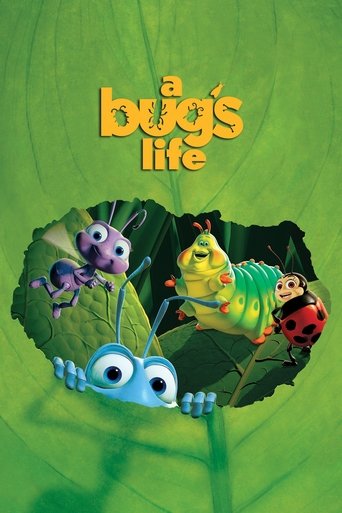
A Bug's Life
1998 · Film · 95 min
Directed by John Lasseter
AdventureAnimationComedyFamily
On behalf of "oppressed bugs everywhere," an inventive ant named Flik hires a troupe of warrior bugs to defend his bustling colony from a horde of freeloading grasshoppers led by the evil-minded Hopper.
5 positive12 neutralfrom 17 commenters
Where to watch
No streaming data for this title.
17 comments on Hacker News
The primary goal of authoritarianism is consolidation of power among a small number of elites. Anything that can reduce that power is an enemy.
The essential weakness that the powerful elites have is that they are, by definition, outnumbered. So in order to consolidate and maintain power, they need to disturb any system that the masses can use to coordinate and form collective action.
(It's a kid's movie, but Hopper's speech in "A Bug's Life" captures this very well: https://www.reddit.com/r/videos/comments/1hfo90u/hoppers_just_one_ant_speech_from_a_bugs_life_1998/)
Reality has a strong consensus-creating effect. We all live in the same material world, so simply by understanding it better and sharing that understanding, we will automatically trend towards having more common ground and more agreement.
That's a threat to elite power, so authoritarian governments have always been anti-science. They may pay it lip service, or attempt to harness it to their own ends, but they never want an entire populace that it well-educated and grounded in reality, because well-informed masses are harder to divide and conquer.
What an excellent piece! I thoroughly enjoyed reading it, brought my childhood memories flooding back. I have so many fond recollections of that 90s era, including "A Bug's Life." I remember gathering with my cousins at my grandmother's house to watch these films on VHS. Time flies.
The movies visible in the photos in the article, and their runtimes in minutes, are:
94 The Good Dinosaur 92 Trolls 98 Wall-E 88 The Lion King 103 Moana 81 Toy Story 91 Trolls World Tour 95 Inside Out 103 Frozen II 95 A Bug's Life > We have two boys, and the eldest is permitted a 30-minute TV session in the morning and another in the evening.
So...if one of them wants to watch The Lion King or Toy Story they have to split it over at least 3 viewing sessions split over at least 2 days? And for anything else on that list they need to split it over at least 4 viewing sessions?
That seems overly restrictive. Yes, limiting kid's TV time is probably a good idea, but would it really hurt to have some flexibility so that they can finish a movie in one session? Maybe let them bank sessions, so they can say skip morning TV for 3 days, and apply that time to the 4th day's evening to get a slot for a whole movie.
maybe you aren't aware, but the russians slaughtered their ruling family and installed a different government at one point, too.
there's an interesting parable in the movie A Bug's Life where the grasshoppers get a lesson from the boss grasshopper about how if the individually-puny ants ever realize that they vastly outnumber the grasshoppers, the grasshoppers wouldn't be able to steal from the ants any longer.
if every ant woke up tomorrow with an unresistable biological urge to overthrow the grasshoppers, it would be done in a day.
The a posteriori "I told you so" title, "Pixar was never a masterpiece factory", is a clickbait sham. Many Pixar sequels outdo most first-run offerings from their wannabe competitors. They have also made a great film or two this decade. I loved Bug's Life. In retrospect, it is easy to demonize the film as arguably its best performance was made by Kevin Spacey. Cars was challenging to get into, particularly given the considerable Heartland cultural nods. As my first born loved it, I saw it repeatedly and eventually I could clearly see its greatness that others could see first viewing. It did decidedly well at the box office. A much much better title of this article would be, "I don't understand why everyone else loved Pixar so much".
Do they? They are from Japan, not Hollywood. Very different business culture. And while they are successful and beloved, compared to Pixar they only made small money. They only have one movie who made comparable money to a Pixar movies, which was Spirited Away in 2002/2003, and it "only" made as much as Toy Story in 1995, and a bit more than "A Bug's Life" in 1998.
So even if investors in Hollywood knew about Ghibli around that time, they probably didn't consider it as a relevant investment.
> "I feel that Pixar’s mastery of storytelling is overrated."
me too. the incredibles was pixar's high point of storytelling imho. of the first six films, i liked the toy stories the least. a bug's life, monsters, inc., finding nemo to the incredibles was like a crescendo of animation, reaching a satisfying zenith of art. cars, which came next, was ok (but unoriginal for storytelling, the characters were mostly great!), but then ratatouille through inside out were all groping for relevance while nakedly harvesting their reputation. of the last 8 movies, only coco has been worth watching so far (i haven't seen the good dinosaur or soul yet). so perhaps a quarter of their 23 films have been good enough to watch again for me; contrast that with the studio ghibli collection, nearly all of which are imminently re-watchable (spirited away is an absolute masterpiece).
I've always wished Pixar would do what Id software did, releasing an Open Source version of some small portion of their movies for analysis, like this Moana scene.
Because the question on my mind is, given the improvements in rendering, there's some year in which we can now render in real time, what took a long time for Pixar to render.
So, what is it? I believe I read that creating the 3D version of Toy Story ran at 24 fps, averaged across the entire film. So, basically, we already crossed the threshold for Toy Story. (But maybe that was only if you have a rendering farm?)
So, where are we at? Could we render a plausible Toy Story in real time now? Bug's Life? Monsters Inc?
> In 1995, with the release date of Toy Story nearing, Katzenberg visited with his old friend John Lasseter and asked him what Pixar's next project would be. Lasseter told Katzenberg about a film surrounding a group of insects and the world they inhabit. This film would eventually become A Bug's Life.
> Later that year, Katzenberg and Dreamworks announced that it would be releasing Antz, the studio's first 3D animated film about... a group of insects and the world they inhabit.
I always suspected that there was something going on between those movies. There it is.
Pixar has a house style, with procedural textures, written in Renderman. Everybody else mostly takes pictures of real world stuff and uses those as textures. Pixar's approach has the advantage that the camera can get very close to a surface without the texture going blocky. "A Bug's Life" and "Toy Story" use this heavily. Wouldn't help in making an Avengers movie.
Here's where that procedural texture approach started: "Road to Point Reyes".[1] First "photorealistic" render, 1983. Today, that's not even an acceptable game asset.
[1] https://lucasmuseum.org/works/detail/asset_id/1292
That all the stories occur in the same universe is a given. Oddly, The Pixar Theory gives no reference (much less credit) to the long-running proliferation of Pixar characters appearing in other Pixar movies. This includes characters from future movies, like Wall-E seen in Toy Story. The Pixar Theory, in its long-history view, fails to address proof most of the movies occur within a narrow timeframe, via facts like Heimlich (from A Bug's Life) appearing in Toy Story 2, and the Pizza Planet truck appearing in every movie (partial exception for Brave, where it appears as a carved-wood toy alongside a bas-relief of Sully).
The Pixar Theory takes a vague notion and just, as noted "post hoc, ergo proter hoc", creates an elaborate and baseless theory to justify it a la most conspiracy theories. Alas, there is a great deal of facts available to both destroy the theory as presented, and at the same time prove the "one Pixar universe" premise to far more comprehensive and compelling effect. Instead of a few vapid paragraphs, the website should be a collection of the dozens (hundreds?) of images tying all the stories together.
Actually there's some incorrect information here, Pixar started using ray tracing in films as far back as A Bug's Life. I can't find a picture on line but you can see it in the scene with the glass bottle. That was done by integration with a separate render but since then RenderMan as added support for GI and other ray tracing features.
I'm sure this update is significant, and sounds like a ground up reworking of the engine, perhaps replacing REYES? But it's not at all accurate to say the Pixar is moving to raytracing. Pixar has been in that neighborhood for more then a decade.
Playings devil's advocate: There are many ways to incentivise even complex, large scale investment absent copyright. From project finance to Kickstarter, it is well beyond self-evident. On the flip-side, the cost of supressing academic and sciendific knowledge through academic publishers dwarfs whatever entertainment value might come from their library (~12 films)[1]. I think your comments on this are too simplistic.
________
[1] Toy Story, Toy Story 2, Toy Story 3; Monsters, Inc.; Finding Nemo; The Incredibles; Ratatouille; WALL-E; Brave; A Bug's Life; Cars, Cars 2
It's sad that "Toy Story 2" didn't make the cut. I think it's a stronger movie than the original with a better villain, a bit of Shakespearean mistaken identity, new characters that you care about, and foreshadowing for the final movie (Stinky Pete asks "Is Andy going to take you to college?" and claims they'll all end up in a landfill.) The climatic scene at the Airport is almost as good as the "Bird Rescue" scene in "A Bug's Life" (which I contend is one of the best action scenes in any animated movie).
In fact, the only thing I don't like about it is how easy Woody gives up on Andy. Woody is, in my opinion, Andy's surrogate father and probably should have come up with "Come with me to Andy's House" much sooner.
(With all this obsession about Pixar movies, can anyone tell I have a three-year old?)
The lesson taught in almost every movie is that your problems are only permanently solved by the death of your action antagonist. Even kids' movies have this lesson, e.g. A Bug's Life where the bad-guy grasshopper is eaten by a bird. There are few movies where the action antagonist does not die, and these invariably involve morally ambiguous lead characters (e.g. The Dark Knight).
It's shame that more conciliatory outcomes are not considered. And you wonder about youth violence, but if this is the message taught by every film what do you expect?
P.S. counter examples please!
One thing you don't realize about the movie industry is that parts of it actually move a lot slower than you think.
Some of these scripts (actually, most of them) float around Hollywood for years, even a decade or longer. They get pushed from studio to studio, shopped around, then suddenly a director or star takes interest in it and a project begins to form.
One can definitely infer once the wheels start moving on a picture (OMG Brad Pitt signed on to do Freakonomics:The Movie!) and word spreads that copycats definitely pop up to try and take some of the action.
You can also add [A Bug's Life (Nov 1998) -> Antz (Oct 1998)] to your list. There's some background here: http://www.businessweek.com/1998/47/b3605013.htm
I think that the biggest difference between the two companies is that Dreamworks doesn't attempt to make lovable characters. Shrek in the original movie is an exception. They make identifiable characters, but rarely are their characters deep and human. Froo and I argued Kung Fu Panda versus Wall-E on IRC, if I recall correctly, and while I'm not nearly as knowledgeable about the animation world as he is, it's pretty hard to say that Jack Black in KFP is a more relatable character than Wall-E. Pixar makes people that you really feel like you know. Dreamworks is willing to make caricatures and as a result, their movies feel shallower from a story point of view. Even if Pixar follows a formula, it's a complex formula with deep permutations so that Mr. Incredible and Woody and Nemo's father and Wall-E are all very different people, even if the one recurring thread is that they all feel real to us.
This is actually the one problem I had with Annie Hall, which I saw recently for the first time: Woody Allen has a brilliant style, but the characters he made all seemed like caricatures, and so despite being a genius movie, I didn't love it. (I thought of this because back when I was a kid and there were two camps of children, the Ants kids and the Bug's Life kids, I was an Ants kid, thought Woody Allen in that was terrific, and thought the movie was stylistically and conceptually beyond Bug's Life, but going back to them I realize that Bug's Life, for all that, still has the more realistic characters, the ones that feel real, and so Ants's clever and detailed world falls apart at that one big seam.)