 Hacker Cinema
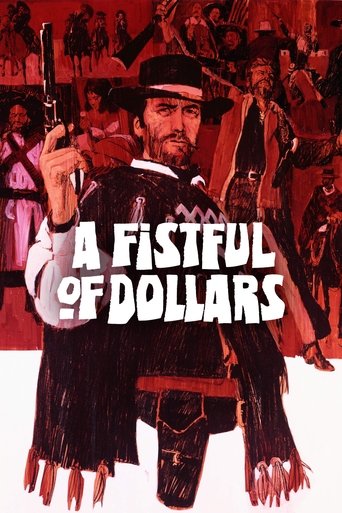
A Fistful of Dollars
Per un pugno di dollari
1964 · Film · 99 min
Directed by Sergio Leone
The Man With No Name enters the Mexican village of San Miguel in the midst of a power struggle among the three Rojo brothers and sheriff John Baxter. When a regiment of Mexican soldiers bearing gold intended to pay for new weapons is waylaid by the Rojo brothers, the stranger inserts himself into the middle of the long-simmering battle, selling false information to both sides for his own benefit.
3 positive7 neutralfrom 10 commenters
Where to watch
No streaming data for this title.
11 comments on Hacker News
I rarely read about the contribution a good music score has to a movie's popularity. A great score makes the movie. For example,
The Blue Max, Ben Hur, the first Star Wars, Lord of the Rings, Dr Zhivago, Fistful of Dollars, For a Few Dollars More, and, of course, Blade Runner!
The time difference between today and Hackers is the same as when the film was released and the year 1964. That's the year films like Dr. Strangelove, Goldfinger and A Fistful of Dollars was released.
You (we) are old :)
There are many metrics that can be sampled, many challenges to normalization.
eg: https://ext.to/browse/?sort=seeds&order=desc&cat=1&q=2019
is a listing of 2019 movie torrents ranked by seeds (number of clients holding full copies of a torrent version).
A normalization challenge is to group torrent variations (1080p rips and 720p rips and WEB-DL's and BluRay and etc.) and tally up and rank interest in various films over time.
Clearly Ne Zha (2019), a Chinese Animation, Fantasy, Adventure movie was a global pirate star of that year .. should it be "normalized" by population of country of origin to smooth out the home team having a billion+ in population "bias" ?
One advantage of ranking films by year and pirate copies is it provides a pragmatic measure of "staying power"
https://ext.to/browse/?sort=seeds&order=desc&cat=1&q=1964
My Fair Lady, Dr Strangelove, Rudolph the Red-Nosed Reindeer, Mary Poppins, A Fistful of Dollars, and Goldfinger are still being hoarded 60 years after their release.
* https://www.themoviedb.org/movie/615453
* https://www.rottentomatoes.com/m/ne_zha
More of a trope about the styling and colour palatte of now classic films set in Mexican territories (but often filmed elsewhere):
Spaghetti westerns were a series of western films pioneered by Sergio Leone in the 70’s mostly starring Clint Eastwood. They have a very specific style to them. Mostly shot on anamorphic widescreen, they developed a language using editing and framing for confrontations between the gunslingers as well as using and updating Akira Kurosawa’s style. A lot of them are straight up remakes of Kurosawa films (A fistful of dollars is Yojimbo, Magnificent 7 is 7 samurai). The films had a bit of a sepia look to them but that mostly came from the art direction and the wide open desert spaces they shot at. They would use a handful of shots from the west here and there but most of them were actually shot in southern Spain with Italian and Spanish crews. Widescreen aspect ratio, tight closeups (chin to eyebrows), quick cuts timed to the music (provided by the great Enio Moricone). The Good, the Bad and the Ugly is seen as the masterpiece of the series (known as the man with no name series). Another major one is Once Upon a Time in the West. Tareantino is heavily influenced by this stayle and pays direct homage to him on both Kill Bill Vol 2 and Hateful 8. This might be able to give you a slightly more modernized rendition of Leone’s style. from: https://old.reddit.com/r/colorists/comments/rs7igu/spaghetti_western_look/
but you can find similar comments across many film boards.
It expired at midnight on amazon. on google tv I was able to watch it for free on Jan 1. I did a little more research on the film and related ones.
There's the first 3 movies, https://en.wikipedia.org/wiki/Dollars_Trilogy (A Fistful of Dollars (1964), For a Few Dollars More (1965), The Good, the Bad and the Ugly (1966)).
This movie was in the second trilogy, "once upon a time", Once Upon a Time in the west, Duck you Sucker, and Once Upon a Time in America. And from wikipedia there's a much better and longer original European cut that is 3 hours 49 mins instead of the 2 hours 19 minute cut. I can't figure out how to stream that.
Could you explain the five basic plots?
While the number of plot structures are fairly countable, a plot can still be considered different by changing part of its contents (character, setting, etc.). The decision on whether a plot outright infringes on an existing plot varies case-by-case. An example of outright copying is "Fistful of Dollars" directed by Sergio Leone, which lifts the plot from "Yojinbo" by Akira Kurosawa.
Ennio Morricone single-handedly "invented" the typical style of Italo Western film music. US-American Western film music used to be lush orchestral scores, instead Morricone used electric guitars, whistling, screaming, Mariachi trumpet playing, various percussion instruments, etc. The music for "A Fistful of Dollars" was something people have never heard before.
However, I can see a similar approach in Masaru Satō's music for Kurosawa's Samurai movies with its sparse instrumentation and inclusion of jazz elements. The whole score is in stark contrast to the music of earlier Jidai-geki movies, which also favoured large sweeping orchestral music.
Given the fact that "A Fistful of Dollars" was basically a remake of Kurosawa's "Yojimbo", I have been wondering if Morricone had been influenced by Satō in any way.
>No, it's a problem of target audience. If you produce films for a Dutch audience, you have two options: either appeal to a sense of Dutch pride or history, or go for something so generic that a decent swath of the population will like it; otherwise you won't have enough of an audience to make a profit. This is what they do, so Dutch films are generally about about our navy in the 16th to 18th century, about WWII, a romcom or some adaptation of a Dutch Children's book. You cannot locally produce a film about something which lies outside of the realm of interest of most Dutch people; Hollywood can, since they have a larger audience, and therefore do have the ability to target niche markets.
Well, EU has 400 million people. One can very well create a movie that appeals to EU audiences. We have lots of shared sensibility and modern problems and history (and it doesn't have to be BS like "16th century dutch navy" or "17th century french villagers").
Movies like Blow Up or Dolce Vita or For a Fistful of Dollars etc where shown successfully all over Europe at one time (and we still have films by people like Lars Von Trier, Almodovar, and so on).
Just because you make something that has a Dutch or Swedish or French etc sensibility, it doesn't mean it can't have pan-European (or even global) appeal. Trainspotting is as British as it gets, for example, but hit Europe big, as did La Haine, La vita e bella, Amelie, and others.
Besides, not all movies have to be blockbusters and multi 100 million dollar productions. Even from the US, I'd rather have the chance to watch some Hal Hartley or Jarmusch, or Cronneburg, that barely pushed 5-10 million dollars in the box office than the nth repeatitive formulaic shit from Hollywood.
The story behind the remakes is pretty interesting all by themselves:
John Sturges' The Magnificent Seven (1960) was based on The Seven Samurai (1954)
When first released in America, the title for Kurosawa's film was "The Magnificent Seven", it created a stir and the rights for "The Seven Samurai" were bought for US$250 from the Toho Corporation, Toho entered into the contract under the pretense of being the sole copyright owner. Over the following 30 years, several lawsuits followed since Kurosawa hadn't received royalties and hadn't given consent to remakes, the end result of which was that Kurosawa and other principals were paid back royalties, but were countersued and Toho Corp ended up having to pay $50000 to MGM (who also gained the rights to any future remake of The Seven Samurai set as a Western). I guess in the real world, the Bandits end up winning after all.
Sergio Leone's A Fistful of Dollars (1964) was based on Yojimbo (1961).
Leone didn't acquire the rights to Yojimbo, he just went ahead and made the film, which was surprisingly successful. Kurosawa reportedly said, "I’ve seen your movie. It’s a very good movie. Unfortunately, it’s my movie." Leone is supposed to have settled out of court for 15% of worldwide residuals plus $100,000.
"The film begins with two bedraggled peasants, Tahei and Matashichi (Minoru Chiaki and Kamatari Fujiwara). Through conversation, they reveal that they had intended to fight alongside the Yamana clan, but turned up too late, were taken for soldiers of the defeated Akizuki clan, and forced to bury the dead. After quarreling and splitting up, the two are both captured again and forced to dig for gold in the Akizuki castle with other prisoners.
After an uprising, Tahei and Matashichi escape. Near a river they find gold marked with the crescent of the Akizuki clan. They thereafter travel with the General of the defeated Akizuki clan, Makabe Rokurōta (Toshiro Mifune), while escorting Princess Yuki Akizuki (Misa Uehara) and what remains of her family's gold to a secret territory. In order to keep her identity secret, Yuki poses as a mute.
During the mission, the peasants impede it and sometimes try to seize the gold. They are later joined by a farmer’s daughter (Toshiko Higuchi), whom they acquire from a slave-trader. Eventually, they are captured and held by Rokurōta's rival, who later unexpectedly sides with the Princess and Rokurōta.
The peasants stumble upon the gold, but are later captured, whereupon Rokurōta explains Yuki's true identity, and states that all of the gold has been used to restore her family's domain. The peasants are then dispatched, taking a single ryō. In the final scene, Tahei gives this to Matashichi to protect; but Matashichi allows Tahei to keep it."
Ok. Inspired, sure, you can see some parallels. Based off, no :) (at least not as The Magnificent Seven and For a Fistful of Dollars are based off Seven Samurais and Yojimbo).
couple notes:
- did author himself followed some formula (essay, etc..)writing this article?
- after watching many Hollywood movies during last decade, i recently re-watched (as i had almost forgot the content of the movie, it was almost like watching for the first time) "For a fistful of dollars" - about half the movie in i was ready and felt like it was the climactic end with the showdown (bank robbery) and was genuinely surprised that it continues well beyond it