 Hacker Cinema
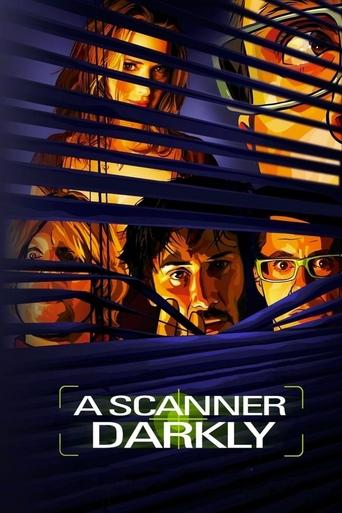
A Scanner Darkly
2006 · Film · 100 min
Directed by Richard Linklater
AnimationScience FictionThriller
An undercover cop in a not-too-distant future becomes involved with a dangerous new drug and begins to lose his own identity as a result.
33 positive4 negative1 mixed38 neutralfrom 76 commenters
Where to watch
No streaming data for this title.
84 comments on Hacker News
> The third is the marriage of entertainment and shopping. I can be doomscrolling, see an ad and buy it without ever leaving the platform. If I remember right, it doesn’t even interrupt your doomscrolling really.
No trolling: This prose is wonderful. It reads like something out of a sequel to the film "A Scanner Darkly".
Note the text from my previous comment "A Social Network for AI Agents" ...I didn't write that. I am guessing it must have been inserted on the server-side, in transit or resubmitted by my browser somehow. Artificial Information, not intelligence.
Was it a sneaky reference to the film "A Scanner Darkly" ?
Anyway, I know of someone who is selling all his stuff obtained in the "good times" ...to survive.
If AI is not a friend, and necessity is the mother of invention, then there will be many others wanting to easily liquidate "their stuff."
I'm also kind of reminded of A Scanner Darkly. That would be another interesting movie to reconstruct this way.
I'm also reminded of those posters in the mall, where from a distance, it's an actor's face. But when you walk up close, it's actually made of hundreds of stills from their films.
Ah okay, thank you. I feel a bit lame as they are pretty recognizable titles. I never got into the blade runner movies outside of cultural knowledge of the plot and know nothing of "A Scanner Darkly". Going to add them to my reading list so thank you.
Sure—in order of mention, that would be “A Scanner Darkly” and “Do Androids Dream of Electric Sheep?”
The slyly comic tone of the latter may surprise those who’ve only seen its rather dour film adaptation (“Blade Runner”), which the original novel resembles only slightly.
I'm a big fan of PKD and also Blade Runner. You've got a point about the film being so very different, but I think it's subsequent success (it wasn't that successful at the time) justifies the approach to the subject matter.
However I do wish that Mercerism (the religion in the book) was included in the film. Maybe someone should attempt to film a more literal adaptation.
Edit: thinking about the difference between the novel and the film makes me think of The Shining and I'm very much in the Kubrick camp - the film being a work of art by itself and so doesn't have to follow the source material.
However, I also really like A Scanner Darkly which is arguably the closest PKD adaptation.
The existence of a fictional movie says nothing about how popular conspiracies are. I have seen a lot of dystopian movies and read such books, including cyberpunk. A Scanner Darkly, The Illuminatus Trilogy, The Matrix, Snow Crash, Dune, eXistenz, just name some random ones. I'll mention four series, too: Twin Peaks, X-Files, Utopia, Nikita. That doesn't make me a conspiracy nut, because I am able to differentiate between fiction and non-fiction.
The trouble from 80's is different. We've shifted power vacuum, but whilst doing so the rich have become very much more rich, and [generally] they don't want to take responsibility; they want raw power. Things like bullshit (lies, conspiracies, manipulation), drama (such as creating friction between poor and middle class), obliteration of facts and science, cryptocurrency to avoid sanctions and law, and criminal behavior (including methods to avoid paying tax) are each tools for achieving more of such power.
UFOs are one of such, too. They're a tool to accelerate the distrust in government. For the acronym UFO itself is broad. A meteorite or Starlink satellite could be mistaken for an alien spaceship. Furthermore, drugs, hallucination, psychosis and the power of suggestion alone are strong tools to feed such fables.
I am well aware fans of conspiracies can very well be fans of X-Files but it is fiction first and foremost, plus don't forget Scully's role and background.
Close Encounters of the Third Kind (best of the grandiose classics imo)
Deep Impact (the only good asteroid movie?)
Jurassic Park + Independence Day (peak Goldblum)
Total Recall + A Scanner Darkly (best Philip K Dick adaptation)
Gravity (great visuals / perseverance story)
Are you talking about made for TV animation or others? I would suggest animated feature films such as The Secret of Kells, A Scanner Darkly, or even Waking Life and Heavy Metal to see that this is not entirely the case.
Well, obviously "Do Androids dream of electric sheep" simply because the movie left out a little bit too much, which you can catch up on when reading the book. Keyword "Mood Organ".
I also liked "Second variety" which has also been rendered as a audio play IIRC.
And, for the non-sci-fi part, A Scanner Darkly is pretty weird. Has also been rendered as a movie...
A cool Keanu Reeves film employs this in A Scanner Darkly.
One thing that they kind gloss over is that rotoscoping is used a lot in films to separate objects.
For example, I did an exam on prince caspian (https://eu.southcoasttoday.com/story/entertainment/local/2008/05/15/prince-caspian-improves-on/52409998007/) to separate his hair from the forest. They didn't have green screen, and even if they did, it would obliterate his hair. (hair is translucent so glows green, and is removed by the software.)
I failed the rotoscoping part, but passed the painting section (where you remove markers, crew or other features not wanted in the final image.)
Whilst "a scanner darkly" is a brilliant example of rotoscoping, its not the example. if you look at this showreel towards the end you see captain marvel, https://www.youtube.com/watch?v=_sYWzFNobEo look at her hair, every individual wisp of hair that extends past her neck is individually masked out.
Good rotoscoping is often the building block of "expensive" looking VFX.
For computer vision its also important so you can get ground truth on tracking various object and training models like segment anything
I mean I get why. The fear is that non-Christian audiences wouldn't care, and fundamentalists would find it blasphemous. I would love a movie of The Three Stigmata of Palmer Eldritch, but we're not gonna get it. Who would make it? Martin Scorsese? Paul Schrader? The Coen Brothers?
Actually, those are all good ideas. But other than Scanner Darkly, Dick's work has mostly attracted people interested in the pulpy science fiction ideas and not so much the existentialism and the critiques of mainstream religion. It's a bummer.
This was really fun. It captured a lot of thinking on a topic I've been interested in for a while as well.
The discussion about converting to a vector format was an interesting diversion. I've been experimenting with using potrace from inkscape to migrate raster images into SVG and then use animation libraries inside the browser to morph them, and this idea seems like it shares some concepts.
One of my favorite films is A Scanner Darkly, and that used a technique called rotoscoping which I recall was a combination of hand tracing animation and computers then augmenting it, or vice versa. It sounded similar. The Wikipedia page talks about the director Richard Linklater and also the MIT professor Bob Sabiston who pioneered that derivative digital technique. It was fun to read that.
https://en.m.wikipedia.org/wiki/Rotoscoping
https://en.m.wikipedia.org/wiki/Bob_Sabiston
A Scanner Darkly.
I like the art style, but if you can't stomach that it's still worth it for the Phillip Dick story-line.
Plus if you're from the LA area it's a way to see a lot of familiar areas in a 'drawn' movie, which is neat.
Nope. I was an avid reader of PK Dick - and the coda to _A Scanner Darkly_ was a clear warning that drugs weren't like doping, a trade where your lose your health but gain performance above normal, but a lose-lose proposition - a _miroir aux alouettes_.
Another artist I am extremely fond of, Mœbius (Jean Giraud), also had a very bad time after a failed psychedelic initiation (but my memory may be wrong, as I can't find it in writing on the web - was it in a biographical documentary or am I mixing him with someone else?).
Like Jodorowsky, I never felt I needed drugs - even to enjoy his work, PKD's work or other usually associated with psychedelic use or culture (Aldiss, Lem, Herbert,Zelazny, Bester). When I listen to weird electrical like Aphex Twin or Bicep and people in the comments talk how they seem to need drugs to feel the music kick, I seriously wonder why - I felt there was little to gain for a great risk to take (either from impurities in the substance, or the substance itself - the risk of a bad trip).
In short: I'm abnormal enough? I am clearly more creative than baseline (but less disciplined to really exploit it - and there isn't a drug with the right profile to make one more disciplined yet critical enough to stay on course).
As a sci-fi reader, of course I am very interested in other dimensions, breakthroughs, alien thinking and superpowers. And LSD and others have that mystique - but seem very disappointing in reality, compared to those expectations.
Both Kurt Vonnegut and Neal Stephenson seek to plumb the intersection between technology and religion, between science and popular culture - but where Vonnegut adheres to the literary traditions of the Western Satirical Canon, Stephenson choose to plough a far more meta-referential narrative path that is weighted by all the detrimental issues associated with Young Adult fiction without representing any of the strengths of the genre.
This is fairly understandable when you look at their respective backgrounds. Vonnegut was a Combat Infantry veteran, earning a Purple Heart in World War 2. He was interned in Dresden, where he survived the Allied bombing of the city in a meat locker of the slaughterhouse where he was imprisoned - emerging to find an alien landscape not unlike the moon. This was, in fact, the eponymous 'Slaughterhouse Five' from which his magnum opus takes its name.
His use of satire, gallows humour and science fiction was rooted in the tradition of the golden era of Science Fiction - namely, the use of these literary devices to try and make sense of a seemingly uncaring and alien world and society that was changing with unprecedented rapidity.
You see Joseph Heller doing very similar in 'Catch 22' when utilising similar narrative devices like non-chronological timelines, omniscient 3rd person narrators, and satirical paradoxes to describe and to try and make sense of his own brutal and often paradoxical experiences serving in the Korean War.
Stephenson, in contrast, is mired in the self-referential and meta posturing of late 80s American University culture - as befitted his first and possibly most insightful book 'The Big U' - a scathing indictment of the homogenisation of the American University system as it geared towards research over pure academia.
The book he is most lauded for - Snow Crash - is in many ways a poor facsimile of Gibson's Neuromancer. Even the title, which Stephenson contends was a result of his computer crashing with a malformed bitmap that '...looked vaguely like static on a broken television set—a 'snow crash...' is lifted conceptually from the opening pages of Neuromancer - "The sky above the port was the color of television, tuned to a dead channel.".
The plotting characterisation and story beats when not directly lifted from Neuromancer, are reinterpreted chunks of Philip K Dicks 'A Scanner Darkly' and the 'The Three Stigmata of Palmer Eldritch' respectively, and what little innovation he brings to the world building is mired in a comic book aesthetic, versus the film noir salience of Neuromancer.
Many would content that this is the point - that Stephenson is playing with the tropes of the Cyberpunk genre. Unfortunately this doesn't explain away his stylistic choice (or sheer lack of ability) to avoid huge explanatory passages that destroy any semblance of pacing or advancing a narrative midway through the book. This, in many ways, is indicative of the 'tell, don't show' fumbling of Cory Doctorow in the way he punches down to his predominantly YA audience.
From Wikipedia…
> Popular films based on his works include Blade Runner (1982), Total Recall (adapted twice: in 1990 and in 2012), Screamers (1995), Minority Report (2002), A Scanner Darkly (2006), The Adjustment Bureau (2011), and Radio Free Albemuth (2010).
If you’ve not heard of P.K. Dick before it’s kind of weird to be worried about “is this a talented artist”… you really need to push your boundaries in any way possible.
I often get a similar phenomenon, for better or worse. I kind of have this rule: read the book first if there's a movie/show about it, then watch the movie/show, then read the book again. This helps me avoid "the book is better" (sometimes -- it's a rare case where the audiovisual format excels, but it happens).
First reading I get my imagination and expectations. Watching the movie/show lets me know how others interpreted it.
If it was a well made, casted, and acted depiction, then the 2nd reading often will conjure images of specific scenes, actors, soundtracks, etc. even if it wasn't quite what I imagined initially. If it was a poor adaptation, rereading the book reminds me that my imagination was better.
To date I can only think of two movies that captured their respective novels nearly identically to my imagination (within reason, given content and technological limitations):
- Phillip K Dick / Richard Linklater - A Scanner Darkly - Michael Crichton / Barry Levinson - Sphere - Ted Chiang / Denis Villanueve - Story of Your Life (Arrival) - Bret Easton Ellis / Roger Avery - The Rules of Attraction - Alex Garland / Danny Boyle - The Beach
I often wonder if the influence of the authors of these books upon the production of the movies was a factor, but I've seen plenty movies where the original author had lots of input/approval and the result was a mess. Dunno.
This reminds me of the story from A Scanner Darkly. One of the characters tells a story about a con artist who was pretending to be a famous con artist. His whole shtick was going around to talk shows recounting how he had played all these outlandish characters and conned people out of all kinds of money, in the end the only character he ever played was that of a con artist.
Maybe that story was based on the Catch Me If you Can guy, but I think possibly not because A Scanner Darkly came out before that movie.
> They also always seem to conclude that the answer to these problems is to keep these machines centralized in the hands of big companies and governments, which is a very strange conclusion when they tend to get paychecks from those groups.
I'm not sure who you mean by they.
I'd suggest a vast majority of the public mindshare (in the US at least) of technology gone wrong and dystopias come from sci-fi.
In general, I have not noticed sci-fi making such conclusions. I rarely notice them drawing any hard conclusions. Readers often come away with a mix of emotions: curiosity, anxiety, excitement, wonder, or simply the joy of stepping outside one's usual reality.
What I read and watch tends to paint a picture more than pitch or imply solutions.
- 1984 seems to make the opposite point, right? It is the classic example of the surveillance state. as such, it is a counter example of centralized power.
- A Scanner Darkly (movie) explore the question of who watches the watchers. It does not paint a pretty picture of the agency doing the surveillance.
- The Ministry of the Future shows how a government agency can't really do much without widespread decentralized underground support. As drones get cheaper, civilian activists become terrorists who assassinate climate unfriendly business people. Spoiler alert: it may not fit the pattern of a dystopian novel.
- Her (a man falling in love with his OS) explores the personal side in a compelling way.
It's a nicely written article, but I have to take issue with the attempt to attach a psychiatric diagnosis to PKD, more than 40 years after his death. By all accounts he was increasingly mentally unstable — the heavy drug and alcohol use did him no favours — and certainly had episodes of deep clinical depression and what would probably qualify as narcissistic traits. But to armchair-diagnose him as a psychopath seems wrong.
The Vancouver period retold in this article is interesting and tragic because it marks the nadir of his 1970s drug addiction; after his suicide attempt, he was able to enter a recovery program (albeit an unfortunately cultish one with parallels to Scientology), weaning himself off heavy amphetamine use, moving out of the drug house and to Orange County, then starting to try write more "adult" novels (he wrote "A Scanner Darkly" during this time), which would lead to his significant international recognition towards the end of his life. But just as things got better, the VALIS incident happened, and he relapsed and started drinking whiskey every day, which contributed to his early death.
i really don't see any similarities with brave new world, it's not particularly dystopian, and your dates are a bit off.
there is a realy interesting film of scanner darkly, with a great cast:
https://en.wikipedia.org/wiki/A_Scanner_Darkly_(film)
Yes, and to add to that, that some topics are biographical or based on some personal thing, like Bob Arctor in A Scanner Darkly.
haven’t seen the movie, but on the book he mentions this.
Part of the problem here I think is the author is focusing on more metaverse style VR and also experiences that are more "documentary" like (as in watching a sports game) vs actual VR games. In my opinion VR is amazing for lots of video games (like a shooter or a flying space game) and the technology has seen tons and tons of development here. It is fairly mature (although takes a fast PC still) and attracts high end developers and artists. A project like "Poker Stars VR" is probably not very attractive to top end 3D artists and VR developers because it is kind of a boring use of VR. People want to work on cool stuff.
In my opinion what we really need is the metaverse but for hackers. A bunch of business suits meeting in real life or VR will always be boring and sterile. But a place that has the magic of early IRC where a group of whitehats and blackhats anonymously can meet virtually? That could be pretty damn cool and result in some whacky crazy avatars and out of the box environments. Imagine a completely P2P capable hackerverse that mashed together something like Mr. Robot and A Scanner Darkly and your friend shows up looking like a cybernetic android dolphin. You won't see the suits Hug in VR - they're all about Handshakes ;-)
It's a bit of a spoiler but you may like the film "The Accountant" starring Ben Affleck.
Also the Book "A Scanner Darkly" by Philip K Dick which (no spoiler) explores the consequences of deep undercover.
Amazing! So counting years now when a first AI feature film hits the cinema screens. Source code: screenplay text. I imagine it may look a bit like "A Scanner Darkly" (2006).
I liked the first half (suburban America) more than the second. I also really like "A Scanner Darkly" - both film and book. All are very well worth reading and/or watching.
"A Scanner Darkly" is dedicated to his many close friends that suffered or died as a result of drug use. I think there is this heartbreaking dedication at the end of the novel, with the names of his friends and how they ended.
Yet the book is full of subtle humor, and a profound understanding of individuals' tragedy at the same time.
There is a great movie made after the novel, with the same name. The movie does capture the spirit of the book, even as switching the medium, a noteworthy achievement.
PKD himself wrote a semi-autobiographical story (“A Scanner Darkly”) about mental breakdown due to drug use. It’s a haunting book and the feeling it evokes has stuck with me since I read it about ten years ago.
https://en.m.wikipedia.org/wiki/A_Scanner_Darkly
As with many PKD stories, it was turned into a film, which although I have not seen it, is technically notable for being entirely rotoscoped.
The problem with your wager is that on a long enough timeline, the doomsayers are always right.
So saying anything OR societal collapse is going to evaluate to true.
There are any number of disasters, both terrestrial and cosmic, that can radically change the landscape of the Earth.
I also don't really find discussions about what's going to happen beyond our lifetime that interesting for the most part. Often, they're just fantastic wishing attached to some loose thread of logic.
The Island
Escape from New York
The Running Man
Akira
Strange Days
A Scanner Darkly
Back to the Future II
Blade Runner
2001: A Space Odyssey
2010: The Year We Make Contact
Death Race 2000
1984
Terminator 2: Judgment Day
Freejack
Westworld
Real Steel
Pacific Rim
12 Monkeys
The Abyss
Timecop
And a host of other films and books are set in futures that are now our past. And while some of these are fantasy designed to entertain, they all make assumptions about what would be possible by that time. And we have fallen woefully short of those predictions. So short, that "flying cars and meals in pill form" is a meme about such predictions.
> The animation style this does look like is that of 2006's A Scanner Darkly, or 2019's Undone.
Rotoscoping is the technique. Basically, you film real life and trace over the frames by hand yielding an animated version of your irl footage.
On the other hand, A Scanner Darkly was a remarkably faithful adaptation of the book, and because of PKD's daughters involvement (they recognized the book's importance to him and it weighed heavily in the creation of the movie).
I am on the other side. I found the movie was a faithful rendering.
But I was bored.
I wish someone will at some piont make a free adaptation, like romeo+juliet, romeo must die, the 2009 BBC version of Hamlet, etc. were.
Gang wars with Oakland police brutality with climate eco terrorists and Indians in reserve and a mad voodoo cult or something and a mind destroying drug/device à la a scanner darkly that gives people ability to foresee things (edit: told from the perspective of a Irulan the freelance social worker). Or maybe a 16th/17h pirate movie with European powers and full blown mysticism at the foreground. The same story but with a very different spin. I like remixes :).
Great movie, not my taste. Hope they can do part 2 for people who enjoyed it :).
You can guess I rather like the other thing, Foundation the TV show. Wish the they can pull it off and have time and resources to get their vision on screens.
His explanation of "cultural imprinting" stuck out to me:
> In a way, cultural imprinting is a form of inception, but it's much shallower than the conventional (Pavlovian) account would have us believe. An ad doesn't need to incept itself all the way into anyone's deep emotional brain; it merely needs to suggest that it might have incepted itself into other people's brains
This is loosely connected, I know, but it reminded me of the "impostor" story from A Scanner Darkly. Had a hard time finding the text on my own, but luckily another user had already posted it here: https://news.ycombinator.com/item?id=27049625
> ERNIE LUCKMAN ... this guy appeared on tv, claiming to be a world-famous imposter. He said he'd posed at one time or another as a great surgeon, a theoretical submolecular high-velocity particle research physicist, a Finnish novelist, a deposed president of Argentina...
> BOB ARCTOR He got away with it? Never got caught?
> ERNIE LUCKMAN See, the guy never really posed as any of it. He only posed as a worldfamous imposter. Turns out he just pushed a broom at Disneyland, until he read about this actual world-famous imposter, and he thought, I can pose as all those things, then he thought, hell, I'll just pose as an imposter. Save a lot of time, a lot easier. Made almost as much money as the real imposter with books and movie rights.
> I didn't really like A Scanner Darkly, nor Do Android Dream of Electric Sheep and would consider them of minor import had not movies been made of them.
Yeah, a different opinion: these are his best novels, along with Ubik and The Man in the High Castle.
I strongly recommend reading Ubik. To me it is his strongest and most consistently good book.
I used to love The Three Stigmata too, but when I tried to read it again recently I couldn't get in to it either. I do think you have to be in the right mood to savor a Dick book, so maybe I was in the wrong mood that time.
The other first-tier PKD book for me is Martian Time-Slip.
Second-tier PKD books for me are VALIS and Galactic Pot Healer.
Third-tier are Maze of Death, Eye in the Sky, and Divine Invasion (the 2nd in the VALIS trilogy.. didn't like the 3rd in the series, The Transmigration of Timothy Archer at all).
Many of his other books, like Lies, Inc, also have great parts in them, but are kind of inconsistent.
Some of his short stories are excellent. My favorites:
- Beyond Lies the Wub
- Roog
- The Father Thing
- Faith of Our Fathers
I didn't really like A Scanner Darkly, nor Do Android Dream of Electric Sheep and would consider them of minor import had not movies been made of them. Other books in this category are Now Wait for Last Year (made in to Total Recall) and Time Out of Joint (made in to The Truman Show.. though the book is much darker). The movie Minority Report was based on another minor short story of his, as The Terminator might have been partially based on his story Second Variety.
Virtually all of the movies made from his work only bear only a very slight resemblance to the originals, which tends to be a lot darker, a lot less action-filled, and much more thought-provoking than the Hollywood adaptations.
From the screenplay of A Scanner Darkly (I don't know if something similar is in the original PKD story)
ERNIE LUCKMAN ... this guy appeared on tv, claiming to be a world-famous imposter. He said he'd posed at one time or another as a great surgeon, a theoretical submolecular high-velocity particle research physicist, a Finnish novelist, a deposed president of Argentina...
BOB ARCTOR He got away with it? Never got caught?
ERNIE LUCKMAN See, the guy never really posed as any of it. He only posed as a worldfamous imposter. Turns out he just pushed a broom at Disneyland, until he read about this actual world-famous imposter, and he thought, I can pose as all those things, then he thought, hell, I'll just pose as an imposter. Save a lot of time, a lot easier. Made almost as much money as the real imposter with books and movie rights.
yep, this seems exactly the same. It's also fitting the Keanu Reeves is in one of the test images. Scanner darkly was a great film, time for a rewatch
"A Scanner Darkly" by Philip K. Dick (there is also a nice movie after the book, with the same title)
Strongly reminds me of "A Scanner Darkly" [the movie, at least] -- where the human scanners have to watch thousands of hours of surveillance video [which they do at increased speed until they spot something notable]
Kinda OT, but I feel Philip K. Dicks' A Scanner Darkly is a much more realistic depiction of today (even for the year it's set in - 2006), especially the situation surrounding the mass surveillance issue.
I'll highly recommend the movie adaptation of the novel, it's one of the more faithful ones. It seems to get lost among all the big-budget blockbusters that the other adaptations were.
Also time to make those shape-shifting suits from A Scanner Darkly (reference being from the movie version - it actually isn't too bad if you have not seen it).
That example gif at the top - the way faces blend between reminds me of camouflage effect from "A Scanner Darkly" film
Wow, that is really close to the animation of the anonymizer hood in 'a scanner darkly' (https://www.imdb.com/title/tt0405296/).
I had a very hard time finding things to like in Neuromancer. It was a long time ago, but iirc the prose is pretty clunky, the characters are made of cardboard, and the plot has all the depth of a Ridley Scott movie. The world building was on point, but there's only so much 80's zeitgeist ("everything is awful, you'll be replaced piecemeal by machines, faceless megacorps rule over vast slums of pleasure junkies bathed in acid rain") that a person can channel with a straight face. Like I love me some weird dystopian cyberpunk universes, but I want that to be the starting point, not the ending point.
(Conversely, by way of making a positive contrast with something in a similar genre that , I really enjoyed A Scanner Darkly by Philip K. Dick).
To be totally clear, I think Neuromancer is probably a thoroughly enjoyable read and I'd recommend it to someone looking for what it is without hesitation. It's just pretty easy to take umbrage with.
I looks like what you could see in "A Scanner Darkly" https://www.imdb.com/title/tt0405296/
Phillip K. Dick also had some bad drug trips and they led to a very long, successful, and prolific career as an author of somewhat psychologically disturbed sci-fi. I love watching the movie version of his book "A Scanner Darkly" because it does a good job of describing the way in which people suffering from the early stages of amphetamine psychosis act and think. The book is even more vivid.
A Scanner Darkly is a great book. Too bad Keanu made that stupid movie.
Thank you, I will, downloaded it already. I've not read much PKD at all, but read some of his VALIS writings after seeing A Scanner Darkly and Radio Free Albemuth, which both seem about 80-90% autobiographical. Radio Free Albemuth strongly reminded me of the amazing movie Equus (1977), also (you could say) about the founder of a religion.
Could you post a video clip of the output? It sounds like the effect from "A Scanner Darkly" perhaps -- loved that effect in that movie!
This type of article about PKD comes around more and more often these days.
What Dick really got his fingernails under was the idea that our subjective reality, our semantic map of the real, has become more real to us than any objective reality. He probes this at many levels, from that of our individual perceptron driving our subjective reality (eg. Dr Bloodmoney, A Scanner Darkly) or even the perceptron of others or another being so overwhelmingly powerful that it drives our reality (eg. Flow my Tears, Our Friends from Frolix 8). He also explores more directly manufactured realities, as in Ubik and The Simulacra, where forces actively set out to deceive, both out of compassion and cruelty - and sometimes just because.
Jean Baudrillard formulated much of PKD’s weltanschauung in his Simulacra and Simulation, which is as mind-bending a collection of essays as one is ever likely to read.
A particular recurrent topic for both is the idea that “The Empire Never Ended” - that we live in the latter-day Roman Empire, having inherited our fundamental western Judeo-Christian semantic symbol set from the commingling of Roman culture (Mithratic cult, god co-option, etc.) with first century Palestinian culture. Our map of reality is that which was last substantially updated then, and everything we have done since is on the map, rather than the underlying reality.
It all gets very gnostic (another favourite theme of PKD’s), but I do think that there’s a fundamental and valid observation that is made and expounded upon about the malleable nature of human reality.
In today’s world of ubiquitous hyperreality, sensationalised and manufactured narratives, instantaneous and often wildly speculative coverage of ambiguous events so far removed from us yet seemingly right on our doorstep, this philosophy becomes deeply compelling.
That reminds me - Hypernormalisation, an Adam Curtis documentary, provides a light introduction to many of these ideas, if a bit of Baudrillard is a steep start.
When I was reading A Scanner Darkly before the movie came out, I remember wondering how they would ever be able to represented the "scramble suit" in a movie, since it was so impressionistic and subjective and mundane looking, that anything you actually drew and animated would be too concrete and objective and freaky looking.
http://www.technovelgy.com/ct/content.asp?Bnum=997
>The scramble suit was an invention of the Bell laboratories, conjured up by accident by an employee named S. A. Powers... Basically, his design consisted of a multifaceted quartz lens hooked up to a million and a half physiognomic fraction-representations of various people: men and women, children, with every variant encoded and then projected outward in all directions equally onto a superthin shroudlike membrane large enough to fit around an average human.
>As the computer looped through its banks, it projected every conceivable eye color, hair color, shape and type of nose, formation of teeth, configuration of facial bone structure - the entire shroudlike membrane took on whatever physical characteristics were projected at any nanosecond, then switched to the next...
>In any case, the wearer of a scramble suit was Everyman and in every combination (up to combinations of a million and a half sub-bits) during the course of each hour. Hence, any description of him - or her - was meaningless.
When the movie came along, I was disappointed in the scramble suit effect they used, since it looked like a bunch of flickering concrete glimpses of different people, instead of an abstract glimpse of one generic unmemorable person. If somebody looked like they did in the movie, you'd sure notice them in a crowd, which is the opposite effect the scramble suit was supposed to provide.
It was a great try, it looked really cool, but it couldn't work because Philip K Dick wrote something that was easy to imagine, just impossible to draw.
Scanner Darkly Scramble Suit: https://www.youtube.com/watch?v=aqWBCsWRdw4
A Scanner Darkly - FX: https://www.youtube.com/watch?v=BWne23FfKW8
>They wear these suits called scramble suits, where it hides their identity, and instead replaces pieces of parts. It gives you the idea that you're seeing the person, but you just can't focus on it.
>You read in the novel and it describes it as a vague blur, or millions of different representations of people. That makes sense when you're reading it. But then we have to visualize that, and actually present that, how do you do that? A blue eye for one second, and I'll shift it to a brown eye, to a different mouth, to a mustache, to a full beard, to nothing.
There's just no way to capture the "just can't focus on it" part of the scramble suit on film, because the scrambling on film draws your attention instead of repelling it.
Rare Philip K Dick interview: https://www.youtube.com/watch?v=7Ewcp6Nm-rQ
>The position which writers such as myself hold in America, those positions are very lowly. Science Fiction is considered something for adolescents. For just high school kids, and for disturbed people in general to read in America. So we are limited in our writing to books that have no sex, no violence, and no deep ideas. Just something of an adventure kind of nature, which we call "Space Opera", which is just Westerns set in the future.
I still can't imagine how they could ever make The Three Stigmata of Palmer Eldritch, Ubik, or Faith of Our Fathers into movies. But that's more because of the plots and the subject matter, than the visuals.
https://en.wikipedia.org/wiki/The_Three_Stigmata_of_Palmer_Eldritch
https://en.wikipedia.org/wiki/Ubik
https://en.wikipedia.org/wiki/Faith_of_Our_Fathers_(short_story)
Eternal Sunshine of the Spotless Mind was written by Charlie Kaufman, who is definitely a Dickhead. He wrote a screenplay of Scanner Darkly that went unproduced after the Linklater version came out. And of course, he wrote my favorite PKD movie not based on a PKD book, Being John Malkovich.
With these examples it always feels like a very good usecase would be automatic rotoscoping. A movie like "A Scanner Darkly" looks like it could've used these techniques, instead of having all the original footage redrawn manually.
For a more current use of rotoscoping, see the movie A Scanner Darkly.
If you've just read that collection, you have a lot of the most mind-bending PKD stories left. Try one of his novels. I'd recommend A Scanner Darkly and Man in the High Castle as two of the more accessible ones (the latter is much less sci fi - it's more alternative history).
His short stories are very variable in quality - a lot of his early stories makes you feel trapped in a 50's idea of a post-nuclear holocaust world because he repeats that setting endlessly as he churned out stories to pay the bills (but there are great gems there too), so the more curated antologies are good starting points. Pick up some more and you'll probably also recognize the plot of any number of movies you may have seen (direct adaptions from his short stories includes Paycheck - in your antology I think - Total Recall, Screamers, Adjustment Bureau, Minority Report and more), where a single idea from his stories was dense enough for a movie.
I've only seen about 20 minutes of the first episode and couldn't enjoy it. I'd like to at least finish the first episode before I make judge for myself whether this one's worth my time (though I'm gonna first watch The Man in the High Castle). Generally though as a rule of thumb: Nice CGI doesn't make up for a terrible story, but a good story can make up for the lack of good CGI. E.g. I did not find the story good in the follow-ups of The Matrix.
I fully underline your statement regarding PKD's Electric Dreams as well as all the Black Mirror seasons. Furthermore, let us not forget that several other of PKD's works have seen a movie adaptations. I can recommend Total Recall (both; watch older first), Blade Runner (both; watch older first), A Scanner Darkly (if you can stand the art style; personally, I loved it), Minority Report, and The Adjustment Bureau (Screamers was OKish). There are series adaptations as well. Check Wikipedia for all the adaptations [1]
I'm not aware of any motion picture adaptations of Stephenson's or Gibson's works. Although I just found out via Wikipedia that the game Netrunner [2] is a derivative work of the Sprawl trilogy, and also The Matrix heavily "drawn" from the Sprawl trilogy as well [3].
[1] https://en.wikipedia.org/wiki/List_of_adaptations_of_works_by_Philip_K._Dick
[2] https://en.wikipedia.org/wiki/Android:_Netrunner
[3] https://en.wikipedia.org/wiki/Neuromancer#Literary_and_cultural_significance
Oblique strategies made a brief appearance in Richard Linklater's Slacker film.[1] Linklater is more well known for films like Dazed and Confused, Waking Life, and A Scanner Darkly, but in my opinion Slacker is by far his best.
[1] - https://en.wikipedia.org/wiki/Slacker_%28film%29
I'm not sure A Scanner Darkly portrays drugs in a friendly light. The main characters are taken straight out of a stoner comedy but they're set against a backdrop of a country that's descended into rampant drug abuse, gang violence and poverty. Not only that, but without wanting to spoil the film, the ending doesn't paint a pretty picture of long-term use.
> I don't think its any coincidence that TV and movies show the murderous and thieving side of piracy as to condition us to be appalled by them, in general.
Is this really true? There's a long history of sympathetic portrayals of drug culture, from Trainspotting (novel and movie) to A Scanner Darkly (novel and movie) to Jesus' Son (novel and movie) to Pineapple Express (mainstream movie), and a whole lot more.
Oh there's some overlap as in all things very little is binary.
None the less PKD doesn't really tell "human vs technology" stories. Take for example "A scanner darkly" which is an interesting psychological thriller and story about chemical addiction. To quote the wikipedia: "A Scanner Darkly is a fictionalized account of real events, based on Dick's experiences in the 1970s drug culture. Dick said in an interview, "Everything in A Scanner Darkly I actually saw.""
"Man in the High Castle" is alt history action. Its not really a story about technology.
"Blade Runner" is film noir action flick with a dose of moralizing about racism and dystopia.
I'd say the thing that defines PKD is technology as escapism. Yeah OK "a scanner darkly" is about speed freaks but he wanted to tell a psychological thriller about addiction without people casually tossing it away as "the speed freaks movie" so he invented a whole substance D mythology to prevent people from taking the easy way out in their analysis. Ditto Blade Runner where the technology was a cloak to hide aspects of modernity he didn't want to talk about, not a central part of the story.
Sort of like how some fantasy pencil whips away aspects of the modern world the author doesn't like in order to pare down to just what the author wants us to focus on.
Technology as a zoom lens, not in the zoom lens. PKD is a cool author but in many ways he doesn't even write sci fi.
How about another definition, soft sci fi can be turned into any other scenery with mere cut and paste, and tada "a scanner darkly" is about elves smoking too much pipe-weed in Tolkien world. But hard sci fi requires a major and substantial rewrite to change the scenery, not just cut and paste. KSR's Mars trilogy isn't going to Venus or ancient South America any time soon.
The problem with the carpenter you mention is out of millions of pro and maybe a billion amateur/ancient carpenters only that one had much insight. Its a bad odds game.
"Take On Me" is rotoscoping, the drawings are traces over the video frames. An evolution of that effect was used in the film "A Scanner Darkly" I believe.
https://en.m.wikipedia.org/wiki/Rotoscoping
I read a lot of PKD when I was in my 20's. It all started with Ubik. Then Androids. A Scanner Darkly. And about 10 other novels. The early Total Recall is one of the better movie adaptations wrt covering the core concepts of the story. Waves and Waves of revelations about the nature of reality. Minority Report, not so much. And of course, Blade Runner is tangentially related to the book. (It's a masterpiece, but it's not Androids)
Once I started getting into the short stories, I started getting pretty paranoid. There's one theme that repeats throughout that reality is not your perception of it, to your eventual downfall. Repeated over and over, across post apocalyptic wastelands, it leads to a somewhat bleak view of the future. (One in particular, I think it's The Fifth Variety, seems to be tailor made to describe computer security from here on out. Spoiler: _Everything_ is a trojan)
Same feeling here. I stopped watching after the first complete-hallucinations episode. It simply doesn't make sense to include those. There are some movies where hallucinations are either important or the main part of the plot (fear and loathing, requiem for the dream, scanner darkly, ...), but if it's just a case of the main character tripping? Just show me them behaving like an idiot in real world. In most cases it literally does not make any difference what they're seeing.
I think it would be amazing if they could combine this voice-modulation technology with a facial motion capture technology (like in Avatar) to display artificial/shifting faces as well as voices. You could effectively create a computer screen-based version of the "scramble suit" used in A Scanner Darkly! http://www.imdb.com/title/tt0405296/mediaviewer/rm1872861440
I think a combined face+voice system would be even more useful in interviews (since a significant amount of human communication is expressed through facial cues). It would also add another dimension to your proposed voice-modulation gender-blinding experiment.
Possibly the finest painting software currently available is Synthetik's Studio Artist (http://synthetik.com/). Compared to Adobe's powerhouse software, it's relatively unknown, but that doesn't make it any less innovative.
It uses an algorithmic 'paint synthesizer' to generate brushes (with hundreds of presets) and auto-paint canvases, and is designed for animation (rotoscoping) as well as static artwork. The output can be reminiscent of the style of the movie 'A Scanner Darkly', but the software is hugely flexible. Here are a couple of rather amazing examples: http://studioartist.ning.com/video/auto-rotoscoped-dancers and http://studioartist.ning.com/video/dance-styles-animation-reel
Also, unlike most other 'painterly' software, the graphics are resolution independent - meaning that they can be scaled up to any size without loss of detail.
I remember when The Scanner Darkly came out there was a lot of talk about how they achieved the style of the film. Some of it was automated, but a lot still had to be hand done. I wonder if using deep learning systems we could achieve the same effect that film had with nearly zero human interaction.
For those that haven't seen the movie, here's the trailer: https://www.youtube.com/watch?v=TY5PpGQ2OWY
I can imagine making good use of techniques like these for some of my game ideas.
It would also enable films like A Scanner Darkly to be made with much smaller animation budgets. https://m.youtube.com/watch?v=eke5VnpNcNk
Took me so long to think of the obvious: A Scanner Darkly! I haven't read the book, but the movie is excellent.
https://www.youtube.com/watch?v=hkjDUERgCQw
Go watch the movie "A Scanner Darkly". It contains a couple of characters suffering from amphetamine psychosis. Phillip K. Dick knew these kinds of people well. If you find your behavior to be similar to the characters in the movie, you should really lay off the Adderall.
I picked up my first Philip K Dick novel (Ubik) recently and it blew me away. I could see the plot elements which were later used in Matrix, Inception and a few other movies. Its fascinating to see how many of his novels got made into movies or were inspirations. I believe it was Keanu Reeves who said his favorite under rated movie is A Scanner Darkly.
He is a very interesting character and a lot of enigma?/controversy surrounds him. This was an interesting conference: https://www.youtube.com/watch?v=jXeVgEs4sOo
Yeah, "VALIS" was alright. I'd definitely put it ahead of "Minority Report" and "A Scanner Darkly", but far behind "Ubik", "The Three Stigmata", and "Martian Time Slip"; and even behind some other lesser works like "Maze of Death" and "Eye in the Sky".
Of the "VALIS" trilogy, I enjoyed "Divine Invasion" much more.
I did enjoy "DADoES", but just found it to pale in comparison to the movie and to Dick's best works. Dick's evocation of compassion for animals in that novel was quite compelling. Compassion for the underdog (literally and figuratively) is a strong, ongoing theme in his work.
I've been meaning to read "The Man in the High Castle", but have kind of shied away from it because I've found that Dick is best when he writes straight scifi rather than books set in the "real world", as it were. Though TMitHC being set in an alternate history does make it somewhat more attractive for me.
"Do Androids Dream of Electric Sheep" was a minor work of Philip K Dick. The movie inspired by it, "Blade Runner" (the original version, not the director's cuts) was far, far better.
"Minority Report" was also a pretty forgettable short story, and this time the movie made of it was mediocre.
"A Scanner Darkly" was yet another minor PKD work that was made in to yet another movie. It seems this list of scifi books if partial towards books made in to movies. But just because they've been made in to movies doesn't make the original book good, much less great.
As far as PKD books go (which is quite far, as he is one of my favorite authors), I would recommend "Ubik", "The Three Stigmata of Palmer Eldritch", and "Martian Time Slip".
And of his short stories, I'd recommend "Beyond Lies the Wub" and "Woof".
Gibson's "Neuromancer" is alright, but "Count Zero" is better. Avoid the rest of his work.
"Brave New World" is an incredibly overrated, heavy-handed propaganda novel, written without a shred of talent. Avoid.
"Dune" is great, though I prefer the last few books of the original (Frank Herbert) series: "God Emperor", "Heretics", and "Chapterhouse". Definitely skip "Children" and "Messiah".
"The Hitchhiker's Guide to the Galaxy" is utterly brilliant, and is deserving of a place on a top-10 scifi novels list.
I enjoyed "Foundation" and "I Robot" as a kid. Not sure if I'd still like them now, decades later. Likewise for "Farenheit 451" and "Ender's Game".
I haven't read "Atlas Shrugged", but I did read "The Fountainhead", which amounted to a very long-winded statement of Ayn Rand's philosophy with two-dimentional characters serving as mouthpieces for it. It could have easily been stated in 30 pages, but instead was stretched out over 600.
Think of this: face recognition is only as good as the pool of identities you're checking against. If the police car scans the plate of a car being trailed, it knows the owners identity. From there, the police mounted camera (you know that's coming) can check the drivers identity against the owner as well as the owner's social graph, and with a high degree of certainty have the identity of everybody in the car, within seconds of stopping the car. If you couple this with broad camera coverage, where you can track anybody backwards in time just long enough to get a shot of that person getting out of its car (it's easy to follow a body across cameras, much easier than identifying a face against 350 million possible persons), or from a public transport where you've used an identifiable rfid card, you now have a small pool to check against, and because you have a selection of headshots from every angle, you can confirm the identity.
Now just do that with everyone with every data's ounce you can get your hands on, and you've got yourself The Machine from Person of Interest, without the silly "identify crime before it happens" angle, but with enough information to also flesh out everybody's social graph independently of the attack surface you might have online. This is how A Scanner Darkly becomes true.
I remember watching PoI to you and thinking, "this is silly, it's impossible to do this, without human operators and secret access to private feeds". Now, it feels like the screen writers I was underestimating after years of silly "electrical outlet viruses" and the like in movies were much more forward thinking and acurate than I was.
> Personally, I'm of the opinion that "public space personally identifiable data collection" should be regulated similarly to HIPPA.
I don't think that's possible; I don't think regulation can work here. Things like HIPPA and PCI regulate a very small number of providers. Regulating the general public at large from getting a picture of you in public on their Google Glass type device just isn't really technically or socially feasible and that will be where the majority of this type of surveillance happens. Beyond that, the next generation doesn't have the privacy expectations that you do; they see you as an old man clinging to old ways.
> I _don't_ expect people(/corporations/tlagencies) to be recording everybody in public spaces and archiving them permanently in ways that allow all archived recordings of me to eventually be crossreferenced and de-anonymised.
Then adjust your expectations, because that is the future and it won't and likely can't be stopped. Have a look at the movie A Scanner Darkly to see a more feasible solution, anonymous masks worn by those who don't want to be seen.
Amazing. It reminds me of the Scanner Darkly movie - I really enjoyed the way it was done, but haven't seen any other movies done that way. It's pretty unique.
Reminds me of the film Scanner Darkly
> A Scanner Darkly (http://www.imdb.com/title/tt0405296/)
It's worth watching for many reasons, but it'd be worth watching for this scene alone:
http://www.youtube.com/watch?v=Z2HP25bKztE
All great movies. Some others (with varying degrees of sophistication):
The 13th Floor (http://www.imdb.com/title/tt0139809/)
A Scanner Darkly (http://www.imdb.com/title/tt0405296/)
Brazil (http://www.imdb.com/title/tt0088846/)
Time Bandits (http://www.imdb.com/title/tt0081633/)
Dark City (http://www.imdb.com/title/tt0118929/) - A little disappointing at the end though =/
And scanner darkly (7.7) - still eXistenZ is the one that really stands out for me. But I admit that there are other "good" movies out there that use PKD as a basis.
Maybe I am missing the irony, in which case I will look like a fool, but P.K. Dick is one of the most significant SF writer, and one of his book is the inspiration for Blade Runner. Several of his books are master pieces, and quite a few have been adapted into movies (blade runner, total recall, scanner darkly, minority report). He died more or less at the same time Blade Runner was made.
Might as well throw in all the Philip K. Dick movies. Total Recall, Minority Report, Paycheck, A Scanner Darkly, and some others.
Of the collection, Paycheck is probably the most hacker-related movie, as the main character is a reverse-engineer.
Probably a book of Phillip K. Dick's short stories. If you want to inspire imagination, nothing's better than sci-fi short stories for a hit of imagination-crack, and Phillip K. Dick is a master.
You've probably seen movies based on his stories, including: the Minority Report, Total Recall, Blade Runner, Screamers, A scanner Darkly and a few others.