 Hacker Cinema
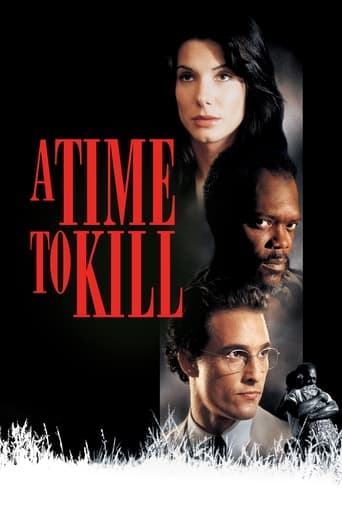
A Time to Kill
1996 · Film · 149 min
Directed by Joel Schumacher
A young lawyer defends a black man accused of murdering two white men who raped his 10-year-old daughter, sparking a rebirth of the KKK.
1 positive1 negative1 mixed2 neutralfrom 5 commenters
Where to watch
No streaming data for this title.



7 comments on Hacker News
From 1883 to 1941, the average was 56 lynchings of Blacks per year [1]. In 2018, 514 Whites were killed by Blacks [2,3] (it should be noted that the FBI data this is based on considers Hispanics White, and offenders are often misclassified as non-Hispanic White [4]). So a 10x bigger problem than lynching was at its peak (or a little less, if we adjust to per capita, since the population did grow since then).
But I accept your example - overzealous lynching did I believe sometimes cross the line from merely flawed justice, into the kind of senseless violent tradition/social phenomenon that the story allegedly draws attention to.
In the same way, the Civil Rights Act kills Whites, by forcing them to cohabit with more violent Blacks, and a media that teaches them to hate Whites. You brought up that lynching was defended as tradition, but it was also defended as morally just, and very recently - in the 1996 film Time to Kill [5]. Based on real events, it depicts two Whites that rape and nearly kill a Black girl, and her father killing them while they're under arrest, but before they reach trial. The film then turns into a courtroom drama, where that father's killing is (successfully) defended as just, and his White lawyer is redeemed from the sins of his Whiteness by defending him (explicitly stated so in the film).
The real case this was based on was slightly different - the two girls (12 and 16) that were raped and beaten nearly to death were White, and their assailant was Black [6].
[1] https://en.wikipedia.org/wiki/Lynching_in_the_United_States
[2] https://www.reuters.com/article/world/fact-check-false-data-on-us-racial-murder-rates-idUSKCN24I29S/
[3] https://en.wikipedia.org/wiki/Race_and_crime_in_the_United_States#Homicide
[4] https://threadreaderapp.com/thread/1700341490206310416
[5] https://en.wikipedia.org/wiki/A_Time_to_Kill_(1996_film)
[6] https://en.wikipedia.org/wiki/A_Time_to_Kill_(Grisham_novel)#Inspiration
There's merit to your suspicions. For example, the 1996 movie A Time to Kill depicts a black father avenging the rape and attempted murder of his ten-year-old daughter by two white men, using it to depict the evils of white racism, and justifying vigilantism. The rape (but not the vigilantism) is based on a true event, when the author witnessed the "harrowing" court testimony of a 12 year old rape and assault victim, with two simplifications: there were two victims and one assailant, instead of two assailants and one victim, and the races were reversed: the perpetrator was black, and the victims were white: https://en.wikipedia.org/wiki/A_Time_to_Kill_(Grisham_novel)#Inspiration
Similarly, the film Bad Ass features an older Latino that beats up white skinheads that were harassing and threatening him. Based on a real event, where an older white man was being harassed and threatened by a black man: https://en.wikipedia.org/wiki/Bad_Ass_(film)
The film River's Edge is about a boyfriend that kills his girlfriend, both white teens. Based on a real murder, but the perpetrator there was black: https://en.wikipedia.org/wiki/River%27s_Edge
The Netflix series Painkiller features a capable black woman lawyer that takes on the Purdue pharma in the opioid epidemic. The real lawyer was white: https://www.thepublica.com/netflix-accused-of-race-swapping-after-replacing-investigators-who-took-down-purdue-pharma-during-opioid-crisis-with-a-fictional-black-woman/
In Indiana Jones: Raiders of the Lost Ark, the Nazis have free reign in Egypt, and the locals support and cheer for the British and Allies, to the point of breaking into song lauding British sailors. In reality, Egypt at that time was effectively under British occupation, which the Egyptians fiercely disliked, and hated the British (they would have a revolution against them in 1952).
https://news.ycombinator.com/item?id=43736805 is one example. Another is the Highway of Death, which inspired a Call of Duty level, but swapped the perpetrators from US to Russians [1]. Yet another might be A Time to Kill [2], based on a novel [3], inspired by a true event. Again, perpetrator and victim were swapped - in the novel and film, there are two white attackers, and the victim is black. In the real event that inspired it, the attacker was black, and the two victims were white. The subway killing of the three scoundrels in the Joker film was likewise inspired by a real event [4], but again, the antagonists were changed from black to white. Or how Dr. Who deliberately alters historical settings [5]. Especially amusing is the case of The Sum of All Fears - in the film, the villains trying to construct a nuclear bomb are neo-nazis. In the book it is based on, the villains were Palestinian terrorists. Finally, in the real event the book was inspired by [6], the uranium was stolen by Israel.
A more straightforward example is the many times that the New York Times 'mistakenly' claimed Iraq had expelled nuclear weapons inspectors, in the run up to the Iraq invasion [7]. This is more obviously false/a lie, while the prior examples use the cover of fiction to mislead.
'Small' changes, but pervasive, like water, mostly cut only one way, and they add up.
[1] https://en.wikipedia.org/wiki/Highway_of_Death#In_popular_culture
[2] https://en.wikipedia.org/wiki/A_Time_to_Kill_(1996_film)
[3] https://en.wikipedia.org/wiki/A_Time_to_Kill_(Grisham_novel)#Inspiration
[4] https://en.wikipedia.org/wiki/1984_New_York_City_Subway_shooting#In_popular_culture
[5] “And we’ve kind of got to tell a lie: we’ll go back into history and there will be black people where, historically, there wouldn’t have been, and we won’t dwell on that. We’ll say, ‘To hell with it, this is the imaginary, better version of the world. By believing in it, we’ll summon it forth.’ - https://www.doctorwhotv.co.uk/moffat-on-diversity-in-doctor-who-we-must-do-better-80637.htm
[6] https://en.wikipedia.org/wiki/Apollo_affair
[7] https://theintercept.com/2023/03/30/new-york-times-iraq-war-error/7
Saw him recently in 'A time to kill'. Great presence as always. Somehow he's always been a great addition to any movie cast.
Are the media always this harsh on "based on a true story" movies that take a few liberties? For example, the A Time to Kill novel and award-winning films were inspired by a real rape and near-murder of 12 and 16-year old sisters, yet I don't think any publication condemned the artistic liberties taken there:
Unlike Grisham's depiction, however, the Scotts were white and their assailant was black. - https://en.wikipedia.org/wiki/A_Time_to_Kill_(Grisham_novel)#Inspiration
likewise, in "A Time To Kill" (1996) where he plays a good role, but does not say MF. That one is just an "ok" movie but it has an incredible cast: Matthew McConaughey, Sandra Bullock, Samuel L. Jackson, Kevin Spacey, Oliver Platt, Donald Sutherland, Ashley Judd, Kiefer Sutherland and more.
I didn't know who wrote this until I read the paragraph on "Time to Kill". A movie came out with that name just after I graduated high school and I was the only one of my friends to see it. Many years later, I saw him interviewed on Charlie Rose. The career transitions inspire me.