 Hacker Cinema
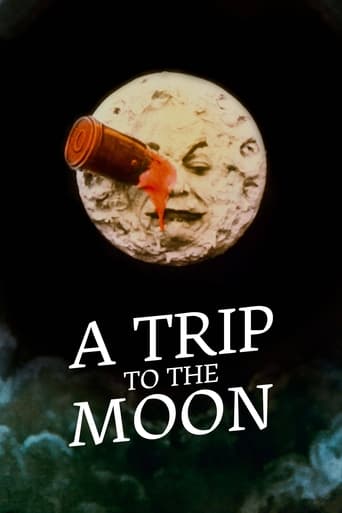
A Trip to the Moon
Le Voyage dans la Lune
1902 · Film · short · 15 min
Directed by Georges Méliès
AdventureScience FictionComedy
Professor Barbenfouillis and five of his colleagues from the Academy of Astronomy travel to the Moon aboard a rocket propelled by a giant cannon. Once on the lunar surface, the bold explorers face the many perils hidden in the caves of the mysterious planet.
1 positive1 negative11 neutralfrom 13 commenters
Where to watch
No streaming data for this title.

14 comments on Hacker News
I think the early french film - A Trip to the Moon - was pirated by edison and others in the united states and the original filmmakers didn't make any money
https://en.wikipedia.org/wiki/A_Trip_to_the_Moon
specifically:
https://en.wikipedia.org/wiki/A_Trip_to_the_Moon#Release
I think the same thing happened with movies.
Edison basically pirated "A Trip to the Moon" and showed it in the US:
https://en.wikipedia.org/wiki/A_Trip_to_the_Moon#Release
Just to add more nitpick to the nitpicking, it's a Georges Meliès movie: A trip to the moon https://en.wikipedia.org/wiki/A_Trip_to_the_Moon
I think if I had to pick a strawman expression to thoroughly defeat, it would be something like "You can't go to the moon by shooting a very big canon".
Because on the one hand, yeah, no explosion-based canon is going to get you to the moon; there's just no way to give a payload enough initial momentum to escape the earth's gravity well without killing any humans in that payload.
On the other hand, once you have canons, Newtonian physics, and an understanding that the moon is a very distant rock and not, like, a spirit god or something, then you have enough information to realize that going to the moon is only a matter of time and enough iterative improvements on those canons. It doesn't require inventing a completely novel technology like portals or teleporters or whatever. (Though it requires a ton of improvements in material science, engineering, computing, etc.)
And I think it's meaningful that From the Earth to the Moon was Jules Vernes' third book, and A trip to the Moon the first science-fiction movie even made. People could see the writing on the wall.
It's harder to make any predictions about AGI, because intelligence is a much fuzzier target than "reaching escape velocity". But it feels like neural networks are closer to the canon than to the pile of chairs: a basic concept that might not be capable of reaching general intelligence, but is only one or two steps removed from one that will reach it given enough engineering and money;
The Internet Archive has a section devoted to silent films:
https://archive.org/details/silent_films
And a Silent Hall Of Fame:
https://archive.org/details/silenthalloffame
And a Georges Méliès collection:
https://archive.org/details/georgesmelies
Specific films:
Battleship Potemkin:
https://archive.org/details/BattleshipPotemkin
The General starring Buster Keaton:
https://archive.org/details/TheGeneral_201312
Le Voyage dans la Lune
https://archive.org/details/LeVoyageDansLaLun
"she inspired a generation of film makers and artists that reality is not one that needs to be reproduced exactly as it is filmed or photographed"
I'm not sure what you mean by that, but there were plenty of films before the 1943 Meshes of the Afternoon which showed reality in fantastic, even dreamlike ways.
From the 1902 A Trip to the Moon to the 1920's The Cabinet of Dr Caligari to 1922's Nosferatu to 1927's Metropolis, and other German Expressionist films, to name just a few.
For me the new thing that Meshes of the Afternoon brought to the cinema was an explicit interest in dream symbolism.. though even that may not be that new, if you count Bunel's 1930 film L'Age d'Or and other films of the surrealist era.
Deren has often been described as being in the surrealist tradition, and I think that's accurate in as much as she was interested in artistic use of dreams and dream symbolism, and the borderline between dream and waking life.
I happened to just finish watching the HBO Miniseries From The Earth To the Moon [1] last night. The last episode features a side-plot about the french film Le Voyage dans la Lune by Georges Méliès, which had an interesting tie to Edison I had never heard of before.
Méliès had intended on US distribution for the film, but before he could make that happen, someone working for Edison bribed a theater owner in London for a copy of the film they had, and Edison then made copies which he redistributed in the US. Méliès didn't see a penny of this, and went broke within the next few years.
[1] https://en.wikipedia.org/wiki/From_the_Earth_to_the_Moon_(miniseries)
[2] https://en.wikipedia.org/wiki/A_Trip_to_the_Moon
Keep in mind that you are criticizing this from the perspective of a game culture that defines this is bad. But that culture didn't exist yet and games like this were part of the early process of creating it.
Players put up with it because this hadn't been defined as "bad" yet. The whole field of what games could and could not expect players to do was wide open.
It's a bit like criticizing Georges Méliès's "A Trip to the Moon" for having poor character development and a weak third act. Those expected aspects of film structure hadn't even been invented yet.
Imagine if Thomas Edison built his inventions off the ideas, and prototypes of others... Without crediting, or compensating them.
Which he did. [1]
[1] He even engaged in outright theft - copying, and selling bootleg movies, for Pete's sake's! https://en.wikipedia.org/wiki/A_Trip_to_the_Moon
The Prisoner (1967-1968) is mesmerising.
Le Voyage dans la lune - Georges Méliès 1902 (link provided) holds up after 115 years. Don't be so surprised! Timeless storytelling and design transcends it's delivery medium.
https://www.youtube.com/watch?v=_FrdVdKlxUk
To the people questioning whether good television is still being made, yes of course it is, it might just take you a few years to find it. True Detective, Fargo, Utopia are all great. A la carte streaming (eg select any 10 shows, 10 movies, $10/month) is the future for media consumption. Which platform will deliver this first only time will tell. At the moment original content is the model and there are some evident growth pains.
There are untold thousands of unlabelled canisters in film archives all around the world. Some of them are undoubtedly very important, but until they're catalogued we won't even know.
Unfortunately, most film archives are enormously under-funded. Here in the UK, arts funding (which is where this normally comes from) has dropped dramatically since the financial crisis. When Jeremy Hunt axed the UK Film Council[1], most regional film archives totally lost their funding. When their money disappeared, so did any chance of employing cataloguers.
A proper archive will at least be storing their film in environments with the proper humidity and temperature to reduce decomposition as much as possible.
The other side of it is that the more decomposition that's happened, the more time you need to invest into restoration. See the 11 year restoration of the 18 minute Voyage dans la Lune for an extreme example[2]. That kind of effort is only possible for a film of enormous historical importance and at least some commercial value.
Source: My partner's a film archivist and moving image historian.
[1]: https://www.theguardian.com/culture/2010/jul/26/uk-film-council-axed [2]: http://sensesofcinema.com/2012/feature-articles/chromatic-frankensteins-monsters-restoration-colour-and-variants-of-georges-meliess-voyage-dans-la-lune/
Avatar and TDK historic points in film. AKA Dancing with Smurfs, and The Movie With More Plot Holes Than The Titanic. Hum, I beg to disagree.
Overall, I got a good laugh from the list. Seriously, this list should be called "things white US kids (of my age, granted) like". Rather than a history of cinema, it belongs more in the "comedy generated by computer" genre. Exhibit one: City Lights isn't there. Exhibit two: Modern Times isn't there. No Le Voyage dans la Lune, no Man With Camera, no Great Train Robbery, Rashomon isn't cool enough to make the list, Vertigo is too weird, and Battleship Potemkin is, like, too commie, you know. The final straws would be Independence Day and It's a Wonderful Life making the list.
I mean, On the Waterfront looks like it's very good (I haven't seen it), but, but, it was released in the same year than motherfucking Seven Samurai!
Harvard University, for example, dates to the Ming Dynasty.
I do not disagree that there are no traces of old culture. However, go to any random city in, say Europe, the middle east, or Asia. Chances are high that you will easily find artifacts from the roman age until now. Most of the US is new, in many cities you'll have to work hard to find something older than one hundred or two hundred years old. This is not a criticism, but many people appreciate cities and artifacts that are old ;).
Also, with respect to culture in the other sense, the difference is huge. US city centers tend to be boring (with notable exceptions such as New York), since much of the activity is in the outskirts, and are only reachable by car. Compare this to many other countries, where city centres are cramped with pubs, small theaters, etc, and people tend to hang around until the early morning. I liked some cities int this respect (e.g. Portland), but in comparison it's still a bit dull.
The United States also has new culture such as ragtime, jazz (various genres), blues, soul, rhythm and blues, rock and roll, and hip-hop music that compare favorably in the aggregate to traditional music from anywhere in the world,
It's just marketed a whole lot better. E.g. I am into jazz mostly, and American musicians are the most well-known. But Europe had (and still has) a lively avant-garde scene, which was at least as progressive is the scene in the US. In Africa, mostly isolated and in parallel, what resembles modern jazz developed (e.g. check out the excellent Ethipiques series). One good example is Getatchew Mekurya from Ethiopia, who developed his own weird flavor of jazz, that sprung directly from traditional ethiopian music. Anyway, I digress. The rest of the world had thriving and progressive music scenes, but often failed to package is for mass consumption.
broadcast media and motion pictures that were largely invented here
Are you kidding? Ever heard of Nosferatu, Battleship Potempkin, Le voyage dans la lune?
but now enjoyed around the world
Hollywood movies are often looked down upon as superficial, but 'ok if you want something easy'.
and this cool thing called the Internet that links all of us together on Hacker News.
True, ARPAnet was invented in the US, but the 'interface' that we all use was invented by a Brit in Geneva ;). Sure, it had its precursors, but the point is, that in contrast to popular belief, the US did not bring us to modernism. It's a collective contribution.
It's not video, it's film that has been converted to video.
Moving Pictures have been around since the late 1800's. The first Sci-Fi film was made in 1902 actually -
http://www.youtube.com/watch?v=xbGd_240ynk Le voyage dans la Lune, Méliès, 1902