 Hacker Cinema
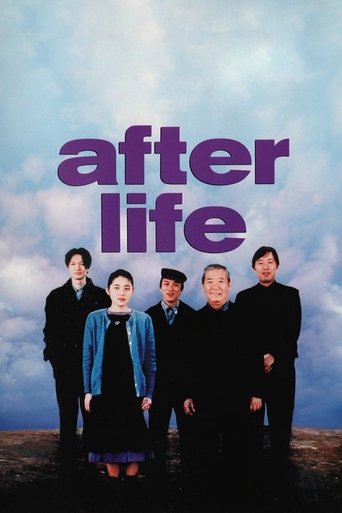
After Life
ワンダフルライフ
1999 · Film · 118 min
Directed by Hirokazu Kore-eda
On a cold Monday morning, a group of counselors clock in at an old-fashioned social services office. Their task is to interview the recently deceased, record their personal details, then, over the course of the week, assist them in choosing a single memory to keep for eternity.
2 positive1 negative1 mixedfrom 4 commenters
Where to watch
No streaming data for this title.




4 comments on Hacker News
I love Kore-eda but it took me many attempts to get through After Life. I'm really glad it wasn't my first Kore-eda film. I find it terribly boring.
Japanese films are notoriously bad. You found a few gems. They are rare. This topic comes up often in Japanese learning groups.
There's also just personal takes. I had to shut off Memories of Matsuko. Maybe the end saves it but it was way too over the top and not in a good way.
Some good older Japanese though
Kurasawa: Ikiru (1955)
Teshigahara: Woman in the Dunes (1964)
These are 2 movies you won't forget.
Conversely, even though I enjoyed Shoplifters I remember nothing about it except the guy celebrating he had sex and the girl burping. Similarly with After Life. I just watched it 2 months ago and had to go look it up to remember what it was about. It was interesting because of the premise but not because of the movie itself.
Sounds like you might enjoy the 1999 movie After Life. A+
Great passage. As a digital artist who works with fractals, that really resonates with me. Visual fractal detail quite often converges to visual noise (and looks remarkably like a noise function as expressed on e.g. a TV set). I usually need to remove or de-emphasize that noise in order to clarify the direction and abstract intent of the work.
One of my favorite films that works along these lines is the 1998 Japanese film "After Life," in which a small party of workers attempt to recreate others' memories with very basic film studio equipment. I absolutely treasure the loss of detail in the various recreation scenes, and the way it suggests that there is actually a satisficing point at which we might realize, "yes, I'm actually reliving that memory right now." So I agree with Mr. Graham's conclusion that technology can bring this about.
On an unrelated note, PG's essays always bring to mind the Meyers-Briggs INTJ type. Essays about the annoyance of accumulating "stuff", a focus on abstract / intuitive learning styles, and clever writing which quickly establishes a theoretical framework which is then thrown against the world's (audience's) experience, rather than starting from first principles hoping to eventually reveal a framework as others might do. His seems to me very much a "systems thinker" approach.