 Hacker Cinema
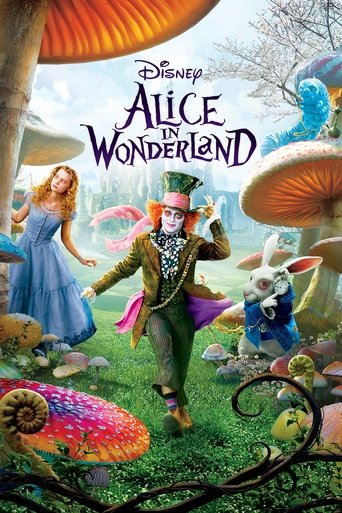
Alice in Wonderland
2010 · Film · 108 min
Part of Alice in Wonderland Collection
Directed by Tim Burton
Alice, now 19 years old, returns to the whimsical world she first entered as a child and embarks on a journey to discover her true destiny.
3 positive5 negative1 mixed11 neutralfrom 20 commenters
Where to watch
No streaming data for this title.
21 comments on Hacker News
I think you've experienced a bit of Mandela effect. Alice in wonderland is in fact mentioned as a metaphor in the movie. However, Alice would eat cake and take pleasant tasting potions to change size.
What's wrong with propaganda? Is that a reason why you haven't seen for example Apocalypse Now?
You might want to watch Andrei Rublev, at its inception a controversial movie heavily disliked by the Soviet state:
https://sovietmoviesonline.com/drama/andrey-rublev
Edit: And then the post-soviet Fairy, which ruminates on the legacy of Tarkovsky's masterpiece.
https://sovietmoviesonline.com/fantastic/fairy
The rest of Melikyan's movies are also quite interesting and fun.
They also distribute post-Soviet russian movies and television series. You should watch the two takes on The Master and Margarita, both high profile projects based off one of the most beloved books in Russia, from two very different times in russian society:
https://sovietmoviesonline.com/drama/master-i-margarita-mini-serial
https://sovietmoviesonline.com/melodrama/the-master-and-margarita-2
The Soviet was especially good a adventures for kids and science-fiction, of which you'll find a lot there, for example Alice in Wonderland and Hard to be a God. You should watch the takes on the latter to get a feel for differences between soviet and post-soviet societies. If the younger version feels hard to watch you might need to watch The Green Elephant and other movies from the russian nineties to prepare yourself and better understand the feelings and mindset of the time.
And if you want you can watch old propaganda movies about the Donbass or whatever, you'll learn a lot about places you likely know very little about.
> While I agree with you, I'm struggling to find a good argument why intellectual property should be treated differently from physical property
1) First reason, it is not physical property.
2) Second, many of the creators who lobbied for longer copyright terms benefited from a rich public domain when they did not have anything. In the case of Walt Disney, he made a film series based on Alice in Wonderland, which never had copyright protection in the US, and it's copyright expired in the UK in 1907.
https://en.wikipedia.org/wiki/Walt_Disney#Early_career:_1920%E2%80%931928
Translators get their degrees for a reason. While they can't make everyone into a master, they can help with avoiding mistakes most amateurs do. Then, of course, there's a question of personal breadth. If a person imagines that lively characters talk like they are in a sitcom, there is little you can do about it.
Consider that Vladimir Nabokov rarely, if ever, mentioned that one of the very first works published under his Russian pseudonym was a translation of “Alice in Wonderland”. It was a very thorough work in which each twist was given a match from more or less similar saying, poem, nursery rhyme, etc. Alice became Anya, and names got translated to something familiar to kids. The thing is, one might wonder where Lewis Carroll was in that. What is worse, because of the Revolution, almost all of the rhymes and jokes to which he alluded would be unused by next generations both inside and outside the country, and therefore forgotten.
I got this on my 4th try or so: https://thismoviedoesnotexist.org/movie/alice-in-wonderland
Children getting whisked away by a handsome protagonist and his magical sidekick to fight against "cool things" like pirates and mermaids in a world unlike our own?
Its an Isekai.
---------
Isekai is this modern trend in anime (and US movies sometimes!! Like Ready Player One), where characters are sent to another world. Sometimes due to death explicitly ("Reincarnated in a New World" plotline: like "I'm a Spider So What"), sometimes just "temporarily" transported (Sword Art Online / Ready Player One, they are "just" playing a video game).
From an "Isekai" perspective: people want two things.
1. A world very different from our own. Completely different "physics" or rules. So magic systems, history, culture, etc. etc. that's nothing like our world. Neverland easily qualifies.
2. A character who explores the new world from our perspective. The main character is always someone "like the audience", who can be ignorant about the new world. (The various characters the protagonist meets are therefore given an opportunity to explain the world to the newcomer, allowing the audience to learn about the world in a natural manner). In Peter Pan, Wendy is the Isekai protagonist.
------
Alice in Wonderland, Connecticut Yankee in King Arthur's Court, Wizard of Oz, A Lion, A Witch, and the Wardrobe. The concept happens again and again as a pattern, because its a good framing device. I'm not sure if Peter Pan can be seen as an allegory of death necessarily, any more than "I'm a Spider, so What?" (2021 Anime) could be.
The children are... children... because the main character often should match the profile of the target audience. Not always, but its a good rule of thumb to keep. Children stories will therefore have child-protagonists more often than not (Polar Express, Lion Witch Wardrobe, Harry Potter). There are exceptions (Peanuts has child protagonists but is largely written for an adult audience), but its just the rule of thumb authors seem to use.
It's like saying that Alice in Wonderland or Wind in the Willows are mere... books...
Games are an art form, completely on par with books, paintings, or movies. I'd say they are one of the most important art forms of our times.
Type "The Cat In The Hat" in a search engine. Surprised to see a Mike Myers film all over the front page?
Or try "Alice in Wonderland".
Search engines are too of the moment — maybe too corporate-bent? Or do we blame the users? Do most people want a bad film when they search rather than a literary classic?
That's great! I'll be sharing that site with my homestay family, who have kids aged 6 and 9. On Monday this week I asked the older one to read a Wikipedia list of Disney films and Dreamworks Animation movies and here's the list she made, which you can compare with the ones on your site:
Alice in Wonderland; Toy Story 3; Incredibles; Pinocchio; Lion King; The Tale of Despereaux; Winnie the Pooh; Maleficent; Cinderella; Frozen; Frozen II; Moana; The Santa Clause; Coco; Pirates of the Caribbean; The Princess and the Frog; Brave 2012; Beauty and the Beast; Born in China; The Boss Baby; Abominable; Trolls World Tour; Gift of the Night Fury; Shrek (all); The Grinch; Book of Dragons; Kung Fu Panda; Puss in Boots; Dawn of the Dragon Racers; Marooned ; Prince of Egypt; Peter Rabbit; Aladdin 1992; Aladdin 2019; Shark Tale; Wallace and Gromit; Chicken Run; Bee Movie; Turbo 2013; Home 2015; Captain Underpants; Tangled 2010; Harry Potter; Despicable Me; Despicable Me 2; Minions; The Secret Life of Pets; The Little Ghost; Waking Sleeping Beauty; Cleopatra in Space; My Neighbour Totoro
If you think about it this came about through laziness and to lower budgets, same deal with great programmers, programmers shouldn't want to do repetitive lazy work but innovate it away. Tedious work becomes a pain on time and budgets, so you innovate to do it faster/better.
Animators didn't want to draw all the backgrounds slightly moving and this allowed re-use and new innovations to make movies faster. This allowed animators to focus on the character cels and making characters look better, the main focus.
The multiplane camera with movable layers for parallaxing directly led to some of the best early Disney movies (Snow White and the Seven Dwarfs, Pinocchio, Fantasia, Bambi, The Adventures of Ichabod and Mr. Toad, Cinderella, Alice in Wonderland, Peter Pan, Sleeping Beauty and The Jungle Book) and helped their budget as well as made them look better. Plus at the time, it was actually an improvement that animators welcomed to speed up their tedious work.
That was the predecessor not the multiplane aspect of it with moving layers, definitely inspired it. Lotte mostly just used it to swap out colored backgrounds on her silhouette cel style to adjust placement and color.
A predecessor to the multiplane camera was used by Lotte Reiniger for her animated feature The Adventures of Prince Achmed (1926). Berthold Bartosch, who worked with Reiniger, used a similar setup in his film L'Idee (1932).
Ub Iwerks invented the multiplane camera with movable layers to create parallax and zooming [1] which created immersive depth. It also saved on budgets, tedious background animation and allowed animators to focus more on the character cels, the star of the show.
The first multiplane camera, using movable layers of flat artwork before a horizontal camera, was invented by former Walt Disney Studios animator/director Ub Iwerks in 1933, using parts from an old Chevrolet automobile. His multiplane camera was used in a number of the Iwerks Studio's Willie Whopper and Comicolor cartoons of the mid-1930s.
Fleischer Studios (Popeye/Betty Boop) also made one or copied in 1934 [1]
The technicians at Fleischer Studios created a distantly related device, called the Stereoptical Camera or Setback, in 1934. Their apparatus used three-dimensional miniature sets built to the scale of the animation artwork. The animation cels were placed within the setup so that various objects could pass in front of and behind them, and the entire scene was shot using a horizontal camera. The Tabletop process was used to create distinctive results in Fleischer's Betty Boop, Popeye the Sailor, and Color Classics cartoons.
William Garrity took Ub Iwerks invention further and that iteration was used in many large successful movies they made [1]
The most famous multiplane camera was invented by William Garity for the Walt Disney Studios to be used in the production of Snow White and the Seven Dwarfs. The camera was completed in early 1937 and tested in a Silly Symphony called The Old Mill, which won the 1937 Academy Award for Animated Short Film. Disney's multiplane camera, which used up to seven layers of artwork (painted in oils on glass) shot under a vertical and moveable camera, allowed for more sophisticated uses than the Iwerks or Fleischer versions, and was used prominently in Disney films such as Pinocchio, Fantasia, Bambi, The Adventures of Ichabod and Mr. Toad, Cinderella, Alice in Wonderland, Peter Pan, Sleeping Beauty and The Jungle Book
[1] https://en.wikipedia.org/wiki/Multiplane_camera
Disney is pretty much only a huge force from using public domain to make money, yet they routinely do things to avoid their IP from entering the public domain.
Some examples [1]:
- Frozen (2013) from Hans Christian Anderson’s Ice Queen (1845) - Revenue = $810.3 million
- Alice in Wonderland (2010) based on Lewis Carroll’s book (1865) - Revenue = $1.02 billion
- Snow White (1937) from the Brothers Grimm folk tale (1857) - Revenue = $416 million (10th highest grossing film as adjusted for inflation)
- Aladdin (1992) from a folk tale in One Thousand and One Nights (1706) - Revenue = $504 million
Then you have their lobbying:
"In 1998, Copyright was up for it’s last copyright term extension, from life +50 years to life +70 years. Disney’s Mickey Mouse copyright had accounted for up to $8 billion in revenue in 1998 when they were lobbying for copyright extension.
Disney’s Chairman, Michael Eisener personally met with then-Senate Majority Leader Trent Lott. The day Lott signed on as co-sponsor of the bill, Disney’s PAC donated to Lott’s campaign. Within a month Disney also gave $20,000 in soft money to the National Republican Senatorial Committee. Of the 13 initial sponsors of the House bill, 10 received contributions from Disney’s PAC. On the Senate side, 8 of the 12 sponsors received contributions" [2]
Protect $8B with some cheap lobbying. What a deal!
[1][2] http://www.forbes.com/sites/derekkhanna/2014/02/03/50-disney-movies-based-on-the-public-domain/#394c4cf41645
I must have been some highly developed child growing up. When I was around 4 or 5 my parents read to a lot of Shel Silverstein and of course plenty of Dr. Seuss.
When I saw the Lorax film, I immediately knew it was about over consumption of resources and a little later on (ages 8 or 9) felt a strong environmental pull during the whole movie.
Even the Sliverstein books made me sad. Take for instance, the Giving Tree. People to this day talk about what the meaning really is:
https://www.mtholyoke.edu/omc/kidsphil/questions/Givingtree/givingtree_discussion.html
When my parents read it to me, I was saddened by the fact the tree gave everything to the child, and the child never seemed appreciative of the gifts. On the one hand, I felt it was about being selfish and even when life has handed you everything, happiness was still elusive. On the other hand, it also spoke to me about generosity, and giving to others who don't have as much as you.
Other books just confused me. Alice in Wonderland just gave me nightmares, never mind what the actual meaning of the story was. I'm content to think it was just some crazy acid trip Carroll was recounting.
I feel like the more depressing themes seemed to connect with me as a child, while some of the deeper meanings (The LOTR series and Wizard of Oz) I totally missed. Even after seeing the Star Wars movies, a friend had point out all the biblical parallels. Like Darth Vader being his father. Father in German is Vater. Vader, Vater, it's so very close, but once pointed out, so obvious.
The gulf between homage and derivative work is quite wide. Consider a few examples of famous derivative works: Baz Luhrmann's Romeo + Juliet, Alice in Wonderland, Apocalypse Now, Muppet Christmas Carol. Right now there are no less than 3 different ongoing adaptations of Sherlock Holmes (the movie series, the BBC series, and CBS's Elementary series).
These are works that would be patently illegal if the source material were not in the public domain. This isn't just about "remix culture", it's about being able to adapt and interpret what's out there, fully and without restriction. Clearly there is value to allowing such artistic freedom once a work has grown sufficiently old. However, today that age has grown quite impractically long. A movie such as War of the Worlds (a 110+ year old book) can be made without seeking a licensing agreement, but movies such as The Hobbit (a 75 year old book), King Kong (79 years), The Chronicles of Narnia (62 years), Casino Royale (59 years), or The Dark Knight Rises (73 years) still require licensing.
And the sad part is that even in the next 20 years when, say, the Superman IP will be pushing 100 years old and Mickey Mouse even older it seems likely that such things will still require licensing.
The fact that the current IP laws have not utterly destroyed creativity or the productivity of creative industries is not a ringing endorsement. The fact is that they are stifling and they have been responsible for creating an industry which is too heavily controlled by a small group.
I've always really liked 3D movies when it's well done. I thought it really made Avatar more amazing and it gave Alice in Wonderland an even more other worldly effect. Most animated movies turn out really well too.
Of course, most movies aren't filmed with 3D in mind and it is crappily added in post. Those suck.
I don't mean to be dismissive of your points, because they do have some merit in this discussion, but I feel compelled to point something out.
Lots of people, otherwise very smart and picky people, have absolutely no "taste" for visual content. They will cheerfully accept the most terrible photographs and shakey video if they accept that as par for the course. Artists tend to take a more objective view, and frequently notice things that their audience may not consciously notice, but that do have measurable effects on the overall quality of the production.
This is as true for videography as it is for photography (in which emotional investment can make people overlook ridiculous image flaws for years before finally seeing the ugly half-face in the corner or a totally botched focus). Unless you train yourself to look objectively, you're often not seeing what's in front of you, merely representing it and evaluating that representation (which is always the case, of course, but there are naturally degrees of fidelity).
For example, I saw Alice in Wonderland 3D, and I was viewing it at the excellent Sundance theater in San Francisco. We're allowed to take drinks into the theater, and we all had a Bit Too Much™ before the start. I don't remember the 3d of that movie being bad, but upon re-inspection and some pointers I can see what a hack-job that was, even among its lackluster peers at the time.
I believe this tells us a lot. The torrent crowd does not represent exactly the moviegoers audience. Lots of downloaders would never go to the movies, even if they crave a movie, it represent different age groups, different behaviours
For instance, "Kick Ass" which is largely a film designed for geeks, is #2 even though it only did $98 million at the box office. You've got to wonder why it's ahead of Inception. In the same way, "Alice in Wonderland" did $1.02 billion in 2010 but it's not on the top 10. The torrent demographic is probably the same one that'd jailbreak the iPhone or use Android more than the rest of the society. A demographic immune to marketing, which can sort out good movies from bad perhaps better than the press, but also biased towards a certain type of movies (Kick Ass, action hero etc.)
Paying $5-10 extra per person for 3D is overrated, especially for movies that aren't shot explicitly for 3D. Animated films like Toy Story and Despicable Me are ideal, and possibly worth an extra few dollars. Alice in Wonderland was not.
The novelty has worn off - it's a premium experience for some films, and a detractor for others.
I've seen 3 movies in 3D. With Avatar and How To Train Your Dragon, I felt the 3D added something worthwhile to the experience. With Alice In Wonderland, it didn't.
I don't think I'd want a 3D TV though, not while you need special glasses to see the picture properly. It's one thing wearing them when you've made the effort to go to the cinema, quite another when you're just casually watching at home; they become something else to lose, like the remote only not as useful.
Having only seen two movies on this list (Avatar 'Real' and Alice in Wonderland 'Fake') my observation is hardly exhaustive, but there was a definite difference in the 3D experience.
With Avatar, the third dimension seem to come out at you from the screen - I even had a cliched duck for cover at one point. With Alice the third dimension seemed to be depth in the screen - many shots felt like you were figuratively looking down a rabbit hole, rather than being immersed within one.
And for what it's worth, I don't mind paying a few bucks extra for the 3D version, real or fake.
Top Headlines from Digg right now:
Oregon Woman Loses $400,000 to Nigerian E-Mail Scam First Look at Johnny Depp- Mad Hatter in Alice in Wonderland New honeycomb tire is 'bulletproof' If TV Shows Had Truthful Titles Phil Gramm Has No Remorse Over Destroying the US Economy Chinese pirates crack Blu-ray DRM, sell pirated HD discs Top 10 Unfortunate Political One-Liners 30 Rare & Expensive Gamecube Games New MythTV Interface Preview Mark Cuban charged with insider trading.
Anyone see a male bias there? The Johnny Depp article would actually tip the scales to the female side in my opinion.