 Hacker Cinema
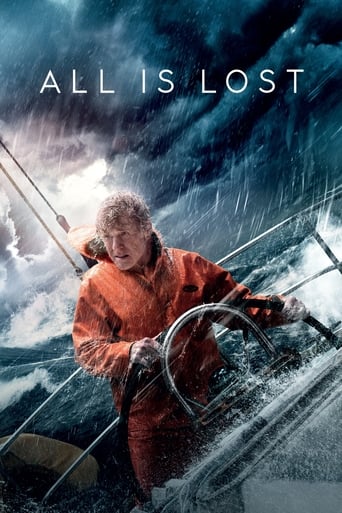
All Is Lost
2013 · Film · 106 min
Directed by J.C. Chandor
During a solo voyage in the Indian Ocean, a veteran mariner awakes to find his vessel taking on water after a collision with a stray shipping container. With his radio and navigation equipment disabled, he sails unknowingly into a violent storm and barely escapes with his life. With any luck, the ocean currents may carry him into a shipping lane -- but, with supplies dwindling and the sharks circling, the sailor is forced to face his own mortality.
10 positive1 negative4 neutralfrom 15 commenters
Where to watch
No streaming data for this title.
15 comments on Hacker News
”All Is Lost” is great too. Robert Redford, no dialogue at all in the film.
I do think this is one of Redford's very best films. A lot of detractors make the mistake of assuming the character is intended to represent an expert & experienced sailor, leading to a complete misread of the story. It is possible to be both clever & unwise.
Edit: Screenplay link! https://thescriptsavant.com/movies/All_Is_Lost.pdf
"All is Lost" (2013) funny enough got me interested in offshore sailing in my late teens.
Incredible performance by Redford, first film that really left an impression on me. There is only one or two lines of dialogue in the entire film.
https://www.imdb.com/title/tt2017038/
https://www.rogerebert.com/reviews/all-is-lost-2013
All Quiet on the Western Front (1933) has a silent version. It was shot differently.
More - https://www.imdb.com/search/title/?num_votes=10000,&sound_mixes=silent&sort=user_rating,desc
Also I quite liked "All Is Lost" (2013) and of course "Hundreds of Beavers" (2022) for contemporary films
How about this: MCU movies begin production with the VFX work for the major action scenes. This happens before they have a script or even a director. Have you ever noticed how MCU movies feel like a completely different movie once the CGI action sequences start? It’s because they are. These are not serious works of craft: they are marketing exercises meant to keep a money tree well watered.
I was never the target audience for this stuff but I was willing to be dragged along to Iron Man and Captain America because at that time “October Movies” still existed. That is mid budget Hollywood dramas and thrillers targeted towards adults, typically with an edgier tone, released in October after the summer tent pole season has run down but before Oscar candidate season has fully started. Basically everything David Fincher directed prior to being scooped up by Netflix fell into this category. Nightcrawler, All is Lost, and Captain Philips, are other “recent” examples, but of course they’re from the first half of the 2010s because Hollywood no longer green lights projects like these in the cinematic universe era. When MCU critics talk about crowding out better films, this is the sort of thing they’re referring to.
Look I apologize for not containing my scorn, but the fact is that the typical 9 year old can understand everything there is to understand in an MCU film modulo the punchline of a couple jokes. These are thematically simple films with no point of view and nothing to say for fear of shrinking the size of the big tent. The sad thing is that films targeted at children don’t have to be dumb; Bambi for example is a shockingly grownup film that sensitively deals with the passage of time and seasons, death and grief, coming of age, the hardness of life, and the cycle of generations, all within a runtime of under 70 minutes. There’s a lot going on there for the story of a fawn who does stuff in the woods. Yet that kind of depth does not exist in the children’s cinema of our times, ie the MCU, and the popular audience doesn’t even know to ask for it anymore.
We’re a stupid people and we get served correspondingly stupid culture. Sorry to rant and be rude, but in my view the MCU’s popularity is one of the leading indicators of our cultural decline, right up there with Trumpism and social media.
There's a difference between ambiguity that's integrated into a story and ambiguity that's forced on the viewer. If the only thing that makes the movie ambiguous is that the final shot of the film isn't five minutes longer, then that is the type of film I hate. All Is Lost, The Grey, Save Yourselves, etc. If it's woven into the story from the beginning then I have no issue with it even if it may not be for me.
All Is Lost[1] follows Robert Redford after a floating shipping container crashes into his yacht. It's very good but a rather harrowing film!
[1] https://www.imdb.com/title/tt2017038/
The format for production screenplays evolved according to the needs of the people needing the physical pages on set, e.g. dialogue has a lot of whitespace so that director and actors can keep notes there. Also, scene headings need to convey a lot of information in one line: on which set the scene in shot, whether it exists as a continuation of the previous scene, whether it's shot on location, and what lighting equipment will be needed.
It's a storytelling format that also needs to function as a reference document. It's very efficient for its requirements.
There's also the idea that one page = one minute of screen-time, but this is a bit of a red herring. Rather it's that overall a 100-page screenplay, if it contains a conventional balance of action and dialogue, with conventional length of scenes, shot at a conventional pacing, will likely result in a 100-minute film once edited. ALL IS LOST is 32 pages and 105 min film, THE SOCIAL NETWORK is 164 pages, 120 min film.
_All Is Lost_, the 2013 movie about exactly this, is actually a really great film.
Except for the first five minutes, there is only a single word of dialogue in the script: "FUUUUUUUUCK!"
After seeing the film All is Lost with Robert Redford solo sailing around the world I have a deep visceral fear of partially submerged shipping containers. You could be sailing thousands of miles from shore and suddenly sinking.
How big of a problem is 1800+ containers lost in what I assume is a major shipping route?
The first thing that came to mind is the movie All Is Lost (2013)[1].
[1]: https://www.imdb.com/title/tt2017038/
The Guardian's take is interesting but I don't think the app economy is driving such a trend. There's been a fundamental shift in movie making in Hollywood. This was precipitated by the loss of the Blue Ray and DVD market on which they could always depend for additional revenue stream. Often times a very lucrative one for a popular movie and $40 price point. With the loss of this revenue stream Hollywood seems to be intent on movies that are as universally appealing as possible. And lack of dialogue furthers that end. It's easy to dispense with dialogue if you are filling that void with shooting, explosions, car crashing and gratuitous violence.
For a different take on lack of dialogue, a highly recommend Robert Redford in "All is Lost." A a beautiful and completely compelling movie with no dialogue, and a single actor and a single setting. Of course Hollywood didn't finance this film and it takes an extraordinary actor to pull this off.
One of the absolutely necessary things you should have on board is solar panels, to keep your radio alive.
Also, the movie All Is Lost comes to mind.
I think people are missing the point of the story. The ship in the film is The Endurance (see Ernest Shackleton).
Set off for Antarctica, at the time might was well have been setting off for a black hole. Bad things happened, was presumed lost, then years later, makes it back to civilization.
At face value, it's a sci-fi movie, and that eye candy got people into theatres, but I think it's better compared to stories like The Life of Pi or All Is Lost. Nitpicking on how accurate the science is in a fictional story sort of misses the point that it's a story.
TL;DR - paid to see it in IMAX and was thoroughly entertained knowing it was a made up story.
The containers are dangerous. You should watch the film "All is Lost", it's about that exact scenario where it shipwrecks a solo sailing ship.
http://imdb.com/title/tt2017038/