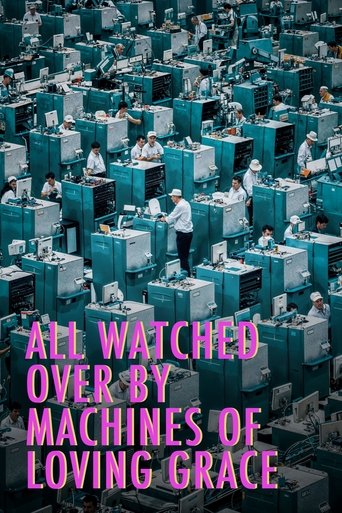
All Watched Over by Machines of Loving Grace
2011 · TV series · documentary · 1 season
Created by Adam Curtis
We have been colonised by the machines we have built. Although we don't realise it, the way we see everything in the world today is through the eyes of the computers.
50 positive2 negative1 mixed6 neutralfrom 59 commenters
Where to watch
No streaming data for this title.
71 comments on Hacker News
Highly recommend the extremely good multipart documentary All Watched Over By Machines Of Loving Grace by Adam Curtis for a fun and wide ranging if slightly silly look at the nexus of Greenspan, Ayn Rand, Silicon Valley, computer technology etc
I remember a mild kerfuffle amongst my sili valley friends when this came out, but I never thought to look up the book at the time. In intervening years I thought it would be a decent read but couldn't remember the name or author, so thank you everyone involved for the reminder.
I do remember the shift from eighties flavoured techno-utopian brautiganesque libertarianism to the more modern "liberty only means not paying taxes and letting me block off beach access" style. I remember noticing it around '98, which means it was going on for at least a decade beforehand.
I can recommend Curtis' documentary "All Watched Over by Machines of Loving Grace." (Named after a Brautigan poem.)
And every time people tell me sili valley has always been a hot bed of randian/heinleinian libertarian thought, I like to recommend "What the Doormouse Said." There was a time when things were different.
Yes, that's absolutely the allusion. Brautigan's line is a popular title for stuff, including a widely read post by Dario Amodei two months before the CCC talk you've linked:
https://www.darioamodei.com/essay/machines-of-loving-grace
And it's also the title of an Adam Curtis documentary:
https://en.wikipedia.org/wiki/All_Watched_Over_by_Machines_of_Loving_Grace_(TV_series)
It's a good line.
Wait until "world models" fail to work along these lines. Models are always wrong. They're useful only as interpretations, they can never reproduce, reference, or mimic the events in question.
Another great example is Tansley's ecological systems model that he worked on for over many years with influence from Forrester only for the Odums to develop models, attempt to reproduce them in controlled environments and watch them fail miserably.
The cybernetic, computational, systems, world models are illusions all. AI has the same limitations simply because the infinity of tasks can never be modeled or automated.
Most of the ideas in the article can be seen, very clearly and cleverly narrated, in Curtis's best series "All Watched Over By Machines of Loving Grace" particularly episode 2.
The term's context belongs to the USSR right before it broke apart.
If you look at Adam Curtis' wealth of documentaries, one of which helped popularize the term hypernormalization:
https://en.m.wikipedia.org/wiki/Adam_Curtis
you will find Curtis oeuvre relies on mashing up content extracted from BBC's massive news archive arranged according to themes chosen by Curtis.
Once of Curtis' central themes is the observation of an intellectual gap between rationalist comprehension of the world through the news, and the wobbliness of how the world actually manifests, especially in the context of politics and leadership. The implicit, recurring question being what are the limits of our science to account for ourselves.
Curtis offers many views into the Soviets, especially in a series devoted to riffing on the mood of Soviet society during the 80s and 90s titled Traumazone.
Curtis' picks from the archives may help you gain a sense for distinctions between the political preconditions of the end of the USSR and ongoing mess of U.S. politics.
One take is that since the 20th century, the orientation of political leadership has profoundly changed: politicians no longer seek to offer coherent solutions in a mechanical nation, they seek the necessity of their own power in an electoral marketplace of influence within an organism of society.
Under such view, the question can be formed: Did the USSR may come undone because its bureaucrats couldn't account for everything well enough to coherently operate an economically coherent centralized state?
Curtis tries to form the same question for Thatchers' & Blair's UK when observing how the British Empire fell apart.
The intro to his film Hypernormalization sets forth the essential observation leading to such questions:
//"How we got to this strange time of great uncertainty and confusion where those who are supposed to be in power are paralysed and have no idea what to do".//
If this observation is true-- which question is begged through the survey of news-- then should it be expected that more centralized societies, however well controlled, might be more vulnerable to limits of understanding of their leadership, and by corollary as no society's leadership has a complete understanding of itself, churn and crisis are inevitable.
All of Curtis' docs deal with variations on the question of the limits of rationalism. His work now amounts large trove on the topic (see filmography):
https://en.m.wikipedia.org/wiki/Adam_Curtis
A excellent aspect of Curtis' work is that he is careful to always veer away from simple proscriptive judgements. He does not pursue belief that there's any specific way that societies are supposed to work, but rather continuously questions how and why they work as they do, embracing the possibility that minds can change and adapt in the face of uncertainty and crisis.
—
PICKS
For this thread, the obvious place to start is:
1 Hypernormalisation.
After this consider the following, in order:
2 All Watched Over By Machines of Loving Grace
3 Oceans Apart
4 Can't Get You Out of My Head
5 Century of the Self
6 Bitter Lake
and then on in any order that suits your interests.
As these docs produce an effect much like good music as well as offering high-quality narrative insights, they can be revisited and appreciated in changing ways with experience.
All Watched Over by Machines of Loving Grace - Adam Curtis
https://en.m.wikipedia.org/wiki/All_Watched_Over_by_Machines_of_Loving_Grace_(TV_series)
See ep-1 "Love & Power," on contradictions of Ayn Rand's life versus her philosophy; can be found on yt / vimeo
Series supplies interesting history for any nerd interested in systems analysis and provides a survey of California Ideology.
His documentary on the legacy of Henritta Lacks' immortal cells and biology, "The Way of All Flesh" is also interesting food for thought on systems analysis.
The BBC TV series “All Watched Over by Machines of Loving Grace” touches on efforts in the last decades of the 20th century to model ecosystems with feedback loop models. It’s quite well-directed, and an interesting watch if you liked the Wikipedia article.
The TV series “All Watched Over by Machines of Loving Grace” talks about how scientists tried to simulate balance in nature with control theory and found that there isn’t much balance at all. The premise that there is balance, despite being very popular, was shown to be false.
I recommend a watch, it is very well-directed too. But here is Wikipedia saying the theory has been discredited if you don’t want to spend the time on the documentary series: https://en.wikipedia.org/wiki/Balance_of_nature
Adam Curtis made a fantastic documentary on the darker side of our relationship with technology. I don't agree with all of his points, but it's still a great watch.
From Wikipedia: Curtis argues that computers have failed to liberate humanity, and instead have "distorted and simplified our view of the world around us".
https://en.wikipedia.org/wiki/All_Watched_Over_by_Machines_of_Loving_Grace_(TV_series)
Also the name of a documentary series by Adam Curtis: https://topdocumentaryfilms.com/all-watched-over-by-machines-of-loving-grace/
You might like the second episode of All Watched Over by Machines of Loving Grace. It talks about how techno-utopians tried to model society and nature as feedback loop controllers.
One might say a part of the reason they have failed is because nature and people don't much care for the I term. These systems have feedback loops for sudden events, but increase the temperature slowly enough and the proverbial frog boils.
There are very many undercurrents in our world we do not see. So much that even when we think we understand and can predict their effects, we almost never take into account the entire system.
Andreessen seems to embody the final evolution of tech libertarianism as depicted in Adam Curtis's documentary "All Watched Over by Machines of Loving Grace" [0].
If you haven't seen the work, I urge you to check it out. SV has always been filled with people like Andreessen, and now that they have accumulated so much power they can just say the quiet parts out loud.
[0] https://en.m.wikipedia.org/wiki/All_Watched_Over_by_Machines_of_Loving_Grace_(TV_series)
Blair's government greatly expanded the use of secondary legislation. It's only one of the reasons I despise Blair and Blairites.
I think Adam Curtis's "All Watched Over By Machines Of Loving Grace" is partly about this; I haven't watched it for a while, and it can be hard to figure out what his documentaries are really about.
Adam Curtis documentaries (e.g., Century of Self[1], All Watched Over by Machines of Loving Grace[2], HyperNormalisation[3])
[1]https://youtu.be/eJ3RzGoQC4s
[2]https://youtu.be/I6EBpLfLHCA
[3]https://youtu.be/VzqDMnUG4kk
This ideology of “replace corrupt institutions with tech” is at the center of SV ideology going back to the 70s. It’s as flawed then as it is now, but it occasionally has wins.
There’s a great documentary on the long history of this idea in tech, both wins and losses, called “all watched over by machines of loving grace”. Brilliant documentary.
What you're referring to is society's attempt to re-build itself based on rationality and individualism as a replacement to political and religious institutions. A canonical response to your point would be that we're seeking to build a society where the rational action would be for the head of NASA further the aims of NASA. This follows from an ideology set out by Ayn Rand. There are a collection of documentaries by Adam Curtis covering the arc of this philosophy: "All watched over by machines of loving grace." is probably the main one here, but "Century of the Self", and "Can't get you out of my head" are also very good.
Naturally, the problem with society's attempt to do this is that rationality is not sufficient for the head of NASA to not go against her duty as NASA's head. A utopia of radical individuals free from any ideology or institution hasn't (yet?) been realized. It's probably not a good idea, but it's the central dogma of silicon valley, the blockchain movement, the AGI movement (especially the sentience-heavy ones), much of the modern scientific community, and (as it happens) hacker news. So here we are.
Also, your logic holds that swearing on a Bible is — in the limit — more likely to lead to moral behavior than swearing on Carl Sagan's work. Nobody believes that Carl will punish wrongdoers (he might even reward them for being rational, or face questions on why he's pushing morality on others). However, people do believe that God punishes. So regardless of whether a deity exists, swearing on religious texts is more likely to alter behavior than on Sagan's.
> Personally I prefer my money to be immune from collective action, given that it's personal funds and not collective money
> It is very nice then that nobody is required to use cryptocurrency for any reason if they don't want to. Everyone who holds cryptocurrency has explicitly opted in to those benefits and risks.
There’s an internal inconsistency in your logic between these two statements.
Money is collective action. It is others controlling you and you controlling others. You cannot have one without the other.
What you’re likely advocating for is a world without politics, where corrupt institutions are replaced by machines/systems that are pure and non-corruptible.
This is the crypto dream, but it’s older then crypto. Ayn Rand is often credited with this thinking. Also, somewhat ironically, the corrupt financial system of today (including 08 crisis) is in many ways more corrupt because it was infused with this thinking in the wave of deregulation in the 90s.
For a great history on this belief system I recommend the documentary “All watched over by machines of loving grace” by Adam Curtis.
It's unsurprising when you consider the history of Silicon Valley and the Randian philosophy that underpins everything. All problems can be solved by the union of entrepreneurship and technology, and anything that stands in the way of progress is a distraction.
There's an Adam Curtis documentary All Watched Over by Machines of Loving Grace [0] that I think is relevant. HN (and even at this point broader programmer "culture") is a "fruit of the poison tree" in a sense - the philosophy of individualism and "greed is good" runs deep.
[0] https://en.wikipedia.org/wiki/All_Watched_Over_by_Machines_of_Loving_Grace_(TV_series)
> More broadly, I think it's a totally unfounded belief that computer technology can somehow transcend human nature coupled with a general ignorance, disinterest, or even contempt for non-computer technology.
This is an excellent point and the crux of the matter. Technology, particularly software-related technology, provides an amplification effect of the worst of humanity.
I'm reminded of the scene in 2001: A Space Odyssey where the chimps discover bones as weapons. Well, now that bone is the Internet.
There's this belief amongst technocrats is that we can somehow be saved by technology. A good documentary on this is Adam Curtis' All Watched Over by Machines of Loving Grace.
> [...] realized that the author was full of shit.
Not only are her writings this way, she was nearly a wacko.
I will recommend to you a documentary where you can get to know the person better. The documentary is very nice, though.
The docu is "All Watched Over by Machines of Loving Grace".
Also discussed in Adam Curtis's documentary "All Watched Over by Machines of Loving Grace" https://en.wikipedia.org/wiki/All_Watched_Over_by_Machines_of_Loving_Grace_(TV_series) - available on Amazon, I think
> Both you and the author of the blog post assume that rationality is better than being able to show our emotions
I didn't say this. If it's not clear, I think it was a great thing and I benefited from it. I value both reason and emotion. It's not a novel or revolutionary topic. Gene Roddenberry explored it with the logic of Spock and the gut intuition of Kirk.
I've since learned it goes back even further:
The romantic writers and poets made a genuine break with the rational, orderly thinking of the eighteenth century Enlightenment. While we still think of Voltaire as a symbol of the power of reason, his contemporary, Jean-Jacques Rousseau, was one of the early, prominent voices of nineteenth century romanticism
https://novaonline.nvcc.edu/Eli/Eng252/Bb_version/StudyGuide/RomanticStudy.html
My own theory is that WW2 and the subsequent struggle with Communism over-emphasized the rational as a survival mechanism and the 70's were a time when we stopped doing that.
Edit: We got to the Moon with rational systems thinking (we also got Silicon Valley) so I'm not saying it was bad. Also, I enjoy Adam Curtis documentaries that explore these topics, esp. All Watched Over by Machines of Loving Grace.
Adam Curtis's short documentary series "All Watched Over by Machines of Loving Grace" explores this idea beautifully, and where we went wrong.
"Can't Get Your Out Of My Head" and "All Watched Over by Machines of Loving Grace" are both required viewing epics in my mind.
The contrast in this interview here, between a "Black Mirror" think-piece, and the expanded-mind reality viewing of a "Can't" is remarkable. I want to give full respect to Brooker, and I don't know where one would really begin to evince the deep, wild, strong currents of an Adam Curtis film from Adam, but the coverage feels superficial, glancing, a glossy commentary. His videos are so deep, so powerful. They speak to longer, wider conflicts & tensions, and this interview keeps trying to reduce the discussion to contemporary points. Adams videos skip around between time points, but in a way that shows continuity, show how ever-present the tensions have been: while we get to visit some contemporary points & places, that wider pan-optic view is not as strong in this interview as what AC videos I've seen.
I re-watched Adam Curtis's All Watched Over By Machines of Loving Grace documentary again recently. It was a strong reminder that the global financier class has never, ever, ever allowed their investments to fail. The IMF or others have stepped in country after country, time after time, the whole world monetary order has been about putting countries deeply into debt to bail out very large investors when their investments when things start to go wrong. Financial stability has always meant saddling the people of a nation with the responsibility to keep the very wealthy in good positions.
The first example is of the Asian Financial Crisis, and the documentary goes on to show how the 2007 US Financial Crisis showed the same playbook in action, of incredibly poorly planned monetary investments going awry & all effort being given to shield the financiers who made these bad decisions from harm.
So, like... yeah. We have made investing in markets have no penalty, for some. Deciding to invest in the welfare & improvement of our nation seems only logical, like only a modicum of parity, given the radical ways the world has continued to spend money to protect the vast fortunes of the giant investor class.
Curtis has some amazing thought piece "documentary" series out. While you may not agree with the world view they take, they're food for thought and come with amazing music and wonderful editing. "All watched over by machines of loving grace" is a lovely look at the Randian SV mindset.
I think Mr O'Reilly is largely incorrect. He is espousing a tech utopian vision. Underlying that idea is that politics is redundant. That is born out of the (not wholly unjustified) frustration around the failure of politics in the west.
So what is politics replaced with? Some other system/s - computer networks, AI, 'the market'.
The appeal there is that they seem apolitical. They are not - they have baked in political ideas. Moreover they allow people with power to take political actions and can credibly that they are not political.
In essence they move people further away from having some say in issues that can significantly affect their lives. They lose power. They lose it directly - they have less say, and indirectly in that their arguments are harder against a supposedly apolitical non human entity.
Moreover the default of any such system is to maintain stability. Which in general gives most benefit to people who are already satisfied by the status quo. Tech people quite like the status quo right now.
Lastly and most importantly such systems have no vision of the future. That requires people.
The end result is a stasis, and increasing frustration from the people who aren't benefiting.
Much of this is covered well by the documentary 'All Watched Over by Machines of Loving Grace', which is now available on Amazon Prime.
You may like the Adam Curtis documentary series "All Watched Over by Machines of Loving Grace", which basically posits that same thought.
This is my favorite documentary.
Also available here: https://thoughtmaybe.com/all-watched-over-by-machines-of-loving-grace/
Came here to write this, but you formulated it much clearer than I would have. Personally, I'd prefer a world with those animals. But that's an ideological (spiritual?) stance.
I recommend Adam Curtis' "All watched over by machines of loving grace" as an exploration of the theme.
https://en.wikipedia.org/wiki/All_Watched_Over_by_Machines_of_Loving_Grace_(TV_series)
> It would be a real service to society IMO if we could find a way to somehow generate enough engagement and energy to challenge the big players without the outrage culture.
I'm not being cheeky (see below), but this already exists. It's talking to one another, person to person. :)
Social media, at its core, targets the very primal part of our brain and bodies. This is my feeling and observation, and I would be very interested to see if there have been studies that show there are fundamental differences to how people communicate online, primarily via text, versus communicating in person. I would suspect there are differences in that our brain literally responds differently.
As I type this, you can't see me. You don't know me. And I can't see nor do I know you. We can't respond to facial expressions or hear the cadence and tone of voice. Many, many times on the Internet, conversations get sidetracked by someone making a joke and then someone taking it too seriously. That's a simple case of online social media interaction, and there are far more complex examples. It's the same thing as working at a company. Often times you hit this moment where you just stop typing a message or an e-mail and just call the other person or go over to their desk. Even with just voice-to-voice communication, things are communicated much faster, and in person is even faster.
A lot of this has to do with the process. Online, someone types something and then someone else types another thing in response and so on. In person, it's a more dynamic exchange.
So at the core, my hypothesis is that almost all media (such as news) and especially social media are doing nothing but bypassing our natural filters and sensors for understanding things and try to directly target our inner primal self. As we can see online, humans are innately primal, especially when you remove all of our other evolved methods of understanding and empathy. When people see someone online say something they vehemently disagree with, they immediately ignore all possibilities and empathetic responses. We go straight to the core of finding the thing we hate about what they just said and then let them know that. However, if a stranger on the train says something like this, we often let it go. If we do engage, we are much more empathetic about their feelings and thoughts, both for human and societal reasons.
Given this, I think it's essentially impossible to build an online community that is directly based upon this type of communication. It's tough enough to build one in person with people you know. And as we've all experienced over the past months, even digital face-to-face communication is hard. There's still dynamics missing like low-latency, body language, tone, hand motions, subtleties of voice, etc.
I view it as an API or architecture diagram. If one drew one out for human communication, there's a lot of abstraction built upon our inner primal workings. But modern media, the Internet, and now social media has given a way to bypass all of that. The inner core can be accessed directly via advertisements, news, social media, propaganda, forums, etc., and now the Internet is like a connection between all these primal cores. It's why it's so insane.
Adam Curtis' documentary All Watched Over by Machines of Loving Grace covers this.
Software is neutral, neither good or evil. It only increases our effectiveness of what we were doing before.
It has its faults, but I really loved Adam Curtis’s documentary ‘ All Watched Over by Machines of Loving Grace’. Full of anecdotes, but it is a fun watch!
Adam Curtis explored this in more detail in the second part of his 3-part documentary “All watched over by machines of loving grace“, titled “The use and abuse of vegetational concepts”: https://en.wikipedia.org/wiki/All_Watched_Over_by_Machines_of_Loving_Grace_%28TV_series%29#Part_2._'The_Use_and_Abuse_of_Vegetational_Concepts'
The concept of “balance of nature” is generally associated with the environmental movement, and I too thought so until I watched Curtis’ documentary. Here is a quote from the summary in the Wikipedia article:
> However, this was opposed by many people within the environmental movement, since the model did not allow for people to change their values to stabilise the world, and they argued that the model tried to maintain and enforce the current political hierarchy. Arthur Tansley who had invented the term ecosystem, had once accused Field Marshal Jan Smuts of the "abuse of vegetational concepts". Smuts had invented a philosophy called holism, where everyone had a 'rightful place', which was to be managed by the white race. The 70s protestors claimed that the same conceptual abuse of the supposed natural order was occurring, that it was really being used for political control.
The article subject of this discussion, from National Geographic, has much less substance to it but this is the part I think reflects the point that a blind adherence to that concept will actually damage the enviroment:
> But the most obvious, and pressing, manifestation is the looming climate crisis, says Corinne Zimmerman, a psychologist at Illinois State University. While the vast majority of scientists agree that efforts to address climate change must involve human action, a public misconception about nature being in balance could inhibit progress. “If nature is all robust and fine, she'll take care of herself, we don't have to do anything about our carbon footprint,” she said. “It's a very naive understanding of nature.”
This article in NatGeo is not detailed enough but it’s quick to read, so I would recommend anyone interested in protecting the environment to take a quick look at it, and in any case watch Adam Curtis’ documentary where he gives this idea a better grounding and shows how things end up not as intendend. We can not base the fight against the destruction of our natural environment on misconceptions.
In the words of (fictional) astronaut Mark Watney[1], we are going to have to “science the shit out of this”.
[1] https://duckduckgo.com/?q=mark+watney+science+the+shit+out+of+this&t=canonical
For those interested in this topic, BBC's documentary All Watched Over By Machines Of Loving Grace is a great watch covering everything from communes, and Any Rand's influence upon the founders of Silicon valley, and of course Algorithmic Governance.
"All Watched Over by Machines of Loving Grace is a BBC television documentary series by filmmaker Adam Curtis In the series, Curtis argues that computers have failed to liberate humanity, and instead have 'distorted and simplified our view of the world around us.'"[0]
[0] https://en.wikipedia.org/wiki/All_Watched_Over_by_Machines_of_Loving_Grace_(TV_series)
Robert Hughes' The Shock of the New and The New Shock of the New
Adam Curtis' All Watched Over by Machines of Loving Grace
An old documentary on plastic pollution and its possible effects on the endocrine system which I can't remember the name of. I believe it was produced by the BBC and was made before the recent wave of concern over plastic.
Software engineers aren't thugs, you're right that they're often soft-spoken and polite -- but they also do not have a history of respecting tradition and laws they view burdensome.
For example, look at the startups, Uber and AirBnb started by explicitly violating laws. Uber has even demonstrated, again and again, contempt for the law.
Then look at the founder-types: Thiel, Gates, Zuckerberg, Jobs, Ellison, etc... They're often anti-social and on the asperger's spectrum. They disregard convention. Violate laws as need be. And can be ruthlessly individualistic/libertarian. Read Thiel's book "Zero to One" or watch the documentary "all watched over by machines of loving grace" for more on this topic.
Look at the stories and discussions posted on this site -- they're often against the grain. There seems to be a keen interest in drugs: psychedelics, MDMA, Ketamine ("as a treatment for depression"), and nootropics ("productivity!"). The libertarians here relish in cryptocurrencies. And there's a prevailing anti-union, anti-socialist, and even anti-SJW attitude: the population here seems to be bright, if isolated, individualistic and perhaps mildly autistic males.
Paul Graham's essays aren't conventional. And other leaders in this domain, such as Naval Ravikant, rail against the "overton window".
For more on Jay Forrester's philosophy and influence on politics, internationally, check out the All Watched Over by Machines of Loving Grace documentary series by Adam Curtis.
Interesting thing is that antidepressant use rised despite antidepressant being mostly ineffective and their underlying principle of action being flawed.
This raises the question of why antidepressant use rised this way. Could it be that heavily medicated people are easier to manage and keep under control to prevent them from rebelling against the lives they're forced into by the societal system ? Could it be related to huge profits from pharmaceutical corporations ?
Then again Facebook and the computer as a machine middleman in human interaction is destroying social interaction and society fabric by replacing actual meaningful interaction that builds human ability to be human. Not the single cause but a recent and efficient accelerator of a trend that push us further apart from each other.
I recommend watching the following BBC documentaries by Adam Curtis:
The Century of the Self[1] The Trap: What Happened to Our Dream of Freedom[2] All Watched Over by Machines of Loving Grace[3]
[1]: https://en.wikipedia.org/wiki/The_Century_of_the_Self [2]: https://en.wikipedia.org/wiki/The_Trap_(TV_series) [3]: https://en.wikipedia.org/wiki/All_Watched_Over_by_Machines_of_Loving_Grace_(TV_series)
Nice to mention the link to Objectivism and Ayn Rand. I can highly recommend Adam Curtis's 'All Watched over Machines of Loving Grace' docu [1], which goes into that relationship and has a great scene of pong!
[1] https://en.wikipedia.org/wiki/All_Watched_Over_by_Machines_of_Loving_Grace_(TV_series)
Adam Curtis' short "Oh Dearism" (https://thoughtmaybe.com/oh-dearism/) 12 minute mini-documentary is a good ramp up to his longer movies and is a critique of the failings of television news media in the late 20th century. My favorite of his is "Bitter Lake" (https://thoughtmaybe.com/bitter-lake/), a haunting "how did we get here" view of the middle east. His 3 part miniseries "All Watched Over By Machines of Loving Grace" (https://thoughtmaybe.com/all-watched-over-by-machines-of-loving-grace/) is a pretty good examination of 1970s silicon valley ruh-roh cybernetics culture and how it collided with the rest of the world vis-a-vis objectivism, finance, etc.
Somebody in this thread mentioned Wiseman's titicut follies, a lesser known but equally fascinating documentary of his is called The Store (http://www.zipporah.com/films/19) and just follows and examines the goings on at the Nieman-Marcus flagship in Dallas during holiday season of 1983.
Another favorite documentary that's more like watching a really good lecture is Thom Andersen's Los Angeles Plays Itself (https://en.wikipedia.org/wiki/Los_Angeles_Plays_Itself ). it's a survey and exploration of the history of Los Angeles and its relationship and portrayal in hollywood and pop culture in general.
Also, the Adam Curtis documentary series, "All Watched Over By Machines of Loving Grace":
https://vimeo.com/groups/96331/videos/80799353
You’re forgetting that the fact that many ignored the law and their own banks policies, driven internally to give out more loans (to anyone, not just the poor), and then mislabeled the risk when repackaging and selling these to others.
https://www.housingwire.com/articles/46335-wells-fargo-to-pay-2-billion-for-allegedly-lying-about-subprime-mortgages
I’d recommend watching this bbc documentary that gives a wider perspective on “risk”: https://topdocumentaryfilms.com/all-watched-over-by-machines-of-loving-grace/
If you enjoyed this review, Adam Curtis' "All watched over by machines of loving grace" documentary series[1] is an absolutely beautiful watch.
[1] - https://topdocumentaryfilms.com/all-watched-over-by-machines-of-loving-grace/
Adam Curtis has made quite a few documentaries that are really worth watching. A few that spring to mind are:
The Trap All watched over by machines of loving grace (Essential viewing for hackernews readers, I think this is his best work) Bitter Lake HyperNormalisation
They are not without flaws, and sometimes I think some of the connections made between events are a little far fetched.
However they are thought provoking and extremely well made.
Gets me thinking of an Adam Curtis' documentary series:
https://en.wikipedia.org/wiki/All_Watched_Over_by_Machines_of_Loving_Grace_%28TV_series%29
Not exactly sure how relevant it is though.
If you want some more depth to the Californian Ideology critique consider watching the Adam Curtis documentary "All Watched Over by Machines of Loving Grace."
https://en.wikipedia.org/wiki/All_Watched_Over_by_Machines_of_Loving_Grace_(TV_series)
Hypernormalisation also covers some of the same ideas and is more recent.
https://archive.org/details/HyperNormalisation
Have you seen Adam Curtis's documentary, All Watched Over by Machines of Loving Grace? A lot of it is about that
>All Watched Over By Machines Of Loving Grace is a series of films about how this culture itself has been colonised by the machines it has has built. The series explores and connects together some of the myriad ways in which the emergence of cybernetics—a mechanistic perspective of the natural world that particularly emerged in the 1970s along with emerging computer technologies—intersects with various historical events and visa-versa. The series variously details the interplay between the mechanistic perspective and the catastrophic consequences it has in the real world.
This style of writing has always bothered me. I don't know how to describe it. College-writing? Like, "The series variously details the interplay between the mechanistic perspective..." What does this sentence actually mean? Surely there's a more efficient way to write it. At the very least by throwing out useless fluff like "variously."
All his documentary series are worth watching. These are
Hypernormalisation
Bitter Lake
All Watched Over by Machines of Loving Grace
Every Day is like Sunday
The Power of Nightmares
The Century of the Self
The Trap
Pandora's Box
The Mayfair Set
Inside Story
Inquiry. The Great British Housing Disaster
The last one is particularly relevant after the Grenfell Tower Fire.
Seriously though, what you are advocating is the Californian Ideology, which has been tried and failed over the last 30 years.
https://en.wikipedia.org/wiki/The_Californian_Ideology
See the following documentary:
http://topdocumentaryfilms.com/all-watched-over-by-machines-of-loving-grace/
> you'd have to see the ( freely available, SFAIK ) film.
For the curious: "All Watched Over By Machines Of Loving Grace"
"All Watched Over by Machines of Loving Grace" is another excellent documentary by Adam Curtis that I found particularly interesting for it's focus on the history of silicon valley.
Wikipedia: https://en.wikipedia.org/wiki/All_Watched_Over_by_Machines_of_Loving_Grace_(TV_series) Documentary: https://thoughtmaybe.com/all-watched-over-by-machines-of-loving-grace/
It's posturing.
Maybe it is just me, but I find the way folks get to these conclusions fascinating.
Just as an example - outside of people like John Muir ( who was a somewhat obsessive ... guy ) , ALMOST NOBODY was an "environmentalist" prior to say, 196x ( call it 1965 ). Zappa claims that (his) "Nine Kinds of Industrial Pollution" was the first use of that word in any popular ( read; non-scientific) literature/media.
The whole idea just sort of appeared, out of nearly nothing. What's interesting is that one of my favorite filmmakers, Adam Curtis, does an essay film, "All Watched Over By Machines of Loving Grace" where he ties environmentalism to ... the then-rising computer industry. The tools of Systems Analysis were turned on Nature, and we discovered Preferred Equilibria.
I don't even know how you'd evaluate Curtis' claim. It's a pretty whacky idea. But something about it... plus a few searches here and there, and sonofagun, there are no actual references to "pollution" prior to the '60s. That's hardly rigorous scholarship.
The reason I picked "environmentalism" is because then things like what "conservatives" hold up were similarly invented even since then, to show that it's not a partisan phenomenon. I think moderate environmentalism has immense value. But it fascinates me that it's sort-of a fabricated idea.
But we, as a species, apparently just do this. Isn't that what the original "meme" was ( before cat pictures )?
I'd point to the massive amounts of privatization of what was public infrastructure.
If you're into documentaries, I'd really recommend some of Adam Curtis's stuff on the topic; he covers the topics much more completely and eloquently than I.
https://en.wikipedia.org/wiki/The_Trap_(TV_series)
https://en.wikipedia.org/wiki/All_Watched_Over_by_Machines_of_Loving_Grace_(TV_series)
All Adam Curtis films are thought-provoking ( he's as easy to disagree with as he is to agree with ) but the one that covers this is "All Watched Over by Machines of Loving Grace".
This film "accuses" modern environmentalism of being an artifact of systems-think that arises from the computer industry. It thinks that the whole idea of a perfect environmental equilibrium comes from that.
It also marries "computer perfectionism" to Neoliberalism in interesting ways. I don't recall if he brings up Adam Smith's "Man of System" as a "villain" here but that seems obvious enough.
I think it rather ignores people like John Muir but it's an interesting idea and worth chewing over.
Obviously, I suffer deeply from this same bias myself :)
"All Watched Over by Machines of Loving Grace", an amazing 3-part documentary about computers, society, the shortcomings of systems-thinking. Also by Adam Curtis.
Companies have more rights than human beings now and have done for a long time; I'd suggest that robots also will be considered more important for the whole of society and will therefore get considerably more rights than you might at first expect.
Adam Curtis' documentary becomes ever more relevant:
https://en.wikipedia.org/wiki/All_Watched_Over_by_Machines_of_Loving_Grace_(TV_series)
I imagine that if one would thoroughly internalize the belief that we're driven by purely rational, mechanistic forces, diving head-first into irrationality in an attempt to search for (or somehow invent) freedom and meaning, would be the only rational thing to do.
His case is discussed in the BBC documentary series "All Watched Over by Machines of Loving Grace" by Adam Curtis, which is very much worth seeing. It's wide-ranging and opinionated in a way that invites criticism, but always fascinating and I think a point of view worth considering, especially for technologists.
http://en.wikipedia.org/wiki/All_Watched_Over_by_Machines_of_Loving_Grace_%28TV_series%29
This reads like an Adam Curtis documentary (a good thing), and several of the episodes of more famous documentaries touch upon some of the themes here.
The episode of "Pandora's Box" called "The Engineer's Plot" describes the rise of cybernetic thinking in the Soviet Union--less so the early resistance to it. It describes some of the insane rituals that developed out of the entrenched management hierarchies that computing was grafted on to. It effectively shows the endgame of the Soviet cybernetic experiment.
More recently, the episode "The Use and Abuse of Vegetational Concepts" of the documentary series "All Watched Over by Machines of Loving Grace" describes the development of cybernetics in the US and the resistance to it from environmentalists (outside the scope of the article). It gives portraits of some of the main characters this article talks about, though.
I have to say I do enjoy Adam Curtis movies very much, even though I often find myself disagreeing with the opinion being presented.
For all their watchability, it's important to remember that these are not straight-up documentaries. They're well-crafted opinion pieces with narratives that (depending on your perception) may or may not be shoehorned into the shape of facts with a blunt instrument. Also the copious library footage, while always tantalizing, tends to be only marginally connected with the subject at hand. They're still worth watching for the presentation alone, and they are great discussion starters.
Personally, I found one of the most disagreeable Curtis projects to be "All Watched Over by Machines of Loving Grace", as entertaining as it was. If you ever have a spare weekend and would like to spend it thinking about the trajectory of society, I recommend binge-watching Curtis movies.
Reminds me very much of the Adam Curtis documentary "All Watched Over By Machines of Loving Grace" (2011), which gives an interesting narrative of this movement's beginning.
And used as the title of a 2011 documentary by Adam Curtis "about how computers have not liberated us but distorted and simplified our view of the world around us".
http://en.wikipedia.org/wiki/All_Watched_Over_by_Machines_of_Loving_Grace_%28TV_series%29
Also a British documentary from 2011, very good, imho:
http://en.wikipedia.org/wiki/All_Watched_Over_by_Machines_of_Loving_Grace_%28TV_series%29
http://vimeo.com/38724174
If you found this article interesting I highly recommend the documentaries "All Watched Over by Machines of Loving Grace" and "The Century of the Self" both by Adam Curtis.
A number of points in the article were covered in the documentaries such as 40's & 50's era mass media concerns and early valley cultural experiment failures.
You are in for a treat! Watch "The Trap" and "All watched over by machines of loving grace", two documentaries also by Adam Curtis.
This is actually well overdue, Curtis is a genius whose work will appeal to a lot of people here.
It's not considered his best stuff, All Watched Over By Machines of Loving Grace is probably most relevant to HN and all three episodes are well worth watching.
IMO his best stuff is on the coincidence and movement of political power. Check out The Trap and The Mayfair Set. The Power of Nightmares is good too.
I like to think (it has to be!) of a cybernetic ecology where we are free of our labors and joined back to nature, returned to our mammal brothers and sisters, and all watched over by machines of loving grace.
Excerpt from All Watched Over by Machines of Loving Grace (1967) by Richard Brautigan
About the BBC TV series by the same name: "The Californian Ideology, a techno-utopian belief that computer networks could measure, control and self-stabilise societies, without hierarchical political control, and that people could become 'Randian heroes', only working for their own happiness, became widespread in Silicon Valley...but that the Californian Ideology had also been unable to stabilise it; indeed the ideology has not led to people being Randian heroes but in fact trapped them into a rigid system of control from which they are unable to escape."
http://en.wikipedia.org/wiki/All_Watched_Over_by_Machines_of_Loving_Grace_(TV_series)
About Adam Curtis: Watching, say, "All Watched Over by Machines of Loving Grace" was fun. But I don't see any reason to believe that his other documentaries about subjects I know less about are any more trustworthy than that piece on computers.
It staggers me that so much prevailing thought still leans towards the idea of complex, highly connected systems as inherently stable, with their natural state as equilibrium. It dates back to the victorians, with their "All things Bright and Beautiful" view of god's creation, which was shattered by darwin. How long it takes us to learn the important lessons.
This view was prevalent in the world of ecology for decades, and led to all that guff about "nature's balance" and "spaceship earth" that we had to put up with for so long. It turned out that these ideas were based on falsified studies.
Adam Curtis addressed these ideas and more in his recent series of films, All Watched Over By Machines Of Loving Grace. Specifically, the second episode: "The Use and Abuse of Vegetational Concepts." The other episodes cover Ayn Rand and her effect on US economic policy, and the Selfish Gene theory and its murky origins in the wartorn Congo. And a whole lot of other stuff.
http://en.wikipedia.org/wiki/All_Watched_Over_by_Machines_of_Loving_Grace_(television_documentary_series)
I highly recommend it, along with his other works, although you should be careful not to suspend your critical faculties in the headlights of his psychedelic filmmaking techniques.
I do like Adam Curtis' work, caught up on the first two episodes of All Watched Over by Machines of Loving Grace this weekend, lots to think about, which is a good thing
http://en.wikipedia.org/wiki/All_Watched_Over_by_Machines_of_Loving_Grace_(television_documentary_series)
tl;dr
The legendary British documentary maker Adam Curtis has a new series coming out called All Watched Over By Machines Of Loving Grace whose thesis is that computers have detrimentally reshaped our view of what society is and our role in it.