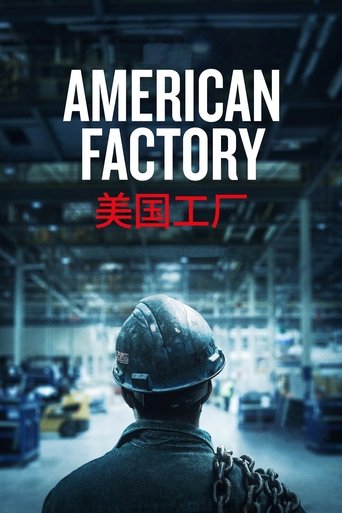
American Factory
2019 · Film · documentary · 110 min
Directed by Steven Bognar, Julia Reichert
In post-industrial Ohio, a Chinese billionaire opens a new factory in the husk of an abandoned General Motors plant, hiring two thousand blue-collar Americans. Early days of hope and optimism give way to setbacks as high-tech China clashes with working-class America.
33 positive2 mixed15 neutralfrom 50 commenters
Where to watch
No streaming data for this title.
52 comments on Hacker News
Has anyone seen this documentary? https://en.wikipedia.org/wiki/American_Factory
https://www.conference-board.org/publications/Productivity-April2022#
>Among major economies and regions, the United States has the highest rate of production of goods and services per hour worked, with only a few small European economies outperforming it. Productivity rates in most parts of the world are well below the US’. Indeed, according to research conducted by The Conference Board, nearly 75% of the global population lives in economies where productivity rates are below the global average of US$21.6 per hour worked.
Of course, it may be reasonable to suspect that at least some of these productivity gaps are a result of different sectors which are served, ie manufacturing vs. services.
https://jacobin.com/2020/02/american-factory-julia-reichert-oscar-speech-best-documentary-marx
>A day before she quoted Marx at the Oscars, Jacobin briefly chatted with American Factory co-director Julia Reichert about her democratic socialism and long history on the Left.
>At Saturday’s Film Independent Spirit Awards ceremony Julia Reichert mentioned “income inequality” during her best documentary acceptance speech for American Factory. The first film released by Barack and Michelle Obama’s Higher Ground Productions, American Factory is about a Chinese capitalist who reopens a closed plant in Ohio, employing thousands of American workers.
https://www.imdb.com/review/rw5946906/
>The only effective means of worker power is through unionizing, and both Chinese and American executives resist it mightily, using pages from the exact same playbook, like targeting leaders and paying for propaganda campaigns. In a sense, the American executives going overseas was like finding a pool of scabs to cross the picket line. As one of the state congressmen observes in speaking to the workers, corporate profitability and treating workers respectfully via a living wage are not incompatible things, and it's shameful that they're treated that way out of unfettered greed in extreme capitalism. (Hmm, if only there was an international labor organization, lol)
>>The issues are in regulatory compliance, demands from politicians and unions. As soon as a major project is announced, the demands start flowing in.
Without getting into the weeds of the documentary's agenda or methods of argumentation - it isn't hard to see that the same methods employed on the mainland with low productivity per worker, will not magically produce different results in the US. Higher productivity, along with higher wages may require automating much of the production process. This may be more capital intensive up-front.
> The higher cost of [US] labor could be offset by higher [US] worker productivity.
I suggest you watch American Factory (https://www.imdb.com/title/tt9351980/) to completely disabuse yourself of this notion.
Can’t say I’m surprised given how ByteDance is their parent.
There’s a Netflix documentary called American Factory that illustrates just how different the work culture is in China vs the U.S.
Hope they change their mind and give these folks free PTO.
You would also enjoy "American Factory" (2019). It's a documentary about a Chinese company taking over an old General Motors factory and hiring Americans to work there.
I was wondering how the manufacturers address the potential culture conflicts. Obama's documentary American Factory revealed two notable contentions. One is that American workers think that the management is too tough on them while the management think that the workers are too unreasonable. The other is that Chinese workers are 30% (or 2X?) more efficient than American workers. I have no judgement on the first contention, but the second worries me. American labors were known to be the best in the world many years ago, and a strong argument against offshoring manufacturing was that Chinese workers were much worse than Americans. Yet the tide has turned.
I’m more bearish of the idea of a major paradigm-shifting Chinese EV incursion to the US.
The US automotive market plays a completely different game than the rest of the world, with a bunch of protections and quirks that have a great potential to stifle a disruptive innovator.
First: the products themselves are regionally unique. The #1 selling vehicle in the US is the F-150, a truck that is a completely insane purchase for most of the rest of the world’s population. Japan may have disrupted the US market, but many of their vehicles they sell in big volumes are designed in America built in America sold primarily to Americans. BYD can’t sell the Qin Plus in America, they need to sell something more like the Rivian R1T. That means BYD needs a US factory to avoid the chicken tax…
Second: The US already shows high willingness to “chicken tax” EVs. All the vehicles that qualify for the EV tax credit are Ford, GM, and Tesla vehicles with high domestic part counts. The government can play this game until the cows come home giving the big 3 ample time to catch up.
So we’ve established that if you’re selling big volumes in America, you are producing cars in US factories. In that regard, China has a weak record of success. If they want to sell trucks in America they’ll probably have to have a UAW factory. The documentary “American Factory” comes to mind for me.
At best, this means that China won’t get the typical labor cost advantage that their entire export economy thrives on. What is their competitive advantage at that point?
Third: the dealer network. Operating in the US means dealing with independent dealerships often enshrined by law. Tesla had to fight an improbable battle to get to the scale it is now without independent dealerships.
Fourth: the incumbents have good tech and are high volume producers in their own right. BYD is big. You know who is bigger? Volkswagen. Toyota. GM. Ford. Even Tesla is bigger by global revenue. 17 other global automotive companies pull in more revenue than BYD, and 9 pull in more revenue than SAIC.
By the way, the “$5,000 used car killer” has been a legend for decades and will never happen in developed markets with strong safety regulations and demanding living standards. Americans literally do not buy city cars, new or used. Get back to me when the Cherry QQ more closely resembles the Ford Maverick.
or Chinese LCD factory in Ohio https://www.imdb.com/title/tt9351980/?ref_=ext_shr_lnk - American Factory
I don't like the reflexive union bashing in the comments, but for some documentary perspective (which to some degree reinforces the objections of the people whose comments I'm complaining about), check out the film American Factory (https://en.wikipedia.org/wiki/American_Factory).
I rarely like documentaries but I liked this one.
> And that is a reason to turn yourself into indispensable cog, not the best replaceable there is.
For centuries, organizations have been adjusting themselves to ensure that all employees are as easily replaceable as they could possibly be, not to mention outright powerless.
I recommend watching the Netflix documentary "American Factory". If I recall correctly, there's a low-level manager who tried to turn himself indispensable at the expense of the company's workers and he showed a lot of surprise once he himself was fired.
https://en.wikipedia.org/wiki/American_Factory
How much of this chipmaking renaissance can be compared to the American Factory Netflix documentary having some of the same challenges? I understand that shows the difference in culture more than anything but underneath it also speaks of efficiency which is of high importance.
> "American Factory" is a really interesting documentary that covers something like this dynamic in the context of an auto-glass manufacturing facility.
probably fab employee adds more value, and can be paid much higher and work with higher labor standards.
I think the push to fab SCs in the US is going to quickly run up against the fact that consumer technology pricing is incompatible with our labor standards. We've spent the last 50+ years exploiting global wage inequality to flood the country with cheap consumer goods, and we've reached a point where our sense of self-satisfaction is entirely fused to the acquisition of these cheap goods. Along the way we've ceded a lot of ground in the way of healthy communities and a rich public sphere. National pride is only going to make up for so much when it causes the iPhone 16 to jump $500 and people are still stuck in their isolating suburban hellscape. IMO the only way for this to work in the long-term is a national reset about what "quality of life" really means, and I don't think our political class is willing to engage with all of the questions that will entail.
edit: "American Factory" is a really interesting documentary that covers something like this dynamic in the context of an auto-glass manufacturing facility. US workers fought hard for their labor rights and capital responded by fleeing the country to more permissive political regimes. We accepted this loss of jobs because it kept the all-import car prices down. Now that other countries are starting to eat our lunch in the global economy we're suddenly not so stoked about globalization, oh no the consequences of my own actions!!
America can't even win a culture war with itself... I don't think college-aged leftists have ever fully comprehended what Pax Sinica means for them: work. Just watch "American Factory", the documentary Obama made on Netflix a few years back. American MBAs think you are lazy compared to Chinese who will work 12 hours a day, six days a week, and would love nothing more than for you to accept that schedule for even lower wages.
Is there even a conversation? Perhaps only at the academic level by old-school Marxist types, or in politicking to effect event weaponization.
The documentary American Factory (2019) is a relatively recent human interest case study. Viewed in this light, automation generally acts as a fell-swoop solution to older approaches in businesses capable of making the required capital investment.
In terms of a process engineering business case, you can rarely just fully automate one unit operation, because the benefits will be quashed by adjacent, older process. It makes far more business sense to go the whole way and automate everything.
Thanks for the recommendation.
This GM/automotive documentary was also interesting: "American Factory"
https://www.imdb.com/title/tt9351980/
(Don't be put off by the dramatized trailer)
Maybe American Factory (2019) or Gung Ho (1986). The latter isn't a documentary though.
> US workers are also significantly more productive than other countries
I certainly hope so. Is it true, though? Obama's documentary, American Factory, says that Chinese workers are more efficient than their US counterparts. I also read somewhere that the average age of workers in shipyards were 55 years, IIRC, and it's harder to find qualified workers who can build heavy machineries in the US than in China, partly because the manufacturing sector shrank so much in the US.
It's more like the endgame.
1. Western companies moves production of components to China. 2. Chinese companies becomes good enough to produce their own products. 3. Western companies starts rebranding Chinese products. 4. Chinese companies buy western companies. 5. Chinese companies open factories in western countries.
Manufacturing isn't industry in itself and the growth of industry is orders of magnitude more in China. Most people just have no idea how supply chains work or how many R&D centers are opening up elsewhere. Many western countries are no longer great industrial economies but still far from real knowledge economies. Western countries don't really have the infrastructure, housing or education necessary and increasingly not alternative ways of competing either like creativity, influence or equality.
There is a documentary called "American Factory". It isn't the best but it is something.
The other danger here is the human resources side of the business. Lots of skilled labor just evaporating away — institutional knowledge that is hard to replace and even harder to document.
The US needs to simultaneously invest in trade schools, stop pushing for higher education so zealously, and perhaps find ways to make our manufacturing workforce earn dignified wages.
Addendum: American Factory (the Netflix documentary) tried to make the takeaway about the plight of the American worker and the decay of manufacturing and the seemingly inhumanity of Chinese manufacturing. What everyone should take away instead is the insane skill-gap on display between the two country’s assembly lines. Seriously, even without the inhumane hours, the Chinese factory still had the US factory beat on everything.
Similarly, there's a Netflix movie by Obama's production company called American Factory that dealt with the culture clash of a Chinese glass factory in America: https://www.rottentomatoes.com/m/american_factory
And _currently_ involves hiring consultants to force employees to sit through hours of anti-union fear mongering the second management smells a whiff of pro-union organizing sentiment.
The 'American Factory' documentary has a great example of what this looks like in real life. Hearing that Amazon or Google or whoever else worked to convince employees to vote against unionizing is one thing, seeing what that effort is like on the ground is altogether more eye-opening.
This reminds me of the documentary titled "The American Factory"[1]. The teams at TSMC would do well to learn from their experience.
[1] https://en.m.wikipedia.org/wiki/American_Factory
American Factory.
https://www.imdb.com/title/tt9351980/
>In post-industrial Ohio, a Chinese billionaire opens a factory in an abandoned General Motors plant, hiring two thousand Americans. Early days of hope and optimism give way to setbacks as high-tech China clashes with working-class America.
This has reminded me of the movie American Factory (https://www.imdb.com/title/tt9351980/).
I highly recommend the documentary American Factory which highlights similar culture clashes in a windshield factory in Ohio.
Trailer: https://youtu.be/m36QeKOJ2Fc
There's a documentary that shows exactly this phenomenon, American Factory.
> i fear that this work-ethic will come back sooner or later to europe to "stay competitive"
I'm a bit more optimistic. In a culture where productivity is not the be-all and end-all, staying competitive at the cost one's whole life, will not take roots. I think that productivity also has different dimensions, which helps.
To me, "speed and agility" are code words for a culture that tolerates long work weeks and hours:
https://en.wikipedia.org/wiki/996_working_hour_system
With a society that had been dealing with famine, poverty, and labor opportunities consisting of subsistence farming in living memory, working 72 hours a week to receive a steady paycheck and a full belly seems like a pretty decent trade.
When you look at the history of the Industrial Revolution and the Western labor movement, I have to have doubts that this "speed and agility" will last. People who are prosperous start to have higher standards, especially as new generations enter the labor market. There is already significant pushback against the 996 system.
It's not hard to out-produce when the average person is working almost double the Western standard.
I thought the documentary "American Factory" was an interesting window into the lives of Chinese and American factory workers. My own analysis/opinion: the factory workers in China were indeed shown to be working quickly, obediently, and working long hours. The Americans looked lazy at times.
I thought the reasoning for this difference was that American workers used to union protections already had generations of knowledge about why they should not become wage slaves risking their health and safety for their capitalist employers, despite having few other options in a town where most of the factory jobs left.
I personally wonder when the typical Chinese worker will wake up to that same reality: that speed, agility, and fast innovation aren't really worth selling your weekends and joints and tendons away just so that the boss can buy a third vacation home.
> The people voted and rejected it.
My understanding is the deck is pretty stacked in favor of the company during those votes. The documentary American Factory was pretty eye opening: the workers in that factory were trying to form a union, and in response the company hired anti-union consultants and had all workers sit through all kinds of mandatory propaganda sessions.
It's like if the in the month leading up to a federal election, every registered voter was required to watch an hour of Fox News opinion programming every day. Sure it won't influence everyone, but it will definitely tip the scales.
I don't know if this does anything for you, but American Factory was actually produced by the Obamas. Their first Netflix documentary.
Politics aside, I thought that was a pretty neat tidbit.
Shoutout to Ohio! Interesting they chose Troy Township (population 4k), wonder if they plan on employing the entire city.
I'm unfortunately a little skeptical, but I hope it works for the city/state and Peloton. If you find the idea of new plants opening in the US interesting, I recommend the documentary American Factory. It is about a plant owned by a Chinese company opening in Ohio (Dayton), so the circumstances are completely different from this. It explores the clash of cultures and conflict of attitudes of the employers and employees. I liked how they dove into some employees and employers lives and circumstances.
I thought it was interesting, but I'm a little biased because I happened to be living near Dayton when it was filmed, and had no clue this type of thing was going on.
I think for a lot of people that attain that level of wealth, work is their life. In the Documentary film “American Factory” the billionaire founder of Fuyao said something to the affect of “work is life” which to me means “ my life would be meaningless without work.”
The documentary that won the Oscar last year, "American Factory", is worth watching. The company in the movie brings in some consulting firm and requires employees to go to classes about why unions are bad during work hours.
There are legitimate reasons to dislike unions, but the reason companies rely on these "ham-fisted" tactics is because the employees are generally less sophisticated than people on HN and the tactics work.
People should really watch the Oscar winning documentary "American Factory", totally eye-opening in regards to the practices of union busting, among many things.
For a great documentary on the clash between American work culture and Chinese work culture, I recommend the 2019 documentary "American Factory".
I guess it might surprise you to learn that China is a big place capable of manufacturing both high quality and cheaper, low quality products,
There’s a really interesting Netflix documentary American Factory that depicts one particular example, and puts on display a lot of the complicated factors you’re talking about. But the interesting thing is after like 2 years of training and tweaking processes, the American location of this auto glass factory just can’t for the life of them produce a product as high quality as the Chinese factory.
See also: most other Apple products, for more examples of high quality things manufactured in China.
Also, call me crazy but why should I care about random Midwestern Americans any more than random Chinese people I’ve never met? Globalization has raised an astounding number of people in China out of poverty in the past 20 years which is an amazing feat.
Not wanting to support the country because of the governments human rights abuses is totally fair, but you seem to be mixing that in as just one reason among all the other protectionist rhetoric.
Lastly, to pretend that companies are giant infinite pools of money that are choosing to hold out on everyone is just silly. If they were to manufacture things in more expensive places, then you’d be looking at $700 headphones instead of $550. If you’d rather support other companies, then great, do that! That’s the beauty of having so many choices.
> To the advantage of union organisers, mass communication and organisation is a lot easier today.
But that's a double-edged sword. It's also an advantage to employers and businesses. And recent history has shown they have the advantage: they been successful at thwarting union formation (see Wal-Mart, the movie American Factory, etc.) and even labor laws (e.g. Prop 22).
I sadly can't google a video, but that reminds me of the scene in "American factory" in China:
https://ubiquarian.net/2020/01/film-review-american-factory-2019-by-julia-reichert-and-steven-bognar/
> American supervisors invited to Fuyao’s homeland are subjected to performances by Chinese workers from the local factory. A young woman sings about productivity and hard work to generic C-pop.. A dance troupe does their thing with neon-silhouetted products from Fuyao Glass. Americans, all wearing red scarves like their Chinese associates, try not to recoil in horror as little Chinese girls dance in near-perfect formations to yet another pop number about company loyalty. Later, young couples rapidly become man and wife in groups at the celebration.
I'm not blaming it on lazy americans. Huge difference. I blame the chinese directly. They never had the intention of hiring American workers. They know American workers are capable but inferior and they screwed them over on purpose.
>Every single thing in this lengthy article comes together to make one clear point: they had no plan at any step of the way and just tried to BS it all, and they've done it several times around the world.
And I'm saying there's a reason for this. It's not an accident. It's because they don't give a shit about American workers. They think American workers are inferior. They don't want to put any real money into the project they bought it up for some ulterior motive.
Not only American factory workers. But many places in the world. It's hard to beat the industriousness of Chinese workers.
I'm not gonna lie, I don't have hard evidence. I'm just guessing the situation but it's also somewhat obvious. You seriously think if China (taiwan technically) was serious about investing in blue collar workers in America they would let it just slide like this? We're talking about the fastest growing economy humanity has ever seen that has transformed from a backwards 3rd world country to a super power within your lifetime. They will eat up and devour any opportunity or deal in front of them. Why would the Chinese miss out on the American Factory Worker???? Probably because they don't give a shit.
The following isn't evidence but if you read my post and watch the linked video... it is an actual short snippet of a real life example of a serious chinese investor who tried employing American factory workers: https://news.ycombinator.com/item?id=24834199
American factory workers can't hold a candle to chinese industriousness. You think those Asian dad memes don't have an actual origin?
https://www.pinterest.com/lindaschloss/asian-father-memes/
Those memes aren't that far from the truth.
watch the movie if you're interested.
"Fox in the cheesehouse"?
While you wait, American Factory is a pretty good documentary about a Chinese auto glass manufacturer trying to set up a stateside plant in an area that aggressively courted them.
Late to this thread, sorry.
I have two tangental questions.
#1 In general terms, what's China's commitment (investment) in higher ed? Compared to the USA and other economies?
USA's tuition, loans, student debt is always good for an argument on HN. Almost no one mentions that the USA decided to privatize higher ed some decades back. So I was wondering if China and others made the same mistake.
#2 How does current China think about growing inequity?
One persons's story in "American Factory" resonated with me. Glass furnace technician Hong We https://www.imdb.com/name/nm10930334/ works his ass off, making huge personal sacrifices, to further enrich Fuyao Glass America owner Jeff Daochuan Liu.
Shown is gob standard corporate team building meetings where Fuyao uses economic nationalism to motivate their underpaid staff.
What is Hong We's future? When will the feel goods not be enough? When will Hong We demand to be paid fairly?
I assume Labor in China will follow the American trajectory. With all that political and cultural strive that entails. But I'm keen to hear what others think.
Edit: I think Cao Dewang is the founder and owner, not Jeff Daochuan Liu. I regret the error.
To the question in general: watch American Factory on Netflix for a good documentary on the efforts of spinning up a US based factory. Basically this company found that American workers were more expensive, had higher safety standards, and quality control was a struggle. In the end the company started to invest in industrial robots for automation.
To this specific case: it's probably to avoid the 22% import duty that India places on products not assembled locally. I suppose the US could pass a similar law.
Somewhat tangential but perhaps of interest to anyone here curious about unions — the documentary American Factory [0] chronicles Fuyao Glass' creation of a factory in the US, and the subsequent attempts (and ultimate failure) of those workers to unionize.
[0]: https://www.netflix.com/title/81090071
I’ve been trying to watch all of the Oscar nominated movies before the academy awards. I’m down to the documentaries now, so I’m watching the documentary “American Factory” about a Chinese company that bought and refurbished an old GM plant in Ohio that had closed down. The camera crew followed around the Chinese workers and the American workers. The difference you see, over and over, is that the Chinese workers have this underlying belief that they are nothing by themselves and that they owe everything - their success, their focus, and even their lives - to the company and, by extension, the government/society. This results in factory workers who work 12-hour shifts, 28 days a month, forbidden to joke around with one another, and still praise their good fortune to be there. If you look back over the history of the Chinese cultural revolution, it started with this mantra: “you accomplished nothing. Society accomplished it and you were there.”
Yes it's a ludicrous notion that working for work's sake is a good thing.
I just watched the documentary "American Factory" (highly recommended), and it's pretty clear to me that doing repetitive manual labor work in a factory is grueling, mind-numbingly boring, dangerous, and not something we should be doing if we can automate it - not to mention low status and low pay. I'd bet that most of the politicians idealizing manufacturing jobs have never worked a manufacturing job before. It's absolutely nothing like any cushy office job. At the end of the movie when they talked about how they were replacing the humans with robots, that should be something to celebrate (but it's not because our society forces people into employment to make a living).
Those workers were making $12/hour at the Chinese owned company despite having made $29/hour in their unionized jobs at GM before it closed. It's not as if the $29/hour jobs were some utopia, but it's a massive difference in pay that affords one a middle class lifestyle. And as a worker, feeling like you have no representation and no say can make any job soul crushing.
Yet politicians talk about "jobs" as some unequivocally good thing as if we're all partners at law firms with corner offices making six figures or whatever they're used to (not that I'd ever want to be a lawyer). They're so clearly out of touch.
The documentary American Factory has something like this. The documentary is about a factory that is built in America and bought by China, to be run by Chinese and American workers.
After a while, the American workers start to unionize. Some of them wait outside to hand out fliers/info in favor of unionizing, and they called that 'stalking'. While some of the internal union fighting employees said they were not safe because people were watching when they were leaving. The organizing workers were fired.
This seems to be a pretty common tactic to prevent unionization, calling pretty basic human communication even a stalking or scary action, then firing them, mostly as a message to other employees.
I agree that the US has wasted immense money in foreign wars with not enough gained to economically justify it.
I also agree that part of China's rise is due to it's economic strengths and strategic investments. In addition to that, they 1.5 billion people, of which there's bound to be a lot of amazing innovators.
The documentary American Factory is a great documentary that shows how the efficiency in China is also helping them out compete the US. (sidenote: produced by the obamas company)
On the note of the defense sector, DARPA has funded so much research (they invented the internet) that has helped innovation and defense companies help provide jobs for many engineers and high tech peoples, which helps the growth in that sector. Defense spending is also how we maintain our safety. But I do agree, that a lot of it is immensely wasteful. I think defense spending is important and useful, but like what you're getting at- the amount we spend stupidly instead of investing or strategically is too extreme
I agree that it's an unreasonable expectation for the average West Virginia former coal miner late in life to "Learn 2 Code" in San Francisco. But the guy that sits next to me in my webdev job did exactly that (family of 6, middle-aged, moved from working in "business" in Texas, went to a coding bootcamp for 3 months, we hired him, now he's the hardest working programmer in the office). I'm not inclined to feel sorry for the guy who can't put in the same effort.
> from their perspective it’s the government coming in and destroying their way of life and then not even bothering to help
It's not our jobs as taxpayers to maintain coal miners' "way of life". Coal mining was a massive improvement to the world in the mid 1800s between whale blubber and refined petroleum, but the world doesn't owe coal miners anything more than a paycheck on the open market, where coal is a commodity and has to compete against fracking (cheaper) and solar and wind (far cleaner and create more jobs). They have cashed 200 years of paychecks and chose to send their young boys into the same coal mines rather than invest in a better life for their kids.
But I also don't look at this in a vacuum. As far as I know, coal mining companies don't offer great pensions for their mine workers. No state in the US has a decent job/vocational retraining and placement system. The coal mining states don't vote politically for good welfare programs that would allow what you claim to want (retirement at their current standard of living). If coal miners wanted a retraining system, they have the ability to vote for political leaders who could do that -- but there is no political will. They could start their own companies or non-profits (like you), but I don't hear about them (doesn't necessarily mean they don't exist). The guys that made billions in coal aren't investing in the same regions that have historically been single-industry areas.
And when it comes to coal, I would argue that - (1) it was largely beat by innovation and fracking before the EPA / federal government / renewables started reducing coal jobs. The largest coal mine in the world is in Australia finished in ~2008 and idled because it was no longer cost effective to run the mine at those current coal prices. - (2) it has massive negative externalities to the entire air-breathing world just to keep a few thousand coal miner jobs[1]. Coal miners know this acutely, but they continue to work in the industry (to the extent that it's possible).
I think it's important to help others, but self-agency has to play a role. Your anecdote about the chat lady shows that she had enough agency to quit her job willfully (I've worked at jobs long past when I had decided that management) and that she didn't bother to go to read a book or internet article about how to move up in the workplace shows a great example of the possibility of agency, but the unwillingness to execute.
I think this kind of complacency is why we are losing jobs to other countries. The Netflix documentary "American Factory" perfectly describes the mismatched expectations of American union workers in 2020 thinking they have the same bargaining power as in 1960 and international companies who know they the Chinese workers doing the "996" work ethic is a far better value than the American who clocks out after a very safe 40 hours a week and demands much higher for producing the same exact product.
When it comes to the entire US, I think we should adopt a more comprehensive employment-and-reemployment program, more like Germany's. But we like to pride ourselves on "being free" and not accepting government handouts or entitlements, so we reap what we sow.
> Coal-mining employment increased rapidly in the late 1800s and early 1900s, and peaked in 1923 at 798,000. Since then, the number of miners has fallen considerably since, due to mechanization. By 2015 it had fallen below 70,000.[1]
[1] https://en.wikipedia.org/wiki/History_of_coal_mining_in_the_United_States
Watch American Factory on Netflix. It would support a bit of what you are saying... Not only is the glass factory in China way more efficient, at least through the end of the documentary, the quality of the Chinese glass also appears to be higher. Of course, in that case there's the confounding factor of the age of the factories which complicates the comparison, but it is all in all a very interesting documentary which looks at this exact question.
Agreed. Also, if you haven't, watch the documentary American Factory on Netflix.
Pretty much highlighting slavery outsourced. We all hate to fill those workers' shoes, but love the fruits of their hard labour.
OT: American Factory (2019) documentary was a good watch too.
Edit: Vote with your wallet in capitalism; what goes around comes around to bite ...
What do you think of Enron: The Smartest Guys in the Room[0]? It's one of my favorite documentaries. I've watched it about a dozen times probably. Dirty Money[1] shares a creator (Alex Gibney) [2] with Smartest Guys, and I also really like that.
Over the weekend I watched American Factory[3]. It may be my new favorite. I don't know if I will watch it as much as Smartest Guys, just because of the storytelling in that.
I like these because they clearly represent different viewpoints. Most documentaries feel like propaganda, and these don't feel that way to me.
0: https://en.wikipedia.org/wiki/Enron:_The_Smartest_Guys_in_the_Room
1: https://en.wikipedia.org/wiki/Dirty_Money_(2018_TV_series)
2: https://en.wikipedia.org/wiki/Alex_Gibney
3: https://en.wikipedia.org/wiki/American_Factory