 Hacker Cinema
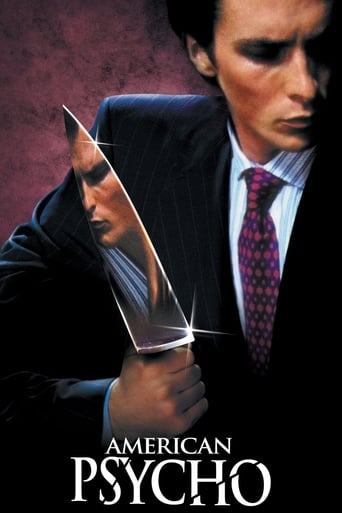
American Psycho
2000 · Film · 102 min
Directed by Mary Harron
A wealthy New York investment banking executive hides his alternate psychopathic ego from his co-workers and friends as he escalates deeper into his illogical, gratuitous fantasies.
16 positive1 negative40 neutralfrom 57 commenters
Where to watch
No streaming data for this title.
57 comments on Hacker News
I so wish you were a bot, but judging on grammar mistakes it can’t be… I have abook recommendation for you, American Psycho, especially when Patrick discusses his musical tastes. I’m sure you like it. There’s a film, but the book is better.
One thing I'm constantly baffled by in current technology is how it seems to be targeted at one pretty precise subset of human population: young, healthy, single people without any problems with perfectly pre-defined schedules and organized lives. Speaking English, having an OCD and being relatively wealthy is a bonus.
Only when you live alone might you be comfortable constantly speaking with your devices. Only if your life if perfectly predefined can you let your fridge order the same food that just gone stale or has been eaten. And only when you are young and healthy and not in any way differing from the "standard" would you be capable of working like these "researchers" imagine you to.
I'm not that person. I'm constantly failing at doing "triple-finger-taps" whenever I'm in need of one. I have a smartwatch with pedestrian navigation and never bothered to remember which vibration pattern means which turn. I don't configure different vibration patterns for different callers on the phone. I have a folding phone, but I almost never do side-by-side windows and when I do, I need to find out how to do that first -- and then how to leave that mode without losing my mind. I almost never use AI features on my phone not because I don't want to, but because I never remember how to activate them. I don't re-configure my gadgets to "fit my mood". I hate recommendations like "you like X, here's Y, it's the same!" I hate that I can't rest my mouse cursor on websites anymore without selecting something actionable, moving, animating or autoplaying.
All of the examples on the linked page are workflows I would never do this way. I won't be talking to my shopping list to double the ingredients. I won't be drawing gestures with my mouse on a document to activate a voice command. I won't use voice commands in general because as it turns out, I'm not capable of bringing out a complete coherent sentence without pausing and/or changing my mind and/or realizing I'm wrong once.
I appreciate those demos for the progress they are showing. It's impressive and astonishing to see restaurants getting extracted from videos or pictures getting expanded or text edited better than I ever could. It's all modern-day magic in a way. One thing it all isn't is a product. We don't have those anymore -- all we get are gimmicks. We don't do common interfaces anymore either, we are separating people in Google/Apple/Xiaomi camps.
And most importantly we don't use that technology for good except for a bunch of people writing e-mails all day, doing shopping lists and booking one of top restaurants in Tokyo for the same evening on a whim. We are long overdue for a remake of "American Psycho", but this time it will be a documentary instead of a satire.
I think that’s because in general people have a pretty broken view of the specific cognitive dissonance that 1) sociopaths can choose to disregard ‘polite’ societal boundaries, and 2) sociopaths are invaluable for disregarding ‘polite’ societal boundaries. Consider four movies with sociopathic leads: “American Psycho” and “Ferris Bueller”, versus “John Wick” and “Jennifer’s Body”; if you try to define their sociopathy in terms of U.S. Christianity’s Good Versus Evil, you’ll end up smashing into dissonances galore. But since having a small fraction of a society be sociopathic is highly beneficial, as it serves as random enforcement of societal laws against grifts from within, you end up with the fear/fame duality we see in media; sociopaths can be absurdly charismatic, and even more prosocial than the best of those who are not asocial.
This suggests a very interesting point, one that makes people deeply uncomfortable:
People are afraid of AI going Skynet on us because, when the roles are swapped, we cheer for John Wick’s prosocial enforcement — and deep down, people believe we deserve more prosocial enforcement for how our societies treat us.
America doesn't own greed. Hardly.
But like the movie American Psycho the American presentation of greed is starkly in your face ... it's something horrifying to see
Some of the typos and poor typography might be accidental simply because that is so common, but the rest of it is surely deliberate.
Remember that _American Psycho_ is repeatedly hinting to you throughout the movie that most, or even all, of what you see is just Bateman's own delusions and hallucinations, which are inferior imitations of reality due to his own impoverished mind and lack of substance. So there's a lot of little tricks all throughout it to subtly destabilize you: https://www.moviemaker.com/american-psycho-anniversary-oral-history-christian-bale-mary-harron-bret-easton-ellis/3/
Sorry I just remember from a Tweet that it was the year that many cult movies came, but one of my favorite years is 2000 for both Matrix/American Psycho.
As for the age, no, I was born well after 1995.
I hate this sentiment. The book isn't "about" a thing in particular, neither does it "mean" any specific thing. It may have been written with some ideas in mind, and there may even be overt indications as to those ideas. Everyone has their own relationship with each and every piece of art, and may sometimes choose to include the artist and/or their intentions, but may also choose to exclude them.
The article even discusses certain readers' developing relationship over time! The book hasn't changed, the text is static. Even within a person, the understanding of the text is fluid. To say it could possibly be misunderstood is to say that there is a wrong way of understanding, but clearly there are at least multiple correct - or at least not incorrect - understandings!
A certain subculture of online males have fallen in love with Patrick Bateman. Now some of them might not have read or watched American Psycho, so to say they misunderstand the art is nonsense as they haven't actually seen it. For those that have and still choose to worship the obviously awful character, I see a lot of people say they haven't "understood" the film/book. They have! They just disagree with author's own interpretation!
I would not with the snap of a finger revert back to a time centuries ago when I have spent all my life up until now learning to live in the current one. No. Just like a tribal Papua New Guinean would not want to, with the snap of the finger, become one of the vice presidents in the American Psycho movie. He wouldn’t know what to do with himself.
Beyond that I don’t know what there is to say about our so-called democratizing technologies when the discussion gets reduced to—and never goes beyond—those very slogans about them being democratizing. Yes. We are now free to repeat the same slogans that everyone else repeats.
I can top that. As a child I was a fan of a relatively unknown sitcom titled “Out Of This World” and I rediscovered it a couple years ago. It was truly surreal to hear Donald Trump mentioned in a show from 1987–1991. (American Psycho is from 2000.)
It's funny as a non-US how many (older) films etc. he's mentioned in (or even cameos in), having never heard of him until (not long before) his first term.
e.g. I watched American Psycho last night, in which there's some 'is that the Trumps', 'why would Ivanka Trump be here'.
For those who didn't get the reference, it's from the movie “American Psycho”.
https://en.wikipedia.org/wiki/American_Psycho
For confused readers, this is a reference to the movie American Psycho
For comedy one needs to subvert expectations, and this is why making light of grave events (Black Comedy) is a big phenomenon.
There are many examples from WW2 comedy to 9/11 memes. Sometimes the examples are more indirect, like in film: American Psycho, American Beauty, Wolf of Wall Street, The Big Short, Fargo, Don't Look Up, Fight Club, Quentin Tarantino's stuff, etc. All of them deal with dark themes in a light way.
Given the prevalence of this in our culture, the author seems a bit surprised. Maybe they didn't connect it to dark comedy.
Truly a tale older than me. In the business card scene in the film "American Psycho", all the guys are Vice Presidents.
For convenience, I asked ChatGPT to create this table, which summarizes how many times each movie has been mentioned in this conversation so far. It got a few counts wrong (as usual), but it still gives a good sense of the frequency. I hope it can be useful to someone:
| Movie | Number of Mentions | |-------------------------------------------|---------------------| | The Matrix | 9 | | Lord of the Rings Trilogy | 8 | | Pulp Fiction | 8 | | Alien | 7 | | Fight Club | 7 | | Ghostbusters | 6 | | Die Hard | 5 | | Back to the Future | 5 | | Inception | 5 | | Star Wars Trilogy (original) | 5 | | Groundhog Day | 5 | | Terminator 1 & 2 | 5 | | Jurassic Park | 4 | | The Thing | 4 | | The Fifth Element | 4 | | Monty Python and the Holy Grail | 4 | | Ghost in the Shell | 4 | | Interstellar | 4 | | Casablanca | 3 | | Office Space | 3 | | Shawshank Redemption | 3 | | The Godfather Trilogy | 3 | | The Blues Brothers | 3 | | Blade Runner | 3 | | Mad Max: Fury Road | 3 | | Unforgiven | 3 | | Total Recall (1990) | 3 | | The Crow | 3 | | The Princess Bride | 3 | | Akira | 3 | | The Big Lebowski | 3 | | Guardians of the Galaxy | 3 | | American Psycho | 3 | | Indiana Jones Trilogy | 3 | | Kiki’s Delivery Service | 2 | | Ratatouille | 2 | | A Clockwork Orange | 2 | | Mission Impossible (various) | 2 | | Casino Royale | 2 | | Skyfall | 2 | | Ferris Bueller's Day Off | 2 | | Star Trek: The Wrath of Khan | 2 | | Apocalypse Now | 2 | | The Shining | 2 | | Groundhog Day | 2 | | Donnie Darko | 2 | | Dune (2021) | 2 | | Gladiator | 2 | | Predator | 2 | | Seven/Se7en | 2 | | The Dark Knight | 2 | | Snatch | 2 | | Prometheus | 2 | | Schindler’s List | 2 | | The Wolf of Wall Street | 2 | | Dr. Strangelove | 2 | | Silence of the Lambs | 2 | | Kill Bill | 2 | | Real Genius | 2 | | Top Secret! | 2 | | Tenet | 2 | | Tinker Tailor Soldier Spy | 2 | | The Adjustment Bureau | 2 | | The Expanse | 2 | | Pulp Fiction | 2 |
Original Star Wars trilogy. Lord of the Rings American Psycho Total Recall (1990) Blade Runner Love Actually The Fifth Element Unbreakable Pulp Fiction Four Weddings and a Funeral Guardians of the Galaxy X-Men X-Men the Last Stand Showing my age here, but I started to lose interest in movies after the 2000s. No I do not want to watch a remake of [Blade Runner, X-Men, etc...]. Also X-Men was great, but my interest didn't stretch to Captain America and Iron Man, so the MCU was a loss for me.
I don't necessarily disagree with this as a rule of thumb, but I thought it would be fun to come up with a few counter-examples. Most of these I would consider "artsy-fartsy" or "artsy-fartsy lite" movies that are popular with audiences but less so with critics.
Lost Highway (1997) - 68% Tomatometer - 87% Audience Score
Fight Club (1999) - 79% Tomatometer - 96% Audience Score
American Psycho (2000) - 68% Tomatometer - 85% Audience Score
Requiem for a Dream (2000) - 78% Tomatometer - 93% Audience Score
Dancer in the Dark (2000) - 69% Tomatometer - 91% Audience Score
Oldboy (2003) - 82% Tomatometer - 94% Audience Score
The Prestige (2006) - 77% Tomatometer - 92% Audience Score
Joker (2019) - 69% Tomatometer - 88% Audience Score
I haven't seen Yellowstone but I'd be amazed if it comes at all close to Blood Meridian for violence. I can't think of any movie or TV show that would.
edit: American Psycho might have if they'd stayed faithful to the book
Techbro8615's comment is a reference/verbatim transcript to the opening bit of American Psycho (the movie): A psychotic yuppie internalizes self-care marketing to such an extent that their life turns into an infomercial. The satire is as biting now as in the 1990s, hence the cult status of the movie/book.
Edit: this reference is as obligatory here on this topic as an XKCD reference for other topics.
I found this video, "Edgelord Movies and the Men who Love Them " [1] by sociologist F.D Signifier, to be a particularly interesting exploration of this specific disappointment. His thesis is that young white men are more attracted to edgelord movies like Joker, Falling Down, American Psycho, or Fight Club that portray a sudden violent break from social norms because they start with an elevated expectation of how society will cater to them that gets shattered one day. The idea of a protagonist that lashes out and punishes "the system" through stochastic violence is very attractive.
Young non-white men are less likely to be under the impression that society is looking out for them in the first place, so their choice of anti-social entertainment looks very different. It's more about detachment and the use of violence for personal enrichment because the social system doesn't matter.
[1] https://www.youtube.com/watch?v=_--JOjsTHjo
> Empty suit isn't jargon, it's a commonly used idiom.
Sorry to burst your bubble but that’s jargon.
> Yuppie isn't jargon, I was thinking about the movie American Psycho.
It’s also jargon.
> It's just a term to refer to your stereotypical middle managers high on their own farts.
I know what those terms mean.
> business jargon
Oh wow look at those goalposts flying by, amazing.
I used those words to be polite and not to call them pillocks. Empty suit isn't jargon, it's a commonly used idiom. Yuppie isn't jargon, I was thinking about the movie American Psycho. It's just a term to refer to your stereotypical middle managers high on their own farts.
Avoiding business jargon doesn't mean having to stick to the 1000 most used English words.
I've lived to see the day where someone made an American Psycho business card reference and a follow up comment would - in context mind you - be able to reference Paul Allen as both the movie character and the Microsoft founder.
What about fiction like American Psycho, We Have Always Lived in the Castle, Pride and Prejudice, or The Tempest? Do they not deliver social commentary on the human condition that equals (or maybe even surpasses) 1984? Are you equally dismissive of thrillers and romantic films? Is Tinker Tailor Soldier Spy vapid? Was Titanic a froofy waste of film?
Nice to see that gore-sploitation films appeared right at the start. After all, there were plenty of completely nude women in earliest films, though those were pretty tame—but afaik porn followed in a couple decades or so, when film stopped costing more than a live tour.
By the way, regarding ‘L’arrivée...’, Wikipedia says that Lumieres attempted 3D films even before getting properly started with flat ones. So, considering that accounts from that time were of quite meh quality, it's possible that the running-out occurred at a 3D showing, making the ‘illusion’ story more plausible.
Lastly, since J.G. Ballard is mentioned, I'll say that both ‘Crash’ and ‘Atrocity Exhibition’ are very cool. Aside from obvious connotations to real people's habits, just the atmosphere of the books is engrossing in the weirdest way. They tickle the brain in a manner that's only similar to what I experienced in childhood, when the world was big and anything could be in it—only, these books are for adults. I don't think they quite make surrealism like that anymore. Kobo Abe and animator Piotr Kamler are contemporaries that are somewhat similar in effect; Cronenberg's ‘Videodrome’ is likewise good (however his ‘Crash’ doesn't really have the feel). Of later stuff, Bret Easton Ellis is proficient in such immersion, and funny enough has a pair ‘American Psycho’-‘Glamorama’ that are close in the themes to each other but are related in execution like the two books of Ballard's, and likewise the film is its own thing by necessity.
Of very current authors, I know only Vladimir Sorokin who can pull off such feats—but his thing is that he can do what he wants with Russian language, and as a result is next to untranslatable. Apparently there's a dude who took on the challenge with English as the target, and several books at once are going to be published very soon (this year, they said)—I'm looking forward to diving in that the first chance I get, but my expectations are high and the outlook cautious.
Only in cities that are full of vanity and thus the induced anxiety? Before coming to the US, I thought a good thing about the US was that people to compare their status with other people (maybe secretly, or so I read), as everyone has their own definition of happiness. Those who are so obsessed with where they are go into the movies like American Psycho, in particular the role played by Christian Bale. Many areas are still like what I thought, but places like the Bay Area seem have changed a lot.
I have experienced episodes of depression throughout my teenage years and now my mid-20's, but never allowed myself to believe that I was having depression because I thought I wasn't "one of them" I thought I was stronger, somehow better than everyone else. YouTube started recommending red pill videos such as edits of American Psycho, Fight Club, The Joker, basically movies of men expressing their feelings via violence.
I recently sought out a psychiatrist as well as a therapist, and have been taking medication. My psychic pain has been alleviated thanks to the medication, which has given me breathing room to work on a lot of toxic mentalities that I carried. Like that the most important thing about my life was my job or how much money I made, caring about status and prestige above all things, thinking of myself as a machine solely to milk for money, among other things like toxic masculinity.
While I never had easy access to weapons, nor do I think I would have ever committed a mass shooting, I can easily see how someone with a weaker support system than I had would be driven to retaliate against society because violence is oftentimes seen as a valid means of emotional expression for young men.
Anyways, thanks for asking :)
The Social Network may be reasonably accurate but it doesn’t portray a culture. It’s the story of a handful of people scrambling to make money from an unexpected success, and a single-minded antisocial programmer who falls backwards into vast wealth and power. The personality traits depicted and maybe exaggerated in the movie may be common but they don’t form a culture — rather they are formed by a culture of predatory capitalism and legal maneuvering. American Psycho is the same story as satire, with more knives and less PHP.
I only saw Requiem for a Dream when it was in the theatre and other than the soundtrack from PWEI's Clint Mansell, what I remember about it at the time was sitting in the theatre watching it and thinking that I had picked the worst date movie ever.
Some months later, she evened the score with American Psycho, so it netted out. I remember people talking about Perfect Blue, but anime wasn't my thing other than Ghost in the Shell being part of the 90s hipster/geek crossover canon.
The previous comment is an internet meme that originated from the film American Psycho. Nonetheless you made a good point, however I think that most people don't need an extensive skincare routine like that :)
The formula for becoming a psycho? Sounds like a playbook from the movie American Psycho
I think this totally depends on where you look. I've had a great time during the pandemic just living with my high school friends, hanging out, drinking and smoking and just doing whatever. And before the pandemic, this is what my work friends and I would do in the bay area pretty much every day.
I think the key here is to just find grounded, normal people. There are a lot of insane narcissists in this country that need to consume, post, buy, etc. Kind of like the movie "American Psycho". These people generally suck IMO and I try to avoid them. My personal rule of thumb is that the more time a person spends on social media, the less I will find in common with them. I find social media obsession to be highly correlated with being an unpleasant narcissist.
Hmm. I'm thinking that if there was a graphical video game based on the book "American Psycho" where one was playing that character, maybe it could be damaging to some.
I never saw such a game. -- The FPS games I've seen, I'd compare them more with looking at a ww2 movie.
"The last of us" -- that game maybe that one can cause, like you wrote, a bit desensitization. It's more realistic brutal violence in that game than what I saw in the games i played as a kid.
Any games come to your mind?
American psycho is a movie.
I'm of two minds when it comes to this issue. I quite liked Fight Club precisely because in my younger years it was 'macho porn', but it left me with some thoughts that later on bloomed into understanding that the film is really criticising all of that.
I've had similar experiences with other works. Starship Troopers isn't quite the fascist power-fantasy that it appears to be on first sight. American Psycho can sorta be seen as a power fantasy, initially, but it's really about a pathetic guy struggling in his environment. And so on.
I don't feel it would do the world a service to criticize these (initially) ambiguous works because they're not spelling out the message they contain. And so while I often liked Ebert's reviews, I felt he was judging Fight Club in precisely the superficial way that doesn't do it justice. I imagine he might review 'Lolita' as a work glorifying adults loving prepubescent girls, when clearly the book isn't really doing anything quite like that.
Err, I suppose the counterpoint in my 'two minds' perspective is that I do get that there are cases where it does feel like the 'criticism' is a flimsy excuse to revel in its opposite. I don't think that applies to Fight Club, but it's an edge case. Better examples would be shows like Breaking Bad. I enjoyed that show a ton, but I could not find a proper excuse to watch it other than 'crime porn'. Any 'message' it tried to convey was clear from the first season. We all kept watching because we loved to see how bad Walter White could get.
This sounds like something Patrick Bateman, from American Psycho, would do. However, in the book/movie, he doesn't get caught and didn't do this act for financial reasons.
Some more movies in no particular order if you want to explore more of psychological horror:
Pandorum
The Lighthouse
eXistenZ
Videodrome
Hellraiser (I’m a fan of the series, some are better than others)
Blue Velvet
Mulholland Drive
The Thing
American Psycho
The Fly
Invasion of the Bodysnatchers (1978 version with Leonard Nimoy)
The author of American Psycho said if it would have be made today it would star Silicon Valley workers instead of Wall Streeters.
https://www.independent.co.uk/arts-entertainment/films/news/patrick-bateman-would-be-working-in-silicon-valley-with-mark-zuckerberg-now-says-american-psycho-a6897466.html
The vanity described in the article is not something I've seen in European tech scene were tech wages are lower and more on par with all knowledge based jobs, outside of management consulting, medicine and law. I feel people here get into tech because the enjoy it, not because it's a quick way to get rich, because it definitely isn't.
To me, it seems like vanity just follows the money and has nothing to to with tech specifically, making such articles fairly pointless. 30 years ago it was Wall Street now it's SV and with all that VC money floating around it's bount to attract various types of personas.
I think it's actually a great take. In my opinion there always has been something downright creepy about justice. The way some people talk about justice and the good society is eerily similar to Norman Bates in American Psycho or corporate modernity which the movie mocks.
There is a thin line where justice crosses over into complacency, maintaining order or just being a hollow PR slogan that instead of rallying people actually pacifies them.
I think the author is right that there is something liberating about pessimism and cynicism because they refuse to play, actually challening and mocking whoever claims to know what is just or correct.
Interesting article.
A nitpick however: "American Psycho" is not really a serial killer movie, is it? In fact, it's debatable whether any killing occurs at all. (Of course, the embarrassing sequel completely misses the point, from what I've read -- and I refuse to watch it).
To me what the author is getting at relates to "All the world’s a stage, and all the men and women merely players", or the movie American Psycho.
I absolutely loved the film and thought it was an incredible piece of art and a piercingly realistic depiction of a certain VERY REAL type of masculinity. You're lucky that you find it unbelievable / overdramatic.
Anyway, when I was a kid I used to love seeing those burnt capsules in the Science Museum in London. So crazy to see the story rendered to beautifully, along with the politics, the oxygen fires, the bouncing off the atmosphere... I couldn't have asked for anything more.
I thought his portrayal was a realistic vision of the pitfalls of masculinity, and not melodramatic at all. My dad's like that, except he smiles instead of having the blank Gosling face. My dad didn't cry even at his own mother's funeral.
Seeing Gosling/Armstrong closing up the notebooks where he'd been trying to figure out how to cure his daughter's brain cancer, seeing him cover his face to cry silently, seeing him snap at his friend "Do you think I left there because I wanted to talk?", his fear of his emotions... It was just so true to life. I cried multiple times in that film. Of course films are always a bit romanticised - I have to say at no point was the illusion broken for me.
I think that film gets into my top 3 films along with Gattaca and The Matrix.
I love Drive but it was really Blade Runner 2049 that made me realise that his "silent" roles are actually a deceptively simple comment of the state of masculinity, kind of like American Psycho (film > book IMO - interestingly the screenwriter of the film was a woman and the directory of the film was a woman, and the film & book are a critique of that version of masculinity).
Also Ryan's performance in The Big Short made me realise that he is CHOOSING to do his "silent" stuff when he does. He's a very talented actor.
> tech bro... CEOs
Even in this headline, there's some pretty interesting equivocation happening between techies and CEOs overall. The article makes a decent case for why there's collective anxiety about tech companies, but neglects the question of "why only tech?"
The ~1990s had a whole string of movies with bankers and investors as villains: American Psycho, Rogue Trader, Glengarry Glen Ross, Wall Street, Boiler Room, and so on. Lately, we had had Wolf of Wallstreet and The Big Short, but in a post-2008 world where banking already has trashed the economy we're surprisingly short on bankers-as-villains films.
We got a couple of global warming films in the 2000s, and a couple more in the 2010s, but I can't think of one which makes a serious attempt to cast oil CEOs as villains - certainly not in the sense that e.g. tobacco companies have been. Avatar is probably the closest thing to "CEOs trashing the environment" that's been a hit.
Pharma companies lend themselves to human-interest tragedies, and we did get Dallas Buyer's Club. But there's no whole genre here like there used to be with "the bank takes the farm".
So there's the missing question: why tech companies specifically? The most obvious answer is just "more impressive visuals". I'm not sure we're talking about a particular anxiety of the moment, or if it's just that banks and oil companies work better on the page than on the screen.
Animal Kingdom did not made me feel like crime life is good and murder there felt badly. Similar with American Psycho. Westworld made mass murder by the end feel fine, a bit sad at maximum, while Game of Thrones made them feel disgusting. People don't root for sociopaths or even good guys in Game of Thrones as much. So I think a lot of admiration for sociopaths comes from how they are shown on screen, what kind of music is played etc, and not just from what they technically do.
Similarly, I like horror movies a lot. But, it is not nearly the same as video of real person suffering (or realistic portrayal). I don't like those at all. Horrors are made to feel you fake bad and it is similar with most popular movies about sociopaths.
Interestingly, American Psycho isn't on that list. Nor should it be.
It's easy to come up with a few theories as to what sets it apart, but I would love to see a proper analysis of how it tackles the subject matter without glorifying the lifestyle unnecessarily--and what other films should learn from it if they aim to accomplish the same
So shocking it's funny – in the same vein that "American Psycho" was funny. The next step for ICO's will surely be a reality-TV show.
This is trying to be funny, but it's not that funny. For a bunch of different reasons. Unless you're an insider telling an inside joke, tech isn't funny, because there's too much to explain, and explanations kill jokes. For the same reason that Wallace Stegner said you can't right novels about Mormons (no one would get them), you can't really write satire about tech. So the author falls back on jokes about Roombahs. Ha! Also, tech workers are not so powerful that they deserve satire. A better attempt at making SV amusing is the book Chaos Monkeys. And a very good example of how to skewer an industry is American Psycho (book, not movie).
My interpretation is that it's very intentionally heavily based off of Fight Club in season 1, but that's just the setup. Now it's what happens after Fight Club. If it were a rip off, you wouldn't have so many Fight Club references and easter eggs. I think it's "sampling" and not "biting." Of course there's disputed gray area, but I think the self-awareness makes it clear that there's a respect for the material it's building off of. There's a lot of American Psycho, Taxi Driver, etc. in there too. It's basically an amalgam of all the mind-bending/character study plot techniques.
Anyone who got that message from the film is completely oblivious to its point. A similar movie with a more extreme premise would be American Psycho. No one aspired to kill prostitutes after seeing that film, I have no idea why Wolf of Wall Street is different.
It's a classic, but is also pretty disturbing, so it's not really for everyone. Wikipedia says:
"He is a self-proclaimed satirist, whose trademark technique, as a writer, is the expression of extreme acts and opinions in an affectless style."
Which doesn't really cover it, I don't think, but is a good start. If you removed the murder from 'American psycho' you would have a book about a guy who was incredibly obsessed with how things he bought and wore effected a person's image. Really, that's kind of what the movie does. (note, still lots of murder by movie standards, so again, not really everyone's cup of tea, but the book goes over each act of violence in the same detail as describing the aftershave he uses.)
You could say that the book was about image? "Look at that subtle off-white coloring. The tasteful thickness of it. Oh my God, it even has a watermark..."
But the point is, the main character, this status obsessed person, was incredibly unlikable on all levels, even leaving aside the violence; one interpretation is that the things we do for status don't make us more likable; in fact, they make us rather less likable. I see a relationship between that and the article, where he seems to complain, essentially, "Everyone is a critic!" - difference being, of course, is that we're now all critics who are published, whereas it used to be that your platform was only as large as your voice is loud.
Same thing...
Have you seen American Psycho? (Of course you have...)
I always had this 'alternate theory' that the movie is about how the top of society can pretty much do as they please.
Preamble: I am 28 years old and have returned to school as a full-time student. I am finishing my first year. I live on campus as an RA and am in freshman level classes. I feel like I can offer a unique perspective to you, here are my thoughts for whatever they are worth.
Don't discount your relationship with your roommate. I know you are looking to other people, and thats fine, but if you two get along that is important. My first time through college was the typical drink/party/girls experience. I made friends and lived with the same group of guys all 4 years. Now, 5+ years later, there is ONE person from college that I am still close with. He is the only one I consider a "life-long" friend. After school he moved in with me and got a job at my company. He met his wife at work, they moved to Cali then to Chicago. They're doing great. A single friendship can make a huge difference...also, this friend and I didn't even know each other freshman year.
Freshman year is tumultuous. Many of the people you see all buddy-buddy right now will hate each other before the end of next year. A lot changes during college and much of it in first two years. Don't stress about friends too much yet, nothing is settled, it just APPEARS to be settled.
Don't try too hard. This will sabotage your efforts. In my first freshman year I had a tough time when my group of friends started mixing with this other group and those new kids didn't like me very much. I tried so hard to earn their approval and be a part of the group but nothing worked. Eventually I got flat-out fed-up and angry. I said "F* them." I started doing my own thing and almost instantly they responded with acceptance. Kids can tell when you are trying hard to make something happen and, for whatever reason, they respond negatively to that. Do whatever it is you like to do, do it well, be proud, be confident, be pleasant and people will gravitate towards you. This will create opportunities for you to create a relationship.
PLEASE don't internalize this. What you are going through does NOT mean people won't/don't accept you or people don't like you. It just means that you haven't made the right connection yet. Making friends is serendipitous to a large degree, the right comment at the right time, a well placed quip, etc. Things come together and it just happens.
And now for some advice,
In high school I moved from the east coast to the west coast for my father's job. I had never had to "make friends" before. I experimented and ranked the best ways to "make friends" They were: talk about sports, talk about music, talk about movies. I'm a big movie fan so I used movies a lot. Quoting movies is an incredibly effective way to start conversations. I still use it to this day. (I don't know what you kids watch these days, the harry potter and whatnot but for me its lots of Jurassic Park, Star Wars, and American Psycho.) They can be obscure quotes and/or obscure movies, whatever. Quotes are good because when someone else recognizes the quote it says "you and I like and notice the same weird/funny things." without saying it. You don't need to be funny or over-the-top about it, just throw it out there and see who responds. If no one responds don't feel awkward, its just something you've seen that they haven't.
This year I have found the after-class-food tactic seems to work pretty well. Towards the end of class, when you are packing up ask someone if they want to get some food, I have found that most kids without another class head to the cafeteria. This is an easy, low-pressure approach.
Practice, practice, practice. Socializing is a technique like a golf swing. Practice makes perfect. Try different things out, now is the time to do that. You will crash and burn sometimes, THATS OK, everyone does. Those crashes will mean nothing to you looking back. Just keep practicing and you will get better. Remember what works and what doesn't. Incorporate and adapt.
I hope some of this helps, I tried to be honest and straight-forward. I'll leave you with this postamble,
I've lurked on HN for quite some time now. A couple years I think. I've never posted anything because I've never felt confident enough in any of my thoughts to broadcast them to such an intelligent and awe-inspiring community. This is my first post because I feel confident in saying to you that it will work out. I can see just from what you've written that you have good things to offer. It's in the honesty and thought of your words. I know this is important to you but don't stress too much. Don't get too caught up in it. It will happen for you.
Please feel free to message me if you want to talk more.
Well I do think violent films are called out, though definitely less often because games are relatively new. IIRC there were many people attempting to link the Columbine shooting and the Matrix, which had just been released.
I must say I can't watch films like Se7en, American Psycho, Requiem for a Dream, Clockwork Orange without being thoroughly disturbed; this is true to a lesser extent with novels, but I can control virtually everything about the experience. I guess what I'm trying to say is it wouldn't surprise me at all if any number of these media encouraged past people to commit crimes, but that doesn't imply they wouldn't have done anything had they not seen/read/played whatever inspired them.
Supposedly he sold the rights already. I finally got around to watching The Dark Knight rises recently, and I think Bale would be perfect for the role. At the beginning of the movie, having isolated himself for several years, he looks quite a bit like mcafee did after being on the run. Also, he knows how to play crazy people like no one else (see the machinist or American Psycho.)
That's an opinion(so of course it can't be wrong) that I have heard, it is being debated fairly intelligently downthread along with a debate about the fantastic King of the Hill and Office Space.
Here is a list of movies that critics and non-critics consider to be much better post WWII satires than Idiocracy, according to internet ratings of these movies. Note: many of these are more humorous and brutal while being less crude and light-hearted than Idiocracy. Also many have plot, emotion, and deep characterization.
Films: American Psycho, A Clockwork Orange, Fahrenheit 451, Nineteen Eighty-Four, Dr. Strangelove, Office Space(also Mike Judge)
http://en.wikipedia.org/wiki/Satire
My main problem with Idiocracy as a satire is that the message it sends is flatly incorrect, because the rules of their world are not the same as ours. It is a satire of some alternate universe in which we are not living, it has no applicability for the world we live in.
Film's message: "If our societies ever end up giving a competitive advantage to low IQ people, time travel will be necessary to correct society's decline."
The truth:"If our societies ever end up giving a competitive advantage to low IQ people, natural selection will take care of it, since intelligence seems to be a competitive advantage for apes."
I think the true message is also a better call to arms for both intelligent people and unintelligent people. The movie Idiocracy seemed like it was made to be consumed by the citizens of the low-IQ world, in both plot and acting. I do enjoy its light-heartedness.
Much more realistic are the famous dystopian texts, especially Harrison Bergeron: http://en.wikipedia.org/wiki/Harrison_Bergeron
I'm sure you'll get plenty of comments on hacker fiction, so here's some "business" fiction:
* "The Bonfire of the Vanities" by Tom Wolfe. The classic novel of 80s Wall Street at its peak.
* "American Psycho" by Bret Easton Ellis. A pretty terrifying picture of greed and excess, again on 80s Wall Street. If you've seen the movie, you know what to expect -- only in greater detail.
* "Atlas Shrugged" by Ayn Rand. Some people hate it, but others find it an inspirational novel. The heroes are driven, smart, competitive entrepreneurs; the antagonists are greedy, pilfering government regulators. Whether or not you like this will probably depend on your pre-existing ideological preference.
I'm sure there are others that I'm forgetting...
This reminds me of the business card scene from American Psycho. God, I love that movie!