 Hacker Cinema
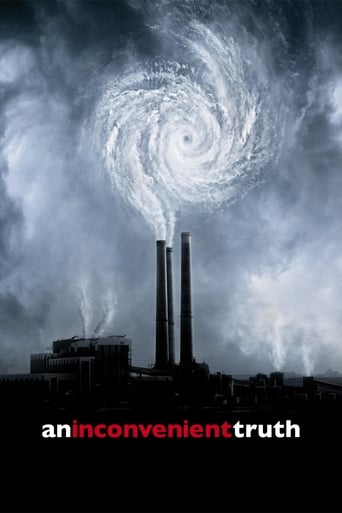
An Inconvenient Truth
2006 · Film · documentary · 100 min
Part of An Inconvenient Collection
Directed by Davis Guggenheim
A documentary on Al Gore's campaign to make the issue of global warming a recognized problem worldwide.
8 positive22 negative2 mixed22 neutralfrom 54 commenters
Where to watch
No streaming data for this title.
59 comments on Hacker News
If it helps, I regard early Facebook as Version 2.0 of the original Stalk That Girl and an example of asocial media that should have been culled at an early stage.
I can't speak to events depicted in films I haven't watched, so that's The Social Network and An Inconvenient Truth off the board :/
Something that would help a great deal would be some very public, clearly worded predictions about future events that should happen.
Climate scientists could help convince skeptics by correctly predicting future events. Skeptics could vet the predictions immediately to avoid late refutations. They’d look foolish if they tried to downplay the events if they didn’t raise concerns at the time they were predicted.
Looking fairly at things, predictions along the lines of ‘An inconvenient truth’ did not help. ( A UK high court ruling found at least 9 errors or exaggerations in the film. )
Demonstrating predictability should increase acceptance.
20 years ago was when Al Gore’s influential documentary An Inconvenient Truth first appeared. Almost everyone I knew discussed it, including primary school pupils. Guess what, we do have better tools today than 20 years ago to fight climate change, such as practical and useful electric vehicles to replace CO2-emitting conventional vehicles.
… however, even that is up for debate. Maybe the TV actor in your own example is Al Gore filming An Inconvenient Truth and the environmental scientist was in the minority which isn’t so afraid of climate change. Fast forward to 2025, the scientist’s minority position was wrong, while Al Gore’s documentary was legally ruled to have 9 major errors; so you were stupid on both sides, with the TV actor being closer.
Side note: Inconvenient Truth documentary might have actually been more widely accepted if it wasn’t a political ad for Al Gore
The section of the population that needs to think about the Inconvenient Truth didn’t watch the movie, because they don’t watch documentaries unless it’s about a Poop Cruise, or a celebrity.
So wait, so you've decided a film by the director of An Inconvenient Truth, that was praised by everybody from Bill Gates to Oprah, has won awards and gotten a 90% on Rotten Tomatoes is "right wing propaganda"?
You may want to recalibrate you sense of where the center is.
I guess, I want to know what the how accurate the models from 1998 on have been.
Iirc, “An Inconvenient Truth” was put in 2006. I remember it winning Best Documentary.
What's conservative about this? "Catastrophic" "doomsday glacier" doesn't sound very conservative to me.
The entire film "An Inconvenient Truth" was too aggressive, and did more damage to trust in climate science than any other publication on the topic.
> Researchers have found that humans quickly stop remarking on hot temperatures; after between two to eight years, what was once a record high starts to feel like the new normal
Al Gore sensitized his layman audience of this effect in his invited talks (c. early 2000s), as slow boiling the toad. It is also a part of the "An Inconvenient Truth" documentary (2006), which is quite a relevant discourse even today. If you haven't watched it, I recommend you should - it is quite accessible, & well explained considering it was made almost 2 decades ago.
> “Since the movie “Inconvenient Truth” the amount of ice of the world has increased significantly toward the mean.”
> That is 100% accurate. You’ve assume I said something else and constructed a straw man argument.
No, I assumed you said that. I think what you intend to now say is "Comparing the arctic sea ice levels between 2006 (the year "An Inconvenient Truth" came out) and today, there is little to no difference in levels." That statement is true and unarguable. It is fact. But it is also very precise and I'd argue not useful.
You are extrapolating by using the word "trend" as that incorporates a more continuous nature of things. That is why we looked at multiple years. Because we need to see a trend. Systems are noisy and if we just take two samples we can't compare them that well because we haven't really incorporated the error/uncertainty associated with those data points. By incorporating more years we are doing just that. We could be much more rigorous and tighten our error bounds, but the process we did is sufficient to discredit your claim.
The truth is that 2023 is only just starting. If we look at 2020-2022 we see that up until... July 1st, that they are near identical to the 2006 values. But that's when they all diverge and there becomes a large gap (July 1st till about Dec 1st).
The 60s comment is addressed in the other comment. Let's not merge two threads.
Re Mars: That article is about methane and not about global temperatures. I'm not sure why this is relevant. Doesn't even mention the delta.
Re Pluto: It explains the difference right there in the article. Earth's eccentricity: 0.017; Pluto's eccentricity: 0.249. A 15x difference seems to play an important role and makes for good explanations about different mechanisms. I mean the fucking thing gets closer than Neptune during its orbit and this was one of the reasons it was downgraded to a dwarf planet.
I'm no longer assuming good faith. You're not even reading your own sources and considering other opinions. I have made the mistake of trying to play chess with a pigeon. I should have expected my board to be full of shit, but I tried to be nice.
That wall of text doesn’t address what I said which was
“Since the movie “Inconvenient Truth” the amount of ice of the world has increased significantly toward the mean.”
That is 100% accurate. You’ve assume I said something else and constructed a straw man argument.
Additionally, as mentioned by another poster, secondary weather sampling stations were built by the government to audit the warming trends reported and the result was no significant increase in temperature.
Additionally it was reported that the BBC reported a historic increase in temperature and after bloggers spent a year doing FOIA requests to audit the data it was found that the entire temperature anomaly was due to a 60 second spike of a single temperature sensor placed in the pathway of airplane jet exhaust which was triggered by three military jets landing right after another.
Additionally, the earth is not the only planet experiencing global warming, every single planet in the solar system is experiencing global warming.
Mars: https://www.spaceflightinsider.com/missions/solar-system/is-mars-undergoing-global-warming-data-from-curiosity-suggests-it-might-be/
Pluto: https://news.mit.edu/2002/pluto
And this warming coincides with the warming trends on Earth.
I could go on… the Bell curve controversy with climate alarmist Michael Mann who’s defamation case against Tim Bell was dismissed because Michael refused to reveal his climate alarmism data to the court for 9 years despite the Judge ordering him to do so.
I could also mention how prominent climate scientists like Judith Curry get evicted from the “Club” once they go against the alarmism narrative.
This whole thing stinks like a religion where heretics are burned at the stake and any contradicting data is ruthlessly silenced.
I'm going to assume good faith. So let's look at the data and see how to read it. We'll even use the same sources!
> Since the movie “Inconvenient Truth” the amount of ice of the world has increased significantly toward the mean.
Let's go to that link (or read the top reply) and verify ourselves![0] Should be easy, right? Let's click "hide all years" on the side and also uncheck the median and ranges (so we have nothing). Then one by one, let's click the decade averages in the top right. Where does the graph move? We could also click every 5 years, or even 1 year and watch each line be drawn. Is there a trend? The one I see completely disagrees with that tweet.
But why is the tweet misleading? That's a better question. Well, click 2022 and you'll see something interesting. In Jan-April there's actually a bit more ice than in 2006, with about 0.5 million km2 as a max differential. But July through December it goes far below, with a differential of about a million km2. But let's check other years, to see if there's a bias. Just select 2022, we'll add 2023 and down to 2017. Okay, we see 2022, 2017, and 2020 are a bit different, so let's keep those in mind. Now let's do the same thing around 2006. We see here that 2006 is a bit abnormal for the years surrounding it. Now let's select the bounding years and then compare the two. Does this make sense and agree with the averages? It should.
Your alarm bells should have gone off in the first place because 2023 doesn't even have a full year to plot. Not even half of one.
> Additionally nearly every climate sensor is located on the tarmac of an airport.
Yeah! That's actually exactly right! We need a lot of thermometers and placed in a lot of locations. (I should also mention that there are a lot of thermometer systems that aren't based on airports though but we could also get deep into wet bulb vs dry bulb and all kinds of things. We'll just stay here for now) So we look for existing ones to work with and then use that data. What I find interesting about this tweet is that usually we're criticized for "manipulating" data rather than this. There's a surprisingly good and approachable article on all this here[1]. You'll find how we adjust surface temperature data to account for being near a black body, how ocean temperatures are adjusted based on the measurement techniques that are used (because each one introduces a different bias), and so on.
Actually one thing you'll frequently find me complaining about is how difficult analysis actually is (though usually in the context of ML). This is quite similar. You can't ever really work with "raw" data, because your measurements have biases in them and if you don't account for them you'll get biased results which do not align with observations. But the best first check that you can actually do is look at prediction model and then look at the results and see how good the predictions were. Luckily with something like climate science we've had decades of this going on and so we can verify this pretty well. We just need to look at models created in the 80's, 90's, and 00's and see how good they predicted the subsequent decades of temperature rise[2,3,4].
So I can get the misunderstandings here and the reason to be skeptical. But I think we've thoroughly shown that the two tweets you linked to are either by people that are misunderstanding a highly complex thing (pretty understandable) or are not acting in good faith (which if they're claiming expertise with lacking knowledge, this too is not in good faith). Climate is a pretty complicated topic with a lot of moving parts that can appear to contradict one another if you aren't careful. I highly suggest drawing charts to keep track of how things connect. Most people aren't trained in these things and so it is understandable. But you also should focus on asking questions when you don't understand rather than asserting "facts". There's no reason to feel embarrassed for not knowing things. We all are pretty fucking stupid, myself included. But let's also try to not trick ourselves. The best way to do that seems to be to challenge our own beliefs. You set up a challenge of "how would I disprove myself" and then see if you can do so. If you can't, then congrats, your opinion should get stronger. If you do, dang, let's update our beliefs. Usually it is somewhere in between though and you don't have to tear everything down. But I have to admit, when the whole perception changes, it is kinda exhilarating. Finding out new things is quite a lot of fun.
[0] https://nsidc.org/arcticseaicenews/charctic-interactive-sea-ice-graph/
[1] https://arstechnica.com/science/2016/01/thorough-not-thoroughly-fabricated-the-truth-about-global-temperature-data/
[2] https://climate.nasa.gov/news/2943/study-confirms-climate-models-are-getting-future-warming-projections-right/
[3] https://agupubs.onlinelibrary.wiley.com/doi/full/10.1029/2019GL085378
[4] https://www.columbia.edu/~jeh1/mailings/2020/20200203_ModelsVsWorld.pdf
Submission Comment:
In this midlength video (23ish minutes), Dr Simon Clark goes over the issues High Court Judge Michael Burton identified with the docu-movie "The inconvenient truth" by Al Gore. With the benefit of time, Dr Clark, identifies which errors were in-fact not errors, verifies which errors were indeed correctly identified by Judge Burton.
In addition, Dr Clark mentions a grave error in the movie, namely the politicization of climate change, and the consequences of above actions with respect to talking about, and dealing with the problem.
Disclaimer: not affiliated with Dr Clark.
Well, obviously what I say must be wrong if you guessed that someone might say it.
Indeed, someone might say "95%" because they want to make the same sort of impression as if they said "100%" but to be able to hide behind it if they're wrong. Or, y'know, they might say "95%" because they've thought about the strength of the evidence and expect to be right about such things about 95% of the time.
(I'm not sure how relevant any of this is to "An Inconvenient Truth" since you say it makes its claims with 100% confidence. I haven't watched the movie. I don't know exactly what it claims how confidently. It's basically a work of propaganda and I would expect it to overstate its claims whether the underlying claim is largely right or total bullshit or somewhere in between.)
Of course I don't think counting smart people is the only way to find out what's true. It couldn't be; you need some engagement with the actual world somewhere. Fortunately, there are plenty of people engaging with the actual world and reporting on what they find. It turns out that those people almost all seem to agree that climate change is real and a lot of it is caused by human activities.
Of course they could be wrong. And you've looked at the evidence, so no doubt you know better than they do. But ... in that case, this is a field so confusing that most people who dedicate their whole careers to investigating it end up with badly wrong opinions. If so, then why should I trust that your looking at the evidence has led you to the right answer? For that matter, why should you trust that? Shouldn't you consider the possibility that you can go astray just as you reckon those "smart people" did?
If I really wanted to be sure about this, then indeed I wouldn't go counting smart people. I would go into the field myself, study it at length, look at the underlying data for myself, and so forth. But that would mean abandoning the career I already have, and taking at least several years of full-time work before arriving at an opinion. So instead I look to see who seems to be (1) expert and (2) honest, and see what range of opinions those people have.
I find that the great majority of experts think anthropogenic climate change is real and a big deal. They could be wrong or lying or something. Do they look less expert than the people saying the opposite? No, it mostly seems like the people with the best credentials are on the "orthodox" side. Do they look less honest? Hard to tell for sure, but there sure seem to be a lot of people on the "unorthodox" side who just happen to be funded by the fossil fuel industry, and I don't see any strong financial incentive in the opposite direction for the "orthodox" folks.
What if I look at some of the particular claims they make? Some of them are really hard to evaluate without those several years of full-time work. But e.g. 10-15 years ago pretty much everyone on the "unorthodox" side was pushing the idea that warming had stopped, because if you look at the temperature graphs from 1998 onwards there was little or no upward trend. The people on the "orthodox" side replied that when you have signal plus lots of noise you will inevitably get periods that look that way. I did some simpleminded simulations and verified that the "orthodox" folks are right about the statistics. And there's a reason why this argument has disappeared into the memory hole: looking at the graph now no one would suggest that it's flat since 1998.
My impression from the limited amount of "looking at the evidence" I've done myself is that, while the "orthodox" folks haven't been infallible, they've done better than the "unorthodox". For instance, since we're looking at things produced by political figures rather than scientists, here https://web.archive.org/web/20071015042343/http://www.suntimes.com/news/otherviews/450392,CST-EDT-REF30b.article is an article by James Taylor of the Heartland Institute criticizing "An Inconvenient Truth". Claim 1: Gore says glaciers are shrinking but an article in the Journal of Climate says Himalayan glaciers are growing. Truth: (1) Taylor's alleged quotation isn't from that article but from something else Taylor himself wrote; (2) what the article (https://journals.ametsoc.org/view/journals/clim/19/17/jcli3860.1.xml) actually says is that in one particular region summer temperatures are falling while winter temperatures rise, and the result is "thickening and expansion of Karakoram glaciers, in contrast to widespread decay and retreat in the eastern Himalayas". So: no, Gore isn't wrong to say glaciers are shrinking, but in one very particular place things work out so that the reverse happens, which is odd enough that someone bothered writing a paper about it. Claim 2: Kilimanjaro. Truth: Yup, Gore got that one wrong. Claim 3: Gore says global warming causes more tornadoes, and the IPCC says there's no reason to think it does. Truth: I dunno, but if the IPCC says that then this is specifically an argument about Al Gore rather than about climate orthodoxy. Claim 4: similar, for hurricanes instead of tornadoes. Truth: again, this seems to be specifically about Al Gore rather than about climate orthodoxy. (Looking at e.g. https://www.gfdl.noaa.gov/global-warming-and-hurricanes/ it seems that the conventional wisdom today is that yes, hurricanes are getting worse and are expected to continue gettings worse, but we don't know with much confidence exactly what the causes are.) Claim 5: Gore says that African deserts are expanding because of global warming, but in 2002 someone found them shrinking. Truth: the Sahel region of the Sahara desert had an extra-severe drought in the 1980s, after which in the short term it improved; this is like the "global warming hiatus" post-1998. The Sahara seems to have increased in size by about 10% over the last century, partly but not wholly because of climate change (https://www.jstor.org/stable/26496100). Claim 6: Gore says Greenland's ice is melting, but actually it's thinning at the edges and growing in the middle and the overall effect is that it's gaining a bit of mass. Truth: take a look at the graph at https://climate.nasa.gov/vital-signs/ice-sheets/; it oscillates within each year but there is an extremely clear downward trend over the entire time NASA's satellites have been measuring. Claim 7: similarly for the Antarctic. Truth: Look at another graph on that same page. There's more random variation here, and circa 2006 you could claim that there isn't a decrease, but the trend is extremely clear.
Gore doesn't come out of this looking anything like infallible, but he's done a lot better than Taylor. And, in general, this is the pattern I see: no one is perfect, especially people who aren't actually scientists, but the claims of the "orthodox" tend to hold up much better over time than those of the "unorthodox".
Ralph Nader: "Everything will be solar in 30 years" (1978)
Al Gore: "Within a decade, there will be no more snows on Kilimanjaro due to warming temperatures" (An Inconvenient Truth, 2006).
Everything is not solar. Snow is still there. Gore literally made a movie on the back of these false claims. Not only has there been no social penalty for him but you are even citing him as an example of someone who was right.
Here it is again: our society systematically rewards false claims of global doom. It's a winning move, time and again. Even when your claims are falsifiable and proven false, people will ignore it.
Thanks for clarifying how you see it. I'm thinking about the documentary 'an inconvenient truth' of last century. If people/politicians would have listened and gave it a serious thought and started to act upon that, in stead of saying 'you consume a lot of energy, so don't tell us what to do', I think we would be better off, the greener technology would have taken off say, 30 years earlier.
After watching some of the congressional hearings yesterday and reading some of the news coverage, I can't wrap my head around how anyone can take this seriously anymore - it feels like I am living in a simulation, or a movie of some sort like The Truman Show.
I think what has enabled this must be something like this:
https://en.wikipedia.org/wiki/Boiling_frog#As_metaphor
The boiling frog story is generally offered as a metaphor cautioning people to be aware of even gradual change lest they suffer eventual undesirable consequences. It may be invoked in support of a slippery slope argument as a caution against creeping normality. It is also used in business to reinforce that change needs to be gradual to be accepted.[6] The term "boiling frog syndrome" is a metaphor used to describe the failure to act against a problematic situation which will increase in severity until reaching catastrophic proportions.[7] It thereby encapsulates the barely noticeable impact of slow environmental degradation that has been described by Daniel Pauly as shifting baselines.[8]
The story has been retold many times and used to illustrate widely varying viewpoints: in 1960 about warning against those who are sympathetic towards the Soviet Union during the Cold War;[9] in 1980 about the impending collapse of civilization anticipated by survivalists;[10] in the 1990s about inaction in response to climate change and staying in abusive relationships.[11][12] It has also been used by libertarians to warn about the slow erosion of civil liberties.[6]
In the 1996 novel The Story of B, environmentalist author Daniel Quinn spends a chapter on the metaphor of the boiling frog, using it to describe human history, population growth and food surplus.[13] Pierce Brosnan's character Harry Dalton mentioned it in the 1997 disaster movie Dante's Peak in reference to the accumulating warning signs of the volcano's reawakening.[14] Al Gore used a version of the story in a New York Times op-ed,[15] in his presentations and the 2006 movie An Inconvenient Truth to describe ignorance about global warming. In the movie version the frog is rescued before it is harmed.[16] This use of the story was referenced by writer/director Jon Cooksey in the title of his 2010 comedic documentary How to Boil a Frog.[17]
Law professor and legal commentator Eugene Volokh commented in 2003 that regardless of the behavior of real frogs, the boiling frog story is useful as a metaphor, comparing it to the metaphor of an ostrich with its head in the sand.[6] Economics Nobel laureate and New York Times op-ed writer Paul Krugman used the story as a metaphor in a July 2009 column, while pointing out that real frogs behave differently.[18] Journalist James Fallows has been advocating since 2006 for people to stop retelling the story, describing it as a "stupid canard" and a "myth".[19][20] After Krugman's column appeared, however, he declared "peace on the boiled frog front" and said that using the story is acceptable if the writer points out that it is not literally true.[21]
Models. Prediction with no long term history of being correct. It's a doomsday cult. I would recommend going back to watch Al Gore's An Inconvenient Truth and see how many of the catastrophic predictions have come true.
You could just go watch the 15-year-old movie An Inconvenient Truth. It's not perfect, but it gives a pretty good overall view of the consequences of climate change.
https://en.wikipedia.org/wiki/An_Inconvenient_Truth
We won't "all" have to do anything -- much of humanity will merely find it awkward. It's the poorest people who will suffer most: they can't afford to relocate, or rebuild infrastructure, or switch to cheaper foods when crops fail because they're already buying the cheapest things.
Western nations will likely buy their way out of it, outside of the occasional hundred-year-flood becoming decadal. The real pain will just be hundreds of millions of deaths and many hundreds of millions more people displaced. It's not an apocalypse. It's merely intense misery on a vast scale.
Nobody is expecting us to cut off fossil fuels entirely, or immediately. Any decent plan will require decades. We could have been well on our way, if we'd started decades ago when this became obvious. The basic physics of climate change are really very, very straightforward: carbon dioxide is opaque to infrared, and if you double the concentration you will increase the temperature. The economics of it are less straightforward, but it's clear that it's a vast amount of energy being pumped into a system, which will cause damage somewhere.
If, will, might, etc.
But have you seen anything that resembles a rapid change?
Putting aside the media alarmists, I have seen nothing that can't be explained as change. The beaches of my childhood are still there at the same height etc. Yes there have been fires (that I put down to forest mismanagement) and floods which will occur if you build on flood plains and if you cut down trees.
So, I don't see rapid change.
You should re watch al gore's original inconvenient truth film and see how well that has aged. He sounds like the proverbial boy who shouting fire in the cinema. Given his eco-investments, his actions are really better explained as a marketing exercise to will line his pockets.
I love documentaries, and these are my favourites. All very worth a watch.
- The Crash Reel
- McConkey
- Buck
- Apollo 11
- Carts of Darkness
- The Wild and Wonderful Whites of West Virginia
- Samsara
- Baraka
- Brooklyn Castle
- Spellbound
- Drew: The Man Behind the Poster
- Crumb
- The Jinx
- The Art of Flight
- King of Kong
- Indie Game: The Movie
- Capturing the Friedmans
- OJ: Made in America
- The Barkley Marathons
- The Seven Five
- Murderball
- Unbranded
- Gringo: The Dangerous Life of John McAfee
- Big River Man
- Hoop Dreams
- Word Wars
- Free Solo
- Long Shot
- Meru
- Being Elmo
- All This Mayhem
- Jiro Dreams of Sushi
- The Cove
- Project Nim
- Alone in the Wilderness
- Behind the Curve
- The Dawn Wall
- Grizzly Man
- 13th
- Winnebago Man
- Man vs Snake: The Long and Twisted Tale of Nibbler
- Get Me Roger Stone
- Icarus
- 13th
- Koyaanisqatsi
- The Thin Blue Line
- An Inconvenient Truth
- Oklahoma City
- Virunga
- The Staircase
- Evil Genius
- Undefeated
- Betting on zero
"an inconvenient truth" predates Gore's movie of that title.
eh, I think you're being pretty generous to Gore there. It was a long, drawn, fought out battle involving many lawsuits and lots of court coverage. In the end, when Gore had basically lost all of his challenges, he did "step aside" as far as dropping the lawsuits. But he continued to be a presence and he was still pretty bitter about it many years later (and brought it up nearly every time he was on TV). 6 years later in 2006 his movie "Inconvenient Truth" he reopened the wound all over again.
Now that said, Gore is a lot better than Trump on this for sure.
I wouldn't say these documentaries have "changed the world"; but they certainly had a larger-than-usual impact:
"An Inconventient Truth" Wikipedia: "Since the film's release, An Inconvenient Truth has been credited for raising international public awareness of global warming and reenergizing the environmental movement" <https://en.wikipedia.org/wiki/An_Inconvenient_Truth>
"Killing for Love" aka "The Promise" ... about alleged murderer Jens Söring - Wikipedia: "Chuck Reid, one of the original investigators of the Haysom murders, has occasionally agreed to be interviewed about the case. His participation in the 2016 documentary The Promise led him to take his long-standing doubts about the outcome more seriously." Jens Söring returned to Germany two years later. <https://en.wikipedia.org/wiki/Jens_S%C3%B6ring#Documentary>
In general, I would say it's very hard to pinpoint real change to a particular movie, apart from bringing public attention to some issue. For documentaries which have done so, I suggest looking at movie awards, best of-lists (e.g. BFI) or the National Film Registry in the United States.
This puzzled me until I realized you're talking about mainstream news-type sites. I agree on that, but these barely qualify as writing in the first place, since none of the traditional goals apply. It's like if the only kind of video you've seen are ads and you then proceed to complain about the info density of video as a whole. Though most video on YouTube also sucks, some things are very well expressed in video, like the documentaries An Inconvenient Truth or Blue Planet II.
For me "long-form writing" brings to mind textbooks, LWN, some bug report emails, some HN comments. These are a different category of writing. I don't think you should sit around to wait for someone else to summarize these for you -- that attitude must be terrible for you in the long run.
This post appears to be fully within the Hacker News "approach to comments" and "site guidelines".
The atmospheric temperature discussed as dangerous has been common in many parts of the earth for many years and is not nearly new. The real threat discussed is from heavy consideration of
"business-as-usual RCP8.5 emissions scenario"
and that is based on climate models evaluating the future, 2050+, effects of human sources of CO2 on temperature and climate.
We have a long history of such models. Apparently they are usually based on the fact that CO2 is a greenhouse gas.
The main question about CO2 is how much warming will be caused by a given quantity of CO2 from human activities.
Yes, CO2 is a greenhouse gas, but maybe surprisingly so far from either observations or models, we have no credible evidence that human sources of CO2 have caused, are causing, or will cause significant warming.
Okay, let's look at the observational data:
There was a movie, An Inconvenient Truth. With data from Antarctic ice cores, the movie showed, for the atmosphere, a graph of temperature and CO2 concentrations going back about 800,000 years.
As I watched the movie, it appeared that the claim was that the graph showed temperature and CO2 concentrations going up and down together. Then the movie concluded that the higher concentrations of CO2 caused the higher temperatures. Then there was a claim that currently more CO2 from human activities would rapidly cause significantly higher temperatures.
But, we could look at that graph more closely, and doing that we will see three situations:
(1) When temperature started to increase, CO2 (concentration, here and below) was low, not high. So, something caused the warming, but it was not high CO2.
(2) About 800 years later, CO2 had increased. Presumably the cause was more biological activity from the higher temperatures.
(3) Some thousands of years later, while CO2 was high, the temperatures fell again. There was a cause, but it was not low CO2. Indeed, the high CO2 did not keep temperatures from falling.
Net, from that 800,000 years of data, there is no evidence that high CO2 caused high temperatures. It would be more accurate (though of course still wrong) to say that the data supported that CO2 caused LOWER temperatures.
For some more recent data, there was some significant warming during the time of the Roman Empire and during the Medieval Warm Period, and there is no evidence that the cause was high CO2. There was some significant cooling during the Little Ice Age from roughly 1300 to 1900, but there is no evidence that the cause was low CO2. There was some cooling from 1940 to 1970 and concerns in the media about another ice age, and those years were when there was more CO2 from human activity from WWII and the post-war economic boom. So, in those years, with more CO2, we got some cooling instead of warming.
Again it would be more accurate (though of course still wrong) to say that the data supported that CO2 caused COOLING.
For some details, can start with "Global Cooling" at
https://en.wikipedia.org/wiki/Global_cooling#1974_Time_magazine_article
which discusses the two famous magazine stories, the 1974 <i>Time</i> story and the 1975 <i>Newsweek</i> story, worrying about "global cooling" and asking if we were entering a new ice age. For more on these magazine stories, at
https://longreads.com/2017/04/13/in-1975-newsweek-predicted-a-new-ice-age-were-still-living-with-the-consequences/
can see the April 28, 1975, <i>Newsweek</i> article “The Cooling World”.
So, net, there is no data on temperature and CO2 from the past that says that CO2 will cause warming.
Yes, CO2 is a <i>greenhouse</i> gas. This means that it absorbs some light in the infrared but not the visible. In the case of CO2, it absorbs light out in the infrared in three narrow bands. The absorption spectrum is given at
https://webbook.nist.gov/cgi/cbook.cgi?Spec=C124389&Index=0&Type=IR&Large=on
Part of the mechanism is Planck black body radiation.
We have had some warming since the Little Ice Age. It may be that we are still pulling out of the Little Ice Age, e.g., it can take a long time for the oceans to warm up. But even with this warming, it's cooler than in the Medieval Warm period and the Roman times when the polar bears didn't go extinct, the ice in Greenland and the Antarctic didn't melt, the oceans didn't rise and flood the coasts, and apparently humans didn't suffer. Apparently the main effects were greater agricultural productivity, e.g., in England, grapes were grown for wine.
Could the warming since the Little Ice Age be due to CO2? No: The warming is at the surface, and CO2 absorbs high in the troposphere with definition at Google:
<blockquote>the lowest region of the atmosphere, extending from the earth's surface to a height of about 3.7–6.2 miles (6–10 km), which is the lower boundary of the stratosphere. </blockquote>
which, from MIT climate scientist Richard Lindzen, Alfred P Sloan Professor of Atmospheric Sciences, Emeritus, at Massachusetts Institute of Technology, has gotten cooler, not warmer.
Several attempts were made to model the atmosphere and calculate and predict the effects of human sources of CO2 on temperature. Nearly all the efforts predicted temperature increases that were rapid and significant.
It has now been some years since the times of the predictions, and the predictions and reality are compared in the graph at
http://www.energyadvocate.com/gc1.jpg
Summary: Nearly all the predictions were way too high.
Science: So, so far climate modeling has no predictive value and, thus, is not good science.
Result: The predictions have no meaningful credibility.
Current Summary: There is no credible evidence from either the 800,000 years of the earth or the climate models that human sources of CO2 have had, are having, or will have significant effects on temperature or climate.
As a result of this lack of evidence, there is no scientific reason to attempt to lower human sources of CO2.
> He was made into a joke for his climate change documentary
He was made into a joke long before that ( lock box ) because he was a joke. And his climate change "documentary" was nonsense. All he did was use his name recognition to peddle a documentary to make himself a shitload of money.
> when now it feels like if we listened 15 years ago we'd be in less of a snake pit.
We did listen. That's the problem.
If you want a good laugh, go watch the Inconvenient Truth. Then go watch Moore's "Human Planet" and see what al gore had been up to since his documentary.
"Earth Day" was an event that happened only every decade up until 1990 when it became an annual event. This concept that what we do has a direct impact on the environment has only been a mainstream idea since the mid-1990s. Outside of super liberal areas like California, things didn't really kick off until Al Gore's movie An Inconvenient Truth came out in 2006. By the standards of the day, just digging the ditch and covering it afterwards was considered forward-thinking in most rural locales.
The Venus Project: Future By Design - By Jacque Fresco. Introduced Jacque Fresco's philosophy, R.I.P., and also the empathy we must have in designing something that is good for the planet and for the future. I highly recommend.
Mike Maloney's "Hidden Secrets of Money" is a beautiful set of YouTube documentaries financed by Mike himself. It educated me and millions out there how money really worked in the real world, and how the Federal Reserve and banking manipulates currency. https://goldsilver.com/hidden-secrets/
The Corporation - When Corporations started to get the same rights and treatment as regular citizens, we have created a monster that have changed our world for the worst.
The Cove and Blackfish. Really sad and made me stay away from Sea World and circuses and places that held animals in captivity for entertainment.
The Fog of War: Eleven Lessons from the Life of Robert S. McNamara - The 11 lessons are worth learning: https://en.wikipedia.org/wiki/The_Fog_of_War
Enron: The Smartest Guys In The Room/Inside Job - When corporations are run by sociopaths.
An Inconvenient Truth - Global warming.
Diana Vreeland: The Eye Has to Travel/Bill Cunningham New York - Learned so much about creativity and just being true to your unique self regardless of what the world thinks.
Zeitgeist - Esoteric knowledge.
That's like saying to me that Opera is competition to Chrome. Come on. What's it have, 0.1% of the videos and 99% of them are from professional photography studios? I can't even remember the last time I visited Vimeo.
edit: I just signed up to give it another chance, looked up something I constantly watch on youtube; "Medieval Documentary" and the few selections I have (3-4) are 5-10 years old.
On the flip side there are so many choices from that search on youtube I'm not even sure what to watch.
Youtube is my cable TV replacement and has been for maybe 10 years, and I'm in my mid 30s.
edit-2: I finally stopped scrolling and getting medieval documentaries. It's endless scroll so it's hard to gauge but I'm guessing I'd be on page 30-40 by now. The only way that I can tell that my search ended was now I'm getting thrown random Youtube rental videos. The first one at the end of my search is An Inconvenient Truth. But they still speckle interesting historical stuff in there for me. Lots of native american, 18th, 19th century stuff, etc. Then a lot of completely unrelated movies, like Holy Hell and Once in a Lifetime, Bill & Ted, what we do in the Shadows. I guess you could use a very vague "historical" against those so maybe that's legit, but not really my aim with that search.
I believe the documentary A Plastic Ocean covers a lot for ocean pollution.
For global warming/climate change- An Inconvenient Truth, which is now probably dated.
I saw a great documentary of the impacts of climate change already being seen in Ladakh firsthand: Jungwa: A Broken Balance. It's pretty depressing to see a village running out of water because of the greed of a society they could never comprehend. Instead they pray for hours, thinking their problems that stem from the environment, are evidence of their own sins. Heartbreaking to see the people that will be impacted the most with the least resources to adapt.
“Ridicule is man's most potent weapon."
"Keep the pressure on."
"The threat is usually more terrifying than the thing itself."
"The major premise for tactics is the development of operations that will maintain a constant pressure upon the opposition."
"If you push a negative hard and deep enough it will break through into its counterside"
"Pick the target, freeze it, personalize it, and polarize it."
From Saul Alisky’s Rules for Radicals.
These are precisely the tactics being used against climate skeptics. Rather than actually caring about debating the science, the alarmist side instead uses phrases like “virtually none of the climate-change deniers have a clue about the underlying science.”
The whole debate stopped being about science years ago and it has instead become a battle of economic ideology. It’s impossible to have a rational debate when the leadership of the debate engages in ad hominem attacks as a matter of tactics.
We talk about “science,” yet hold up an Inconvenient Truth as some sort of inflatable prophesy, as if Al Gore were Moses holding the Ten Commandments. Despite all sorts of debunked aspects of that film, to call it into question means we are somehow intellectually inept. One would be intellectually inept to not call it into question! As far as realizing how we have been manipulated — that manipulation cuts both ways: many people actually think the debate is still about the climate. It’s not. It’s about economic systems and the means of production.
I’ve stopped caring about the debate and just quietly vote for candidates with whom I agree. There is an expression about wrestling pigs that comes to mind when I think about the climate debate..
Is it so unbelievable that people could just disagree with you that you have to assume they’re espousing a fake or paid for position?
I consider myself a conservationist so I think outrageous and easily falsifiable claims like “this was caused by climate change and we can expect more of this” destroy the credibility of the people making the claims and the dangers of climate change in general.
The most famous was the 2000 article that claimed snowfall was a thing of the past which was finally deleted after years of mocking:
https://wattsupwiththat.com/2015/11/12/one-of-the-longest-running-climate-prediction-blunders-has-disappeared-from-the-internet/
There are so many more examples including Al Gore’s An Inconvenient Truth being released shortly after Katrina and being advertised with a hurricane coming from the smokestack of a factory saying we can expect hurricanes like that will be much more common going forward. Instead we had hardly any hurricanes make landfall for over a decade.
https://m.imdb.com/title/tt0497116/?ref_=fn_al_tt_0
So on Amazon page we see the distribution in addition to the average score. People clearly either love it or hate it.
https://www.amazon.com/Inconvenient-Truth-Al-Gore/dp/B00AB0SHRW
Plus it skews toward the positive, since we would expect a verified buyer is more likely to be someone that already approves.
On the other hand, films that everyone thinks are OK are still indistinguishable from a film I may either love or hate. This is not a flaw, but inherent in the idea of ratings itself.
I don't see bimodal distributions as a problem, but hiding them might be.
> The overwhelming consensus of experts is that its going to have an enormous impact.
How soon? Al Gore's "An Inconvenient Truth" predicted apocalyptic consequences in as few as 10 years. 10 years later and it turns out the documentary had tons of erroneous assumptions. Oops.
> That's akin to demanding that all engineers accurately predict which piece of the roof will collapse first, where the pieces will hit the floor, how many pieces it will break up into and on which date.
If your model has poor predictive power, it's not a complete model. Engineers can accurately predict lots of things using standard models - for example whether a building will be able to withstand shear wind forces. Climate science cannot predict anything except "it will be disastrous with apocalyptic proportions at some non-deterministic point in the future" How is that a useful prediction beyond generating hype?
I rest easy knowing Al Gore and Leonardo DiCaprio have burned far more fossil fuels than I ever will in my entire life.
When someone throws the 'denier' slur around, I throw a giant steak on my Big Green Egg, grass-fed for extra environmental impact.
Edit: I just got off the set of a major motion picture and I've seen firsthand the incredible waste that goes into making movies such as "An Inconvenient Truth" which isn't even a huge production. Don't even get me started on Leo's movies, those soundstages didn't light themselves.
How do you figure it is a satirising exaggeration and not a straw man designed for ridicule?
I found a transcript of "An Inconvenient Truth" at http://www.admc.hct.ac.ae/hd1/courses/blog/gw/An%20Inconvient%20Truth%20Transcript.pdf. The section on 20 foot sea level rise is a description of what would happen "If Greenland broke up and melted, or if half of Greenland and half of West Antarctica broke up and melted" and ends with "Is it possible that we should prepare against other threats besides terrorists? Maybe we should be concerned about other problems as well."
I agree that it's a call to action. I disagree that it's a prediction of something imminent, as in, an outcome that will happen within a couple of decades of when the movie was made. I read it as a need for imminent action, to prevent one possible long-term outcome.
BTW, Gore does make some short term predictions, which have proved to be incorrect. Gore said that within a decade there will be no snows of Kilimanjaro. That decade has passed. Instead, http://www.the-cryosphere.net/7/419/2013/tc-7-419-2013.pdf says that most of the ice cover will be gone by 2040, and the rest by 2060. http://lindseynicholson.org/wp-content/uploads/2011/07/Moelg-et-al.-2013.pdf further points out that there will be snow even if there are no glaciers.
(While incorrect, I do not think it seriously affects the underlying meaning. The choice of "snow" over "glacier ice" should be read as an homage to Hemingway, with some poetic license allowed.)
Gore predicts Glacier Valley will have no glaciers within 15 years, or 2021. NPS estimates no later then 2030, https://www.nps.gov/glac/learn/nature/glaciers.htm , so Gore may be a couple years off there as well.
Gore was willing to make testable predictions in the 10-15 year span, which is a clue that the 20 foot rise in sea level that he described was not meant as a prediction of something imminent.
I am guilty of reading "predicting foot to meter per year seawater rise" as a satirising exaggeration for "predicting immediate, catastrophic (plausibly sea-level related) consequences" and I did not state that clearly. With that amendment, I think my comment still has merit, but it may no longer have responded to anything you wrote. Sorry about that.
That said, An Inconvenient Truth did suggest a 20-foot rise as something imminent. Did it "predict" it? No, not explicitly, it suggests and imagines and calls to action. It also doesn't specify the timescale, but there is great urgency. With that, your GP, while very much on the high end, is way closer to AIT than AIT is to IPCC.
A short note on movies and art: the difference between "The Core" and TDAT (and "regular" art and the "climate" ditto) is that the latter didn't use science as a plot device, it explicitly injected itself into a political debate, dominated by a scientific discourse.
Where are the people who said that the sea level would raise 1 foot to 1 meter per year?
You didn't answer that question. Everything you wrote is a distraction, which ends up increasing the confusion you describe and complain about.
You pointed to some artists and movies. So what? I can point to movies who have depicted meteors crashing into modern day Earth, and volcanoes erupting in Los Angeles, and even have the core of the Earth stop spinning. Artists have different goals. They are not required to only depict what science predicts +/- 1 sigma.
You point to a scientist who liked that "The Day After Tomorrow" used climate change as a plot device, even if the science was awful. So what? I'm sure some Spacewatch people like "Armageddon" and that some geologists like "The Core", even though the science is awful in both. Are you equally disdainful towards those scientists? Or do only climate scientists draw your ire? (BTW, "Water World" used global warming as a plot device, was almost 9 years before TDAT, and portrayed an equally scientifically absurd future.)
You mentioned "An Inconvenient Truth". Does Gore make a prediction that there will be 30cm or higher water rise per year? Does he even predict that the Atlantic will have reached the base of the Empire State Building by now?
How is the IPCC 2001 report not an attempt at a thorough rebuttal? What level of rebuttal would you require before you say it was sufficient? Do we all need to be like Neil deGrasse Tyson and pinpoint every single scientific flaw in a movie? Or go even further and reject every movie with a flaw?
In other words, I'm not going to get into a goalpost argument with you before you even say what the goalposts are.
Your argument of the structure of the argument is useless. It's so easily inverted. Watch: You have set up your own Motte and Bailey about what's going on in this HN thread, so nothing I say can dissuade you. You have inserted irrelevant commentary from your bailey to defend your views. Now you can ignore me because you think I'm using irrational arguments, because you have placed me in a spot where you think I can be ignored. Now you can enjoy your motte.
I argued that the OP presented a straw man argument that misrepresents what the large majority of climatologists and policymakers like Gore were making 15 years ago. Do you agree or disagree with me?
I presented the IPCC report to supports my argument. Gore's "An Inconvenient Truth" also supports my argument. If you disagree, do you have an actual examples of people who predicted 30+cm/year sea rise, or even that much of Manhattan would be underwater by now?
There's a lot of motte/bailey'ing[1] going on in the climate change debate.
There is tons of histrionics and scare mongering out there. I particular remember during the COP15 meeting in Copenhagen, art installations illustrating how the city would be under water if sea level rose 7 meters, which is the estimated rise if all of the ice on Greenland melts. The Day After Tomorrow, not to mention An Inconvenient Truth.
While there certainly are and were voices critical of these things and their dubious relationship with the science (whether settled or consensus or not), their usefulness in advancing the agenda appears to be appreciated more than their role in misrepresenting the science. This is an actual quote from a scientist listed in the "criticism" section of the "The Day After Tomorrow" Wikipedia page[2]: "I'm heartened that there's a movie addressing real climate issues. But as for the science of the movie, I'd give it a D minus or an F. And I'd be concerned if the movie was made to advance a political agenda.". This is an actual scientist on the record believing that TDAT is "addressing real climate issues". That is like applauding Swordfish[3] for addressing cyber security issues. That is the Bailey.
Then, years after, when these things perhaps look a bit more absurd (and some very specific predictions turned out not to come through, at least not as unambiguously as expected), we get "The IPCC's 2001 report was for <1 meter rise over the entire century ... Do you have evidence that it wasn't just kooks saying what you suggested?"
That's the Motte.
You can't have your cake and eat it, too. If it was only kooks saying it, certainly none of the non-kooks bothered throughly rebutting them at the time.
1:http://blog.practicalethics.ox.ac.uk/2014/09/motte-and-bailey-doctrines/
2: https://en.wikipedia.org/wiki/The_Day_After_Tomorrow#Criticism
3: https://en.wikipedia.org/wiki/Swordfish_(film)
I think you are confusing documentaries with "fair and balanced" news programs.
CitizenFour - did this present the NSA side of things?
An Inconvenient Truth - did this present the fossil fuel industry's viewpoint?
GasLand -- did this present the drilling industries perspective?
Documentaries are about presenting both sides. Documentaries are about presenting truth as the filmmaker sees it - usually with the intent to draw awareness and elicit change.
Climate change is a really big deal. When we've had scientific movements of this magnitude, the face of the movement has always been a scientist (think Copernicus, Darwin, or Einstein).
The face of climate change is jointly Al Gore and the IPCC, which was formed from the environmental portions of the UN.
If the face of climate change was a scientist, I'd be more apt to believe it, and so would millions of other people of a conservative political bent.
An Inconvenient Truth is the seminal work on climate change meant to inform the general population, and a substantial bit of the movie is spent on the 2000 presidential election controversy.
Why in the world would anyone think that Republicans and political conservatives would just readily accept the information put forth by liberal politicians, merited or not?
And if I'm actively looking for the truth, how can I find it? I can't spend my lifetime doing my own research, taking my own measurements, experimenting and publishing papers to find out on my own. It's hard to find any material for lay people that don't have some environmental activist telling me I'm an idiot for no believing all the science Al Gore has already presented me.
Honestly, if human beings end up going extinct because we destroyed our atmosphere with fossil fuels, it'll be as much the gross mismanagement of the politics by environmental liberals that's to blame as every American eating burgers and driving SUVs.
Los Angeles, Local Only.
Slated is an online marketplace for film financing and dealmaking — connecting a global network of investors, filmmakers and industry professionals.
For filmmakers, Slated is a platform to promote viable films to an engaged audience. For investors and the industry, Slated provides access to qualified filmmakers and leading organizations to facilitate targeted introductions and help discover viable projects.
Backed by prominent angel investors in the entertainment and finance communities, Slated has built a passionate management team with experience from major studios, technology, and financing companies.
Members include some of the world's most prolific filmmakers and actors from films such as: Pulp Fiction, Good Will Hunting, Iron Man, The Kids Are All Right, An Inconvenient Truth, and The Descendants.
Gotta have...
.Python
.Django or similar Python web stack
.Linux command line tools, i.e., bash and everything else
Nice to have - not all, but some...
.Django Rest Framework endpoint design and dev
.App performance optimization (used newrelic.com? awesome!)
.RabbitMQ and Celery backend task design
.Python Fabric deploy scripting
Apply through StackOverflow: (Mention HN if you see this posting first. ) http://careers.stackoverflow.com/jobs/65775/python-django-developer-slated
I recently watched his movie "manufacturing consent" and was surprisingly disappointed. It seemed kind of disjoint with no solid message and unfortunately it was boring to watch to boot.
I really think corporate control of media, and media bias, and how it affects our society is a really important topic that needs its own easy to digest documentary, like black fish, or an inconvenient truth. Something that will popularize the issue, and explain the problems to people who normally wouldn't be interested.
When I think fast, I think being able to rendering hundreds of thousands of data points in real time, kind of like 'Google Maps' but for Time instead of Space, you should be able to fly over and analyze vast datasets.
As a historical note, since this is an area near and dear to my heart, I shipped an open source library several years ago circa 2007 that attempted to do this by applying the 3D graphics concept of a "mip map" to time series, with several representations of the data at various LOD automatically computed by sampling and filtering. I demoed it at Google I/O 2008 rendering 1 million data points in real time. Location here: https://code.google.com/p/gwt-chronoscope/, it's written in Java using GWT, and also the same code runs on the server for Java2D rasterization, and on Android. It has a JS API and Microformat API as well.
Here's a screencast of it in action, including things like animation, markers, synthetic datasets (technical analysis), styling, and history undo/redo. https://www.youtube.com/watch?v=RLYNHQVIeNg
I eventually wanted to get to a point where people could collaborately analyze data and tell stories about it. This screencast shows "Timelord" which was a integrated with social networks and supported a concept called "Micro-presentations", using a markdown-like format to allow people to write animated two-way video/chart synchronized stories. In this video, Al Gore's movie "An Inconvenient Truth" is synchronized to a Chart of CO2 and Temperature.
https://www.youtube.com/watch?v=s5Y21t0u_Zw
The following quote is relevant here:
“WOULD ANY SANE PERSON think dumpster diving would have stopped Hitler, or that composting would have ended slavery or brought about the eight-hour workday, or that chopping wood and carrying water would have gotten people out of Tsarist prisons, or that dancing naked around a fire would have helped put in place the Voting Rights Act of 1957 or the Civil Rights Act of 1964? Then why now, with all the world at stake, do so many people retreat into these entirely personal “solutions”? Part of the problem is that we’ve been victims of a campaign of systematic misdirection. Consumer culture and the capitalist mindset have taught us to substitute acts of personal consumption (or enlightenment) for organized political resistance. An Inconvenient Truth helped raise consciousness about global warming. But did you notice that all of the solutions presented had to do with personal consumption—changing light bulbs, inflating tires, driving half as much—and had nothing to do with shifting power away from corporations, or stopping the growth economy that is destroying the planet? Even if every person in the United States did everything the movie suggested, U.S. carbon emissions would fall by only 22 percent. Scientific consensus is that emissions must be reduced by at least 75 percent worldwide.
Or let’s talk water. We so often hear that the world is running out of water. People are dying from lack of water. Rivers are dewatered from lack of water. Because of this we need to take shorter showers. See the disconnect? Because I take showers, I’m responsible for drawing down aquifers? Well, no. More than 90 percent of the water used by humans is used by agriculture and industry. The remaining 10 percent is split between municipalities and actual living breathing individual humans. Collectively, municipal golf courses use as much water as municipal human beings. People (both human people and fish people) aren’t dying because the world is running out of water. They’re dying because the water is being stolen.
…Personal change doesn’t equal social change.” — Forget Shorter Showers: Why Personal Changes Does Not Equal Political Change
Even if every Guy Fawkes mask were made at Foxconn itself, a boycott wouldn't do anything to the working conditions. Teens would still purchase them based on the movie (or, heaven forbid, the actual comic book). What is necessary is restructuring the world to make Foxconn impossible.
[1] http://www.orionmagazine.org/index.php/articles/article/4801/
It's no surprise that the AGW crowd is losing the war of public opinion. Take the last line of the article that details a part of the report:
The draft report says the available evidence now suggests that above a certain threshold of warming, the Greenland ice sheet will almost disappear within approximately 1000 years, which will result in 7 metres of global sea-level rise. It estimates that the threshold may lie between 1 °C and 4 °C of warming, but is not confident of this figure.
So what they're saying is they are not confident that some degree of warming may occur within a huge band which may do something that sounds really bad (but they don't actually spell out the bad things) in the next 1,000 years.
I am a scientifically literate person with a strong conservation and environmental bent. But when I read something like this even I roll my eyes. Because I want people to actually conserve, please take the following advice to the AGW crowd:
First, stop using the disaster du jour to say, "See!?! We can expect more of this from now on!" Because when you did this with Katrina and then we had 8 years of relatively quiet hurricane seasons you sound like a "sky is falling" fool. The fact that "An Inconvenient Truth" came out shortly after Katrina with a hurricane on the movie posters and box covers was ridiculous.
Second, stop making inaccurate predictions about what is going to happen. For example - for a while everyone was decrying that snow was a thing of the past because of global warming (example: http://www.independent.co.uk/environment/snowfalls-are-now-just-a-thing-of-the-past-724017.html) When we then had record snowfalls throughout many areas of the world, the same people changed their tune and said, "Exactly! Global Warming will actually bring more snow!" Enough of this nonsense.
Stop using things like carbon credits to live a ridiculously lavish lifestyle while telling everyone else to live simply.
Finally, stop trying to profit off of AGW. http://www.nytimes.com/2009/11/03/business/energy-environment/03gore.html?_r=0
There are many people that you will never convince of the reality of AGW. But there are many more people that you are turning away from believing you because of the things above. Because I think finite resource conservation is the right thing to do, please stop hurting this cause.
Why? Because some things are testable. Antibiotics can be tested in a lab, while climate science cannot. Furthermore the climate is not behaving like early models predicted it would, so it makes it hard for people to accept (especially after sensationalist movies like An Inconvenient Truth). Also the politics involved are complex. Some countries (like my Canada) use way more oil per person and wouldn't be as affected by climate change.
Speaking of repeating talking points...
Muller himself stated he was never a skeptic - he just criticized the shoddy science of the global warming advocates. His BEST project confirmed to him his previous belief in anthropogenic global warming.
"I was never a skeptic -- only a scientific skeptic," he said in a recent email exchange with The Huffington Post. "Some people called me a skeptic because in my best-seller 'Physics for Future Presidents' I had drawn attention to the numerous scientific errors in the movie 'An Inconvenient Truth.' But I never felt that pointing out mistakes qualified me to be called a climate skeptic." [Huffington Post - not a scientific source, but probably reasonable to accept quoting a person about himself. http://www.huffingtonpost.com/blackberry/p.html?id=1072419]
You can read more about his recognized bias and scientific approach in a 2003 MIT technology review article: http://www.technologyreview.com/news/402357/medieval-global-warming/page/2/
Imagine An Inconvenient Truth[1] with all the charts and visuals replaced with tables of percentages....
[1]: http://www.imdb.com/title/tt0497116/
Edit: where's that Markdown standard spec...
I remember a polar bear desperately trying to locate a patch of ice in the movie "An inconvenient truth". I hate to imagine the situation polar bears are in right now.
I'm not going to comment on the contents of the story as it's really just a formal announcement of long-leaked information, but the descripion of Muller as some type of 'climate sceptic' is a PR stunt. He has always been a firm believer in the catastrophic human caused global warming movement.
Some quotes going back over time:
"It is ironic if some people treat me as a traitor, since I was never a skeptic — only a scientific skeptic. Some people called me a skeptic because in my best-seller ‘Physics for Future Presidents’ I had drawn attention to the numerous scientific errors in the movie ‘An Inconvenient Truth.’ But I never felt that pointing out mistakes qualified me to be called a climate skeptic.” - Richard Muller in an email to Huffington Post, 2011
“If Al Gore reaches more people and convinces the world that global warming is real, even if he does it through exaggeration and distortion – which he does, but he’s very effective at it – then let him fly any plane he wants.” – Richard Muller, 2008
“There is a consensus that global warming is real. …it’s going to get much, much worse.” – Richard Muller, 2008
“Let me be clear. My own reading of the literature and study of paleoclimate suggests strongly that carbon dioxide from burning of fossil fuels will prove to be the greatest pollutant of human history. It is likely to have severe and detrimental effects on global climate.” – Richard Muller, 2003
It would seem that Dr Muller is more intent on creating a headline and grabbing publicity than contributing to the body of knowledge. This would be great PR for a startup, but I find it a questionable tactic in this field.
That is a very week premise, which looks disguised as an attempt to sell one book by criticising another. You could equally apply that much scrutiny to any public profile book or movie (anything by Michael Moore, for instance).
I'm sure Lomborg's book contains exaggerations and selective presentation of the truth - after all, it's a popular literature, not a scientific work. But the very same standards applied to other 'popular' works of Global Warming media, like 'The Great Global Warming Swindle' and 'An Inconvenient Truth' have also showed up outright lies, fabrications and distortion of the truth.
In other words, it's unlikely that anyone can print or make something in this genre without someone else finding all sorts of facts that are wrong. But the whole thing is down to interpretation.
Ultimately we should be judging these books and movies for ourselves, and realising that much of the material contains a kernel of truth, probably much embellished for the narrative.
The article is worth studying as a masterpiece of political rhetorics. A salesman truly shows his skills when selling a bad product.
He explains that some side issues in the debate (IPCC claims about disappearing Himalaya glaciers,FOIA violations) are mistakes and he conveniently ignores the big elephant in the room: tampering with temperature records, corruption of the peer review process, lack of evidence for AGW.
And this is all coming from the same Al Gore who used to make false claims about melting polar ice caps, increases in sea level rise, ... in his movie "An Inconvenient Truth".
To cite [1]: "You can bet he’d be making the same claim if we had a below normal snowfall records too."
[1] http://wattsupwiththat.com/2010/02/23/the-goracle-forecast-agwmore-snow/
> This movie belongs to the "inconvenient truth" kind of call to humanity and it is free to download and watch.
Does the world need more alarmist fiction?
In other news, truth is not beauty.
"An inconvenient truth" was one of the better movies I've seen recently. It didn't cost all that much to make and has turned out to be quite profitable.
The big studios would like us to believe production expense is related to quality, but I doubt that's the case.
Did more than one version of "An Inconvenient Truth" circulate, or is error #1 just totally made up?
From my recollection seeing the movie, and from the transcript below, Gore never claimed that a 20 foot rise was inevitable 'in the near future.' He said that scientists have been surprised at the higher-than-expected rate of melting, and that the potential exists if all the ice melted to have a 20-foot rise.
Other "errors" also seem to be much more definitive statements than what was actually said in the movie.
http://forumpolitics.com/blogs/2007/03/17/an-inconvient-truth-transcript/
i can't believe i've gotten to the bottom of this thread, and no one has mentioned this.
first of all, you can't look at kiva.org and tell me that software can't make a difference in the world.
second of all...
- measured in dollars, the bill+melinda gates foundation is the biggest charitable organization in the country, by an order of magnitude. they give more to fight aids in africa than any country does, i believe.
- this is, in part, thanks to warren buffett, who gave away 85% of his fortune to charity.
- pierre omidyar, the founder of ebay, now runs omidyar network, an investment firm which specifically funds opportunities based on their potential for social good. portfolio: http://www.omidyar.net/portfolio.php
- jeff skoll, the original president of ebay, founded participant productions, which aims to educate through entertainment. it's the company that produced syriana, good night, and good luck, and an inconvenient truth, among other films. http://www.participantproductions.com/
- speaking of ebay, that site has enabled over a million people to quit their jobs and make a living pursuing their passions.
- someone in the comments mentioned aubrey de grey, who's doing research to cure aging. guess who's funding it? peter thiel, founder of paypal. http://en.wikipedia.org/wiki/Peter_Thiel
there are probably hundreds of other examples of people who did well by society and then gave back. (in fact, i'd love to hear these stories if you know any offhand.)
Shooter, if you've already gotten past the first part -- doing well by society -- there are plenty of ways to give back to society that would be far more effective than going to med school. PG's doing it in his own way, but if you've got something else in mind, maybe you should talk to some of those other folks for inspiration. my understanding is that bill gates assembled a small group of really smart people and asked them to make a short list of major problems in the world that could be solved with money.