 Hacker Cinema
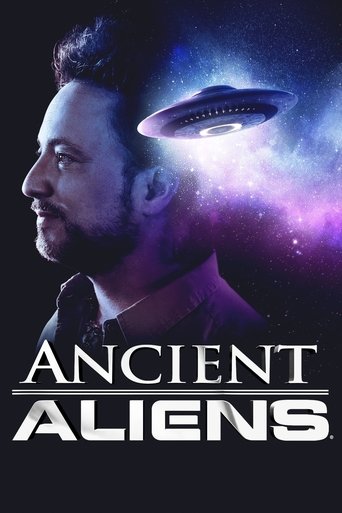
Ancient Aliens
2010 · TV series · documentary · 42 min episodes · 22 seasons
Created by Kevin Burns
DocumentaryMysteryScience FictionFantasy
Did intelligent beings from outer space visit Earth thousands of years ago? From the age of the dinosaurs to ancient Egypt, from early cave drawings to continued mass sightings in the US, each episode gives historic depth to the questions, speculations, provocative controversies, first-hand accounts and grounded theories surrounding this age old debate.
5 positive16 negative4 mixed6 neutralfrom 31 commenters
Where to watch
No streaming data for this title.
37 comments on Hacker News
Pop culture is a narrow subset of culture, not interchangeable with mythology.
Stargate is a work of fiction, while ancient aliens presents itself as truth (hiring pseudo-specialists, pretending to be a documentary, etc).
You need to seriously step up your game, stop trying to win arguments with cheap rethorical tricks, and actually pay attention and research things before posting.
I remember there being an episode of Ancient Aliens (or some similar show) wondering whether the reason Aliens were coming to Earth was for our gold—and then at the end of the entire episode, they spoke to a scientist who said "Yeah, if you want some Gold, they can just make it in a particle accelerator". I thought it was pretty great—an entire show about something outlandish, and then just blow the entire idea up at the very end.
Well that's a wildly wrong guess.
Regardless, if you've not seen the existence of or any episode of Ancient Aliens (or Finding Bigfoot) you'll see what i'm saying: some of these spectacles are more for fun than for politics, because they can be outright funny.
In my case it redirects me to https://history.de, where I learned that, if I turn on my TV, I could be watching the highly-regarded documentary series "Ancient Aliens". I think the website redirects you to your "local" version of the site, content be damned.
To me it's more like a newsstand selling only aliens magazines, bigfoot books and sexy (but not yet porn) magazines.
Every magazin with a title "bigfoot found!" reveals another "mermaids discovered" magazine, and below that a "tony blair is a reptilian, proof inside", and if people want to stay there and consume all the magazines, why not? In the end, there's more quality content there, than on discovery channels (ancient aliens, mermaids, etc.)
not even joking:
https://www.imdb.com/title/tt11274284/
https://www.imdb.com/title/tt1643266/
https://www.imdb.com/title/tt1816585/
...
Ancient Aliens is interesting precisely because it doesn't explicitly advocate Ancient Astronaut Theory. Sure, there's a lot of weasel-wording and implication, but they regularly go up to that line without ever crossing it.
I think it ought to be required viewing in elementary schools: spot the point in each episode where they jump the shark.
see also https://news.ycombinator.com/item?id=42094214
EDIT: > the stars imply a sense of place and order
that order changes every now and then; see https://news.ycombinator.com/item?id=38761574 (in conjunction with https://xkcd.com/3012/ ?)
This certainly smells like a History Channel "documentary" to me! Right up there with Ancient Aliens and the like.
- Analysis that is not shared to review
- Data that is not shared for review
- Broad assumptions that are quickly narrowed down to "facts"
- There is "more evidence but we can't show you because.... reasons"
I've said before that Ancient Aliens ought to be required watching in elementary schools, because episodes usually start from a basis to which perfectly reasonable people would concur, and gradually spiral out into full on "Aliens"; it's a non-trivial exercise to note where the shift occurs.
(furthermore, by non-trivial use of language they usually manage to imply things they do not actually claim; one also sees this sophistry frequently among the better sort of politician)
I think conspiracy stuff is fine on Netflix if presented as entertainment, but I wish they would label it as such in some manner. I'm not sure how one best goes about doing that though outside of hiring some actual anthropologists and archaeologists to do an episode at the end of the series that points out what I assume to be a lengthy list of flaws and assumptions (probably too expensive).
I once watched one of the Ancient Aliens episodes for fun (it was entertaining) and found some pretty poor logic being used to try to fit their conclusions (no surprise there). It is a little sad that a certain portion of the population eats it up though.
I will say the title of the linked article is also jumping pretty hard when asking "how has this been allowed".
Are you maybe thinking of Ancient Aliens?
I remember an episode like that, IIRC it also had some crazier claims like pyramid complexes resembling calculator circuit boards.
The genius of this Silurian hypothesis and related ones is that they are theories of archeology where you start with an unfalsifiable premise, and then anything that fails to falsify it becomes evidence for the theory, hence "ancient astronaut theorists say 'yes'" I discovered that ancient aliens TV series just before the pandemic and have binged it as a kind of esoteric comedy, where every confirmation of the theory and their various hustles lands like a hypnotic joke. It's probably my guiltiest vice.
It is really plausible that ancient pre-cataclysm civilizations were so sophisticated that they used megalithic walled fortresses as a trans-solar biosecurity schemes, if you first accept the unfalsifiable premise that some proto-humans became spacefaring. It's brilliant.
I actually believe they're probably right in some coincidental way as well, but I enjoy the misdirection in the logic of their ideas because it's like a card trick. However, concretely, today there are two things we know: magic is a trick, and stories of parapsychological phenomena are not evidence of sophisticated extra-terrestrial life. The junk ideas challenge what other theories of everything we believe that are founded on similarly mysterious premises. Religions are fairly contained, but ideologies like the ancient astronaut theory evolve to incorporate whatever idea they encounter as new evidence of itself. Can you can do it for anything? "Ancient _X_ theorists say 'yes'"
It must be infuriating to some academic archeologists to get questions about aliens, but really, it's developing interest in the field, and I've probably said before that we could fund and promote a lot of real science by attaching entertainers to it. Not to go on, but AA is one of my favorite silly topics.
> them
Welp, if the TV series “Ancient Aliens” has told us anything it’s that if there is any chance “prehistoric” or “non-white” folks did it, it was aliens. Always aliens. Except when it’s time traveling white humans from the future come to the past to help “those people” carve stones.
(I am mocking the horseshit show, in case anyone worries.)
What is up with all of the policing of people's entertainment? There's some moral superiority going on with thinking a silly documentary of one guy's life work is going to harm some "vulnerable" population that isn't even statistically significant to begin with nor would cause any long term harm given the attention span on a single topic nowadays is shorter than 24 hours. Will this documentary be relevant in a year? 5 years? 10 years? Probably not.
Another way of thinking about it is the show Ancient Aliens has been on air for over a decade. Did you know it is still running after its 15 minutes of fame and memes? Many articles talked about it being "fringe", but rarely did we call it conspiracy.
https://www.smithsonianmag.com/science-nature/the-idiocy-fabrications-and-lies-of-ancient-aliens-86294030/
https://en.wikipedia.org/wiki/Fringe_theory
Furthermore, some wrong things are wrong in ways that are more interesting than others.
An excellent example is "Ancient Aliens"*. The show is wrong, to be sure, but very careful to make wrong implications with non-wrong claims. IMO it ought to be required viewing in all elementary schools.
https://www.gutenberg.org/files/48612/48612-h/48612-h.htm#Page_110
> Take the statement: "Harry said to me, he said, 'I never told anybody that Al's wife was a retired strip-teaser.' Mind you, I don't pretend to believe Harry, but that's what he said, all right." What are the possible true sources for the statement of fact or libel concerning Al's unnamed wife? What are the alternatives on ostensible sources? First use? Second use? The common sense needed to analyze this statement is of the same order as the process involved in analyzing the statement: "Reliable sources in Paris state that the visit of the American labor delegation has produced sensational repercussions in Moscow, and that Moscow, upon the basis of the American attitude, is determined to press for unification of the entire German labor movement."
* for those who have not seen it, each episode is a work of art, starting out with the uncontroversial, and ending with some wild hypothesis, with the "documentary format" hosts couching everything in impeccable language. A typical statement: "Ancient astronaut theorists believe X. What if it were true?"
Actually, yes they do, in large part. The problem is that the people who produce the documentaries don't want to make "let's talk about modern archaeology" documentaries--they think lay audiences won't lap it up, and so instead want to shift everything to "crusader against orthodox archaeology" (which usually means something akin to Hancock or Ancient Aliens) instead.
> Yes, Hancock is highly speculative and isn't doing archeology. He's also not a white supremacist either as many academics claim (the "canceling" part of his gripe). But let's not pretend that there is evidence for Atlantis either.
There's a few things to unpack here.
First, the Atlantis theories are essentially racist. Fundamentally, what it does is take some impressive structure--Great Zimbabwe probably the most notorious example--and ask who built it. The natural first place to start looking is among the indigenous inhabitants (and in basically all cases, there is substantial evidence that this is indeed the case), but this theory is instead built by another group of people for whom there is really no evidence. In other words, the theory is going well out of its way to avoid the explanation that the indigenous inhabitants, to such a degree that you have to ask why. And the "why" is probably an inability to believe that the indigenous people could be capable of building such structures.
The second thing to point is the degree of lack of evidence. This isn't "oh, we haven't found any evidence;" no, it's "we have to posit something completely unlike every known explain to explain why we haven't found any hint of evidence." Yes, global sea levels were at lower doing the last glacial maximum--but note that every early civilization we have spread out substantially far from the coastline. Most of them weren't even centered on the coast.
Third, the framing of "just asking questions" and "I'm a journalist, not an archaeologist" is something that just pisses me off. Hancock has been pushing this narrative for several decades now (and the underlying theories are over a century old)--the questions he's asking have already been answered. He's clearly not interested in listening to the answers--and that makes him not even a journalist but a propagandist instead. If he's proven so unwilling to change, we shouldn't give him the benefit of the doubt and pretend that he's some kind of pop psychologist.
And the final, and most frustrating thing is, this sort of stuff sucks the air out of actual interesting archaeology. A great example of pop archaeology that covers "challenges to mainstream archaeology" [1] well is Charles Mann's 1491, which has the benefit of everything being supportable by actual evidence. And it still manages to bring up interesting questions like "what is a writing system?" (is the Andean quipu a writing system?) or "is agriculture a prerequisite for civilization?" (Norte Chico suggests perhaps not). But instead of stuff like that in documentaries, all we get is... Ancient Aliens^H^H^H^H^H^H Atlanteans. Again.
[1] One really unfortunate aspect of pop archaeology is that it's generally stuck in the early 20th century. This means that the current "consensus" in archaeology is actually surprisingly against what people think of "mainstream archaeology."
> his raging against academia was exhausting enough to make it unwatchable after a point.
For me, that point was somewhere in the first episode. Sorry, after watching Van Daniken (sp?) and the Ancient Aliens crew use misinformation and "asking the question" type fallacies to basically ruin widespread understanding of history all I can say is "fuck that guy in particular".
I didn’t have cable growing up, but by the time I was in college History channel had already given up on history and was just running “Ancient Aliens” and its ilk along with reality TV. As far as I know, there is nowhere to find good documentary content on a regular basis (whether by streaming or legacy media). PBS gets close, but even their Nova and Nature programs have degraded in quality.
I have a pet theory about what makes Giorgio Tsoukalos and Ancient Aliens so dangererous they needed to be deleted from Rogan/Spotify. Essentially Ancient Aliens is more scientific and intellectually rigorous than anything you read in mainstream news or any of the narratives that drive policy, and it exists as a constant source of embarassment to anyone whose job is to prop those narratives up. It is profoundly subversive.
The people I know who get mad about it get really mad about it, because it is the satire to end all satire. Ancient astronaut theory is a fully consistent ideology and critical theory with at least as much applicability as any critical theory. I could easily write persuasive word for word transcriptions of any of their episodes for any current social issue and it would be as rigorous as the criteria for whatever else people already believe.
When you add a philosophical layer of Pascal's Wager meets Roko's Basilisk - Ancient Aliens may well be the pinnacle of human achievement.
I must be in the minority here, but Ancient Aliens is one of my favorite tv shows. It has some of the funniest, most outlandish, content I’ve ever seen.
Hard to know how Ancient Aliens on the History channel fits into this.
Documentaries like money?
Interesting!
Sadly, upon reading it, I got this unsavory feeling this would end as "evidence" on an episode of Ancient Aliens.
I was on my honeymoon with my fiancee and at the end of the night, we liked to relax by opening a bottle of champagne and watching Ancient Aliens. Don't get me wrong, both of us believe in the possibility of life in outer space but that show was funnier than most modern sitcoms.
Heck, even Monster Quest was more believable.
Agreed; that said, there's an Ancient Aliens tv series that acts serious but, I think, is mostly recognized for being hilarious...so frivolous I've actually watched it because it's just so laughable.
Is this an episode of Ancient Aliens?
Clearly the author has not eaten boxes of those newly legalized brownies and binge watched seasons 1 through 15 of "Ancient Aliens." If he had, he would know that "ancient astronaut theorists, would say yes."
It's entertaining, but what subtle improvement has he made on the work of eminent theorist Giorgio A. Tsoukalos?
If you listen carefully, History Channel doesn't actually say that. (implied heavily, and maybe it was different in earlier seasons, but I think "Ancient Aliens" ought to be required viewing for anglophone school children[1], because each episode starts from presenting factual information and slowly works its way towards very carefully hedged wild "conclusions"[2]. as with the sorites paradox the question to keep in mind while viewing is: when does the shark jump occur?)
[1] compare interpretation of reported speech in https://news.ycombinator.com/item?id=23614277
[2] "Ancient alien theorists conclude X. What if it were true?"
Its very easy after watching the ancient aliens season 1 pilot episode, believe me!
How It Works and Ancient Aliens do the job for me. If I watch either of those after I've just had dinner I don't stand a chance. I'm knocked out by the end of the episode.
Why does this feel like a 2019 version of an Ancient Aliens episode?
There ya go History Channel, finally finding a somewhat decent line between their history documentaries and Ancient Aliens.
Based on the comments in this thread, I'm sure this will soon be an episode of 'Ancient Aliens' on the "History" Channel. If it isn't already.
Is this suggesting that the same TV network which airs a show called "ANCIENT ALIENS" would have some completely inaccurate and poorly researched easily debunked claim on one of their TV shows?
What's next? Is some blogger going to reveal to the world that Seinfeld and Star Trek aren't real too??
Presumably they're not related by movie subject; they're related by viewer preference. That is, Netflix is effectively saying that stereotypical person who watches and enjoys [movie A] will also tend to watch-and-enjoy movies X, Y, and Z.
This is the same algorithm broadcast networks enact when they try to figure out what shows to pick up: "who does our audience consist of? What would they watch if it were offered? Air things like that." This is why, for example, the History channel shows Ancient Aliens documentaries—they have nothing to do with History; they have everything to do with the particular people who tend to watch the History channel.
You can usually figure out pretty explicitly what cluster you're being assumed to be in, and what it's like, by watching the advertising attached to a TV show or movie. Why do they play SUV ads at Disney/Pixar movies? Because the people in the theatre with money to spend tend to be parents-of-five-year-olds, who often are considering purchasing a new car. Thus, if you told Netflix you had watched a Disney/Pixar movie, it would probably recommend you other media that people in your cluster—people who might buy an SUV soon, to put it one way—would watch.
This is like the Ancient Aliens series for numerology. For episode 2 I suggest the number 2. As a premeditation I suggest we all start to cogitate on the preternatural property of the number 2: it being a "magic number".
Tomorrow's schedule: http://www.history.com/schedule.do
* Swamp People (multiple episodes) - Cajun reality show * Down East Dickering - knockoff Pawn Stars reality show * 'Info Documentaries' - pretty sure this is 3 hours of infomercials * Gettsyburg Civilians - a history show! At 4:30am. * UFO Files - from 7am til 5pm * Ancient Aliens - 5pm til 8pm * more UFO Files until midnight
That's the entire schedule for the day, no omissions. Reality shows, then informercials, then 17 (seventeen!) straight hours of aliens. They do spend 30 minutes on Gettysburg at 4:30am, which along with WWII is the only history the History Channel even considers touching.
If the author thinks 'the assumed essential decency of the state and its agents' is the reason people are against conspiracies, he's got no understanding of the issue at all.
Some of us object to conspiracy-mongering because we know people are only human, and have a limited capacity for outrage and action - there's only so much we can do beyond taking care of our families. At the same time, we know that plenty of objectionable things that deserve our attention are happening every day - things that are known and acknowledged to be happening, things that may be perfectly legal and constitutional but are nonetheless repugnant.
When the public's attention is drawn to an entertaining and sexy conspiracy theory, something that might have happened but very very probably didn't, the public's attention is no longer focused on the absolutely-100%-objectionable things taking place every day. That's why conspiracy-mongering is a net loss for society, and why I'll happily crack tinfoil hat jokes at the author's expense - it's not because I think the government's a big group of lovable folks, it's because all that time we're collectively spending writing the script for a future episode of Ancient Aliens could be so much better spent.