 Hacker Cinema
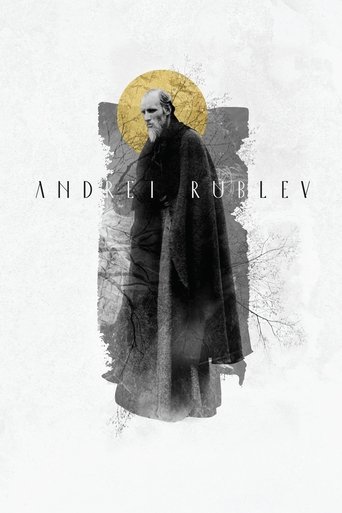
Andrei Rublev
Андрей Рублёв
1966 · Film · 183 min
Directed by Andrei Tarkovsky
An expansive Russian drama, this film focuses on the life of revered religious icon painter Andrei Rublev. Drifting from place to place in a tumultuous era, the peace-seeking monk eventually gains a reputation for his art. But after Rublev witnesses a brutal battle and unintentionally becomes involved, he takes a vow of silence and spends time away from his work. As he begins to ease his troubled soul, he takes steps towards becoming a painter once again.
19 positive1 negative5 neutralfrom 25 commenters
Where to watch
No streaming data for this title.
30 comments on Hacker News
I would also recommend his movie Andrei Rublev, though that is probably even harder to watch because of the length and medieval setting; but, for people that like to see something different, this is very different to current movies.
And from his disciples definitely recommend Zvyagintsev and his The Return and Leviathan.
Software development has been commoditized and is directed by MBA's and others who don't see it as a craft. The need for fast project execution is above the craft of programming, hence, the code is bug-riddled and slow. There are some niche areas (vintage,pico-8, arduino...) where people can still practise the craft, but that's just a hobby now. When this topic comes up I always think about Tarkovsky's Andrei Rublev movie, the artist's struggle.
> E.g. movie Tenet starts from depicting a scene from "Russian life": under a low sun, in freezing cold, dirty hungry Russians are crawling in the dirt gathering "pieces of Uranium" with their bare hands.
Your very own directors depict it this way, mainly Tarkovsky's Andrei Rublev or Stalker.
What's wrong with propaganda? Is that a reason why you haven't seen for example Apocalypse Now?
You might want to watch Andrei Rublev, at its inception a controversial movie heavily disliked by the Soviet state:
https://sovietmoviesonline.com/drama/andrey-rublev
Edit: And then the post-soviet Fairy, which ruminates on the legacy of Tarkovsky's masterpiece.
https://sovietmoviesonline.com/fantastic/fairy
The rest of Melikyan's movies are also quite interesting and fun.
They also distribute post-Soviet russian movies and television series. You should watch the two takes on The Master and Margarita, both high profile projects based off one of the most beloved books in Russia, from two very different times in russian society:
https://sovietmoviesonline.com/drama/master-i-margarita-mini-serial
https://sovietmoviesonline.com/melodrama/the-master-and-margarita-2
The Soviet was especially good a adventures for kids and science-fiction, of which you'll find a lot there, for example Alice in Wonderland and Hard to be a God. You should watch the takes on the latter to get a feel for differences between soviet and post-soviet societies. If the younger version feels hard to watch you might need to watch The Green Elephant and other movies from the russian nineties to prepare yourself and better understand the feelings and mindset of the time.
And if you want you can watch old propaganda movies about the Donbass or whatever, you'll learn a lot about places you likely know very little about.
I remember watching Adrei Rublev for the first time, getting more and more pissed the whole time. It wasn't the technique. I had already seen Solaris. It was the hapless passiveness of the main character. However, the bell making sequence really drew me in. I had this immense tension waiting to see how it would turn out. The ending broke me and suddenly the whole movie clicked for me.
I don't wish to spoil it or taint someone else's experience so I'll just say, many films have a plot twist at the end but I can't really think of another movie that manages that kind of an emotional turn. Not without something pretty hammy like a surprise betrayal or death. Andrei Rublev will always stick with me.
Andrei Rublev is by far his best film in my opinion.
The best way to watch these movies would be by pirating them from the RuTracker, as that way you will be sure that you are not contributing any views or advertisement money to the Mosfilm, with a bonus of much higher bitrates.
Here are the links:
Solaris — https://rutracker.org/forum/viewtopic.php?t=6191155
Stalker — https://rutracker.org/forum/viewtopic.php?t=6182463
Ivan's Childhood — https://rutracker.org/forum/viewtopic.php?t=6194960
The Mirror — https://rutracker.org/forum/viewtopic.php?t=6194964
Andrei Rublev — https://rutracker.org/forum/viewtopic.php?t=6194948
The Passion According to Andrei — https://rutracker.org/forum/viewtopic.php?t=5820633
Battleship Potemkin by Sergei Eisenstein is in public domain, and so you can legally watch any other upload on YouTube instead of Mosfilm's, for example https://www.youtube.com/watch?v=HsQcljysO-8
Tarkovsky's "Stalker" is loosely based on the "Roadside Picnic"[1] a sci-fi novel of Strugatsky brothers.
A. and B. Strugatsky are not that much recognized in the western countries as Andrey Tarkovsky, but they made significant contribution to the Russian literature of XX century, and their books are still popular in the post-soviet countries. In particular, the Roadside Picnic influenced many modern sci-fi works too, including, for example, the "S.T.A.L.K.E.R." and the "Metro" video game series.
Tarkovsky's "Stalker" is quite distinctive from Strugatsky's novel both in style and plot, but the screenplay of the movie was written by Strugatsy brothers too. Basically, they made completely different work in the same setting, but following completely different narrative. Also, they included a lot of pieces from their other (less famous) work "The Ugly Swans" into the screenplay, which is closer to Tarkovsky's film style. For example, the Writer's monologue[2] is just a direct translation of the same monologue from The Ugly Swans.
"Solaris", another Tarkovsky's famous sci-fi movie, based on Stanislav Lem's novel of the same title, was a more controversial work. Stanislav Lem made quite critical reception of this adaptation that simplifies and distorted his novel's original ideas. However, I think that Tarkovsky's "Solaris" is still the best adaptation of this book we currently have.
Aside from this, I would recommend "Ivan's Childhood" a war movie about orphaned child, and the "Andrei Rublev" a historical movie about the famous Russian Orthdox Icon painter set place in the late middle ages, and about survival of artistic people in hard times.
[1] https://en.wikipedia.org/wiki/Roadside_Picnic
[2] https://www.youtube.com/watch?v=uwIoSI1Eqak
It's one of his most accessible movie, and usually resonates with tech people for obvious reasons. His best movies imo are Mirror, Ivan's Childhood, Andrei Rublev, Stalker and then Solaris, Nostalgia and Sacrifice.
Now Solaris book by Lem is far superior to Tarkovsky's rendition.
It’s actually five films because “The Passion According to Andrei” is simply the original longer cut of “Andrei Rublev”.
I believe Tarkovsky himself preferred the final cut which is 20 minutes shorter (but still over three hours, so not exactly a cinematic snack).
Solaris is my favorite Tarkovsky film. Some observations:
* When they assist the exhausted Kelvin to his room near the end, his body blocks the light but occasionally his body moves so the light can come through and blind the camera. This parallels the discussion about destroying the visitors by blasting them with bursts of light.
* Burton's extended unexplained car ride is (in my opinion) a nod to the 2001 star-gate.
* In the old footage they watch near the start of the film, we see stylistic artwork of important figures in the background. These would certainly be informed by Tarkovsky's expertise on Orthodox Iconography (see his "Andrei Rublev").
* Interesting to compare and contrast the visitors with Kubrick's "HAL". The visitors are purely physical and totally unaware of where they are/what's going on. HAL is purely mental and totally omniscient. Both raise all kinds of interesting metaphysical questions about personality and the soul.
* The swirling water-plants at the beginning and end of the film are evoked by the paper strips the crew hang up on their ventilators.
Right now the entire film is available free on YouTube: https://www.youtube.com/watch?v=LutMHAeCfLU&t=5193s (turn on closed captions unless you speak Russian)
A few other "greatest" scenes in cinema:
* Isak's vision of his family picnicking at the end of Wild Strawberries (1957), where a man finds peace in his journey through the memories of his life
* Hidetora walking out his burning castle in Ran (1985) amid a battle amid his two eldest sons for supremacy, his plan to divide his kingdom among his three children having come to a disastrous end - a man realizing his children (and humanity in general) are more horrible than his naive dreams of unity could sustain.
* Two scenes in The Cranes Are Flying (1957): a montage of Veronika's beloved dying in battle (he falls as his soul seems to ascend bc the camera angle) while she goes about her life; Veronika finding out Boris is dead for sure at the train station, giving the flowers intended for Boris to the returning men and their families, and then she sees the cranes above Moscow - hope and renewal.
* In I am Cuba (1964): a martyred revolutionary, a student, is carried through Havana as the whole city stops what they're doing to honor him, solemnly, cigar-factory workers and all.
* In Andrei Rublev (1966), there's an extended sequence where a bellmaker's young son agrees to pour a bell for a local lord. You see the entire process of making the mould and pouring the metal. It has a town-fair atmosphere. But at the end, there's tremendous pressure on the young bellmaker to have the bell ring properly and have no cracks. And it does. The protagonist, the lapsed monk Andrei Rublev, regains his faith, seeing the result of the young bellmaker's hope. (I've shared this a few times on this website.)
* At the end of L'Ecclise (1962), the two lovers decide to meet the next day but they don't. Instead, we see thirty shots of the empty city - a devastating way to get to the heart of loneliness and lack of connection in modern life.
Tarkovsky is a genius. The original novel for Stalker is a must read (esp. if you can read Russian). But I cannot watch some of his movies after I learned that he _cruelly_ killed a horse in https://en.wikipedia.org/wiki/Andrei_Rublev_(film)#Depictions_of_violence. I cannot justify this for the sake of art.
Tarkovsky was truly one of cinema’s great directors. His films aren’t simple or easy, but they are gorgeous to behold and if you put in the time, you’ll be richly rewarded. As others have mentioned, Stalker and Solaris are his two great sci-fi films, easily on par with Kubrick’s 2001. For history buffs, Andrei Rublev is fantastic too.
Andrei Rublev is one of the supreme achievements of cinema. Just so moving and beautiful, and hopeful, too.
Try “Andrei Rublev” it’s (watched all his work) one of his more balanced films, as in its full of symbolism but it’s intertwined with the narration, so one may go through it without noticing then subtext, while it’s probably one of the best (if not the best) films about medieval ages.
I'd risk to suggest that "Andrei Rublev" is Tarkovsky's best film as it is both approachable, auteur, commercial, poetic, symbolic, naturalistic and everything you'd imagine one of the vertebras of the 20th century culture to be.
Yes, late Tarkovsky is great too, but it's not really quite cinema at that point. "Rublev" is The Movie in Tarkovsky's filmography.
It's also probably one of the best medieval films there is, regardless of the genre, "7th Seal" to "Kingdom of Heaven".
Another great, often overlooked movie is his very first one - "Ivan's Childhood". You can see him still begin somewhat cautious there, but the movie is as poignant as they get. It was created by one of the best artists of the generation as he watched the dawn of the 60s era as a member of the society for which World War 2 and Red Terror are yet to become "yesterday".
Just a few days ago I watched Sci-fi classic "Solaris" by Andrei Tarkovsky and I had no expectations or knowledge about the movie or Director before watching it and it blew my mind. I then looked into other movies directed by Tarkovsky such as "Stalker" and "Andrei Rublev" which nobody in my age group knows or talk about but these are great movies. I am looking forward to finding such hidden gems and watching these films.
The article talks mostly about lighter-hearted movies, but I'd still want to recommend my favorite examples of "burdensome beauty" (as they put it) by Tarkovsky:
"Зеркало" (The Mirror): https://www.youtube.com/watch?v=CYZhXm02kN0
"Сталкер" (Stalker): https://www.youtube.com/watch?v=TGRDYpCmMcM
"Андрей Рублев" (Andrei Rublev): https://www.youtube.com/watch?v=x6kqlveBhVY
And, if you're into Slavic cinema in general, I'd also recommend "Life is a Miracle" by Emir Kusturica: https://www.imdb.com/title/tt0322420/ -- he's not a Russian director, but he is fantastic.
In undergrad, I went to the library once and watched Andrei Rublev on laserdisc. I had been "into" films before, but this was quite unlike anything I had seen up to that point.
Anyways, there's a scene in the film with a pagan ritual that is shot with such dreamlike perfection. I remember seeing something from the corner of my eye and noticed there were three other film-obsessed laserdisc enthusiasts standing behind me mesmerized.
Andrei Rublev is on Criterion blu-ray now as a flawless restoration. Watching it recently, it's a bit heavy-handed, but still magnificent if you watch the film on it's own terms.
I think many of the visual techniques pioneered by Tarkovsky are now commonplace, but the meandering dreamlike pace and tone is still rare. Apichatpong Weerasethakul comes to mind as a director who can pull-off the dreamike stuff as well as Tarkovsky. See Uncle Boonmee Who can Recall his Past Lives (https://youtu.be/gqlD_VnsM-k).
Tarkovsky movies are boring, so I would ask someone if they minded boring movies before recommending him. It's just that lack-of-boringness is not the only axis by which to judge or enjoy a movie. I can put up with being bored for 2 hours if I get something else out of it. I don't think you need to like Tarkovsky -- I don't think you need to like anything -- but Tarkovsky is a good examples for the pleasures of cinema orthogonal to the boring-not-boring axis.
I like the way you put it about feeling the movie. When I try to picture what it was like to live in the Middle Ages, I usually end up picturing something like Andrei Rublev.
I have mixed feelings about Tarkovsky. He is certainly profoundly important. His sensuality is unmatched. Whether it's the perfect use of sound (endless dripping water, the ringing of a fallen cup), the incredible imagery or the beautiful stories (I think about the bell story in Andrei Rublev a lot), Tarkovsky is the king of making you feel the movie.
That said, I don't worship at the altar of Tarkovsky. I don't love that his movies have this impenetrable length. I don't love that his movies inevitably have some long philosophical lecture by a male character while the women stay to the sides, often silent. I will sound like a petulant digital native, but I have been bored by a Tarkovsky.
Too often Tarkovsky is used as this unquestionably brilliant artist. To appreciate him is to be a true cinemaphile, while to hate him is to indicate your pedestrian tastes. I don't agree. There should be no shame in being bored by Stalker, in not getting Andrei Rublev, in finding The Sacrifice a little too navel gazing.
If I had to explain Tarkovsky to someone who doesn't watch art movies, I'd say that he's like the Velvet Underground. Unless you have a particular taste, you probably won't enjoy songs like Heroin or Venus in Furs. But you'll definitely enjoy the music made by people who did like Heroin or Venus in Furs. You don't have to enjoy Tarkovsky. But watch some of his movies, and you'll start to have flashes of recognition in movies like Arrival, La Cienaga, The New World, etc.
This brings back memories from the early 2000s. I was in high school and got very interested about Andrei Tarkovsky but it was very hard to get copies of his works anywhere. Finally I was able to order couple of VHS's to my local library from some library quite far away. Watching The Sacrifice after school alone in our house was more frightening than any scary movies I saw afterwards (not too many tbh...). Also I grew deep respect to Andrei Rublev. Still have a copy of his Holy Trinity on my wall.
Andrei Rublev is just a mighty movie. As in as good as movies get. The church bell sequence alone: I was literally relieved for that kid.
Andrei Rublev. It's long. And slow. And in black & white. And about a Russian medieval iconography painter. But the last sequence is stunning.
It's about a young boy who is the son of a bell maker. Everybody in his town, bell maker included, has died. Some soldiers come around looking for a bell maker and the boy claims that he was taught by his father. He proceeds to make the bell.
I won't go any further, but the story is one of the greatest analogies for creation and creativity. Tarkovsky was likely talking about his own films and his process of creation, but I believe it applies to anything creative, whether that's a startup or a programming language.
The cinematography of Andrei Rublev (and really all of Tarkovsky's films) feels almost magical.
I remember the first time I watched Andrei Rublev, it was in a university library, in one of those media carrols (on a laserDISC !). There's a scene in the middle of film depicting a pagan spring ritual where Rublev and the other monks were compelled to participate. Anyways, by the time that scene was over I turned around and noticed several other students standing behind me asking what the F was I watching, they were so mesmerized, they abandoned what they were watching and just started to watch Andrei Rublev.
One contemporary director in particular come to mind, that remind me at least in part of Tarkovsky. Apichatpong Weerasethakul, who directed "Uncle Bonmee who can recall his past lives" and others (https://www.youtube.com/watch?reload=9&v=_bJdvNS4iRw). Like Tarkovsky films, this film and his others meander in plotless dreamy arcs with sumptuous camera work. Weerasethakul has even stated that he's OK with people falling asleep while watching his films.
Andrei Rublev felt like a slog until the last segment with the bell making. That segment really built tension for me and at its end it became clear to me that the entire film had been a set up. It established the vanity of Rublev's religious experience and his realization of that through his sudden exposure to the chaos of the world outside the monastary.
But to make Rublev's epiphany clear -that he could live for compassion, passion and the kindred spirit of a fellow creator- you had to be taken through this long process of seeing this crazy world through Rublev's naive eyes.
It was definitely one of my first experiences where I discovered that sticking with art that is challenging or difficult could truly pay off in a way immediately gratifying art sometimes cannot.
More concretely, if you live in/near NYC, follow http://screenslate.com - we get a wealth of repertory film screenings all the time. I've managed to see Andrei Rublev, The Mirror, Nostalgia (twice!), and Stalker all in 35mm over the past couple years.
"Sculpting in time" is also the title of Tarkovsky's book which I haven't read, but I now have a new impetus to do so.
Interesting about colour - perhaps a "less is more" thing. The end of Andrei Rublev is breathtaking, for instance.
I saw Mirror three times at the cinema, and there are not many flicks I can say that about.
Tarkovsky is my favorite 20th century film director bar none. Here's are some reasons why and why you might also be interested in his films:
(1) He described his art as poetry applied to cinema or "sculpting in time," a fundamentally different conceptual idea of the cinematic art that he went to a great length to clarify (in a book of the same name, highly recommended).
(2) His use of color is incredible. Some films, especially stalker, are near black and white with incredibly vibrant and poignant uses of green. This is a bit like Bergman at his best, but even better.
(3) He was deeply religious in a "mystical" sense, with a lot of respect for past traditions, but not in a dogmatic sense and with appreciation for both Christian and pagan elements (see Andrei Rublev for both aspects)
(4) He knew other European traditions extremely well. Ivan's childhood is a meditation on the war with Germany, including shots of Duehrer's prints. Nostalgia involves his time in Italy traditions including Madonna cults and important artwork. Sacrifice has Shakespearean references, Rembrandt, Japanese samurai, and magical traditions. In general, his films are full of long shots of important pieces of Renaissance art with profound meaning.
(5) He spent a lot of time thinking about the integration of technology and the rest of life. Solaris is the futuristic spaceship version of this. Stalker is the apocalyptic version of this.
I think in a century Tarkovsky will rightly be credited as inventing a whole new type of cinema, his way of approaching it was fundamentally in tune with a "mystical" sense and integrated with other forms of visual art (i.e. the long gaze you have at a painting), and the punctuated, rhythmic reading of poetry.