 Hacker Cinema
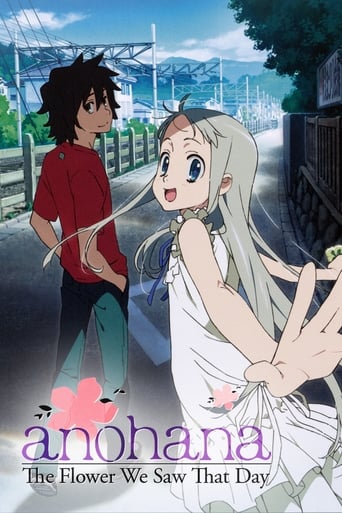
Anohana: The Flower We Saw That Day
あの日見た花の名前を僕達はまだ知らない。
2011 · TV series · 23 min episodes · 1 season
Jinta Yadomi and his group of childhood friends have become estranged after a tragic accident split them apart. Now in their high school years, a sudden surprise forces each of them to confront their guilt over what happened that day and come to terms with the ghosts of their past.
2 neutralfrom 2 commenters
Where to watch
No streaming data for this title.



2 comments on Hacker News
Have you tried watching something like OddTaxi?
It's a bit social commentary (not very heavy but you can feel it). But I don't think it's about loneliness or relations much at all (I guess the Walrus and the Nurse Llama have a bit of a romantic fling but I don't consider it a major part of the show).
I'd say one of the major villains is someone who has fallen into the stereotypical gachapon gamer / whale / hikkomori type shut-in that sounds like you'd enjoy him as a villain.
So rather than catering to that demographic, OddTaxi skewers it by clearly marking that character as villainous.
It's just a solid Film Noir murder mystery, except the main character is the Taxi Driver with damn near perfect memory and facial recognition rather than a proper detective. It takes some time and discussions with various people around town to figure out the murder plot, but I was quite satisfied by it.
It's a dry show with a lot of talking. The bulk of the show is just the Walrus / Protagonist picking up customers around town, talking with them for 5 minutes and dropping them off.
But it's those discussions alone that leads him to the murder plot. It's really fun to see how everyone around town was so close to the murderer.
-------
I agree with you that there's a genre of anime that celebrates or dramatizes the Hikkomori / shut-in type (ex: Re:Zero, Jobless Reincarnation). But at this point, the Hikkomori is a stock character, just one tool to tell a story.
There's a lot of different uses of the "emotionally stunted Hikkomori" (ex: Anohana is the Hikkomori who through the drama of a Ghost coming back to talk with him, he gets pulled out of it and emotionally heals).
But anime and anime culture is above all, about stock characters that are borrowed, remixed, and turned into something new in the next story. The emotionally-stunted Hikkomori can become the hero in Re:Zero, the antagonist of OddTaxi, or a source of Comedy in Devil is a Part-Timer.
Frieren seems to cover a lot of Hikkomori Tropes (emotionally stunted character who is suddenly learning how to deal with emotions as she interacts with humans). So I think you're right in that she's seemingly related to the trope. I don't think I thought of her like that before but it seems to match up more-and-more that I think of it. She has all the markings of a Hikkomori in terms of attitude and even story progression (Himmel had to convince her to get up and try)
I appreciate the article--I spent about a year as kind of hikikomori.
Nevertheless I feel the need to make some minor critiques...I feel the author makes a number of small errors in trying to prove their point. For example, the author says:
"The Hikikomori phenomenon is now finding a form of narrative legitimacy in cinema, manga and pop culture. It is creating its own iconography. The novel Welcome to NHK (acronym for Nihon Hikikomori Kyōkai or The Japanese Hikikomori Association) plays with the name of Japan national broadcasting giant (NHK) and a story of a conspiracy to create the Hikikomori. The novel became a manga series and a twenty-four episodes anime series. Since then Hikikomori characters multiplied in anime and manga: Rozen Maiden, Serial Experiments Lain, Tatami Galaxy, Anohana: The Flower We Saw That Day, to name a few."
Welcome to the NHK is a novel from 2002, and the anime came out in 2006 iirc, so "now finding a form of narrative legitimacy" is maybe a bit disingenuous...and Serial Experiments Lain, which is from 1998, predated it and to my mind more properly fits alongside other cyberpunk meditations on technology and identity (interestingly, though, there is an 2channel-styled imageboard that has adopted Lain as its mascot). Similarly, I don't think someone would watch Tatami Galaxy or AnoHana and come away from those thinking that the "dominant theme" is about hikikomori-ness. At least, I didn't. You could certainly contest these points, though--the author's method of speeding through points that, if more properly explored, might not fit so cleanly into the essay's thrust, just left a bad taste in my mouth. Just my 2c.
It just crossed my mind that the American writer Tao Lin makes a number of explicit references to this lifestyle in his work; he has an ebook called "Hikikomori", which I haven't read, and his novels almost always have the main character spending days or months not really talking to anyone, feeling depressed, and just "doing things" on the internet. He has a book coming out in the future called "Leave Society".
If anyone knows of other American authors who treat this topic, would be interested. I feel like it has certainly come up in literature, just not under this name.