 Hacker Cinema
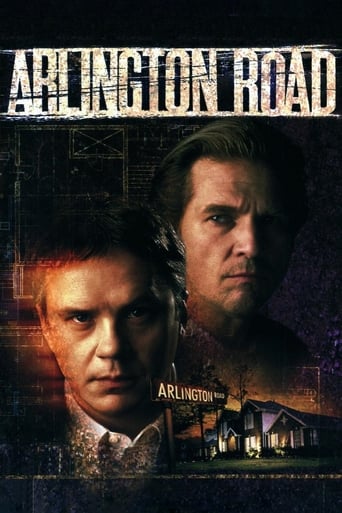
Arlington Road
1999 · Film · 117 min
Directed by Mark Pellington
Bedraggled college professor Michael Faraday has been vexed — and increasingly paranoid — since his wife's accidental death in a botched FBI operation. When a seemingly all-American couple set up house next door, Michael begins to suspect there’s more to them than meets the eye.
2 neutralfrom 2 commenters
Where to watch
No streaming data for this title.




3 comments on Hacker News
> The story is resolved either in the protagonist’s favour or against them: they triumph or else fail tragically.
I've always been a huge fan of the bad guy winning decisively. It is relatively rare.
We have subplots from the action hero films where some pretty bad things happen, but I feel like movies like Se7en and Arlington Road take it to a completely different level.
>Another possibility is that he had a nervous breakdown or substance abuse episode, leading to both the paranoid emails and the irrational vehicle operations.
Something very plausible and easy to think -- even in cases where it is not the case. Which reminds me: http://www.imdb.com/title/tt0137363/
He was a seasoned journalist. Working on a very dangerous case (as he has done in the past, annoying many).
He might have feared and feel intimidated -- and that might have led to erratic driving and crash.
But he sure knew when and if the FBI talked to his friends and colleagues. And it's not like it's the first time a journalist is crashed (either literally or figuratively) for his work. Gary Webb comes to mind. Ruben Salazar too. And those were more innocent times.
"Your Logical Fallacy Is" giving too much credit to "logical fallacies".
Conversations are not formal proof, in pure logic.
And logical fallacies are not pure logic either. More like guidelines.
In the real world, where you don't have all the information at hand, and you have trust levels and possibilities and resource limits, a "logical fallacy" can be more beneficial (statistically) than not.
Case in point: "appeal to authority". If I'm sick, I'd rather trust my doctor, than a non-doctor guy, just for the fact that the doctor has a MD and he does not. I don't have time to study medicine and examine both approaches (e.g I could be bleeding to death). So the more rational thing to do here is listen to the authority, not the random guy.
Similar issues can be found for most of the other fallacies, from ad hominem to no-true-scotchman and beyond.
Nice guidelines, but by no means complete and by no means appropriate for all real life situations.
Like Occam's Razor. It's just a guideline too. Sometimes the MORE complex story, with the more entities involved in it, is the one that actually happened. E.g in police cases. There is often a clean-cut explanation that might seem obvious but is wrong, and a more involved story that is what actually happened. Lots of innocent have fell prey to the "obvious" and "simple" explanation, only to be proven innocent many years later.
Think of the movie "Arlington Road". What would most people think of the events, not knowing the whole story? "But most real cases are not like Arlington Road!" My point exactly. Most, not all. Occam's razor is a guideline, not a logical necessity.