 Hacker Cinema
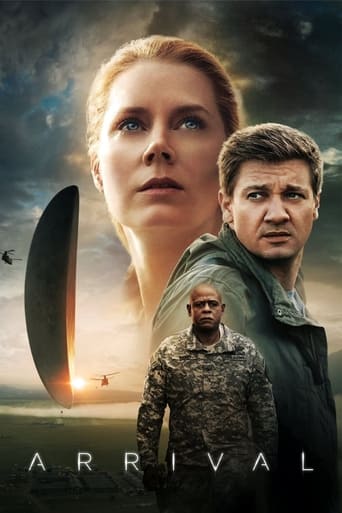
Arrival
2016 · Film · 116 min
Directed by Denis Villeneuve
Taking place after alien crafts land around the world, an expert linguist is recruited by the military to determine whether they come in peace or are a threat.
142 positive17 negative8 mixed105 neutralfrom 272 commenters
Where to watch
No streaming data for this title.
301 comments on Hacker News
I mostly agree. Though sometimes the models come up with useful concepts that I'm happy to be introduced to, like the "shape" of a problem (probably like intelligence being "spiky", and Kiki & Boba). I still don't quite 'grok' what the 'seams' concept is yet though.
But I have noticed that while "loosely held" is a convenient shorthand for uncertainty, I don't like that one slipping in to my daily language. Except maybe to communicate with models, but even then, it feels weird to be speaking in neuralese.
It's all starting to feel like the movie Arrival.
I guess it's a sign of getting old when I see the world classic and expect Gone With the Wind and Casablanca, but instead the list has Arrival, The Martian, and the Bourne Identity. The Sixth Sense is on the list for the US and it's a movie I coincidentally rewatched last night, again finding it to be a masterpiece.
In any case, very different list in Canada: Rocketman, Ford v Ferrari, Little Miss Sunshine, Catch Me If You Can, Jurassic Park, and the Proposal.
I think I get your point. I can't say that I've observed it writing boilerplate just for the sake of it, but it is disproportionately/abundantly present in the training set. One of the first rules they teach in ML is to balance datasets, even if it's with fake/interpolated samples.
The linear L->R generation is definitely a thing, it's much more costly for an LLM to iterate edits, where a skilled vim coder will be jumping all over the place, trying to make all the LEGO pieces fit.
The skill therefore relies on just being able to one-shot entire chunks of code correctly, and it's amazingly good at this... But even the SOTA models still have a lot of unused imports and unused variable declarations. They just have to "guess" what they'll need and hope for the best. If they include a mass of numpy/scipi/react/icon imports that they might need, it opens the landscape for them later on when predicting relevant tokens, reaching a more ideal solution.
It doesn't hurt to add imports that might be helpful, rather than penalize the solution because you haven't got them. Although the last few SOTA models are more "harness/tool aware", they're starting to have the instinct to write the code anyway, and to be allowed to go and fix the imports later via tool calls.
For anyone who's seen the film Arrival (2016), their entire language is formed of complete concepts, not sequences of words and time. I keep thinking back to this.
but that's imposing our language on them, when we should be understanding them
like in the movie Arrival, where the aliens patiently waited for human-led communication hubris to run its course, before teaching us a far superior language in a way they could have done the whole time
> I think "Arrival" as a story is better than the movie. I think the movie misses on the part on how hard communication can be, and how different is the way aliens grok the reality as a whole.
The movie does not miss anything about the difficulties of communication because that is not what the movie is about: it is about motherhood/parenthood, love, grief.
To add some context, the author of this article is a science fiction writer, one of his stories was adapted into the movie "Arrival".
I think "Arrival" as a story is better than the movie. I think the movie misses on the part on how hard communication can be, and how different is the way aliens grok the reality as a whole. Also did you watch the movie first and read the story or the other way. I read the story first and then watched the movie with lot of anticipations, and was tad disappointed.
If you've read Ted Chiang's "Understand," you'll understand why this headline made my eyes pop out. For those who haven't, it's in the "Stories of Your Life and Others" collection, which includes the short story that the film Arrival was based on.
Ah I see. I had not gotten that far. Something I got from "Story of Your Life", by Ted Chiang. The sentence, "The rabbit is ready to eat"[1]. Also this old chestnut from NLP:
Fruit flies like a banana. Time flies like and arrow.
[1] The movie Arrival is based on this novella.
Fun read. Haha I also love the idea of being a mathematical braid. Arrival is a great film, but my favorite fictional take on this kind of thinking is still Slaughterhouse-Five.
Listen: Billy Pilgrim has come unstuck in time.
Arrival is one of the best films ever.
The only reason we can’t fly is that we don’t have wings.
It’s a limitation created by our brains evolving to process 3D environments. If we were LLMs we have no 4D training data.
A great example is the film Arrival.
> Rama may turn out unrecognizable after the Hollywood script jockeys have been through with it, as happened to Foundation.
Denis Villeneuve (Dune, Blade Runner 2049, Arrival, Prisoners, etc) is set to direct and is writing the script as well:
* https://en.wikipedia.org/wiki/Rendezvous_with_Rama#Film
Though it may be a little while since he first has to release adaptation of Dune Messiah, and a Bond film is probably next:
* https://en.wikipedia.org/wiki/Denis_Villeneuve#Upcoming_projects
>as happened to Foundation. (I actually like the Apple TV version, but it’s definitely its own thing.)
This is not necessarily a bad thing. Others have noted that a faithful adaptation would have been a snooze-fest and inconsistent at best. There's lots of cases where a movie/TV version departed greatly from the source material, and was better for it.
>Rama may turn out unrecognizable after the Hollywood script jockeys have been through with it
It's being helmed by Denis Villeneuve, the guy who did Blade Runner 2049, Arrival, and the new Dune movies. If anyone can do a good job with it, he can.
>For sci-fi takes on truly alien first contacts,
Don't forget Villeneuve's "Arrival".
Look, I thought the Sapir-Whorf hypothesis was great when I learned about it, too. I love the movie Arrival (and the Ted Chiang story it's based on). But if you aren't a social scientist, it can be very appealing (and self-defeating) to latch onto a specific concept you heard about and try to create some grand theory of the world. This is fine, but it's sophistry, not deep thinking.
In the sci-fi film Arrival (also based on a short story), humanity are kind of like irresponsible young students. If we get past our focus on war/conflict/us vs them perhaps we can learn new things from the aliens.
I think that breaks the style a little of 'humans bad for aliens' enough, right?
Either way I enjoyed Arrival (and the short story).
See also: using Mathematica for drawing the circles like in the movie Arrival
https://youtu.be/r8nTifCIr0c
The 90s films mentioned in this post are works of art and the actors and creators were artists. Compensation sustains the art, but it’s not the primary purpose.
Netflix is a business. The content on Netflix is largely designed or purchased with a primary goal of engaging paying users.
We can find plenty of films that are works of art after the 90s. One Battle After Another is a recent one that comes to mind. Parasite, No Country for Old Men, Arrival, Moonlight, Tree of Life, Midsommar, Mandy…
Wouldn’t say best but he is certainly world class for his short stories. While the film “Arrival” was excellent, it was based on his short story “Story of your life” which was even better.
Building one is definitely a puzzle. And trying to read it upside down/flipped without actually flipping it is also a kind of puzzle (i.e. like trying to run a compilation in your head, trying to see in your mind first before "running"/"compiling" the program).
They're also like the made-up language from the movie Arrival. You kind of need to know the end and the beginning at the same time.
I wonder how good GenAI is in generating ambigrams. I know they're very good in generating those visual illusions of having a face in a landscape. Perhaps that can be the next "Pelican test" once the Pelican test has been completely absorbed in training.
I think Arrival was quite good, but has some blemishes that Chiang's story doesn't.
To name a few: the movie is way more sentimental -- I subscribe to the notion that "less is more" when trying to stir emotion, and I think Villeneuve overdid it -- and also has your standard "big movie" thriller/suspense/action moments that are completely unnecessary and are only there to make the movie commercially viable. I understand why they are there, but they are still blemishes.
To be fair, some things only work in the movie and are bits of genius, like when Louise suddenly asks why she's getting all these mental images of an unknown girl -- only then the viewer understands she's not remembering something from the past. It's a surprising moment and, to my recollection, it's only in the movie. Even if I misremember and it was in the story, the visual element works better.
The short story is perfect.
Arrival is my new favorite movie ever
Movies that come to mind:
https://www.themoviedb.org/movie/17654-district-9
https://www.themoviedb.org/movie/329865-arrival
Truly interesting read! @mhagiwara The article reads very well.
With the bandwidth left from parsing all that new information, all I can say is this is something. I know there's still a whole lot of figuring out to do.
(I imagine if there were peeps from other-than-earth, they'd probably communicate in a manner as this - depicted in the "Arrival" movie)
Thanks for sharing. I'll be donating a star on github and keeping watch-O
When it comes to storytelling and suspension of disbelief, I’m a fan of Ogden Nash’s advice. Wanna hear it? Here you go: Here’s a good rule of thumb; too clever is dumb. The art of storytelling – especially science fiction – must contain some suspension of disbelief (SoD). Otherwise you’ll have idiots in the theater going ‘wait, why did Iron Man punch the Hulk? They’re supposed to be friends. Worst movie eVar!!’
But too much SoD ruins the story. Take for example, the movie Arrival by Denis Villeneuve from 2016. The entire plot (Spoiler alert) hinges on a suspension of disbelief on our part that human beings can alter time simply by changing their perception of it. In the last act of the film, the protagonist learns the alien language alters humans’ linear perception of time, allowing them to experience memories of future events. Banks’s visions of her daughter are revealed to be premonitions; her daughter will not be born until sometime in the future.
That never sat well with me as the audience – like, all this time all we had to do was ‘change our perception?’ That seemed awfully familiar, but I couldn’t figure out why. Then it hit me – ‘Arrival’ has the same plot as ‘Somewhere in Time.’
My understanding is that this “temporal fuckery” (I’m not a physicist) exists even in the basic math of light diffraction. When light passes from air to water, it somehow “knows” the right angle to diffract at to reach its destination as fast as possible, even though from a classical viewpoint the destination is not known until after the light has passed through the medium.
The short story “Story of your life” (that the movie Arrival is based on) uses this as a pseudo-argument for how the aliens could have a non-temporal understanding of reality.
Depends on what you're doing, right?
Let's take video streaming. I have a pretty compressed version of Arrival that's at 2GB and is a 4k movie ~2hrs long (the original file was ~2x the size). To stream that we need to do 2000Mb / (3600s * 2) = 277.8Mb/s. This also doesn't account for any buffering. This is one of my smaller 4k videos and more typical is going to be 3Gb-5Gb (e.g. Oppenheimer vs Children of Men). Arrival is pretty dark and a slow movie so great for compression.
Now, there's probably some trickery going on that can get better savings and you'll see used with things like degrading the quality. You could probably drop this down to 1.5Gb and have no major visual hits or you can do a variable streaming and drop this even more. On many screens you might not notice a huge difference between 1440 and 4k, and depending on the video, maybe even 1080p and 4k[0].
For comparison, I loaded up a 4k YouTube video (which uses vp9 encoding) and monitored the bandwidth. It is very spiky, but frequently jumped between 150kbps and 200Mbps. You could probably do 2 people on this. I think it'd get bogged down with 4 people. And remember, this is all highly variable. Games, downloads, and many other things can greatly impact all this. It also highly depends on the stability of your network connection. You're paying for *UP TO* 300Mbps, not a fixed rate of 300Mbps. Most people want a bit of headroom.
[0] Any person will 100% be able to differentiate 1080p and 4k when head to head, but in the wild? We're just too used to spotty connections and variable resolutions. It also depends on the screen you're viewing from, most importantly the screen size (e.g. phone).
Hard sci-fi can definitely be popular, The Martian and The Three-Body Problem are two examples I can immediately think of. I think the Arrival and Contact movies would also count (not sure if the books were considered popular before their film adaptations came out). There is usually a way to avoid most of the "opaque wall of gibberish" so that there is just enough for a technical-minded reader to tell that the author has put some thought into it and the science makes sense, but still little enough that a non-technical reader can enjoy the story without having to care about the scientific worldbuilding.
I think Lord of the Rings might be a good analogy. LotR is sort of "hard fantasy" in that Tolkien put a ludicrous amount of work into building an internally consistent world, as you can tell by The Silmarillion, but that book is not enjoyable to read (in my opinion). Part of the reason LotR is good is that he took out enough of the walls of text to make it fun to read. A good hard sci-fi author might have a Silmarillion-level of knowledge about their own book's setting, but be able to leave almost all of that out of the final product.
It has been kind of made into a movie! The Heptapods [0] in Arrival (2016) written script is a circular shape with each subsection of the shape conveying a different meaning ultimately representing a concept or thought. A quote from the movie:
> Like their ship or their bodies, their written language has no forward or backward direction. Linguists call this "nonlinear orthography", which raises the question: Is this how they think?
While the movie explores philosophical questions other than "Arrival" and does a quiet beautiful job at that, actual linguistic experts have helped making it and it has been praised for its accuracy. I suggest you give it a go.
[0]: https://aliens.fandom.com/wiki/Heptapod
While the transformer movie might be a little bit Hollywood, Steve Jablonski did a great job - especially Arrival to earth.
Also, not a movie but a TV series, Battlestar Galactica (the new one). Bear McCreary created a space opera (the shape of things to come, Prelude to war…)
I dunno, 2015, I'm a little weak on this year: It Follows, Creed, Ex Machina, Max Max: Fury Road, Sicario, The Hateful 8. I'd watch those again with someone any time, and recommend all of them often. Several on my to-watch list most of which I expect to be good, like Queen of the Desert, While We're Young, Slow West, and The Overnight, just haven't made it to them yet. Not an exhaustive list, just gleaned from some titles I have at hand.
2016: Green Room, The Nice Guys, Hail Caesar!, The Neon Demon, Swiss Army Man, Hunt for the Wilder People, The VVitch, Train to Busan, Shin Godzilla, Moana (hey, I like this one), Arrival. Moonlight's on my to-watch and is supposed to be really good.
2017 (I've done OK on catching up with these!): The Lost City of Z, Dunkirk, Low Life, Good Time, Logan Lucky (absolutely slept on, kills it as a feel-good lightweight small-stakes heist movie), Blade Runner 2049, The Death of Stalin (I liked this less than a lot of folks, but given how widely-loved it was, I'm probably the idiot here), One Cut of the Dead, You Were Never Really Here. The Planet of the Apes movie from that year, plus Phantom Thread, and The Little Hours are to-watch for me and come highly recommended.
2018: Annihilation, Isle of Dogs, Upgrade, Sorry to Bother You, High Life, Eighth Grade, the Suspiria remake. To-watch that I expect to be good include Champion (Korean arm wrestling movie—there's another movie by the same name that year), First Reformed, BlacKkKLansman, The Favourite, The Wolf House, Climax, and some others.
2019: HUGE year for the particular (small) set I'm seeing on my list, including a ton to-watch but a bunch I've seen. Uncut Gems, The Lighthouse, Knives Out, Little Women, JoJo Rabbit, Ready or Not, Parasite, Midsommar, The Art of Self Defense, maybe Marriage Story (but if you've seen one Baumbach movie, you've kinda seen them all, and I'm not sure I'd put it above The Squid and the Whale). Midway's a well-above-average war movie and pairs great with Tora, Tora, Tora! as a crazy-long double feature in a really fun way. To-watch list is nuts and I really need to dedicate a month or so to filling out my watched-list for this year: First Cow, The Irishman, Portrait of a Lady on Fire, Bacurau, Once Upon a Time in Hollywood, The Farewell, The Souvenir, Blow the Man Down, The Vast of Night, Her Smell, Funan.
It basically just keeps going like that, year after year, and I've barely even tried to dredge up good movies for most of those years, the bulk of it's just stuff that's risen to my attention one way or another, and I'm terrible at keeping up with foreign film especially. I also left off some that a lot of folks would probably include, like at least one Mission Impossible (aside from MI2, I think these are all pretty good action movies, though quality varies a bit) and Avengers: Endgame which, opinion on the rest of Marvel aside (I think it's mostly kinda lazy crap? But was basically entertained for most of them regardless, so I guess I can't complain too much) was a hell of an event. Also Black Panther, which everyone loved but I was pretty meh on (I hate the entire end fight, and it's looooong)
Optimistic scifi properties:
* The Long Way to a Small, Angry Planet by Becky Chambers (+ sequels)
* Monk & Robot by Becky Chambers (+ sequel)
* Most of, but not all of, Star Trek. This is getting infected with cynicism in some places, but still largely optimistic about a utopian future.
* The Martian by Andy Weir
* For All Mankind on Apple TV+
* Arrival movie
That's what I can think of since the 90s. Doubt it's a complete list, but really Becky Chambers is the optimistic voice in the domain, primarily since she focuses her works on interpersonal vs. galactic or societal dynamics.
> There are so few examples of good follow-ups to nostalgic media. The only other example I can think of is Blade Runner (1982) and Blade Runner 2049 (2017).
I know this is controversial, but I disliked Blade Runner 2049. It feels made by someone who just didn't get Blade Runner and was both copying it mechanically in parts, and improvising unfaithfully in others. (Coincidentally, I liked Arrival but the changes Villeneuve introduced to make it more "sentimental" ruined the reigned-in emotions in Ted Chiang's piece -- again it felt like he just didn't "get it").
I obsess about Blade Runner -- to me almost every scene is artwork, and the music is amazing. The plot? I mean, yes, there are plot holes aplenty, but I don't think this movie is truly about the plot, beyond the philosophical themes.
Blade Runner 2049 in contrast seems so cynical and shallow to me. It just didn't work.
PS: also, the insufferable Jared Leto. And the non-entity that is Luv. While Blade Runner has the best anti-hero ever in Roy Batty... and the best dying speech (vs Luv's "I'm the best!". Ugh).
>The new Dune movies have amazing craftsmanship but feel as if they were generated by AI
Except for Arrival which owes a lot of its humanism to Ted Chiang's source material that's something that I've noticed about Villeneuve's work. Technically well made but there's something inhuman and cold about how he writes characters and scenes, as if they're surgically made. I think it really stands out too if you watch the old and new Blade Runner back to back.
Some of my favorites (no particular order):
- The Martian
- Arrival
- Snowpiercer
- Annihilation (a bit scary in some parts, but not really horror overall)
- The Congress
- Ex Machina
- Her
- Children of Men
- Blade Runner & the new Blade Runner
- Gattaca
- District 9
- Edge of Tomorrow
- Elysium
- Terminator 1 & 2
- Upgrade
- Eternal Sunshine of the Spotless Mind
- Mad Max (new one) and Fury Road
On the cheesier side:
- Demolition Man
- Judge Dredd (both the original and the new one)
- Terminator 3 and beyond
- Matrix movies
Grand vistas but slow and sometimes boring, and often haughty / overbearing:
- The new Dune movies
- 2001: A Space Odyssey and its sequel (some other number, like 2010 or something, can't remember)
- Interstellar
- Inception
------
Of all of those, my top 3 would be the first three (Martian, Arrival, Snowpiercer).
- Ghost in the Shell (1, then 2)
- Children of Men
- Stalker
- Solaris
- Blade Runner 2049
- Devs (a brief tv show, but just one shot the whole series)
- Contact
- Under the Skin
- Paprika
- Annihilation
- Arrival
- Ex Machina
- The 5th Element
- The Substance
- Primer
- Tenet
- Upstream Color
- 12 Monkeys
- Her
The whole sci-fi short story and movie Arrival is based on this concept
I read the original screenplay and the short story before arrival came out and frankly I much prefer the short story. The theme of the short story with respect to the protagonists ability is completely different in the movie!
Maybe that is what I read. When the move came out I wanted to see it. Why ? Because I read the book and thought it was great. I did searches and discovered Arrival was written in 1998 and was a short story.
That was a big surprise because I could have sworn I read that story in the 80s. From what I remember the movie pretty much followed the story I read almost exactly.
> Story of Your Life
Adapted into the movie Arrival, directed by Denis Villeneuve:
* https://en.wikipedia.org/wiki/Arrival_(film)
As a corollary to this question.
I happen to be learning functional programming and really struggling with a different way of thinking, at the same time I saw the movie Arrival, with the alien language as main plot point.
It struck me that what programming language we pick, fall in love with, dig into, does seem to change our thinking and ways of approaching problems. It can actually change our brain.
In the movie Arrival, the aliens use a non sequential language.
Agree with you wrt the millennia-old problem of:
>the consciousness and moral weight of non-human animals
The modern low-point was the period of extreme reductionist behaviorism (e.g. John Watson https://en.wikipedia.org/wiki/John_B._Watson). Good news is that very few have taken that point of view seriously for well over 50 years.
Maturana and Valera’s classic book Autopoieses and Cognition came out in 1970 and greatly broadened the definition of cognition in a way that makes good sense to me. And that highlights what all our LLMs are missing.
Not sure that randomized control trials (RCTs) are a problem in animal research. We have effectively done a zillion RCTs going back to Edward Tolman and his rats. Even in the 1930s he clearly demonstrated what most scientist accept as cognition, and even as a form of consciousness.
Self-consciousness in the way we experience this phenomenon is more controversial, and many still think self-consciousness the way we mean it as recursive inner monolog—is coupled strongly to language.
Granted that many argue that the distinction is artificial and/or just a quantitative matter of degree. Even Heidegger gets very close to this position. But at some point a quantitative discontinuity is so marked that it is labeled as a qualitative difference. Our language use is qualitatively different and our linguistic resources for self-appraisal seem to me to be “unusual” to say the least compared to other species. (I watched the great movie “Arrival” again last night.)
My guess is that most of us will concede that the evolutionary and developmental steps and stages and level of awareness are open to inspection. Watching this blooming process as infants grow up to become kids and then adults is definitely one of the greatest of joys.
Loved this one. If interested in similar scifi short story bundles I can recommend Ted Chiang’s “Exhalation” and “Stories of your Life and Others”. One of these was the basis for the “Arrival” movie.
https://en.m.wikipedia.org/wiki/Ted_Chiang
Arrival and Dune Part 1 are both really good, 10/10, adaptations.
Dune 2 to me shows that even with an amazingly talented adapter/director, that there are some limits to what can be conveyed from literature to film.
The limit in Dune 2 comes down to the fact that much of the “action” in the novel takes place via internal monologue. To convey that in film ends up being very, very hard and with Dune you can’t escape it.
In my viewing of Dune 2 I thought they weren’t able to really show the vastness of Paul’s internal journey, his visions of Jihad, struggling with his place in the universe as his mind is transforming. I didn’t feel that was in the film and made a lot of other actions and motivations more confusing.
I’m glad we have so many ways to tell stories, and I’m wholeheartedly for adaptations, but the fact that some types of ideas and stories are best expressed via one medium over another is something to embrace as well.
I watched the movie first, found out who wrote it, and read the book it was in.
I did love a lot the short story, and kind of got mad at "Arrival" for some of the changes it makes to the story. But. After several (SEVERAL) re watches of the movie, I got to "understand" what Villeneuve was about, and I fell in love with the movie as well.
It currently sits in probably my top 5 preferred movies to re watch (Being the others both Blade Runners, About Time & Notting Hill in no preferred order)
Ted Chiang's "Story of Your Life" was the basis for Denis Villeneuve's film "Arrival". The movie isn't a literal adaption of the short story, but IMHO it is very true to the original.
Since all of Chiang's stories are short stories or novellas, they've very approachable. You're not committing to a full novel, you can easily read these stories in a single sitting.
Ted Chiang is one of my favorite writers. I don't think I've read a single story of his that I didn't find interesting, and a lot of the ideas raise profound deeply engaging questions.
It was an enjoyable enough movie night! Think I watched it during COVID with some beer and Thai food, and it was satisfying enough to make me want to play some sci-fi games afterward :)
Nothing as thought-provoking as that other space squid movie, Arrival, but it wasn't trying to be. I had a good time.
Or maybe teaching the child about the future possibilites and metaphors that symbols / characters need not be static. They can morph, shapeshift just like Rorschach's inkblot. Similar to the movie Arrival. Plus it is fun.
Rorschach Animation - Experimental Movie https://www.youtube.com/watch?v=Enijvy5fc8g
That's correct. A fascinating topic is how the written representation shapes the user's language, and, by association, their thinking - a written word version of teh Sapir-Whorf Hypothesis if you will. For example, for the aliens in the (story and) movie Arrival, was their superior all-temporal thinking capability due to their language, or their interesting written form?
Interesting personal anecdote: My son is learning French in school, he's native in both English and Turkish, but not very good with Turkish spelling and does not use it often. I've seen him struggle with memorizing French words and their pronunciation, because he doesn't have an alternative phonetic representation of them (he doesn't know IPA, naturally :-). But Turkish spelling is (almost 100%) phonetic and I remembered that's how I memorized English when I was kid, I would think about their pronunciation in Turkish! E.g. cheese would be "çiyz".
My linguist friends went wild when Praat appeared onscreen briefly in the movie Arrival.
Arrival was a movie where I didn't enjoy it until the end when everything fell into place and it instantly became a favorite.
Very glad to see someone also mention Arrival.
I would strong suggest reading the Ted Chiang short story on which it is based: Stories of your Life.
Spoilers ahead:
The movie necessarily makes some changes and adds some action through geopolitics, but at its core it remains the story of a mother that knows that her child will die and her marriage will fall apart; yet she still decides to get married and have a child. It's a story about accepting fate and the ephemerality of life and happiness - and then aliens also happen to be around with a very cool perspective on time to make the whole story work.
Into the Wild, this perhaps romanticized / dumb idea that blindly chasing your passion to your demise may still be worth it. Dying from mushroom poisoning doesn't seem so fun though...
Walter Mitty and Big Year, similar adventures about people chasing their silly passions (but not fatally).
Transcendence, Her, and Robot and Frank, some of the very few AI-optimistic movies. I've always believed in the transformative social good of AI, since I first heard of the Borg, but most people and media are staunchly against it. It was nice to see a more friendly viewpoint.
I really enjoyed Arrival too and hope we have an experience like that someday, but the whole time travel thing was a turnoff.
(Mild spoilers)
Both of these were written stories first, but I first encountered them as movies.
Arrival. I really enjoyed the idea that learning something new could lead to other changes in perception that you wouldn’t think are related. It also led me to other works from Ted Chiang, each of which brought unexpected mind bending concepts.
Solaris. Teaches the lesson that we need to accept that there may be things we just aren’t able to understand.
You conveniently left out Arrival. Also, Blade Runner 2049 was not a remake, but a sequel with original content. Also, Dune was a book adaptation, not a remake. Also, that's just a weird reason to reject a director. Is it easier to direct a movie that's set in an existing universe? Should we reject all World War 2 movies as potential masterpieces since they're just remakes of a thing that happened?
This is a pretty popular hypothesis.
In fact, the Oscar nominated movie Arrival is based entirely on this idea.
This reminds me of a short story by Ken Liu, The Message, which details a xeno-archaeologist digging into a place full of radiation. The main character doesn't get the warning message until it is too late and almost loses his daughter.
Googling it now it seems at one point is was going to get adapted to film [1], but seems like that went nowhere.
[1]: https://reactormag.com/ken-lius-the-message-to-get-big-screen-treatment-from-arrival-team/
Semi related, if you haven't seen / read-arc for Arrival, I highly recommend it. It hints at TFA, as well as all kinds of computational challenges at decoding an alient written language. If you like reading between the lines, this movie is a lifetime of fun puzzles.
I've seen this movie! Arrival
I enjoyed Peter Watts' provocative review of Arrival, which I thought I'd shared on HN in the past, but search suggests apparently not:
https://www.rifters.com/crawl/?p=7021
In terms of quality I want to rate it above the other two movies we're talking about, and right up there with, ahem, the original Blade Runner as a classic science fiction film. (for me that's saying something, since I dislike the visual style of Villeneuve's films)
edit: my main problem with the bomber subplot was just how heavy handed it was
Arrival is an incredible film. (And sure enough, as is the story it's based on.) That's even with the discounting factor of the useless rogue bombers subplot.
Blade runner 2049 is an interesting film. Visually gorgeous. Ana de Armas doing one of the best stone-cold scenes I have ever seen. And the whole film having the guts to tell a small story in a big world. Commendable. But I also find myself cringing at how it took a well constructed universe and pretty much dismantled it. So I'm rather torn over what I should think of the film.
Of course, story telling wise the Dune mini-series was far above the first new film. But that didn't make the new film bad, it just made it ... different. And too packed. Dune's story is fundamentally big, sweeping and slow. Squeezing it into a film format will cripple it.
Arrival was so good it got me to seek out all his other movies. There's no director whose movies I have rewatched more.
I feel the same way.
Watched Arrival then read it, and loved the movie.
Read Dune and then watched it. Underwhelmed by the film.
I didn't find it to be incoherent at all, but I had read the book over a decade ago and had seen the previous adaptations. In some sense, maybe I was the ideal audience, because I knew the outline of the story going in but either didn't notice or didn't care when things were left out. Given the success of the film both financially and critically though, I have to imagine that a lot of people who hadn't read the book still understood and enjoyed it.
The reaction to Dune is similar to the reaction to Oppenheimer. I'm a huge fan of Christopher Nolan. A common criticism I see of him, which echoes what you are saying here, is that his characters lack motivation and are one-dimensional. I actually don't disagree. For me, film isn't primarily about character or plot like literature is. It's about creating a mood using pictures and sound. The best parts of Oppenheimer weren't the details of characters' personal lives or the Manhattan project or the senate hearings, they were the sweeping montages of beautiful images, music, and snippets of dialogue that came together to create a feeling of fear and awe appropriate for the subject matter. I feel the same way about Villeneuve's Dune. It might not be faithful to the intricate story of the book, but I think it nails the dark, vast, mystical quality that inhabiting the Dune universe ought to feel like.
You mention Blade Runner 2049. For my money, Villeneuve's true masterpiece is Arrival. It's not only great science fiction but also has a surprising amount of emotional depth, which sci-fi usually lacks.
I really like the movie, but i think it did lose some of the soul of the short story.
The short story is essentially a story about grief using time travel as a metaphor but not actually having time travel in it. The movie has the character changing the past in a critical moment which kind of undermines the whole soul of the story imo.
To be clear, i still think arrival is a great movie, just rather different from the source material in terms of meaning and "soul"
I loved the movie Arrival and can't agree it is soulless. Don't get so focused on what it lacks from the short story that you don't see what it does have that the short story does not.
After Villeneuve had repeatedly blown my expectations out of the water. He turned my favorite short story that I thought was unfilmable into the fabulous Arrival created a worthy sequel to the groundbreaking Blade Runner. So I was extremely excited about him making a new version of Dunrle given that Lynch's Dune is one of my favorites movies. Yet, I somehow didn't feel it. I thought it was that I didn't like the actors nearly as much and that I was so used to the music from the Lynch's version. I think you hit the nail on the head though by calling out the lack of dreamlike qualities. To me that was always what I loved about the movie (and other Lynch movies). I can see that others might prefer it without that, but to me that's what made the movie. Without it it's just yet another space opera which I think of as a derogatory term.
>I'm not sure why exactly cause both are universally praised it seems
because Villeneuve was basically one of the front runners of the "intangible sludge"[1] aesthetic as someone dubbed it. Everything he makes has the same cold, color-drained feel to it (looking at the trailer for the next part, literally), and it's a style that a majority of film and TV makers has bought into now. What stood out about Lynch's version was just how psychedelic it was, which the book was too, and it's completely lost in the new adaption. I'd even go farther than 'sterile', Villeneuve's movies are straight up inhuman. With the exception of Arrival, which I think owes most of its core to Ted Chiang's story, none of the movies Villeneuve has made evoke any kind of connection, between characters or to the audience.
[1]https://x.com/_katiestebbins_/status/1461348307901378561?s=20
Just one data-point, but I have only seen the _Arrival_ movie and perfectly understood that element of the aliens' writing system, and why it was important to their experience of time. I suspect that the circular design was chosen to be a better visual depiction (time as a closed loop, maybe?) of that idea.
So many of the negative comments about Villeneuve's Dune in this thread are astonishing to me, but I will just pick this one: surely scale is something that Villeneuve does so brilliantly! From Arrival, though Blade Runner 2049, to his Dune, he has an amazing ability to make things seem vast (space ships, buildings, cities...) - it's almost a trademark of his work, to me, so colour me baffled that you would single this out for criticism.
(For context, I read and enjoyed the Dune books as a child, I've seen the Lynch film several times and find it broadly comical, I love Twin Peaks, and I think Villeneuve is arguably one of the best mainstream directors working right now.)
Couldn't it be possible that you just have a different taste?
I'm not a huge fan of Arrival but I would not have said it's empty and soulless. I do think it's a good movie though.
If I remember correctly (can't find the book), the novel describes the aliens writing as a intricate multi-level rectilinear ideogram where in order to start drawing the design, you needed to know the exact ending of the entire message. Each ideogram was an entire complex reply. This implied that the aliens had a different sense of time.
Whereas the movie, the writing was a simpler circular design with slight filaments hanging off and no mention of the encapsulated message as a whole IIRC. The movie design reminded minded me of the Lucent Technologies logo [1] (worked for them a short while, back long ago).
I really liked the story and the movie but different media formats have different aims and constraints so it's hard to compare. I wish the movie industry would tackle more original content (like Arrival) rather than endless sequels.
[1] https://en.wikipedia.org/wiki/Lucent
Agreed.
One of the few uses of ever-improving "AI" bot generation of characters, faces, blending images, etc. I can imagine is the ability for fans to remix films and TV.
For example...
* to edit together the original BBC TV Hitch hikers' Guide to the Galaxy with the better SFX of the otherwise poor film.
* to create extra episodes or installments of beloved serials where the text exists but the actors are dead
* Or, in this instance, to mix Lynch's visuals and characters with Villeneuve's less scenery-chewing version which sticks closer to the text.
One could even imagine editing Villeneuve's Arrival to stick closer to the text of Ted Chiang's sublime "the Story of your Life", where the way the aliens write is pivotal to the story but the screenwriters didn't understand.
Oh, thank you, I'll buy a copy! I thought Arrival was a fun movie
You are working on a lot more cool things than I was when I was 17. Rock on! If you enjoyed "I, Robot" I recommend Ted Chiang's "Stories of Your Life and Others". The movie Arrival was based of one of the short stories in this collection.
You never know. I thought this about my favorite short story Story of Your Life by Ted Chiang. I didn't think it was possible to turn it into a movie at all and yet Denis Villeneuve did an amazing job with Arrival which is based on the story.
Edit: Movies, unsorted, from the top of my mind:
https://en.wikipedia.org/wiki/The_Limits_of_Control https://en.wikipedia.org/wiki/I_Origins https://en.wikipedia.org/wiki/The_East_(2013_film) https://en.wikipedia.org/wiki/Winter%27s_Bone https://en.wikipedia.org/wiki/Contagion_(2011_film) , seen before Covid, deemed to be realistic, and therefore better than stuff like https://en.wikipedia.org/wiki/The_Andromeda_Strain with https://en.wikipedia.org/wiki/Warning_Sign_(film) somewhere in between. https://en.wikipedia.org/wiki/Phase_IV_(1974_film) https://en.wikipedia.org/wiki/Wizards_(film) The remakes of the Planet of the Apes. https://en.wikipedia.org/wiki/28_Days_Later , https://en.wikipedia.org/wiki/28_Weeks_Later a little less so, though it had some great scenes of flying into London City Airport and the modern parts around that. Bladerunner in the original versions, the remake not so much. 2001: A Space Odyssey, the intro and first parts, spaceflight to the moon and such, the rest not. Too boring. I liked the sequel 2010: Odyssey Two better, actually. Avatar. Part one only. All of this https://en.wikipedia.org/wiki/Alien_(franchise) with the exception of the crossover stuff. https://en.wikipedia.org/wiki/Elysium_(film) for the almost cyberpunkish fuckedupness of it. https://en.wikipedia.org/wiki/Dracula_Untold https://en.wikipedia.org/wiki/The_Beach_(film) https://en.wikipedia.org/wiki/Harrison_Bergeron_(film) https://en.wikipedia.org/wiki/Idiocracy https://en.wikipedia.org/wiki/WALL-E https://en.wikipedia.org/wiki/The_Island_(2005_film) https://en.wikipedia.org/wiki/THX_1138 https://en.wikipedia.org/wiki/Logan%27s_Run_(film) https://en.wikipedia.org/wiki/Metropia_(film) https://en.wikipedia.org/wiki/Rollerball_(1975_film) https://en.wikipedia.org/wiki/Sleep_Dealer https://en.wikipedia.org/wiki/Southland_Tales https://en.wikipedia.org/wiki/They_Live https://en.wikipedia.org/wiki/Transcendence_(2014_film) https://en.wikipedia.org/wiki/V_for_Vendetta_(film) https://en.wikipedia.org/wiki/The_Puppet_Masters_(film) https://en.wikipedia.org/wiki/The_Survivalist_(2015_film) https://en.wikipedia.org/wiki/Supernova_(2000_film) https://en.wikipedia.org/wiki/Sunshine_(2007_film) https://en.wikipedia.org/wiki/The_Hidden_(1987_film) https://en.wikipedia.org/wiki/Patient_Zero_(film) https://en.wikipedia.org/wiki/Capricorn_One https://en.wikipedia.org/wiki/Hangar_18_(film) https://en.wikipedia.org/wiki/The_One_(2001_film) https://en.wikipedia.org/wiki/Timecop Ron Silverman Badass! https://en.wikipedia.org/wiki/Alternative_3 https://en.wikipedia.org/wiki/Lucy_(2014_film) https://en.wikipedia.org/wiki/Atomic_Blonde https://en.wikipedia.org/wiki/We_Are_the_Night_(film) https://en.wikipedia.org/wiki/Contact_(1997_American_film) https://en.wikipedia.org/wiki/The_Truman_Show https://en.wikipedia.org/wiki/Colombiana https://en.wikipedia.org/wiki/Knowing_(film) https://en.wikipedia.org/wiki/The_Dead_Zone_(film) https://en.wikipedia.org/wiki/Sphere_(1998_film) https://en.wikipedia.org/wiki/The_Adjustment_Bureau https://en.wikipedia.org/wiki/Arrival_(film) https://en.wikipedia.org/wiki/Lifeforce_(film) https://en.wikipedia.org/wiki/The_Fourth_Protocol_(film) https://en.wikipedia.org/wiki/The_Machine_(2013_film) https://en.wikipedia.org/wiki/Moon_(2009_film) https://en.wikipedia.org/wiki/The_Final_Countdown_(film) https://en.wikipedia.org/wiki/Firefox_(film) https://en.wikipedia.org/wiki/Paycheck_(film) https://en.wikipedia.org/wiki/Cypher_(film) https://en.wikipedia.org/wiki/Trigger_Point https://en.wikipedia.org/wiki/Echelon_Conspiracy https://en.wikipedia.org/wiki/The_Anderson_Tapes https://en.wikipedia.org/wiki/The_Parallax_View https://en.wikipedia.org/wiki/The_Last_Seduction
TV-Series: https://en.wikipedia.org/wiki/Survivors_(1975_TV_series) and the remake linked from there. https://en.wikipedia.org/wiki/The_Last_Train_(TV_series) https://en.wikipedia.org/wiki/Jericho_(2006_TV_series) https://en.wikipedia.org/wiki/The_Strain_(TV_series) https://en.wikipedia.org/wiki/Wayward_Pines https://en.wikipedia.org/wiki/Silo_(TV_series) https://en.wikipedia.org/wiki/Colony_(TV_series) https://en.wikipedia.org/wiki/For_All_Mankind_(TV_series) https://en.wikipedia.org/wiki/Yellowstone_(American_TV_series) and its prequel https://en.wikipedia.org/wiki/1883_(TV_series)
WESTWORLD!
https://en.wikipedia.org/wiki/Foundation_(TV_series) https://en.wikipedia.org/wiki/The_100_(TV_series) Praimfaya! Yeehaa! https://en.wikipedia.org/wiki/Counterpart_(TV_series) https://en.wikipedia.org/wiki/The_Ark_(TV_series) https://en.wikipedia.org/wiki/Altered_Carbon_(TV_series) All of Black Mirror! https://en.wikipedia.org/wiki/Serial_Experiments_Lain https://en.wikipedia.org/wiki/Travelers_(TV_series) https://en.wikipedia.org/wiki/Falling_Skies https://en.wikipedia.org/wiki/Devs_(TV_series) https://en.wikipedia.org/wiki/The_Peripheral_(TV_series) https://en.wikipedia.org/wiki/The_Expanse_(TV_series) https://en.wikipedia.org/wiki/Helix_(TV_series) https://en.wikipedia.org/wiki/Incorporated_(TV_series) https://en.wikipedia.org/wiki/Raised_by_Wolves_(American_TV_series) https://en.wikipedia.org/wiki/See_(TV_series) https://en.wikipedia.org/wiki/Tales_from_the_Loop https://en.wikipedia.org/wiki/Dark_(TV_series) https://en.wikipedia.org/wiki/Deutschland_83 and sequels. ÄXZÄLLÄNNT! JAWOLLJA! https://en.wikipedia.org/wiki/Humans_(TV_series) https://en.wikipedia.org/wiki/Into_the_Night_(TV_series) https://en.wikipedia.org/wiki/War_of_the_Worlds_(2019_TV_series) https://en.wikipedia.org/wiki/Terra_Nova_(TV_series) https://en.wikipedia.org/wiki/American_Gods_(TV_series) https://en.wikipedia.org/wiki/Ozark_(TV_series) https://en.wikipedia.org/wiki/The_Man_in_the_High_Castle_(TV_series) https://en.wikipedia.org/wiki/Ascension_(miniseries) https://en.wikipedia.org/wiki/Person_of_Interest_(TV_series) https://en.wikipedia.org/wiki/The_Event https://en.wikipedia.org/wiki/Origin_(TV_series) https://en.wikipedia.org/wiki/Pioneer_One https://en.wikipedia.org/wiki/Revolution_(TV_series) https://en.wikipedia.org/wiki/Resurrection_(American_TV_series) https://en.wikipedia.org/wiki/Salvation_(TV_series) https://en.wikipedia.org/wiki/Under_the_Dome_(TV_series) https://en.wikipedia.org/wiki/V_(2009_TV_series) https://en.wikipedia.org/wiki/Caprica
This all began about 2006 with https://en.wikipedia.org/wiki/Battlestar_Galactica_(2004_TV_series) after having abstained from possessing a TV, or watching that by other means (with some exceptions for news and documentaries) since 1996, and mostly no cinema either.
That stuff rehooked me in a binge-watching session. Shit happens :-)
Do yoo vanna häff fries wiff thät?
/nerdsnipe off
Certainly when it comes to computer software causing language to change far outside the sphere of computing terms, TikTok takes the cake, with words like "unalive" joining the real-world lexicon: https://www.washingtonpost.com/technology/2022/04/08/algospeak-tiktok-le-dollar-bean/ is a fascinating read for those unfamiliar with Gen Z jargon.
But the OP article briefly raises an interesting point by way of linking to and quoting https://www.jstor.org/stable/40171308 :
> Analysis of the screen recording data revealed that students were more apt to make microstructural rather than macrostructural changes to their work and that they continuously revised at all stages of their writing.
The idea that we can easily make non-append-only changes to our text simply by moving a mouse or trackpad may very well change how we think about language.
A less severe version, perhaps, of the phenomenon in the movie Arrival and Ted Chiang's novella Story of Your Life (highly worth a read, and easily accessible with a quick search), where learning an alien language changes a person's entire outlook on - well, to minimize spoilers, every aspect of how life is lived.
Perhaps, insofar as I typed the word "perhaps" after I wrote the rest of the forthcoming sentence... we already live in a world where something like this has transpired.
You may also like Ted Chaing's work.
Some of his stories are available online for free here: https://www.freesfonline.net/authors/Ted_Chiang.html
His short story "The Story of Your Life" was adapted into the 2016 movie "Arrival".
There's a short short by Ted Chiang about this concept (he also wrote Stories of Your Life which the movie Arrival is based off of). In the story, a father records his family's entire life but he realizes that he was just living vicariously through the camera instead of truly being present in the moment.
Reminds me of Arrival (the movie).
You’re objecting to what I might call “pop sci-fi”, and while I wish there was more “hard sci-fi”, those are just doomed from the start. Big effects budgets just aren’t compatible with the very low expected audience for stuff like that. Hard sci-fi will (almost) always be relegated to low budget indie films (and those may have a better chance on streaming compared to cable tv).
The few notable exceptions include: Solaris, Contact, and Arrival.
At a certain point, you have to be realistic about how closely a big budget production will cater to one’s very specific tastes.
Indeed, it reminds me of the movie Arrival (and the short story upon which it's based) where the heptapods are able to show a complete sentence and story within one glyph. I thought it was interesting just how much the movie focused on linguistics, which is rare to see in Hollywood films.
Something else that's interesting about language is it's just a form of compressive medium for thoughts; I think of a concept, then I put it into words (compression) that you the listener then have to interpret and understand (decompression) and then fit your brain state to the new data you've received. It's overall a very lossy medium compared to what brains can do. It would be much easier to beam my thoughts and images and videos in my mind directly to you.
Unless you or I have aphantasia, of course.
Also, the assumption that math is universal so sharing vocabulary in math is helpful for bootstrapping language understanding is a fascinating assumption to question. Even if you can explain Pi and prove that you can mutually understand trigonometry that might give you some small portion of engineering insight, but it can't yield most of the rest of engineering such as design or aesthetics (or emotions) or any number of other things that make for useful project communication.
It's something I've often thought about in the way that the Voyager record was built and Sagan's Cosmos novel assumes it and many others. Even recently, the novel Project Hail Mary borrowed that assumption that math is enough shared language to bootstrap understanding. I think the movie Arrival did some of the best work of showing why that wouldn't necessarily work, but also had the language in question designed by a mathematician and still fell into some parts of the assumption/trope. I'm not saying any of these examples are bad for doing this, I certainly love them all. It's still a small something worth criticizing.
It's certainly not a bad thing to want to communicate math, and to hope that things like Pi are "constant enough" to provide bootstraps to other communications, but it's also such a fascinating thing how much science fiction thinking (and real world scientific thinking such as the Voyage Record) think that you can just sort of "yada yada yada" your way from "so we established communications of basic mathematical constants and concepts" directly as a straight line of some sort to "now we can communicate all sorts of other things".
For me, one of the beautiful subtexts in the movie was Adams' remembrances of dreams of horses, where it wasn't explicit whether it was the aliens expressing the images to her, or she was summoning the feeling of communing with another being, using that experience as a tool to open her mind to what the beings were expressing to her. It captured the feeling of synesthesia very well. Between Arrival and Interstellar, the potential of movies to express incredibly complex ideas with new visual metaphors seems to finally be coming into form.
Arrival, The Martian, Moneyball, The Big Short, there's something magical about these movies that no matter how many times they are on TV I will just sit and watch them again. I don't know what it is about the stories but it probably has has something to do with that XKCD comic about the scene in apollo 13.
I enjoyed Arrival and recently learned that the movie was based off a short story by Ted Chiang, "Stories of Your Life And Others".
I recently read his other book, "Exhalation" and wholeheartedly recommend it.
The team has a GitHub repo:
https://github.com/WolframResearch/Arrival-Movie-Live-Coding
Ted Chiang has the incredible ability to paint extraordinarily compelling speculative fictional worlds in such a condensed package, and in a way that ties in a philosophical component while still hewing towards the "concludes in a way that is surprising yet always inevitable."
While my favorite is probably Story of Your Life, Understand is damn near my second favorite, or rather probably was before I got to Exhalation and realized just what he had done there. (To pull at the thin threads of what constitutes consciousness so deftly...)
But there are so many great examples of building these compelling, rich tapestries, with enough world building and exploration to draw you all the way in. Tower of Babylon, Merchant and the Alchemist's Gate... just phenomenal pieces that stick with you long after you've read them, and are something to savor.
Separately, I was so pleased with how Denis Villeneuve (and specifically, Eric Heisserer) adapted the screenplay for Story of Your Life, to create such a phenomenal transition to film in Arrival... it seemed such a complex concept that could easily collapse for want of oversimplification or trying too hard, and instead it was such a faithful reproduction... ended up being one of my favorite science fiction films of all time.
Damn, I love Ted Chiang.
The 2010s in sci-fi gaves us:
- Dredd
- Melancholia (may not qualify for some sci-fi fans, I suppose, and I can understand why—it's so very allegorical)
- High Life
- Under the Skin
- Annihilation
- Ex Machina
- Edge of Tomorrow
- Looper
- Blade Runner 2049
- Sorry to Bother You
- Arrival
- Mad Max: Fury Road
- The Last Jedi (I know lots of people hated it—I think it's the only more-or-less good Star Wars movie since the original trilogy, and was shocked at the broadly-negative reaction, having come out of the theater thinking "finally, we got a good one, even if it did play the ending way too safe; everyone's going to be so happy!". We're not gonna change each other's minds in HN comments. Agree to disagree.)
And that's just the ones I've seen and thought were somewhere between good and great. And that I could remember or quickly find a reminder of with a quick search. I hear very good things about the new Planet of the Apes series (like, "each entry is better than the last" good) but have only seen the first one. Lots of people liked Rogue One, Snowpiercer, Ad Astra, and Interstellar (I didn't, or at least didn't think they were notably good, but hey, lots of people did). Godzilla, Pacific Rim, and Kong were OK romps. Heard good things about Upgrade and Attack the Block, but haven't seen them. The Martian was OK (some loved it). Inception was alright (again, lots of others like it way more than I do).
How many really good sci-fi movies did the 70s produce? The 80s? I think we're doing fine.
I feel like there are plenty of decent movies being made in modern times, and plenty of bad movies from the 70's. We only remember the good stuff from the 70's and forget most of the bad.
For example, in regards to sci-fi, it's not super recent but I thought Arrival [1] was actually really good. It told a solid story in a somewhat unique way.
I also think a few episodes of Black Mirror have done a pretty decent job with some of their stories.
[1] https://en.wikipedia.org/wiki/Arrival_%28film%29
I think the movie industry can still tell good stories, I just think that many movies don't optimise for this and instead optimise for revenue (across cinemas, streaming, merch, TV, etc).
There have been some amazing films in recent years with plenty of effort put into their craft. Villenueve's Dune and Arrival come to mind in Sci-Fi, things like Everything Everywhere All At Once, Knives Out, these are all films that I think have been made with a deep appreciation for the craft, without trying to appeal too widely and lose their depth. I guess you could argue that some of these are telling from "weird angles", but I'm not sure I'd agree, and even if so I think those differences bring significant value rather than being gimmicks.
Ted Chiang's sci-fi short story collections like Stories Of Your Life and Others is fantastic. It features the story that the feature length film Arrival from a few years ago was based on, among other great stories.
I loved the show and picked up the book afterwards (still working my way through it), and ya I think you're right to some extent, but the show feels more additive than reductive; the book, as it is, would not adopt well for television, and the more human stories felt like a nice addition for me without straying too far away from the book's story. Arrival felt like it was in a similar boat where it was adapted for the movie-medium and, IMO, much better for it.
The aliens in the Expanse universe are also very alien and difficult to understand. Which makes their technology and civilization (for the Ring Builders) quite interesting. But yes, the point of the book and even the 2002 movie was that Solaris wasn't human, and yet we keep trying to understand it as it if were a mirror. That seeking out alien life is really just seeking out more versions of humanity.
Which was Lem's way of criticizing popular science fiction. Most aliens are either presented as humanoid or monsters from our nightmares. But Solaris is something else entirely. I would say the Arrival aliens are pretty alien as well, even though they do manage to communicate their language to the main character.
I often get a similar phenomenon, for better or worse. I kind of have this rule: read the book first if there's a movie/show about it, then watch the movie/show, then read the book again. This helps me avoid "the book is better" (sometimes -- it's a rare case where the audiovisual format excels, but it happens).
First reading I get my imagination and expectations. Watching the movie/show lets me know how others interpreted it.
If it was a well made, casted, and acted depiction, then the 2nd reading often will conjure images of specific scenes, actors, soundtracks, etc. even if it wasn't quite what I imagined initially. If it was a poor adaptation, rereading the book reminds me that my imagination was better.
To date I can only think of two movies that captured their respective novels nearly identically to my imagination (within reason, given content and technological limitations):
- Phillip K Dick / Richard Linklater - A Scanner Darkly - Michael Crichton / Barry Levinson - Sphere - Ted Chiang / Denis Villanueve - Story of Your Life (Arrival) - Bret Easton Ellis / Roger Avery - The Rules of Attraction - Alex Garland / Danny Boyle - The Beach
I often wonder if the influence of the authors of these books upon the production of the movies was a factor, but I've seen plenty movies where the original author had lots of input/approval and the result was a mess. Dunno.
There's an interesting short story "Story of Your Life" by Ted Chiang that is related to this concept.
It was the motivation for the movie arrival (though IMO is much better - the movie manufactures some drama that does not exist in the short story)
Aliens in the movie Arrival perceive time in circular fashion, basically live in future and past.
These are all generally highly reviewed can lead to interesting discussions:
Gattaca - interesting take on genetics/DNA discrimination
Europa - hard science fiction, maybe a bit slow for a 12 year old
The Net - older movie but the concept of digital exile resonates today
City of Ember - post apocalyptic civilization that lives deep underground
First Man - dramatization of Neil Armstrong and the first moon landing (not realy "fiction")
Arrival - first contact situation, tastefully done
Contact - another first contact situation that explores how politics, skepticism, and fanaticism react
The Martian - easily as fun as the book
The Prestige - competing magicians in an industrial age setting
The Hunger Games - extreme class divide in a future setting
Jurassic Park - the original not the sequels
Stargate - wormhole travel to another planet (be careful with the TV shows though, SG1 on streaming has full frontal nudity and "not ok" scenes which were obviously not on the broadcast version and a total shock when we watched it as a family)
District 9 - has some graphic gore and language, so it might be 14+, but is an interesting look at aliens as refugees
Contagion - a look at how a pandemic could play out. Premiered before COVID.
The Maze Runner - interesting setting and look at group dynamics
Honey, I Shrunk the Kids - fun setting
The Village - scary movie with a sci fi twist
Galaxy Quest - comedy
Short Circuit - old movie that deals with AI sentience
Innerspace - another old one, but has some fun concepts
I get the sense that you would like some adult themes, but not too slow?
Top of my mind (and in no specific order) would be:
- Dark City
- The Thirteenth Floor
- City of the Lost Children
- Tron (original and maybe new one)
- Interstellar
- Inception
- A Clockwork Orange
- Her (very relevant to our times)
- Dune (2021 version)
- Brazil
- The Martian
- Children of Men
- Edge of Tomorrow (most like Marvelverse on this list but still very good)
- Moon
- Twelve Monkeys
- Upgrade
- The Fifth Element
- Contact
- Okja
- District 9
- Predestination (very relevant to our times)
- Serenity (but might need some prep from the tv show before watching)
- World on a Wire
- The Abyss
- Minority Report (very relevant in our times)
- The Fly
- Videodrome
- Equilibrium
- Strange Days
- The Andromeda Strain (relevant after Covid)
- eXistenZ (trippy but I loved it when it came out and was only around your sons age)
- In Time (interesting class dynamics on display)
- Enemy Mine
- Franklyn (some interesting takes on mental illness)
- The Arrival
> He found 2001: space odyssey kind of slow and tedious
Oh man, have you rewatched it lately? I had very fond memories of 2001, like I’m sure many people here, but I watched it again and found it slow and tedious and then some. The first act with the apes and wailing operatic singing went on forever. The stuff on the moon is forgettable. I was really surprised to find out that everything I remember about the movie, where they’re near Jupiter, starts halfway through. The ending is so weird I’d forgotten most it that too. There’s no question about 2001’s influence and place in movie history, but by today’s film standards, for kids who are used to modern film, 2001 is harder to appreciate. Or I don’t know, I looked up the critical reception and maybe it was then too… https://en.wikipedia.org/wiki/2001:_A_Space_Odyssey_(film)#Reception
I have made the mistake of showing my kids films that I loved from my childhood way too many times. It has backfired and made my kids not want to watch movies with me, and most of the time they’re right and the films I loved just aren’t that good by today’s standards. My youngest is also afraid of watching space movies, especially with me, because I liked a lot of them and maybe started trying to show him when we was too young. The quality of films and shows has gone up, though, and my kids helped me see it. Once I completely stopped pushing the movies I liked, the kids started sometimes finding them on their own, but they also show me movies they live that I wouldn’t have considered. It is also surprising how often movies I like haven’t aged well in terms of social dynamics, my kids are fairly sensitive to mildly racist or sexist dialogue, and there’s more than we remember from movies made in the 70s-90s.
Sci fi movies my kids have loved: Villeneuve’s Dune, The Last Mimzy, A Wrinkle in Time (non-Disney version), Cowboy Bebop (anime), Interstellar, Arrival. (Will add more if I remember)
Ghost in the Shell, Sunshine, Children of Men, 12 Monkeys, Edge of Tomorrow, Moon
The Expanse show/books are great
I’m waiting til 13 for Akira
Mine is 11 and matrix, terminator, back to the future, arrival were all too slow. He liked the Jurassic Park books but the movie was “too hokey.”
Arrival - best science fiction movie in recent memory (maybe ever?)
Ex Machina - also great.
Her - different style, but still very good (also with recent LLM developments maybe closer than we think).
The Martian (not as good, but entertaining)
Also I know parents have their preferences, but 12 seems old enough for any of this (if they’re reading Asimov)
I was disappointed in interstellar (but it is a beautiful movie) just dumb in a lot of ways and the “but what above love” subplot really annoyed me.
I’d give gravity an honorable mention. The director’s other movie Children of Men is one of my favorites but doesn’t really qualify as scifi.
For shows, the expanse is probably the best recent thing.
I’m not sure if Super8 qualifies, but I think that’s a generally underrated movie.
Wow this is cool. I just made a comment on how the aliens in sci-fi movie Arrival were awesome Octopus looking aliens called heptapods.
This is pretty much the end result of capitalism - the atomization of the individual and alienation of workers from one another. All interactions and interpersonal relations are now mediated through our relations to the means of production and the capital markets.
There at least used to be a remaining vestigial substructure to society in things like churches and civic organizations. As we've slowly grown into a society of unbelievers, the churches have splintered into myriad heterodox sects, and we've supplanted much civic engagement with work and internet use, this substructure is failing.
Chapo Trap House touches on this frequently, but their recent episode called Arrival (ep 706) had a pretty poignant example. It was commentary on a series of NY Post and Times articles about the supposed drastic increase in crime, and how people, especially those who live in the burbs, are starkly disconnected from the reality of the world. And specifically because of some of these factors I outlined above.
I have slowly formed a trusted circle of programmers on Discord of various political stripes that are able to keep each other somewhat in check and connected to reality WRT the happenings in the world over the past 7 years or so. It has definitely helped keep me grounded in the past few years of covid and suburbia driven isolation and a drastic increase in media consumption.
the same Ted Chiang who wrote the short story that inspired the movie Arrival, which is in the very excellent short story collection Story of Your Life and Others...
Chiang's short stories are beautiful; he reminds me of Stanislaw Lem, brilliant, creative, and ahead of his time. I was surprised they made Arrival into a movie (and that it was as good as it was).
The author is not a random reporter but Ted Chiang, a well-known science fiction author. The movie "Arrival" is based on a story by him.
In case folks don't know who he is, Ted Chiang wrote the short story collection "Stories of your Life and Others", and one of the stories was "Story of your Life", on which the movie Arrival was based.
Arrival! It's a great movie, but I don't want to explain too much.
Also I believe there's a movie in the works for Project Hail Mary. Just finished the book and am hoping the film will be as good.
Reminds of Arrival in that way: come in thinking it’s a movie about alien invasion, realize it’s a (rather provocative, mind-bending) love story.
I am fortunate to be part of a book club whose members will read almost anything, but who tend to gravitate toward SF. Over the last few years we've read some amazing stuff. Here are some recommendations from my list of favorites, and which I continue to ponder many months after reading:
"This is How You Lose the Time War" by Amal El-Mohtar and Max Gladstone. Without a doubt one of the most amazing and beautifully-written books I've ever read (and I read a lot). Astonishing.
"Children of Time" by Adrian Tchaikovsky. If I had read the book jacket short-description of this book in a book store, I probably would have put it back on the shelf, but I am so glad I didn't do that. Seriously.
"The City and the City" by China Miéville. A difficult beginning. To be honest I had to start this book two or three times before it finally clicked, but when it did... oh man.
"The Book of Strange New Things" by Michel Faber. This is a story that has been done by a couple of other authors (notably Mary Doria Russell in "The Sparrow"). But this book is so delicate, so lovely that I have purchased and given copies to my nerdy-wordy friends more than any other. It sticks in my head and I still think about it in some way almost every week.
"Bewilderment" and "The Overstory" by Richard Powers. OK, to be frank, anything by Richard Powers is worthy of your attention. There are very few authors working today who can construct prose like this man. Perhaps his work is not for everyone, but if your brain works a certain way, you will no doubt fall in love with this guy's writing. He has many books, but for those with a sci-fi slant, also check "Galatea 2.2" and "The Gold Bug Variations"
"Exhalation" and also "Stories of Your Life" by Ted Chiang. Two collections of memorable short stories, including the story that the movie "Arrival" was based on.
"Providence" by Max Barry. Wow. This needs to be made into a movie NOW. This book was so intense at points that I had to stand up and put it down because my heart was racing. A very fun, quick read.
Some sci-fi gems that were scattered in between those listed above include: "Starplex" by Robert J. Sawyer, "The Clockwork Dynasty" by Daniel H. Wilson, "Solar Warden" by Ian Douglas, "Hench" by Natalie Zina Walschots, "The Peacemaker's Code" by Deepak Malhotra, "Hail Mary" by Andy Weir (don't let the naysayers fool you, this is a fun book with a lot of interesting ideas), and the entire "Vaz" series by Laurence Dahners.
You should read the short story The Tower of Babylon by Ted Chiang who also wrote Stories of Your Life, the inspiration for the movie Arrival.
Thanks for sharing that tidbit - Annihilation is one of my favourite recent SciFi movies. That and Arrival.
If you haven't read Ted Chiang's short stories yet, do so. His first collection (Stories of Your Life and Others) was my favourite, but his more recent one (Exhalation) was also very good (the title story, Exhalation, is gorgeous). Stories of your Life is what the movie Arrival was based on and (as ever) the story was better than the movie.
As far as sci-fi novels, I have pretty generic tastes for this crowd: Dune, The Dispossessed, The Martian. The Crying of Lot 49 is one of my favourite books. Not exactly sci-fi but close.
Some classify Truman Show as sci fi.
And depends on what you mean by "supernatural". There are many many movies without magic, but with possible future inventions. The category of hard scifi.
Europa report, primer, deep impact, robocop, starship troopers, blade runner, matrix, eternal sunshine of the spotless mind, total recall, arrival, Jurassic Park, the man from earth, ...
But yeah, Gattaca is still my favourite movie.
Exactly this. If you listen to the stories told by directors and writers of cult classic movies/shows then you'll hear them often talk about having to fight for it and how much of a "risk" the movie was. Hell, Guillermo del Toro has yet to produce At The Mountains of Madness despite it already having many eager fans waiting. But we also have problems with advertising and distribution. Every Sci-Fi lover I know loves Arrival but that movie didn't even play in half the theaters when it came out.
Ironically we're seeing many streaming services produce higher quality content and a big part is that they are taking more risks. People are not just being vocal, but voting with their dollars. I'd far rather see something in the theaters than at home but not only is the price of a movie far higher than a month of streaming, but there just are so few good theatrical movies now. A major part of streaming services' success actively demonstrates that YOU are not the problem.
"Stories of Your Life and Others" by Ted Chiang (from 2002). Contains the short story that the movie Arrival was based on, and a bunch of other cool stories as well. Definitely the best SciFi I've read in a long time.
I'm not sure how well the film tracks with the real science of time, but "Arrival" turns my mind inside out each time I watch it. Even if it's not factual it challenges you to rethink what you think you think...about time.
https://en.m.wikipedia.org/wiki/Arrival_(film)
I asked ChatGPT. It gave me bunch. I got some I've never heard of. I think I'll look into them.
<ChatGPT>
list 50 interesting movies that explore AI.
The Matrix
Ex Machina
Blade Runner
The Terminator
I, Robot
The War of the Worlds
A.I. Artificial Intelligence
Transcendence
The Fifth Element
2001: A Space Odyssey
WarGames
Westworld
The Machine
Her
The Iron Giant
Automata
The Truman Show
The Prestige
The Martian
The Fly
The Bicentennial Man
Surrogates
The Day the Earth Stood Still
Limitless
Robocop
Electric Dreams
The Island
The Time Machine
The Circle
The Arrival
The Host
The Stepford Wives
The Brain that Wouldn't Die
Frankenstein
The Invisible Man
Metropolis
The Thing
Jurassic Park
Independence Day
Gravity
Artificial Intelligence: AI
Avatar
The Hitchhiker's Guide to the Galaxy
The Matrix Reloaded
The Matrix Revolutions
Inception
Interstellar
The Time Traveler's Wife
The Butterfly Effect
The Future.
</ChatGPT>
The new Dune does what villeneuve does in all his films. Like go watch Arrival or Bladerunner 2049, they all have this big sweeping shots, every frame is a painting. Villeneuve sees films as a way to capture the visual feeling of something being bigger then you. All his films do this. In Bladerunner 2049 Villeneuve literally has the hologram girl as a giant hologram that Ryan Gosling's character encounters when he is deciding whether he exists as a person or not. She stands there demonstrating that the world has digitized and moved away from humanity so far that whatever humanness is left is whatever you decide for yourself. The best part of this movie I thought was that then this relationship between Ryan Gosling and the hologram girl becomes the most human relationship in the film. Because they chose it to be that way. Even though neither one is actually human.
Ted Chiang explores this idea in a short story called "The Truth of Fact, The Truth of Feeling" (https://devonzuegel.com/post/the-truth-of-fact-the-truth-of-feeling-by-ted-chiang-subterranean-press), which takes place in a world where commercial, individual, always-on recording exists. Ted Chiang also wrote the short story that the movie Arrival was based on.
> It’s not like we have some internal compass that naturally grounds our cardinal direction.
I'm reminded of "Story of Your Life" [1] / "Arrival" [2] wherein a character's language shapes their thoughts. Those are fiction, but there's also some supporting non-fiction evidence.
Apparently there's a tribe of humans on Earth (in Australia) whose language primarily refers to cardinal directions when describing the location of things - as in "hand me the north cup on the table". I don't think that's the only one - there's also Tenejapan Mayans [4]. From the latter group there's cited examples of an experiment with blindfolded/dizzy Tenejapan in a darkened interior who can identify the cardinal directions accurately. All of this is to say that maybe in fact some humans actually can sense this as if they had an internal compass.
[1] https://en.wikipedia.org/wiki/Story_of_Your_Life
[2] https://en.wikipedia.org/wiki/Arrival_(film)
[3] https://pages.ucsd.edu/~jhaviland/Publications/ETHOSw.Diags.pdf
[4] https://www.ncbi.nlm.nih.gov/pmc/articles/PMC3095761/
watch the feature film 'Arrival' (2016) for an implementation.
Ted Chiang's short novel "Story of Your Life" [0], later turned into the movie "Arrival", describes an alien culture which uses variational calculus [1] as the normal way to describe physics, that is, their equations are mostly about finding functions with extrema of certain kind, not just derivatives (as are the normal PDUs we use in physics). The idea is that "our" equations mostly deal with the arrow of time and thus use terms like dx/dt extensively, while "their" equations are about the entire configuration of something in spacetime, not singling out the time dimension.
[0]: https://en.wikipedia.org/wiki/Story_of_Your_Life
[1]: https://en.wikipedia.org/wiki/Calculus_of_variations
Greg Egan is an extreme example of math in hard sci-fi. https://www.gregegan.net/ORTHOGONAL/ORTHOGONAL.html
72 Letters by Ted Chiang is a great short story with a well-developed premise. Maybe not people's typical idea of hard sci-fi, but as a fan of the genre I really enjoyed it. One of his stories became the movie Arrival.
Peter Watts is another author whose work I really enjoy. The slideshow you linked reminds me of a fictional presentation he used to have on his website on vampire biology. Can't find it though.
Right, but in all the "Sam enjoys the paper?" uses, you'd normally only do that if you were repeating something already said, and questioning a specific part of it. Like your friend said, "Sam enjoys the paper" and you're asking for a clarification by repeating and emphasizing a part of the statement.
Otherwise, it's just easier/clearer to phrase it like "Who was enjoying the paper?" or "How does Sam feel about the paper?" or "What does Sam like to read?"
But those constructions don't necessarily apply to other regional variants of English (especially if English is a second language for them). In that case they may be adapting their English grammar to be closer to the syntax of another language they speak.
Several of us here, including myself, are guessing that the blog author may be Indian (I'm not sure, it's just a guess). If so, there are papers studying this phenomenon or something close to it (I'm not really sure... I'm interested in languages, but I'm not at all a linguist and this is way over my head...). I'll quote (emphasis added) one paper: https://www.researchgate.net/publication/265785678_Embedded_wh-questions_in_L2_English_in_India_Inversion_as_a_main_clause_phenomenon
> The corpus study reported here challenges a conventional assumption in the World Englishes literature concerning the grammar of L2 English in India: that auxiliary inversion with wh -movement (henceforth wh -inversion) is exactly the opposite of standard U.S. and U.K. English, being impossible in main clauses yet obligatory in embedded clauses (Bhatt, 2000 ; Mesthrie & Bhatt, 2008 ; Trudgill & Hannah, 2008 ). 2 If the prevailing account were valid, this language variety would constitute a rogue grammar in the sense of Thomas ( 1991 ). However, the results suggest that, in this respect, the grammars of L2 users of English in mul-tilingual societies, just like those of monolingual speakers of standard varieties, fall within the compass of Universal Grammar (UG).
In other words... what you're saying makes perfect sense to me and presumably other speakers of some broad "American English" because we're used to those formulations. English elsewhere in the world, possibly including wherever the blog author came from, does not necessarily follow the same rules all the time, especially if English is just one of a matrix of languages they use throughout a week, mixing and matching languages and grammars according to who and what they need to communicate.
As an aside... if stuff like this interests you, the movie Arrival might be interesting? It's that rare pop-sci movie that tries to actually deal with alien linguistics instead of hand-waving it away with a universal translator/babelfish.
The film Arrival (2016) is well known for hiring consultants- experts in linguistics, other scientists, even Stephen Wolfram- to improve its portrayal of an alien language and the people working to decipher it.
Nobody complains when a consultant is hired in this capacity, and yet sensitivity readers, whose role is broadly similar, are somehow considered bad? It's not like they rewrite your whole book- they offer notes for things that don't make sense given the characters and plot, just as a developmental editor might.
A publisher doesn't just print the text they're given, they edit it, suggesting changes they believe will help it be better (and thus sell better). There's a back and forth dialog between editors and authors, and it's entirely possible either side might walk away if there's no willingness to compromise. This happens to all books that aren't self-published. Adding another type of editor to the mix isn't gatekeeping.
Yep for any reputable publication, the rights revert to the author after some reasonable amount of time. Then they can sell option rights or expand etc however they see fit. (If a pub asks for rights in perpetuity be VERY wary!)
Optioning for TV or film is usually the most lucrative, but can be very difficult, especially for new writers breaking into the field. This is especially true for short stories. One big exception is Arrival, which was based on Ted Chiang’s short story, which have paved the way for other short stories to get optioned in similar fashion.
I feel like I have a pretty good idea of what does and doesn't impact him; he reacts quite clearly if something is problematic (he's read/watched LOTR/Hobbit and one moment he reacted to in The Hobbit movies was Bolg vs Kili). Mal in Inception was probably the heaviest thing as the gunplay there isn't overly visceral. We've watched The Matrix together, Ready Player One (undead ballroom was fine, but skipped the old zombie in the bathroom) and Ender's Game (has a graphic bullying revenge scene). I love Moon, but the language is a bit old for him for now - one day though, as I think that's one of the tightest sci-fi stories, and will get him thinking. Blade Runner too.
He'd probably cope with recent Dune, which I thought was very polished. We should watch The Martian, as he read Project Hail Mary and liked it. From memory, Arrival would be good assuming some of the undertones went over his head. Contact is another good one in a similar vein (common element with Project Hail Mary and Arrival of decoding messages).
My favoritest movie of all time. Blade Runner 2049 was a really good movie, but I don't consider it canon, Scott's endorsement notwithstanding. They were both awesome science fiction. The original was transformative, brilliant, hopeful and had a sense of humor; by contrast the sequel was dour, gloomy, pessimistic and despairing. Still, I am glad it was made, and I think Villeneuve is a phenomenal director. Arrival was amazing. Dune has been brilliant.
I'm with you. Arrival is an absolute classic. BR2042 needed some suspension of disbelief IMHO, but it was as good as you could hope for in a BR sequel. Dune pt. 1 ... it's one of the greatest sci-fi movies ever made.
Artificial Intelligence is modeled after human intelligence. It's pretty much useless against a true alien mind, unless we imagine aliens as being human-like with a different shaped body.
The beauty of the film Arrival was showing the challenge of interacting with a truly alien language.
Until recently, Denis Villeneuve's movies were in this range as well:
* Prisoners: US$ 46M
* Sicario: US$ 30M
* Arrival: US$ 47M
See: https://en.wikipedia.org/wiki/Denis_Villeneuve#Reception
His first three movies were <$7M. He went up market (>$160M) with BR2049 and Dune.
'We come in peace' becomes 'We are in the room' reminds me of the movie 'Arrival' about trying to communicate with aliens and the linguistic difficulties.
Ted Chiang is a great writer, while not being showy. I like his writing for how easy he makes it seem to write compelling ideas into narratives. I found his short story collection Stories of Your Life and Others quite a good intro to his oeuvre. I quite liked the film Arrival, which is based on the title work of the collection.
I should read more of his work.
https://en.wikipedia.org/wiki/Stories_of_Your_Life_and_Others
yeah. arrival is also sort of magical.i feel like arrival movie should have an entire back history, spin offs and sorts because it feels like that, "there is more to this"
Consider editing your comment to not mention anything spoiler related. I feel the movie hits different if you’re not expecting anything.
Arrival is truly a masterpiece though. I won’t forget it as long as I live.
Going on a tangent, but I love the idea of a form of visual communication (like reading) that would have eye movement as feedback.
Something like a computer interface where the direction you choose to read in reflects a choice. Something like a menu selection.
If you started with a language similar to the logographs in the Arrival movie, and built into the language the fact that your response flows in a specific direction, giving the system a chance to generate new output to you.
Klingon is rather odd in that it aligns with the US ASCII character set and uses base 10 for numbers. Not all that alien to us I rather liked the wierd language used in the film Arrival that was dreamt up using the Sapir–Whorf hypothesis. That one was pretty cool even if the hypothesis was later discredited.
>Even the talented people—you could take Dune, made by Denis Villeneuve, an extremely talented, gifted artist, and you could take No Time to Die, directed by…Gary?”
Cary Fukunaga.
Cary Fukunaga—extremely gifted, talented, beautiful artists, and you could take both those movies, and you and I could go and pull the same sequence out of both of them and put them together. The same sequence where the cars all crash into each other. They all have that stuff in it, and they almost have to have it, if they're going to justify their budget. And that's the good films, and the talented filmmakers.
It is interesting but when I watch Denis Villeneuve last films I really ignore all this genre thing because I'm so at awe of his execution. Similarly, when I first watched Tarkovsky's Solaris I quickly lost track of the plot but was drawn to the uniquely crafted cinematography and hypnotized by the deliberate manipulation of pace; at the end I was watching a movie by itself instead of contrasting it with my reading experience beforehand. The same could be said about the seamless implementation of Conrad's "Heart of Darkness" into the Vietnam setting of "Apocalypse Now"
[Arrival has imho a very noticeable weak plot, it is only when you read the short story "Story of your Life" that it fits nicely in. Nevertheless once you ignore that apparent flaw, it is a wonderful shot movie.]
The "marvelisation" has gone so absurd that here you are in 2019 after dozens of franchises watching "Joker" (in parallel with another Joker version at the backdrop of Ledgers last peformance) which subversively utilized the marketing ploy into tricking the audience watching a deeply disburting indie-film about the chasms of our society depicted in a masterfully balanced unstable character drawing by an actor using nearly his whole skill set.
Cervantes as a prisoner of his time quite successfully played with the readers expectations of "chivalry romance" (a popular franchise back then) to express himself artistically in a new way we now call a "novel". You laugh and cry at the same time when reading through the book, a comedy, tragedy, persiflage, psychoanlysis, slap-stick ... it really is a mess. Embrassing the mess is not something you can persuade "rational thinking" types in the movie industry making the decisions, so you trick 'em. Unfortunately nowadays you have to do a lot of lip-service. I don't know about Chloé Zhao but "The Rider" and "Nomadland" were great movies, I wonder what "Eternals" meant to her aside the recognition of entrusting her with a 200$ million budget.
>We got great hard sci-fi like Gravity, Arrival, Ex Machina
Those were terrible movies and not hard sci-fi. Okay, maybe Arrival was watchable.
Every era is an era of horrible films. That’s Sturgeon’s law for you.
Looking at the 2010s as a whole, we got to watch some amazing films.
We got great hard sci-fi like Gravity, Arrival, Ex Machina. The coming of age genre saw entries like Ladybird, Eighth Grade and Booksmart. Animation reached new heights with films like Inside Out, Spider-Man into the Spiderverse, and Kubo and the Two Strings.
We got comedies like The Artist, Grand Budapest Hotel, Death of Stalin, and Jojo Rabbit. Dramas like Moonlight, Fences, Spotlight, Parasite, Blue Jasmine.
Even in the ever-popular comic book genre, we got Logan and Joker playing at a very different level.
But also, it was the decade of the MCU. Let’s not underestimate what Disney has achieved with that — one big overarching story spanning over twenty films, bringing much deeper character development and more serious themes than what we’d gotten used to from blockbusters.
I think you mean “Arrival”. “The Arrival” is a 1996 film starring Charlie Sheen, which is also about aliens coming to earth.
> Lawrence of Arabia from 1962 looks so much more real than Dune, even when just comparing the shots of people in Bedouin costumes hanging out in a desert
I don't quite feel that's a like-for-like comparison. All of the Denis Villeneuve's films I have watched have a surreal/unreal quality to them: from the top of my head Sicario, Arrival, and especially the one with the weird deer, whose name escapes me. That's just his "style" - I suppose it's how scenes are framed, color grading, and how his shots tend to linger; there's a dream-like quality to it, even for the "grittier" scenes - Sicario has a lot of those.
I think so much of what made The Thing great is what they couldn't show because of their limitations, not because of their great special effects. It's a thing that the great digital effect artists have realized and integrated into their movies.
When you look at movies like The Arrival, which is not considered a great special effects film because they're understated and get out of the way of the story, the effects artists plop a digital ship into the middle of a field and leave it there. Understated digital effects, in conjunction with practical effects, are often the most effective and least appreciated.
Villeneuve has a tendency to direct movies that do this well (and I apologize for being a bit of a fan boy), and I hope that more movies take this direction.
I enjoyed the Marvel films, but at times they looked a bit like digital vomit on screen and became hard to follow. I couldn't even finish Aquaman, TBH, as it was just over the top with the amount of digital noise. Though, Justice League attempted to do better than this, the Darkside fight was a bit nauseating =(
Again, though, I think the Villeneuve films will stand the test of time, where as the blockbuster comic films will go the way of films like Predator. I enjoyed it at the time, but it doesn't really hold up.
Exhalation and Stories of your life and others by Ted Chaing. These collections of short scifi stories are stunning, and particularly the stories Exhalation and Story of your Life. They combine detailed technical descriptions of the science fiction aspects with raw emotional beauty. The movie Arrival is based on Story of your life.
La Peau de Chagrin (The Wild Ass's Skin) - Balzac. Beautifully written novel about desire and health, with verbose descriptions that I personally loved. Some nice quotes here [0]
Ubik by Philip K. Dick - Pretty mindbending and interesting twist on the whole "(distorted) perception of reality (what even is reality?)" theme. (9/10) [scifi]
[0]: https://knowledge.uzpg.me/dataobj/2771/#quotes
I thought the movie implied this as well?
I include Arrival alongside Children of Men as an example of a case where the movie is better than the book (and I'm a big Ted Chiang fan) - changing the daughter's death from a climbing accident to a disease was much better imo.
Very similar to the great movie Arrival.
https://en.wikipedia.org/wiki/Story_of_Your_Life
Super interesting points, IMHO.
And it brings up the point that while I've talked with many folks in different fields about time-travel thinking, I have never found a field where it's not useful to bend one's mind in this way. I've come to the conclusion that we have to shift the way we think about ourselves in time, so we can navigate more successfully as a species. I suppose that's obvious from the article.
Anyway, to address your question re: Prisoner's Dilemma equivalent within a time-travel paradigm -- isn't that what virtually every Dr. Who episode is really asking?
But more recently -- to my view the movie Arrival successfully solves a time-travel-inspired Prisoner's Dilemma by modeling the Present Amy Adams as capable of negotiating with her Past and Future selves (as the captors) and bringing actionable tactics into the Present. So she not only succeeds in being released from prison, she saves the world too.
So it's communication and collaboration with the captors (the non-Present versions of ourselves) that can turn them (us) into advocates.
Meanwhile, the other prisoners are the aliens, who have access to the same strategy over time (and use it to teach Amy Adams' character). There can't be any clear communication between them, but they can circumvent this by connecting in the future and being aware of that connection in the Past/Present.
So it's a brilliant solution to the prisoner's dilemma -- just because you can't communicate in the present doesn't mean that after you get released you can't share how you did it!
The interesting thing about the future, in general, is it's way less crowded than the past and present -- because the past and present are where most people think you have to do things to get them done.
It is, and I think there was previously a general view that only humans have language that handles abstractions like counterfactuals and non-present objects, which was disproven by border collies searching for named objects.
The "riding an alien," frame opens up the idea of other intelligences to ask the question of, is there an analogy where if let's say most humans and our language lacked the tools to communicate or reason together about things that were not there in the room with us, how would you communicate with those people?
It's a bit like Plato's Cave, but imo, the answer is math. Language is not the substrate for cognition and the mind, math is.
The way we communicate concepts to horses, interestingly, is via geometry. A horse has no concept of lines and circles, but by establishing a foundation of lines, circles and other figures, we build language with them by associating movements that express our intentions with those figures and points on them. The reason it's not just "training," and I would argue it's language, is because once you have established this geometric languge, a horse can determine your intentions from the ground, meters away, and not on its back. Modern olympic dressage in this sense is a kind of cargo cult that preserves some of these ideas and techniques, but in a weird ritual pagentry form, where the deeper art is something each individual practices. I'd speculate that humans have been doing math as long as we've been riding horses isn't a total coincidence.
It makes one wonder what else geometry can be a vehicle for communicating, and what it might mean to encode intentions via geometry for us. It's worth re-watching the Ted Chiang / Denis Villeneuve movie Arrival and Amy Adams' characters' flashbacks in it for a really beautiful illustration of this.
> bloodless
Most of modern life for most people in the west and even beyond is relatively bloodless. At least not bloody filled :p.
I enjoy films that are slow paced and stick closer to reality. So usually I’d prefer them not to be so dramatic. But I get you mean bloodless in how simple Arrival was too.
I don’t disagree at all with those points about Arrival. However Denis didn’t write most of his films any way, no? I enjoy the concept of time a lot so really just that combined with the visuals are enough for me to love the film. You’re def right on the massive weaknesses.
I gave only a few examples. I don’t pay too much attention to what is the major film in theaters. There’s only like 2 major releases on average per week. Even if it’s 3. That’s only 150 films. There are so many good films put out.
I think modern day stacks up if not exceeds past days especially when you don’t look at the major wide releases that are in thousands of movie theaters.
I think we would end up disagreeing on how good current films and old films are. I would not think of old films as good as you would, etc. if we were to begin listing a bunch out. This same sort of thing has happened with me with friends and music before.
To throw two recent films I watched. Though they aren’t new. The Lighthouse and Midsommar. The latter especially stacks up with how so much coverage of it was framing it as a happy story with a happy ending…when it’s a psychological horror film where every protagonist loses.
It’s also harder to compare only films. TVs golden era is arguably happening now. There’s a lot of very high quality awesome TV. Notably thanks to HBO, Netflix. I think one of my favorite shows, Rectify, was on IFC. Pretty obscure. This takes away from films as people can only multi task so much.
Yep. And doesn't work as a standalone movie either.
Aesthetics were amazing. But after a certain point I just don't care how it looks and feels. No story worth digging into.
And it's not like the man can't tell a character driven story. I cared a lot about the characters in Arrival. It made my whole family cry.
I felt nothing from Blade Runner 2049. Nothing.
Wait and watch it with part 2.
My biggest gripe with it is that it's just yet another Villeneuve movie. It's not different enough compared to BR2049. It seems as if 2049 was just a study for Dune. (Because probably it was.) And there's just not enough life in Dune compared to the richness of the books. (Nor in BR. Or in Arrival. ... Because Villeneuve emphasizes the anxiety of alienation a bit too much...?)
This is how I felt about his Blade Runner 2049 -- aesthetically stunning, but weak hollow story, like an intensively expensive well done fan-fic.
As a big fan of the Dune series I'm a bit unsure if I really even want to see the movie.
Arrival was excellent, but my experience with Blade Runner 2049 makes me unsure about Villeneuve's work.
Yes, Arrival was terrible and bloodless. The central conceit was what I called the sundered triforce but this tropes page calls the Dismantled Macguffin [1]. It was Villeneuve's first real stepping out into becoming whatever Hollywood needed him to be and it shows every step of the way.
> This is the easy way out. Revering the old is easy. In 40 years people will be saying how new films don’t compare to Dune (2021) or Blade Runner 2049.
Startlingly rare within our generation means what I say. I would expect there to be a strong corpus this round given film history but it defied my own expectations. That doesn't mean I don't think good examples exist just that they're, well, startlingly rare.
Upstream Color was courageous I'll give you that. But I think it took real moxy from Carruth to make it happen: he did the music, shot the film, wrote it, directed it, and starred in it and for basically no money just like Primer. And I think directors like Ana Lily Amirpour who did A Girl Walks Home Alone At Night are the courage we need to see. The problem doesn't appear to be a lack of directing talent so much that the media machine takes that talent and corrupts it absolutely.
Look what happened to Ridley Scott or Taika Waititi. They became owned and operated by the industries behind them which must ensure a broad appeal for the highest ROI. It's market forces at their most efficient at a global scale we've never seen before.
[1] https://tvtropes.org/pmwiki/pmwiki.php/Main/DismantledMacGuffin
You only chose older films to contrast with Dune (2021). Blade Runner being the newest at nearly 40 years old. It’s a lot easier to bring up old media. Be it music or movies. People revere the old, the classics.
Apocalypse Now, which is amazing, in my opinion, didn’t get amazing reviews upon release.
Fall from grace means you didn’t like Arrival too much either? I loved Arrival as I loved Sicario and Enemy.
> Alien or Blade Runner?
I love the concept of time so personally I enjoyed Arrival more than either of these. Same with Ex Machina, Annihilation, Primer, and Upstream Color. I also think these films are better too. I admit I must have a bias against glorifying the classics because of it being done so much. Obviously everyone has biases.
> There is good cinema within our generation but it is startlingly rare. Most of what makes it to the theaters is bloodless, drained of anything to say about anything at all.
Yes. This is the easy way out. Revering the old is easy. In 40 years people will be saying how new films don’t compare to Dune (2021) or Blade Runner 2049.
You said what makes it to theaters. Not wide release films. That would include a lot of indie and other films. In that case, I completely disagree. I believe it has gotten better. I get to see movies with a wider range with the easier access and technology for smaller films that get to be made. Same with music.
I know of at least one theater complex nearby that has an Imax screen or two, but those are not the best sound in the house. They're very good, but the gold standard (at least around here) are the couple of normal (but quite good) screens + projectors that they've paired with some fancy Dolby thing. It's noticeably better, in movies that are mixed for it (and I think this one is).
However, I'd probably take Imax with very good sound over a normal theater with the best possible sound, for this one. Then again, I've not tried it in the best-sound theaters, so maybe I'm wrong about which is preferable.
I know that, trying to (re-)watch it at home, my normally-plenty-good pieced-together 5.1 system was not up to the task, which is the first time I've felt like that about this set-up of mine—and I watched both Arrival and Blade Runner 2049 on it, so it's been Villeneuve-tested before.
Yes. I thought the overall "feeling" of the movie was a bit like Arrival (another Villeneuve movie).
> […] or you have designated Oscar-type fare, which as of late means something extremely depressing that says how bad humans are.
In the 2020/2021 season, the nominations included The Father about a man suffering dementia (from his perspective) and Sound of Metal about a drummer going deaf.
* https://en.wikipedia.org/wiki/93rd_Academy_Awards
For 2019, we had the best picture nominations include Ford v Ferrari, Little Women, and 1917:
* https://en.wikipedia.org/wiki/92nd_Academy_Awards
Previous to that, Bohemian Rhapsody:
* https://en.wikipedia.org/wiki/91st_Academy_Awards
Going back one more year, Dunkirk and Lady Bird:
* https://en.wikipedia.org/wiki/90th_Academy_Awards
Lastly for this discussion, Arrival, Hacksaw Ridge, Hidden Figures, and La La Land:
* https://en.wikipedia.org/wiki/89th_Academy_Awards
I think these are good counter-examples to your claim that only two types of movies being made.
yea interstellar would be my top movie pick if i was stuck on a desert island that also had a working dvd player
what about under the skin? edge of tomorrow? ex machina? arrival? bladerunner 2049? tenet?
but maybe you mean that they were flops, ie not huge box office hits, or that you didn't enjoy them
Alien, The Matrix, 12 Monkeys, Terminator, Fight Club, The Fifth Element, The Sixth Sense, Back to the Future, eXistenZ, Gattaca, The Arrival, 2001 space Odissey, the Shining, Trainspotting, Ground Hog day, Dune, Dark city, Tron, Demolition man, Total Recall, Robocop, The city of lost children...
Nuanced, scify, full of smart details or mind bending films are not new.
In fact, it's really hard to innovate now, because so much as already being covered.
The Ted Chiang books are great. Short stories. 'Arrival' the movie is based on one of them.
I’m not sure I’d put arrival in this list. It’s a great short story and a pretty good movie, but calling what calling what happened time travel is kind of missing the point or really stretching the term.
> What argument can one make when the burden of proof is to show cultural regression?
First, you will need to give examples of what kind of movies you find "creative" that were done in the past and there is no current equivalent for that level of creativity.
"Jojo Rabbit", "Parasite", "Blade Runner 2049", "Coco", "Lady Bird", "Arrival", "The Nice Guys", ... that is the past 5 years with one almost missing because the pandemic. Is any of that any good for you?
What do you think that it was so creative in the past and has no comparation today?
Yeah, Arrival fits well and I enjoyed it. There are a number of lower budget films you could add to that list like Primer, Moon (2009), or Gattaca. Ex Machina is sci-fi + drama. I'm sure there's plenty more. There's just a tendency for sci-fi films to lean heavily into action (or occasionally horror) like The Martian film did when compared with the book.
Jurassic Park feels more action/horror focused to me, but it has a sci-fi premise.
I don't know if Arrival has a book, and if it does I didn't read it. But the movie seems pretty solidly in what you're describing as "sci-fi" here. Takes a single premise and then builds the world around that "what-if". Same with Contact and Jurassic Park, with touches of drama and action / horror, respectively.
If Mathematics is a language to describe reality, maybe numbers are not its whole alphabet. Inherent complexity, things that are not discrete, and emergent properties may not be described adequately with numbers, and maybe a different alphabet or even language is needed.
Numbers may be (or not, it may depend on our biology) a good initial concept, but maybe something else may be developed, something more "correct" to deal with the tasks of describing reality, something like metric vs imperial units.
The idea of integrating time to your vision of reality in the way it is used in the Ted Chiang's The story of your life (the movie Arrival was based on it) could be a good approach.
Yes. I saw it around when it came out which was when I was just on this side of a protracted bout myself. I have watched the film over 100 times and it helped me reflect and ultimately build my way back. And:
Arrival is the greatest film about bereavement ever made. Cover to cover, it captured and studied every grueling nuance of the process.
Inland Empire is the greatest film about infidelity ever made. Probing the movie's deeper puzzles teaches watchers some key points about the topic which are at a minimum useful in avoiding said misstep IRL.
If you haven't seen it yet, as an enjoyer may I recommend 2016 film Arrival. Could just as well be a dolphin in the tank.
"They're saying.. 'Thanks for the fish'.
Interesting thoughts. Language is indeed interpreted syntax, and requires an interpreter or else it's just non-random arrangements of matter.
"If communication is just translation, how much meaning is lost in the process?"
I don't think it's 'just' translation. It includes it, but translation is a form of interpretation that doesn't move between layers of abstractions and instead moves laterally along the same "plane of abstraction" to another syntax/encoding... which can literally be called "translation" (like in vector space movement), and could even possibly be the same mathematically speaking. Therefore, in theory, translation can be lossy or isomorphic (not losing any information), and the latter means that you can go back to where you started from because you have all the information still there.
"If language is the tool with which we represent abstractions, what does a richer language (rich in terms of how much information it can represent) than what we currently have look like?"
That Sci-fi movie, Arrival (circa 2017) is about this. I don't want to give any details, but it's pretty good if you're into atmospheric sci-fi's.
This reminds me of the devices described in the short story "The Story of Your Life", which is the basis of the movie Arrival. Excellent, excellent story and very different from the movie, if anyone's into that kind of thing.
Arrival: The short story its based on it amazing and explains things not just using linguistics but also physics. I love the movie, but it's sadly not as good, especially how it ends.
Love "Arrival" but I won't nominate it for this list. It's for "physics lovers" and "Arrival" is more for linguistics nerds; the central plot of the film hinges on the Sapir-Whorf Hypothesis, after all.
In the same note of "sci-fi but not exclusively physics", I want to recommend "Another Earth"---very indie production, for better and for worse. Also, if you are a physics nerd, a certain plot point might irritate you. But, on behalf of the film, I ask you to grant it a bit more patience and suspension of disbelief. For me it hits the same dramatic notes as "Interstellar". Good quality intellectual entertainment.
For those who didn't look at the author, this piece is by Ted Chiang, the Hugo award winning author of many excellent short stories. One of which "Story of your life" was made into the movie "Arrival". I would highly recommend both of his short story collections. He is a deep thinker with a nuanced point of view.
I can't read this article but am currently trying to find ways around that since I think it will be thought provoking at the very least.
Written this way, numerals reminded me of the Ted Chiang’s “Story of your life” (which served as a basis for the movie “Arrival”). Both are recommended.
Also I could not help but notice poster’s nick name. Question to them: is there a connection?
I have mixed feelings about Tarkovsky. He is certainly profoundly important. His sensuality is unmatched. Whether it's the perfect use of sound (endless dripping water, the ringing of a fallen cup), the incredible imagery or the beautiful stories (I think about the bell story in Andrei Rublev a lot), Tarkovsky is the king of making you feel the movie.
That said, I don't worship at the altar of Tarkovsky. I don't love that his movies have this impenetrable length. I don't love that his movies inevitably have some long philosophical lecture by a male character while the women stay to the sides, often silent. I will sound like a petulant digital native, but I have been bored by a Tarkovsky.
Too often Tarkovsky is used as this unquestionably brilliant artist. To appreciate him is to be a true cinemaphile, while to hate him is to indicate your pedestrian tastes. I don't agree. There should be no shame in being bored by Stalker, in not getting Andrei Rublev, in finding The Sacrifice a little too navel gazing.
If I had to explain Tarkovsky to someone who doesn't watch art movies, I'd say that he's like the Velvet Underground. Unless you have a particular taste, you probably won't enjoy songs like Heroin or Venus in Furs. But you'll definitely enjoy the music made by people who did like Heroin or Venus in Furs. You don't have to enjoy Tarkovsky. But watch some of his movies, and you'll start to have flashes of recognition in movies like Arrival, La Cienaga, The New World, etc.
If you loved Contact, you will love Arrival too - https://www.imdb.com/title/tt2543164/ ...
> I’ve only seen the movies, but my understanding is that they reasonably closely reflect the books, at least in terms of major themes and plot points.
Arrival is a good movie, but it's radically different from Story of your life, which is an intensely interior novel. It also substitutes a familiar time-travel plot for the, to me, radically novel linguistic approach to (not really but, for want of a better word) time travel that the novel creates.
> The stories are far from identical, but there are lots of similar themes - aliens sharing knowledge with us, the challenges of deciphering their language, world governments and extremists acting somewhat as antagonists, the interleaving of the protagonist’s personal life/family with all this.
I agree that these points are in common (although I'd argue that the role of world governments, while still important, is more peripheral in Story of your life), but they seem like quite common sci-fi tropes to me. Perhaps Contact is the ur-text for the trope after all ….
This is one of my all time favorite movies. I’ve seen it probably 30 times and it is always just as good. A lovely lovely story. As others mentioned, Arrival is similar and that is also a top movie for me.
I’ve only seen the movies, but my understanding is that they reasonably closely reflect the books, at least in terms of major themes and plot points. Based on timelines, my guess is that Chiang’s novella was inspired by Sagan’s novel. The stories are far from identical, but there are lots of similar themes - aliens sharing knowledge with us, the challenges of deciphering their language, world governments and extremists acting somewhat as antagonists, the interleaving of the protagonist’s personal life/family with all this.
I could easily be wrong too, but I certainly got Contact vibes when watching Arrival.
> To compare it to a more modern movie, I think Arrival was inspired a fair bit by Contact.
Do you think Chiang's story was based on Contact (movie or book), or only that the movie was? Neither of those seems likely to me—more just a case of two authors independently writing about similar themes than of direct inspiration—but I haven't seen Contact for some time, and never read the book.
Yes, that’s the movie, and I think it’s worth watching. To compare it to a more modern movie, I think Arrival was inspired a fair bit by Contact. If Arrival is up your alley, you’ll probably like Contact too.
Arrival is a great movie for the holiday season, whatever culture you are from.
It doesn't make sense financially. Arrival had a budget of $47m. The general rule is that marketing budget for a movie is 50% of the production budget. That leaves us at $70.5m to break even. At $15 per month, you need that movie to generate 4.7m new subscriber-months to be worth it. Is releasing Arrival on HBO Max going to be the deciding factor for 4% of US households to subscribe for a month? I doubt it.
I didn't say "small". Streaming can certainly allow a movie with a $1m-10m budget to turn a profit. I am mostly worried about the mid-budget standalone movies that are targeted at adults. Movies like Arrival or Knives out are recent examples. I'm not sure streaming works to the same extent for a $30m-60m movies like that.
For those of you unfamiliar with Ted Chiang, he is a very highly regarded science fiction novelist who specializes in short-form writing. His novella "Story of Your Life" was the basis for the 2016 film Arrival, which I loved dearly and is definitely worth watching if you have not already.
Science cannot be abstracted from language. Whitehead and Bertrand Russell, Gottlob Frege, David Hilbert all operated under the idea that you might one day and you really can't.
The movie Arrival (2016) explores a truly inter cultural exchange and they convincingly envisioned it being very experiential, very tactile and detailed, concrete and lived. A truly intercultural dialogue would be very personal and particular
Abstractions are very useful, but mostly as a shorthand or a design framework for ourselves. That's why we speak English here instead of Esperanto
https://en.wikipedia.org/wiki/Logicism
https://en.wikipedia.org/wiki/Hilbert%27s_program
Have you seen any of his movies prior to Arrival and Sicario?
Incendies, Enemy, and Prisoners are all quite emotional in distinct ways. Although, I personally feel Arrival was definitely emotional in its own way.
In contrast, I have really enjoyed & have found many things likable abt all his movies.
Also worth noting that afaik, all his movies post-Arrival just consists of BR2049.
I feel all his movies post-Arrival have that feeling. Before that I loved his work.
What kind of books do you like?
Personally, I recommend reading the novella "Story of Your Life" by Ted Chiang, on which the film Arrival was based, because the novel is quite a bit different from the movie and takes the whole topic of non-temporal existence in a much more Slaughterhouse-Five direction.
Semi-related: "Arrival" was a terrific movie adaptation of "Story of Your Life", an even better short story by Ted Chiang, featuring attempts at communication with advanced alien intelligence. Highest recommendation for both.
"Liking what you see: A documentary" is a short story by Ted Chiang published along side Story of your life (Arrival) that talks just about this topic. Sci-fi story about what could happen if we had the technology to remove beauty bias entirely. Well worth a read: https://afuzzyrants.wordpress.com/2017/03/08/liking-what-you-see-a-documentary-by-ted-chiang/
Ted Chiang (wonderfully talented sci-fi author, wrote the story Arrival was based on) wrote this great short story "Liking What You See: A Documentary" that explores a device that causes people not to see physical attractiveness, by inducing something like prosopagnosia (a medical condition where people can't recognize faces) in the wearers. It's written in short snippets of people arguing for or against device and whether it should be mandatory. It didn't consider the legal system angle though!
"Liking What You See: A Documentary" is an excellent short story by Ted Chiang (these days best known for the story behind the film "Arrival") about this topic.
In the story, a highly-targeted brain treatment exists that can make it so that one is unable to perceive physical attractiveness. The story explores the ethics of such a treatment.
Here is a pdf, but if you like it, I highly recommend supporting the author and getting both of his collections, "Stories of Your Life and Others" and "Exhalation". You won't regret it.
https://webcache.googleusercontent.com/search?q=cache:vSPLnvgBqIgJ:https://canvas.wayne.edu/courses/102861/files/3959556/download%3Fdownload_frd%3D1+&cd=7&hl=en&ct=clnk&gl=us&client=firefox-b-1-d
I think parent poster is referring to Arrival: https://www.imdb.com/title/tt2543164/
This reminds me of the film Arrival and relates to the Sapir-Whorf hypothesis [1]regarding how language affects our perception and cognition. It's certainly a very interesting design (there's a hieroglyphic electrical circuit quality to it), but it wasn't clear what we can infer or gain from this non-linear form of writing. I feel like non-linear thinking is naturally how our brains work (or has more potential to work), but not how we have been trained to decode symbols, so it'd be interesting to see how this type of language might alter our cognition.
Would this help us look at ideas more holistically? Would this help us be more sensitive to relationships rather than just the objects? Could this open up new patterns of thinking? Lot's of interesting questions.
[1] https://en.wikipedia.org/wiki/Linguistic_relativity
100% agreed re: Spotify, but Netflix's algorithm seems to think that if I liked Annihilation and Arrival then I'll like any young adult or action movie with scifi aesthetic.
Similarly, if I liked The Witch and Hereditary then top recommendations for me must be $5m budget cash grab teen slashers and haunted webcam gimmicks.
I think random selection would be more effective for me than the current Netflix algo(s).
I am in the same boat, but unsoftened - for me, the movies ruined the books, because no matter how hard I try to dispel the bland images of the movies from my mind they overpower the once awesome images I envisioned when reading the LOTR books. I can still read the Silmarillion and enjoy the fantasy though.
I feel like Jurassic Park is on the other end of the spectrum, where seeing the original movie greatly enhanced re-reading the book(s).
And I never watched Ender’s Game... but I have a hunch, based on clips and reviews, that doing so would sully the book. Given the modern direction of big-budget cinema just being ridiculous action sequences I try to avoid movie adaptations of good books. Arrival is the only recent film I can think of that was better than the book (short story) it was based on.
Edit: spelling
I thought it was a truly novel speculation on encountering nonhuman intelligence in the cosmos that challenges our most common fantasies about space exploration. I know I’m guilty of anthropomorphizing intelligence because that’s a lot easier than considering that it may come to us in incomprehensible forms, so I was generally impressed how well he was able to portray that— devising the actions of a nonhuman intelligence is almost a paradox.
I can see how the dry digressions (which I personally enjoyed) and lack of resolution could rub some readers the wrong way, but I found the philosophical questions it raised valuable, not to mention the mystery and human interest woven between it all. There are of course other works with this kind of thought experiment (like the movie Arrival and the short story it’s based on), but I find Lem’s pessimism refreshing.
I do read books. Nowhere near as many as my wife, who's read 16 books already so far this year, but I do read books.
I've finished three books so far this year. The 3rd and 4th books in The Expanse series, and Stories of Your Life and Others by Ted Chiang (which includes the short story that the Arrival movie was based on). I'm about 4 chapters into Don Quixote also, which I decided I'd finally read this year.
And that's with the following distractions:
* Letting myself enjoy and complete a 25 hour visual novel video game (AI: The Somnium Files, for anyone curious)
* 15 hours of training to be an ESL tutor
* Preparing lesson plans and meeting with my ESL Learner on a weekly basis
* Taking a 6 week travel writing course at my local library
* Polishing up 4 different board game prototypes, writing rules, filming videos and entering them into two different game design competitions
* Coding two different video games I'm hoping to release sometime this year
* Writing a first draft of a short story for an annual short story anthology that my local writing group does every year
* Hosting a monthly playtest night for local game designers
* Having a wife and two dogs that demand time and attention every day
* Working at a company that has 1-2 network outages each week (at least the past month and a half) that requires me to sit for hours after work coordinating with network and server teams to fix the issue
* Getting mentally prepared and brushing up technical knowledge for the inevitable interview gauntlet I'll need to undergo to find a new job.
I'm sure there's things I'm leaving out. This is all since January 1st this year, btw.
I also write novels off and on, I just don't have any finished yet. Lots of first drafts from participating in Nanowrimo for 10 years. It's a lot harder for me to revise and finish them, though, especially with juggling all my other interests (game design and development usually takes priority). Planning to attend a writer's retreat in two weeks to try to get one in a state that I don't mind other people reading it and giving feedback.
Also despite all this, I waste a ton of time on the internet and really need to nip it in the bud if I want to keep juggling so many balls in the air. And I do still see most Marvel movies. Not DC movies though, except Shazam!
I'm not sure what to take away from this article. Sure, knowing multiple languages may be somewhat cognitively beneficial, but is it worth the time investment? I'm not so sure.
An aside, Arrival was an entertaining movie. I'm a sucker for those kinds of "unrealistic" sci-fi films.
I can relate, as I do this all the time, being inside my head, a mashup of multi-verses, projecting myself in alternate realities, being able to time-travel in to the future and opening a conversational 1-on-1 portal to my present self, to answer the question like Dr. Banks from the movie Arrival or when Brand reaches out to her past self in Interstellar, all while taking bus home, or while taking a long shower.
I can watch an entire movie inside my head from another character's point of view or vantage point.
I'm also able to on the spot improv storytelling, something that I was able to do easily as a teen during summer camps and recently I got introduced to the world of DnD which got my mind racing and volunteered to become a DM.
Loneliness is a rarity for me as I feel content wandering off, writing and art is my way of projecting to this world, which I have plucked out from the sea of infinite realities through dreams and daydreaming.
When someone talks to me, asks me a question/opinion or solution, a whole mindmap/flowchart,timeline appears before me which I can navigate spatially in 3d.
When someone asks for direction or trying to find out where I am, I literally see a 3d flyover or bird's eyeview from where I'm standing.
When I dream, not only that I dream in colors but they have a feel to it like watching something nostalgic or when I travel. Sometimes dreams has visual filters as a part of it. Have you dreamed being inside a cartoon/comicbook, painting or noir movie?
I do have a hard time turning my brain off which sucks when trying to go to sleep.
This is the basis of the short story "The Story of Your Life" from which the film "Arrival" was adapted.
Art of the propagator
It is like a discovering a new programming paradigm. Something new and different, not a Lisp, not a Datalog, weirdly distributed, with interesting properties, but powerful. There are adjacent things, BLOOM project and Eve language seems to have discovered something simmilar, and Edward Kmett working on his new language is using propagators quite heavily.
https://pdfs.semanticscholar.org/755c/48fd10aa303497ef849977c36529c0bb09ff.pdf
Sci-fy to go with it: probably Ted Chiangs Stories of your Life (or its movie adaptation Arrival)
Out of the tarpit
I thing this is a paper that might have lead to Clojure, React, Elm, e.t.c ... but not really, a weird parallel reality where we really like reactive relational databases.
http://curtclifton.net/papers/MoseleyMarks06a.pdf
The most unassuming movie I was recommended, but turned out to be spectacular: Upgrade. I read somewhere the producers had really low expectations for this movie as it is low budget and not about comic book superheroes. Apparently, there are no plans for the 2nd installment. But, imho, creative camerawork, beautiful cinematography and wild choreography put it anywhere above and beyond most any superhero flick out now.
The movie that shattered any expectations I had for it: Enter Nowhere. I stumbled upon it on Amazon Prime, thought the synopsis was somewhat interesting and went into watching it with extremely low expectations (the title is crap, the poster is crap, it has Clint Eastwood's son with wooden expression throughout the movie). But this movie turned out to be a trippy puzzle unlike what we are used to (Cube, Saw, Escape Room). Instead of wealthy people with kinky(?) sense of entertainment and insane philosophers, it has something to do with WW2. Unusual.
Low budget movie that takes place in a single room, yet won't bore you even for a second: Circle. It's a survival game movie where predicting the outcome of the game is half the fun. Blew all my expectations out the park. I watched a lot of survival movies of late and this is one of the (very few) best.
The movies that deserved all their hype: Arrival, It, Us, Annihilation. In Arrival I loved the design of aliens, their environment, the way the linguist tries to decipher their language and the final twist. One negative is how the movie deals with geopolitics - it's crude and laughable. For a movie led by kids, It (the movie) is really a solid one. It is polished like a huge budget superhero flick, but also, uh, literate and entertaining. Us is a beautiful, very slick movie that pops in your face. It has a couple of interesting twists and some funny bits. Refreshing break from the regular Hollywood fare(schlock). That said, Us is riddled with holes as if someone shot at it from a semi. But even with that it's fun to watch as Hollywood doesn't make movies like Us often (only on special occasions?). Annihilation is gorgeous. Period. The set design is a work of art and I love the subject matter. Again, H'wood doesn't dabble in this sort of stuff very often. The move signals the ending twist half-way through, but I am not sure it's even a twist. This movie doesn't end with a bang as it's all about the process. To me it is a meditation on research, often frustrating and unsuccessful (though, the linguist in Arrival was very much successful in her endeavor :) The soundtrack is unusual (and beautiful) for this kind of movie (although the movie itself is unusual). I love the sound design in all these four movies. Really attractive.
Among the memorable shorts (I watch a lot of them; I can recall many, but can't remember their titles) I saw are The Gun Fighter [0], Paradox (try solving the problem in the movie before it ends)[1], Thresher [2], Rakka [3].
[0] https://www.youtube.com/watch?v=cWs4WA--eKU
[1] https://www.youtube.com/watch?v=nnfh3qcpBxA
[2] https://www.youtube.com/watch?v=SqNdbHHWtBc
[3] https://www.youtube.com/watch?v=VjQ2t_yNHQs
They all had an established director, producers, and/or actors. It’s a safe risk because studios (from this list fox (rip)) can either bank on the casting list/director history (baby driver, the Martian, arrival) or have it as their one “cinema” film for awards season. Theres a lot missing for 10 years of film that just didn’t take off.
The problem with the Sapir-Whorf hypothesis as an argument against academic knowledge is it may be true for the general population, however, the entire purpose of STEM academia is to subvert the Sapir-Whorf hypothesis. Teaching a kid quantum mechanics or calculus inherently has little to do with the general population's belief in religion or astrology or virtue signalling, for example.
The average Joe_6_Pack Arrival movie heptapod might culturally have an easier or harder time learning lambda calculus; its certain that the only people (well, heptapods) who would matter, the CS academics, would be quite familiar with lambda calculus.
STEM has a dependency chain such that its hard to do quantum mechanics without something like statistical thermodynamics and basic probability theory. Thus, cultures without statistical thermodynamics, like Ancient Rome or non-European cultures in general never developed quantum mechanics, therefore no nifty MOSFET transistors therefore no electric cars or industrial VFDs therefore no solar non-petrochemical energy industry therefore they die out or are replaced with more advanced cultures before interstellar travel is reached.
We don't know the dependency chain for interstellar travel but the more complicated things are, the more fragile they are, always, so its HIGHLY likely any two interstellar cultures would have identical dependency chains to pass various gates along the path. You can play games with early steam engines burning lignite or peat and it won't matter terribly much at the time or in the long run, but it seems there's only one way, using metal catalysts, to "invent" your first organic chemistry hydrogenation process, for example. You can make steel in a low tech medieval blacksmiths shop, but transistors have tighter constraints. Most of advanced civilization is a mask over fragile, complicated, and delicate dependency chains.
We'd like to think we're on the path to interstellar travel rather than self destruction, so obviously all interstellar aliens would have lambda calculus much like ourselves, because the gates we have to pass thru only pyramid and narrow as the task gets more complicated. And interstellar travel seems likely to be complicated.
I haven't been to a movie theater in more that 10 years now. Almost every trailer I see looks spectacularly boring. I am not exactly demanding audience either. I just want movies to be (1) fun (2) interesting (3) exciting. The recent-ish movies I saw (not in a theater) that would satisfy the given criteria are It: Chapter 1, Upgrade and Arrival. Hollywood can make extraordinary stuff if it wants, but currently it's tied up with modern day "westerns"(?) aka superhero movies. Aren't people tired of "evil vs good + explosions + unfunny one-liners" formula? What about stories like "I Have No Mouth But I Must Scream" by Harlan Ellison or "Blindsight" by Peter Watts? Wouldn't they look insane on the big screen?
>Lots of original movies are released - probably more than ever. It is just that the public prefers names they know
In the 80s and 90s we had bladerunner, the original matrix of course, we had alien and a significant amount of mainstream, big name fiction. Yes, retro movies have always existed but alongside the creation of entirely new genres, in particular in science fiction. We had Gibson alongside others creating the entirely new cyberpunk subgenre that influenced many of these original movies.
What exactly is the equivalent of this today? Yes we have some new stuff, I liked Ted Chiang's Arrival for example, but is there a big new future oriented wave of genuinely new fiction? I don't see it at all.
Thanks for the recommendation. I am part way through Exhalation, and I just bought “Story of Your Life and Others”. I really liked the movie Arrival - it is one of the few movies that I have purchased so I can watch it whenever I want.
We really do live in a world with so much great entertainment in the forms of literary art and movies.
The author, Ted Chiang, recently released his book of short stories, Exhalation. This story is included in the book.
It's good, but not as good as his first book, imo, "Story of Your Life and Others". Story of Your Life was the inspiration for the movie "Arrival". That book was amazing.
This principle plays a crucial role in the short story Story of your Life by Ted Chiang. Sadly this did not make it into the movie Arrival, though I guess this is somewhat understandable, would be tough to communicate this in a Hollywood movie.
One interesting thing about the movie Arrival is that they actually completely flipped the message of the story in their adaptation!
An explanation of the differences is ROT13 encoded below to avoid spoilers:
Gur zbivr Neeviny vf fhcresvpvnyyl onfrq bss Grq Puvnat'f fubeg fgbel "Fgbel bs Lbhe Yvsr". Obgu vaibyir gur neeviny bs nyvraf ba rnegu naq qrgnvy n yvathvfg'f nggrzcg ng haqrefgnaq gurve ynathntr naq ubj yrneavat gung ynathntr nssrpgf gung yvathvfg. Ubjrire, gur rssrpg bs yrneavat gur nyvra ynathntr vf pbzcyrgryl qvssrerag va obgu fgbevrf.
Va gur zbivr, yrneavat gur ynathntr pnhfrf gur yvathvfg gb tnva gur fhcreangheny novyvgl gb frr vagb gur shgher. Va fgrerbglcvpny Ubyyljbbq snfuvba, gurer ner n ohapu bs npgvba fprarf jurer gur cebgntbavfg vf enpvat ntnvafg gvzr gb erynl n zrffntr sebz gur shgher gb gur cnfg.
Ba gur bgure unaq, va gur obbx, yrneavat gur ynathntr erfhygf va n fuvsg bs crefcrpgvir sbe gur yvathvfg. Gur yvathvfg qbrfa'g rknpgyl orunir nal qvssreragyl be erprvir nal arj vasbezngvba. Gurve bhgjneq orunivbe vf rknpgyl vqragvpny gb orsber gurl yrnearq gur ynathntr. Gur qvssrerapr vf gung gurve vagreany crefcrpgvir unf fuvsgrq terngyl. Guvf vf fbzrjung cuvybfbcuvpny naq pna or n ovg pbzcyvpngrq gb pbaprcghnyvmr, ohg Grq Puvnat qbrf n znfgreshy wbo rkcynvavat gung arj crefcrpgvir va gur fgbel.
If you're undecided on reading Chiang's work, I would suggest checking out the movie Arrival based on one of his short stories.
I found it to be a wonderful adaptation and inspired me to dive into his works. I've found a joy reading his work that I haven't experienced in reading sci-fi since coming across Philip K. Dick when I was much younger.
Movies Contact and Arrival had few good ideas.
Yes, for now.
Jio's rival Airtel owns satellite/cable tv platforms and even supplies wired internet in parts of major cities. No one with any ambition has really tried wired internet in India -- for a long time the only way to get it was via the government-run telecoms provider (who are -- surprise! -- not very good).
Jio's parent company produces a lot of movies in India and in Hollywood, including Arrival, Ready Player One, Ghost in the Shell, Lincoln, etc. They know the value of a converged platform that serves data + video. And they don't have a satellite/cable tv network because the Jio vision was all-digital, all IP. And they have been building the backhaul to do this at scale across India (lots of planning applications are online) and are now slowly trialling Jio GigaFibre (a Gigabit Home Fibre service) in parts of India.
What I don't know is if they can turn these trials into a compellingly priced proposition Indians will pay for (and get rid of their cable tv subscriptions for -- and cable is very popular in India, even wired cable tv -- even in low-income neighbourhoods. So clearly India can solve the last-mile wiring problem if they want to). But they have been able to do it with 4G and I suspect they wouldn't trial a Gigabit fibre product if they didn't have a proposition in mind.
Incidentally if you're wondering: "won't 5G make wired internet redundant" -- India has lots of cell towers but also lots of people connecting to each of those towers. This means that often speeds during the daytime are pathetic. I personally used Jio and Airtel while visiting India recently in May, and even web pages had trouble loading (on both networks) in the afternoon^. I suspect the effective bandwidth available per subscriber in even small Indian cities (1M would be small in India) would be quite variable, and certainly small during busy periods.
Sorry if this is too much detail. I just find the ambition involved in bringing internet at scale to an entire country (especially one the size of India!) endlessly fascinating.
^ May is 'peak summer' in India, and the afternoon sees very few people on the roads and the bazaars are deserted as people rest or take a siesta. I suspect internet usage goes through the roof then.
"Story of Your Life" By Ted Chiang (source for the movie "Arrival")
I like them. United overseas flights have a pretty good movie selection that always includes at least a few favorites like 'Arrival'. The software and hardware in seat-back screens has also gotten vastly better over the last 15 years, so they are now responsive and easy to use.
Check out Ted Chiang. He did technical writing for programmers, and science fiction writing for the public. His famous piece, "Story of Your Life", was turned into the film, "Arrival".
> Bringing another being into this meatgrinder of a world is the cruelest act in itself.
My world view is grim, but not as pessimistic as yours. May I recommend you something?
Have you seen the movie Arrival? The protagonist makes a decision near the end of the movie that is as much in contrast of your statement as it can be. I was (and still am) unbelievably moved by that revelation and think about it to this very day.
Your comment reminded me of the film Arrival;
<spoilers>
Where at the end once the mc has the new ability, she can see her painful future, and yet she accepts it because, well, what can you do about predestination? Had me thinking, if an individual could perceive time non-linearly, would they see their future folly, and yet perform the same mistakes, at peace with their actions?
</spoilers>
The thesis of this article was also explored in the beautiful, emotional and brain-twisting short story /Story of your life/ by Ted Chiang, with a delicious bit of the principle of least action known from modern classical mechanics mixed in, in which a linguist's perception of time is fundamentally changing in the course of her studies of an alian language. Very much recommended. (This story was the basis for the 2016 movie /Arrival/.)
I read Stories of your Life and Others by Ted Chiang. It features a bunch of stories that intersect a lot of science and philosophy.
There is a story that is about humans having a finite germ line. There is a story about a future scenario where humans can turn off their conception of "beauty" when looking at others. Then there is a story that turned into the movie Arrival, but the story is much better because it brings in a lot more physics (principle of least action equated to foresight).
Definitely the most thoughtful and inspiring book I've read this year.
The "thing" on the right is a reference to the aliens in the movie Arrival where the main character (a linguistics professor) communicates with tentacled smoke beings by holding up white board messages.
The movie "Arrival" showed beautifully how alien forms and languages can be quite different than what we expect..
"to push even further, how would one imagine an alien language where the organisms do not speak through mouth-like organs?"
That's the basic plot of Arrival.
https://www.imdb.com/title/tt2543164/
"The Electric Kool-Aid Acid Test" by Tom Wolfe (RIP). One of my all time favorite book, one of my all time favorite authors.
"The World According to Garp" by John Irving. Again, one of my favorite authors, one of his best books, but I really recommend almost all of his books.
"Starship Troopers" by Robert A. Heinlein. Just read this a couple weeks ago, highly recommended.
"A Walk in the Woods" by Bill Bryson. Just another of my favorite authors, I recommend any of his books if you like travel books. Very witty and well written stuff. A Walk in the Woods is probably his best known book about his attempt to thru-hike the AT.
"Story of Your Life and Others" - Ted Chiang. Really really good sci-fi short stories. Some great stuff. The movie Arrival is based on the title short story, Story of Your Life.
Honorable Mentions (from things I've read in the past year): "Meddling Kids" by Edgar Cantero "The Island of Dr. Moreau" by H.G. Wells "Furiously Happy" by Jenny Lawson
I could keep listing books, but this is probably already excessive.
This is also a plot point in Ted Chiang's story "The Story Of Your Life" which was the basis of the movie "Arrival".
This is a great article.
> "The difference in mind between man and the higher animals, great as it is, certainly is one of degree and not of kind."
I think deep down we all inherently know this. This is largely why I try my best (although it is difficult) to eat mostly vegetarian. I think if it were a matter of survival killing and eating is natural, however what we do with live stock and factory farming is obviously unethical.
It's hard to watch footage of the process, from birth, life, and ultimate death of animals in captivity. It reminds me of a video game I played called "Prey" (great game, worth playing even today).
A recent film that strikes this chord but misses the chance to drive it home is "Arrival" (2016). Another recent film is "Bladerunner 2049" (looking at the farming practices of both protein and replicants)
There are countless documentaries on Netflix (and likely other services) regarding factory farming animals which are worth watching. They certainly helped clear some of my own ideological barriers.
Arrival is a great movie that I didn't enjoy. I think it's because it's a drama with a bit of sci-fi. And the movie explains "the thing" way too much. I felt it thought I was stupid.
I thought the recent film "Arrival" was really good.
There's another film "The Arrival" that's a year older than Contact.
Arrival has non-hostile aliens.
BTW, if anyone liked Arrival, the older film Contact is really good as well.
I actually found it really irritating too. I'm not endorsing Arrival. That said, the inter-country politics were by far the most interesting thing about it. And it's a major Hollywood film that literally addresses the question "What Happens If China Makes First Contact?"
Me: I'm writing off this article if it doesn't mention 'Arrival'.
Liu told me that first contact would lead to a human conflict, if not a world war. This is a popular trope in science fiction. In last year’s Oscar-nominated film Arrival, the sudden appearance of an extraterrestrial intelligence inspires the formation of apocalyptic cults and nearly triggers a war between world powers anxious to gain an edge in the race to understand the alien’s messages.
Ahh, there we go. Thank you.
Long article. I didn't read all of it, but the parts I skimmed were good. I had no idea that China had its own answer to Arecibo.
EDIT: not sure why this is getting downvoted. The title of the post is literally one of the biggest plot points of Arrival. It would have been somewhat tone-deaf to popular culture had the article come out with this title and not mentioned Arrival. And sure enough it did. That was my only point. I wouldn't have made this comment if the post were titled "China's Answer To Arecibo".
If anyone want's to know the soundtrack, it is 'On the Nature of Daylight' by Max Richter.
If you think you've heard it somewhere, it was in Arrival - http://www.imdb.com/title/tt2543164/
B Roll. This is the behind the scenes footage Hollywood studios provide. PR for a film. Usually spliced in when broadcasting a celebrity interview to give "atmosphere".
But I find the mega budget production aspects fascinating. Seeing the million dollar DaVinci Resolve boards. The robotic Oculus camera cranes. As well as the intricate stunt choreography and wire work for Guardians 2. The massive alien ship interior sets for Arrival. The ballroom in Beauty and the Beast.
Another recent good one: Murder on the Orient Express. Istanbul's Sirkeci Rail Station. And a snow bound cliff outside Vincovci. All recreated on London sound stages. And shot in vintage large format Panavision 65mm analog film cameras ;)
Behind The Scenes On Murder on the Orient Express
https://www.youtube.com/watch?v=BH_R2OauWMk
Sounds great, but there is slim chance of finding them, and even if we do, they will be too far away. We should instead prepare to meet the artificial intelligences of tomorrow, which are a sure bet. It will be like Lee Sedol trying to understand AlphaGo, not like the linguist professor from the movie Arrival trying to understand Alien language.
I find aggregated (and especially RT) scores mostly useless. Aggregated scores seem to consistently reward safe, samey material over anything interesting. Below are some of my absolute favourite movies from the last 10 years with RT score. A good chunk of these I would not have seen at all if I made my viewing decision based on "the wisdom of the crowds". I've also seen all the Marvel movies - they're so fleeting that I can't even tell you what happens in most of them. Almost all are "certified fresh".
- Speed Racer (40)
- Synecdoche: New York (69)
- Arrival (94)
- Her (94)
- The Neon Demon (57)
- Mad Max: Fury Road (97)
Interstellar is solidly science fantasy. Arrival is arguably science fantasy since it's central conceit isn't very sciencey (amazing movie though).
The Expanse is borderline since there's basically a magic substance (the proto molecule), though everything _except_ that is very hard sci fi.
On the contrary, I have been getting into modern science fiction after being raised on my dad's collection of Asimov/Clarke/Heinlein/etc. and the modern stuff is great. Check out Vernor Vinge, Greg Egan, Kim Stanley Robinson. None of that is science fantasy. If anything, I'd say that science fantasy is less popular now than it was two or three decades ago. Look at the popularity of modern TV and movies: Arrival, The Martian, Gravity, The Expanse, Interstellar. Three of those are complete hard science fiction and the others are more in the vein of 2001: A Space Odyssey and Contact than Star Wars.
> Probably lacking the ratio of explosions to character development that modern scifi movies and tv audiences demand.
To be fair, in the collection of stories I would have expected never to be adapted, "Story of your life" is high up there, and yet "Arrival" was a deeply thoughtful film that, despite a few strange adjustments, was faithful in many important ways to its source. (OK, it did have one explosion.)
I loved how in Arrival, they build a statistical model to map between concepts in the two languages, ostensibly via a joint embedding space.
They don't elaborate on it in the movie, but I could totally see such ideas being explained with style (and tense background music) in future sci-fi films about AI. Make it as banal as possible.
Is it just me or someone else thought about the 2016 movie Arrival talking about time in languages (no spoiler - I think it is a great film for NLP folks)
I remember there was a research claiming babies have innate ability to perform simply addition and subtraction (1+1=2 for example), and here is a reference to babies innate ability predicts their math skills
https://today.duke.edu/2013/10/babymath
P.S. I was also told the hardest part of researching babies is to get clearance and approval from their parents
So it seems like we as human have the basic building block for math built-in, and it takes practices and further development to create complex concepts based on those simple blocks.
For one, the science is dead wrong. Just because the three body problem doesn't have an analytical solution that doesn't mean that orbits are chaotic. Case in point: the very solar system in question is now known to have at least one planet in a very stable orbit. Nor does it mean that they are particularly difficult to calculate in many circumstances. You just can't use algebraic methods. So I was turned off because the what-if proposed was fantasy not science fiction. Fwiw I had the same response to the movie Arrival, which many people seemed to love.
Second, the proposed solution that allows for the aliens to predict future seasons and therefore develop culture and technology reflects human problem solving. This is intellectually lazy and wrong. A more realistic solution, of the type I prefer to read about, would have the aliens evolve different ways of thinking that are more compatible with iterative methods than algebraic manipulation. To such a mind abstract reasoning would be really difficult, but it would be entirely natural to specify initial conditions and solve iteratively. Such a mind would find solving ordinary differential equations as easy as breathing, but solving x + 3 = 4 would need a computer. Even more interestingly, how would those differences in mind structure reflect the development of their language, culture, and societal structure? These are all very fascinating questions that seemed extremely obvious to me from the setup, and the sort of thing many hard sci-fi authors like Raynolds or Clarke would tackle. It's a book I would read and rave about. But instead we get the same old trope of basically human aliens invading earth because it is "habitable", never mind that habitability should be a non-concern to any self-respecting interstellar species, for whom climbing down a gravity well is probably a net negative. Planets are in fact shitty places to live in terms of galactic real estate, even more so when they are infected by foreign biology.
Finally, the behavior of humans across the entire books is utterly unrelatable. I'm limited in how much I can say without spoiling the story. But in short every scientist is portrayed as incurious (wtf?) nihilist easily swayed by the suggestion to kill all humans. And the rest of humanity hardly dares better -- they willingly and dejectedly walk to their own execution when they are told to later in the series. I have no explanation of this other than bad writing.
It was, in short, a really bad book.
I recently watched the scifi film Arrival and it suggests that language can not only allow you to experience time differently, but to [1] (spoiler).
I wonder if there's any truth in what it suggests, or if its just scifi mumbo jumbo.
[1] "see" the future.
The movie Arrival (2016) incorporated this idea as its primary plot element.
I am happy and sad. Arrival and Sicario are precisely the kind of complex, thoughtful directing that SF needs after years of Marvel movies.
On the other hand, why reboot Dune yet again? Nobody has given Asimov's Foundation a try!
Very surprised to pop in and see discussion of Dune without mention that Denis Villeneuve is rebooting Dune. [0] Villeneuve is also working on the Blade Runner sequel scheduled for release in October.
For anyone who has seen Arrival, Sicario, or his other movies, I wonder if you're on the same hype level as me. He's absolutely excellent. He also seems to loves sci-fi, which can't hurt.
[0] http://www.theverge.com/2017/2/1/14468876/dune-reboot-denis-villeneuve-director-official
Alternative hypothesis: something set 21,000 years (edited - well spotted!) into the future is going to be as impossible to imagine for us as today's world was for Jules Vernes. As such gothic madness might be a more realistic interpretation.
A lot of the criticism misses the mark. I can try and find alternative explanations. The "outdated" computers? The Butlerian Jihad caused that future world not to build anything more complicated than a light switch. The unique worlds, monochromatic and with their odd uniqueness? Visible signalling of these being different cultures that survived by virtue of their unique characteristics. Unlike the "bugs vs Marines" of a lot of space opera, the Tleilaxu, Guild, Bene Gesserit and Harkonnen are all fundamentally different, their differences giving them a survival edge, influence and power. Black desert suits? Maybe the filters need solar energy to run. Erotic Bene Gesserit intonation? Have you read the later books?
This was the only depiction of Baron Harkonnen which I thought truly captured his sadistic genius. And the blocky shields are so much cooler than the form fitting transparent bubbles of later Hollywood SF (e.g. Star Wars), also explaining the difficulty involved in going slow for so long when trying to penetrate them (because the space between shield and human is so great). Or what about the worms, which despite (or perhaps because of) the sorry state of 1984 CGI somehow were just as immense as I had imagined them reading the words. There was this alien feel to all the vehicles, especially the ornithopters and the harvester carrier, which has only been recently replicated in the seemingly nonsensical vertical ovals of Arrival or the glaring contrast between earth and ship in District 9. This was definitely the artistic generation responsible for Brutalist architecture, which is not always fun to live in, but has a thousand times more soul than the International Style condos copy/pasted across all of the world's megacities today.
Lynch's movie was glorious precisely because it freed itself from the constraint of present day science and became a standalone creation from the inspiration of the source material. The other interpretations did not create that sense of awe. I found the miniseries particularly boring, a kind of BBC period drama feel instead of being transported into a completely new, intense world. What makes Dune great as a book and as a 1984 movie is precisely that it frees itself from "realism" and suspends disbelief in just the right way for telling a great story. Might as well complain about X-wings flying like F-14s and making sound in vacuum...
No, he has opinions on language, not knowledge of linguistics. He is a science fiction writer. It's an actual academic discipline, you know, not just people harumphing in armchairs.
The Sapir-Whorf hypothesis, which underlies Arrival, has been debunked for years in academia, and the movie, if detached from that hypothesis, is more of a thought experiment on the effect of the linearity of time on human thought than a thought experiment on anything related to language itself.
For context, to forestall some knee jerk reactions I'm seeing:
1. This essay is part of a series, where guest authors are explicitly asked to "uninvent" something. So there's a level of built-in hot take to this.
2. The author is Ted Chiang, writer of Story of Your Life (and the work that the movie Arrival was based on). He's explored how language affects how we think before (Story of Your Life/Arrival is explicitly about this). So this kind of falls in line with that.
Anyway, I think this is a fascinating thought experiment to work through. What would China be like with a phonetic system? What would change? How much of the culture is derived from the method of language and how much from other factors?
For those unaware, Ted Chiang wrote the short story that the 2016 film Arrival was based on.
> Many seem to criticize this adaptation for not exploring the same themes or reaching the same conclusions as the original
It didn't need do that. It could've told a totally different story and been set in Rio and it would've been fine if the script wasn't in Hollywood formula 101. I saw this movie before and it was called Robocop. And the dialogue was beyond awful. Arrival took a chance and assumed that the audience wasn't intellectually sterile. Pacific Rim (which I love btw) and its intentionally bad plot was better.
The whitewashing bothers me not so much that the Major needed to be Asian per se. It's that Hollywood just doesn't think an asian person can be a lead in a movie that doesn't have kung fu in it.
> Yeah. The "mainstreaming" of sci-fi has been kind of a mixed blessing. We got all the PEW PEW PEW lasers and blinking computer lights but none of the thought-provoking stuff.
I'm inclined to agree with you, but then I also saw a couple of big Hollywood sci-fi movies this winter that were actually thought-provoking.
1. Arrival - adaptation of a really challenging short story. Drops most of the physics stuff, but keeps the linguistics, and the human element. Only adds a little action.
2. Passengers - lots of action, but centers around an ethical conundrum that will give you plenty to talk about afterwards.
Agree on the new Star Trek reboot. It really offers me nothing of what I like about Star Trek.
> She could have decided not to have the child right?
There is nothing in the movie that explicitly supports this.
(Spoilers ahead.) My take is that as she learns the language, her mind is changed. Not only can she remember the future, she comes to understand that she cannot change it. Just like the other heptapod knew it was going to die, but came to Earth anyway because the future is immutable.
Giving her free will introduces a paradox: the future which she remembers will no longer exist if she veers off the path. Unless she can see all possible futures, which is a different story to Arrival altogether (see Dune). The whole visit could be pointless in any case (again, spoilers) if Earth decides not to help the heptapods in the far future. The entire plot hinges on an immutable future.
I specifically read "Story of Your Life" a few months back prior to watching Arrival, as some people here claimed they liked the movie Adaptation better. I have to say I agree. It was a fine short story, and had some very good conceptual elements, but I found his explanation of the phenomenon and it's consequences for people subject to it lacking (or perhaps I misunderstood a portion of it). The movie skirted actual explanations with respect to this, but thus wasn't subject to scrutiny that may have shown it to be less solid than was supposed.
I dug these up and posted them in the last Chiang thread I saw, here are some links to his short stories:
Division by Zero: https://web.archive.org/web/20110319012240/http://www.fantasticmetropolis.com/i/division/full/
> A brilliant mathematician wrestles with the consequences of her earthshattering proof.
Understand: https://web.archive.org/web/20110527120639/http://www.infinityplus.co.uk/stories/under.htm
> An experimental treatment bestows a regular person with superintelligence, propelling him into a dangerous series of mindgames.
Story of Your Life: https://web.archive.org/web/20101206050220/http://guccipiggy.objectis.net/prose/storyofyourlife
> A talented linguist reflects on her life as she struggles to grasp the meaning of an alien language. Nebula Award (Best Novella). [this is the story the recent film Arrival is based on]
Seventy-Two Letters: https://web.archive.org/web/20010802144026/http://www.tor.com/72ltrs.html
> In a world where mystical scrolls impart animating power, a shocking discovery threatens to upend society.
Hell is the Absence of God: http://www.e-reading.club/bookreader.php/70896/Chiang_-_Hell_Is_the_Absence_of_God.html
> An unbeliever struggles with the question of faith when God is scientific fact and angels routinely visit the earth. Hugo, Locus, Nebula Awards (Best Novelette).
What's expected of us: http://abyss.uoregon.edu/~js/21st_century_science/lectures/whats_expected.html
> A simple time machine undermines the concept of free will, with disastrous consequences.
The Merchant and the Alchemist's Gate: https://web.archive.org/web/20120911120914/http://www.dregston.com/boards/read.php?16,22867,22867
> An ancient alchemist introduces a traveling merchant to a mysterious time-traveling gateway. Hugo, Nebula Awards (Best Novelette).
[I looted these from here, fixing the broken links I could and excluding the ones I couldn't: http://www.metafilter.com/98974/This-isnt-your-grandfathers-science-fiction -- there are a few more links in there, including some essays.]
There are major spoilers to the movie Arrival in this article, so make sure you watch it (or read the short story) before reading this.
I just got his book yesterday after realizing that the movie "Arrival" was based on one of his short stories. Really looking forward to reading it !
Mathematics is founded in logic. You cannot use logic to prove logic. Instead, we start with some axioms and build from there using rules that we think we reasonable and intuitive. I vaguely recall learning about a position in philosophy that holds that these axioms and rules come from the way the human mind is structured. If this is true then there is no reason to think that an alien mind would use the same axioms. For example, something that seems entirely fundamental to us might require a very complicated proof in the alien system. If the two systems are pragmatic and useful then they can produce conclusions that correspond to the physical world, and from there we can relate the two.
However, a major plot point in the movie is that time does not exist and that there is no such thing as causality. In the world of Arrival, there is not a lot of reason to believe that mathematics, logic, and science are capable of bringing us to a true understanding of the universe. It wouldn't work to teach human mathematics to the aliens because human mathematics is weird and wrong.
It think this linguistic approach remains very superficial in that it only targets vocabulary and ways to represent it and to translate it. It does not tackle the "deep structure" the grammar that underlies and, in my belief, determines everything that sits above. Yes, I know, I'm a chomskian... I also understand that this would have propelled the narrative in a wildly weird area where most spectators would have probably gone to do some other thing than to watch. And "Arrival" is not a bad movie. I just wonder what would a truly alien language, with a truly alien underlying structure, would look like. Much more than vocabulary keys could be needed to even begin to communicate. This is also where the SW hypothesis would begin to really become hugely significant.
> If I remember the book correctly ...
No book, sad to say. The movie is based on a Ted Chiang short story named "The story of your life."
https://en.wikipedia.org/wiki/Story_of_Your_Life
There are a number of books out there named "The Arrival" or a variation thereof, but they have no connection with the movie.
I only post this to keep people from ordering books with that name, hoping to acquire more depth than the movie provides. Not to disparage the movie, which I regard as first-rate.
Implications:
- Every Agent can have it's own language best suited for work in its domain. It can then auto-translate that to English at the end. This adds ambiguity once instead of at every step of the work if all of it was done in English. Like doing math with floating point then converting to int vs doing math in int the whole time. Concrete example: Law.
- Agents could evolve a language that averages the Sapir-Whorf biases of known human languages. This new language would help humans understand each other better. Concretely, this language could be used as an intermediary in UN Meetings from which known languages could be auto-translated to while mitigating learned Sapir-Whorf biases.
- As @amelius alluded to out, Agents could automate the process of learning alien languages: what we saw in the film Arrival (Dan's short story is so much better).
Any of you saw the movie "Arrival"? Without spoiling anything, it drops an amazing concept, which is also exploited in the novel in a much subtler way, and it's bugging me ever since.
In the movie, the "alien" are not perceiving time like us, they experience it in a circular way, they also write in a circular way. There is no beginning and no end to what they write, it just happen. The main character, after having studied them for a long time, start to think like them, and she start to experience time like them. So she merely exist in the present, past and future, she just exist. You can take what you want, but for me it's like we maybe simply exist, at any given time, we can remember or/and live our past but also our future. We just exist, at any given moment of OUR time; You can BE at anytime between your birth and death. We're maybe just stuck in our current concept of time, like we maybe don't perceive other dimensions because they are "hidden" to our way of experiencing our world.
Enough talk anyway.
Mr brain literally hurts when I attempt to imagine the final answer behind the universe. I get to a point where my brain quivers and pushes me back like I'm not meant to be lurking there. Off limits, out of bounds.
It's so annoying not knowing. Where did all this matter come from, and if it's always been here, then how the hell has it always been here, and why is it like it is. What caused the nature of nature?
I bet God doesn't have the answers either. Why would God know the source of God? It wouldn't.
This is why I kind of like that recent movie called "Arrival" or the proper name "Story of your life". A new language delivered from Aliens would be great to tackle the big questions.
the article on Arrival/Story of your Life not being a time-travel story was a recent fail
Loved the book / movie but haven't read that article. Do you have the link? Thanks.
I know I should have seen Arrival already, and I am sure I once read or heard that "Story of Your Life" was the basis for the film, but damned if I didn't get halfway through the very spoilery discussion here in the comments without realizing just what I was being spoiled on.
In case there's anyone else out there that, like me: Reads hn comments first to determine if the article is worthwhile, and doesn't really mind being spoiled on the plot of books, but hates being spoiled on the plot of films, beware!
I would recommend to watch Arrival _before_ reading Story of Your Life and this post: I think that Story of Your Life contains spoilers for Arrival which aren't nearly as spoilery the other way around. I found Arrival more emotionally touching, and Story of Your Life more scientifically interesting, so both are worth while.
plenty of good movies are still released each year, just the ratio of good vs the rest seem worse than in past or it's maybe nostalgia and i an becoming old, for instance recent Arrival was decent movie
I really like the Smalltalk environments, but I have never done anything but play around in them. Don't misunderstand me, play is very important to creativity, yet I have never done a project or lengthy program in Smalltalk. I use Maxima on Android (running on ECL), and Mathematica. Jupyter notebooks are also a great way to do explorations in say Julia or Python, but to this day, Mathematica is my favorite mathematical playground. I know Stephen Wolfram gets called out a lot on HN, but the product is great in my opinion aside from the closed source mathematical routines. I'll try Len out, but it looks like graphics from the 80s compared to the drag-and-drop, code, curated internet resources of Mathematica. Watching Christopher Wolfram code in Mathematica for some fills for the movie 'Arrival' was cool too [1]. In any case, I am glad to see mathematics anywhere I can!
[1] https://www.liveedu.tv/christopherwolfram/
Pulp Fiction was one of the first movie that came to my mind as well. It's a beautiful movie (visually), and could be made today for the same cost as it was in 1994.
Looking back at movies from several decades ago, the credit scroll had a few hundred people at most. Now there are a few hundred animators for something like Arrival. Interestingly, Arrival's credits list about the same number of people as Terminator 2. Both excellent movies, but one is small and intimate, and the other grand and explosive - same size crew, much higher balance on visual effects in Arrival vs. practical engineering and effects in T2. Would Arrival have been significantly different or less effective if made with 1991 technology? Probably not.
"[They] were so preoccupied with whether or not they could, they didn’t stop to think if they should."
In all honesty, I watched Arrival last night, and I've been thinking about it all day. It's actually the main reason I posted my comment. I highly recommend watching it.
There have been a number of posts about this movie on HN, many of them interesting https://hn.algolia.com/?query=Arrival&sort=byDate&prefix=false&page=0&dateRange=all&type=story
Some of them address the linguistic side of the movie.
> The movie-makers were giving Christopher raw data, just like in real life, and he was trying to analyze it. ... > In the final movie, the screen visuals are a mixture of ones Christopher created, ones derived from what he created, and ones that were put in separately.
I wonder -- did he synthesize the handwriting samples under analysis or was that from the film's conventional creative team? I read Chiang's story after having seen "The Arrival" and IIRC the descriptions weren't anywhere near as clear about the circular nature of the sentences.
Also, the recent movie "Arrival" (or the short story it's based on).
The movie Arrival (2016) covers this topic nicely. Apart from that it's also an excellent movie all overall.
A friend just gave me a book of TC stories and I'm really enjoying them!
Arrival was, well it was a Hollywood movie, but I was so glad to see linguists in a film I had to see it and enjoy it.
First story by Chiang I read years ago, and loved it. Took me a while to remember who it was by when I looked for it again later.
I assume it's coming up because the movie Arrival [1] is based on Chiang's "Story of you Life" [2]?
[1] http://www.imdb.com/title/tt2543164/
[2] https://en.wikipedia.org/wiki/Story_of_Your_Life
[Spoilers for Arrival, Contact, and Interstellar]
Forget aliens for a moment. Contact is a retelling of one of the oldest stories on record: the plight of the faithful. (Wo)man encounters awe-inspring supernatural force, tells the world but can't prove it, gets dismissed as a fraud/crazy, but goes on knowing in her heart that her experience was real. The rest is implementation details.
Putting a scientist in the role of prophet, and getting buy-in from science-y, atheist audiences by using aliens instead of God (you don't know that they're a God metaphor until you're on Jodie Foster's side), are precisely the kinds of intentional inversions that make adaptations of classic tales great. Present the message differently, using different tools, to appeal to different people in different ways.
In theater, Anais Mitchell's Hadestown takes Orpehus and Eurydice, sets it in 20s Appalachia, and expands a story about a hero into a story about the industrialized world: Orpheus and Eruydice's light, playful hearts are nature and beauty and song, while Hades is heavy industry, the coal mines, the Man, the capitalist machine. Also gives it some awesome music.
Sarah Ruhl's feminist Eurydice, from the same myth, subverts a story of a man's heroics in (trying to) rescue his damsel in distress, and transfers the agency to the damsel. These are both, in my mind, highly successful retellings.
Interstellar certainly has components that you'll find elsewhere - what story doesn't? - but none of them that I can place are a huge part of its identity. I wouldn't classify it as a retelling.
Arrival directly copies the setup of Contact: aliens make contact, we ingeniously decode their communication, the message is a blueprint/schematic for something that might be a weapon. Then it concatenates on the ending of Interstellar: time is non-linear, it can be transcended by the power of (love|language). It is neither faithful to nor a clever inversion of either story. It just takes half a plot from one movie, half a plot from another, and puts a different bridge in between them.
I had a good time in the theater, I'd probably see it again, I just don't have as much respect for the story as I did for either Contact or Interstellar individually. The linguistics were an interesting value add, just not that powerful.
Impressive. You are technically correct, with respect to the current screenwriting requirements.
Unfortunately, you come across as highly antagonistic to a screenwriter (a) whose script was almost immediately made into a brilliant, popular film [73] and (b) whose story was foundationally about the way language affects our thinking.
Your main argument is that people's scripts will get rejected if they don't chain them into a box and use peculiar little brass fasteners to hold them together. This inclines me to believe that you've not yet actually seen "Arrival."
Sometimes I think a little change in the film industry would be productive, if it meant we'd get more movies like "Arrival," even if it means breaking rules, and fewer movies like "Captain America: Civil War," who follow the rules but composite dozens of mismatched absurdities and are basically mass-market children's cartoons.
[73] Common knowledge. By the way, championing your knowledge of "how HN works" WRT references just sounds self-congratulatory.
I enjoyed the movie even more than the original short story "Story Of Your Life". Which is very rare. "Arrival" is not perfect, but very good.
A very good intro is also http://blog.stephenwolfram.com/2016/11/quick-how-might-the-alien-spacecraft-work/ by Stephen Wolfram who helped with some science parts on the movie.
My short review: https://letterboxd.com/rurban/film/arrival-2016/1/
Fine - let's go for a walk together, build a fire, cook and chat and see what we have in common - It would be interesting. This is why TV and film like Humans and Bladerunner and I, Robot and Arrival and books like Ancillary Justice are fun - how much would we understand each other? how would it be different from interacting with a human?
Same! People have been telling me for a while to read Ted Chiang and I kept putting it off, but Arrival was good enough that I figured it was time to bump him to the head of the queue. My brother says the short story is better than the movie: same basic idea but without the intrusive Hollywood tropes, so I'm looking forward to it.
You should try the short story "Story of Your Life" by Ted Chiang. Just finished reading it, it's the story that Arrival is based on. Haven't seen the movie yet, but the story managed to blow my mind in the same way Death's End did.
I'm very curious about what you consider to be "the best scifi, the really good stuff". Could you name some examples?
Very few decent SF scripts go into production, even fewer with such amazing talent on board (Villeneuve, Johannsson, Adams) etc.
Arrival is not just one of the best SF films this year, it's one of the best films this year.
Villeneuve and Johannsson weren't handed Bladerunner 2 for no good reason :)
More that I think about it, makes sense there'd be more of an advertising push for a movie that's rather difficult to describe, even difficult to understand, vs "hey another Marvel Universe film of course you're going to go see it".
Definitely doesn't seem fair to complain that Arrival needed to be promoted to make money. Look at what happened to "Iron Giant": fantastic film, completely underwhelming box office because WB had no idea how to market it.
>> You're trying awfully hard to dislike a movie you haven't seen.
I am. I do try hard. I've been burnt by too many movies. If am only going to see one in a given month (at the theatre) I don't want to waste that opportunity. I don't think I am alone in heavily criticizing how a movie is promoted as part of the decision. One of the reasons I went to DrStrange was that the movie had not been so heavily promoted. It's a standard superhero movie, but the lack of exaggerated claims gave me confidence.
The last time I allowed someone else to take me to a "critically acclaimed" movie I ended up cringing through Twelve Years a Slave. Or Contact, which I only sat through because I was with people. If Arrival is anything like Contact I want to know that in advance.
I truly enjoyed the movie Arrival! Highly recommended.
The least amount of "its a movie" was required of any movie I have seen in years. I did not see where it was going, and I was thrilled when it got there.
I'm still sad they changed the name of the movie from Story of your Life at the last minute (from what I heard the title did not do well with the initial test viewers). Arrival is so much more generic, but it is doing well for the number of screens they put it on which is the most important factor.
The greater the marketing hype before a film arrives in my town, the greater the inevitable disappointment. Perhaps Arrival is great, but imho the truly great ones don't invest in such a hype machine.
The "100% at rotten tomatoes" line in the commercials give me pause. I checked. It's at 95, not 100. I can see why. Scores do change, but it's just more evidence of heavy marketing. The best scifi, the really good stuff, doesn't hit a home run with reviewers immediately. I'm suspicious and so will probably go see this movie myself first rather than suggest a group of us go.
I've seen Arrival, so minor spoilers. (rot 13)
Gur nyvraf ner sne qvssrerag sebz hf, jvgu n aba-cubargvp ynathntr gung vaibyirf "abayvarne haqrefgnaqvat bs gvzr". V chg gung va dhbgrf orpnhfr gur rssrpgf ner qrzbafgengrq va gur svyz, ohg vgf vapbzcyrgryl haqrefgbbq, ol obgu gur punenpgref naq zlfrys (gur nhqvrapr), cebonoyl vagragvbanyyl. Fhssvpr gb fnl, jvgubhg n tenfc bs gur shgher, gnyxvat gb gur nyvraf vf qvssvphyg. Gur havirefr gur svyz vf va vf qrgrezvavfgvp, fb lbh unir gb or noyr gb haqrefgnaq fbzr cneg bs gur shgher fgngr bs gur havirefr gb zbir sebz gur cnfg fgngr gb gur cerfrag fgngr.
If that doesn't make sense, go see the movie. ;)
If anyone hasn't read the short story that Arrival is based on, definitely check it out, it's called "Story of Your Life". Ted Chiang is a fantastic SciFi writer and I was very excited (worried?) that this particular story was chosen for a film adaption, as it doesn't seem to lend itself well to the medium. But based on early feedback I'm optimistic.
Not sure how closely the movie follows the short story's plot, but obviously spoilers could be involved, so fair warning. Here is a PDF version of the story: http://cfile203.uf.daum.net/attach/254E884754DC52CB277F4F
A valid concern. The very first line: This post is about the movie Arrival; there are no movie spoilers here.
While Arrival is emotionally complex, it's also not very original or "sensical" with cliches and the overblown importance of Amy Adams' character - a couple other countries arrive at the same conversational point first with their linguists and the whole mahjong thread is both wrongly simplified (it's a game of win/lose) and impractical. The immersion in a language giving you superpowers? The reuse of the final shot of (the movie) Enemy midway in the film? The purpose of the other ships (oh, earth distraction?). The implication you can have the concept of weapon without the concept of tool...it's fundamentally broken storytelling. The attempt at realism (a la Close Encounters) but with a demonization of the military and mischaracterization of breaking quarantine rules (taking off the suit initially would have gotten her removed, obviously and limiting a word list wouldn't be a concern and is forgotten quickly as the herring it is). Just a sloppy movie that's a vehicle for an M Night Shyamalan trick. It might as well all have been a dream sequence and it's the exact same movie.
When I came back from watching "Arrival" I immediately looked Heisserer up, thinking "this guy did his job well, he must be behind some other interesting movies". Yeah. "Final Destination 5", "The Thing" remake.
Makes you wonder how many very talented people are stuck doing shitty things in any industry because things just didn't line up for them. At least they have for Heisserer, now. He's like the inverse of Lindelof, who turned out after all the hype to be a phony.
Tangentially related:
In a conversation with a producer and a screenwriter after my first film consulting contract, I quickly learned how much more attractive realistic scripts can be to potential directors. The fact that the film industry is actively embracing subject matter experts not only for establishing overarching themes and very central elements to plots but also to accurately represent even the most minor details is a fascinating turn in the last twenty years of filmmaking.
Minor details in the case of this film might be things like deciphering written sentence structure and realistically assembling new sentences. Minor details in the case of e.g. the matrix might be the use of SSHNuke. It's just nice to see.
•••
As for Arrival, it was easily one of my favorites this year, if not one of my personal favorite film of the last five. You should see it it you haven't. It's easily one of the most emotionally complex films we've had in quite a while.
The very first thing on the page is
> [This post is about the movie Arrival, opening everywhere tomorrow; there are no movie spoilers here.]