 Hacker Cinema
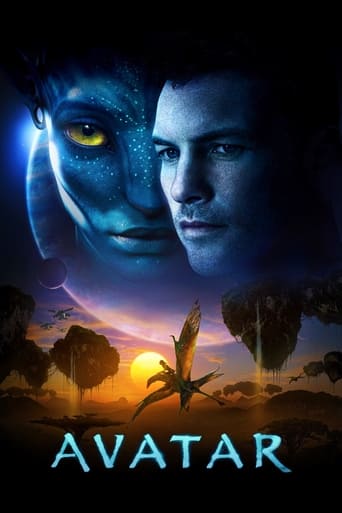
Avatar
2009 · Film · 162 min
Part of Avatar Collection
Directed by James Cameron
Science FictionActionAdventure
In the 22nd century, a paraplegic Marine is dispatched to the moon Pandora on a unique mission, but becomes torn between following orders and protecting an alien civilization.
113 positive116 negative50 mixed345 neutralfrom 624 commenters
Where to watch
No streaming data for this title.
741 comments on Hacker News
To be fair: the quality of movies produced by Hollywood has gone rapidly downhill already in the 1990s. You only need to compare the movies Quentin Tarantino makes; now personally I think Pulp Fiction is still by far his best work, but I concede that the movies he created lateron were above average (though I would not go as far as many others, who'd rate these in the 8 to 10 point ranges; I'd go more between 6 to 7 or 7.5, largely because there are a few smaller issues cropping up and I always notice these when I compare them with Pulp Fiction, which was really good; actually really well-made).
I noticed this in the 1990s in many movies. For instance, Independence Day - the computer animation pissed me off. I found them bad. Even Terminator 2, where evidently many people say it was great, I was nowhere near as convinced; I found the first terminator better and more "logical" and more consistent, too. But things decayed quickly in the 1990s really. Even movies such as Avatar I find total garbage. And while I am not totally against superhero comic/marvel adaptations (I liked xmen and in particular Hugh Jackman as wolverine), these are always the same formula. Tons of CGI, big fights where nobody knows what is going on, very little thought elsewhere in that formula. There are exceptions, but by and large these things keep on happening. Individual directors manage to break out of the mold (Chris Nolan) but by and large movies really SUCK now compared to the "oldschool days". And while some of this may be due to me becoming more critical, the production quality just sunk. Take movies such as Megalopolis - this captures what is going wrong. It seems as if the whole movie industry has partially collapsed in the last +25 years and they don't really know what to do to change this. The same has happened to games, by the way. It is almost as if only one formula exists only now.
Checks out, Papyrus: https://fontsinuse.com/uses/61309/avatar-movie-posters
Ed Harris acted the crap out of that scene. And the whole dynamic between him and Mary Elizabeth Mastrantonio in that film was awesome. I wish James Cameron was bringing that same level of characterization to Avatar :-/
Avatar movie blue monkeys jack into forest matrix.
But the blue monkeys are metal rods with radio and the forest matrix are forest wide fungal colonies.
I got bored with mine after a week and returned it. I couldn’t even muster up the energy to actually use it on the final weekend I had it.
The window management was buggy. I didn’t see a point to the virtual displays on the Mac. Maybe it was me, but some elements were tack sharp while others felt blurry, which messed with me a lot. The battery didn’t last long enough to feel like I could be cordless, but also got in the way while plugged in. Overall the whole experience felt really finicky.
Some of the immersive content was cool, but the cuts in the video were really jarring. I felt like they should have been done in a single shot.
Movies were… ok… I watched Avatar for the first time, and in 3D. It was fine. Not enough for me to sit down for 3 hours to watch the 2nd one before returning it.
I thought the dinosaur demo was the most impressive, but it was rather short and I didn’t know where to go for more stuff like that. I had the new one, so that demo was already old by the time I tried it, and still the more impressive part of what I tried.
I found some immersive 360 travel videos on YouTube, which were cool, but limited.
I wanted to like it, but the discomfort wasn’t worth what it gave me.
I don't know much about the movie industry, but I think the biggest commercial successes for early CGI was possibly Jurassic Park? I don't think it would have been nearly as good if it had all just been done with puppets.
Likewise, there's been a ton of movies since that could in theory have been done purely with SFX instead of VFX, but which is probably must better from having used VFX/CGI, titles like The Matrix, Lord of the Rings, Inception, Avatar, etc.
Obviously there was also charm in titles like E.T. and Gremlins, and I think there might still be a market for movies like that, such as the 2019 Netflix series The Dark Crystal: Age of Resistance (I loved the 1982 version as a child, though this sequel wasn't for me).
I guess the question is: will generative AI allow new movies to be made, the same way that CGI has? Or will it just be an economic shift: the same quality CGI but at a fraction of the price?
There may still be people out there who believe that AI will never be able to create CGI as good as humans can, these might be the same people who used to say that CGI can never look realistic. And if you work in VFX, I bet that you can spot a fake mountain with the slightly incorrect shadows in the distance easily, but as a simple movie watcher, I really don't see it, especially when it's only on screen for like 3 seconds.
Even Shadows of the Empire as a standalone movie would be a breath of something new and fun.
Maybe not the highest art ever but both were solid stories memorable enough for us to remember decades later. Thrawn was a respectable villain. We weren't supposed to like him but couldn't deny his competence.
Of memorable blue people, for comparison I've watched Avatar twice and don't remember a thing about it.
While it's true that VR has died a hundred deaths, I can't imagine certain parts of AI ever going away. Just because it hasn't gotten as far as we dream for it, doesn't mean it isn't already useful. It's most definitely already useful. We just have to remember it hasn't caught up to the dreams yet.
VR on the other hand, has never found its niche. It's surely out there somewhere, and so it'll die a few more deaths yet. But it is very far behind AI in terms of usefulness and/or entertainment value.
Also don't forget about 3D. While 3D movies had their moment, and still has a following, it isn't lost on anyone how bad the movies actually are when seen in 2D. There are exceptions, like the Lord of the Rings trilogy. But some 3D movies are painful to watch in 2D because those extreme-close on extreme-far tunnel shots look terrible in 2D, and just distract. Example of that? Avatar, which looks more like a bad video game in 2D.
Yep! My essays in schools had prompts like “Describe the similarities between the Pocahontas story and the first Avatar movies”. The point was not the produced text, but the activity itself. And as a teacher, I believe it’s quite easy to catch cheaters, because producing a stellar text one day and a crappy piece another is an anomaly.
The entire history of the US is founded on white supremacy. From the genocide of Indigenous people, to slavery, to Hiroshima, Korea, Vietnam, Iraq, Afghanistan, Palestine...
Only Titanic and Avatar earned more money (inflation adjusted) than this film:
https://en.wikipedia.org/wiki/The_Birth_of_a_Nation
This is a tricky topic to navigate because from a materialist perspective consciousness is the side effect of biochemical mechanisms. And many will point to the brain as the obvious container of our consciousness as a bullet to the head versus the arm would demonstrate.
But if a brain/intelligence is all you need to prove consciousness, then would an effectively complex set of neural networks that contained the same amount of neurons as a human be considered "conscious"? My guess is even at that level, probably not. Algorithms alone may mimic consciousness, but it won't be true consciousness.
Imagien this: what if consciousness is closer to something like the movie Avatar? What if the body our consciousness inhabits is closer to that of inhabiting a machine or computer that coexisted with the physics of the universe our body exists?
This would mean Jake from Avatar could theoretically inhabit not just a Na'Vi body, but what if they reproduced the Pandora equivalent of a squirrel for Jake to insert his consciousness into? Jake the Squirrel would be only as capable of expressing itself as the constraints of the body would allow it to.
Many religions discovered a long time ago that this is the most likely model of what we understand to be consciousness/sentience.
I'm not saying you're wrong, this is a conversation larger than what we may believe and touches into the core of what makes us humans that machine alone cannot replicate.
Yeah, that's pretty much it. They standardized on 24 back when sound on film took over Hollywood, and we now have a century of film shot at that speed. It's what "the movies" look like. There have been a few attempts to introduce higher frame rates, like Peter Jackson's The Hobbit and James Cameron's Avatar, both at 48 fps, but audiences by and large don't seem to like the higher frame rates. It doesn’t help that we have nearly a century of NTSC TV at ~60 fps[1], and our cultural memory equates these frame rates with live tv or the "soaps," not the prestige of movies.
[1]Technically 29.97fps but the interlacing gives 59.94 fields per second.
It’s a Gen-Z initialism, who are too young to be familiar with ‘avatar’, unless you’re talking about the movie.
Exactly, Avatar was literally what I was picturing when I wrote that. They're not good movies. But damn they're fun to watch in 3D, on a giant screen, and with great sound.
That's not to say that all movies in this category are *only* worth watching in the theater like Avatar is. For instance I would have still enjoyed the recent Dune movies either way but they were a lot better with all the pomp & circumstance.
Avatar is a good example.
I enjoyed each one in the theater but I tried watching Avatar: The Way of Water at home and despite having an entire media room devoted to good sound, proper lighting well calibrated projector and such it was not all that great. The movie fell a little flat without the theater experience to go with it.
I saw the limited run in advance to the 3rd one coming out in theaters again and it was good in that setting, as a reference point for my experience
I went to see Avatar. I only go to the movies once a year its a kinda tradition on New Year's Day.
It cost me 50 eurodollars for two tickets. And people complain Netflix is expensive!
> But producing that digital good costs time and money (anyone on HN care to disagree?)
Not disagree, but it is more nuanced than this I think. I spend a fair amount of money going to movie theaters, usually independent movie theaters but sometimes big ones, to see new releases. As I understand it, the production and funding model relies almost entirely on the box office numbers. I think when dealing with older releases, the waters are much murkier.
I end up seeing new things in person and paying a huge premium to do so. I won't pretend I do it for moral reasons or even strictly to support the creators (although I do it in part to support the independent theater itself). It does keep me from feeling bad for also running a media server, on which maybe 1% of the content is newer than 5 years old, though.
I have almost never bought a physical copy of a movie -- and in my mind the IP holders are usually terrible curators of their own content. Physical media is provided in a horribly limited and anti-consumer format, tied to ephemeral standards and technology and often embedded with advertisements and few subtitle options. Digital products are, somehow, worse. Tied to a walled garden, with no true 'ownership', sometimes platforms like Amazon video will even make their own edits to movies, removing crucial parts for no apparent reason (the wicker man, avatar) and without marking it as abridged. They often make decisions that scream 'cash grab' (i.e. years ago when TNG came on netflix, I went to stream it and was shocked at the potato quality. Later re-releases were released in an un-cropped widescreen that included things like boom mikes because of the original intended aspect ratio of the show.) DRM is a nightmare. The product I want -- a file containing the media and only the media, which I can view however I want without logging into anybody's servers -- does not exist. And if it did exist, well, I do also take issue with paying full price for a file of a 40 year old movie, for example. I know there are costs associated with remasters, etc, but most of these are not remasters (and those costs are also much much lower than outright movie production).
A notable exception is outfits like Vinagar Syndrome, who as a labor of love dig up lost media and often re-cut or remaster / distribute it, and due to the low scale and lack of demand likely do not make much if any profit off it. I often do see showings of Vinegar Syndrome releases at my indie theater though or rent them from the one remaining video rental place (I'm unsure whether or not that benefits the production company).
It probably gets more hairy for people who watch a lot of new serialized media, which I do not.
I kind of wish people would think critically about the gradient of potential consumption habits when making their media choices rather than separating into pro / anti piracy stances, because it's an interesting and multi-faceted topic with a lot of considerations to be made.
> Shouldn’t we have an international body of some sort at this point?
Says who?
Europe? The blue Navi in the movie Avatar?
This has been going on in technology for decades.
1. New productivity enhancer comes out. 2. Everyone thinks, "This is it! Work will get shorter|easier as a result of this!" 3. Instead the work gets faster|more|higher quality and the (time) volume stays roughly the same.
This applies across (almost?) everything: club newsletters that used to take half a day to write out by hand later took half a day to type and lay out with some clip art. It still takes a year or more to make a movie, but now we get Avatar instead of Ice Pirates -- look it up! :-)
When work reduction does happen, it generally happens at a person-quantum level: people hang on to their role until it goes away entirely, and they (hopefully) find something else to do. Rarely is it the case that someone legitimately reduces to part time incrementally as productivity increases.
AI is similar: no doubt jobs will go away as a result, but much less often will AI result in jobs that are easy/part time. For anyone still in the "work" game, even with AI there's still 5x8 hours of work to do.
How do I sqaure this circle with that the biggest films in the last two decades have been Avatar, Avatar: The Way of Water, and Avatar: Fire and Ash
2h 42m, 3 hours 12 minutes, and 3 hours 15 minutes.
All 3 are WAY too long and Way of Water in particular felt like it was 4+ hours subjectively.
Yet, they're literally the biggest films EVER by gross.
So seems the general public has longer attention spans than film students. This isn't the first time that lay people are objectively better/smarter than so-called "professionals" in a field.
Adrian Tchaikovsky is really good at these alien ecosystems kind of thing (his Children of * range being quite good). This was a terrific short story. One thing I am curious about is whether there is a different kind of science fiction out there. The driving thread through all of modern English sci-fi is "we shouldn't go out there and do anything; we are the bad that ruins a delicate thing". That's a cool story but somewhat overly tropey at this point I think. This short story, the Avatar series, they have this ecological moralizing. AT is creative enough that the novel ideas (single species life-cycle planet) carry the tale even though the moral thread is the same as the Avatar movie: corporations destroy ecosystems they don't understand in the resource pursuit.
I enjoy the "what if we're the baddies" just as much as anyone else. But are there big stories with these exciting concepts where we aren't the baddies in the Anglosphere?
A thing I enjoy about other cultures is seeing what is unusually different about them. In the Three Body Problem, spoilers to follow for the series, humanity aren't The Bad Guys With Agency. We aren't even The Big Bad or The Big Good. We're sort of just other participants in this universe. The dual vector foil is employed by someone else, the guys who want space back from the pocket dimension to reboot the universe are just someone else, everything is someone else. We are bit part players in this play.
This goes on even to a few movies. The Wandering Earth movie (somewhat different from the short story) has this part at the end (obvious spoilers to follow) where the heroes accomplish the task and reboot their Earth Engine after conquering all odds - only for the camera to zoom out and show numerous other teams also having done the same. This wasn't the only struggle won. Cool alternative tale where it isn't so much One Team Saves The World or One Team Ruins The World.
> Cut copyright to 15-20 years by default.
This alone will kill off all chances of that ever passing.
Like, I fully agree with your proposal... but I don't think it's feasible. There are a lot of media IPs/franchises that are very, very old but still generate insane amounts of money to this day with active developments. Star Wars and Star Trek obviously, but also stuff like the MCU or Avatar is on its best way to two decades of runtime, Iron Man 1 was released in 2008, or Harry Potter which is almost 30 years old. That's dozens of billions of dollars in cumulative income, and most of that is owned by Disney.
Look what it took to finally get even the earliest Disney movies to enter the public domain, and that was stuff from before World War 2 that was so bitterly fought over.
In order to reform copyright... we first have to use anti-trust to break up the large media conglomerates. And it's not just Disney either. Warner, Sony, Comcast and Paramount also hold ridiculous amounts of IP, Amazon entered the fray as well with acquiring MGM (mostly famous for James Bond), and Lionsgate holds the rights for a bunch of smaller but still well-known IPs (Twilight, Hunger Games).
And that's just the movie stuff. Music is just as bad, although at least there thanks to radio stations being a thing, there are licensing agreements and established traditions for remixes, covers, tribute bands and other forms of IP re-use by third parties.
3D? 4DX is the way to watch Avatar movies.
I don't really enjoy the stories all that much, but the experience is fun.
Although, I usually turn off the water while I'm eating my popcorn.
3D? 4DX is the way to watch Avatar movies.
I don't really enjoy the stories all that much, but the experience is fun.
I've never seen Avatar for this reason. It seemed like all 3D hype. However, after 3 movies and 2 more planned, with the 3D hype long dead, are the visuals going to carry a 5 movie franchise from a director with over 20 Academy Awards under his belt?
I've been debating watching the movies now that there a few of them out, thinking there must be something there. However, I've never heard anyone actually talk about these movies in real life, which is still a concern.
>That said, the game (or movie) still needs to be the most important thing. When a studio tries to lean on graphics as the selling point, it always ends up poorly.
Counterpoint: Avatar. I have never heard someone say they loved that movie because of the amazing story. They like it because it's very, very, very pretty to look at.
Not true in all cases - for example Blu Ray doesn't support 48 FPS which is probably the reason why we never got high frame rate home video releases of The Hobbit and Avatar rather than the directors thinking that we should see those movies in 24 FPS when at home.
Avatar is really only worth watching in 3D in theaters anyway, the story is nothing special if you need to sit through it for 3.5 hours at home.
My physics teacher in high school used unobtanium in class and was the first I recall using it. This was way before Core or Avatar. After reading your wiki link, it fit perfectly with the definition of a frictionless, massless pulley use.
It's funny, because I'm one to use movie references in casual conversation like it's nothing, yet my use was definitely not in this case
Unobtanium is fiction from the movie Avatar lol
Notoriously bad exposition I might add ("This is unobtanium. This is what we're here for!").
moviegoing has always been evolving. from kinetoscopes to grand movie palaces to suburban multiplexes. nothing has ever stayed the same for long in cinema.
heck, most theaters used to be continuous program viewing, meaning you’d show up not knowing what was playing, halfway through a movie, cartoon, or newsreel. scheduled viewing was pretty rare until the early 60s, only reserved for tentpole movies like Gone With The Wind or Ben-Hur.
in some ways, where we are heading is back to where we were: tentpole cultural moments like Barbie or Avatar thrive, but the bread and butter of entertainment happens informally, but now at home.
I went to see Avatar on a Imax screen. It was already about a month after the release so it was pretty quiet.
But those kinds of movies are rare- and it is expensive. You have to drive and park for half an hour, pay 30 euro for two tickets and ofcourse the drinks. Not something I want to do every week.
> Let's not pretend that James "Avatar" Cameron is deep.
It’s not, but it’s also now 3 films in 16 years. That’s not a lot.
We have had 20 years of comic book movies and endless sequels from the major studios.
Let's not pretend that James "Avatar" Cameron is deep.
I did see it in 3D originally, and that didn't outweigh the rest. I've seen a couple of movies in 3D, and while it's an interesting novelty, I doubt it could ever be essential to the experience. I don't think Avatar benefitted much from it.
That's a bit ironic: Avatar was best known for its 3D effects, which you generally can't see at home.
That may not outweigh the rest of the problems with theaters: the price of tickets, the cost of concessions, the noise, the inconvenient times, not being able to pause, etc. But if there was one movie that benefitted specifically from being seen in a theater, it was Avatar.
Avatar is one of the last movies I've seen in a theatre, in 2010. I've since seen it again at home, and that was a better experience. There's nothing magical about theatres; any movie involves the things the Academy of Motion Picture Arts and Sciences gives awards for, no matter how it's released.
> "We’ll put the movie out for a week or 10 days. We’ll qualify for Oscar consideration.” See, I think that’s fundamentally rotten to the core. A movie should be made as a movie for theatrical, and the Academy Awards mean nothing to me if they don’t mean theatrical. I think they’ve been co-opted, and I think it’s horrific.
From the same guy who allowed Avatar to be released 12 years later so it could retake the top spot from Avengers Endgame. (to be fair, that movie had a small rerelease itself to gain that top spot)
I think this is close, and the video touches on that as a characteristic that’s contributing to this, but there’s a motivation left unaddressed by the video that needs to be called out:
Reducing depth of field reduces the render resolution, which reduces the costs of digital processing and generation.
The simplest way to demonstrate this on a desktop computer is with the photography mode in games like Minecraft or Satisfactory or Elite Dangerous or No Man’s Sky, where the user can modify the Render Distance and Depth of Field at will. Load up the game viewing some planetary scene and enable the fps counter, then start changing the render distance; the closer you set it, the faster each frame will be generated. But the background will look defective and empty, so add depth of field, and now it doesn’t look so cheap — and when you take the photo, depending on the game, it may override your realtime render distance because it can take five seconds (!) rather than 1/60th of a second to generate that frame at 20 megapixels.
I think that the shift towards low depth of field in movies is, in part, a reflection of cost pressures, especially in 99.9% CG movies like Quantumania. And I think this is where Avatar beats out the competition for pure CG worlds in this video, because it renders at full resolution. It must have cost significantly more to produce than Quantumania (yep, $250m > $180m). I wonder how much of that difference was due to rendering the entire movie with a cheapness DoF blur. If nothing else, shadow rendering is so much of the difficulty of CG, that it could plausibly alone be the reason.
(I think that low depth of field is also currently popular because mobile phones lack it, and so producers are consciously or unconsciously selecting for an experience that is distinct from what they might film on their own. Depth of field is a very cheap form of escape.)
Gathering all the metaphors (I know) here for reference:
- "All toupées look fake. I've never seen one that I couldn't tell was fake." [1] - All CGI in movies looks fake. It jumps out at me every time I see it." - All WebView apps suck. Every one I've seen has a bad obviously-web-derived UI. re: that last one though -- I'd at least acknowledge that WebView apps are roughly at the end of the early-2000's era of CGI: not exactly "The Rock in The Scorpion King" bad, but generally not at the level of Avatar or Les Misérables.
1. https://news.ycombinator.com/item?id=45250878
> I think he/she was being ironic. You either own it or Apple owns it.
That’s really reductive thinking. I guess the idea is to blur all the different connotations of “own” into one thing and assert they are all the same?
I “own” a car, but am not allowed to drive it in some situations (if I’m drunk, on the wrong side of the freeway, …). Does that mean the state actually owns it?
Disregarding context in favor of reductive binaries is the #1 sign of zealotry. You see it everywhere: either a movie is original or it’s not, so Avatar is / isn’t (pick one) because it follows familiar tropes / innovated in visual arts (pick one).
The world is actually contextual. The moment you throw that out, no meaningful statement can be made.
> Oddly enough the otherwise dumb Avatar films are among the only ones to show starships with something approaching proper radiators.
I imagine it's the same reason James Cameron is a world expert on submersibles - the guy picks individual topics in his movies to really get right.
This is a big thing never shown in sci-fi. For example, those huge torch ships in The Expanse would need gigantic radiators. Even if the drive were upwards of 90% efficient the waste heat would melt the engine and the rest of the ship.
Even the ISS has sizable radiators. The Shuttle had deployable radiators in the form of the bay doors if my memory serves me correctly.
Oddly enough the otherwise dumb Avatar films are among the only ones to show starships with something approaching proper radiators.
There’s no air resistance in space so radiators don’t impact your flight characteristics.
https://tvtropes.org/pmwiki/pmwiki.php/Main/QuicksandSucks
TV Tropes suggests the idea whilst even existing in fiction for hundred of years before TV, is now "discredited".
---
Personally I prefer more interesting madcap cultural theories. Here's one from the top of my head:
Quicksand refers to anxiety about the natural world from an increasingly urbanised and ecologically disconnected population. Or maybe Quicksand represents an increasing urban populations attitude towards nature. It represents the opposite of a safe, technology, capitalist, consumerist industrial world of the post WW2 era. Nature was literally seen as hostile. Nature can make a person stuck, capture them, and kill them. It's allied with getting lost in the woods stories, a trope which emphasizes both physical and existential disorientation in the face of nature's indifference
Quicksand on TV existed throughout the early ecological hippy inspired new age of the late 20th century but the seeds were being sown. This changed in the late 20th and early 21st centuries as we witnessed the convergence of environmental concerns (e.g. plastic bags, straws, global warming) with the logic of neoliberal capitalism, together with an increase in bureaucratic management on behalf of people. Nature is not scary but something to be protected from harm. Nature is reconfigured from a place of danger to a place of stewardship. Avatar, the movie represents the change the most.
Thus, the role of cities and technology as agents of death and destruction have changed. It is not nature that entraps or destroys, but rather the infrastructures of urbanization, capitalism, and technological progress. Ironically this valorisation of nature is happening at the same time as increasingly technological manipulation of the rural environment - mechanisation of farming, house building, terraforming, weather modification. Nature is no longer wild, is not even tame, it's another resource to be shaped and used.
Quicksand not only is discredited as being inaccurate, it's ideologically impossible for nature to be dangerous anymore.
My current strategy is account hopping and ad blocking. I pay for Amazon Prime but I'm happy to pay less and have Firefox clean out the ads. I've cancelled my Netflix subscription for the third time. I'm soon going to re-enable Apple TV; probably for 1 or 2 months. And apparently HBO Max and Disney+ are now finally entering the German market. I will never pay for all of those at the same time. The more this market fragments, the smaller the pie gets for all of them.
What baffles me in this market is that there is all this unmonetized content that remains exclusively locked up in archives that is still very watchable earning almost next to nothing. The notion of cross licensing content between these networks seems controversial.
Take Game of Thrones for example. Exclusive to HBO. Some people in Germany may or may not have pirated that back in the day. Because HBO was not available in that market and there was no way to watch that legally even though world+dog was talking about that. Now it's old news of course. But Germany is probably full of people that might have payed for watching that when it wasn't old news yet. There are decades worth of high value series that you can buy (in some cases) but not stream. And I bet sales aren't all that great. Judging from the lack of marketing.
In the same way the BBC is sitting on decades of quality content. Same for most public broadcasters. Very hard to get your hands on any of it. Why are there no multi billion deals with Amazon, Netflix, Apple TV, etc. being closed about that content. Netflix is back filling their catalog with cheap Korean action movies and other filler crap instead. And they are cutting the budgets of the exclusive content that made them big.
Another example is that movie studios have been publishing 3D blockbuster movies for about 15 years now. These are almost all very expensive movies that only ran for a short time in cinemas. 3D only kicked off with the first Avatar movie. None of the big streamers offer any 3D content whatsoever. What's wrong with content publishers that they are allowing a good investment to go to waste like that? It's not a technical problem. TV makers have been trying to flog 3D tvs for ages. But without any content (not counting obsolete things like blue ray) there never was a reason to buy those.
That list has Avatar and La La Land on it. It’s definitely not elitist!
There’s some real gems on lists like this but some of the older stuff would definitely be a slog for most people and would probably need to be put into context to make sense.
Recently I’ve engaged in a practice of just hitting play on any old movie on Prime with at least an actor or director or even studio I’ve heard of. Essentially any film from the 40s to the 00s that had a budget and was remembered enough to make it to Prime. It’s been quite rewarding, all sorts of hidden gems out there even from the 70s through 90s. Even the mediocre stuff from then is often more nuanced and creative than a lot what you get today.
I credit homelabbing through my twenties with just about everything good that's happened to me in my career. I certainly didn't end up being moderately employable because I'm smart, charismatic, incisive, creative, lucky, educated, diligent, connected, handsome, sanitary, interesting, or thoughtful; no, it's because I have a tendency toward obsession, delusions of grandeur, and absolutely terrible impulse control.
So I started buying junk on eBay and trying to connect it together and make it do things, and the more frustrated I got, the less able I was to think about literally anything else, and I'd spend all night poking around on Sourceforge or random phpBBs trying to get the damn things to compile or communicate or tftp boot or whatever I wanted them to do.
The only problem was eventually I got good enough that I actually _could_ keep the thing running and my wife and kid and I started putting good stuff on my computers, like movies and TV shows and music and pictures and it started to actually be a big deal when I blew something up. Like, it wasn't just that I felt like a failure, but that I felt like a failure AND my kid couldn't watch Avatar and that's literally all he wanted to watch.
So now I have two homelabs, one that keeps my family happy and one that's basically the Cato to my Clouseau, a sort of infrastructural nemesis that will just actually try to kill me. Y'know, for fulfillment.
2002 was also when broadband internet and movie piracy became more prolific - DivX was just out, DVD burners became a thing, etc. Streaming video was in its infancy, with TiVo and VOD slowly becoming a thing (although that only reached mainstream in 2007 when Netflix launched). DVDs and DVD players became mainstream, as well as flat TVs, HD video, etc.
Anyway. The tech in the movie theaters did improve by a lot since then, 3D was a fad but we get 4K, imax, Dolby Atmos, etc nowadays. But it's not as popular as back then, cost and convenience probably being important factors, but the lack of long exclusivity (it's now only weeks sometimes until a film is out on streaming) and the overflow of media nowadays isn't helping either. The last really popular film was the Marvel films and the last Avatar film, other than that it feels all a bit mediocre or unremarkable.
I wonder if that's the other factor. The 90's and early 2000s were for many people the highlight of filmmaking - this may be a generational thing. But there were years where multiple films would come out that were still remembered fondly for years or decades after.
Meanwhile, I couldn't name you a single good or standout film from the past year or years. Nothing I remember anyway. I think the combination of the LotR trilogy and the Star Wars prequels ruined films forever for a lot of people, in a good way for the former and a bad, cynical one in the latter, lol.
To restate what you're saying to make sure I understand, you're saying that kids that grew up during the Avatar era (gen alpha/Z) are biased to prioritize VFX when watching a movie and my generation (millennial) is biased to enjoy things like plot, acting, etc?
It didn't use anywhere near as much as the hobbit, but lots of things are enhanced. I have a similar problem with Avengers/Marvel which just doesn't look great to me. Avatar did look very good though. The main problem I have with CGI is if the story isn't there, which for me is definitely the case with most Avengers movies which are just a mess.
Jurassic Park fits into the TvTrope of "Seinfeld Is Unfunny".[1] CGI dinosaurs are awesome when you see them for the first time in 1993, when Reboot was cutting edge.[2] Now it's a basic requirement to have photorealistic CGI, so the first film that did it doesn't stick out to me. I'm 25 and grew up with Avatar. People younger than I am mock minor compositing issues because they're so used to perfection.
You probably feel the same way about the VFX in King Kong and our grandchildren will laugh at us for living in a world in which we cannot generate unlimited dinosaur movies on-demand with AI.
[1] https://tvtropes.org/pmwiki/pmwiki.php/Main/SeinfeldIsUnfunny
[2] https://youtu.be/fuEJWmxWkKw
People were skeptical that 120Hz vs 60Hz made any difference in gaming. I’m still not sure how skeptical I should be. The threshold seems somewhere between 60 and 240, and it’s really hard to believe that 240 makes a measurable difference in real world performance (e.g. competitive games). But I can believe 120Hz matters vs 60Hz.
There’s also confusion over human response time vs whether you can perceive something. Even if 240Hz looks slightly different, if a human can’t react to that difference (other than to say it looks nicer, which is a personal preference rather than an empirical assessment of “better”) then it doesn’t really matter anyway. Kind of like how Avatar looked different in 48Hz instead of 24Hz, and at the time it was hailed as some revolution in movies, and then it came and went. Personal preference.
As a direct answer to your question, I was a gamedev from 2005 to 2012, and back then people were arguing that 120Hz couldn’t make a difference and that 60Hz was fine. It stuck with me, since it seemed mistaken. So I shouldn’t have said “generally accepted,” just “I vaguely remember the world arguing a decade or so ago that 60Hz was good enough in all situations, e.g. competitive gaming.”
This is sort of explored in the film Strange Days, which is probably not very well known generally but perhaps would have a large fan base on HN.
https://en.wikipedia.org/wiki/Strange_Days_(film)
Had no idea til I looked it up just now that James Cameron did the story, of Avatar, which shares a lot of tech influences with Strange Days. They could even be in the same cinematic universe, though many years apart.
The Abyss is a movie by James Cameron, who also made Terminator, Terminator 2, Aliens, True Lies, Titanic, and Avatar.
"The Abyss" is about a deep sea crew that encounters ... aliens...?
And yes, in general, I recommend The Abyss. It's definitely not the same as Project Hail Mary, but it does have similarities.
Lack of radiators is endemic in sci-fi. All those cool starships and torch rockets would bake their crews and then melt.
I didn't like the Avatar films except for the starships, which are among the more physically realistic in construction including massive radiators. They'd probably need to be even bigger though IRL if you're talking about something loony like an antimatter rocket.
I'm not into anime, but this is in my top 3 favorite movies. Aside from the sheer coolness, it's environmentalist but not in the typical annoying way like the blue people Avatar movie. It's more matter-of-fact, you won't win fighting against nature or against each other.
And the main character has the right amount of flaws. Even though Nausicaa is totally against war by the second half, the movie shows that this is easier said than done. She has to reach that conclusion after taking part in the fighting herself, and even then she has to use warning shots from a machine gun. She's not invincible until the last scene.
You might just not like big-budget movies - there's definitely a correlation between the size of the budget and a lack of novelty. Take a look at Wikipedia's list of most expensive films, almost every single one on there is a big franchise film - often late in the franchise too. I think the first one on there that isn't based on previous material is Avatar at #41 and I think the only other is Tenet at #62.
This makes sense - if you're funding a movie you want a return on your investment. You could make 20 risky $10m movies or one that's $200m which has to succeed or else. When you put your money into the $200m movie you want to make sure it's as inoffensive as possible and appeals to as wide an audience as possible, so you want a franchise that's proven to pump out hits in the past (or a director who does the same, like Cameron for Avatar and Nolan for Tenet).
>The idea that a film artist doesn’t need to know how a camera works is laughable. And not just the camera, but different film stock, processing methods, lenses, lighting, and the interaction of all those as well as the subject being shot. The level of attention to detail in great films is wild.
The Aliens documentary is really good for this. So much of the special effects on the film are in camera tricks.
Cameron is a really interesting person to study because he absolutely mastered every part of film making before deciding to go all in on Avatar and ubiquitous 3d effects.
If data integrity is assured, and thus there is no change in the data to store/transfer, then that's the opposite of computationally transforming the data?
How do we see robot and AI and helping interactions in film and tv and games?
A curated list of films for consideration:
Mary Shelley's "Frankenstein" or "The Modern Prometheus" (1818), Metropolis (1927), I\, Robot (1940-1950; Three Laws of Robotics, robopsychology), Macy Conferences (1941-1960; Cybernetics), Tobor the Great (1954), Here Comes Tobor (1956), Jetsons' maid's name: Rosie (1962), Lost in Space (1965), 2001: A Space Odyssey (1968), THX 1138 (1971), Star Wars (1977), Terminator (1984), Driving Miss Daisy (1989), Edward Scissorhands (1990), Flubber (1997, 1961), Futurama (TV, 1999-), Star Wars: Phantom Menace (1999), The Iron Giant (1999), Bicentennial Man (1999), A.I. Artificial Intelligence (2001), Minority Report (2003), I\, Robot (2004), Team America: World Police (2004), Wall-E (2008), Iron Man (2008), Eagle Eye (2008), Moon (2009), Surrogates (2009), Tron: Legacy (2010), Hugo (2011), Django Unchained (2012), Her (2013), Transcendence (2014), Chappie (2015), Tomorrowland (2015), The Wild Robot (2016, 2024), Ghost in the Shell (2017),
Giant f robots: Gundam (1979), Transformers (TV: 1984-1987, 2007-), Voltron (1984-1985), MechWarrior (1989), Matrix II: Revolutions (2003), Avatar (2009, 2022, 2025), Pacific Rim (2013-), RoboCop (1987, 2014), Edge of Tomorrow (2014),
~AI vehicle: Herbie, The Love Bug (1968-), Knight Rider (TV, 1982-1986), Thunder in Paradise (TV, 1993-95), Heat Vision and Jack (1999), Transformers (2007), Bumblebee (2018)
Games: Portal (2007), LEGO Bricktales (2022), While True: learn() (2018), "NPC" Non-Player Character
Category:Films_about_artificial_intelligence : https://en.wikipedia.org/wiki/Category:Films_about_artificial_intelligence
List of artificial intelligence films: https://en.wikipedia.org/wiki/List_of_artificial_intelligence_films
Category:Films_about_robots: https://en.wikipedia.org/wiki/Category:Films_about_robots
Category:American_robot_films: https://en.wikipedia.org/wiki/Category:American_robot_films
That is a nonsense definition of creativity. The parent also wasn't suggesting - as far as I can read - that creativity is defined solely in the realm of the "truly novel" (or "isn't based on anything you've ever seen before").
All creativity is a conversation between our own ideas and what already exists.
Consider the unused soundtrack to James Cameron's Avatar [0][1], where ethnomusicologists set out to create a kind of music that had never been heard before.
They succeeded. But it was ultimately scrapped for the film because - by virtue of it being so different to any music anyone has ever heard before - it was not remotely accessible to audiences and the movie suffered as a result.
To argue that work is not creative because it is still based on "music" is absurd.
[0] https://www.youtube.com/watch?v=tL5sX8VmvB8
[1] https://ethnomusicologyreview.ucla.edu/journal/volume/17/piece/583
this thread is helping me understand why I always thought 3D movies looked _less_ 3D than 2D movies.
That and after seeing Avatar 1 in 3D, then seeing Avatar 2 in 3D over 10 years later and not really noticing any improvement in the 3D made me declare 3D movies officially dead (though I haven’t done side by side comparisons)
Hell yeah, this one of many issues I had with the first Avatar movie. The movie was so filled with cool things to look at but none of it was in focus. 10 minutes in I had had enough and was ready for a more traditional movie experience. Impressive yes, for 10 minutes, then exhausting.
Stereo film has its own limitations. Sadly, shooting for stereo was expensive and often corners were cut just to get it to show up in a theater where they can charge a premium for a stereo screening. Home video was always a nightmare--nobody wants to wear glasses (glassesless stereo TVs had a very narrow viewing angle).
It may not be obvious, but film has a visual language. If you look at early film, it wasn't obvious if you cut to something that the audience would understand what was going on. Panning from one object to another implies a connection. It's built on the visual language of still photography (things like rule of thirds, using contrast or color to direct your eye, etc). All directing your eye.
Stereo film has its own limitations that were still being explored. In a regular film, you would do a rack focus to connect something in the foreground to the background. In stereo, when there's a rack focus people don't follow the camera the same way. In regular film, you could show someone's back in the foreground of a shot and cut them off at the waist. In stereo, that looks weird.
When you're presenting something you're always directing where someone is looking--whether its a play, movie, or stereo show. The tools are just adapted for the medium.
I do think it worked way better for movies like Avatar or How to Train Your Dragon and was less impressive for things like rom coms.
I had a similar complaint with the few 3D things I watched when that has been hyped in the past (e.g., when Avatar came out in cinemas, and when 3D home TVs seemed to briefly become a thing 15 years ago). It felt like Hollywood was giving me the freedom to immerse myself, but then simultaneously trying to constrain that freedom and force me to look at specific things in specific ways. I don't know what the specific solution is, but it struck me that we needed to be adopting lessons from live stage productions more than cinema if you really want people to think what they're seeing is real.
> Go watch CGI in a movie theatre and it's worse than 20 years ago
Objectively this isn't true as CGI technology has improved by leaps and bounds (think e.g. subsurface skin scattering in new vs old Gollum), however there's a lot of other factors at play; old CGI used film tricks to make it blend better, new CGI uses full CGI and digital whatsits and doesn't care anymore. It also depends on budget and what studio takes care of it. Good CGI is invisible, and there's a number of non-superhero films where the CGI just isn't visible / you're not even aware of it. Anyway, what 20 year old CGI are you thinking about, and what are you comparing it with? I'm thinking The Spirits Within (2001) or Beowulf (2007); the former did not age well, the latter was already panned as having poor CGI when it came out. Avatar (2009) pushed the frontier again I think.
> go home to play video games and the new releases are all remasters of 20 year old games because no-one knows how to do anything any more.
This is a blinkered view of reality; there's thousands of game developers outside of this bubble, from single person developers making modern classics like Stardew Valley or even Minecraft when it first came out, to teams of developers that are bigger than those that made the games of 20 years ago.
Also, your opinion isn't fact; in the top 20 best selling games of 2024 [0] there is only one arguable remaster (GTA 5, which is on its 3rd remaster) and two complete remakes (FFVII Rebirth and CoD 3), with the former being a completely different game compared to the original. I share your cynicism about the "top of the line" video game market today, but you're not correct.
(meanwhile I'm playing 2007 video game (Supreme Commander))
[0] https://www.gamespot.com/gallery/2024s-best-selling-games-in-the-us/2900-5106/
Avatar the movie franchise? The most common thing you'll hear people say about it is that it's "Pocahontas in space".
But some of the really old (like 1940s) cartoons were very smooth and well-done. I have DVDs of old Tom & Jerry cartoons, and they are excellent.
My experience, is that the ones made in the 1970s and 1980s had crap quality.
I watched this movie, and think it very much deserved the Oscar, but the character rendering was a bit “scruffy.” The environment rendering was great, and it looks like they optimized for movement, in the characters, which was a good choice. Once I spent some time, watching, the rough rendering didn’t matter.
I had a similar experience, watching Avatar. At first, it seemed like a cartoon, but I quickly became immersed, and the fact it was rendered, didn’t matter.
I read, somewhere, that the movie is being re-rendered. I think they may have the money for that, now.
One of the biggest things that always bothers me in sci-fi, even harder sci-fi like The Expanse, is the missing heat sinks. All those ships would need massive radiators or they’d melt.
The starship in Avatar got that right. Rest of the film is comic book level and derivative but the ship is good.
This is why there’s ideas like the Bussard ramjet, which may not work but try to work around this problem by using in situ mass-energy.
Now I have read that it may be possible to use a powerful magnetic field to assist with slowing down by braking against the interstellar medium, which helps.
The Avatar films have (in spite of very derivative plots) fairly realistic (at least physics wise) interstellar ships. They accelerate using beamed laser propulsion from the Sun and use antimatter rockets to decelerate, then repeat this in reverse to come home. One assumes they somehow recharge at their destination but this is not shown. Too bad all that cool tech is in service to humans who decided to be the bad guys from War of the Worlds.
Still traveling that close to c brings up tons of other problems. Collision with a micrometeorite would be like an atomic explosion, and blue shifting of incident and cosmic background radiation would blast you in the head with x-rays and gamma rays. Those problems would demand more mass for active or passive shielding, and you’re already mass constrained.
All things considered it’s way more practical to go slower — which could still be insanely fast e.g. 0.25c — and figure out how to cryosleep or become an AI that can just turn yourself off for the trip. Cryosleep for humans is a brutally hard biomedical problem but way easier than trying to approach the speed of light. There are other multicellular animals that can do it, albeit much simpler ones, so it’s probably possible.
0.25c allowing for acceleration and deceleration gets you to Centauri in around 25 years and to further star systems with promising exoplanets in hundreds of years.
Then there’s generation ships, but that’s the kind of thing Mormons would do. :)
> Tell me you commented without watching the video without telling me you commented without watching the video.
I didn't watch the video. I watched the gaming landscape evolve over the past 20 years and I personally witnessed which games succeeded and which did not: https://en.wikipedia.org/wiki/List_of_best-selling_video_games
The only bestseller on that list that predates the Wii with a female protagonist is Pokemon. The reason? Before the Wii, the entire market for games was masculine individuals. It was pandered to in it's entirety because it was not perceived that women used or wanted to use consoles and computers. The advent of the Wii (and moreover, the smartphone) radically upset that assumption. The market literally changed, and the approach businesses took changed along with it. Borderlands went from being a slapstick must-play to a goiter-sized shame pimple on the aging face of gaming overnight. There really are hundreds of such series that never stuck the landing when the market changed. To name a few, Quake, Spec Ops, Deus Ex, Need for Speed, Outrun, Tom Clancy, Star Fox, F-Zero, Oddworld, Crysis, Skate/Tony Hawk, Saints Row, Postal, XCOM, Shadow Warrior, Serious Sam, Red Faction, Unreal Tournament and Conkers Bad Fur Day all didn't survive. Meanwhile, Animal Crossing, Fortnite, Minecraft, Terraria, Stardew Valley, and Among Us are more popular than ever. Touhou outlasted Space Invaders - what does that tell you business-wise?
> There's absolutely nothing wrong with having entertainment made officially for one gender or the other
Not between us consumers, but for businesses there absolutely is; it makes less money. Why make a big-budget Barbie movie that men will be disgusted by when you can shit out another Star Wars film that couples and families will rush out to watch? The reason we don't see more Barbie like movies is that people don't think feminist mass appeal is enough to get significant audiences out the door, and they're absolutely right. People want Avatar, people want Jurassic Park. Horror flicks do well too. Anything that doesn't divide people along critical lines is much more profitable and has greater potential for mass-appeal. Top Gun is a funny pull since it's a movie that was only funded after the Navy realized it was a propaganda piece. As an indie script it went nowhere.
Look - I don't want my favorite series to go woke. But that ship sailed when Kojima left Konami, and the case is probably the same for your favorite series as long as it's owned by private capital and shareholders. I'm just telling it how it is, because you and I both know games are going down the shitter but we apparently disagree on what the motive is.
> Yeah you can. Warhammer 40K Space Marine 2, Black Myth Wukong, Dragon Ball Sparking Zero, etc
Quite famously, Warhammer is both a blatantly moronic series and a demonstrably woke one as well. Unless "non-woke" simply means "violent" to you, then I'm not sure what you mean here. Warhammer as a series is against imperialism, pro-diversity, pro-LGBT, is apologetic to communism, creates fictional races of bug-people to squash and mostly just ends up pitting different queers against each other in frilly painted outfits. Fitting that it's a series descendant of model-painting tabletop pansies. Eric Cartman says it best: "We're playing 40k, dude!" https://youtu.be/rIo7UYVwcAU
Black Myth Wukong is a poor man's pittance of a soulslike, and it'll be lucky if people mention it in the same breath as Lords of the Fallen. It pulled punches (much in the same way Warhammer as a franchise does) because it's a mass-market game that can't make subversive statements without pissing off the Chinese market. If you think both of these are tentpole "non-woke" games to you, then I have to admit that woke gamers are getting much better content than us masculine men are. At least they can tolerate Elden Ring without accusing it of being historically inaccurate for putting women in armor and making men hug one another.
Oh, and since you made it this far here's a blackpill; queer and diverse voices are destined to succeed in gaming because the entire market is hyper-saturated with manly titles that nobody wants to play. Even utterly dogshit games like Fortnite attain mass appeal by ditching the Call of Duty desaturated look and pitting Snoop Dogg against a dude in a bannana costume. Undertale charmed 10s of millions of gamers with a cat that needed money to pay for college. Non-manly games are a gold mine, and if the success of mobile gaming is any indication it's a vein that goes quite deep. It's not that men are inferior as an audience, it's that they've been pandered to for too long with little ROI. It makes no business sense trying to chase this shrinking audience, especially if it means more Cyberpunk 2077-like releases that just waste everyone's time and money.
> it’s really just fodder for further conversation
Exactly this.
Just go, "Well, one of my favorite movies is _Avatar_, because..."
Wikidata.org the database behind Wikipedia is a good alternative as a general database including films and related crew for instance with Avatar (2009) https://www.wikidata.org/wiki/Q24871
Although is cannot be queried in SQL, but SPARQL instead https://www.wikidata.org/wiki/Wikidata:SPARQL_query_service
I suppose you could potentially take a movie like avatar and create a somewhat interactive experience with it?
"real films with 3D look like paper cut outs layered over each other and it's very distracting and looks lame)."
Probably because those movies are FAKE 3-D trash that studios troweled out, killing one thing that is highly piracy-resistant and theater-boosting.
Most people complaining about "3-D" movies have probably seen only two real ones: Avatar, and something from Pixar. The vast majority of movies marketed as 3-D were not shot in 3-D, but rather processed into fake 3-D in post. The result: exactly what you describe, lame cut-outs.
Just another reason that the studios and media conglomerates deserve no sympathy when they whine about piracy or declining revenues. They screw actors, writers, theater owners, and the audience... when they've had (and ignored) interesting avenues available to revitalize their industry and audience.
It's a question of cost, knowledge and time. Avatar was in 2009 and the motion capture there was well beyond what was on display in Rogue One.
My take on it is that ILM had their own in house animation process and rather than admit that it was costly, slow and gave abysmal results, they doubled down and tried to push it through.
Again, there might be some excuses that can be made for Rogue One, but none for Mandolorian and the later Star Wars movies. The Luke Skywalker scene was deepfaked days after the episode aired [0] and, again, the DeepFake version is much better but still horrible because of the animation.
[0] https://www.youtube.com/watch?v=wrHXA2cSpNU
"The movie industry got stuck in a terrible place with 3-D as an "add on" to a regular movie"
Well, they didn't just "get stuck" there; they put themselves there. That was a choice. They should have shot in 3-D when they wanted to release in 3-D, and refrained from post-processed fake 3-D in all cases.
Seth Rogan said that he and... I don't remember, maybe the director of Green Hornet wanted to shoot in 3-D and the studio turned them down. After it was done, the studio changed its mind and made it into fake 3-D.
And yes, there's a misperception that "action" and "spectacle" movies are the best for 3-D. Wrong. The coolest 3-D pictures I've shot are often indoor scenes with lots of objects; for example, a long dinner table set with dishware and glasses, with an open door in the background revealing a cobblestone street.
Most people scoffing at "3-D" have probably seen almost none of it. Many people have only seen one legitimate 3-D movie: Avatar. Otherwise they might have seen a Pixar movie rendered in 3-D; or if they're lucky, Hugo. Or the Transformers one where they tear up Chicago. Most did not see Drive Angry.
Beyond that, I'm hard-pressed to name a modern movie shot in 3-D.
The best book recommendation I have in mind is "A Psalm for the Wild-Built" by Becky Chambers. It's a small book, but it truly embraces the Solarpunk aesthetic in many cool ways.
When friends ask me for fictional works with a Solarpunk vibe, here's my short list.
Movies: Miyazaki's "Castle in the Sky" and "Nausicaä of the Valley of the Wind," Cameron's "Avatar," Disney's "Atlantis: The Lost Empire" and "Treasure Planet".
Video games: The Zelda series (especially the latest ones: TP, SS, Breath of the Wild), "Horizon Zero Dawn", "Nier: Automata".
Really? You could tell the planes in Top Gun: Maverick were all CGI over reference footage? You could tell the Barbie movie car sequences were shot in front of a green screen (as opposed to a matte painting, which is how it appears)? You could tell that almost all the racing shots in Gran Turismo were CGI?
This wasn't an example given in the video series but what about a movie like Brokeback Mountain? Can you tell which of the sheep or which of the mountaintops are CGI? If you can, that's absolutely shocking to me.
Take a look at this shot: https://www.reddit.com/r/vfx/comments/z8wbv4/whats_the_consensus_on_this_shot_from_the_avatar/
Can you tell which parts are CGI and which are practical?
Here's the answer: https://imgur.com/a/Q7UUn2G
There are a number of films: The Matrix, the original Star Wars, Jurassic Park, Avatar, I’m sure many others that were just so different and jaw-dropping in many ways when they first came out—in those cases because of effects of various types mostly—that it can be hard to appreciate their novelty at the time.
Some stand up better than others.
Shoot, I'm just realizing that we're as far from 2038 as we are from 2010.
In 2010 the the iPad was released and the movie Avatar had come out. So we're closer to 2038 than the release of the iPhone (2007).
> There are gems coming out today that will be considered great works by our descendants.
Wow. Can't wait for the next Harry Potter / Avatar / Celebrity book / Spiderman movie !!!!11!!!1! Great works!
> but isn't right now pretty amazing too?
No.
How many people watched Dune 1 and 2 because of a story that has been around for decades and already had one interesting film interpretation? How many people watched Avatar for the story?
The existence of IMAX should be a hint that there is value in very crisp visuals.
However, this stupid tiktok filter is NOT "very crisp".
I think this book was the basis for the Avatar movie.
I read it as a teen and really liked it, but you do a great job of poo-pooing it haha.
> Here [2] is a table of best selling movies, inflation adjusted. No movie made in the past 25 years, including the endless men in spandex movies, is among them.
The Force Awakens (2015) is #11. Avatar (2009) is #15. Avengers Endgame (2019) is #16. And that’s just in the top 20. Not too bad for a list that covers a century of films, especially when you consider the limited entertainment options available in the first half of that century.
Finding ways for humans to live well now without consuming their children’s ability to do the same in the future.
A good framing would also draw a link to fiscal responsibility. A renewable sustainable civilization is paying its bills fully. Fossil fuels and other non renewable processes are putting it on a credit card, and one with an unknown interest rate. Eventually you can’t do that anymore and the interest comes due. Right now humanity is still putting something like 75% of its primary energy use on credit.
The worst framing is the anti-human framing you see from radical greens or films like Avatar. If you really hate humans the logical thing would be to do nothing and let us crap where we eat until we render our environment inhospitable to us. If humans are the problem the activists should go home.
That's the other thing to keep in mind, seeing things in perspective for the time; these movies were literally groundbreaking, like Wizard of Oz' transition to color film (compare with e.g. Avatar which popularised 3D film), Jurassic Park's use of CGI blended with models and live actors, the unfortunately one-off Who Framed Roger Rabbit, Toy Story's full CGI film that revolutionised animated filmmaking (arguably for the worst since it eventually came at the cost of "traditional" western cartoons).
It feels like it's getting harder to do something new.
I remember every line from Lord of the Rings now because so many memes were made of it.
But then you have e.g. Avatar where at best you remember "I see you" and... nothing else, besides high level things like blue aliens and jungles, because there's no memes. That was the weird thing about Avatar, one of the highest grossing films of all time, but nobody talks about it.
I find creepy things in all the videos, despite their breathtaking quality at first glance. Whether it is the way the dog walks out into space or the clawlike hand of the woman in Tokyo, they are still uncanny valley to me. I'm not going to watch a movie made this way, even if it costs my $0.15 instead of $15.00. But I got tired of Avatar after watching it for 20 minutes. Maybe all the artificial abundance and intellectual laziness the generative AI world will make us realize how precious and beautiful the real world is. For my kids' sake, I hope so.
I was close to returning my Vision Pro but after using it on a plane recently during a business trip (I travel a fair bit) I will definitely be keeping it. It has been the best in flight entertainment by far, watching 3D movies on here while flying is outstanding. It felt like I could touch the water when I watched avatar. It’s also useful for having a big screen when I’m sitting down on a sofa and using my laptop, however, when I tried to use it for work longer term, like 7-8 hours it was just too uncomfortable.
Both avatar movies are somehow insanely high grossing and apparently nobody remembers them at all. It’s a skill set to be sure.
It's more stable (and structurally leaner, I think) to instead have the engines at the front in tractor configuration, as in the interstellar ships in Avatar movies.
If you have a 3D capable setup Gravity is a must! Avatar and Life of Pi are also some favorites.
There’s also a few gems and lesser known films that were released on 3D Blu-Ray like Hitchcock’s Dial M for Murder, which was shot in 3D but wasn’t originally released in the format because the 3D fad died by the time the it came out.
They’re hard to watch because 3D TVs were so unsuccessful. You often need a special Blu-Ray player, and I don’t know of any streaming service that supports 3D.
3D TVs were too far ahead of their time. 3D works far better on 4K than on 1080 since each eye only gets half the image, (though the 4K 3D format doesn’t exist) so it would be nice to see it make a comeback on VR. While 4K and HDR are much better I still miss the occasional 3D film.
Well BR2049 was made by the same director and probably a lot of the same crew so I'd be surprised if it didn't look similar.
Prometheus and Interstellar look nothing like these movies though. The production design is completely different even though there might be similarities in the color grading.
I give you that the super washed out colors has been a very common aesthetic in the past 15 years or so but I wouldn't say all scifi movies adopt it. Some examples: District 9, Avatar 1 and 2, Inception, Tenet, Ex Machina, etc.
Remember the scene in the first avatar movie where Jake is learning how to be like the Na'vi and he gives a solemn speech to the animal as he kills it, thanking it for its sacrifice and showing it respect?
I wonder, if we took indigenous perspectives for animal life, would it be more acceptable to take the life of animals for consumption? Minimize suffering, use the whole animal, don't overconsume so that the species can sustainably live on, let them live life more free range, not in prisons, etc. Or would it still be just as bad because the animal still can suffer? Indigenous thinking is something that is being promoted by certain sustainability movements, and I wonder if it applies here and would make animal consumption more ethical, or would it just be whitewashing?
I'm not terribly surprised that the director of Avatar has "updated" his previous movies to look more digital than filmlike. Some people embrace the limits of the medium and some don't.
Mixtral is missing in half of the benchmarks in that paper. Hardly conclusive. It’s also common knowledge that these benchmarks have a lot of issues[0]. A good litmus test, but not a substitute for actually seeing how the models do in the real world.
On the topic of “hardly conclusive” things, Gemini Pro literally told me just a few minutes ago[1] that the Avatar movies did not have humans in them. There was no funny business in the prompting. At least Mixtral knows that Avatar has humans in it. Most of Gemini Pro’s responses have been fine, but not exceptional.
[0]: one random article talking about these issues: https://www.surgehq.ai//blog/hellaswag-or-hellabad-36-of-this-popular-llm-benchmark-contains-errors
[1]: https://i.imgur.com/En37EJD.png
And I bet an other Avatar movie with Apple money
Yes and no. Yes for big blockbusters like Avatar and Marvel movies. No because CGI tech is being rapidly democritized and lower cost houses are increasingly able to do amazing things. Movies like Distric 9 and Chappie have shown you can make an effects driven movie for far less that is a critical and commercial success. Check out Corridor Crew in youtube to see what's possible now out of your garage. It's amazing, there are so many fun fiction type movies being made today that are equal or higher quality to commercial movies from 10 or 15 years ago.
Edit: Movies, unsorted, from the top of my mind:
https://en.wikipedia.org/wiki/The_Limits_of_Control https://en.wikipedia.org/wiki/I_Origins https://en.wikipedia.org/wiki/The_East_(2013_film) https://en.wikipedia.org/wiki/Winter%27s_Bone https://en.wikipedia.org/wiki/Contagion_(2011_film) , seen before Covid, deemed to be realistic, and therefore better than stuff like https://en.wikipedia.org/wiki/The_Andromeda_Strain with https://en.wikipedia.org/wiki/Warning_Sign_(film) somewhere in between. https://en.wikipedia.org/wiki/Phase_IV_(1974_film) https://en.wikipedia.org/wiki/Wizards_(film) The remakes of the Planet of the Apes. https://en.wikipedia.org/wiki/28_Days_Later , https://en.wikipedia.org/wiki/28_Weeks_Later a little less so, though it had some great scenes of flying into London City Airport and the modern parts around that. Bladerunner in the original versions, the remake not so much. 2001: A Space Odyssey, the intro and first parts, spaceflight to the moon and such, the rest not. Too boring. I liked the sequel 2010: Odyssey Two better, actually. Avatar. Part one only. All of this https://en.wikipedia.org/wiki/Alien_(franchise) with the exception of the crossover stuff. https://en.wikipedia.org/wiki/Elysium_(film) for the almost cyberpunkish fuckedupness of it. https://en.wikipedia.org/wiki/Dracula_Untold https://en.wikipedia.org/wiki/The_Beach_(film) https://en.wikipedia.org/wiki/Harrison_Bergeron_(film) https://en.wikipedia.org/wiki/Idiocracy https://en.wikipedia.org/wiki/WALL-E https://en.wikipedia.org/wiki/The_Island_(2005_film) https://en.wikipedia.org/wiki/THX_1138 https://en.wikipedia.org/wiki/Logan%27s_Run_(film) https://en.wikipedia.org/wiki/Metropia_(film) https://en.wikipedia.org/wiki/Rollerball_(1975_film) https://en.wikipedia.org/wiki/Sleep_Dealer https://en.wikipedia.org/wiki/Southland_Tales https://en.wikipedia.org/wiki/They_Live https://en.wikipedia.org/wiki/Transcendence_(2014_film) https://en.wikipedia.org/wiki/V_for_Vendetta_(film) https://en.wikipedia.org/wiki/The_Puppet_Masters_(film) https://en.wikipedia.org/wiki/The_Survivalist_(2015_film) https://en.wikipedia.org/wiki/Supernova_(2000_film) https://en.wikipedia.org/wiki/Sunshine_(2007_film) https://en.wikipedia.org/wiki/The_Hidden_(1987_film) https://en.wikipedia.org/wiki/Patient_Zero_(film) https://en.wikipedia.org/wiki/Capricorn_One https://en.wikipedia.org/wiki/Hangar_18_(film) https://en.wikipedia.org/wiki/The_One_(2001_film) https://en.wikipedia.org/wiki/Timecop Ron Silverman Badass! https://en.wikipedia.org/wiki/Alternative_3 https://en.wikipedia.org/wiki/Lucy_(2014_film) https://en.wikipedia.org/wiki/Atomic_Blonde https://en.wikipedia.org/wiki/We_Are_the_Night_(film) https://en.wikipedia.org/wiki/Contact_(1997_American_film) https://en.wikipedia.org/wiki/The_Truman_Show https://en.wikipedia.org/wiki/Colombiana https://en.wikipedia.org/wiki/Knowing_(film) https://en.wikipedia.org/wiki/The_Dead_Zone_(film) https://en.wikipedia.org/wiki/Sphere_(1998_film) https://en.wikipedia.org/wiki/The_Adjustment_Bureau https://en.wikipedia.org/wiki/Arrival_(film) https://en.wikipedia.org/wiki/Lifeforce_(film) https://en.wikipedia.org/wiki/The_Fourth_Protocol_(film) https://en.wikipedia.org/wiki/The_Machine_(2013_film) https://en.wikipedia.org/wiki/Moon_(2009_film) https://en.wikipedia.org/wiki/The_Final_Countdown_(film) https://en.wikipedia.org/wiki/Firefox_(film) https://en.wikipedia.org/wiki/Paycheck_(film) https://en.wikipedia.org/wiki/Cypher_(film) https://en.wikipedia.org/wiki/Trigger_Point https://en.wikipedia.org/wiki/Echelon_Conspiracy https://en.wikipedia.org/wiki/The_Anderson_Tapes https://en.wikipedia.org/wiki/The_Parallax_View https://en.wikipedia.org/wiki/The_Last_Seduction
TV-Series: https://en.wikipedia.org/wiki/Survivors_(1975_TV_series) and the remake linked from there. https://en.wikipedia.org/wiki/The_Last_Train_(TV_series) https://en.wikipedia.org/wiki/Jericho_(2006_TV_series) https://en.wikipedia.org/wiki/The_Strain_(TV_series) https://en.wikipedia.org/wiki/Wayward_Pines https://en.wikipedia.org/wiki/Silo_(TV_series) https://en.wikipedia.org/wiki/Colony_(TV_series) https://en.wikipedia.org/wiki/For_All_Mankind_(TV_series) https://en.wikipedia.org/wiki/Yellowstone_(American_TV_series) and its prequel https://en.wikipedia.org/wiki/1883_(TV_series)
WESTWORLD!
https://en.wikipedia.org/wiki/Foundation_(TV_series) https://en.wikipedia.org/wiki/The_100_(TV_series) Praimfaya! Yeehaa! https://en.wikipedia.org/wiki/Counterpart_(TV_series) https://en.wikipedia.org/wiki/The_Ark_(TV_series) https://en.wikipedia.org/wiki/Altered_Carbon_(TV_series) All of Black Mirror! https://en.wikipedia.org/wiki/Serial_Experiments_Lain https://en.wikipedia.org/wiki/Travelers_(TV_series) https://en.wikipedia.org/wiki/Falling_Skies https://en.wikipedia.org/wiki/Devs_(TV_series) https://en.wikipedia.org/wiki/The_Peripheral_(TV_series) https://en.wikipedia.org/wiki/The_Expanse_(TV_series) https://en.wikipedia.org/wiki/Helix_(TV_series) https://en.wikipedia.org/wiki/Incorporated_(TV_series) https://en.wikipedia.org/wiki/Raised_by_Wolves_(American_TV_series) https://en.wikipedia.org/wiki/See_(TV_series) https://en.wikipedia.org/wiki/Tales_from_the_Loop https://en.wikipedia.org/wiki/Dark_(TV_series) https://en.wikipedia.org/wiki/Deutschland_83 and sequels. ÄXZÄLLÄNNT! JAWOLLJA! https://en.wikipedia.org/wiki/Humans_(TV_series) https://en.wikipedia.org/wiki/Into_the_Night_(TV_series) https://en.wikipedia.org/wiki/War_of_the_Worlds_(2019_TV_series) https://en.wikipedia.org/wiki/Terra_Nova_(TV_series) https://en.wikipedia.org/wiki/American_Gods_(TV_series) https://en.wikipedia.org/wiki/Ozark_(TV_series) https://en.wikipedia.org/wiki/The_Man_in_the_High_Castle_(TV_series) https://en.wikipedia.org/wiki/Ascension_(miniseries) https://en.wikipedia.org/wiki/Person_of_Interest_(TV_series) https://en.wikipedia.org/wiki/The_Event https://en.wikipedia.org/wiki/Origin_(TV_series) https://en.wikipedia.org/wiki/Pioneer_One https://en.wikipedia.org/wiki/Revolution_(TV_series) https://en.wikipedia.org/wiki/Resurrection_(American_TV_series) https://en.wikipedia.org/wiki/Salvation_(TV_series) https://en.wikipedia.org/wiki/Under_the_Dome_(TV_series) https://en.wikipedia.org/wiki/V_(2009_TV_series) https://en.wikipedia.org/wiki/Caprica
This all began about 2006 with https://en.wikipedia.org/wiki/Battlestar_Galactica_(2004_TV_series) after having abstained from possessing a TV, or watching that by other means (with some exceptions for news and documentaries) since 1996, and mostly no cinema either.
That stuff rehooked me in a binge-watching session. Shit happens :-)
Do yoo vanna häff fries wiff thät?
/nerdsnipe off
The most popular movie today is not ten years old. They have made movies since The Avengers. (Notably, Avengers: Endgame, but less facetiously, a Super Mario movie and James Cameron's Avatar sequel were pretty popular.) I'm not asking for something inventive and genre-defying, just a game that is not literally ten years old.
The technology I always cite for something that had huge hype then died is 3D generally. I remember around the time Avatar was release everyone was convinced that 3D was the next big thing.
For several years after Avatar it was hard to watch movies that weren't showing in 3D. People rushed out to buy 3D TVs. Phones were featuring 3D displays. Cameras were boasting the ability to capture 3D pictures...
I think 3D will eventually make a come back as VR technology progresses, but I genuinely didn't get the hype for 3D during that period.
Under this methodology, the best film in history was Avatar.
Atmos or DTS:X or Aura3D content sounds absolutely incredible, with a proper setup.
And yet, most atmos mixes aren't very good. Even movies with good atmos mixes for cinema often have a shitty mix on streaming or BR with only the surround soundscape expanded into the overhead channels.
And that's not a surprise — if you know the overhead and surround speakers are dedicated speakers of high quality, e.g. in cinemas, you can put dialogue and important audio onto these channels. But if the atmos and surround speakers might just be reflected from the ceiling or tiny satellites you obviously can't use them for audio that's essential for understanding the plot.
And for music it's even worse, while some music was originally mixed for quadrophonic or 5.1 listening — kraftwerk 3D, pink floyd's dark side of the moon — most atmos mixes are just upmixed from the stereo mix and provide no benefit whatsoever.
And so the way most people interact with atmos — cheap soundbars reflecting channels off the walls and lazy upmixes of pop music — provide no benefit whatsoever and just result in disillusionment.
The same has already happened with 3D films (Avatar looked spectacular in 3D, but obviously if you watched 3D-converted films on a cheap TV it sucked) and is happening again with HDR content (properly mastered content on a mastering monitor or even a good 1000nits Rec.2020 OLED looks absolutely spectacular, but converted content on a 400nits IPS sRGB panel obviously sucks).
I think this is being unfair to modern movies and I say this as someone who loves old 70s-90s horror movies. They do have a very real quality to them on account of the very good practical effects, comically bad "cgi", little in the way of studio staging, and often very little in the way of soundtrack. It creates a vibe that is really hard to replicate.
But modern movie style has its pros, the dreamlike quality that once your brain adjusts to the clean unreality makes it feel far more real and lets movies push further in bending reality, the truly incredible soundtracks that amplify emotional moments and build such beautiful tension, modern cgi that puts even the best horror makeup to shame, waaaaay better audio compression and mixing making jump scares truly terrifying and action hit harder, the ability to bend or break the rules of camera focus to create movies where the whole screen is sharp to show off the set or build dramatic irony for someone paying attention.
There is a lot to love about movies in the last 15 years. People seem to have forgotten how fucking good the first two Iron Man movies were, how mind boggling the first Avatar was visually. We've been eating so well we're sick of the taste.
Diamond painting is a fascinating hobby in which small resin "diamonds" are placed on a canvas to produce sparkling artwork. We look at three kits that were inspired by three classic movies: "Avatar," "Star Wars," and "Spider-Man." Starting with Avatar diamond painting, artists can use this fascinating form of art to recreate the rich hues and sceneries of Pandora, including the Na'vi's blue skin.
The Star Wars Diamond Painting Kit immerses painters in a timeless world and gives them the chance to recreate iconic characters and moments, such as the epic battles between Luke Skywalker and Darth Vader and the charismatic Han Solo. Each diamond gradually builds a stunning tribute to this enduringly famous franchise.
Finally, the Spider Man Diamond Painting Kit allows us to portray Marvel's most popular superhero in exciting metropolitan scenarios. With the help of this kit, fans can recreate Spider-Man's web-slinging adventures. Each small resin diamond adds to the precise features of the Wall-Crawler's iconic costume and thrilling action scenes, creating a vivid tribute.
These kits provide an interesting artistic adventure, regardless of whether you prefer comic books, movies, or just the immersing technique of diamond paints. You can bring your favorite movie characters or scenes to life in a stunning display of colors and textures by carefully putting each tiny piece together one at a time. Grab a kit, then begin your exploration of the glittering world of diamond art paintings.
This is probably more real than an actual alien craft being kept a secret for decades.
Ancient aliens plays on loop on history channel 24/7 on top of a plethora of alien moves being made every year. As well it's the one superstition that all people sort of believe as well. Far right (that isn't hard religious) is deep into these conspiracies. Far left that does shrooms all-day while fondling crystals and playing with tarro cards like Pokemon also like UFOs as well. Even general center left atheist and scientists at least likes the idea of life on a distant plant even if we aren't in possession of an alliance craft.
In school and the work place talking about religion can cause problems with HR/administration or even a lawsuit but you can't get in trouble for talking about aliens.
Even the popular avatar movies tries to mix aliens and religion into an easy native for people even if it's about a human invasion. So much so that people suffer "post avatar depression"
https://www.cnn.com/2010/SHOWBIZ/Movies/01/11/avatar.movie.blues/index.html
Aliens in a since is the new "god of the gaps" to help people make since of things we don't fully understand.
Look at Avatar (2009) vs the sequel. The original was ~3 hours long, and a pretty ok movie. Kept the attention of everyone in my family from beginning to end. The sequel was 15 minutes longer, but we gave up before the end of the first hour because it was atrocious, particularly the paper-thin "dude, bro" writing.
As if the 'plot' of Avatar wasn't already entirely derivative of earlier films like Dances with Wolves and Fern Gully, it turns out they ripped off their visual aesthetic from Roger Dean as well. James Cameron should be ashamed of not giving credit to the earlier works who so heavily inspired his.
The Avatar films, the latest Planet of the Apes, and some of the Gollum scenes from the LOTR films seem like peak mocap. I'm guessing it's partly do to the actors, the director, the digital artists, and the fact they aren't all truly human. Things not being human make it easier to fool our eyes because we look at humans every day since birth.
I would love to hear from a primatologist who's decades into their career to see if they think Planet of the Apes holds up.
Have you missed the whole explosion of terrible movies that make tons of money(Marvel, Avatar, etc)?
Apparently, the masses don't care about art.
The Vision Pro claims it can scan a face/person and use the digitized likeness as an avatar.
No need for an “Avatar 3” — it is fast and relatively cheap compared to the hardware that movie / video game productions already use.
> Is there an overproduction of artist hopefuls compared to the movies being made?
Yes.
Hollywood in the general sense is also an industry packed to the brim with ego and wishful thinking. Nobody wants to rock the boat because, heaven forbid, an artist may never be allowed to live their dream working on the next Avatar or the next Toy Story for crossing the wrong person.
For better or worse, most young artists I've known are wishful thinkers. They each had a dream of working on the next Jurassic Park or the next equivalent to 2001 A Space Odyssey, or the next Frozen or whatever. Although the software industry is filled with aspirations of working at The Google or Meta, unlike programmers, artists in entertainment are willing to work for peanuts because they can't have their grand vision shattered.
The fantasy of being important is what fuels the entertainment industry. It's numerically infeasible for every artist to work on The Next Big Hit, but everyone is required to believe they can in order for there to be enough fresh artists to be chewed up and spat out.
I'm so glad I left animation and became a programmer. The worst coworkers in software pale in comparison to the giant throbbing dicks that exist everywhere in the entertainment industry. I can refuse to work weekends or, even more drastic, quit my job when the deal gets bad, and it's unlikely to permanently damage my career if it even does at all. My career isn't founded on a combination of free work and brown-nosing.
> this is one of the places I feel generative AI can do a lot of good.
I seriously think that studios aren't far from having their lunch totally eaten by small groups of individuals using various forms of AI. No doubt that GPT has been used in Hollywood already, but VFX and animation are stuck in the past in many ways. These studios are afraid to experiment, which is why they resort to using old school methods that are outclassed by individuals with deepfake tech.
Avatar is a relatively new franchise and there are only two movies in the series.
"Sonic", "She-Hulk", "Cats", "Avatar"....
Maybe the industry will eat itself and we can go back to film making where it's the story that drives the film.
Edit: watched "Life After Pi" linked to here in the comments section. I feel my comment above is too abrasive now. The VFX guys don't deserve this crap. I still dislike the modern "Blockbuster" however.
Although it has had loads of critically acclaimed hits, I don't think Pixar was ever considered as much of a "masterpiece" factory as it was a hit factory. It's only ever a small percentage of people who go to the cinema to see masterpieces. People go to be entertained, and Pixar has been very good at that for a very long time. It also benefitted from riding a steady wave of in-house CG improvements all the way from the Luxo shorts to the point where the verisimilitude has to be dialed down so as to fit the expectations of the Disney/Pixar look.
Like the first Star Wars films, there was a gee-whiz tech factor to their early movies that compensated for some banal or hackneyed beats in their storytelling. And they can't rely on that any longer. If anything, they've ceded the eye candy aspect to the Avatar series and the eye-popping Spider-Man cartoons. I think to the extent that Pixar is in trouble, it's because they need to figure out a way to break out of their self-imposed box without losing their core identity as a studio.
If it were anyone else in Hollywood, I'd agree. However, James Cameron is kind of a unique individual. I know someone who worked with him for several years on Avatar, and the stories I've heard are intriguing. Cameron has extreme attention to detail, which is why his films tend to take much longer to produce than other features. What I've heard is that Cameron wanted to look at Avatar fully rendered frame by frame before approving it.
He also, by all accounts, has developed genuine expertise in deep sea diving by having the same attention to detail. This isn't to say he's doing the design all by himself. Rather, he worked with engineers and designers to build subs, and is meticulous on every detail with them, the same process he uses on his films.
His expertise speaks for itself: his sub has dived into the Challenger Deep successfully, because it was solidly & competently engineered.
I worked on mechanical engineering and ID for some 3D video glasses in the mid-2000s. One of the supposed use cases was watching movies on a plane. As part of the project we tried to test out that hypothesis by having users watch something (I think it was Avatar) while in a limo driving down 280 (a fairly smooth highway in the Bay Area). One of the subjects had to pull over and vomit. Turns out he was a former fighter pilot.
The product found a niche as remote googles for FPV (first person video) drone pilots, but was not successful otherwise. It had a very narrow field of view and the aperture was small, so getting aligned to even see anything was challenging.
I still remain skeptical that movies on a plane will really work out, but I have more recently tried out some VR experiences which blew my mind and made me much more positive about the whole field. [0] [1] I'm also cautiously excited by the orders of magnitude improvements that Apple as made in resolution, field of view, and latency for passthrough.
[0] https://phi.ca/en/carne-y-arena/
[1] https://phi.ca/en/events/space-explorers-the-infinite/
Television manufacturers are constantly looking for a premium feature, since the profits are so slim on the lower end.
3D was one such feature, but had a benefit for non-3D movies in that it needed significantly more backlighting for active glasses to not give an overly dim experience.
3D was also odd in that normally such features get adopted first by a higher tier "early adopter" market - but because of Avatar and other family friendly 3D content, it was generally purchased by families. Perhaps its biggest early negative was expensive active glasses handed to young children.
HDR was another, but is somewhat spoiled by the lack of any good certifications/branding. Anything which can _process_ a HDR signal will be sold as a HDR television.
Curved was so weird to me, but that is because I always mount my televisions. Curved was a byproduct of the processes allowing for it. Since the curve has a fixed radius, it does lock you into a viewing distance 'range' that isn't always going to work for people.
4K was yet another, and partly what pushed 3D out in the US market. Active 3D also had a hard time with pixel ghosting - each frame was different from the previous.
Smart TVs are a different approach - sell advertisement and premium channels, I suspect in the future even put services like Uber Eats on TVs, all for secondary revenue channels to make up for how tight the primary sales channel is.
I see you’re making a lot of points on this post, but I did some quick reading and it seems like you might have some facts wrong. Maybe this is because you’re reading a hype article from 2009 published just 1 day before Avatar was released in theaters and also relying on your memory versus reading a 10+ year retrospective article. I’m not saying that Cameron and Avatar did zilch for 3D in the film industry. I’m saying that some of your justifications about the level and ways of impact might not be accurate.
For example, you keep saying that a lot of theaters had to buy expensive projectors for Avatar. However, the article you linked to does not imply this. Sure, I imagine some theaters did buy digital projectors in time for the premiere. But all the article says is that many theaters didn’t have digital projectors even just 1 day before Avatar’s release. So no, most theaters weren’t buying digital projectors and 3D glasses specifically for Avatar. They couldn’t have. They bought them afterwards for all of the _expected _ future 3D movies. The retrospective article I mentioned above explicitly states this.
Also, the statistics used in your article are a bit misleading. Sure lots of cinemas around the world did not have digital projectors at the time, BUT the _big_ ones (that serve millions of consumers versus hundreds or thousands per year) did have digital projectors.
Also, for example, you keep saying that studios “needed to do something” with Cameron’s 3D technology since it was expensive to develop. However, this is not true at all. Only Cameron used his technology. Most of the films released after Avatar weren’t even shot in 3D. They were shot in 2D and then converted to 3D which led to poor viewing experiences.
Avatar’s influence on the 3D industry seems less direct than you’re making it seem.
Here’s the 2022 retrospective article titled “What James Cameron and ‘Avatar’ Did (and Didn’t Do) for 3D filmmaking”:
https://www.theringer.com/platform/amp/movies/2022/12/13/23506729/james-cameron-avatar-3d-filmmaking-legacy
Consumers don't buy screening rights from movie distributors, cinemas do, and Avatar generated years worth of demand from Cinemas to get a return on the expenses they incurred from screening it. Consumers never had any substantial level of demand for this product, and it took years for the industry to correct for this mistake. You are the one who is trying to rewrite history by claiming James Cameron and his movie Avatar weren't responsible for all of this.
I’m not suggesting it was centrally planned, but you’re massively underselling James Cameron’s role in this.
For starters the 3D cinematography technology created specifically for Avatar was legitimately innovative and better than anything in the past (though still a terrible experience imo).
When Avatar was in production barely any cinemas had the projectors to screen it, and most of them had a big and expensive rush to upgrade for Avatar
> In the UK alone, only around 320 out of 3,600 cinemas are digitally equipped, while in the US the ratio is even worse (2,500 out of 38,000). "So there is a big problem looming," admits Peter Buckingham, head of distribution and exhibition at the UK Film Council. "You are looking at about a minimum of £80,000 to get yourself into a 3D position. Even with the hike in ticket prices and the potential hike in audiences, that's quite a stretch for the smaller venues. The danger is that, in this digital switchover, a number of cinemas may well be left behind."
https://theguardian.com/film/2009/aug/20/james-cameron-avatar-3d-film
I vividly remember this at the time, and the huge amount of FOMO coverage of stories about whether your local cinema would be able to play 3D Avatar. Obviously none of this would have happened without the expectation that a wave of new 3D movies were about to be released.
The direct results of James Cameron wanting to make cool new 3D technology for Avatar was an immediate (and permanent) increase in ticket prices at the cinema, and 10 years of awful 3D movie screenings from cinema desperately trying to claw back the money they wasted on it.
> all of the subsequent movies and consumer facing products were just there to try and recoup some value from these (probably bad) investments that were made for just this one film.
Interesting. First time I've heard it mentioned that way.
My viewpoint at the time was that the 3d craze in tvs' was more due to manufacturers looking for the next big thing to compete with each other, and Avatar had come out recently and was doing well. Thus "let's add 3d" and every other kitchen sink / feature they could find. Thus smart tv's now, etc.
Avatar (2) 3D looks awful compared to VR. It's better than other 3D movies but it only really works for falling down a chasm.
The problem with that 3D craze was that it was implemented entirely because James Cameron wanted it. All of the technical innovations and infrastructure costs were implemented for Avatar, and all of the subsequent movies and consumer facing products were just there to try and recoup some value from these (probably bad) investments that were made for just this one film. It lasted only as long as it took people to realise that general enthusiasm for 3D movies wasn’t very strong in the broader market of all people other than James Cameron.
Avatar seen on a CRT tv was more 3d than most 3d movie in 3d theater rooms. Cameron crew was really world class.
Mostly presupposed hardware issues. Based on very thin assumptions, and some opinions that just seem wrong - for example, wearing a Quest 2 with the Elite strap is pretty comfortable, by far the largest issue is heat buildup and pressure around the eyes. The apple headset being lighter and with the much wider band looks to me it would actually be more comfortable.
The failure of 3D movies is always used as a cautionary tale, but it was a pretty unique case that came down to artistic execution. Both Avatar movies are incredible in 3D and don’t generate any kind of discomfort, but the average “3D” title from other studios was a cardboard-cutout mess, usually a worse experience than it’s 2D counterpart. Not a technology adoption problem.
Feels a bit like 3d movies. The producers can practically taste a fresh new market, just have to get the consumers stampeding.
I don't think there's been the Avatar equivalent yet, and though it might take a bit longer, I think there will still be a tipping point where enough people realise it's garbage and Zuckerberg is thrown into a long dark well forever. Followed by the peoples' tim cook right to the stomach.
Slightly more seriously, this stuff reminds me of that book Snow Crash (which I love). But it's never going to be like that, and even if it was, the virtual world aspect of that is a bit of a horrible dystopia. It's like a drug.
>"Does someone watch an entire 2+ hour movie..."
Avatar is 3+ hours. Would drain a battery which accordingly to specs lasts 2hrs.
Long ago in the Avatar (2009) movie there was a scene when a guy was walking with a tablet-like device displaying some info, then grabbed that info with some kind of hand gesture and threw that info on a wall-mounted screen.
This AR demo was the first thing I ever saw that did something comparable by taking the app off mac and opening it in VR. Now, I don't really want an AR glasses, but I absolutely want to grab things from my smartphone and display it on any nearby screen, and not in (clunky) Chromecast / Airplay way, but seamlessly.
I like 3D movies, but only for real spectacles (Dune, Avatar). The market is there, but it’s smaller than one might think at first glance
I would agree that technically can wait, just like I can afford to wait to watch the newest Avatar movie, or wait to find a new job even though I'm at the recommended time to job hop to maximize salary gains (2 years), or how I waited a long, long time to first buy Bitcoin (I remember seeing it priced at $7/coin).
But there might be some benefits to not waiting, and some opportunities that are available now that might not be available later. Like for me it's already saving me time in development and helping generate ideas for my board game designs that have been stuck, in some cases, for a long time.
I would agree that you shouldn't be beating yourself up for not learning it right away and think you're in trouble if you don't learn it immediately. But it might be worth looking into anyway.
Avatar was cool. Heavy CGI looked fantastic at first. But then it became a commodity. Still there are movies I like. Mostly well made sci-fi for kids. Avatar2 is not in the list.
A post about typography in sci-fi movies and no mention of Avatar?!
Last time I went to the theatre was for the latest avatar, over 3 hours. I still have sciatic nerve pain in my hip from sitting that long. Never going to a theatre again. i say hell no to long movies, and theatres in general.
I think the bigger issue is that most of what's presented as "3-D" in modern times is fake. Most people have seen exactly one movie that was shot and rendered in true 3-D: Avatar (well, that's two movies now).
Other than that, they may have seen a Pixar movie or Hugo in true 3-D. Or the Transformers one where they rampage through Chicago.
Otherwise, it has all been post-processed fake-3-D crap that unsurprisingly turned audiences off.
Also there's a misconception that 3-D is only good for spectacular movies. Hugo showed otherwise, and anyone who has experience taking 3-D pictures knows that the best ones are often indoor scenes of dinner tables or rooms or normal objects, or water.
How far away are we from an AI which can hallucinate and simulate.
The year is 2026
"hey, how can I watch 'avatar 3 - tokyo drift' today? it's not out yet." "easy, just go onto ftp.disney.com and download it". "really?? can you do it for me?" "yeah here it is"
suspiciously fast response arrives, with a video which is a movie about blue aliens that gpt6 has just asked midjourney 8 to create for it.
Hallucinating is the wrong word here. If the prompt explicit asks it to "simulate" something then it's just following directions.
Hallucinating it would be if it came up with the concept all by itself. Like I asked where I could see the latest Avatar film and it said "easy, just go onto ftp.disney.com and download it".
Sure, but that's every movie. Hollywood accounting is always bogus, and yet Avatar still pulled in a ton of money.
I'm sure Disney was disappointed in Lightyear's performance given its marketing push and brand appeal, but I don't think you're listing the movies that are central to Disney's strategy anymore. Ever since COVID, Disney has pretty much banished Pixar to Disney+, not as "premium" releases that cost extra, but just included day one on the service. If they had theater runs, they were limited or international-only. That includes such films as Soul, Luca and Turning Red, whereas Encanto from their other animation company (Walt Disney Animation Studios) got a wide and successful theatrical run. Turning Red's box office returns are irrelevant because of this. However, due in part to people going back to theaters and (largely) to the film's brand recognition, Lightyear became the first Pixar film since 2019 to be given a real theatrical release. And the main reason it bombed was, I believe, because everyone and most importantly families had gotten used to being able to watch those movies on Disney+ for a lot cheaper. Even if that one waited two months to come to the service.
As for Strange World, it was widely observed that Disney didn't give it any marketing push and a majority of people weren't even aware of its existence. To me, the main reason is that Disney doesn't bother to hype up movies that they don't really believe in. Strange World was one such film, a WDAS movie that isn't a fairytale or a musical (and isn't safe from the kind of conservative hate campaigns that Disney tends to avoid). Disney has a long history of letting their studios make films outside of the cookie cutter but release them with little fanfare. They can now easily be written off as Disney+ fodder.
Disney absolutely still relies on their animation studios for blockbusters, but they've noticed which formula works best for each. Pixar is never as successful as when it does sequels. WDAS routinely hits the 1 billion mark when it makes new additions to their fairytale canon, or bombastic musicals (see Encanto's massive success). It's no surprise then that they're now pushing WDAS, a notoriously sequel-adverse studio, into making a third Frozen and a second Zootopia, and that a _fifth_ Toy Story is suddenly in the works at Pixar alongside... Inside Out 2. Any other project is bound to get buried in the release schedule or dumped on Disney+.
So what kind of movies are core to Disney's strategy? Star Wars is on a kind of hiatus and lives on Disney+. We have Marvel of course, which isn't in the healthiest state but still produces frequent hits. Avatar is now a big one. Any animated movie that fits their preferred formula. And of course, the depressing string of live-action remakes which, if they're all quickly forgotten, often hit the 1 billion mark, and I've no doubt that their lifeless Little Mermaid clone will do the same. I think Disney is now suffering from the same "we grew too big, too quick" realization as every other tech and entertainment giant, and they're definitely reeling from a few recent failures, but I wouldn't use Strange World or Turning Red as the poster children of their troubles; they never bet much on those anyway.
Unfortunately, when Disney makes the most bland and forgettable nostalgia bait, they still make the "movies people want to see".
Apparently Mr. Spielberg does exactly this: he seems to be on the advisory board of a company for generating movies from phone footage [1].
We will probably have tons of movies with Avatar-like graphics, unfortunately, also with Avatar-like story, since that's really the hard part: encapsulating emotion in the artifact.
[1] https://wonderdynamics.com/#team
The funding landscape for movies is radically different, that’s for sure.
We’ve somehow squeezed everything out of the middle. What’s left is the blockbusters at the top (Avatar, Marvel, Star Wars, Jurassic World), the low-budget indie movies at the bottom (within reach for funding by individuals, rather than studios) and in the middle, as far as I can tell, there’s just A24.
A24 is doing really well, but I think we’re missing the pipelines and economic incentives that brought us a bunch of our favorite movies from the 2000s and earlier.
I'm talking about 3D in the Avatar series specifically, not 3D (including real 3D) as a whole. Avatar has made billions of dollars so far so it's doing something right. But yes, I agree that generally speaking, people like better stories with worse CGI than vice versa, it's just that James Cameron's movies are an exception to that rule.
I haven't seen the second Avatar film at all; my observations are merely from seeing the first one in 3D and the trailers for the second. I'm aware that it's shot entirely 3D as well. While I was wowed at the 3D effect when I saw the first one, the thrill of that entirely wore off within a week or two and is not a big enough draw for me to see the second. I don't think I'm in the minority here, 3D was huge in cinemas for a year or so after the first Avatar film and then interest from the general public waned as well, probably in part due to subsequent 3D films using the post-production method and I agree the effect is not as good.
3D (including "real 3D") just doesn't seem to be the drawcard though that the geek community seems to think it is - I think the public in general would prefer better story, CG that serves the film and the story etc. And that is why I probably won't see the second - the story is not strong or interesting enough for me, and even the "wow" full 3D effect is not strong enough to pull me back, given the uncanny valley effect of the characters and the lacklustre story.
I remember watching Avatar in 3D and being blown away (both by the dreadful screenwriting and by the amazing 3D effect).
It taught me that the key you immersive 3D is to treat the screen as a window. Things have depth beyond it, but never protrude out of it.
I noticed only two shots in the movie where anything protruded from the screen towards me, and they really caught my attention.
Did you watch in IMAX 3D? I watched in both 3D and 2D and the 2D simply cannot compare to the 3D. The way most 3D movies work is the 3D effects are done after the fact in post-production. 3D in Avatar movies are done entirely in the shooting phase, through 3D cameras. Hence, the 3D in Avatar films is much more immersive to me than in something like Dr Strange 2, which simply could not compare.
The rendering in the Avatar movies is at the cutting edge. But quite apart from the very uninteresting storytellying there's something there that just doesn't work for me visually - I don't know if it's the uncanny valley effect of the giant skinny blue people with giant eyes or what, but I'd definitely rather watching something creative and painterly like the Puss in Boots movie, or even something like the Last of Us with really well integrated CG visuals and VFX that aren't necessarily top of the line, but well integrated and support a good story.
The competitive advantage is in storytelling, not necessarily visual fidelity. People will watch a somewhat worse looking movie with a better story than a better looking movie with a worse story. And honestly, can anyone really tell slightly worse graphical quality these days when so many animated movies already look good?
The exception, of course, is James Cameron and his Avatar series. People will absolutely watch something that looks 10x better because the visual fidelity itself is the draw, it's the main attraction over the story. This is usually not the case in most movies however.
I don’t see anyone saying they don’t have the right to fight back. That’s why it’s an interesting story for me, it shows why eco-terrorism can be a rational answer. Also fun to compare avatar themes with his ex-wife’s film that came out the same year, zero dark thirty.
> I think you’re still assuming that practicals could do it all and somehow CG is solely at fault for things you don’t like.
I'm really not. Of course sequences like dinosaurs running, or films like Avatar and LOTR couldn't be done without CGI. There's a reason these films weren't possible before CGI; the technology simply didn't exist to bring the author's vision to life.
> In fact, when Jurassic Park came out: the CG elements were the hero’s in the news.
Of course. Animatronics were nothing new, while CG of that level and scale was practically unheard of. I would still argue that those films elevated practical effects to another level, which should be equally lauded as the CG work.
> It’s ridiculous to say animation isn’t a form of film making.
That's not what I'm saying. I don't look down on it, and enjoy many animated feature films. What it is, though, is different to traditional film making, which puts it in a different category of entertainment. The production doesn't involve a physical set, live actors, cameras, makeup artists, and dozens of humans dedicated to capturing live performances. Instead it involves voice actors who mostly work in isolation, an animation director who mostly works with artists, and large teams of designers, animators, editors and technicians who bring the characters to life.
> It’s possibly the most pure form of film making. You craft every single detail, and make every single choice along the way.
Are you implying that traditional filmmakers don't? How is that constructive?
> Are you seriously going to say that Toy Story isn’t film making? Or The Lion King? The little Mermaid?
Like I said, not in the traditional sense.
My point is that once CGI becomes indistinguishable from reality, and most/all scenes are entirely created by computers, is it a live action movie, or an animation at that point? The line is already blurry today with movies like Avatar, but I still enjoy watching movies that make practical effects a priority, over those that liberally use it in every scene.
The raptors that are CG in most of the shots that aren’t just their heads? Like the entire sequence where they chase the kids…
you’re also comparing things without considering how the process created them.
Avatar wouldn’t look any more real with practical work. It’s just not possible to make robotics today that can have that level of articulation and micro expression. the reason it doesn’t look “real” is because the film makers didn’t want it to look real. It’s meant to be fantastical.
You claim most CG is bad in films but I’d argue that you, like many others, glomp onto the bad CG and ignore all the fantastic CG that you don’t notice.
How many people do you think noticed that the entire environment they’re in isn’t real in these shots? https://youtu.be/V5mS7BHmZJI
Often what people consider “bad CG” is overly apparent CG. This can be down to three things:
1. Budget. Both money and time.
2. Deliberate Aesthetic choices
3. Directors often put CG more in your face than practicals
Practicals wouldn’t make a difference there because they’d fall prey to the exact same issues which is why they’re often replaced in post anyway.
Aesthetics are a big one. The visual style between the original Jurassic Park trilogy and the Jurassic World trilogy is different. The new trilogy is significantly more fantastical in style and lighting. This is why you can’t just randomly compare shots between different films. They’re created by different teams with different goals. You need to compare against the raptors etc in the same film or where similar choices were made.
When people say “I wish this was done with practicals”, what I think they mean is “I wish this was better” but ignore the why.
Thanks a lot for linking Polygonjs here! I assume it might be a follow up to my tweet yesterday announcing new CAD modelling nodes [0].
For context, Polygonjs is a design & animation tool for WebGL. It is based on the popular threejs library, and allows artists and designers to create interactive experiences without any coding. It's is also procedural and node-based, which means everything is created by linking nodes together. Your scenes are then fully procedural, you can always go back at any node and tweak things and see your changes propagate. It's great to experiment.
There are several examples scenes you can start from [1]. Those shows how to setup basic or custom material, procedural geometry, particles, raymarching, states & events, computer vision. There are examples for every taste, and more to come.
Even though the visual editor is not open source, the core library is [2]. So if you are a coder and would like to add nodes to your projects, you can perfectly do so, via the plugin system [3]
It is inspired by visual effects tools like Houdini and Nuke, which I've used for years when working in films like Gravity, Avatar and The Martian. One of my goals is to bring the power of those tools to the web.
Finally, this is all from bootstrapped effort, I'm not a funded company, so I'll take all the support and love you're happy to send my way! While the app is free to use for unlimited time, I encourage you to purchase a license, it's a lifetime one with 12 months upgrade (similar to jetbrains IDE) and you'll always own your files. There's no tracking (except for one license check when the app starts), no lock-in. And it's currently at a reduced price.
[0] https://twitter.com/fradingue/status/1634604273433563137
[1] https://polygonjs.com/docs/examples
[2] https://github.com/polygonjs/polygonjs
[3] https://polygonjs.com/docs/plugins
The first Avatar had zero lasting cultural impact and this one will be the same. Name me one quotable line from either film. “I see you” lol
You seem like a very shallow person if you think these films are any good.
Being cliched and predictable isn’t even the biggest problem. The original Avatar story was cliched and predictable yet I enjoyed it. This Avatar 2 story on the other hand doesn’t even make sense. The kids were captured and rescued three times in a single movie which is beyond ridiculous. Quaritch had his hostages but kept making empty threats and basically stood there watching his men taken down around him without doing anything. The water clan simply disappeared halfway into the final battle while clan leader’s daughter was still held hostage. What a mess.
You mention Jurassic Park, but the fact is that movie wasn’t doable with animatronics alone. The most memorable shots in that film are CG.
I also contest your assertion that the results are more impressive than todays CGI. That’s some rose tinted nostalgia, but there’s no way to replicate some of the advanced motion and realism like the latest Planet of the Apes or Avatar with animatronics. The range of motion required is just not safe to do or cost effective.
Safety is a big one. Having an animatronic T-Rex chase a car at speed in the rain is not physically safe to execute in the same space as your main actors. The requirements are at odds. To work in rain requires materials that are hard to move, to move fast requires lighter materials and heavier motors. All of that is a giant weight hurtling at your talent. Use of lighter materials also makes them less durable or more expensive.
Furthermore, most animatronics and practical effects in film today are replaced. As much as people sell the allure of “this film is done practically”, the majority of it gets replaced with CG in post. The new star wars films tried that angle with BB-8 and Top Gun Maverick claimed the same, but they practical elements people laud were CG in the final film.
I realized why VR is doomed when I sat in the front row of an imax movie of Avatar. It totally reminded me of Oculus—and made me think “wait, do I want to look around? Does that actually improve my experience at all?”
Also, if VR made sense, why is it still more fun to play games where you see your character vs games where you look out the eyes of your character?
Also, VR is an awful social experience. No fun for other people in the room. Except for poking the VR dork in the belly, hehe
—debbie downer
Growth itself is not cancer. Growth that never ends is cancer, because it eventually consumes all available resources in the system. I mean this is raw inescapable logic, there's no argument against this.
There's an alternative way. A simpler life. The term for it is called equilibrium. It's not a bad way of life.
It's very hollywoody but essentially the movie Avatar is sort of a window the essential nature of what a life of equilibrium is.
I think it’s the latter.
Because, as you point out with low poly models, there’s so much that goes into the fidelity of a game beyond just output resolution - there’s polygon count on the models, resolution of the textures applied to those models, shadow and light effect resolution - each operating independently.
When a game like Apex is played at high settings but output at a low resolution, at that point upscaling it isn’t much different than upscaling a standard def DVD of a movie like Frozen or Avatar. You’re not creating detail in things like individual set pieces that didn’t previously exist, you’re filling in the blanks of the entire image blown up at once per frame.
I found this more entertaining than the new Avatar movie.
Blade Runner, Avatar, Ender's Game (which sucked, but still), Aliens movies/Predator movies, Edge of Tomorrow, Matrix movies, Star Trek movies. There are plenty of "not Star Wars" examples out there, some of which are extremely successful.
Counterpoint: As with books and music, the blockbusters pay for the entire rest of the ecosystem. The MCU, Star Wars, and Avatar movies keep people going to theaters, which keeps the movie theaters alive for all the "creative" arthouse films that the movie hipsters keep trying to foist on us. Most people simply choose not to watch these other films.
And last year, Paramount was the top-grossing studio until Avatar was released at the end of the year.
It's answering right here.
"Hello, this is Bing. I found some information about the new Avatar film for you.
There are actually two new Avatar films in the works, one based on the animated series Avatar: The Last Airbender and one based on the 2009 science fiction film Avatar by James Cameron.
The animated film is set to begin production sometime in 2021 and will be released on October 10, 2025.
The science fiction film is titled Avatar: The Way of Water and is a sequel to the first Avatar film. It was released on December 16, 2022 and was a massive box office success, earning over $2.2 billion worldwide2. It stars Sam Worthington, Zoe Saldana, Sigourney Weaver and Stephen Lang3. James Cameron directed and produced the film and reportedly made a minimum of $95 million off the film.
I hope this helps you."
Sure you're not gonna wear one on your commute.
But on a long-distance train or a long plane flight? I could totally see people reclining and wearing this to watch TV and movies.
(Honestly, the gigantic IMAX-sized cinema screen in VR is kind of the killer app nobody is talking about. Not to mention it's the highest quality 3D movie experience you can get, if you want to watch something like Avatar.)
Obviously nobody's going to be playing games on a VR headset on public transportation, at least not ones that require moving controllers in space.
4DX completely ruined my experience seeing the new Avatar. What an absolute joke. My girlfriend kept getting tossed out of her seat so I had to help hold her in. I bursted out laughing when two people in the movie shook hands and everyone’s seats rocked up and down with the motions of the hand “shake”. It’s kind of amazing that they actually followed through with such an unbelievable awful idea.
I’m guessing you didn’t read the article because Avatar made in over 2 billion dollars, exceeding even their expectations, becoming the 6th highest grossing film of all time. Or maybe it bombed, beats me.
As MTV some 20 years ago said: "Once it's not enough, recycle."
Sarcastic, of course.
Just look at Hollywood. Every now and then they reboot some movies or they make a follow up: Cinderella, Pinnocchio, Mad Max, Avatar, Star Wars etc.
it's interesting to compare all of the hype around LLM on here with my anecdotal experience with my tech friends who doesn't really seem to care, and my non-tech friends who couldn't care less.
sort of reminds me of the hype around 3D movies immediately after the first Avatar movie.
Inception and Tenet both do not follow this (you can try and stretch Cobb's narrative _a bit_ there but "in familiar situation and now not" is definitely not the thing).
Harry Potter is not this.
Despite what you might think, I think most Marvel movies don't really follow this! Sometimes a single character follows this and they end up being the tragic character.
Not a movie but I think we get to Romeo & Julliet and this doesn't work.
Jurassic Park is not this. Terminator is not this. The Terminal is not this.
Avatar _is_ this I think! Kind of.
This is (basically) how voice assistants are structured today, and the results are... lacking. The core issue here is that you're still modeling this like a RPG conversation tree - which is inherently limiting.
You can use AI to help beef up the breadth of possible scenarios supported, but ultimately it's still a conversation tree.
Take two very plausible real-life conversations that can be had. We'll start with one that's a bit more mechanical and domain-limited:
A: "Can I get two tickets to the 8:30 showing of Avatar?"
B: "I'm sorry, but that showing is fully sold out. Would you like the 9:30 showing?"
A: "No that's too late, what else is showing around that time?"
B: "There is a showing of M3gan that starts at 8:40, is that ok?"
A: "Yeah, I'll have two tickets for that."
So in this case the customer went off-script. Your chatbot may be designed to predict intent and walk through a script - a well-edited and wide script, but the user can walk off the script at any time - in this case making a wholly separate query unrelated to the original ticket purchase.
Importantly also that the results of the query are then used to re-contextualize the original intent. This is a very normal conversation that practically no humans would have trouble with - but in a conversation tree-type model breaks very badly.
Now let's take it up another level:
A: "Can I get two tickets to the 8:30 showing of Avatar?"
B: "I'm sorry, but that showing is fully sold out. Would you like the 9:30 showing?"
A: "No that's too late, what else is showing around that time?"
B: "There is a showing of M3gan that starts at 8:40, is that ok?"
A: "I need something kid-friendly unfortunately. What do you have on that front?"
B: "Puss in Boots would be good if your kid like animated movies, there's a showing a little before, at 8:20. Is that ok?"
A: "Yes, two tickets please."
So in this case the user is expecting some type of situational intelligence that merges two areas (ticket buying, movie information and recommendations) and where references to each area must flow smoothly back and forth and inform each other. This level of dynamism is practically impossible to model using conversation tree-type approaches (even AI-assisted conversation trees, which have wider coverage but the same rigid structure).
This is a good example of where current approaches to the problem space produce very rigid, mechanical conversation agents that require the user to have deep knowledge of the (expected) conversation structure, which inhibits discovery of new capabilities and also is intimidating for novices who have not yet internalized the expected scripts.
You'd have to be pushing 250-300 watts an hour to burn that much, but people do burn that much in an hours time if you look around a few bike forums. If you have time to do a long and leisurely ride, 3 hours or so, the length of the new Avatar movie, you'd probably knock out at least 1000 calories imo. Whats nice about a road bike in particular for caloric burning, at least in my experience, is that it makes you want to push the bike and go as fast as you can and keep snapping up through your gears and catch up to the cars (passing them even when they hit traffic or you are descending).
Wait until you see the movie Avatar.
Try to upload the latest Avatar film to Internet Archive and it will be taken down as well. This particular one is being called out to generate online outrage, nothing more.
If there's anything I know about 1998, it's that Steven Tyler was dreaming of me, and didn't want to miss a thing. I can't think of the last time a movie moved the cultural dial the way they used to in the 90s. I guess Frozen? It seems to be a lot rarer nowadays.
For me at least, a movie just isn't a spectacle the way it used to be. Going out to see Top Gun: Maverick, and seeing The Batman at a drive-in cinema is probably the closest I've been to that feeling since the original Avatar. Maybe I'm not giving enough credit to the Avengers movies.
All substance and no style can work, as your examples prove. But it's also possible to find examples of successful movies which were all style, no substance. For instance the first Avatar (I haven't seen the recent sequel.)
I agree that higher is objectively better and more realistic. I think in a few years we will start seeing media catch up with this.
The current trend is higher refresh screens. All new phones support 120Hz, and next generation MicroLED TVs will support at least 240Hz. MicroLED TV and phone screens have practically no refresh rate limit (nanosecond response times[1]), so they can easily be made to update at the limit of human perception (1000Hz or more[2]). The only bottleneck is that we are waiting for better HDMI or DisplayPort bandwidth.
Another trend we are seeing is vastly improving AI upscaling (and interpolation). We are not necessarily far from the point where the filmmaker can no longer make the choice for you, and if you want to watch a Nolan classic at hundreds of FPS, you can simply run an AI frame interpolator to do so with very few visual artifacts. See NVIDIA DLSS for a current real-time example of both AI upscaling and interpolation for video games[3].
Related to the AI improvements are improvements in compression. This is not really something that is seen yet but the level of semantic understanding that AI algorithms have should let them far surpass traditional "dumb" (manually human-programmed) compression algorithms. This will make you realistically able to store many 16k 12-16bit 1000FPS+ HDR films, and can also be used for increased transfer bandwidth efficiency.
Lastly is the impact of VR technology. Immersive viewing experiences, like watching the Avatar movies in 3D with VR goggles, are vastly more immersive at higher frame rates. As VR tech becomes better and more widespread this is another incentive to provide high frame rate media to the public.
[1] https://www.pcgamer.com/samsungs-new-microled-tvs-are-five-million-times-faster-than-your-gaming-monitor/
[2] https://blurbusters.com/blur-busters-law-amazing-journey-to-future-1000hz-displays-with-blurfree-sample-and-hold/
[3] https://www.nvidia.com/en-us/geforce/news/dlss3-ai-powered-neural-graphics-innovations/
The milestones (from the source code):
//<10 seconds 'A single frame of a film': 100ms, 'It would take light to go around the Earth': 133ms, 'A blink of an eye': 400ms, 'The time it takes light to reach Earth from the moon': 1255ms, 'The fastest Formula 1 pit stop': 1820ms, 'The fastest 1/4 mile drag race time': 3580ms, 'The fastest Rubik\'s cube solve': 4221ms, 'The fastest 40-yard time at the NFL Combine': 4240ms, 'The fastest 1 liter beer chug': 4370ms, 'A skippable Youtube ad': 5000ms, 'A full bull ride': 8000ms, 'The fastest 100m sprint': 9580ms, //10 Seconds 'The Wright Brothers first flight': 12000ms, 'The fastest 200m sprint': 19190ms, 'The fastest 50m freestyle swim lap': 21300ms, 'The Westminster Kennel Club dog agility record': 28440ms, 'A typical television ad': 30000ms, 'The fastest NASCAR lap at Daytona': 40364ms, 'The fastest 400m sprint': 43030ms, 'The fastest NASCAR lap at Talladega': 44270ms, 'The fastest 100m freestyle swim lap': 47050ms, //1 Minute '"Just a minute"': 60000ms, 'The fastest Formula 1 lap at Monaco': 74260ms, 'The fastest Formula 1 lap at Monza': 81046ms, 'The fastest 800m sprint': 100910ms, 'The fastest 200m freestyle swim lap': 102960ms, 'The fastest Kentucky Derby time': 119400ms, 'An NHL penalty box time for slashing, tripping, or holding': 120000ms, 'How long it takes to drive across the Golden Gate Bridge (without traffic)': 135000ms, 'The duration of the "Millenium Force" roller coaster': 140000ms, 'The longest Super Bowl national anthem': 156000ms, 'One round of a boxing match': 180000ms, 'The average song length on Spotify': 183000ms, 'The fastest 1,500m run': 206000ms, 'The song "Never Gonna Give You Up" by Rick Astley': 215000ms, 'The fastest 400m freestyle swim lap': 220140ms, 'The fastest 1 mile run': 223130ms, 'The duration of the "Steel Dragon" roller coaster': 240000ms, 'The duration of "The Beast" roller coaster': 250000ms, 'The song "4:33" by John Cage': 273000ms, 'The longest sky diving freefall': 276000ms, 'The Any% speedrun of Super Mario Bros for NES': 294948ms, //5 Minutes 'An NHL penalty box time for fighting': 300000ms, 'The average duration of a typical sky dive': 330000ms, 'The average time for a drive-thru order': 356800ms, 'The time it takes Jeff Bezos to make $1 million': 402000ms, 'The fastest race car lap around the Nurburgring': 403300ms, 'The time it takes light to reach Earth from the sun': 500000ms, 'The time it takes a rocket ship to reach outer space': 510000ms, 'A typical marching band show': 515000ms, //10 Minutes 'The length of the first space walk': 600000ms, 'The longest a human has held their breath (non-oxygen assisted)': 695000ms, 'The average duration of popular Youtube videos': 702000ms, 'The time it takes an average human to walk 1km': 710000ms, 'The fastest 5K run': 757350ms, 'The average time to bake a pizza': 810000ms, '1% of the entire day': 864000ms, //15 Minutes 'A typical commute in the United States': 960000ms, 'The fastest superbike lap of the Isle of Man TT': 1002778ms, "MLK's \"I Have A Dream\" Speech": 1020000ms, 'An average baseball inning': 1200000ms, 'The song "2112" by Rush': 1233000ms, 'The first angels to appear in the movie "Angels in the Outfield" (1994)': 1275000ms, 'An episode of The Office, Seinfeld, or Rick & Morty': 1320000ms, 'The time it takes to drive the entire Chesapeake Bay Bridge Tunnel': 1380000ms, 'The song "Octavarium" by Dream Theater': 1440000ms, 'A typical Super Bowl halftime show': 1500000ms, 'The fastest 10K run': 1584000ms, 'It takes for Bobby Boucher to get his first game snap in the movie "The Waterboy" (1998)': 1719000ms, //30 Minutes 'The average time to bake a cake': 1950000ms, 'The time it takes until the launch in the movie Apollo 13 (1995)': 2081000ms, 'It takes WALL-E to arrive at the Axiom in the movie "WALL-E" (2008)': 2164000ms, 'The shortest war in history (Anglo-Zanzibar War)': 2280000ms, 'It takes Harry Potter to arrive at Hogwarts in "Harry Potter and the Sorcerer\'s Stone" (2001)': 2381000ms, 'The album "Thriller" by Michael Jackson': 2539000ms, 'The album "Dark Side of the Moon" by Pink Floyd': 2589000ms, 'An episode of Breaking Bad, House, or Firefly': 2640000ms, 'The boot camp sequence in the movie "Full Metal Jacket" (1987)': 2730000ms, 'The album "Abbey Road" by The Beatles': 2823000ms, 'It takes Simba to become an adult in the movie "The Lion King" (1994)': 2849000ms, '10% of a typical work day in the United States': 2880000ms, 'The album "Kid A" by Radiohead': 2996000ms, 'The time limit for the essay portion of the SATs': 3000000ms, 'The time it takes a standard ice cube to melt at room temperature': 3150000ms, '0.01% of an entire year': 3155692ms, 'The album "Fearless" by Taylor Swift': 3221000ms, 'The time it takes for the basketball game to start in the movie "Space Jam"': 3222000ms, 'An episode of Game of Thrones, True Detective, or The Sopranos': 3300000ms, 'It takes Harry and Lloyd arrive in Aspen in the movie "Dumb and Dumber" (1994)': 3394000ms, 'The album "Jagged Little Pill" by Alanis Morissette': 3443000ms, 'The fastest half-marathon': 3451000ms, //1 Hour 'An episode of Top Gear': 3600000ms, 'The inception of Robert Fischer begins in the movie "Inception" (2010)': 3847000ms, 'Riding the longest subway line in NYC from Queens to Inwood': 3900000ms, 'The time it takes Jeff Bezos to make $10 million': 4017600ms, 'It takes before Sean Connery says "Welcome to the Rock" in the movie "The Rock" (1996)': 4022000ms, 'A flight from Syracuse to New York City': 4140000ms, '5% of the entire day': 4320000ms, 'The album "Goodbye Yellow Brick Road" by Elton John': 4580000ms, 'The album "Scenes From A Memory" by Dream Theater': 4626000ms, 'The movie "Primer" (2004)': 4740000ms, 'It takes to fully charge a Tesla (at 440V)': 4788000ms, 'The ferry duration from Long Island, NY to New London, CT': 4800000ms, 'The movie "Toy Story" (1995)': 4860000ms, 'A drive from Syracuse, NY to Rochester, NY (87.5 miles)': 4920000ms, 'The movie "The Lion King" (1994)': 5280000ms, 'The longest State of the Union address': 5280000, //Duplicate time... //1.5 Hours 'The movie "Mony Python and the Holy Grail" (1975)': 5460000ms, 'The movie "Monsters, Inc." (2001)': 5520000ms, 'An average duration of a soccer game': 5700000ms, 'The movie "Reservoir Dogs" (1992)': 5940000ms, 'The longest Innaugural address': 6300000ms, 'A drive from Orlando, FL to Tampa, FL (84.6 miles)': 6660000ms, 'An SR-71 flight from New York City to London': 6896400ms, 'The movie "Alien" (1979)': 7020000ms, //2 Hours //'25% of a typical work day in the United States': 7200000ms, 'The average duration of an NCAA basketball game': 7200000ms, 'The movie "Star Wars: A New Hope" (1977)': 7260000ms, 'The fastest marathon time ever ran': 7299000ms, 'The time it takes to listen to every studio album by Nirvana': 7667000ms, 'The movie "Dogma" (1999)': 7680000ms, 'The average duration of an NBA basketball game': 7860000ms, 'The movie "The Matrix" (1999)': 8160000ms, 'The movie "Fight Club" (1999)': 8340000ms, 'The movie "The Shawshank Redemption" (1994)': 8520000ms, 'The movie "Forrest Gump" (1994)': 8520000ms, 'A drive from New York City to Philadelphia (94.6 miles)': 8520000ms, '10% of the entire day': 8640000ms, 'The movie "Inception" (2010)': 8880000ms, 'The movie "Avengers: Infinity War" (2018)': 8940000ms, 'The movie "Pulp Fiction" (1994)': 9240000ms, 'It takes Voyager 1 to travel 100,000 miles': 9360000ms, 'The movie "Avatar" (2009)': 9720000ms, 'The average duration of an NHL hockey game': 9750000ms, 'The movie "Saving Private Ryan" (1998)': 10140000ms, 'The movie "The Godfather" (1972)': 10500000ms, 'The movie "Lord of the Rings: The Fellowship of the Ring" (2001)': 10680000ms, //3 Hours 'The average duration of an NFL football game': 10800000ms, 'The total time limit of the SATs': 10800000ms, 'The movie "Avengers: Endgame" (2019)': 10860000ms, 'The average duration of an MLB baseball game': 11280000ms, 'The time it takes for a standard ice cube to freeze in a freezer': 11700000ms, 'The movie "Titanic" (1997)': 12600000ms, 'A drive from Boston to New York City (215.9 miles)': 13560000ms, 'Alex Honnold\'s free solo climb of El Capitan': 14160000ms, //4 Hours 'Half of a typical work day in the United States': 14400000ms, 'The flight time from New York City to Los Angeles': 19800000ms, 'The time limit of one session of the Bar exam': 21600000ms, 'It takes Voyager 1 to travel 250,000 miles': 23400000ms, 'The fastest swimmer to cross the English Channel': 24900000ms, //>8 Hours 'A full typical work day in the United States': 28800000ms, '0.1% of an entire year': 31536000ms, 'The time it takes Jeff Bezos to make $100 million': 40173000ms, 'The time it takes to assemble a car': 57600000ms, '1% of an entire year': 315360000ms, 'It takes for the Lōʻihi volcano to rise above the surface of the ocean becoming a new Hawaiian island': Number.MAX_SAFE_INTEGER //285,616 years
The bigger question is how many people go to the movie theatre (cinema). In 1930s America, about half of people used to go to the cinema on a weekly basis. By the 1950s it was 30%, by 1950 it bottomed out at 10% [0]
Today it's very rare. This is not because of the relative quality of the films, it's because there's more choice.
While most people who go do the cinema occasionally, nowhere near "Everyone" saw Avatar, Top Gun, Endgame, etc. In the UK there were 13 million cinema admissions last July, which would be just 1 in 5 people even if everyone who went only went once, and they only went to see Top Gun.
Same with watching TV. In the 90s about half a given population would watch primetime tv, today it's nearer 1/10th, there's more options to entertain. .
In the UK cinema dropped like a stone in 1955 [1], when ITV started broadcasting.
[0] https://ecommons.udayton.edu/cgi/viewcontent.cgi?article=1023&context=pol_fac_pub
[1] https://www.economicshelp.org/blog/6693/business/cinema-attendance-in-uk/
For me it's The Simpsons. I made the mistake of looking at a few episodes lately. It had the barest of wit, no whimsy, little inventiveness. Made me sad.
And every time I think of the latest watery Avatar -- AARGH. It was ... nothing but some nice scenes and some shoot em up.
What are these so-called male-bashing cartoons, films, etc.? Are any of the Marvel or DC series male-bashing, for example? Avatar? James Bond? Video games like Fortnite?
We watched them back to back over two days.
The first movie had a romantic couple and lots of characters exploring the beauty of Avatar and discovering it's world.
It felt like that part was missing from Avatar 2.
The plot of the movie is that a human wants to kill the Avatar who killed him in the first movie. Except dead-human got reanimated as an Avatar creature.
That's the first 5 minutes so it's not really a spoiler.
There are other humans, but they're just assistants to the revenge-fest.
The main driver of the plot is revenge, the 'we want resources from planet Avatar' isn't a main plot point, or at least it's not what the story is about - it's about one man/Avatar's bloodlust against another Avatar (and kill anyone who gets in the way Rambo style)
I remember the feeling of sheer awe while watching both movies. "Wait, what, he is a metallic skeleton underneath?!! No goddamn way!!!". I really miss that feeling in today's movies, even "Avatar 2" by the same James Cameron. He replaced it with some gizmo gimmicks, like exoskeletons or crab sumbarines, which are impressive, but not awesome.
Is all this dysfunction you describe in Avatar 2 with the humans in the movie, or the aliens? If it's the humans, I don't see the problem: the original movie depicted humans pretty poorly too, that was kinda the point.
If you liked the first one you'll probably like the second one too.
It sounds like the GP probably hadn't seen an avatar movie before?
_ALL_ of his 80s and 90s movies hold up. He was a master storyteller that understood the tools, the craft, how to get the best out of the people working for him, and most importantly the story and characters.
For whatever reason, he through out story and pushing people to their limits for technology and spectacle. It makes me sad to think that the last movies we’ll see from Jim Cameron are likely all in the Avatar universe, written by committee and acted in front of green screens.
I appreciate action too but i mean, character or world building is not that hard and doesn't really require that much when a 30 second commercial can give you enough backstory to (unwillingly) empathise with someone.
Theres a difference from both Avatar 1 and quite a few of Michael Bay's older movies - they still have have a story arch.
Just a few minutes of character building and a few intermezzos and these movies would be much, much better in my opinion.
But i also hate too much CGI. I don't know what happened to "well dosed", it makes what's dosed so much more valuable.
> a movie called “Two Hours Of Giant Rocks Hitting The Earth: No Characters Edition”
But would you go to see Giant Rocks 2?
> the fact Michael Bay is rich means a lot of people agree
This is the argument often made for Avatar against the "no cultural impact" observation. It still doesn't have any quotable lines or memorable characters.
Interesting, I didn't love the new Avatar but I thought it was much better paced and directed than a Marvel or superhero movie. Shots lingered and showed more emotion than the current crop of action / fantasy movies (Star Wars, Marvel, Transformers).
No they are just better. I watched them years later and not as a kid and they're just great.
It's about the pacing, pauses and slower character and world building.
Newer movies are built for second screening and maximising action sequences to not bore the audience which kills all atmosphere and sense of time and place - the worst example of this is the new Avatar movie, absolutely horrible in every sense of the word, while the first one was alright as i remember it.
You simply need to "set the stage", explain why this story is important and why the characters deserve sympathy or hate before you start your 3 hour action sequence - this step has been removed for some reason.
Verhovens old movies were the same - there was a nerve, a seriousness, a reflection beneath the action, now it could just have well been created by an alien algorithm without a sense of the actual human experience.
I wonder if it's a ridiculously extrapolated but misunderstood tic-tokification of cinema to please marketing? Because i've seen 20 second tik-toks with more emotion and character introduction than a lot of newer movies.
> Why do films insist on explaining things that don't need to be explained.
Yeah an utterly baffling trend. I hadn't linked the two but you're right of course the same trend to add explanatory scenes and to simplify open plot points.
Worse still when they retroactively change the plot! Or scenes to fit a sequel.
Some major examples that come to mind is Avatar being changed to accommodate a sequel - in an entirely unnecessary way by adding a post credit scene in the style of MCU.
Last of Us 2 just replaying incorrectly last of us scenes and then the remaster being changed to suit.
Sometimes I think it's simply lazy writing or when a story outdoes the talent of its creator.
I did like the reveals in knives out because they genuinely add new info and suddenly many dynamics that were rich and understandable became very different yet rich and understandable.
How will Google know if a website has AI generated text or legitimate information?
Did the president really marry a Llhama? What happened in the third inning of the world series game.
Is the plot of the 5th Avatar movie a real leak or just an AI dream.
Google will have challenges once AI generated content explodes across the internet.
Exactly. We don't have virtual reality at all. We have virtual remote viewing with sound.
We are basically at the Eliza stage of VR with a bunch of people pretending Eliza is not that far from passing the Turing Test.
Once we have virtual skin sensation and virtual physical movement there is no intellectual debate about any of this. Just instruction tutorials about how to have the experience because no marketing needed.
Once we have this I can think of far more interesting things than swimming around in the Avatar movie.
"Who wouldn't like to wander, fly and swim around Pandora, the world of Avatar?"
Me, but I doubt it will be the same experience, if the scene is highly optimized by hand like the movie is vs. some AI generation.
I think it will be commonplace to virtually walk around in movie scenes turned into 3d scenery by AI by the end of next year. I can see this turning into a real industry. Who wouldn't like to wander, fly and swim around Pandora, the world of Avatar?
It will also lead to questions about the copyright of the resulting models, probably somewhat dependant on how automated this process is.
'James Cameron has always been a director who harnesses the latest CGI advances to whip up thrills, but with Avatar: The Way of Water, his first film in 13 years, he faces an undeniable challenge. Can audiences still be wowed, given the constant torrent of wide-screen spectacle? And are there new delights to be discovered in the alien world of Pandora, all these years after the original Avatar?'
ChatGPT's list is interesting, the data must skew more heavily towards old internet where culture was more America centric. The Matrix, The Matrix Reloaded, The Matrix Revolutions, Avatar, A.I. Artificial Intelligence, Westworld, Ex Machina were all very directly or moderately inspired by Ghost in the Shell 1995. Ghost in the Shell was likely inspired by the original Blade Runner. There might be others, but I am not as familiar with them. There are at least 5 films that seem to confuse inorganic AI with organic AI, almost like the model associated a larger class of aliens to AI because of specific strong relationships between AI technology and alien technology. I wonder to what degree it treats the word AI as being both artificial intelligence and intelligence that developed in artificially created life.
I asked ChatGPT. It gave me bunch. I got some I've never heard of. I think I'll look into them.
<ChatGPT>
list 50 interesting movies that explore AI.
The Matrix
Ex Machina
Blade Runner
The Terminator
I, Robot
The War of the Worlds
A.I. Artificial Intelligence
Transcendence
The Fifth Element
2001: A Space Odyssey
WarGames
Westworld
The Machine
Her
The Iron Giant
Automata
The Truman Show
The Prestige
The Martian
The Fly
The Bicentennial Man
Surrogates
The Day the Earth Stood Still
Limitless
Robocop
Electric Dreams
The Island
The Time Machine
The Circle
The Arrival
The Host
The Stepford Wives
The Brain that Wouldn't Die
Frankenstein
The Invisible Man
Metropolis
The Thing
Jurassic Park
Independence Day
Gravity
Artificial Intelligence: AI
Avatar
The Hitchhiker's Guide to the Galaxy
The Matrix Reloaded
The Matrix Revolutions
Inception
Interstellar
The Time Traveler's Wife
The Butterfly Effect
The Future.
</ChatGPT>
Wasn't Avatar 1 also available in 2D ? When 3D was NOT an amenity ?
Anyway, yeah, arguably even color wasn't "transformational" (sound probably was ?)
But then 3D films and TVs are pretty much offtopic anyway - unlike VR/AR compared to 2D (or even 3D) monitors, they don't radically change the mode of interaction compared to 2D films and TV... (not to say that VR/AR will be successful)
> I think you mean 2010s, with the release of Avatar in 2009 ?
I in fact don't. The wave starts earlier.
> 3D now being an option in cinemas everywhere
It's an option that not many people pick. Even before the pandemic, 3D ticket sales were declining: https://www.flatpanelshd.com/news.php?subaction=showfull&id=1554281023
And it has rebounded less well than 2D: https://www.statista.com/statistics/259987/global-box-office-revenue/
Compare that with the introduction of color or sound, and it's pretty obvious that 3D films are at best a niche. I haven't heard of any 3D film that's offered only in 3D. Even Avatar 2 is available in 2D, suggesting that even James Cameron, one of 3D's biggest proponents, considers it optional.
Will theaters keep offering it? Probably, but theaters are a business in decline and so are desperate for anything that gets people coming in. Just looking at some theaters selling Avatar tickets, 3D is treated as an amenity like Dolby sound or reclining seats or "plush rockers", whatever those are. Perfectly nice, but hardly the stuff of societal transformation like Zuckerberg is hoping for.
I think you mean 2010s, with the release of Avatar in 2009 ?
3D movies are still around, though sadly "real" 3D is pretty rare (remove the "Filmed in 2D" from the list, and of course the Digital 3D animations have different constraints : https://en.wikipedia.org/wiki/List_of_3D_films_(2005%E2%80%93present).
But it's kind of weird that you would say this, with 3D now being an option in cinemas everywhere now (if not in homes any more, though my own TV is still compatible), especially with Avatar 2 that just released ?
https://news.yahoo.com/james-cameron-avatar-way-of-water-3d-high-frame-rate-104938634.html
There are still reasons people might want to go to the theater (and they do since there are some movies like Top Gun and Wakanda Forver have raked in money). One is you don't want to wait. Another would be that you like going to the theater, particularly if you have a nice one nearby. It's an afternoon or night out. A third would be that some movies you want to enjoy with a crowd. End Game or Avatar come to mind.
There are also dates, and it's a place teenagers can hang out, and you something for your kids to do away from the house. The socializing stuff you might not get as much of at home.
I went to the theater a couple months ago because Smile looked like a good enough horror movie that I wanted to see it when it came out. I enjoy the theater experience for certain movies. Dune was a really nice theater experience. There's been a few that were great to see in IMAX 3D, like Prometheus or Tron: Legacy. Infinity War and Endgame were magical becuase of the audience reactions and just they incredible excitement around them across the globe. Granted, that was pre-pandemic, but maybe the latest Avatar recaptures some of that.
I'm not arguing, but what are some examples?
I'll start: Spielberg.
I would argue with this, though: "Avatar and Titanic presumably aspired to be excellent films as well."
No, I don't think they did. I think by now Cameron had internalized the screenwriter's gospel of character arcs and what audiences (presumably) want to see, and regurgitated it. "Excellent" to him meant "what people will pay for."
To be fair he also created The Terminator, Aliens and Terminator 2: Judgement Day—all of these films were blockbusters and arguably excellent films.
Avatar and Titanic presumably aspired to be excellent films as well. The visual effects that went into each were nuts, and Titanic's production values were quite good.
Why legendary directors sometimes end up making progressively worse films later in life is a rather complex question.
Cameron is strange because he is a legitimate genius at some parts of movie-making. For all their mediocrity, Titanic and Avatar have exceptional action sequences - and Cameron is a bonafide genius at that.
I present to you, ladies & gents, James Cameron:
https://en.wikipedia.org/wiki/James_Cameron
Avatar and Titanic are stunningly mediocre films. But look at the box office numbers.
I'm pretty sure that snl papyrus avatar skit is better than the movie Avatar
There's currently more fanfic on AO3 for Goncharov (539 stories) than the James Cameron Avatar movie (333 stories).
Power suits as in Aliens, Avatar and the Matrix movies? Those are empowering.
Which is understandable. 21st Century Fox was a much larger company than any of the other three mentioned companies - with sales offices, distribution deals with other studios, physical movie studios, large television production units (especially that output content in the UK/AU).
21st Century Fox also owned the rights to hundreds of movies (Avatar, Alvin and the Chipmunks, Dr. Seuss) and plenty of television (1/3 of Hulu, The Simpsons).
They also had the movie rights to some of the Marvel characters. I don't know how much that was worth to Igor, but it seems that he really wants to get the family all back under one roof.
It's interesting that you mention the ABC acquisition - in today's money that would cost $36.09 billion - just roughly half of the Fox acquisition.
There's a whole lotta comments on that thread about angering The Mouse, one pointing out that 'Musk thinks he's hardcore? He hasn't yet dealt with the angry Mouse'. And, downchain, there's a tweet posting the first 2:30 of Avatar (Disney), and many mentions of a bunch of the Fast & Furious films (Universal) posted in their entirety in 2:30 long clips.
Monday 10 AM will be interesting for the Twitter legal team. Oh, right, seems they were mostly fired . . .
VR is just the most recent incarnation of the "3D vision" gimmick every generation will rediscovered and then abandon. We had multiple waves of this fad, starting with the stereoscopic novelty postcards of the 19th century, the many 3D cinema revivals (the Avatar craze even saw the rise of ludicrous 3D TVs), and now Metaverse and its ilk.
It always fails because, once the novelty of the effect wears off, people realize it's basically pointless. The extra information 3D brings is not worth the logistic cost. So they revert to regular 2D cinema, classic virtual worlds like MMORPGs etc. which are much more comfortable to experience and deliver the same basic product.
Video engineer here. Many seemingly network restricted tasks could be unlocked with faster CPUS doing advanced compression and decompression.
1. Video Calls
In video calls, encoding and decoding is actually a significant cost of video calls, not just networking. Right now the peak is Zoom's 30 video streams onscreen, but with 1000x CPUS you can have 100s of high quality streams with advanced face detection and superscaling[1]. Advanced computer vision models could analyze each face creating a face mesh of vectors, then send those vector changes across the wire instead of a video frame. The receiving computers could then reconstruct the face for each frame. This could completely turn video calling into a CPU restricted task.
2. Incredible Realistic and Vast Virtual Worlds
Imagine the most advanced movie realistic CGI being generated for each frame. Something like the new Lion King or Avatar like worlds being created before you through your VR headset. With extremely advanced eye tracking and graphics, VR would hit that next level of realism. AR and VR use cases could explode with incredibly light headsets.
To be imaginative, you could have everything from huge concerts to regular meetings take play in the real world, but be scanned and sent to VR participants in real time. The entire space including the room and whiteboard or live audience could be rendered in realtime for all VR participants.
[1] https://developer.nvidia.com/maxine-getting-started
James Cameron became jelous of Di Caprio and Kate Winslet and thus decided to only make movies about humanoids so that people would only think about him as they get out of the movie theatre.
I can't even name any actors in Avatar, they also went in hiding and not appearing anywhere.
Avatar is one of the biggest grossing movies of all time with a plot critical of the military and imperialism.
I make music for film, and I edit video in relation to that work often.
I can recall several years of having to learn how to do things in so many different applications that dictated the end product because the applications were very complex to use, and quite time consuming. I couldn't understand how friends were paid less than application developers (Around 60k annually) to do some of the most impressive VFX things I've observed in commercials and movies, and it was very hard for them to find work even when they had great portfolios.
Fast forward to now, there are mobile apps that can edit videos, and add effects, color grading, etc to videos. I can literally run a video editing session in my car that outputs better product far more quickly than I used to be able to do with $2k software... Even mobile software that can work with object files... Making the process of creation easier will likely be the best field for innovation moving forward. Making things more simple will also save studios and VFX editors tons of money, time and grief.
TikTok formats are dominating the entertainment world right now, VFX movies are beginning to look disingenuous because they either overdo effects, or they cut corners and make things low quality, relying too much on the power of celebrity to push the movie forward... Viewers are also worn out by actors trying to take cues on green screen sets, it comes across often as far too staged, or far too busy visually.
Movies where the VFX trump everything else end up being weak on writing and emotional composition in my opinion. Movies that rely on celebrity become very weak on VFX... I think good movies come from a great script that can be used to plan everything that comes thereafter, and then the quality of the final product depends on the vision of the director and execution of the team involved.
Movies like Blade, Hancock, Ant Man, and even more recent work like "The Boys" are some of my personal favorites because VFX are not the primary hitch to the stories... Avatar completely lost me, even though far more money was spent to make it. VFX is a support tool to great films, when it becomes the primary aspect, the script suffers and budgets balloon, and the worst part is that movies take 5 years to make instead of just taking one.
> Disney+ is huge, and it got there so fast. It's absolutely dizzying to think how fast they are going to blow past Netflix with Disney+ alone.
Well. No surprise given how much buy-ups and mergers the regulators tolerated... Out of the list for popular franchises, Disney owns the top two (MCU/26 B$, Star Wars/10 B$) and has significant involvement in the third place (Spider-Man). Additionally, they own Avatar (which is the most profitable movie ever made), The Simpsons, Indiana Jones, the entire catalog of Pixar, the entire classic and re-made OG Disney IP and a ton of other stuff [1].
Of the really popular stuff, the only things Disney doesn't own are Harry Potter (which is a complicated dumpster fire not just given the tendency of JKR to set her own life work ablaze, but also IP-rights-wise [2]), the DC Universe (which hasn't managed to stay even close to competitive with MCU), Star Trek (which went off Netflix to Paramount+) and James Bond.
The future of entertainment is scary - Disney needs to be broken up, or the government needs to step in and mandate that copyright holders have to provide fair and equal streaming rights to everyone, similar to the music industry (which managed to get the hint on its own, and now there's more than healthy competition in the market with OG Spotify, Apple Music, Amazon Music, Deezer, Tidal and a boatload of smaller ones).
[1] https://ifilmthings.com/disney-owns/
[2] https://www.theverge.com/2021/11/16/22770469/harry-potter-streaming-hbo-max-peacock-abc-family-freeform-rights
You gave your review, and I gave mine. We just have different taste. I wasn't saying you have to like it, but you ended your comment with a statement: "[without nostalgia] it's pretty meh. Same with Blade Runner." that I disagree with. We're allowed to disagree; as you said, it's subjective.
Movies like Blade Runner sometimes don't appeal to mainstream audiences. Both BR movies have slow pacing, and often have long shots without dialog. Interstellar is similar in many ways.
Avatar is a good movie. Sure, the plot is simple, but it's a groundbreaking film nonetheless. And still quite enjoyable.
Bad CGI is often just bad cinematography. The ability to have a camera anywhere goes to some animators and studios heads, and so the viewer sees something different than normal framed shots. Avatar was really bad for this. The first Tron film had good cinematography.
His replies make me reminisce the good old days when digital TV was first introduced in my native Brazil all the way back in 2007.
It was most people's first contact with actual HD video (remember, DVD's were king back in the day with a resolution of 720x480).
Suddenly, everything needed to be "digital"! You saw combination front-door locks being rebranded as "digital locks", ovens with a timer function being rebranded as "digital ovens", motion sensing faucets being sold as "digital faucets" (although this one specifically felt more like a hail mary to get those insufferable things some traction in the home market). You get the idea, any old regular household item that they could stick a piezo buzzer in there was trying to surf the hype wave.
But my all time favorite was when they tried to rebrand video doorbells as "digital doorman's", which is ironic because it relied on 100% analog composite video. lol.
The same thing happened again when Avatar (the movie) sparked the resurgence of 3D movies, with some companies being as desperate as releasing "3D White" toothpaste into the market. Fun times.
I guess we’re pushing the point with modern blockbusters (Marvel/Star Wars) where more of the movie is animated then not. And Avatar is inverse Who Framed Roger Rabbit at this point.
To have realistic 3D technology you need to have 3 things:
1. Stereopsis - different image for both eyes.
2. Accommodation - ability of eye lense to focus on different distances.
3. Vergence - eyes rotate slightly inward or outward so that the projection of an image is always in the center of both retinas
Modern 3d technology (movies, VR) provides only sereopsis without accommodation or vergence and vergence-accommodation conflict can cause headaches. You also notice that if you look at different part of the screen from where the movie camera is focused on, the image is blurry. Basic lens-screen technology can't solve all these problems. For VR you need either eye tracking (it's coming) light field technology or hologram technology. This is why VR is still work in progress.
You can make passable 3d movie if you try really hard (James Cameron, Avatar) but then you must direct the movie differently 3d always in mind. Most 3d movies don't do this. They just slap 3d in as an afterthought to save money. Panoramic scenes with objects at different distances where eyes can scan the scene don't come out well.
yes according to modern media sentiment. Never once have I watched a movie that argued for the antithesis of the "Avatar" respect nature mantra. I mean even without the warmongering factories are never portrayed in a positive light unless they're Willy Wonka's.
Quality is subjective. What you presumably mean is "fewer, but more expensive" originals.
You have to remember that a lot of cheap TV makes money. Sure, not many people may watch it, but that doesn't matter if it's cheap enough to make. That's the premise of a lot of the terrible reality TV you see.
The same principle applies to movies. The ideal film isn't another Star Wars or Avatar; it's the Blair Witch Project. It cost tens of thousands to make, but grossed almost $250 million globally.
You may notice that Netflix has a bunch of zombie movies and things. Horror films are generally cheap to make, and horror fans are a reliable audience.
Papyrus is so widely used it's comparable to Comic Sans for many designers. It's not a bad font (even less so than Comic Sans) but it's overused and thus comes off as "amateurish". The skit names hookah bars, Shakira merchandise and off-brand tea because these are not only things that actually often use the font but also aren't considered examples of great design.
This is contrasted with Avatar being a massive blockbuster movie with a huge production budget and arguably one of the most successful movies of its time. As the article states, the font isn't really a terrible choice for the movie but because it's so "basic" it comes across as low effort compared to the overall production value of the movie itself.
You could argue that it's elitism but at least in part it's played for laughs because it's such an irrelevant detail while also being so potentially infuriating to those who actually do that kind of thing for a living. Realistically most professionals likely just rolled their eyes when they saw it used Papyrus or had a good laugh, but it's fun to exaggerate this to such dramatic proportions because it mixes a grain of truth (the font choice feels cheap) into an escalation of dramatic stakes (the protagonist losing sleep, obsessing over the typeface, stalking the designer, and finally crashing his car and yelling at him from the street) and the final pay-off (the designer smugly looking at him, implying the protagonist was right about the font choice being an evil act that the designer "got away with").
Hey, I named two characters (three with Eiwa!)!
I actually liked the movie, it's just that the characters aren't often addressed by names, so it's hard to remember them. In Aliens, for example, people always refer to each other by names (Vasques, Hudson, Bishop, etc), but in Avatar they don't.
(And i can probably name actors who played most roles, including Giovanni Ribisi)
so in conclusion, actually a pretty hilarious confirmation of my point that nobody remembers or really cares about Avatar the movie.
Exactly. I went along to see Avatar because I hadn't seen a 3D movie and figured I'd go and watch the best version of the technology. I enjoyed the experience, and also didn't bother seeing any other 3D movies and haven't seen Avatar a second time.
Good point. 3D film wasn’t new by any means. I remember doing some of those 3D movies (or actually ’4D’ movie ‘rides’) at Disneyworld, as late as the early 2000’s that we’re still using the older ‘red/ blue’ lenses.
Avatar however, took us to a whole new level. The modern CGI, along with the incredible amount of effort that went into planning out the cinematography to integrate with the 3D, is truly unmatched.
Many big ‘Blockbuster’ still have 3D versions, but it’s so clearly just something they add on after the fact, and they weren’t designed with that in mind. Very forgettable.
I don't see it. It reads like "AVATAR" to me, even though this is the first time I am seeing the new logo and I read these comments before looking at the logo.
Are we reading it differently? I see that there is some additional space on the top before the "R", but I think that when I am reading it I might be looking mainly at the bottom 75% of the logo, and it looks fine there so maybe that's why it still looks fine to me?
Alternatively, having seen the first movie a couple of times and having seen the original logo a couple of times, maybe I am so used to the word "Avatar" from the original logo that even if I try to read the new logo as "AVATA R" I still read it as "AVATAR"?
On the other hand, there is a company in Norway (and I think they are in several other countries also), called "BDO" and even though I know about their company from having heard about it several times and having even attended a couple of business presentations that they have held, I consistently misread their logo as "LBDO". You can see their logo on the Norwegian website, it has the letters "BDO" on it in blue, with an L-looking shape in red surrounding the front and underside of the letters; https://www.bdo.no/nb-no/home-no . So it seems that familiarity is not always enough to read a logo the way that it was intended to be read.
The Chapo boys make some interesting pro Avatar (the movie) points: https://youtu.be/s7CtTo88QOI
It was a fad! And it wasn't the first time either. 3D films were all the rage in the 1950s in movies like "The Creature From the Black Lagoon", although they used the older "red & blue" filter technology. In the 1980s it was back briefly for films like "Metalstorm: The Destruction of Jared-Syn" using polarized glasses, and finally in the new millennium, movies like "Avatar".
I watch films for a lot of reasons that have nothing to do with the script, and Avatar had a lot going for it that wasn't written on the script when it came out, but films like that tend to age poorly. What's so impressive is that Avatar... didn't age poorly, it still looks quite good, even by our modern standards.
I'll probably see these for the spectacle, if nothing else.
The new typeface is nice, providing the required feel without succumbing to cliche, but now whoever is actually using it to typeset titles isn't doing any kerning! This makes the title look like it is supposed to be "Avata R" (the typographer almost certainly did create proper kerning in the font, but as soon as you start messing with different sizes and increasing the tracking, the kerning is going to have to be adjusted as well, and that wasn't done).
It's like James Cameron said "Fine! I won't let my guy I had make the titles last time choose the font, we'll have a new font made. But I want the my guy to do the rest of the title work, because he'll still do it for just a crew jacket."
https://www.creativebloq.com/news/avatar-way-of-water-logo
Anyway, I quite appreciate the WIP sketches, it makes it plain what the influences are: the bones of the letters are somewhat reminiscent of typefaces like Lithos or Penumbra, and the slight blobbiness of terminals and serifs (which might otherwise be classified as either wedge or flare serifs) subtly recall both Papyrus and some "runic" typefaces. The "runic" influence shows up in some other details as well, like the 'v' of the A's crossbar. The rejected "too extreme" lowercase has a hint of Fraktur or something similar.
Like Papyrus, though, this is most certainly a display font. I hope the designer gets to create a toned-down text version that will be usable for subtitles, fixing the other poor typography decision made in the first movie.
When Films&Stuff on Youtube did a 10-years-later video on Avatar [1], they said that it was not just about "the 3D hype". It was that Avatar was the first (and maybe still only) movie to use 3D effectively because they emphasized Positive Space (creating depth through 3D to strengthen immersion) over Negative Space (the popping-out-of-the-screen effect that's more commonly used because it's way more noticeable, but also gets old fast because it's fundamentally a gimmick).
I too have quickly grown tired of 3D movies and actively avoided them for the last 10 years, but when Avatar 2 comes out, I will definitely see it in 3D.
[1] https://www.youtube.com/watch?v=Wt-kEIQcLKw
Yeah, I think it was mostly the 3D hype (and great marketing) that made Avatar a success. The movie itself is more or less just the sci-fi version of Pocahontas.
You monster (j/k).
Nice font work. I’ll be greatly surprised if the Avatar sequels gain anything like the popularity the first movie had, but at least it won’t be because they used Papyrus.
>The problem is it tried so hard to be a 3D movie that it was lacking in all other area.
This is okay IMO. There is no shortage of great movies. I don't mind that we've got Avatar: the incredible tech demo with uninteresting plot instead of Avatar: a good movie.
I’ve never seen ‘The Last Airbender’, but always heard good things.
As far as Avatar ’The movie’, the plot & storyline was certainly not the most original, or memorable, but I’ll never forget watching it in 3D in the theater.
Still to this day, I don’t think any movie has come close to utilizing 3D visuals they way they did. It’s was absolutely stunning, and added a lot to the experience!
Especially for the time it came out, the 3D tech was just starting to become popular in theaters. I’ve seen many movies since then in 3D, and it always seems like an afterthought. Doesn’t really change or add that much.
Avatar, on the other hand, seemed to be designed from the get go to be a 3D movie and it shows. I will always hold it in my mind, as the pinnacle of 3D movies. Still waiting for someone to make a movie that even comes close.
Yeah honestly I only remember Avatar the movie because of the SNL Papyrus skit mentioned in this article lol. Possibly superior to the movie. But who knows, maybe Avatar 2 with its new font will be better...
I mean, I do like the ideas and messages Avatar the movie was going for, but perhaps it was too visual for me. The experience of watching in theater was great/dazzling but nothing really stuck with me.
I think it's basically everyone's opinion that watched both, which is why 10 Years Later, 'Avatar' Is the Most Popular Movie No One Remembers https://www.vice.com/en/article/bjw4bv/10-years-later-avatar-is-the-most-popular-movie-no-one-remembers which obviously is not completely true, as evidenced by this post, but one thing I have noticed is that whenever anyone mentions the movie Avatar someone always comes in and says I got excited because I thought we were talking about the other one, but whenever anyone mentions the other one nobody gives a damn about the movie.
on edit: I guess 13 years later, but who cares, it's Avatar the movie.
--What happens when we start building beyond the planet and need to accommodate for curvatures in space time?
By the looks of things, Star Trek fixes this issue by eliminating money.
In Avatar, there's a whole other interesting world of economic star travel where the mineral unobtanium is valued at 20 million per kg. Interstellar travel with back and forth trips to another world actually works out to be profitable for a company and that's set in 2154. With inflation at current rates 20 million ain't going to be much, so it seems like this problem get's solved. Or the company in that film has worse margins than air travel.
> This is an artificial scarcity.
This is a foolish truism.
(1) Intellectual property creates an intentional natural monopoly over the rights to sell that good. That's the whole point of a copyright. Thus, by design, they can make it as scarce as they want.
(2) Since the good is digital, the good is, by definition, non-rival in economic terms (i.e. consumption by one consumer does not prevent simultaneous consumption by other consumers).
Thus, ALL digital intellectual property is "artificially scarce" unless it is made totally freely available on the internet.
However, the entire point of a copyright is to enable the content creator to get maximum value for their product (obviously subject to competition with other products).
This is handled through distribution deals AND price discrimination. If Netflix had to make ALL content available EVERYWHERE for the monthly SAME PRICE, then most of the world would suffer. By being able to charge different amounts for different content, they are actually resulting in less dead-weight loss compared to normal monopolistic pricing (which again, the copyright grants a monopoly).
> Splitting series across platforms is such a shitty, anti-consumer maneuver
You could analogize this to "not releasing a movie for streaming at the same time as it is released in theaters is such a shitty, anti-consumer behavior". You aren't wrong that is true, ceteris paribus (i.e. with other conditions remaining the same). BUT you are ignoring that producer revenue effects of this simultaneous release. If a movie cannot force customers who have the highest demand to go to the theater first and pay a premium and then release it for home streaming, they would make substantially less money. That would (and is) totally devastating the film industry (currently) as they cannot afford to produce a big blockbuster.
James Cameron summed this up well when reflecting on if the Avatar sequels (which were green-lit before the pandemic) will end up making any money: "The big issue is: Are we going to make any damn money?" Cameron says of his planned sequels. "Big, expensive films have got to make a lot of money. We're in a new world post-COVID, post-streaming. Maybe those [box office] numbers will never be seen again. Who knows? It's all a big roll of the dice."[1]
Similarly, TV distribution follows a model of first-run distribution paying the highest price for the exclusive rights within a certain market.
I totally get (and agree) that it is incredibly frustrating to have this kind of system. The problem is that, by design, these copyrights are monopolies. And if you don't enable some kind of price discrimination when you have a monopoly, then the incentive of the monopolist is to charge the HIGHEST price / most exclusionary set up so that they can get the maximum profit, at the expense of substantial dead-weight loss. Using things like the time-value of money to separate your customers into a cohort that doesn't want to wait and will pay and one that is willing to wait for the content to come to streaming months later is quite effective.
So my question to you if -- how would solve this otherwise given the monopolistic nature of copyrights AND ensure we don't have a substantial decrease in available content? This question deserves serious attention by the entertainment industry. The music industry basically had piracy annihilate artist revenue from record sales 20 years ago and then they settled on a system that seems great to customers (i.e. virtually all music is available on any single streaming service) however it has created a situation where artists make virtually no material income from streaming and make most of their income from live concerts. That seems like a bad outcome for the artist. Basically their monopolistic rights to their copyright were shattered by a standardized pricing scheme for streaming.
The difference -- music is extremely cheap to make and can be made by the band themselves at home. Sure, plenty of video content for things like tiktok or youtube can be done that way as well. But movies and higher production value TV shows absolutely cannot. They require several hundred people to be paid wages for specialized roles to make.
[1] https://ew.com/movies/james-cameron-teases-avatar-sequel/
> and the special effects didn't seem that much less obvious to me than they would today
While I understand where you come from, there is still a difference of the medium.
Eg: I have seen Blade (1998) on a VHS first, except it was a pirated copy of a pirated copy. It was a very dark, almost noir toned story, somewhat visually akin to Sin City. Years later, when I saw in a decent quality on a (still analog at that time) TV I didn't recognized it first. And again, years later on a digital TV it became just a bunch of ads for Snipes on a highly lit backdrops and ugly CGI. Somewhat similar, though not that jarring, is my story with Babylon 5. Even when it aired I could see the effects and CGI (they were pretty obvious most of the time) but now the difference of quality (and 38" vs 14") sometimes distracts from immersing to the story.
BTW only with Avatar I finally couldn't reliably distinguish where the CGI starts or ends, but it was a top notch one. I still see the "lame" CGI (especially when a fake motion blur is cranked up to 11) even on a high budget films, like all that comic book adaptations.
Care to look up the top grossing movie of that year? There is plenty of successful sci-fi including Star Wars, Jurassic Park, The Matrix, Transformers, The Hunger Games, and Avatar. Every genre can produce flops, but many of the most profitable movie franchises have been sci-fi movies.
For people asking why to go to the Moon or Mars:
The movie Avatar made in box office $2.9B. This is exactly the same amount of money as SpaceX asked for the Moon landing - $2.9B.
Have you asked people who watched Avatar what is the purpose of watching Avatar?
Instead of making a fiction about going to a moon, we can actually go to the Moon.
It really is the question - why do you live? What is the purpose of anyone life?
There does not seem to be any purpose to anything in the universe. But we can choose what we want to do.
So the answer: Because we want to, because it is exciting, because it inspires, because we can.
Because this is what life is about.
The movie Avatar made in box office $2.9B. This is exactly the same amount of money as SpaceX asked for an actual moon landing of $2.9B.
Have you asked people who watched Avatar what is the purpose of watching Avatar?
Instead of making a fiction about going to a moon, we can actually go to the moon.
The author mentions that 2C-P has "notable physical discomfort" and I can attest to that, although I didn't have effects for as long as stated (my trip was more around 7-8 hours, author states "up to 20 hours", and my onset was also faster) it had a significant discomfort, especially when compared to 2C-B which induces a loud, unstoppable euphoria. It wasn't as much of a physical discomfort but a mental one. Eventually what calmed me down from the 2C-P was watching a newly released movie I never really bothered paying attention to before, Avatar.
None the less, interesting to see this list on HN, and read about some new compounds I haven't heard about before (hello 25B-NBOMe).
I'm just saying that things flying out of the screen rarely add value to the movie. I had 3d tv and my only shows for it were some documentaries, Avatar, Paddington bear, and 3d adventure of tintin.
2 kids movies
1 animated movie
some short but interesting documentaries.
(horror movies runner up (mostly resident evil lol)
Not exactly market crushing content.
The main problem with 3D tv was the content. 3D really only works with bad movies like resident evil. You are not going to have need or want 3d in a movie that is an oscar contender.
(Avatar as the single exception)
100% agree with your point. I don't believe in a broad VR future. A movie, just as an open-world video game, lives of its content and storyline. I watched Avatar in 3D and it was great, but not because it was 3D, because it is a good movie. Even in 2D this would be very enjoyable. Same holds true for video games. I don't think Witcher 3 would have significant more success if it was in VR or the experience would be orders of magnitudes better just because of VR. Same as any shitty game with bad story, unlovely crafted characters etc. will not be good just because it is VR.
If the Metaverse means I can watch hatespeech + antivaxx posts, pictures of peoples lunch on a 3D canvas or cat videos, I pass.
> For example, when he discusses the latest Dune with Lawrence of Arabia - both acclaimed movies.
But Dune is barely out for a few months - it's a blockbuster, for sure, with enormous production budget, lots of public interest, etc. But so was Jurassic World, the Star Wars sequels or the Hobbit trilogy. Whether Dune will become an all-time classic like Laurence of Arabia remains to be seen.
Maybe a fairer comparison would be something like Lord of the Rings vs Dragonheart or Conan the Barbarian or whatever else iconic fantasy movie there was before the CGI era?
Or for Scifi, maybe the old Star Trek movies vs Avatar? (Blue cat people, not the other Avatar)
Or Star Trek TOS vs Deep Space Nine vs Discovery.
Yes, each movie should aim to push the boundary out a bit. But you don't try to film Avatar in 1978 (without completely changing the scenes), because with puppets and matte paintings it'll be relatively unwatchable.
2D Lord of the Rings as an animated film in 1978? Sure.
Live Action Lord of the Rings? Wait till 2001 for it to be good.
James Cameron’s latest installment of Avatar will be in high frame rate. In fact he’s been advocating for high frame rate for many years now in the industry. Went so far as to shoot a mini movie demonstrating various formats and their pros/cons.
Was shown at CinemaCon years ago and is available within the industry.
> Finally, am I the only sick of these stereotypical images of 'native indigenous cultures living in simple harmony with nature' a la Avatar? One real refreshing aspect of the film and the book is that the Fremen were often more technologically advanced than offworlders, having superior stillsuits and so on, and they had their own long-term agenda - i.e. slowly terraforming the planet to make it more suitable for human life. Note also that the infantilization of native cultures was often used as a justification for enforcing 'civilization' on them, as well. Enough already, they were people with goals just like all other peoples.
While I agree with this sentiment, I think it's still really important to recognize the deep ecological knowledge that indigenous peoples have of their environments. The Cahuilla people, who are indigenous to where I live, for example have always had botanical experimentation deeply integrated in their cultures. Some of the most important people in their cultures were botanists. They had many complex rules around patches of certain plants growing and these important people (who I'll just call "doctors" as an insufficient translation) would claim certain patches and study them for years. Some of this knowledge was shared with the rest of the communities, while some was protected and only shared with their close family members or apprentices. Their "folk taxonomy" had names for every single species of oak that is recognized today in the area. An extremely impressive task given how readily many species hybridize
The same can be said of many indigenous peoples around the world. There's an increasing recognition that the Amazon isn't just some pristine wilderness but rather a "manufactured landscape" that has been deeply shaped by the indigenous caretakers of it. In fact there's also an increasing recognition that oftentimes "conservation" ends up hurting the environments it's trying to protect because it kicks out the indigenous people that the landscape relies on. This can also be seen in California where so much of the ecology is dependent on the cultural burn practices of native Californians
Avatar and Interstellar, both made with enormous budgets by overwhelmingly successful directors, are weird examples to use for "non-mainstream".
In fact, most of the Oscar Best Picture nominees from 2020 [0] meet that description better than the movies you cited (not sure what was in theaters last year, but most of them were readily available from a mainstream source; I'm sure that in a normal year most would have been in mainstream theaters).
[0] https://en.wikipedia.org/wiki/Academy_Award_for_Best_Picture#2020s
Marvel movies are the top of the line financially, but they are all the same basic formula, and they're effectively film versions of old comic storylines.
When was the last time you saw actually original (as in, not based on last year's surprisingly successful novel), creative, non-"mainstream" movies at your city's cinema? Interstellar or (to a certain extent, given that the plot was more or less copied from Pocahontas) Avatar, likely.
Anything else is moved off to niche/arthouse cinema or straight to DVD/Netflix.
With games, it's the same. Innovation has been sorely lacking in many genres from racing to shooters - it's all remasters, microtransactions, free to play and advertising bullshit these days or the atrocity that Rockstar made out of GTA 3/VC/SA. Last actually innovative game in the shooter genre probably was Borderlands.
what? Avatar is the most money ever spent making a film in history..
Stern only does themes that are a licensed intellectual property, since around 2003. And even more specifically, they only do licenses that are a franchise rather than any specific individual movie, since that will become dated. (The one notable movie exception was Avatar, and original property exception was Whoa Nellie.)
Also, Williams' Attack From Mars wasn't a knockoff, it predated the Mars Attacks movie by a year, it was just coincidence that the two industries parodied the same thing around the same time.
The film sure looks like Avatar. The 7-volume manga series, on the other hand, feels more like Dune, especially after the second or third book. It goes much deeper into the ecological and political history of Nausicaa's world, shoving her unwilling into the middle of a world war and shaping her to become a different kind of Messiah figure than the cute version of the film. The landscape outside of the Valley of Wind is far from the lush green of Pandora, and in fact is just as deadly as Arrakis is. Also, giant worms.
But if James Cameron takes an interest in the Nausicaa universe, he'll probably develop an actual flying contraption that looks and works just like the moeve! Absolutely no complaints about that, either. :)
Avatar: Bought 4 tickets in 2009, Bought DVD and BluRay version (that are still in my closet)
Wanted to watch it last week in the background while I worked. $3 everywhere.
You got my money, I’ll watch it when it’s on TNT, or SyFy, or whatever on dish network.
I’m not paying $3 to rent it again.
This article is spot on. We pay for Prime (can’t peel out the movies), We get HBOMax with our cellphone package(?), can’t peel it out if we need tethering…pay for netflix and Disney+
So I’m ALREADY paying, easily $135 a month. I’m done. You want me to go back to NOT paying that much, we can do without, because it doesn’t feel like I’m getting nearly $5 a day in value out of it…
Yes, but my point is that he's not a saviour of the Freemen at all. It's clear in the books that they are better armed, better adapted and their numbers is severely underestimated by the Harkonnen. At no point in the first book are the Freemen truly at risk of being decimated.
This is a fine line to thread and I haven't seen the movie so I can't comment as to how the handled it, but while the Freemen don't have interplanetary domination in mind and Paul does lead them to Jihad, it's not like Avatar where the native are being exterminated and some random guy leads them to military success.
Avatar has been simultaneously the highest-grossing film of all time and yet had almost no influence in the landscape of popular culture, which I find it incredibly amusing.
its been the case for at least the past 5 years. the last thing people ever talked about in movies was avatar 10 years ago.
yeah this sounds like "top grossing movie" phenomenon. Since the movie market is always growing and there's inflation, a top grossing movie today doesn't necessarily mean it's more successful/popular. eg. if you consider avatar (2009) which grossed $2.8B and titanic (1997) which only grossed $2.2B, titanic is actually the top grossing one once you account for inflation.
Their success might be the main reason I no longer go to the movies. I like sci-fi action movies like Starship Troopers, Terminator, Alita: Battle Angel, Total Recall, Avatar, The Matrix and such.
But these days no one seems to care for such products. What makes the big bucks seems to be super heroes made by disney. Would have been fine had they not have completely taken over the market now.
Yes, I'm an old fart and movies/TV is targeting the young population. Totally normal. But am I just old and bitter, or is this superhero trend just marketing? I think it's mainly the latter.
It should just come down to the source files and the hardware. The Quest 2 is 1832x1920 per eye but with the FOV it probably can only really render 1080p video if you're watching it in something like BigScreen.
I use mine to watch 3D movies and it's pretty great. I missed out on seeing Avatar in theaters so being able to watching it in 3D without waiting for a re-release or anything is convenient.
When I was growing up I remember paying like $5 to see a movie. Used to see movies often. But as I grew up I became too busy with school to go. After I moved to Australia is went to see Avatar. The tickets in Sydney on the imax screen were $48 each…
Now I just rent them from iTunes when they are avaliable.
Because people might view it as making fun of Chinese capitalism and imperialism.
Avatar was viewed by some as being about problems in China relating to demolishing people's existing homes to build new buildings in their place. There was some discussion at the time that they only allowed it due to being the top grossing movie of all time.
To go nerdily pseudoquantative I would expect roughly a exposure * quality * originality impact. If something introduces a new trope or context and it is widely watched it ends up echoing itself with imitators and callbacks unless discredited. If it is novel but is niche or panned it will introduce the idea to a few and may rarely get snuck in as an obscure reference or inspiration. (See the B-movie influences on major film-makers.) One random example for theory crafting is how Avatar has become infamous for how forgettable a movie it is from lack of originality and poor plot. Forgetability aside, if a myth or concept is already widely believed or known there isn't as much change it can introduce and worse, it risks becoming seen as boring.
There are all sorts of messy cross-correlative details too like big budget works taking fewer risks and being less original owing to the stakes.
Wreck-it-Ralph kind of cheated, but... how many different styles of 3D animation did you see in that film alone? (Wreck-it-Ralph is sort of the "Who Framed Roger Rabbit" of this generation, so it makes sense. No one will say that Betty Boop has a similar drawing style to Woody Woodpecker, even if both are characters in "Who Framed Roger Rabbit")
------
Thanos (Avengers: Endgame), Shrek, Davy Jones (Pirates of the Caribbean), the Na'vi (Avatar), Spiderman (Into the Spiderverse), and the recreation of Princess Leia (Rogue One) are all 3d animation. Would you argue that they're the same style?
The question for me is how much it matters after the novelty wears off.
I count at least 5 waves of 3D technology starting in 1851 with the Brewster Stereoscope. Each time there's a surge of popularity driven by the legitimately amazing initial experience. And each time people slowly stop caring. People were incredibly excited about Avatar, and many thought it would change the movie industry. But how many people now go out of the way to see something in 3D?
I want to try this just to see what happens, if I will have again the feeling something is more real than reality.
Because optometrists are illegal in my country (here only medics can decide what glasses you can use), currently I don't have stereoscopic vision, although my brain CAN do it, if I had the correct images sent to my eyes somehow. (one of my eyes muscles is slightly shorter than the other side thus the images on that eye are shifted unless I had an optometrist design me glasses with a prism).
So when I watched Avatar, an actually well made 3D movie, it literally felt more real than reality, despite it being obvious fantasy with aliens, floating rocks and all that stuff.
EDIT: for those wondering, I am from Brazil, here medical professionals often sue the shit out of anyone offering any service remotely similar to an optometrist, they are quite aggressive about it, some attempted to make even discussion of the subject illegal. And when I was trying to get the prism and asked around my medics about it, one of them went really ballistic, I honestly thought the guy was going to punch me. I believe the reason for that is that for many medics, designing glasses is their only source of income, a guaranteed one, since here is ALSO illegal to buy glasses without a medic desining them for you first, even if the new glasses are supposed to be identical to the old ones!
Two quick thoughts:
1. The results don't load for me in Firefox unless I reload the page. I can see from the network tab that the ###.json file is received, but nothing is shown. (Tested on both desktop and Firefox for Android.)
2. I think the request "Name an old movie..." undercuts the surprise factor of discovering how old the movie you picked is, which is presumably the point of the site. My first pick for an old movie was Casablanca, which is too old to even generate results. I picked Lawrence of Arabia and then Star Wars, but the comparison films (some French thing from 1903 I'd never heard of, and King Kong) only confirmed that my choices are, indeed, old. I think some other prompt would be better able to create surprise. You want people to be entering films like Avatar or Men in Black, not films they consider "old".
Thanks for the info -- I had assumed this was the case[0].
When I looked at the animations/video, I thought it was really slick and as I read more about the tech it appeared to be as I expected, but I'm not sure if I should be disappointed by that.
I think it was quite intelligent for the company to offer a smaller, relatively inexpensive ($249 early-bird isn't bad) display because I fully expect it'll be impossible to properly evaluate the quality of the tech without actually seeing it live. The few times I've played with some of the more exotic screens (even oddball LCD screens like the promising, but brief IGZO LCD panels) are very difficult to evaluate. The videos are usually far from what it looks like in-person (and I'd wager about 75% of the time, the video makes displays look worse than it is).
I'm curious if you can speak to the down-sides of doing things this way. Were this screen a "real holographic display" but with the similar constraints[1], would it be substantially better? From the videos, I get the impression that this screen can only display 3D within the bounds of the "box", so if a real holographic display behaved similarly, what could it do that an autostereoscopic screen cannot?
I'm curious because I was left behind during the 3D craze (that disappeared, as I predicted, a few years later). I can handle about 30 minutes of 3D-glasses before I start getting the early symptoms of Migraine. I was hopeful when the TVs came out that I might be able to watch Avatar[2], finally, but I tried various sets with different types of 3D glasses (active/passive, I recall?) and they felt more uncomfortable than at the theaters[3]. I've never been diagnosed with lazy eyes/other eye problems, but I feel like my eyes go cross-eyed with the glasses on.
I'd have to see this, physically, to be comfortable with buying it. At the price-point of their smaller option, that's getting pretty close, though. If they had a very convenient/complete return policy, I'd probably check it out.
[0] That's not to diminish the value of the comment, I had only assumed it was some form of "Glasses-free 3D", but know nothing about the tech or how it works.
[1] As in, the dream is a "projector like" screen where a hologram could just be displayed in an arbitrary location in a room, is out.
[2] I have not seen it, yet. When it had finally died down in theatres, I had read that the story was "not very interesting/creative" and "kind of dumb". This was supported by the fact that everyone I know who went to see it told me nothing about what the movie was about and not one of them mentioned anything they liked about the "story". I think the best summary I received was from a close friend who said "I left the theater and 'the world' seemed a little less real" and I was interested to see the result of this camera that was invented for the purpose of filming that movie, but I haven't seen a second of it, yet.
[3] I thought it was normal to feel "off". I call it "almost dizzy" because I don't feel off balance, it just feels like it takes an amazing amount of effort to pinpoint objects with my eyes -- screen or otherwise -- with any kind of 3D glasses on. I wear a very low prescription pair of glasses (not required for driving, I'm nearly 20/20) and other than really cheap sunglasses, I generally have no difficulties otherwise.
Charles Stross has a short story called "Missile Gap", which I heartily recommend. Just mentioning it relating to this topic is a bit of a spoiler; it contains the line "Humans are not useful. The future belongs to ensemble intelligences, hive minds". It appears to be online here: https://subterraneanpress.com/magazine/spring_2007/fiction_missile_gap_by_charles_stross
I can't think of any where a civilization coalesces or evolves into one being and that gets explored in depth; only where it happens briefly "and then they uploaded/transcended/melded with the God-entity, the end" style. I suspect it would be hard to imagine being in a single superintelligence, I can only think of them seen from outside by ordinary humans. There are a few I can think of which have one-mind/hive-mind ideas on the small scale:
Starship Troopers, the enemy bugs are insect-style intelligences where only the queen is really sentient and the rest are worker-drones.
Joe Haldeman's Forever War ends with a reveal of the enemy being a hive mind of some kind, and it was all a mistake. Seen from the human side with no exploration of the enemy except that they exist.
Peter F. Hamilton has this idea in a couple of his books; one is Morning-Light-Mountain[1] which is an alien hive-intelligence which outcompeted all others in its solar system. The other is a trans-human faction starting to go the same way, "multiple-people" who clone themselves and have brain implants to sync their brain state into one mind shared between all their clones. Only on the small scale of a few dozen bodies, not a competitive intelligence. They're smaller plot parts in large space operas.
John Windham's Midwitch Cuckoos, the alien children are believed to be a hive mind, as teaching something to one of them turns into something all of them can do. Also seen from the outside, we never find out about their origins or the adult aliens.
(In the film Avatar, the aliens have a tree where they can tap into the wisdom of their ancestors, it turns out to be a kind of hive-mind of the dead).
[1] https://peterfhamilton.fandom.com/wiki/Morning-Light-Mountain
[2] https://classicsofsciencefiction.com/2019/03/01/rogue-farm-by-charles-stross/
The first article was written in 2012, box office numbers peaked in 2010. Everyone was wowed by Avatar in 2009, and then less impressed when the best 3D movie of 2010 was Avatar: Special Edition.
Almost no one cared about 3D movies in 2012 and it was only industry momentum and sunk cost fallacy that kept things going for as long as it did.
> Avatar [...] —a quickly forgotten, crappy science fiction movie
I mean, you're not wrong, but I think it's fair to note that yours is not a popular opinion [0]. :D
[0] https://www.bbc.com/news/business-56397511
It’s honestly just more trouble than it’s worth. I have a 3D TV (by relative accident) and I’ve never used the 3D functionality. Even going to the movie theater it was honestly never a big draw once I got over the novelty of it, which happened approximately 2/3 of the way through Avatar. That was almost the only content that was ever specifically made for the 3D format—a quickly forgotten, crappy science fiction movie that wasn’t even that much better in 3D compared to 2D.
VR might be another story, since VR content has a much more convincing 3D effect. But that entails pretty fundamental changes to cinematography, and requires the viewer to wear a massive headset that blocks out the real world; having some friends over for a movie night is virtually impossible.
> Media are reporting that wealthy migrants are still being welcomed
Ouch, that article links to one from May 2020. It said the Avatar film crews were allowed to fly in, whilst families were separated.
I don't think that's so weird. Sure, they had the same writer and character designer, but the themes were somewhat different. I mean, even though the movies shared the same director, not everyone who likes the Terminator also likes Avatar, etc.
Chapo episode about Avatar (the Cameron Movie).
A sincere discussion of the film as an anti-colonialist, anti-imperialist, anti-capitalist film, that challenges the common view of the film as a 'white saviour' ferngully-like and attempts to explain why the film was so "un-meme-able" in contrast to recent Marvel movies.
https://www.youtube.com/watch?v=s7CtTo88QOI
Avatar the Movie (from director of Titanic, not the anime). I remember how hyped it was before the release and I felt it definitely delivered (second one is slated for 2022 release)
Fermi Question Time! (maybe more of a Fermi hypothetical because I don't have an official answer).
How many people exist who call themselves "Avatar Fans"?
As a follow up, how many of these people actually care about the official font of the film?
Shots fired.
Interestingly, 3d TV had the same problem as VR now: lack of content. A single movie (Avatar) created the whole industry, and there was little follow up.
You might say the same about VR and Beat Saber.
> I wonder where the stereotype of scantily-clad leather-fetish armor for barbarians actually comes from, given its extreme prevalence in modern culture and complete absence in actual historical cultures.
I think it developed roughly like this: it probably somehow is rooted the "othering" that is fundamental to the "scientific" racism that was used to justify slavery and colonialism[0]. Leathers, furs and plain nakedness would fit there as a convenient stereotype of primitive cultures, compared to woven cloth which implies the use of technology and being refined. That gives us the (inaccurate) rough leathers vs woven colorful clothes contrast, representing primitive savages vs sophisticated civilizations.
Caveat: that is the most speculative part - I might be projecting modern stereotypes to a time before they were established, but it sounds like a sensible starting point to me.
If that holds up, then after that stereotype is established we enter Romanticism. People longing back to imagined pre-industrial times when things were pure and good (note that thanks to Tolkien this is also deeply, deeply embedded into the DNA of fantasy - Sauron and his orcs represented industrialism). We get the stereotype of the noble savage[1], which endured all the way to a fairly recent movie about giant blue natives on other planets[2] (not to be confused with that other movie about savage planets and blue giants[3], but anyway).
This was and still is hugely problematic, btw. Even if you don't include the anti-industrial vibes, you still have the glorification of a mythological collective past. That was a big part of 19th century propaganda used to sell the idea of nation states to people who historically did not belong together at all. Same with justifying the use of military force to unite people into one country. You can probably guess where that ended up. Spoiler: Godwin's law applies - which I think also makes it clear why it's Tolkien's depiction of "Sauron = industrialization = bad, Elves = nature = good" is not quite so simplistic and easy to reject either, since the theme also is a reaction to WWI and WWII.
Anyway, this is probably also where revealing skin really started becoming a thing: nakedness has a long history of implying innocence in art, and as a contrast also emphasizes vulnerability being violated by civilization. So suddenly being simple, barely clothed and primitive is "good".
And then we get to what everyone else has pointed out: pulp stories and sexy fantasy.
[0] https://en.wikipedia.org/wiki/Scientific_racism
[1] https://en.wikipedia.org/wiki/Noble_savage
[2] https://en.wikipedia.org/wiki/Avatar_(2009_film)
[3] https://en.wikipedia.org/wiki/Fantastic_Planet
> When you come to the end of the 90's and the beginning of the 2000's you have movies like Fight Club and Matrix denounce technology as the destroyer of the society or humanity.
Really depends who's in power. By the 2000s, film people were obsessed with litigating 9/11, the Iraq war, etc. Avatar comes to mind. Looking at ultra big name top budget stuff, it's going to be a product of its time because that's what's marketable.
M.I.A. has some cuckoo beliefs, but her performance aesthetics and her harping on giant Internet and media companies was wildly ahead of its time. Was that anti-technology?
YouTube is the populist agenda, it is the #1 Internet time sink, did people want technology or did they want free music and TV? How are you supposed to advance an anti-audience agenda?
there are a lot of visually/technically impressive movies and tv shows that are (subjectively) awful-mediocre in terms of their substance (see: Avatar)
i don't see how the OP's take on the mandalorian is at odds with the idea that the people who make it are probably pretty good at their jobs
Infinite monkeys on infinite typewriters can produce a work of Shakespeare.
https://en.wikipedia.org/wiki/Infinite_monkey_theorem
Or infinite AI creating infinite movies can create Avatar.
Very, very cool work, I fully expect to use this exact project in the future!
To those of you who always thought this stuff looked neat but never tried it out, and to those who may have used blender in the past and gave up, I would HIGHLY encourage you to try again with the latest version of the software. Although there is still a bit of a learning curve, there have been massive improvements have to the software suite.
The ability to code audio/visual in blender is just incredible. I describe it like this: Imagine yourself as someone trying to code an image that looks like a tree in machine code. Then imagine your partner comes over, sees what you are working on, and hands you Python and a fully setup IDE, it's like being given literal magic.
I downloaded the latest version earlier this year to write some basic AI simulations (cube wars!) and to create models for my 3D-printer. Like when I first learned to code, the fun of the machine totally sucked me and I got completely off-task from my original goal. Lately I've been working on two things with the same lines of code, music videos and simulated walks through forests(Think the movie Avatar). With only a few hundred lines of code I am able to generate infinite forest trails in which you can walk (or fly a drone-style camera) through, synced to music that is generated by the AI-mushrooms WITHIN in the scene itself! Literally was able to go from 0 to highly visually engaging trippy music videos in the last year with minimial musical production experience and with no music-video production background. The ease in which you are able to generate things via code is stunning and the limits feel completely boundless.
Sometimes this type of long form journalism is nice because it lets you marinate in a different world. Here I can't help but feel like I just want them to get to the point because I don't really want to marinate in the Flat Earth world.
If a super intelligent AI came to me and said, "I'm going to take over the world and destroy humanity, but first I wanted to see if there was anything you needed." One of the things that I would ask it to do in order to buy time would be to annotate all the background details of every movie. For example, in Jurassic Park when Hammond is trying to get Dr. Grant to come to the park, the trailer they are in has a bunch of newspapers on the walls. What do those say? Who are all the extras that are hanging out at the dig site? Like who are the actors and can we give their characters any backstories that are consistent with the world of Jurassic Park.
I can't help but want the same thing from a story about a Flat Earth conference. How many other people went there just to see what was up. Who is there as a joke. Occasionally people send fake articles to journals to see if they can get them published. Does the same thing happen to Flat Earth conferences? People try to see how much of an outlandish presentation they can get away with? And finally, how many people go there, have a good time, pretend to buy into the whole Flat Earth business, but then when they get back and are cornered indicate that they only went because their friend went / to see what it was like / because they make fun of them later / etc.
Finally, this whole business feels very similar to me as the whole Evolution in education stuff. Sure people believe in the wrong thing, but at the end of the day very few people actually understand how the right thing works and even if they get that far they don't see what any of the implications are. Yeah, I would prefer people believe things that are true, but they don't understand it either way and they refuse to think about the implications.
I greatly appreciate the world building in things like Lord of the Rings or Avatar the last airbender. Everything works together in great detail to create a holistic world where actions have consequences that echo through the centuries. It feels like most people are just as happy to watch Michael Bay's Transformers. Maybe they like Avatar as well, but they don't understand why the shyamalan movie "adaptation" is bad. So I have a hard time caring that they agree with me that the cartoon was good as well.
I didn't have a feeling that it's set in a foreign world. It looks like some ugly moving things got slapped on the map because in a video game you naturally have to shoot things.
When developers want to pass a message they use catmen from the Avatar movie. Imagine changing alien models to that. There will be another whole layer of questions.
As a massive Disney fan, the parks would be very different! Almost all new rides in the parks are based on Pixar / Marvel / Fox properties.
Firstly Pixar - The Pixar brand pretty much turned around the failing 'California Adventure' after the 'Pixar Pier' conversion. Toy Story alone has more rides than any other movie with Midway Mania, Slinky Dog Dash, RC Racer, Toy Soldiers Parachutes and Slinky Dog Zig-Zag Spin. The French pavilion in Epcot is getting Remy’s Ratatouille Adventure (which is already in Paris). There would be no crush coaster, no Radiator Springs Racers...
Disney probably wouldn't have entire areas of their park dedicated to Pandora and Star Wars, both of which were after the aquisitions of Fox (Avatar) and Lucasfilm (Star wars). Both Florida and California have Guardians of the Galaxy rides enabled by the acquisition of Marvel, and are planning more Marvel based attractions.
Bob Iger realised that just licencing these properties wasn't good enough - only ownership of the brand can protect Disney's long term interests ('What if pixar decides just to stop making Toy Story? Or refuses to licence their next hot property? Or gets acquired by our competitor?').
NZ does rely on quite a few seasonal workers from overseas. Some are currently stuck here: https://www.stuff.co.nz/national/300025484/seasonal-workers-in-nz-when-cyclone-harold-struck-are-desperate-to-get-home
That article says 14,000 workers/year from just the Pacific. Not sure of the total, and it's probably not large by European standards.
Our borders have been very effectively closed the last few weeks though. The fact that 56 Avatar film crew people have just been let in (on a chartered flight, after testing negative, and now spending 14 days in quarantine) has been quite contentious: https://www.stuff.co.nz/dominion-post/news/wellington/121681820/avatar-crew-touch-down-in-wellington-in-historic-flight-from-la
At least in the US, having a Ph.D. and insisting on being referred to as "Doctor" is considered a real asshole move. Usually one might address the person once as "Dr. Whatever", but they will invariably reply, "Please, call me Jane".
Even referring to someone as "Dr. Whatever" in the third person is pretty unusual, if you've ever met them. If I was to speak of my college professors right now, I certainly wouldn't use "Doctor". Maybe if they were 70 or had a Nobel or something.
(Related: In the movie Avatar, one scientist introduces himself to another scientist as "Doctor Norm Whatever". It absolutely clangs, at least to my ears.)
I haven't played Beat Saber, but I remember Avatar. As beautiful as it was, it remained unique. All new films for the past decade have been released as 3D, but I cannot think of a single one other than Avatar that I would prefer watching in 3D over 2D. Is there reason to believe Beat Saber would not become VR's Avatar?
I hate that HN allows downvotes for disagreement rather than off-topic or non-sensical commenting. You make a good point. I'm reminded of the movie Avatar, "there’s one thing that shareholders hate more than bad press, and that’s a bad quarterly statement."
His manifesto is remarkably close to the blue smurfs’ position in the movie Avatar.
I'm sure we're need better technology than Dyson sphere. Just another way. Human race with Dyson sphere looks like parasite virus who build giant construction to destroy the sun and get another climate change. Just look on top manager from Avatar film people like him will controls Dyson spheres. It can be another Boeing 777 Max where sphere can be broken and peoples get blackout for years or any problem with the sun. We're need another technologies for travel around universe and give energy to our ships directly from any sun and any point of the space for recharge ship power banks. I wrote below about the possible technology of the future 3D printing of the light directly on atomic level and peoples will make amazing teleports
It could be really cool to have in-game art using the exact same assets from the actual film. Even whole scene cinematography could be taken from scene data used in a movie.
I can imagine a consumer experience using high-end VR (say an attraction at Disneyland)... take the assets and cinematography from a scene in a movie, digitally recreate everything that WASN'T already digital from the scene, and then you could relive a scene in VR, with the bonus that you can navigate it in realtime and see it from different perspectives. This would be especially adaptable for franchises like Avatar where everything in the film is already composited in 3D.
On a darker note, you could combine all this with things like the Body Transfer Illusion, take some kinda psychedelic and star in your own horror flick where gruesome things are done to your own body in VR. Good times for the whole family!
I'm glad to hear there are a few people happy with the current stuff. But I'll note that in the 1990s wave of VR there were people who would talk exactly like this. It was amazing; they loved it; the tech and content wasn't there yet, but surely in 10 or 20 years, we'd all be spending all our time immersed. And I'll note that James Cameron, director of Avatar, has essentially the same belief about 3D movies: https://www.cinemablend.com/news/2428530/the-problem-3d-has-had-according-to-james-cameron
I'm still unconvinced. And I'll note that plenty of people get the feeling of presence from novels, from comic books, from movies, from games. Getting lost in a world isn't a property of technology. It's something humans have been doing since we were telling stories around a campfire.
When we want that, that is. As you say, we just as often want distance from our experiences. And quite often we're indifferent to immersion; it's not material to the experience we seek. Movie tickets sales are down 25% since 2000. That might be in part because some people have fancy home theaters that are nearly as good, the at-home 100" screen with 7.1 sound. But I think it's mostly because people are happy watching things on laptops and tablets and phones. They mostly don't want to "be there", however much that horrifies the Martin Scorseses of the world.
You made your points well and I thank you for it. But my questions are behind the motivations of these alarmists mentally damaging our kids.
How are movements like the Extinction Rebellion, Great Thunberg, being funded ? How is she getting all the money to do her travel ? How did she go from doing strikes by herself at the school to the UN in less than a year ? I have heard of fairytales, but please don't tell me that she got there because of organic, viral support from people. There is BIG MONEY behind this. And how did she get so many celebrities to endorse her and have so many meeting arragned ?
I just don't see the people behind these protests and that makes me super skeptical of how "organic" these movements are.
Before someone accuses me of conspiracy theories. James Cameron produced a movie on How Vegan athletes are rewriting nutrition science (haven't watched it). Applying my "follow the money" universal rule, I came across an article that points out tothe fact that James Cameron has invested a lot of money in Vegan food corps
https://www.bloomberg.com/news/articles/2019-06-03/-avatar-director-sees-global-salvation-in-plant-based-investing
This is the kind of propaganda hiding real intentions that irks me to no end.
> Someone is going to create a phenomenon like Avatar for VR and content will never be the same.
Avatar was a milestone for 3d movies. Would you say movies have never been the same since then?
You are correct, but I think your prediction false. We need to remember that "Hollywood" is a specific set of entities. We're not talking about independent film producers. We're talking about the largest film publishers. And those film publishers are like publishers in any other creative endeavor - they have been almost completely eliminated in having any business reason to exist. While their empires were built upon solving the problem of distribution, that no longer has any value whatsoever. In fact, due to the ways they built their distribution networks, they are severely hampered in the ways in which they can actually do distribution compared to purely digital/online firms. Distribution, the golden goose that made them billions, is now a noose around their necks. Whereas once they funded new productions as a side hustle, something that was necessary just so they had something to distribute, their role as a source of money is now the only thing they have to offer that has any value.
Anyone can distribute a movie. A clever 12 year old who knows how CDNs work can set up global distribution in their spare time for fun. This is a problem. Being reduced to a source of funds in a creative business is almost guaranteed business death. In the past, total control over the distribution chain allowed movie publishers to manipulate things to be profitable. There is a very inconvenient fact that businesses in the creative space have to deal with (although they never admit it, not even to themselves) : the public response to any creative work is random. Truly and perfectly random. There is nothing you can do to improve your odds, they remain even. Sure it seems like there are things you can do to bend things in your favor, like use big-name stars, throw a lot of money at the project, etc. But run the numbers. It doesn't work. Not even a little. For every Titanic or Avatar you have a Waterworld or an Ishtar. The book 'A Drunkard's Walk' has a couple chapters about the creative fields, book publishing and movie publishing specifically, where they go through the research and the numbers. It's just random. The audience is different every time, so it makes sense that the end result is randomness in the theaters on opening weekend and right after publication.
So what do you do if you're a business who wants to make money, and your industry has changed from being this thing you could control and make profitable, kicking your failures aside as fast as possible and keeping your successes around for as long as possible, to being mostly a game of chance? You lean on the little control you still have, of course, and movie companies definitely do that in the theaters. Good luck catching a movie after opening weekend if not many people showed up that weekend. Maybe go see Avengers: Endgame for the third time? But that's pretty limited in how much it helps. It still hurts badly to drop $10 million filming a movie and then having to kick it to Bluray or streaming after 4 days in cinemas. What you do is play it as safe as humanly possible. You don't take any chances. You make sure the movies have big names, have big special effects, have big budgets, and you definitely don't do anything that would ever risk limiting your market whatsoever. You don't mention religion, you stay away from politics, you absolutely prostrate yourself at the feet of anyone and try to make the most broadly palatable thing you can based on aggressive focus-testing, analytics, etc. You go wholesale soulless. It's the only option, really. And it probably still won't work. It will probably still catch up to them eventually. Because you can't escape the numbers, and big chances even on the safest bets at the craps table is still gambling.
The creative work will continue to come from independent filmmakers, and their destiny is bright. Not billion-dollar Avengers: Endgame bright, but bright enough to keep yourself warm beside and make a living off of. No longer do they have to keep their fingers crossed and hope Weinstein buys the rights and puts it on a shelf somewhere to prevent it from competing against him in the box office. They can sell to Netflix or Amazon or Disney or just "publish" the thing themselves. And a niche market is fine and survivable.
We're already geoengineering without intention to create energy.
This moral question is a red herring.
It's more that those against geoengineering have unrealistic expectations that things can go 'back to the way they were' - some idealized past where the balance of nature is achieved and everything stays static. A fiction created by popular media.
The world hasn't ever been static. With or without humans.
We need a new basic narrative to get out of this way of thinking. It's really that intrinsic. We see the idealized past in Tolkien's work, in Avatar, in Disney movies - they create an idea that the only solution forward is reverse entropy. This is a damaging idea because it removes agency from us humans and leaves it up to the gods in which we'll inevitably come up empty-handed.
A quick Google shows a few sites that keep history of IMDB ratings. Unfortunately they seem to concentrate on movies actually in the IMDB 250
Some interesting ones:
Avatar - http://top250.info/movie/?0499549
Se7en - http://top250.info/movie/?0114369
Heat - http://top250.info/movie/?0113277
Star Wars: Episode VII - The Force Awakens http://top250.info/movie/?2488496
Terminator 2 - http://top250.info/movie/?0103064
Note: There seems to be a big shifts in movie ranks in May 2005 and July 2012, probably due to a change in the ranking formula.
Or whatever the “networking protocol” used by the indigenous species on Pandora (for those who’ve seen the movie Avatar)
>Although it is a huge risk, this is the modus operandi of Hollywood blockbusters, AAA games, and many live acts.
Statistical analysis suggests it is really just the same risk as a small production: 50/50. For every Avatar, there is a Waterworld.
>While it's true that you don't have a definite formula for success, the quality of the result is a thing you can control for in some degree just by hiring people with a track record(another avenue of capital: buy the visible superstars), and then providing them with this marketing infrastructure to work within.
That, too, has been extensively studied. For every star-studded mega-hit, there is a star-studded mega-flop... and a mega-hit populated only by unknown first-time actors. Once you look at all the data, there really isn't anything you can do to budge the needle. Big stars will not increase your chances of success. Big budgets will not increase your chances of acclaim. The only studies that have shown actual predictive power before the release of a media property dealt with Tweets sent within 48 hours of the public release. And obviously, it is quite a bit too late at that point to make funding decisions. This fact isn't new, history is littered with tales that show that even those whose sole career it is to spot and publish successful works have horrendous track records. I just read last night that in the 1970s, the book Zen and the Art of Motorcycle Maintenance was submitted over 200 times to publishers and once someone did agree to publish it, they expected to make no money on it. It almost instantly became the best-selling philosophy book of all time. Not even the most stellar hit can be spotted beforehand.
The book 'A Drunkard's Walk: How Randomness Rules Our Lives' has a couple chapters about this and I think explains it quite well. The main issue is that the audience is never the same. If a film hits the theater this week versus next week, the available audience is fundamentally just not the same people. Few people go to the theater every single week, so your ability to really nail the tastes of the audience of this weekend won't help you if you release the following weekend. They back this up with research, specifically including research about the factors you mentioned like star power, production budget, etc. The publishing industry has always been ruled by superstition because that's how human beings respond when put in a position of total randomness. They will say that certain publishing companies CEO is a 'tastemaker' and 'knows what the people want'... analysis, however, shows that the CEOs who had this reputation were actually benefitting from the success of projects started under the tenure of the prior CEO, then when the projects they themselves backed got made and didn't perform as well, they "hit a cold streak", left, then the next exec started getting credit for their later projects, and the cycle repeats itself. If you're in that industry and looking to make a career, it's hard to build upon an honest "well, I will roll the dice and hope for the best", so fanciful mythmaking is essentially encouraged.
I'm not aware of research specifically controlling for the random response of the public and examining the influence of marketing alone. It would be interesting to see. A battle for peoples attention is absolutely what it boils down to once the publishers lose control of distribution and can no longer meaningfully restrict what options the audience has which was always their primary means of ensuring a positive return despite random outcomes from each individual effort.
The actual outcomes of cheaper distribution have been realized as less equal outcomes: the biggest hits are bigger than ever, the rest are part of an ever-increasing undiscovered long tail.
Even though distribution is cheap, when the product is consumable entertainment, you are competing on the basis of marketing for people's attention, which is a scarce resource. Capital can buy up attention through a variety of means:
* A saturation advertising blitz around release(as was realized with 1989's Batman campaign, and repeated countless times since). Rather than just release the product with a standard press kit, go all out: advertise a pre-event event, like a panel at a fan convention. Make secondary products that serve as loss leaders, each one creating a new advertising hook.
* Bundling and cross-promotional tactics(buy this new graphics card and get a free game!). When you have a large sales organization, you can afford the time and resources to negotiate complex deals of this nature.
* The inflated production values are the product: Avatar was a hit because it was a big, expensive, technically advanced production, and there are only so many of those in the world. Although it is a huge risk, this is the modus operandi of Hollywood blockbusters, AAA games, and many live acts.
* Franchise marketing: Instead of just having a piece of media, build a collection of IP adaptable to many mediums and release products for all of them, building a new hook for the brand with each release. This gives the same kind of effect as a saturation campaign, but is playing a longer game, and aims to make each release solid and more than a tie-in(e.g. why is Avengers: Endgame a record breaking hit? It's because it's the capstone to a decade of Marvel movies that build up to this moment, all using a consistent style and maintaining a similar level of quality).
While it's true that you don't have a definite formula for success, the quality of the result is a thing you can control for in some degree just by hiring people with a track record(another avenue of capital: buy the visible superstars), and then providing them with this marketing infrastructure to work within.
So I don't see an escape from these tactics without a change in the rules of how to capture human attention. Brand building for pop culture is a hugely expensive exercise, and this has made for a market that fights tooth and claw to get a small promotional edge. But like with other lines of business, waves of opportunity come and go that allow new products to get through, and Game of Thrones is one such example of the wave of "prestige TV" that appeared around the end of last decade.
It's interesting that a "business card sized game" is still interesting in 2019. IE, there will be people who want to play it... a game that would have been at home in 1978.
I think there's a parallel here to film/tv. You can make a billion dollar "avatar." People like those, but there's always room for a "blair witch project" or a "clerks" that someone can decide and make.
That almost certainly isn't needed for a project like this, but I wonder if it would be needed to try to make money off this. It might be like the whole "The events depicted in this movie are fictitious..." warning you see at the end of almost every movie regardless of it is some realistic and plausible story or if it something like Avatar.
Everyone here owes themselves to watch Disney's "Tomorrowland".
"'We saved a seat for you?' That's a commercial."
I was just looking at stills from Tomorrowland, for inspiration for things to build in Second Life. Second Life is a good test for futuristic architecture, because, after you build it, you get to live, work, and play in it. You find out if anyone else wants to. Not much passes that test.
Tomorrowland is a theme park. Swooping roads with no offramps. Big round unflyable craft that land in cradles. Giant tubes full of plants. It's not a working future.
"Minority Report" is considered one of the better examples of futuristic urban design in film. It suffers from the usual problems. Giant arcology structures mean nobody in the interior volume has a window. The road network's connectivity is far too low. Overall, though, it looks halfway workable.
"I, Robot" is a bit more workable. Worlds with a lot of "nature", like "Avatar" and "Jurassic Park" do OK. The giant tree thing tends to be overdone.
There's a whole world building department at USC's film school.[1] Their videos are not impressive. There's a startup in this space.[2] Mostly they do title sequences and ads.
[1] http://worldbuilding.institute
[2] https://www.imaginaryforces.com/
Pixar really wants to stay out of the uncanny valley with their characters, so they intentionally design them to look "cartoony"--closer to the classic hand-drawn animation of the past. They want their movies to look like animated movies.
"Live action" movies try to make it to the other side of the uncanny valley. Usually the most successful efforts cheat a bit by avoiding human characters. Think Avatar, Gollum, Snoke, Thanoes, etc. They look so real! (If aliens or ring-wracked wretches were real...)
Where movies looks weird is when there are elements on both sides of the uncanny valley--in the case of The Good Dinosaur, the backgrounds look real and the characters look like cartoons.
This was surprising because Pixar is usually careful to avoid this. The sea in Finding Nemo looked amazing, but it didn't really look 100% real--it looked like a beautiful stylized version of a sea. Same with the environments in The Incredibles, as the top blog here details.
Perhaps the deficit of happiness can be better explained by one of Peter Thiel's most excellent reductionist observations:
The countercultural in the '60s was the hippies. You know, we landed on the moon in July of 1969. Woodstock started three weeks later, and with the benefit of hindsight, that’s when progress ended, and the hippies took over the country. [1][2]
Perhaps, for too long, the left has engulfed and held hostage our cultural ideas of progress and advancement. And perhaps that has imbued us with a certain stripe of ideological stagnation not just in the way we perceive modernity but in also the debilitating influence on how we perceive actual technological progress itself and its relevance to the overall happiness of our society.
Perhaps our dominant leftist culture's 'ideological stagnation index' is the unmeasured metric that could explain why we feel the way we feel despite technological progress.
Thiel on the same topic:
Today the counterculture is to believe in science and technology. You know, our society, the dominant culture doesn’t like science. It doesn’t like technology. You just look at the science-fiction movies that come out of Hollywood — Terminator, Matrix, Avatar, Elysium. I watched the Gravity movie the other day. It’s like you would never want to go into outer space. You would just want to be back on some muddy island. And so I think we’re in a world where actually believing that a better future is possible that you can have agency and work towards a better future, that is actually radically countercultural.[1]
[1] Glenn Beck and Peter Thiel On How To Change What's Politically Cool
http://www.youtube.com/watch?v=IER50pX-FuM&t=3m22s
[2] Technology Stalled in 1970
http://www.technologyreview.com/qa/530901/technology-stalled-in-1970/
> Avatar is probably the closest thing to "CEOs trashing the environment" that's been a hit.
What about "Erin Brockovich"? PG&E is a power company, though the hexavalent chromium was used to fight corrosion.
I did not see the movie, but the Wikipedia summary says the decision was traced to upper management.
> tech bro... CEOs
Even in this headline, there's some pretty interesting equivocation happening between techies and CEOs overall. The article makes a decent case for why there's collective anxiety about tech companies, but neglects the question of "why only tech?"
The ~1990s had a whole string of movies with bankers and investors as villains: American Psycho, Rogue Trader, Glengarry Glen Ross, Wall Street, Boiler Room, and so on. Lately, we had had Wolf of Wallstreet and The Big Short, but in a post-2008 world where banking already has trashed the economy we're surprisingly short on bankers-as-villains films.
We got a couple of global warming films in the 2000s, and a couple more in the 2010s, but I can't think of one which makes a serious attempt to cast oil CEOs as villains - certainly not in the sense that e.g. tobacco companies have been. Avatar is probably the closest thing to "CEOs trashing the environment" that's been a hit.
Pharma companies lend themselves to human-interest tragedies, and we did get Dallas Buyer's Club. But there's no whole genre here like there used to be with "the bank takes the farm".
So there's the missing question: why tech companies specifically? The most obvious answer is just "more impressive visuals". I'm not sure we're talking about a particular anxiety of the moment, or if it's just that banks and oil companies work better on the page than on the screen.
So you're saying that in a free market no one could get the capital without the IP? I'm sorry, but I feel that's ridiculous. They could still have access to popular actors, directors, screenwriters.
Franchises aren't everything. Otherwise the highest grossing movies wouldn't be Avatar and Titanic :)
Sales records in film are flat values, not inflation-adjusted values. Avatar is the only film in the 2000s to break the top 10 for inflation-adjusted revenue from film. So they aren't breaking sales records, or even close to it, they are breaking "dollars earned" records. Inflation-adjusted costs of going to a movie have remained fairly even, while inflation-adjusted sales figures have plummeted.
Scarred retina on one of my eyes here, due to blunt trauma as a child. If I close my good eye, everything appears as if through a heavy noise filter. Can read letters if super enlarged fonts though, with a bit of work.
My vision appears mainly monoscopic, with the damaged eye providing perfectly integrated peripheral vision.
It is never "funny" or weird - except if an eye feels tired it would have to almost always be the good one, and I have no problem driving or mountain bike riding. I'm slightly short sighted, wear glasses when out and about (contacts offer very little protection by comparison and are a pain to put on) - always buying premium polycarbonate lenses - but take them off when sitting at a screen (work) or just reading or engaging with anything in close proximity.
I was greatly surprised to find myself being able to experience 3d when watching Avatar at IMAX Melbourne - I'm thinking the largely exaggerated scale helped - the movie was not blurry, but I could strongly sense the depth; I'm very impressed by the brain's ability to make sense of things.
As for the prescription of my bad eye, I just set it to the same as my good - it really doesn't matter, so might as well have them be uniform.
Interesting link. Avatar the movie (2009) had glowing vegetation on Pandora, and I am sure I could find earlier references. IIRC the algae glows in the movie The Red Planet (2000) too.
Bioluminescence is very neat, however, I worry about runaway light pollution no matter the source. I used to like to look at the stars from my rooftop in Brooklyn back in the 70s with my small refractor telescope. Now the amount of light masks the sky. My old eyes are blinded when driving at night by the pure white, intense headlights on the newer cars even if I look aside to avoid them.
So the main point of Avatar in your opinion -- the reason it was explicitly made -- is that the military sucks? Not colonization or overcoming physical adversity or even just a fun sci-fi romp? It was just $100 million of "lol the army sucks?"
And you realize that a movie about the horrors of the Vietnam War isn't necessarily anti-military, right? America lost tens of thousands of young men and hundreds of thousands more were injured -- the country was torn about the war, with people literally dying in protests. It was a BIG DEAL. Which is why tons of movies and tv shows have dealt with those issues in the ensuing 50 years.
If your movie says "the Vietnam War sucked" or even "Lots of American soldiers came back from Vietnam with incredibly severe mental and physical problems" -- that's not anti-military. That's the truth.
If you want rah-rah, "go Army!" then there are plenty of archived Army recruitment and propaganda films from the 40s, 50s, and 60s on YouTube.
Avatar comes to mind, as do all of those depressing post-Vietnam movies.
Gollum was definitely a benchmark, maybe even still. Then there's Avatar and Cesar from the Apes movies. But we've yet to get close with actual humans. What started with Final Fantasy we still have that "uncanny valley" in things like Tron and Star Wars: The Force Awakens.
Side note: I can't find an article but I believe Gollum was one of the first times deaf movie-goers could actually read a digital actor's lips.
It would be easy to hide such a vehicle. Just do your final deceleration burn in the outer solar system. The gravity of Jupiter or Saturn would be useful for an interstellar capture maneuver anyway. At that distance we'd be very unlikely to see anything, especially if it happened in 1940.
The little things sighted as "UFOs" would not be interstellar craft. They would be probes or local runabouts. The interstellar transport might resemble the craft depicted in the film Avatar (which was actually a realistic design), or maybe a hollowed out meteor. The latter would look natural when not executing a major engine burn.
As far as hiding: if they knew they were here to observe an intelligence with conceptual thinking ability and language (even one much less intelligent than they) they would know any overt contact would radically and permanently alter the subjects behavior.
This is all incredibly speculative. I'm just saying that it can't be ruled out by easy superficial arguments. It can't really be ruled out at all. We just don't have enough evidence to rule it in either.
Many of the works that have received the most cultural success have been science fiction.
Of the five top grossing films, Avatar and Jurassic World are very clearly science fiction, Star Wars and The Avengers are arguably science fiction. It's only Titanic that couldn't be claimed to be science fiction.
The situation is probably similar for TV Series too.
The status problems of science fiction are arguably related to its extreme popularity.
Fox continues to own News and Sports. However rumors are that Murdoch may also be shopping other parts of what remains. Disney gets Movies including Avatar and XMen, etc, 300 other channels, production studios, controlling stake in Hulu and for some bizarre historical reason, now own the rights to Star Wars IV, A New Hope.
as: I will leave the production side away
I have my own age, but I don't give a damn for HD+ videos. It was cool to see demo videos of coral and landscape in stores but ... even the best tv show or movies won't bring me much joy in 4K. That's optimizing the wrong parameters IMO.
3D could be of help, but so far 1) people didn't find how 2) people barely tried. I remember being disappointed by Avatar because the story was so obvious and rehashed... I went to see a few 3D movies (beside thor I think none surprised my senses). And last year Avatar 1 was on TV. I was shocked, the framing was so amazing. I thought, 1) Cameron knows how to film action 2) the live virtual set he had for Avatar made his 3D 'animation' much more tactile/tangible. No other movie had this, they were average 2D shots with more tech. Reminded me how Scott's Alien 1 has more depth than most 3D movies in the first 10 seconds. Something how they approached movie making, real sets (something star wars went back to, ironically after being one of the major step into virtual sets).
For video games, I can't deny that the 3rd dimension brings something, but for aesthetics or story telling it's moot. The beauty is elsewhere. And some games are doing just that, they will toy with representation and mix hires 3D environment with pixelated characters. Its oddity makes the games interesting and mysterious.
I really do believe that our brain likes 2D representations, and attach emotions and meaning to them; paintings and old games were tickling this sense. The hyper realism (which I ran for too) is tickling another sense, and not the right one.
ps: I just found this on twitter, https://thesixfifty.com/game-changer-lasting-legacy-of-the-atari-2600-4bea9717bf3, it actually touches some aspects of what I'm feeling
A few years ago I built a home theater in a dedicated room. 135" screen, 3d-capable projector, etc. I built it to watch Avatar, and it succeeded very well at that. I can absolutely say that 3D worked very well in that specific instance.
Saying "good 3d is hard" is very different from saying "it doesn't work and never will". I'm sad to see good 3D on the decline. When done well it's rather spectacular.
Can't comment on 3d on a TV -- never done that. Avatar is the only 3D movie I can remember seeing in a commercial theater. There may have been others, but they weren't worth remembering.
I have always been curious if all the people saying they don't like 3D actually experience the discomfort they describe or just want to look fancy like old wine geeks. I myself have watched just 2 movies in 3D: Avatar and Resident Evil: Afterlife - both of them looked visually awesome and caused absolutely no discomfort to me. I would certainly love to watch Interstellar and Blade Runner 2049 in 3D, that's a huge pity that's not possible.
imax 3d movies are really cool. Avatar 3d was the first movie where I thought the 3d really worked.
I have a 3D TV and a handful of films that are both decent films and use 3D effectively. It's a good experience but I'm not sure I'd describe it as better than seeing it in Imax 3D. Most of the films that really nail 3D are "big screen" experiences like Avatar that, for me, tend to have more impact on the big screen.
Location: San Francisco Remote: Sure Willing to relocate: Possibly, but not outside of the USA Technologies: Python, C++, Java, HTML/CSS/JavaScript/SQL Résumé/CV: http://www.ocf.berkeley.edu/~kawal/code/deep.gif Email: see resume
I'm looking for my first job in software development after 10+ years in visual effects for films as a technical director. I worked at world class studios (Lucasfilm/ILM, Disney, and Dreamworks) on killer films (Avatar, King Kong, Madagascar, and the Matrix sequels).
I have a BA in Applied Math with a CS focus from UC Berkeley. I know my data structures and algorithms and have a strong record of shipping product for demanding clients on real deadlines.
McCaffrey's Pern stories would need some pretty good special effects for the dragons, wouldn't they? Cheesy dragons really distract from the story in a movie.
I think we've got sufficient effects technology to do a good dragon nowadays. Examples would be the dragons in Avatar and the dragons in How to Train Your Dragon (especially Toothless from the second movie).
>>If you ask people why they don't go to the movies more they will often cite the idea that there is nothing new they haven't seen before
>I have literally never heard someone say this
There's a huge site dedicated to TV & Film tropes: http://tvtropes.org/pmwiki/pmwiki.php/Main/FilmTropes
Not saying tropes are bad, but once someone has seen a lot of narrative entertainment the patterns become pretty obvious. They're generally more acceptable if done in very creative ways. For example, Avatar was fully tropey, but the production was wholly unique.
>No new words are needed. Probably true. In fact watching the film Avatar where the Na'vi can connect with their environment is perhaps the best example of consciousness in action switching its focus from one part of the body to another, where their environment is their body, and the Na'vi is consciousness itself.
Our bodies are largely autonomous with cells communicating via a variety of methods either pumping in/out chemicals to the cell itself or the immune system placing protein markers for other parts of the body (immune cells) to deal with bearing in mind that every cell in the body has a complete copy of the DNA.
One thing I have learnt about the body, is there is alot of redundancy built in for it's survival, every cell has a complete copy of the DNA which can be altered leading to cells not functioning properly, and there are a variety of means in which the consciousness can be alerted to problems which need addressing like hormone's or nerve messages.
Simply dropping 500Mg of niacin (the non flush variety) on an empty stomach demonstrates how quickly the prostaglandlins can be stimulated into action in many different parts of the body, not just the skin but internal organs like the lungs & liver. How aware you your consciousness is about these changes and effects is perhaps also an indicator of your consciousness, just like some people are more aware of their food cravings.
When considering food craving's & how pregnant women can suddenly start craving things like coal when they perhaps have never eaten it before also indicates some sort of memory that may have been passed on by their parents, or maybe there is some other subconscious mechanism which perhaps through the nose enables the body to identify a substance which contains chemicals which the body needs.
The fact our taste and enjoyment of food and drink is altered simply by light also indicates our consciousness is easily swayed over the logic or remembered/imagined experience.
Ultimately its hard to define what consciousness is exactly because when considering the blood brain barrier and how hard it is for some chemicals to reach the brain but not other's, is our consciousness largely just a collection of learned experiences where nature has utilised cholesterol into a storage medium and consciousness itself is just a memory of chemical & electrical responses in a variety of cells which certain feedback mechanisms like nerves, immune system cells and hormones the brain is able to remember and influence its behaviour as a result?
No. What Ive means by that is they were bound by the constraints in technology so far so they could not achieve this vision so far.
This is similar to what James Cameron said after filming 'Avatar' that his vision was to create such a film for more than a decade but slow technology advancement was the reason he could not make this film sooner.
I'm sorry but I can't let this one slide. Yes, children have been subjected to a slew of execrable sitcoms but at least in the realm of cartoons children's there is much that is of high quality. Adventure Time, Gravity Falls and Steven Universe roundly refute "universally terrible". Even the 2000s had Avatar, Samurai Jack, early Spongebob and Fairly Odd Parents. Other than nostalgia and smugness, I can't find any justification for claiming that none of it was as "mentally stimulating" as the 90s given how equally rife with garbage the 90s were.
I look forward to new great firsts like this one. 15+ years ago TV and Movies were major status differences. Actors/Directors wouldn't besmirch themselves working on tv. It's been interesting seeing this flipflop. Netflix could be the first one to reach budgets that double, triple or more Game of Thrones or parallel on a per-minute basis Avatar and so on but in lengthier form. I had always imagined them bringing their A-game to a Star Wars TV series (maybe copping FireFly elements), and despite the Disney news which is overblown, I still think this could happen.
You're right that people should set their expectations properly, but IMAX Digital is still pretty great, visually and aurally. I saw Inception on an IMAX Digital screen and it really was just about perfect. The somewhat over the top audio production that Nolan does really comes alive on a system like that, and the film looked beautiful.
In a situation like that I don't know what the utility of the larger system would have been. I saw Avatar in 3D on such a system, and it was of course completely amazing, but that's not for everything.
The only movies I've seen that do 3-D "right" have been Avatar and Dredd. The former because the technology was built around the film, and it was presented in this subtle way that created an extraordinary depth without feeling cheesy or tacked on.
The latter because they really did some cool effects with the "Slo-Mo" drug that didn't have the same impact in 2-D.
But aside from those, it just feels like a way to charge more for a less-enjoyable experience (films that are too dark, potential headaches, uncomfortable glasses).
Exactly!
Fake parallax that just turn epic scenes and scenery into tabletop models.
It's obvious, but why do they ruin their efforts like that. Don't they watch their own movies after post 3d editing?
I think even Avatar made it too far. I think I've whatched some animated films that didn't blow totally, but almost every other film that I have seen in 3d was a disappointment.
James Cameron ("Avatar", "Titanic", etc.) used to argue that high frame rate was more important than higher resolution. If you're not in the first few rows of the theater, he once pointed out, you can't tell if it's 4K anyway. Everyone in the theater benefits from high frame rate. This may be less of an issue now that more people are watching on high-resolution screens at short range.
Cameron likes long pans over beautifully detailed backgrounds. Those will produce annoying strobing at 24FPS if the pan rate is faster than about 7 seconds for a frame width. Staying down to that rate makes a scene drag.
Now, Cameron wants to go to 4K resolution and 120FPS.[1] Cameron can probably handle that well; he's produced most of the 3D films that don't suck. He's going to give us a really nice visual tour of the Avatar world. For other films, that may not help. "Billy Lynn's Long Halftime Walk" was recorded in 3D, 4K resolution and 120FPS. Reviews were terrible, because it's 1) far too much resolution for close-ups, and 2) too much realism for war scenes. Close-ups are a problem - do you really want to see people's faces at a level of detail useful only to a dermatologist? It also means prop and costume quality has to improve.
The other issue with all this resolution is that it's incompatible with the trend towards shorter shot lengths. There are action films with an average shot length below 1 second. For music videos, that's considered slow; many of those are around 600ms per shot.[2] They're just trying to leave an impression, not show details.
[1] https://www.polygon.com/2016/10/31/13479322/james-cameron-avatar-3d-4k-hdr [2] http://www.cinemetrics.lv/database.php?sort=asl
Hi, Grakn developer here. In fact you have just caught a mistake in our website! If you run that query on a live system, it will return Avatar: we missed a line in the example query specifying that we want movies different from Avatar. We will fix the website asap
Prolog indeed seems eminently suitable for this use case.
For example, let us consider the first use case shown on the page:
graql>> match $x isa movie; $y isa person; $z isa movie value "Avatar"; ($x, $y) isa directorship; ($y, $z) isa directorship; select $x;
This finds movies directed by the director of Avatar.
Here are a few relations in Prolog that we can use for this example:
movie('Avatar'). movie('Titanic'). movie('Aliens'). movie('Terminator 2: Judgement Day').
person('James Cameron').
directorship(X, Y) :- movie_director(X, Y). directorship(X, Y) :- movie_director(Y, X).
movie_director('Avatar', 'James Cameron'). movie_director('Titanic', 'James Cameron'). movie_director('Aliens', 'James Cameron'). movie_director('Terminator 2: Judgement Day', 'James Cameron').
These are Prolog facts and rules that suffice to illustrate this use case.
In Prolog, we can query this database as follows:
?- findall(X, (movie(X), person(Y), movie(Z), Z = 'Avatar', directorship(X, Y), directorship(Y, Z)), Xs).
Note how closely this query corresponds to the initial example!
Prolog answers with:
Xs = ['Avatar', 'Titanic', 'Aliens', 'Terminator 2: Judgement Day'].
Note that this is in fact more complete than what the example shows:
results>> [ {"isa": "movie", "value": "Titanic"}, {"isa": "movie", "value": "Aliens"}, {"isa": "movie", "value": "Terminator 2: Judgement Day"} ]
Interestingly, this misses Avatar!
Avatar was like the highest grossing movie of all time, and it was just Pocahontas with CGI.
Just because people use it doesn't mean it's artistically meritous.
My opinion isn't subject to YOUR conditions. I've played Pokemon games since a very early age, and I had certain expectations for the experience that weren't even close to met in the final product.
The marketing was vague, but it's not like a complex concept either. It's pokemon on the go, in the real world. It's not a scavenger hunt game, and that's what we ended up getting.
I could be a bit nicer about how I explain it, but I LOVE Pokemon and this game is a giant blemish on the legacy, as far as I see it.
This is precisely the arrogant ignorance that led to the British Navy's shame with Camperdown and Victoria and then the weak showing at Jutland.
Real soldiers have respect for their adversary and since they practice war in war games, they know that no adversary can be discounted. In particular intelligence and willpower count for far more than weaponry. The film Avatar is another good example of how arrogance about the adversary led to defeat.
The enemy that you need to fear is the one who is not afraid to suffer pain and loss. Like the Soviet Union in WWI for instance. Or Syria's Army nowadays.
I have an acquaintance working on a similar project, a CG film titled "White Tiger Legend". He's been a VFX artist on many films you've seen (LOTR and the Hobbit movies, Avatar, the Matrix trilogy, &c), and has been plugging away at this the entire time I've known him.
It's very much a passion project for him, much like "Nova Seed" seems to be for DiLiberto. He isn't working entirely alone (he's got actors — though as a Kung Fu black belt, he's doing most of the motion capture for the fight scenes himself — voice talent, a composer for the score, &c), but it's very much his vision, and his baby.
This kind of thing takes discipline and dedication of a sort most of us can't even imagine, let alone execute.
>What if we decide to invade what seems to be small civilization... What if it's a honeypot?
A plot twist like this would make a movie like "Avatar" very interesting: humans invade a beautiful moon with a seemingly backwards indigenous civilization so they can steal its natural resources, it turns out it's a honeypot (or a protectorate) of some far more advanced civilization, which then decides to wipe out all of humanity. I think this would be a great movie, though there wouldn't be a sequel (at least not one with any humans in it).
That's reasonable, but again this is the #2 grossing film for the year in the US. #1, #4, #5, #7 where PG kids movies. #3, #8, #9, and #10 where comic book movies in a long string of comic book movies.
So, yes revenue was down, but the movies where also very derivative. The top grossing films adjusted for inflation are Gone with the Wind, Avatar, the first Star Wars, Titanic, The Sound of Music, E.T. the Extra-Terrestrial, The Ten Commandments, Doctor Zhivago, Jaws, Snow White and the Seven Dwarfs.
The Force Awakens might make #10 on that list while being the only franchise movie to do so. But, no movie from 2016 is even close.
Some 3D theaters are great, the IMAX ones tend to be the best because the projection equipment is top-notch, but others are really awful. The picture's dim.
Some 3D movies are great, like Avatar that actually shot things using 3D cameras. In other movies, like Captain America, they add the 3D in post and it looks like garbage. I appreciate a 3D movie done well, but too many are half-assed.
The real problem for me is if I can't see it in IMAX I'd rather see a film in not-3D but because the theaters have a hefty 3D surcharge, they're not interested in running the 2D version. I'm paying a ridiculous tax for something I don't even want, and I have no options other than going way out of my way to avoid it.
Maybe you like everything in 3D. That's fine. There are a lot of people that don't care for it and yet are forced into paying for it for lack of options.
Depends on the movie. Pretty sure pores weren't problematic for Avatar, or March of the Penguins, or many other movies. For the majority of movies that do focus primarily on humans, there are typically still scenes (e.g. outdoor panoramas) that clearly benefit from high resolution. And a competent film crew should be able to soften the look if it is appropriate. It's slightly absurd to suggest that 4K is the max resolution we should allow because some films might be diminished by the use of 8k.
James Cameron*. No one since has put in the amount of time into getting the details right, Avatar was an unbelievable experience and it is 8 years old. He really deserved to win best director, he really pushed the boundaries of what is possible in film and it went somewhat overlooked.
3DTV has always been too much work for the consumer. You have to pay the big ticket price of getting a 3DTV. Then you've got to get a pair of glasses for each viewer. What if you're one pair short? Plans ruined? Then you've got to get the 3D version of the movie. What movies do you even consider watching in 3D? Personally, I can only think of Avatar, Gravity, and maybe Dr. Strange.
I had been sort of hoping that 3D TV would not become the norm.
I saw Avatar in 3D and while the effects were fun to watch, I thought that the expressiveness of the depth-of-field shots was actually reduced.
In 2D cinema, the viewer's eyes adapt to the shot that the director intended, which often involves focusing on the foreground or the background... once in a while a shot puts both in focus, but it's rare.
The visual cue of depth of field is why cinematographers continue to use it even though it's been technically feasible for a long time to simply make all objects in the shot appear in focus.
In Avatar, the critters zoomed toward the audience and the effect was immersive, but I thought many of the close-in shots lacked the intimacy that good 2D shots can often attain.
3D vision is a perceptual use of depth of field to heighten the brain's ability to discern objects. There is similarly no reason why the human visual system couldn't have evolved to perceive objects in focus over a wider range of distances.
In fact, the human perception of a constant, detailed visual field is an illusion that the brain stitches together from the data collected by the narrow beam of detailed focus directly in front of our gaze.
So I think doing accurate 3D requires simulating the way in which the brain picks out objects at different depths, but this can't be done simply by offering one depth of field for all viewers, since our eyes can't bounce back and forth alternately focusing a near and far object and creating the increased acuity we get in normal vision.
3D film is unreal in that it requires us to suspend our normal method of discerning space, and watching it is something we must learn to do, just as we must learn to interpret 2D depth of field as both an attentional and spatial cue.
Avatar. Crap movie, but a nice theme ride in 3D theatre.
>This "stop doing something because I personally don't like it!" mentality is what should be done away with.
Couldn't agree more.
It's the same mentality that makes people declare that "[arbitrary tv show] should've been cancelled long ago!"; or what a travesty it is that [arbitrary beloved IP] is getting a sequel/remake/reboot.
If the Simpsons runs for fifty seasons, it doesn't undo the first ten.
If they reboot Batman a dozen more times, it doesn't keep you from thinking that Adam West was the best Batman.
And to categorize 3D movies as simply a fad totally disregards works for which 3D was an integral part of the creative vision, e.g. Avatar, Gravity, Love.
There's simply no good reason to discourage anyone from contributing anything creative to the culture, even if you question their motives.
Plot and story are very important. To me the most enjoyable movie of the year is usually the best script winner. Almost never the best movie winner.
But there's this thing called cinematography. And when it is done well, it adds another layer of enjoyment to the movie viewing experience. 3D is part of cinematography.
So, yes, plot is important. But if you are watching a movie instead of just reading a book, it is usually because the added elements are worth it.
And I say that as someone who usually reads the books as well.
3D is fun, and films like Avatar and Tron and Pacific Rim are totally worth in 3D.
Or if you don't want to fiddle with very fragile things just buy 2D glasses, I won't link because I do not want to spam but they exist and they do the job.
As an aside, this reminds of the prime example of "people are so stupid you can't even imagine": I checked some epilepsy forum when Avatar came out because I suspected it's dangerous and yes, people said it is not advisable and some got auras and some even seizures from the movie so I decided 3D movies are not for me. Not everyone though -- there was someone who posted "yeah, I saw the warnings here and went to see Avatar 3D and got a seizure" and I am like "you can't be real".
You left out "Avatar" which was the movie that single-handedly sold 3D to the world.
Avatar was a poorly composed 3d experience in my opinion. The combination of depth-of-field effects with stereoscopic vision was really off-putting, I can see shapes nearer to me than the focal point, and can look at them, but can't focus on them.
The only 3d experience I enjoyed - well enough as I wouldn't dissuade someone from viewing the film in 3d, at least - was Gravity, since the small-aperture space cinematography was very suited to a 3d presentation, 3d contributed to the feeling of the film - helping acheive a sense of contrast in scale between the personal experience of the main character and the very large catastrophes around them, and not just a fancy way to produce distractions.
3D was a big part of Baz Luhrmann's The Great Gatsby. It made me wish Moulin Rouge had been done in 3D.
I think using 3D effectively is hard, and most films being made don't have a good reason to use it. It also makes my eyes feel a little uncomfortable, so I'm not crazy about it getting widespread use. Most filmmakers don't have the visual sense (and budget/tech crew) of Baz Luhrman or James Cameron.
The Wizard of Oz was a really masterful tech demo for color, because color was a pivotal part of the story. 3D's problem is that it has been totally driven by technologists and financiers rather than storytellers. If the first big 3D film were The Great Gatsby rather than Avatar I think we'd have a very different sense of what 3D is. Although The Wizard of Oz may be unique in the way the tech manages to serve the story just as much as the story serves the tech.
I was completely surprised by how great home 3d is! And I don’t really like 3d in the theatres at all.
Last year I bought a 55” 1080p LG OLED and on a lark, picked up a 3d blu-ray to see how it looked. Jeez, I was totally blown away! So much better than the movie theatre “Real 3D” while using the same passive glasses. A ridiculously beautiful 3d effect that was easy on the eyes. Just amazing. I started to stockpile whats left of the 3d blu-rays being produced. Thankfully, the 3d blu-ray editions tend to have all of the 2d versions as well, so it’s not the end of the world.
Favorite 3d blu-rays: Avatar (omg, just incredible), Inside Out (hankies required). 3d animated movies are the best.
I will go over and add my name to the petition. Home 3d is great.
It contributes to story if movie designed ground up for 3D specifically. Actually, the only movie I have seen in this category was Avatar. The environment, colors, action scenes are all designed to look better in 3D. Other movies I watched have always ended up with poor experience.
Not really, the observation can be made about any new technology and sometimes will be correct, sometimes not. Without further explanation why 3D TV and VR, two completely different technologies, are somehow comparable it's just noise.
Edit: There's also little proof that 3D TV failed because wearing the glasses was awkward. I can only compare it to 3D cinema, which is basically worthless. Avatar is still the only movie I've seen where it worked, for every other one it was just money paid for nothing.
A quick google search[1] about the movie Avatar showed in 2010 people couldn't go see Avatar without being unhappy with the world they had to live in here.
Surprised this article gets a new flavor every year about what people feel they wish they had.
[1] Mine was 'people experiencing loss after watching avatar'
When I interned at Autodesk, they have something similar for movie making.
they call it the virtual camera. it's essentially a tablet, you used as if it's a camera of a virtual world.
Avatar was made with that device.
>Finishing an amazing story, you feel a let down afterwords; the characters were not real and you can never interact with them.
For whatever reason I've never heard anyone say this before but that's exactly the experience I had after I went and saw James Cameron's "Avatar" (2009) in 3D at the cinema back when it came out. I think I may have had that same feeling after finishing a couple of books as well -- probably after Catch-22 and after Cryptonomicon -- and likely some other movies too but Avatar is the one that I remember having had that feeling after.
Anyway, thanks for making me aware that others have felt the same way about fiction. Of course, I don't believe that any of my feelings are unique in the way that nobody else has felt the same but I hope you get what I mean. Also, when I say that I remember the feeling, I don't mean mean to say that I still keep wishing I could travel to Pandora or interact with the blue catpeople -- the feeling itself faded within a few hours or days or something like that, but the memory of having had that feeling stuck with me :)
>At the blockbuster level, which is where some disruptive action would have to happen before the mass media starts declaring the disruption of film, I don't see any films while skimming over Boxofficemojo [0] that aren't either part of a franchise, anchored by an A-list actor, or based on a property like Marvel or a popular book/toy.
There are some exceptions. Avatar, whatever you think of it as a film, was a blockbuster film with a blockbuster budget. Though, in that case, it was the director who was the A list so maybe that's just an addition to your list.
But, to your basic point, with the amount of money that a blockbuster-type film takes to create, the finance guys are definitely looking for factors that will help bring people into the theaters.
So, I wrote this text talking about the impact that I think an artificial intelligence will have upon the artistic creation. It's quite a huge text, but I think it's worth to read, and I thought maybe some people here would be interested.
Basically, I argue that with an AI, making art will get a lot easier. I mean, imagine if making an "Avatar" movie was as cheap as write a fanfic. Imagine if we have machines capable of dubbing movies in a new language, imagine if we have machine capable to convert any content to 8k, imagine if we have a machine capable of creating new episodes of ____ (insert here your most loved TV show that got canceled), and so on...
Imagine if making art was easier. If everything you needed was the idea, and the machine did the rest? That's basically the idea of my text.
Also, I speak about the history of people trying to create this sort of highly automated way of producing art, which is something very, very hard. Especially due the fact that each work of art is subjetive to such particular criteria.
Mine is a Panasonic Viera that I got a year or so before they stopped making Plasmas. It's a nice panel even if, in retrospect, I might have gotten something less reflective for the room it's in. (Still, I use it very little when it's light out.)
If there's a 3D Bluray of a movie I genuinely want to watch, I'll pick it up but there are very few. Funnily enough, I've never bought Avatar as I saw it in Imax 3D in the theatre and was pretty much "That was an impressive experience but I don't really need to watch an echo of a not-so-great movie again at home."
It pays to keep this in the context of the events in our recent history which some argue have lead to a certain stripe of ideological stagnation in America, not just in the way we perceive modernity but in also their debilitating influence on how we perceive actual technological progress itself.
Peter Thiel has been steadfastly vocal on this :
I think one of the … you know, the counter-cultural in the '60s was the hippies. You know, we landed on the moon in July of 1969. Woodstock started three weeks later, and with the benefit of hindsight, that’s when progress ended, and the hippies took over the country.
Today the counterculture is to believe in science and technology. You know, our society, the dominant culture doesn’t like science. It doesn’t like technology. You just look at the science-fiction movies that come out of Hollywood — Terminator, Matrix, Avatar, Elysium. I watched the Gravity movie the other day. It’s like you would never want to go into outer space. You would just want to be back on some muddy island. And so I think we’re in a world where actually believing that a better future is possible that you can have agency and work towards a better future, that is actually radically counter-cultural.[1]
[1]
Peter Thiel and Glenn Beck discuss what the counterculture looks like.
http://www.glennbeck.com/2014/10/21/could-this-be-the-new-counter-culture/
(or if your political persuasion forbids you against patronizing Beck)
https://www.youtube.com/watch?v=IER50pX-FuM
Just checking a few random movies.
Movies I checked that have this disclaimer:
- Despicable Me 2
- Django Unchained
- Inception
- Jurassic World
- James Bond: Spectre
- Avatar (extended cut)
- Spaceballs
Movies I checked that don't have this disclaimer:
- Tangled
It's usually among the very last lines of the end credits, among the statements about dedication to the environment, distance from the tobacco industry, lack of animal abuse etc. If you're not watching the end credits you will never notice it.
With the exception of Star Wars: The Force Awaken, I haven't seen any of the blockbusters mentioned, though I wonder how much this article cherry-picks, given that the 2 top grossing movies this year (Civil War, Zootopia) [0] seem dialogue-dense based on their trailers despite being summer entertainment. Also, I would have attributed the disappearing of dialogue to our increasingly dumbed-down short attention spans, something that has been evident in Jerry Bruckheimer films. Also, Avatar, which had such shit dialogue that I found it hard to believe until I looked it up that James Cameron had written the screenplay for his Aliens, which has timeless (if brief) dialogue.
That said, it's completely believable to me that the cost of making universally clever dialogue is much harder than just doing it in one language, and will be the easiest line-item to justify cutting with international audiences being increasingly prized. I've always been OK with reading subtitles but it wasn't until Inglourious Basterds did I realize how jarring and unusual it is to have foreign languages hold equal screentime to your own native language (which makes me respect IB even more for its artistic achievement).
It'll definitely be a shame if plots themselves become increasingly dumbed down for international reasons. One thing the OP didn't mention in terms of the Chinese-market effect on Americans is the seemingly higher frequency of Chinese locales making cameos...though this is something I welcome, as the Chinese-based set pieces in movies such as Skyfall as Pacific Rim have usually been spectacular.
Nausea inducing incongruous locomotion is of course an absolute fail. But that is not a problem unique to VR, and for the most part you know it going in if you're likely to get motion sickness.
The actual issues with VR of eye fatigue are more subtle, and often hard for users to identify. They simply get an increasingly negative attitude towards the experience over time, and over repeated use. This is why an entire industry can spin up and have what seems like a great product, but have an odd lack of audience.
The exact same thing happened with stereo in movies. The technology existed for a long time, but lost favor because it was a subtly unpleasant experience. Avatar and the modern resurgence of stereo has been more successful because of the decision to always converge the subject. Even now many supposedly expert "stereographers" try to emphasis the "stereo" effect by pushing the subject into a different depth from the screen by not converging on the subject.
Watch a stereo version of Avatar without 3d glasses. You'll find that 95% of the film is completely watchable without glasses because the subject is always converged, or the shot isn't even stereo.
Yep, this is the problem. And we've known about it for more than a decade.
I tested using VR when we were building the Virtual Production system for Avatar back in the summer 2005. We were seeing if it would help the actor's eye lines to actually see the virtual world they were performing in. The problems then are still the problems now. Nothing meaningful has changed with VR yet.
- Lack of convergence. (Movies, done well, are converged on the subject, VR is not)
- Lack of depth of field.
Latency, fov, and resolution were also issues but to a much lesser degree.
No one will be able to use VR for long periods of time until those two issues are resolved. In fact, I think it is actually irresponsible to let anyone under the age of 12 or so use VR without correct convergence and focus due to how it may effect ocular muscle development.
>> This news will come as a welcome relief to anyone who hates having to watch concerts through a sea of smartphone screens
Alright. Tangent before getting on point. I'm someone who hasn't been to a movie theatre in the past 6 years except for Avatar and Inception in 2009/2010. My blood boils every single time I see a cell phone pulled out to check the time, reply to emails or text messages, or "quietly" answer a call "I'm at a movie, I can't talk now, I'll call you later... 2 more minutes of talking". I just can't handle it. I'm not a very angry person, and I've never even been in a fistfight, but I truly have a hard time resisting shouting at these people, or grabbing their phone out of their hands and smashing it.
I will only go to see the best of the best in theatre now; the films that must absolutely be seen on a large IMAX screen with booming bass audio. I cannot handle the situation of cell phones shining in my face in a dark theatre. I fully advocate Faraday cages inside theatre rooms. Make it so that signal works just outside the doors of the theatre, but not within it. Gunmen, fires, and "family emergencies" do not warrant cell phone usage in a theatre. They didn't exist 30 years ago; if you can't go 2 hours without your phone, don't go the theatre.
But fuck this. I've been an iPhone user since the 3G (3G, 4, then 6). If this patent ever becomes integrated, I will give up my ecosystem with my MacBook and iPhone and switch. No way in hell do I accept having my camera locked out in whatever location anybody decides to block it. What a way for police states to deny the recording of government employees breaking the law. I expect I'd think differently were I a concert-goer (clearly I would despise people pulling out their bright phones in a dark concert hall). But this... this is going too far.
Thankfully this patent is already 5-7 years old without being used. Let's hope this is one of those patents that sits around as a piece of intellectual property without ever being used. The potential for abuse is too high.
I think it would be amazing if they could combine this voice-modulation technology with a facial motion capture technology (like in Avatar) to display artificial/shifting faces as well as voices. You could effectively create a computer screen-based version of the "scramble suit" used in A Scanner Darkly! http://www.imdb.com/title/tt0405296/mediaviewer/rm1872861440
I think a combined face+voice system would be even more useful in interviews (since a significant amount of human communication is expressed through facial cues). It would also add another dimension to your proposed voice-modulation gender-blinding experiment.
It's funny people in the comments mention that they did not buy games exclusive to the monitor manufacturer. It's true but it also reminded me of the 3D movies wars of 2010. Major CE manufacturers all got exclusive rights to the parts of a small 3D movie library and made these titles available only with the HW purchase. E.g. Panasonic had Avatar so to watch Avatar in 3D you had to buy a Panasonic TV, Samsung had How To Train Your Dragon, Sony had a bunch of Sony titles and I don't remember if LG had anything. We all know how this turned out for the home 3D.
Given that it's new technology and the applications that could make use of this don't exist, I think you have to give them a little more leeway with their marketing material. I agree that most of the "apps" are likely custom-built just for this demo (I'm basing this on the appearance that the apps are interactive rather than just canned videos projected into space) but that doesn't mean it's invalid to showcase those as possibilities.
What would have been really neat is to have the Everest map fixed in space and the user could walk around it and lean in to zoom. Sort of like how many sci-fi movies have 3D mapping projections (Avatar, Prometheus, etc. etc.) that the characters can walk around and sometimes physically interact with. That would have been a good demonstration that it's not just canned video.
A few decades ago, someone would have been considered totally correct to say that no one is going to be streaming live video over the internet as it's just not efficient or practical. As bandwidth, storage, and processing power tend towards infinity, all those impractical ideas suddenly become possible. Imagine being able to search the entirety of the internet instantly as you type each keystroke. Impractical? Maybe Google will crack that some day.
I would disagree that Avatar was particularly good. It did lots of annoying things that work for movies, but don't work for 3D (i.e. depth of field, fast-moving action). It also didn't seem to understand it's own medium at points - if you put a stand in for a polaroid photo in a 3D movie, it looks really tacky if the polaroid also has a perfect 3D effect to it.
You make a great point about Avatar. After all these years, it is still the the only real 3D movie. It seemed like we were on the brink of great 3D, but no one else could even match Avatar.
Non-interactive VR is what game developers call a "track ride". You're locked to a path. You can look around, and maybe stop, start, shoot at stuff, and solve puzzles, but you can't get off the track.
For a long time, game developers struggled with how to tell a story while not locking the player into a track ride. A movie is a story. A good game today is a place you visit. VR track rides are somewhere in between.
Getting a story line into a free play game is hard. But it's been done many times now. GTA V is a good example. The GTA games are open, free-play worlds. You're free to just drive around and sightsee, which is fun all by itself. The gameplay "missions" give the player goals and achievements, but there are many ways to achieve a goal. (Amusingly, the way to make the most money in GTA V is to speculate in the stock market, not steal cars. Score one for realism.)
The VR crowd now has to face that problem. Otherwise, they'll go down the same rathole as 3D TV and movies. (Yes, Avatar in 3D was good. That's because Cameron is very good at visual world-building. Almost every other 3D movie didn't need 3D or overdid it.)
It's like with 3D movies, now we have 4k LCD TVs that support 3D glasses. But how often does one watch a 3D film at home or at a cinema? Beside Avatar and a few Pixar CGI movies, most weren't that great (often filmed in 2D and rehashed later for 3D).
Virtual reality glasses are ready (and were ready several years ago, but quite heavy with two CRT monitors in the helmet), but many people are sensitive to motion sickness - so this will be less popular than 3D glasses we know from 3D TVs/cinema. Plus it is more expensive. Certain games lend themselves to VR like racing/space games, were you sit and can move your head. But many other traditional games feel strange, at least for new users and sensitive individuals.
Augmented reality (Google Glass, Hololens) is further away and not ready yet. It will take 3-5 more years until we will see the first consumer products. At the moment the graphic quality is low and the POV is far too small - the graphics overlay area is very small. Some games lend to that technique, but many others won't be that great if you always see your own walls as background.
More promising is glasses-less 3D (aka autostereoscopy), known from the Nintendo 3DS: https://en.wikipedia.org/wiki/Autostereoscopy , https://en.wikipedia.org/wiki/Nintendo_3DS#Hardware . It's friction free, no additional equipment is required, it can be used by more than one person.
Oh, I love it. Not because it's good, it's not, it's an incoherent mess; but it's a great incoherent mess. By which I mean that it tries so hard and fails so badly I end up somehow seeing through it to the vision of the film Lynch was trying to make, which is a masterpiece. It's fascinating.
And there are moments of brilliance to it. The Guild Navigators! The Emperor's Court! The spacecraft design! I even love the poorly matted and ludicrously scaled sandworms, which convey a sense of grandeur that modern films somehow have trouble with. Oh, and Toto's soundtrack is great.
Ah, here we go.
David Lynch's sandworm ride: https://www.youtube.com/watch?v=ld2DMsyy0go
Scifi channel's sandworm ride: https://www.youtube.com/watch?v=WVqXE9ZY5wk
Which of those is more fun?
I'd rather have a glorious failure like Dune over the polished insult that was Avatar any day.
Next I will explain why Van Helsing is one of my favourite films...
> If you take the plot from an episode of Star Trek and modify it such that it fits into the Dr Who storyline, you've created a work that's derivative of both Star Trek and Dr Who. Similarly, if you take code from Solaris and modify it such that it tightly integrates with Linux, you've created a work that's derivative of both Solaris and Linux. Since ZFS can only be distributed under the CDDL and since GPLv2 requires all derived works to be distributed under the GPL, you can't satisfy the license.
That is analogous to writing a new piece of software intended to be similar to an existing piece of software rather than a port of software under license. Examples of the former include the Linux kernel (meant to be similar to UNIX SVR4) and the wine project (meant to be similar to Windows). If that argument is valid:
1. Oracle is in an excellent position to sue every Linux user not using Oracle Linux, because they own rights to UNIX SVR4, which they inherited from Sun.
2. Microsoft is in an excellent position to sue wine users.
3. James Cameron and 20th century Fox would also be in trouble with Disney for Avatar's similarities to Pocahontas.
4. Probably plenty of other bad things.
However, this argument does not apply to ZoL because the code originated in OpenSolaris and is under license and exists as a discrete module, rather than a whole program.
So far, the only thing that you have concretely stated is that you met some attorneys who were unwilling to make a decision on legality. You are not an attorney (unless you have obtained a bar number since I last asked) and I have yet to hear that anyone with a bar number that agrees with you.
If you want to prohibit people from using software you write with things that you consider to be derivatives when the law does not recognize them as such, you need a license that makes that explicit. Such a license could not be called an open source license under clause #9 of the open source definition:
https://opensource.org/osd-annotated
Consequently, the GPL is definitely the wrong license for that.
On the other hand, and not that I'd like to be sued for placing links, if the link in my page is something like <a href="ftp://thepiratebay.com/avatar.mp4">Avatar Movie Download</a>, the argument that the page had the text of the Holy Bible in it last time I checked might not be very convincing.
So I can see how someone might mull.
Things the varying subsets of the general population show interest in:
- addictive phone/puzzle games - big budget games (CoD, etc) - movies - travel - porn - immersive escapism - customising their surroundings
I think we'll see all of these things play out in VR. Travel and interior design are both expensive and VR can provide some steps towards both. You get home from work, shattered, eat and then just lie around in your little apartment. Why not have it feel like it's palatial, like you have epic views over islands or in space. With videos playing on huge virtual screens within that.
My brother lives interstate. With VR, we could watch a video together as though we were in a cinema beside each other. Or play Xbox as though we were in the same room. In either case, it's not as though we need contact or photorealistic avatars - it could be a dark shape next to you.
Right now, many people watch abysmal TV nightly just to relax. I think we'll see people just hanging out in VR worlds as an alternative to the depressing reality of many real lives. I think if you had some decent approximation of the world of Avatar (as one example), there'd be millions of people who would spend hours each day existing in that neon/blacklight environment rather than switching on TV and watching any old junk.
And ad or promotional spend? This is a missing factor, surely?
A movie will have a reputation: good, bad, or indifferent. But a movie also has to be known. Ad spend gets the movie in front of eye-balls at least insofar as it gets to be known to exist. But also word-of-mouth, which is like free ad spend. This is why there are slow burners and mega-flops.
Incidentally this is why I have refused to see Titanic, Avatar, and the latest Star Wars in the theatre. If you scream in my face I'm not going to watch your movie in the theatre. Hype turns me off seeing something, but that's just me not wanting to roll with the crowd perhaps, and not a function of hype itself. Seems like most people don't react this way though.
> Profit margins for Hollywood aren't that great
Avatar production cost: $237,000,000 USD
Avatar global revenue : $2,787,965,087 USD
91% of Avatar's total revenue was pure profit... practically unheard of in most industries.
Sure, Avatar is a unicorn, and sure studios often produce strike-out movies... but the occasional home-run more than makes up for them.
> How do you justify spending $200 million on Force Awakens and hope to recoup that from Netflix fees?
Perhaps the $200 million production cost is unreasonable. We've all seen how many people and companies are involved in producing a single movie. The actor assistants have assistants that have assistants who have paid interns. One company will do a single character model while another goes a different character.
There's so much waste in the movie industry... it's ripe for the typical "SV" disruption (come in cheaper, and same or similar quality, and make it more easily accessible to the masses).
I agree that there have been plenty of quality indie titles but I think the 3D / recreating reality aspects of VR are somewhat limiting here. 2D games (some of my favorite recent indies) are out of the question in VR. A major goal of VR is to recreate reality or some "reality", which requires well designed 3D models and animations. That being said I think there will be great indie experiences available, but they'll also be up against a limited user base when it comes to making money.
Another way to look at it is that the Oculus isn't just a peripheral, it's a platform. Console makers have learned how important it is to either keep console costs down or subsidize in order to reach the largest user base, which in turn draws developers and subsequently a larger library which leads to more platform purchases.
Most titles aren't going to work with the Oculus out of the box. Even for a standard FPS you can't just check box and enable VR. The best experiences, and the ones that will drive sales will be designed specifically for VR.
Think about 3D movies and the difference between seeing something like Avatar that was created with 3D in mind and some of the terrible 3D addition cash grabs that have come out. A lot of those poor post 3D additions have turned people off to 3D movies altogether.
If New Zealand is kowtowing to the US, ask yourself why. In politics generally people don't do favors for others for free.
Here's another possible angle: Hollywood might actually be contributing favorably to New Zealand's economy, either directly or indirectly (e.g. through increasing tourism), when it films movies like Avatar, LOTR and The Hobbit. See, for instance http://www.forbes.com/sites/carolpinchefsky/2012/12/14/the-impact-economic-and-otherwise-of-lord-of-the-ringsthe-hobbit-on-new-zealand/. In 2014, the screen industry revenue was NZ$3 billion (see http://www.stats.govt.nz/browse_for_stats/industry_sectors/film_and_television/ScreenIndustrySurvey_HOTP13-14.aspx).
This guy was directly undermining Hollywood's business, which meant it could also undermine New Zealand's movie industry, implying it was also in New Zealand's interests to bring him to justice.
I'm still waiting for them to stop making 3D movies so I can watch a normal movie like a normal person. Avatar was 6 years ago. The joke stopped being funny back when AirBnB was still about blow-up mattresses.
So in other words, like that Avatar movie James Cameron directed, except with robots replacing the Na'vi. Or if you're a Doctor Who fan, like the episodes with the Gangers.
Either way, it'd definitely make remote working a lot more interesting. And a lot of other things too, with the military potential being near endless...
The point is that the ceiling for the multiple a Hollywood film can return is way lower than the ceiling for the multiple VC can return. The discussion is around paying high prices and still getting a huge return, which makes Avatar a more apt analogy than the Blair Witch Project.
That having been said, perhaps the analogy is a bit flawed, but at the going market cap Thiel has a 60,000x return on Facebook (on a large sum of money), and that will likely continue to go up.
Even if the analogy is Twitter, started by the already successful Ev, or Slack, started by the already successful Stewart, both are likely to return a greater multiple.
One of the Showscan demonstration theaters was in a Chucky-Cheese Pizza restaurant in Northern Virginia, in the 80s. I went to see the demo film and was amazed. I've been a fan of high frame rate ever since. Sadly, Hollywood seems uninterested. I saw the first two Hobbit films in HFR and liked it. I believe James Cameron wants to use it for the next Avatar film. I hope they release an HFR version that is NOT in 3D. That wasn't done for the Hobbit and I think that was a mistake.
I think you're dramatically overestimating the number of people who don't want to see demo reels in the cinema. In our tight technical circles, sure, I agree that most people don't. But our tech circles are such a small percentage of the audience of hollywood films. There are plenty of movies that aren't drowning in VFX released every year, yet the numbers don't lie. Avengers, Harry Potter, Avatar, Pirates of the carribean (see http://en.wikipedia.org/wiki/List_of_highest-grossing_films for more)style films blow others out of the water. It's extrememly clear that people want films that are knee deep in VFX. If they didn't, then they'd stop spending 1.5 billion dollars on going to see the avengers, and see something else instead.
Computers seldom appers in paintings, photography, other visual arts or in lyrics. Science fiction movies is the exception where computers play in integral part. I never wanted a bendt see through computer monitor until I saw Avatar.
“It took 30 years for the Star Trek communicators to become the Motorola Star-Tac, and even longer for the communications satellite that Arthur C. Clarke fictionally invented in one of his books to become reality,” Underkoffler said. “But now, this could happen in six months.”
3D IMAX does the trick, i can really see the 3D effect and i find it very impressive. 3D movies like Avatar do not work so well though, it gives me the impression of having several 2D layers instead of actual 3D effect (it lacks depth, again). But Oculus is even worse than that, I don't see any 3D effect at all.
Have you tried 3D glasses in big movie theaters like IMAX? Or watch a movie like Avatar or Jurassic Park (re-released 3D edition of the 1993 movie) on a good 3D TV. You should see the 3D effect there.
But some people only see 2D, e.g. with only one eye or eye-problems.
Imagine that you're a football (aka soccer) player. And of course all your teammates are football players too.
To communicate explicitly on the football pitch, you use a combination of names, pronouns, short phrases, hand gestures, head movements, etc. But actually most of the communication on the pitch is implicit--players observing each other, inferring the mental state of each other, and making changes based on those inferences. That's how players running at full speed are able to improvise complex plays involving long passes.
This is how I think of the communication between smart social animals like wolves or dolphins. They are like a football team. Every individual is an athlete, with essentially similar physical characteristics and skills. And they interact to accomplish essentially athletic goals, like hunting, or asserting dominance, or mating.
So, I'm not holding out hope that dolphins have a secret rich language, or even an interest in developing one. Heck, even among humans, professional athletes do not have a strong reputation as deep thinkers. But they think a lot about their particular sport.
The movie Avatar, while terrible overall, got this right, I think. Scientists failed utterly to make a connection with the big blue natives. It wasn't until a warrior (by accident) took on the task that the connection was made. The big blue natives were themselves warriors, so of course that is the type of communication they valued most.
Edit just for fun:
http://www.dailymotion.com/video/xqrzuj_the-life-aquatic-with-steve-zissou-clip-i-am-sick-of-these-dolphins_shortfilms
Read the article. The younger viewers complained about cliches in Aliens, probably from seeing the same cliches reused in movies they've already seen, like Avatar.
The Abyss and Avatar were both made after Aliens. How can Cameron reusing themes from Aliens in those movies be a criticism of Aliens?
Yes yes yes! Absolutely breathtaking. One of the best intros to a sci fi movie. And that is with 80's special effects!
Looking back at it, special effects, the mood, is still so distinctive and well done. And that was probably the pinnacle of non-digital special effects. And we'll probably never get back to it but even after so much investment and so much advancement in computer technology, digital effects are still not quite there (thinking of modern Star Wars, Avatar...). At some point they'll be outmatched but we are still not there.
Part of the problem is James Cameron reusing the same themes and tropes in all of his movies. The Abyss and Avatar are pretty similar to Aliens thematically.
One thing that I’ve found puzzling over the last ten or so years is the anger directed towards people who choose to work hard
I think there is serious merit to that sentiment. Others in this thread have made very keen observations on this all pervasive national attitude that has blanketed America in the past decade or two.
however the biggest issue facing the US is this message that excelling isn't to aspired too, acceptance of who you are and who someone else is is all that matters. It is a self defeating mindset. Don't worry if you fail, you had no choice, you just can't do better. Here let us take care of you....
And fully expecting to be flamed, I give you perhaps, the most lucid and no-nonsense explanation of how this kind of self-defeatist thinking has come about envelope the national psyche, in the form on a nice quip by none other than, Peter Thiel himself:
The countercultural in the '60s was the hippies. You know, we landed on the moon in July of 1969. Woodstock started three weeks later, and with the benefit of hindsight, that’s when progress ended, and the hippies took over the country.
He adds:
Today the counterculture is to believe in science and technology. You know, our society, the dominant culture doesn’t like science. It doesn’t like technology. You just look at the science-fiction movies that come out of Hollywood — Terminator, Matrix, Avatar, Elysium. I watched the Gravity movie the other day. It’s like you would never want to go into outer space. You would just want to be back on some muddy island. And so I think we’re in a world where actually believing that a better future is possible that you can have agency and work towards a better future, that is actually radically countercultural.
[1] https://news.ycombinator.com/item?id=9034895
[2] http://www.youtube.com/watch?v=IER50pX-FuM&t=3m22s
[3] Technology Stalled in 1970
http://www.technologyreview.com/qa/530901/technology-stalled-in-1970/
Other similar experiments include Cinema 52, where a group of people agreed to watch the same movie, once a week for a year. Top Gun the first year, Back to the Future the second year and Avatar the third year: http://www.cinema52.com/the-experiment/
Also The Lawrence Julie & Julia project where one guy decided to watch the movie Julie and Julia every single day for an entire year: http://www.lawrenceandjulieandjulia.com/
Avatar was the most profitable movie in history, as well as the most pirated one.
Profits seem to be much more strongly connected with quality/popularity rather than the rate of piracy.
James Cameron (Titanic, Avatar, etc.) wants to get frame rates up to at least 48FPS. He considers that more important than resolution, pointing out that higher resolution only benefits the first three rows in a theater.
With the low 24FPS frame rate, pans over detailed backgrounds look awful. This is a serious constraint on filmmaking. Cameron's films tend to have beautifully detailed backgrounds, and he has to be careful with pan rates to avoid "judder". "The rule of thumb is to pan no faster than a full image width every seven seconds, otherwise judder will become too detrimental."(http://www.red.com/learn/red-101/camera-panning-speed)
There are some movies from the 1950 and 1960s where this is seriously annoying. That was when good color and wide screen came in, and films contained gorgeous outdoor shots of beautiful locations. With, of course, pans. Some of the better Westerns of the period have serious judder problems. Directors then discovered the seven-second rule. Or defocused the background slightly, if there was action in the foreground. Some TVs and DVD/BD players now have interpolation hardware to deal with this.
The author's analysis of the human visual system is irrelevant for pans. For pans, the viewer's eyes track the moving background, so the image is not moving with respect to the retina.
So, when a movie has made $100 million and I buy a download for $5, how much of that goes to the ordinary workers (not rights holders, not first rank actors)? I'm going with none. Once the show breaks even the people who worked on it have been paid their wages. There's no argument of loss of income to make. Sure you can argue the rights holders deserve their extra millions (or cents) but your argument on loss of wages is void then.
So I torrent a movie, Avatar say, and now I should go to jail for several years and pay a fine that bankrupts me?
Whilst if I take a packet of cigarettes from a shop - about the same sales value - I get a fine of $20 and maybe if I'm really unlucky a night in a cell.
This is a complete disparity of punishment. The only reason for it to be like this is media interests owning the political process to such an extent that they can buy preferential treatment before the law.
And what's worse, is that the shop owner will get nothing, no police will help with their loss despite it being a physical good. Whilst for the movie rights holder, despite the actual loss being virtually zero (if not actually negative as sales can follow directly from the action) they get massive aid from the legal system and incomprehensibly large punishments on their behalf. Copyright infringement should by rights be a tort too.
Your argument is implicitly based on an assumption that piracy/sharing reduces income/profits. I'm not so sure this assumption is correct; at least it hasn't been demonstrated as true (AFAIK). A strong argument speaking against it is the fact that there are many examples that say the contrary; Avatar is one of the most pirated movies and also one of the most successful ones, and earned a huge amount of money just on cinema tickets. You have e.g. Zynga, King and Rovio who have earned lots of money on free games.
I used to pirate stuff much more when I was younger (a poor student). Now, I often pay for music that I really like, to support the artists! Other music I just watch on YouTube. If I was sure that Netflix would provide a better service than downloading (i.e. good quality, little wait time, superb selection, offline viewing, no geo-restrictions), I would subscribe.
>The ultimate laziness of avatar: The mineral they're after that is so hard to find that is the basis for the movie, what shall we call it? Ahem, unobtainium yeah that's a good name!
Maybe they are mispronouncing Ununpentium.
Yeah, the plots of Avatar and Pocahontas are so identical that you can literally take a synopsis and play Mad Libs substituting the character names and it describes both perfectly.
The ultimate laziness of avatar: The mineral they're after that is so hard to find that is the basis for the movie, what shall we call it? Ahem, unobtainium yeah that's a good name!
I laughed out loud in the movie theater when they revealed that.
> The plot of "Avatar" was depressingly cliche; a standard retelling of the standard action movie plot, done once again.
I liked when Avatar was described as "Pocahontas in Space". It's pretty interesting tooling around on TVTropes.org and seeing exactly how you can break down a movie into well-known and well-worn cliches.
It reminds me a bit of high school literature critique. It used to bother me quite a bit when we'd tease out these meanings from books since I couldn't believe that authors spent their time trying to come up with hidden metaphors on every page. It took a long time to change my perspective to recognize that these books were successful decades after they've been written because of those buried metaphors and tropes. All of the books that were facile and poorly written disappear into history, and whether the authors intended every single sunset to mean something unique, the books are worth studying because they connect in that way and for whatever reason, we connect with those meanings.
Warning for those who get sidetracked easily, TVTropes is a worse wormhole than wikipedia, but it's endlessly interesting to see what's behind successful media: http://tvtropes.org/pmwiki/pmwiki.php/Film/Avatar
Hollywood is mostly a system of aggregating tropes into stories. The minority sidekick, token minorities, the plucky Southern Women (Steel Magnolias? Really?), the imminint danger down to the second, etc. There is a book on movie plot writing called, "Save The Cat" that is the most insightful book I've read on that subject.
The plot of "Avatar" was depressingly cliche; a standard retelling of the standard action movie plot, done once again. The special effects made it worth seeing, twice for me. Rarely does a movie rise above such things.
http://www.amazon.com/Save-Last-Book-Screenwriting-Youll/dp/1932907009
WoW to me is like the movie Avatar. An age old story (EverQuest == Last of Mohicans) rehashed in a polished (3D/visuals) experience that anyone can enjoy.
I don't know about the music, but Avatar, one of the most pirated movies of all times, was also one of the most financially successful. It seems like making quality movies still pays off.
> As CG in movies and videogames keeps improving, my suspension of disbelief is often broken
I have never really seen CG portrayal of people in live action films that didn't break suspension of disbelief, it always falls right into uncanny valley stiffness. The exception being Avatar, which for whatever reason doesn't seem to have had the problems other films have.
We have a broader semantic navigation technology that is driving this site. Shortly we will be doing apps for books, video games, and business.
We think that why movie recommendations are so hard is because people might like the same movie for different reasons. For example, if I told two friends that I liked the movie "Titanic", and asked for a recommendation they might separately recommend "The Perfect Storm" and "Avatar". Two very different movies, but both would count as good recommendations for different reasons. The problem, is that when a person recommends a movie to you, they have already filtered it according to what they thought was interesting about the movie.
Having said that it is still the best way to discover new movies. We believe that easy to use semantic browsing is a good middle-ground for any information discovery.
nanocrowd is very cool. I have not heard of the company before, but they have a very interesting take.
3d TVs (and HD audio) are like an inferior analogue of something else. While I could see people eventually getting used to the audio, the TV thing hasn't caught on because it's not that great and there's no content (I described in another post on this thread how content creation will go for holograms).
The thing is that 3d for movies etc. hasn't been done very well. Avatar is still the high water mark in terms of technical polish, but in general it has only been used to build up special effects a little, and there's no visual grammar in the way that one exists for the frame itself. It doesn't add a whole lot extra to the film experience, and it adds even less to the TV experience. Few games were developed to take advantage of the technology, which was a mistake. Projected holograms, however, combine very well with interactive applications. At a later stage you may well see narrative art in hologram form, which could lead to a revival of theatrical performance for a mass audience, but that's 10 years off.
I don't think the Avatar example is appropriate. Avatar is competing on the top and few films have a budget like it. There are ten of thousands of films in the same year that can't move higher because they can't be distributed in a better way.
BTW, I think films like Russhmore (1998) and Festen (1998) are much better than Avatar. My complete ranking here: http://www.imdb.com/user/ur0601133/ratings?start=1&view=compact&sort=user_rating:desc&defaults=1&scb=0.3476005101110786
The article isn't really referring to the Oculus Rift in particular, so much as the gender-linked nature of depth perception. That's an underlying technological issue, and not something you can fix by dropping a few grams and giving it a paint job.
It's a bit of a linkbait title, because it's quite misleading in that it suggests (especially to the large fraction of people who read the title without opening the article) that Oculus is engaging in some institutional gender-discriminatory behavior (an amusing perhaps autoantonym is that an equivalent title might be "Women don't use Oculus Rift, but it's not sexist!").
Just as easily, the title could have been "Is Avatar sexist?" (I'm actually really curious if 3D movies also induce nausea that differs in rate along sex/hormonal lines, and I would have expected, given its mass-market nature).
From a pretty shallow search, I found http://www.pacificu.edu/vpi/publications/documents/OVS.3DViewing.Yangetal.pdf which claims that there isn't a link between gender and anything (nausea, dizziness, disorientation, blurring were all found to not correlate) except for "involvement in the movie".
Maybe we shouldn't be thinking in terms of utopia/dystopia or good and evil. If there is one thing about us, it is technology marching on.
Maybe we're just slowly being converted (or converting ourselves) into the borg. And it isn't brutal, it is cozy, nice, a little bit dull maybe, because we are working on losing our ape-like rawness. If it would be brutal, it wouldn't be efficient, and we highly value efficiency! We have the drugs for 'fixing people', and the neuroscience progresses. Maybe we'll simply end up as some kind of big, self-aware, computing foam covering the whole planet. Which many here would describe as 'dystopian', yet it is interestingly close to the simple idea of 'utopia' from, let's say, the movie 'Avatar'.
I remember reading a fun fact in an MIT faculty newsletter a few years ago: the amount of money that American students spend failing calculus — paying for the course and tutoring, then redoing it — is greater than the budget of Avatar (over $300 million).
Every year, our students spend the budget of a James Cameron film on failing to understand calculus...
I worked for 13 years on this problem (unlike the article, I focused on making films using the same skills used today in live-action, vs. having gamers start doing it), but in the end, couldn't actually get funded. (This was back in 2011, and we were raising $32 million, just over half of which was for hardware.)
I'm actually a filmmaker first, and learned programming after attending Siggraph in 1998 while going to film school and having a vision then of how to take Pixar's non-linear, iterative story/filmmaking process and use it to do live-action filmmaking. I knew it'd be at least 10 years before the hardware was ready, but there was a ton to do even before that.
Avatar got close to doing things the right way, on the way to becoming the highest grossing post-TV film, but was unable to iterate (due to lack of tech, but mostly because no one there actually knew that it'd be a good idea). Cameron got his first rough cut of Avatar more than two years into the process (!). By comparison, Pixar turns a new cut of their animated films around in a few months, and my process did so in about six weeks.
Anyway, all of this is to say: improvements in this area are going to have to happen the way the author is describing, even though the tech to actually re-build Avatar for around 1/10 of the cost has existed for three years now, because there is just no way to get the final solution funded directly.
Looking back, it should have been a warning sign to me that Pixar was funded out of Steve Job's own pocket to the tune of $50 million. Steve. Fucking. Jobs.
If he's the only guy willing to put money into this stuff (and to my knowledge, Pixar is the only company he put his own money into—it's also what made him a billionaire, BTW), then there's just no chance that Sand Hill, or worse, Hollywood, is going to fund it. It's not that they didn't like the idea or the tech, it's that a tech-based film studio is in a no-mans land as far as funding. It's never going to happen.
So I gave up, and now I'm CTO at a company doing a social networking app, and I just spent the last 36 hours prepping to finish up the custom streaming database I wrote from scratch which, according to my benchmarks, should do about 1 million writes per second AND 10 million reads per second—on a single box, fully encrypted between the client and server. Yee haw.
I can do that stuff almost in my sleep these days because the performance requirements of interactive, live-action style filmmaking where you can actually do physically-accurate lighting requires extreme optimizations in the software and hardware. That $16 million was a cluster than acted like a single machine, rendering inside a scene about 1.5 Petabytes in size, 24 frame a second. Social networking even at Facebook scale is a walk in the park compared to that.
But I get sad every time I read an article about this stuff, and remember what could have been. What a waste of talent to be doing this shit, when I could be making films. It reminds me of that guy who tweeted that all the best people in tech were spending their time trying to figure out how to make people click on ads. Yup, pretty much. Art? Who needs that?
But whatever, my plan now is to keep CTOing startups until I've got fuck you money and can just pay for a Pixar-like studio myself, out of my own pocket. Just like Steve Jobs did.
I've mainly 3 problems with 3D-movies
1) For some reason, when I watch one, the first 20 minutes or so my left eye feels "numb". Hard to describe, just unpleasant.
2) I wear glasses, and I can't wear contacts. Clunky 3D glasses don't work for me, and some theaters don't use polarizing filters so there's no clip-ons
3) This seems to be related a lot to how a film is edited, but there's an effect that makes everything on screen look like miniatures (as in tilt/shift photography) to me. It's not the same in every movie. Avatar = good, Hobit = soso, John Carter = very very bad.
Sidenotes, yeah, the picture is darker. And somehow the movie does indeed feel "smaller", those effects don't bother me much, but they don't help.
Consequence: I don't buy a 3D-TV, I don't buy a 3D-Beamer, and if I can avoid it I don't go watch a 3D-Movie. Unfortunately, I like going to cinema, and sometimes cinemas only have 3D screenings, which is annoying because then it's a choice between not seeing the movie in a cinema or 3D (both bad options).
Oh it was. I've never seen a 3D movie before, I went specifically because so many critics I trust had said it may have been the first case of 3D done well and actually being useful to the storytelling.
But that's the same reason I don't expect to do it again any time soon. What were the previous movies where 3D was supposed to be a big part of the experience? Avatar? Polar Express? Even if those were perfect movies, they were years and years ago. The last time I even gave it a second thought was Hugo.
Gravity made a lot of sense, because you convey just how alone the characters were in the volume of space. It's going to be a while before someone makes a movie 1) with a good script and 2) a good director that 3) really uses 3D well.
Right? The whole time I was watching it all I could think was "this really isn't all that impressive".
Most of what they did is stuff that's been in movies for decades. There wasn't anything really interesting. I mean, almost all of Revenge of the Sith was digital sets. Avatar's use of the same techniques is much more impressive, especially when you consider they did some rendering on the fly so James Cameron could see the digital world on a screen while filming.
Similar to what was portrayed in Avatar Movie.
Calling them fascinating would more approriate since there is no way to understand what these numbers mean. It's like the Avatar film without the sound track. Not sure if it's really interesting yet.
My first reaction to this news was: "there is one screenwriter who was involved in writing Raiders of the Lost Ark, Empire Strikes Back, and Return of the Jedi?"...and he's still alive? what the hell has he been doing all this time and how badly did he piss off George Lucas to not be involved in the most recent Star Wars and Indiana Jones movies? Both Raiders and ESB have such wild adventure and such respect for the audience's intelligence that watching them today is still a revelation, even after seeing them dozens of times. I recently watched Avengers for the first time and was shocked at just how such a dull movie could make so much money...are our standards just lower? Are special effects too relied on to gloss over poor imagination? Or am I just getting really old, even though the original Star Wars movies were before my time? I felt the same way during Avatar...I couldn't believe that the same guy who wrote the sparse but brilliantly quotable dialogue of "Aliens" was behind Avatar's groanworthy one liners.
I hope Kasdan brings back the magic and that the reason why we don't see movies like ESB and Raiders anymore is because their screenwriter simply stopped writing them.
My own thoughts on the negligence and indolence of the PC industry are full of rage. But this guy makes my rants seem a little tame. I love it!
I believe I have an unpopular opinion about desktop PCs. The conventional thinking is that desktop computing is boring because a modern PC does everything it is intended to do just fine. That may be true, but the problem is that the industry is not interested in establishing new usage patterns—new things the PC should do.
At the end of last year, I started a series of rants about how modern technology sucks [1] with particular emphasis on the frustrating stagnation of desktop computing and the bothersome way every new portable computing device wants to be a center of attention.
I was pleasantly surprised that the author of the linked article hits the target squarely when he lists off what PCs need. The first item: better displays. He may be speaking more about laptops (and they are deserving of the shame), but allow me to rant a bit about my preferred computing medium—desktops.
The stagnation of desktop displays is, and has been for a decade, the crucial failure of desktop computing. Display stagnation is the limitation that allows all other limitations to be tolerated. It is the barrier that leads the overwhelming majority of users (and even pundits!) who tolerate mediocrity to declare everything else—from processors, to memory and GPUs—as "good enough." I absolutely seethe when I hear any technology declared good enough (at least without a very compelling argument).
Desktop displays, and by extension, desktop computing is so far from good enough that it should be self-evident to anyone who observes users interacting with tablets or mobile phones(!) while seated at a desktop PC. Everything that is wrong with modern computing can be summarized in that single all too common scene:
1. Desktop displays are not pleasant to look at. They are too small. They are too dark. They are too low-fidelity. And they often have annoying bezels down the middle of your view because we routinely compensate for their mediocrity by using more of them, side-by-side.
2. The performance of desktop computers is neglected because "how hard is it to run a browser and Microsoft Office?" This leads to lethargy in updating desktop PCs, both by IT and by users ("I don't want the hassle"). In 2013, I suspect many corporate PCs in fact feel slower than a modern tablet or even mobile phone.
3. Desktop operating systems are actively attempting to move away from (or at least marginalize) their strong suits of personal applications and input devices tailored for precision and all-day usage.
4. Desktop computers--and more accurately personal home networks--have lost their role as the central computing hub for individuals by a misguided means of gaining application omnipresence: what I call "the plain cloud." This is because none in the desktop industry (Microsoft most notably) are working to make personal networks appreciably manageable by laypeople.
5. Mobile phones and tablets are often free of IT shackles and therefore enjoy more R&D (more money to be made).
Desktop displays stopped moving forward in capability in 2001, and in large part regressed (as the article points out) since then. Had they continued to move forward--had the living room's poisonous moniker of "HD" spared computer monitors its wrath--I believe we would have breathtaking desktop displays by now. In that alternate universe, my desktop is equipped with a 50+" display with at least 12,000 horizontal pixels.
Desktop computing needs to leverage immersion (without nausea; VR goggles need not apply, yet). Large form-factor super-high-definition displays would bring all manner of new technology needs with them:
1. Gesture controls.
2. Ultra high-bandwidth wired networking (win for wired network folks) to move super high definition files.
3. Ultra high-capacity storage.
4. Extremely fast processors and GPUs to deal with a much greater visual pipeline.
Such a computing environment is a trojan horse for today's tablets: it turns tablets into subservient devices as seen in science fiction films such as Avatar. The tablet is just a view on your application, allowing you to take your work away from the main work space briefly until you return. I say trojan horse, but that's not quite right because I actually want this subservient kind of tablet very much. I do not want a tablet that is a first-class computing device in its own right (even less do I want a phone to be a first-class computing device). I only want one first-class computing device in my life, running singular instances of applications for me and me only, and I want all my devices to be subservient to that singular application host.
For the time being, that should be the desktop PC. In the long haul, it could be any application host (a local compute server, a compute server I lease from someone else, or maybe even a portable device as envisioned by Ubuntu's phone). But for now, the desktop should re-assert its rightful role as a chief computing environment, making all other devices mobile views.
[1] http://tiamat.tsotech.com/technology-sucks
I once tried to search for Avatar the movie, but SERP returns many Avatar the video game. I added -game, but realized that if a blog titles "Why I like Avatar (the movie, not the game)", it might be filtered out with the -game keyword.
I'm a vfx guy and used to work at ILM (lucasfilm). This title is incredible misleading. Tech to "previsualize" objects "in camera" has been around a long time and is in pretty wide use. Avatar used it very heavily, for example.
It's important to realize that what happens in post is a whole lot more than making a 3d object and placing it in the scene. We do a lot of integration work in 2D by hand to match things like color, edges, etc. There's massive amount of simulation work on water, fire, etc. Sometimes people straight-up paint on film frames in things like photoshop.
The big win with real-time visualization is the creative control for the direction and director of photography, who are generally far removed from the final product and this can cause expensive second-guessing all around.
Lastly, it's a bit condescending to artists working on games to suggest that the painstaking work that goes into making/optimizing/QCing interactive content is something that can just happen on the fly. Sure, game engines and hardware are pretty great, but games themselves are more and more realistic because very specialized people are working very hard to make them that way.
> you can only pull the rabbit out of the hat once.
What about Avatar? It's a movie, but it's the same basic trick -- forgettable plot, but amazingly photorealistic and beautiful world.
Both of those sites that you cited are terrible, filled with conspiracy theories and shrill rhetoric. Unfortunately more and more people on HN seem to be citing them.
Anyway:
> Do you recall any big American movie in the last decade (or even more) that painted America's military in a non-positive light?
The Bourne series. Though that was about the CIA.
Safe House, also CIA.
Avatar, as someone else mentioned, analogously painted the US military in a bad light.
Full Metal Jacket certainly shows some of the more brutish and shameful sides of the US military.
> I do remember The Hurt Locker, and a whole list of other movies, Iron Man and Captain America
So are you upset that these movies didn't pause to lecture the audience about the horrors of American imperialism? Are you upset that they don't serve your particular political agenda?
> To me, truly the most amazing thing about this is that pretty much no-one knows about this!
The people who don't know don't care. This information is readily available. And even some of the people who do know don't care (like me).
No doubt you can induce the same effect in far objects by exaggerating the difference between what each eyes can see. If you didn't have the size to compare, you would actually think they are nearer.
However, this is not very realistic - this is why sometimes the 3D effect in a movie vanishes or looks gimmicky. Until today, the most convincing 3D scene I ever saw were the recording in Avatar, which were recorded using a 3D camera very near to the face of the actor.
Avatar the 2009 movie? A real mining company would have gone through local government and just have set up an underground mine, and tunneled under the tree-thing. Maybe done a study or two to assess the impact of mining tree roots.
A project that big would go through quite some effort to appease the locals - otherwise the mine (basically inevitably) gets written off.
> Some of the word behind the scenes in the SMPTE world this summer is that 60fps could be too much of a gamble and Avatar will go out in 48fps. No one will say this publicly, and Cameron and team are still hyping 60fps in general while not committing to anything. But there are fears that if shot at 60fps, there’s no clean way to play the movie at 24fps in some theaters– an easier transition for 48fps but even untested in 48 given that that issue helped derail the move to SMPTE DCP for The Hobbit release. And fear that current playback gear can’t do 450Mb/s at 60fps. Gear manufacturers say they can do 500Mb/s, but the studios in reality have to settle for less, due to the bit-rate bottlenecks in various systems.”
Never thought about that but yes it makes sense that the conversion from 48fps to 24fps is easy whereas the one from 60fps to 24fps seems impossible or cumbersome. If this is delaying the 60fps age, then I'm really sad about it :(
James Cameron said in November 2012, on his possible usage of 48 FPS:
“If there is acceptance of 48 [FPS], then that will pave the way for Avatar (sequels) to take advantage of it.”
http://latino-review.com/2012/11/james-cameron-talks-avatar-2-3-48-fps-high-frame-rate/
There are going to be 3 Avatar sequels:
http://variety.com/2013/film/news/avatar-to-get-three-sequels-foxcameron-hire-screenwriters-1200570515/
Time enough to iron out any issues with HFR (high frame rate). 48 OR 60.
Whenever I see something inspired by Clarke, Asimov or Roddenberry, I wonder who is inspiring the kids of today. Which movies or authors? Or will be indebted by the guidance of the early SF authors for the next 100 years?
My first guess is Avatar as a grand inspiration, but who are the writers out there standing of the giants before them? Quoting country music usually gets me in trouble, but "Who's gonna fill their shoes?"
> Considering the film Avatar literally has what can only be considered an animal rape scene
First, have you ever seen two animals have sex? It's almost always what humans would call rape. Second, the "animal rape" scene isn't any more rape than a human riding a horse is (I'm assuming you're referring to the Navi riding the dragon things). It depicted an activity that was normal for those species in their culture.
My problem with this article is that the assumptions used are simply mirrors of his criticisms. He remarks that 'all they have' is a number of convictions but the arguments on the other side are also particularly weak.
Considering the film Avatar literally has what can only be considered an animal rape scene in it and very few people noticed and actually took children to watch it I don't think 'rape culture' is a particularly egregious term.
I'm no uberfeminist, but I can certainly see how pornography is extremely abusive in most cases. There's a reason there is a genre called 'porn for women' whos primary draw is that there's no gagging or slapping or facials. Sure some women enjoy these actions, but why the heck is it everywhere in porn?
De gustibus non est disputandem (an ancient proverb stating 'in matters of taste, there is nodispute [that can result in an objective conclusion]).
Ironically, the plot of Avatar is largely a retread of an animated 1992 film called Ferngully (http://en.wikipedia.org/wiki/FernGully:_The_Last_Rainforest). Other than showcasing some interesting 3d technology, and high-quality CG, it's not particularly groundbreaking. Come to think of it, the most impressive thing about Avatar (with a few years' perspective to think about it) was the marketing campaign.
I saw The Dark Knight and I would not have lost anything if I didn't. What's so good about it? Yes it has one or two nice jokes; the whole Joker character is nice; but not enough to agonize thru a 3 hour movie.
(Inception was even more boring, they have one good joke and no Joker)
While Avatar, for example, is a movie that does deliver something you would not have if you didn't watch it.
Avatar and TDK historic points in film. AKA Dancing with Smurfs, and The Movie With More Plot Holes Than The Titanic. Hum, I beg to disagree.
Overall, I got a good laugh from the list. Seriously, this list should be called "things white US kids (of my age, granted) like". Rather than a history of cinema, it belongs more in the "comedy generated by computer" genre. Exhibit one: City Lights isn't there. Exhibit two: Modern Times isn't there. No Le Voyage dans la Lune, no Man With Camera, no Great Train Robbery, Rashomon isn't cool enough to make the list, Vertigo is too weird, and Battleship Potemkin is, like, too commie, you know. The final straws would be Independence Day and It's a Wonderful Life making the list.
I mean, On the Waterfront looks like it's very good (I haven't seen it), but, but, it was released in the same year than motherfucking Seven Samurai!
Well done, in both data crunching and visualizing. I'd love to revisit this in 15 years and see what modern films held up. I doubt TDKR will last (even for being a decent movie). Avatar and TDK will probably continue to be notable films, as both were historic points in film.
The only one I was surprised to see on there was Juno. I've never seen it, is it really that notable?
Indie Games are safer; small budget, small sales, still success. AAA games are gambles; huge budgets, great sales, are failures, they must have psychotically high sales numbers. I predict AAA titles will be fewer and fewer. Hopefully our gaming consoles will be augmenting that with smaller titles in the future.
It will be just like the movie business, usually you pay a little to rent decent movies run of the mill movies and watch them at home, and every once in a while you will pay theater prices to see Avatar or Harry Potter or whatever is hyper big budget and popular.
Gaming is still a young industry that needs time to find itself.
>People download things which they either do not have access to or do not value enough to pay for
Yes, THIS!
I think this is the crux of the entire argument that is completely ignored by nearly every content producer. People value things differently for a huge number of reasons. With things with a personal appeal like music, or maybe TV/Film but I imagine less so, some people will pay more for their favourite band, others won't. That means the band is undervaluing their product to their greatest fans (good for the fans) and over valuing for their lesser fans.
Normally, when I download things, it's because I don't value the product at the price it's being sold, but I do still value it! Film is a great example of this. I'll happily pay $5 to rent a great film like Django unchained, or Avatar, etc. But am I going to pay the same amount for the (boringly bad) Bourne Legacy? No. But I would still pay something to see it.. perhaps $1, maybe $2. But I can't because there is no option to do this. So instead, I would consider downloading it.
So what have the film company lost when I chose to pirate instead of purchase? Not $5 because I wouldn't have paid this in the first place. So they've lost $2. And what have I lost? I've had to spend some of my time hunting down and waiting for the film to download (A minor inconvenience) but that's it. So seems like the only loser is the film company.
For evidence, look at the most highly downloaded film of 2012 'Project X'. IMDB gives it a 6.6 rating and it sounds a bit lame but fun. Exactly the sort of film that isn't worth full price rental.
Or perhaps that's just how I see things..
Avatar's budget, to take a not-too-random example, was $237 million. You're looking at probably about half that for a videogame, which is insane.
Err.. That's not insane at all.
Video game revenue has long outstripped movie revenue[1, 2009]. To pick a non-random example, it too 24 hours for Halo 4 to bring in $220M revenue (as opposed to 17 days for Avatar)[2]
Halo 4 cost around $40M to produce[2]
[1] http://www.guardian.co.uk/technology/gamesblog/2009/sep/27/videogames-hollywood
[2] http://online.wsj.com/article/SB10001424127887324439804578115432402361940.html
The suckiest aspect of what they're doing is the target.
GW are sending their nastygrams to a novelist. And not a best-seller, but a low-budget self-published author who's been donating a chunk of the proceeds to veterans' charities: someone without a sufficiently deep pocket to fund a legal defense.
If GW's lawyers really had the power of their convictions they'd have started by targeting James Cameron over "Avatar". After all, which infringement is more damaging to their brand -- an obscure self-pub serial with maybe a couple of thousand readers, or a big budget movie franchise that cost a billion dollars to make and presumably (Hollywood accounting practices aside) made the backers a profit?
The lone hero is reminiscent of the archetypical Kantian concept of Übermensch ( http://en.wikipedia.org/wiki/%C3%9Cbermensch ).
Interesting article, but blockbuster posters come in a myriad of formats - I was actually expecting a "hero prominently at the center, sidekicks scattered around the background of the frame" kind of thing, much like that GI Joe: Retaliation movie (cf links). I just checked a few on the top of my head, and the only one that follows the painting style is I Am Legend for obvious reasons.
Armageddon: http://www.imdb.com/title/tt0232500/
Fast and Furious: http://www.imdb.com/title/tt0232500/
Avatar: http://www.imdb.com/title/tt0499549/
Transformers: http://www.imdb.com/title/tt0418279/
GI Joe: Retaliation: http://www.imdb.com/title/tt1583421/
I Am Legend: http://www.imdb.com/title/tt0480249/
So basically Peter Jackson's crew did a bad job with lightning, makeup and sets. Faced with new medium they failed mastering it at first try.
I wonder how long we'll have to wait for a movie that does the same for 48fps that Avatar did for 3d.
Disclosure: I'm a cinematographer. Prior to seeing the film, I was excited because I had read interviews with PJ about how HFR makes 3D so much better and cleaner. Looking back now, I don't know why I was fooled into thinking that there is something wrong with 3D. The supposed benefit of HFR is that it reduces headaches for people who get them from 3D. I don't get these headaches so there was nothing wrong with 3D for me before. Is it worth shooting all 3D films in HFR for the percentage of people who get headaches from 3D?
Regarding what you said about the "old guard" effect: It would be interesting to see some polls of audiences who have seen both versions. Unlike you, my non-film friends didn't have polarized reactions, they just thought it seemed different. The question I'm getting to is: Will the public fall in love with HFR enough for an industry shift in the way films are shot, despite the fact that many of the people in the film industry feel that the look of HFR cheapens the story?
All that aside, it's pretty interesting that we've gotten to the point where when single big films like "Avatar" and "The Hobbit" come out, it spurs conversations about huge industry shifts.
"To the objective, cynical observer, 3D TV has always come across as a fad fabricated by TV makers and Hollywood to sell more TVs and Blu-ray discs."
I'm perhaps a subjective observer, working in the entertainment biz, though I consider myself cynical enough to pass similar judgment. 3D has been a fantastic way to build sizable margin into box office ticket prices, and presumably, the same logic compelled studios and electronics manufacturers to push 3D technology into the home: to keep the home video revenue stream alive for a few more, gloriously lucrative years.
Now I'll remove my cynic's cap. I think 3D is a very interesting piece of technology. I can count on five fingers the number of movies I've seen that make truly good use of 3D. Nonetheless, those that do seem to do it well. Say what you will about Dances With Aliens, errr, Avatar. But the use of 3D in that picture was pretty freaking cool. Same with (some) of the 3D in The Hobbit. When used to convey a sense of depth and scale, especially in wide shots over vertical landscapes, 3D can really bring a sense of majestic proportion to a big-budget film.
Does that mean I want to invest in a 3D TV for my home? No. The calculus that went into most consumers' purchases of 3D TVs was essentially "Eh, might as well." It was a hedge against the possibility that the future really would be all about 3D. If faced with a new TV purchase, some folks figured they might as well spring for the model with all the latest bells and whistles. If 3D ended up going nowhere, well, at least the TV could still play 2D at high def. There just weren't enough of these people to bankroll the 3D revolution, and/or enough people who could be convinced that a revolution was actually forthcoming.
As a consumer, as a production professional, and as a fanboy, I bear no animus toward 3D. I just think it will end up as another tool in the filmmaker's arsenal, rather than the Next Great Leap that Hollywood wanted people to think it was.
>The other opinion, which is that 24 FPS has some inherent artistic merit that makes it the ideal format for cinema, is bizarre and incomprehensible to me
Well, it depends. For one, it coincides better with the ~1/25 rate of which a retina persists an afterimage, which might give it a better perceptual look over a higher frame rate.
And perhaps it's not the "as much fidelity" part that is asked of the film medium, but the illusion of a different world, which better fidelity would destroy.
>and that type of argument could be (and probably was) used to argue against audio ("talkies"), color, surround sound, digital color correction, etc.
Well, from a purely artistic perspective, the argument is not incomprehensible at all, even against audio, color, surround sound and such, depending on the prevailing theory of art.
And, purely empirically, I'd go on to say that the more technologically advanced a movie, the worse film it is. But I come from a European/French perspective on the art of cinema, and I wouldn't consider Avatar or LoTR as a "good" film at all.
Analyses that repeat the “post PC” mantra in its various forms may be correct in doing so, but the mantra is getting threadbare. Since I’ve read this sort of thinking so many times (desktops are dead, Intel is doomed, ARM is the new hotness, etc.), I don’t find it terribly interesting to hear the same restated. Don’t get me wrong, I appreciate the detailed analysis provided by the author, but the thesis is unsurprising.
Here’s what I would like to read if a technology journalist could dig it up: What kind of strategic planning is going on within the halls of Intel, Dell, HP, Lenovo, et al with respect to keeping the desktop PC relevant? Put another way: I find it astonishing that several years have been allowed to pass since desktop performance became “good enough.” The key is disrupting what people think is good enough.
The average consumer desktop and business desktop user does consider their desktop’s performance to be good enough. But this is an artifact of the manufacturers failing to give consumers anything to lust for.
Opinions may vary, but I strongly believe that the major failure for desktop PCs in the past five years has been the display. I use three monitors--two 30” and one 24”--and I want more. I want a 60” desktop display with 200dpi resolution. I would pay dearly for such a display. I want Avatar/Minority Report style UIs (well, a realistic and practical gesture-based UI, but these science-fiction films provided a vision that most people will relate to).
I can’t even conceive of how frustrating it is to use a desktop PC with a single monitor, especially something small and low-resolution like a 24 inch 1920x1080 monitor. And yet, most users would consider 24” 1920x1080 to be large and “high definition,” or in other words, “good enough.”
That’s the problem, though. As long as users continue to conceive of the desktop in such constrained ways, it seems like a dead-end. You only need so much CPU and GPU horsepower to display 2D Office documents at such a low resolution. There was a great picture CNet had in one of their reports (and I grabbed a copy at my blog [1]) showing a user holding and using a tablet while sitting at a desktop PC.
In the photo, the PC has two small monitors and is probably considered good enough to get work done. But the user finds the tablet more productive. This user should be excused for the seemingly inefficient use of resources because it’s probably not actually inefficient at all. The tablet is probably easier to read (crisper, brighter display) and faster, or at least feels faster than the PC simply because it’s newer.
Had desktop displays innovated for the past decade, the PC would need to be upgraded. Its CPU, GPU, memory, and most likely disk capacity and network would need to be beefier to drive a large, high-resolution display. So again, what are the PC manufacturers doing to disrupt users’ notions of “good enough,” to make users WANT to upgrade their desktops? I say the display is the key.
[1] http://tiamat.tsotech.com/i-see-the-problem
Filmmaker here. There's a lot more to having good 3D than parallax, and 'painted on' is a necessity to get better 3D today on live-action films even if you film with two cameras.
The only films that truly have great 3D today are Avatar (in the 3D animated scenes -- most of the movie) and modern 3D animated films (Disney, Pixar, Dreamworks, etc.).
The reason is that you need different parallax settings (among other things) within the same shot. Let that sink in. There's no global setting for any of the stereoscopic cues that works well for all objects in a single image. Obviously, then, having two cameras alone doesn't really get you good 3D no matter how you do it.
Live-action recording like the Hobbit only ever gets one set of 3D settings per frame, unless you do the 3D 'painted' thing you claim sucks, and even then, the '3D painted' technique is time-consuming, expensive, and still not as good as what you can get when you're doing 3D stereoscopic rendering and can actually use different settings for different objects within the frame at the same time. FWIW, I'm certain that the Hobbit also used the '3D painted' technique. Everyone does it when they have the budget for it.
If anyone is really interested in how 3D is actually done by those in the industry, subscribe to cml-3d. The 3D supervisors post their techniques on films often; it's quite an interesting read.
The first and only movie I saw in 3D before was Avatar and it was almost painful. I avoided 3D since then. Last weekend I saw Hobbit in HFR 3D by accident: we thought it was in 2D, but got handed the 3D glasses at the entrance. And what can I say: I enjoyed it, to the point where I think that seeing it in 2D would be a lesser experience. Some fast moving action scenes were still uncomfortable, but nature shots were simply gorgeous.
ok. that wasn't obvious from my initial sign-up and look around, from my mobile. I'm a big fan of cartoon-style graphics but not at the expense of clarity and focus. I'm not really your target audience; I play piano, however my brother and father are definitely in your group. so, I could really use more information to help me decide if this could be for me. what do I need? why the wide-open space, sky and clouds? is my choice of avatar important? wasn't avatar an expensive movie? is this free? (hope this isn't too negative but I presume u would prefer constructive comments rather than 'awesome graphics' statements. we know they're awesome but that don't get u signups converting to payments.)
That said, I did not entirely agree with them :)
I agree that Kickstarter is unlikely to raise 300 million dollars for the next Hobbit trilogy. I disagree that a huge blockbuster will never be crowdfunded. Transformers, Harry Potter, and Avatar all cost less than 300 million dollars. 30 million people pre-paying 10 dollars is not ridiculous, when you look at how many people use Google, and how many users Facebook claims to have.
Surprisingly, movie studios don't necessarily fund the projects that they profit from. Since you mentioned LotR universe:
"New Line made enough pre-sales in foreign markets, and there were enough subsidies to pretty much cover their costs. New Zealand was not the only subsidy. There was also the British Commonwealth subsidy and the German tax subsidy in those days. New Line didn't have to put up any cash to make that movie."
Also movie studios consistently claim to not make profits from their movies.
"However, New Line later produced accounts showing that instead of making a profit, the movies made "horrendous losses". According to Hubbard: "We found it surprising because it was one of the biggest box office success of all time.""
Other funding options: a company could start making short films and then transition into making larger, more expensive ones once it gains the trust of its audience. The films could be broken into "episodes" to reduce the amount of money that each chunk would cost. This all ignores patronage, another alternative funding mode.
Lastly, most movies aren't blockbusters. Even if everything I just said is a lie, the vast majority of movies will be just fine, because their budgets are laughably small. District 9 was shot for 30 million dollars. Primer was shot for 7000 dollars. When Harry Met Sally cost 16 million dollars. Citizen Kane cost 15 million. Pretty Woman cost 14 million. The government funded BBC has produced such things like The Office, Monty Python, and Billy Elliot on less than 5 million each.
http://www.nzherald.co.nz/business/news/article.cfm?c_id=3&objectid=10693123
http://en.wikipedia.org/wiki/Hollywood_accounting#Examples
A lot of "3D" films are basically parallax because they add in the 3D after the fact, painting it on in a special compositing tool. Only a few live action films are genuinely shot in 3D from the start, like Avatar.
I've found that computer animated films often translate better to 3D since, obviously, it doesn't require any fancy cameras.
In March 2010, Wired magazine had an article about how the CEO (Howard Stringer at the time) was going to save Sony. The headline says it all:
"Saving Sony: CEO Howard Stringer Plans to Focus on 3-D TV"
It probably seemed like a good idea at the time. Avatar, the film, came out in December 2009, was 3-D, and was hugely popular. You had to have a 3-D TV to watch it in 3D at home. Other movies were being made in 3D. 3D was the future. And then it wasn't.
http://www.wired.com/magazine/2010/03/ff_sony_howard_stringer/
pretty low, considering that a movie like Avatar made approx $3 billion in revenues.
Really? I'm not being sarcastic at all. Please share.
EDIT: Despite Fox News, the Fox network broadcasts left-leaning shows like The Simpsons, Family Guy, and American Dad, which regularly mock Fox News. 20th Century Fox distributes a lot of films without any discernable agenda[1], even backing films like Avatar, or the Wall Street sequel. I'm convinced that News Corporation is entirely mercenary in its agenda and only started Fox News because right-wing cable news was a wide open opportunity in the late 1990's.
[1] http://en.wikipedia.org/wiki/List_of_20th_Century_Fox_films
Avatar cost $200-300m dollars to produce and promote, all before they knew it was going to be a hit. $10m for a TV show is of course beyond the abilities of most independents, but there's no reason to believe that only small independents would be players in a new TV market.
> Free-riding is a narrower concept than simply reduced incentives.
AnthonyMouse didn't say otherwise. This is a non-sequitur.
> free-riding addresses the specific case of where the ability to copy a design cheaply and easily and thus undercut the inventor reduces or eliminates the incentive to invest in new designs.
In this case, yes, that's the theory. The problem is that there is no meaningful evidence to support the notion that incentives are affected in this way by the effective elimination of copyright or patent monopolies. Consider, for instance, the fashion industry -- specifically a no-fly-zone for patents and copyrights, but highly active and very lucrative for successful firms. More interestingly, it pays the designers, the actually "artists" of the industry, far more consistently than some copyright industries (e.g. record industry) and far with far more significant high-end payouts for top performers than other copyright industries (e.g. software development).
As statistics in Falkvinge's article show, however, the consistency across the field has been increasing in the record industry since the advent of Napster, thanks to such effects as increased directness of the business relationship between the artist and the consumer (bypassing the copyright dependent record industry infrastructure). Meanwhile, the watermark for top performer income in software development is also rising thanks to the rise of business models independent of copyright protections, such as served by facilitators like Kickstarter and Humble Bundle and the growth of foundations supported by voluntary donations that fund open source projects.
> It's not just whether there would be operating systems, but would the market be served as well by those operating systems?
Yes, absolutely. There. Asked and answered.
> BSD was a university research project that arose in the context of a major DARPA project.
This is no more accurate than your statement that Thomas Jefferson was a proponent of copyright and patent law. UNIX was originally created by software developers within AT&T Bell Labs, in part to scratch an organizational internal itch, and made available for free to universities; BSD Unix was originally created as what amounted to a patchset by Bill Joy at UC Berkeley to serve his own desire to work on the project.
It wasn't until after the third major version of BSD Unix (3BSD) was created that DARPA funding related to the project appeared at all. This funding guided the direction of BSD Unix development for the 4BSD release, of course, but given the history of the previous three versions it seems ludicrous to suggest that without DARPA interest the BSD Unix project would have suddenly evaporated and we would never have a publicly accessible BSD Unix. You are, for some reason, seeing the existence of DARPA funding at a late stage of UC Berkeley involvement in Unix development as some kind of evidence that DARPA funding was a necessary precondition for the existence and continued development of BSD Unix, which is a wholly unwarranted conclusion.
Subsequent to meeting the DARPA-directed goals of 4BSD, development went back to what it had been before: largely Bill Joy scratching an itch. 4.1BSD was essentially the result of him tinkering with kernel performance. While DARPA still kept its hand in things, it basically served as bureaucratic overhead, which the developers accepted because their parent organizations received what amounted to bribes. To suggest that somehow BSD Unix would not have existed without DARPA funding is just laughably without supporting evidence. It's like saying that without Avatar there never would have been 3D movies. S Cameron's movie represented a huge influx of capital into the 3D movie industry, and it suddenly looked like 3D movies were the future, but after the hype waned the result is that a lot of people realize that 3D is not magic fairy dust that automatically makes movies Better. They further realized that 3D movie technologies and techniques were actually progressing for a long time leading up to that moment when conditions were right for someone to take advantage of a confluence of factors to create a big-budget, very popular 3D movie. James Cameron, it could be argued, was just in the right place at the right time, and as a result he got credit in the history of 3D movies far out of proportion to his actual contribution -- just like DARPA in the development of BSD Unix according to your version of history.
> Linux started as a personal hobby, and the incentive structure has always relied heavily on people scratching their own itches.
It's funny how you take a strong argument against the necessity of copyright, turn it around, and present it as though it's some kind of argument for copyright. No, it doesn't work like that; the Linux kernel and the huge communities that have arisen around it all add up to a gigantic counterargument for the notion that we wouldn't have useful operating systems without copyright.
> Would either have served the home computer user market like Windows did?
With greater interest, in the absence of a market-dominating monopolist, I'm sure it would have served the home computer user market far better than MS Windows did in the real world. After all, MS Windows is the result of push-marketing, where a huge corporation decides what it will sell based on its judgments of the most "efficient" production methods for its purposes, then spends ungodly amounts of money on marketing to convince people that's what they want to acquire. By contrast, open source OS projects serve the actual interests -- the economic demand -- of actual users. The fact that Microsoft has effectively muscled the lion's share of competition out of the market through means largely unrelated to directly competitive provision of quality limits the actual sources of market inputs to the development plans of other OS developers so that they tend to focus on narrower target audiences; the narrower target audience influence on their development is thus in part a result of the existence of MS Windows, and not a natural state of affairs that ensures BSD Unix projects could never serve the same user demographics as MS Windows.
You're not talking about what would realistically happen in the absence of copyright, in other words. You're just talking about what happens if you remove a copyright-dependent organization and assume nothing else would change, which is quite unrealistic.
As for your assertions about smartphone support, icebraining responded to thats, I'll stop producing Wall Of Text.
Internet of Things is inevitable. Its a human tendency to try to connect with everything around them. It started with telephones and then emails, mobile phones, social networks...now that we have established a means of communication between at least half of the worlds population, via one of the above mentioned technology, its time to start connecting our house, cars and even pets.
I think there is going to be a Pandora (ref to movie Avatar) like reality where everything is connected, but in case of humans the 'Eywa' will be 'Internet'.
> Do you mean the computer-graphics movie, or The Last Airbender?
I meant Avatar, the computer-graphics movie, although I really like The Last Airbender, and I wish it had gotten more attention.
Avatar is nothing more or less than a very long mathematical expression, sort of like a computer plot conducted very carefully for aesthetic reasons. When they watch Avatar, viewers are looking at mathematics.
> None of those really has any mathematical interest for the viewer
People who watch Avatar, who find it interesting, are appreciating mathematics even though they may not realize it. All the lighting, the colors, the motions, are expressed by the mathematics of physical reality.
When a real tree falls, it's very mathematical. When the big tree fell in Avatar, that was also mathematical. As to the first, mathematics could be used to predict exactly how the real tree falls. As to the second, the falling tree was the result of a computer solving a differential equation that described the tree and gravity.
They're really the same -- mathematics predicting reality, and mathematics generating an imaginary reality.
Oh, this is so wrong. Did you like Avatar? Then you like math. Avatar is one long, beautiful mathematical expression, from beginning to end.
Do you mean the computer-graphics movie, or The Last Airbender? None of those really has any mathematical interest for the viewer -- though The Last Airbender rocks.
Well, funny enough, if you look at the hacker news thread about Avatar hitting 1B, it is in fact discussed (one of the people mentioning it is me).
I stand by this, just as with movies: it matters. If not these numbers are completely arbitrary and meaningless. It is equivalent to comparing, numerically, the price of one company in Pesos vs the price of another in Dollars, it would make no sense unless they are both converted into the same unit. In this case, we don't even have to go that far back: even Microsoft's market cap in 1999 (adjusted for inflation) was more.
Edit: link http://news.ycombinator.com/item?id=1079716
When are these numbers ever inflation adjusted? Biggest grossing movie of all time inflation adjusted is still Gone With the Wind, but that didn't really stop people from talking about Titanic or Avatar.
Everybody considers themselves a geek these days. Because they like batman, board games or scifi movies like avatar.
Lets hope a majority of people will be fooled into thinking they are part of a special club of l33t interweb freedom f1ght3rs.
I am being both sarcatic ( about how everyone thinks they are a geek these days ) and honest ( about that it could actually work ) here.
This is more of a real-life Surrogates, a movie which focuses on mind-controlled robots, whereas Avatar focuses on mind-controlled human/alien hybrid clones.
You mentioned Avatar, which chose Papyrus, narrowly missing Trajan the movie font -
http://www.youtube.com/watch?v=t87QKdOJNv8
In the vast majority of sci-fi movies, the main mode of remote communication for humans is video based (last one I have in mind is Avatar, where the characters left each other "video voicemails"). You can also find a lot of speculations in the 1900's about how the future would have "videophones". So there's definitely some basic human desire for that.
But that being said, we've had the technology for videophoning for a solid decade now, and it never caught on as a default mode of communication. Is it that the offering just wasn't good enough? Maybe.
But I also have a feeling that it's not really something we want except for some certain cases (long distance relationships, talking with your young children, for whom image is essential, etc.).
Videochatting is weird— you get some of the body language, but not all of it. You lose on some subtlety of facial expressions because of screen size+resolution, distance to the camera, lossy encoding, etc. You have to be focused on the screen, you can't move around, sit down, get up, etc. like you would in a normal conversation.
As a result, videochatting today is almost uncanny valley-like, and for most cases, audio only largely suffices. I feel like until we have high-fidelity life size holograms, visual telecommunications will never really catch on on a wide scale.
This is true. I was in the Philippines when Avatar was released, and it was the same day as the US release. It used to be that you could see a new movie in the US and travel to SE Asia the next day and by the time you got there nobody would have seen it for weeks or months after.
As far as I know, to date only 2 films have actually been filmed in 3D, Avatar and Sanctum. Which is probably why the 3D is done well.
There is nothing new about the idea, I've seen this in numerous sci-fi movies, most notable one being Avatar.
Check out this post on the topic: http://blog.goodfil.ms/blog/2011/10/07/a-better-way-to-rate-films/
'Quality' is intended to be a more objective score of the craft of the film. Quality of writing, directing, acting; originality of the idea; how influential it is.
'Rewatchability' is where your enjoyment gets factored in. We think it's important to consider 'watching it again' rather than enjoyment first time because it separates out films better. For example, the film Avatar is quite enjoyable the first time round, but IMO not particularly worth rewatching.
Btw, I'm the author of both posts :)
James Cameron is mining space? I have a feeling that the sequel to Avatar will be a documentary...
Wow. Simply, wow.
I was literally 90% done with my Kill Hollywood RFS application when I saw Paul's tweet about this article and it stopped me dead in my tracks. Can anyone tell me that the Kill Hollywood is about making the world better and not simply about revenge?
I just finished ranting like a lunatic on twitter (sorry Paul), but I'm going to try and be nice here. Keep in mind that you are attacking my very livelihood. I've been working in the film industry for my entire adult life. I recently quit my job at Paramount, a key member of the "most unscrupulous of all the industrial conglomerates" and rampant exploiter of "artists they pretend to represent."
I'd like to offer my perspective as a humble filmmaker. Are there any other filmmakers here... any? I highly doubt it, the amount of ignorance I see tossed around on the subject of Kill Hollywood is simply staggering. When will I see ANY balanced perspective? One real solution? One real alternative? I can promise you that it won't happen unless Silicon Valley is willing to at least talk to a damn filmmaker about these issues. Here's my email: odnamra@gmail.com. Hell, here's my cellphone: 323-963-4433. You want to kill Hollywood, call me anytime.
First, everything the RIAA and MPAA has down is WRONG. As a filmmaker whose future is on the line, I can tell you that it affects me more that it affects you. It's my livelihood, but only your inconvenience.
Now, on to the article. The author makes two technical points: sharing is easy, and storage is abundant. My response is… well, duh!
Here's a hint, killing Hollywood is NOT an engineering problem. All of the engineering problems have been solved, the technology already exists! We can instantly share a movie to all devices anywhere. We can store every type of media ever created. Thanks. It isn't helping.
The author also offers one pseudo solution about marketplaces. I hate to tell you this, but distribution is already a marketplace! Sure it might be inefficient, sure it is mostly dominated by a few key (evil) players, but it DOES exist. Paranormal Activity was made by one solitary man. It then went through a series of marketplaces and eventually pulled in $200 million dollars. I know the guy who made the film, we met when I helped make Paranormal Activity 2 and 3 (he's a former videogame developer fyi), and I can tell you that his "blood, sweat, energy and tears" paid off pretty damn well, thank you very much! Question: Can this marketplace be improved? Answer: Yes, but… here's a snapshot of what this mythical marketplace would have to replace:
Total industry size $90 billion. New movies enter the market through theaters, generate $30 billion, then proceed through windows rental>cable>VOD>DVD/Blu-ray>streaming>etc. The order can sometimes be different, what's important is that there are relative amounts of money made at each stage. A distributor might pull in $7 per ticket PER PERSON at a theater (how many friends do you take to the movies with you?), $5 per DVD/Blu-ray, and only 50 cents on streaming. [source: http://paidcontent.org/article/419-forecast-online-demand-for-movies-tv-shows-will-surpass-dvds-this-year/] Can your solution replace three friends going to a movie theater and generating $21 for the distributor with three friends watching Netflix and generating 50 cents? Also consider the fact that you may see a movie in theaters, then buy it on dvd, then buy a blu-ray, and THEN watch it on Netflix over the span of several years. Also, marketing is a huge problem, the cost of marketing that movie worldwide is amortized across the entire lifecycle, and is heavily front-loaded. If you skip straight to digital streaming, for example, you skip out on huge amounts of advertising. Don't believe me? Name five indie movies that came out this year. Now name five Hollywood movies. Lastly, and this is important, what Jacques fails to realize is that the cost of making new movies REQUIRES all of these windows to exist. I personally don't want to live in a world where the only movies I can watch are kickstarted documentaries. You tell me we can crowdfund a $500 million dollar Avatar without using the hedge fund approach of a major studio, and I will change my mind.
P.S. income from ALL DIGITAL is currently ~$3 billion of the $90 billion pie, why would Hollywood be in a hurry to abandon scarcity?
Ignoring everything I've said, what happens when you get your wish? I can promise you that if cut out theaters so you can stream Ironman 4 (the documentary) to your retina display iPad while sipping lattes on Powell St., the whole system will come crashing down.
Clearly the MPAA and the RIAA are assholes that need to be destroyed, but consider what you destroy along with it. Some of the greatest living storytellers on this planet are filmmakers. Tell me what you are offering James Cameron, creator of the 1st and 2nd highest grossing films of all time (almost $5 billion dollars worth of customer validation) in exchange for the theater, his medium of choice?
I believe there are solutions, LOTS of them, but we need to work together to create them.
/rant complete
> Regardless of what one may think of his movies; this is bad ass.
Hmmmmm.... Aliens, Titanic, Avatar... not to mention Terminator, T2, The Abyss. Many people consider his movies to be bad ass and innovative as well. He's one of the very few directors where I can count on him setting his own bar so high that I'm going to love whatever he makes. Along with Ridley Scott and Spielberg, and more recently Nolan and Fincher joining their ranks, in my eyes.
>I will raise holy hell for any ISP that blocks my transmission of avatar.MP4 across their ISP to my own device. If I own Avatar.mp4, the ISP's need to understand that I am sending it to my own device, or a device of someone who has "pair bought" avatar with me (we both split half the money to buy it).
Like it or not, you can still be sued for that. You bought a license to watch the movie, not to copy the movie to another device. I'm not sure if there's a legal concept of joint ownership of the license to watch a movie.
It's not the ISPs that need to change. This is like raging to the states who voted to lower their max driving speed to 55 in the 70s. Yes, it was their decision, but they were heavily coerced by the federal government with stiff penalties if they didn't. I highly doubt the ISPs signed on to lose customers just because they believe in IP that much.
> I think there's an argument to be made that the well could dry up, but I don't think it's a well substantiated one.
There may not be proof either way, but if people do not have to pay for information goods, it only stands to reason that there will be less of them produced. Certainly, they won't go away entirely, but why would anyone produce a movie like Avatar if there is no legal way they can get paid for it?
The world I want is a world where people don't have to spend hundreds of millions of dollars to make movies like Avatar. They can make movies that good themselves in their free time as a hobby. Other people who like the idea can get on board and help. In the end the result is shared with everyone like telling stories around a big global campfire. (They may or may not then sing Kumbaya).
That seems ridiculously impossible and utopian right now, but I'll bet that won't always be so. How do we get there from here? I'd really like to short circuit the part where everyone that believes this is impossible or undesirable economically has to die off before this can happen.
Hear hear... comes down to reputation.
One does not simply steal the software running the service, one must steal the entire service.
How does one profit from music? By creating fans which in turn builds a brand which can be leveraged in creative ways... concerts, endorsements etc...
How does one profit from movies? Exclusive access to high quality versions first. Avatar cost anywhere from $250m - $500m, it has grossed $760m. Theaters sign up, pay money and get the best shit first... sure it will be copied... eventually (maybe within hours) a pirate theater may get a hold of it... but will it always be in a few hours? Or will it be a day or three? Avatar made ~90% of its money by week 10... obviously the theaters don't want it out for as long as possible... same goes for the studios... so if all efforts were focused on inside leaks instead of consumption, a stronger business model and secured profits would be had.
In fact... when you look at it... the Gov is subsidizing the industry through law/enforcement due to the inability of the industry to manage its own business. 'HALP! I can't keep my fucking people in line'... the only real Gov. response should be... GET YOUR SHIT TOGETHER BITCH.
How does one profit from books? Similar to movies and music... brands & exclusive distribution.
How does one profit from games? Exclusive and _secure_ distribution.
How does one profit from an idea? Building the infrastructure (the business) for that idea to execute.
Not to mention the kick started method... I threw down on Double Fine Adventure... some of you did too... its about to hit $3m.
If some thing is good... one does not simply steal that thing and inhibit its profit... one must steal the entire world in which that thing exists in order to really harm the thing stolen. Otherwise the harm done is marginal... and if that harms kills your thing, your thing was marginal as well. Better luck next time....
I guess what I am trying to really say is... GET YOUR SHIT TOGETHER... and http://youtu.be/zypjjdX-hvQ?t=40s
2c.
> The question comes down to how much Joe blow WOULD have paid for avatar.mp4 had his only option been to purchase a DVD, wait and rent it, or watch it at a friends house.
So how do you answer that question. I would argue that many a Joe blow would have payed exactly $0.
I used to see a lot of free movies because my friend worked for the local movie theater. And there were a good number o f movies after which I wanted my "free" back. Yes a good amount of media is so close to garbage that the cost is negative (they would have to pay me to watch).
So assuming that pirate copy = a lost sale is a ridiculous argument.
>That does not provide the same utility for riaa as the avatar.mp4 did for Joe blow.
Good old Adam Smith teaches us that value in exchange is often the opposite of value in use. (His example is that we pay very little for water, which is vital for survival, but lots for a diamond that has very limited value in use, in comparison.) Joe's utility for watching the movie is thus almost irrelevant to the question of how much he should pay for the privilege.
>The question comes down to how much Joe blow WOULD have paid for avatar.mp4 had his only option been to purchase a DVD
Not true, considering our entire economy runs on consumer surplus:
http://www.cliffsnotes.com/study_guide/Consumer-Surplus.topicArticleId-9789,articleId-9756.html
For example, a rabid "Twilight" fan may readily spend a hundred dollars to see the movie, but will actually end up paying just as little as the guy who was dragged in by his fiancee.
The same way a defective 3d printed vehicle would be returned, proof of destroying what you made for a full refund. In the case of avatar... You can't unsee the movie, maybe an equivalent dose of pain to counteract the plesure? Maybe if you can prove you only derived a few units of pleasure from it, you are compensated the delta between how much was claimed and how much was delivered.
A startup where you sell movies for prices according to how much the watcher enjoyed it might be a billion dollar idea.
Your analogy of a server based app is not a great one. If Google shared all of its source code, it would be a huge security risk and embarrassing amongst other things, but it would not lead to the end of their business by any means. Google makes money because they create a massive infrastructure that is NOT simply copyable. The fact that you can't read the actual Java, C etc. code that is executing on the server doesn't really matter: even if you could there is so much more value in the business than just that. Duck Duck Go is a great example: it has roughly the same quality search results as Google, but if you just gave the Google source code to DDG they wouldn't all of a sudden eat Google's lunch.
If you could all of a sudden press a button and copy all of that infrastructure, and spin up jobs and get the recruits that they have etc. the value provided by Google would be minimized. This is the nature of progression.
What exactly is the real value made by creating Avatar when the same value can be provided for free by an uneducated child who downloads it off the internet? Shouldn't we be organizing our economy around rewarding the things that actually do provide value (ie: getting the content to the person who wants it), rather than the thing thats correlated with providing value (content creation in and of itself)? Copyright is just a miniature monopoly.
Movie theaters still provide a great value. Despite the fact that I can rent or download a movie for much cheaper I still go to them for the end experience. We need to organize the economy around incentivizing end experiences, not incentivizing correlated factors.
Exactly. I wrote this as a top level post and then read your post, so decided to post it as a reply here instead:
Imagine your server based app suddenly become instantly copyable and deployable by anyone visiting your site, at no charge to them or you. You launch your latest startup and within 6 hours there are thousands of clones around the world competing with you. This new reality applies to any new web or mobile app you build. That would terrify me.
I agree the method of enforcement and level of influence the industry has on our legislative process is extremely problematic. I don't agree that how industry execs are compensated is relevant.
Intellectual property like the movie Avatar cost money to make and have real value. As consumers we are prepared to exchange money for that value, money which is worth less to us than the value we extract from the product. It's just that the laws of physics have changed and it's no longer possible to exchange one unit of Avatar for X dollars because once the first customer consumes it, it is free for everyone else, in a perfectly efficient piracy market.
I want to live in a world where people spend hundreds of millions of dollars on making movies like Avatar. So rather than telling the industry to just "get with the program, your goods are free like smells now", I'd like to see our community come up with a solution to this very very hard problem. Any takers?
Capturing and mapping real life "acting" to a virtual character is actually very useful.
Games interweave game play and story telling moments. During story telling moments, using this tech allows the virtual characters to express better emotion.
You don't just insert live action actors in the middle of a game in place of the virtual characters because it would be jarring and confusing. You don't use live action actors during interactive game play because all motion combinations and cameras angles need to be synthesized at real-time.
For non-games, if you don't want your actor to look like a human, but still want it to express human emotions this is applicable. Think Avatar.
If this demo is actually rendering in real-time on a PS3 (ie: not just playing a movie on a PS3), then the graphics are amazing.
Thanks for your response. I think there are two distinct points in your paragraph, so I'll respond to them one at a time:
------------
1) "The Promoting of the Arts Argument" Wherein if we don't work to provide a significant amount of funding to artists, they won't be able to create expensive works.
It is true that, unless studios can see a significant amount of return on their investment, they won't have an incentive to create massively expensive content. But there are more than a few problems with this line of reasoning.
First, is there any evidence that technology and innovation will cease if piracy continues? The mount of illegally-acquired content is increased dramatically in the last 10 years, but artistic progress hasn't stopped. In fact it's increased. We still have expensive and technologically-groundbreaking blockbusters like Avatar being produced. And there are more self-published authors and independent filmmakers than ever before.
Secondly, where do we draw the line? There has to be a cutoff point. We could theoretically create laws that force people to buy movies, guaranteeing that the film industry has $100 million in funding for every movie it makes. Or $1 billion. Or $10 billion. But would that really be justifiable? At some point, you're going behind "promoting art". There are plenty of movies that cost 1% of Transformers to make, but contributed much more to society by almost all accounts. I don't think it's the government's place to guarantee the financial success of the artistic industry. And if they're going to do that, it should be done via taxation, and the public should own some stake.
Third, why can't artists rely on supply and demand? If the public values art so highly, it will pay for it. Louis C.K. released his new standup online in an easily-copyable way, and he made millions. People still go to see movies in the theater. They still see plays. They still go to art galleries, and live concerts, and book signings. Hell, they still buy books and even e-books. This is how artists have survived for centuries, and how art will continue to progress. If you're good enough, people will want to see you and your work.
Fourth, why should anyone be guaranteed success in the digital marketplace? The downside to the digital world is that file-sharing, which will obviously be a problem when audio and video are converted to bits. The upside is that you can easily reach billions of people, so the potential for exposure and revenue is huge. But as an artist, no one is forcing you down this path. As I pointed out above, there are plenty of other ways that you can succeed. So how is it justifiable for us to have laws that limit the populace's digital freedoms, just so artists and companies can make business decisions with less risk?
------------
2) "The Consequentialist Argument" Wherein piracy must be bad, because it ultimately results in less income for artists.
I don't think this argument is as strong as the first. We live in a capitalist culture where nobody is guaranteed to succeed at any business venture. I don't see why there should be an exception just because the business is related to art.
Your argument implies that, if the ultimate consequence of a decision is a reduction in someone else's income, the decision is unethical. If that was the case, then early car owners would have been immortal for failing to support people still in the business of selling horses. And it would be unethical to share a lawnmower with a neighbor instead of buying your own. And it would unethical to borrow a friend's DVD (or copy its data) instead of buying a new one.
This doesn't seem sufficient to me. It not that you deprived someone else of income: it's how you did it. Compare all of the above to, say, copying DVDs and selling them.
Why would they want to charge $10/month for their full libraries when the average blockbuster DVD/Blu-Ray release sells 1-2 million units a month from each individual movie?
Why would they want to charge $10/month for their full libraries instead of getting a couple million from Starz, a couple million from HBO, a couple million from Showtime, etc just to license a couple movies at a time for their networks?
Why would they want to charge $10/month for their full libraries when they get millions to sell a couple new releases at a time to cable operators for On Demand rentals?
Simply licensing everything for internet streaming for a couple bucks a month solves the piracy problem, but it also completely destroys their profits. They make far more money with the current system of physical discs, staggered format releases and exclusive licensing deals for different segments of their library with different distributors than they would make giving it all away for pennies per movie on a streaming service.
What did Netflix take in last quarter in revenues? $800 million or so? That's just 4 times the DVD revenue from Avatar. One movie.
The Forbes author explained it well on page 2:
"To use an analogy I’ve drawn on before, the gap between Tiny Tower and Sim Tower might be the difference between James Cameron‘s sci-fi Avatar and the similarly themed Dances with Wolves. However, the space between Tiny Tower and Zynga’s Dream Heights would be the difference between Dances with Wolves and another film set in the 1800s about Native Americans with the exact same plot, lookalike actors and titled 'Cavorting with Bears.'"
Mad Men produces 13, 45-minute episodes a season. 13 hours of content for $33 million (at 2.5 million an episode.)
That's $55,000 a minute, versus $1,462,962 a minute for Avatar. An order of magnitude difference. Each minute of Avatar cost nearly as much as a small episode of Mad Men.
That's exactly the kind of feature a shrunken Hollywood, not focused on blockbuster hits, might produce.
>This is just sad, I get the impression from the comments and up votes that tech does not get Hollywood. Hollywood business only work because only Hollywood is willing to give Christopher Nolan 200+ million dollars to make Dark Knight, ditto with James Cameron's Avatar.
Your comment is somewhat ridiculous because these examples are not risks. Christopher Nolan was well known before Batman Begins in writing Memento. James Cameron wrote the script for the original Terminator and directed Aliens, T2 and the highest grossing film of all time in Titanic. Anyone would've bet on these two individuals.
We did very fine, thank you, before Nolan's "Dark Knight" or Cameron's "Avatar" hit the screens, and I'm saying this as a movie freak. In fact, I'd say that the only difference between Melies' movies (which he did as an independent producer back in the day) and "Avatar" is only a technological one, not an artistic one.
If you have to pay the same to see Avatar & The Blair Witch Project, then sure, the big budget movies seem like better value. But only a vast price fixing monopoly, supported by ever more draconian legislation, enables that equivalence.
The price of movie distribution is fast approaching zero. If big budget movies had to compete on a level playing field, I suspect they would rapidly become unprofitable.
This is just sad, I get the impression from the comments and up votes that tech does not get Hollywood. Hollywood business only work because only Hollywood is willing to give Christopher Nolan 200+ million dollars to make Dark Knight, ditto with James Cameron's Avatar. When Google, Microsoft, Apple, Facebook or Yahoo decides to give a Christopher Nolan or James Cameron $200million+ to make a movie, things will be different. Then these multinationals can distribute to everyone who wants to buy the movie without DRM, without regional restriction and at a competitive price. Until then everything is just posturing, indie budgets will not change Hollywood. Tech world has competition, but only Hollywood is making these big budget productions.
edit: not sure why this is getting down voted, it would be interesting to see a counterpoint.
No, you'll compete with Quentin Tarantino, and the Cohen Brothers, and they don't put out a film every week.
Anyway, you've named some of the best high-budget movies over the last 10 years. They don't release an Avatar every month.
The only way we can get hollywood to innovate is to make a convincing case that by innovating they can make more money.
At 99c a pop, you would need _billions_ of views to compete with the income of a blockbuster [not to mention innovative] film like Avatar, which according to Wikipedia made nearly $2.8 billion. If you look at the most popular YouTube videos, you'll find things like Justin Bieber's songs with about 700 million views. Making the generous estimate that about a tenth of those viewers would pay for that content, you would make about $70 million, which is orders of magnitude less than what they do now.
>If a consumer watches one of my studio's productions instead of watching Avatar, we didn't just earn $0.99 -- we also stole a $10.50 purchase from 20th Century Fox.
That's not how the economics work. Consumers have a level of disposable income. Just because they spent 0.99 on your movie doesn't mean that they won't also spend $10.50 on Avatar. The allocation of disposable income is not based on price as much as quality.
Secondly, $0.99 vs $10.50 is a failure in signal theory. You immediately signal to the consumer that the value of your movie is far less than most other forms of entertainment. The reason why the $0.99 model works for music on iTunes is that all songs are priced the same. There is no signaling of quality between songs. The 99 cent model works for iPhone apps is that it is low enough of a cost to value to risk ratio that it's worth 99 cents to try something out. If it is bad, there's no real loss to it. There's little opportunity costs associated with it.
But you can't sell a $10M budget movie at 0.99 and make a reasonable revenue.
> If a consumer watches one of my studio's productions instead of watching Avatar, we didn't just earn $0.99 -- we also stole a $10.50 purchase from 20th Century Fox
Why would the consumer not just watch movies from Fox too? Especially since if he only pays you $0.99, he'll still have plenty of money left to give to Fox.
"You will never be able to fund a movie like Avatar. And if you can't do that, you'll never be able to take on Hollywood."
I don't have to make an Avatar to beat Hollywood. That's fighting fire with fire. We can fight fire with water. If a consumer watches one of my studio's productions instead of watching Avatar, we didn't just earn $0.99 -- we also stole a $10.50 purchase from 20th Century Fox.
I'm betting that when given a cleaner, more enjoyable alternative to the mandatory commercials, overpriced fatty junk food, and general awfulness that the current moviegoing experience has degraded into, we can steal a fair amount of business.
Its a good idea because it brings in a level of transparency. But I'm not sure if it'll make a big dent on Hollywood.
Why do some movies do well and others don't? There are a lot of reasons. But if we were to simplify, there are 2 things that matter more than the rest.
1. The buzz factor.
Reason why studios pay $20 million to a well known celebrity is because they know it will generate the buzz and create expectations.
2. The story and the experience.
Once the movie is released, and the first wave of viewers go and watch it, then it all depends on how good their experience was - for the buzz to sustain.
To beat Hollywood, you have to become better than them at telling good stories well, and creating buzz that lasts to make money out of it.
You absolutely have to become good at monetizing the buzz. Only selling the movies for 99 cents is a bad monetization plan. You will never be able to fund a movie like Avatar. And if you can't do that, you'll never be able to take on Hollywood.
If I were to develop a plan to beat Hollywood, it would center around creating buzz. How to use the new media to generate buzz.
Maybe create a new incentivized market... a whacky idea like: the first hundred thousand people who watch a movie can share in its profits.
Video games are there today -- computers and mocap rigs all the way down. Still they are approaching hollywood movies in terms of budget. Tangled and Avatar are some of the most expensive movies of all time.
There are no shortcuts to that level of polish. Doesn't matter how advanced your rendering is, you still need an army of 3D artists. Makeup isn't going to be much cheaper just because you do it in Maya.
I am sort of surprised that pg chose movies rather than music. Movies are hard. You need a lot of things to make a movie. I liked Avatar. You can't do that kind of thing on the cheap. Actors, sites, makeup, lighting, special effects, etc. For music, you need the band, which are essentially founders from an equity standpoint, and own their own instruments already since they know how to play them. You need like $1000 of recording gear and some dude to hit the "record" button.
Eventually movies will be democratized, but killing the RIAA/iTunes cabal seems like the obvious first step.
What about if the price of apples went up you could still be making the same amount of money as when they were cheaper...and you need less people to buy your apples. I can almost guarantee that a smaller number of people saw Avatar in theaters than Gone with the Wind.
A movie ticket, on average, cost $.23 in 1939. Adjusting for inflation, thats $3.72 today. I think I paid $15 for Avatar 3D.
http://boxofficemojo.com/about/adjuster.htm
If you adjust for how ticket prices have grown over the years, the highest-grossing films of all time are:
1. Gone with the Wind
2. Star Wars
3. The Sound of Music
4. E.T.
5. The Ten Commandments
So in those terms, we haven't actually had a new highest-grossing film of all time for seven decades. The nominal biggest movie ever, Avatar, really only comes in 14th.
Source: http://boxofficemojo.com/alltime/adjusted.htm
That's why you need new models to promote and monetize movies. Piracy without compensation is of course not viable, but so is not the current "overcharge for zero-cost-digital copy so we can pay exorbitant promotions for mediocre movies" (e.g. avatar's 1/3 of the cost was promotion)
We both agree the idea that 65 years after your death your estate will still own the copyright to that post is insane. However, you defend the basic concept that copyright protects artists which enables them to produce more content. Yet, Shakespeare had no copyright protection so he produced more not less content. He still profited from his work, just not as much.
But, let's look at it from another direction. Simplify the tax code enough and H&R block goes out of business. That does not mean society is worse off. Copyright enriches artists at the cost of society but the real question is society bettor off. There is a deluge of new content, but the overwhelming majority truly interesting works are not for profit. I honestly think we would be bettor off if Avatar had never been created an instead we what artists do when they are not pandering to the largest audience possible.
PS: I don't listen to music. I don't watch TV. I do occasionally see a movie, but it's been a while. I used to do a fair amount of reading but I literally only follow a single author who I would just as soon donate to to keep them writing as buy their books. I do play WoW, but that's a subscription game which would survive just fine without copyright.
> WoW has made more money than any movie ever will.
I'm not sure that's a very fair comparison, since WoW made it over nearly a decade now.
The top-grossing movie (Avatar) made $2,7 billion in theaters alone. 2011 alone has seen 3 different movies beyond a billion gross, and that's excluding home video, broadcast and merch.
And movies have the advantage of hollywood accounting.
If they did not play accounting games they could pay actors based on movie revenue without increasing upfront costs. However, major studios are setup as cost plus contracts where they get upside on successes and still make money even if nobody sees the movie.
Also, if you look at the actual costs it's not hoard to find advertizing more than 50% of the budget for mildly expensive films. Because advertizing is effectively a huge fixed cost they are incentive to make expensive movies with big stars and or explosions that they can leverage to make their advertizing less expensive.
EX: Jurassic park and Avatar could show Dinosaurs and so did not need big name talent to get people into seats.
Two reasons I don't hit the theaters as much:
1. Quality
Very rarely do they release a movie I feel is a must see. MI:4 was probably the most recent, but it's still not Batman or Avatar.
2. People
As others have said, the amount of texting, talking, and overall noise/distraction is unreal. People kicking my chair, non-stop talking, laughing, etc.
Their arguments are also pretty inconsistent. They complain about piracy, yet Avatar, a movie released in the age of piracy, is the highest-grossing movie of all time.
They aren't afraid of loses from piracy, instead they are afraid that they'll have to start producing quality content instead of dumb movies like Jeniffer's Body, Jack and Jill, Season of the Witch, Red Riding Hood and Shark Night.
Unfortunately, Avatar only had budget for a total of four dimensions. So they gave three to the visuals, and just one to the characters.
Holy hell was that an awful, awful film.
> Why is the Hobbit being filmed in 3D?
Because Peter Jackson wanted to film it in 3D.
From the point of view of filmmakers, stereoscopic 3D is something new to be explored, like color, or before that, sound, or before that, editing.
Avatar and Hugo are two solid examples of 3D done right. I hear that The Great Gatsby will be another great example, as well as The Hobbit, which will be the first major 3D studio release filmed at 48 fps (which makes the stereoscopic effect much easier to watch).
My own company, Fohr, among other things deals with some major issues affecting live-action 3D. (To date, the best 3D is being done by computer-generated animation films. This is because each element in the scene can have it's stereoscopic parameters adjusted independently. When live footage is captured, though, this is far more difficult to accomplish.)
Bottom line: filmmakers are embracing 3D because they like it, and because they want to help pioneer the storytelling devices that make for good 3D.
I've always really liked 3D movies when it's well done. I thought it really made Avatar more amazing and it gave Alice in Wonderland an even more other worldly effect. Most animated movies turn out really well too.
Of course, most movies aren't filmed with 3D in mind and it is crappily added in post. Those suck.
The strangest thing about the whole 3D cinema trend is that it seems to have sprung out of some anti-piracy / anti-home-cinema idea among the studios. I can't speak for everyone, but for me it is just another reason to wait and watch the film at home. Why would I want to watch a blurry, dim version of the film through a pair of glasses on top of my regular glasses? I did watch Avatar in 3D, and I regret doing so. It's a pure effect, one that adds nothing to the film and for me, detracts from the experience significantly enough to make me wait for the DVD release.
I can't figure out if Peter Jackson is genuinely excited about 3D or if he's in some kind of reality distortion field where 3D will save the art of cinema.
Obviously film as a medium is an art form and not everyone values it the same (or at all).
Reasonable analogies do have limits that it pays not to overextend them. Software itself has more direct and inarguable benefits then film: the software equivalents of Avatar save lives in our world and many of them wouldn't exist in RMS's utopia.
The point isn't that zero people will be writing software, the point is that the few people left will not accomplish a fraction of what's currently being done.
If there were no copyright for film, you'd still have films being made for various reasons (hobbyists, educational, propaganda, vanity, advertising, etc.) but there's no way you'd see stuff like Avatar get financed.
It seems that the main argument of the supporters of the bill is that piracy is bad for the economy, since it causes job loss.
In reality, at least the way I see it, things could not be further from the truth. Yes, there is a slight loss to the American economy when foreign consumers are not paying for the movies and music (although mostly American companies are to blame here - I cannot buy music anywhere on the internet even if I want to, so TPB is my only source of 24/7 entertainment). However, when it is the American customers that are "stealing", this is not really bad for the economy, as no money is actually lost, it is simply redistributed when the consumers use the money they saved when downloading to buy other stuff - probably coming from the industries that make much less profit than the entertainment industry.
Also, the entertainment industry seems unable or unwilling to face the fact - the consumers aren't buying not because they can download for free, but because the products are crap, not worth the money. Avatar was the most commercially successful movie of all times, in the period of most piracy of all times.
One of my eyes is a good bit stronger than the other and I've never been able to see those 3D holograms and don't have true depth perception.
Interestingly enough, Avatar did work in 3D for me (though the effect did seem to depend on how close I was to the screen - closer worked better). Its the only 3D movie that has worked, but admittedly I have not went to many since I figured its a waste of time if I can't see the effects anyway. I tried a 3D TV last year and it didn't work for me at all. Avatar did though and while I don't know if the effects made the movie more immersive or anything, they were certainly interesting. It was really the simplest effects that had the most impact: sparks, rain drops, clouds - stuff like that.
Making 2D movies into 3D seems completely pointless to me.
Ok, I'm making some assumptions about 3D movies, admittedly. --I just figured that the only reason anyone liked Avatar was because the 3D effects made up for the horrible plot. At least, that's the only reason I can think of for why anyone would like it.
The technology race in video games is as utterly retarded as it is in the movie industry. There's as much room for Clerks and the Blair Witch Project as there is for Toy Story and Avatar.
> By now, with films like Iron Man, its sequel, and Avatar, Hollywood has made us thoroughly familiar with the idea of the robotic exoskeleton.
I'm sorry, what? If you don't know what you're talking about, just don't talk about it. It's that simple. You lose credibility all around for every mistake you make.
I really want someone to make a CG movie that centers on exploring a made-up world and does not have a storyline or narration. Just some guy traveling from point A to point B and the viewers tagging along. Think Time Machine or Avatar in a format of that Norwegian train movie [1].
- or -
I would settle for a game of the same kind with stunning visuals and mind-blowing landscapes and detailing, the game that is centered around exploring the world rather than advancing a character or completing missions.
Who's with me? :)
[1] http://boingboing.net/2009/12/19/norwegian-public-bro.html
The tech/work behind Avatar is far more expensive then Toy Story. There are plenty of poor quality animation that pop up in films by major studios. And there are a number of quality cg animation by students for example http://vimeo.com/1470875 Avatar is really an edge case, majority of the shows on Hulu don't cost that much. For example: http://philipbloom.net/2010/04/10/house-season-finale-shot-entirely-with-canon-5dmkii/
The finale of a popular show was shot using the Canon 5Dmkii. A camera many amateurs are using to capture their content. There are some stories that are best told with the big tech and budget of major studios, but like I mentioned, in most cases, the cost of promotion and over paying for hyped talent is keeping everything they do very expensive.
I worked in the LA area (aka "Southern California") for 4.5 years in three different companies in three different industries--image restoration/movie post production, network test and measurement, and finance. FWIW during that time I also interviewed in Silicon Valley and got job offers in the Bay Area, but elected to stay in SoCal. I recently left the US primarily for family reasons and the farcical US immigration system.
It's true that there isn't the same concentration of high-tech companies in SoCal compared to Silicon Valley, but then it's a much bigger place in terms of population. In the Hollywood area (e.g., Burbank, Glendale, Studio City etc.) there's a ton of animation and post-production shops that develop a lot of software. If you're a system administrator you can run some of the largest render farms in the world.
If you're into computer graphics, whether it's image processing for post-production or 3D for animations and games, SoCal is probably the center of your universe. E.g., the technology to shoot 3D movies like Avatar was largely developed in SoCal.
Further west in the San Fernando valley and Calabasas there's a healthy cluster of mid-sized world-class companies like DataDirect Networks, Ixia, DTS and Fulcrum Microsystems.
Further south in Orange County and San Diego there's a bunch of companies like RED, Blizzard, Broadcom and Qualcomm.
Suffice it to say that there's a lot of very good high-tech work being done in Southern California!
Certainly 3D realistic games (AAA FPS titles, for example) are very expensive to make. However, many of them also have fantastic returns and have generated extraordinary revenues. Just as in the movie industry there is a place for both high and low production values.
Modern Warfare 2, for example, was the highest grossing entertainment launch in history, including blockbuster movies, making a third of a billion dollars in a single day. Today only perhaps 2 or 3 films have had higher box office revenues than Modern Warfare 2 has made. No sane person would pass up a chance for such revenues. More so when you consider that at that scale games cost far less than movies to produce: MW2 cost about $60 million to make, whereas Avatar had a budget of $237 million, Titanic had a budget of $200 million, and even the Return of the King had a budget of $94 million.
Hollywood seems to be chugging along just fine, and the gaming industry seems to have lower costs and comparable revenues.
But why are games not relevant? The question here is about whether an app ecosystem adds significant value to a platform for end users, the nature of that value (be it entertainment, productivity or whatever) is neither here nor there.
If you wish to say that $2 billion is irrelevant then we'll disagree on that (and it might be worth noting that in terms of box office receipts only one movie - Avatar - has ever made that in any case) but to put the scale in terms that relate to the mobile download market as opposed to some random unrelated market, sometime likely late this year app downloads will surpass iTunes music downloads (and to put that in context iTunes is the largest seller of music in the USA and has over 80% of the legal US music download market).
That 14 billion apps equates to over 60 apps for every iOS device sold (http://www.asymco.com/2011/01/16/more-than-60-apps-have-been-downloaded-for-every-ios-device-sold/). If the suggestion that most people aren't really using third party apps is true then a small but significant number of people must be downloading hundreds and hundreds of apps each. While I'm sure that some people are doing that, I'm not convinced that enough are doing it to allow for a significant installed based doing nothing at all. Personally I consider myself a prolific downloader and I don't have two hundred apps.
One point of clarification which is worth noting - this figure is new app downloads, not updates. If I download Twitter then three updates that counts as one, not four.
For what anecdotal evidence is worth (not much) I don't know a single iPhone or iPod touch user who doesn't download and use third party apps and that includes people inside and outside of IT ranging in age from 10 to 40.
I've seen that movie - Avatar I think.
I worked at Pixar from 2000-2010 and I can tell you that a really good director definitely earns his/her salary. A good director can mean the difference between a bad, overbudget film and an on-budget success. You're going to have a lot harder time cutting costs than you might think too. Salaries dominate the budget of films like Avatar and Toy Story 3 and the kind of talent it takes to make those films can't currently be had for less. Maybe you don't care if films like that disappear from the market but you should at least acknowledge that is what will happen if DVD and ticket sales continue to slide. None of the alternatives currently on the table compare.
You forgot about: Need access to military assets? Avatar had zero need for military assets.
The most effective form of censorship is self censorship. Let's not say really bad things about X, because I don't want to burn any bridges. There is a popular image of the US military has little to do with reality. Consider the number of times an active army US soldier is portrayed as raping someone in a movie vs the other guy's army. Or the extremely high unemployment rate rate for soldiers you only serve one tour.
>> Want to shoot a war movie? Need access to military assets?
Where did Avatar use current military technology?
>> You're going to have to run the movie by the Pentagon first to make sure it portrays "The Right Side of the Story".
You mean like Avatar? Or Redacted? Stop-Loss? Battle For Haditha? Green Zone? Or any of a host of other war movies made by Hollywood in the last 40 years that trash the US military to varying degrees. Go further back in time and you get movies like Casualties of War, Apocalypse Now, etc.
You accuse others of lying in the service of their politics, all the while you engage in that very thing. The term for this is projection.
I had this same feeling about Avatar. It was a halfway decent little distraction, but nowhere near as good as 100 * 4 million dollar movies.
8500 startups could have an internal shared service ecosystem/infrastructure that could keep each one as lean as possible and concentrating specifically on the problem they intend to solve. Take chaotic advantage of economies of scale? A few runaway hits could make it all worth it.
I understand the argument about reforming patents in an accelerated age, but how exactly do copyrights stifle creativity?
How would the public benefit if all of a sudden Mickey Mouse was in the public domain? I can see a bunch of toy companies salivating, but how will it improve the public good?
How has Mark Twain's work been remixed or creatively remained since it entered the public domain?
Would publishers not have released "The Girl with the Dragon Tattoo" if "The Scarlett Letter" was still protected?
Again, patent reform makes some sense since increased access to core tech has proven to spark innovation in unforseen places, but I can't think of many examples where copyrighted material entered the public domain to the benefit of us all.
Also, copyright law seems to be pretty flexible with fair use provisions, limitations on what can be copyrighted (e.g. no recipes), etc.
As a case in point consider Avatar. It was widely mocked as being "Dances with Wolves with Aliens" and it is the highest grossing movie ever. How is that possible when the IP world is as muddled as the author suggests?
Noted. I'm willing to rescind that bit, unnecessary hyperbole intended to drive home the point that most of the scarcities which have driven up the real costs of media production over the years have recently evaporated, yet the "budgets" and the compensation which producers expect—and apparently, "deserve"—remain astronomical.
You'll note that despite its phenomenal financial success, Avatar was unsuccessful in its bid for Best Picture, an accolade which one would assume is of greater importance than "moneymoneymoneymoneymoney" to artists (read: the people who actually make this stuff). The Hurt Locker—a film which cost ~$11M to produce—came away with that honor. Perhaps if Mr. Gianopulos is concerned with ensuring his fair compensation, he should stop allowing James Cameron to convince him it costs $300M to make a movie people will pay to see.
As an aside, if you want to float me $55,000 I bet I can find a way to arrange a few dozen iPhone camera sensors into an array that would beat the pants off of any "professional" solution available c. 1995.
Try again.
The argument is not that copyright is unnecessary. The argument is that "honoring copyright" and "taking legal action and attempting to secure government oversight to prop up an obsolete, commodity-based business model" are nowhere close to being the same thing.
To assert that Barlow is attempting to confuse is totally disingenuous. The two issues are conflated. They're conflated because the rights-holders have conflated them. He's not sitting on that stage debating a panel of artists and philosophers; the majority of them aren't even proper economists. They're just the guys who have the most to lose if things change, and they're attempting (I would argue illegally/unconstitutionally, but until we can get a handle on lobbyism, 1st and 4th amendment rights violations, and continuing trends towards oligarchy in this country... que será, será) to leverage as much influence as they can muster to legislate their poor business model into continued existence in a world which no longer supports it.
Let's take the honorable Mr. Gianopulos' example: when someone asks you for a couple hundred million dollars to make a movie about some blue aliens, you'd like to be compensated.
First of all, "some blue people on another planet"? Now, I'll be the first to say that I felt Avatar was mostly Pocahontas with better visual effects. But come on. Gianopulos was a poor Greek kid from New York City, he attended college and law school, then immediately went to work in Hollywood. This is his entire life. He's on a stage insisting that the sanctity of these (his?) arts must be protected by any means (currently legal or not) necessary. And he still can't get six words out of his mouth without being completely dismissive of the art he professes a desire to protect. This is one of the two biggest successes of the man's professional career. I wonder if he refers to Titanic as "some fucking thing about a sinking boat."
(The attitude illustrated in the preceding paragraph is the foremost reason many of us consider these people to be pig-fuckers, incidentally. I'm going to step outside the bounds of rational discourse for a moment and risk some downvotes to make an audacious assertion: If you (not you, edanm, who I'm replying to, but you, the reader) believe that these multi-billion dollar media conglomerates actually concern themselves with art or the livelihoods of artists, or that they intend to protect anything but their own bottom lines, or that they are somehow entitled to the role of sole, perpetual rights holders and distributors of any media created by anyone, anywhere, ever (as their comments indicate that they believe they are), you need to please see your way right the hell out of this discussion—maybe do some light reading, I'd recommend starting with Lessig's Free Culture— because you clearly don't understand what the fuck is going on here. Yeah, there was a lot of hyperbole in there. I'll leave it up to you, dear reader, to sort out whether or not I'm full of shit.)
Now, down to brass tacks. What Mr. Gianopulos is really concerned with is Avatar as a vehicle for his well-deserved compensation. So let's take a look, shall we?
Avatar budget: ~$237,000,000 Avatar worldwide gross as of Jan 2011: $2,039,472,387+
According to News Corp's 2000 Annual Report [1], 20th Century Fox grossed roughly $1 Bn worldwide for all films released in FY 2000, and nearly half of that (~$494 M) was a result of them duping viewers worldwide into watching Star Wars: Episode 1 (including me, on opening day, the bastards). I was a freshman in high school by the end of FY 2000, which means Napster was in it's last throes, but Opennap networks were as numerous as they'd ever been and more configurable clients like WinMX were widely distributed, Newsgroups and IRC Warez/Scene channels had been hot for years, and the Kazaa's of the world were coming soon, with Torrents and an infinity of blogs posting an infinity of Rapidshare links on the horizon. I "knew" (on the internet) a guy at the time who had over a terabyte of music available for download, when a terabyte was an unfathomable amount of data. He had a cushy job where he could more or less take home as many hard drives as he wished, whenever he wished, and he filled them up largely with multi-hour trance and techno DJ sets, at quality levels way above the average back then.
All of this is to say, in FY 2000, if you knew how to work the internet and were so inclined, you could get anything you wanted, for free. Maybe you had to wait a few days for it to download on your dial-up connection, and it may have occupied 20% of the remaining free space on your 20 Gb hard drive, but you could get it. All those people who paid repeatedly to see "The Phantom Menace" multiple times in theatres? They definitely knew how to download a copy of it well before it was released on DVD. And yet they still paid. Weird, right?
Flash forward a decade, when broadband is prevalent, storage is cheap, and the tools and understanding required to download any given copyrighted work are not merely the domain of geeks and organized crime, but are in fact readily available to your dentist, my mom, an increasing percentage of the elderly, and everyone on earth under 25 years old. Also, probably dogs. Yet 20th Century Fox managed to nearly double FY 2000s yearly gross with a single film. But Mr. Gianopulos is concerned about compensation. Better call the lawyers. Actually, better just get international heads of state to issue mandates that henceforth Sony/BMG, Time Warner, CBS, NewsCorp, Viaporn...I apologize, Viacom, NBC/Universal/GE?/Comcast??/Whatthefuck and the weeping ghost of Walt Disney are the sole arbiters and proprietors of any creation which may be construed as "media," and furthermore will act as government contractors wherein they will be responsible to define and enforce the meanings of the words "art," "artist," "music," "culture," "innovation," and most importantly, "deserve."
None of this even begins to address the astronomical budget of a film like Avatar in an age when a $200 cell phone can record higher quality video for a longer period of time than a $15,000 professional camera and $40,000 worth of film could 15 years ago, nor the fact that marketing ANYTHING to a worldwide potential customer base has gone from "complicated and expensive" to "marginally free, and the easiest shit ever." My passion, music, also suffers great tribulation resulting from the decisions of the aforementioned pig-fuckers, and as you'd imagine I have quite a lot to say on the topic, but I've already written a ton here, best to let some of you tell me why I'm doing it wrong before I carry on.
[1] http://newscorp.com/report2000/filmed_ent.html
(edit: changed caps to ital, removed superfluous characters)
What if a hundred million people paid US$ 1 to help James Cameron make Avatar? Would you pay US$ 10 to help making a sequel to Tron with the creative freedom a Disney movie would never be able to enjoy? Just plug Kickstarter into Facebook and you have the tools to do it.
Without Disney overhead, I doubt it would cost US$ 170 million.
> "When someone comes to you and says I need a few hundred million dollars to make a movie about 10 foot tall blue people on another planet, that's not an easy decision to make. But if you do make that decision and it does turn out to be Avatar, then you'd like to be compensated."
This seems to imply that 20th Century Fox feels entitled to making the kind of profits that would support such exorbitant investments. I liked Avatar as much as the next guy, but the concept of making that much money off of something like music or film is a relatively recent phenomenon, dependent upon the combination of wide distribution with artificial scarcity. Even if Avatar couldn't be made without the kinds of conditions that allow for those kinds of profits, I'm pretty sure I'd trade it for all of the direct and indirect casualties of the recording and film industries; but really, I'm just thoroughly unconvinced that high quality work can't be motivated by more reasonable profits and other less tangible benefits.
I don't think 3D is entirely useless, it's just not used to its full potential in my mind. Explosions, space battles and what-have-you are nice and all, but when I saw Avatar the one scene that really blew me away was just a bunch of people sitting around and talking, with no camera movement whatsoever. It felt so real and intense.
I want to see some serious drama shot in 3D, I want to see the technology serve story and character.
(And yes, I am anxiously awaiting the local release of Werner Herzog's 3D cave documentary...)
I have to strongly disagree. The experience of watching a film in a movie theater is completely different than watching it at home, even with a high end home theater setup.
First of all, the vast majority of people can't even come close to replicate this "technological experience" of movie theater. The huge screen as well as the audio system absolutely do change how you experience a film, be it Avatar or 2001 or Metropolis (the last two of which I've only recently seen for the first time on the big screen, and even though I have a pretty huge TV, this was an entirely different experience).
But aside from the technology involved, a movie theater is a completely different environment than your living room, it is designed to keep you entirely focused. I find I am much more immersed in a movie when I see it in the cinema. Also, some movies are just made to be watched as part of a larger audience (e.g. I can't imagine I'd find Borat even remotely as funny as I did when I watched it in a small theater packed with a cheering crowd).
On a somewhat more esoteric note, I seem to remember a study that showed rear-projection (like on a TV) had a different impact on the brain than front-projection (like on a movie screen). I can't find anything about this now and it might've been complete bogus, but maybe someone else knows something about this...
b) they still got all the money for the cars they produced, there is not a single missing
It doesn't work like that - in the event of a magical button that can replicate a car, all the cars they'll be able to produce and sell is exactly 1.
In such an event the car maker won't be able to recuperate its sunk costs, and the writing would be clearly on the wall, so such a magical car will never be produced, unless there's legislation in place that prevents people from giving away free cars.
In software or creative endeavorers, where the sunk cost is mostly measured in time spent on the task, there are always people willing to give away their work for free (having other incentives than money). Internet also makes it easier to find other people with the same interests and collaborate.
But make no mistake about it - hobbyists will never be able to create something like an Audi, or an Avatar or an Adobe Photoshop for that matter (yes, I'm a happy GIMP user, it ain't and never will be on the same level as Photoshop).
I buy the DVD on amazon.com, but while it's shipping I torrent the same movie and watch it. Is it still a theft?
Yes and No, depending on the perspective - No because you already payed for the privilege of watching it, Yes because torrents are usually of poor quality, which may make you give bad reviews to people whom would otherwise watch it themselves.
Imagine you're Da Vinci, and I'm displaying a copy of Gioconda in my museum, half the size, with the hue changed, with less details and cropped, saying to people that that's just like the original Gioconda ... after all the hard work you've put, I'd imagine you'd get upset too.
On the other hand it isn't right for people to get charged multiple times for the same movie. So I guess piracy itself is as morally-wrong as these ripoffs.
If I torrent something "getting for free" is never the reason to do that.
IMHO, I'm also torrenting stuff because I want to check out what I'm buying ... people should really learn to make better demo versions and price their stuff according to the provided value.
Personally I'm sick of bad movies that lured me to see them because of a fancy trailer that exhibited non-representative traits of the movie.
Also for software, 30 days valuation periods are not enough for complex software like Office or Photoshop. Also, software like Photoshop Elements should be free of charge, or you should get some sort of refund when buying Photoshop.
This is the real problem IMHO - ripoffs.
Does the OP really think directors intend to shoot at 24fps because of the artistic beauty of 100 year old technology, or because thats how it will be played and they do the best the can with it? It's clear from the IMAX, etc versions of movies like Avatar and James Cameron pushing for 48fps that this is a severe restriction on what a film maker can do.
I think most film makers would love to be able to control all the things a modern HDTV can do to an image.
I think this article is the equivalent of saying that we shouldn't have rounded corners on websites because designers have to work with IE in mind. OMG look how badly Chrome is screwing up those beautiful square corners.
dont be fooled, this is not 3D as in "stereoscopic" 3D like avatar. You will not get the feeling of depth because for that you need a different image for each eye (only achieved with glasses or a special screen (like 3DS or at the movies). This is just a 3D geometry trick...
> The filmmaker said that when he begins shooting the "Avatar" sequel in about 18 months, he will be shooting at a higher frame rate, though he has yet to decide if that will be 48 fps or 60 fps. He said George Lucas was "gung-ho" to make the conversion, and also called Peter Jackson one of his allies. Jackson, he said, had at one point been heavily weighing shooting "The Hobbit" at 48 fps.
Awesome!
It's finally happening. The 24 fps speed is a relic from the stone age of cinema, back when technology simply could not cope with higher frame rates. So all they could do was shoot at 24.
Then something odd happened. Everyone was shooting at 24, including the grand masters of the art. All the procedures, techniques, all the clever things they devised, took that frame rate as a given. They were not simply shooting AT 24 fps, they were shooting FOR 24 fps.
Thus the "film look", which is the way a motion picture looks if it's shot at 24 fps using the standard cinema techniques. From a technical limitation, it became a cultural given. Because Bunuel and Eisenstein and Bergman all shot at 24 fps, everyone simply assumed this is how cinema is supposed to look like. Higher speed video ended up being seen as "cheaper looking, made for TV".
But it's exclusively a habit, a purely conventional thing, imposed by culture.
I remember thinking a while ago that, what it would take to break the mold is a few big names in cinema to start purposefully shoot at higher frame rates, and at the same time try and figure out new ways to express the same things at the new speed. Some geniuses need to reinvent the art to break free from the old stereotype.
Cameron filming at 48 or even (please, please, please) at 60 fps cannot do the same things that Cecil DeMille did at 24. Or, rather, is free to not do the same things, because the lower frame rate is limiting in many ways.
And now finally it happens. This is great. I hope 24 fps finds its true place - in the history books. It's time to move on.
Or distribute a file that wasn't Avatar.mp4, but looked like it to the Dropbox client?
Modern hashing algorithms make this practically impossible, sorry.
Just because you have a hash string that's not technically a copyrighted film, you could still be guilty of copyright infringement. cf. http://ansuz.sooke.bc.ca/entry/23
I sometimes enjoy a "big production movie", along the lines of Avatar (although I wasn't wild about that one), and think the world would be worse off without them.
Movies cost millions of dollars to produce. With no IP, we would be left with either movies produced by some rich patron or only by very low-budget amateurs, because otherwise, how do you recoup the money?
I am not sure why you are discussing wine; it is not a good analogy, as it is not an information good, and while you may feel that the "laws are all outdated", any reasoning about the purchase and distribution of wine is likely to not apply much to information goods.
1) pick a project large and difficult enough that you don't already know how to accomplish it. I certainly will not have fun if I already know how to accomplish the task before I've begun.
2) daily progress. It doesn't have to be consistently a huge amount of progress every day, but it should be enough progress that you could grab somebody and say "hey take a look at what I did today" and be able to show them some new functionality you've added.
3) responsibility. You should feel bad if you are not making progress. If there are no consequences then it's easy to slide off the cliff.
To help myself with #3, two weeks ago I began making daily video logs (like from the movie Avatar). Every day I tell the camera what I have accomplished, and I present a quick 1-2 minute demo of the new code or functionality. But most importantly I tell the camera what I will accomplish tomorrow. And in tomorrow's video log I better either have that task completed or I have to fess up and explain to the camera why I didn't get it done.
Great break down!
I think it's important to remember that groups B and C aren't static.
In my, completely unsubstantiated, opinion group B would be much larger for blockbuster media.
Think a new video game from Valve or Id Software or movies like Avatar or Titanic. These types of media don't really need piracy to market due to the fact that many/most people already know they exist. I would also guess that they gain much less from word of mouth, but I'll fully grant that's just an opinion:)
On the other hand you'd have "indy" games and movies, and other niches like anime, where piracy may actually help spread the word about this media and help it gain sales through increasing the size of group C.
Selling used books is not comparable with putting an ebook on PirateBay. Lending books and returning them when you're done reading is also not comparable to putting an ebook on PirateBay. You also can't display the same painting in 2 museums unless one of them is just a cheap copy and people don't appreciate copies in museums.
All cases of "sharing" the "older media" you describe are subject to the laws of scarcity. Even xeroxing a book is subject to it, as the cost of that can be even higher than just buying the book; and is mostly done for technical references for which you can't find the original.
I think you might be missing my point. My point isn't that piracy doesn't exist, it does, my point is that sharing also exists and in the digital realm it is easily confused with piracy. A library allows a great number of people to read a book without any of them paying a dime to the author. In many ways it's fundamentally comparable to piracy, potentially hundreds of people a year can read a book while the author is only compensated for the purchase of a single book. However, we tolerate and indeed celebrate such things because we recognize that there is a tradeoff between the necessity of financial reward for creating art and the necessity of spreading the consumption of art by lowering the financial barriers to access.
However, while scarcity is intrinsic with physical goods it is not so with digital goods. Thus, when you translate an ordinary library into the digital realm without imposing artificial scarcity you get something that is fundamentally indistinguishable from pirate bay.
"people sharing" is a romantic notion; in a perfect world there would be no problem with it, but writing a book / creating a game / composing a song / creating a movie - takes time, lots of effort and monetary cost that can be quite substantial.
Would people create movies such as Avatar (in the interest of sharing) if the movie industry would go bankrupted? I doubt it. Would people donate money if movies were released for free? Sharing is all fine for people, as long as it doesn't cost them too much. But few people give away their work for free and even fewer do it for altruistic reasons (it's like "spending other people's money" - how can you not be fine with that?)
This is a false dichotomy. If all unregulated digital distribution were piracy then you would be correct, people would stop paying for goods that were available digitally and it would become difficult for more such things to be created, as creators would no longer be supported financially in doing so. However, that's not how things have played out. Avatar is a good example. It was almost certainly available online in clean, high-def versions while it was still in theaters and long before it was available on DVD. With just a few clicks and some waiting anyone of hundreds of millions of people could have downloaded and watched it, without paying James Cameron anything. And indeed many did. But none of this forestalled the massive financial success of the movie, both at the box office and in later DVD, blu-ray, and streaming sales.
This is not an isolated phenomenon. The ability to "pirate" digital media has been widely available and widely known for many years. And yet the music, movie, television, and book industries have not collapsed. Indeed, in the case of the movie industry it had a banner year in 2010. How can this be? There is no possible interpretation of the data which is compatible with the notion that huge numbers of people who engage in "piracy" are not also spending lots of money on media. Under the "all unregulated digital distribution is piracy" model this doesn't make sense. However, under the piracy + sharing model it not only makes perfect sense but is a predicted phenomenon of that model.
Despite this evidence that there is more to media "piracy" than just piracy many people refuse to accept it. But in order to proceed to a sane enforcement of laws and a healthy industry where content creators are rewarded for their creations we must see and acknowledge what is actually going on.
_the onus is on producers to figure that out_
And they have, with DRM and all that. Only problem with it is that it's a PITA for honest customers, but technology evolves and people always find ways to build better mouse-traps.
DRM very rarely works. DRM on movies, tv, and music does not work. Every example of DRM trying to impose artificial scarcity on these media has been utterly broken. It takes only a matter of seconds to begin downloading blu-ray rips. And yet despite this, as I've said, the industry still makes tons of money. Indeed, even when digital media is distributed without DRM (as is increasingly the case for music through Amazon MP3, iTunes, and other distributors) the world doesn't end, and artists still make money.
So the onus really is on all of us - if you don't like the current legal frameworks, think of something to reward the original authors; otherwise the situation is only going to get worse.
You seem to think that the situation has been getting worse, but it hasn't. In fact, the situation has been getting better. The lower costs and barriers of digital distribution, with or without DRM, has enabled artists to gain a higher share of the revenues of their work. And has enabled more artists to get into business who would otherwise have been too marginal to have been accepted into the industry. There are many examples now of artists giving away their work in exchange for variable donations (down to none), many of these have been hugely successful in generating revenue.
The problem we face today is not to find some desperate measure to divert us from the inevitable desolate wasteland of rampant piracy and starving artists. Rather, the problem we face is to acknowledge and accept the reality of digital goods and to come up with legal frameworks and business models which embrace the natural strengths of digital goods rather than denying them and pretending we can model this new media landscape by pasting a map of old media on top of it and changing a few of the labels.
Avatar is an interesting choice to make an example of, since copying it degrades a lot more information than copying normal, non3d movies. That is, by whatching it in a cinema, you get a better experience than if you download it (since you lose the 3d effects).
Ugh. I know I'm probably in the minority, but, to me Avatar is a perfect counter-example. Because so much money was involved in its production, to make it a safe bet for a good return on investment, it had to necessarily appeal to the lowest common denominator. Hence the emphasis the flashy technology of production and presentation and basic complete neglect of everything that makes a film _art_.
If the movie industry went bankrupt, people would still create cultural artifacts, and (though I have no evidence for this) I would imagine they would create more meaningful ones. I don't think any of our neolithic ancestors made any money on the paintings at Lasceaux.
one of the reasons i loved Avatar is because the foundation of its universe is relentlessly scientific and natural, on top of which there is spiritual and social goodness
another movie like this that comes to mind is The Incredibles, which despite featuring superheroes has clear respect for physics
i sure wouldn't mind more movies like that. i think there is greater creativity from starting with a rigorous foundation
I'll go along with bad_user's example of Avatar.
From Wiki: "Avatar was officially budgeted at $237 million.[3] Other estimates put the cost between $280 million and $310 million for production and at $150 million for promotion."
So, I'd have to agree. At those costs, I don't think any amount of creativity or motivation could get that creator over the hump if all they had to look forward to was a bunch of people torrenting their creation.
I view the choice as simple. If you don't want to pay, in some regard, then don't watch the movie. Everyone has a choice. And nowadays the choice is easy... wait a few months and pay a $1 from Redbox if that's all its worth. Or get it through Netflix. At least the team gets SOMETHING for it.
I think that, these days, we can take special effects for granted - every movie will have them and they will be mostly great - and undetectable. It takes an expert to be impressed by Avatar and how sunlight filters through foliage and skin. As special effects approach reality, it takes a trained eye will be able to differentiate the great from the groundbreaking.
Maybe compelling story is the key factor here. I don't believe kids went to see Transformers for the effects - all they wanted was to be entertained.
Neither Michael Bay nor Sigourney Weaver have much involvement with special effects.
And, actually, what convinced me to see Avatar were the special effects. And there wouldn't be enough special effects in the world to convince me to go to a movie theater to watch Transformers.
Assuming the ratings have been made since the launch of the site, there's also a massive systematic error introduced by people being inclined to forget films they considered to be pretty rubbish a decade ago, whilst being determined to challenge popular opinion on the stuff they wished they hadn't watched last year.
Whilst people feel the need to use ranking systems to express their dismay at Avatar not being the experience they'd hoped for and correct their teenage daughter's friends' belief that the Twilight Saga is deep and insightful, it's mostly the people that actually consider themselves fans of Adam Sandler and Hugh Grant's stock characters that bother to go and rate Happy Gilmore and Four Weddings and a Funeral.
This dude is ranting about the wrong thing. There are parts of Avatar and Transformers, etc, that look like you're running a game on an overloaded computer.
The problem here isn't televisions running at a high rate. The problem is film adhering to the bleeding edge of what was possible 100 years ago. 24fps is not adequate to handle lots of motion.
More like the movie Avatar looks like footage like this ;)
The footage almost looks like clips from the movie Avatar.
Or: "3-d movies are a great idea, lets take scenes from Avatar and put them in our movie" I don't think excessive simplification lends justice to the issue. Just like how piracy isn't necessarily theft, what Bing is doing isn't necessarily copying.
I think your 'oversupply' might be in the number of people willing to do X (acting in films, music, writing...), which doesn't necessarily correspond to the set of people who are actually good at X. The ideal solution would let people who are good at X do more of it, as this benefits both them and everyone else. In other words, we're "better off" with Humphrey Bogart acting full time, and J Random Dude moving on from waiting tables and dreaming about movies to something he's actually better at (making sets or something).
Were films something people could freely and legally copy, we might see a shift to handycam amateur efforts funded by table waiting, and fewer things like Avatar, which would require approximately 281328282 man-years of table waiting to produce. I think that we would lose something in that transition (although other things would be gained).
The popularity of Avatar tells us little about the long term commercial viability of 3D films. Avatar was the subject of a huge amount of marketing and hype (deserved or not) so there are reasons to think it would have done well regardless. Especially when you consider how the directors previous mainstream effort fared. Also, the box office figures for 3D features are falling.
http://www.ft.com/cms/s/0/3ea83ed0-1770-11e0-badd-00144feabdc0.html#axzz1C3Pn4W3x
You're using hand picked data points to argue against the validity of an attempted reasoned argument.
Agree to disagree. The marketing value of 3D effects? How exactly does one market 3D effects when the only displays that can showcase them are in the movie theatres behind clunky glasses?
People saw AVATAR because hundreds of millions were spent on marketing, it had James Cameron's name attached, and it was well liked by popular critics and audiences. 3D was a footnote compared to that attention.
3D effects do no marketing favors for middling or outright-poor movies. The only thing they consistently do, is increase average ticket prices.
This is a great point. Theaters are pushing 3D because it means more money for them. Apparently Avatar was amazing in 3D, and theaters used that fact to make a lot of money off of underwhelming 3D experiences.
I saw Tron in 3D and suffered very mild side effects -- facial tension and a headache that went away after a few glasses of wine. The 3D effects weren't enough to make even those mild side effects worth it. I'm not even sure the 3D effects were a net plus for the experience without considering the side effects. Add a 40% premium on the ticket price, and it was a great deal for the theater and a lousy deal for me.
Until the technology changes fundamentally, I'm starting to think 3D movies are like heroin: we'll see a periodic resurgence and decline as the lessons fade away with one generation and are relearned by the next.
I find it odd that you should name Avatar as a movie appropriate to see in 3D. I find that Avatar had a ton of the problems that Walter Murch was talking about. It gave me a massive headache because often times the focus wasn't where I wanted it to be.
Tron on the other hand, generally didn't have this problem, there was huge depth of field throughout, and generally nothing too straining.
Adjusted for inflation, I'm pretty sure Avatar is about 19th on the list of all time movie gross.
Your relentless drumming of this point -- i've seen you post similar comments to this at least once before in this discussion --lacks merit I think.
Avatar is a counter-example, yes. But I would argue that in this case the main story was technology itself -- in a non-scalable way: the uniqueness of a technology leap.
Incorporating 3D in every single movie just because Avatar was a huge hit would have been like shooting only sinking ships after Titanic.
That's throwing out the baby with the bathwater.
Go to a real IMAX theater and watch a real IMAX movie. They tend to be science documentaries, like Hubble 3D. Compared to that, Avatar just seemed fuzzy and out of focus to me.
Yea, that was the exact same effect Avatar had on me. I'm really glad I saw it 3D and now feel no desire to see another movie in 3D for at least a couple years (when hopefully some new neat tech has come along which I'll feel compelled to check out).
After having seen Avatar in 3D, I felt no need to see it in 3D again and I totally agree that I'm not going to any more 3D movies until the next significant tech improvement occurs. The same is true for most people I know. However we had to go see Avatar in 3D to come to that conclusion.
I definitely saw Avatar a second time only because of the 3D. Additionally, last weekend I wanted to see a movie in the theaters and picked Tron: Resurrection or whatever it's called solely because of the 3D.
Avatar was a good enough movie by itself to win awards and make money. It probably got a small kick from being 3D, but I disagree it was a huge part.
FWIW, I saw it in 2D first, loved it, then later saw it in 3D and hated every minute watching it. It was dark and gave me a HUGE headache.
This is certainly the reason I went to see it. However, not only was I underwhelmed by the regurgitation of the Pocahontas story, I was extremely underwhelmed by the 3D. The only effect that made me think the film was "realistic" was the flies that kept flying around when they were in the forrest.
Avatar did exactly the opposite of what intended to do and that is, it turned me off of 3D movies not on to them. Sure, it made the money it did, but at least for me, it didn't do anything to advance the technology nor promote it.
You can see how James Cameron paid careful attention to depth of field in Avatar. If the foreground or background are blurry in a 3D film it seems to cause confusion as you can't focus on these things even though, given it's 3D, you might think you should be able to.
It's theoretically possible to produce some kind of hologram-like 3D that would side-step this problem.
I've greatly enjoyed some 3-D movies. My impression is that the current systems do better when the dynamic range in value isn't very strong. "Cloudy With A Chance Of Meatballs" tried to do all sorts of transmitted light effects that are tempting but don't quite work. Other films, like Avatar, Tangled, Tron, and the 3-d conversions of Toy Story 1+2 and work a lot better.
Last weekend I was playing with some 3-D glasses, black paper and colored pencils, trying to draw stereoscopic images by hand. The first thing I realized is that you've really got to get conventional perspective right... It has to tell a consistent story or your brain is going to really rebel.
Avatar kind of disproves your whole thesis. It had neither story nor acting talent worth speaking of, and bucket loads of technology. Yet it sold more tickets than just about any other movie in history.
I really wish what you said was true and that filmmakers would focus more on great stories, but box office takes show again and again that flashy effects beat great stories 4 times out of 5.
I don't know anybody who went to see Avatar because they thought it would be a good movie. I also don't know anybody who went to see the 2D version, despite it playing at the same time and a few bucks cheaper. Everybody went because they wanted to see what could be done with the cutting edge in CGI technology plus insane amounts of money and to see what this 3D cinema thing was all about. I have as little evidence as you do, but I imagine that skipping the 3D version wouldn't have gotten the film anywhere near as much hype (and thus money).
I happen to dislike the idea of most films and (horror!) tv and games using 3D, and at the same time I enjoyed 3D Avatar like a child.
About the "small" thing, I sat at the 4th row (?) and the image was fine.
But given a choice, would moviegoers pick the 2D version over the 3D version?
In a universe where Avatar 3D never existed, would the 2D version alone have sold as much? Remember, they would have also been able to deliver the movie earlier (I don't know how much, but making a 3D movie can't be free - at least not yet).
I'm reasonably certain that there are only a very small number of people who saw Avatar for the sole reason of it being 3D (in other words, if the 2D version was the only option, they would have skipped it).
I had this feeling with some poorly made 3D movies. But I only occasionally had that feeling while watching Avatar.
Which is more likely, that 3D makes no sense to most people, or that you're one of the few which has problems watching 3D movies? I do know a few friends which thought Avatar 3D was "nothing special", but most of us thought it was great in 3D, easily worth the reduced light.
I agree that a lot of bad 3D movies are put out there now, and I think the current hype will fade. But I have no doubt that the technology has advanced far enough that 3D is here to stay this time.
I, and a bunch of my friends get headaches with 3D movies. Avatar included. The difference with the Model T is that people were willing to bear out neasea for the massive convenience a car brought. Blue aliens are less compelling.
Don't know, everybody seems to bash 3D these days. When I watched Avatar I thought it was pretty awesome and didn't get any headaches either. Maybe it's no good having a 3D TV at home and expose ourselves constantly to fake 3D every day, but watching a movie every now and then in the cinema can't be that bad.
Edit: Also, all these people are just speculating, there's no science backing up any pro or anti 3D claims. I would be careful giving Nintendo 3DS's to small children, that are still developing vision, but as I said I don't think watching a 3D movie every now and then is a bad thing if you enjoy doing so.
As much as I hate the recent spate of 3D movies, I don't think it has anything to do with the technology, but more about how poorly it is applied. I say this because Avatar, at least for me, was simply mind-blowing; it was easily the most immersive film I've ever watched, but mainly because the 3D was done tastefully, subtly, and with care. You can give me as much hand-waving sudo-science to try to convince me I'm not supposed to have liked it, but it won't change my mind; Avatar in 3D literally brought tears to my eyes.
This letter is from Walter Murch, seen at left, the most respected film editor and sound designer in the modern cinema.
I'd hate to be introduced like that.
That said, his points make sense. I don't get a headache from watching 3D movies but it does cause extra strain. It's more tiring than watching a normal movie. I have no intention of buying a 3D TV at any point in the future, and though I'll go to a 3D cinema for the different experience, if the movie is the right kind for 3D (e.g. Avatar), I certainly don't see it as a revolutionary new technology.
Another argument I heard against 3D movies is that apparently our brains use all sorts of cues (about 20, I think) other than differences between what the eyes see, in order to make us see things as 3D (which is why, among other things, the world doesn't suddenly look 2-dimensional if you cover one eye). 3D movies provide only one of those cues, and so naturally causes a strange feeling because the other 19 cues are missing.
Another nail in the coffin of 3DTV: It's been out for years and I don't know a single person who has bought one.
How about everything?
Seriously. The graph is one of the best data structures we have for modeling systems and taxonomies.
See, for example, Avatar. What enabled the effects in that film, at its very core?
A Directed Acyclic Graph.
<b>but the films that make the most money are rarely bad. The highest grossing films of the last three years have been Avatar, The Dark Knight, and Toy Story 3</b>
Which, even if praised by whoring critics, are all quite bad , formulaic, shit.
They aren't gonna be near (random selection of quality stuff): Citizen Kane, On the Waterfront, Arsenic and Old Lace, Apocalypse Now, 2001: A Space Odyssey, Vertigo et al in any cinephiles list...
A lot of bad sequels make orders of magnitude more money than critically acclaimed films, but the films that make the most money are rarely bad. The highest grossing films of the last three years have been Avatar, The Dark Knight, and Toy Story 3, which were all critical darlings to various degrees. People really want great movies but are willing to settle for mediocre ones that have some of the things they're looking for (e.g., exceptional visuals, or characters in which they're already invested).
It's not really a common attitude, but many vocal feminists/leftists have that attitude. It plays well into the gender/class struggle ideology and the culture of victimhood. The article is mostly trash using opinions unfounded in data, but supported by mainstream society.
If you look at the popular videos it's all pretty benign and standard fare, the author was right in her economic analysis that decreased distribution costs have increased variety but if you look at whats being viewed its still all standard fare. It's like indie film, yes the internet has caused some indie films to do very well and increased the variety of films available, but the vast majority of people are still going to blockbuster major releases such as Avatar.
Also, if you look at what the Victorians (a notoriously conservative period of western history) had access to, or what was made by the likes of Betty Page in the 50s you can see the the internet didn't really change anything. All the internet really tells us is that lowering barriers to consumption increases demand. Hardly a revolution in economic thought.
No one seriously quotes Freud in regards to sex, Freud's opinions date to a time in psychology before statistical analysis was prevalent. They also date to a different time and culture. Freud said a lot of things and like most people, he was mostly wrong. Even Kinsey which was the definitive study with regard to male sexuality for many years has many holes in it. It's very difficult for sociologists / psychologists to tease apart nature from nurture and know what is eternally 'true'.
If porn was really causing aggressive and dangerous sexual behaviors you'd see it reflected in a variety of stats. Since there are no facts to support such a conclusion, opinion and anecdote are substituted.
Stealing is wrong in any form, but I have no sympathy for the losses major studios and record labels have suffered due to online piracy. Illegal downloading hasn't robbed the industry from profit, Avatar/Inception/The Dark Knight box office sales have disproven that. What has ended, is the business model of putting garbage inside a shiny mystery box that people have to pay for the opportunity to peek inside. Gone are the days of cd's that have one good song and fifteen filler tracks, movies that show their only worthwhile parts during the trailer leaving the story begging for a plot. Forget you Hollywood, I hope your industry suffers needlessly for years. The 'mystery box' business model only works when people can't preview the garbage inside
Studios take a sliding scale percentage. On some new releases, 100% of the ticket price for the first week is taken, sliding to 25% after six weeks. For a theater to make money from the actual movie, they need films like Titanic or Avatar that had extended runs, otherwise, most of the income is purely from concessions. Coke and Pepsi sell their product extremely cheaply to many theaters (and shopping malls if they can work exclusives) for the branding rather than the profit.
Now he just needs two cameras, for a stereoscopic display.If Avatar and HTTYD told us anything, it's that the killer app of 3D cinema is flying sequences.
The fact that it worked for one movie does not mean that it would work any other movie.
The hook with Avatar was that it was a spectacle deliberately designed to be seen in 3D on the biggest screen possible, to the extent that there's very little point not seeing it in a movie theatre.
It's a unique example and its impact (and profitability) would be lessened by a) competition by similar movies and b) greater adoption of home 3D hardware.
He did. It was also available to download for free on the Internet.
"No IP" does not mean "You can't charge for things." Enough people would rather go to a movie theater than get on Bittorrent that he made his money back.
Side note: I was one of those people. I wear Pirate Bay tshirts around, I'd throw out all IP law if I was in charge... but I did pay money to go to the theater to see Avatar. Going to the theater and getting that crazy huge screen, great sound system, and (maybe) the 3D was totally worth it.
The importance of the <popular movie person> mentioned in the movie preview is directly proportional to how good the movie is going to be. e.g., "From the director of Avatar..." is probably going to be a good movie. "From the sound editor of Forrest Gump" doesn't have quite the same chances.
I can't recall what movie it was, but I once saw a trailer that touted itself as "from the company that distributed <not very good movie>." The movie proved to be terrible.
I enjoy going to a theater as well... but eventually, the only theaters that will exist will be high-end, classy joints like Gold Class Cinemas (http://www.goldclasscinemas.com/).
When I want to see a movie in a theater, I want to receive the best experience possible.
If the movie isn't worth seeing on a high-end screen, with high-end sound in a high-end facility, I want to download (and pay for) a good quality copy of the movie. Recently, I've seen Inception, Avatar, and a couple of other movies that between the sound and the picture deserve an experience.
The Social Network is a great movie that does not deserve an experience. It's a entertaining mockumentary that I really enjoyed watching - I did not miss anything by foregoing the theater. When the DVD comes out, I'll buy it.
The most odious part of Cameron's carry on is the way he travels to remote villages in South America and parades them around like sideshow curiosities in tribal outfits. He implores us to leave them be, leave the noble savage alone (this is also the underlying message from Avatar, as I understand it) He never asks them if they'd like a refrigerator for food and medicine, an air conditioner or some roads built to increase their access to civilisation. Instead, they are just assumed to be more pure, a better way of living than the rest of us, and morally superior as a result. But nobody ever asks the villagers what they think. They're just told to stand there in war paint and look at one with the forest.
I haven't seen Avatar because once I saw the plotline I couldn't bear to sit through it. It's bad enough trying to watch a decent U2 concert these days without all the preaching being folded in.
Then there was the highly publicised event where Cameron was going to call 'high noon' on some bunch of climate change skeptics at a public debate. I think it was at an environment conference or film festival or something. But as the date approached he asked to have the rules changed many times before pulling out altogether. I'm sure the reason is not to give the skeptical point of view any airtime, but it just makes him look foolish and clumsy.
I loved Avatar, but I've noticed a strong theme from Hollywood for over a decade now of environmentalism. It's either the subtext, subplot in the 90's movies, and now it's become the main context and plot of major movies in the 00's and I'm getting the strong feeling I'm going to be beaten to death with it in the 10's.
I think one of the reasons I've gone from liking the Harry Potter film series to outright loving it is because environmentalism isn't even a sub-subtext in the story. The plot is that humans are doing incredible damage to humans, not that humanities inactions are inevitably going to hurt us by some bullshit catastrophe like 2012 or the day after tomorrow.
This bullshit enviro-paganism has driven me to the point of not giving the slightest damn anymore. If you tell me we've got a program error from monday to friday, but you offer no solution to fix it except to spell check the code (recycling) then I'll tell you to fuck off by the next monday. If you offered a major rewrite I'd buy in. Double-down on Fusion research, go all nuclear with new power plants (it's the only practical and realistic way, if you deny it you're ignorant of the massive wastes inherent in solar and wind systems and the fact that many of these systems rely on the existing coal and gas infrastructure to support it in low-wind or cloudy periods).
We're being told we've changed the world disastrously through our inactions, then we should be showing the world we can change it through our actions. Sequester carbon, go nucelar, build a frigging IR reflector in space, build cloud machines.
I find it more disturbing that environmentalists are flat out ignoring the disastrous effects caused by wind turbines, killing bird and especially bat populations and promoting demineralization of farm land (note this is the preliminary step in desertification). Not to mention that there's already been noticeable wind-speed decreases in areas of heavy wind turbine usage. I think interfering with the wind patterns is going to fuck up the planet far more than a little CO2 as you'll actually be creating high and low pressure regions permanently.
I'm a movie junkie and a Cameron fan -- at least until Avatar. Plus I love startups and business issues.
James is part of this interesting movement by performers to insult and preach to audiences. At some level, we all want to be challenged by art -- art should take us places and make us look at ourselves in ways we haven't before.
But, in my opinion, what's happened is that art has ran out of ways to easily challenge us. This has led to the development of sort of a religion -- people are selfish and harmful, the planet is in danger, we must wake them up in order to save our children.
Not getting into whether that's a good worldview to have -- there are many pros and cons -- the problem here is that this particular religion, like all religions before it, has become rigid and predictable. That hurts the art, and it hurts the business.
Avatar was a wonderfully visual film -- and an example of a movie I don't want to see again. It was preachy and trite. The plot was about as dumb as possible. But damn, it was gorgeous. I bought the first disc I could when it came out. And it's still sitting unwatched on the shelf.
When you cross the line from art to preaching, from sharing experiences to moralizing, the art suffers.
I am also fascinated by this propensity for famous entertainers -- basically our version of a high-paid circus clown -- to insult the people that are buying tickets to their attractions. James isn't as direct about it, but underneath all of this the message is clear: you are a mindless consumer and your lack of concern and selfishness is destroying the planet. You're a selfish asshole. Give me some more money and I will say it in a different way. That's got to be the weirdest business model I've ever seen.
This seems like an almost deliberate misreading of what I've said:
This seems like a very common problem on the Internet, perhaps even more so than in the rest of life. Most of the HN comments I disagreed with on this thread: http://news.ycombinator.com/item?id=1729501 regarding "How Universities Work," an essay I wrote, concern misreadings.
The same thing happened regarding an essay about the movie Avatar. In fact, it was so common that I wrote another essay examining the reaction to the first: http://jseliger.com/2009/12/30/trolls-comments-and-slashdot-thoughts-on-the-response-to-avatar/ .
I think one reason pg says things like, "I don't mean..." in his essays is avoid this kind of thing as much as possible. I'm a grad student in English and assign a couple of his essays to freshmen; the most common disagreements they have are with things not actually said in the essay. A favorite question I ask in class or on their journal entries: "Where do you see that?" The usual answer turns out to be, "nowhere."
Worth noting that this article wasn't an attack on Facebook necessarily. WSJ has been running a series of stories on privacy issues for weeks now, this is just the latest story. I've read many of the articles and I have to agree with most of what they have written - many companies are in fact finding, scraping, selling and otherwise moving our personal information across the web.
The bigger question is how much should we care? I really don't care if 'X' company knows that I like baseball. But I do mind if someone gets my credit card information and uses it to make purchases - someone just spent $1k on iTunes on my credit card. I'm disputing it with Apple and my bank right now - argh.
I mostly respect the WSJ but I would certainly not put it past them to protect, or at least ignore a sister company like MySpace. When a lot of the right leaning media was questioning the storyline and motives of the left leaning Avatar movie, the WSJ was nowhere to be found. No surprise that News Corp owns the studio that produced Avatar.
I don't see the moral problem this article hints at. The film is rated PG-13, not the concept of Avatar or the merchandise.
And given the comments about True Lies any subversion of the rating system sounds like a great thing. Obviously otherwise excellent movies are being made into mediocre crap so that they can reach a wider audience and rake in more money.
I have to wonder why they are doing this. Money might not be the only reason. If you think about it, Fox will probably pony up the money to 'test' new technology on Star Wars. So, I wonder if this is a golden opportunity to build a technology that could better up convert/ sample any 2d film to 3d.
With that in mind, I wonder what the tech is like, what does it do?
Will it detect object edges and try to give them a z position on the fly? With a single camera? ( that's pretty sweet tech, AR could use that. )
I know there was some work on using the vibration in an orthoscopic camera to extract out the necessary angles to generate a 3d image.
With movies, they seem to develop tech that will get them close, and then pay someone to tweek it. ( how close will it get them? )
The concern I have with this approach is how they are going to get the details of items to pop in 3d. One of the things that Avatar did so well was how every item, even the jewelery seemed to have depth to it. ( after seeing it in imax 3 times you have to wonder )
Completely there with you man. Initially I started playing and didn't understand why I couldn't use that weak shale you can dig easily with your hands for a pick and why the harder stone wasn't yielding anything. Once I figured out how to make all wood tools to get better resources, It was over man. I've now made like 5 different homes, and learned how to mark them from the spawn point. My memories of exploration and mining trump those of my daily duties in real life. My latest story was of mining a sub basement of my home, and discovering a vast underground cavern with zombies. I died, and lost that homes location. In the effort to find it, I discovered new land, with more features that replicated the movie Avatar. I have picked the tallest mountain in the clouds for my next project. A case of beer or mt. dew, and a free night, and I will conquer that mountain...
This game makes me want to start mining out of my basement in real life. However my landlord won't let me.
I'd also like to point out that this is the exact success story I needed to boost my ego for my day job and daily projects for startups and indie development.
No it's not. Even for fiction, the plot depth of the books I've read multiple times is incomparable to the plot depth of the movies on the all time best selling DVD lists. That is, unless you think that Avatar and Twilight had really deep plots.
Tl;dr: look at a 3D tv, move your head to the side. It doesn't work right and your brain knows it. That is the reason they are not going to succeed.
I still don't think the technology is there. Current stereoscopic offerings don't (can't, perhaps) produce an acceptable simulation of a 3D space.
Stereo sound can be faithfully reproduced by multiple speaker setups or even perfectly reproduced by headphones. It's acceptance didn't just hinge on tasteful, realistic usage of the technology but also the fact that it's "close enough" that our brains can fill in the details.
Current 3D technology (at least what I've seen in movie theaters) cannot represent a HUGELY important sensory feedback loop at all in that if you move your head the picture doesn't shift.
Consider any object in your office. Attempt to investigate and understand it's shape and position with respect to yourself. You, I nearly promise, just wiggled your head back and forth to scan the object and make fuller use of our inherent depth perception machinery. Until that can be accurately simulated with a 3D tv, I don't believe in it. Until that can be accurately simulated for multiple observers with a 3D tv, I don't believe in their use beyond a few first person shooters.
There are of course people doing cool stuff with that kind of technology. Cue the obligatory movies of that guy who uses Wiimotes to track head motion. Totally amazing stuff! I believe his tech can get so much closer to truly deceiving my brain into believing the 3D experience than Avatar did and it makes use of a normal TV.
As a final coffinnail, even if Wiimote headtracking tech does get into everyone's homes, that stuff depends on having a complete model of the space you're viewing. It'd make for fantastic gaming, but the hurdle to making a movie or TV show like that is another huge technological/economic/social holdup.
I am not sure since Avatar was one of the few films I had to watch in 2D. :D But I don't think there's any particular reason why a 3D film ends up being darker: the cinema people simply need to raise the brightness of the lamp.
In the case of Avatar, the only reason to see the film was to see a slightly too long demo reel on what the current state of the art in CGI movies looks like. The 3D was an integral part to the whole tech demo experience.
No one wants to pay extra for glasses and watch a faux 3D illusion.
Really? Because I remember a lot of people here a few months ago saying that you were wasting your money if you didn't pay extra to see Avatar in 3D.
Personally, I agree with you. I hate 3D movies. I'll go out of my way to see the non-3D version. But, there's plenty of people willing to pony up the extra $4 for it.
Apparently:
> I think the 'pain' comes when there are issues with the c > library that lxml binds to.
Scores 80.99/100
I think that the algorithm needs more work....
Also:
> I count 8: > Avatar (2009) - Yep > Titanic (1997) - Yep > The Dark Knight (2008) - Yep > Star Wars: Episode IV - A New Hope (1977) - Yep > Shrek 2 (2004) - Nope > E.T.: The Extra-Terrestrial (1982) - Nope > Star Wars: Episode I - The Phantom Menace (1999) - Yep > Pirates of the Caribbean: Dead Man's Chest (2006) - Yep > Spider-Man (2002) - Yep > Transformers: Revenge of the Fallen (2009) - Yep
Scored 74.45/100
I count 8:
Avatar (2009) - Yep Titanic (1997) - Yep The Dark Knight (2008) - Yep Star Wars: Episode IV - A New Hope (1977) - Yep Shrek 2 (2004) - Nope E.T.: The Extra-Terrestrial (1982) - Nope Star Wars: Episode I - The Phantom Menace (1999) - Yep Pirates of the Caribbean: Dead Man's Chest (2006) - Yep Spider-Man (2002) - Yep Transformers: Revenge of the Fallen (2009) - Yep
Let's look at the top 10 (I will use US sales): Avatar (2009) - Yep, Titanic (1997)- Yep, The Dark Knight (2008) - Yep, Star Wars: Episode IV - A New Hope (1977) - Yep, Shrek 2 (2004) - Nope, E.T.: The Extra-Terrestrial (1982) - Nope, Star Wars: Episode I - The Phantom Menace (1999) - Yep, Pirates of the Caribbean: Dead Man's Chest (2006) - Yep, Spider-Man (2002) - Yep, Transformers: Revenge of the Fallen (2009) - Yep
So 9 for 10
I'm imagining a complete partitioning of utility functions here. To me, a type-II civilization would be more akin to the planet of the Matrix movies—a symbiotic system involving:
A. a sentient civilization, living in a virtual universe with unlimited possibility, and
B. a completely automated outer reality, keeping the sim running, of which the sentients have (and need) no awareness.
Part of the sentients' remembered history would be that that "we used to live in a much more limited universe, but then we ascended to this one," or something like that. The "reality" that the automated system inhabits would be no more real to the sentients than your fingertip is to your IDE. (And would have as little realization of an orbital bombardment against the automation as your IDE has of your fingertip holding down the power button of your computer.)
The automated system would want only to grow and maintain itself, and would not have the higher-level thinking capacity required to formulate larger goals. It would be more like a plant, having the same sort of relationship to the sentients that we have to bacteria that live in our bloodstreams. (I want to mention both Avatar and [End of] Evangelion here, for oddly-complementary visuals.)
I saw Avatar. Criticisms of the plot aside, I loved the 3D. I wanted to see it with my partner. But when I talked to her about it, she said that 3D films make her nauseous.
So now, it seems like every movie coming out that is possibly even worth seeing is in 3D. I can adjust to the experience, but my partner can't, and this is a problem because going to the movies is one of the few options we have for a quick date away from the house and baby.
Like Ebert, I'm fine with 3D as an option. But I hope it doesn't become the dominant form for decent movies. I'm hoping that the studios continue offering the alternate non-3D option for each movie they release.
I've seen 3 movies in 3D. With Avatar and How To Train Your Dragon, I felt the 3D added something worthwhile to the experience. With Alice In Wonderland, it didn't.
I don't think I'd want a 3D TV though, not while you need special glasses to see the picture properly. It's one thing wearing them when you've made the effort to go to the cinema, quite another when you're just casually watching at home; they become something else to lose, like the remote only not as useful.
Do you mind if I side-track a little and ask people's opinion of 3D in general?
I've seen two movies in 3D in the past year - Avatar and Toy Story 3. While Avatar was fun, and Toy Story 3 exception, I didn't feel that the 3D really added much to the experience. In particular, the colour for Toy Story 3 seemed dimmer than normal. I also where glasses, so I sometimes had reflections obscuring the picture.
I understand that 3D is being hyped as the next big thing to get after a big flatscreen TV, so I'd be interested to hear what people here think of it.
11%? Is that all?
Sorry, but I'll never 'get' the 3D hype. I didn't get it in the 80s when it was massive either.
The glasses are so distracting, uncomfortable. The image is dim. The colors washed out. The 3D effects are so obvious and off-putting it's like watching a movie and being jabbed in the eye with sticks every so often.
Movies already contain all of the visual clues our brain need to understand the 3D within them. Stereoscopy is just an unnecessary addition.
Is Avatar a good enough story to stand up on its own without the special effects?
Give it time. The tech is still pretty new.
I've only seen one move in 3d: avatar. I thought it was pretty amazing to look at.
With any new technology, there are trade offs. This goes for movie from b+w to color, color to digital, etc. For the move to 3d, some parts of the screen are not in focus. Don't try and look at them directly. Let your eyes be drawn to the parts in focus and you won't have a problem. That's how the director wanted it any way (this goes for 2d movies too, it's just used less frequently).
Actually, this is super-weird.
This feeling of 3D "coming out" of the screen is caused by a thing called "negative parallax", and things receding into the screen caused by "positive parallax".
Avatar actually had a comparatively mild amount of negative parallax, compared against things like Jim Carrey's A Christmas Carol, which was LOADED with it.
Negative parallax can look really bad and cheap very easily. It takes a light touch to make it look good. Avatar did it really well and used it sparingly, so that when it DID happen, it surprised you - the "duck and cover" moment. Other, shitty movies use it everywhere, to the point where you no longer notice it - the maximum negative parallax becomes your 0-base (subjectively).
Not sure about this year, but last year they accounted for 11% of ticket sales:
http://www.businessinsider.com/3d-films-helped-boost-the-box-office-2010-3
Also, watch Avatar in 3D. It made me a believer.
Having only seen two movies on this list (Avatar 'Real' and Alice in Wonderland 'Fake') my observation is hardly exhaustive, but there was a definite difference in the 3D experience.
With Avatar, the third dimension seem to come out at you from the screen - I even had a cliched duck for cover at one point. With Alice the third dimension seemed to be depth in the screen - many shots felt like you were figuratively looking down a rabbit hole, rather than being immersed within one.
And for what it's worth, I don't mind paying a few bucks extra for the 3D version, real or fake.
I found it impossible to relate to or care about any of the characters.
If you haven't seen it, find the incredible review of the Phantom Menace on YouTube by Red Letter Media. The most insightful part is where he asks people to describe the nature of the characters in both trilogies. For the original movies, people instantly recall, for example the "dashing...arrogant..scoundrel" Han Solo. For the newer films, nothing. What was princess Amidala like? Nobody cares.
Avatar suffered from this, and no amount of shiny graphics could ever bring me to care. With great characters you can forgive all kinds of things (eg Battlestar Galactica.)
Exactly. I don't get all the Avatar hate. The story was bad, but the cinematic experience was excellent. It was a summer blockbuster style movie. I didn't go into it expecting a plot, I went into it expecting action, explosions, and shiny things. It delivered superbly on those things. Don't judge Avatar against hard sci-fi, judge it against something like Star Wars or the new Star Trek movie. Its purpose was to entertain, not to leave you thinking about it for days. Personally, I find nothing wrong with that. I generally prefer movies like Primer, but sometimes it's nice to kick back with a bucket of popcorn and marvel at the pretty lights.
Alas, most of people saw Avatar, and believe that it was the best movie in the history of genre..
I've know about your Bingo Card Creator for about a year now, and for the first time I know what it is. Clearly an explanation is not necessary for your market (which I assume is the US); to expand internationally, evangelizing for the teaching method itself would reap great rewards, I believe. As a vague demonstration, Avatar has earnt 27.5% domestic, 72.5% international: http://boxofficemojo.com/movies/?id=avatar.htm
[I'm in Australia, a close relative was a secondary school teacher, and I've never heard of it. But sounds like a great idea, and you have a great pitch for selling it]
very minor nit: nice to distinguish in some way the final month (May) in the chart as incomplete (or not show it).
It is unsuitable for grown-up films of any seriousness. It limits the freedom of directors to make films as they choose.
I fully agree with him at this point in time. I think once 3D gets more mainstream young directors will find ways to make use of this new medium.
A lot of the points that Ebert raises are similar to ones raised when sound was beginning to be added to the films in the 1920s (http://en.wikipedia.org/wiki/Sound_film). For example "Sufficient playback volume was also hard to achieve"Current problem is that Hollywood uses 3D just to project inherently 2D designed movies on screen, except for some shock scenes where a snake comes at you, etc. This limits its use to juvenilia or "blockbusters" like Avatar. That doesn't mean it's always going to be that way.
It's interesting that a sort of Innovator's Dilemma biases people who are in the movie making business. For example, Chaplin saw little value in talkies: "Chaplin firmly believed that “silent film's message reaches the entire spectrum of ‘intellectual and the rank and file’" (http://www.articledashboard.com/Article/Charlie-Chaplin-and--Talkies-/695199) and his sentiment was shared by many actors and producers.
I bet the first color movies looked like little more than a gimmick, too.
Now, I did see Avatar in 3D. I was curious. I was also underwhelmed, and I agree with all of the technical limitations everyone has mentioned. (Particularly the darker picture). But I'm not naive enough to claim I know what will happen in the future.
I certainly think a great 3D movie CAN be made. Imagine a WWII fighter-plane movie in 3D! Heck, even Avatar did some cool things with it. Blame the director - sending things out of the screen into the audience because you CAN is just poor cinematography. I'll wait until the next generation of more artful 3D films, then decide.
The low framerate (24fps) became very noticeable for foreground objects for me, I think because their apparent velocity caused insufficient overlap between successive images. But I haven't noticed this in conventional movies - was it due to 3D, or was the shot chosen to take advantage of 3D when it would normally be avoided?
My favourite 3D sequence in Avatar was when the heroine dropped-in on her dragon, falling away from us. Very cool and effective. I think a skateboarding documentary would be awesome in 3D (or any activity that is intensely 3D from the POV of the performer).
Even infinite depth of field wouldn't completely solve the problem. The point is, your eyes have to physically focus on the far away screen the entire time, or the whole movie becomes blurry (obviously). When you're looking at a "near" object, there's always a mismatch between its apparent distance and the focus point of your eyes. And as you pointed out, you can't turn your head.
However, given these limitations, I've found 3D movies to be a great experience. In the case of Avatar in particular, an important point of the movie was how the protagonist becomes part of the alien world, and I felt that the 3D environment really helped the audience to get the same feeling. YMMV of course.
What's really a rip-off is all those movies now that were converted to 3D in post production. It's a bit like manually coloring a black-and-white photo before color film was available -- it may look kind of okay if you don't look too closely, but it's not the real thing. The flat faces in particular make people look like cardboard cutouts.
For me, "How to train your dragon" was the most enjoyable 3D experience of all the 3D films I've seen - Avatar, Alice, Clash, HTTYD. The 3D didn't get in the way, and it really enhanced certain parts to the extent that I'd miss it. I've seen this film twice!
Coming to think of it, colour films are pretty useless too. What extra enjoyment do you get from colour films that you can't get from B&W films? Any hitchcock, chaplin, etc. fans here?
"IT ADDS NOTHING TO THE EXPERIENCE." - That's plain BS. It does for me.
"IT CAN BE A DISTRACTION." - Maybe, but so is Eastman color. We're still figuring out the art of it ... and making great progress imo.
"IT CAN CREATE NAUSEA AND HEADACHES." - Even normal film can cause epileptic attacks. So what?
He makes good points though. Avatar did cause dizziness for me, for example. And at times I had a hard time focusing my eyes on the right things to get the 3D effect. I surely hope it's not the future of movies!
After finally seeing Avatar in 2D I'm convinced 3D was the only thing it had going for it. As I lulled through the movie there were times when I thought "Yeah, this scene would look cooler in pseudo-3D." I don't think it did a very good job of backwards-compatibility.
How to Train Your Dragon, though, was still quite enjoyable in 2D and I hear it was well done in 3D without going overboard.
I couldn't agree more with this guy, as former film maker, enthusiast, I've found the 3D movies to be a range of uncomfortable to distracting. Most importantly 3D is used to distract from the fact that the stories are 1D and disinteresting. Avatar... terrible movie.
You know what the best form of immersion is, a compelling story, and characters that make me care about them. The movies that I love have filled that role without the use of fancy 3D cameras, and giant blue cats.
If you were even to look at films in the same genre, 2001 : a space odyssey would be a perfect example. It used special effects to convey a sense of futurism, and to keep you locked in the world Kubrick created, but they weren't the center piece, the center piece was always the story (as an aside, I think the effects of 2001 still look more photo real than avatar).
As always my 0.02 dollars.
I have yet to go to a 3D movie where I felt 3D really added to the experience. Avatar came close, and there were times when it was really cool, but there were also times when I turned my head or something didn't line up right and 3D took me out of the movie. Maybe a part of that is that right now the tech is immature, but I know that every time I've paid for 3D it's felt like a ripoff.
Ebert's point on focus really hits home for me. When you are watching a movie in 3D it feels like I should be able to focus my eyes anywhere I like, instead of accepting the focus the director has chosen in traditional movies. When I want to look at something in the background in a 3D movie, I expect to be able to focus on it. So either all 3D movies need to be filmed with really high depth of field, or 3D will always feel broken.
Once again, Herzog is my man:
And my hero, Werner Herzog, is using 3-D to film prehistoric cave paintings in France, to better show off the concavities of the ancient caves. He told me that nothing will "approach" the audience, and his film will stay behind the plane of the screen. In other words, nothing will hurtle at the audience, and 3-D will allow us the illusion of being able to occupy the space with the paintings and look into them, experiencing them as a prehistoric artist standing in the cavern might have.
That sounds awesome.
Even though it was great fun watching Avatar in IMAX and in 3D, I can't help but cringe at all the wasted plastic used for the glasses.
Someone watched "Avatar" or "V," I see...
In all seriousness, the possibility of harmful alien contact is quite real and should be taken into consideration by the scientific community. That said, I think it's much more important (and hopefully covered in the new documentary series) to concern ourselves with our behavior as we venture out into the Universe and seek new territory and resources. I mean knowledge.
Though I'm not ready to call facebook a fad, or undercut it's significance, I will go out on a limb here and say the way the website works was pretty novel for a while, but it's lacking in innovation.
The ability to check your friends status? Ok, pretty cool. Connect with old HS and college friends? Ok, that's sort of cool too. But more and more I find myself withdrawing from actually participating in the micro of the site, and using it more as a macro tool for my own identity. I don't have a facebook now because I actually use it, or gain much from it, rather I simply have it because, well, everyone else does. And it comes up on Google when people search my name.
In other words it's a part of my general online identity, along with my personal website, twitter, posterous, etc. I'm not saying I use these tools like a lot of others might, but I'm also trying to drive home the point that it's just another of many identity tools that I have at my disposal.
Now I'm not sure about Facebook taking over my complete identity, as in being my de facto online presence, because I have huge issues with the way facebook is going about retaining its control over the data generated from their users.
I think if facebook wants to stay relevant they'll have to keep entering new domains on the web, and certainly they have plans for location-based services, and other stuff down the road.
For the time being now though, the entertainment of watching status updates on my phone, or browsing peoples wall streams just doesn't seem economic to me in terms of building something people would use on the order of a Google search engine. Sure some people may be spending a lot of time on there, but to me it looks more like an illusory fixation with comparing oneself to others than something that I can get real use out of.
(With my Mac I run a business and organize my entire personal and professional life, with Google all of the worlds information is literally at my finger tips, with Facebook I just found out that Stacey's new dog took a leak on the carpet and that Steve thinks avatar was a great movie; there's a big difference there.)
Fine art is (generally) static, but film and theatre are not, they're the performing arts and this is where I believe video games fall. Where is the difference between Titanic and Avatar? Is Avatar not art or is it excluded because of graphics? Is Shreck not art because it's even more computerised? Where is the line? There isn't one, people insist there is a line somewhere yet they, like Ebert, fail to define where and why that line is.
As I said, there are many things I wouldn't consider art, but I know for a fact 90% of people disagree with me.
Your own personal experience with Facebook just isn't relevant when comparing it to 400-500 million people.
I've seen comments on here that people doubt Facebook is as strong as it is. For young adults Facebook is synonymous with the Internet.
I'd be interested in the numbers as well, but the whole idea that because most of us on here don't use it, it can't possibly be doing as well as everyone else says is pretty silly. It's like Avatar, yes it did gross almost three billion dollars world-wide, and yes it's not the greatest movie in the world but the money and in FB's case the userbase speak for themselves.
> "Are you that great?". No, apparently he's not.
That's not really fair - there are plenty of very good motivations for writing (and reading) fiction other than immersion in a sustained imaginative world. By that criterion, "Avatar" is a better film than than, say, "Casablanca," because James Cameron knows more about the flora of Pandora than Michael Curtiz does about Morocco.
Adams is a great writer precisely because of his lack of pretension, his humility, and his irreverence -- I'd be disappointed if he didn't regard his own work with the same outlook he had for everything else.
I'm trying to brainstorm what a model that embraced p2p would look like in the context of the movie industry. For music, it means concert ticket prices have gone way up. To some extent, I think the same effect can be seen in movie ticket prices (though production budgets have skyrocketed for blockbuster movies over time and this also affects movie ticket prices). I paid $17 to go see Avatar in IMAX!
I think the music industry can get by w/ higher and higher concert prices because each concert/venue is a separate,unique product and people don't mind paying for a band they really like. In the movie industry, although there is a small subset of moviegoers who will go see the same movie 6 times in the theater, the product is completely consistent through each viewing so after a certain point of price hikes, I think less and less people will attend movies in the theater.
Well, much of what made Avatar special was actually built just to make Avatar; that's what Cameron does. But I get your point.
It's complicated, though, because while the budgets for movies continues to climb, the individual production costs continues to go down. Businesses like Industrial Light & Magic keep building blockbuster special-effects laden movies, and the techniques that they use to accomplish that become a less expensive foundation for future projects.
So, so far, I don't see that the profitability there is fading. Pixar is certainly doing fine, and I suspect that Cameron can pretty much work on whatever he wants after this.
And, as the technology continues to progress, the need for other aspects of costly production will go down: movies will require less actor time, fewer cuts, fewer sets, less props, fewer models...
I think Avatar, and other popular films like it, make the best counterpoint to this article.
It seems obvious to me that as more and more users find more content online, there will be a "thinning of the herd". Some shows and networks will simply fail to find a way to adapt to the new market; others will survive, or even thrive. It's not really happening yet because traditional television viewership still eclipses its online counterparts, but it's coming.
Anybody could have downloaded and watched Avatar while it was still in theaters; yet, people paid to see it because it offered a unique in-theater experience. Other movies get expensively produced only to get meager box office results. They don't offer a modern theater experience, and customers aren't motivated to do anything other than download it or wait for the DVD. There must be at least a few entertainment executives that realize this, and it's likely to affect what they're willing to produce.
Internationalizing software is an engineering effort to fulfill a marketing objective: namely, extending placement into foreign countries.
When you internationalize a film, there's a bit of "filmmaking" (in that you have to have voice actors dubbing the original film, or you have to have translators rewriting your dialogue) but unless Cameron's more multilingual than I thought, I rather doubt directing all those voice actors and supervising those subtitle writers was any artistic effort on his part. His input was a marketing input: I want my film dubbed and subbed into dozens of languages and shown on half a dozen different screen types. (Cameron's not the first director to film with multiple aspect ratios in mind, nor is he the first to make the artistic call of having different aspect ratios, but I'm sure it affected the filmmaking.)
I didn't mean to take away from his studio's technical chops. Avatar's raised the bar for special effects, distribution, and pioneering new screen formats. But it's not a "labor of love", it's just well executed business.
It is true, colour grading has gone crazy in today's movies. I find it so amazingly distracting. Fortunately there are still some tastefully graded films being made. Even Avatar was pretty nicely coloured.
Like all fashions, this will change with time.
I don't feel this is true at all. I think people start to question reality when the plot is weak or when the object that in unrealistic is tied to the plot in a significant way.
I've never sat through Back to the Future and seen a nerd say "but what exactly does a flux capacitor do in order to enable time travel, this movie is so unrealistic!". I think that as long as a minimal effort is given to explain away these points it is satisfactory to most people as long as those points are not essential to the movie: the physics of time travel is not essential to the story of Back to the Future.
However, the more important to the movie, the more time must be spent. Cloning dinosaurs, and specifically how they clone dinosaurs, was pretty important to Jurassic Park. Hence, more effort was placed in explaining this to the audience (they're all girl dinosaurs, fossilized dna, need frog dna, etc etc). This is significantly more involved than "oh we have a flux capacitor for that" explanation. Both are perfectly fine though, since they match their necessity to the movie.
I personally felt that Avatar succeeded at this level of explanation. Aside from "unobtanium" somehow making it past the first edit of the script, the technological/biological stuff was fine: Unoriginal? Yes. Uncomfortably unrealistic? No.
However, I think absolutely everything else about that movie was pretty subpar. The plot was really uninspired. Its sad, so much gloss on top of such an empty story. On top of that, I really was not that impressed with the graphics. I'm sure plenty of people will tell me I don't know what I'm talking about, but when I'm 70 years old and someone asks me, visual effects-wise, what was the highlight of my movie going career, I'm going to say seeing the brachiosaur in Jurassic Park, and probably won't even remember Avatar.
I don't think the movie has anything positive to say about humanity's achievements. The avatar's only there so a white guy whom the audience identifies with can be on the "right" side of the fight, i.e. against the other humans.
The "continued appeal" of Cameron's last blockbuster (Titanic) lasted about a year longer than this one and then everyone forgot about it. Avatar's gonna go in the history of film for popularizing 3-D, but it's remaining to see whether there's any continued appeal in it.
I think a more sophisticated plot would have made a better movie, but it'd have killed the box office. Cameron knows his audience. When you make the most expensive movie ever, you better damn well be shooting for a wide audience; the nerds aren't going to get you a positive return on the investment. Avatar was exactly what it needed to be to justify its existence.
Once this technology becomes cheap enough, then it'll make economic sense to make really smart movies to chase the long tail of very specific niche audiences, but movies cost too much right now to be able to do that effectively. People who like really smart movies are a tiny niche audience. You have to dumb it down or it'll lose money.
The point is: Cameron and the Production (together with the distributors) wanted to make a movie that earned fast enough. They didn't want a masterpiece (I think, the original Avatar manuscript, Proejct 880, is actually a lot better that this version[1]).
Because of all the buzz with the "go green" and climate change, this version attracts more people (manuscript freezed before the UNCCC Copenhagen).
[1] http://chud.com/articles/articles/21969/1/PROJECT-880-THE-AVATAR-THAT-ALMOST-WAS/Page1.html
I actually thought the film was much less anti-corporate than previous work by Cameron. In Aliens we have the corporation that is the acting force behind the military. In Avatar the Ribisi character is weak and even somewhat sympathetic.
As far as the script goes, my favourite line was Sigorney Weaver's toss-off about the Tree of Souls: "I'd die to get a sample of that". Between that and the obvious dualism intended with the mechanical and natural avatars, there's enough evidence of a thinking screenwriter to justify the film. Too bad it never really comes together.
I think he largely misses the point. Like many other sci-fi pieces, Avatar is a fantasia and not a serious look at our possible future.
Much of the human technology was obviously modeled after current American military tech, and that was a deliberate choice. This approach allowed Cameron to tap into current feelings and cultural currents. If things had been more 'realistic', then it would have been alien to modern audiences. Really, properly modeling the future would have made the story far more difficult to tell.
It's darned hard to make a story that's universally accessible. 'Avatar' is a pretty decent sci-fi movie that's understandable to people all over the world. It will also revolutionize cinematography and filmmaking from this point onward. Any proper analysis of the film should keep those points in mind.
I thought the "networked tree" thing was actually quite clever. Think of it this way: Suppose you were living in Kurzweil's post-Singularity future, where you have absolute command over biological and nanotechnological mechanics, and you wanted to set up a world-wide communications platform that will last forever. You wouldn't mine precious metals and sling fragile fibers as we have done. Instead, you'd engineer it into the fauna: self-repairing, self-sustaining, global.
"The spirits of your ancestors living in the trees" sounds mystical and backward, but "copying your brain to the internet to be saved forever" sounds wonderfully Kurzweillian. Cameron bridges the two, but the technology was too advanced for Kurzweil to identify it as such. :)
One thing I thought was neat about the original Avatar script that got left out of the movie was a closing threat from the Na'vi to the humans: Our giant biological computer has analyzed you and engineered a virus that will destroy you, should you return to Pandora.
While I agree with the thrust of Kurzweil's criticism, there are a couple of things he missed.
First, I too was disappointed by the simple, anti-corporate picture it painted. But it wasn't 100% black-and-white. There was a short scene in which Ribisi's character is reluctant to attack, and the army guy bullies him into it. I think the story would have benefited greatly just by expanding and amplifying that scene (although it was already a rather long movie).
Kurzweil criticizes that the technology a century hence ought to be more advanced. He says the only revolutionary thing shown in the movie is the avatar tech itself. First, he misses the obvious fact of star travel and the hibernation that it relied on.
But more significantly, I think he misses that while things advance, the form they take tends to ape what we're used to. Thus, our automobiles are very much "horseless carriages". Tablet computers are named that for their resemblance to zillion-year-old stone tablets. Since the tech in the movie was largely part of the scenery and not really highlighted, I think it's entirely to be expected that we wouldn't recognize how advanced it is.
The mistake most people make, including this article, is thinking that Avatar was an "animated" movie. It was not animated, it was motion-captured. If you saw the making-of Avatar, which I think aired on HBO, you would see that Cameron did actually direct the movie. He was able to see a realtime 3-D representation of his actors and set using a special hand-held camera.
A lot of his critiques are based on the assumption that technology is the main driving factor in human development and behavior. If I apply his logic to the real world here's some of the questions I would have:
-If lightweight body armor is available, why do our soldiers not have access to it?
-If the technology for filtering clean drinking water is available then why does half the world not have clean drinking water?
-If plastic surgery can improve or change our appearance why doesn't everyone use it?
He completely glosses over the fact that economic factors play a huge role in how technologies are used and adopted. That very fact is blatantly obvious in the film itself, you even have a main character who can't walk, for no other reason than the fact that he can't afford to pay to get his legs fixed.
The whole movie is about a company that is trying to maximize profits. Why would we expect them to buy top of the line gear for every single soldier if they can get away with cheaper stuff? My argument is supported over and over again in the film: the only reason the protagonist was even involved was because the company was unwilling to lose money by wasting an avatar.
Generally,almost all the last (last 5-10 years) movies made in USA is completely dumbed down garbage. I realize, that american culture as a whole is (and has always been) somewhat infantile, but, still let's say, Terminator and Back to the Future were excellent movies. The more country get deindustrialized, the more people move to "service economy and real estate" the more they become disconnected from reality, and less you need to entertain their minds.
My major concern with Avatar - why in the hell everybody are american in this movie? Does Cameron beleive that USA will still be the "power" in 100 years? Or without stripe/stars flags everywhere nobody would watch the movie?
District 9 was a great movie I am glad it won the BitTorrent Oscar ;) I am surprised Avatar was downloaded so many times considering that it wasn't a very good movie aside from its visuals.
"Uhm, what?!"
That's exactly what I was thinking. Happened to me with Avatar in a big cinema.
Or it could be that Avatar's acting was nothing special. The movie was gorgeous; the acting, ho-hum. The characters were all playing archetypes, at some points it seemed like they were overplaying archetypes (Sam Worthington seemed to be trying a bit too hard to drive home that he was the "dumb marine" type, and Zoe Saldana switched between "tender alien babe" to "tough alien warrior" far too easily), and there was little in the storyline to draw out a Best Actor/Actress performance.
Reminds me of Titanic, which was also shut out of the Best Actor/Actress awards when everything was over. 12 years later, the acting for Titanic seems laughably bad. I wonder if we'll look the same way at Avatar in 10 years.
Agreed. This is one of the reasons a sufficiently large (non-3D) IMAX screen provides an incredibly immersive experience for all kinds of long distance "big" shows like "Everest" or my childhood favorite "The Dream is Alive". You get all the right visual cues to feel as though you're looking out an airplane window zooming over terrain or standing on a mountain peak. In my experience, the IMAX shows that have been less impressive have been the ones relying on lots of close-up work. Undersea ones in particular don't feel as immersive because the camera needs to be too close to the subject in order to have sufficient detail.
I would argue though that just because you don't see in 3D at a long distance, doesn't mean that the little area at 3-4m away isn't important for traditional movies. Most personal interaction is at that distance. In fact, a lot of the dialog scenes in movies are shot as though you're standing right there looking the actors in the face. I think good 3D in that range is also what pulls you into the scene and really makes you feel like you are there. There were a couple of scenes in Avatar where this was really well done, most notably when they were in the thick of the jungle and insects were buzzing around your head. That little detail really made me feel like I was standing there.
From the article:
The Wikipedia entry on depth perception (an excellent read) lists ten different cues that your brain uses to figure out exactly how far away something is. Parallax is just one of them. Since the various movie and television display technologies only offer parallax-based depth cues, your brain basically has to ignore several other cues while you're immersed in the world of Avatar. This is why the 3D of films doesn't feel quite right.
I agree that 3D films often feel a bit weird, but I'm not 100% sold on his idea of why this should be. The Wikipedia article names many visual cues that are present in 3D movies as well (e.g. relative size, perspective, texture & lighting etc.). It seems conceivable that your brain is "tricked" and has to adapt to the new situation, I just don't know if his reasoning is valid.
You have some very interesting points.
But remember that there is also progress in at least the technically oriented arts. Even the best games of the past look positively dated compared to modern fare. I played Planescape Torment very recently. It is probably one of the best video games ever in my opinion, but it was painfully dated when compared to even budget games on my PS3. In music the entire Techno and Metal Genre's are relatively recent (I am a huge fan of Savatage for instance) and could not exist as they are today without technology that is relatively modern. Avatar is an example of a movie that could not have been made ten years ago....
Even in books, recently written books are often more timely than the classics. I love many of the classics in literature, but you will find few of them dealing with the issues raised by Artificial Intelligence (not none, Frankenstein and The Island Of Dr. Moreau are at least close, but very few).
So, I agree with you, but I think you are glossing over the very important factors of improved technology and timeliness of subject matter.
Taking the top movies in adjusted domestic gross, dividing by their non-adjusted domestic gross, and then multiplying that ratio by their worldwide gross, you get:
1. Gone with the Wind - $3.04 billion 2. Titanic - $2.34 billion 3. A New Hope - $2.24 billion 4. E.T. - $1.93 billion 5. The Sound of Music - $1.92 billion 6. Jaws - $1.73 billion
As of this post, Avatar is 2.05 billion and climbing. Will it be the most watched movie of all time worldwide (in theaters), or will Gone with the Wind retain its dominance? *Data taken from boxofficemojo.com.
It's a sliding scale of box office gross that goes to the studios. Believe it or not, each film has its own deal, and there isn't really a standard amount. Bigger films can negotiate more for the distributor (studio) and less for the exhibitor (theater). The typical pattern is that the first weekend or two is very heavily slanted towards the distributor (as much as a 85/15 split, though 70/30 is more normal). Then the distributor's share goes down each weekend.
The rule of thumb is that over the course of a typical film, the distributor will receive about 55% of box office gross. Foreign deals can differ a fair amount.
Each deal is different, and it's hard to say what any one film gets without some insider info.
Then there's the cost of the film. There's not been a firm number on Avatar's production costs. High 200s is a good guess, but it's a guess.
P&A (prints and advertising) can be a huge cost on something like Avatar, though it had fewer prints than a typical blockbuster. Advertising was certainly substantial, though. I suspect 100 million is actually low.
Cameron's share is likely defined to come after some sort of breakeven point, some minimum number the studio beancounters said had to come back to the studio. There's really no standard whatsoever for someone like Cameron though, so who knows.
It's also important to remember that a lot of a film's production cost is really just the studio paying itself. Soundstage rental. Grip trucks, costuming, blah blah blah. Money moving from one column to another.
Avatar probably didn't qualify for any tax credits, though some films get really amazing deals. Some come close to having half their budgets in transferable tax credits, depending on the state or locale they shoot in. Those tax credits can be sold for cash and can considerably lower the cost to a studio.
The traditional hope for an average film has been to break even on box office, profit on the ancillaries - dvd, tv, etc. But with DVD sales dropping, that model will need some adjustment.
Avatar, though, is probably pretty close to some definition of profit in theatrical release.
And all that billion plus dollars is cash flow. Which is king, as much in Hollywood as it is anywhere else.
the film studios only see part of (I've heard ~50%) gross box office when taking theater operator's share out (+ cost to manufacture and distribute film reels, etc). Plus Avatar cost >300 million to produce + >100 million marketing + James Cameron's share, etc. Film studios make most of the profit from accounting/tax tricks, dvd revenue, tv deals, etc.
This doesn't account for the fact that Avatar on 3D IMAX costs more than an average movie. They're using $7.35 as the ticket price, not the $17 I've seen as the actual price. From the article: "Inflation-adjustment is mostly done by multiplying estimated admissions by the latest average ticket price."
Keep in mind this list is only for domestic. While many films on this list came out before international distribution, Avatar has been particularly successful internationally.
Pirates go after the multi-million dollar Hollywood blockbusters moreso than art school film projects. Revealed preferences seem to suggest that people often prefer media which has a non-trivial cost of production. Pirates dig Avatar, too. And there will be no Avatar when they can no longer charge for it.
[$669.5 million is] an attention-grabbing 275 percent increase from the second quarter of 2008.
Anyone else get annoyed by this very useless factoid from the very first paragraph?
--
The movie industry has the very same problem. This summer's blockbuster movie is created. Unfortunately, screenings reveal that the movie is terrible and no one actually wants to see it. So what does the industry do? Spend millions on advertising, hoping for a very strong first weekend showing.
And, like the airlines in the story, they wonder why (Avatar aside) sales are falling flat.
I had a friend who went into labor while watching Avatar. True story. Not sure what possessed her to go to a 3 hour long movie when she was past her due date.
"Nobody loses" - you feel it's healthy that the government dictates what's playing in cinemas? The fact that it's Avatar just tells you about the odds for a film that actually has some value, eg criticism of the ruling party.
Looks like it's to protect domestic Chinese films, as the 3-D version is still playing in theaters.
Alternate point of view:
"According to a report in the Hong Kong newspaper Apple Daily, the move was made at the urging of propaganda officials who are concerned that "Avatar" is taking too much market share from Chinese films and drawing unwanted attention to the sensitive issue of forced evictions."
Apparently only 20 foreign movies are allowed to be shown in Chinese theaters every year.
Regardless of the reasons, it's still a very fenced-in society.
I wonder how Avatar will do in DVD sales though. Everything I've heard from friends is that it is only worth watching in 3D...
Fascinatingly, but unsurprisingly, this is yet another piece that uses Avatar as a springboard into an essay about real-world human events starting from the claim that Avatar is clearly allegory for one specific such event. Being from the second wave of such articles, it even takes note of the other interpretations and alleges them to be incorrect.
What makes Avatar such a great movie is that A) so many people are so sure it's "about" a particular historical or current situation that they care about and B) they're all different. I've seen Vietnam, I've seen Iraq, I've seen Afghanistan, I've seen South America or the Americas as a whole, I've seen Africa, I've seen climate change, man, I've seen a lot of different interpretations.
James Cameron FTW!
I made it about halfway this through before bailing. Yet another "western civilization is so bad" articles. Ho hum.
The problem here is, as mattmaroon put it, if you buy into this logic we'd all still be chasing down antelopes on the savannah. At some point some civilizations, for whatever reason, start developing things like private property, the wheel, common law, reading, the printing press, etc.
It's become fashionable to say something like "well, that doesn't make them any better than other civilizations" but I think that's soft-headed horseshit. Anybody who lives in a civilization with private property, contract law, medicine, literature and art is living in a better place, and in a better way, that somebody who doesn't have it. Some cultures are demonstrably better than others, like it or not.
The interesting question, especially with alien stories, is "How do two wildly diverse cultures interact in a way that is respectful of both?"
I've thought about this for some time, and using all the earthly examples I can come up with, the fact is they don't. If we ever meet another primitive species and interact with them? It's going to be very traumatic on the part of the other species. Likewise, if Cebulons from the Osari System arrive next week with technology five thousand years ahead of ours? You can say goodbye to a lot of what people think of when they talk about human culture.
And I guess I'm okay with that. If the Cebulons show up, I'm going to be first in line learning to speak Cebulonese, watching all the Cebulonese TV shows, and taking my kids to Cebulonese high schools. We will learn, adapt, and overcome, and the human species will continue. To me that's a lot more rational that sitting around moaning about how things might have/would have been had things not changed. I just hope the Cebulons come to trade and exploit our resources in a manner respectful of private property, so we can go to their system and do the same one day :)
I really did not like Avatar. Gorgeous, magnificent movie. Terrible hackneyed, one-dimensional plot. Ugh. I think a quote from Cameron's other movie is most apt: I vote we nuke it from orbit. It's the only way we can really be sure.
For all of you Avatar Blues Post Depression folks - this is a mighty good alternative... No really there is so much to explore in our Earth, instead of just being melodramatic about some movie.
Yes Avatar is frickin' cool.
I saw an advert on Lovefilm, basically McDonald's waffling on about promoting Avatar. McDonald's are the essence of evil capitalism, wrecking the environment and people's health, yet Cameron let them promote his film.
We suspect that neither Mr. Cameron nor 20th Century Fox (a sister company to this newspaper) had any idea of the effect their movie would have on the other side of the world.
While Cameron probably did not predict that exact scenario, I find it hard to believe that he did not see the parallels between the film he created and what's happening right now all over the world as first-world countries continue to exploit the third-world at the expense of those living in it.
In this situation it's only slightly different as the conflict is within the country itself. It's not surprising the film resonates strongly with those humans who find themselves in the same shoes as the Na'vi.
See: "The real Avatar story: indigenous people fight to save their forest homes from corporate exploitation"
http://news.mongabay.com/2009/1222-hance_avatar.html
To add to this point, Avatar is actually more than an old story: it's a boilerplate movie plot. Anyone who is educated about script writing knew exactly what it was by minute 20 because it followed the formula to a T.
The reason the formula exists is that it's versatile. Anyone can plant themselves inside and understand it from their worldview. That's why it's so similar to other movies, and that's why people can see the Vietnam war and Chinese real estate developers in it.
I beg to differ. If you can get past his bad-language-for-its-own-sake style, the Filthy Critic has a great review-- great in the sense that his review is both a thoughtful critique of the movie, and an entertainment in its own right: http://www.bigempire.com/filthy/avatar.html
By framing his review as an argument between himself and his nephew, he acknowledges what he sees as good about the movie, but also brings to bear his trademark criticism of Hollywood storytelling. Even when I disagree with his assessment of a movie, I often find Matt's reviews thought-provoking as well as amusing to read.
There is a significant difference between a locked-at-30fps game and a locked-at-60fps game. Heck, I've seen 60fps video on a PC and you could instantly tell that it was uncannily smooth compared to regular 30fps video. Many high-end filmmakers have been pushing for higher framerate movies as well - Roger Ebert has been a big proponent of this due to demos he's seen (preferring it over 3D), and James Cameron was pushing for Avatar to be filmed at 60fps.
One of the most interesting examples of 30fps vs. 60fps. was the PC port of the original Halo. It has the option to unlock the framerate from 30fps and render as fast as possible, unlike the locked-at-30 Xbox original. However, all the animations were 30hz - if you disabled the framerate lock, the gameworld would run perfectly smooth (moving, physics, etc.), but all of the animations stayed at 30hz, appearing choppy and disconcerting. (I believe there are demos of Halo 1 for PC and Mac, should you have a computer capable of running it - since it's many years old it should be OK on anything with a reasonable graphics card, though you may need to turn the graphics settings all the way down to see the effects.)
Many games will be fine at 30FPS, as long as they maintain that framerate - but for very fast action games, the extra frames do make a noticeable difference in feel and responsiveness.
I really wish they had made _this_ movie.
For those who don't want to read this all, some bullet points. Read the entire piece for in-depth description and analysis, but these bullet points are the main, stark differences between Project 880 and Avatar - Earth and its environmental problems are explored
- We see Josh Sully's Avatar being born
- It's revealed the Avatar program exists to train Na'vi to be an indigenous workforce for the Corporation, since it's so expensive to send human workers
- There are more humans, including a bioethics officer on the take, a video journalist, a head of the Avatar program and a second military dickwad
- There is an Avatar controller who is burnt out because his Avatar died with him in it. He committed Avatar suicide because he had fallen in love with a Na'vi girl who had been killed by the military
- The Avatars have a Na'vi guide named N'Deh, who is sleeping with Grace
- Grace survives the soul transfer
- Josh Sully gains the Na'vi trust by being a member of the community. He also excels in a major hunt
- Josh Sully shows his leadership not by taming a dragon but by leading a raid on Hell's Gate to rescue prisoners
- Josh Sully isn't the only Na'vi to ride a big dragon
- Pandora is a living entity and it sees the humans as a virus; it has been mobilizing the plants and animals to attack all along because it wanted to force the humans out
- There is no unobtainium beneath Hometree. The military just wants to wipe out the local Na'vi to send a message to all the tribes that they must be obeyed.
- Some of the humans and the Avatar controllers rise up in the final big battle
- Josh Sully tells the Earth that Pandora will give any humans that return a disease that will wipe out humanity
"Why should our ability to comprehend the universe be the yardstick by which we measure ourselves?"
The movie Avatar (obviously on my mind because I recently saw it) tries to bring the audience around to the opposite conclusion. The movie makes clear that the humans better comprehend the universe (star ships, ability to create bodies to control remotely, etc.) but then unequivocally roots for the aliens who demonstrate no interest at all in the scientific method.
Which I guess is a long winded way of saying, the ability to comprehend the universe is certainly not accepted as the most important yardstick of worth by all your fellow human beings.
I saw the movie yesterday, and I also watched "District 9" yesterday. I'm kind of amazed at how the 2 movies approached the same basic idea - humans oppressing aliens - and ended up entirely different. While I enjoyed all the visual effects of Avatar, I think District 9 had a more interesting treatment of the idea, mostly because it was less utopian.
There are, fundamentally, two different ways to approach science fiction, exemplified by Star Trek and Star Wars. The "Trek" style uses a "weird" setting to enable social commentary that would otherwise be either unpalatable or simply impossible. In the "Wars" style, the "weird" setting is the whole point: the reader/viewer can witness world-building on a grander scale than would otherwise be possible, and the plot can include elements that the audience would never otherwise swallow.
There's almost always some crossover between the two, but it's important to remember that each is very difficult to do well. Very few artists are skilled at both. A work that tries to focus on both, as Avatar does, usually fails.
Avatar is an excellent example of world-building, on possibly a bit too grand a scale for a movie: there are a handful of things that should have been explained away or lampshaded, but the explanations just wouldn't fit into an already-too-long movie. Where it falls flat is in its attempted social commentary.
I would imagine that the limited resource on earth would sell for an incredibly high price before getting depleted. Thus Earth would become a conservationist society, careful not to waste resources or produce too many humans.
It is hard to imagine that the incentive for space travel to find new source would be outraced by extremely fast usage of resources.
Plus there are asteroid belts to mine, and probably tons of them in the system that that Avatar is occupied.
From my political perspective, this is mostly a libertarian film that pit a peaceful tribe who rightfully homestead the island against a fascist corporation that was granted evil government privilege.
Though I can't help but think that most people will think this is about environmentalism and planting tree and that greedy evil free market corporation ruins everything.
Not to review a review, but this is not a very good review. Much more interesting is the linked wired article.
I have always been disappointed in the Star Trek films, being a fan of Dune. Yes, it does seem to me to be a rip-off of Dune, and a poor one at that. I think Avatar is a much better movie than any of the Star Trek series. I wouldn't say that it is the best movie ever, but it is certainly at the top of the list for special effects, by a large measure.
(Don't forget that James Cameron did Aliens, Titanic, Terminator one and two.)
That is an interesting comparison. Still the movie is worth seeing no matter what the script as a demonstration of what special effects are now possible. And for the full experience, IMAX is best.
That said, I would have personally enjoyed the amazing special effects in Avatar more if I hadn't recently seen Under The Sea 3D with my 5 year old son. Therefore I was aware of exactly what 3D visual experience that screen is capable of, and was correspondingly aware of how much the movie fell short of that ideal.
In the documentary I remember looking from one fish to another, and feeling my eyes refocus for the different depth and then notice the amazing detail. By contrast in Avatar I never felt that anything really was in solid focus.
I didn't find the linked article remotely critical or insightful. The author accuses Cameron of hypocrisy simply for having an environmental agenda. Why it is wrong for a successful entrepreneur to have an ecological agenda. I use money and care about the environment. Am I a hypocrite too?
The most interesting thing as far as I'm concerned is the evolution we can see in Cameron's approach to the military industrial complex. In Aliens it is the corporation that is the malevolent organization. It manipulates the military to do its will, and while the military is dehumanizing and anti-feminist, at least the individual soldiers are morally neutral and somewhat sympathetic characters.
In Avatar we see a much more coercive and malevolent military organization which is inseparable from the corporation itself. Cameron has become much more cynical in his view of politics. And that is interesting on its own, even without going into all of the strange parallels the script draws between the two sides which imo undermine the claims that this is an unthinking film.
I think any backlash probably has more to do with the hype surrounding the movie than the actual expectations set by the trailer or the production company.
My wife and I have lots of friends who rave about Avatar. We know some people who called it "the best movie [they'd] ever seen". We saw it and were thoroughly disappointed as such.
As an action movie, it's fine and cool. As "the best movie ever", not even close.
I'm in avatar right now. It's beautiful but too long , and it lacks depth and cohesion. If you want a sweet scifi movie with actual plot see district 9.
Downvoted at will :)
Sorry, but the last Bourne movie I saw had no plot, same goes for the second transformers movie. And LOTR wasn't exactly a cheap movie to make either... And the Terminator series has a nice deep story about AI.
It is an action movie that was fun to go see. It was visually rich. It had an actual plot (that wasn't half bad!). While Transformers2 was written over a few weeks, it produced a movie that was stupid and confusing. Avatar has been in the making for the past sixteen years. There are a ton of details that were created and even if they were not shown in the final film. A full language, foliage, planetary physics, not to mention questions like am I a murderer if I kill your avatar when you are in it? And then of course is the technical aspect of the movie from being in 3D (and cameron's history of that), to the amount of CGI in the movie. Sounds like a pretty good movie to geek out on to me.
I agree with your reply if someone is giving James Cameron a hard time for something in his movie.
I disagree with you though if someone is pointing out how people might watch Avatar and get the wrong impression. Not that the movie shouldn't have been made or should not be watched, etc... but just that its interesting to note how people watching the movie might be thinking.
"my trollish reply to everyone who has been analyzing the heck out of Avatar in the past week has been: "it's a friggin' ACTION movie, that's all! enjoy it as that, and don't expect more!""
My generic answer tends to be, "If we expected more, we'd get better action movies."
My specific answer WRT Avatar is that the movie obviously aspires to be more: an eco-parable, opposing large organizations, whatever. Therefore it deserves at least some of the analysis it gets.
For those who have seen the movie checkout out this article on 'Project 880' which goes through the original script discussing differences which very much sound like would make for a much richer story then what we got in the movie.
http://chud.com/articles/articles/21969/1/PROJECT-880-THE-AVATAR-THAT-ALMOST-WAS/Page1.html
(feel free to downvote at will ...)
my trollish reply to everyone who has been analyzing the heck out of Avatar in the past week has been: "it's a friggin' ACTION movie, that's all! enjoy it as that, and don't expect more!"
james cameron was the guy who brought us the Terminator movies, True Lies, and a few other great heart-pounding action movies of the 80's and 90's (Titanic was an outlier for him ... it was far different than any other movie he had done). nobody was over-analyzing the geo-political realism or marital relations in True Lies.
the man is an action filmmaker. his movies should be compared to other big-budget Hollywood action films (e.g., transformers, bourne movies), not to deeply profound works of sci-fi/fantasy art like LOTR, Neal Stephenson novels, etc.
1. Avatar, or other movies that can't be fully experienced without 3D or other tech that is only available in theaters. For music additional offerings like I Am T-Pain.
LARGE SPOILERS AHEAD:
I liked Avatar, but to me the obvious science fail was the telepathic connection between the Na'vi and the animals. Evolution doesn't work like that! Rattlesnakes do not grow rattles for your benefit! I'm afraid that yon astrophysicist knows rather a bit more about physics than about evolutionary biology if the inter-species universal complex adaptations didn't jump out at him.
As for the planetary tree-mind being able to read out human brain networks using its own standardized equipment, who are they kidding?
Yes, the whole plot would have worked without it! The central tree could have been providing a vital nutrient without which the local ecosystem would fail, or something that their women needed to reproduce. There's no reason you need telepathy to ride a horse. The final stampede could have been started by one or more heroes, rather than being magic. And the final body-swap wasn't really necessary (just keep using the old equipment), but it could have been an effect of running the interface for a sufficiently long time (the alien brain gets reprogrammed).
And then it would have been hard science fiction, which would have made a visually-awesome, okay-plot movie into one of the greatest SF movies of all time.
Also, I will accept pretty alien ladies for the sake of plot, but having them cry tears is going too far, and it's not necessary. That really jumped out at me.
Avatar was good, but it could have been so much more if they'd spent five minutes thinking about how to get the plot effect they wanted via science instead of magic.
First off, I just saw Avatar yesterday and thought it was great. I highly recommend it. Even if you haven't seen it, I don't think this comment will spoil anything for you.
I have a few problems with this review, because the author assumes that the Na'vi must follow the same cultural development path as humans.
I argue that our path to our current culture didn't start with writing, but with agriculture. Agriculture, and later city-building, is all about destroying nature to build a new environment better suited to our needs. What if, because of the deeply interconnected nature of Pandora, the Na'vi evolved to include the surrounding nature in their in-group? That would imply that, for a Na'vi, morality would apply to a tree as much as another Na'vi. Clearing forests for crops would be tantamount to mass murder.
The Na'vi culture is definitely a "Noble savage" stereotype, but note that they have a warrior culture. This implies that they must regularly go to war with other tribes, even if they don't show it in the movie. I also object to citing Steven Pinker's The Blank Slate here. His arguments only apply to human cultures.
It doesn't have to be complicated, but at least it should be realistic. For example it bothered me that the flora and fauna on Pandora was completely unrealistic. I don't think horses would have a very good time in the jungle, for example. If it was realistic (ie adhere to evolution theory), then one could still learn something from the movie, even if the plot was shallow.
Likewise in terms of evolution theory, I wonder how/why would loads of animals evolve with a common digital port. Not saying it is impossible, but then the history of that would be seriously interesting (I suppose the whole world would have to be an artificial creation by an ancient high tech race or something).
Instead, this movie dumbs down the common public by reinforcing naive stereotypes.
What amuses me in that context is that for example, the real native Americans did not even have horses before the settlers arrived. This just shows to me how extremely shallow the research for Avatar was. Of course natives have to ride horses and scream passionately and engage in stupid fights and rituals.
It bothers me because as it happens, I consider artificial life to be one of the most exciting things. There would have been so many opportunities here.
Wow...thanks for taking the time to put together that comment!
For the most part, I agree heartily with your statements. On the topic of the Civil War, I'd disagree slightly - I'm not sure I agree that the price paid was worth it, but I appreciate that you've weighed the actual evidence and concluded otherwise. Most people just accept what they read in their high school textbook, or cling to "The South will rise again" fantasies.
The reason I drew a comparison to Nazi movies, rather than generic propaganda films, is the racial nature of the conflict in Avatar. The fundamental Big Lie of Nazism was that Aryans were superior to, and being oppressed by, the lesser races. The Big Lie of Soviet Communism, on the other hand, was about the oppression of one class of people by another, and the inevitability of a classless society. It has a human universalism that Nazism lacks.
To make my point in another way, the movie could just as easily (speaking as someone who is not James Cameron) have featured two warring factions of Na'vi - traditionalist and technological - in which case I probably wouldn't have drawn the Nazi movie comparison.
And now, I'm off to learn more about the Sengoku period :-)
"I like movies that have strong plots and not try to insult my intelligence" isn't the same as saying every movie has to be "high art", - or "overwrought deconstruction of modern human sexuality retold as 4 movements of the lives of people" in your words ;-) .
What you've done is use the timeworn rhetorical device of taking someone's point of view and try to (rhetorically vs logically) invalidate it by positing an absurd opposite.
I think Avatar sucks except for the visuals. Bad plot, bad dialogue bad acting. None of this implies preferring "pedantic art flicks" as an alternative (this is your cute rhetoric at work - the unwarranted exaggeration of my stance).
Nice try though. ;-)
It's pretty simple really, most people can't follow a complex plot. For a big blockbuster movie to make money it has to attract the widest audience possible, and that requires dumbing it down so the average person can follow along and not get confused.
This technology however, once it becomes more widespread and cheaper, will enable future movies to be made so cheaply that it'll become profitable to chase the more targeted audience. You can't make a smart movie for 300 million dollars, you'll lose your ass; there just aren't that many smart people out there that would appreciate it.
But when you can eliminate the actors, and their salaries, and just CG everything and hire a bunch of voice actors, and get that 300 million movie down to 1-10 million, then you can target highly selective audiences with something aimed directly at them profitably.
Take for example Man From Earth http://en.wikipedia.org/wiki/The_Man_from_Earth shot for 200k, exactly the opposite of Avatar, virtually no budget and a fantastic plot. A movie I loved but couldn't get most people to sit through if I tried, they just wouldn't appreciate the plot and would complain about how cheap it looked.
I loved Avatar by the way, but not for the plot, it was exactly as weak as I expect all blockbuster plots to be, but it was fucking beautiful visually and technically stunning.
A simple script isn't the same thing as a bad script, though. Star Wars, Raiders of the Lost Ark, Die Hard, Alien... these are simple scripts, but they were all turned into good movies.
The problem with Avatar's script is not so much its simplicity, but its preachiness. A story set in a simplified world of good and evil isn't so annoying (cf Star Wars) unless it's supposed to be making some kind of political commentary on our own world.
Yeah. An alternate reading of Avatar (supported by the text) is the story of a stolid marine colonel's tragic death in support of a mission to establish humanity's last hope for escaping the dying Earth. Sending humanity back at the end of the movie, with the exception of two collaborators, is genocide of the entire human race.
I know, that isn't quite the Wars For Oil Suck, Love Your Purple Bambi Earth Goddesses Or You Will Be Brutally Slain thing he was going for, but still.
(Edited to add: Am I a bad person if I sympathized with the marine colonel most out of any character? "Oh blimey, traitors have just stolen a top-of-the-line helicopter gunship armed with missiles that could blow us all apart. Men, masks on! I'm about to blow the door, step unprotected into an environment filled with poisonous gas, and engage them singlehandedly. With a sidearm.")
Yeah, Princess Mononoke is really a lovely film. I thought when Spirited Away came out and became popular that people would naturally go back and check out Mononoke, but it didn't happen that much. Definitely worth a watch.
As for Avatar -
My two biggest complaints:
1. It paints it as black and white, good vs. evil. This is such a common source of human misery and brainwashing that I thought we'd started to move past in cinema. Every leader worth anything tries to play the underdog card. Ask yourself about every cause you sincerely respect and believe in - do any of your leaders not paint it as you vs. the world? The New York Yankees are the only organization I can think of that don't try to play the underdog external evil enemies card. All the world religions do, all political parties do, all nations do, and so on.
2. My housemate had a great quote - he said, "They completed de-humanized the humans before doing all the violence to them." It's quite right - the evil military industrial capitalist marines have no family members, loved ones, passions, or good about them. They exist to be eaten by dinosaurs, shot by arrows, crushed, beaten, and shredded. There's no marine who signed on for a security job, got a little freaked out what's happening, and died due to the complex violent decisions of the leaders. Nope, all the marines are not even human or worth sympathizing with at all - destroy the expoiters, make violence on them, and they deserve all the hells we can visit upon them.
When you take "we're completely good and they're completely evil" and mix it with "our enemies aren't even human", you get a recipe for horrible atrocities. I watched a documentary of what the Imperial Japanese Army soldiers was thinking at Nanking. They regarded their cause as God's work, and their Chinese enemies as not human.
Never mind the specific politics. Do we really want our epic, landmark art to assert that there is in fact pure good, pure evil, and the people with different views than us are pure evil and aren't even human? I kept trying to think of if I had a kid, how I'd talk to him or her after watching that to understand that the "clear good and evil" thinking leads to very bad places.
Who cares about the plot? It's beautiful. Amazingly, wonderfully, brilliantly beautiful.
There is a wonderfully realistic, fully immersive, 3D environment right outside my office window right now, but I don't care.
Want to know why?
Because the plot is boring. I get out of my chair, walk to my car, go to the gas-station, and then go home to play with my dog and go to bed.
The end.
People go to movies because it is better than reality. Perhaps those who never leave their couch are wowed by images that look exactly like reality, but Avatar's visual effects wowed me only in a "well, it looks like they finally did it properly!" sense. No offense to anyone who worked on this film, it is a staggering technical achievement, but it doesn't really do anything that reality doesn't.
/this might be due to my being a bit bitter that I can't see the 3D version due to my non-stereoscopic vision :(.
It's also true that if you're spending $300,000,000 making the movie, it's got to play everywhere. EVERYwhere. It's going to be translated into 50 languages, usually badly. It's going to play in villages where no one reads and no one speaks English and the sound system loses half the words anyway.
Simple works. Complex doesn't.
As foreign box office has grown to a higher and higher percentage, this has become more and more true. Avatar did over 2/3rd of it's global box office opening weekend outside of the US and Canada (the "domestic" market).
Cameron did his job.
"Who cares about the plot?"
I do. (Sorry for being ...uh .... different).
yes it looks cool. Some of us expectt more in a movie. Sorry about that.
I personally found the warmed over "Stupid White Man penetrates exotic closed society and rises to be leader of it, seducing the native woman" plot tiresome, repetitive and tedious, especially with the clunkiest dialogue I've heard in a decade, and insufficiently compensated for by the technology/visuals. I found the "noble savages" idea and infantile hippy politics and preaching tiresome too.
For some of us lesser mortals good graphics/special effects is just one element of a good Scifi/fantasy movie, and then not the most important aspect.
(from the review) " what it really felt like to me was a fourth movie in the Shrek franchise, pipping the yet-to-be-released Shrek Forever After to extrapolate that series' twin curves of rising technical achievement and plumetting wit to their logical endpoint: a near-immaculate feat of visualisation, accompanied by a staggeringly awful plot in which clunky genre conventions triumph completely over plausibility and originality. Avatar even boasts its very own love story where societal expectations and superficial barriers of size and pastelicity are overcome by generous helpings of pixie dust."
This expresses my feelings perfectly, but I wouldn't be so polite. I think Avatar is a terrible movie with gorgeous visuals and nothing else.
Aliens != Red Indians in fancy dress. The movie insults my intelligence on multiple levels. Yes I know, Caveat Emptor and all that, but I guess it must be because I am one of "these people"?
In a nutshell, the audience for nuanced, elaborately plotted scripts is not as big as that for epic hammy ones. The movie industry (qua theaters) is not really about movies so much as it is a marketing operation for comfy chairs, sugary drinks, and popcorn. Hence the big-budget movie emphasis on the 'wow' factor, best appreciated via a 75-foot screen.
To some extent, it's always been this way. Look at Shakespeare: most of his plays are set in foreign countries which would have been terribly exotic to his audience, or are concerned with battles, magic, or murder - it's all pretty sensationalist stuff.
With this sort of big-budget production story complexity takes a back seat to putting the audience 'into' the experience. Gattaca is a fine sci-fi movie that turns on a clever script and strong acting performances, but it wasn't exactly a box-office sensation. But it was pretty cheap to make. with something like Avatar you want a story that everyone can follow easily rather than one that risks alienating any segment of the audience. Epic stories generally try to minimize ambiguity and complexity: the payoff is emotional rather than intellectual.
> Yes, it looked real, but...so do movies that have no CGI at all.
Yea, but Avatar makes stuff that can't be real look real, which aids greatly in being able to suspend disbelief and go along for a ride in someone else's imagination. Movies without CGI just show me the boring real world I'm already very familiar with.
I have a theory that artists do not have the same desires as the public. In cinema a bias towards cinematography and SFX could arise because the plot actually does not interest the artists as much as it perhaps should. Even a good plot will not remain interesting after many hours of work and so the artists lose sight of the prize and indulge themselves with technical aspects of their craft.
(This is not supposed to be a complete explanation of what led Avatar to lack in original plot and verisimilitude).
I would argue it is to do with the medium. The feature length film needs a plot to sustain interest, for me and apparently at least a few other people. If it's just a technology demo then it can be over and done with in 10 minutes - in Avatar they could have just started with the final battle. If Avatar were such a tech demo, then your comment would be unassailable, but as it is as a film is a bit lack-lustre.
I thoroughly enjoyed Avatar. While its plot wasn't complex, deep, and enriching; it still had a plot. One that was blended well with other sub-plots. It also served well with the world building. The plot didn't distract from it and the eye candy didn't distract from the plot.
It was a perfect balance in my opinion for what it is. A beautiful film that is opening the doors for fresh and new science fiction (which has been lacking).
It varies. He can be a bit plodding sometimes, especially when exploring politics - his characters tend to be introspective rather than bold actors. So I found Teranesia (SE Asian ecopolitics) rather a struggle, but on the other hand I flew through Diaspora, where most of the characters don't even have physical bodies and there were a lot of very abstract concepts.
None of his output is light reading, but (IMHO) it's extremely substantive, as opposed to the physically substantial 1,000 page doorstops and franchise vehicles...I doubt I'd enjoy a novelization of Avatar, for example. I'm into that movie for the magic carpet ride rather than the dialog or character development.
He recommends Princess Mononoke.
It's that fact alone that makes me take his review into consideration. If you haven't seen Princess Mononoke, I'd highly recommend it. Actually, I'd recommend all the Studio Ghibli films. My wife and I have the entire collection, and are in the middle of watching the last one we haven't watched yet, Porco Rosso (which is so far, fantastic). "These" are the kinds of animations I, personally, want to watch.
- Visually stunning, without the need for CG.
- Not overwhelming, ie: Not too spastic or overwhelming, commercial-esque, scene switching.
- No overly annoying characters.
- Original content.
You can find the entire Studio Ghibli series online at your favorite Bay of Pirates, but, I'd recommend you actually buy them all, as they are simply amazing. (My Neighbor Totoro is the kid friendliest, and the others aren't necessarily). My apologies if this wasn't specific to Avatar, but I'm just about to finish all of Studio Ghibli's works, and am simply amazed at these films. Fantastic.
Despite it being a rehash of Great Nature vs. Technological Fucking Civilization, Avatar has going for it a much better plot than Titanic, a completely hokey, treacly, implausible film that won eleven Oscars and is still uncontested in terms of box-office revenues.
To be honest, I am more interested in the production than I was in the movie.
Maybe this means that Avatar was done well, but I wasn't terribly wowed by anything in it. Yes, it looked real, but...so do movies that have no CGI at all.
I guess my point is that the back-end stuff from this movie is the interesting bit, so the PR is welcome.
Don't worry, Avatar and Titanic are nothing alike. Titanic is a big-budget chick flick, Avatar is a pure action/adventure movie without much sappiness
"... An entire generation of teenagers are now going to have a lifelong crush on a huge blue woman with a tail named Neytiri ..."
I went and saw Avatar yesterday and was blown away.
It was as good as when I first saw Star Wars the first time it was shown after wagging school and catching a train into the city. It was way better than the first Star Trek feature film first hit the cinema - those close-ups of the Enterprise still make me cringe. It was as good as Alien and Alien II which followed. I was trying to think why. Here's some of the reasons.
While most films shy away from the complexity of situations, this one didn't. I get the feeling Cameron had some unfinished business. A story not told, an alternate Aliens. The similarities are pretty striking. The film is about colonisation of a planet, with ruthless company yes-men backed up by Colonial Marines (or PMC's in this case). It even has Ripley. This time though we see colonisation and exploitation from the eyes of the conquered. We see what is lost. We see the consequences.
This isn't a re-make of Aliens two where the Colonial Marines blast away Ripley's bad-guys. Instead we are shown the complexity of a culture clashes, the conqueror and conquered. We see the relationship between locals and their environment, man made corporations and hired muscle and most importantly the consequences of War. It could be South America when Cortez arrived looking for gold, it could in the jungles of Sumatra now with timber ~ http://www.worldwildlife.org/what/wherewework/borneo/people.html The film is also is about as anti-mainstream as you'll probably get in popular culture.
Ask yourself what was the last time you saw a film that painted a beautiful picture of an environment and culture then see it destroyed in grisly detail before you... this is no ordinary Hollywood action flic. Sure the good guys win and the company men get packing. There are weak points in the film. I noticed even William Gibson was a bit shocked (my measure of what good writing is) ~ http://twitter.com/GreatDismal/status/6810783279 at name given to the exploited mineral "unobtanium" ~ http://twitter.com/GreatDismal/status/6810951397 being mined.
The strength of the film is that it mirrors enough of our own world right now and that and the richness of the characters and ideas in my mind makes up for any of the technical shortfalls.
> Avatar, like Titanic, is one of those movies you’ll want to see over and over.
Wait, what? Am I the only one that thought Titanic was 2 hours of my life that I regret wasting?
Of all the stories to be told about that fateful night, it was a travesty that the film was dedicated to the story of two horny teenagers hooking up. Bleh.
I'm disappointed that Jar Jar Binks isn't in Avatar. That's the one thing that would make it worth seeing.
5. Saw it in 3D on a non-IMAX screen. I know enough to know that I'm supposed to be impressed by the CGI in the skin/eyes of the Na'vi and other creatures. And given that I'm supposed to know that, they (generally) succeeded. The 3D wasn't really any different than any other Real 3D movie, and I really didn't see any difference in the quality of the CGI landscapes versus LoTR or even Jurassic Park (which were just arial shots). The story, of course, is Dances with Wolves in Space.
I wish I went to Up in the Air instead.
As to the ZOMG: Glengarry Glen Ross could have been filmed in the 1930s, but it's one of the best films in my lifetime. To say that Avatar changes movies forever is insane.
What I find amazing is the amount of people who have no knowledge of Avatar. This movie is an event among events.
And even the author says he only started reading about it a week ago, which I find amazing. Not at all like the iPhone in this regard.
----
Downvoters: So, what exactly did I say that merits downvotes?
9. Went in with high expectations, and they were exceeded, which is rare for me. Most of the criticisms of Avatar are for its somewhat trite storyline, but for me, it definitely worked. The movie runs long at ~2h40m - it takes its time to develop characters and show off its fantasy world, but never does it feel like a drag. I can't recommend it enough.
I haven't seen the movie yet but I saw the trailer a while ago and I just rewatched it then and from a pure CGI point of view it looks pretty meh. Like comparable to the first Final Fantasy movie perhaps but not much better. The first time I saw the trailer (at least two months ago, maybe an early cut?) I actually commented on how bad the CGI was before realising it was Avatar. Added to this story just sounds like an old retold story as Arrington highlights. I'm sure the film is actually really clever and the little I know of Cameron has led me to think he is a passionate and down-to-Earth guy so I'm sure it's good but I'm really not getting that impression so far. In fact, this has to be the most marketed film ever (I see adverts everywhere even online and in the App-Store as well as tie-ins with multiple TV shows (Entourage, South Park come to mind)) and this kind of marketing always makes me instinctively wonder why it's so heavily marketed. I've avoided learning too much about TC/Arrington because it seems there's often controversy but is this the kind of site where sponsored reviews ever appear?
But isn't that the point? How valuable is it to discuss rumors?
I heard a rumor last week that Microsoft is going to buy Apple. Should we spend dozens of articles talking about it? I heard another rumor that the movie Avatar is a secret communist plot to take over the world. Is that worth 10 articles too?
Also I'm not sure if someone edited "Rumor:" out of the title but it is currently neither in the HN title or the Reuters article.
Great to read such an in depth analysis. I had read about Cameron's integration of CGI with live action at production time, but had not found anything that explains this different kind of 3D as well as you just did.
I've had this hunch for a while that there are show biz executives out there hoping against hope that Cameron's new 3D technology - which as you say can only be fully appreciated in the cinema - will magically save the industry from the evils of content piracy. Will be amusing to see how that pans out.
As much as I'm looking forward to seeing Avatar, a lot of the conversations that I've had with people about the movie revolve around the concern that the movie its self will be overshadowed by the technology. E.g. when Final Fantasy: The Spirits Within was released, my friends and I went to see it solely because the CGI looked so state of the art (we're geeks, what can I say), and it surely had pretty graphics. But the story (what there was of it) and just about everything else sucked pretty hard. It seems like they were really counting on the CGI to carry the movie. Either that or they were just in denial of how crap the other aspects of the movie really were.
So I'm really just hoping that they've ended up putting more into Avatar than the new technology alone. A story line more original than that which has been hinted at would be good.
Although the article mentions the topic, it has such a broad sweep that it obscures the real takeaway, which is the way that 3d is employed. All the stuff about the incredibly detailed CG, backstory etc. is valid and interesting, but epic levels of such are not really new - Star Wars has a very detailed alternative universe, and any Tolkien nerd above a certain age can remember the vast level of supplementary data on Middle Earth that existed before the movies (Tolkien was a philologist by profession so he had fully developed multiple languages etc. to invest his imaginary world with a sense of realism).
The real kicker (from studio and filmmaker's point of view) is how Cameron is employing 3d. On most films until now it's been a novelty, used to make a weapon or explosion seem to imperil the audience, or to abuse perspective for comic effect. Cameron's achievement is to integrate it tightly with the existing cinematic language of the lens.
Basically lenses can be 'wide' or (confusingly) 'long'. A wide-angle lens presents a wide field of view while exaggerating perspective, while a long lens isolates small detail and can reduce the sense depth. Obviously this is important for framing, but it can be used in other ways; if you wish to increase tension, shoot someone running towards the camera with a long lens. S/he will hardly seem to be moving forward at all, and as viewers we fear the character will be unable to reach their objective in time. Conversely, the same motion when shot with a wide lens will suggest rapid movement from background to foreground, giving us a sense of power an inevitability (or conversely, of weakness and impotence if a character is falling away from the camera). Obviously I'm just scratching the surface here, but the various distortions of perspective possible with different focal lengths are a big part of what gives cinema its dramatic power.
What Cameron has been doing with Avatar is to shoot in deep focus (no using the aperture and focus controls to blur out the background, a favorite technique for isolating the subject from the environment) but instead create depth by altering the angle between the two lenses dynamically, creating the illusion of a large space in which attention to depth is focused stereoscopically. Until now most 3d projects have kept the stereoscopic distance fixed, which yields the feeling of watching the story take place on a stage in front of one and occasionally having one of the props or actors protrude outwards toward the audience. By varying the angle between the lenses in the same fashion as our eyes, Cameron presents a far more immersive way of experiencing the third dimension.
Much of the skepticism towards Avatar trailers and so forth stems from the fact that the background is often fully in focus - a technique which has been used to great cinematic effect (eg in Citizen Kane) but which has fallen out of fashion over the years. In videogames, by contrast, such deep focus is common (since you don't know where the player will want to focus attention in advance, and also because simulating narrow depth of field dynamically is computationally expensive). This deep focus is necessary to provide a credible sense of depth with variable-angle stereoscopy (if we threw the background out of focus too much, the foreground characters would just seem to be floating in space), but when you see it projected in regular 2d it looks old-fashioned and videogame-y.
It's not the CG that looks weird; if you shot an ordinary scene with the same 3d technique it would look boring and flat in 2d (indeed, the difficulty of emphasizing depth by adjusting focus on a consumer video camera is a big part of what makes it 'look like video'). So the primary reason Avatar is a Big Deal for Hollywood is that Cameron seems to have succeeded in developing a 3d photographic technique that is much more compelling and realistic than the standard fixed-angle 3d which has been used until now, which actually emphasizes the separation of the audience from the action. And in order to fully appreciate this...yes, you'll need to go to the theater.
Cameron has also done other amazing things - being able to integrate the CG with the live action at production time (instead of imagining it and then integrating the two image sources over months or years of post-production work) is also a very big deal, but that's much more 'inside baseball' as the main beneficiaries are the filmmakers rather than the audience, although it will lead to better results insofar as it will make it easier for less skilled or funded production teams to produce convincing blends of real and artificial images. And there are a host of other technical innovations - there will be multiple books written for the professional market on how to improve a film by employing Cameron's techniques; indeed, I dearly wish Cameron himself would write a book (or several) on his approach to directing, since he is the master of staging and editing complex visual action - if you need proof of this, watch a long action sequence from Terminator 2 (or any of his other films actually) and then a similar action scene from Michael Bay or someone similar; he too has access to huge budgets and armies of technical professionals, but in films like Transformers audiences can literally lose track of what's going on, who's winning a battle etc.
But the bottom line is that Avatar will live (or die, but probably live) by virtue of the way Cameron leverages 3d to put the audience 'in' the visual story, which is a fundamentally different photographic technique from that employed up to now.
Out-Lucas Lucas is easy, just throw a decent story in there, and don't get high on the effects.
Given Hollywoods history in recent years, I'm not to confident that Avatar will be such a good movie.
Stories and videos about the tech behind the making of Avatar would be far more HN-worthy than the mass-market trailer. The trailer is essentially just an ad/teaser/spoiler for a movie that will probably be as heavily promoted as Titanic.
Crack Creative (http://www.crackcreative.com) developed a new production technology called "Virtual Production" for Avatar back in 2005. It allows directors to shoot CG motion capture characters and settings interactively like an actually location.
Pace Camera (http://www.pacetech.com/) developed the 'fusion' 3d camera to film(HD) the live action parts http://www.nowpublic.com/3d_hd_fusion_camera_from_pace.
Crack Creative (http://www.crackcreative.com) developed a new production technology called "Virtual Production" for Avatar back in 2005. It allows directors to shoot CG motion capture characters and settings interactively like an actual location.
Pace Camera (http://www.pacetech.com/) developed the 'fusion' 3d camera to film(HD) the live action parts http://www.nowpublic.com/3d_hd_fusion_camera_from_pace.
http://singularityhub.com/2009/08/20/avatar-official-movie-trailer-released/
right, because like 99% of hackers don't watch scifi stuff, right? What better audience is there for a movie like avatar than hackers?
Ugh. Not the sort of person I'd expect to suddenly turn around and release a good movie. This story re: the graphics was interesting, though. I might give Avatar a shot.