 Hacker Cinema
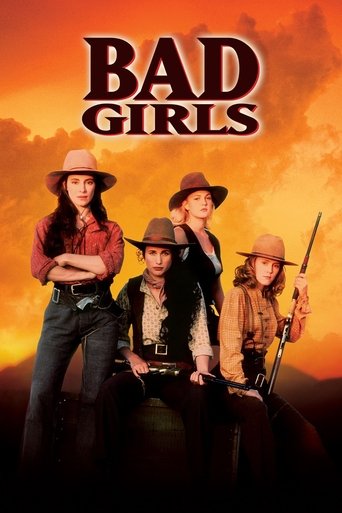
Bad Girls
1994 · Film · 99 min
Directed by Jonathan Kaplan
Four former harlots try to leave the wild west (Colorado, to be exact) and head north to make a better life for themselves. Unfortunately, someone from their past won't let it happen that easily.
1 negativefrom 1 commenter
Where to watch
No streaming data for this title.






3 comments on Hacker News
Paid overtime will fix scheduling. Scheduling is bad because the cost falls on the employees, not the employer. If crunches resulted in time and a half, double time, and triple time, scheduling would get fixed.
As I've pointed out before, film scheduling is an established discipline. Making a movie is much more complex than a software project. There are a lot of moving parts. Things get changed. There are people problems, weather problems, and transportation problems. Most importantly, if a film project goes into crunch mode, everybody starts getting paid overtime. This reduces the tendency to underestimate.
There are also third party estimates. Hollywood has something called "completion bonds". A completion bond is an insurance policy for the investors. Either they get a showable movie into theaters, or the completion bond company has to pay the investors. A completion bond costs about 5% of the cost of the film.
Completion bond companies do their own estimates. Estimation inputs are "script, budget, shooting schedule, (and) résumés of key crew." To survive, they need a net error near zero - they must overestimate and underestimate about equally. Consistent underestimation would put them out of business.
Since they do a lot of this, they have scripts and financial data from previous movies. They can look up "car chase, metropolitan area, 2 minutes screen time" for how much that cost the last 50 times someone did it. They also have director info, like "director X averages 2.5 takes per scene". All this info is collected across multiple film companies.
The completion bond company has the right to intervene if the project starts to go over budget. Worst case, they can fire the director and take over the production. This is rare, but it happens. "Malcolm X" by Spike Lee (1992) and "Bad Girls" are examples. "Malcolm X" was an epic movie, a bit too epic - it runs 3 hours and 22 minutes - and somebody had to say no to Spike Lee. "Bad Girls" (1994) was just a botched production, and the bond company put in their own director to try to salvage something. It still lost money, but did reach theaters.
That a completion bond company can fire the director puts teeth in this system.
This is why film scheduling is a real discipline, while software scheduling is not. Film production is unionized, and overtime costs real money, at least time and a half, often more.
As I've mentioned before, there's something called a "completion bond" in the film industry.[1] A completion bond guarantees third party investors that a completed, releasable film results, or your money back. Completion bond companies will take a shooting script and cost it out, then quote on what the bond will cost. It's usually 3-5% of production cost.
Completion bond companies are thus very good at cost estimation. They keep records on what and who has overrun budgets in the past, and by how much, and adjust their estimates accordingly.
The completion bond company has several options when a film is in trouble. They can put people on set to watch where the money is going. They can put in more money, which is the first thing to be paid back when the film releases. As a last resort, they can fire the director and producer and put their own people in, to get something finished. That's seldom done. "Bad Girls" (1994) is a film where that happened. It's a terrible movie, but they got half the production cost back, which beats zero.
The threat of that happening keeps management in line. Big career setback for a director and producer when that happens.
[1] https://www.eqgroup.com/completion_bond/
Union, Yes!
The film industry has most of the problems of software development and game programming. But because Hollywood is heavily unionized and overtime is paid at 1.5 to 2x normal, film scheduling and budgeting is a well-developed discipline.
Film production has something known as a "completion bond". This is an insurance policy that guarantees to the investors that the film will be completed. The insurance company has the right to fire the director and anybody else and take over the production if it goes significantly over budget. The result may not be great, but you will get a movie.
"Bad Girls", a 1994 Western [1] is an example of a movie where the insurance company stepped in and took over. They put in a new director, who spent a day looking over the production and talked to everyone. She then sent the camera and lighting crew back to Hollywood, told the set builders to finish the two sets they nearly had finished and forget the others, put the stunt director on teaching the lead actresses some horse riding tricks, told the costume directors to come up with some bad-girl riding outfits, and then went off with the writers to hammer together a script that used those components. In a few weeks, they had a movie. Not a great one, but one that made back $15 million, which is a lot better than zero.
That's how you beat the crunch problem. Underestimation in the film industry applies great pain to management, not the employees.
[1] http://en.wikipedia.org/wiki/Bad_Girls_%281994_film%29