 Hacker Cinema
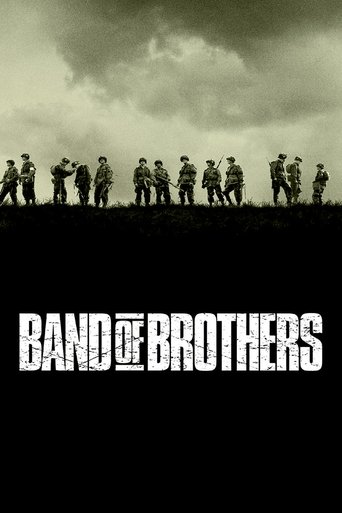
Band of Brothers
2001 · TV series · 1 season
Drawn from interviews with survivors of Easy Company, as well as their journals and letters, Band of Brothers chronicles the experiences of these men from paratrooper training in Georgia through the end of the war. As an elite rifle company parachuting into Normandy early on D-Day morning, participants in the Battle of the Bulge, and witness to the horrors of war, the men of Easy knew extraordinary bravery and extraordinary fear - and became the stuff of legend. Based on Stephen E. Ambrose's acclaimed book of the same name.
22 positive2 negative2 mixed18 neutralfrom 44 commenters
Where to watch
No streaming data for this title.
46 comments on Hacker News
“My point is that it's not very obvious what it is unless you are super studied in Nazi symbology”
Or if you ever played a WWII themed video game (Wolfenstein, Call of Duty), or if you’ve ever watched a WWII show like Band of Brothers or watched a major WWII movie like Schindlers List or Saving Private Ryan. I could go on, it’s prominent in nearly any WWII media.
Honestly, I don’t know if people toting the line saying it’s “obscure” are intentionally lying because he aligns with their political agenda or are completely oblivious to any level of detail in any media.
It’s really astonishing.
If you are not awake, you are asleep. American Cinema has been all for defeating nazis since before the war ended. Band of Brothers, Saving Private Ryan, https://en.wikipedia.org/wiki/Inglourious_Basterds
All we have seen so far is white kids shooting people in red states.
Is DHH trying to legitimize a stance that fascists are some how good?
I am no fan of Jimmy's show but this seems out of line. My tinfoil hat thinks this might be a way for Sinclair to "justly" remove a show that has been loosing ratings by riding the popular wave and saving some face.
According to sites like https://televisionstats.com/s/jimmy-kimmel-live he wasn't even in the top 500 TV shows
Band of Brothers a show from 24 years ago still gets more viewers that Jimmy get's now.
Our kids, both teens, are beloved by everyone they meet. I'm not exaggerating.
Our oldest, our daughter, has had a few jobs working in her craftland, and both loved it and was loved by her fellow employees and customers.
Our son is an open chess champion who is beloved by his chess club compariots. When he played out of his mind and won the open tournament, the cool part was that his chess club mates were really happy that he won, and a parent of one of his friends excitedly told me how happy they were. Even thought his son was much younger, my son's friendliness and kindness really endeared him to that young Indian boy.
The question is, "Why?"
First off, we're not particularly religious at home. We sometimes pray before meals, but we tend to eat when we're hungry, i.e. not all together, always. We rarely pray together because I feel strongly that religion is a personal affair. I also do not pray in front of them, to prevent putting any kind of pressure on them towards my preference. We Sufis feel there is no superiority in one form of religion over others, and I manifest that most deeply by letting them know that their path is theirs to choose. I'm only here to love them and teach them how to be lovingly kind and respectful to others.
Second, and probably most importantly: they have never had unfettered access to the Internet and we have no TV of any kind, and they do not have or use smartphones or social media of any kind (except our daughter is a good navigator in the car).
We did have Hulu for a minute, but mainly for the powerful "Summer of Soul". We have also watched some Tubi for, for example, "Death on the Nile" and a few select others. And the old Jeremy Brett Sherlock Holmes series are a mainstay, as well as a few select movies, such as the Avengers series and "Knives Out", but it is very minimal, nothing too sexy, and nothing at all too violent.
And ZERO internet or social media. Sure, we might look some stuff up, we watch some stuff like Tosh Show (after I pre-screen it), but stuff more like Veritasium (that they love), and some random YT videos we find interesing. Plus, we watch a fair bit of NHKOnline for Design Stories, 72 Hours, and, of course, Grand Sumo Highlights (just for how entirely foreign and intense that sport is) for maybe a decade now. They have their favorite EPL and Serie A teams, plus Champion's League, as they like to knock the ball around at the park. My son and I follow the NBA through a few pods (while he chesses online on his computer, which is in the living room with this one, our "media computer") and the occasional highlight.
My point here is that I keep their media appetites satiated with interesting, curated content, but they're spared the titilating fiction that I grew up on. The only horror movie they've seen (multiple times) is Jordan Peele's fantastic "Nope". But absolutely no gratuitous sex stuff, whatsoever, not that we don't have the occasional conversation about such stuff. And we watch a bit of comedy, with three of Tom Papa's stand-up specials on Tubi being a big recent hit.
The important thing is that we human beings have a part of us that gravitates towards the lewd and lascivious, and our media is naturally permeated with it, and they just don't need it, and my approach has worked. They help the family around the house because they understand that they're valuable parts of the team and that doing good work is good for everyone. And when they do catch wind of something gross (usually said by a comedian), they appreciate that we'll talk about it but that we screen off that part of the world for them.
I was exposed to porn at a young age (6th grade recycling dumpster "Oui" magazines) and then Playboy Channel and HBO in my early teens. No teenager needs Animal House or Porky's in their lives. Being homeschooled (our daughter's choice because middle school orientation was brutal, and our son to play more chess), they're also not socialized by kids with smartphones who watch "Game of Thrones" rapescenes and whatnot.
My daughter has listened to and/or read half of my favorite author William Gibson's novels, plus Anna Karenina and lots and lots of other literature plus Langston Hughes' own poetry collection plus the biographies of some famous women. We all together listened to 2018ish's Pullitzer Prize-winning 900pg biography of Frederick Douglass (5-6 hours/day for 2-3 weeks, weekends off), so they know how brutal America is to Black folks, and how talented and capable they are. And my son and I have listened to Stephen E. Ambrose's "D-Day" and "Citizen Soldier" multiple times, and we all love his book and Tom Hanks' miniseries "Band of Brothers". My son and I have also listened to a lot of the excellent podcast "Fall of Civilizations".
They understand the importance of love and they know enough of history to understand how brutal most of this world has been and still is, to some extent. We watched Jan6's debacle unfold live on CNN's live website, to our shared horror. That this orange bastard pardoned those fuckers is truly evil, and my kids understand that full-well. We hold no ethnic animus, or consider ourselves superior in any way to others, except perhaps in our worldview that centers on universal compassion, kindness, and mutual respect.
They have NEVER -- and I mean NEVER -- had an ill word said against them by anyone, ever, and that's no exaggeration. A teacher of our daughter's cried on their last day when she pulled me aside to tell me how much she will miss our daughter, and our son was chosen to be in the 4th grade class that spent part of the day mainstreaming ASD kids; he was chosen for his kindness. We love and care for each other, without even having to ask. We enjoy hanging out and we laugh a LOT, with each other, at each other, and, most importantly, at ourselves.
So, when I say that nothing in the universe is more important than we human beings choosing compassion, for one and all, I mean it, and I have the fucking proof. And when I say we're living in a world full of purblind fools who are destroying this world with their ignorant selfishness, I know what I'm talking about.
Wake up to compassion, my friends. Both your and our collective happiness is at stake.
"There's still time to change the road you're on." --Stairway to Heaven
And I've always sworn around the kids and let them swear freely (but only in the house), because that's the only way to learn the difference between profane and vulgar. Fucking is a very useful word, so long as it's not the verb form, but even that rule was broken when, at the end of Bale's Batman trilogy, Ras al Ghoul's daugher betrays him, after having slept with him, my wife asked why she did both those things, our daughter replied,
"She fucked him before she fucked him."
I couldn't be prouder that she both understands that truth and knows enough to not say it in public.
To me the Alpha Mentality is just stupidity in another Yes-Man form.
Seems you hold the alpha mentality deeply and respect those you seem as alpha. By your own logic, cult leaders are alpha and should be respected.
Respect can only be earned, continuously reinforced, and lost in a single moment. Respect cannot be demanded or forcefully requested.
Watch the first episode of "Band of Brothers". Who would you want as a leader, the alpha, one with power, Captain Herbert Sobel or 2nd Lutenaint Richard Winters, the one without power?
Well, what I call poverty is merely the American technical definition for the term; it bears no resemblance to what most other countries of the world would call poverty, e.g. the favelas of Brasil, most of Africa, etc. As such, we have EBT (formerly called Food Stamps) that we use to pay for some food each month; as well, we live in a subsidized apartment so our three-bedroom is below market rate, though in a polluted area of the city (via both nearby traffic and nearby commercial businesses), where most children haven't had the quality of diet and environment we take care to provide for ours. My education, predilection towards curiosity about scitech and better-living, and luck of good schooling (G&T with an AppleII in 6th grade) via large 80s defense budgets has also provided me with a lifetime of education (via internet since 1988 with no TV) such that I used our pandemic stimulus money to buy two $600 RabbitAir high-quality air purifiers (they are fantastic!) and some plants. That's just one example, though an important one.
What I can say is that creation has provided what we needed, first through my previous life as a successful programmer, but since, through my wife's love for and excellence in cooking, while I am an attentive home-schooler (it is easy in our state; an unexpected and rare benefit of fundamentalist thinking) and home IT specialist, keeping the education and fun flowing, but in simple but meaningful dimensions. Plus, we take the kids to wonderful parks where good air and nature can be found. Most importantly, we have taught them how to be appreciative for the life and perspective we have. We are not particularly religious at home (I mostly keep my practices to myself, as I am loath put any kind of pressure on them in that dimension), except in my making sure to point out where compassion provides great outcomes and ignorance of compassion causes unhappiness both in the small and large. My wife and I have demonstrated generosity to strangers and the teaching has really taken with both the now-teenagers, who are beloved by their peer groups for their kindness, talent, intelligence and humor.
Don Juan (Carlos Castaneda's teacher) says that, in life, what we choose to NOT do is the dominant factor, which I have found to be true, through both experience and written wisdom. As such, the kids have been taught the perils of common negative behaviors, such as: alcohol and other drugs, sexual promiscuity, being belligerent to others, being ignorant of the truth of karma, compassion, and truth.
As Sufis, we do not espouse the superiority of any form of religion, nor do we speak ill of those who have not embraced religion in their lives. The only measure of a person is how they treat others, and we are not to treat them poorly even in that event, though we may have to intervene to prevent harm to innocents. We have not had to do that in our American lives, thankfully, but a study of history has impressed the reality of oppression (and necessity of countervaling compassion) upon them. This included studying the life of Frederick Douglass (we listened to the entire free audiobook for the 900pg 2019 Pulitzer Prize-winning biography together for 5-6hrs/day 5-6days/wk over perhaps three weeks), and we boys have listened to Stephen E. Ambrose's two WWII books, D-Day and Citizen Soldier, multiple times (as my son played chess, and daughter worked on her skills in various crafts, especially sewing full poofy-sleeve dresses and shirts and skirts as well as amigurumi (cultural inheritances of my wife's non-American culture, tho I have crafty Aunts)). They both love the Band of Brothers book and miniseries, and we have together listened to both The Hobbit and Lord of the Rings books in full multiple times, as well as the latter five books of my favorite author William Gibson, whose works are filled with heart and enough rock'n'roll grit to convey that regular people have sex, are sometimes trans, are sometimes gay, and are completely human while being both imperfect yet good people, worthy of respect, no better or worse than us.
All this is to say that we have encouraged their own interests and creativity by providing lots of legos (we have the Unimog!), books, art materials, and shown lots of interesting videos from Uncle Dave (Attenborough) (thanks 2010ish bittorrent documentary sites) as well as Veritasium and lots of NHKOnline (Design Talks Plus, now called Design Stories). We also watch Futbol (soccer) highlights, Sumo (such a different culture), and Judo (for its badassery and fundamental respect). What is important here is that they don't have their own internet-connected devices, but have access to them in our living room, where I live and exist. My son plays online chess and loves his chess club and tournaments. They both have used study.com and Khan Academy for their academic requirements, so they are not without internet access, but only in the service of curiosity and learning and fun, under our loving gaze.
My only hard and fast rule here is that there can be no bickering, and there truly is none, because we respect each other and truly care for each other. The key is that the true value of compassion at home is to take it out into the world every chance we get. They know that we love and serve them, rarely ask them to serve us, and that when we ask them to serve the family (by, for example, my son being in charge of doing the dishes), we do so only because someone needs to do it, and that it's only for the good of the family. Gratefulness is a antidote to our complaining human nature.
All of this (long-winded, I know) is to say that how one serves one's family is the root and trunk of inculcating compassion into one's society because they will take those values/virtues into it, while educating them about the perils of acting on one's vicious (vice-tending, as opposed to virtuous) and selfish tendencies. History and current events, when portrayed in the honest light of virtue/vice evaluation, is an excellent means of educating the entire society, firstly via our two new members. Our daughter's new ability to vote in this coming election is a fruit of our tireless labors.
We have also demonstrated to them a loving husband-wife combination, where we have occasionally argued, and where we rule together by consensus, such is the nature of marriage, where apology and positive self-evolution is required for every person's personal growth and the success of the community, and having a leader who values the opinions of everyone while recommending but not commanding the best course of action is also IMO the best model of society. We should each do the best thing because it's what is best for everyone -- at least we should try, that is.
My wife and I decided to have children to honor the wisdom teachings of universal compassion and service to humanity, to end all suffering and serve the true happiness of everyone, in truth and kindness. We have been very successful, though certainly not perfect and yet also certainly absolutely uncommon in America, or anywhere as far as I can see. This has largely been due to my ability to be a stay-at-home dad of creative bent, not sequestered by myself in some bedroom on a Zoom call or walling myself off. It is kindof a sacrifice, but I've not been very money-oriented in my life, and, though I have been able to earn a good living from being a badass programmer at times early in our marriage, my inability to prioritize money over human beings not only kept me out of the manager-class, but put me in direct confrontation with those souless bastards and their entire intent and modus operandi.
I'll address the rest of your comment in a separate reply. I need a break and this one is loooong-winded already ;-)
My take is that Saving Private Ryan is "pro-war" movie like most Hollywood productions on the topic and not about 2WW really.
The give away is how the save Ryan squad seem to have agency and do like cool self-govern manouvers, like the storming of the 80mm AA gun hill, etc. More like a teenage boy fantasy. Band of Brothers is another good example of cool agency.
The opening assualt on the beach is some sort of low point for things to get better and under the protagonists' control.
A true to history version would be soldiers getting shrapnel wounds from indirect fire and being shot at by soldiers they can't see. Then they redo it somewhere else becouse someone said so.
I recently rewatched Band of Brothers and this scene hit me really hard (starting at about 1:50):
https://www.youtube.com/watch?v=Y43-p3xLDyo
This is from the final episode of the series. Easy Company have fought their way from Normandy to Germany, losing hundreds of their friends and brothers in battle after brutal battle. Now the Nazis have surrendered and they finally have some respite - but their celebrations are shortlived. Their commanding officer informs them that they're to be redeployed to the Pacific. The war isn't over, and the expression on Malarkey's face at 2:09 says it all.
Whatever anyone says about the atomic bombings, I bet those men were damn happy to hear about Japan's surrender. Imagine if they'd been sent to invade Japan, in another brutal campaign that would have taken months if not years, costing hundreds of thousands more Allied lives.
Then imagine telling them that the government had secretly developed a powerful new weapon that could have ended the war earlier and avoided all this bloodshed - but they hadn't used it because they were worried about the moral implications. I don't think they'd have agreed it was the right choice.
Reminiscent of the scene in one of the later episodes of Band of Brothers: In the last weeks of the European war, Major Dick Winters is ordered to send a patrol to cross the Rhine, in rubber boats, during the night — for the second night in a row. The patrol's quite-dangerous mission would be a repeat of what the same soldiers had done the previous night: to capture German prisoners and bring them back for interrogation. Winters concludes that the repeat mission would be a pointless risk of his men's lives. So he disobeys his orders: he tells his people to get a good night's sleep and report to him in the morning that they did the repeat mission but were unable to find any additional German soldiers to capture. Winters's soldiers were visibly relieved.
companies are wary of bringing in an EM for a team (prefer to promote within the ranks, in my experience)
In Band of Brothers TV series there is a plot line where an NCO is promoted to be an officer. Soon after he is moved to a different unit because the Army has a policy to distance such promotions from their organic units.
And they're going from binge-watching ad-free episode of an entire series, to releasing one episode a week... with adverts.
Yeah, no thanks. I'll just VPN+torrent the ad-free version and watch that, thanks. On any device of my choosing as well.
And why should I pay £8.99 or whatever to one streaming service, for one programme, that was previously "free to air" for the other series? Paramount taking back Star Trek from Netflix for example.
I'm not sure how many multi-million dollar, unseen cancelled-after-one-season dramas with 50,000 viewers these studios need to create before they realise 'we need viewers to 'build a franchise' and make a profit'.
Just imagine if these series or dramas were only seen by a few thousand people at most: Star Trek, Battlestar Galactica, Band of Brothers, Shogun, Dallas, Cheers and so on. Even How I Met Your Mother and Big Bang Theory were pretty much pre-streaming when they started, but syndicated to world-wide terrestrial channels.
For me the sweet spot has always been miniseries like band of brothers, where it’s basically an 8-12 hour long movie.
This seems to be the case with virtually any profession. You have to just learn to live with it, mostly, maybe even laugh at it. It was damn near a pasttime when I was still in the Army to make fun of how the military is portrayed in film and television. Basic as fuck shit like almost no one even has a haircut that meets regulations. It also makes you doubly appreciate when someone gets it right. We all loved Band of Brothers for that. At least the first season of Mr. Robot stands out in light of so many ridiculous and shitty "hacker" portrayals. Having worked on classified projects is even worse. After working for the NRO for years, scenes of people willy-nilly taking over satellites are so silly you just have to take it as part of the way that fictional universe works, clearly unlike the real universe. The Mission Impossible movies are still pretty entertaining in spite of it.
Honestly, probably the worst thing I can recall is the first season of The Walking Dead when Rick hides inside of a tank turret. I was a tank commander back in my time. Do television writers really think there is that much space inside the turret?
"Look at you! You have horses. What were you thinking?"
https://youtu.be/LyZK8k4gzyg
There's a great scene at the end of the Band of Brothers miniseries where the victorious American soldiers drive their trucks past a column of surrendered Germans with horse drawn wagons. We're fortunate that the Nazis never quite got the hang of industrial scale assembly line mass production.
Really depends on the context of the scene.
Since I've been exposed to violent movies (and shows, and videogames) for 25+ years, I can neither remember nor imagine how it feels for someone seeing murder on TV for the first time, but for as long as I can remember, it's been the case that a similar-looking scene could feel cheesy, boring, neutral, or emotionally devastating, depending on the story, setting, tone and other contextual elements. For example, scenes from Saving Private Ryan or The Band of Brothers are still burned into my mind, having both moved and disturbed me greatly as a teenager - while plenty of other movies featured similar ones, and watching them I'd just yawn.
In particular, no, most people don't care about the accuracy of medieval pigs. In general though, realism is often important for its consistency and for the ability to link the game to outside resources.
A lot of writers, artists, worldbuilders, etc like to incorporate realism into their creations, but in my opinion the more important part is having consistent systems, and realism is just used as a shortcut to consistency. Obviously a fantasy story with dragons isn't realistic, nor is a sci-fi story with superluminal starships. But what good media does is ensure that what it shows is consistent, that there's no magic or technology that would break the system or create a plot hole, and that in general what you see on the screen or read on the page is the natural result of background systems. Like, the article says that mature male pigs were rarely found in pens in the village; this is the result of the background system of how pigs are farmed. If you're watching a movie or playing a game and see a pigpen in a village and it only has sows and piglets (assuming you can somehow tell male and female pigs apart), then that hints that the creator knows about those background systems and takes them into account in their works.
The second reason that realism is values, especially in games, is that it means that you can use your existing knowledge of real systems in game, and similarly use your game knowledge to better understand real systems. For example, I play a game called Hell Let Loose, a WWII multiplayer shooter whose maps are created with period maps and aerial footage. Going into the game for the first time, I may not know how the game plays or what its specific mechanics are, but I know that, for example, Pavlov's House is going to be a great defensive position. Similarly, when I watch a WWII documentary or show like Band of Brothers, I can see where they're fighting and recognize the location from my experience on the Normandy maps, and think about how difficult it is to take those objectives in the game. Of course, the game is a game, its systems aren't directly transferable to real life, and playing a game isn't nearly as difficult as real life would be, but because the core of the game system and the real system are the same, the game helps me better appreciate what the real soldiers went through.
In my opinion, people fundamentally like making connections between things they know. Novelty is appreciated as a way to form new connections. If people can look at a piece of media and make connections to it, they'll enjoy it more. Similarly, if people can look at a piece of media and make connections within that media, making predictions as to what's going to happen, or connecting the actions of two characters when the media doesn't make an explicit connection, then they'll enjoy it more as well. These connections are facilitated by consistency and accurately following the rules of the systems in play. If the show is realistic, then people have an intuitive better understanding of those systems and can make more connections, increasing their enjoyment of the piece. Realism isn't required, but it offers more potential connections and helps ensure the background systems are being followed.
I don't know. 465 million seems still steep for 8 episodes TV show. I am all for it cause Disney has seemingly skimped on their CG budget for their newer shows. So more competition means more TV shows will have film quality production.
But it is a concern, if their show costs more than something like Avengers: Endgame which had some of the biggest actors in Hollywood involved in addition to the probably insane VFX budget.
Obviously COVID would have affected the budget for the show, but I have a feeling that it went way over budget than was initially intended.
Although I agree with the marquee concept. HBO had their own marquee show: Game of Thrones, though it produced a lot of quality stuff like the Pacific, Band of Brothers, Sopranos etc that can be watched for years to come. Game of Thrones on the other hand was a big disappointment for the fans and its negative reception probably made HBO wonder what they would do after it was over (hence the Targaryen origin show and the Jon Snow series are being developed... personally I'm skipping both)
The common view in the US is distorted because as the cold war developed people were shown a lot of propaganda lionizing the US's victory and distracting from things like the firebombing. When you talk to more serious people in the US there's awareness of the point you're making, you just won't find it in Hollywood's movie version of things anytime soon.
A similar issue is how Band of Brothers, an otherwise excellent show, re-enforced the idea that D Day happened to stop the holocaust. Those who've read a bit more history however know it was to stop the soviets from marching all the way to Portugal, and that the US and allies declined to take even simple measures like bombing the railway lines to the death camps to fight the holocaust. In particular the treatment of holocaust survivors like a game of hot potato afterwards makes clear what the priorities actually were.
There are many military movies. Band of Brothers (technically a mini series). Has examples of good and poor leadership as well as slightly different styles.
There are many sports movies too. The movie Greater shows how one can become a leader by inspiring their peers and persevering.
I can't think of that many business movies. There have been a couple movies about Steve Job. He was successful, but I'm not sure I'd call him a good leader.
The OODA loop was invented by Col. John Boyd during the Vietnam War and is being adapted here for the business environment.
The point is for some hard decisions, you will have to act on imperfect or incomplete information. A good leader will make a decision, because doing nothing and hoping you get more info will in fact be worse than making the wrong decision. As you get more information, you can then alter or tailor your decision. This is especially true in a military environment.
For an example in a popular movie, look at 1st Lieutenant Norman S. Dike Jr. in Band of Brothers.
This assumes the Disney back-catalog strategy makes sense in the digital age.
Pre-VHS, Disney would re-release movies in theaters. They could re-release Fantasia, or Cinderella, or whatever, and still make money in theaters in the 1970s.
But, there wasn't that much content to watch at that time. You had live TV or movies. That was it.
Today there is more on-demand content out there than I could watch if I lived a million years. Do you think "Bright" will keep subscribers 10 years from now for Netflix?
Just as an example: "Band of Brothers" and "The Wire" are two of the best things I've ever watched. Would I _keep_ an HBO subscription forever after I've watched them? No...
Most of the Apple TV+ shows announced so far have TV-MA ratings [1]. They're also making the follow-up miniseries to Band of Brothers and The Pacific which will undoubtedly be violent [2].
[1] https://tv.apple.com/
[2] https://www.hollywoodreporter.com/live-feed/apple-launches-house-studio-band-brothers-pacific-follow-up-1246746
I would like to second the tv series Generation Kill. Brilliant show. Really highlights a lot of the ridiculousness of war. Not as serious nor on the same scale as Band of Brothers, but still good nonetheless.
Eh, I'm not sure Band of Brothers holds up as well as you might think. It's really strong in episodes 2 through 6, where the core characters are all together from Normandy to Market Garden to Bastogne. But after that those core characters disperse, either by getting promoted or becoming casualties, and then from there the series just kind of fizzles out; for better or worse, in those early episodes Winters is the de facto protagonist, and once he departs the show never really manages to find another one.
The later sequel The Pacific suffered from the same problem of not having a stable, interesting point-of-view character for the audience to attach themselves to, only unlike Band which starts with one and then discards him The Pacific lacks one throughout.
I enjoyed it quite a bit, but I think w.r.t. HBO miniseries Band of Brothers is better.
Its good, but I think its easier to be good for 6 episodes than it is for multiple seasons. Even if you disregard that- Is it better than Band of Brothers?
There are different types of leadership, which get confused or conflated when talking about promotions and organizations. There are people who lead by being exemplars. Such people might contribute greatly to the organization, yet have minimal management skills.
Then again, this also applies to different kinds of management. There are many different kinds and styles of management, which are differently suited to different situations. My wife and I often talk about her managing the "A students" versus the "B students" versus the "C and D students." Note that this is relative. If an organization is pushing into new and difficult terrain, some completely independent A students might become more like B students in the new context. Some "C and D students" might start to thrive in a far messier context. Think of the change of context between training camp, versus combat deployment in Band of Brothers and Hacksaw Ridge. In both of those shows/movies, the people who thrived and contributed the most in one context were very different than in the other context.
I agree with you, outside of a few productions the vast majority of netflix content isn't good. Black Mirror, Stranger Things, the new movie the Ballad of Buster Scruggs... I can't think of anything else I like from them.
Amazon has the same problem, both Amazon and Netflix seem to pump out tv shows without putting that much work into them going for quantity over quality. First Amazon show I actually enjoyed was the Jack Ryan tv show. Sneaky Pete was good for the first few episodes but it just seems to fizzle out.
In contrast, almost everything on HBO is good. I rewatched Band of Brothers for I think the 3rd time the other week and I enjoyed it just as much as I had the first time I had seen it.
Yep, that's all you true. I loved Band of Brothers and The Pacific. These days we watch a lot of old movies on films truck/criterion collection and mubi which sometimes even partners with festivals to bring their movies to steaming. I do miss going to the cinema more often though, especially during summer days that are too hot to do anything outside.
It seems like you like good films from auteurs - Dunkirk (Christopher Nolan), Isle of Dogs (Wes Anderson).
The great thing about films like that is that if they do age, they age very well, and there are hundreds of films by auteurs you'd probably enjoy.
AFI Top 100 movies, the Criterion collection, or just going through a director's previous films.
If you liked Dunkirk, have you seen the Band of Brothers TV series?
I highly recommend checking out a film festival if you like seeing original films. Most film festivals only show movies that have yet to be public. There are hundreds of movies a year that are shown at film festivals and never seen again.
A careful analysis of Beethoven's later works shows him to be a worthy contender.
In particular, the Große Fugue [0] and the Op. 106 Hammerklavier sonata [1] (ironically so nicknamed, because at Op. 101, Beethoven directed that all sonatas from that time on be named Große Sonate für das Hammerklavier, and the nickname only stuck to this) show a profoundly advanced sense of counterpoint and structure. In addition to applying all of the classical transformations to motifs (including augmentation, diminution, cancrizans, canons and sequences), he even performs note for note reversals in time. (A temporal cancrizan, if you will.) [Edit: it would be a crime to fail to mention the late string quartets, which show prescience of modernism and are considered to be the pinnacle of chamber music. Many of you will at least be familiar with the Op. 131 c# minor quartet, which Wagner called the "saddest music ever penned" and whose 6th movement was used in the Band of Brothers episode "Why We Fight".]
Similarly, Brahms' masterful applications of form and counterpoint put most other composers to shame. Rather than be as enormously prolific as Bach, the quality of his output is more consistently excellent. (No doubt partially due to his penchant for burning the manuscripts which he felt were subpar.)
I think it's a little unfair to put Bach on this pedestal. There's plenty of music by any composer mentioned to relax to or feel stimulated by. Additionally, Bach's musical temperaments are somewhat limited by his media and styles. He is the master of his craft, but his craft has limited scope.
Yes, Bach has his own, unique, immovable place. But Beethoven, Brahms, and many other composers have immutable, unchallenged championships in their own arenas.
[P.S. Please mark this with a [2014] tag to denote when it was published.]
[0]: https://en.wikipedia.org/wiki/Gro%C3%9Fe_Fuge
[1]: https://en.wikipedia.org/wiki/Piano_Sonata_No._29_(Beethoven)
I would pay $10 a month to watch Game of Thrones, House of Cards, or other high production value TV shows on a big screen with other fans each week. I might even pay $20 or $30 a month for just those few months of new episodes for the latest season.
I would even pay $10 a month for a few months to watch an episode of Band of Brothers each week. I really enjoy the movie theater viewing experience. Lately I've only gone to the theatre to see the new Star Wars or Pixar films (only because I am a fan of those two franchises). Nothing else that is being released interests me.
I'm aware that some theatres book corporate trainings or private showings. I don't think it would be unreasonable for them to air new episodes of top television shows on the night of. It would be interesting to see what demand for that would look like.
Wiki has some information about it: https://en.wikipedia.org/wiki/Conversion_disorder
It was a plot point in one of the "Band Of Brothers" episodes.
Indeed.
I also watched Saving Private Ryan and Band of Brothers somewhen around 13 and those movies deeply touched me. Yes, I was pretty much crying and trying not to vomit on the D-Day scene, but it left me with deep impression about horrors of war, something that school never gives you. I didn't become more violent because of that - on the contrary, it reinforced my wish for peace and compassion for people living in places trapped in war.
I love the UI and the results! I'd just say that I have two concerns; while the click-to-add nature of the genre list is great, I don't think it's immediately intuitive. Perhaps I'm just part of the old "if you click a link it takes you to a page" demographic, but clicking to add or subtract -- while in my opinion the right mechanic here -- isn't immediately obvious. Making it more clear how this works could save you some traffic by avoiding requests from people who don't immediately understand how the UI works.
The second thing is that, on browsing movies "from Japan," I immediately get Band of Brothers, Kill Bill, Lost in Translation, The Last Samurai, and the latest American reboot of Godzilla. If it's intended to show movies set in a particular country, that's potentially a really cool gimmick, but as it is it seems inaccurate.
Love the site, though! Great work!
Correct. 93% of German casualties were inflicted by the Red Army[1]. Operation Overlord was part of a 'blood debt' that Stalin felt western allied leaders owed him. The Russians would've likely taken Berlin eventually without the western allies opening up the western front, despite what Band of Brothers etc. might tell you.
[1] see footnote three- http://www.americanpopularculture.com/archive/film/wayne.htm
Great idea, I just have one question, how will you make money? You have a great idea which I could use, and I'd hate to see it go away...
As an English teacher (9 years experience) from an IT background (25 odd years, but not all of it active), here are a couple of ideas I thought you might like to look at:
1: Hook it up to a lesson planning system. I use videos a lot in my classes, and also try to set them for homework. Currently I use TED.com, as their older videos have full text transcripts available (the feature where you can click on a word and it takes you directly to the point in the video they say it is priceless), as well as subtitles in various languages. Think of a way a teacher could set up a simple worksheet (PDF or online) for students to use with the video. This worksheet could include pre-watching questions, including pre-teaching of difficult language that may come up in the video, and then some language activities to do after watching to reinforce anything they learn. Bonus points if you could hook this into an online learning platform such as moodle so that it would integrate with a language course. Set up social sharing in two areas, one for teachers to share lesson ideas based on vids, and one for students watching the vids and you basically could make your own video learning platform. English teachers have no money and are pretty badly paid, (I make my extra cash consulting, but I just love teaching) so you can't target teachers directly, but, make it free for individuals, build evangelists among them, then target schools and universities with extra features such as participation reporting, gradebooks, enhanced cryptographic security (the EU has pretty tough Data protection laws), institution branding and so on.
2: Integrate it with Hulu or Netflix, and make it a value add for both sides. Hulu or Netflix can add an extra "learn with us" feature, and people could choose to add it to certain shows either on an episode by episode basis or for whole seasons. Again add options for social integration, and, if you do point 1 from above, have 'featured' teachers who make lessons based on your platform and also get a cut of the pie. Conversely you could speak to rights holders and negotiate with them directly (e.g. I see a lot of people on this thread talking about "Friends", so more popular shows could garner higher rates for learning from them)
3: Building on points 1 and 2 above: segment your market - shows with legal or business vocabulary could charge more. Military shows (band of brothers etc) could be marketed to NATO etc, etc. Along with social you could integrate gamification, which I think would work well in this kind of situation, with the added benefit that you could work with language examining bodies to match your 'badges' with real world targets of language learning. Although good luck working with those arrogant assholes from Cambridge :)
4: No clear money with this idea, this is just for cool factor- do something similar to hiphop genius and crowd source language interpretations and meanings. They figured out how to get funding, so can you. (This actually would be really cool, as I can see linguists arguing with people who actually use the language :)
So I am an 'idea guy' and this doesn't fly on HN. But this time I feel that I finally have enough domain expertise to comment, and I am actually trying to implement some of these ideas at the moment, I just don't have the tech chops (or hardware to be honest) to deal with working with video on this scale. But I am working on language points (I have an idea about your 'secret sauce', but don't worry, your secret is safe with me Batman ;) as I am in the midst of running an online language course for an EU project at the moment and creating all the materials from scratch, by hand, and it is a pain!
I would love to chat with you guys if you are serious about making money from this, my email is in my profile (it's basically my HN username @ gmail). Meanwhile, I have over a hundred students who I need to email with a link to your site and I need to figure out how I can integrate your work with my axe (I mean my teaching :)
Saving Private Ryan. It's the first time I had any kind of idea as to the suffering these people went through to give us our freedom. I know it is a film, and it is dramatized, but you watch that and it will give you some sense as to what it must have been like that. After watching that, and then Band of Brothers, the famous phrase "For Their Tomorrow, We Gave Our Today" made a lot more sense to me.
Only to a limited degree. Yes, there were soaps and other serials that had long-running narrative arcs, but not with the kind of sophistication contemporary writers are using.
Let's call it the 'Post-Buffy' school of thought, where character nuance, motivation, back-story, plot and sub-plot are all delivered with a kind of attention to detail formerly only used by novelists. There may be a few examples from the 60's -- The Prisoner comes to mind -- but even that can't really touch the narrative layers we've seen in the last decade: The Wire, Lost, Mad Men, Breaking Bad, Battlestar Galactica, Game of Thrones (TV as novel if there ever was one), Six Feet Under, Dexter, Band of Brothers, and so forth. These aren't just books, they're novels.
This I think is partially the result of the ability of viewers to sit down and spend concentrated time with a series when they come out on DVD. The first time my wife and I did this was maybe 10 years ago with Buffy and Angel, and it was the most fun I'd ever had with television. This was a new experience. We'd lose 4 or 5 hours late on a Friday just chaining one after another, like the Battlestar Galactica skit on Portlandia.
What I think Netflix is doing, and probably what it has massive amounts of data to back up (I watched Buffy through Netflix, come to think of it), is that this new type of viewer engagement -- long sessions of series "gorging" -- has completely transformed the way we experience television. I think this is why they released the House of Cards episodes all at once. This is also probably why they're not releasing viewing numbers -- the new experience context of contemporary viewers has very little to do with the old Nielsen ratings arc, and would be a poor measure of the show's success, from Netflix' own point of view.
Think about the best military movies you've seen. Do they "dumb down" the technology? In my experience, no.
It's accurately portrayed. At the same time, it's not the center of the story. That is still the human component.
They spent a lot of time/effort in "Saving Private Ryan" getting the sound of the M1 clip ejection right. But nobody ever comments on or explains this in the movie.
Veterans watching the movie said they "got that right".
(I'm not saying that "Saving Private Ryan" doesn't bend reality in some ways for the sake of the story. But they didn't... have Rambo take out a platoon with his bowie knife.)
("Band of Brothers" is another good choice -- the mini-series precursor to "Saving Private Ryan".
Then there are, for example, some of the older, somewhat spartan but impactfully understated British films, whose titles I can't think of right now. It was actually films like these that I was thinking more of, when I started writing this, before those contemporary items came to mind.)
If done properly, such portrayals can convey a quiet, authoritative air that is actually more convincing than some of the "explained"... "exaggeration" and/or simplification that exists in many movies including some big budget production.
Aiding this might be spending some time actually explaining these things, in some depth, to the actors, so that they can portray them with some understanding, rather than simply parroting the script.
Of course, you might have to convince/sell a potential purchaser/producer on this idea, to help the technical content go down.
P.S. I should probably shut up, now.
But, I think there is something to an accurate portrayal that is the richer for not being too self-conscious (on screen).
P.P.S. A few random films, with different topics, where this might apply, that I'm happening to think of upon this unplanned attempt to come up with some relevant examples.
"China Syndrome" (although I'm a bit hesitant, having only seen this with commercials and while somewhat distracted)
"Traffic" -- the older, European mini-series version, from the 1980s
Watch "Eat Drink Man Woman" and see how much of a feel for 90's (upper classs-ish) Taipei you walk away with. (Although, admittedly, as I understand it Ang Lee brings a certain outside or cross-cultural perspective to it from his having spent significant time abroad.)
There are probably many better examples, but that's what my tired mind can dredge up, at the moment. And I think this represents a variety of things where authenticity enhances rather than confuses or degrades.
P.P.P.S. See P.S., above. ;-)
In high school, our history teacher showed parts of 3 episodes of Band of Brothers ("Day of Days", "Bastogne", and "Why We Fight"). It was pretty graphic and awesome. The scene in the holocast camp in "Why We Fight" was pretty disturbing.
She tied it in pretty neatly with our lessons on WWII. The high school was in Wisconsin.
Edit: Forgot about "Why We Fight"
I rarely see a movie more than once. If it's on iTunes or Amazon Video I can rent it for $3-4 (just like a video store, would you imagine that) and see it.
Buying it has two problems:
- I don't want to spend $15-20 on something I'll see only once.
- I want to see it now. A lot of my movie viewing is spontaneous (e.g., "I'm tired and don't want to do anything tonight... what good movies haven't I seen?"), and I'm not a hardcore enough movie buff to maintain a physical backlog of movies I need to see.
- Reselling is a pain. How? Craigslist? For one thing, I'm not sure what the demand is for random obscure DVDs on it, and secondly, that's more time I burn meeting up with a buyer just to get $5 on a DVD.
I will buy physical copies of things that I truly love and intend to see over and over again (e.g., the Band of Brothers box set, or the Firefly box set...)
1. The Killing Fields
http://movies.netflix.com/WiMovie/The-Killing-Fields/671140?trkid=438403#height1457
2. Danny Deckchair
http://movies.netflix.com/Movie/Danny-Deckchair/60033353?trkid=496751#height1554
3. As Far as My Feet Will Carry Me (German film)
http://movies.netflix.com/Movie/As-Far-as-My-Feet-Will-Carry-Me/70068024?trkid=496751#height1848
4. Vitus (another German flick)
http://movies.netflix.com/Movie/Vitus/70068654?trkid=496751#height1509
5. The Diving Bell and the Butterfly (French film)
http://movies.netflix.com/Movie/The-Diving-Bell-and-the-Butterfly/70071610?trkid=496751#height1941
6. Band of Brothers (HBO mini-series)
http://movies.netflix.com/Movie/Band-of-Brothers-Disc-1/60024705?trkid=496751
7. The Pianist
http://movies.netflix.com/Movie/The-Pianist/60025061?trkid=496751#height1522
8. I am David
http://movies.netflix.com/Movie/I-Am-David/60034547?trkid=496751#height1771
TV series like Band of Brothers are not history, strictly speaking. They are fiction.
TV is a bad example. Premium channels have a ton of money from their subscriptions, so they have a ton of money to invest into new programming. Take HBO for example, the Band of Brothers 10 episode series cost $125 million to make. The Pacific miniseries, has a budget of $250 million. Regular channels simply don't have the $$$ to match up. So while HBO has truly epic shows, regular channels are stuck doing cop shows, since they are cheap to make.
News on the other hand is static. The paid services aren't going to report better news. They aren't going to report more news. Nothing will change in how they are run, its just a way for them to start charging for content that is free elsewhere.
I went to public high school in a Western Pennsylvania suburb (two PA Turnpike stops away from Paul Graham's alma mater, which means our suburban strip wasn't quite as good) and in my best social studies class (US History) we watched an unreasonable amount of full length movies, including Band of Brothers in its entirety. We didn't do a whole lot in the class, but at least he told us that Westerners killed all of the Indians. He told us to just read Howard Zinn if we wanted to learn something.