 Hacker Cinema
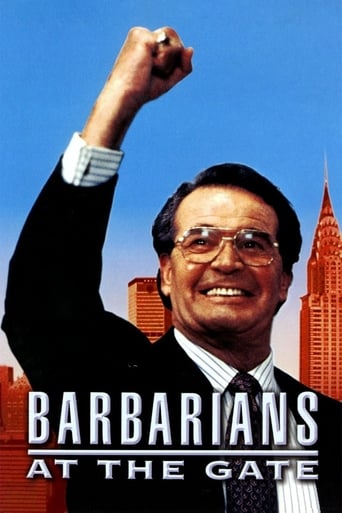
Barbarians at the Gate
1993 · Film · 107 min
Directed by Glenn Jordan
F. Ross Johnson decides to buyout his own tobacco firm RJR Nabisco after the plans of the launch of his new product, a smokeless cigarette Premier, fail on account of market rumours.
6 positive2 neutralfrom 8 commenters
Where to watch
No streaming data for this title.
9 comments on Hacker News
Did you see the HBO movie version of Barbarians at the Gate? I thought it was pretty interesting. You can watch it all on youtube.
https://www.youtube.com/watch?v=ZS4ENJCIYNM
If you are interested in narrative films about leveraged buyouts I recommend Barbarians at the Gate:
https://en.wikipedia.org/wiki/Barbarians_at_the_Gate_(film)#:~:text=It%20tells%20the%20true%20story,and%20CEO%20of%20RJR%20Nabisco.&text=Barbarians%20at%20the%20Gate%20received%20generally%20positive%20reviews%20from%20critics.
I watched this a while ago on YouTube:
https://youtu.be/Z3HiONtjZSM?si=HQPNiA2dBLk4qqeT
It was a made for TV movie about the true story of rjr Nabisco trying to go private through a leveraged buy out because their cigarettes and how everyone everywhere was greedy. It's kind of absurd how greedy and stupid everyone is in the movie.
I mean it’s been a huge thing that people have known about for decades. Romney was one of them. Barbarians at the Gate is a popular book on KKR in particular and was made into a movie.
As to why it’s not illegal... there’s both the realpolitik “who are friends with congresspeople” as well as the wonky “how do you make it illegal? It’s just combining a lot of elements of capitalism”
The way you make it illegal, of course, is preventing stuff like directors being able to get paid big bonuses for buyouts (basically bribes to accept LBOs), by properly classifying such movements as stealing assets from the company
Are you guys not familiar with the "Barbarians at the Gate" story of what happened with KKR & RJR Nabisco in the late 80s?
I highly recommend you watch the movie or read the book if you don't know about it. The movie is excellent.
Knowing that sequence of events, I feel like people should have realized that all of this would happen to Toys R Us.
Barbarians at the Gate is a - surprisingly good - movie about the hostile takeover & leveraged buyout of RJR Nabisco. The events depicted became the poster child for the corporate greed of the 80s.
Buying a company with borrowed funds and using the company's cash flows or assets to repay the loan is known as a Leveraged Buy Out (LBO) [0]. It was very trendy in the 1980s but has recently made a comeback.
A good book to read on one of the most notorious examples of an LBO is Barbarians at the Gate [1][2] which dealt with the takeover of RJR Nabisco, a large American food and tobacco company.
For lighter fare, re-watch the 1990 movie Pretty Woman [3][4] but this time ignore the fluffy romance and focus on Richard Gere's character, Edward Lewis, as he goes about negotiating the LBO of a shipbuilding company. Edward Lewis was modeled on a real-life LBO guy, Reginald Lewis, who bought Beatrice International Foods from Beatrice Companies in 1987 in an LBO worth $985 million [5].
[0] https://en.wikipedia.org/wiki/Leveraged_buy_out
[1] https://en.wikipedia.org/wiki/Barbarians_at_the_Gate:_The_Fall_of_RJR_Nabisco
[2] http://amzn.com/0061655554
[3] https://en.wikipedia.org/wiki/Pretty_Woman
[4] http://www.imdb.com/title/tt0100405/
[5] https://en.wikipedia.org/wiki/Reginald_Lewis
Actually, the premium is usually a multiple of the present value added by the combination of the two companies. Imagine two airlines with many different routes, but a bit of overlap. If they merged, some of those redundant routes could be eliminated, which would reduce the costs and probably increase utilization on the remaining routes, they may also be able to sell the redundant planes and terminal slots. This could potentially represent billions of dollars of value above the sum of the values of the two companies separately.
Think about how you would divide this premium between the target and the acquirer. It's actually pretty simple, imagine the next best possibility for the target. If there are many acquirers, the target should appropriate most of that value, hence, a high premium. If the next best alternative isn't as good, the acquirer should capture value. It follows logically that the optimal rational bid for a company is slightly more than the value added in their second best alternative (as an aside, this is really close to how IPO pricing works). Companies aren't necessarily rational though, so in competitive acquisitions companies frequently pay more than the actual value added. Empirically, acquirers in single-bidder acquisitions typically see price-appreciation of about 2% in event studies, whereas acquirers in multi-bidder acquisitions typically see price drops of about 1.33% in event studies. This indicates that acquirers in single-bidder acquisitions typically appropriate some of the added value, whereas in multi-bidder acquisitions, the target company captures all of the value added (plus some) by the acquisition.
A really interesting example of this was RJR Nabisco in the 80s. The idea was to separate RJ Reynolds, the tobacco company, and Nabisco, the food company. RJR was a cash machine, but they had a huge uncertain liability from tobacco lawsuits that was depressing the value of the entire company; the separated company was worth a lot more than the company was together. It was trading for about $55/share, then KKR structured a LBO to buy it and break it up, and paid $109/share (management initially bid $75/share for a takeover). In that case, there were many bidders, so the vast majority of the value was appropriated by the shareholders (in fact, KKR didn't generate a good return). [1]
In general, the market cap is the best indicator of the true value of a company in it's current configuration. That does not mean there is not some other configuration or combination where the company could be worth a lot more. It's worth mentioning that whenever the market price is incorrect, there is an arbitrage opportunity available to move the price to its true value. HFT is basically designed to capture these opportunities almost instantly, which is exactly what you would expect if markets are efficient.
1: I highly recommend the 1993 HBO movie Barbarians at the Gate, about this LBO.
And Swordfish is a great movie about being a hacker... specifically the common recruiting process.
On a more serious note, I do agree with you. Some decent movies with a office environment/work theme: Boiler Room (2000), Duplicity (2009), Glengarry Glen Ross, Other People's Money (1991), Swimming with Sharks and Wall Street (1987).
I've also enjoyed the dramatized real-life stories in Rogue Trader and Barbarians at The Gate.
I used to work in the finance & investing industry before doing a startup. The slimy, misleading marketing proliferating itself everywhere is absolutely ridiculous. They're even pretentious enough to call their fees and back loaded funds "products".
If you've ever seen the movie Boiler Room, my second finance job was similar. My third finance job had similarities to Barbarians at the Gate (on a much lower scale) and the classic tulip bulb story: http://en.wikipedia.org/wiki/Tulip_mania
Strange world is the finance.