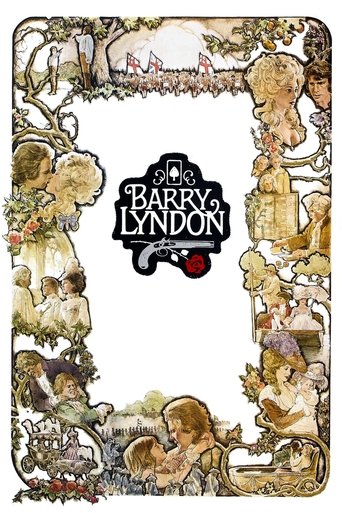
Barry Lyndon
1975 · Film · 188 min
Directed by Stanley Kubrick
An Irish rogue uses his cunning and wit to work his way up the social classes of 18th century England, transforming himself from the humble Redmond Barry into the noble Barry Lyndon.
34 positive5 mixed36 neutralfrom 75 commenters
Where to watch
No streaming data for this title.
88 comments on Hacker News
'Children of Men' is probably the best contemporary example of this - appalling book that informed a piece of cinema that's basically beyond reproach.
The archetype in blockbuster cinema has to be Spielberg's 'Jaws'. I'd also give 'Barry Lyndon' a huge commendation.
Those who contend that 'Starship Troopers' is a better adaptation than the book simply don't understand Heinlein or his aims. A fantastic movie and a darkly cynical piece of social commentary on jingoistic nationalism and 'bootcamp' movies as seen through the lense of a highschool ensemble. The book, however, represents a weightier piece of analysis in its own right and provides some fascinating insights into fascism, civil and civic duty, and the role of the individual in the machine.
I could also go into a long and varied debate about Michael Crichton and Stephen King properties which span both sides of this fence, but that's for another post I feel!
Theatres don't just show new movies. There's something very special about being locked in a dark room with a big screen to watch Alien or Barry Lyndon. Older movies especially look great in a theatre and some of the magic is lost on a smaller screen.
90% of any content is crap but you're missing out if you like movies and you haven't seen Sinners, The Bone Temple, or NOPE (to name a few recent great theatre watches).
The photo nerd hacking tweak of note here was the pushing of the stock to 200 and using uniquely crafted NASA lenses built to photograph the dark side of the moon with not seen before aparture.
Arguably a youtube rending of a compressed digital source viewed on a computer screen falls short of a 1970s full cinema via film live viweing.
Technically it was pushing well past the envelope for the day: https://neiloseman.com/barry-lyndon-the-full-story-of-the-famous-f0-7-lenses/
Thanks! Here's the full list: 2001: A Space Odyssey, 8½, Aguirre the Wrath of God, Ali: Fear Eats the Soul, All That Heaven Allows, Apocalypse Now, Ashes and Diamonds, A Woman Under the Influence, Barry Lyndon, Bicycle Thieves, Breathless, Casablanca, Céline and Julie Go Boating, Chinatown, Chinese Roulette, Citizen Kane, City Lights, City of Pirates, Contempt, Daisies, Damnation, Dishonored, Earth, Electra My Love, El Topo, Eraserhead, Eyes Wide Shut, Film Socialisme, Fitzcarraldo, Fuego en Castilla, Hiroshima Mon Amour, Holy Motors, Inauguration of the Pleasure Dome, In a Year with 13 Moons, India Song, Inland Empire, Irma Vep, Koyaanisqatsi, La Dolce Vita, La Jetée, Late Spring, L'Eau de la Seine, Le Voyage dans la Lune, Lolita, Los Olvidados, Lost Highway, Lucifer Rising, Man with a Movie Camera, Metropolis, Mirror, Mulholland Drive, Night Music, Ordet, Orpheus, Persona, Pickpocket, Playtime, Psycho, Rebecca, Rosemary's Baby, Rumble Fish, Scarface, Seven Samurai, Sherlock Jr., Singin' in the Rain, Stalker, Sunset Boulevard, Taste of Cherry, Taxi Driver, Testament of Orpheus, The 400 Blows, The Blood of a Poet, The Cabinet of Dr. Caligari, The Color of Pomegranates, The Green Ray, The Holy Mountain, The Isle, The Lady from Shanghai, The Night of the Hunter, The Passion of Joan of Arc, The Seventh Seal, The Spirit of the Beehive, The Tales of Hoffmann, The Tree of Life, The Turin Horse, Time of the Gypsies, Tokyo Story, Touch of Evil, Trans-Europ-Express, Ugetsu, Un Chien Andalou, Uncle Boonmee Who Can Recall His Past Lives, Vampyr, Videodrome, Wavelength, Werckmeister Harmonies, Wild Strawberries, Moonlight Sonata, Stellar, The Haunted House Biased toward European art cinema, experimental work, and directors who broke conventional narrative rules.
> No, your favorite movie is not crap because the creators didn't grind their own lens.
One of the reasons Barry Lyndon is over 50 years old and still looks like no other movie today is because Kubrick tracked down a few lenses originally designed for NASA and had custom mounts built for them to use with cinema cameras.
https://neiloseman.com/barry-lyndon-the-full-story-of-the-famous-f0-7-lenses/
> Popular and highly acclaimed games not at crap because they didn't write their own physics engine (Zelda uses Havok)
Super Mario Bros is known for having a surprisingly subtle and complex physics system that enabled the game to feel both challenging and fair even for players very new to consoles. Celeste a newer game also famous for being very difficult yet not feeling punishing does something similar:
https://maddymakesgames.com/articles/celeste_and_towerfall_physics/index.html
> or their own game engine (Plenty of great games use Unreal or Unity)
And Minecraft doesn't, which is why few other games at the time of its release felt and played like it.
You're correct that no one builds everything from scratch all the time. However, if all you ever do is cobble a few pre-made things together, I think you'll discover that nothing you make is ever that interesting or enduring in value. Sure, it can be useful, and satisfying. But the kinds of things that really leave a mark on people, that affect them deeply, always have at least some aspect where the creator got obsessive and went off the deep end and did their own thing from scratch.
Further, you'll never learn what a transformative experience it can be to be that creator who gets obsessive about a thing. You'll miss out on discovering the weird parts of your own soul that are more fascinated by some corner of the universe than anyone else is.
I have a lot of regrets in my life, but I don't regret the various times I've decided I've deeply dug into some thing and doing it from scratch. Often, that has turned out later to be some of the most long-term useful things I've done even though it seemed like a selfish indulgence at the time.
Of course, it's your life. But consider that there may be a hidden cost to always skimming along across the tops of the stacks of things that already exist out there. There is growth in the depths.
The only thing that George got wrong was failing to realize that he is not an engineer, but an inventor. I am saying this as a fan of his work. He is something that I would dare to call a techno artist. He is the Kasparov of sw engineering, not Karpov. His ideas are like lightning. A powerful strike that shakes the earth (or Earth? maybe). But his agenda and his goals interfered with his God given power. Ironically, you can hear him saying on a podcast with Friedman (dont' remember which episode) that one should not have a lofty goal, but then you have him talking all about such goals. The Saviour persona takes over (not saying he doesn't have that in him), but this does not suit him. It should be instinct, rather than intellect that guides him (which is the case with every artist). Think of the reason he got into hacking. From what I understand it was one summer, now long time ago, him being bored. That's it. Boredom mixed with curiosity and innate talent. What got Kubrick into making films? Him seeing how bad the films he saw were. Him thinking he can do better. And he did. A perfect example of motivation that was purely technical in nature. Problem solving skills that needed an outlet. That doesn't mean it is the only reason to get into films, far from it. In words of Kubrick himself: “Some directors are primarily interested in working with actors, others are more interested in visual composition or camera movement. I don’t think there is one correct emphasis.” We all know to which group Kubrick gravitated to (the latter of course, just like his idol Max Ophüls). My point? There was something specific that got him stared and not just: "I wanna make films". Take a look at what got him started filming 2001. It was not a book by Clarke, but this:
https://en.wikipedia.org/wiki/Universe_(1960_film)
More precisely it were the special effects he saw from a Canadian documentary in the link above. Barry Lyndon? NASA lenses. Could you say the same for Scorsese? I don't think so. He would never. Ever. Do it for those reasons. Moving on. When N.Tesla invented induction motor did he do so for the improvement of the infrastructure and improving the lives of others? No. He did it because he wanted to improve DC motor. Or namely, the fact that he did not like the sparks that came from the brushes and that were caused by electrical arcing on commutator segments. Did he care to perfect his invention? No. Mikhail Dolivo-Dobrovolsky did. N.Tesla could not care less about the materials used or the number of phases that would make the motor perform at it's best (even though he was invested in the production phase initially). Why? Because his mission was complete. He gave the idea. He built a working model. Then he moved on. Just like Kubrick, his energy came from a desire to solve a problem. No shame in moving on. Imagine Kubrick calling it quits after Lolita. Or N.Tesla devoting his energies on perfecting the induction engine. Or Elon Musk working on electric cars and not caring about space travel. Etc... Not good. Because there are people in this world made specifically for that role. That would be the Torvald's of the world (L Torvalds: "I am not a visionary. I'm an engineer. I'm happy with the people who are wandering around looking at the stars but I am looking at the ground and I want to fix the pothole before I fall in"). The Karpov's. The Marcan's. The George R.R Martin's... Not Nikola's, not Elon's or Steven King's. Not George's. And just because visionaries look at the stars does not mean they have a lofty goal. Or that they are entitled. Visionary is the wiring of the brain. Those blessed with it should not go against it. I could be wrong. I am not that technical. I am that educated. I have not achieved much in life. English is not my first language.
-1. One of the most famous biggest budget dudes, Stanley Kubrick, using an ultra rare incredibly special f/0.7 he bargained with NASA to get is, to me, an argument not that the past was great with natural lighting & could use it. It's an argument that that was the hardest most difficult costly & inaccessible upper-est echelon of what was possible, that only a couple rare gods of cinema had any access to dark natural lighting.
A focal plane mere inches thick!
Incredibly wild constraints here. It's incredibly fun to read about & folks should!
But everything about the Barry Lyndon story & the extreme effort to make it validates the top post to me. Our modern sensors are just stratospherically better & wildly unconstraining vs the past.
> Modern digital cinema cameras can capture dark scenes far better than the film stocks of the 90s and earlier. So set designers don’t need to blast light everywhere to have actors be visible… > Go watch a 90s movie and look at a night or interior scene. You’ll see that everyone is actually lit by blue lights. Not natural darkness. That’s a major change.
Let me introduce you to some film history:
https://neiloseman.com/barry-lyndon-the-full-story-of-the-famous-f0-7-lenses/
I think you might be looking at the film through rose tinted glasses without the broader context. Kubrick's films had been nominated for 9 Academy Awards and won 1 (he was personally nominated 3 times) by the time Barry Lyndon started filming. (He had also directed a certain Spartacus.)
Warner Brothers were keen to bankroll whatever he wanted to do, even tolerating moving the country of production due to the Troubles.
He was given some artistic freedom due to previous commercial success - ie. a "data- and money-driven approach". He also really wanted to be making a Napoleon biopic, but financing was pulled when a similar film failed at the box office, so he didn't get it all his own way.
Barry Lyndon was only a modest commercial succes. So much so that Warner Brothers hooked him up with a much safer bet for them for their next venture. He was given unfinished manuscript of The Shining, from the wildy popular best seller King for his next project, which was also simpler to produce ie. "relentless pursuit of revenue".
TLDR Making films is expensive and needs to be a commercial activity, but every now and then there's a fortunate crossover of quality and funding. This still happens but you need to look out for it.
> isn’t lack of art sense, it’s all of the above. It is clear that film, and any other creation today, is soulless, aims at the common denominator [...]
That's a problem with what you seek, rather than what is created.
There are lots of films and other creations being made that are the exact opposite of soulless, and does not aim for the common denominator.
Yes the big blockbuster movies are typically predicable sequels with limited inspiration. But that's what the audience wants. If Barry Lyndon premiered this year it wouldn't be a blockbuster hit, I am sure.
So you need to put in some effort, and not just go on the highway and complain it's not an exciting drive.
I love the thread about Barry Lyndon. I’ve seen it for the first time recently and it is clear there is no talent, or rather no money, to create something so earnest and opinionated. The problem isn’t film, isn’t digital, isn’t the ironic dialogue of modern blockbuster, isn’t lack of art sense, it’s all of the above. It is clear that film, and any other creation today, is soulless, aims at the common denominator, there is no strong opinion, no auteurship. You see that in blockbuster film, blockbuster game design, blockbuster art even. In software.
Call me old and grumpy but there is a real sense that this data- and money-driven approach is the lowest, most sterile point for artistry and creativity. ‘Art for art’s sake’ is the antithesis of the relentless pursuit of revenue and efficiency. You do not have art when you need not to offend anyone but sell the most units. When art is just another product out of the industrial line.
I am led to believe Ridley Scott is over being told he isn't historically accurate. He knows. He also does care about some things, and doesn't like being nitpicked about others. He really cares about a visually beautiful, historically "acceptable" framing, colour matched and evoking a mood. "But the Germanic people didn't wear braes at this time and wolfskin wasn't worn with laminar armour" makes his temper show.
Bret Devereaux isn't wrong. He's also not in the film business.
Ridley Scott thinks "acceptable" means he may at least ask a historian to suggest things. He won't give Russel Crowe a raygun, he may misuse ballista freely and reinterpret gladiator school freely. They didn't die usually? Pshaw.
"nitpick" is the kind of pejorative he'd use I think. I don't think Devereaux is nit-picking, the battle scene and a shitload of other stuff is about as a-historical as you can get without Kirk Douglas and Ray Harryhausen.
"The Duellists" which is Scott's movie of a Joseph Conrad story is beautiful, "Barry Lyndon" (by Stanley Kubrick) levels of attention to detail. I have little doubt Historians of Napoleonic era rip it to shreds. Harvey Keitel and Keith Carradine .. just wonderful.
Kubrick frequently uses a two act - Barry Lyndon where he rises from nothing to peak at the exact midpoint and then falls to nothing at the end, or Clockwork Orange where he does a bunch of horrible things in the first half and the consequences are mirrored around the midpoint of the movie.
Odd little mistake on the Kubrick film. It's "Barry Lyndon" not "Barry Lindon".
Definitely worth watching if you haven't seen it already.
I saw it in the theaters in 1999, I was a huge Kubrick fan, 15 years old and I hated the movie.
After two divorces, I watched it again and totally understood the whole thing. It is a great movie.
Still, my favorite is Barry Lyndon...
Agree. Also, Kubrick's other works strongly emphasize lighting, composition, music, and effects over plot. Just look at Barry Lyndon's candlelit scenes (which look like paintings by the Dutch masters), Eye's Wide Shut's Christmas lights, Clockwork Orange's use of Beethoven, or 2001's match cut from a bone to a spaceship. You can't achieve those in a book, because they are purely audiovisual phenomena. And movies have different constraints: like time limits.
King doesn't have to worry at all about what the score is, or how to film a wall of blood. It's simply not part of the medium. The requirements and constraints are completely different.
2001 Lolita Barry Lyndon The Shining Spartacus
these "mid" films would be among the top 10 ever easily
but according to him "tough" guy Eastwood can surpass it
Kubrick’s results were all over the map. He made maybe three great films:
Dr. Strangelove
Full Metal Jacket
A Clockwork Orange
A bunch of not bad films:
2001
Lolita
Barry Lyndon
The Shining
Spartacus
One real turd of a film:
Eyes Wide Shut
And a bunch of forgettable filler:
All the other films he made.
Compare this to the Anti-Kubrick, Clint Eastwood, who made:
Unforgiven
Mystic River
Million Dollar Baby
Letters From Iwo Jima
Gran Torino
And a bunch of okay films:
Pretty much everything else
And it’s pretty obvious that you don’t need to be an abusive taskmaster like Kubrick to make great art.
I highly recommend the documentary Filmworker to anyone interested in Stanley Kubrick's character.
It's about Leon Vitali, the actor who played Lord Bullingdon (the neurotic brother of Lady Lyndon) in Barry Lyndon. After filming Barry Lyndon, he quit acting and became Kubricks personal assistant / factotum for over 20 years. Although some would say he was Kubrick's personal slave. It is utterly shocking to see how badly Kubrick treated him at times. Vitali did the work of 4-5 assistants, completely neglected his family, destroyed his health, spend the best years of his life re-cutting scenes until 5 in the morning while listening to Kubrick's violent tantrums, and ended his successful acting career for him. But apparently he was paid so little by Kubrick that he ran into financial trouble after the director's death. Yet for some mysterious reason, he remained completely loyal to his master until his own death in 2022.
My favorite trivia on Barry Lyndon is the fact that he built a camera out of satellite lens to get the necessary aperture to shoot candle lit scenes with no artificial lighting. But with such a massive aperture, the actors had to stay absolutely still to remain in focus, which you can tell in the card playing scenes.
Though I love the film, the very slow rythme makes it hard to re-watch, and probably impenetrable to today's young audience.
Barry Lyndon is probably my favorite (or at least, the one I appreciate the most) of Kubric's films when it comes to his perfectionism, but perfectionism alone isn't a great metric for the resulting film:
> Cimino shot more than 1.3 million feet (400,000 metres; nearly 220 hours) of footage, costing the studio approximately $200,000 per day in salary (equivalent to $720,000 in 2022), locations and acting fees.Privately, it was joked that Cimino wished to surpass Francis Ford Coppola's mark of shooting one million feet of footage for Apocalypse Now (1979).
https://en.wikipedia.org/wiki/Heaven%27s_Gate_(film)#Production
Heaven's Gate isn't even all that great to look at. There's still the matter of taste involved, and well, Cimino made some questionable decisions.
I like the reference to Stanley Kubrick's Barry Lyndon.
For anyone interested, the story of how he was able to film by candle light[1] is a really interesting bit of engineering in the pursuit of art.
1. https://neiloseman.com/barry-lyndon-the-full-story-of-the-famous-f0-7-lenses/
I've always interpreted the movie differently, and in relation to the other Kubrick movies (for example Barry Lyndon). I think Kubrick was fascinated by the relationship between violence and success- a nihilistic view of humans as eternally engaged in a violent struggle to subdue each other.
A Clockwork Orange is not about a happy ending in which a young, violent and brilliant teenager finally decides to get an apartment and a job; it's about that teenager realising that he can channel his violence in a much more productive way. Or to put it more clearly: the minister that spoon-feeds him at the end is a psychopath possibly worse than Alex- but one in a suit, with vast resources and power, because he uses violence in a more covert and clever way. So the growth of the main character that we expect at the end of a good story is there, it's just not a happy ending (for us).
I'm pleased to announce that despite this problem with ads, I like that they make a lot more media accessible for free tier YouTube. I can stream Barry Lyndon on YouTube anytime for free thanks to some HBO deal. I'm sure you can find tons of free movies you can watch now, I love YouTube, if you need ad free, you can buy a different cheaper country's YouTube yearly subscribe. With AI media I expect this kind of ad in the very near future. https://youtu.be/HnXgbMgfkYg
Barry Lyndon is amazing! The magical quality of the lighting, the music, lady Lyndon's expression at the end. Probably one of my all time favorite films.
I vaguely remember reading about special low f-stop lenses.
Here it is:
Kubrick was "determined not to reproduce the set-bound, artificially lit look of other costume dramas from that time." After "tinkering with different combinations of lenses and film stock," the production obtained three super-fast 50mm lenses (Carl Zeiss Planar 50mm f/0.7) developed by Zeiss for use by NASA in the Apollo Moon landings, which Kubrick had discovered. These super-fast lenses "with their huge aperture (the film actually features the lowest f-stop in film history) and fixed focal length" were problematic to mount, and were extensively modified into three versions by Cinema Products Corp. for Kubrick to gain a wider angle of view, with input from optics expert Richard Vetter of Todd-AO. The rear element of the lens had to be 2.5 mm away from the film plane, requiring special modification to the rotating camera shutter. This allowed Kubrick and Alcott to shoot scenes lit in candlelight to an average lighting volume of only three candela, "recreating the huddle and glow of a pre-electrical age." In addition, Kubrick had the entire film push-developed by one stop.
https://en.wikipedia.org/wiki/Barry_Lyndon#Cinematography
That's insane!
> After "tinker[ing] with different combinations of lenses and film stock," the production obtained three super-fast 50mm lenses (Carl Zeiss Planar 50mm f/0.7) developed by Zeiss for use by NASA in the Apollo Moon landings, which Kubrick had discovered. These super-fast lenses "with their huge aperture (the film actually features the lowest f-stop in film history) and fixed focal length" were problematic to mount, and were extensively modified into three versions by Cinema Products Corp. for Kubrick to gain a wider angle of view, with input from optics expert Richard Vetter of Todd-AO. The rear element of the lens had to be 2.5 mm away from the film plane, requiring special modification to the rotating camera shutter.
https://en.wikipedia.org/wiki/Barry_Lyndon
> The lens was designed and made specifically for the NASA Apollo lunar program to capture the far side of the Moon in 1966.
> In total there were only 10 lenses made. One was kept by Carl Zeiss, six were sold to NASA, and three were sold to Kubrick.
https://en.wikipedia.org/wiki/Carl_Zeiss_Planar_50mm_f/0.7
I think you could shoot Barry Lyndon’s candle light scenes on iPhone just fine. The lens was custom made ƒ/0.7 because the film was shot at ISO 100, IIRC.
People forget how much more sensitive silicon is to light than film.
Edit: got currious, it was ISO 100 pushed 1 stop during development[1]. So, since an iPhone's ƒ/1.78 main lens is ≈2.5 stops slower than ƒ0.7, using ISO ≈1200 should give you the same exposure (if shot at 24fps). Certainly doable.
[1] https://neiloseman.com/barry-lyndon-the-full-story-of-the-famous-f0-7-lenses/
Explaining that semi-obscure reference: Barry Lyndon is a Kubrick film that famously has shots lit by only candlelight. This was accomplished by using extremely ”fast” lenses created by NASA for (I believe) the Apollo missions.
> his other films took quite an interest in perfecting the settings.
Kubrick took quite an interest in perfecting all aspects of his films.
https://collider.com/stanley-kubrick-the-shining-scene-guinness-world-record/:
“Stanley Kubrick movies are notorious for having multiple takes. One instance is in Eyes Wide Shut, when Tom Cruise's Dr. Bill Hartford walks through a door. He just walks through a door. That's it. 95 times Cruise walked through the same door. It is not surprising, then, to know that the Guinness World Record for "Most Retakes for One Scene With Dialogue" belongs to Kubrick's The Shining with a whopping 148 takes.”
One of the actors in that scene was a kid.
Another example is (https://en.wikipedia.org/wiki/Barry_Lyndon#Cinematography):
“After "tinker[ing] with different combinations of lenses and film stock," the production obtained three super-fast 50mm lenses (Carl Zeiss Planar 50mm f/0.7) developed by Zeiss for use by NASA in the Apollo Moon landings, which Kubrick had discovered. These super-fast lenses "with their huge aperture (the film actually features the lowest f-stop in film history) and fixed focal length" were problematic to mount, and were extensively modified into three versions by Cinema Products Corp. for Kubrick to gain a wider angle of view, with input from optics expert Richard Vetter of Todd-AO. The rear element of the lens had to be 2.5 mm away from the film plane, requiring special modification to the rotating camera shutter. This allowed Kubrick and Alcott to shoot scenes lit in candlelight to an average lighting volume of only three candela, "recreating the huddle and glow of a pre-electrical age."”
Surprisingly no mention of Barry Lyndon, for which Kubrick had special cameras/lenses designed so he could film scenes lit by candlelight without extra lighting. That movie plays like series of paintings.
That's is why I called it two separate axes and not two ends in a single axis. You need a base level of technical competency to understand what the limitations of your equipment are to leverage it to the fullest extent and avoid doing things that will just plain not work, and the technical features are needed to accomplish specific things, but artistry is till required. Feature films have been captured on iPhone (you can say that is little more than a stunt, but it still exists).
Not everyone is filming Barry Lyndon with f/.95 aperture in candle-lit scenes. Watching older films where both the glass and the film were subpar compared to what's available today, where the grain was high, the focus puller wasn't at the top of their game leaving characters somewhat out of focus (when looking closely, maybe not noticeable at 480p or 720p), but the films are still enjoyable. Parts of The Batman were filmed on a Helios 40-2, an objectively terrible lens when it comes to it's optical characteristics, but it can evoke a look that you can't otherwise get which helps with the mood the cinematographer was trying to capture. You won't be able to capture the vast expanses of night time scenes of Nope (filmed as day for night with infrared cameras) with subpar equipment. You need full sharpness for easier rotoscoping when dealing with VFX. You want the best cameras available to capture miniatures of spaceships like in 2001 or Interstellar to make people believe these are real spaceships. You can leverage a new technology in a new way, like 28 Days Later used new at the time digital cameras (that would nowadays be considered subpar) for easier application of effects like undercranking and lower production costs, or how they used 360 shutters in Collateral. But you can also make a film like The Man From Earth that was shot in a single room, with a bunch of actors and an camera that was average at the time, or Saving Private Ryan simply undercranking and using really short shutterns to ensure that the beach landing scene was crisp through and through. Everything Everywhere All At Once didn't have Marvel-budget level gear, but they still made one of the best movies of the past few years.
I don't fully disagree with what you're saying: better tools expand the envelope of what you can accomplish. But technology is in service of the art, not the other way around (unless you're producing marketing material for the manufacturer, I guess ^_^).
I love combing over features, and learn about the mechanics of these amazing machines, and the theory of the physics of light (even knowing how it works, it is still feels like magic that you can take a full picture of an object that is partially obstructed as long as you can make that foreground element blurred enough). I'm a shit artist, but I trust one with a point and shoot to make something better than I can with my DSLRs. I can't wait to see what new story telling tricks people will come up with new tech, like Nope did.
Barry Lyndon is a very special movie. You have to love cinema and love Kubrick to love Barry Lyndon. It is not a movie which rewards casual viewing, but, if you're already talking about special lenses from NASA (and yes that is true) you'll appreciate all the work which went into it.
"Barry Lyndon" is not one I've seen, but famously Kubrick acquired special lenses from NASA to shoot by candlelight (I believe f/0.7 which were then the fastest in the world), so when he says an infinite amount of care went into the look of the film, I believe him. This is a very cool piece of ephemera from the film world to have come up online. Thank you.
The aspect ratio discussion in this reminded me of Stanley Kubrick's projection instructions for Barry Lyndon: https://somecamerunning.typepad.com/some_came_running/2011/06/test.html
When I went to see the new Avatar movie I looked at the AMC app and realized that I had only been to see 5 movies in theatres since 2017 and with one exception (the anthony bourdain documentary) I had seen them all at the big IMAX at Lincoln Square in New York.
I went from being someone who went to sometimes multiple movies a week in theatres to having only been to five movies in the past five years!
I know a lot of this has to do with me personally but I also think it's indicative of factors (including bad projection) ruining the experience.
Factors for why I've reduced my moviegoing, in no particular order:
Theatres seem to be absolutely disgusting now. I went to a "dine in" theatre near me years ago and there was a spill of something on the seat. After searching for and finding someone who worked there they helpfully gave me some paper towels and shrugged. Even ignoring extreme events like this, theatres just don't seem clean anymore. The anecdote about them using leaf blowers to clean seems apt and accurate.
The experience in general seems to be degraded and less respectful. I find the attitude of others in the theatre to be terrible (talking over movies, using phones, kicking chairs, etc). Whatever foods they are selling now smells awful and is nausea-inducing to me.
I'm not even sure it would be /possible/ for me to go see as many movies as I used to. I'm sure this is partially my shifting taste but there also seems to be far less variety now vs 10-20 years ago, more screens showing fewer movies trending towards blockbusters. I definitely could not find one movie a week I was interested to see, even ignoring other factors.
Streaming is completely upsetting this as well. Previously I had to decide between "see this now or wait 6-12-18 months" and now movies either release on streaming in a few weeks, or, have simultaneous releases. Many of the most interesting (to me) movies don't even release in theatres.
I have vastly upgraded my home cinema experience. This is largely in response to all of the above points, but, it absolutely factors into it. I have an 85" OLED screen with a Very Good ATMOS sound system.
For all but the largest of movies I can now watch them at home, in better quality, in better comfort, at my own pace.
Movie theatres are dead, long live the movies!
One of Ridley Scott's first (but relatively obscure) films was "The Duelists". This is a fairly unique film. Apparently a cinematic response to Kubrick's Barry Lyndon. It has a lot of future famous actors, and all the drama and manners around dueling in Napoleonic France.
The Duelists, 1977
France, 1801. Due to a minor perceived slight, mild-mannered Lieutenant d'Hubert is forced into a duel with hot-headed irrational Lieutenant Feraud. The disagreement ultimately results in scores of duels spanning several years.
https://www.imdb.com/title/tt0075968/
as someone who used to work at a digital intermediary (DI) company (think photoshop filters but for film) most of this is bollocks.
> But every time I watch something made before 2000, it looks so beautiful to me
No, the author is confusing nostalgia with aesthetics.
Heat for example is a great movie, fun story, good suspense. It looks ok, but its colours are all over the place. you don't notice it, because its an old film and old films should feel like that.
The quote:
> Tungsten allows for more accurate color in camera but LEDs are cheaper, cooler, and more convenient. So the solution is to film on a nice digital camera and fix the color in post.
very much nope. None of the stuff you've seen in films since about 2005 looks like it was shot. No film ever gets to screen without colour correcting. In fact every setup will have a macbeth chart film so that they can conform the colours so they are consistent.
More over, film is colour corrected in 16bit log, which is way more colours than most of us can observe, and a fuckton more dynamic range than can be displayed.
yes shite LED lights have worse spectral response than tungsten, but its fairly easy to correct for (hell if you are good enough you can film under sodium lamps and make it look good. )
but ARRL lights have full RGB, with loads of effects that were not possible before. I as a mere mortal can light a room like the Holywood golden age for <$1000(but not with ARRL lights, because they are $5k each). For the big players, you can do something ridiculous like this: https://ymcinema.com/2022/09/26/lighting-a-desert-magnificent-bts-footage-of-nope/
> Another user mentioned that shooting on film required a level of forethought, planning, and patience that digital simply doesn’t
Yes, it also means that you can't take risks, because every foot of film cost a fuckton to process, you have to rush it to get developed, then view the rushes, print the stuff you like or re-shoot. reshoots are very expensive. If you miss a shot, then you are fucked, because it'll blow a hole in your budget.
digital allows instant playback, much less reset, and longer shooting in much more challenging lighting situations. For example Barry lyndon could be shot without custom lenses.
Digital allows multi camera shooting, meaning that you can get much better acting from everyone, because a "two shot" takes half the time.
So to the meat: "all of netflixs looks the same"
No, you are looking at fashion. Colour and feel of a TV show is completely under the control of the producers/directors/DoP. They colours you are seeing are a conscious choice. When the next Coen brothers movie pops up, you'll see a rush to have warm, low contrast rich colour movies again.
Marvel movies look like that, because they chose to.
Marvel Tv series look like that, because it was a choice.
They respond to fashion, which means that at the moment shit is dark and grundgy, because thats what's in.
Black and white will come around shortly.
TL;DR: the author is talking shit about stuff they are making assumptions about. none of the data there is accurate. Its just a reworked classic: "everything was better in the old days, the youth don't put any effort into the craft" which given that this is literally the tail end of the golden era of TV is utter risible bollocks.
A famous counterpoint to your statement that eighties film stocks would not be able to capture that kind of low-light high-contrast scene: Barry Lyndon (released in 1975).
However, it's pretty much guaranteed that both the old and new scenes mentioned in TFA have a _ton_ of extra lights and flags just out of camera. If anything, the article is pretty naive in assuming that they just walked up to some diner and started filming using available daylight.
Yeah.
Spartacus: Swords and sandals.
Paths of Glory: WW1 anti-war.
Strangelove: I don't know what genre that was.
2001: Space opera.
A Clockwork Orange: Dystopian sci-fi.
Barry Lyndon: Picaresque costume drama.
I haven't checked, but I think the gaps between his movie releases roughly doubled with each release.
There are some scenes in these movies that scream "Kubrick". There always seems to be a perspective shot in which the camera is pointing down the centre of some tunnel or corridor. In Paths of Glory it's a trench; in 2001, it's the aisle of the shuttle. It's usually some grand corridor.
Same. I was lucky to see it on film once, and the theater projected it without masking, so you could see one of its most brilliant touches, that it has two aspect ratios (1.66:1 and 1.33:1) [0] depending on the scene, which enhances the "rewsreel" effect, as if unrelated stock footage were spliced together. i believe the only home video version that faithfully reproduces this is the criterion dvd, done so at kubrick's explicit demand.
The cinematography overall is brilliant, which is a hallmark of his movies of course, the most famous examples maybe being 2001, and Barry Lyndon, in which he used astrophotographical lenses to capture scenes lit only by candlelight.
Gil Taylor, Strangelove's DP, was a wartime aerial photographer for the RAF, and went on to shoot Star Wars. [1] Just so many fascinating levels of unique brilliance went into the creation of that film.
[0] http://www.film-tech.com/ubb/f3/t000289.html
[1] https://ascmag.com/articles/wrap-shot-strangelove
In my teens I spent a whole paycheck on the Stanley Kubrick DVD box set. In hindsight this was dumb but then again all of the films are amazing.
The set: Stanley Kubrick Collection (Lolita / Dr. Strangelove / 2001: A Space Odyssey / A Clockwork Orange / Barry Lyndon / The Shining / Full Metal Jacket) https://www.amazon.com/dp/6305440093/ref=cm_sw_r_apan_i_4XQ999X4XZC1T0K6HY3N?_encoding=UTF8&psc=1
Barry Lyndon was shot with an f/0.7 lens because Kubrick wanted period-correct lighting: candlelight, which required a super fast lens with the film used. To my knowledge he wasn’t going for shallow DoF.
One of the probably underappreciated aspects of digital is that it makes what would have been considered extremely low light photography and film-making a few decades ago almost effortless. See what Kubrick did for Barry Lyndon candlelit scenes.
As an undergrad in the late 70s, even B&W up to about 1600 ASA/ISO was pushing things and required special chemistry. For color you really wanted to shoot ASA 25 Kodachrome if you could. Could reasonably go up to about ASA 100 Ektachrome in subsequent decades. And could push things to maybe 400/800 with significant compromises.
These days a full-frame DSLR can hit 6400+ without breaking a sweat. Probably higher with the newest equipment.
I was being "filmed" for a documentary a couple of months back and the lighting was just some LED soft boxes.
Check out the dueling scene in the Kubrick film Barry Lyndon. I think it might deromanticize it for you.
"Barry Lyndon" always felt like a film that Kubrick just did in his spare time and took no creative- / deadline- / budget- / non-Barry-Lyndon-as-Kubrick-wants-it-to-be -related input from anyone. A pure Kubrick piece.
I do enjoy "Killing", however, so much that I am tempted to call it my Kubrick's favorite.
He agrees with me that “Barry Lyndon” is Kubrick’s best. I guess I feel a little vindicated since I’ve never found anybody else that did agree with that. I love all of Kubrick’s films, but in some of the best, he just couldn’t tell the story it seems. Barry Lyndon tells the story in addition to being classic Kubrick.
Barry Lyndon may be slow-paced, but it's the Kubrick I'd pick too. Just don't come to it as a Hollywood movie.
Kubrick’s Barry Lyndon, Forman’s Amadeus, again Kubrick’s Clockwork Orange, Antonioni’s Blowup, De Sica’s Miracle in Milan are some of the first films that come to mind and wish more people came to enjoy them
Some of this is true, but Kubrick's underrated "Barry Lyndon" (1975) shows you that you can film in realistically dark candle-lit rooms.
beyond the technical aspects of what was going to be done with kubrick's napoleon, it seems as though lot of the same ideas from this film were encoded, in reverse, into barry lyndon.
the more i read about napoleon, and what could have existed had it been allowed to be made, the more i come to appreciate what was actually accomplished with barry lyndon.
If you’re interested in this article / Kubrick, I highly recommend you watch the documentary Filmworker[0], which is a beautiful portrait of Leon Vitali [1], Stanley’s long term assistant quoted in this article.
He was cast in Barry Lyndon in 1974 and, after experiencing Kubrick’s genius and work ethic up close, gave up a promising acting career to devote his life to helping him achieve his vision— at great personal sacrifice. It’s moving, and helps explain the true cost of artistic excellence.
[0] https://m.youtube.com/watch?v=PEZ2r1YGKSA [1] https://en.m.wikipedia.org/wiki/Leon_Vitali
I really hated Roma. I don't say that lightly. I'm in violent agreement with Richard Brody's review:
> That effacement of Cleo’s character, her reduction to a bland and blank trope that burnishes the director’s conscience while smothering her consciousness and his own, is the essential and crucial failure of “Roma.” It sets the tone for the movie’s aesthetic and hollows it out, reducing Cuarón’s worthwhile intentions and evident passions to vain gestures.
https://www.newyorker.com/culture/the-front-row/theres-a-voice-missing-in-alfonso-cuarons-roma
It's this way with all the characters. They're all shallow, one-dimensional tropes you're never given any reason to care about. Except for the domestic servants, they're all unlikeable.
Worse, I found the film outright boring (I say this as someone who loves Barry Lyndon).
The scene shown on the movie poster that I gather is supposed to have a big emotional impact, just left me feeling manipulated. It's telegraphed to you from a mile away, and then the family claiming they love the maid, it just isn't believable given how they've ignored her and mostly treated her like crap.
Speaking of crap, the dog shit. Why the hell was that so important to Cuarón that he features it, what, a dozen times?
Finally, I really didn't care for the B&W combined with digital. The overall effect just looked contrived to me. (I watched it on 100" screen with a calibrated JVC D-ILA projector, so I think I viewed it pretty close to how the director intended.)
If you want to see a brilliant 2018 film about the human condition and a family dealing with trying circumstances, watch Shoplifters instead. I viewed Roma and Shoplifters the same evening. I'm so glad I watched the latter and wish I could have my two hours back from the former.
TL;DR: Roma sucks, watch Shoplifters instead. Or Tokyo Story if you want to see Roma done right.
An interesting case study that's recently had me revising my views on Kubrick's obsessiveness is one of his less-appreciated films, Barry Lyndon.
To reproduce the not-yet-electrified world of its 18th-century setting, Kubrick famously spent huge amounts of time on that project finding ways to shoot scenes using only natural light (see https://en.wikipedia.org/wiki/Barry_Lyndon#Cinematography). This went so far as shooting interior scenes set at night using only candlelight, since that's how they would have been lit in real life. Cameras aren't really designed to work well with such low and inconsistent lighting, so he had to go to great lengths to get usable footage.
Ever since its release, the standard take on Barry Lyndon has been that the results didn't justify all that effort. The unusually low lighting made scenes seem willfully obscure, like Kubrick was capriciously forcing the viewer to work extra hard just to keep up. This (along with a sadly weak performance by Ryan O'Neal in the critical role of the eponymous Barry) is a big part of why Barry Lyndon has languished for decades in the "lesser Kubrick" bargain bin.
But a recent remastering has produced a 4K version of Barry Lyndon, and I was surprised to discover when watching that version on a large TV that suddenly the film popped visually in a way it never had before. Where before it had seemed dark and hard to watch, now it felt more like observing a great painting, with lots of subtle detail I'd never noticed before. And then I realized that all those years of bad feelings about Barry Lyndon had come from watching it in low resolution on small screens, while Kubrick had been shooting for the big, bright cinema screen. I'd literally been watching the movie wrong all that time.
So it turns out Kubrick's obsessiveness in this case really did pay off. Those of us who'd only ever seen it on home video -- which is to say, most people -- just had to wait for the quality of the home viewing experience to catch up to his standards in order to see it.
All of the movies by him that I’ve watched are brilliant.
Dr Strangelove is my favourite movie. The Shining is excellent, A clockwork orange, Barry Lyndon, 2001, Eyes Wide Shut ...
He was also a fantastic photographer.
I believe Kubrick would have loved the challenge of exploiting HFR. NASA cameras for Barry Lyndon and all that...
The Hobbit films were a terrible choice to introduce the tech to a mainstream audience for any number of reasons, the heavy dependence on makeup and other “artifice” for the production not least.
IMHO "Barry Lyndon" is one of the best movies ever-made, and I say that as a cinephile who also thinks that Kubrick is slightly (but just slightly) over-rated.
A literature prize like the Nobel is by definition a thing targeted towards literature buffs, and Borges is a god among gods for those kind of people (of which I'm a part of), with or without female characters (come to think of it, I can't remember that many male characters in his books either).
Anyway, I stopped taking the Nobel literature prizes all that seriously the moment when I realized that they hadn't given it to Proust (his duchesse de Guermantes is one of the most important female characters in the history of literature) and Kafka.
This is so true about Kubrick as a photographer. He’s able to create these big immersive worlds where the pallet of emotions I experience as a viewer is just so... wide.
I’ve probably failed to explain that very well so here’s a well known example.
The story about the shooting of Barry Lyndon has been covered on HN before. In short Kubric got the fastest lenses he could and had old camera specially adapted so that he could film by candle light. Of course he also knew that such a wide aperture would give him a tiny depth of field, conveniently rendering the scene like a flat period painting come to life.
I suspect he may have worked backwards from that simple idea to the rest of the film but that just speculation on my part.
His use of newly invented steadycam in the Shinning for dream like scenes with the kids is another example.
Watching his films seems to be about more than just the plot and the story. I lack the vocabulary to adiquately explain myself, I’m just a fan, but it’s kind of like watching an art installation that happens to be a block buster film.
If you haven't seen it already, I recommend Barry Lyndon too. Very overlooked film. It's three hours long but almost every scene is beautifully shot
Apparently one of the "tricks" in Barry Lyndon was that the actors had to be coached to move in very specific planes so that they would remain in focus.
Sensor sensitivity is IMO one of the underappreciated aspects of digital--especially with full frame sensors. I can attend an event and shoot at ISO 3200 (or higher with newer cameras) at a fairly fast shutter speed and expect quality still photos. Back when I was doing photojournalism, something around 1600 was the fastest you could push even black & white film and still have usable results. (And those were still a compromise.) For color slides, 200 was close to the limit--and that was a compromise.
The problem with the "fast" lens approach used in Barry Lyndon is there's a tradeoff between how much light you let in and how much of the scene is in focus (keyword: "depth of field"). If that works for whatever mood you're trying to create, great. But that's not always what a director is going for. You can mitigate this by letting less light in and using more sensitive film or overdeveloping ("pushing" is the term people use) your film to compensate, but that might lead to more film grain than you'd like.
You can use "fast" lenses on digital cameras, too. The benefit is that if you're using increased sensitivity on a modern digital sensor, the noise you get is usually less noticeable than you'd get with film.
> He quickly realized, though, that film “didn’t have the sensitivity to capture the scenes we were trying to shoot, especially the things we shot at dawn and dusk,” as he told an interviewer.
Sounds like he simply didn't have the right cameras. As far as I remember Barry Lyndon was shot without electric light; but Kubrick had to use some rather special lenses (ex-NASA i think).
I pretty much do. Barry Lyndon was also a cinematic tour de force for the time in its use of available light. But, like 2001, it's a long and rather cold film and one that I ultimately respect more than I love.
(In the case of 2001, it is on my list of best films, but if I'm being honest that's more on the basis of its place in film history and scenes that are part of both film and broader cultural memory than because of a particular desire to watch the movie as a whole repeatedly.)
> Why is this film brilliant? I found it unbearable. Half the story is told by an omniscient narrator (a device that simply doesn't work in a film), the story advances at a glacial pace, the protagonist is completely unlikable. Of course the backstory would feel somewhat pompous and dated, based on a 19th century book, but in my uninformed, incompetent opinion bringing this old fashioned feel unchanged to a 20th century medium didn't do either of them any favors.
> Kubrick made a number of classics that have either aged very well or become a cherished document of the time when they were made. Can someone please explain to me why this movie belongs up there with the Shining, 2001 and Dr. Strangelove?
To be honest, I've repeatedly watched all the films you mention, and Barry Lyndon is by far my favorite. For me, it's the rare film that actually immerses you into a different historical era. Most "historical" productions take contemporary people and attitudes and put them into old costumes (for a particularly egregious example, watch an episode of The CW series "Reign"). Barry Lyndon actually takes you to a different age; and, you're correct, to our sensibilities it seems pompous and dated (to their sensibilities, we'd probably appear presumptuous and uncivilized). The movie does great justice to the Thackeray book - it brings it to life in its original form, instead of shoehorning it into modern sensibilities. On top of that the camera work, music etc. is just icing on the cake. I believe that allowing yourself to be engrossed by a film like Barry Lyndon, reaching the point where you understand the characters and can relate to their motivations, is a very rewarding experience, comparable in many ways to traveling to a strange but wonderful new country where people tick to much different rhythms.
Thanks. Worth for seeing the Kubrick's typography decisions for his 1975 letter (I know that he didn't decide anything just for that letter, but I'd still like to know what was that that produced such fonts?) and his explicit instructions regarding the subject.
As an example for everybody to evaluate if they consider left-out pixels significant for them, this "Barry Lyndon" snapshot is 16:9 (1280:720)
https://stillsfrmfilms.files.wordpress.com/2013/11/121.jpg
In that resolution, what's missing is "just" 72 pixels total above or under the picture. The difference would be that there's no "cut" of the stones of the fire.
On another snapshot
https://stillsfrmfilms.files.wordpress.com/2013/11/421.jpg
the foot that misses the sole would be whole.
Seem to be small differences. There are certainly enough films which were shoot with the intention not to project everything that's in the frame (that's why the mics are often "in frame" in "wrong" transfers -- the idea was that the last correction was during the projection, and there actually keeping everything is against the director's intention). But "Barry Lyndon" is exactly the movie that went to extraordinary lenghts for the photography aspect of it. Think about it: it's technically hugely inconvenient not using modern lights during shooting of the whole movie, but that was one of the major decisions of the director. The piece of the object cut off the photograph when not intended is the photographer's nightmare.
But I can really understand that people who wouldn't care honestly wouldn't.
By the way, the "exact" transfer to the TV HD would give 1800 instead of 1920 pixels wide image, that is, 60 pixels left and right would be black. Would some customers complain as "not wanting black pillars" too? Probably. But the fans?
I love a three of the films you just mentioned, but for different reasons. The thing all of these films have in common is that they are intensely and carefully constructed, and what I admire most in Kubrick is his ability to create singular worlds. I actually think that as a narrative story teller he is lacking, he just makes it work by having his characters act as if they are in some sort of trance.
I can understand why you wouldn't like Barry Lyndon: it is slow, and fixated on a very idiosyncratic corner of history/lit history. I think this comes down to a matter of personal taste, some people don't enjoy spending time with the characters and the places on screen here, and some people do.
With regards to 'omniscient narrator', I agree it is almost always ill suited to film, but for me in Barry Lyndon the world was so indebted to that of the novel, that the narrator didn't seem odd or out of place.
At the same time, I think anyone would be hard pressed to argue that the film isn't a landmark, technical achievement. I can't think of another film which looks like a moving 18th century painting. The film is also, consciously, epic, dealing with a wide spread of characters, locations and lives, fitting them into a framework which at the very least attempts to say something about 'the big things' (mortality, love, society etc etc). Even if it seems pretentious and vapid to some, it doesn't to others. It also feels singular (though so does all of Kubrick). I would be willing to bet you could take any frame and it would be recognizable out of context.
I actually think Barry Lyndon has aged better than 2001 and Dr. Strangelove, and maybe that's why it receives more love now than back when it was released. Barry Lyndon and the Shining don't have any special effects which look laughable in a modern context (men in ape costumes, psychedelic colours, falling against a greenscreen backdrop etc). 2001 and Dr. Strangelove are still immensely enjoyable, and valuable, and it's remarkable they haven't aged worse, but they still look like they were made when they were.
Sorry for being a pompous arse, I actually can really see where you're coming from, just trying to argue the other side :)
I'm going to be a bit vague, but if you haven't seen the movie, don't read this.
Its an epic movie that takes you through a persons life. Its great because it plays with your emotions. The audience starts out rooting for him and, and least I was, get impressed when he succeeds. Then you experience his decline and get a feeling for how success changes him. He makes some bad decisions, but its easy to understand why. The mistakes start to pile up and he quickly becomes someone most people loathe and he becomes the antagonist in someone's story.
Lots of movies do similar things, but I thought Barry Lyndon was incredibly engrossing and it actually succeeds in this crazy character development that might feel trite in most cases. It was also shot extremely well and the film score is fantastic.
I've always thought Wolf of Wall Street as a modern day version of Barry Lyndon, but with more flash and less substance.
As I and others are saying in various ways, it's a remarkable achievement in many ways. However, as even Roger Ebert said at the time, "“Barry Lyndon” isn’t a great success, and it’s not a great entertainment, but it’s a great example of directorial vision: Kubrick saying he’s going to make this material function as an illustration of the way he sees the world." (Ebert still gave the movie a strong recommendation and generally upped his opinion over time.)
I personally enjoy Barry Lyndon overall--and this may well get me to watch it again--but I've been less inclined to re-view it than I have many other Kubrick films. (Honestly, I'm not really in a big hurry to rewatch 2001 either; it was also an impressive achievement when it came out but it shares the coldness and the very deliberate pacing of Barry Lyndon.)
I don't think it's at all irrational to say, meh, didn't enjoy it and don't want to see it again.
Every time this film is mentioned, I'm reminded of the old fairly tale, the emperor’s new clothes. Everyone, absolutely everyone who has good taste and knows something about movie making seems to worship this film. Only those who are unfit for their positions, stupid, or incompetent don't like it.
I haven’t seen Barry Lyndon, so I can’t agree with you or explain why it’s enjoyable as well as beautifully constructed. But not enjoying such a film is certainly no cause for contempt. There are lots and lots of things like this. Not everyone enjoys sitting for five hours of Siegfried. Mahler isn’t everyone’s cup of tea, no matter how educated their ear. And Gravity’s Rainbow... Well the HN discussion of the book provoked much the same type of discussion.
A lot of the social behaviour you seem to be lamenting are associated with the fact that many such works of art require a certain education and progressive experience to appreciate. Bebop just sounds “frenetic” to the ear that hadn’t been listening to Swing for a decade. Modal Jazz sounds ”pleasant but meandering” to the ear that hadn’t been listening to Bebop for a decade. And so forth.
But when you have the foundation in place, you appreciate the way Bebop broke from Swing, and Modal broke from Bebop. But without the foundation, you get nothing. So some people, being tribal and wanting to self identify through contempt for others, will measure your fitness for belonging to their club by whether you have the educated ear to appreciate Free Jazz, or some such.
It’s not that much different than looking down our noses at people who don’t appreciate the “obvious” brilliance of higher-kinded types and monads. Sometimes, people don’t appreciate them because they don’t have the education in place (whether formal or not). But sometimes, they have the education but it simply doesn’t “click.” There is taste and personal experience involved, not just an absolute standard of aesthetic appeal.
In my own case, I had trouble with appreciating the albums “In a Silent Way” and “Bitch’s Brew” when I first heard them, even though I was studying Jazz and thought I had the right stuff to get into them. I thought I understood intellectually what was going on, but nevertheless they didn’t speak to my heart.
I came back to them perhaps a decade after I first heard them, and as it happened, I began to feel them, not just listen to them. But that doesn’t happen to everyone. If it doesn’t, there is no need to beat someone up over it, but then again, it doesn’t mean that the work of art is a fraud, and that everyone is standing around a blank canvas marvelling at the brush strokes the artist chose not to employ.
In the end, a movie like Barry Lyndon fits the old quip:
A “classic” is a book everyone wants to have read, but few want to read.
The people raving about it are the few that wanted to see it, saw it, and liked what they saw, while most of the world wants to have seen it. That’s no insult to anybody, so please don’t take offence.
---
p.s. This is a a whole ‘nother topic, but the expression “good taste” does not actually refer to taste that is good in some absolute sense. It is a term that refers to having taste in common with the upper classes of society at a particular time and place. Lots and lots of excellent and fine things were not “in good taste,” and many things in good taste are now thought of quite poorly. “Good taste” is a measure of fashion more than anything else.
https://en.wikipedia.org/wiki/Taste_%28sociology%29
Personally I found it remarkable for it's involved story, excellent cinematography, the classical music, the staging. His selection of classical performances was so enchanting and perfect for me. You could take stills from the movie and frame them, they're so well constructed and composed. Yes you could say the story was not as enthralling at times as the movies you mentioned, I found it dragged a bit, but Kubrick films are often very slow moving. https://stillsfrmfilms.wordpress.com/2013/11/12/barry-lyndon/#jp-carousel-4138
I wish people on here wouldn't downvote just because they don't agree with an opinion.
I somewhat agree with you. I don't find Barry Lyndon to be in the class of the three films you list. I think it's a good film--and a tour de force with respect to cinematography and general production design--but may of the criticisms leveled at it when it first came out still apply.
My first memory of real cinema. We learnt at school about how 18th century aristocrats lived, but to see it in vision via Barry Lyndon made the whole franchise seem as exuberant as our history teacher had said. Strangely, one of the slowest moving films I've seen, but it grips your attention with a vice. Worth watching.
If you consider buying a Blu-Ray version of "Barry Lyndon" currently available, note that it has a wrong format. Apparently, the film was made in a 5:3 format which would, if transferred correctly to the current TV aspect ratio (16:9) leave black stripes to the left and the right of the picture. But it would be true to the original. And the only current offer unfortunately cuts off the upper and the lower part of the picture to "fill" the TV screen.
The apparent result is that, for example, the scene for which the filmmaker waited weeks before the sky "looks right" almost doesn't contain the sky anymore.
I know there are customers who just want the "full" picture even if nothing looks how it should (shorter people or missing parts of the content) but those who want to get what author made should probably wait for (hopefully) some later different edition, if it ever happens ("blah blah average customer etc"). But I guess the current format is a partial reason why those disc are untypically cheap. The real fans who want to own the film could care. Others don't want to watch it more than once and don't particularly even need to buy the disc.
Barry Lyndon is probably an example of a film that has become admired over time. Although, to be fair, it was admired when it was released--a lot of people just didn't love it all that much. It was quite the technological tour de force with respect to the authenticity (e.g. shooting by candlelight) and cinematography but it was, with some justification, criticized for being a rather "cold" film, as Kubrick films tend to be.
I don't think Kubrick needs any more mythologizing or celebrating, but dammit if Barry Lyndon isn't a ridiculously great piece of film-making. While I think his Napoleon film (which provided all the research for the Lyndon world-build) would have put every other historic pic to shame, I dare say it would have been as focused and understated as this remarkable film.
There are not so many movies in my life I want to watch for several times. Kubrick made eight of them. Barry Lyndon is my favorite.
Kubrick does something like this, in parts of his films. Long scenes in Barry Lyndon and 2001 strike me as driven by, or interpretations of, the music. Of course there is a kind of "plot" going on, but these films can be seen as stealth abstract art.
Also, in Tarantino the music is often one of the major characters.
While not a fan of The Hobbit's use of HFR (I thought it worked well in mostly CGI action scenes and not at all everywhere else), I too am waiting for someone to use it in the right context.
I don't think Barry Lyndon would work, period pieces for the most part I believe work better at 24. But The Matrix very well might. With The Matrix it might work best if it was a mix of HFR and 24. HFR when they are in the matrix and 24 when they are out (of course that brings another set of problems in projecting mixed frame rates in the same movie).
HFR I believe would work really well in sci-fi that is meant to look and feel a bit sterile (think THX1138, The Island, etc.). Or in heavily CGI scenes.
The big problem with The Hobbit, since it is the first, there is still a bit of working out the kinks and bugs (lighting to me was a big issue in the first HFR film). Give it time and it might prove an indispensable creative tool.
Well, you're not actually describing a 'hacker' - you're describing an entrepeneur. But, yes, he was a lot more technically invested than a lot of other auteurs. I recommend the documentary 'Stanley Kubrick: a life in pictures' to anybody interested in living life on their own terms. Very inspiring.
Oh, and I find 'Eyes Wide Shut' to be a woefully mistunderstood and underated gem. I'd rate it second to 'Barry Lyndon' in the Kubrick oeuvr. A lot of his other films (Shining, 2001, Clockwork) I found to be technically marvelous but mishandled in terms of storytelling.
One thing I was hoping this series would shed light on was an oddity in demographic voting patterns with the ratings system.
From my own (anecdotal) observation, there's a class of films where the 'Females 45+' rating is a big outlier in the voting, with a large proportion of '1' votes. it's as if there's a gang of a few hundred users consistently downvoting films who are classed by IMDB as being part of that demographic - I don't know if it's a default setting that some bots or trolls have used or if there really are a bunch of cinephobic old women out there just watching and hating on films, but it did spark my curiosity as to what the pattern was. It doesn't happen in every film, and it's rare that you see any other demographic sticking out like this.
The best examples are critically acclaimed films with low voter counts. More popular, or less well-received films tend to have a lot of negative noise to begin with, so the effect is less noticeable, if it's there at all.
Here's some examples:
Army of Shadows : http://www.imdb.com/title/tt0064040/ratings?ref_=tt_ov_rt
Spartacus : http://www.imdb.com/title/tt0054331/ratings?ref_=tt_ov_rt
Ikiru : http://www.imdb.com/title/tt0044741/ratings?ref_=tt_ov_rt
Passion of Joan of Arc : http://www.imdb.com/title/tt0019254/ratings?ref_=tt_ov_rt
Breathless : http://www.imdb.com/title/tt0053472/ratings?ref_=tt_ov_rt
Z : http://www.imdb.com/title/tt0065234/?ref_=fn_al_tt_2
Barry Lyndon : http://www.imdb.com/title/tt0072684/ratings?ref_=tt_ov_rt
I was twitching on behalf of the 1AC in that dolly shot at the dinner table with an oblique angle. In fact, just looking at the credits[1], there was a dedicated focus puller on the film. The 1AC probably just watched the lens at all times to make sure it wasn't bumped or even thought of roughly.
Thinking that other nerds must be talking about it[2], I found a great thread discussing the ~20cm DOF @ 3m and the tradeoffs that would be involved in shooting a similar setup today. http://reduser.net/forum/showthread.php?65115-Barry-Lyndon-Candle-lit-scenes
[1] http://www.imdb.com/title/tt0072684/fullcredits
[2] I've been fixated on the New Wave and crusty mise-en-scène and so discussion of Kubrick only comes up about once a year. It's always Barry Lyndon, this lens, and how much better the film would have been without Ryan O'Neal. :-)
It is quite common to push-process Kodak Vision 500T one stop to ASA 1000.
Of course, Stanley Kubrick shot Barry Lyndon before the widespread availability of T-grained film. Thus, the high-speed film available in 1975 would've been much grainier.
>At the time they could maybe reliably shoot at the equivalent of ISO 800? (some historically informed cinematographer, please feel free to correct me.
It would be unusual to shoot on film stock as fast as ISO 800. In most cases 500 would be the highest. The scenes in Barry Lyndon shot on the f0.7 lenses were actually filmed on ISO 200 stock, partly to avoid too much grain.
Standard film stocks would be 50, 200, 250, and 500 ISO. I know that nowadays Kodak don't produce 35mm film stock greater than ISO 500 (unless as part of a special order).
If you read up on the Barry Lyndon lenses, you'll find they were customized quite a bit and actually were in danger of crashing through the film plane, so I don't think they would want to make more of these.
As for <F/1 lenses in general, you can manufacture them but the precision required and the quality of glass make it extremely expensive. Cinema primes of that quality can cost tens of thousands of dollars if they are for sale at all.
Kubrick would have loved the high sensitivity of current senros, which makes it practical to shoot without artificial light* though it has to be said that film stocks have improved a great deal since Barry Lyndon was shot. But I'm much less certain about whether he would have embraced 48 FPS (not Hz, because we're not modulating a coherent beam). He had such technology fully available to him as far back as the 60s and chose not to employ it.
* Lighting is not just about making sure there's enough light. Some scenes look great just as they are. Most...don't. Your brain filters out a lot of what you don't care about it in the real world, but when you see it on screen it sticks out like a sore thumb. Lighting is more of an artistic than a functional thing in most cases, and is used to draw the viewer's attention towards or away from what the director wishes.
>Knoll asked me, "You probably only noticed the odd lighting in the interior scenes, not in the outdoors scenes, right?" And once he asked it this way, I realize he was right. The scenes in the HFR version that seemed odd were all inside. The landscape scenes were stunning in a good way. "That's because they didn't have to light the outside; the real lighting is all that was needed, so nothing seemed amiss."
I would love to see cinematographers experiment with natural lighting for shots. Kubrick (in)famously did this in Barry Lyndon[1] 37 years ago. To do this he used f/0.7 Carl Zeiss lenses that were designed for NASA.
Nowadays we are far less limited due to the incredible light-sensitivity of modern image sensors. And if that doesn't work we can go for larger sensors, which would still be far cheaper than doing the same with film.
I have a feeling Kubrick would be having a field day with current tech and would have been one of the first supporters of 48Hz.
[1] https://en.wikipedia.org/wiki/Barry_Lyndon#Cinematography
Kubrick also had an insane obsession with his tools. Most of Barry Lyndon was shot on F1.0 (EDIT: it was F0.7) glass, which, as far as I know, was only available from NASA at the time and probably can't be found at all today for film cameras.
EDIT: f/0.7, thanks! Holy shit!
> Black and white, sepia-tone, deliberate flicker and visual noise
Those are merely effects, and usually gimmicky ones at that. A better example would be something like Kubrick's Barry Lyndon[1]:
"The cinematography and lighting techniques Kubrick used in Barry Lyndon were highly innovative. Most notably, interior scenes were shot with a specially adapted high-speed f/0.7 Zeiss camera lens originally developed for NASA. Many scenes were lit only with candlelight, creating two-dimensional, diffused-light images reminiscent of 18th-century paintings."
The best filmmakers obsess over these kinds of details. If I remember correctly, Stanley Kubrick: A Life in Pictures goes into more detail about the techniques Kubrick used in Barry Lyndon[2].
1. http://en.wikipedia.org/wiki/Stanley_Kubrick#Barry_Lyndon_.281975.29
2. http://www.imdb.com/title/tt0278736/
Kubrick's films before 2001 (Spartacus, Paths of Glory, etc) tended to tell the story with words and pictures. From 2001 on, with the notable exception of Barry Lyndon, he seemed to become obsessed with imagery, or as you say, creating visual poems (and even Barry Lyndon with its simple plot was a visual powerhouse), but I'm afraid his storytelling became secondary.
For those of you who haven't read Clarke's book 2001, you should consider putting it on your list. As garyrob has implied, it's very different from the movie - very concrete - and yet, possibly as a result, almost more hallucinogenic than the film could ever be.