 Hacker Cinema
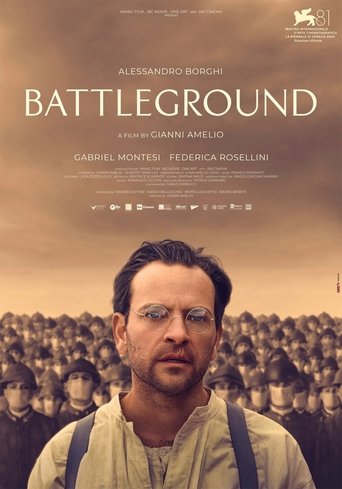
Battlefield
Campo di battaglia
2024 · Film · 104 min
Directed by Gianni Amelio
These are the years of the First World War and Dr. Stefano Zorzi spends his days in the Exemption Clinic in a large city of Northern Italy, where he not only takes care of soldiers who arrive from the massacre of the front, but also he fights simulation and self-harm of those who hope to be dispensed, by sending them before the Military Court. If Stefano, in fact, does his utmost to heal soldiers and send them back to fight, Dr. Giulio Farradio makes them ill, or helps them to self-injure seriously enough to be exonerated. The two doctors, who went to university together and were great friends, they not only (secretly) challenge each other on a professional level, but also on the sentimental one: they are both linked to Anna, a courageous nurse with a strong character. But when the great ‘Spanish’ fever epidemic arrived in 1918, the time for love, politics and science ends up getting confused dangerously...
3 negativefrom 3 commenters
Where to watch
No streaming data for this title.






3 comments on Hacker News
Igor, This is a subject area that seems like it would be a good starter learning project and doable but really its not.
There are many problems that just are not suited to a young person at that age level of comprehension. Gaming graphics for example often requires understanding quaternion math, computer science, and hardware at a very low level (realtime processing where ms framerate processing counts).
Game design often also is multidisciplinary and requires knowledge of psychology, storytelling, music, and art.
Kids simply don't have the life experience, to put something together for this and have it turn out in a satisfying completed project.
Additionally, even when you are an expert, the experts don't play their own games most times. The vast majority of the fun and allure comes from the discovery of not knowing everything about the game and discovering it. This is why writing games for yourself is often doomed to failure.
Additionally, most games today have subtle manipulations and embedded addiction triggers. These aren't things they can just pick up and use. As an example of this, Call of Duty and Battlefield (FPS), have headshot audio triggers that associate through pavlovian conditioning headshots ingame with the dopamine hit sound cha-ching.
The ability to control addiction is in a part of the brain that doesn't usually develop fully until your 20s, and this stuff is in most modern games. There is a framework called the Octalysis Framework, it provides common methods to embed dark patterns in a way people don't perceive. It is based on some earlier work based in thought reform (torture), and later psychology experiments identifying key drivers to enable manipulation. This is extremely subtle stuff similar to what Pixar & Disney do in their movies (i.e. the handsome guy is always the villain, the preacher is always crazy...lot more).
Robert Cialdini wrote a book covering some of this precursor material. The book is called Influence, and it lays out all our natural perceptual blindspots, and how to exploit them. These are blindspots not even grown adults will notice most of the time without training.
I think you will be better served by starting them on something educationally constructive that is more suited for their age. If you are looking for something math related, Cosmic Calculator series has shortcuts that let you do math amazingly fast. Storytelling for writing authors may be good as well, or just focus on getting them to read for pleasure.
Descartes Rules of Method were particularly useful around that age as well as logic and reasoning (which public education will not teach them), since they are only just starting to be able to discern lies from truths, and that is a major developmental milestone.
Other activities might include Piano lessons, or art lessons.
The current gaming landscape is unhealthy, and can't be vetted by an 11-yo and even platforms designed to make this no-code easier, you have to worry about them suggesting and influencing in ways that will diminish them, or mislead, or creating interference and frustration, or something more directly harmful like TikTok and their recommendations to the Blackout Challenge (kids have literally died).
Some who don't have children might think this is overblown but there are no trusted platforms out there that will safeguard kids appropriately.
Google "Roblox kids scandal" and you'll see what I mean; and they've been recommended here in more than a few other comments.
Update: Sometimes I find it really surprising where others priorities are here on HN. You'd think protecting children would be paramount, but voting paints a very different picture, -3 for mentioning tiktok or the roblox scandal...
This seems really trivial, but I noticed an immediate quality of life increase when I switched from video games to physical pub games like darts and billiards.
When I come away from an hour long video game session, my body has been physically sitting and staring at a screen as I move my fingers, so it's actually a physical state physical similar to "work" and doesn't actually leave me feeling energized and relaxed. If I spend an hour throwing darts or shooting pool (even alone at home as a solitary activity), I stand up (better for my posture) and my body feels like it's engaged in a physical task in a way that actually lets my mind relax. It leaves my brain (and mind) both feeling better. And there's also the fact that pub games lend themselves to the social "let's meet up with some friends at the pool hall" kind of activities more than video games do, at least my experience.
Other examples of "physical" hobbies might include playing a musical instrument, creating something physical (woodworking, crocheting, origami, drawing, sewing, painting, cooking), these often tend to be the kind of quiet meditative activities that give your mind a rest and actually feel like taking a break from work (as opposed to certain video games, which can actually feel more stressful on a chemical level; one of the reasons I quit playing games like Dota and Counter-Strike is that I'm pretty sure they kept my adrenaline and cortisol levels high for an unhealthy amount of time).
As an alternative to giving up video games, maybe consider playing different kinds of games. Even as I spend less time playing video games, I work in the video industry, and so I play a large variety (partly out of a sense of professional responsibility, and partly because I'm curious about what my friends in the industry are doing), but rather than spend 100 hours playing a Battlefield or Call of Duty each year I'll play a lot of smaller video games that deliver a complete experience in less than 5 hours. Playing a smaller narrative game like Night in the Woods felt like an emotionally fulfilling experience similar to watching a movie, whereas playing a multiplayer game like Battlefield or Overwatch just felt like hopping into an adrenaline-fueled meat grinder for an hour every day.
Call of Duty's (and Battlefield's) single player campaigns are more akin to a Michael Bay movie than a video game.
That's not to say I don't enjoy playing them, but I do sort of miss the days when games actually had deep single player gameplay.