 Hacker Cinema
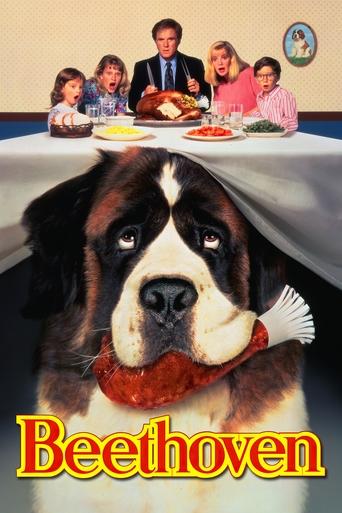
Beethoven
1992 · Film · 87 min
Directed by Brian Levant
The Newton family live in their comfortable home, but there seems to something missing. This "hole" is filled by a small puppy, who walks into their home and their lives. Beethoven, as he is named, grows into a giant of a dog... a St Bernard. Doctor Varnick, the local vet has a secret and horrible sideline, which requires lots of dogs for experiments. Beethoven is on the bad doctor's list.
2 neutralfrom 2 commenters
Where to watch
No streaming data for this title.



2 comments on Hacker News
This article left me a bit confused. After a perusal I couldn't find a satisfactory set of criteria that defines a "Beethoven" beyond this vague bit at the top, which feels very hand-wavy.
> Why has there been no one better in the last ~200 years - despite a vastly larger world population, highly democratized technology for writing and producing music, and a higher share of the population with education, basic nutrition, and other preconditions for becoming a great musician?
and from a footnote:
>Beethoven's music is "great" in at least two significant senses: (a) for nearly all listeners, it is enjoyable; (b) for obsessive listeners who are deeply familiar with other music that came before, it is "impressive" in the sense of demonstrating originality/innovation/other qualities.
a) in the footnote feels very, very selective in "for nearly all listeners", and b) I'm not sure how "impressive"-ness is quantified, especially if obsessive listeners are required as a hurdle to clear to establish impressiveness as a barometer for a qualtifiable "better".
What's "better"? How is the author sure there is no one "better"? Who decided that?
What criteria makes someone better? Is it some combination of technical skill at the keyboard, compositional skill at "the harmonic style of 18th century european music"[0] ? Is it the Fame that is achieved as a result of writing famous, lasting compositions? It is the music's complexity, or popularity? Does it have to be limited to so-called "classical" music, or music at all?
[0] Adam Neely's excellent video "Music Theory and White Supremacy" feels like a must watch in the context of this article https://www.youtube.com/watch?v=Kr3quGh7pJA
The article speaks to acclaim, by who? By what criteria? Do we need to compare "today" to "While Beethoven himself was alive", or at least his reputation near after the time of his death?
And, how does the author know what will be considered "better" or "acclaimed" in 50, 100, or 200 years? There are certainly musicians as skilled, popular and prolific as Beethoven now. CErtainly there have been acclaimed, talented, prolific mucisian's since Beethoven, right?
I mean, could Steven Sondheim be considered a "Beethoven" of today? Robert Johnson, Miles Davis, Bob Dylan, Jimi Hendrix, John Lennon, Tosin Abasi? All innovators, all skilled, all prolific, all famous, all acclaimed ... all better? Today, who could say -- by what metric are we saying "better"? By what perspective? By whose opinion?
The charts were pretty, though.
> Something is very wrong when the top result for "Kafka" is some software.
Not necessarily. If the software is more discussed on the net than the man it's named for, then perhaps that would be best?
> Do you want to live in world where you kids google "Socrates" "Beethoven" and some software project shows up on top?
You can bet your ass that if we had internet the way we do today in the early 90's that if you searched for Beethoven the first result would have been the dog movie.
Interestingly, I had an edutainment console called Socrates when I was young and it's very hard to find information on.