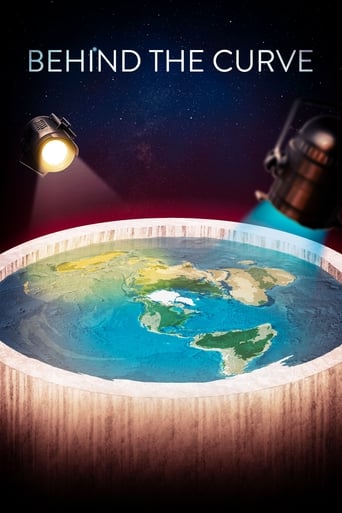
Behind the Curve
2018 · Film · documentary · 96 min
Directed by Daniel J. Clark
Meet the growing, worldwide community of theorists who defend the belief that the Earth is flat while living in a society who vehemently rejects it.
23 positive8 neutralfrom 31 commenters
Where to watch
No streaming data for this title.
36 comments on Hacker News
I love this bit from the documentary "Behind the Curve (2018)." One of the scientists poses the following question: "What evidence could I show you that would change your position?"
If someone can't answer that, it's probably not worth arguing about.
In a similar vein I highly recommend Behind the Curve, which is a documentary about the flat Earth movement. It was a pretty fair film and tried to get to know the people involved in the movement and what it was that motivated them.
It was interesting to see that one of the main figures featured in the documentary started out pretty generically wanting to get into conspiracy theories and started reading up on one after another until he found a particular one that clicked.
https://en.wikipedia.org/wiki/Behind_the_Curve
Once you internalize that flat-Earther-ism isn’t about the Earth being flat you realize that rational arguments are pointless.
To expand on that, it’s about community and finding people who share your interests. The movie Behind The Curve explores this idea and it’s quite revealing.
I’d strongly recommend the documentary “Behind the Curve”. The close look at people in (not quite a cult) gave me a visceral appreciation for what draws people to it (it provides acceptance for people who sorely lack it) and why it can be so hard to leave (one’s identity becomes so tied up in it).
> If someone is in a group that is heading towards dysfunctionality, try to maintain your relationship with them; don’t attack them or make them defend the group. Let them have normal conversations with you.
This is such an important skill we should all have. I learned this best from watching the documentary Behind the Curve, about flat earthers, and have applied it to my best friend diving into the Tartarian conspiracy theory.
If you're actually interested in skepticism, I recommend the podcast Skeptics Guide to the Universe (SGU). James Randi was a good friend of the hosts. The show mainly is a discussion of general science news from a skeptical lens. Their attitude towards the paranormal stuff is pretty dismissive, but this is because they've engaged with the believers for decades and have discovered a complete disregard for evidence or truth in those communities.
I also really the movie "behind the curve", which goes deep into the flat earth movement. Really a great way to understand what motivates these people (status in their community, mostly) and how they think (with lots of bias).
The flat earth documentary Behind The Curve made it clear that the reason for participation in the flat earth community is more about a sense of belonging for the people involved than anything else. Give people something that is better for society that can meet that emotional need, and maybe things will change.
There's an interesting documentary about flatearthers called "Behind the Curve" that gets into individual flatearther origin stories. The interesting thing is they are not stupid it's more than they have learned to not trust people in positions of authority on topics of science (often due to an experience in grade school).
Towards the end there are a few funded research projects that are erily more similar to the social dynamic of actual "legit" academic science than the film makers probably realize.
Behind the Curve is a good documentary about flat earthers. A lot of them seem to believe it because it gives them a sense that they have figured something out that others haven't. It makes them feel special.
Others believe it, or at least continue to believe, because they find a community and connection with other believers.
What was the controllable with Eddington?
* https://en.wikipedia.org/wiki/Eddington_experiment
Einstein's models made a prediction, people 'tested' that prediction in Nature, and it turned out accurate. General theory has made other predictions, and empirical observations have found them to be accurate as well.
Plenty of "real" science is/was done outside of controlled experiments in a lab.
A phenomena was going to happen (e.g., tax law changes): some economic models predicted X would happen, and some predicted Y would. We can see which were more accurate and which were falsified:
* https://en.wikipedia.org/wiki/Kansas_experiment
Rotterdam is running an experiment right now with regards to real estate markets and regulation:
* https://www.youtube.com/watch?v=BRqZBuu_Ers
* https://www.dutchnews.nl/2023/06/buy-to-let-ban-is-good-for-first-time-buyers-but-bad-for-tenants/
Every time the Federal Reserve makes a policy change there are people running their models on what will happen, and if their models are right they make a lot of money, and if they're wrong they lose a lot of money:
> But why was Gross betting so heavily against Treasuries? Brad DeLong tries to rationalize[1] Gross’s behavior in terms of a coherent story about an impending U.S. recovery, which would lift us out of the liquidity trap. But Gross wasn’t saying anything like that. Instead, he was claiming that the Fed’s asset purchases — QE2 — were holding rates down, and warned that the impending spike in rates when QE2 ended would derail recovery.
> So why did he believe all that? It all comes down, I’d argue, to liquidity trap denial.
> Since 2008 the basic logic of the economic situation has been that the private sector is trying to run a huge surplus, and the public sector isn’t willing to run a corresponding deficit. The result is an economy awash in desired savings with nowhere to go. This in turn means that budget deficits aren’t competing with private borrowing, and therefore need not drive up interest rates. This isn’t hindsight; it’s what I and others have been saying since the very beginning[2].
* https://archive.nytimes.com/krugman.blogs.nytimes.com/2014/09/30/the-pimco-perplex/
If people don't want to bother accepting the results of these experiments and continue following models for reason other than accuracy, that's hardly the fault of the field of study. See the movie Behind the Curve on folks doing perfectly valid experiments and completely ignoring the results:
* https://en.wikipedia.org/wiki/Behind_the_Curve
Clip (ensure unmuted):
* https://old.reddit.com/r/facepalm/comments/sjeoqd/flatearther_accidentally_proves_the_earth_is/
* https://twitter.com/Rainmaker1973/status/1559907302483935237
Can't tell if this is an excellent troll. Reminds me of the moment in "Behind the Curve" Netflix's excellent flat earth documentary, when one of the characters, discussing her feud with another flat earther, says something like "He's just so wrong about stuff. Could I be that wrong...? Eh, nope, I guess I know I'm right"
But in case you're not trolling the parent by comparing their climate chance conspiracy theories with even more ridiculous UFO conspiracies, relevant xkcd: https://xkcd.com/2572/
Maybe this was once true, but nowadays I'm afraid the etiology is rather more complicated than that - flat eartherism is now full-on cult territory. I recommend the documentary "Behind the Curve".
There was a documentary on Flat Earthers (Behind the Curve?) where they devised and did this experiment themselves on a calm lake. When the experiment showed the change in height because of curvature they… rejected the results and moved onto another experiment.
There's a clip of the segment on Youtube, but my search-fu is failing me and I can't seem to find it.
I mean, if the person in question is under 15 and has never picked up a physics textbook, then mocking someone that believe in flat earth is out of the question.
And there is plenty of room to allow people to change their position, to test science via hypothesis and measurement.
But when a person is a speaker at flat earth conferences telling people that science lies to them about everything, they just might be a charlatan. I believe the movie 'Behind the Curve' covers this, but must admit to not having watched it. From the synopsis of the movie the flat earthers perform experimentation proving the earth is a globe, then discard the evidence never to bring it up again. So yes, if this is the case, the tone is demanded.
I think there's a really important distinction between ideas that are simply wrong like phlogiston or perpetual motion, and things like antisemitic/white supremacist conspiracy theories (if you look into this subject you'll find that they're one in the same, with antisemitism being the foundation of white supremacist conspiracy theories) that have evolved to spread virally though a population and perpetuate bigotry and motivate violence. It's a pretty literal form of "mind virus," and they're subject to selective pressures that cause them to literally evolve to be very difficult to discard once you've accepted them. Phlogiston isn't a closed system of ideas that absorbs all criticism of it and inverts it into evidence that "they" don't want you to know about the ideas.
Consider flat earth conspiracy theories (which are not nearly as harmful as white supremacist ones and I don't mean to equate them, only to pivot to a different example that's a less touchy subject); it's trivial to debunk FE arguments, and people have, exhaustively. But unlike phlogiston, that didn't make the FE stop having currency in our discourse. It's not just something wrong which will lose out in the marketplace of ideas. In the documentary "Behind the Curve," several of the flat earthers come up with really compelling experiments that debunk the flat earth. But they aren't actually convinced by their own results. A conspiracy theory or system of conspiracy theories survives by being an endless font of explanations that paper over the inconsistencies. Those that are unable to do this either die off or are incorporated into a larger system of theories that have more explanatory power.
As a matter of free speech it shouldn't be illegal to hold or to discuss these views, but unlike ideas that are simply wrong they create and enhance hazards as they spread. They isolate people within these communities; I don't know if you've ever spoken to someone who is a hardcore conspiracy theorist, but it can be really difficult to connect and interact with them because they will have really strong responses to seemingly innocuous things, and constantly insist that you're a rube for not thinking along the same lines. This often erodes their relationships with people outside the culture of the conspiracy theory (which are often very loving & supportive places). These communities form a millieu which hate groups and fascist movements can be drawn from, not because these individual people are especially hateful, but because they've been indoctrinated into a cult-like setting where a proposition like, "there are children being held in the basement of this particular pizza parlor, someone needs to step up and save them" is taken quite seriously. You don't have to be a hateful person to show up to a pizza parlor with a gun (or commit other acts of violence) once you've developed the sincere belief that children's lives are at stake and that it's your personal responsibility to defend them.
How to properly counter this phenomenon is largely an unsolved problem, and I'm not suggesting that a dictatorial approach is warranted (that'd pretty obviously backfire by seemingly validating the conspiracy), but there's more nuance here than orthodoxy vs. free exchange of ideas. We need to find a way to continue the free exchange of ideas while addressing these dangerous, emergent phenomenon.
I'm currently working on software to help people create a personal epistemology, to compare theirs with others, and to collaborate on a shared epistemology. There's various reasons I think this is a good idea, but one of them is that I think being able to demonstrate what you believe and why would be beneficial to our discourse and hopefully counteract conspiracism.
I actually am a big Pratchett fan and have read all the novels in his Discworld universe, some several times. It is a comedic fantasy world, yes, but it's mainly a setting in which he can build a parodic analog of the modern world. The geography of the world doesn't come up much in the stories.
Much of my thinking on the subject comes from Steven Novella and his blog
https://theness.com/neurologicablog/index.php/behind-the-curve-flat-earth-exposed/
> Another powerful aspect of the film has a similar (but much smaller, in my opinion) climactic moment, but runs in the background throughout the film – the echochamber effect of being in such a movement. The subjects of the film are overwhelmed with confirmation bias, from themselves and each other. They also have the mentality of being in a small beleaguered group, and trying to change the world.
> The underlying motivations for any particular belief are also varied. This film did do a good job of showing a variety of people who have come to the Flat Earth community from different places, for different reasons, and have varying roles to play. The result is a complex mix with no single or simple solution.
He also goes into some of the lengths and surprising expense they go to and rationalizations used to maintain their beliefs. They did not seem like sophists to me, but perhaps it's all just an ever more elaborate joke.
This kind of makes sense depending on how you view the purpose of the show.
He starts off, right off the bat, talking about how he is going against the establishment of “Big Archeology” and is subject to persecution by their shadowy machinations.
It’s a very sensational idea, and my personal impression of the show was more about him trying to prove his DaVinci Code style narrative that centers himself than him trying to actually prove that Atlantis exists. His “archaeology” is tangential to (though in support of) his persecution narrative in that his thesis is about a shadowy conspiracy to hide Atlantis.
For example, Behind The Curve was a _documentary_ about silly kooks that are trying to prove that the earth is flat. It was not an exploration as to whether or not the earth is flat. It would have been pure entertainment to take them at face value, like a Christopher Guest movie.
I guess I'm not sure what you're demonstrating with this link. I watched Behind the Curve, and it generally treated flat-earth proponents as nice, well-meaning people who've just gotten themselves stuck in a rut where no evidence will convince them. That seems like the right attitude towards this kind of theory to me. Perhaps some of the scientists in the movie were exasperated by how obviously false flat earth is, but I can't imagine any of them writing a letter like the one in the source article, saying that flat earth theory is harmful and you're racist if you believe in it.
I love documentaries, and these are my favourites. All very worth a watch.
- The Crash Reel
- McConkey
- Buck
- Apollo 11
- Carts of Darkness
- The Wild and Wonderful Whites of West Virginia
- Samsara
- Baraka
- Brooklyn Castle
- Spellbound
- Drew: The Man Behind the Poster
- Crumb
- The Jinx
- The Art of Flight
- King of Kong
- Indie Game: The Movie
- Capturing the Friedmans
- OJ: Made in America
- The Barkley Marathons
- The Seven Five
- Murderball
- Unbranded
- Gringo: The Dangerous Life of John McAfee
- Big River Man
- Hoop Dreams
- Word Wars
- Free Solo
- Long Shot
- Meru
- Being Elmo
- All This Mayhem
- Jiro Dreams of Sushi
- The Cove
- Project Nim
- Alone in the Wilderness
- Behind the Curve
- The Dawn Wall
- Grizzly Man
- 13th
- Winnebago Man
- Man vs Snake: The Long and Twisted Tale of Nibbler
- Get Me Roger Stone
- Icarus
- 13th
- Koyaanisqatsi
- The Thin Blue Line
- An Inconvenient Truth
- Oklahoma City
- Virunga
- The Staircase
- Evil Genius
- Undefeated
- Betting on zero
It reminds me of the flat earthers movement documentary "Behind the curve". Where the main actor in the documentary joined the movement and wrose through the ranks to the leader. This person was a bit of a social recluse before but now he met his wife, gained friends around the world and brought in an income.
He was asked if he was shown proof that would change his mind could he and he said he couldn't, because his entire identity was built around this belief. If he changed his mind he would lose everything.
This is one of the dangerous things about echo chambers and micro communities produced by social media, it gives people a global identity even if their identity is based on nonsense.
No problem, have fun! — and if you enjoyed that FE article, you will likely enjoy the 'Behind The Curve' movie too, it's really quite amusing :)
> Flat earth is an interesting case in point. It is actually quite challenging to show that the earth is round in a way that does not require you to take anyone's word for anything.
There's a Netflix documentary called Behind the Curve (2018). There's a guy who keeps running these experiments to prove the earth is flat. But keeps inadvertently proving that its round!
There's a superb interview[1] with Neal Stephenson that was published just yesterday about this kind of human behavior.
Here's a quote from Neal:
"Another thing I’ve been reading recently is “The Fixation of Belief” by an American philosopher named Charles Sanders Peirce. He was writing in the 1870s, and he goes through a list of four methods that people use to decide what they’re going to believe. The first one is called the method of tenacity, which means you decide what you’re going to believe and you stick to it regardless of logic or evidence. ... The next method is called the method of authority, where you agree with other people that you’re all going to believe what some authority figure tells you to believe. That’s probably most common throughout history. The third method is called the a priori method, and the idea is, let’s be reasonable and try to come up with ways to believe things that sound reasonable to us. Which sounds great, but if it’s not grounded in any fact-checking methodology, then you end up just agreeing to believe things by consensus — which may be totally wrong. The fourth method is the scientific method. It basically consists of accepting the fact that you might be wrong, and since you might be wrong, you need some way for judging the truth of statements and changing your mind when you’ve got solid evidence to the contrary. What you’re seeing in the Baroque Cycle is the transition from Method No. 3 to No. 4. You’ve got all these people having what seem like reasoned, logical arguments, but a lot of them are just tripping. So a few come in, like Hooke and Newton, and begin using actual experiments and get us going down the road toward the rational world of the Enlightenment. But what we’ve got now is almost everybody using Method 1, 2 or 3. We’ve got a lot of authoritarians who can’t be swayed by logic or evidence, but we’ve also got a lot of a priori people who want to be reasonable and think of themselves as smarter and more rational than the authoritarians but are going on the basis of their feelings — what they wish were true — and both of them hate the scientific rationalists, who are very few in number. That’s kind of my Peircian analysis of where things stand right now."
[1] https://www.nytimes.com/interactive/2022/01/10/magazine/neal-stephenson-interview.html
(Nit: I think you mean "Behind the Curve", not "Beyond". But yes, really good documentary recommendation!)
Having some views that are out of the mainstream, I sympathize that trying to have a good faith argument can be frustrating, but remember it’s generally bad actors and trolls who are most likely to downvote and reply to a post they think they can easily shame. There’s plenty of people who would appreciate a different perspective even if it’s mostly downvotes.
I recommend the excellent documentary “Behind the Curve” for a good look at what happens to people when their views are marginalized. They dig in and develop tunnel vision. The way the lab leak theory for COVID subtly shifted from conspiracy theory to real theory illustrates how important it is not to be dismissive.
> Why should I — someone with many of my subjective ideas and opinions try and talk someone else out of their personal beliefs and opinions.
Because letting people operate on a false belief affects everyone else.
It's one thing to believe in homeopathy as curative - it's another thing to recommend it to people as sound medical advice, when there is no evidence that supports it.
It's one thing to personally believe in creationism - it's another when you insist on teaching it in schools, disregarding its empirical validity.
That's when real people, either the gullible or the vulnerable or even the ones in no position to resist, are hurt - either physically, as homeopathy can do, or intellectually, as science denial does, or even socially, as people vote against their own self-interests through an incorrect understanding of what's actually happening. You normalize this harm by allowing it to happen.
I'm not saying don't let people believe whatever they want. I'm saying it's important to insist they know where their beliefs end and where facts begin, because the alternative is them causing harm, justifying it under their beliefs, and you thinking that's alright then. Conspiracy theorists do not know that distinction between fact and belief.
You raise a good distinction between "conspiracies that turned out to be true" and "conspiracies in general", but you're talking at cross-purposes here. The article is discussing belief in clearly-false claims (as evidenced either by actual research on the subject or evaluation of the complete record), whereas you're using "conspiracy" in the classic sense of disinformation (claims which are true but where knowledge of their truth is suppressed until a later time). I would argue that, even with that distinction, the same default position to novel claims should be assumed in everyday life: skepticism, willingness to examine the evidence against the baseline, and openness to agreeing with said evidence should it meet a strong standard. This default position usually means you don't change your current behaviour unless the evidence is insurmountable, so: trust, but verify(!!!), all new claims before acting on them, and if that verification fails, repudiate and encourage repudiation from your fellow humans.
What's important also is that most people don't have the tools to understand how to verify information correctly, so even the method above only works if you understand how to verify anything. Scientific illiteracy, innumeracy, and herd mentality are common issues here, as is cognitive dissonance or poor methodology - the Netflix documentary "Behind the Curve" describes how flat Earth experiments typically start by rejecting the premise of a globe, conducting experiments that strongly fit the narrative of globe nature, and then dismissing those results as flawed and only highlighting those which seem to indicate anything other than globe nature. That's cherrypicking, and cognitive dissonance alone lets people conclude that that's not what they're really doing. These are ordinary people, like you and I, with an impressive capability to rationalize and a reluctance to challenge whatever gives them comfort - any one of us could end up like them, in the right conditions.
That's why it's important to arm yourself too with knowledge about practical epistemology. LessWrong is a weird community, but they seem to have better resources on this than many other places, so I recommend their wiki. Knowledge of the scientific method helps, as is knowledge of the historical method. Understanding how scholarship is a prerequisite to science - that is, it's not enough to have done an experiment to be a scientist, you also need understanding of the current state-of-the-art to be able to advance a meaningful argument and to be able to demonstrate correct understanding when asked - is absolutely critical (this is the number one reason why physics and math professors receive so many emails from crackpots advocating a new proof of the Riemann hypothesis and whatnot, because these crackpots either aren't aware of the necessity of scholarship or are aware but have never been subjected to a rigorous test of their scholarship).
I agree. After watching 'Behind the Curve' [1], this is the feeling I got from the whole thing.
[1]: https://www.imdb.com/title/tt8132700/
You should really go watch the flat earth documentary "Behind The Curve". The reaction of flat earthers to their experiment failing to support the flat earth theory resulted in them deciding they needed to do a different experiment.
The reality is that conspiracy theories are far more about socialization and communities than they are about facts.
I enjoyed the Netflix documentary Behind the Curve which highlights several of the big people in this community. A lot of the documentary is a comical subtle troll, but it sheds light on how the people in this community are alike by being sort of social outcasts.
They’re brought together not necessarily by a strong belief that the Earth is flat (though most in the community strongly believe it, or at least pretend to) but because they were bullied as kids, socially awkward, had a hard time making and keeping friends, etc. From this angle I absolutely see how strong a connection these people might have to others in this community and why it would be hard to say “screw you only friends that I’ve ever had, your theories don’t make scientific sense”. They might lose the only friends they ever had.
This somewhat reminds me of the current state of politics. Why counter even a single belief, value, etc. that your echochamber has when they’re probably friends of yours and you know it could change your relationship for the worse (even though I think it’s ridiculous that questioning a political opinion with a well thought out, logically crafted counter opinion could ruin a relationship).
A large portion of flat Earthers are serious conspiracy theorist who don’t believe in things like the moon landing ever happening and are very anti-government who refuse to believe anything coming from the government and NASA simply because they’re the government. The flat earth society is also a cult that people join to feel like they’re a part of something so they accept to go along with the story and believing in it to remain accepted. There’s a documentary on Netflix called “Behind the Curve” which was kind of interesting.
Here's a hint. The annual gathering of flat earthers featured in the Netflix documentary "Behind the curve" is called (with a rather awkward word ordering) "Flat Earth International Conference" -> "FEIC" -> fake.
The documentary "Behind the curve" gives a nice glimpse inside the minds of Flat Earthers.
> It’s about the social group first and foremost
This was very well highlighted in "Behind the Curve" documentary (available on Netflix). One of the main figures of the flat-earth movement spoke quite openly that he lost his friends when he "found the truth", and doesn't want to go through that again.
Trailer: https://www.youtube.com/watch?v=VZzsq40Bx2Y
The comment to which you responded mentioned the documentary "Behind the Curve," in which a group actually does experiments. The experiments obviously do not support a flat earth, so they then hide the results, admit quietly that things aren't looking good, and then try to change the experiments to get the results they want.
Behind the Curve is a great documentary about the strange resurgence of flat earth theory in the last few years. It covers a few of the major YouTube personalities.
I think flat earth’s comeback is actually a good thing and YouTube is making a mistake. It’s true that nobody 30 years ago believed the earth was flat but they probably couldn’t articulate why they believed that. People who are brave enough today to re-examine their beliefs should be admired, not ridiculed.
Of course flat earthers are wrong, but the coolest part of the documentary is when members of the movement start spending thousands of dollars to conduct experiments to prove their theory. At the end one of them gets a contradictory result to what he expected, and you can see the doubt start to form in his eyes as he smiles and just says something like “Oh, that’s interesting, that’s very interesting.”
YouTube has given nonconformists a platform where they can be honest and be themselves, and it’s unfortunate they look to be trying to take that away. Of course some people on there will hold views that are frankly stupid, but I’d say it’s better than having everyone believing the same thing out of a sense of conformity.
If you haven’t watched the Netflix doc “Behind the Curve”, I highly recommend it.
The movie exposes the sort of cultishness of flat earthers and more than anything ends up making you feel bad for their desperation. Seems like a lot of those people just need support groups for their problems, and flat earth theory gives them a common enemy to rally against.
The movie isn’t all sad though, several times during the movie the more scientific members end up proving themselves wrong, which is fun to watch.
Anyway, again, I recommend the movie. It’s good for a laugh but also offers a reminder of the group’s humanity, which I think is important when we look at fringe groups.
Could have started that way, but it seems to have gone beyond that. I'd recommend watching Beyond the Curve (2018) -- https://www.imdb.com/title/tt8132700/