 Hacker Cinema
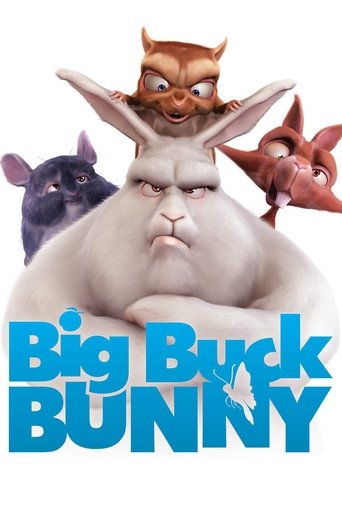
Big Buck Bunny
2008 · Film · short · 8 min
Directed by Sacha Goedegebure
Follow a day of the life of Big Buck Bunny when he meets three bullying rodents: Frank, Rinky, and Gamera. The rodents amuse themselves by harassing helpless creatures by throwing fruits, nuts and rocks at them. After the deaths of two of Bunny's favorite butterflies, and an offensive attack on Bunny himself, Bunny sets aside his gentle nature and orchestrates a complex plan for revenge.
8 positive8 neutralfrom 16 commenters
Where to watch
No streaming data for this title.
19 comments on Hacker News
It's a different game. It may be technically compatible with other WADs and that's useful, but if the point is to actually play Doom, your idea is basically like when I once observed people around me downloading illegal video files and I wondered why they didn't just download Big Buck Bunny instead. (I was in middle school and not into movies)
"Tears of Steel" was the fourth Blender Open Movie project. The first one was 2006's "Elephants Dream", then "Big Buck Bunny" and "Sintel".
From the more recent ones I highly recommend "Sprite Fright".
Im not a 3d artist, but I still find Ian Hubert's blender tutorials[1] very cool to watch.
He comes off as an artist who immensely enjoys their craft. I have also really enjoyed his Dynamo Dream series [2] which are a labor of love for him. He's only released like 3 episodes over several years, but hey labor of love.
Ian was also chosen as the director of Tears of Steel (2012) which is one of the Blender Open Movies [3] the foundation produces. You might not recognize that film, but many of you have heard of at least one Blender Open Movie, Big Buck Bunny! A big nod (IMO) from the Blender foundation that he represents the spirit of the project and community, as well as has the skills to oversee a project meant to demonstrate Blender's capabilities.
These Open Movies are projects that HN can likely appreciate, as they are created to showcase and help push capabilities of the open source Blender software, are licensed under Creative Commons, and their assets are provided to the community for free.
(This comment is a love letter to Ian Hubert)
[1] https://www.youtube.com/@IanHubert2
[2] https://www.youtube.com/watch?v=LsGZ_2RuJ2A
[3] https://studio.blender.org/films/
I don't see anything wrong with that if the example titles are under the correct licenses like the often used: https://en.wikipedia.org/wiki/Big_Buck_Bunny which can then be mapped to open databases like https://www.themoviedb.org/movie/10378-big-buck-bunny.
> This isn't a YouTube video.
You can get high-resolution copies of the Big Buck Bunny film and play it locally in the same what.
> What are they going to do?
Obviously this would be a malicious use of DMCA (as it has been with other cases of open source software), but they could:
* Tie them up in long and expensive legal battles, using the system itself to punish them
* Have their repositories DMCA'd
* Contact their service providers and have them revoke their services
I am just suggesting caution.
I would suggest they remove the screenshot of the Avengers movie given the amount of DMCA going on for such things... (loosely suggesting some open source software could be used for viewing pirated material.) Big Buck Bunny by the Blender Foundation could be a good replacement [1].
[1] https://www.youtube.com/watch?v=aqz-KE-bpKQ
And yet that's exactly what you're "buying" when you crowdfund a freely redistributable work. Even some movies have been crowdfunded in this way, such as the animation movie Big Buck Bunny.
Random fact: the 'Big Buck Bunny'[1] short film that the presenter shares during the screen-and-audio-sharing demo was made by the Blender Foundation[2], an organization that develops open and free content creation tools.
[1] - https://en.wikipedia.org/wiki/Big_Buck_Bunny
[2] - https://blender.org/foundation/
Depends on what you are after, but it's the demo movie that VLC and other media players use as it's available under an open license.
https://en.wikipedia.org/wiki/Big_Buck_Bunny
https://peach.blender.org/download/
We built a setup like this where four people would power a monitor with sound and a small video player to show short movies like Big Buck Bunny. The point was to demonstrate how utterly inefficient this power generation method is.
I never thought I would see the day that Google removed Big Buck Bunny, the definitive copyleft short film, on copyright infringment grounds, against the actual creators, and there would actually be some argument over whether or not this was proper....
And using a Hollywood movie as an example? If he wanted to claim "it's just a tool, usable for anything" he should have used something like Big Buck Bunny as the example.
Big Buck Bunny is from a number of films by the Blender Foundation. They also made the live-action movie Tears of Steel, which can be downloaded uncompressed: http://media.xiph.org/tearsofsteel/
In that realm, one example I've seen pop up a lot where some kind of video needs to be shown off is "Big Buck Bunny" [1], a project to build an open movie using blender.
[1] https://peach.blender.org
I'm watching Sintel now at 1080p. The quality is something I'd expect to see in a movie theater! Previously I've seen Big Buck Bunny, which my daughter loves. :) But Sintel blows it away.
Before I got into web development I was involved in several open source blender projects, usually as a modeler (someone who creates the 3d objects, then passes them on to people who color animate and process them). I have used both maya3d (the oracle of the 3d modeling, powerful, industry grade software with a cost prohibiting casual experimentation) and blender, in addition to several other programs in limited amount.
Blender is everything that is right about the open source community.
The feature list is very comparable to commercial applications (which usually run > $500)
http://www.blender.org/features-gallery/features/
The community(s) are great, super helpful, nice, and diverse.
http://www.blender.org/community/user-community/ http://www.blenderartists.org/forum/ http://www.blendernation.com/ (and many more, in other languages)
But one of the most important, and as far as I know, unique things about blender and the community are the open movie projects.
The Blender Foundation establishes clear and detailed roadmaps for features (something many open source projects struggle for). Then they take a small group of some of the best artists and programmers from the community, and pay them to create a open source project using the current goals in the roadmap. The most recent was Project Durian, which created the short CG film "Sintel" with a focus on developing blenders renderer to do high res (4k) renders, and the animation system to allow for crowds and complex animations. They also developed some sfx like fire and explosions. At the end, not only was the film released as creative commons, but all the files from the film were too, so the community could benefit.
Where did the money come from? Presales of the DVD, which contained all the special features and files, and was released before the movie was posted to youtube, giving a "sneak preview". One project serving as fundraising, community support, community outreach, tutorial/teaching, feature development, focus grouping, beta testing/dogfooding, and publicity. Success.
Here are links to some of the other blender open projects.
- http://www.sintel.org/ - Project Durian - Sintel, focus on special effects, high res cinimatic rendering, and animation improvements. - http://www.youtube.com/watch?v=eRsGyueVLvQ
- http://www.bigbuckbunny.org/index.php/about/index.php - Project Mango - Big Buck Bunny - focus on hair/fiber, work with outdoor/large scenes, improve animation system for cartoony deformation styled animations. (http://www.youtube.com/watch?v=XSGBVzeBUbk)
(Note: Chances are you've seen this somewhere, because of the CC licence, stores and online video hosts love to use it for a placeholder)
- http://orange.blender.org/ - Project Orange - Elephants Dream - This is the project which developed blender into a program that had all the features to compete with the big boys, added the node compositing and spleen animation controls, plus lots more. (http://www.youtube.com/watch?v=XFtg0WBD5Hc&feature=fvst)
I would advise watching all of those, besides being great artistically, the stories are actually pretty good.
I think Blender really is different from other graphics free-software: - It is baked by a very strong foundation. - It is used by real studios all over the world (and more and more used) - It is used by the scientific world a lot. - The new release cycle is around 10 weeks. And every release ships with awesome features. http://wiki.blender.org/index.php/Dev:Doc/Process/Release_Cycle - the community is strong, big and active. - it supports a lot of OS, and the experience is great in all of them. - The foundation is very user focused : * they create "open movies" to identify the needs and the weakness of the use of Blender is pro environement. You don't know about Big Buck Bunny (http://www.bigbuckbunny.org/) or Sintel (http://www.sintel.org/) ? * they try to focus on real problems, not on eye-candy or extra-features that would impress but not be useful once.
First, I'll note that what you wrote here somewhat contradicts your original post
Straw man argument. The original post was a series of questions. My reply to your comment was the hypothesis I posed to myself. They don't contradict each other as the questions were posed as a result of the hypothesis.
This is an absurdly small and misleading sample, even within your stated target.
This was never intended to be conclusive market research, this is just to see if it warranted further research into the topic. In a short space of time (4 hours) I've received some good feedback and suggestions from both parties and been directed to some resources (eg the zombie comic) that I didn't know existed.
I could have, for all intensive purposes spend hundreds of thousands of dollars and thousands of hours conducting extensive research - or I could just build the damn thing and release it for much less than what it would cost to obtain "accurate research".
versus a large, general audience of young viewers who enjoy (and pay for) digital animation content.
You know, this is where your false argument falls down. You don't have to have a customer paying for the actual content, or even advertising to be able to monetise it. They sure help, but it's not the only method.
You specifically stated that you wanted to do this as a low-cost thing
Finally, you got something correct.
thus you can't be making high-quality, specialized content
Oops, spoke too soon.
Just because the big name companies like Pixar and Dreamworks are throwing hundreds of millions of dollars at creating this kind of entertainment, doesn't mean that it is the only way.
Think about it for a second, really break it down into its component parts. Your typical animation FILM by those 2 studios is around 90 minutes of entertainment and costs upwards of 100 million dollars each. It's about on par with what Hollywood is spending on films.
Now lets look at your average tv show, 22 minutes of entertainment. So if we used the Hollywood blockbuster model, each episode should cost around $25 million plus right? No, it doesn't work that way.
Lost for example, which is notorious for being expensive to produce cost (in its first year) $44 million for 22 episodes at 43 minutes (approx) running time each.
That's an approximate 10 times the entertainment, for less than half the cost.
So if Film and TV operate at completely different scales, then obviously there is a huge disconnect between the cost of production and the amount that someone can be entertained.
To further back up my concept, I present to you a video called "Big Buck Bunny" - it is essentially a video demo that was created by the Blender Foundation for their open source tool.
This video is 10 minutes of animation, completed in 3 months with (depending on how you look at the team makeup) 7-9 guys from concept to delivery using only open source software
http://www.vimeo.com/1084537
That surely doesn't look like a low quality animation to me. So it's not an impossible task.
Are you saying that you can produce 6 seasons of Frasier with the cost of 1 minute of Pixar animation? Sounds doubtful.
Not cost - number of artifacts within a that timeframe over several shots.
Then again, Let's run some numbers to talk about cost.
WALL-E cost $120 million for 98 minutes, Ratatouille cost $150 million for 111 minutes, so you could infer that Pixar animation costs about $1.3 million per minute (roughly) and each production takes around 3-4 years to make.
The Blender "peach" team produced 10 minutes of animation (Big Buck Bunny) in 3 months with 9 people from concept to delivery using all open source software. (There were only 6 people primarily involved in the production of the animation itself, 2 were actively developing Blender as software and 1 did the music)
Big Buck Bunny - http://www.vimeo.com/1084537
Once all the meshes, sets etc are initially created, it all boils down to production of scripts, storyboarding and then animating more content based off artifacts you've already produced.
Remember, I'm talking a sitcom format, that is you artificially limit yourself with numbers of characters and locations (which includes lighting etc) which allows you to spend more time on animation instead of producing more sets/figures.
In fact, once everything is set up, animation is one of the shortest segments of any film animation project (dont believe me? check Dreamworks Animation's general timeline breakdown from their most recent annual report, page 21, link follows)
http://ir.dreamworksanimation.com/dwa/export/system/modules/com.dreamworks.framfab/resources/downloads/2007_DreamWorks_AR.pdf
So while no, you might not get a full 6 seasons, you could probably do several seasons for the cost of 1 minute of Pixar production.
You seem to be talking about growing an animation studio from the ground up.
Thats exactly what I'm talking about.
The model I've been more or less discussing throughout this thread is for a startup I'll be working on soon, maybe even applying to YC with in the next round of funding.
PG says, make something people want - this year is turning out to be the biggest year on record for Hollywood in terms of ticket sales, people spend more time in front of their TV's now than 5 years ago and now they also spend more time online (and TV/film piracy is on the rise)
Fact is - people want to be entertained...