 Hacker Cinema
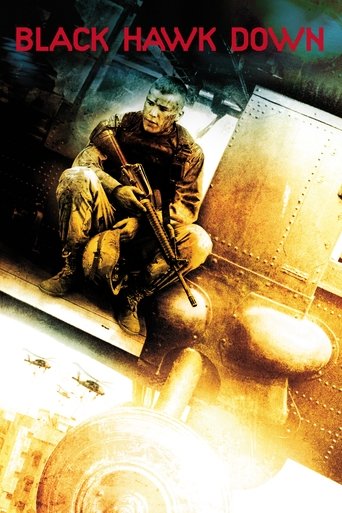
Black Hawk Down
2001 · Film · 145 min
Directed by Ridley Scott
When U.S. Rangers and an elite Delta Force team attempt to kidnap two underlings of a Somali warlord, their Black Hawk helicopters are shot down, and the Americans suffer heavy casualties, facing intense fighting from the militia on the ground.
8 positive1 negative11 neutralfrom 20 commenters
Where to watch
No streaming data for this title.
21 comments on Hacker News
you say cannon fodder - the latest reports indicate not a single casualty in todays US offensive.
infact US combat operations are very well known for minimizing troops casulaties, and when it happens an entire movie gets made about it (black hawk down)
china has absolutely zero track record in might-makes-right style of politics.
and not to mention how many chinese students are currently betting their future on living in the US, and how many billions of dollars of chinese assets are invested in the US. if anything, chinese expats in the US would actively lobby the CCP to avoid a military confrontation with the US, whatever it takes.
I know this sentiment but for me it does not apply to Scott. He made some great movies later in his career; Black Hawk Down, Hannibal, Prometheus and The Martian are all masterpieces imo. The Last Duel was also pretty good
Novalogic used this technique for terrain rendering for quite a while, my favorite is the first episode of Delta Force. It looks like Comanche 4 and the original Black Hawk Down did away with this method and switched to a polygonal engine: https://en.wikipedia.org/wiki/Comanche_4#Reception
What is communication like between different branches of the US military nowadays?
I remember reading a series of newspapers articles about the Somalia battle that was later the subject of the "Black Hawk Down" movie. I haven't seen the movie so don't know if it covered the communication issue I'm about to mention.
The army had a convoy on the ground trying to reach the crashed Black Hawk helicopter. The navy had a surveillance plane watching. The plane would see that the convoy was heading toward and ambush but they could not talk directly to the convoy (I don't remember if it was because they didn't have radios with the frequency the convoy was on or if there was a rule against it) so had to relay the warning and recommended alternate routes back to their own base.
There that would go up through the chain of command until reaching someone who was able to talk to a counterpart in the army, then down the chain of command in the army and finally to the convoy. By then the alternate routes the plane had found were no longer applicable, and the convoy might have even already reached the ambush.
When they got past that it would just happen again farther along with another ambush.
Endorsement always happens at the aesthetic level, there's never anything explicitly political about genuinely fascist work.
Take Fight Club which you're 'supposed to' take as criticism of explosive violence but it still basks in it. Or superficially anti-war movies like Black Hawk Down which are basically war porn aesthetically. The Young Pope is another good recent example. Superficially it's satire but on every other level obviously sympathetic to what it portrays.
My top top pick is actually a youtube channel that does movie essays: https://www.youtube.com/@filmjoy
They are terrifically well researched with a bunch of easter eggs and production backstory and are put together in a high production value, thoughtful way.
They really made me love and appreciate film much more.
I think it's the same way as musicians appreciating music, right?
Non-musicians might say learning more about music theory, makes some music seem less magical in a 'knowing how it was done' sort of way.
But like a musician actively listening, watching film from a more critical viewpoint/lens is really fantastic. You start to think about things like 'who was the cinematographer?', 'Who did the music and score?' and enjoying finding things like how a certain director has a certain motif.
As for the film list:
- The lord of the rings trilogy, is I assume mandatory watching for all at this point.
- The Matrix trilogy, supplemented by the movie essay here: https://www.youtube.com/watch?v=M0VnYcMHuDc
- Whiplash (2014) A J.K simmons masterpiece
- Sicario (2015) Cinematographer Roger Deakins doing some amazing work alongside Denis Villeneuve.
- Blade Runner 2049 sort of an obvious choice but beautifully made, better than the original in all ways except maybe soundtrack. The original Vangelis Blade Runner music is sort of genre defining.
- Black Hawk Down (2001) Absolutely stellar cast some of whom in their first role or wouldn't have their breakout role until several movies later. Possibly one of the most well paced movies, it's extremely clear and coherent throughout. It's also tidy self and self contained, no one said lets make 10 sequels and a cinematic universe. Dealt with the morals and psychology of war that would be further touched on in Jarhead (2005) another great movie.
- The Hurt Locker (2008) If Jarhead is a claustrophobic look at how useless and powerless an average infantry soldier can feel during war, The Hurt Locker is a study of a soldier addicted to it. Through a lens of up close nihilism.
- The silence of the lambs (1991) Hannibal Lecter / Anthony Hopkins with a bunch of scenes that are so good they are studied in film schools. Genre best horror-thriller.
I agree, and Blade Runner is very dated (80s fashion and music). Alien on the other hand hasn’t aged a bit, and along 2001 and Star Wars really defined scifi movies. The same guy reinvented peplums with Gladiator, and war movies with Black Hawk Down. I think it’s enough to justify all the misses.
You can download IMDB’s database as flat files. It is interesting to see the evolution of imdb ratings over a director’s career. Some are remarkably stable like Woody Allen or Martin Scorsese. Some others falter like Brian de Palma. Ridley Scott has some ups and down but is fairly stable over a long career.
Yeah, I do find the realism troubling at times. I think it's a bit obscene when kids teabag each other in some middle-east inspired CoD map when a few thousand kilometers from where they're playing people wearing similar garbs kill each other in similar places with similar weapons.
It's something fairly unique to videogames too. Imagine the outrage if some American propaganda war movie à la Black Hawk Down showed American military personnel engaging in 360 noscope kill streaks, trying to rack up headshot combos.
A lot of the removed U.S. content, is usually accessible in other countries (and vice-versa in some cases). I find more blockbuster movies when I am in Europe can be accessed via Netflix than in the U.S. (e.g. Black Hawk Down, House, Brooklyn 99, Lethal Weapon, Mad Max, Star Wars VII etc). There are a couple of search engines specific to find the right region.
Netflix from my understanding can pay less upfront for rights to well known movies outside the U.S. (https://flixed.io/newest-best-netflix-movies/).
The problem with Netflix from a non-U.S. region viewer is its lackluster offering of native language movies.
Awareness ain't everything, case in point: Millions of neo-Nazis are aware that the Holocaust happened, that still didn't and doesn't change a thing about their beliefs.
That's because it's about more than merely "being aware", it's also about taking responsibility and learning a lesson and sadly it looks like that hasn't really happened in the US yet, exemplified by statements like this one:
> If the US was really such an intolerant and unrepentant place, you wouldn't even have a debate about race.
It's funny how you think that's something positive when it's anything but. It's the year 2017, that's probably a couple of decades too late for a "race debate" which isn't even a debate at all.
What happened in Charlottesville wasn't a "debate", it was a show of force by the US American far-right, which only acts so emboldened because the US never really dealt with its race issues besides "being aware" of them and acting decades too late, Charlottesville was the result of this half-arsed behavior and I fear it won't be the only nor the last one.
> If it appears from the outside that the US sees itself in Hollywood good vs evil terms, everyone does.
The difference being that the US has such a massive and far-reaching cultural influence that the "good guy" tale ain't only influencing US Americans in their patriotism, it basically ends up brainwashing large parts of foreign populations.
Of course, Merkel believes she is on the right side, so did Hitler, so did Raegan, so did Stalin. The difference being: Merkel is at least aware that this ain't always true, due to cultural history, the same doesn't apply to the US to the same degree if at all.
The US, as a country, never has acknowledged or atoned for any "national shame", that's why "US patriots" feel so comfortable bathing in their ultra-nationalism while being hilariously unaware of how fanatic it makes them.
Yes, there are Germans who consider their own culture superior to others, the difference being: It's not socially accepted in Germany at all, people like that are usually considered bigots. This is because we Germans are not only aware of our past mistakes, we take responsibility by trying not to repeat them.
And one of the mistakes Germans made was following unfettered fanatism in the form of patriotism. Patriotism and national pride had both been major driving elements for the Nazis taking over power and being able to commit their crimes.
In that regard, the US shares many similarities with the Third Reich, more than most people would like to admit. Way too many US Americans are complicit in their countries crimes as they rather indulge in their patriotism about being "Number One" in "everything".
> US media at the same time is very ready to criticize such absurdities (see World Police, or modern political humor which is huge worldwide - Stewart, Colbert, Oliver).
I'm sure Colbert and Oliver have just as much international reach and influence as Hollywood blockbuster movies like Black Hawk Down, American Sniper, Top Gun or even Casablanca, which have been shaping world opinions about the US for decades.
> It's just annoying to hear people from outside cultures try and shrink down a nation of 50 mini-nations and 300 million people into some kind of comprehensive worldview. It's not reality.
The US ain't "50 mini-nations", the cultural, linguistical and geographical differences just don't support a statement like that. There's also a reason these states are United because they share "some kind of comprehensive worldview", which at its most basic level starts with the "American Dream" and at the extreme ends results with "America Number 1, America First" fanatics.
> I assume other countries aren't perfect places, but I'm not on French and German message boards telling Germans how they're just thieves and murderers and that's why they have been successful.
Excuse my naivety, but to me, this ain't a "US American message board", I rarely think in such terms when I'm surfing online, to me, it's foremost an English language message board devoid of any national connection. There are lots of international topics and people around here, just because somebody speaks English, or a board uses it as its language, does not make them US American.
That was the lesson of the movie Black Hawk Down. Many of the Rangers didn't take water, body armour, night vision etc because they thought it would be a quick in-and-out job.
> The UAV's in the Middle East are used as a weapon, not as protection, and as long as our public remains ignorant to this
Honestly, it has always been seen as a weapon. The whole point of drone is to carry out mission 24/7 as much as possible, because a pilot can't fly back and forth without sleeping. Also, humans have emotions they don't always follow orders.
> incredibly difficult for the best analysts to identify if someone has weapons for sure
I have always thought the military fly drones to carry out specific mission, such as taking photos or launching an attack. And the latter is usually confirmed by some "intelligence". I want to see how many drone attacks were performed without a single human intelligence confirmation.
> But here's the thing: I may not have been on the ground in Afghanistan, but I watched parts of the conflict in great detail on a screen for days on end
This is best seen in the movie Black Hawk Down (2001), based on true story.
AFAIK, the original homepage for "Black Hawk Down", which was a long-form serial newspaper story before it became a book and a movie, still looks as I remember it back in 1997:
http://inquirer.philly.com/packages/somalia/sitemap.asp
Back then, it was one of the most sophisticated news and multimedia packages. It still is today.
A bunch of exceptional films in that list.. you have good taste.
So, you acknowledge that there is a default, and that the films you mention challenge that default. I think everyone can agree on this.
Why are films like 'the thin red line' or 'full metal jacket' so powerful. The only pro-american-military film which I can remember having such a deep impact on me was 'black hawk down', and I think we all know the story behind that one.. I would argue that they tell a truth, and in the face of 60 years (give or take) of holywood military propaganda. And what does it matter that a dozen critical films come out over a thirty year period when, lets say 50 films a year come out pro-military.
Breaking it down your essential argument is - there is no propaganda because people like the propaganda. Question you should be asking is, who created that default?
I just saw the movie (HFR 3d at Metreon), and while I mainly disliked that it seems to be a single solid 2.5-3h movie split into two badly edited 3h movies, the HFR was pretty good.
Not a fan of 3d, though; everything good about 3d seems to be handled just as well through depth of field, and once a lot of viewers will be on 2d, there is never non redundant 3d; it is either pointless in a scene, or backed up with depth of field, composition, color, or other ways of indicating depth and importance.
The HFR really sucked, IMO, in the early Shire scenes, which were boring indoor things. I've seen HFR before so I don't think it was adjustment. It worked well in battle or action scenes. A movie like Black Hawk Down or maybe sci-fi would do really well with HFR I think; not drama or fantasy.
What did seem to work in 3d were some of the 30 minutes of text and graphics beforehand. I am excited about 4k or 8k realtime rendered graphics for user interfaces.
> Black Hawk Down
Yeah, that was a good movie, but Ridley Scott is so much better than most Hollywood directors that it's not a fair comparison. (Never saw Jarhead)
> And here’s something no one has stopped to consider: Maybe making movies is too damn expensive. Or rather, far more expensive than it needs to be.
Hmm. I went to the theatre (first time since a long time as the experience feels antiquated and overpriced) with friends to see Sherlock Holmes, and the opening scene perfectly exemplifies the point: for about ten second you see a shot of the cathedral of Strasbourg. Half of it consists of a CGI explosion. I live there, and to produce this shot, they locked this part of the city for one week.
Ten seconds. One week. A whole team plus equipment. To the other side of the world. Seriously.
When seeing the scene I found that downright shocking, especially given the 10€ hole burning my pocket.
By comparison it takes Turn10 Studios three days[0] locally to gather enough information on a track to subsequently work on for one year. That's a full-length, five kilometer track.
I know this is not the same, and various other things come into play, but I just can't help but have an alarm bell ringing when I see movie production costs. See for yourself (budget in $):
- 2001 and Star Wars: 10 million each - Independence Day: 75 million - Transformers: 150 million - Kill Bill 1+2: 50 million - Jurassic Park: 65 million - King Kong: 200 million - Blues Brothers: 30 million - Fast & Furious: 90 million - The Fellowship of the Ring: 100 million - Harry Potter: ~150 million each - Full Metal Jacket: 15 million - Jarhead: 72 million - Apocalypse Now: 30 million - Black Hawk Down: 90 million - Terminator: 6 million - The Matrix: 60 million - Terminator 2: 100 million - Casino Royale: 100 million - Quantum of Solace: 230 million - Sherlock Holmes: 125 million - The Godfather: 6.5 million
I know those $ do not mean the same across time, but still, you can see going from simple to double produces crap (CS vs QoS), or produces twice the length at arguably the same 'quality' (whatever that means) for a significantly smaller cost (LotR vs HP). I don't see either why F&F costs thrice as much as BB, and almost twice as much as KB.
Bottom line: MAFIAA, please produce non-crap and control your costs instead of blaming piracy.
[0] http://forzamotorsport.net/en-us/underthehood4/
"Is the U.S. rich in happiness? contentment? My perception is no."
Happiness is relative. Struggling to scrape by on a dollar a day, and wondering where your next meal is going to come from must be pretty awful. Perhaps more people should do volunteer work to realise just how lucky we have it in the west. I think that by being wealthier, you can "move up" Maslow's Hierarchy of Human Needs[1], and if you reach 'self-actualisation' i.e. you are intellectually fulfilled, have pride in your work and accomplishments etc., that that is it's own kind of happiness. I agree that you are never going to achieve any kind of happiness by simply pursuing some arbitrary dollar amount. That is a fool's game. Beyond a certain point increasing your bank account balance is a meaningless exercise.
The second and third paragraph mention some things are are an unfortunate byproduct of an industrialsed nation. They are also arguably unnecessary - the means are there to combat obesity, products made by slave labour, destruction of the environment etc. I don't really have a good answer for these. It's important to note that some of these things can happen in a poor country too - I remember in the movie "Black Hawk Down" that the soldiers were admiring the lovely view of the ocean, but they were warned to not go in as it was extremely polluted. It probably wasn't the Somalians that polluted it though!
"Your point appears to be that financial innovation (money pursuits) can and sometimes do lead to benefits for society." It all depends. If you are a seller of Credit Default Swaps in Goldman Sachs circa 2006, you probably know in your heart and soul that what you are doing is highly destructive to society. But dammit, you need to hit your annual bonus, so you sell, sell, sell. Good inventions can be twisted in destructive ways.
All human systems and artefacts are imperfect. They are also morally-neutral. Think of nuclear power. When it was discovered, the idea was to bring really cheap electricity to the masses. As it turned out, the electricity wasn't cheap and the most horrific weapon ever created was unleashed. Or even a car - you can use a car to help an elderly neighbour get into town, or use it to escape from a bank robbery. And so on.
"As a counter, I'll offer this up. The great scientific discoveries of the world were not done for money. Newton would not have been a better mathematician had he been paid more. Human progress, largely, comes from people who like to solve problems. Who are curious about the world and want to understand it. A society that gives such people the means to pursue their intellectual passions is one that progresses."
True - but one must also pay the bills. You could work on your passion with great dedication and focus, if only for that pesky matter of money. Look at pg - he solved his money problem by selling Viaweb, and used his newfound time and wealth to help young up and coming entrepreneurs to launch and grow their businesses. If you ever see pictures of him, you know he just loves every minute of what he does. He does a great job because he cares deeply about nurturing entrepreneurship. But if he didn't have the time and money to do YC and had urgent bills to pay, things would be different and the world would be a worse off. Also, watch "The Secret History of Silicon Valley". Steve Blank details how Silicon Valley wouldn't exist today without defense funding from the government. We wouldn't be having this conversation if the US didn't spend so much on military research!
On a related note, I was watching the BBC one morning and the question was posed to (I think) a historian: why couldn't the renaissance have happened in England? He gave two reasons, one was that England at the time was consumed in civil war, and the other was that the Catholic church was a major patron of the arts. Money again. By having such a wealthy benefactor willing to fund them, artists like da Vinci could create works of art like La Pieta[3]. A similar virtuous cycle exists today in Silicon Valley, with investors willing to place big bets on tech innovations that may or may not work. See the parallel? Those with money, but less skill (the Church, VCs) are willing to fund those with the skill, but not the money (hackers, artists).
"I would argue that a better system needs to be developed because the downsides to the pursuit of money are quite bad and will lead to a world with it's resources plundered."
Money, stock and bond markets are just a human construct that reflects human faults and failings, mood swings and fear and greed. Although it's imperfect, the capitalistic system is the best system we've come up with so far. It emulates evolution, which is probably why it beats communism and other alternatives. Hopefully it will continue to evolve to the betterment of all.
On the lack of money causing evil, just look at the piracy situation off the coast in Somalia. There is no jobs or way of earning a decent wage there. So they turn to piracy as it's they only way to actually make money in that unfortunate country.
[1] http://www.ruralhealth.utas.edu.au/comm-lead/images/Maslows-needs-Pyramid.jpg
[2] http://www.youtube.com/watch?v=ZTC_RxWN_xo
[3] http://pwlawrence.com/wordpress/wp-content/uploads/2010/08/Michelangelos_Pieta_5450_cropncleaned.jpg
I thought one particularly sickening part was around 18:50 when a Humvee drove over a body, or at least the driver thought he did. And then the other guy on the line jokes "well, he's dead". Talk about disrespecting the dead.
When an American soldier dies, his mates will risk their own lives to recover the body and a book and testerone-fuelled movie get made about it (Black Hawk Down). But when an Iraqi gets shot to shreds by a chain gun and run over by a Humvee, its some sick joke. We live in a twisted, unequal world in many ways.
ps. How amusing that this comment is getting down voted. The truth is unpleasant, but still the truth
It's worth comparing this to "Black Hawk Down". I didn't have a problem with the film, video game, or book.
To me, this Fallujah video game seems to be in really poor taste. It's probably because the US is still in Iraq.
For the military side of that analogy I highly recommend reading Black Hawk Down. It's a moving account of real-life heroes, a remarkable story of of a modern army engagement, but besides that it's also a great analogy to the business world.
The actual 3-way split in the Army is special forces (Delta Force), paratroopers (Army Rangers) and infantry. The developers analogy would be "done, and gets things smart", "smart and gets things done", and the rest. In Somalia we had Rangers and Delta, and the book goes into much detail on the incredible difference in skill and capability between the two. The analogy to developers is uncanny.
The point of course is not that developers are like soldiers, they are not, but rather that there are fundamental reasons that different human activities are structured in similar ways.
BTW, while it reads like fiction, Black Hawk Down is a documentary, and even the dialogue has been reconstructed from recordings. The movie is very faithful to the book, but the distinction between special forces and Rangers, the political side of the conflict, and some other interesting detail is much more clear in the book.