 Hacker Cinema
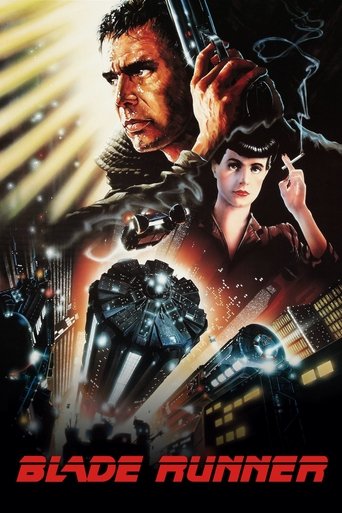
Blade Runner
1982 · Film · 118 min
Part of Blade Runner Collection
Directed by Ridley Scott
In the smog-choked dystopian Los Angeles of 2019, blade runner Rick Deckard is called out of retirement to terminate a quartet of replicants who have escaped to Earth seeking their creator for a way to extend their short life spans.
181 positive31 negative18 mixed236 neutralfrom 466 commenters
Where to watch
No streaming data for this title.
600 comments on Hacker News
You're leaving out an important aspect that Blade Runner displays. In the opening crawl replicants are called androids and this leads the audience to believe that they are mechanical. Over the course of the movie you are shown that more and more of the replicants are biological until you are forced to accept the reality that replicants are genetically modified humans.
How many humans would you damn to save that mechanical toad?
I've seen a few people complain that the first trailer for the Neuromancer TV show looks "too bright" or "too clean." I think the real difference is that they're consciously trying to avoid that Blade Runner aesthetic, which includes avoiding the "never get brighter than dusk" trope.
It is quite mediocre. Nothing "fucking amazing" about the title cards. In the world of movie title cards, this one sits in the bottom half.
Midway through, the article stops being about Blade runner and becomes "people building things with AI are creating garbage", and Blade runner title cards is now a prop that substantiates that opinion.
It's fine if the typographic analysis holds up. It does not. I'm not able to see what OP is seeing. What am I missing?
I rarely read about the contribution a good music score has to a movie's popularity. A great score makes the movie. For example,
The Blue Max, Ben Hur, the first Star Wars, Lord of the Rings, Dr Zhivago, Fistful of Dollars, For a Few Dollars More, and, of course, Blade Runner!
This seems like a lot of verbiage to say 'I found a video of an early version of the Blade Runner opening titles and they're surprisingly ass,' an observation I heartily agree with.
Some of the things he's gushing over have a very prosaic explanation, eg the capitalization of NEXUS and TYRELL CORPORATION. Whenever a named entity (human or prop) makes its first appearance in a movie script, it's capitalized to indicate that it's a story element that will require continuity, the art department, and a budget of some kind. This convention is so intuitive to even the casual reader that I'm surprised it's not employed more often. I agree with the other person who observed that the ark red of Replicants is an unfortunate artefact of the optical transfer process, but it does do a good job setting the viewer up to be scared right from the outset.
I've always assumed the title cards were one of Ridley Scott's concessions to the studio that loved the movie but were terrified about how to sell it to the public, like the eoriginal gumshoe voice-over that explained a lot of the story in the style of an old detective novel.
The complete opening sequence of Blade Runner is "fucking amazing". The entire movie is "fucking amazing". It is a beautiful, visually stunning masterpiece that I will never tire to look at complimented with a Vangelis soundtrack that ranks as one of the best in all of cinema. And a performance by Rutger Hauer that is pure artistic mastery. And has a woman ever looked as seductive as Sean Young smoking a cigarette as she's being interviewed by Harrison Ford at Tyrell Corp? Speaking of the opening sequence, even that computer animated Ladd Company tree is cool and which I have only seen one other time in "Outland", I think. The music that plays as that tree is being rendered seems to announce you are about to witness something extraordinary.
Yeah, the issues of political critique that were key to early cyberpunk have largely been lost. It's partially the fault of the first Blade Runner movie, which exploded the genre while also sanitizing it of the harshest elements.
> I think in the near future, people will start filtering out movies that have a non-trivial share created by AI.
I'm not _sure_ that's true? "Most people" know that McDonalds don't make the best burgers in their city - probably not even the best burgers in their neighbourhood. But they do make burgers that are reliably the same and for heaps of people "good enough" when things like price and availability and consistency are taken into account. And I don't blame then for that, for those people burger quality is a think that value less then me, and convenience is something they value more than me. They're not "wrong" just different.
Some of us will. I'm more concerned personally with books and music, and go well out of my way to make sure I'm buying then from "real people"(tm). The last few years most of my in cinema movie watching has been at a local cinema that screens classic movies. Recently I've seen a 70mm print of 2001 A Space Odyssey, 35mm prints of Blade Runner and Godfather. Last week we went to see the original Matrix I _know_ I'm not watching much AI generates film.
Interesting first point. I'm reminded of Blade Runner, which definitively fits in the "robots are people too, you monster!" genre ... But the source material was the exact opposite. Philip K. Dick went out of the way to rub in that even if the robots could move you to tears with their art (Luba Luft), be a reassuring authority figure for years (Garland), or even appear vulnerable and afraid (Pris Stratton), they are actually not people, but rather artifacts designed to fool you about what they are.
It's amazing how many people miss that. The SEO-spammed "grade saver" analysis practically says that the film is right - and from what I've seen, it's probably fair in that the teachers grading you might well think that too. Most misunderstood PKD book by far.
The project consists of 10,000 unique, algorithmically generated characters. Inspired by the 1970s London punk scene, the cyberpunk movement, and the film Blade Runner, these avatars sport a 24x24 pixel "pixel art" aesthetic.
Each Punk possesses specific traits that determine its market value. There are five main character types:
Humans (9,881): The most common (6,039 men and 3,840 women).
Zombies (88): Green skin and red eyes.
Monkeys (24): Highly sought after by collectors.
Aliens (9): The rarest in the entire collection, with pale blue skin.
In addition to their type, Punks possess accessories (attributes) such as sunglasses, hats, pipes, or earrings. A Punk with 0 or 7 attributes is extremely rare.
Punks are not simply digital images; they represent a key milestone in the history of Web 3.0. It was one of the first times a smart contract enabled the decentralized proof of scarcity and ownership of a digital asset.
The director's cut of Apocalypse When at, I dunno, about nine or ten hours (take a blanket and pee bottle), is definitely worthwhile, but most films that have gone over about two hours seem to be just the director being so impressed with their own vision that they didn't know when to stop. But then it's also quite a balancing act, there are some films where the studio insisted on messing it up (Blade Runner is a prime example) and others where the studio should have reined in the director a lot more than they did (many films where the director had a huge hit with film n and was given free rein to do whatever they wanted in film n+1).
It doesn't even have to be too long to go off the rails, for example Stalker, if you haven't read Roadside Picnic, is just two nutters wandering aimlessly around the landscape for 2+ hours (Tarkovsky allegedly said that it needs to be slow and boring at the start so that people who walked into the wrong film showing had a chance to leave), and if you have read the book is nothing like the book. It's a fabulous film but presumably completely baffling to anyone who hasn't read the book, and also somewhat unsatisfying to someone who has.
What a great film, one of my all-time favorites. I remember seeing it in the theater without knowing anything about it, and walking out completely stunned and overwhelmed. It felt like I’d just experienced something that would stay with me for the rest of my life.
It belongs up there with Apocalypse Now, Mad Max / The Road Warrior, The Good, the Bad and the Ugly, Blade Runner, and the rest.
A masterpiece.
I highly doubt the creators for the show are actually combining The Matrix and Blade Runner. It just seems the author is hallucinating nonsense.
The Matrix took inspiration from Neuromancer and I guess Blade Runner is the closest we have to a cyberpunk-vibe movie?
None of the text in this article are quotes by the creators, it’s just someone who clearly hasn’t read Neuromancer an asked an LLM to write the article and compare it to existing movies.
What made the plot unique was Korben and Zorg never actually directly met one another in their on-screen struggles. Most never notice such details as a traditional Bouffon character often blinds viewers to subtly, and thus some lose the story arc in the chaos. It is just a poor production gamble to place Rudy, Jar Jar Binks, or most Jim Carrey characters in a genre outside absurdist slapstick comedy.
https://en.wikipedia.org/wiki/Bouffon
Blade Runner had its own issues, but was a better film done with far less. =3
If you enjoyed the Fifth Element absolutely watch Jodorowsky's Dune
https://www.imdb.com/title/tt1935156/
On the cover it's a story about the failed production of Alejandro Jodorowsky's Dune script but the deeper story was the aggregation of an unbelievably talented pool of visual artists including Jean "Moebius" Giraud (mentioned as central artist in 5th element), H.R. Giger, Chris Foss, Salvador Dali, & Dan O'Bannon.
That group would go on to centrally influence the visual style of a huge body of science fiction work including Alien, Blade Runner, Total Recall, Star Wars, The Matrix, Guardians of the Galaxy, etc etc.
The art and creativity on display in the film is absolutely sonic.
Kind of like the original PayPal mafia!
Adam Savage covered the Mondoshawan props on his channel last year:
https://www.youtube.com/watch?v=pf5dPrmBvwE
It was a fun film, but Chris Tucker broke the pacing too many times for a general audience. Even now on rottentomatoes his role still distracts focus from the character arcs.
https://www.rottentomatoes.com/m/fifth_element
Was a cult classic for sure, but nowhere near Blade Runner as a film. =3
I am a big fan of both films, and have over many years come to the firm conclusion that, while 2010: The Year We Make Contact could never live up to its best-films-of-all-time predecessor, it’s both a terrific film on its own merits and could be tweaked even today to be better.
What it needs, fundamentally, is the Blade Runner treatment: Kill the expository voiceover, tighten up the edit, make the ending less sentimental and more mysterious.
Give me a fucking break. You’re treating Blade Runner like some high‑falutin moral fable while the actual underclass is sitting in plain sight, exploited by systems you refuse to even look up. Modern slavery isn’t just a dystopian backdrop; over fifty million people live in some form of forced labor or forced marriage right now, and that number has been climbing, not stabilizing. Tens of millions are stuck in forced labor for companies and states, generating hundreds of billions in illegal profits off human coercion every single year. Countries like India, China, North Korea, Pakistan, Russia, Indonesia, Nigeria, Bangladesh, Turkey, and the United States together account for well over half of all victims, and some of the worst spikes are happening in Iraq, Venezuela, and countries already drowning in climate‑related disasters.
If you want a real starting point that actually hits you in the chest rather than in the feel‑good aesthetic cortex, look at wage theft in the United States. Wage theft outright steals about fifty billion dollars from workers each year. That’s over a hundred times what robberies cost in terms of direct financial loss, and it’s happening to the very people who can least afford it. At least four million workers are paid below the minimum wage illegally every year, each losing roughly three thousand dollars on average, which adds up to over thirteen billion dollars in stolen wages just from that one category. That doesn’t even include unpaid overtime, not being paid for full hours, being misclassified as “independent contractors,” or being forced to work “off the clock” with no record and no recourse.
Low‑wage workers in service jobs, domestic work, farming, and precarious gig‑adjacent roles are the ones getting hammered hardest, with surveys in several cities showing around half of low‑wage workers reporting at least one serious wage violation each year. You can’t get poorer than having time stolen from you, and that’s exactly what’s happening on a massive scale. The feds barely lift a finger: the agency meant to enforce basic wage rules has fewer than six hundred and fifty investigators overseeing more than a hundred and sixty‑five million workers, which is one investigator for roughly three hundred thousand people. In the most recent year they recovered a bit over a quarter billion dollars in back pay, but that’s less than one percent of the estimated fifty billion stolen from workers in that same year. In plain English, the state is letting something like ninety‑five percent or more of wage theft go utterly unpunished.
So no, Blade Runner is not your wake‑up call. The film is a mood board for people who want to pretend they’re deep while keeping their eyes closed to the real indices of exploitation happening right now, right here—the forty million people trapped in modern slavery worldwide, the tens of millions in forced labor, and the fifty billion dollars stolen from workers in your own backyard every year. Those are the numbers that should disgust you, not some neon‑soaked metaphor about replicants. If you can’t feel rage in front of that, you’re not woke; you’re just playing dress‑up in someone else’s hellscape.
---
Fun little project, though!
Publishers make choices the author had no say in all the time. One of the things commonly mentioned about Phil Dick is that while the movies you've probably seen based on his work (such as "Blade Runner" and "Total Recall") have different titles than the stories they are based on, those stories weren't published under his proposed name in many cases either.
I don’t really think it’s as simple as BR1982 influencing everything else. Other movies that came out before it also had more interesting visual styles than movies being made today. For example: Escape from New York.
The more recent movie looks more minimal because Villenueve makes minimal looking movies. Personally I find it devoid of visual interest compared to the 80s films, especially the original BR. Even the “inspired” scenes like the market/food stalls are so lifeless in comparison.
Here are two clips to compare. The more recent film is typical of movies today: too digital, too clean, not enough movement or energy.
Original Blade Runner: https://youtu.be/vbRRL7S2Tg0?si=gwMJvEr8fj11vUkU 2049:
2049: https://youtu.be/g6u33j_T5VQ?si=wvGDtUIH6LryvRKq
> The recent film feels like any other generic sci-fi movie.
While that's true to some extent, as I noted in my sibling comment (https://news.ycombinator.com/item?id=46775053), it's partly because 2049 lives in a world where, for over 30 years, most other sci-fi visions of urban environments were strongly influenced by OG Blade Runner. It's hard to appreciate how much the 1982 original visually impacted everything that came after.
Denis Villeneuve faced an almost impossible challenge in balancing faithfulness to the original production design while evolving the original's vision of 2019 forward 30 years to its own related but visually distinct descendant. Almost every visual choice risked either being "nearly a copy of the original" or "hardly related to the original".
I'm a huge fan of the original - so much so, in 1992 I bought a plane ticket to fly across the country for one evening just to see the limited run of the original workprint in Westwood. In 2017, I was so concerned any attempt at a sequel to such a seminal classic was doomed to fail that I didn't even go see 2049 until I heard reviews from fans I trust. But I was pleasantly surprised that, given the near-impossible task, 2049 was a success on its own terms. Despite the limited budget, Denis managed to not only avoid tarnishing a classic, he did it credit by not camping on its coattails. And Roger Deacon's cinematography definitely deserved the Oscar he won.
Blade Runner's future still feels futuristic even today - while many sci-fi films of that era don't. I think it's largely due to the brilliant production design and cinematography. Just about every creative department over-achieved spectacularly. I saw it in 70mm when it came out it and it absolutely blew my teenaged mind. Even as a hardcore sci-fi fan, I'd never seen anything like BR's vision of an eclectic urban dystopia.
Today, it's hard to appreciate just how much of a visual sledgehammer Blade Runner was in 1982. The film doesn't look all that shocking from modern perspectives but that's only because BR so strongly influenced almost every other vision of the future that came after. It simply defined what compelling visions of the future should look like. It's hard to put your head back into a world where nothing had ever looked like that.
If you haven't seen the restored version that film archivist Charles de Lauzirika did, do yourself a favor and watch the 4K HDR10 version (released in 2017). He spent years painstakingly rescanning the original camera negatives (something rarely done for remasters) and the result is a revelation.
> I wonder why that is. My guess is that it's just a symptom of the same thing that causes everyone to stop buying colorful cars, and instead default to a grayscale one: fear that being too outlandish or creative will turn off potential customers/viewers.
One aspect of it is that the sci-fi future is not really a future in general, it's a future how it was imagined at the time. In the 80s we had maximalist fashion - bright colors, shoulder pads, big hair. So the future from that time looked even more so like that.
If we look at the future as imagined in the 40s and 50s we might laugh at the silly looking robots. We'd never put robots like in a current sci-fi movie, unless as a joke. But, at the time they were not made for laughs, people thought that's what robots would really look like.
An even deeper part of this is that the future from 80s from movies that became popular also adds to how we might see the future now. Aethetics from popular movies are immortalized. Like say, you're lamenting why doesn't current sci-fi look like Blade Runner, but imagine if Blade Runner had terrible characters and bad acting. You wouldn't want that aesthetic in sci movies today. It would be associated with crap.
It's not even so much that I like the taste / style of the fashion in the original Blade Runner, more that it just feels more real and interesting. The recent film feels like any other generic sci-fi movie.
One of the reasons modern sci-fi films (e.g., Blade Runner 2049) seem so flat to me is because of the costumes. They're always too minimal and too forgettable. There's really nothing special about the fashion in that movie.
Compare that to the hyper-maximalist 80s movie outfits. The original Blade Runner has more creativity in one outfit than pretty much the entirety of the sequel.
I wonder why that is. My guess is that it's just a symptom of the same thing that causes everyone to stop buying colorful cars, and instead default to a grayscale one: fear that being too outlandish or creative will turn off potential customers/viewers.
"Future Noir: The Making of Blade Runner" by Paul Sammon
A deep history of the making of the movie "Blade Runner". Very enjoyable if you liked the movie.
There's a complete discussion of the evolution of ideas and the fact that the distinction between "androids" or "synthetic life" versus "robots" or "humanoids machines" arose after R.U.R.
But what makes us think R.U.R. is still about robots is that the play is explicit that the robots are assembled, not grown:
> His robots resemble more modern conceptions of man-made life forms, such as the Replicants in Blade Runner, the "hosts" in the Westworld TV series and the humanoid Cylons in the re-imagined Battlestar Galactica, but in Čapek's time there was no conception of modern genetic engineering (DNA's role in heredity was not confirmed until 1952). There are descriptions of kneading-troughs for robot skin, great vats for liver and brains, and a factory for producing bones. Nerve fibers, arteries, and intestines are spun on factory bobbins, while the robots themselves are assembled like automobiles. Čapek's robots are living biological beings, but they are still assembled, as opposed to grown or born.
That's an interesting angle. Wonder if that part of the movie could be rescored with something in the public domain so the rescored version could be distributed freely. It also reminds of the Commodore 64 game for 'Blade Runner' which was oddly stated to have been inspired by the soundtrack rather than by the movie itself. I've seen claims that they couldn't get a license to do a video game based on the movie, so being inspired by the soundtrack was a workaround. That never seemed legally grounded to me but copyright, especially the components of musical performances, gets really strange sometimes.
Future Noir: The Making of Blade Runner by Paul M. Sammon.
Well written, in depth history of the making of the movie Blade Runner. Very enjoyable so far!
It's a similar thing to watching movies from before the mid-2000 (I place the inflection point around Collateral in 2004) where after that you get overly dark scenes where you can't make out anything, while anything earlier you get these night scenes where you can clearly make out the setting, and the focused actors/props are clearly visible.
Watch An American Werewolf in London, Strange Days, True Lies, Blade Runner, or any other movie from the film era all up to the start of digital, and you can see that the sets are incredibly well lit. On film they couldn't afford to reshoot and didn't have immediate view of what everything in the frame resulted on, so they had to be conservative. They didn't have per-pixel brightness manipulation (feathering and burning were film techniques that could technically have been applied per frame, but good luck with doing that at any reasonable expense or amount of time). They didn't have hyper-fast color film-stock they could use (ISO 800 was about the fastest you could get), and it was a clear downgrade from anything slower.
The advent of digital film-making when sensors reached ISO 1600/3200 with reasonable image quality is when the allure of time/cost savings of not lighting heavily for every scene showed its ugly head, and by the 2020's you get the "Netflix look" from studios optimizing for "the cheapest possible thing we can get out the door" (the most expensive thing in any production is filming in location, a producer will want to squeeze every minute of that away, with the smallest crew they could get away with).
Black Mirror episode portraying what this could do: https://youtu.be/XJIq_Dy--VA?t=14. If Apple ran SHARP on this photo and compared it to the show, that would be incredible.
Or if you prefer Blade Runner: https://youtu.be/qHepKd38pr0?t=107
I tend to agree with your take on these movies, but I find I can enjoy some of them to a greater extent by rejecting the notion of what's "cannon".
For instance, I like the bleakness of Alien 3 opening with Newt and Hicks both dead. That doesn't spoil my enjoyment of Aliens, which ends on a triumphant note. These are different stories, and they can be treated on completely different planes. If you want, you can imagine the movies as representing alternate branching universes, where one branch led to Newt and Hicks dying in hibernation, and in some other branch that's too uninteresting to be put to film, they live happily ever after.
I also liked Blade Runner 2049, but I don't need to retroactively reevaluate the original Blade Runner in light of any of the questions that are settled in the sequel. In Ridley Scott's original film, Deckard's humanity is still open to question, regardless of what's presented in Villeneuve's version.
Of course when the sequel is complete trash, it's easy to ignore entirely. Terminator 3 being the obvious example.
Alien and Aliens were masterpieces, but I've been consistently disappointed by everything after.
Let's agree to ignore the awful VS Predator crossovers for a second. I'm not sure they are canon anyway, and they are obviously cash grabs and not made with the same care of even the worst Alien movies.
Alien 3, while it has a cool idea (prison planet), is a mess as a result of executive meddling (the story can be read online). And they killed Hicks and Newt... bastards!
Resurrection was awful and awfully badly acted. I like Jeunet, but this was a hard miss. It has some cool visuals at times, typical of Jeunet, but the movie itself was embarrassing.
Prometheus was atrocious. Badly acted, badly scripted (characters making the dumbest of choices at every turn, professionals who don't know their profession -- xenobiologists who pet alien snakes, geologists who get lots at the first turn -- this has been discussed countless times). And the loss of mystery... nobody needed to know more about the Engineers/Pilot aliens, that's not how good storytelling works. Aided by technology, Scott "pulled a George Lucas" and forgot the cardinal rule of scifi horror/mystery: less is more.
After this, I exercised the good sense of avoiding Covenant (the plot summary seems bad), and Romulus, and now the new TV show.
I think overall the gravest sin is that the Alien universe was meant to be sketched in the broadest strokes, and details and mystery kept, not overexplained.
I wish they had let the first two awesome movies rest in peace.
Extended universes suck.
P.S. same applies to Blade Runner. Then again, I didn't even like the sequel, so I'm sure I'll dislike the upcoming show :(
Almost all humans do things daily that LLMs don't. It's only if you define general intelligence to be proficiency at generating text instead of successfully navigating the world while pursuing goals such as friendships, careers, families, politics, managing health.
LLMs aren't Data (Star Trek) or Replicants (Blade Runner). They're not even David or the androids from the movie A.I.
This is very dismissive of The Beatles. I agree there isn't much sonic similarity to them anymore in charting music, though there is a lot of great new music released that is heavily in their debt. Tame Impala (up until the latest album) is probably the most recent big artist to wear an obvious Beatles influence.
the examples of LZ and Ozzy - "She Loves You" moved Ozzy to start a band. Sabbath sounds nothing like The Beatles, but inspiration doesn't require a similar sound.
This is more of a fun story than an inspiration - The Beatles inspired Graham Gouldman (later of 10cc) to write "For Your Love", which he then gave to The Yardbirds. Eric Clapton didn't like it, and left The Yardbirds and joined The Bluesbreakers, and then founded Cream. Jeff Beck replaced him, and was later joined by a London studio musician named.. Jimmy Page and The Yardbirds becamae The New Yardbirds and then Led Zeppelin. So, Zeppelin may never have existed if not for The Beatles. In general, they blew the doors open for all the British bands to have success here.
The Beatles' influence on how contemporary music sounds has waned, you're right about that - it's certainly favored an electronic direction. The early/mid 90s were the last period where they really loomed large, as the grunge, neo-psychedelia, and britpop bands loved the Beatles. To me, Nirvana and Soundgarden sound nothing like The Beatles but they both claim to have composed songs trying to imitate The Beatles. It's not always obvious to us as listeners.
Their influence on how music is made in a studio is indelible, though. They were relentless in experimentation. Their requests forced George Martin to realize his brilliance as a producer. George Martin didn't invent the recording techniques - Geoff Emerick and Ken Townshend did (couple of example - close miking bowed instruments, automatic double tracking, both of which immediately became commonplace).
They also remain influential on the concept of a band. They had total creative control and they wielded it, as Marvin Gaye, Stevie Wonder and Prince and others later did. Gordy probably doesn't let Marvin do "What's Goin On" if the era the Beatles ushered in didn't threaten Motown so much.
The Beatles were a cultural and social phenomenon in addition to a musical one. They had a lot of gravity.
None of this is to argue that Kraftwerk are anything but titans. I love Kraftwerk. Much of my favorite music is the result of the Beatles' and Kraftwerk's combined influence. "Souvenir" by OMD is an example - that has both influences all over it. Since you are immersed in and create electronic music you feel Krafterk's influence more. Instrumentalists and singers probably feel more Beatles influence.
last point - I watched Blade Runner in 2019. I loved it, but it just felt like a good sci fi movie. It didn't feel important or innovative, because every sci fi movie since Blade Runner bears its influence.
We can't imagine hearing Revolver in 1966, or something as indulgent as Sgt Pepper just a year later (along with all the Magical Mystery Tour songs). It doesn't sound revolutionary anymore, but at the time, it was.
I guess it depends a bit. There is of course plenty of action scifi schlock that is pretty shallow.
But probably the works that most popularized robots were Asimov's stories which very much revolved around why robots do X (although in some ways Asimov's robots aren't just a stand in for otherness but have more of a unique identity relative to other works and isn't usually about uprisings per se).
Blade runner & do androids dream of electronic sheep are very much about what it means to be human.
Battle star galactica (the remake not the original) is another obvious example about otherness and dehumanization of the enemy. So to westworld (the tv show that is).
The non-uprising ones also often are about if the robot has a soul e.g. Data in star trek.
What would be the plot of a movie equivalent to Blade Runner for this scenario?
Yeah, but the Blade Runner Replicants lived longer than most FANG coders churn positions.
One of the best Sci-Fi movies of all time. =3
Slightly different there because it's important in both cases that Ripley (and we) can't tell they're androids until it's explicitly uncovered. The whole point is that they're not presented as artificial. Same in Blade Runner: "more human than human". You don't have a film without the ambiguity there.
The fictitious Voight-Kampff test is based on a real machine based on terrible pseudo-science that was used in the 1960s to allegedly detect homosexuals working in Canadian public service so they could be purged. The line from the movie where Rachel asks if Deckard is trying to determine whether she is a replicant or a lesbian may be an allusion to the fruit machine. One of its features was measuring eye dilation, just as depicted in the movie:
https://en.wikipedia.org/wiki/Fruit_machine_(homosexuality_test)
The stakes for men subjected to the test were the loss of their livelihoods, public shaming, and ostracism. So... Blade Runner was not just predicting the future, it was describing the world Philip K. Dick lived in when he wrote "Do Androids Dream of Electric Sheep" in the late 1960s.
It's just incredible to me that Blade Runner predicted this in literally the very first scene of the movie. The whole thing's about telling humans from robots! Albeit rather more dramatically than the stakes for any of us in front of our laptop I'd imagine
This post made me feel things. In Phillip K. Dick's "Do Androids Dream of Electric Sheep?", the inspiration for the movie Blade Runner, wild animals have died out due to the after-effects of war and most people can only afford electric animals as pets.
Here the ingenious circuit design and debugging to make an electronic firefly is made all the more poignant by the fact that artificial lighting disrupts firefly reproduction and communication,[0][1] meaning that LED light pollution at night is one of the main reasons firefly populations are declining.
[0] https://doi.org/10.1002/ece3.4557 [1] https://doi.org/10.1098/rsos.220468
You're right; also, apparently, Gibson said he hadn't seen Tron as late as March 1983, and he finished a draft of Neuromancer before that August https://www.bookbrunch.co.uk/page/free-article/neuromancer-the-birth-of-an-sf-classic/ . (Though this also confirms that he had seen Tron stills in mid-1982, though that's still well after both "Burning Chrome" and the Jacked In outline (both 1981)). OTOH the similarities to Blade Runner have never really been hard to explain: if you cross film noir and hard-boiled with New Hollywood and '70s malaise fiction then it's natural to end up with something a bit like Blade Runner and so also Neuromancer, while on the other hand there are of course huge differences between the two as well.
> Japan never really did counter-culture as mainstream as the US does.
I would put Akira in that bucket, but I see your point.
The way counter-culture is brought into mainstream is a lot more strategic in Japan, and the reader is expecting to do more deciphering work than in Blade Runner for instance.
E.g. Final Fantasy is overtly about fighting a Zaibatsu like corporate overlord that's depleting the vital resources of an environment. But what's promoted is gun-swords, spiky hairs and cute or sexy fighters.
Same way Reiji Matsumoto's Galaxy Express 999 is a 113 episodes long dissing of the corporate culture but it's all behind psychedelic tropes.
Those are arguably mainstream, given the money,an-hours and corporate weight invested in them and the general reception.
But none of them will put the main message up-front as much as Hunger Games would for instance, there is always a veil of flashiness that needs to be peeled to get to the substance.
(to note, SF live action is a lot harder to fund in Japan. I'd attribute that to the existence of anime which is so much more cost effective. With the budget for a live action Gundam you could make three TV series)
Gibson was obviously very inspired by Japan. The Matrix was also in part directly inspired by Ghost in the Shell, even creating The Animatrix at the same time. But Ghost in the Shell and Blade Runner was told from the inside. It is about the authorities chasing down rouge elements. Neuromancer and The Matrix is from the perspective of the outsiders.
Like someone else said in the comments here, cyberpunk is counterculture. It is in the name. Gibson moved to Canada to avoid getting drafted into the Vietnam war. Japan never really did counter-culture as mainstream as the US does. Considering the overlap between cyberpunk and anime, I would actually say that Japan is sometime given too much credit by being treated as the superior original with deeper meaning. When it is Western media that have explored more advanced and diverse interpretations.
A similar thing happened with Battle Royale. A niche movie. The same concept became a cultural phenomenon with The Hunger Games, and later Maze Runner and Divergent series. And then video games. Now made from the outspoken perspective of the teenagers.
So you should absolutely credit the US counterculture and environment for a large part of cyberpunk and dystopian, but also more utopian science fiction. I don't even like Hollywood much, but it still has a far wider catalog than anyone else. Who else could make Grand Theft Auto, Call of Duty: Modern Warfare or even Star Trek: Voyager? Disney made Andor by the way.
> have very little understanding about what makes good movies
I've seen many thousands of movies, and that does give me knowledge about what makes a movie better.
For example, music makes a huuuuge difference, even if one may not even be aware of the music. For example, Star Wars and Lord of the Rings would be diminished considerably without their very good soundtracks. You can see this with the Hobbit movie - a lousy soundtrack, which severely damaged the movie. 2001 was greatly enhanced with the soundtrack. I read that Kubrick spent hundreds of hours listening to records searching for the perfect music. It paid off handsomely. What would "Blade Runner" be without the Vangelis soundtrack?
You are aware that there a number of contemporary star trek movies and tv-series (as much as I wish they wouldn't exist), right?
Besides, real nerds very much are into older media and not just current pop culture. Which is why things like trek (and blade runner for that matter) end up getting sequels - because there is an audience for it.
Let’s be real, the overwhelming majority of those 500 are straight up terrible. Netflix alone has produced well over 100 movies, and IMO at best some of them are worth finishing not that I can think of any off the top of my head.
Now I’m sure you’ve looked forward to many movies but off the top of your head list stuff you’ve either seen more than once and or actually recommend to someone that came our in the last 10 years vs…
(78) The Deer Hunter, Superman, National Lampoon's Animal House, Invasion of the Body Snatchers (79) Apocalypse Now, Alien, Life of Brian, Mad Max, Escape from Alcatraz (80) The Shining, Star Wars: Episode V, Airplane!, The Blues Brothers, Caddyshack, The Elephant Man (81) Raiders of the Lost Ark, Das Boot, The Evil Dead, Mad Max 2, Escape from New York, Time Bandits (82) Blade Runner, The Thing, E.T. the Extra-Terrestrial, Poltergeist, Conan the Barbarian, Fast Times at Ridgemont High, Tron (83) Scarface, WarGames, Star Wars: Episode VI, Trading Places, The Evil Dead
Obviously not all great movies but that’s ~30 classic movies in just 6 years and I’m sure I’ve missed a few as kids movies are largely missing from that list.
This is beginnings of AI discrimination. If an answer is written by an LLM but equal or superior in quality to a human answer why question or disparage it?
I don't know but it looks like you're probably a white guy. Your mannerisms and vibes make it look like you're white. Nothing wrong with this, just wanted to point it out. See what I'm saying.
It's like the blade runner movies.
I have to agree with the article's author that what he calls "overzealous" removal of movie mistakes seems wrong. It wouldn't matter so much if the original movie was still readily available, but it's often the case that only the latest "fixed" version remains available.
With Star Wars in particular, Lucas' incessant meddling has long have gone far past the point of diminishing returns, and frequently making the movies worse.
More in general, I like watching the original movie, warts and all. I often disagree with the corrections, especially when they restore scenes that were left out for a reason, make color correction choices I disagree with (e.g. Blade Runner's "green tint" is inferior to its original bluish tint), etc.
Ah okay, thank you. I feel a bit lame as they are pretty recognizable titles. I never got into the blade runner movies outside of cultural knowledge of the plot and know nothing of "A Scanner Darkly". Going to add them to my reading list so thank you.
In Blade Runner's case, the art design is superb. As I mentioned in my parent comment, that's not what I referred to as generic. The script though is what is generic and ham-fisted compared to the novel. It's also not a case of that meme, as I was comparing to the novel, and to earlier films which it is derivative of while taking just the skeleton of the plot from the novel.
Blade Runner passed the test of not making my children pick up the phone while watching it.
Very few movies do that.
Sure—in order of mention, that would be “A Scanner Darkly” and “Do Androids Dream of Electric Sheep?”
The slyly comic tone of the latter may surprise those who’ve only seen its rather dour film adaptation (“Blade Runner”), which the original novel resembles only slightly.
There's also a 1979 science fiction novella by William S. Burroughs titled Blade Runner (a movie)
I don't think the human relationship stuff including the animal obsession really fits in the noir movie that Blade Runner ended up being (and hard to say that the decision to turn it into a noir thriller was a bad one considering how influential it's been). I do agree that keeping the other agency and their paranoid testing of each other would have been entirely in keeping with how the film worked out though. But Deckard testing as human would have disagreed with Ridley Scott's idea that he wasn't...
Thanks for weighing in with real-world experience doing film scans.
> From my experience, 4K was the absolute edge you could pull from the best 35mm films... I managed to pull 8K from some 70mm ride footage.
This matches the expert opinion I've heard elsewhere, as well as what was done when scanning Blade Runner (an historically important film now in the national archives). They scanned the 35mm camera negatives at 4K and the 65mm VFX camera negatives at 8k. I'd add that in film scanning, extended color depth is also very important to capturing the full fidelity of what's on the celluloid. An adjacent high-impact factor is how the grain structure of film is handled in post-scan processing. This entails artfully balancing a tricky set of trade-offs because the highest-frequency edge and chroma details are down in the noise floor. Extracting more signal is a knife-edge balance between amplifying noise on one side or suppressing filmic texture on the other. Ultimately, these choices move beyond technical correctness to aesthetic judgement, which I imagine has to be the sweat-inducing part of the job. Anyone really interested in resolution, film scanning and digital cinema should see this in-depth comparison shot by an expert ASC cinematographer specifically to be a definitive set of proofs for the industry. He compares (and pixel-peeps) identical shots from a range of top digital cinema cameras (Arri Alexa, RED, etc) with a high-quality 6K film scan. https://www.yedlin.net/ResDemo/ResDemoPt2.html. I found the results pretty surprising.
> Wizard of Oz is 3x35mm for the color scenes, though. So, in theory you could use some clever algorithm to almost certainly create 8K transfers from it by using the tiny differences between the three frames.
Yes, I really hope that whoever handled the source preparation contributes a technical paper or note on what they did and learned in the process. What I've found so far is far too vague technically but implies they started with the 3-strip camera negatives (perhaps from an earlier scan). As you mentioned, that would enable interesting possibilities for noise reduction by leveraging the differences between the three strips. I kind of hope that sort of noise reduction was actually done by film preservationists in an earlier scan (perhaps for a Blue-ray or UHD release) as the archival source scans deserve the highest fidelity.
As I said in my other, longer post in this thread, I really hope that this effort for a Sphere version will also yield a less extreme 2.39:1 (Cinema Scope), 2.74:1 (Super Panavision) or even IMAX version from the 4:3 aspect original. I appreciate and value wide format cinema but personally think the Sphere FOV is so incredibly extreme it has more negatives than positives for cinematic storytelling. FOVs as extreme as Sphere are really only suitable for theme park attractions, amusement park rides or head-mounted immersive stereo 3D. I realize that the opportunity to collect $100 a ticket at the Sphere was too good for Warner to pass up but we're talking about a cinematic film that's become a cultural artifact. I'm not so purist as to balk at the idea of extending such a classic film with VFX and AI assist but a more "serious" cinematic version would be wonderful in addition to the over-the-top Sphere format. Hopefully, the Sphere version is a limited time release window and there's a subsequent IMAX release (15 perf / 70mm please) and an eventual 2.4:1 UHD (which I'd definitely buy).
I'd rather have the obsession everyone has for the few remaining animals on earth, and the race to own at least a replica. Electric sheep are just a background detail in the movie, while they're as central as hunting the replicants in the book...
I'd also like the scene where Deckard runs into another blade runner agency, further complicating the question if he's a replicant or not :)
I'm a big fan of PKD and also Blade Runner. You've got a point about the film being so very different, but I think it's subsequent success (it wasn't that successful at the time) justifies the approach to the subject matter.
However I do wish that Mercerism (the religion in the book) was included in the film. Maybe someone should attempt to film a more literal adaptation.
Edit: thinking about the difference between the novel and the film makes me think of The Shining and I'm very much in the Kubrick camp - the film being a work of art by itself and so doesn't have to follow the source material.
However, I also really like A Scanner Darkly which is arguably the closest PKD adaptation.
Really curious to know what the test shots from Boss Films looked like!
Richard Edlund’s team’s work on various films of the 80s was impeccable (including Ghostbusters, Die Hard, Big Trouble in Little China, and more). They were the inheritor of the crown of high quality 65mm VFX after Douglas Trumbull quit the business (the pinnacle of his work being films like Blade Runner and Brainstorm).
I have to wonder what was wrong that caused the last minute switch to ILM!
In my mind I'm visualizing the IBM office to be of scale in the Blade runner movie :-)
I dunno, the billboards in movies like Blade Runner were kind of cool.
Advertising in my opinion has a UX problem, it is however inextricable from a capitalist society. It needs to look great, it needs to be consistent and it should respect user consent and privacy. That's pretty much it.
Billboards don't invade your privacy or require consent, so they just need to look modern/great and be placed in areas where they won't disrupt natural and residential scenery. Unlike web-ads, they're more or less consistent but like i said earlier, I wish they were more "cool" like in scifi movies.
Movie theaters aren't dead - maybe multiplexes playing nothing than the same regurgitated soulless IPs are, but I love going to our local single-screen cinema, because they have a good programming: not only blockbusters; also old movies instead of just contemporary, new stuff. When I'm watching classics like Blade Runner for the first time on a big screen, it's much better experience (it helps they have beer on tap I can drink while watching, and the tickets cost half than in the nearby multiplex) than watching at home .
Speaking of high quality "Monstrous Cables" and draconian legal remedies: there's K. W. Jeter's Noir (1998), a Cyberpunk novel whose detective protagonist's main job is killing copyright violators so that their still-living spinal cords may be incorporated into hi-fi system cables:
https://news.ycombinator.com/item?id=15668069
DonHopkins on Nov 10, 2017 | parent | context | favorite | on: Electric Sheep on Ubuntu Linux 17.10
I deserve to be downvoted by the literature snobs, but if you liked Blade Runner the movie (and who in their right mind doesn't?), then you may very well enjoy K. W. Jeter's three written sequels to the MOVIE Blade Runner (not the BOOK DADOES), "Blade Runner 2: The Edge of Human", "Blade Runner 3: Replicant Night", and "Blade Runner 4: Eye and Talon". There is no book "Blade Runner 1" -- that's the movie.
The irony is that Philip K Dick was offered a whole lot of money to write another book entitled "Blade Runner" based on the screenplay of the movie, but he insisted on maintaining the integrity and title of his original book DADOES by re-issuing it with a reference to the (quite different) movie on the cover, instead of rewriting another book called "Blade Runner" based on the movie based on his own book. (Harrumph!) He would have made a lot more money by selling out that way, but he steadfastly refused to do it.
However, fortunately for us, after his death, his friend and fellow SF writer K. W. Jeter (who also wrote an excellent cyberpunk novel Dr. Adder which Dick loved) sold out on his behalf and wrote those three books based on the movie (which referenced famous lines like "Wake up. Time to die!").
They explore the question of what the fuck happened after they went flying off into the wilderness (that unused footage from The Shining), and whether Decker was a replicant. (Who would have guessed??!)
So even though they're not written by PKD, or directly based on his original all time great book, and not as authentic and mentally twisted as a real PKD book, they are still pretty excellent and twisted in their own right, and well worth reading. They're based on an excellent movie based on an epic book, and written by a friend and author PKD respected, who's written some other excellent books.
And while you're at it, check out Dr. Adder and K. W. Jeter's other books too! Especially Noire, for its hi-fi cables made out of the still-living spinal columns of copyright violators. (I suggest you buy a copy and don't pirate it!)
https://en.wikipedia.org/wiki/Blade_Runner_2:_The_Edge_of_Human
https://en.wikipedia.org/wiki/Blade_Runner_3:_Replicant_Night
https://en.wikipedia.org/wiki/Blade_Runner_4:_Eye_and_Talon
https://en.wikipedia.org/wiki/K._W._Jeter
https://en.wikipedia.org/wiki/Dr._Adder
https://en.wikipedia.org/wiki/Noir_(novel)
http://www.indiewire.com/2015/12/watch-u-s-theatrical-ending-to-blade-runner-that-features-footage-from-stanley-kubricks-the-shining-97996/
http://www.sf-encyclopedia.com/entry/jeter_k_w
Jeter's most significant sf may lie in the thematic trilogy comprising Dr Adder (1984) – his first novel (written 1972), long left unpublished because of its sometimes turgid violence – The Glass Hammer (1985) and Death Arms (1987); Alligator Alley (1989) as by Dr Adder with Mink Mole (see Ferret) is a distant outrider to the sequence. Philip K Dick had read Dr Adder in manuscript and for years advocated it; and it is clear why. Though the novel clearly prefigures the under-soil airlessness of the best urban Cyberpunk, it even more clearly serves as a bridge between the defiant reality-testing Paranoia of Dick's characters and the doomed realpolitiking of the surrendered souls who dwell in post-1984 urban sprawls (see Cities). In each of these convoluted tales, set in a devastated Somme-like Near-Future America, Jeter's characters seem to vacillate between the sf traditions of resistance and cyberpunk quietism. In worlds like these, the intermittent flashes of sf imagery or content are unlasting consolations.
[...]
Much of his later work has consisted of Sharecrop contributions to various proprietorial worlds, including Alien Nation, Star Trek, Star Wars [for titles see Checklist]; of some interest in this output are his Ties – they are also in a sense Sequels by Another Hand – to the film Blade Runner (1982), comprising Blade Runner 2: The Edge of Human (1995), Blade Runner 3: Replicant Night (1996) and Blade Runner 4: Eye & Talon (2000), and making use of some original Philip K Dick material. The sense of ebbing enthusiasm generated by these various Ties is not markedly altered by Jeter's most recent singleton, Noir (1998), a Cyberpunk novel whose detective protagonist's main job is killing copyright violators so that their still-living spinal cords may be incorporated into hi-fi system cables; the irreality of this concept, and the bad-joke names that proliferate throughout, are somewhat stiffened up by the constant interactive presence of the already dead, a Philip K Dick effect, as filtered through Jeter's own intensely florid sensibility. [JC]
> There are so few examples of good follow-ups to nostalgic media. The only other example I can think of is Blade Runner (1982) and Blade Runner 2049 (2017).
I know this is controversial, but I disliked Blade Runner 2049. It feels made by someone who just didn't get Blade Runner and was both copying it mechanically in parts, and improvising unfaithfully in others. (Coincidentally, I liked Arrival but the changes Villeneuve introduced to make it more "sentimental" ruined the reigned-in emotions in Ted Chiang's piece -- again it felt like he just didn't "get it").
I obsess about Blade Runner -- to me almost every scene is artwork, and the music is amazing. The plot? I mean, yes, there are plot holes aplenty, but I don't think this movie is truly about the plot, beyond the philosophical themes.
Blade Runner 2049 in contrast seems so cynical and shallow to me. It just didn't work.
PS: also, the insufferable Jared Leto. And the non-entity that is Luv. While Blade Runner has the best anti-hero ever in Roy Batty... and the best dying speech (vs Luv's "I'm the best!". Ugh).
If you're a sci-fi and/or a fantasy fan I really recommend watching the original film and the prequel in that order and make your own mind up.
I was young when the original came out so I found it good but scary. I felt the prequel was excellent and it left me wanting more.
These days I feel a lot of my youthful nostalgia has been vandalised for a quick corporate buck. Probably the worst has been Willow on Disney+.
There are so few examples of good follow-ups to nostalgic media. The only other example I can think of is Blade Runner (1982) and Blade Runner 2049 (2017).
>The new Dune movies have amazing craftsmanship but feel as if they were generated by AI
Except for Arrival which owes a lot of its humanism to Ted Chiang's source material that's something that I've noticed about Villeneuve's work. Technically well made but there's something inhuman and cold about how he writes characters and scenes, as if they're surgically made. I think it really stands out too if you watch the old and new Blade Runner back to back.
what if they don't know they are bots like in this short film:
https://www.youtube.com/watch?v=4VrLQXR7mKU
or any blade runner..
^5 ^5 ^5
Posts like this are precisely why I took interest in HN
I'm so old Stanley Kubric '2001, Space Odyessy' made an indelible imprint:
"DAVE, I CAN'T D0..."
Chilling, indeed. Decades later movies like 'Blade Runner' & 'Bi-Centenial Man' casting sympathetic light on Artificial LIFE.
Now we've this BUZZWORD (oops, SEO 'Keyword'?) of these 2 uppercase letters... LLM (Tip of what iceber, begs the question?) choking bandwidth.
Call Pizza-Hut for pickup & this elegantly crafted BOT takes the order
Is this really (total cost) less expensive than employing a human?
Yet I've not found any projects using this tool to aid dementia, blind, deaf or etcetera.
The fundamental issue is extremely pro-AI people do not respect any creative endeavor at all, and therefore all of this is unknowable to them. They don't know why people are interested in art or why people want to make art; movies, images, music, any form of creative expression; they simply know that people are interested in those things, and that various AI models will let them make those things without investing into the skills to execute, or indeed, even the vision to know what they might want to make. To them, a movie is not a thing you make because you want to express something: a movie is a product, brought to market, and people then pay tickets to see, and they see things like Sora as a way to make movies that people will want to see. This is the only way that the way they talk makes any sense: because they don't know why people want to see movies, them wanting to see it is treated as a given. Of course they'll want to see it, it's a movie.
And like, this isn't that weird. This is the mindset of every money-minded media executive that exists, and is why studio meddling in projects is almost universally bad, and the more meddling there is, the more frantic focus-group testing that's done, the more diluted and bad the art comes out in the end. Classic example is the original theatrical release of Blade Runner which was subject to tons of studio interference before it's release, and the studio's version is so legendarily bad that the studio itself, decades later, has all but fucking buried it at sea.
It's this particular kind of brain worms that infests people who want to get into that space, but have no desire to cultivate skill. They want to make things people love and/or get the money for doing so, but they have no idea why people make things, or why people want the things people make. Hence why all of them are tripping over themselves for their imagined AI future.
And if you think I’m being elitist or whatever, I’m just reading the marketing here. All of this stuff is sold with the primary selling point being you can make stuff without learning the skills required to make stuff so it’s naturally going to be most appealing to people who lack skills and see the acquisition of them, or more likely the difficulty involved in that, as something they don’t want to deal with.
I camped out in line on Hollywood Blvd for several hours to be in the first public screening of Dune at the Chinese Theater. So I know I saw the release print and to my then college-aged perceptions, I didn't really connect with it. I didn't think it was bad but I didn't think it was good either.
I blame this on the muddled mess that was the release edit and how misleadingly the film was promoted by the studio. I was a huge fan of pop sci-fi like Star Wars, Alien and Blade Runner and the advertising set a very different audience expectation than what the film delivered. Unfortunately, that experience kind of tainted Lynch's Dune for me.
I didn't really begin to appreciate Lynch as a great filmmaker until Blue Velvet and Twin Peaks, both of which I loved. Someone linked a 'highly-regarded' three hour fan edit of Lynch's Dune which I've bookmarked to check out.
I find AI to be fascinating because of humankind's old dream to create intelligent life in a machine. Just watch the countless old and new movies and animes or read the novels².
With big advances, the current wave of AI is finally promising to turn this dream into reality.
Besides, it's already quite useful even with its current shortcomings.
--
² here's a short very incomplete list:
The Matrix, 2001 A Space Odyssey, Blade Runner, The Terminator, Robocop, Her, Ex Machina, Ghost in the Shell (1995, 2004, 2017), Data in Star Trek, Star Wars, ...
Some of my favorites (no particular order):
- The Martian
- Arrival
- Snowpiercer
- Annihilation (a bit scary in some parts, but not really horror overall)
- The Congress
- Ex Machina
- Her
- Children of Men
- Blade Runner & the new Blade Runner
- Gattaca
- District 9
- Edge of Tomorrow
- Elysium
- Terminator 1 & 2
- Upgrade
- Eternal Sunshine of the Spotless Mind
- Mad Max (new one) and Fury Road
On the cheesier side:
- Demolition Man
- Judge Dredd (both the original and the new one)
- Terminator 3 and beyond
- Matrix movies
Grand vistas but slow and sometimes boring, and often haughty / overbearing:
- The new Dune movies
- 2001: A Space Odyssey and its sequel (some other number, like 2010 or something, can't remember)
- Interstellar
- Inception
------
Of all of those, my top 3 would be the first three (Martian, Arrival, Snowpiercer).
What I liked about this in Blade Runner, was that if replicants are "people" (more the topic of the first movie), then it's not much of a stretch to consider software-AI as people, too. It would have been great if this question had been further explored in the 2md movie instead of just accepted.
People aren't romanticizing it in a positive way, they are mostly fascinated by the bleakness of it- and shocked that something they thought was relegated to fiction actually existed in real life. Much of HN grew up as nerdy kids on cyberpunk SciFi like Blade Runner, Johnny Mnemonic, and the Matrix and this looks exactly like that, which is no coincidence, because that aesthetic was largely based on Kowloon Walled City itself, unknowingly to the people consuming it.
The cyberpunk author William Gibson was aware of and inspired by Kowloon Walled City. Cyberpunk is characterized by "high tech low life" - it is seen as awful and dehumanizing, something people might want to read a book or watch a movie about, but not live themselves.
In hindsight, the whole Cyberpunk aesthetic being based on real world inhumane living conditions that actually already existed might be inappropriate by modern standards. It is making an amusing fantasy or spectacle out of other peoples suffering- however Gibson, etc. were using this setting mostly because they had a negative view about the impacts of technology on humanity, and were writing fiction to express and warn people about these concerns.
Every film does that. It's called a log line. Hollywood is chock full of classes teaching you how to write great log lines.
https://en.wikipedia.org/wiki/Log_line
Actually, the logline is one sentence. If Scott is giving you two sentences to make your pitch, it's a luxury.
So, a sample log line for Blade Runner:
Deckard, a blade runner, has to track down and terminate 4 replicants who hijacked a ship in space and have returned to Earth seeking their maker
Does this feel like it really captures what makes Blade Runner a great movie? It seems like a fine basis for a sci-fi movie, but no better or worse than thousands of others.
The log line is the elevator speech. It gets you into the room. If you can't make a compelling log line you don't even get started. But saying "Make a good log line" isn't really much in the way of advice.
The original Turing test started by imagining you're trying to work out which of two people is a man or woman based on their responses to questions alone.
But supposing that you ran that test where one of the hidden people is a confederate that steganographically embeds a gender marker without it being obvious to anyone but yourself. You would be able to break the game, even if your confederate was perfectly mimicking the other gender.
That is to say, embedding a secret recognition code into a stream of responses works on humans, too, so it doesn't say anything about computer intelligence.
And for that matter, passing the Turing test is supposed to be sufficient for proving that something is intelligent, not necessary. You could imagine all sorts of deeply inhuman but intelligent systems that completely fail the Turing test. In Blade Runner, we aren't supposed to conclude that failing the Voight-Kampff test makes the androids mindless automatons, even if that's what humans in the movie think.
Interestingly, I was about to type a longer answer (why we aren't living in a cyperpunk future) and decided to ask ChatGPT which tv show, series, whatever from the 80's comes close to our actual future.
Top result was, indeed, Blade Runner.
Fascinating~
So Blade Runner is a documentary of the future?
Starting in the Internet first then IRL.
I joke but this is already has been happening for many years: email verification, captcha, pics with a customized message.. just like “AI” was present in 90s digital cameras.
This is like 1997's Blade Runner game camera (and from the movie too):
https://youtu.be/DRx2Leb2yDE?t=1680
The Westwood Blade Runner game is the true sequel to the film I say.
Sure, some people might like living in a huge apartment that takes up a whole commercial floor, but how many can afford it? The landlord isn't going to rent out that much floorspace cheaply, and even if they did, can you imagine what the electricity cost for HVAC would be?
We've seen this kind of living arrangement in the Blade Runner movies (J.F. Sebastian lived in some old hotel I think, and Deckard in the newer movie lived in a casino I think), but they presumably didn't have to pay rent, and they probably didn't have any heat either. They also lived alone and didn't have families complaining about it being too cold inside.
I suppose you could put up some insulated walls (if they aren't already there) and make a smaller apartment within the space where you keep the HVAC on, to keep your energy costs manageable, but then you're back to the previous issue about the cost of rent, because of the sheer amount of floorspace. If the location is desirable, it's going to be too valuable to rent out at the price of a normal apartment.
For convenience, I asked ChatGPT to create this table, which summarizes how many times each movie has been mentioned in this conversation so far. It got a few counts wrong (as usual), but it still gives a good sense of the frequency. I hope it can be useful to someone:
| Movie | Number of Mentions | |-------------------------------------------|---------------------| | The Matrix | 9 | | Lord of the Rings Trilogy | 8 | | Pulp Fiction | 8 | | Alien | 7 | | Fight Club | 7 | | Ghostbusters | 6 | | Die Hard | 5 | | Back to the Future | 5 | | Inception | 5 | | Star Wars Trilogy (original) | 5 | | Groundhog Day | 5 | | Terminator 1 & 2 | 5 | | Jurassic Park | 4 | | The Thing | 4 | | The Fifth Element | 4 | | Monty Python and the Holy Grail | 4 | | Ghost in the Shell | 4 | | Interstellar | 4 | | Casablanca | 3 | | Office Space | 3 | | Shawshank Redemption | 3 | | The Godfather Trilogy | 3 | | The Blues Brothers | 3 | | Blade Runner | 3 | | Mad Max: Fury Road | 3 | | Unforgiven | 3 | | Total Recall (1990) | 3 | | The Crow | 3 | | The Princess Bride | 3 | | Akira | 3 | | The Big Lebowski | 3 | | Guardians of the Galaxy | 3 | | American Psycho | 3 | | Indiana Jones Trilogy | 3 | | Kiki’s Delivery Service | 2 | | Ratatouille | 2 | | A Clockwork Orange | 2 | | Mission Impossible (various) | 2 | | Casino Royale | 2 | | Skyfall | 2 | | Ferris Bueller's Day Off | 2 | | Star Trek: The Wrath of Khan | 2 | | Apocalypse Now | 2 | | The Shining | 2 | | Groundhog Day | 2 | | Donnie Darko | 2 | | Dune (2021) | 2 | | Gladiator | 2 | | Predator | 2 | | Seven/Se7en | 2 | | The Dark Knight | 2 | | Snatch | 2 | | Prometheus | 2 | | Schindler’s List | 2 | | The Wolf of Wall Street | 2 | | Dr. Strangelove | 2 | | Silence of the Lambs | 2 | | Kill Bill | 2 | | Real Genius | 2 | | Top Secret! | 2 | | Tenet | 2 | | Tinker Tailor Soldier Spy | 2 | | The Adjustment Bureau | 2 | | The Expanse | 2 | | Pulp Fiction | 2 |
Here's what I term my "flypaper" movies. If I happen to glance at the satellite TV guide and notice one of these coming up, there's a good change I'll be watching it.
Lawrence of Arabia The Maltese Falcon Most Hitchcock films Blade Runner The Man From Snowy River The Martian Monty Python & the Holy Grail The Princess Bride Serenity The Thin Man series The Thing Tombstone Young Frankenstein Monty Python and the Holy Grail Clerks and most Kevin Smith movies Baby Drive and most Edgar Wright movies Fanboys Spinal Tap Kung Fu Hustle Apollo 13
The Crow
The Machine (if you like Ex Machina, try it)
Alien
Prometheus
Fight Club
Secretary
Casablanca
Kill Bill
The Emperor's New Groove
Star Wars Episode IV - The original goodness, not the CGI horror-show.
Star Wars: Rogue One
American Beauty
Dredd.
Hellboy (directors).
Blade Runner (theatrical).
Chocolat.
Noise (Australian film, 2007. Love that one).
I try not to watch films too many times in quick succession. The repetition dulls the experience for me.
I watch movies with intensity - 110% pure focus (and never, ever with any distractions). So, it's extremely rare I watch any movie twice. Maybe a total of around five movies ever, usually viewed years apart. Pulp Fiction is the only movie I ever watched twice on consecutive days. I saw it in the theater the first week it came out and went back again the next night.
Of course, it's obviously an incredible movie but the key reason for my immediate rewatch is that the film's structure is just so fascinating. BTW, Blade Runner is the only film I've watched five or more times.
Original Star Wars trilogy. Lord of the Rings American Psycho Total Recall (1990) Blade Runner Love Actually The Fifth Element Unbreakable Pulp Fiction Four Weddings and a Funeral Guardians of the Galaxy X-Men X-Men the Last Stand Showing my age here, but I started to lose interest in movies after the 2000s. No I do not want to watch a remake of [Blade Runner, X-Men, etc...]. Also X-Men was great, but my interest didn't stretch to Captain America and Iron Man, so the MCU was a loss for me.
No, the whole reason "Director's Cuts" exists is that those represent the cut the director wanted, not the theatrical cut released by the studio (which is driven by the studio's or producer's wants).
See, for example, Alien 3, Blade Runner, and Justice League for the most notorious/well-known examples. Lesser known examples include Aliens, The Abyss, Kingdom of Heaven, Doctor Sleep, Lethal Weapon, Dark City.
Only a handful of directors at the big studios get the right to control the final cut. You'll notice the director responsible for 3 of the 4 highest-grossing movies of all time has 2 movies in that list; this is because James Cameron didn't earn the right to control final cut until after his 3rd blockbuster success.
A few studios, like Netflix and A24, adhere to the "auteur's theory" of filmmaking, and let the director have full control over the creative process of the film, including the final cut, even without an established record of hits, but this is the exception, not the norm.
Enhance.
The film Blade Runner for a large but was about determining hunting down androids that were so close to being human.
Not part of the test, but a nifty party of the film, was about using a photograph to see what clues were in a picture by looking deeply into reflections.
As has been said, this omission can be added as a test in generating the AI images in time, but I just loved how this inadvertently reminded me of Blade Runner.
I did not recognize the quote. I haven’t seen Blade Runner.
The quote is attributed to “Matt,” and it’s at the top of Matt’s resume. The speaker in Blade Runner was Roy Batty. If Matt was trying to include a famous quote on his resume, why did he attribute the quote to himself?
Regardless of the answer, I don’t think a technical resume is the right place for quirky call-outs to films. Particularly if you are substituting your own name as the speaker of the quote. Maybe I’m being too harsh, but in the context of this resume, IMO, it’s just another red flag.
The existence of distinct variant works is mildly interesting, and so there's (diminishing with volume) value in preserving variation, Big Wave (神奈川沖浪裏)† is a woodblock print, like many modern low scale printing processes for art it produced definitely different items each time, if you've seen Big Wave in a local city gallery and can see another somewhere they're certainly not just the same thing, the way every student's identical print of a famous band poster is.
But on the other hand, most of the value is in the core thing, not the variation. Modulo special cases like the "Wicked Bible" (which has a misprinting in the Ten Commandments) we care about that and not the variation.
It's easy to say that Blade Runner is an important movie. Hard up for preservation capacity if we're choosing obviously Blade Runner beats Ghostbusters 2. Easy. Ghostbusters 2 wasn't a terrible movie but it's no Blade Runner. OK, how about the "Director's Cut"? Sure OK, two copies of Blade Runner. The "Final Cut"? Ugh. Fine, OK, let's have three versions of Blade Runner rather than kick one out for a sub-par sequel to Ghostbusters. There are four more commercially released versions of the movie. That's too many. At some point we should cut our losses and say no, another Blade Runner is not worth it, we'll have Ghostbusters 2 instead thanks.
† That's deliberately not an accurate translation, but we all know what I'm talking about.
Crazy to me that people think 2049 was a masterpiece. That film was full of the most generic sci-fi story tropes possible and entirely missed the chaotic, visual genius of the original. It’s a forgettable sci-fi action movie that no one would have looked twice at if it weren’t named Blade Runner.
Previous discussions on this: https://news.ycombinator.com/item?id=37963935
https://news.ycombinator.com/item?id=21960584
As much as I enjoy the original Blade Runner, it really does not feel like a masterpiece the way 2049 does.
Note the usage of quotes from Nabokov's Pale Fire during the baseline test. A few I liked:
Do you feel that there's a part of you that's missing? Interlinked. Did you buy a present for the person you love? Within cells interlinked. * spoiler alert *
Joe (aka "K") has to pass the baseline test to demonstrate his lack of emotional state.
There's a scene early on in the film where K will be giving a present to his hologram love, Joi. She's the opposite of K - full of emotion, joy, sadness. Joe just had a rough day, comes home, and she tries to cheer him up
Joi : Would you read to me? [gets up, crosses to table, 'picks up' Nabokov's Pale Fire] Joi : It'll make you feel better. 'K' : You hate that book. Yes, of course she hates that book. She is a glowing ball of emotion and doesn't want to ever give that up. She's the most emotional character in the whole film.
It's clear the film is a true labor of love from Hampton Fancher and Michael Green. They put their entire being into this work.
I can only imagine the conditions his "workers" worked in back then given how poor the conditions still are today.
I think scenes from ship breaking, electronics recycling, and other recycling efforts sent overseas could fit in, as-is, to a film like Blade Runner.
> I kind of like that we’re thrown headfirst into this world without a ton of exposition around motivations and whatnot. It feels _a lot_ like Blade Runner that way (my favorite film) — sort of confounding and urgent.
I really like this part of fiction and media as well, because it forces you to do some work piecing everything together, so you feel a bit like a detective as well. Way better than superhero movies where you are spoonfed everything. It's a common narrative device found in Phillip K. Dick books, one of which Blade Runner is based off of. I really like the way it builds suspense.
I kind of like that we’re thrown headfirst into this world without a ton of exposition around motivations and whatnot. It feels _a lot_ like Blade Runner that way (my favorite film) — sort of confounding and urgent. And you’re teased with these glances and sprinkles of a very intriguing world.
All of this is to say I think the movie is just fantastic and I regularly find new things to love about it on each rewatch.
> although Blade Runner wasn't a high budget movie
It was a big budget movie. It had a $30m budget (which would be $100m today), which was enormous by that day's standards, making it the second most expensive movie released in 1982, after Annie (!). Meanwhile, E.T. only had a budget of $10m.
Minor correction, because this is often misunderstood:
> The famous monologue was improvised by Rutger Hauer
It wasn't improvised. Hauer rewrote the monologue by cutting a few words from the original script, and adding the "like tears in the rain", which he showed to Scott and Peoples, who liked it.
The original line in the script was: "I've seen things... seen things you little people wouldn't believe. Attack ships on fire off the shoulder of Orion bright as magnesium... I rode on the back decks of a blinker and watched C-beams glitter in the dark near the Tannhäuser Gate. All those moments... they'll be gone."
Source: "Dangerous Days: Making Blade Runner", great documentary about the film.
I think you recall wrong, and miss what's great about Bladerunner.
Who's human is a key overt point in the novel, with Deckard wondering about the indefatigable anti-android DJ, and a subtle point, with Deckard being incapable of emotionally connecting to some common 'human' things; he is not emotionally engaged with animal care, and doesn't like the weirdo emotional gestalt device I can't recall the name of. It's right in the title -- what is different about a human, an android, and an android that thinks it's a human?
To my eyes, launched the same year ET was launched, to the same audiences, Blade Runner is right at the edge of what could have been successful. And, it is full of these fundamental questions of humanity. Unfortunately the cinema release dumbed it down with Harrison Ford's narration -- a result of the studio thinking the movie was too arthouse to play widely.
Visually and narratively, the implications are strong that Deckard is a replicant, including the weird questions about what police station is real, his ability to match Roy Batty physically, Edward James Ulmos' uncanny ability to find Deckard, and know what he's dreaming about -- it's all there in the original.
> (although Blade Runner wasn't a high budget movie)
Its budget was comparable to Return of The Jedi, released the year after. Both around $30 million. It wasn't a high grossing movie, it made its budget back and a bit more but did not become a box office hit.
For me the most damning thing about Blade Runner is how much it comes alive during Rutger Hauer's monologue. Maybe it was intentional that the rest of the movie feels entirely emotionally dead, but it wasn't a good decision. It's a noir pastiche, but actual noir stories are lurid and sexy. Philip K Dick understood that, and all his books no matter how mind-bending have an element of pulp.
About the movie: It's amazing how much second guessing many / most of these works get. I get that this is a result of the budgets required (although Blade Runner wasn't a high budget movie) and (consequently?) the number of people involved but it's like nobody can resign themselves to trust the original vision (script, visual design) or trust the director. With test showings fraught with the risk of being poorly understood or grossly clumsy in the correction. Major works of art - that must rely on general public ticket sales.
For me, this is one of the movies I re-watch periodically simply for the visuals - the work done on the setting in concept art and the glorious result in turning that into film. "The kind of place the crew of Alien live in when on shore leave", sure, but just a fresh look and well implemented. Certainly hugely successful on that.
Any recommendations on creative fresh looks in recent SF movies? Say the past 15 years?
Mortal Engines was fresh, silly, and fairly well done. And silly.
The Zero Theorem was quirky and worth mentioning... but... too half-assed and grunge, used-furniture that's been done many times?
PKD's novel is misunderstood as a result of the movie. This novel and his work in general were less interested in trying to know ascertain who's a robot, and more interested in why one thinks he's human.
The movie was made to play in Peoria, so it was written with a Cartesian conceit of "replicants" as others in the Baudrillard sense of simulacra: the story was designed to reinforce the idea that humanity is a stable fixed point of reference upon which cleverly designed machines are intruding. This was calculated to be assimilated my audiences (the movie functions as a memory implant) who are upon arrival to the theater were already operating under the delusion of thinking they're free because they have endless choices for consumption, including which movie to watch. The love story between Deckard and Rachel seems calculated as a somatic device to inhibit introspection that might further trouble and arouse viewers to the point of rejecting a challenging product.
My recollection of Deckard in the novel was that he wasn't much concerned with what constituted androids outside of narrow technical dimensions—though maybe I mis-recall my own reading? The character had his own problems. He was quintessentially American, preoccupied with status, possessions, work-a-day worries, televangelism, and somatic distractions, like the mood organ.
Stepping up a level, the open question of the story being who is building us as the robots we find ourselves to be? Of course there's no answer to this question: it begs a god a patriarchy, an orthodoxy.
That the movie took on a adoring following which is overly invested in particulars is typically ignorant fan fetish: Robots (fans) touching robots for pleasure. The cusp is the awareness that civilization is robotic.
Lucas's THX 1138 seems well informed by the ideas of PKD's Androids.
The uncanny and nihilistic aspect of the beast-machine was the central theme of Kubrick's 2001; the monolith illustrating a realm of authenticity inaccessible to us, no matter the power and complexity of the garments we attire as tribute to our uncanny of our self awareness. Kubrick's epic comes off as a depressive's longing for an extinction event that would result in a rebirth of the species (self) on some other plane of existence.
Tarkovsky's adaptation of Lem's Solaris tried to go further than Kubrick, with the observation that everything we feel is real is a regress of a universal mind, and our views of ourselves play out in some kind of Klein bottle of nature.
Blade Runner feels trite, but I truly enjoyed Villeneuve's sequel as just stomping ahead with the pre-suppositions of Scott's movie and continuing to build out its world of increasing alienation with some kind of an attractor of family and self-sacrifice in the midst of a gruesomely overdeveloped world: the star child has no immune system and so must live in a hygienic bubble with nothing to do but create memories for everyone else.
21st century Hollywood eating itself.
> But enough about Blade Runner 2049
Kidding aside, while Blade Runner 2049 is a really great movie, I cannot accept it as canonical. The original has a sense of humor, sexiness, and even tenderness that 2049 does not. The original has characters doing truly reprehensible things, but no one is outright, cartoonishly evil with incomprehensible motives as in 2049.
I loved Blade Runner when it came out, cheesy voice over and all. At the time, I was a regular at showings of film noir that popped up at my local film center so I understood the vibe created by Ridley Scott. And I loved the Sci-Fi fusion. I remember watching later with my brother on pay-per-view and he was bored out of his gourd.
I really didn't consider the philosophy of deeper meaning contained within, so the contradictions this article points out never bothered me. They still don't. Yet I agree that the discussions around this movie that have taken place for 40 years, and its revival after box office failure continue to amaze. I do love Ridley's "Final Cut" version and the sequel as well which cements Deckard's replicant status.
That is indeed a great twist in the book.
The weird thing was the obsession with robotic animals that's not in the movie at all. I think it was meant to underline the apocalyptic world where living things have mostly disappeared.
The best thing for me about blade runner is the visual style of the movie. It spawned an entire visual genre of cyberpunk and most cyberpunk franchises still lean very heavy on this. The darkness with neon, the 80s vision of the computer, the heavy branding and Eastern influences, the music etc.
It's still my favourite genre for techno party cosplay.
You're definitely correct. Not even only on different streaming services. Movies have different cuts too. For instance, Blade Runner has 5 different cuts
> second guessing the artistic choices
This is the original sin of this process. They are tampering with the artistic object, it's no longer what the artists intended.
Some might say this is being pedantic, but the quality of the image has a huge impact on the feel of a movie. For some films, such as Blade Runner, the mood and feel created by the (dark, obscured) look of the film is easily half of the impact. Changing that film would be a crime against humanity, yet I imagine it's only a matter of time before it gets regraded so people can see the film "properly".
Blade Runner, as it was the first one I saw that was about the meaning of memories and beliefs.
I actually liked The 6th Day when it comes to ideas of our "natural" view on identity and ownership of individual assets etc.
Matrix, of course, for its search for reality/truth behind ones inherited perceptions, no matter what consequences (there are more ideas in the movies, though).
Not sure I'm following on Denis, his most loved movies are all remakes of singular masterpieces (Dune, Sicario, Blade Runner)
>Arguably, the original trilogy was simply dungeons and dragons in space. Wizards, rogues, and knights in space.
It was basically Flash Gordon plus WW2 movies plus samurai movies plus fairy tales and Arthurian fantasy in space.
I think one of the reasons why The Force Awakens is not good is that it tries to copy previous Star Wars movies, but Star Wars has always been best when it copies stuff from other genres and mixes them together into a new thing, not when it tries to copy from its own previous films.
>it's pretty much the only widely known sci-fi films from the last 70s early 80s
Close Encounters of the Third Kind, Alien, Blade Runner, and The Terminator are all widely known late 70s / early 80s sci-fi films.
Probably not as well known but still pretty widely known are Star Trek: The Motion Picture, The Thing, and 2010: The Year We Make Contact.
You need to watch both of them: Jodorowsky's Dune and H.R Giger's documentary "Dark Star: HR Gigers Welt". Giger was a true artist to the bones, his house was like a macabre gothic castle from dracula, full of statues, books and art.
Jodorowsky hired Dan O'Bannon, HR Giger, Jean Giraud Moebius, Salvador Dali, Mick Jagger, Pink Floyd... not to mention his own son.
He and Moebius created L'Incal and Metabarons, one of the wildest rides in the realm of european comics. Moebius was one of the most talented artists in the history of the Franco Belgian comics scene of France.
Surreal that Jodorowsky's Dune never materialized. I think it would have been truly amazing and far better than Lynch's Dune. I won't even mention the modern adaptation. How can the guy who made Blade Runner 2049 fails to deliver something so important for Science Fiction? Villeneuve was saved by legitimate actors on blade runner.
Disrupt has a nice track with samples from Dark Star called Bomb 20.
https://m.youtube.com/watch?v=fP2r59XMMvM
The whole album Foundation Bit is full of samples from movies like Blade Runner, Tron, THX 1138 (George Lucas) etc.
A real gem if you like electronic/reggae.
"The Congress" is to "The Futurological Congress" is to Stanislaw Lem like "Blade Runner" is to "Do Androids Dream of Electric Sheep" is to Philip K Dick.
Both great movies loosely based on both great but very different books by great authors, each with something unique and deep and important to say, that all stand on their own and are worth knowing.
I loved that movie! It truly is gorgeous, right up there with Blade Runner IMO. I just wish they'd release it in 4k, I'd re-buy it in a heartbeat.
I enjoyed Peter Watts' provocative review of Arrival, which I thought I'd shared on HN in the past, but search suggests apparently not:
https://www.rifters.com/crawl/?p=7021
In terms of quality I want to rate it above the other two movies we're talking about, and right up there with, ahem, the original Blade Runner as a classic science fiction film. (for me that's saying something, since I dislike the visual style of Villeneuve's films)
edit: my main problem with the bomber subplot was just how heavy handed it was
Lynch's world building, Captain Picard vs Sting, rather well-acted, Toto's soundtrack, that intro (oh man, that intro).. what's not to like! I see it as completely different takes, I prefer the old one - has soul to it. Kind of same with old Blade Runner vs 2049. Newer films are technically awesome, yet kind of vapid. And, yes - tastes are different, but let's talk in 20 or so years and see which stick. Old ones already stuck. Kind of similar to how people shat on SW prequels, yet they're still with us in popular culture, new ones not very much.
The challenge is to avoid cribbing from Blade Runner, or modern popular works influenced by it (such as Cyberpunk 2077 - whose original tabletop game Cyberpunk 2020 was in the same wave of '80s cyberpunk). Gibson hadn't yet seen the film when he wrote the book!
Los Angeleno here: There are any number of guys with money who look at Blade Runner, Robocop, and such films and say, "That's what I want!" Then they make it happen.
When gigwatt billboards all-in-a-row light up a foggy night, the city looks like the nightmares presented thirty or more years ago.
It's a drug-fueled, vision or dream which to me makes it great. Neither movie has any qualities I like in scifi. Neither plays through interesting what-if scenarios and their impact on society. Blade Runner, Ex Machina or Primer are great examples of that.
The moral of the movie and show are very different too. Like JP the moral of the movie Westworld is that it is hubris to try to control a complex system and eventually something will (and does) go wrong. The show is much more like Blade Runner with the robots being actually intelligent and like BR the moral is that it is wrong to enslave and give false memories to intelligent beings even if they aren't human.
Should you pay royalties if someone says to you "remember that scene from Blade Runner" or "imagine if Jean Luc Picard beamed into the middle of a Batman movie" and visualize something similar to something highly similar to a movie or TV show you've seen?
Nah, I think this is bullshit. One of the big movie of this year was Barbie, which is way more 'woke' than any Disney. A pretty 'woke' movie was honor among thieves, which wasn't great but still a better adventure/story than all recent Disney/Marvel movies (who imo are less 'woke', but I do not know the exact definition). Eeaao is also quite woke and was a huge success (the best postmodern film since Blade runner imho), and Dune was critiqued for 'being woke', and was still a success (I'd call it the worst Villeneuve movie, but it was mostly okay).
No,the reason why Disney movies fail is because they are bland rehash of already existing movies, who follow marketing instead of authors/directors. In general, I'm really disappointed in new movies from known directors, the worst being in my mind, Ridley Scott (who created the best medieval movie in 2007, and now all his recent film shit on historical realism, enough to bother me. And since my father worked on two of his recent movies, I had/have to watch it :/)
> We might say there are two Ridley Scotts, expressed in the colour palettes that have come to dominate his later films: a Ridley Scott of greys and blues, of toil and depression and the cold and hostile northern landscapes of Prometheus and Alien Covenant, (..)
Great article, but IMO it's missing the aspect of Ridley Scott apparently being increasingly less interested in story than in visual presentation, which I believe explains especially the varying quality of his more-recent movies.
As someone who was really looking forward to Prometheus and the continuation of the Alien franchise, the final product was quite a disappointment. Not visually but in terms of the overall storyline. Later seeing the making-of [1] of Prometheus clearly illustrates the problem: Ridley Scott, certainly a master of visual storytelling, shaped the story based on the images he wanted to see. Scriptwriters then ghastly had to make these images happen in the story.
The same can also be said to some extend about his later views on Blade Runner, where he destroyed the storyelement of ambiguity whether Deckard is himself a Replicant by blatantly answering it.
--
However, it might as well be that some stories actually don't captivate him as much, so he ends up "making the spectacle happen" instead of crafting story and presentation into one coherent piece of film.
[1] https://youtu.be/Emj_-Bx6Qdw
I think the key word is "fi" there, for "fiction".
I love it in a movie or an evocative painting or a comic.
I don't want it in real life, though.
Kind of like, I love watching Blade Runner. I don't want to live there.
I mean, you're free to make up your own definition, but it won't be shared by the vast majority of other people.
From the Wikipedia article: [1]
> Cyberpunk is a subgenre of science fiction in a dystopian futuristic setting that tends to focus on a "combination of lowlife and high tech" featuring futuristic technological and scientific achievements, such as artificial intelligence and cyberware, juxtaposed with societal collapse, dystopia or decay.
> The settings are usually post-industrial dystopias but tend to feature cultural ferment and the use of technology in ways never anticipated by its original inventors ("the street finds its own uses for things").
> Much of the genre's atmosphere echoes film noir
All of this comes from the foundational literary and cinematic works that defined the cyberpunk genre, namely (in rough chronological order): Blade Runner, Neuromancer, Mirrorshades: The Cyberpunk Anthology, Akira, Snow Crash, Johnny Mnemonic, and The Matrix.
The visual aesthetic representation of the cyberpunk genre is firmly rooted in a vocabulary involving dense cityscapes, night, neon lights, and rain (echoing the film noir vocabulary), often set in slums of East Asian metropolises or US Chinatowns.
Deciding that the common elements of all these works isn't what "cyberpunk" is is simply creating your own, personal, idiosyncratic definition.
1. https://en.wikipedia.org/wiki/Cyberpunk
I love how the Roy Batty monologue from the original Blade Runner movie ("I have ssen things you people wouldn't even believe...") keeps popping up. The robot acutally looks like it was made J. F. Sebastian, so making it say the monologue at the end was a very nice touch IMO.
I assume this is a Blade Runner 2 thingie.. which I actively deny its existence, as the first (and ofc the only one) is one of the best sci-fi movies ever made, so there was never a need to make another one.
So your question is moot because there is no JOI in Blade Runner (the good - orthodox - 1!) :)
But because I am "a generous god" ("300" reference), for the fans of Ryan Gosling, you can always watch his SNL - Papyrus skit: https://www.youtube.com/watch?v=jVhlJNJopOQ
As a somewhat old greybeard at this point, let me apologize for all of the other greybeards who never shut up about this movie.
I don't blame you if you watch this movie and are left wondering what all the fuss is about.
It's sort of like the LOTR novels, the original Star Wars movies, or maybe even the original Alien movie. Or listening to the Beatles or Nirvana. They were the progenitors of absolutely zillions of derivative works, to the point where Blade Runner's "neon noir cyberscape" aesthetic and LOTR's "humans n' orcs n' elves n' wizards" dynamic have utterly saturated and permeated our cultural landscape.
So if you experience these things in reverse chronological order, once you get back to the "originals" it's understandable if you wonder what the fuss is all about.
For those who did experience things in roughly chronological order, there's a real thrill and nostalgia attached to these utterly game-changing works. And obviously there are lots of other folks who enjoy that kind of uh, cultural spelunking or whatever we want to call it. There's a lot of fun to be had if you enjoy exploring art that way.
On the other hand... there's no reason to do it that way either. Don't listen to any stupid old nerd who tells you that you have to love Blade Runner or some other retro-ass thing.
If everybody just worshipped the past we'd never come up with anything new.
That's because nostalgia warps your perception of reality.
Let's say you never watched either movie and you were born in the 2000s.
2049 is obviously the superior movie.
Likely you were around when the original blade runner came out so your bias is already set.
Both films you mention are from Dennis Villeneuve, it's probably just his stylistic look and cinematography in general that you don't like. There are much better examples of bad cinema to contrast against Blade Runner, plus there's not a lot of neonoir.
I rewatched Blade Runner yesterday and I don’t think I could disagree more. If anything, films from the 80s like BR were far more impressive and well made than anything coming out today. The level of minute details, background sounds, interesting lighting, etc. etc. is levels beyond any big budget film from the last decade.
Every time I watch something like the more recent 2049 BR or Dune films, I’m struck by how empty and boring it all feels. Everything today is too polished, too streamlined. It’s not organic or natural feeling at all.
Here are two clips to compare. The more recent film is typical of movies today: too digital, too clean, not enough movement or energy.
Original Blade Runner: https://youtu.be/vbRRL7S2Tg0?si=gwMJvEr8fj11vUkU
2049: https://youtu.be/opDlMeqRACI?si=Eu2SCx7F_s4lvXLx
Editing based on the latest script, Including all unused cut, Complete reproduction of Sid Mead illustrations and more. Blade Runner White Dragon Cut is going to be ver5 ! Editing based on the latest script Editing based on the latest script
According to Poul Sammon’s book ‘Future Noir’, some changes were made at the editing stage of the film’s production. Among them are the following three points––where the flow of the movie was changed dramatically.
1 From Zhora’s retirement to Deckard and Rachel’s love scene 2 From Deckard and Rachel’s love scene to Sebastian’s apartment 3 Deckard and Roy’s chase scene
In “Blade Runner: White Dragon Cut version 4” (hereinafter referred to as “WDC 4”), 1 and 3 have been reworked as scripted. In “Blade Runner: White Dragon Cut version 5” (hereinafter referred to as “WDC 5”), 2 is further reworked as scripted––aiming for full reproduction of the script dated February 23, 1981.
https://whitedragoncut.com/?page_id=2407&lang=en
Anyone have a torrent of this cut? Blade Runner is my favourite movie of all time.
I found a trailer that explains what it is:
https://www.youtube.com/watch?v=_FA2uT2gvaM
Apparently it includes a ton of delete scenes plus more fan made scenes from the original script? Maybe someone could explain further.
From Wikipedia…
> Popular films based on his works include Blade Runner (1982), Total Recall (adapted twice: in 1990 and in 2012), Screamers (1995), Minority Report (2002), A Scanner Darkly (2006), The Adjustment Bureau (2011), and Radio Free Albemuth (2010).
If you’ve not heard of P.K. Dick before it’s kind of weird to be worried about “is this a talented artist”… you really need to push your boundaries in any way possible.
In my opinion, even though PKD endorsed an early cut of the film before his death, Blade Runner really does the book a disservice. They cut out a lot of the more interesting bits like the androids animals and the religion of Mercerism
hello from California - "Do Androids Dream of Electric Sheep" is an amazing novel, and (surprise) quite different than also-amazing movie "Blade Runner"
focus on "drugs" is typical of critics, easy to draw the bystanders IMHO
Is it just me or does hearing "Zilog Corporation" not sound like it's straight out of the movie "Blade Runner"?
Not really a useful comparison, given Blade Runner was shot on film, and film is a high-resolution medium.
Blade Runner was intended to be seen on 70mm film in a cinema. People who saw it at a 35mm-only cinema (the vast majority) would have experienced a slightly inferior picture quality.
The 4K scan of the film may or may not match the quality of the original film depending on the graininess of the film, but from a 70mm source it will probably be slightly inferior to the film version, however grainy 35mm prints have grains bigger than a 4K pixel, so the transfer is about the same quality.
Someone watching the film on a VCR (or even a DVD) isn't getting anywhere close to the original intended experience. They may still get a lot of the atmosphere from the experience, but it was always a sub-par experience compared to the cinema, and most people who who watched films on a VCR were only too well aware of that as even most commercial VCR tapes weren't up to the standard that was possible for broadcast OTA TV especially for PAL.
In contrast, running a video game designed for NTSC or PAL TV's, usually somwhere between 320 and ~350 horizontal pixels that were then encoded to NTSC or PAL, so keeping the original pixel accuracy on the luma component of the colour, but smudging colours to a lower accuracy in the chroma (each line was ~280 colour clocks, but some of these weren't visible, so maybe estimate 200 pixels horizontally), and finally output to a TV with a different arrangement of pixels again depending on the mask in the TV.
It was pretty much accepted that single pixels wouldn't be the colour they were supposed to be, and many pixel games used dithering to create new colours and colour gradients to make up for limited palettes from the hardware and usually even more limited palettes from the colour look-up tables (because memory was a premium, systems were often 4 colours from a choice of 16 or similar). Even well before the advent of LCD TVs, some games looked a bit ugly when using a higher quality RGB computer monitor (e.g. the 1080 for the Amiga) compared to using a TV, even though the monitor was vastly superior for applications.
To compensate for the relatively low refresh rate of interlaced broadcast TV, the phosphor on the screen was designed to decay in brightness slowly so that the alternate lines would fill in the gaps left from the previous field to give the impression of a higher vertical resolution (this is why NTSC is usually called 480i30 and PAL 576i25) but in practice, most games treated each field individually and depending on the timing of the signal they output, it might not even be actually interlaced at all, so games really ran at 240p60 (NTSC) or 288p50 (PAL) with some blur between frames from the phosphor which wasn't designed for that. As an aside, this is why live TV broadcasts (i.e. using an old TV camera rather than a film scan) look so jaggy on a modern TV - although they are interlaced, the two fields aren't independent when the camera or subjects are moving as the image is captured twice in different positions. This looks OK on a TV, because the phosphor has decayed a bit and the newer image is slightly brighter, but also because the image is effectively blurred across a couple of frames anyway. Later studio cameras in the digital age captured the whole image at once and output a genuine interlaced signal where the odd and even frames were coherent.
When you try to play a game designed for CRT on a modern LCD TV, first of all, you don't get any of the effects mentioned above, you just get a crisp square that fills the entire pixel space. Some TVs allow a "clarity" or "crispness" adjustment that blurs the image a bit, but fundamentally the image is never what was intended originally, nor how it was perceived when seen on a CRT. Attempts to up-scale these low-resolution images to take advantage of the higher-resolution from the LCD can often lead to even weirder artifacts - e.g. you might like an upscaler to recognise a diagonal edge and create a smooth diagonal, but this can lead to weird diamond patterns in dithered areas. And some TVs might also try to de-interlace the image, leading to the jaggies I mentioned above from live TV cameras.
All in all, games from a certain era were designed to look good on the output technology of the time, and modern TVs generally do a terrible job of replicating that experience unless you go through a specialised CRT filter which tries to replicate in software the effect you'd get if you stuck a hi-resolution digital camera in front of an old CRT displaying the signal. Some of these are actually pretty good, but vastly different from what you'd get plugging your old game directly into a TV.
Films were generally designed for watching in the cinema, and were broadcast on TV at a lower quality, and sold on VCR at an even worse quality. Watching a high quality transfer on a blu-ray is much closer to how they were intended to be seen, and not only doesn't create any weird artifacts by being better quality than you'd have seen on your CRT showing a VCR tape, it'll actually reveal new details that were always there in the film that were just missing on the VCR version.
He he the machine learning naysayers gonna jump on this one for sure.
Consider a human being designing a scifi styled font; how do they get started? By opening references, of course! To examples of other scifi styled fonts that they do not have the rights to, nor will they credit.
Also consider another human being designing a scifi styled font; but instead one that is not allowed to reference the work of anybody else, as some argue machine learning models ought to do. This human being has no references to open, they have not seen any scifi media, be it movies or posters or fonts or anything else. How can they create something like this without any reference at all to it?
If a human being creates a scifi font, and their inspiration is not references to other scifi fonts but instead, I don't know, a general concept of the "vibe" they got from watching Blade Runner, must they credit Blade Runner for the inspiration? Must they pay the owner of the Blade Runner rights for their use of ideas from Blade Runner?
The film version is flawed but still well-worth anyone’s time who got this deep in the thread & enjoys hard, near-future sci-fi.
My theory is that 2010: The Year We Make Contact is a lot like Blade Runner, pre- the various Ridley Scott re-cuts.
Drop the voiceover, tweak the ending to be less literal / sentimental, fix some of the FX matting, and you’d be left with one of the best serious SF films since 2001.
The hooker scene did nothing for me, but the replicant alignment test was interesting. I think K was an interesting character.
I do agree there were some good questions asked by the film (just not anything to do with Wallace's "vision" -- boy did this ruin the movie for me!).
> Would have been fine as an independent original film and not blade runner
Yes. I would have received this way better had it been an original film with echoes of Blade Runner (so I would have been spared, for example, the ridiculous execution of clone-Rachael) instead of an official sequel.
I can accept "I'm a director who admires Blade Runner and want to do a film that is a homage to it", but cannot accept "I want to do Blade Runner 2".
For the record, I think Villeneuve is a good director and also think this was a genuine attempt at doing something good. It just happens that it was a bad idea, doomed to fail.
Idk. I thought the hooker scene and the android test scene were phenomenal and interesting. If the first one asked if synthetic life could be human, this one seemed to argue that it’s arguably inevitable if the beings are living real lives; and the ultimate meaningless of the distinction. I thought that was great.
I agree Ford and Leto were distractions to the detriment of the film. Would have been fine as an independent original film and not blade runner although the reflections of the original did help highlight the themes.
I'm a fan of Blade Runner and really disliked Blade Runner 2.
To be honest, it didn't stand a chance with me: BR2 is a movie that didn't need to get made. Someone else in this thread called it "fanfiction", and that's what it is: technically very well made, but pointless fanfiction nonetheless.
But if I had a slightly open mind about it, the inclusion of old Deckard, the chew-the-scenery overacting of Jared Leto (and actor that is always hard to like), and that ridiculous "I'm the best" Luv -- which is miles behind the marvelously inspired Roy Batty -- were the final nail (nails?) in the coffin of this trainwreck of a movie.
The only saving graces are set design, K and the implications about Joi and her mass-produced but convincing displays of affection. The rest of the story is pointless and most of the characters are unlikable and badly acted.
Again, no movie would have satisfied me. I think the very concept of a Blade Runner sequel is wrong and a mistake; but Hollywood must march on, I guess.
Blade Runner 2 is basically .. fan fiction done by one of the best directors ever.
The story is pointless. The movie aimless. The visuals and acting and directing absolutely stunning. As lovely as it was to look at, I'd just like my 3 hours back. The original movie was a somewhat campy but beautiful film-noir sci-fi detective thing that actually didn't take itself that seriously, despite being aesthetically quite serious. The new thing took itself way way way too seriously.
But Dune 1 is amazing. Highly recommended, and I'm a deep Dune nerd (... but not the Brian Herbert crap, that's not Dune) for decades.
It's not the "same" as the book -- it lacks a lot of what's there -- but it's enough of the book and amazing in its own right that it's absolutely worth the experience.
Blade Runner 2 was a great film. I think made slightly worse by its connections to the original. But I would recommend it. It’s nice that it is far enough in the future that it is a different world concept and there is no inclination to care about the canon.
Blade Runner is less of an adaptation and more of a "inspired by", I think. The book and the film(s) stand on their own just fine.
I literally have to claw back my consciousness just to be able to imagine what it is like to have any "joy" (no pun intended for the Blade Runner movie) in something like this. What the...
Blade Runner is pretty much THE gold standard when it comes to Cyberpunk cinema, and it's themes are pretty much everything you described. Blade Runner ain't no parody.
From Article >"“I hope the future will be like Star Trek, but I’m afraid it’s going to be like Babylon 5.”"
This is exactly what I'm seeing. Having watched sci-fi for decades, I was pretty idealistic about Star Trek, the future is going to be great.
But it is turning out to be more like Blade Runner. Or the mega corp in Alien.
Recently Re-watch the Babylon 5 episodes on the Right Wing take over of the Earth Government, it was incredibly realistic for its time. It was legit scary how similar it was to our elections, and we are living through it. (not even sure the mind control part is even too un-realistic with the fake AI stories coming out).
The title "Blade Runner" was unintentionally borrowed from a 1974 novel by Alan E. Nourse, and it has no direct connection to the plot or themes of the 1982 film directed by Ridley Scott, which is based on Philip K. Dick's "Do Androids Dream of Electric Sheep?" The adoption of the title has contributed to the film's enigmatic history and enduring cultural significance.
Filmed as a movie adaption of a Camus-inspired poem in Wales, Wales as a fallback location after failing to reach Tangier. Rearranged into a loose adaption of the novel "Blade Runner (a movie)" only in post production. That's amazingly true to the convoluted nature of that story's evolution!
The articles referenced on the Wikipedia page seem to be almost deliberately nonspecific about the timing of pulling in the Burroughs material: at some point between 1979 and 1983, so it could be well before or after Ridley Scott turned those two words into a household name. Might be the best way to play the cards given, ambiguous endings run in the family.
Or, since the original intended sense was "smuggler of blades", within the world in the movie "blade runner" could be interpreted as "smuggler of death in the underworld of the replicants".
(With the dark irony that the original was meant to be "smuggling equipment to heal the needy", re-applied to a context of "bringing death to the desperate".)
Dangerous Days: Making Blade Runner is a great documentary, really recommended.
It was to be called Dangerous Days in Fancher's last draft before eventually taking the name Blade Runner.
A few weeks ago I read Do Androids Dream of Electric Sheep, and as a long time fan of Blade Runner it provided a lot of good back story on the movie. Highly recommended.
Wild. Doc turned sci-fi author wrote a book [1]. Book re-written by someone else to be a movie [2]. Movie never published. Rights purchased and turned into a totally different movie [3].
[1] https://en.wikipedia.org/wiki/The_Bladerunner
[2] https://en.wikipedia.org/wiki/Blade_Runner_(a_movie)
[3] https://en.wikipedia.org/wiki/Blade_Runner
Hard to TL;DR because it's a twisty tale that doesn't make a lot of sense.
It was the name of an unrelated book by an obscure author that was adapted into a "film treatment" by Willam Burroughs; and it was sitting on the right shelf when Scott and Co. were scratching around for a title. Neither manuscript had an influence on the final film, and the term "Blade Runner" is never explained in the film.
That was my first thought too. It looks like an interesting project, but that specific font makes it hard to understand what the screens are showing. Looking at Blade Runner posters, there are other typefaces that you could use to convey information while being true to the movie's spirit. I would use the current font sporadically and only for short phrases in large font size.
P.S. Movies:
Great example: https://youtu.be/Km6bFBSVty4?t=74
https://www.pastposters.com/details.php?prodId=4514 https://filmandfurniture.com/2014/09/blade-runner-design-whiskey-glasses/
Books: Necromancer etc.
Good compilation:
https://tvtropes.org/pmwiki/pmwiki.php/Main/JapanTakesOverTheWorld
I'm not against editing and changing movies. There's lots of reasons one might want to do so, and I think audiences and artists should be able to engage and manipulate art as they want. But I do think the original should always be easily accessible. For example, a streaming service might offer "Blade Runner" and then have a drop-down menu to select the theatrical release or the director's cut. Imo, that's not a big ask. I run a Jellyfin server at home and it has this feature.
It's worth asking before anyone loses their mind about this, who made this change and why? Licensors like Criterion can't and don't "re-edit" (if you can call removing 4 seconds re-editing). Others can and do pretty frequently.
It's decisions about market fit by executives, not a moral crusade (as we have seen, Hollywood execs aren't really the type for that). Sometimes the whole film is affected, as in Blade Runner, Brazil, Once Upon a Time in America, or Kingdom of Heaven. Those movies were "butchered" (to use the language of the histrionic Forbes article). Yet in Leon (The Professional) the director supposedly intended the titular character to sleep with his underage protege. I'm glad someone overrode the sacred "artist's intent" there, and I wish someone had done the same for George Lucas's ill-advised Star Wars editions.
Here someone probably looks at a report and says, OK here are the movies in our pile with more than 20 slurs in them. Let's try to get that number below 10 so we don't have to add a "the language in this film represents the time in which it was made..." warning, that turns a lot of people off.
These decisions get made to maximize shareholder value, and the original film is not lost (except in the case of Star Wars), it's just one of a dozen variant cuts — you think they show the same exact movie everywhere in the world? Ever been to China? Believe it or not art is flexible and resilient. A film can survive a temporary blip while some VPs try to minimize complaints from sensitive viewers. If you disagree with those viewers that is another issue in my opinion.
It's well worth reading the book by Stanislaw Lem that it's based on, The Futurological Congress!
https://en.wikipedia.org/wiki/The_Futurological_Congress
>The book opens at the eponymous congress. A riot breaks out, and the hero, Ijon Tichy, is hit by various psychoactive drugs that were put into the drinking water supply lines by the government to pacify the riots. Ijon and a few others escape to the safety of a sewer beneath the Hilton where the congress was being held, and in the sewer he goes through a series of hallucinations and false awakenings, which cause him to be confused about whether or not what's happening around him is real. Finally, he believes that he falls asleep and wakes up many years later. The main part of the book follows Ijon's adventures in the future world — a world where everyone takes hallucinogenic drugs, and hallucinations have replaced reality.
In the same way that the epic movie Blade Runner was based on Philip K Dick's classic book Do Androids Dream of Electric Sheep, both movies are deeply inspired by but quite different than the books, so they both have unique important things to say and are worth reading and seeing.
Both pairs of movies and books are among my top favorites!
Many of Lem's books and stories are also excellent mind bending gems -- especially The Cyberiad!
https://en.wikipedia.org/wiki/The_Cyberiad
https://en.wikipedia.org/wiki/Stanis%C5%82aw_Lem
>[...] The Cyberiad (Cyberiada) provide a commentary on humanity in the form of a series of grotesque, humorous, fairytale-like short stories about a mechanical universe inhabited by robots (who have occasional contact with biological "slimies" and human "palefaces").[11][35] Lem also underlines the uncertainties of evolution, including that it might not progress upwards in intelligence.[36]
I think the writer's point is that Kubrick has been analyzed _to death_ on social media. It's true - there's a huge ecosystem of YouTube explainer videos, listicles, in-depth articles about his shooting style, camera tricks, editing, symbolism in his films, etc. So, I don't think he's actually wrong. In previous decades there was an ecosystem of books and magazines about films (for example I have books on the making of Dune, the making of Blade Runner, the making of Star Trek, books of essays on X-Files, Serenity, and Cinefex magazines that go into amazing detail on how the visual effects for Lord of the Rings were made). But most of this sort of thing seems to have shifted to online.
Gladiator was shot by Ridley Scott, just like Blade Runner. Kubrick (who i love) is so legendary, he really should just get credit for every great movie in existence ))
Blade Runner is not a Kubrick film.
I think Kubrick's movies are fantastic, deep, atmospheric, thought provoking. True art.
I have never made it all the way through one without falling asleep. 2001, Blade Runner, Dr. Strangelove.... Even movies loosely associated with Kubrick like A.I. cause me to nod off. I have to stop when I'm nodding off and come back later fresh in order to finish.
Maybe it would be different if I had seen them in theaters.
Good point. On his passing away right before Blade Runner was release, not even a mention that reportedly Ridley Scott screened parts of the movie, and he evidently was lost for words, saying “I’m in awe that you were able to reproduce what was in my mind”.
Because it's niche and getting people into the theatre is dependent on the marketing budget behind the films themselves, and in particular, the celebrities.
There's too much noise in the world for people to realize that 'Blade Runner' is playing at some random theatre.
What could work are co-markted events, for example, playing 'Blade Runner' leading up to a new release, and, if it's promoted broadly.
Or 'film festival' type things - I'm also certain there's a market for Venice/Cannes/Oscars content even in the theatre chains but it'd require marketing coordination.
Finally - price. It's too expensive relative to the 'almost big screen' we have at home, and the shift to 'Big CGI Only' for theatres is real. This is a whole other problem.
This has a nice coda with the Commodore 64 game "Blade Runner" (A video game interpretation of the film score by Vangelis).
The original Blade Runner score is certainly innovative, and not bad, but I'd argue that it aged very poorly. The synthesizers they used may have sounded futuristic at the time, but watching it today, the soundscape screams "this film created in the early 80s." The use of a purely orchestral score in the Star Wars films is a big reason why they continue to hold up.
I mostly agree with you about Leto.
Artificial humans as in they are flesh and blood like biological humans but are engineered. More like the clone troopers from star wars but they are designed to do all sorts of jobs not just soldiers and they aren't direct clones of real people.
Rutger Hauer's character Roy Batty is a soldier replicant. He was made for combat and even talks about it in his tears in the rain speech at the end. Because he's a soldier model he has greater physical features than biological humans. Stronger, tougher etc. He deals with Deckard without trouble.
Another replicant in the film named Pris is described as a "basic pleasure model". I think you can figure that out.
Replicants form a slave underclass in the world of Blade Runner and the Tyrell corp markets and sells them. The replicants in the movie are part of the latest "nexus 6" line. Sounds like smartphones but they were going for a consumer product feel.
Worse, the novel The Bladerunners' story treatment was later published as "Blade Runner (a movie)", not to be confused with Blade Runner, a movie.
It would be a far better movie if every scene with Jared Leto was deleted.
Interesting that the score makes the difference, the score from blade runner 1982 is really unique to me and inseparable from the movie. If I hear a single note from it I think about the movie and if I see a frame of the movie, I think about the music. I can't remember a single thing about the 2049 score, except that at the time I thought every interesting part was a shallow clone of the original mashed up with the main theme from Terminator 2 because someone thought it was about robots.
> PKD is not interested in what it means to be human. He is interested in "what does it mean for a human to decide that another person is not a human?".
This is why Blade Runner is my favourite movie. This one question is so interesting to consider and creates a great setting for a scifi story.
It will be relevant in the future with augmentation and AI.
Technically the film is named after this novel; they optioned the title and then slapped it on their Do Androids Dream script because it sounded better.
You're pretty close in your plot summary, it's about a dystopian future where surgery, and specifically possession of surgical instruments, is illegal. The "Blade Runners" are couriers that deliver the scalpels to underground surgery clinics. The name makes a lot more sense for that than for an android hunter but I'm happy we got the Blade Runner we got.
There are a lot of factors at play here (for humans in general). I myself, in my 50s, painfully clearly experience the contrast between the 'automatic recall' of any random stuff from the time of e.g. my early twenties, with not remembering anything particular happening a few days ago, unless I focus and luck has it something imprinted (wrong word). In spite of this, I believe I retain significant parts of my 2049 viewing, which I did appreciate, for what a "II Movie" might be. My main point if any being, my retaining or not retaining stuff from a particular movie has as much and more to do with my state at that given time, than with the movie in question. Another thing, to my dimmed sensibilities, is that I view Blade Runner as a more 'clear and basic' film (in a positive way) - "Hunter track down renegade robots". I cannot as clearly describe 2049, I assume because it was interwoven of many thinner threads, K or not be damned. I am not saying that one movie has threads and the other not, but they are 'cut' differently, differently textured.
> The whole thing in the Blade Runner world is that you can't tell the difference between a human and a replicant with a physical examination.
You can, but only through a very intrusive bone marrow analysis. It's mentioned (in either the movie or the novel) that they were hours into an autopsy before they realized it was a replicant.
VK is the alternative when you don't want to subject a suspect to dangerous and intrusive surgery.
Great article. This movie was so good - I was so bummed when it did not perform well at the box office. But when I saw it, I knew it was a modern sci-fi classic. I also agree with the (controversial?) take that Blade Runner 2049 is better than the original movie.
I grew up with blade runner and the hardest part to accept was that Han Solo was such a wimp. I didn't return to it until I became interested in Syd Mead.
Pretty sure it was the same summer he got frozen in carbonite.
https://en.wikipedia.org/wiki/Syd_Mead
The freshness of the technology is what I like about the first film and makes the second film a more of the same feel to me.
Just read the Syd worked on both Blade Runners...
I adopted the book last.
>It's curious and unexpected that an actor in a major movie wrote a scene for it, hence a relevant submission.
Ryan Gosling is literally the least interesting aspect of this article, and his involvement is the least worth discussing.
It's relevant because of the intellectual merit of the ideas presented, the philosophy behind the Voight-Kampf test, the nature of humanity, virtual humanity, culture, etc, which originate from Philip K. Dick and Blade Runner. The difference in the way the book, original screenplay and sequel approach the question of testing who or what is and isn't human, in a world where general artificial intelligence is ubiquitous.
Unfortunately the title doesn't reflect any of that, and makes it seem like a celebrity piece. That's the part good hackers find interesting. It would have been better without any mention of the actor whatsoever.
That’s a long read and I’ll have to reread the first sections to understand the differences between the tests in book and film.
Author certainly knows a lot about the Blade Runner universe. Surprised that they think the second film is better. I think most Blade Runner fans see the second as technically excellent but a little cold. Also making Blade Runner’s android nature explicit rather than implied, didn’t really advance the story.
It's funny you should cite Blade Runner which was the canonical case of a Director's Cut being very different from the editor's cut. A studio-produced film is made by a committee as a commerical product. One they can recall. There's actually tons of subtle edits than can happen between a theatrical release and a home video release that barely get noticed.
Not to mention Blade Runner was a book first and a remake most recently. There's no canon, it's fiction. And man, canon. The Christian Bible is edition of pure convenience based on centuries of oral fable. Trying to stamp a canonical version is anathema.
There is value in that. One thing is tradition and one thing is media or history. I agree that traditions and culture should advance but by means of creating new things not overwritting existing ones.
The Wire would not be the wire without the accent, manerisms including slurs, drugs and police brutality.
Dazed & Confused would not be the same without the 70s issues and fortunes but you have the show Skins replacing those with the 2000 "revisions" or Euphoria with the 2020 ones. There is no need to rewrite any of those.
It could be argued that in movies like Blade Runner the rapey scene of Deckard and Rachel does not add anything to the story or characters. Ignoring the technical difficulty of changing those scenes without altering the story narrative or the character morals and flaws at the end of the day is a product of it's time with it's flaws.
In this case it was designed that way on purpose although I consider the reasons weak and it could have been done better if that was the intent. It doesn't help that the actress did not enjoy making the scene. https://youtu.be/vIdlYzbugT8?t=261
It can also be interpreted as Deckard being a lowlife scum that purposely rapes Rachel taking advantage of the fact that she is being hunted, he is the only one who is going to protect her and she knows it.
In this case maybe not you or me would care if the scene was rewritten but I'm sure someone trying to study older movies, a director or Harrison Ford cuestionable love scenes would if only the rewritten movie had survived.
If remakes add something to the table it's the ability to reimagine stories in a less flawed way by our standards without deleting the past.
TLDR; rewriting media is very nuanced and we should take the easy way out of remaking it or creating new stuff instead.
If they weren't paying attention to Black Mirror, the BSG reboot, the Terminator franchise, the Replicator arc of Stargate, every episode of Star Trek where the computer/Data/the holodeck/nanites went wrong, Ex-Machina, The Matrix franchise, Age of Ultron, basically any Asimov AI story, Blade Runner, 2001, or any folk tale about being careful what you ask of powers that take you literally from Midas to Fantasia…
"Oh, they're just fictional!"
…then I suggest attaching a rusty metal spike to the keyboard.
It won't do anything, it's easy to avoid, it'll just sit there looking dangerous.
Hopefully that would be enough just by itself.
And yes, this is a reference to a similar suggestion for making drivers pay more attention behind the wheel.
ChatGPT's answer:
The novel you might be referring to is "Do Androids Dream of Electric Sheep?" by Philip K. Dick. In this novel, there are self-driving cars called "hovercars" that are powered by organic artificial intelligence, including dog brains. The novel has been adapted into the movie "Blade Runner".
Oh please, lots of great cultural creations had a profit motive. You think "Blade Runner" was made without any desire for profit? Or "2001: A Space Odyssey"? Or Peter Jackson's LotR movies? Those were enormously profitable.
And Rings of Power was not that bad. It's not as great as the LotR movies, sure, but it's better than the Hobbit movies. (But not as good as some of the Hobbit fan edits.) And it's a LOT better than the new Netflix show "The Ark". What a turd, and a huge disappointment coming from some of the people behind Stargate.
i’m curious to know more about how the model would know what is blade runner outside of stills found online. is it able to watch and analyze YouTube videos or ““ watch movies and transcribe the text and also pull out stylistic elements from the cinematic work?
There are numerous science fiction books that have explored the potential impact of artificial intelligence on humanity, ranging from utopian to dystopian scenarios. Here are some of the most interesting and relevant titles that address the questions and fears you've mentioned:
"Neuromancer" by William Gibson (1984): This cyberpunk classic envisions a future where AI is deeply ingrained in human society and plays a significant role in shaping it.
"2001: A Space Odyssey" by Arthur C. Clarke (1968): The novel, as well as the film adaptation by Stanley Kubrick, explores the relationship between humans and AI, particularly when AI begins to develop its own goals and intentions.
"Do Androids Dream of Electric Sheep?" by Philip K. Dick (1968): This novel, which inspired the movie "Blade Runner," questions the nature of humanity and consciousness as it relates to artificial beings.
"I, Robot" by Isaac Asimov (1950): A collection of short stories that feature the famous "Three Laws of Robotics" and explore various aspects of AI and their impact on society.
"The Moon Is a Harsh Mistress" by Robert A. Heinlein (1966): This novel features an AI that becomes self-aware and partners with humans in a fight for lunar independence.
"The Culture" series by Iain M. Banks: This series of novels is set in a post-scarcity society managed by benevolent, hyper-intelligent AIs called Minds.
"The Singularity is Near" by Ray Kurzweil (2005): Though not a novel, this non-fiction book predicts the future of AI, discussing the potential for AI to surpass human intelligence and the implications of this eventuality.
"Accelerando" by Charles Stross (2005): The novel explores a future in which AI, augmented humans, and post-humans coexist, addressing various ethical and societal issues along the way.
"Daemon" by Daniel Suarez (2006): This techno-thriller features an AI created by a deceased programmer that sets out to create a new world order.
"Altered Carbon" by Richard K. Morgan (2002): This cyberpunk novel touches on AI's impact on society, particularly in the context of human consciousness and digital immortality.
These books offer thought-provoking explorations of the possible consequences, both positive and negative, of advanced AI systems like ChatGPT. While each of these works is fictional and speculative in nature, they can still provide valuable insights and stimulate important discussions about the future of AI and humanity.
Turning Red was a great movie—my daughters love it and have watched it repeatedly. I put that one in the category of wonderful box office bombs: miracles that they managed to exist, in spite of being obvious box office failures, like The Big Lebowski or Blade Runner.
Free Guy might work, but I would consider just saving the whole simulation concept for whenever he is old enough for The Matrix, or other AI movies such as Her and Blade Runner. Free Guy is quite lazy with the Hollywood tropes. Lazy might be fine when he hasn't seen that many movies yet, but still I would prioritize watching something "better" (many other good suggestions here).
> That and bladerunner are probably the two slowest sci fi movies in the canon
Silent Running: hold my beer.
(I say this with love for Silent Running and Blade Runner. I find 2001 to be the hardest one to watch.)
An EPIC scene from "The Congress" (2014): A short but entirely mesmerizing drug come-down, reality dissolving scene from the film "The Congress" (2014) based on the 1971 novel "The Futurological Congress" by Stanisław Lem. All rights to the makers.
https://www.youtube.com/watch?v=IMMI8HWhqEc
The comments on this youtube video are actually spot on and excellent!
https://news.ycombinator.com/item?id=8314622
DonHopkins on Sept 14, 2014 | parent | context | favorite | on: The Future According to Stanisław Lem
I just watched The Congress -- https://en.wikipedia.org/wiki/The_Congress_(2013_film) -- and WOW, it was excellent. Quite different from the book The Futurological Conference that it's based on: for example, it had cockroaches playing poker instead of sewer rats playing bridge. ;) But well worth watching for its unique take on the entertainment dictatorship. If you liked Who Framed Roger Rabbit, Looker, and Fear and Loathing in Las Vegas, you won't be disappointed! Something weird happens in the middle of the film, that's all I'll say...
>According to director Ari Folman, some elements of the film were inspired by the science fiction novel The Futurological Congress by Stanisław Lem in that similarly to Lem's Ijon Tichy, the actress is split between delusional and real mental states. Later, at the official website of the film, in an interview, Folman says that the idea to put Lem's work to film came to him during his film school. He describes how he reconsidered Lem's allegory of communist dictatorship into a more current setting, namely, the dictatorship in the entertainment business, and expresses his belief that he preserved the spirit of the book despite going far away from it.
It took longer than its length of two hours to watch, because I had to stop and rewind to replay and and freeze frames frequently. (Check out what's going on in the fish tank while she's saying "I wish you could see me animated, it's pretty sick. It's like a genius designer on a bad acid trip. Oh my god, I don't know, I look like a combination between Cinderella on heroin and an Egyptian queen on a bad hair day".)
I'm going to have to watch it many more times, because there were a lot of details to absorb -- time will tell if it's up there with Blade Runner as one of my favorite movies very loosely based on a great book.
https://culture.pl/en/article/ari-folman-on-the-genius-of-stanislaw-lem
https://news.ycombinator.com/item?id=15175516
DonHopkins on Sept 5, 2017 | parent | context | favorite | on: The sudden death and eternal life of Solaris
I really loved the movie The Congress, directed by Ari Folman, an adaptation of The Futurological Congress. Like Blade Runner's relationship to Do Androids Dream of Electric Sheep, it was a lot different than the book, but shares some deep ideas, and stands on its own as a great movie.
The scene in the USC ICT's motion capture studio was riveting, with Robin Wright playing a partly fictionalized version of herself, and Harvey Keitel playing her agent, baring their souls to the giant emotion capturing machine.
https://en.wikipedia.org/wiki/The_Congress_(2013_film)
https://www.youtube.com/watch?v=1rNSTizOsws
https://www.youtube.com/watch?v=pPAl5GwvdY8
https://news.ycombinator.com/item?id=30069100
DonHopkins 8 months ago | parent | prev | next [–]
Paul Debevec created the Light Stage to capture high dynamic range reflectance fields (including clean high resolution normal/bump/gloss/texture maps) of human faces. It uses hundreds polarized LED lights and cameras, plus lots of image processing, to separate the lighting effects of specular reflectance (glossy shine) from subsurface scattering (glowing skin), so you can reconstruct the 3D image and relight it under different conditions, environments, and viewing angles.
https://en.wikipedia.org/wiki/Paul_Debevec
https://www.pauldebevec.com/
https://en.wikipedia.org/wiki/Light_stage
"The Light Stage With Paul Debevec" - 360 Video (captured with JauntVR panoramic camera):
https://www.youtube.com/watch?v=xujwI4dimDA
Digitizing Photorealistic Humans Inside USC's Light Stage:
https://www.youtube.com/watch?v=c6QJT5CXl3o
Paul Debevec: Light Fields, Light Stages, and the Future of Virtual Production:
https://www.youtube.com/watch?v=bAe2dUJxe3w
A Light Stage was featured in the 2013 film "The Congress", which is a 2013 film adaptation of Stanislaw Lem's book, "The Futurological Congress", directed by Ari Folman:
https://en.wikipedia.org/wiki/The_Congress_(2013_film)
https://en.wikipedia.org/wiki/The_Futurological_Congress
I really love that movie and the book it was based on, which both raised some interesting issues: Like Blade Runner's relationship to Do Androids Dream of Electric Sheep, it was a lot different than the book, but shares some deep ideas, and stands on its own as a great movie.
The Congress Official Trailer (2014) Robin Wright, Jon Hamm HD:
https://www.youtube.com/watch?v=1rNSTizOsws
The scan scene in the Light Stage at USC ICT's motion capture studio was emotionally riveting and technically realistic, with Robin Wright playing a partially fictionalized version of herself, with Harvey Keitel playing her agent, baring her face and soul to the sparkling panoptic all encompassing emotion capturing machine.
The Congress (2013) Scan Scene:
https://www.youtube.com/watch?v=pPAl5GwvdY8
[...]
Blade Runner, Avatar, Ender's Game (which sucked, but still), Aliens movies/Predator movies, Edge of Tomorrow, Matrix movies, Star Trek movies. There are plenty of "not Star Wars" examples out there, some of which are extremely successful.
Metropolis is a front-runner for most-influential-movie-ever (assuredly not at the top, but—it's a contender), and it's largely the visual design that does it. It is, indeed, captivating throughout, carrying one through the film's... less-endearing qualities. Blade Runner is absolutely one of the most important films to owe it a huge debt, and it's no accident that Blade Runner went on, itself, to influence the visuals of so many later films. It's (Metropolis) the kind of film "visionary" ought to be reserved for. There are a few very-famous bits that even people who've not seen it might know about, but the whole movie's full of that kind of thing.
Metropolis, though overlong and a bit hammy, pulled me through with the music and the visuals. Even when the effects aren't believable the design is stunning.
In fact, it's pronably not until the 80s with skmething like Blade Runner or Brazil that you get a film so thuroughly designed and detailed from a visual perspective.
Edit: Though Tati's Playtime just came to mind.
Its a case of "your holding it wrong". These movies (blade runner/etc) should come with screen calibrations to assure that people don't have the brightness on their TV's turned up too high. A problem that is far to prevalent, along with having the contrast set at cartoon levels to make them pop.
These old movies were _DARK_. For long stretches you could barely see anything much less all the details of the ships. I read/watched an interview with H.R. Giger many years ago, where he talks about how he created fear in his movies by barely showing anything and letting the mind fill in the horrible details.
So, if you can see the details of the drop ship beyond what is being directly lit by the landing lights/etc then your TV needs to be seriously adjusted. Same for the alien itself, it should only barely be visible. And for a movie like Alien this makes sense, between being in the depths of space, or below heavy/dark cloud cover there shouldn't be a lot of light, particularly ambient light.
Obviously just a personal opinion, but Do Androids Dream of Electric Sheep is a much more compelling story than Solaris (the only Lem I've read). I loved Solaris. It's a beautiful piece of writing. But Do Androids Dream of Electric Sheep had me on the edge of my seat in anticipation. I'm not surprised that Blade Runner makes a more compelling movie than Solaris's film adaptation.
I think that at least one of the reasons is that the topic of many of his stories/novels is blurring the boundaries between the reality and non-reality (however that is defined in each novel). This is a recurring theme, with neither the reader nor the protagonist(s) being sure about things:
* DADoES / Blade Runner: Who is an android/replicant and who is a human? * WCRIfYW / Total Recall: Which memories are real and which are implanted? * Ubik: Who is dead and who is alive?
The filmmakers love this concept as it has many parallels with making films - see Inception and Matrix as examples.
Didn't know there were sequels. Don't think I'd want to watch them though. I'm sure they feel the need to explain things, and the good thing about the cube is that it's never explained.
Rant. Why do films insist on explaining things that don't need to be explained. Shutter Island would have been a better film without the last 5 minutes answering the question as to whether he's insane. Even blade runner, why does deckard have to be human, it's much more interesting when the question is open. Same for the sequel.
Some classify Truman Show as sci fi.
And depends on what you mean by "supernatural". There are many many movies without magic, but with possible future inventions. The category of hard scifi.
Europa report, primer, deep impact, robocop, starship troopers, blade runner, matrix, eternal sunshine of the spotless mind, total recall, arrival, Jurassic Park, the man from earth, ...
But yeah, Gattaca is still my favourite movie.
What you are talking about is the visual experience. In my opinion, this will be mostly a problem BECAUSE the visuals have been there already. All of those movies following Blade Runner did their part of the Neuromancer-Cyberpunk thing.
However I consider the hardest part being the emotional depth of the characters which get their unique taste through the authors way to describe them. The Burroughesque touch and the unknowns is what makes Gibsons early works truly special (it gets easier with his latests works as we can see with the current adaptation of Peripheral). The show needs a true artists touch. It doesn't have to be what Gibson did but it should be something special, not mainstream.
Dune on the other hand is a straight forward dynasty drama at the beginning and only later escalates into a philosophical exercise later on before it explodes into something completely different towards the end (of the original books).
The beginning has been done already in Game of Thrones for example and is pretty much doable.
Neuromancer is harder but I think Apple can pull this off because I feel this brave approach from them. A feeling I had with Netflix at the beginning.
I always interpreted it as "unable to be adapted faithfully."
For instance, in my earlier post I mentioned the live-action Ghost in the Shell, which in some parts Hollywood almost-mechanically adapted to be shot by shot identical to the original animated film, while completely missing the point with the racebent casting choices and much of the writing. I would count that as a poor adaptation, but not adapted so faithlessly that it has no resemblance to the original work.
Then again, Blade Runner is a loose adaptation of PKD's original story, yet does its central themes justice. So I guess "unflimable" is a relative term. Maybe it could ALSO just mean "no demand or desire to see adapted for film or television."
My overall point is that it's a golden age of IP and with the mainstreaming of nerd culture (and the endless demand for content from the streaming studios), all sorts of works that were once considered unfilmable are about to see the light of day.
ChatGPT's list is interesting, the data must skew more heavily towards old internet where culture was more America centric. The Matrix, The Matrix Reloaded, The Matrix Revolutions, Avatar, A.I. Artificial Intelligence, Westworld, Ex Machina were all very directly or moderately inspired by Ghost in the Shell 1995. Ghost in the Shell was likely inspired by the original Blade Runner. There might be others, but I am not as familiar with them. There are at least 5 films that seem to confuse inorganic AI with organic AI, almost like the model associated a larger class of aliens to AI because of specific strong relationships between AI technology and alien technology. I wonder to what degree it treats the word AI as being both artificial intelligence and intelligence that developed in artificially created life.
I asked ChatGPT. It gave me bunch. I got some I've never heard of. I think I'll look into them.
<ChatGPT>
list 50 interesting movies that explore AI.
The Matrix
Ex Machina
Blade Runner
The Terminator
I, Robot
The War of the Worlds
A.I. Artificial Intelligence
Transcendence
The Fifth Element
2001: A Space Odyssey
WarGames
Westworld
The Machine
Her
The Iron Giant
Automata
The Truman Show
The Prestige
The Martian
The Fly
The Bicentennial Man
Surrogates
The Day the Earth Stood Still
Limitless
Robocop
Electric Dreams
The Island
The Time Machine
The Circle
The Arrival
The Host
The Stepford Wives
The Brain that Wouldn't Die
Frankenstein
The Invisible Man
Metropolis
The Thing
Jurassic Park
Independence Day
Gravity
Artificial Intelligence: AI
Avatar
The Hitchhiker's Guide to the Galaxy
The Matrix Reloaded
The Matrix Revolutions
Inception
Interstellar
The Time Traveler's Wife
The Butterfly Effect
The Future.
</ChatGPT>
Um, this sounds like a perfectly enjoyable opening scene.
OPENING SCENE
EXT: Day(?), above a port. The sky is the color of a television, tuned to a dead channel
(I picture that either as a sort of uniform gray, or actually pixellated static. Just lighten up the sky in the opening scene of Blade Runner)
The main reason I don't want to see it is I can already "see" the whole movie in my head (because I scripted it when I read the book as a kid) and I know they're going to get all the details wrong.
A film adaptation of Neuromancer loses my favorite part of it, the writing. The most famous part of the book is its opening line: 'The sky above the port was the color of television, tuned to a dead channel.' It feels more like reading verse than prose, and it's worth it to read it just for that.
Take that away and what is left? It's published far back enough that unique elements of its plot should already be familiar to audiences from its imitators. The characters to me are not very memorable (maybe Wintergreen is). Gibson found that Blade Runner looked exactly like what he had in mind for Neuromancer. There's no meat to the book without it being a book.
There’s something about all of this I just find a bit gross. I enjoy Star Trek and The Orville which have androids and humans interacting but in those programs the androids are identifiable as such. There’s Blade Runner which I enjoy as well and obviously feel empathy and compassion for the androids who want to be free to live their lives. So what is the problem here?
It feels to me like the problem must be one of deception. I don’t want to feel like I’m being had. Whatever content I consume, I want to know if humans made it or if AI did. I want to know if I’m talking to something or someone. And if it’s getting to the point where it’s impossible to tell the difference then I feel like I’m going to start using the internet solely for tasks where I don’t mind it being generated by an AI which basically means narrow information retrieval for specific problems at hand. Which just feels kind of sad.
Maybe there’ll be some mind blowing AI song or novel that everyone starts raving about and I get curious and check it out and change my mind. But I’m not sure. I feel like art needs to be tied to people and stories and mythology. There’s tons of great music being created on a daily basis but music itself doesn’t excite me like it did because music used to be part of your social identity: the clothes you wore, the people you hung out with. Same with TV and Film; what we gained in on-demand convenience we lost in shared experience which came about from being forced to sit down and watch it at the same time as everyone else and then excitedly discussing it the next day.
There is something about AI and its convenience and devaluation of art that just fills me with bad vibes. I can’t help but feel this is going to push us even further away from each other and towards individualistic but ultimately dissatisfying la-la lands. I hope I’m wrong.
Johnny Mnemonic was dead tree published in 1981. (I have the issue of OMNI)
Blade Runner, the movie, was released in 1982.
And PKD's DADoES was published in 1968.
Honestly, IMHO, Blade Runner in movie form shares more DNA with Alien than proto-cyberpunk. They're both character studies rather than world-building exercises, albeit with massive credit to Ridley Scott and the design team that their "background" world is more lifelike than many world-centric films.
But Blade Runner fundamentally lacks the multi-level cutthroat competitive aspect of cyberpunk. Oddly enough, a quirk that frequently recurs in British scifi, in contrast to the more free market American themes.
I was shocked to read this comment because I interpreted your original comment as meaning a Philip K Dick novel would be optimistic compared to the cyberpunk dystopia in which we find ourselves now. lol
Anyway it's pretty fair to confuse the two I think, there can't be any way Johnny Mnemonic wasn't influenced by Blade Runner (I'm guessing it's true of both the movies and of the books). Very similar themes and protagonists at a certain level of abstraction.
Ridley Scott famously claimed that he “found the novel too difficult to read”. Dick was infuriated with the first draft of the film, and absolutely hated it, writing very sarcastic comments about it.
However, after the script was reworked, and Dick read it, he said "you read the screenplay and then you go to the novel, and it’s like they’re two halves to one meta-artwork, one meta-artifact."
This makes for some great reading delving into what Dick thought of the film. https://soothfairy.com/2022/09/16/what-did-philip-k-dick-think-of-blade-runner/
I especially like Special Effects Chief David Dryer's recollection of what Dick said after watching the first reels:
> Dick looks me straight in the eye and says, ‘How is this possible? How can this be? Those are not the exact images, but the texture and tone of the images I saw in my head when I was writing the original book! The environment is exactly as how I’d imagined it! How’d you guys do that? How did you know what I was feeling and thinking?’
> “Let me tell you, that was one of the most successful moments of my career,” Dryer concludes. “Dick went away dazed.”
I also particularly liked Dick's comments about what the film meant to him:
> I can only say that I did not know that a work of mine or a set of ideas of mine could be escalated into such stunning dimensions. My life and creative work are justified and completed by Blade Runer. Thank you … It will prove invincible.
I call it the Blade Runner problem.
While waiting for the cool neon and chrome cyberpunk dystopia from the movies to show up, the boring, black and white with blue LED cyberpunk dystopia slipped in instead.
We won't get the Hollywood version of Idiocracy, either.
The Blade Runner that in theaters was terrible.
There were tons of crappy voice overs explaining what was going on. Theological content was removed - the “confession” scene where the robot murdered his creator, the stigmata-style wounds, the dove flying up to heaven. Even the famous “I’ve seen things …” speech was gone.
When home movies became a thing it was re-edited. It became a classic in the “cuts.”
I don’t know if there’s a lesson there. Maybe “don’t worry about re-editing stinkers.”
There are quite a few recommendations for the classics, but if someone doesn't enjoy the slow burn of those deep books, maybe they should start with something lot more dopaminergic: animes and movies!
PsychoPass, Akira, Cowboy Bebop, Neon Genesis Evangelion, Attack on Titan.
So, movies. I only saw The Shawshank Redemption a few years ago, and it's really really good. Classic. Human. Touching. I'm not even sure how to characterize it except yes, really go see it, it's really at the top of the power distribution of movies.
12 Angry Men. At this point it's the cliché of old but good movies. At this point it's a satire of a socially interesting movie due to its naivete, yet for someone who seems a bit close minded it might be just the right thing. (Or not? :D)
The Pianist. Again, simple. Brutal. Or the recent Joker.
. . .
But really when it comes to AI and fiction.
Blade Runner. If that's not fiction that's worth investing time into, then what is? Even typing this I've got the chills thinking about Roy Batty.
Yes, the film "The Congress" was quite loosely based on the Stanislaw Lem book "The Futurological Congress", but in the same way that the film "Blade Runner" was quite loosely based on the Philip K Dick book "Do Androids Dream of Electric Sheep".
Both the books and the both the movies are excellent and unique and stand on their own, all having a lot of interesting important things to say, both in common with each other and on their own.
>According to director Ari Folman, some elements of the film were inspired by the science fiction novel The Futurological Congress by Stanisław Lem in that similarly to Lem's Ijon Tichy, the actress is split between delusional and real mental states. Later, at the official website of the film, in an interview, Folman says that the idea to put Lem's work to film came to him during his film school. He describes how he reconsidered Lem's allegory of communist dictatorship into a more current setting, namely, the dictatorship in the entertainment business, and expresses his belief that he preserved the spirit of the book despite going far away from it.
Absolutely! I love that film (as much as love Blade Runner, for similar reasons), and it's spot on point. I wrote more about the film and the technology here:
https://news.ycombinator.com/item?id=33044577
I've written about the film "The Congress", based on Stanislaw Lem's book "The Futurological Congress", starring Robin Wright and Harvey Keitel, and featuring Paul Debevoc's Light Stage, which explores the issues of actors selling their likeness so their twin can star in movies:
https://news.ycombinator.com/item?id=8314622
DonHopkins on Sept 14, 2014 | parent | context | favorite | on: The Future According to Stanisław Lem
I just watched The Congress -- https://en.wikipedia.org/wiki/The_Congress_(2013_film) -- and WOW, it was excellent. Quite different from the book The Futurological Conference that it's based on: for example, it had cockroaches playing poker instead of sewer rats playing bridge. ;) But well worth watching for its unique take on the entertainment dictatorship. If you liked Who Framed Roger Rabbit, Looker, and Fear and Loathing in Las Vegas, you won't be disappointed! Something weird happens in the middle of the film, that's all I'll say...
>According to director Ari Folman, some elements of the film were inspired by the science fiction novel The Futurological Congress by Stanisław Lem in that similarly to Lem's Ijon Tichy, the actress is split between delusional and real mental states. Later, at the official website of the film, in an interview, Folman says that the idea to put Lem's work to film came to him during his film school. He describes how he reconsidered Lem's allegory of communist dictatorship into a more current setting, namely, the dictatorship in the entertainment business, and expresses his belief that he preserved the spirit of the book despite going far away from it.
It took longer than its length of two hours to watch, because I had to stop and rewind to replay and and freeze frames frequently. (Check out what's going on in the fish tank while she's saying "I wish you could see me animated, it's pretty sick. It's like a genius designer on a bad acid trip. Oh my god, I don't know, I look like a combination between Cinderella on heroin and an Egyptian queen on a bad hair day".)
I'm going to have to watch it many more times, because there were a lot of details to absorb -- time will tell if it's up there with Blade Runner as one of my favorite movies very loosely based on a great book.
https://culture.pl/en/article/ari-folman-on-the-genius-of-stanislaw-lem
https://news.ycombinator.com/item?id=15175516
DonHopkins on Sept 5, 2017 | parent | context | favorite | on: The sudden death and eternal life of Solaris
I really loved the movie The Congress, directed by Ari Folman, an adaptation of The Futurological Congress. Like Blade Runner's relationship to Do Androids Dream of Electric Sheep, it was a lot different than the book, but shares some deep ideas, and stands on its own as a great movie.
The scene in the USC ICT's motion capture studio was riveting, with Robin Wright playing a partly fictionalized version of herself, and Harvey Keitel playing her agent, baring their souls to the giant emotion capturing machine.
https://en.wikipedia.org/wiki/The_Congress_(2013_film)
https://www.youtube.com/watch?v=1rNSTizOsws
https://www.youtube.com/watch?v=pPAl5GwvdY8
https://news.ycombinator.com/item?id=30069100
DonHopkins 8 months ago | parent | prev | next [–]
Paul Debevec created the Light Stage to capture high dynamic range reflectance fields (including clean high resolution normal/bump/gloss/texture maps) of human faces. It uses hundreds polarized LED lights and cameras, plus lots of image processing, to separate the lighting effects of specular reflectance (glossy shine) from subsurface scattering (glowing skin), so you can reconstruct the 3D image and relight it under different conditions, environments, and viewing angles.
https://en.wikipedia.org/wiki/Paul_Debevec
https://www.pauldebevec.com/
https://en.wikipedia.org/wiki/Light_stage
"The Light Stage With Paul Debevec" - 360 Video (captured with JauntVR panoramic camera):
https://www.youtube.com/watch?v=xujwI4dimDA
Digitizing Photorealistic Humans Inside USC's Light Stage:
https://www.youtube.com/watch?v=c6QJT5CXl3o
Paul Debevec: Light Fields, Light Stages, and the Future of Virtual Production:
https://www.youtube.com/watch?v=bAe2dUJxe3w
A Light Stage was featured in the 2013 film "The Congress", which is a 2013 film adaptation of Stanislaw Lem's book, "The Futurological Congress", directed by Ari Folman:
https://en.wikipedia.org/wiki/The_Congress_(2013_film)
https://en.wikipedia.org/wiki/The_Futurological_Congress
I really love that movie and the book it was based on, which both raised some interesting issues: Like Blade Runner's relationship to Do Androids Dream of Electric Sheep, it was a lot different than the book, but shares some deep ideas, and stands on its own as a great movie.
The Congress Official Trailer (2014) Robin Wright, Jon Hamm HD:
https://www.youtube.com/watch?v=1rNSTizOsws
The scan scene in the Light Stage at USC ICT's motion capture studio was emotionally riveting and technically realistic, with Robin Wright playing a partially fictionalized version of herself, with Harvey Keitel playing her agent, baring her face and soul to the sparkling panoptic all encompassing emotion capturing machine.
The Congress (2013) Scan Scene:
https://www.youtube.com/watch?v=pPAl5GwvdY8
"Rouen Revisited" is an earlier interactive kiosk project that Paul Debevec and Golan Levin created in 1996 at Interval Research Corporation, based on photogrammetric modeling techniques he developed at UCB:
https://www.youtube.com/watch?v=Ao3kf0YQ31c
https://acg.media.mit.edu/people/golan/rouen/
>Between 1892 and 1894, the French Impressionist Claude Monet produced nearly 30 oil paintings of the main façade of the Rouen Cathedral in Normandy. Fascinated by the play of light and atmosphere over the Gothic church, Monet systematically painted the cathedral at different times of day, from slightly different angles, and in varied weather conditions. Each painting, quickly executed, offers a glimpse into a narrow slice of time and mood. We are interested in widening these slices, extending and connecting the dots occupied by Monet's paintings in the multidimensional space of turn-of-the-century Rouen. In Rouen Revisited, we present an interactive kiosk in which users are invited to explore the façade of the Rouen Cathedral, as Monet might have painted it, from any angle, time of day, and degree of atmospheric haze. Users can contrast these re-rendered paintings with similar views synthesized from century-old archival photographs, as well as from recent photographs that reveal the scars of a century of weathering and war.
>Rouen Revisited is our homage to the hundredth anniversary of Monet's cathedral paintings. Like Monet's series, our installation is a constellation of impressions, a document of moments and percepts played out over space and time. In our homage, we extend the scope of Monet's study to where he could not go, bringing forth his object of fascination from a hundred feet in the air and across a hundred years of history.
Here's a paper about "Multifocus HDR VIS/NIR hyperspectral imaging and its application to works of art" that references his work, about how you can capture the 3D texture and hyperspectral reflectance field of artwork in a way that you could dynamically relight in different conditions and environments, interactively view in VR, use in high quality computer games and renderings, etc:
https://www.osapublishing.org/oe/fulltext.cfm?uri=oe-27-8-11323&id=408878
>Multifocus HDR VIS/NIR hyperspectral imaging and its application to works of art
>Abstract: This paper presents a complete framework for capturing and processing hyperspectral reflectance images of artworks in situ, using a hyperspectral line scanner. These capturing systems are commonly used in laboratory conditions synchronized with scanning stages specifically designed for planar surfaces. However, when the intended application domain does not allow for image capture in these controlled conditions, achieving useful spectral reflectance image data can be a very challenging task (due to uncontrolled illumination, high-dynamic range (HDR) conditions in the scene, and the influence of chromatic aberration on the image quality, among other factors). We show, for the first time, all the necessary steps in the image capturing and post-processing in order to obtain high-quality HDR-based reflectance in the visible and near infrared, directly from the data captured by using a hyperspectral line scanner coupled to a rotating tripod. Our results show that the proposed method outperforms the normal capturing process in terms of dynamic range, color and spectral accuracy. To demonstrate the potential interest of this processing strategy for on-site analysis of artworks, we applied it to the study of a vintage copy of the famous painting “Transfiguration” by Raphael, as well as a facsimile of “The Golden Haggadah” from the British Library of London. The second piece has been studied for the identification of highly reflective gold-foil covered areas.
[...]
>5. Conclusions and future work: In this study, a complete framework is introduced for the hyperspectral reflectance capture of a painting in situ, and under high dynamic range conditions. Both the high dynamic range and the focusing problem due to chromatic aberrations have been overcome by using multiple captures with different focus positions and exposure times. A final hyperspectral reflectance cube has been computed using weighting maps calculated for both sample and flat fields and the quality of this cube has been tested and compared with a spectral cube captured in the usual LDR and single focus way. Our results show that the proposed method outperforms the best low dynamic range capture acquired. The sharpness index, as well as the color and spectral metrics show that it is possible to achieve good quality spectral reflectance images using a hyperspectral scanner in non-controlled illumination conditions. Moreover, as an example application, highly reflective golden material has been segmented from a facsimile. Our results show that by applying the proposed framework for capturing and processing, those areas which saturate the sensor in the usual capturingway, can be correctly exposed and segmented using the HDR multifocus capture. In future research, a new version of this framework will be developed including piecewise cube stitching for blending different cubes captured in different regions of big paintings. This will allow us to get closer to the painting and retrieve higher spatial resolution data, whilst still maintaining the spectral resolution and performance achieved in this study. Moreover, we will use the spectral reflectance images computed in this study, together with X-ray fluorescence measurements for the non-invasive pigment identification, in order to help the dating of ancient paintings and other works of art.
https://en.wikipedia.org/wiki/Hyperspectral_imaging
Well, as I mentioned in my comment, I have no interest for movie adaptations in general. I like movies (and I'm even somewhat of a film buff) but I don't think of them as a superior art form at all and I literally never hope for a movie adaptation of anything I read. In my opinion, a novel isn't enhanced or magnified or whatever when it is adapted for the screen. Quite the opposite, and I would prefer "Hollywood" to work on original ideas rather than whatever their current strategy is.
There are, of course, plenty of cases of good adaptations that can live side-by-side with the original material, Blade Runner comes to mind, but they tend to be outliers.
The movies were direct adaptations of the original material and the trailers I watched at the time were too off-base for me and I preferred my own head cannon to Peter Jackson's so I skipped the whole thing.
On the other hand, the series was sold more like an ad-lib inspired by the annexes of The Lord of the Rings, which are as fuzzy as it gets, so it was supposed to be less tied to the original story and, in theory, less off-base with my head cannon. It turned out to be even worse than the little I now know of the movies so I will stop here. Some of it certainly is pretty but, as hinted above, I tend to value stories and characters more than visuals.
In fact, the delta between my head cannon and the series is far greater than with the movies so I might as well watch them one of these days.
Written word FTW.
Future noir it's just cyberpunk since its conception.
Blade Runner it's film noir in the future, and Neuromancer it's a hardboiled mistery book with computers.
It has sense, a lot of pulp writers wrote both mystery and sci-fi booklets under diferent aliases, and a lot of plots were recycled by changing the setting.
I really appreciate the work this subculture does. I was a big fan of Soul Reaver back in the late 90s, and it was famous for having about 1/5th of the game removed before release. Twenty years later, I finally got to see what it would have looked like, just because someone stashed a few prototypes away.
I'm sure there are plenty of other examples, especially of unfinished games that were never released, like Sierra's Babylon 5 space combat sim, Dead Phoenix on the GameCube, etc.
There's a section in the bonus material for the Blade Runner final cut where someone mentions that the only reason they have the unused footage is that someone intentionally ignored instructions to destroy a palette of film back in the 80s. The film world finally caught on about archiving that material. Hopefully the game industry will sooner or later as well.
> What would happen if a Chinese company made a movie where Martin Luther King is an Albanian immigrant who came to Italy with the Vlora ship in 1991 to become a supporter of immigrants rights and got killed by a mobster in a fight over a pool game?
You're not very good at arguing your case. I see where you're trying to go with this, but that analogy sucks.
Look, Disney just ruins everything. I grew up with the A.A. Milne books for Winnie the Pooh. As a child, I had a picture in my mind for all of the characters, appearance, voice, manner. Disney's Winnie the Pooh is not it, and they have such cultural dominance that their vision can seem to overwrite the original.
I've had to just learn to not sweat it. Blade Runner 2049? Excellent movie, but I do not consider it canon. The original had a sense of humor and hopefulness that 2049 just absolutely lacked.
My Disney+ shows that I'll have access to Pinocchio on September 8th. Not sure if you have already seen it, but if not, give it a watch with an open mind. You might like it.
> first true Cyberpunk movie
Tron, Brazil, Videodrome, Metropolis, Terminus, Escape From New York, Blade Runner, etc etc etc
I saw Blade Runner and Road Warrior as a double feature. Blade Runner was pretty but Road Warrior was the one that kind of blew my mind. No way you kill the protagonist's dog and blow up his car half way into the film!
You gave your review, and I gave mine. We just have different taste. I wasn't saying you have to like it, but you ended your comment with a statement: "[without nostalgia] it's pretty meh. Same with Blade Runner." that I disagree with. We're allowed to disagree; as you said, it's subjective.
Movies like Blade Runner sometimes don't appeal to mainstream audiences. Both BR movies have slow pacing, and often have long shots without dialog. Interstellar is similar in many ways.
Avatar is a good movie. Sure, the plot is simple, but it's a groundbreaking film nonetheless. And still quite enjoyable.
BR 2049 is a very bad idea ("an actual sequel to Blade Runner, this many years later? LOL no") that ended up amazing and worked great both as a film and as a sequel, somehow (and by "somehow" I mean "Villeneuve is awesome and we don't deserve him")
Kinda like the Watchmen TV series.
I feel like I have a pretty good idea of what does and doesn't impact him; he reacts quite clearly if something is problematic (he's read/watched LOTR/Hobbit and one moment he reacted to in The Hobbit movies was Bolg vs Kili). Mal in Inception was probably the heaviest thing as the gunplay there isn't overly visceral. We've watched The Matrix together, Ready Player One (undead ballroom was fine, but skipped the old zombie in the bathroom) and Ender's Game (has a graphic bullying revenge scene). I love Moon, but the language is a bit old for him for now - one day though, as I think that's one of the tightest sci-fi stories, and will get him thinking. Blade Runner too.
He'd probably cope with recent Dune, which I thought was very polished. We should watch The Martian, as he read Project Hail Mary and liked it. From memory, Arrival would be good assuming some of the undertones went over his head. Contact is another good one in a similar vein (common element with Project Hail Mary and Arrival of decoding messages).
The interesting thing about Blade Runner and almost all modern sci-fi and cyberpunk is that they all took their influence from one single comic, The Long Tomorrow, by Dan O'Bannon and Jean Giraud (aka Moebius).
Dan and Moebius were working on Jodorowsky's Dune. During a slow period, Dan was bored and started drawing a comic. Moebius saw this and offered to rework it a bit. Their collab appeared in Heavy Metal (Metal hurlant) magazine. Ridley Scott used this comic as visual inspiration for Blade Runner. William Gibson even credits this comic for Neuromancer. Other movies influenced by this comic, or the art of Moebius include Tron, Heavy Metal (based on the magazine comics), The Fifth Element, and The Abyss. And, of course, pretty much everything else that came later such as The Matrix or video games like Deus Ex.
It's crazy to think about all the what-ifs with Jodorowsky's Dune. If he did not bring Dan and Moebius together, we wouldn't have Blade Runner (or a vastly different one). If Dune didn't fall apart, Dan wouldn't have gone and written Alien. If Alien didn't happen, Ridley Scott may not have known about Dan O'Bannon or Moebius, and never have done Blade Runner.
Nausicaä of the Valley of the Wind was also influenced by Moebius, according to Miyazaki. Look at Azrach (again, Metal hurlant magazine) and the similarities are obvious. The French were really ahead in illustration and animation at one point, and don't often get the credit they deserve. Go and look at what René Laloux was doing with Fantastic Planet, Time Masters, or his short films. Some of this stuff still blows my mind.
Yeah. I'm with you. You're gonna "invalidate" pretty much literally any sci-fi movie of the past if your criteria for "has it held up?" includes "do they somehow have modern-day tech?"
I just think of a Blade Runner-ish world as an alternate path our society might've taken. Had a few things been different here and there, we might not have had LCD screens. Or we might've had something vastly better.
I disagree. While challenging and a definite technical marvel these issues are relatively deterministic based around the amount of resources a movie has to throw at effects, cinematography and art direction.
I feel pacing is the hardest thing to accomplish, and a lot of times it's the luck of the draw.
Ridley scott in general, his movies have below average pacing. He got lucky one time with Gladiator.
Blade runner is great, I love it. But I can't deny, among all of cinema and among ridley scotts filmography, Blade runner has pretty horrible pacing.
I like blade runner, but I'm one of the people who finds the pacing horrible and I think most people in the general audience agree with me. Blade runner definitely is not blockbuster for this reason.
I sometimes meet people like you and the parent who actually like the pacing of BR and I totally get it. It's like reading a deep novel.
Though I wonder, are you guys able to empathize with why pacing is actually important to the general audience? Was something like Game of Thrones (probably one of the most masterfully paced pieces of cinema) just too "busy?"
>1. Pacing. It feels slow. This might blow your mind: The movie is only 2 hours. The sequel is about 45 minutes longer. I think this criticism is, frankly, invalid. Plenty of art/indie films get positive points for being contemplative, but this is a detractor from Blade Runner for some reason. Pineapple Express has the exact same run time, Sex and the City 2 is longer.
Pacing has nothing to do with movie runtime. A movie can be 3 hours with incredible pacing. Additionally a movie CAN be both contemplative and have great pacing. In the group of movies that have pretty bad pacing, Blade runner is one of the front runners.
That being said, many people have the ability to ignore pacing many people can't. Personally for me I can ignore pacing, but I very much notice it's absence and a movie is actually worse off without good pacing. Blade runner to me is therefore a good movie despite horrible pacing.
>2. Story and dialog. The movie is hard to understand the first time you watch it if you aren't hearing every word of dialog and processing it. I think this is the most valid criticism, but, again, it's supposed to be a good thing for a movie to challenge you to think, to take in context clues, rather than spoon-feeding you how you should feel like it's a summer blockbuster Marvel movie.
This is debatable. There's a sort of catharsis involved with solving a puzzle and deriving solutions from information not given explicitly. But if a movie delivers information too obscure not everyone can fully solve the puzzle and for those that don't the movie is raw shit. Seriously. If someone can't figure it out, then the movie is effectively horrible to THOSE people.
A movie is not suppose to be a puzzle. It's just suppose to feel like one. A movie should provide the right amount of foreshadowing, hints, expose, and explanation such that the audience FEELS like they are solving a puzzle. Movies that are actual puzzles are sort of snobbish as they are deliberately targeting puzzle solvers, not a general audience.
Blade runner to me is unintentionally a puzzle. It wasn't Ridley's scotts intention to make the thematic elements of the movie so hard to parse.
>3. The ending. It's not much of one, there isn't a big payoff anywhere. This type of ending is somehow totally fine for art/indie films but "not okay" here. Personally, I think we're supposed to feel like being a Blade Runner is a bit pointless. The ending is unsatisfying on purpose, just like the endings in Disco Elysium.
I thought disco elysium was more satisfying. It had better pacing which made the ending have a better payoff. Inception is also a movie with a ambiguose ending but PEOPLE loved it.
The problem with Blade runner is not really the ambiguous ending. It's because the pacing that built to the pay off was really bad and the thematic elements are hard for a general audience to parse so throwing an ending that's ambiguous on top of all of that just makes everything seem much worse.
Agreed. But also no denying the fact Blade Runner had horrible pacing.
Pacing is hard to get right in a movie. It is a separate pillar of measurement for a movie. A movie can rate 10 out of 10 for setting and character development and 3 for pacing. Blade runner is such a movie.
In general Ridley Scott isn't very good at making well paced movies. Pacing for him comes as a bit of a lucky draw. Gladiator is one of his movies that had incredible pacing, but in my opinion that was mostly luck as most of his movies don't have good pacing.
i personally found LOTR to be "groundbreaking" for it's time. But if LOTR came out after say something like GOT. Well GOT is better in that sense.
The key difference between modern cinema and previous cinema is pacing; and this is a key ingredient stories need to be good, that people often dismiss.
GOT by itself, is a relatively Mundane story. But pacing was masterful. Killing off the main character at the end of the first season was revolutionary.
LOTR also has a relatively generic plot. LOTR is mostly famous for the world building. That was a first and it was revolutionary as well.
I would say however, that when analyzing basic human nature and looking at what we truly like and don't like... pacing is actually far more important then world building.
Blade Runner is great, I liked blade runner for the world building and character development as well. But don't be so snobbish as to ignore pacing. The pacing in blade runner is categorically horrible.
An important part of movies is pacing. Many fans (not all and not the majority, but a lot) are so snobbish, they can't see the fact that Blade Runner has really bad pacing.
Blade runner is great, I like the movie, but it lacks pacing and many members of the general audience place a high bar on pacing.
From my perspective, while I like the movie, I can still understand why someone like you wouldn't like it. And it makes sense. What you say is true, the ending offers no resolution and the pacing through the whole movie was just really bad.
But the good parts of blade runner that people talk about. Those things are also true.
That's a great pick. If we were going to pick a handful of candidates, Matrix definitely would have to be a part of that very short list.
Part of me wants to stump for Blade Runner over The Matrix, if only because Blade Runner had less... prior art, so to speak. It was more of an entirely new aesthetic whereas The Matrix was more evolutionary. The leap was huge, don't get me wrong, but it felt more evolutionary.
Blade Runner's look is something you continue to see today in various sci-fi and games, copied nearly verbatim. It was simultaneously the birth of a new aesthetic and maybe its apex as well. Like, where do you even go with that look? It felt fully realized, right there in 1982.
The Matrix... it wasn't really the look that influenced future works, it was more of the camera work and wild shots. Bullet time, the 360deg freeze circular panning thing, and so on. I guess you do see "bullet time" everywhere now.
There's also something to be said about the relative financial success of the movies. Blade Runner was that influential despite being a box office and critical dud at the time. It's relatively easy (and even expected) for smash hits to wield massive influence. But duds? We have to admit: that's just incredible.
Anyway - awesome pick. Rather than picking one over the other, I would say: they both belong on the Mt. Rushmore of "most visually influential movies."
> I enjoy the pace of Blade Runner. Many movies today are just too busy and pointlessly hysterical.
Agree, Blade Runner has perfect pacing for me. It is not action movie, but i do not expect nor want it to be one. Compared to other classic sci-fi movies like 2001: Space Odyssey, or Tarkovsky's Solaris or Stalker, these are slow-pacing movies.
The story is so much more than "marginally interesting."
When do creations made by human gain true sentience? When do they gain rights? What happens when these replicants are so advanced that their status as replicant is difficult to impossible to detect?
What makes us human in the first place? How do we know our memories are genuine? Without our experiences and memories, are we just organic robots?
Blade Runner gets a few of common pieces of criticisms:
1. Pacing. It feels slow. This might blow your mind: The movie is only 2 hours. The sequel is about 45 minutes longer. I think this criticism is, frankly, invalid. Plenty of art/indie films get positive points for being contemplative, but this is a detractor from Blade Runner for some reason. Pineapple Express has the exact same run time, Sex and the City 2 is longer.
2. Story and dialog. The movie is hard to understand the first time you watch it if you aren't hearing every word of dialog and processing it. I think this is the most valid criticism, but, again, it's supposed to be a good thing for a movie to challenge you to think, to take in context clues, rather than spoon-feeding you how you should feel like it's a summer blockbuster Marvel movie.
3. The ending. It's not much of one, there isn't a big payoff anywhere. This type of ending is somehow totally fine for art/indie films but "not okay" here. Personally, I think we're supposed to feel like being a Blade Runner is a bit pointless. The ending is unsatisfying on purpose, just like the endings in Disco Elysium.
From the recent movies, I think "The Matrix" was more influential than "Blade Runner". You can split the history in movies before Matrix and the movies after.
It’s not easy for me to think of a scifi movie that I like more than Blade Runner, or Alien/Aliens. The cinematic craft they show is, IMHO, simply stunning.
I enjoy the pace of Blade Runner. Many movies today are just too busy and pointlessly hysterical.
I concur.
There are aspects of Blade Runner I certainly appreciate, and I think the world's a better place with films like it.
Yet the hype around it doesn't make a lot of sense to me. It also lacks many things that typically makes a movie an enduring classic. There's not a lot of memorable dialogue or things that are meme-worthy. Not saying that those things are what make a great movie, but many great movies, even very old ones, rear their head in popular culture much more than I think Blade Runner has. I certainly hear about Blade Runner a lot, but it's rare that why people enjoy it is articulated beyond appreciation for style.
Also, I think the direction should have made it more clear that Decker is not exactly a protagonist. Because it doesn't (from what I remember), it's a bit confusing when he sexually assaults that one synth. I just wasn't a fan of how that part of the plat is handled.
It suffers from the same misfortune as the LOTR novels, Aliens, Friday the 13th, Godzilla, or countless other works that were among the first major works in their genres.
They were groundbreaking, foundational works that influenced everything came after them. The later works were often amplified takes on what came before; explicit attempts to out-do their ancestors.
(Sometimes this works, and sometimes it doesn't. You don't always improve things just by adding more...)
So, folks go back to the originals and wonder: "what's the fuss about? what was so groundbreaking about the hard-sci-fi-ish space marines and H.R. Giger visuals in Aliens? or the boring, soulless, pondrous killer in Friday the 13th? " The originals seem tame or quaint by comparison to what came after.
Know this: there is a whole world of enjoyment out there waiting for you should you ever decide to appreciate works of art in their appropriate historical contexts. Blade Runner has its faults and its charms and is by no means a perfect movie, but it is arguably the most visually influential movie in history or damn close to it.
Things are never entirely born from nowhere, but Blade Runner's now-cliched "neon cyberpunk dystopian future" look had never been really done before, certainly not on the big screen, and I'm honestly not sure if it's been done better since.
As far as discussing Blade Runner on its own merits, outside of any context... I understand why some think it's boring. It's slow and meditative. Deckard is a cipher. But this is by design. It works for me, mostly.
Of course, if you just want to skip all of that context business and focus on the latest/flashiest works in a particular genre... that's cool too. Literally nothing wrong with that. It's art. You can interact with it however you want. Don't let anybody tell you otherwise.
Blade Runner is one of those movies that are remembered more for introducing interesting questions and world-building than presenting a truly engaging and highly efficient narrative.
Like Star Wars and Robocop, it is not flawless and hardly a masterpiece. But, like the above, it also has a significant place in the history of film.
Am I the only one who doesn't get the hype about Blade Runner?
I guess, it was an okay movie, but hardly the cult classic everyone keeps talking about, and with a weird cop-out ending that doesnt really offer any resolution (yes I know there are alternative endings, they seem as bad).
My favoritest movie of all time. Blade Runner 2049 was a really good movie, but I don't consider it canon, Scott's endorsement notwithstanding. They were both awesome science fiction. The original was transformative, brilliant, hopeful and had a sense of humor; by contrast the sequel was dour, gloomy, pessimistic and despairing. Still, I am glad it was made, and I think Villeneuve is a phenomenal director. Arrival was amazing. Dune has been brilliant.
> Probably a better way to put it is this. If you like Blade Runner AND the MCU, or at least understand why from a mainstream perspective the MCU is a work of art that stands on the same level as blade runner, then I don't despise you.
> If you like Blade runner and you hate all forms of movies that are mainstream blockbusters like star wars, MCU, or all the other stuff and think those things are beneath you... then yes... in that case I despise you.
Lovely.
> Go watch the MCU
FWIW, I own _and enjoyed in theater_ all the MCU films, and all the BR releases.
No one has any ability to ontologically confirm anything about themselves, no not even the cogito.
In fact, blade runner I claim is a movie whose entire message is trying to undo the philosophical cuckerey that Descartes unleashed upon us all
Maybe. The problem is the majority of the population has the exact same taste I'm talking about. Everyone loves summer blockbusters while Bladerunner is a niche.
So am I rationalizing something or am I trying to explain something to a stubborn elitist minority?
I think we're both intelligent enough to know that the later reason is the actual reality and that I'm not the one actually rationalizing things.
Top Gun just crossed a billion dollars, and while I haven't seen it, I'm sure the pacing is frenetic as fuck. Nobody needs to rationalize a billion dollars, but somebody definitely needs to justify a niche movie like blade runner.
cheers.
Even without leaving Scott, Alien seems to have been at least as visually influential as Blade Runner. Plus of course Star Wars and Star Trek...
Blade Runner is fairly distinctive even today (outside of Cyberpunk, most other post-82 sci fi that I can think of is definitely more influenced by other things) which IMO is a sign that it isn't as universally influential as other 70s/80s sci-fi films.
Off the top of my head, do any of BSG, Babylon 5, Mass Effect, Jurassic Park, Inception, Terminator, The Expanse, Interstellar, Independence Day, or The Matrix have particularly strong ties to Blade Runner's aesthetic compared to their ties to other early film sci-fi?
Yeah I'm not hard headed about it and get that it's not for everyone. I'd be open to other possibilities for how the ending was handled. I definitely don't think direct narration would have worked though. The voiceovers in the theatrical cut of Blade Runner are almost universally disliked. Some less subtle hints like you say could have worked.
I thought Spielberg ruined AI btw. But that's a different topic. I thought the final scene was the only good one in the movie. The imagery and implications stuck with me for decades.
i liked brazil, but it, blade runner, and 2001 weren't nearly as good as delicatessen. delicatessen is so darkly funny and deliciously memorable (ha).
city of lost children, which came a little later by the same directors, is my all-time favorite in that dystopian future genre. it's probably a top 10 movie for me. plot, characters, the world you get sucked into, all top-notch. plus, you get the "brain in a vat" years before the matrix (which is also miles better than blade runner, 2001, and brazil).
Excellent comment. Makes me feel "less guilty" for being bored to bits by Blade Runner (and 2001, similarly). I "feel guilty" because I consider myself a big sci fi fan, and while they are visually brilliant movies, they just drag ass. I have see why they are widely acclaimed in concept, but also felt like I was not not "getting" something.
The new Dune is long, dense, cerebral, visually brilliant, but is paced way better in my opinion. There's a continuous forward drive.
De-emphasizing pacing is just as bad as de-emphasizing any other important facet of cinema. But we have this dichotomy that action is "cheap" and not as "smart", because it has wider appeal.
I think neurotype plays a lot into this. I have ADHD, and the snobby cousin comment about "digital detox" is exactly the elitist garbage that rubs me the wrong way. It attaches value to "not being bored" as if that's something I have control over.
That's very closed minded of you to say that. Because I never said this.
Probably a better way to put it is this. If you like Blade Runner AND the MCU, or at least understand why from a mainstream perspective the MCU is a work of art that stands on the same level as blade runner, then I don't despise you.
If you like Blade runner and you hate all forms of movies that are mainstream blockbusters like star wars, MCU, or all the other stuff and think those things are beneath you... then yes... in that case I despise you. I actually think you don't have the sophistication to see why mainstream cinema is just as great if not often greater then the obscure stuff.
It's easy to hate the mainstream. It's enlightenment to like the mainstream after hating it. Those elitest people are just at level 2. They don't realize there's a third level that brings you back full circle.
I would know I watched hundreds and hundreds of movies. More then your average person and I started at a very young age.
Not sure why you’re being downvoted; this album and the Kuedo alias in general wears the Blade Runner inspirations on the sleeve.
It’s not surprising he was tapped to help score the Blade Runner short film: https://ra.co/news/40000
Opinions about movies aren't indisputable truths.
There are things that are general truths though. Opinions held by such a high majority of people that such opinions are very close to the truth in the sense that often people talk about such opinions without using "speculative" adjectives.
I would say the things that I talk about in my post belong to those "general truths." I would also say fans of Blade Runner don't belong to the majority crowd. Their opinions are well outside mainstream and they <often> view that sort of opinion as superior. I personally view that sort of opinion as "alternative" and I despise people who view it as "superior."
Not saying you are such a person, nor many of the people on HN. But you have to admit; such a crowd does exist.
> comprehend why Blade runner even has the possibility of being boring then I'm likely too stupid to be communicating with you
Step away from the sugar drinks and try a digital detox. :-)
People paid to see Vangelis sound and light shows, when there wasn’t even a movie rolling. Surely with a movie attached, the sound and light isn’t that dull?
https://news.ycombinator.com/item?id=31437226
Buried in that thread is a pushback to your premise about MCU, a video that actually excerpts from Inception while taking down those “MCU scores” (pun intended) in particular.
Nobody can hum from Marvel movies because they play it safe (aka boring)!
https://youtu.be/7vfqkvwW2fs
I appreciated a quote from that discussion, tying back to your hypothesis: “People do not remember safe choices. Only bold, original music.”
Blade Runner wasn’t safe, though they almost ruined it with the release voice overs trying to make it safer…
Interestingly if you go down the rabbit hole, a reply video to that one points out the Star Wars theme everyone remembers was “copied to hell” from countless old movies before it. That response goes on to say the problem is, roughly, digital production sameness.
> there is absolute truth to the statement when someone says that movie is in general quite slow and boring
Well, no. Boredom comes from within. When you have too many thoughts, or too few, to focus, boredom happens.
Blade Runner is an experience, the pacing makes room to take it in. If you don’t open your mind to take it in, if your mind wanders off, or loses the plot, you will miss the excitement that builds from an authentic experience.
> Bladerunner is so boring that it wasn't copied too much. But the other sci-fi stuff get copied to hell
This line suddenly makes me wonder if you were just messing with us. Hmm.
Instead of engaging, here’s a bite sized listicle: How to Be Less Boring and Less Bored.
TL;DR: Lay off virtual sugar, digitally detox, open the mind…
- appreciate interestingness - hang out with geeks - enjoy quietude - get out of a rut - read long form - try three things you’d never, three times each - regain a sense of wonder
And remember, “Boring is as boring does!”
When I first got really into Blade Runner, having first seen the original director's cut, I enjoyed the question as a puzzle to be solved. Really got into fan theories online and the unicorn dream was the smoking gun, and wasn't that so clever! So cool.
Then I read a compelling essay online (that I can no longer find) that pointed out the entire film's thematic weight only exists if the opposite holds. I also saw the original theatrical cut and read interviews with the screenwriter and Harrison Ford and it became clear that the unicorn dream was basically a retcon by Ridley Scott and it really makes no sense for it to be there. So my version of Blade Runner is basically the final cut without the unicorn dream, that is a perfect film, ambiguous without that "smoking gun."
(don't worry I read your essay...and now THAT is a fan theory)
"He gets a gun put to his head and then he fucks a dishwasher." - Rutger Hauer in mark kermodes excellent documentary On the edge of blade runner
https://youtu.be/g3mq-1jcFzk
Arguably one of the best reproduction of an artist's
https://bleedingcool.com/movies/philip-k-dick-blade-runner/
> I loath the speedy sci fi that tries to touch on atmosphere and then hurries along with their paper characters and so on.
Post-Blade-Runner movies can spend less time developing their aesthetic and setting specifically because they can "import" the Blade Runner vibe "by reference", as it were, while Blade Runner had to build up the whole thing from scratch.
To fair, importing a setting this way isn't necessarily lazy: doing so allows the derivative film maker to spend more time on the things that make his film unique. There's only so long an audience will tolerate.
I get what you're saying (I worked in fiom and tv for eons before switching out), but you can't really do it like that. Comparison needs to include both what the movie was built on, leading to it, and then also to consider directors own body of work leading to it. That takes into account period of work and release as well. What came after (not immediately) is not relevant to the work itself since it's out of period (in future). To even start talking in this direction you'd have to invoke, serially, works like Clockwork Orange, American Graffiti, Taxi Driver, and then Midnight Express to even start outlining the silhouette of what is to come.with Blade Runner.. and that's just a start since Ridley Scott's path is a bit unusual, and that movie's genesis especially so (see Legend he did sonce it's close to the period). That only covers the basics of the basics of discussing of what and specifically why this particular work is the way it is and why emulating the moves later (2049) didn't yield the same.
Edit: typing on mobile. Screw it, I hope it's at least somewhat readable.
I agree, and Blade Runner is very dated (80s fashion and music). Alien on the other hand hasn’t aged a bit, and along 2001 and Star Wars really defined scifi movies. The same guy reinvented peplums with Gladiator, and war movies with Black Hawk Down. I think it’s enough to justify all the misses.
You can download IMDB’s database as flat files. It is interesting to see the evolution of imdb ratings over a director’s career. Some are remarkably stable like Woody Allen or Martin Scorsese. Some others falter like Brian de Palma. Ridley Scott has some ups and down but is fairly stable over a long career.
I also saw Blade Runner in its original theatrical release, and it's still the version I prefer. In this case I think the studio heads did Scott a backhand favor by ending the film as they did.
Spoilers:
If, as depicted in the original release, Deckard is human and Rachael is a replicant, then the movie is a true love story. The message of a true love story is that the Other is as deserving of love and dignity as I am. It's the message of Romeo and Juliet, Frankenstein and To Kill a Mockingbird, to name three offhand.
Whether your allotted lifespan is four years or threescore and ten, if you understand that you don't know how much time you really have, then you are entitled to the full measure of decent regard and respect the melancholy of that understanding earns. Batty bought that respect for Deckard and Rachael's sake. Thus the original ending is moving, and completes the film's overall themes.
If Deckard is also a replicant, as subsequent versions try to establish more and more explicitly, then of course he's going to want to be with Rachael. It's a no-brainer, it's no sacrifice, and there's no moral revolution of the characters. In which case I don't really know what the movie is supposed to be about. Boy robot meets girl robot, boy robot loses girl robot, boy robot gets girl robot? Boring. Definitionally cliché.
I suppose the realization of it is supposed to be some kind of shocking twist, but to me it simply empties the film of meaning.
Ridley Scott is a middling, hit and miss director who has said that if something does well he'll follow up with sequels. It's a kind of throw it at the wall and see what sticks approach as opposed to committing to a vision and knowing when to let it end.
Blade Runner was an ambitious, pretty, ambient but also boring film. To refer to it as the GOAT is hyperbolic. To call Scott a genius etc. because of Blade Runner is also unjustified because all its strengths trace directly to PKD, Syd Mead, Jordan Cronenweth etc.
It's one seriously overhyped film. All subjective of course, but then so are such articles and they arguably add to the hype.
yes, nor does the movie. Eldon Tyrell is not Japanese, Tyrell is not a Japanese or even an Asiatic sounding name, Rachel is not Japanese.
Yutani is a Japanese name, Weyland-Yutani sounds like the merger of an Occidental and Oriental firm.
I was not supporting the Japanese xenophobia zeitgeist idea vis-a-vis the names, I was indicating that the name itself (in Blade Runner) did not support it and indicating that from the source material of the book it was not supported.
I disagree.
Blade Runner seems to age like wine, and becomes more poignant with each re-watch.
It has a good pace, amazing visuals, asks tough questions, has some really good action sequences, etc.
Of course, everyone is looking for different things in movies and the experience is highly subjective.
Blade Runner will always be one of my favorites - right there with Contact, They Live, Jurassic Park, and other top-notch SciFi films.
What is star wars actually about though.
There's probably no blade runner without star wars but it's just childish/shallow if you don't buy into George Lucas.
The originals are good movies but only empire is truly great and even then it's just a good flick. It asks almost no questions of the audience.
But not as hypnotic.
Brazil is an amazing movie, but Gilliam is always distractingly manic.
Blade Runner is graceful. The pacing, the characterisation, the imagery, and especially the music make it almost as much of a ballet/opera as a movie.
It's not just science fiction, it's Wagnerian.
2001 is a very different type of film though. Blade runner is a film I could get my marvel-loving friends to watch, they would not watch 25 of chimp on chimp action
There are three things that are important to the movie.
- Pacing so you don't get bored. - Thematic depth - Atmosphere
A lot of pretentious people like to ignore pacing as if their brains are made up of pure IQ and anything related excitement is beneath them. Make no mistake, we are all human and we all get bored. Pacing is important and it takes a lot of effort (and intelligence) for a director to maintain that level of momentum for a movie.
Let's face it, Blade runner really screwed up with pacing. Ultra slow pacing is understandably sort of required for the atmosphere but while it scores very very very highly in the other areas; there is absolute truth to the statement when someone says that movie is in general quite slow and boring. If your brain is too big to comprehend why Blade runner even has the possibility of being boring then I'm likely too stupid to be communicating with you, you should go read other comments of higher intelligence.
The MCU scores highly in pacing and probably is the greatest paced franchise of all time, with 10 years of momentum and a payoff unlike anything ever seen before in cinema. But because of pretension, in general a certain crowd looks at the entire franchise with disdain; even though it's actually much harder and challenging to create good pacing then many of the more serious thematically deep movies I've seen out there.
Inception would be movie that on average has the best high balance on all three pillars. Good pacing, thematically deep, well established professional/corporate atmosphere. Though I would say in terms of theme and atmosphere, while quite high, it's not quite high enough to get past certain pretentious attitudes. I would even argue that sometimes if the pacing is too good, the movie becomes too popular and thus "not good" to the elite crowd.
At the same time, sometimes if the pacing is too good, the themes and atmosphere get copied by dozens of other movies. The audience sees too much of it and becomes more sophisticated. Now the stuff that use to be high concept to the general audience becomes quite boring. Directors and movies producers are always playing catch up to increase sophistication and bring you stuff you've never seen before.
@duxup, I think this is what's happening to you. Bladerunner is so boring that it wasn't copied too much. But the other sci-fi stuff get copied to hell and now the cookie cutter sameness doesn't do it for you anymore. So you turn to the thing that's most different.
FWIW, Blade Runner (like some other films e.g. Apocalypse Now) weren't considered as anything special at the time but were more appreciated as the years went on with or without director's cuts.
That said, I really liked both at the time.
blade runner is good, however my personal best sci-fi film is matrix, specially the 1st one
Most of Gattaca is shot indoors and the sets have a very minimalist aesthetic. It looks futuristic, but since their budget was quite low* it was also a way to keep costs down. The visuals bear no comparison at all to Blade Runner. It's an incredible movie nevertheless.
* I quite enjoyed how astronauts wear a suit and tie even on spaceship launches. Out-of-universe that was probably because they didn't have the budget for spacesuit costumes. But in-universe it is still legitimately a "space suit" and might be a nod to how formal the Gattacca workplace setting is (I've read too much r/moviedetails).
I like Blade Runner but I don't think it has aged particularly well, it was very much a product of its time even though ironically enough at the time it was very much unique.
What made this really clear to me was the sequel which I think was way too literal about the aesthetics. Flying cars and CEOs living in ziggurats and CCCP banners made the new movie almost seem like a caricature. It's retrofuturism, like Back to the Future almost rather than science fiction. And that has somehow impacted my experience of the original now too which seems more dated to me now.
What does stand the test of time though is Rutger Hauer's performance and the humanism that he has given his character, something that was absent in the sequel.
Blade Runner is one of those movies that gets better every time you watch. First time I watched it, I was thoroughly bored. But over the years I seem to appreciate the deeper meaning under it. It tries to present some fundamental questions - "what separates humans from robot/AI?, Is it the act of humans giving birth to other humans or feelings or deeds?, Is robot/AI superior to human or vice a versa?"
For those who find this movie boring, I'd recommend reading the book - "Do Androids dream of electric sheep" and maybe then watch the movie.
I was born after it was released yet I find it's imagery unique even now. Every frame feels like an elaborate painting/artwork. I can imagine how innovative might've been when it was first released in early eighties.
you sound like those type of guys that try to be 'cool' by disliking what other people like.
Blade Runner is a great movie for its time and it has inspired a lot of artists. It is a Noir (Sci-fi), and the type of movie that only adults would appreciate, due to its storyline. If you are under 25, probably it is not a good movie for you.
Same with 2001: A Space Odyssey, which came much earlier. any other movies of the time.
Also Interstellar is very unique in one major aspect: They had to model true science (and maybe made a discovery) when they modeled the look of light around the super massive Black Hole. 5 years later, the real black hole halo pictures came out, and the movie got it spot on.
You might not like the story, but good movies like that try to predict the future. They often miss, but sometimes get it right. Blade Runner deals with AI, Androids, and the question of 'What is human'. We might face this issue if General AI becomes a thing 50 years down the road.
The xenophobia angle is really interesting to me. Despite being born after the movies release I always loved it. But I am also a huge japanophile and am unusual in the regard that I badly want cities as they are in Blade Runner and other Cyberpunk fantasies and was thus blind to the xenophobia, since I see the intended negative as desirable.
Blade runner isn't even that good, thematically. But I get why it's considered the best.
It's because in most sci-fi movies a lot of effort is spent on the setting and thus the story while many times is good, often lacks the depth of their non-fiction counter-parts.
Bladerunner is one of the few movies that has blockbuster level visuals while maintaining a very serious story with a lot of depth. Gattaca is another sci-fi movie that achieves this as well, though the visuals in Gattaca aren't blockbuster level.
Blade Runner suffers from the same problem as every other important classic.
Younger generations who see it today have already seen 100s's of movies and TV-series, anime etc. that are based on aesthetics and narrative of Blade Runner. The original has little originality left for new viewers because it has been endlessly copied and they have already been immersed in it.
Another great example is Friz Lang's M (1931). It has influenced everyone from Hitchcock to everything in Film Noir. If you watch it now it's almost comical. It has every trope of serial killer movie. Except everyone else is copying M. Even if you have not watched the movie, you have already seen the movie thousands of times.
> I guess now that I have kids I'll soon be on the other side trying to convince them that the old stuff I like is cool and special, and they'll prefer the new stuff.
Absolutely, hehe. (I love the old Blade Runner, not at all the new one)
> I had a professor in college who was obsessed with Blade Runner and had us watch it in class.
To balance that out, our religion teacher showed us The Exorcist ( https://www.themoviedb.org/movie/9552-the-exorcist ) - sounds hard but to be fair anybody who did not want to watch it was allowed to leave the room & come back later.
> I just don't get the hype.
IMO, much depends on when you were born.
When it came out, Blade Runner was truly something else and rode in on multiple deep cultural vibes of that era (e.g. Japan, Vangelis's synth music, etc...).
Second, the book it was based on (https://en.wikipedia.org/wiki/Do_Androids_Dream_of_Electric_Sheep%3F) was also quite unique in the SF genre of that era, as was the author (Phil K Dick).
The thing is : on top of that, amazingly enough, the visuals / art direction has aged rather well, going from what was a futuristic vibe at the time to something that now looks steampunk-ish.
I must confess to being boringly average when it comes the Blade Runner: I do love the movie, and it is certainly in my top ten sci-fi movies list.
Calling it the "greatest of all time" seems like a total exaggeration. That being said, I've found it interesting that a film that in many ways seems so dated manages to have such a hypnotic effect on me every time I watch it. I think it's just one of Ridley Scott's directorial gifts that he manages to conjure up such an infectious mood in so many of his films. Of course, the other example is Alien. I definitely love a good viewing of Blade Runner when I'm content to chew on some slow paced sci-fi.
I am one of the 11 people on Earth that hates coffee. "Hate" isn't strong enough. Even "despises" I'm not sure goes far enough. It tastes disgusting to me. I can't even stand the smell. This has led me at times to wonder if I'm crazy or if everyone else is. I do notice a ton of people consume a ton of sugar in their coffee so it seems like many don't really like coffee. They like sugar. But I digresss.
I have the same "am I crazy?" thoughts with Blade Runner. Unlike coffee it's not bad (subjectively). I just don't get the hype.
It's a product of its time too. I'd put it in the 80s Cyberpunk bucket where the noir surroundings and mega corporations are a product of xenophobia, basically. There were genuine fears the Japanese were "taking over". And Blade Runner reflects this zeitgeist. In Blade Runner it's the Tyrell Corporation. In Aliens it was the Weyland-Yutani Corporation.
Rutger Hauer did give a good performance and there were some good lines [1] but I'd never put it in my list of top films. Not even my list of top sci-fi films. It is better than Interstellar though, which is trash, so there's that.
[1]: https://www.youtube.com/watch?v=wRxHYHPzs7s
This statement might be more poignant than you think, there's an interesting video here comparing Marvel with Star Wars and James Bond in terms of how memorable any of the music is, because it's almost all cookie cutter: https://www.youtube.com/watch?v=7vfqkvwW2fs
I think all the points here have value, I've definitely played some really good games recently including some that were mentioned above, but I definitely think there's a general risk averseness because AAA game studios are too big to experiment so a lot of games are rehashed sequels or incremental "improvements" (as in the movie industry or whatever's in the music charts).
I'd put some of the blame of this on the outcome bias, things are judged on whether the outcome was favourable (e.g. profit) not whether it was the right decision (e.g. let's try something different with novelty, but riskier).
As Julia Galef covers in one of her podcasts (will have to find the link), the exec that tries something risky might get a promotion if it succeeds and get sacked if it doesn't as opposed to getting promoted from suggesting something novel regardless of whether it worked. See also "No one ever got fired for choosing IBM".
How many films that get critical reception now, got poor/indifferent reviews initially because they were just too experimental/novel for the time, e.g. Original Blade Runner. What will people think in 10, 20, 50 years about Marvel films.
I’ve got a 55” 4k set and I definitely don’t have that problem - I live in the Oregon high desert, where we get a ton of sun, and with my set located about 8’ from a 9’ x 16’ picture window I have never had trouble seeing even dark movies, a la Blade Runner, midday.
I looked through their soundtrack discography before putting the reply together, and while those were all successful movies, but I didn’t consider them to be on the same level as the Blade Runner or Gallipoli soundtracks which, to me, are amazing in their own right. (Carlos’ A Clockwork Orange naturally goes into the same category).
> Imo, Vangelis brought the synthesizer from an experimental novelty to an instrument for composition. The two sounds I associate with him are the long brassy triangle with a steep envelope that we know from both Blade Runner and the accompaniment to the piano in the Chariots of Fire theme, and his effective use of chimes.
One of the most memorable parts of the Blade Runner soundtrack is the brass synth that casually tools around the blues scale. It sounds like an homage to old detective films and grounds the entire movie.
I wonder-- did that influence the intro to Dire Straits' Money for Nothing? It begins with a nice little synth bass and some arpeggiator bleeps and blorps, but there's a similar synth that similarly cruises around a blues scale for a bit.
Digression-- after listening to it again, I noticed that pentatonic synth business in Money for Nothing ends on a C two octaves above middle C which then does a quick upward glissando about an octave and a fourth. Did the keyboardist map the midi wheel to a perfect 11th to do that glissando? If so it sounds incredibly smooth: great job DX7, and/or early MIDI, and/or Alan Clark!
Edit: clarification
There is a story about how Ridley Scott wanted to use this specific piece and a couple more by Vangelis in Blade Runner, and Vangelis told him: why reuse my old pieces, I can make a new score for this film specifically.
And so he did, in some short timeframe.
Thanks for posting this, I always wondered why I couldn't be bothered with the whole Marvel franchise and this whole playing it safe, cookie cutting of film scores between movies makes the whole thing massively less memorable than say Blade Runner etc. Though I did lol at the spiderman bit at the end.
It ties in with a running discussion I have with a mate of mine about the state of music, compare the top 40 nowadays with 40 years ago and the variety of genres and styles on display back then feels much more unique and varied than now or maybe I'm just being nostalgic or maybe that's the whole problem with the need to recoup massive budgetry outlays and post the highest grossing box office yadda yadda (tangential tie in with the recent conversation about OKRs)?
P.S. RIP I still have fond memories of listening to Albeido 0.39 whilst playing Elite on my BBC eons ago and going round to my mates and listening to Jon and Vangelis that we'd borrowed from the library.
Maaaaaan about the time Blade Runner came out I was a fourth grader fumbling with the Chariots of Fire record pretty much every day. That was the first record I remember associating the different reflections on the grooves with the length of the song. Pretty clear given that side 2 was all one song.
So many elementary school crushes I dreamt of to that album.
Didn't get whacked upside the head by Blade Runner until like 1989 or something and then went on that endless quest to find the version of the soundtrack that most matched what you hear in the movie (there was some legal crap about releasing the original music). Ended up with a few of the CDs floating around.
My world wouldn't be the same without his music.
I’ve been listening mostly to his 70s proggish stuff lately, but the opening of Blade Runner still gives me goosebumps. It wouldn’t have been half the film it was without his music.
https://youtu.be/P1jXmJmmj3o
RIP. He had some memorable soundtracks during the 80s: Blade Runner, Chariots of Fire. Also scores for the TV series Cosmos w/ Carl Sagan. I used to own the cassette tape for "China" which I remember enjoying many years ago.
That's a shame.
His work on blade runner just has this timeless magic to it. The sequel ends on his motif (tears in rain) for a reason too.
I also forgot to mention that chariots of fire is truly great too.
Some parts of his music haven't aged too well, but the stuff that hasn't is sorely missed in today's film scores. Even if Zimmer is brilliant he's not a poet.
>Can you qualify this statement a bit more? I don't really agree here. The Matrix doesn't even appear in this list
It's obviously going to be somewhat subjective, but if take film critics or scholars words to have any weight since they are constantly comparing these things, The Matrix and Blade Runner are almost always at the top of 'Most Influential Sci-fi Movies of All Time' lists. e.g.
Empire: 1. BR 4. Matrix https://www.empireonline.com/movies/features/best-sci-fi-movies/
Screenrant: 1. Matrix 4. BR https://screenrant.com/most-influential-sci-fi-movies-of-all-time-ever-made/
Vogue: Not ranked but both are in the top 10 https://www.vogue.com/article/most-influential-sci-fi-films
Cultural ifluence doesn't equal financial success. (There are tons of best seller books out there that sell far more than classics ever have, but are forgotten about almost immediately after). The impact both films have had on popular culture is gigantic. Think of all the movies, TV shows, and cartoons that parodied or copied their styles. There's tons of scholarship out there on it too, but still it's always going to be somewhat subjective.
But yeah I somewhat agree that cyberpunk style was starting to die out in the early 2000s, I just think it had a revival recently due to the fact that certain elements of cyberpunk really came to fruition in recent years. https://bluelabyrinths.com/2018/12/05/cyberpunk-1-0-visions-of-the-future/
Imagine watching Blade Runner 2049 on a laptop display. No amount of convenience is making that experience worthwhile in my opinion.
I watched most of the 'classic' movie canon (including the original Blade Runner) on rented VHS tapes and a cheap CRT TV, and many of those where among the most 'worthwhile' movie watching experiences in my life. A great movie will 'shine' on any equipment.
And my point is that over the last 20 years or so, I found myself spending a lot of time wishing there was more cyberpunk content out there.
Also I'm pretty sure Star Wars and Star Trek were as big, if not bigger.
Yes, The Matrix had a huge impact -- I was there for it. But that was as much about the revolution in VFX and cool shots than it was about having a cyberpunk setting. Besides, all of the followups (save for the Animatrix) have been duds.
CP2077 came to be because CDPR likes to take unknown franchises and elevate them to greatness; this is true for both The Witcher polish novels and the Cyberpunk TTRPG. While I think the demand for cyberpunk is certainly there, as evidenced by the folks' enthusiastic support for CP2077, I would not consider cyberpunk to be the dominant force in sci-fi. (The lukewarm reception for both the modern Blade Runner remake and the new Matrix confirm this opinion for me) I would suggest you consider your thoughts in a wider context.
> two most inflential sci fi movies of all time
Can you qualify this statement a bit more? I don't really agree here. The Matrix doesn't even appear in this list: https://en.wikipedia.org/wiki/List_of_highest-grossing_films and the numbers here aren't worthy of the kind of praise you're heaping on it: https://www.the-numbers.com/movies/franchise/Matrix#tab=summary
It wasn't even the highest grossing film the year it came out, as it was eclipsed by Star Wars: Episode 1.
Underground and generally unpopular aesthetic? Really? Biggest sci-fi movie of the 80s? Blade Runner. Biggest sci-fi movie of the 90s? The Matrix. And these aren't just the biggest sci-fi movies, they were huge cultural phenomena when they came out. They definitely transcended the genre. Following those kinds of things the cyberpunk aesthetic became so ingrained in reality we barely even see it anymore. Screens of adverts plaster every new city centre. Even the term 'cyberspace' and other internet slang literally came from cyberpunk novels. All of that is mentioned in the cyberpunk articles. But the point is it's outdated and we need to work beyond it and create something new which can have a similar influence on the future.
Yes! I recently went on a little trip and the AirBnB host had Netflix. This is the first time I’ve ever used Netflix. And oh my god how do people find anything with it?? I didn’t realize that you could scroll horizontally for about a day. And the categories are… useless. +1 for traditional “action” categories. And the content was mostly straight to DVD B-movies with a few “80s oldies.” I did manage to watch the new Blade Runner there so ok they did have something I could recognize.
And the TV shows were awful. Nothing I’ve never heard of. I couldn’t even find Seinfeld reruns or something normal. And after watching a random selection of them I am so glad we never wasted our money on the service. My wife picked a show (neither of us ever heard of) apparently about a narcissist woman who moves to Paris for work and it was just a low budget list of every “arrogant American visits France” trope and stereotype ever invented.
The experience was very much like visiting my devout Christian friend who has a huge bookshelf full of religious movies I’ve never heard of, and nothing “mainstream popular”. Like when you turn on Netflix you enter an alternate universe where nobody’s ever heard of The Wrath of Khan, The Godfather or Pulp Fiction.
In my opinion you're absolutely right and I'm relatively young. (that is to say I'm born in the 90s and grew up in the 2000s).
One big argument in the thread is that mass culture was always mediocre but I think that's just wrong. If I look at the music I like it's to a large degree electronic, rock, popular music from the 60s to late 80s. Bowie, Daft Punk, Clash, Aphex Twin, dozens more.
Same with videogames. People need to take a look at what was released in a single year like 1998. Banjo Kazooie, Starcraft, Half Life, Metal Gear Solid, Ocarina of Time, etc. They still milk these franchises right now, and they've barely made any new ones since. They used to actually invent new genres of games every year.
No different with movies. My favorite movies like Strangelove, Alien, 2001, Psycho, Godfather, all ordinary mass culture stuff but great. Virtually everything in the cinemas right now is awful in comparison.
And I literally cannot be accused of nostalgia because I wasn't even born. Not just is everything homogenous but it's old. Science fiction now consists of Blade Runner remakes and Dune and Star Wars and Cyberpunk frozen in the aesthetics that are half a century old.
For people who disagree I have basically a simple question. Can they name something that is as new in form to us right now as Blade Runner was back then, or as punk and electronic music were in the 70s and 80s?
Those actually created big parts of the SW EU! Stuff that was written for those games got authorized into canon. Star Wars also produced a ton of new material for its EU. It was a living universe, ripe for gaming.
Blade Runner is 2 movies. (Or 14 or something, if you count all the directors cuts)
I liked both blade runner movies immensely. I don’t think I would be interested in this though. And finding a group would be even harder. The alien one sounds interesting though. Anyone done it?
William Gibson actually saw Blade Runner before he finished his final draft for Neuromancer. He almost didn't publish it because he was afraid people would think he was ripping off the movie.
I'm quite a bit younger than you, and not entirely clued up on cyberpunk and related genres, but I'd think "Blade Runner" (1982) and its source novel "Do Androids Dream of Electric Sheep?" (1968) brought many of the same/similar ideas to the fore a while earlier.
Neuromancer still sounds ground-breaking and I hope to read it one day.
As an aside - something interesting I just found was Gibson's thoughts on Blade Runner. He had seen the first 20 minutes of it and thought his book would be seen as a copy of the film. [1]
Edit: I uh finally read the article after spending ages in the comments and see that they mention this exact incident in there. Whoops.
[1] https://web.archive.org/web/20070926221513/http://www.williamgibsonbooks.com/blog/2003_01_01_archive.asp#90199532
I don't think it's contrary.
First, Blade Runner came BEFORE Neuromancer was released, so it cannot have been a derivative, and there weren't any good representations of the aesthetic on screen either; its visuals broke new ground in many senses. Gibson rightly feared that:
> "BLADERUNNER came out while I was still writing Neuromancer. I was about a third of the way into the manuscript. When I saw (the first twenty minutes of) BLADERUNNER, I figured my unfinished first novel was sunk, done for. Everyone would assume I’d copped my visual texture from this astonishingly fine-looking film."
[source: https://web.archive.org/web/20070926221513/http://www.williamgibsonbooks.com/blog/2003_01_01_archive.asp#90199532]
Are there any other visual works of cyberpunk that came after Neuromancer and that Gibson praised? There must have been, but how common were they?
Second, I don't think Gibson's main objection was the aesthetic, but rather, that derivative works didn't do anything with it. They just copied, losing the punk spirit and rebelliousness.
Context is important.
I've heard young people argue that the Beatles weren't all that great, and then go on to name modern artists who would have never existed without them.
I'm late Gen-X and my wife is late millennial. We watched Pulp Fiction together and she didn't get it. I realized then how much of it was groundbreaking because of the time of its release. Someone watching it now just won't be blown away like I was when I first saw it. I imagine if we went back and watched Blade Runner it would be another forgettable movie to her and not the groundbreaking masterpiece it was when I saw it for the first dozen times.
Reminds me of the Steely Dan song 'Hey Nineteen'...
Was born in 1973 and grew up in the Redwoods of Northern California, near what would eventually become Silicon Valley.
In that place and time, the 80's were mostly a very fun and exciting bunch of years to be a child, with the crazy hippie 60's/70's mentality of the adults crossing over into a new "cleaner" era of exploding fresh technology and intelligent comic vision.
Records became cassettes. Being able to record our own sounds and listen to music on mobile devices for the very first time was totally amazing. The first personal computers arrived, which were equally incredible, although quite mysterious and complex.
Atari 2600 and the video game revolution hit, with all of us hooking up our new joystick machines to parents big Zenith televisions, while dumping quarters into arcades.
The arrival of the VCR was a breakthrough in being able to watch movies at home, GOOD movies such as Star Wars, Breakfast Club, Blade Runner, Dark Crystal and countless other great films from the time, many of which we saw in theater.
Really cool new music was coming out regularly, from bands like Depeche Mode and Oingo Boingo. MTV arrived and was extremely bizarre and brilliant, at first.
The environment was less toxic and people were far less paranoid in general. We spent endless sunny days riding bikes, swimming in rivers, climbing trees, building forts, go-carts, and causing silly mischief, without any threat of watching cameras. We could make prank phone calls in the middle of the night without any worry about "Caller ID." ;)
We were afraid of the "nuclear war" propaganda constantly pouring out of the 3 mainstream TV channels (PBS was relaxing) and some young friends committed suicide. Yet, the Space Shuttle launches were inspiring and we felt that America was genuinely dedicated to freedom, democracy, and justice. This illusion was eventually crushed, for me.
The 80's officially died in a wave of hip-hop, rap, awful "butt rock," bad films, and a sudden appreciation for general stupidity. The inspiring momentum of what felt like a positive movement seemed to fall apart suddenly with corporate consolidation of media, commercialization of everything, and a darker, harsher, lifeless cultural attitude.
Been missing that bright 80's era, ever since.
> Can you obviously tell that the photos have been edited?
It's incredibly obvious to me. Reality just doesn't look like that to the naked eye. Although I'm experienced in photography, cinematography and digital imaging, I'm still always surprised so many regular viewers don't realize almost everything seen in films and TV shows is carefully planned, constructed, processed and manipulated to achieve the visual looks they see as 'normal'. To be clear, I'm not only talking about the more obvious special effects and 'beauty shots'. Just making a typical scene from daily life look realistic on camera often requires painstaking craftsmanship.
You might enjoy looking at some making-of documentaries focused on cinematography. In the area of this urban nighttime noir-cyberpunk look, I'd suggest watching the behind-the-scenes material included in the Blu-Ray boxed-set of Blade Runner. It goes into fascinating detail on how cinematographer Jordan Cronenwith pioneered this look. I remember seeing Blade Runner in a theater when it first came out (I was in high school). I found the visual style to be so stunning it inspired my lifelong interest in imaging. Today, so much of what we see in movies looks 'Blade-Runner-ish' that we hardly notice it but prior to BR nothing looked like that in cinema.
I get what you mean. Some of the photos are indeed very uninspired; the worst in my opinion is the SEGA photo, what does it have going for it except heavily retouched colors?
I like some of the others though. The saturation make them feel cartoony. Plus neon and umbrellas will always remind me of Blade Runner, one of my favorite movies ever.
> Hard to get all of that in one movie, and the trailers made it seem more Star Wars than Blade Runner.
This is because directors usually don't have anything to do with the trailers (in fact, it's typically outsourced to companies who specialize in making them). Trailers tend to reflect what the studio execs want people to think the movie is about, which trends towards "what gets the most people to buy tickets?"
Sadly, I don't think this will ever change.
I did enjoy the movie, though. Villeneuve really did the book justice, and I cannot wait for part two.
> Walking around Tokyo, I often get the feeling of being stuck in a 1980’s vision of the future
Osaka is probably where you'll feel most like you're in an 80s cyberpunk movie.
Try Doutonbori in Osaka or Shin Sekai at night. There is an outdoor from a Blade Runner scene that's still there intact in Doutonbori (Glico). The atmosphere is very Willian Gibson-y.
My comment is too old to edit now, but I just thought of something:
I saw a video on youtube awhile back about the making of the original Blade Runner. In it, they said that PKD did not live to see the film in theaters, but they were able to show him a 10-15 minute "highlight reel", which included shots of the flying cars. PKD said it was like they were reading his mind, it was so accurate.
So at least to PKD, the original Blade Runner's flying cars were canon. Not that I think the lack of design evolution between the two films seems too realistic, but given the events that occurred between the two films [0][1], I can see lots of technological progress being lost. Consider the scene in 2049 where K brings in the sample for Rachel and the desk employee says that they lost a lot of data during the blackout, and to not expect much for anything this old. Had all that not happened, I'd completely agree that the design of 2049's flying cars seemed too retro, that they would have pioneered new vehicle layouts by then.
[0] https://collider.com/blade-runner-timeline-explained/
[1] https://bladerunner.fandom.com/wiki/Timeline
Edit: Found the video where PKD seeing the highlight reel is mentioned: https://youtu.be/EByNb7F-A34?t=1556 (the whole video is worth a watch, the entirely-analog techniques they used are incredible)
Lots of sci-fi is kind of heavy handed, but Blade Runner has a little more nuance and ambiguity. There are things left unstated but implied, and the films don't give you all the answers. There's symbolism that's the viewer can interpret however they wish.
They're films that I recommend watching once, then reading a bit about them, then watching them again - they do grow on you.
Can someone explain to me the appeal of Blade Runner? I love most sci-fi, but I simply couldn’t make it through the first movie. I thought maybe the newer movie would be better. Nope. Couldn’t finish it. It’s probably the only sci-fi I haven’t liked. But, so many people seem to like it that I realize that I must be missing something.
Blade Runner is a total madcap romp compared to Tarkovsky's Solaris, though.
(I love that movie, but the threat of punishing my friends with it is a standard joke...)
I really liked Blade Runner 2049, but I love Blade Runner. I can always watch that movie, and have watched it all my life.
While Blade Runner 2049 is an excellent movie and has Ridley Scott's endorsement, I cannot bring myself to see it as canon. Its bleak and profoundly hopeless view was not foreshadowed in the original, which had a sense of humor and awe that was stripped from 2049.
The biggest problem I have with CGI is that the speed of motion does not match what is physically possible - especially in superhero movies. It's like the motion you get when watching "Family Guy" stunts.
One interesting comparison, I would like to read about, would be between "Blade Runner" and "Blade Runner 2049". The original used models and moved cameras around the models for effect, whereas the sequel, I'm sure, used CGI but to good effect. I'm a fan of both movies.
Cheers
Originally the Voight-Kampff test[0] was for this purpose, from the original novel by Philip K Dick "Do Androids Dream of Electric Sheep?"[1] from 1968. The test was designed to distinguish between replicants (androids/bots) and humans. Blade Runner (both the 1982 original[2] set in 2019, and the 2017 sequel[3] set in 2049) both feature the machine.
The baseline test seemed like an unnecessary deviance, and more like an active-duty psych exam measuring the psychological effects of the job.
It's also arguably the point of the novel/movies (I'll leave it at that to avoid spoilers).
[0]: https://nautil.us/blog/the-science-behind-blade-runners-voight_kampff-test [1]: https://en.wikipedia.org/wiki/Do_Androids_Dream_of_Electric_Sheep%3F [2]: https://en.wikipedia.org/wiki/Blade_Runner [3]: https://en.wikipedia.org/wiki/Blade_Runner_2049
Most of the time flops have had too much material cut out to hit runtime requirements ("nobody will watch a 3 hour movie!"). Kingdom of Heaven, Batman v Superman, Watchmen, Alien3 all get better with restored material.
Blade Runner is interesting as there are 3 different versions, all about the same length but with some very different scenes. Theatrical also has a terrible voice over which was later removed.
The Shining is one that gets better when shortened - most feel that the 119 minute European version is better than the 144 minute US cut.
Apocalypse Now is interesting - Redux (193 minute) is a slog compared to theatrical (147); but Final (182) is probably the best version and a great example of the balance needed.
There's also the video 'How Star Wars was saved in the edit' which has a lot of good information on what editing can do. The video has kindof been co-opted by the internet as definitive proof that George Lucas is a talentless hack, but it's really not that much different than what happens on every other film. https://www.youtube.com/watch?v=zEHRNS-Scrs
It’s also notable for being nearly the only film to stay pretty faithful to the original story. Blade Runner being the other.
Your example seems interesting, it reminds me of Blade Runner that I recently watched for the first time. The style should be used sparingly and for specific purposes, though - like teal and orange color grading in blockbuster movies isn't (is that getting better recently?).
Special effects are not bad per se. The problem is that these days, a lot of movies use FX as a substitute for storytelling.
Just consider Blade Runner: It is just stunning, visually, but it uses these visuals to tell a story, not to distract from a lack of story.
That being said, I agree: Given the choice between good storytelling and good visuals, I'll take a good story any day.
And while we're in this era, let's not forget about "The Third Man", "The Maltese Falcon", or "Double Indemnity".
The problem with your wager is that on a long enough timeline, the doomsayers are always right.
So saying anything OR societal collapse is going to evaluate to true.
There are any number of disasters, both terrestrial and cosmic, that can radically change the landscape of the Earth.
I also don't really find discussions about what's going to happen beyond our lifetime that interesting for the most part. Often, they're just fantastic wishing attached to some loose thread of logic.
The Island
Escape from New York
The Running Man
Akira
Strange Days
A Scanner Darkly
Back to the Future II
Blade Runner
2001: A Space Odyssey
2010: The Year We Make Contact
Death Race 2000
1984
Terminator 2: Judgment Day
Freejack
Westworld
Real Steel
Pacific Rim
12 Monkeys
The Abyss
Timecop
And a host of other films and books are set in futures that are now our past. And while some of these are fantasy designed to entertain, they all make assumptions about what would be possible by that time. And we have fallen woefully short of those predictions. So short, that "flying cars and meals in pill form" is a meme about such predictions.
> Nothing on the scale of Grand Central for a public building has been attempted in a long time.
I am not a commuter in New York City, which may contribute to my difficulty in understanding this.
Because the Oculus Terminal looks very strange and elaborate to me, and is actually a train station. I think.
https://en.m.wikipedia.org/wiki/World_Trade_Center_Transportation_Hub
I've not been in that building, only seen photos. I find Grand Central Station to be beautiful in its way, and I very much like the grand terminal of the Los Angeles station, which was a surprise to me (it's featured, as the police station in an opening scene of the movie "Blade Runner".)
> That's about all lately.
Checkout the The Expanse.
> ignore the source material and do ... something else. Blade Runner for example.
Blade Runner did not call itself Do Androids Dream of Electric Sheep?. Contrast that with the Will Smith movie I, Robot.
So why is that surprising? There are few or no quality scifi/fantasy movies if you actually read scifi/fantasy books.
Villeneuve did something competent-ish with Dune. Altered Carbon season one was decent. I couldn't watch the second season because they really went off the rails with it. That's about all lately.
Funny enough, I think the best sf movies are the one that ignore the source material and do ... something else. Blade Runner for example. Or Tarkovski's Stalker. Note that they aren't named as the books that inspired them.
As for Foundation, I haven't seen it and don't intend to. But judging by people's opinions it looks to me that not only it has no connection with the book. It's also a bad movie taken as a standalone movie?
I would reject faithfulness as a measure of success. I'd much rather have "That's not Foundation!"
I already have Foundation. I can read it whenever I make the time. It's kind of cool to see a book translated to the screen... but if it doesn't really survive the translation? That's ok too! It can just be a movie with a ton of similarities to an existing story.
Blade Runner, The Shining, Starship Troopers, or hell, Adaptation. They all have varying relationships to the source material. None are especially faithful, but they're all still good movies.
I also found Blade Runner 2049 terrible. It felt totally empty. The original movie had an interesting story and built an interesting world. I don’t even know what 2049 was really about.
I felt the same about the “Joker” movie. Good acting and production but ultimately not interesting .
You only chose older films to contrast with Dune (2021). Blade Runner being the newest at nearly 40 years old. It’s a lot easier to bring up old media. Be it music or movies. People revere the old, the classics.
Apocalypse Now, which is amazing, in my opinion, didn’t get amazing reviews upon release.
Fall from grace means you didn’t like Arrival too much either? I loved Arrival as I loved Sicario and Enemy.
> Alien or Blade Runner?
I love the concept of time so personally I enjoyed Arrival more than either of these. Same with Ex Machina, Annihilation, Primer, and Upstream Color. I also think these films are better too. I admit I must have a bias against glorifying the classics because of it being done so much. Obviously everyone has biases.
> There is good cinema within our generation but it is startlingly rare. Most of what makes it to the theaters is bloodless, drained of anything to say about anything at all.
Yes. This is the easy way out. Revering the old is easy. In 40 years people will be saying how new films don’t compare to Dune (2021) or Blade Runner 2049.
You said what makes it to theaters. Not wide release films. That would include a lot of indie and other films. In that case, I completely disagree. I believe it has gotten better. I get to see movies with a wider range with the easier access and technology for smaller films that get to be made. Same with music.
When you state it's one of the best movies ever made, do you mean it's up there with Apocalypse Now? Are there lines or performances from Dune you intend to stand next to Brando's? Is it in any way pointing at or making explicit an essential aspect of the human condition in a way that no other film has done before? (You don't have to agree with me this is important for one of the best movies ever made but it helps.) Should it stand shoulder to shoulder with Bergman or--for sci-fi--Alien or Blade Runner? If so, I'd really appreciate an explanation of why you think it's one of the best movies ever made.
It's my opinion that Dune is the seal to Villeneuve's fall from grace. His early career was studded with greats like Sicario, which explored the deep vulnerability of a powerless female lead outflanked by the violent potential of the professional men in her company; and Enemy, a psychotic allegory for fear of real intimacy. Villeneuve was a rising star, I couldn't have been more excited for where he was pushing film together with his often companion, Roger Deakins.
Dune is nothing more than beautiful scenery with airbrushed beauties vaulting through bedecked spaces. The dialogue could have left the lips of anyone in any scene with as much impact as the platitudes of a college freshman.
There is good cinema within our generation but it is startlingly rare. Most of what makes it to the theaters is bloodless, drained of anything to say about anything at all. Villeneuve's new Blade Runner 2049 was a visual feast as equally as bankrupt. The passage from Nabokov's Pale Fire that Gosling was allowed to develop into the film's baseline test appears as a kind of last, bare rebellion from the director against the powers of Hollywood like Sylvan Esso's pop track Radio, 2 seconds longer than the mandated 3.30 of a real radio hit.
i never thought of any of these franchises as particularly futuristic. Blade Runner is a sort of film noir detective story, star trek is more of a relocation in space and not time despite the superficial advance in tech, and BttF is, while literally moving through time, not really envisioning a future.
Gibson and Stephenson were two of the people who actually tried to talk about the future, and they got a lot of things right. We didn't get the Jetsons type retrofuturism with flying cars and 60s suburbs on mars, but the internet alone has made the world a lot stranger than people imagine.
Economics, GDP measurements and so on are very good at capturing the world of commodity production, and indeed not much has changed, but when you look at how information moves around today a great deal has changed, and gdp statistics don't capture it.
the entire idea that 'the future' is measured in terms of economic output, where people are flying on huge rockets or something like that is itself a symptom of being stuck in the industrial age
I am honestly glad this sort of researching is leading the way towards a quantitative measure of depression. I am not sure if we'll get to the level of a finger prick blood test that we use for diabetes, but research like this makes me think more positively of the future.
I know the medical healthcare community is slow to change to an evidence research based approach because "we do it because it's shown to work in the past". Doctors overriding novel research papers and going based on intuition is something deeply ingrained in healthcare culture.
I hope and am optimistic that this changes with the current generation of doctors where research papers and UpToDate is a few clicks away.
Depression is subjective because it's defined by symptoms rather than quantitative tests, but that's a limitation of the current technology.
Psychiatry is one of the few fields of medicine that reminds me of when the answer to a lot of ailments used to be bloodletting. Some drugs like benzos and lithium help stabilize mood at the cost of cognitive functioning. Those aren't drugs of the past, they're used by doctors today.
The zapping a brain with electrodes, sounds liked a more selective way of using ECT. I am sure the patients in these clinical trials understand the risks and I understand we're not in the age of medicine where lobotomies are done negligently or from a patriarchal view of how a man and woman should behave.
I think the first major step to ridding the idea and stigma around mental health, such as when people casually call themselves depressed or say they're addicted to shopping, is to quantify it.
I hate the idea that suicidal thoughts and attempts are the benchmark that the general public uses to gauge the severity of depression.
This might not be a perfect study and it's so specialized to the individual. But even if this study shows which biomarkers from which parts of the brain are correlated with what kind of depressive symptoms, that would be leaps and bounds ahead of what current clinical psychiatry looks like.
Edit: I just remembered the extrapolating that some people are doing in the rest of the thread. The Penfield Mood Organ from the world of Philip K. Dick's, Do Android Dreams of Electric Sheep. The first chapter describes one of the characters dialing the device to make herself feel deep despair and depression for a set amount of time twice a month to feel human. It's an interesting read if people haven't yet, Blade Runner is the movie based loosely based on it. They are different enough that the book is worth reading even if you've seen the movie.
the gulf states are a weird place to be. For the most part it really does have a complete fakeness to it. Being there feels exactly like what it is, a bunch of autocratic new money building itself status symbols. However I would call it more 20th century than 21st century, because all the aesthetics are like someone watched to many Western sci-fi movies of the 60s, 70s and 80s like Blade Runner and then decided to build exactly that because it looked cool, weirdly retro-futuristic.
It's also often weird in a way that it tries to blend local and traditional culture with its material excess, but in a way you would expect from someone at the other end of the world who doesn't actually know anything about it.
Leiah (and Tarking) are not good examples.
Blade Runner comes awfully close. Compare the original movie footage with the replicated 3D version and it's almost impossible to tell.
https://www.youtube.com/watch?v=nQcxEo5MUc8
I'd say, rendering is basically solved. The problem now is animations. Very hard to replicate all micro expressions and imperfections we have come to accept from humans. Even humans with motion capture rigs seem to be insufficient.
That said, what about the John Connor death in Terminator: Dark Fate? What's uncanny about that?
https://www.youtube.com/watch?v=49YHDbdRP0A
Behind the scenes:
https://www.youtube.com/watch?v=B4Rm9k7kTZQ&t=60s
Thought-provoking questions! For me, ad-tech creates a few interrelated concerns:
1. Pervasive, asymmetric surveillance increases the power differential between individuals and big corps/governments. The latter groups can use that power to preempt healthy competition, causing individual quality of life to stagnate in a local maximum.
2. Ads themselves are attention hijacking, thought injection, and manipulation/coercion—all forms of mind control. Most people consider their mind central to who they are (often along with body, memories, and personality), it's wrong to mess with that non-consensually. (No, clicking "accept ToS" isn't consent.)
3. Centralizing surveillance data (as by companies and governments) prevents the surveilled from protecting their own vulnerabilities from bad actors. It's like passwords: you can invest in memorizing many strong ones, or re-use one that's written on a post-it on your desk, but since in this metaphor the surveillants are also storing your password in plaintext in paper filing cabinets, so it doesn't matter how much effort you put into protecting your passwords. Put another way, if the Coke recipe or a Boeing blueprint were leaked, it's the company's loss, so they work hard to protect their secrets. But if someone hacks a consumer company's user data, it's the users who are affected; if it weren't for regulatory fines and news exposés, companies wouldn't even be hurt by such breaches.
As for the end-game goals: Companies surveil and advertise because they're allowed to and it works.
We see futuristic attention hijacking tech in sci-fi films and TV, like giant holograms [Blade Runner], ads that address each individual [Minority Report], or ads that stop until you're paying attention again [Black Mirror]. But it's less common to see futuristic attention protection tech. (That makes sense if you consider the funding source of these sci-fi productions.) Black Mirror did have one episode where a person was exiled from everyone else's senses, but I can't think of others.
[It works] The individual's goal could be total control over perception of the world. As a natural-born human, you can easily close your eyes, but your other senses are harder to dampen, and so provide vectors for involuntary thought injection (ads). Now with widespread earbud use, you can sort of close your ears too. But imagine installing an ad-blocker so your senses just didn't report ads, or your brain didn't perceive them? As with many technologies, it'd be quite dystopian if centrally controlled, quite freeing if under individual control. Even more fantastical would be the ability to experience but be unaffected by stimuli (including ads), which might not even be a technology exactly.
[They're allowed] The other goal could be simply to use our collective power (i.e. government) to more strictly regulate—or even ban—surveillance and advertising (and enforce it!). While this always possible, I'm afraid it's no longer realistic in U.S., though other countries could still pull it off, as could whatever government eventually replaces the American one.
Lastly, what if nothing were free? Part of the problem is that the difference between $0 and $1 is much, much larger than from $1 to $2, i.e. free is a way better price than even dirt cheap (or sometimes even being paid). Tech start-ups are especially guilty abusing the marketing power of "free" in combination with unsustainable infusions of venture capital, which is dishonest if not somewhat fraudulent. Business would survive the removal of tactics like "free + ads" and "loss leaders".
I have to imagine an obscure 1970s sci if film is almost certainly going to get a smaller audience than Blade Runner.
> In every one of these theaters I am always shocked to see how few people a classic pulls in. Went to see Blade Runner “Final Cut” at AFI on a huge screen and there were like 40 people. 2001 in a 70mm print was about half full. Inception or Interstellar in IMAX (the real one, 70 ft tall screen) was less than half full.
Maybe you chose bad examples.. but all of these movies are movies I like quite a lot and I would not have gone to see any of them in the theater. Why? Because I've seen all of them a dozen times already and I'm sure I'm not alone. If they want to pull in more people, they should probably pick movies people haven't already watched repeatedly to the point of fatigue.
I can think of at least 4 big movie theaters in DC that did this.
The Uptown used to do revivals between big releases. I saw Blade Runner, Ben Hur, 2001, and other classics there. They did not make money on those and had to convert to 100% current releases. I think it is now closed.
The Air & Space IMAX theater used to do “Sci Fi Sundays” where they played a classic science fiction movie on Sunday evenings as the last showing.
The Avalon is in one of the richest neighborhoods on DC/MD border. When it went bankrupt all the neighbors pooled their money and started a nonprofit to keep it open.
The AFI has a theater in a MD suburb, which shows all sorts of revivals and classics year round.
In every one of these theaters I am always shocked to see how few people a classic pulls in. Went to see Blade Runner “Final Cut” at AFI on a huge screen and there were like 40 people. 2001 in a 70mm print was about half full. Inception or Interstellar in IMAX (the real one, 70 ft tall screen) was less than half full.
A small takeaway is that, with so much historical catalog, the audience is very finely chopped up. Only a relatively small % of people love each old movie enough to rally to the theater at a specific night and time.
The big takeaway is how crucial strong marketing is for theater attendance. Undoubtedly there were many available casual fans who simply did not know about these showings. Mass marketing is hard and expensive.
Having turned 30 and watched a lot of movies, I have a similar feeling. I still pay for Netflix (even if I only use it a couple times a month) and look forward to movies, like the upcoming Dune, and occasionally rewatch some of my favorites, like Blade Runner, but these days I'm much more into YouTube. There's so much good content out there, and a lot of time it's interesting, and I'll learn something useful.
As the author says, TV shows have really gained foothold, but I don't have time to watch several hours of content only to find out whether I might enjoy it. It's too big a time commitment for me.
For those who actually understand it, it's a transcendent masterpiece of cinema.
Or maybe it's just the sort of popcorn-crunching entertainment that summer blockbusters should be made of.
In any case, it's the perfect midpoint of Harrison Ford's astonishing trilogy of The Empire Strikes Back, Raiders of the Lost Ark, and Blade Runner.
I'm always amazed at how many people watch movies/TV like Blade Runner, Black Mirror, Terminator, Altered Carbon, Her, Ex Machina, Firefly, Cowbow Bebop, etc and think "Yeah, that looks like a future I want." Dystopian Sci-Fi is a warning, not a blueprint. Even the utopian Sci-Fis often reference a struggled past in transitioning to their societies. And a lot of these problems have to deal with surveillance or an adjacent technology (like Minority Report or the more realistic Psycho-Pass).
He was in some documentary about life being a simulation. I enjoyed his Blade Runner stuff anyway. [d]
Holy Plate of Shrimp! I was just recommending a movie to a friend by comparing PKD and Lem:
Hey have you seen The Congress???!?!?!
https://en.wikipedia.org/wiki/The_Congress_(2013_film)
Trailer:
https://www.youtube.com/watch?v=zkDyKWKNeaE
I like it almost as much as Blade Runner, which it parallels, by being a movie based on a (Stanislaw Lem / Philip K Dick) book that it's inspired by but a lot different from, but the movie stands on its own and has something unique and interesting to say.
https://en.wikipedia.org/wiki/The_Futurological_Congress
Both the book and the movie are excellent but different!
There's a riveting dramatic scene on a Light Stage, where Harvey Keitel provokes emotional responses from Robin Wright for capture by the Light Stage. Lots of cool techno blinking lights. And it's actually technologically and anatomically correct! It accurately shows how a real Lightstage actually works.
The Congress (2013) Scan Scene:
https://www.youtube.com/watch?v=pPAl5GwvdY8
Light Stage:
https://en.wikipedia.org/wiki/Light_stage
Paul Debevec:
https://ict.usc.edu/profile/paul-debevec/
The plot and story touch on deep issues!
About how the movie industry is being turned upside-down! But much bigger than that. What happens to actors?
And how do consumers "consume" characters and celebrities?
They literally consume them not just like but AS drugs!
It's visually delicious -- you can see some consumption here:
https://www.youtube.com/watch?v=BPGhw4nACfk&ab_channel=AlexGAlexG
I don't mind product placement where it's credibly part of the artistic vision of the director - the classic examples here from my point of view include the Atari placement in Blade Runner.
The things that stick out like a sore thumb are where there's an element that has clearly been scripted by the advertiser to inject into a script.
Like: we're in a police procedural TV show and the detective's interactions with the GPS/entertainment system on vehicle Brand X suddenly become a focal point of dialog or the scene.
That stuff's just obnoxious.
Weaving a product into a film or television program may be just about acceptable - whether payed for or not (the Modern Family Apple episode or advertising in Blade Runner stand out).
But adding/replacing ads in “classic” well regarded movies really destroys any notion that these are works of art or classics in any way.
True. For the article, I experimented with a number of 'in the style of' prompts. Where there's a distinctive visual iconography with strong key features, BigSleep [1]does an amazing job of abstracting and reproducing that style. Besides artists, it also does very well with iconic movies like Blade Runner and The Matrix.
[1]The Deep-Daze author's most popular T2I mashup: https://github.com/lucidrains/big-sleep
https://colab.research.google.com/drive/1NCceX2mbiKOSlAd_o7IU7nA9UskKN5WR?usp=sharing#scrollTo=WztSrRF23Rqg
Indeed. A bit like what happened with Blade Runner and 2001 (which has a different relationship to the movie as neither is based on the other).
I think 2001 is a movie making masterclass in itself.
Maybe the author should explain more what he perceives as the current situation. I mean AI is almost in any science fiction movie (2001, Terminator, Star Trek, Blade runner)
I love the atmosphere and the originality, but you shouldn't go into the cycle expecting action - it's like expecting action from Blade Runner. The first book takes 100 or 200 pages to describe the events of a single day. Some character introductions are breathtaking though, I was particularly impressed by the hothouse. Some episodes and creatures are amazingly creepy.
Like you're suggesting, external data can be seen as a variant of literals embedded in code.
https://www.python.org/dev/peps/pep-0589/
movie: Movie = {'name': 'Blade Runner', 'year': 1982}
It's all possible in theory, but the support in widely used static type checkers is very basic or has bad UX.
On the other hand, this is exactly what you need to write secure code.
The original was 1982, not 1984. [1]
I mention this mainly because I doubted my memories when I saw the date 1984, which would have put me in uni rather than as still at school.
At that time, I was probably more of an arsehole than I am now, but I credit the film for making me rethink some really important things, mainly to do with rights/respect for others. I would like to think that its effect on me was positive.
At the time of watching it in the cinema (1982, with the explanatory voiceover "I knew the lingo, every good cop did" etc), I remember being uneasy with Deckhard's pressuring of Rachael to kiss him etc. But it didn't spoil the film for me.
Years later, I got a DVD collection with various cinematic releases and director's cut (without the voiceover narrative and with previously cut scenes) etc. I was surprised that the Deckhard/Rachael stuff hadn't been revisited; years after having watched it in the cinema, it looked to me to be even more like an abuse thing. However, I still rate the film for providing a slap in the face about discrimination etc.
I'd like to see another cut - with the voiceover, which helped me and I like it - but with revisions to the Rachael/Deckhard pressured relationship thing.
It isn't as though Harrison Ford hasn't had revisionists messing with his work, after all. We all know that Han shot first. ;-)
[1] https://en.wikipedia.org/wiki/Blade_Runner#Release
Blade Runner: 2049. Considering how highly regarded the original 1984 movie is it didn't seem possible for the sequel to nail it. Not only that but it managed to improve Blade Runner's (original) films story along the way.
I think that's probably the way to go if a business wants to tackle the problem of a useful home robot in the next decade. I totally agree with your point about home developers being forward-looking and designing homes with robots in mind.
That said, I don't relish the idea of my oven or toaster being internet-connected (https://tech.slashdot.org/story/20/11/25/1910244/aws-outage-has-taken-down-a-big-chunk-of-the-internet).
I also think it's good to also think long term beyond what is immediately feasible or commercially viable. Personally, as someone who enjoys the sci-fi movie Blade Runner, I would much prefer to see a robotic android being "more human than human", than having to compromise in the design of homes.
The Lord Of The Rings did not open with "One does not simply walk into Modor". Blade Runner didn't open with "Yes, Rachel is a replicant".
You were confused after 5 seconds _because_ of the way he chose to write his story. It's proof that it was "readable" and well written because you reacted like that. Like you, I spent the first 2/3rds of the post wondering what "gone" meant. When I got to the bit where he came out and said "dead", the whole of the previous ambiguity and confusion resolved in a quite powerful way, almost as though I'd been internally hoping "gone" just meant "they drifted apart after stopping working so closely together". It hit me like a slap when the truth was revealed, which made the feeling of compassion for Ryan's loss and sorry even more bittersweet. I totally appreciated this style. _My_ "personal take" is that your personal take is based on a misunderstanding of the medium you're reading and the authors intentions. (Perhaps not a totally unexpected misunderstanding, given the site we're on and the more usual type of articles HN links to. But I doubt you have too much difficulty getting your head into "API documentation" or "political opinion" mode in the first few sentences if an article, I just don't quite understand why you (and a few other comments) didn't work out "Oh, a personal story piece" and either read it in that mindset or click back if they're not your thing.)
I'm guessing you've never read many murder mysteries? Or watched many crime or medical tv series? Or played Cluedo(/Clue)? Do you think each round of that game should open with "So Professor Plumb did it in the library with the candlestick. Right, you start." Should CSI open with "So we convicted him on DNA evidence found in the back seat of the Uber we linked to his credit card"?
Same. 29. I think it's just that we grew up with the internet, and although we haven't 'seen it all,' we've picked the low-hanging fruit.
When I was a kid, the first time I walked into a video store, it blew my mind. I spent every weekend for years binge-watching 3, 4, 5 rented movies. Now, I haven't actually watched a movie in years. I think that although there are new movies coming out, the patterns are fundamentally the same and so movies have gotten boring. After you've seen Apocalypse Now, Evil Dead, and Blade Runner, the Wire, Caddyshack, Oldboy, No Country, Night of the Living Dead, Y Tu Mama Tambien, and on-and-on-and-on, you've seen damn near most of the plot variations that can conceivably be constructed. So, new stuff just looks the same as the old stuff and it's not so exciting.
Same with the internet. I discovered 90% of what I still think is cool by the time I was 13. I picked the low-hanging fruit. So, now I'm at the point where I go deep on things. It's not sexy, but it is pretty rewarding. Used to think Magic-1 was awesome, well now Ben Eater's 8-bit-kit is half-assembled on a table in my living room. Used to think rock climbing was cool, but now I have to put in weekend after weekend at JTree moving over granite. Used to think Fravia was cool, well now it's time to construct my own web-crawlers. Used to think metalcasting and the Lindsay Catalog was fascinating, but now it's time to build actual internal combustion engines from scratch. Used to listen to the old Defcon DVDs on a pre-iPod mp3 player, but the time came to actually work through Erickson's AOE.
I think it's a natural evolution of life. When you're young you make a shallow pass and find what really resonates with you. When you get older, you spend more time digging down deep into those things and it's not as exciting as it once was, but there is a satisfaction from getting good at those things.
An alternate approach is to try viewing the internet through the lens of cannabis. I've had many nights in life where smoking some pot and watching YouTube has segued into a late-night coding session implementing something fun in Python that's been kicking around in the back of my head for a while. Pot has a way of helping you see things you've seen a million times in a completely new light. Some people love it, some people hate it. YMMV.
Most people seem to hit this point in life and just have kids to keep stuff interesting when things start to get boring. They take up a lot of time, teach you a lot of stuff, and suck up a ton of time.
If enough people were to use identically looking umbrellas it would be very hard indeed to track individuals passing below bridges and roofs. In Tokyo there is already a prevalent style for umbrellas: The transparent model you can see in the 1982 cult film Blade Runner.
It will not be possible to detect a bot from the isolated peace of text in the near future. Only interactive tests will do the job, like those in the Blade Runner movie.
Regarding Do Androids Dream of Electric Sheep: https://www.imdb.com/title/tt0083658/
I do agree that the removal of the extinction of animals theme, the removal of Deckard's wife, and to some extent the removal of mercerism detracts from the movie (or at least with the second two significantly alters bits), however not sure if the removal of the "it's difficult to kill someone when you've had sex with their double"-theme is really detrimental.
the whole fake police precinct full of androids thing was probably also better removed from a cinematic standpoint.
on edit: at any rate we should probably take into account that Phil Dick seemed to appreciate the movie https://screencrush.com/philip-k-dick-blade-runner/
> It's an interesting case of literature-movie adaptation.
Indeed. It's one of my favorite films as well, and consider that I'm a PKD fan: I don't think it's even a companion piece to the book. It hits some of the same themes, but Blade Runner is more neo-noir with smoke-filled rooms, and Do Androids is more PKD exploration of ideas, religion, anxieties, etc. PKD loved what he managed to see of the movie before dying, mind you.
I think what makes Blade Runner engaging is that it's not trying to be a direct translation of the book. It even reverses some of the book's characterizations: "Rachael" is in the book manipulative and a liar, but in the movie she's naive and the one being lied to. The androids from the book are cold and callous, almost completely unempathetic even for their own kind. The replicants from the movie are way more empathic -- Roy Batty is arguably an antihero rather than a villain. I've watched Blade Runner many times, being one of my favorites, and there are times I consider Roy the true protagonist of the movie.
It does hit some of the same themes of PKD's works: what is real and what is fake? What is human, and what deserves to live?
The rarity of animals in Blade Runner is a recurrent theme in the film.
Instead of endlessly rehashing Blade Runner and ripping off Neuromancer, it would be nice to see film and TV execs produce something about the what the future world will look like when it’s dominated by the Chinese Communist Party.
They won’t though because the Chinese Communist Party is fucking scary and doesn’t take to being commented on.
All those little plastic widgets and cheap clothes we import are paying for this navy.
The original Blade Runner is a great example of a film that depicts the changing architecture of a city - while we see sweeping shots of mile high sky scrapers throughout the film, on the ground we still see the remains of historic architecture, repurposed and built over - the police station was built within Los Angeles's 1939 Union Station, Frank Lloyd Wright's 1924 Ennis House makes an appearance as Deckard's apartment, and of course the famous Bradbury Building was used as the set for the film's finale. The end result is a city that still feels like it has a history not too dissimilar then the Los Angeles of the real world, extrapolated out to 2019 based on 1980's fears of overpopulation and such.
Something it's sequel wasn't really successful with, where instead the city looks unrecognisable, with architecture that looks alien rather then anything actually realistically plausible. If it wasn't for the frequent Coca Cola and Sony product placement you could be convinced the city was Coruscant from Star Wars or something.
Late comment but for me it's Planet of Apes (original) and Blade runner.
I have never questioned my free will, consciousness, evolution and what makes us human so much.
And there are some french and hindi films that changed my perspective about love and life
The Aviator - I don't know why I was so obsessed with this guy eg. Howard Hughes his tragic/surreal life having so much money and descent into madness. The passage of time makes me sad as well, you see the peak/height of the day...
The Master - this is emotional the churning water scenes in particular with the music great sound track
Her - mostly I enjoy the intro, I don't know maybe it's a part of being alone a lot up to where he meets the OS for the first time, something like this is interesting
Lost in Translation - somehow I found this movie and the social aspect is nice
Iron Man movies - for motivation
Blade Runner - I was obsessed with this movie in high school 10 years ago quoting it ha "I've seen things..."
2001 Space Odyssey - probably my most favorite humbling scene the bone becoming a space craft [1] it's just so emotional "exiting the system". It felt freeing briefly to think you can leave everything that exists and go to nothing, it was an idea of escape for me at the time. It makes me want to strive for that, but it's not a 1-man job and it takes a while eg. probably not in our life time... the whole 4 years to nearest star at light speed thing. And what is there anyway.
Jobs - probably get hate for this but there was something profound the idea of the chips becoming state/data on a screen.
Social Network - sorry to be basic but I used to watch that to get pumped trying to come up with something big(lol). It's funny when I first watched that movie I was not into software/web dev and later on I understood more and more of the basic stuff he was doing to make the girl comparison app and also mentioning Apache to host the initial The Facebook like "Ooh I know what that is".
[1] https://www.youtube.com/watch?v=0ZoSYsNADtY
I've only seen the movie [0] (Blade Runner) so I'm not sure if it was in the book as well, but the Voight-Kampff test is meant to provoke an emotional response in the interviewee. These questions are from the movie (at least partially).
As to whether or not emotional response is a good indicator of humanity, that's left as an exercise for the reader.
[0]: https://youtu.be/Umc9ezAyJv0
Exactly! This is why The Orville is a better Star Trek than the official reboot. Sci-Fi was always about exploring ethical dilemmas in current society. Just portraying them as either a different species (representing a some subgroup in our society) or potential outcomes of policies if they were to be abused. I mean, if you think Blade Runner/Do Androids Dream of Electric Sheep (and Altered Carbon) is just a gritty Sci-Fi Film Noir, then you missed half of the movie which was about socio-economic status and struggles (specifically Blade Runner is critical of Reganomics).
It is a matter of taste of course, but, say, Makoto Shinkai's 'Garden of Words' I found a lot more visually pleasing. I know you cannot compare works from different eras, but that just highlights that today, one would watch Akira more for its history than for how it stands on its own today. In comparison, the original Blade Runner stands very well in its own right today and I would not hesitate to recommend it to someone who hasn't watched it.
Akira just didn't captivate me, and I watched it for the first time in a packed out cinema.
Do Androids Dream of Electric Sheep?, the basis for Blade Runner, is really a fantastic novel too. It has been overshadowed by the film, but it’s prediction that organic life would become a status symbol as it was destroyed replaced by Capitalist simulacra seems especially relevant today. I think about it all the time when I see Instagram influencers with hobby farms or children playing Pokémon during our ongoing mass extinctions.
Interestingly a lot of films (like Transformers and Fast and Furious franchises) cost a lot, yet are incredibly boring. Pulp Fiction, Blade Runner had much smaller budget. And Youtube rocks on modest earnings.
It is like AAA vs indie games - Undertale is incredible (as many AAA games are).
I do not argue against ownership. Just of ability of big money to hide lack of story. It happens that books live in most open (paper) and most close (DRM hardware) variants. Somehow reminds Elsevier and arXiv. I'm glad I don't have to run DRM hardware for software development and this conversation.
I remember thinking in 1980s that year 2000 would be something unrecognizable. You can feel this optimism in movies like Back to the Future, Blade Runner, Terminator or Escape From New York. They would set entirely different worlds in relatively near future, largely due to expectations from then recent technological change rates.
In reality (aside from tremendous change of political landscape) the 80s and the 00s weren't particularly different to live in.
Ha, I had the same experience on a date with my brand new tiBook in 2001 .. wouldn't play the DVD .. but VLC, which had been released around the same time as the tiBook, did though!
In my case, we'd carried my tiBook up to the lawn on the front of the Hollyhock house in LA (Frank Lloyd Wright house), and watched Blade Runner on a blanket on the grass with the house in the background, as that glorious California sun set in the distance. My date was most impressed that we were having an outside movie date in that way ... it was pretty neat to have such freedom on a picnic date. (She wasn't as impressed when I checked my email over the Ricochet modem I had though, even though it was frickin' awesome at the time..)
Been a VLC paid subscriber for almost 20 years now, as a consequence.
Mark Fisher (RIP) made a good point in this vein: our vision for the future is stuck in the '70s and '80s. If you watch a really old sci-fi movie like Forbidden Planet[0] (or listen to its rather incredible proto-industrial soundtrack[1]), you get the distinct feeling that it's "cheesy" or "wrong", that its vision of the future has fallen greatly out of sync with our own. This feeling diminishes as you go forward in time, and basically subsides entirely once you reach the eighties. Throbbing Gristle, Kraftwerk, Blade Runner, Akira... all "futuristic", even to modern eyes and ears. Is this due to improvements in visual effects and electronic instrumentation, or have we "given up" on the future in a very real sense?
[0] https://www.youtube.com/watch?v=BWQbnyHNY3k
[1] https://www.youtube.com/watch?v=unSrf-htPbk
Thank you for this, I did not know about Syd Mead, but just flipping through the images on that page it's clear how influential he was. Wikipedia lists pretty much exactly the associations I made:
> Mead worked with major studios on the feature films: Star Trek: The Motion Picture, Blade Runner, Tron, 2010, Short Circuit, Aliens, The Spirit of '76, Timecop, Johnny Mnemonic, Mission: Impossible III, Elysium, Tomorrowland and Blade Runner 2049. George Lucas created the AT-AT for his Star Wars saga based on art by Mead.
This is in no way to diminish his work, but the impression I got (and that I'm trying to confirm/debunk, given the wikipedia article doesn't really address this) is that his art really transposes the society of its time into the future. That is, he almost exclusively addresses the technological advancement, while keeping the societal structures largely intact. For example, that's why the retrofitted houses give the impression of still being inhabited largely by working class people, while the ski resort and leisure time imagery with the sports cars still seems to be a luxury only few can afford even in the future. I don't see signs of "fully automated luxury space communism" there.
This may be me projecting though, hence the question if this is correct. And again, this is not to take away from his work. They are stunning. :)
The closest I can describe is that it felt like I watched Blade Runner (director's cut), enjoyed and was invested, and then at the very end Deckard said "I'm a robot" and killed Rachael.
I've debated this at length with people, because I know it's a popular film, but felt the same way after re-watching it.
It pierces my suspension of disbelief that AI can be created that simultaneously (a) simulates complex behavior & (b) completely lacks self-reflection.
Either give Caleb a character flaw (thus justifying his implicit murder by Ava) or have her successfully escape, reflect in the helicopter, turn around, and end the movie with her conflicted after re-landing at the house.
Otherwise, I don't see how the ending doesn't reveal the entire plot as a Shyamalan-esque mechanical Turk (ha! or inverse, as the metaphor would be). A filmmaker got us to believe a lie by omitting any contrary evidence? How difficult!
Well let's talk about gamma correction - originally created because B/W Tv tubes were not linear, rather than doing the linear->tube conversion in each TV (which typically had ~10 tubes in them - think 10 transistors) they did the conversion in the Tv studio for ALL the TV receivers and just standardized the non-linearity of the TV screen tube's response.
We kept that same gamma when we switched to digital color spaces (and MPEG compression) - it's why noiry dark movies (think of Blade Runner with people in dark spaces smoking) - because of gamma correction there are few digital codes available at the dark corner of the digital color cubes and the result tends to be blocky simply because the color space simply can't represent those colors .... all because of a technical choice made in the late 30s to reduce the cost of Tvs
I think most people agree that cyberpunk is pretty cool, right? Even if you just see the movies, blade runner, ghost in a shell, johnny mnemonic, etc.
Blade Runner (1982) A classic movie about artificial humans (replicants).
Tannhäuser Gate is only the most enigmatic reference of the best scene of the best movie in the universe, and I never heard of any mind altering substance called Tannhae that you were admitting to use (are you a Can-D user or a Chew-Z user? [1]), so I assumed it must be a Blade Runner reference! But now I understand it's a direct reference to what Roy Batty may have been indirectly and allegorically referencing, which is quite un-disappointing. ;)
[1] https://en.wikipedia.org/wiki/The_Three_Stigmata_of_Palmer_Eldritch
Yeah I wasn’t sure how to describe it, but “about” seemed sufficient, as it generally includes the backdrop of the story. E. g. a cyberpunk future Los Angeles is just the backdrop of Blade Runner, but it’s clearly a critical part of the film.
This essay covers some interesting aesthetic trends, but its timeline and evidence are manipulated to fit the author’s argument.
But rather than nitpick, I just wanted to say that I find the current “style maximalism” to be quite fascinating. That was always the promise of globalization to me: the juxtaposition and mixing of aesthetic and cultural traditions. Of course you will sometimes get Trump’s gaudy excess, but that’s more of a comment on his lack of taste than an argument against the baroque in itself.
Edit: For an everyday example of what I'm referring to: compare the original Blade Runner (1982) to the sequel (2017). The first film is far more baroque, dusty, maximalist, and messy - and it lends the film a real sense of atmosphere and authenticity. This scene is a good example [1]: it's raining, there are neon lights everywhere, the characters are speaking in a hodgepodge of numerous languages including Hungarian, Japanese, and German. Later in the movie, you have a variety of bizarre characters, androids, robot dolls, and city environments.
Then, compare a similar scene in the new film, 2049.[2] Its style and atmosphere are far more minimal, modernist, and simplified. It feels a little too sterile, too clean for a post-apocalyptic city with hundreds of millions of people. The rest of the film follows suit: the abandoned locations don't seem that abandoned and the characters are all pretty straightforward. It is nowhere near as strange of a film as the first one is.
[1] https://www.youtube.com/watch?v=ZcwOApqmJMQ
[2] https://www.youtube.com/watch?v=opDlMeqRACI
He was a designer for the 1990 movie Solar Crisis, and you can see a lot of the elements that he used earlier in Blade Runner.
https://www.imdb.com/title/tt0100649/
Mate, this is nothing new... just have a look at what happened with Blade Runner, or infamously the first Star Wars trilogy: every new release tweaked this or that, and it’s now extremely hard to find the original theatrical versions.
Having it explicitly done in a transparent way would actually be an improvement. It would trigger the necessary alerts for archivists to get to work, and we’d never risk losing the historical record of a film.
It's something like a long running joke, but I like to celebrate "Future Day" every October 21st. For at least a few "negative years" (-3rd to -1st, IIRC), I invited friends over to my place to celebrate it together, but it's a date that was intentionally picked to a boring, ordinary Wednesday on its Zeroth year in 2015, so celebrating it alone is just usually more convenient.
The celebration itself I will always describe as quite simple, and laid back: I order a pizza from Pizza Hut, some Pepsi (and only those particular brands for reasons of verisimilitude), watch all three parts of Back to the Future (as the one long movie it has always been to me since I was a kid), and contemplate Gibson's Law.
Gibson's Law reminds us that "The future is already here, it is just unevenly distributed."
It's very easy to look at the technologies that past visions dreamed of and be disappointed in some that didn't make it existence in the present. It's tougher and more rewarding to ponder what we do have, how much the technologies in our pockets, on our walls, in our homes, would have startled and astounded friends or ourselves from the past, but that we take for granted simply because they exist, that they are something we use every day, that they've blended into the background.
It's easy to get lost in the spectacle of hover boards and hover converted cars in BTTF Part 2, but there's a surprising amount of technology that did exist in our 2015 that wasn't far from that vision. If you wanted Biometric thumb locks on your doors in 2015, that was rare, but plausible. It's possible there were some kids in 2015 high on Kinect games, and never before introduced to a classic arcade cabinet, to have the way-too-strong opinion that games that need hands are kids toys. They'd be really dumb kids on the losing side of that battle (all their friends with Wiis probably laughed at them), but it was imaginably a briefly valid opinion. BTTF Part 2 faired a lot better in the brand game than Blade Runner or (especially) 2001, and the only heavily featured trilogy brand that didn't survive to 2015 was JVC merged to form today's Kenwood brand, but Kenwood will still sometimes sell JVC brand stuff for nostalgia's sake.
Anyway, long rambling above aside, it is weird that we've crossed into the "future" from when we were kids, but it's an interesting opportunity too, to contemplate where we are and where we are going. To quote one Dr. Emmett Brown, "It means that your future hasn't yet been written, so make it a good one."
As an absolute fan of Blade Runner, I disliked BR2049 and I really think it was a mistake to film a sequel of the original. I don't think the original needed a sequel, the open ending and unanswered questions were perfect, and in fact most of the "tied loose ends" of the sequel kind of run contrary to the original for me. They undermine their characters and make it all some sort of silly experiment/conspiracy that simply doesn't do it for me. I dread the thought of Ridley Scott now saying he has more stories to tell... especially if they are of the "quality" of his Alien/Prometheus sequels.
I think I would have enjoyed BR2049 better had it been an entirely new movie and not a sequel to something. And if it didn't have Jared Leto overacting, of course, but I suppose that cannot be helped.
Surprisingly, the title was taken from William S. Burroughs' Blade Runner: A Movie (1979) which has just been reissued: https://www.theguardian.com/books/booksblog/2019/nov/19/ever-heard-of-blade-runner-a-movie-no-not-that-one
Burroughs wanted to make a movie out of The Bladerunner by Alan Nourse (what? another one? 1974) and when he realized it wouldn't happen, turned it into a novel instead.
Neither book has anything to do the movie we know. They just liked the title. And both Burroughs and Nourse got paid for it.
>The second Blade Runner is a love letter to the first that also expands on some themes and further adds to the original myth
fully agreed, but I wish it would have been as visionary and as much of a leap as the original movie. We seem to live in the age of love letters with star wars, comic book adaptions, ready player one, and soon a fourth matrix movie.
I would be really glad if we had more filmmakers work on truly new aesthetics instead of just paying homage to works of the 70s, 80s and 90s.
to me the cyberpunk elements in expanse look really like props existing as homage to cyber scifi - they don't have an active role in the movie. It centers on the adventures of the protagonists confronting central power, heads of state and planets etc. blade runner was just a retired policeman pursuing the lowest of the low. very different points of view
The second movie? Nah.
The first Blade Runner is a view of a dystopic future that raises a number of philosophical themes.
The second Blade Runner is a love letter to the first that also expands on some themes and further adds to the original myth. It’s kids playing in their dad’s sandbox once more.
If you started reworking the original BR environment, it would not work. The whole point is to throw you right back to the original, warts and all. You have to anchor it firmly, so that then you can take some liberties elsewhere (nuked Vegas etc).
I think there are plenty of modern interpretations, although it is possible they just don’t exist anymore in mainstream cinema.
The movie market itself has changed greatly from the 70s and 80s. There was no such thing as video streaming and the home video market was in its infancy at best. If you wanted to watch a movie at that time you probably had to go to a theater or maybe wait for a TV airing.
Blade Runner was considered a financial flop when it released, and even its (mostly superior) nostalgia-fueled sequel failed to do much more than break even.
These kinds of thought provoking films don’t appeal to a mainstream audience: to fill a modern theater, you have to provide something to the specific kind of audience that wouldn’t rather just watch a 10 part series at home.
So it’s either a mass-appeal big budget thriller with merchandising potential, or a low budget low risk movie.
Showing “the future” on screen isn’t usually cheap, either. And you can’t do a lot of world building in 2 hours.
According to Future Noir: The Making of Blade Runner by Paul M. Sammon, the actual words of Cityspeak were put together by Edward James Olmos, the actor who plays Gaff:
> [Second credited Blade Runner screenplay author David] Peoples did not, however, come up with the mishmash of languages that Olmos speaks in the film. "That was pretty much all Eddie's doing," Peoples recalls. "All I'd done was indicate that Gaff was speaking some funny language in the script and then translated that into English."
> According to Olmos, "Cityspeak was already a word being tossed around when I came onto the picture. I'm not sure who came up with the actual word -- I think it was David Peoples. But I guess I'm the guy who literalized it.
> "My first idea was to put a mixture of genuine Spanish, French, Chinese, German, Hungarian, and Japanese into Cityspeak. Then I went to the Berlitz School of Languages in Los Angeles, translated all these different bits and pieces of Gaff's original dialogue into fragments of foreign tongues, and learned to properly pronounce them. I also added some translated dialogue I'd made up myself. All that was a bitch and a half, but it really added to Gaff's character."
Maybe to challenge Deckard. Deckard refuses to play by Gaff's rules (street rules) then, but by the end of the film Gaff does speak English with him ("Too bad she won't live!").
In Blade Runner 2049, I don't recall cityspeak being used at all, and the scene with Gaff being interviewed by the new Blade Runner is entirely in English.
Iconic movie Blade Runner (1984) takes place in a dystopian future which was imagined to have happened by November 2019. So, I had the plan to come with a sonic tribute on that date. And here we are. You can play with the varied tracks - even animate the sliders. Among others, you will be able to recreate the mood of the opening scene in the original movie, and classic Vangelis moods. As the different stems loop with different timings, the whole creates ever changing variations. The iconic Yamaha CS-80 sounds have been recreated using the modern Moog One - an all-analog synthesiser too. This soundscape goes really low in frequency, good headphones or a subwoofer, are highly recommended. Enjoy!
http://screenprism.com/insights/article/what-are-the-differences-between-blade-runner-and-do-androids-dream-of-elec
[..] the movie takes place in a crowded Los Angeles whereas the novel is set in a nearly abandoned San Francisco.
So why is The City by the Bay deserted? Well, Do Androids Dream of Electric Sheep? is set after World War Terminus (WWT), a deadly conflict that’s destroyed the Earth with its radioactive fallout. Most of the planet’s animals have gone extinct, and a large amount of the human population is suffering from physical and mental defects. These unfortunates are nicknamed “chicken heads,” and the novel introduces us to one of these handicapped humans, an ambulance driver named J.R. Isidore. Fans of the film can probably guess that Isidore is the inspiration for J.R. Sebastian. Of course, while Isidore is mentally challenged, Sebastian is an inventor-genius suffering from Methuselah Syndrome.
Thanks to the radiation, most of the healthy humans have immigrated to off-world colonies where they’re paired with robotic servants (andies). Of course, there are a few “normal” people who’ve elected to stay on Earth, such as Deckard. The remaining humans are obsessed with animals, and since most creatures were wiped out thanks to WWT, live pets have become a major status symbol. [...]
It’s a good write up. It goes on to compare PKD’s andies and Ridley Scott’s replicants.
If you want to bring up PKD’s novel version, there are many differences.
PKD set his universe in an emptier future San Francisco. Ridley Scott’s future Blade Runner Los Angeles was nothing like DADES’ SF.
Two different worlds, I think..in movie vs book
The creator of the website here. Thanks for your kind comments! Just wanted to add that I am currently working on a tribute to the original Blade Runner soundtrack... as the action of that movie takes place in November 2019 (!) Now re-creating the sound of the legendary Yamaha CS-80 (played by Vangelis) by programming varied analog synthesizers (I do not own a CS-80). Stay tuned!
William Gibson didn't actually know much about computers or networks when he wrote Neuromancer (on a manual typewriter IIRC)... ironic given that he coined the word "cyberspace."
And as far as inspiration goes, it's worth noting that Blade Runner came out as William Gibson was finishing Neuromancer, and he almost gave up on it because he was afraid that by the time the book came out people would think he was ripping off the movie.
I don't think the Matrix needs to "credit" Neuromancer as an inspiration, though. The Matrix draws from a lot of sources, but being cyberpunk, inspiration from Neuromancer is a given.
What about my case isn't about convenience exactly ?
All of it is about convenience to access content. Netflix had it at first when its library was "fresh". But since it is a rolling library instead of an ever growing one, it almost never has the movie I want to watch.
Blade Runner is the first example that came to mind and I believe that it is a good one. it is an acclaimed movie that should be very easy to find online.
I would be ready to pay more for a Netflix like service with "everything". Actually I used to pay for multiple services at once.
Would I pay 10 times ? I don't think so, personally I don't value such a service that highly but that's a subjective opinion (just like somebody could rightfully say that for them Netflix or Spotify are too costly) and a bit of a straw-man IMO.
It has already happened to me as well.
Look, I want a convenient way to watch movies. I would even be ready to pay more than I do right now to Netflix to have a library of ALL the movies I want to watch.
1 library, not 10, especially if they may or may not contain the movie I want to see.
My honeymoon period with Netflix and co is over.
- I feel that their original content has dried out : there is even more of it, but it rarely interest me these days and I feel like the quality has dropped in favor of quantity.
- Let's say I want to watch Blade Runner. I want the "final cut" (IMO the best version, it is the director's cut, unlike the "director's cut" which isn't one in this case). Well, I have just checked, this movie is not on Netflix. If it was, I would not have the choice of the cut. I would not be able to e.g. listen to the team commentary either. That's the first movie that sprung to my mind, but that's a good example of my experience with Netflix.
A rolling library of content like what Netflix and co have is not what I want. At all. I want an ever growing one.
I like to be able to get my content "legitimely" (quotes because if you watch old movies, chances are you are not paying the artists but the mega corporation who bought the rights to it but that's OT), and I am not looking for solutions to "cheat the system". However, right now torrenting sites are becoming again the most efficient (and in some cases only) solution to access the content I would like to watch.
- The "Esper Edition" of the Blade Runner soundtrack, by Vangelis et al., is a must: https://www.youtube.com/watch?v=SQFRtbDK9Yk
- The classic horror movies made by Hammer Films had terrific soundtracks, James bernard's being my favorites: https://www.youtube.com/watch?v=isG3-rQqxZA&list=PLs3T-t417YhSZSUSAIDgcLjvhE4h2n1Vl
- David Lynch's Twin Peaks, by Angelo Badalamenti: https://www.youtube.com/watch?v=wDbSYAJ9Tvw
- Everything and anything by Bernard Hermann: https://www.youtube.com/watch?v=Owm8RkA3FtA
- I'm not sure if it ever received a proper release but the Hannibal TV show's soundtrack, by Brian Reitzell, is highly regarded for, IMO, good reasons.
- David Lynch's Dune, by Toto and Brian Eno: https://www.youtube.com/watch?v=NMnM1Qww2xs
- Goblin's horror soundtracks: https://www.youtube.com/watch?v=zQejiArD608
- John Carpenter wrote the soundtrack of most of his films himself. My personal favorites are The Fog: https://www.youtube.com/watch?v=zKGzUxH9GyQ and Christine: https://www.youtube.com/watch?v=TEwN1-Gaj5s
- John Schlesinger's Marathon Man, by Michael small: https://www.youtube.com/watch?v=eh8osZAYTjo
- Classic Godzilla soundtracks by Akira Ifukube et al.: https://www.youtube.com/watch?v=q3FnS6lx-Ds
- David Cronenberg's The Naked Lunch, by Howard Shore with Ornette Coleman: https://www.youtube.com/watch?v=eBh_4_i2zLk
That scene is quite plausible! People have calculated that we could supply all of Earth's (present) energy needs by covering just 1.2% of the Sahara desert in solar panels [1], and there would be positive side effects on the local climate to boot. Of course, we would never actually get all our energy in one spot, since there are questions of transmission, redundancy, political instability, etc. But it does point toward a future where lots of otherwise-useless desert land (like in SoCal, where the Blade Runner movies take place) is converted into solar farms.
[1]: https://science.sciencemag.org/content/361/6406/1019
I've loved Blade Runner since I was about 12 (h/t Westwood Studios), and never knew until today about Rutger Hauer's Dutch language films or collaborations with Paul Verhoeven.
It's happens so often, I wonder if there's a word for the feeling of discovering art, on the day it goes from the world? The clearest case for me, was discovering the music of Johnny Martyn, the day he died.
RIP Rutger Hauer
Not many Dutch actors were good enough to make it internationally, Hauer deserved every bit of fame he managed to collect. His best films are in Dutch, in spite of his Blade Runner fame.
Its interesting when you read any science fiction or watch movies and TV e.g. Firefly, Blade Runner, Altered Carbon, Fifth Element etc.
In all of those there is this common theme of a major melding of Western and Chinese culture.
Will life imitate art in this case?
I dunno about PKD. His books are often lifeless to me, and I have other reservations but about blade runner, I read the book (Do Androids Dream of Electric Sheep) many years ago and IIRC there was virtually naff all in the films that related to the book.
So has anyone read the book and can say I misremeber, that the film and the book were at all similar? Honestly curious.
I watched the original again recently and it stood up rather well. The one thing that really dated it wasn't the curved CRTs which I can overlook but when Deckard had Rachael in his flat, and pushed her hard against a wall when she apparently wanted to leave. Such an action and attitude wouldn't be acceptable these days.
I don't know how old you are now, but Neuromancer was published in 1984, Blade Runner hit the cinemas 1982, and later the GITS movie in 1995 (manga published 1989), which inspired the Matrix movies and so on. Don't forget about Akira.
Dystopian futures aren't really anything new.
An old favorite combo i would use was similar.
1. live police scanner, typically sf
2. light thunderstorm sounds via rainymood.com
3. Blade Runner Blues
Feels incredibly film noir.
Reminds me of this Bandcamp user makes some really cool Sci-Fi ambient loops, this one is a Blade Runner ambient loop: https://cheesynirvosa.bandcamp.com/track/blade-runner-ambient-deckards-apartment-sound-also-in-the-movie-alien
I think something like this would be awesome in generative.
Movie theaters will lose popularity but the theater experience cannot be reproduced in the home at least for the foreseeable future.
I don't see many films in theaters because many films gain nothing by being viewed at the theater. I often see films in like Interstellar, Dunkirk, Blade Runner, etc that are an assault on the senses and have a lot to gain through theater viewing.
The question to me is- will people care? There are plenty of examples of people shirking quality for convenience.
> Back to the Future Part II - Film - 1989 - Year set 2015
> Blade Runner - Film - 1982 - Year set 2019
We are living in the future that seemed to be so far away when I was a teenager ...
Star Wars is a mess for the past has tech more advanced than the future. Blade Runner is still watchable though and never laughable because it seemingly has been placed in an intentional anachronistic SciFi setting: the 1940's hairstyle and dress Rachel wears, a 1950's "Raymond Chandler" slice of life story, a computer that is more "steampunk" than plausible. The films "Brazil", Marie Antoinette", "Titus", Jesus Christ Superstar, adopt that anachronistic style as well.
I'm always struck by the giant CRTs in futuristic 80's movies. Blade runner is one example where there are scenes with CRT screens that even look very blurry/dated compared to the screen I'm watching on.
Also, this is a recent one, but in Star Wars rogue one, I felt it was odd how they had what looked like an IT nightmare. Seriously, they had to physically fly to the base and deal with a robotic arm connecting hard drives (was it tape drives?). Sure they have humanoid robots that are way beyond any tech today, but their cloud storage was basically current and even old school tech. Why don't they have some tiny crystal that stores unlimited data or DNA storage in a small cylinder or something that you would expect in the future? To be fair it is a "long time ago in a galaxy far away" but still, are we technologically ahead of those death star builders in some way?
K W Jetter was a good friend of Philip K Dick, and the character Alex Turbiner had some similarities and might have been based on him! From the review I linked to:
>A sort of Dick-like (in the sense of a largely ignored and prolific author of paperbacks and lover of music) author and idol of McNihil shows up in Turbiner. (Jeter wryly notes that authors were particularly “mean bastards” in regard to copyrights.)
It's ironic and fitting that PKD has been reincarnated as a robot and new versions of his mind and his work have been reconstructed by infringing on his intellectual property rights with machine learning.
https://www.theguardian.com/technology/2006/sep/14/copyright.guardianweeklytechnologysection
https://www.vox.com/2016/6/1/11787262/blade-runner-neural-network-encoding
K W Jeter also wrote some authorized sequels to Blade Runner (the movie, not the book Do Androids Dream of Electric Sheep).
https://en.wikipedia.org/wiki/K._W._Jeter
Shot composition is great, but I'm pretty tired of the post processing going on there. There's way too many people taking city shots, desaturating it, and ramping up the blue and purple, and it's all starting to look the same. People go out and buy tons of CineStill 800T attempting to recreate the look from the film used in the original Blade Runner movie, too.
If you like this style you can find plenty more on the cyberpunk reddit, though.
You can do tons of amazing night city photography without the colors getting so unrealistic. Just look at the lighting on https://2um6b944etm332zlf4pb7a19-wpengine.netdna-ssl.com/wp-content/uploads/2018/06/Fine-Art-Tom-Blachford-Zig-Zag_.jpg - color is so off on all of the interior lights that, IMO, it really detracts from the photo.
But, hey, it's art, so this is all just, like, my opinion, man.
There are still lots of good science fiction written today. Unfortunately in the past many of the writers did it because they in turn loved science fiction.
Many (most?) writers in the past barely made a living off their writing and many had to have a second source of income to continue. In other words they did write thinking it would make them rich.
Today with science fiction movies like Blade Runner, Star Wars and Star Trek, and TV shows like West World and Doctor Who and successful books on the Best Seller list writers think there is big money to be made.
This has us ending up with a lot bad writing from people hoping to break in without learning even the basics of science fiction much less learn real science itself.
Other than my daughter being a writer, this was my exact experience, with identical reactions on their respective parts after taking wife and daughter to 2049. Knowing that the original Blade Runner is my favorite film, my wife gave me the 5-disc collector's edition in the briefcase for Christmas 10 years ago. Picked up the BluRay of 2049 on Black Friday. Was going to opt for the 4K version but haven't seen a review I like of a 4K player yet (and I'm not sure my eyes could tell the difference after staring at screens for the last 35 years).
This was the same reaction my fiancée had. While I consider the original Blade Runner the best sci-fi movie of all time (followed closely by the original Alien in which the doomed ship Nostromo feels like it departed Blade Runner earth), I do think 2049 is right up there and didn't disappoint my insanely high expectations for the film.
Tarkovsky's my favorite director, but I really did not like Solaris. For me, Tarkovsky's Stalker is the infinitely better film.
The Man Who Fell to Earth, Primer, Videodrome, Blade Runner, Brazil, A Clockwork Orange, Open Your Eyes (aka Abre Los Ojos), and Empire Strikes Back would be others I'd put on my favorite scifi movie list.
In contrast to the other comments about how 2049 was slow etc., let me say that I took my wife and daughter to see 2049.
We watched the original "Final Cut" Blade Runner a couple of weeks before 2049 and both wife and daughter felt that the original was slow but they respected the movie.
After seeing 2049 my wife said she enjoyed the movie better than the original but wished it could have been an hour shorter.
My daughter was ecstatic and said that 2049 could have been another hour even longer and she would have been happy. But my daughter is a cinematographer, so possibly that's partly why she loved it.
> (I took my wife to see a 70mm showing of 2001 in September and she just yelled at me "What the hell was that?!")
Reminds me of taking a few of my friends to a screening of Blade Runner 2049. On the way there I was gushing about how the original Blade Runner is amazing and one of the pillars of cinametic sci-fi. After the movie was done I was going off on how this was an amazing homage to the original etc., one of my friends interjected with ‘I don’t understand what the hell did I just watch’ and the others were just staring at me with this ‘???’ look on their face. They even thought I pulled a fast one on them in saying that the original wasn’t required viewing as the links are only tangential.
In the movie 2001, the computers feature flat screen displays because they were actually displaying rear projection film. This accidentally gave it a more futuristic look than later sci-fi’s such as Alien and Blade Runner which featured bulbous CRT computer screens.
Also, like in OP’s tweets, there were no actual computers involved in the production of 2001. All of the displayed 3D wireframe models were films of physical wireframe models.
>...so good that nobody needs to do such things anymore.
There is a lot of CGI that just looks fake. I would even say most, at least to me. I go back to Star Wars (ep 4). The physical models still look good. The original Blade Runner still looks good. I've also noticed that CGI movies look okay in the theater, but once they hit the high compression formats like Blu-ray or streaming, the CGI really becomes noticeable. The practical stuff still looks good in these formats. Go back and watch Hunt For Red October, and know that during the submarine underwater scenes are just physical models in rooms of smoke to simulate underwater. I really notice when they do 100% CGI characters like Spiderman and Hulk.
It is. Elrich's population bomb was an earlier example that has been wrong so far. I recently re-read Whitley Strieber's Nature's End, published in 87. Although a fictional account of the future similar to the Blade Runner movies (in terms of environmental impact), it embodied the idea at the time that the Earth couldn't support several billion humans. Set in the mid 2020s, the northern forests were dead from acid rain, the Midwest was a desert and the Amazon had mostly burned down. 7 billion humans had completely decimated the biosphere.
So I'm a little skeptical whenever the latest doomsday predictions roll around.
If you like Blade Runner, you'll like the Swedish TV series "Äkta människor." There was also an English remake called "Real Humans", but it doesn't hold a candle to the original.
God, I hope we get a third Blade Runner movie.
Well I guess it succeeded artistically in giving me the impression that it was totally shameless marketing and not just another PKD conspiracy theory.
In this universe, maybe Fuji Film instead of Kodak is in still business and on your desk today, if only because of that shrewd giant blinking billboard of a product placement, that made them seem "futuristic" to generations of Schwarzenegger fans. (Not exactly the butterfly effect, but the stockholders will take it.)
https://imgur.com/a/3jHzwl6
Here are some Blade Runner product placements:
https://productplacementblog.com/tag/blade-runner-1982/
I love the Atari placements:
https://productplacementblog.com/movies/atari-in-blade-runner-1982/
Apparently product placement in Blade Runner is a curse:
http://mentalfloss.com/article/67956/10-fascinating-facts-about-blade-runner
10. IT’S CURSED.
It might not be quite as hardcore-cursed as Poltergeist or The Omen, but Blade Runner has a curse of its own … on the businesses whose logos appear in the film. Atari, Pan Am, RCA, Cuisinart, and Bell Phones all suffered severe business problems in the years shortly after Blade Runner’s release, as did Coca-Cola, whose 1985 “New Coke” experiment was less than successful. Members of the Blade Runner production team refer to this as the “product-placement Blade Runner curse.”
> And on an extra level, I have started to wonder how such a piece could be represented through programming. The website that rots, pixel by pixel, when it isn't viewed; or the application that subtly corrupts itself over time.
I suppose that's also already true today. Unmaintained software rots; the OS moves on and the software no longer runs. DRMed software has its servers shut down. Online games get shut down. Etc. The most loved software typically has enough interested hackers to keep it alive; releasing bug fixes decades later, defeating DRM, emulating server software to keep old online games alive, etc. But if no one cared about a piece of software, it won't be long before it "rots" and becomes unrunnable in the future.
Somewhat related, your comment reminded me about a piece of online performance art. It was a website with an animation of a dying astronaut, a countdown, and a clickable button. If the button wasn't clicked within a certain amount of time, to reset the countdown, the astronaut would die. Forever. As long as someone, somewhere, on the internet clicked that button, the astronaut would keep on living.
Things were touch and go when the website first went online. Not a lot of visitors meant not a lot of people to click the button and keep him alive. But it went viral, and his life was nearly assured.
I believe in the end a server glitch or something ruined it; the countdown ran out and the astronaut died. And that was it. There was no reset after that. For a brief flicker in time that virtual life burned dimly enough to light up the internet. Now he's merely a buried artifact of internet history.
The transience of the act is what gave it value. If something never dies, if it can never be lost, what value does it hold?
At the end of the film Blade Runner, the "Tears in Rain" speech. I always felt like he was saying he finally found value in his life. Androids, living only for a brief few years, didn't find much value in their lives. But he realized he had seen and done things that nobody else in the world had. And when he dies, those things will be lost forever, like tears in the rain. It seems pointless. But that loss is what gives value to his life. He isn't just another android. He's something priceless.
My favorite is Matrix. Also love Blade runner. Actually I love almost every cyberpunk movie.
Blade runner was a cool movie but i'd rather not actually live in that world.
On a long enough timeline, I'm sure we'll have a sufficient understanding of ecology to be effective stewards of our environment, but you're massively understating the complexity that will go into it. We're by no means there yet and won't be for centuries, even if we get do get a mars colony going in the next couple decades.
This reminds me of the scene from the remarkably prescient original Blade Runner (1982) where Deckard is able to look around corners in a photograph -- he tells the computer to "pull out, track right, track 45 right, enhance,..."[1] and finds a woman that wasn't visible at first.
[1] https://www.imdb.com/title/tt0083658/quotes
EDIT: Rereading the quotes from the script, it seems like Deckard was using the reflection from a mirror to look into another room. However, in the movie it felt like he was going around a corner to get to the mirror.
>Cyberpunk dates at least a decade before Neuromancer (...)
Interestingly, the movie Blade Runner hit theaters before William Gibson had finished writing Neuromancer. When he saw the movie, he was afraid people would think that he ripped off the movie's aesthetic. [0,1] Most people would probably assume the movie was influenced by the book, but the movie almost killed the book.
[0]https://io9.gizmodo.com/how-did-william-gibson-really-feel-about-blade-runner-896472321
[1]http://www.williamgibsonbooks.com/blog/2003_01_01_archive.asp#90199532
Interesting. I always found his book Do Androids dream of electric sheep, which Blade Runner is based on, so much better than the movie.
In the first Blade Runner movie with the voice over version, Deckard says that LA has 106 million people in 2019. The visuals for both movies do show a super compacted city similar to Magnasanti, with presumably a similar quality of life.
I’ve always had a soft spot for 2010 and thought it could benefit tremendously from a Blade Runner-esque recut: Drop the voiceovers and make the ending much more ambiguous.
It still wouldn’t be 2001; in has the bones of a very different film. But as a rare example of a hard SF movie with a terrific cast and largely excellent writing, it could certainly stand on its own.
> I've never met anyone who didn't like 2001
In some circles, admitting that you find anything by Kubrick "boring" is considered uncool, so nobody will admit to it. It's like Blade Runner (also mentioned in Moorcock's essay, not coincidentally): their cultural and historical significance for genre development means that cinematographical critique will always be forced to take a back seat.
Personally, I'm a child of the late '70s and I just cannot watch 2001 without falling asleep. Sure, I admire the photography and the realism; the second half of the movie is occasionally exciting; but among Kubrick's work, it's definitely not one I'd rewatch. Part of the reason is even willfully acknowledged: Kubrick actually meant to show how space-travel was very boring, Moorcock mentions it. So there is no shame in admitting that the message was efficiently driven home.
As others here have mentioned, there are a few different versions, but that's a vast understatement. There exist seven[1] different versions of this film. The differences range from the removal of Deckard's 13 explanatory narrations to a complete change of the ending.
The real question is, what film called Blade Runner did you see?
1: https://en.m.wikipedia.org/wiki/Versions_of_Blade_Runner
Stand Blade Runner next to nearly any action, super hero, or "science fiction" movie made after 1999, and Blade Runner wins or ties, every time. For several reasons.
But it's not enough to just be better than the cotton candy fluff of recent movies, since that's not a real competition. It's a solid movie that stands on its own, even despite some quirky flaws in the delivery and editing of the performances.
It's not Rocky Horror Picture Show, where you and your friends have a party, and participate. It's more of a sleepy, quiet time movie like Taxi Driver. Like Taxi Driver, and any other classic movie, it gets better with repeated viewing, as more details tie together.
It's not a mind blowing movie, but for it's time, it dealt with a lot of new themes in extremely subtle ways, without excessive treatment. The future was cast as a recognizable, ordinary reality, taking on a tone that really only draws a cult following, but warrants substantial appreciation.
Movies like this don't get made anymore because risking a budget on cult appreciation doesn't land well in a pitch, especially amid the modern environment of implicit piracy, if it's fair to label shared viewing as such.
Whether it was the first movie to feel vaguely cyberpunk-ish or not, doesn't matter much anymore, but Blade Runner had a deep gravitational pull that influenced visual concepts of the near future well into the late nineties.
Without a sequel, all of the open-ended background trivia that was never elaborated upon, left open a whole universe to imagine, and this is where the cultural resonance ties in. The people who enjoyed the movie were left free to speculate about what really went on in the off world colonies, given the curiousities revealed by film.
I wish more movies were like Blade Runner. It's a rare item. It's not a movie you watch once. It's not a blockbuster. It's not a movie you turn off, when it finds it's way onto your TV, however that manages to happen.
I recently watched the original Blade Runner with a bunch of friends; none of us had seen it before. Immensely watchable was certainly not the general opinion. A few of us decided it was worth watching only because it set the background for the new Blade Runner. We're probably missing some cultural element that meant it didn't elicit quite the same reaction as it did for you and I'm very curious what that might have been.
Have revisited 2001 recently. Particularly the scene just before Intermission. Where HAL is reading the lips of the astronauts in the pod. It just really holds up. Apart from the genius editing and sound design. It feels even more a cautionary moment for modern minds on AI. As it must have been to American audiences during the height of the Vietnam War era.
Ridley Scott's original Alien and Blade Runner remain immensely watchable 30+ years on. Perhaps even more so. Which makes it high time not to just complete Clark's monoliith films. But write the next chapter in "Dystopian AI" cinema. One in which a super-intelligence doesn't merely write off the necessity of humanity. But actively yet surreptitiously nudges us to produce more powerful versions of itself ;)
Shhh! Don't give them any ideas!
Seriously, Hollywood's love affair with remaking movies is just sad. Of course, it's not completely new, they were doing it even back in the early days, but not to the extent that they are now. They just aren't coming out with that many new and innovative movies like they did in the 70s and 80s. Where's the "Alien" or "Blade Runner" or "Ghostbusters" of today? Movies like that just aren't being made, but remakes or sequels to these decades-old movies are.
Blade Runner the film has remarkably little economics in it, it's more of a post-colonial treatment: some runaway slaves from the colonies have escaped back to the motherland, where they are subjected to pseudo-scientific tests to deem them subhuman so they can be executed.
The original PKD novel is much stranger and explicitly mentions a World War Three which has made a large number of animal species extinct. It's much more focused on the questions of mechanical substitutes for emotional relationships and the affect on the self.
Oh boy, am I triggered! I recently spent some time looking for a new job and went through a number of terrible interviews that involved psychological behavioral assessment tests.
I don't think it was a coincidence that all of the really bad interviews/companies I've had also made extensive use of psychological evaluation/behavioral analysis questions. These things seem to go hand-in-hand.
To directly answer your question, I think the real intent behind behavioral questions is that there wasn't any intent, or much thought. People who ask these kinds of questions often ask them because they just googled for things like "how to conduct an interview", and "questions to ask during an interview". They found websites with examples of terrible psychological evaluation questions, but they don't really know why they are asking them or what they were supposed to get out the question.
What your are seeing here is monkey mimicry. Look at all the companies and hiring managers that have been mimicking what they think is great advice they got from how Big-Company-X (google/facebook/stanford/et-cetera) about how to hire great people. Remember all those stupid brain teaser tests?
In the few cases where some train of intelligent thought lead to someone asking these silly questions, they usually just want to push you a little to find out if they can make you snap easily, or get frustrated. This is an important and desirable trait in abusive workplaces because the employer doesn't want someone who is going to raise their hand and say, "excuse me, that's not right". Of course, it's important in good workplaces too, because they don't want someone who is overtly aggressive or displays an inability to be flexible in stressful situations, or gets easily flustered.
Think of the scene early on in the movie Blade Runner. (But try not to think about the fact that the position being interviewed for was a waste disposal job). Don't pull a Leon Kowalski in the interview.
The hiring process is a sieve; a gateway filter. What kinds of people are being let through, and what kinds of people are being filtered out by this style of hiring process? Paying attention to this will often gift you an awful lot of insight into how the company operates and what kinds of people you would potentially be working with.
There are other, more clever, ways of figuring out the behavioral profile of a potential worker without subjecting them to an abusive and insulting interrogatory, but they almost always take more time and effort, and really, who has time for that?
The most significant problem I have with psycho analysis questions is that if the interviewer is not qualified to interpret the results of their experiment, then that's a serious problem. And, how many of the HR goons you've met do you think have a degree in psychology, or have been training in interpreting the results of a psychological evaluation? None at all ever? Yea me too.
It's not entirely their fault. Hiring people is really hard! Even if you do put the candidate through a series of exhaustive tests and have qualified staff to administer and evaluate those tests, the result is still that sometimes it just doesn't work out, or the candidate ends up leaving for a better job after a few months.
For me, I turn the whole situation around. Behavioral analysis questions are a valuable source of information about the company. They are usually a display of mediocrity and thoughtlessness (but not always!), and those are usually not the kinds of organizations I want to work in.
If an interviewer asks me "Tell me about a time you got into an argument with you manager.", I like to turn it around at them and watch how they react: "I don't make it a point to get into arguments with my co-workers. What happens at work is business, and I don't let it get personal. But it really troubles me that you are so terribly concerned about conflicts in your workplace. What is going on in your organization that is promoting this kind of behavior between staff?" "What kind of manager promotes conflicts and argument rather than engaging in de-escalation and consensus-building, and is that the kind of management I should expect to be working with in your organization?"
The above is written a little aggressively(it's all about the in-person delivery), but doing this has it been super effective for me. People don't realize that they are projecting the toxicity and problems of their workplace in their questions.
At the very least, when it's all over, ask the interviewer why they were asking you these questions, and what they expected to get out of it. If they don't have an answer or seem offended that you would dare ask, then you've got your answer: RUN AWAY.
Remember that behavioral assessments are evaluating: >Communication/verbal skills >Listening ability >Attitude >Ability to play the submit-to-my-authority game
Good luck in your next interview!
But no mention of PKD (Philip K. Dick) and his novel "Do Androids Dream of Electric Sheep?", on which the movie "Blade Runner" is based.. ?
I don't even know how an article managed to mention dystopias and blade runner, in 2018, without even a mention of "Altered Carbon". That, and it ignores that "The Expanse" was a series of novels (I think there's like... eight books now?) a long time before it was a TV series. The novels go into a great deal more detail on the lives of the Belters and how the political situation depicted came about.
I agree with you completely about things like a housecat and how far we are from something that advanced. The movie Blade Runner made me cherish and appreciate just how incredible animals are when I learned real animals were like the ultimate status symbol in that damaged world. I looked at my own animals differently from that point on and began to see just how complex and amazing these self-replicating, totally autonomous organic beings are and how very far away from creating that we are.
Reminds me of Philip K. Dick's book Do Androids Dream of Electric Sheep? made into the cult movie Blade Runner.
Same here. I occasionally rent movies from Redbox and I wasn't aware of the codes. They're typically far cheaper than renting from Amazon. Sometimes I'll find a relatively newly released movie that I want to watch, and Amazon will want $5.99 to rent it (eg Blade Runner), versus ~$2.12 for the blu ray from Redbox. Amazon's digital rental prices are semi obnoxious at times; Alien Covenant is an ok movie that has been out on disc for a while, Amazon still wants $5.99 to rent it, you can buy the used blu ray from Redbox for $4.23 or rent it for half that. I have a box not far from my house, so I'll just grab the disc while out doing something else.
I've only seen about 20 minutes of the first episode and couldn't enjoy it. I'd like to at least finish the first episode before I make judge for myself whether this one's worth my time (though I'm gonna first watch The Man in the High Castle). Generally though as a rule of thumb: Nice CGI doesn't make up for a terrible story, but a good story can make up for the lack of good CGI. E.g. I did not find the story good in the follow-ups of The Matrix.
I fully underline your statement regarding PKD's Electric Dreams as well as all the Black Mirror seasons. Furthermore, let us not forget that several other of PKD's works have seen a movie adaptations. I can recommend Total Recall (both; watch older first), Blade Runner (both; watch older first), A Scanner Darkly (if you can stand the art style; personally, I loved it), Minority Report, and The Adjustment Bureau (Screamers was OKish). There are series adaptations as well. Check Wikipedia for all the adaptations [1]
I'm not aware of any motion picture adaptations of Stephenson's or Gibson's works. Although I just found out via Wikipedia that the game Netrunner [2] is a derivative work of the Sprawl trilogy, and also The Matrix heavily "drawn" from the Sprawl trilogy as well [3].
[1] https://en.wikipedia.org/wiki/List_of_adaptations_of_works_by_Philip_K._Dick
[2] https://en.wikipedia.org/wiki/Android:_Netrunner
[3] https://en.wikipedia.org/wiki/Neuromancer#Literary_and_cultural_significance
I think this is an important point. Also, there are a number of additional elements that make the film exceptional that the book lacks.
My favorite example of this is the deliberate misquotation from America, A Prophecy:
“Fiery the angels fell; deep thunder roll’d round their shores, burning with the fires of Orc.”
Fell replaces “rose”, signifying that these off-world replicants are angels falling to earth.
Truly more human than human.
Additionally, for an example of extrapolation, Blade Runner does not explore the consequences of exponentially increasing reasoning/abstraction that an artificial intelligence could theoretically achieve which human intellect could not understand.
Do you have a reference to his comments on the other changes? I would be most interested in reading them.
Personally, I feel analyzing PKDs books as if they were written with a clear point in mind doesn't work well. PKD, was a heavy drug user (in fact he's quoted as saying all his books were written while on amphetamines). He claimed to have paranormal experiences. And claimed to have had a parallel life where he lived as "Thomas", a Christian persecuted by Romans in the first century AD. I think he was heavy interested in Christian mysticism.
It's his questioning of reality, and his visions of other worlds, and the idea of a shifting, unstable reality that come across in his work for me. I think Blade Runner the film, is an interesting take on this. It's certainly a very vivid vision of a different, confusing and mysterious world, and it's my guess that this is what he liked in what he saw.
I also also surprised to hear he liked it, given how different a world it is to what he wrote.
PKD only saw a 20-minute effects reel set to some pre-existing Vangelis music that they liked, not any assembled scenes. He was amazed by it, but it's worth pointing out that he did not like the script, and disagreed with most of the changes.
Blade Runner is the rare adaptation that is pretty faithful to the essence of the original material (which is what you'd hope for), although by making Deckard a replicant it changes the point of the novel, which is to show a man's disillusionment with a world that has become itself an illusion, a fake reality that lacks meaning. The androids in DADOES are sociopaths who can't feel anything, whereas the film portrays them as full of empathy and deserving of love. The film turns it into a story about a hunter who learns how he's wrong to hunt brings that can feel as much as he does, which is an altogether different and rather more mundane concept than what the novel strives to tell us.
As a side note I was really disappointed in Blade Runner 2049. The script seems to lack completely that dark feeling of confusion and uncertainty of the original movie. Actually, a lot in it seems to be built around rigid dichotomies: humans and replicants, good and evil, physical and virtual. While in the original replicants were heralds of a new synthetic reality replacing the current one (and the final doubt about the nature of Deckard showed that it was already impossible to tell the one from the other), in the sequel all is reduced to a fight between opposing factions, as if the problem was "who is gonna win in the end?".
The movie is paced really slow. A lot of it was to show off the special effects. I find Blade Runner to be similar.
It was a good call at the time, since that's what got them awards, but I'd like to see both of them with the non-critical bits sped up to see if it improves my viewing experience.
I've also seen it commonly attributed to Star Wars. Star Wars, for better or worse, completely and almost single-handedly changed the pacing of sci-fi movies in the 70s. You can almost spot Star Wars as a line in the sand and tell which sci-fi films predate it, which postdate it, and which got stuck being released too close for comfort (the multiple editing cut fiascos of Blade Runner and Star Trek: The Motion Picture seem to be in part due to the pull of pre-Star Wars pacing versus changing film audience expectations).
In the movie, from a plain photography, the ESPER machine manages, somehow, to enter into a reflection, and then expand in the reflection, seeing things that are "not there" in the original image, in practice in the fiction the whole 3d space (even what is on the side of the door) is navigable and viewable:
http://thelegalgeeks.com/2017/06/28/admissibility-of-zhoras-photo-in-blade-runner/
What I mean can be better appreciated in this reconstruction:
https://typesetinthefuture.com/2016/06/19/bladerunner/
https://typesetinthefuture.files.wordpress.com/2016/06/bladerunner_esper_room_layout_full.png
https://vimeo.com/169392777
I deserve to be downvoted by the literature snobs, but if you liked Blade Runner the movie (and who in their right mind doesn't?), then you may very well enjoy K. W. Jeter's three written sequels to the MOVIE Blade Runner (not the BOOK DADOES), "Blade Runner 2: The Edge of Human", "Blade Runner 3: Replicant Night", and "Blade Runner 4: Eye and Talon". There is no book "Blade Runner 1" -- that's the movie.
The irony is that Philip K Dick was offered a whole lot of money to write another book entitled "Blade Runner" based on the screenplay of the movie, but he insisted on maintaining the integrity and title of his original book DADOES by re-issuing it with a reference to the (quite different) movie on the cover, instead of rewriting another book called "Blade Runner" based on the movie based on his own book. (Harrumph!) He would have made a lot more money by selling out that way, but he steadfastly refused to do it.
However, fortunately for us, after his death, his friend and fellow SF writer K. W. Jeter (who also wrote an excellent cyberpunk novel Dr. Adder which Dick loved) sold out on his behalf and wrote those three books based on the movie (which referenced famous lines like "Wake up. Time to die!").
They explore the question of what the fuck happened after they went flying off into the wilderness (that unused footage from The Shining), and whether Decker was a replicant. (Who would have guessed??!)
So even though they're not written by PKD, or directly based on his original all time great book, and not as authentic and mentally twisted as a real PKD book, they are still pretty excellent and twisted in their own right, and well worth reading. They're based on an excellent movie based on an epic book, and written by a friend and author PKD respected, who's written some other excellent books.
And while you're at it, check out Dr. Adder and K. W. Jeter's other books too! Especially Noire, for its hi-fi cables made out of the still-living spinal columns of copyright violators. (I suggest you buy a copy and don't pirate it!)
https://en.wikipedia.org/wiki/Blade_Runner_2:_The_Edge_of_Human
https://en.wikipedia.org/wiki/Blade_Runner_3:_Replicant_Night
https://en.wikipedia.org/wiki/Blade_Runner_4:_Eye_and_Talon
https://en.wikipedia.org/wiki/K._W._Jeter
https://en.wikipedia.org/wiki/Dr._Adder
https://en.wikipedia.org/wiki/Noir_(novel)
http://www.indiewire.com/2015/12/watch-u-s-theatrical-ending-to-blade-runner-that-features-footage-from-stanley-kubricks-the-shining-97996/
http://www.sf-encyclopedia.com/entry/jeter_k_w
Jeter's most significant sf may lie in the thematic trilogy comprising Dr Adder (1984) – his first novel (written 1972), long left unpublished because of its sometimes turgid violence – The Glass Hammer (1985) and Death Arms (1987); Alligator Alley (1989) as by Dr Adder with Mink Mole (see Ferret) is a distant outrider to the sequence. Philip K Dick had read Dr Adder in manuscript and for years advocated it; and it is clear why. Though the novel clearly prefigures the under-soil airlessness of the best urban Cyberpunk, it even more clearly serves as a bridge between the defiant reality-testing Paranoia of Dick's characters and the doomed realpolitiking of the surrendered souls who dwell in post-1984 urban sprawls (see Cities). In each of these convoluted tales, set in a devastated Somme-like Near-Future America, Jeter's characters seem to vacillate between the sf traditions of resistance and cyberpunk quietism. In worlds like these, the intermittent flashes of sf imagery or content are unlasting consolations.
[...]
Much of his later work has consisted of Sharecrop contributions to various proprietorial worlds, including Alien Nation, Star Trek, Star Wars [for titles see Checklist]; of some interest in this output are his Ties – they are also in a sense Sequels by Another Hand – to the film Blade Runner (1982), comprising Blade Runner 2: The Edge of Human (1995), Blade Runner 3: Replicant Night (1996) and Blade Runner 4: Eye & Talon (2000), and making use of some original Philip K Dick material. The sense of ebbing enthusiasm generated by these various Ties is not markedly altered by Jeter's most recent singleton, Noir (1998), a Cyberpunk novel whose detective protagonist's main job is killing copyright violators so that their still-living spinal cords may be incorporated into hi-fi system cables; the irreality of this concept, and the bad-joke names that proliferate throughout, are somewhat stiffened up by the constant interactive presence of the already dead, a Philip K Dick effect, as filtered through Jeter's own intensely florid sensibility. [JC]
Make the technology for flying cars. Like the one in the movie Blade Runner.
In my mind Ridley Scott's decision to include the voiceover in the film more or less disqualifies him from rendering a final judgement about this stuff.
Scott is an interesting filmmaker. Blade Runner and Alien are two of the best films ever made in my opinion. Everything else he's done is amateurish in comparison (also in my opinion), even the successful/fun stuff.
This makes me wonder whether there's something behind the greatness of those two films other than his direction. Maybe the writer/crew/cast/studio/producers had more power in his earlier films and used that power wisely?
There's an interesting passage on the wikipedia article for Alien:
> Scott had wanted the Alien to bite off Ripley's head and then make the final log entry in her voice, but the producers vetoed this idea as they believed the Alien should die at the end of the film.
All that aside, it's not always clear who "owns" a film. The director tends to get a lot of credit, but film-making is collaborative, and who's to say that the screenwriter doesn't get to decide what the film is really about?
That's irrelevant since we're talking about Blade Runner the film.
As pointed out, Scott has said before e.g. in a documentary written and hosted by film critic Mark Kermode called On the Edge of Blade Runner that he meant for Deckard to be a replicant. Harrison Ford never believed he was a replicant, and Rutger Hauer claimed the debate came up after the fact. However, Mark Kermode recently revealed a debate between Scott and the director of the new film, Denis Villeneuve, where Scott repeated this claim, saying that if Deckard wasn't an android, the film wouldn't make any sense: the unicorn, the dream - the central twist is that Deckard doesn't realise that he is a replicant, and that he is chasing himself. Villeneuve however, disputed this, and said that it's not as clear cut as Scott makes out, and that the film is much more ambivalent than that.
http://www.bbc.co.uk/blogs/markkermode/entries/7070baee-ad33-4024-868e-019939dd2c9b
No, the jury concerning the character in 1982’s Blade Runner is NOT still out. Deckard is a replicant. The article gets that wrong and director Ridley Scott himself even explains it:
http://www.digitalspy.com/movies/blade-runner/news/a616639/is-blade-runners-deckard-a-replicant-ridley-scotts-definitive-answer/#~oYOhQbdmEOioE2
I’ve seen Blade Runner maybe 10 times. I saw it again Tuesday night, in digital projection for the first time, at the Grand Lake in Oakland. Wow. Beautiful.
http://www.the-numbers.com/movie/Blade-Runner#tab=summary:
Domestic Box Office $32,656,328 International Box Office $ 483,290 Worldwide Box Office $33,139,618 Production Budget $28,000,000
I rewatched the original Blade Runner earlier this week in preparation for the new movie and the love scene between Deckard and Rachael is surprisingly rapey (he overpowers her). It doesn't hold up well over time, and wouldn't be written like that today.
Totally agreed that societal mores change over time and you can retroactively realize that something wasn't OK.
I saw Blade Runner (1982) in the theatre this last weekend. First time I’ve watched it in probably a decade. It’s still an absolutely mesmerizing film, but I couldn’t help but think of San Francisco and Los Angeles while watching. The fact that it’s always raining in what’s supposed to be Los Angeles in 2019 foretells environmental disaster that seems not far off. The abject and gross poverty reminded me of the tent villages in SF. It’s a timeline I have little faith we’ll jump out of.
Or "Martian timeslip". In fact "blade runner" is a pretty poor adaptation of the book (but a great film, imo). I'm not sure most of pkd would benefit too much from a "direct" film adaptation...
I loved the man in the high castle for many of the changes and the overall style - but it seems the writers got a bit lost trying to round off the open ended story and fill in some blanks. Small wonder, considering the book.
I have a nice television, but I still prefer going to a good theater to see movies.
There are a few theater operators that have figured out that just showing the movie and selling expensive popcorn isn't good enough. They have to have comfortable seats, decent food, great drinks, rules against talking and using phones, and reserved seating. When the experience is good, I'll pay to see movies I already know well. For example, I just went to see the original Blade Runner two weekends ago.
It's a little like how I can watch baseball on TV, but every year I still love to go to the ballpark to watch live. There's more to it than just the thing you are ostensibly there to see.
So I agree with you. They should have same day streaming. For people that like going to the cinema, they will still go.
I also think that on your way out the theater, they should have DVDs and BluRays of the movie you just saw for sale.
Part of the problem is that we actually don't know what tomorrow will be like, so it's hard to pick the right soothsayer, if you will. Maybe another movie got the smartphone thing right but you never watched it.
Rather than Blade Runner, I think Children of Men will turn out to be a much more prescient vision of what's to come. (Not the main plot line but everything surrounding it.) But like I said... we don't know.
I had the opposite reaction to Blade Runner and thought it cut the most interesting parts from the source material, like Mercerism and the whole weird culture about buying fake animals.
I liked the movie, but the only real similarity to the book is character names.
Also, yes, to me the new Blade Runner is yet another signal that Hollywood is becoming focus tested to death.
Agreed. I too have always been a fan of the sub-genre.
Except.... I might've been excited for the Blade Runner sequel if I hadn't known Harrison Ford was in it. Had I been blind to that, could go in without knowing, maybe it would be ok.
To me, Blade Runner really improved upon its source material, and the unanswered and heavily hinted at question of "what is Deckard" is one of those improvements. That question made the story MORE like a PKD "question reality" story, and I love it for that reason.
Now that question is apparently answered, or perhaps shown to have never been a real question to begin with. I'll see the movie, because it still looks interesting, but I might just choose to box it into its own space, separate from the movie that spawned it.
Some things shouldn't have sequels.
There are more in Innocence, especially during the parade scene, but even then the city itself is much more raw, like SAC and esp. SAC2G nails it. There's way too much of a Blade Runner feel in the live action movie.
Actually, "Back to the Future" did a really good job. However, not sure how many of us took it seriously.
Since then, many of the things predicted have come, more or less, true. I wonder, which SF movie we should pay attention to.
Ex Machina or Blade Runner, or even Agents of SHIELD, show us what a rogue AI might do, means people do take this "menace" seriously or is just a ... film feature/ good plot?
It seems that someone is building a business based on this "fear" of AI. I find this interesting.
After decades Lynch's Dune is still my favorite movie of all times. I was very young when I watched it and I didn't have much of a reference for what movies were even supposed to feel like at the time, so Dune seemed like a perfectly normal place to start. Suspect the experience is quite different if you already have decades to movie going by the time you see it.
Besides Star Wars and Blade Runner I can't think of another SF movie that has as much impact on me.
> Blade Runner is another one that should have probably been spread over two or three movies.
As a huge fan of Blade Runner, I strongly disagree. A masterpiece I've watched plenty of times already and love dearly, but there simply isn't enough plot to stretch into a series. I'm a bit upset at the general tendency to turn everything (books, movies) into trilogies, and then have prequels, sequels and whatnot. I'd rather have a single beautiful piece of art, and then have the director and scriptwriter move on to different works. I prefer focus to a never-ending milking of the proverbial cash cow. I don't enjoy "shared universes" or "world building" -- I'd rather have a single, focused good movie.
Or, to paraphrase Eldon Tyrell:
"The light that burns twice as bright burns half as long, and you have burned so very, very brightly, Blade Runner."
No more sequels. No more trilogies. I beg you, Hollywood!
Once Upon A Time in America should have been a trilogy, it's yet another movie that was undone by its length and the time it was released. Blade Runner is another one that should have probably been spread over two or three movies.
Sometimes I wonder what film history would look like, if only movie directors, producers and distributors had accepted the serial format earlier. It took the success of Return of the Jedi to make it acceptable to spread a story over multiple features, and even then it was considered just a geek thing until Peter Jackson's Lord of the Rings saga. Now Marvel keeps scoring hit after hit with the biggest shared-continuity universe in the business, auteurs have embraced serialization with high-quality TV series, and it's only a matter of time before someone starts purposefully making non-genre continuity-linked trilogies.
Oh there's some overlap as in all things very little is binary.
None the less PKD doesn't really tell "human vs technology" stories. Take for example "A scanner darkly" which is an interesting psychological thriller and story about chemical addiction. To quote the wikipedia: "A Scanner Darkly is a fictionalized account of real events, based on Dick's experiences in the 1970s drug culture. Dick said in an interview, "Everything in A Scanner Darkly I actually saw.""
"Man in the High Castle" is alt history action. Its not really a story about technology.
"Blade Runner" is film noir action flick with a dose of moralizing about racism and dystopia.
I'd say the thing that defines PKD is technology as escapism. Yeah OK "a scanner darkly" is about speed freaks but he wanted to tell a psychological thriller about addiction without people casually tossing it away as "the speed freaks movie" so he invented a whole substance D mythology to prevent people from taking the easy way out in their analysis. Ditto Blade Runner where the technology was a cloak to hide aspects of modernity he didn't want to talk about, not a central part of the story.
Sort of like how some fantasy pencil whips away aspects of the modern world the author doesn't like in order to pare down to just what the author wants us to focus on.
Technology as a zoom lens, not in the zoom lens. PKD is a cool author but in many ways he doesn't even write sci fi.
How about another definition, soft sci fi can be turned into any other scenery with mere cut and paste, and tada "a scanner darkly" is about elves smoking too much pipe-weed in Tolkien world. But hard sci fi requires a major and substantial rewrite to change the scenery, not just cut and paste. KSR's Mars trilogy isn't going to Venus or ancient South America any time soon.
The problem with the carpenter you mention is out of millions of pro and maybe a billion amateur/ancient carpenters only that one had much insight. Its a bad odds game.
Blade Runner's production design is beautiful and almost prefectly timeless in its depiction of a future. The only thing that dates the film for me is the cathode ray tubes. They are even in the flying cars I think.
Directors and designers could start using flat blue devices so that interfaces can be re-imagined, in 2-D, or 3-D, and composited in future re-masterings. I like the non-desript tri-fold devices in Westworld. Kudos to the 2001 team for getting imagining tablet interfaces although that did not sway the jury Samsung vs Apple iPad case[1][2].
[1] http://appleinsider.com/articles/11/08/23/samsung_cites_science_fiction_as_prior_art_in_us_ipad_patent_case.html
[2] https://en.wikipedia.org/wiki/Apple_Inc._v._Samsung_Electronics_Co.
Not sure if manga qualifies as reading but for manga/anime cyberpunk I can recommend Ghost In The Shell. It deeply touches these subjects, from multiple angles.
Then, since you specifically said read, there's Philip K. Dick, who wrote loads of books on this genre. When people think of Blade Runner they don't even know its based on a novel by him [1]
If you're referring to a book which studies cyberpunk as a genre from a documentary PoV then I wouldn't know.
https://en.wikipedia.org/wiki/Do_Androids_Dream_of_Electric_Sheep%3F
Only two companies with almost the same name?
As the dying replicant says at the end of the Blade Runner film, "I've seen things you people wouldn't believe."
The original soundtrack by Kenji Kawai, like Vangelis' Blade Runner soundtrack, is what helped make the film a timeless classic. I really hope the music in this clip was to merely engage people who aren't familiar with the original film by Mamoru Oshii. An excellent soundtrack can make a passable film a really enjoyable experience - case in point: Solaris (2002).
I agree with all of these but have to add some, because you are missing a lot of the classics.
- Alien (talk about classic Sci-Fi Horror)
- Westworld (watch the movie before the show. Trust me)
- 2001 A Space Odyssey
- The Thing (I've only seen the old one)
- Moon
- Children of Men
- 12 Monkeys
- Gattaca
- Blade Runner
- Dark City
- Akira (anime)
- Primer (my favourite time travel film)
- Interstellar
- Black Mirror
- Psycho-Pass (anime)
And of course everyone needs to watch - The Adventures of Buckaroo Banzai Across the 8th Dimension
It's an unpopular opinion, but I didn't love Blade Runner. Don't get me wrong I like Phillip K. Dick as much as the next guy, the movie just wasn't there for me.
2001: A Space Odyssey
Sunshine
Blade Runner, gattaca, the matrix, alien etc.etc. basically just google "best sci fi movies of all time"
I was thinking about something like antigravity..So cars can have six degrees of freedom...So no need to take off/land in the conventional sense...I believe movies like Blade Runner and Fifth element featured cars like that.
In that case, manual driving will be mostly like sailing a ship. Equipped with a gps, the car can maintain a course. And with a radar with a sufficient range, it can alert incoming bogies so that user can take proper action...
Somewhat? I don't think he's positing conspiracy, but this certainly seems to be about a larger breakdown than some shitty earbuds.
The piece repeatedly admits that all of the old movie tech he's lauding is still bulky and impractical and terrible. It certainly doesn't seem to be endorsing Blade Runner and The Matrix as actual, human-friendly design. So what I got from it was an indictment of blankness more than minimalism. The feeling, broadly, that something is terribly wrong and that this is reflected in enforced-aesthetic devices as well as larger society.
I read a lot of PKD when I was in my 20's. It all started with Ubik. Then Androids. A Scanner Darkly. And about 10 other novels. The early Total Recall is one of the better movie adaptations wrt covering the core concepts of the story. Waves and Waves of revelations about the nature of reality. Minority Report, not so much. And of course, Blade Runner is tangentially related to the book. (It's a masterpiece, but it's not Androids)
Once I started getting into the short stories, I started getting pretty paranoid. There's one theme that repeats throughout that reality is not your perception of it, to your eventual downfall. Repeated over and over, across post apocalyptic wastelands, it leads to a somewhat bleak view of the future. (One in particular, I think it's The Fifth Variety, seems to be tailor made to describe computer security from here on out. Spoiler: _Everything_ is a trojan)
> Would you "fix" a movie?
Yes, if I had the time and artistic ability. I've enjoyed various unofficial re-cuttings of Star Wars, different edits of Blade Runner, and so on. I'd put other things in the same category: upscalers for emulated games, texture packs for N64 games and Minecraft, mods for Minecraft and every other game under the sun, re-implementations of game engines or whole games that introduce features not found in the originals, etc.
> to make a full-on clone of the game.
Nintendo shut down Pokemon Uranium within 9 days, after 9 years of fan development. If they'd only called it Rucksack Goblins and made up their own characters...
I think that ways to extend an existing system in unintended directions are more interesting than most of the existing systems. Reinterpreting art is an art-form of its own.
Great post, Its quite fascinating to see that some influences of cyberpunk owes its origin to french Sci-Fi. I would like to also add that, they are many more French influences such as Jean Giraud which have also inspired, countless artists, e.g. like Hayao Miyazaki (creator of spirited away) and worked several times together. Just to add, that one of my favorite sci-fi movies of all time, has to be the fifth element, well its concept art was made by Jean Giraud & Jean-Claude MézièresaS. And I must say that movie along with blade runner and the matrix, those movies were the best tech-noir / cyberpunk comic -movie sci-fi adaptations ever made. Merci la France.
Mœbius (Jean Giraud) was the artist who was responsible for the look of many of our favorite films (Escape from New York, Blade Runner, the Fifth Element, etc.) and he published his sci-fi works in Métal Hurlant. His impact was far reaching and he's not as well-known as he should be.
https://en.wikipedia.org/wiki/Jean_Giraud
>However, that's not to say the end result is particularly enjoyable for me to watch. It's long runtime wears down on me and by the first hour I find myself wanting to watch many scenes at 1.5x speed just to feel like I'm watching a movie and not staring at slightly-moving still photography.
Blade Runner has the same issue. Great visuals, but you have to watch them for twice as long as you need to.
In defence of word salad-generating screenwriting neural networks, arguably the finest spoken lines in any Sci Fi movie - the "tears in the rain" speech in Blade Runner - also owed more to the actor's ad-libbing than the original screenplay
This is possibly the next generation of video/audio/image codecs.
What he did was create a specialized compression algorithm that works very well to compress the data that is each frame of Blade Runner, and decompress it (lossily, like mp3) back into a video stream.
To put this into perspective: Blade Runner is 117 minutes long. At 25 frames per second, that is 175_500 frames.
As he says, the input data he used was 256x144 with 3 colour channels, meaning each frame was 110_592 bytes. This results in an input amount of 18_509 MB, uncompressed.
His neural network compresses each image down to 200 floats though, i.e. 800 bytes. So the whole movie as compressed by the NN is 132 MB.
A friend of mine who works with neural networks estimated his NN to be roughly 90MB at 256x144, so the storage needed for the movie he created is about 222 MB.
This means that if this technology can be made fast enough, and the reproduction high enough in fidelity, we could be looking at replacing compressors (Fraunhofer MP3, Lame, MP4, DIVX, JPEG) made to handle all types of input equally well; with compressors that can are so good for one specific set of data that compressor + data is smaller than anything the traditional compressors could create.
And even if its not fast enough, it can still be a very efficient compressor, trading size for CPU.
Plus, lastly, the NN itself can be compressed as well, and classic compressors can possibly be applied to the frame data.
He only trained it on Blade Runner, I think. (This is doable because a single movie has a lot of frames.) So all of the other movies should be out of sample.
Oh, I know that, and I love the book and movie, I just thought that it was ironic that it was a talk with Andy Weir.
As science progresses, he could in fact publish new editions of "The Martian" with the relevant stuff corrected, a la Ridley Scott's numerous editions of Blade Runner, or, God forbid, Lucas' editions of Star Wars.
What defined "golden age" cyberpunk that set it apart from ordinary science fiction? My modern mind associates the term with movies and video games that boil down to knock offs of Blade Runner and Deus Ex.
I was also thrown off by this movie. I remember watching it in college. It seemed very disjointed, throwing around a bunch of dialogue, vocab, characters, politics, etc. at me that seemed badly translated and only poorly if ever explained or described. Sure, plenty of eye candy and then some somewhat intriguing AI stuff at the end. Recently, I tried watching a couple episodes of SAC, and while it was easier to follow, it felt again like I was only understanding about half the dialogue.
I am also told that it can be a little off-putting or disorienting to some because it is more concept-driven than plot-driven, which, in addition to being an awkward mashing together of the beginning and the end of the manga (manga wrangling seems in some form or other a common source of awkwardness in anime- e.g. Akira), is probably why it was hard for me to follow. To each his own, I suppose, but I think it's cool when you have both a well-told story AND intriguing concepts (e.g. Neuromancer, Gattaca, Blade Runner, etc.)
The movie was my gate to anime. I was unable to take it seriously at all before. Had to literally be forced to watch the VHS tape.
It was the greatest experience in a movie since my most favorite one: Blade Runner.
Thats why I can't follow your judgment. For me the movie is art. It's slow moments are something I rarely see so perfectly made and fit to draw Cyberpunk. It drags me into the world making me think about the frame for a moment. The music never gets enough attention here but the combination is very artistic.
In the end, there will always be people who just find it boring. Like Blade Runner. I think, we have more then enough action in the world of moving pictures. Stopping for a moment and thinking about the picture itself won't hurt.
I just finished up watching almost all of Ghost in the Shell, from the original movie to Stand Alone Complex; I still need to re-watch Innocence. Originally I'd gotten into it back when I was a wee teen in the early/mid 2000s, and I hadn't completely understood the topics and commentary then. It was just cool action sequences with intriguing characters and an engaging story. All I can say now is, wow; the series is on-point. It's top tier sci-fi, up there with the likes of Neuromancer and Blade Runner. SAC is awesome and I liked it the most, since it has some really nice side episodes that expand on the world, like the one where the one Tachikoma's (a Tachikoma being this spider like mech with a nascent AI) neural net starts to develop beyond its parameters due to some "natural oils", but the whole series is amazing.
Just don't watch the original video animation things (OVA), which are basically two movies that each are amalgamations of Stand Alone Complex's two seasons. Not only is Batou's voice different, they don't do SAC any justice. Those things should be banned.
I like looking at stuff like this, but it's a completely unrealistic view of humanity's future.
If we're really lucky, the cities of the future will look something like those in Blade Runner (minus the part about people living offworld) or Dredd, or even the Mad Max movies. But more likely, things are going to look more like 28 Days Later or The Walking Dead, or the scene of the future in The Terminator.
Many of these questions have been explored in AI fiction for many decades. Even right down to the titles, like the book "Do Androids Dream of Electric Sheep" which became "Blade Runner" for the movie version. Or "I, Robot" by Isacc Asimov.
Philip K. Dicks's "Do Androids Dream of Electric Sheep?": Liked the movie (Blade Runner) better, but not bad.
Ernest Hemingway's "A Farewell to Arms": While reading it I found it extremely boring, though there was this feel to it that still made it pleasant to read. I can't really describe it.
Plutarch's "Lives" from the main figures from the end of the Republic (Penguin Classics collection): By far the best books on Roman history I've ever read.
Livy's books on the Second Punic War (Penguin Classics collection): A bit extensive, very detailed. I liked Plutarch's better (even though he's a bit more imaginative according to modern historians), but nevertheless a great read.
Various books by Machado De Assis (Quincas Borba, Helena, among others): National author, I just love his books, even though they all share a common plot.
A book on Alexander the Great. Can't remember the author. It was a summary of his life and conquers, very short but entertaining reading.
This year I'm planning to read some more Ancient History narrated by the classics, some Shakespeare and maybe Nietzsche or Dante (heavy reading I guess). I'm just as fond of history as of fiction, as Livy puts it:
I shall find in antiquity a rewarding study, if only because, while I am absolved in it, I shall be able to turn my eyes from the troubles which for so long have tormented the modern world...
The latest episodes on ads with a wink (does she know she's an ad vs does she know she's a replicant) at Blade Runner (which is seen as the first SciFi to forecast the importance of ads in the future) fairly accurately depicted how hard I feel it is to not be distracted on the Internet these days, as well as discussing the really disturbing trend of the "sponsored content" in text content medias.
> Half of this article is this woman seriously > personifying her "robot" (robot or ipad on wheels?)
That's ... sort of the point of the article. The attachment the woman finds herself feeling to it and her identification with it. The last line of the article pretty much hits that home.
Next up: "What's up with Blade Runner? Half the film is about androids?!"
PKD is the problem. Most of his stories are a few action sequences (where he ruins the pace with internal dialog and flashbacks) padded by the main protagonist sitting around in some altered state, complaining about the women in his life. His male villains are to be revered: they are cunning and intelligent. But even his "not evil" female characters are meant to be loathed: duplicitous, unfaithful, nagging.
It would be one thing if this were just one book, you might argue those are just those particular characters. But it's a theme across his books, one that thankfully often gets removed or toned down in the movie adaptations. PKD is a misogynist. He is the author who changed my mind about how misogyny works and just how pervasive it actually is.
In Blade Runner's case, "Do Android's Dream of Electric Sheep" is not a coherent book. Blade Runner went a long way towards improving the cohesiveness of the plot, even regarding the ambiguous components: they are intentionally ambiguous now. The action scenes that Deckard practically walks through in the book have real impact and danger in the movie. And Ridley Scott thankfully just killed Deckard's wife off completely, making her a symbol of nostalgia and mourning, rather than contempt. Oh, and they completely skipped the weird religious VR experience sub-plot that never amounted to anything in the book anyway.
At least, not on HN. However, would you put The Martian almost on par with 2001? Would you rate it more than Blade Runner? I wouldn't do either, no way.
If you interpret the rating as probability of that a randomly selected person will enjoy the movie then yes. I would probably rate it higher than both.
I haven't seen The Martian yet but I'd put Gravity well above Blade Runner. I found Blade Runner really dragged, and I found the characters impossible to relate to or care about. I was actually quite surprised as I'd expected to enjoy it (e.g. I loved Ex Machina).
I think it's easy to miss how much general improvement there's been in moviemaking. I accompanied my mother to see The Transporter Refuelled a few weeks ago, and by 2015 standards it's dreck. But at the same time I was amazed by how polished everything was; the pacing, the movement, even the terrible dialogue was only terrible because it was doing clunky exposition. In some ways it was better than a good film from 20 years ago, and compared to a bad old film like say Armed and Dangerous it was night and day.
Blade Runner is one of my favorite movies, but it has some serious problems, almost all of which are due to it being based on a Philip K. Dick novel.
To be honest, I preferred the martian to 2001. Might have just been the mindset that I watched 2001 in, but it felt the like 3 or 4 films in one and sort of dragged.
Although I would rate Blade Runner higher than the martian. Your mileage may vary, one size does not fit all etc etc.
De gustibus non est disputandum. At least, not on HN. However, would you put The Martian almost on par with 2001? Would you rate it more than Blade Runner? I wouldn't do either, no way.
As for the video games space, well, I don't know it enough. But I suppose you could argue that video games are different from movies in that they require a much higher level of engagement, both in terms of time and concentration - not to mention the monetary investment. So it is reasonable that they are evaluated more thoroughly by their users and that whatever hype surrounds them has a lower impact of their final rating.
You select some odd movies to pick on. 2001 was a classic. Sure, for viewing it as a modern audience it has way too many issues to score anywhere near a 90, but for its time the score was more than warranted.
The Martian I haven't seen yet, but according to general consensus it seems to be pretty good.
Blade Runner is another classic, the fact that it didn't score in the 90's is surprising.
Some people didn't like Gravity at all, but I really did. I would easily have given it a 90 myself.
The problem with Rotten Tomatoes is that - I suspect- the studios are perfectly able to influence the professional reviewers. Or, more probably, professional reviewers adjust their expectations and judgments on the type of movie they're reviewing. The end result is that every recent shiny pile-of-crap produced by Hollywood gets enthusiastic reviews and therefore excellent scores on RT.
Gravity: RT score 97%
2001 A Space Odissey: RT score 96%
The Martian: RT score 93%
Blade Runner: RT score 89%
If you're looking for an alternative, I use http://www.criticker.com. It calculates expected movie ratings based on your previous ratings, it's a much better way to decide what's worth seeing and what is not.
I thought the style looked familiar, apparently it was used as a location on "Blade Runner", a film full of dystopian visions of the future.
If you have only the poem, the common interpretation is perfectly reasonable. Frost said the poem was "tricky", which is a clue from the poet that the common interpretation could be wrong. But what gives the poem meaning? Are you allowed to interpret it yourself? Or does the poet's obscured intent trump that?
In Blade Runner, Is Deckard really a Replicant just because Ridley Scott said so later? There's a few clues in various cuts of the film, but nothing is a slam dunk.
There many games that only achieved success years after release (for example Psychonauts). It's the same thing as with films (my favourite: Blade Runner).
https://en.wikipedia.org/wiki/We_Can_Remember_It_for_You_Wholesale (adapted to film as "Total Recall" twice).
Quite a few of his stories have been made into movies with Blade Runner ("Do Androids Dream of Electric Sheep?") probably the best adaptation.
https://en.wikipedia.org/wiki/Philip_K._Dick_bibliography#Film_adaptations
You know when you watch movies like Total Recall, or Blade Runner, or play a sci-fi game, and there's that pervasive company that seems bigger than any political super power? That's what I think of when one of the Four Horsemen (especially Google) looks like expanding territory blatantly outside their core offering.
In this case, I'm hoping they're just hiring technical people and not looking at cleaning houses, but it always brings that fictional megacorp to mind and makes me uncomfortable.
The movie is absolutely worth watching, mainly due to sheer force of Thom Andersen's intellect. Unfortunately he misses a few things that the average HN reader might find obvious. For example he spends quite a bit of time talking about Blade Runner but seems completely flummoxed as far as understanding what the movie was about.
It's available for streaming on Netflix instant.
http://www.netflix.com/WiPlayer?movieid=70000095
Nah, man, I first came to Japan (from the Bay Area) in 1989 and it totally was like a science fiction movie. I then moved to Tokyo in 1994.
• weird giant TV screens all over the city, bleating ads at you while you ate in a grubby hand-built noodle shop next to a skyscraper (Blade Runner)
• super-advanced mobile phones COLOR SCREENS that you could PLUG INTO YOUR PDA AND DIAL INTO BBSes WITH! (Star Trek)
• toilets that sensed your motions and flushed for you (never saw this in a movie but I always imagined after seeing them that the toilets on the Death Star had to be like this)
• elevated trains and highways that passed through buildings and let you peep into tiny apartments so small they might as well have been Battlestar Galactica living quarters
• the badass cassette walkman i bought with an extra D battery attachment
• robotic vacuum cleaners doing the airports and stations while playing a creepy melody so they didn't scare you
... plus tons more like that. I had never seen any of that stuff in the USA in those days. It just doesn't really sound high-tech and futuristic anymore.
True, but Blade Runner had a different story. The producers forced the Director to add the voice-over for the final cut of the movie before release because they would be worried the audience would not "get it" otherwise (if I remember correctly). The Director's Cut was the true version of the movie originally planned for theaters.
I was born in 1980, I didn't have an awesome home life but some of my fondest memories are watching films like Aliens (and Blade Runner and Terminator) with my father.
There was and is something undefinable about movies of that era (maybe everyone feels the same about the movies of their era) that modern films rarely capture for me.
The prelogy was as much badly done than badly timed, they were still trying to go over using the technology[1] for the sake of it, nowadays you see people using CGI to help the experience more often.
People will probably realize that all of this is unnecessary. There was a video on youtube showing how much CGI there was even in a movie like The wolf of Wall Street. It's incredible how everything is faked (scenery, mood, ...), you end up wondering how people did make movies at all before. Well they did it pretty well.
CGI characters and stage are bad because they lack .. depth. I watch Alien often and only a few seconds of it sucks you into the ship. Same for Blade Runner, the guys are walking in an actual street, it probably embeds the whole crew a lot more, giving realism that can't be achieved in green rooms (Star Wars < 4 shined in this department, it was as bad a Soap Operas).
All of this require good sense and good sense of measure. Terminator 2 SFX very pretty crude in retrospect, but the editing made them blend perfectly. If you do frame by frame you'll laugh as some shots were really bad, but in real time, it never shows, the pace, framing, action compels your mind to think about the story, not the pixels.
[1] which makes the original trilogy even more impressive, most was invented on the spot yet it wasn't detrimental to the story.
Here's a visualization summary of entire movies in a "barcode" timeline format from the start of the film to the end.
[0] http://moviebarcode.tumblr.com/movie-index
[1] 2001: A Space Odyssey http://moviebarcode.tumblr.com/post/3432026155/2001-a-space-odyssey-1968-prints
[2] Aladdin http://moviebarcode.tumblr.com/post/5766889425/aladdin-1992-prints
[3] Beyond the Black Rainbow http://moviebarcode.tumblr.com/post/39051819960/beyond-the-black-rainbow-2010-prints
[4] Blade Runner http://moviebarcode.tumblr.com/post/4438993828/blade-runner-1982-prints
[5] Star Wars Episode IV http://moviebarcode.tumblr.com/post/13255664875/star-wars-episode-iv-a-new-hope-1977-prints
[6] The Wizard of Oz http://moviebarcode.tumblr.com/post/3512965847/the-wizard-of-oz-1939-prints
The teal-and-orange plague followed from DI[0]. Amélie predates the widespread use of DI, and DI's later compromission by the TaO plague. So it probably isn't the contrast, most of the movies from the time (and before it) would have similar non-TaO palettes (unless they were specifically going for it, as in Blade Runner)
[0] http://en.wikipedia.org/wiki/Digital_intermediate
Heh, I loved the term "truckers in space", which pretty accurately described some of the characters in Alien - Brett, Parker, Dallas.
Speaking of Ridley Scott, my favorite movie of all time is Blade Runner. I was watching it the other day, and noticed that the incept dates of some of replicants were 2016. Oh boy, Ridley got that one wrong. But they still used payphones too, like in Alien. Remember Deckard calling Rachel from the video pay phone at the bar?
So it seems like filmmakers predictions either grossly mispredict the amount of technological progress at the big scale. Everybody thought there would be moon colonies by now, or advanced cyborgs. Or they don't see the technological innovation at the small scale. They can't see things like cell phones, the internet, etc..
I have seen several movies with the 70s or so, with flat screens hanging on the wall. So I guess they ocassionally get things right
As annoying as that is I'm still comforted by the reminder of the (plausible) Blade Runner scene and the thought of how much I like that film - and it's never ending relevancy.
It's pretty bad luck that his books suffered from so much adaptation decay. If only the same studios and directors that produced movies inspired by Philip Dick were also interested in Gibson (blade runner, total recall, minority report, just to name a few), there might have been some cinematographic masterpiece.
I can't agree with you regarding the movie adaptations. They are different. Some are very good movies, but they are "inspired by" PKD's stories rather than straight adaptations.
I can get why you prefer the movies, given that you write that you prefer PKD's "straight scifi", but to me his "straight scifi" is the most boring part of his output.
Do Androids Dream of Electric Sheep is not Blade Runner. Blade Runner is a single story-strand from Androids, re-imagined. It's a better movie for it, probably, but what makes PKD's stories to me is the density, with multiple intertwined stories.
As for Exegesis, it's for the specially interested. Of course it is navel gazing - it was his attempt at making sense of his mind after a psychotic breakdown. It was never written for publication.
I've found the vast majority of his stories to be pretty bad compared to his best books. Then again, the vast majority of his books are also pretty bad compared to his best books.
Hollywood has made some great movies out of his short stories (the original Blade Runner, the original Total Recall, The Terminator). But you have to realize that these movies usually have little to do with the short stories. The movies are more inspired by them than faithful adaptations of them.
This is for two reasons:
First, the stories have too little in them to make a movie out of if Hollywood was set on making a faithful adaptation of them. But this is how they like it, and why they choose the short stories rather than the books. The diretors and writers want to use a lot of creative license to fill in the gaps and flesh out some core idea that they might find interesting.
Second, Hollywood still isn't ready to make a faithful adaptation of a Philip K Dick work, because his works rarely fit the Hollywood scifi formula. They are usually too dark, too depressing, and are rarely full of action, have too much dialogue, and require too much thought on the part of the audience. Scifi blockbuster material this is not. Not unless it's heavily altered from the originals, like most of the movies based on his stories are.
Blade Runner is a notable exception. But even it is pretty superficial and action-packed compared to the book. It's still a great movie, and (in my opinion) far better than the book. But it's not as faithful as it could be.
Regarding your disdain for his books, I can understand it. They're not for everyone. I happen to like weird books, and I think Dick has points he wants to make when writing them, but you obviously missed them. And since you missed them, I don't blame you for not liking them. I wouldn't have liked them myself if I thought that they were pointless. But they're not. I could write long essays on the points of each of my favorite PKD books, but I'll spare you.
I'll just say that they are great for people who enjoy reading and thinking about the following themes:
- what is reality? - what is the purpose of life? - what does it mean to be human? - is the world as it appears to be? - what, if anything, lies beyond the appearance of the world? - are non-human or "subhuman" lifeforms less worthy than the fully human or "superior" human beings? - what is the role of the mass media in our world?
Dick is also a great champion of the underdog and has a very strong sense of justice. In many ways, he is a very moralistic writer, who was deeply influenced by the Holocaust and the Civil Rights struggle in the US. His works reflect that.
He was also deeply interested in mysticism, gnosticism, and philosophy, and is one of the more philosophical science fiction authors I've ever read (as you can probably tell by the many of the themes listed above). If you are interested in any of those, you'll probably like Dick's best books.
All of the problems you mention are problems created by the writer, director, producers, etc., and have nothing to do with bad science. They can, and frequently do, show up in every genre of film. One of my favorite films is Big Trouble in Little China (as an example) and I'm sure there are all kinds of issues about the film itself, but I still love the film. Ditto Blade Runner, Brazil, Contact, etc.
Disclaimer: I'm not a scientist by profession.
Even though I've got a keen interest in computer graphics I've always found well-done live-action special effects to be more engaging than digital effects. There are movies who don't abuse the seemingly limitless power of computing but in my opinion there are surprisingly few.
Good examples where analog > digital: all the Ray Harryhausen movies, Alien, Aliens, Blade Runner, Terminator, Predator...
As someone who works in the film industry, Hollywood makes movies that reflects the public's hopes and fears. It doesn't do dystopia for its own sake, any more than it does mindless techno-optimism. Picking out the re-release of Blade Runner as an example of what Hollywood churns out 'like clockwork' seems self-contradictory to say the least.
On the larger question of why we don't have a lobby to fund basic research, I don't know - perhaps because nobody wants to expend political capital on research that might not be patentable or commercially exploitable, plus you could argue that private capital is already performing effectively in that area. I think it's absurd to pin the blame on Hollywood and think it's more to do with the limitations of our geographically representative form of government, which makes alternative electoral structures like party lists impossible. Probably the best hope for blue-sky scientific research is a new cold war, sadly :-(
> Heck, there isn't a single nationally syndicated journalist who can even rebut the casually-dystopian hogwash Hollywood routinely churns out, like clockwork.[3]
> [3] Blade Runner: The Final Cut, review
Can you explain this one? I don’t understand why journalists should be “rebutting” SF movies from the early 80s.
I have never heard someone use the plot of Blade Runner as any kind of policy advice... which makes sense because we’re not living in the aftermath of a nuclear war, and we don’t have to deal with escaped androids from off-world colonies. Most of the Blade Runner fans (and fans of the Dick novel) I’ve met are bullish on technology.
When these topics, concerning the general disinterestedness and the indifference of the voting populace toward science and technology come up, one is left to wonder how it is even arithmetically possible in 2014, that there isn't yet a financially lofty interest-group apparatus in Washington, advancing policies that collectively foster the cause of basic research in science & tech.
Where are the think tanks?
Where are the high powered K-street lobbyists?
( I'm discounting the nascent and newfangled lobby groups, here.[1] )
We could not even help elect a single legislator in our own backyard.[2]
Surely, it certainly isn't for the lack of war-chests.
What is it then?
Heck, there isn't a single nationally syndicated journalist who can even rebut the casually-dystopian hogwash Hollywood routinely churns out, like clockwork.[3]
I know images of a bleak and soulless future rings more bells at the box office than visions of a verdant tech-enabled one.
Nonetheless, tens of millions of people watch these movies to nurture their already well-developed dislike for science & rational thought on one side and their embrace of religious dogma and superstition on the other.
[1] Tech Firms and Lobbyists: Now Intertwined, but Not Eager to Reveal It
http://www.nytimes.com/2014/09/25/upshot/tech-firms-and-lobbyists-now-intertwined-but-not-eager-to-reveal-it.html?_r=0
[2] Tech Industry Flexes Muscle in California Race
http://www.nytimes.com/2014/02/06/us/politics/tech-industry-flexes-muscle-in-california-race.html
[3] Blade Runner: The Final Cut, review
http://www.telegraph.co.uk/culture/film/filmreviews/11089809/Blade-Runner-The-Final-Cut-review.html
Maybe they will be similar like the replicants in blade runner and each have a scripted past instilled into them. As my sibling comment states, its not terribly unlike TV shows.
Philip K. Dick's The Man in the High Castle is definitely worth a read. Valis [or is it VALIS?] is also an interesting read...in the psychotropic sense of "interesting".
I found Do Androids Dream of Electric Sheep worth a read for the way in which it differs from the movie...the importance as status symbols of synthetic animals in the novella and its implications in regard to synthetic human lives a more compelling theme than the straightforward human rights theme of Blade Runner [or Alien from the same period in film].
What's funny is that I consider God Emperor and beyond to be the Dune series books worth skipping, but that's probably because they came out after I had read the first three...at the time, trilogies were the thing due to Tolkien's Lord of the Rings and Assimov's Foundation series [later to also be extended like Herbert's epic opus].
"Do Androids Dream of Electric Sheep" was a minor work of Philip K Dick. The movie inspired by it, "Blade Runner" (the original version, not the director's cuts) was far, far better.
"Minority Report" was also a pretty forgettable short story, and this time the movie made of it was mediocre.
"A Scanner Darkly" was yet another minor PKD work that was made in to yet another movie. It seems this list of scifi books if partial towards books made in to movies. But just because they've been made in to movies doesn't make the original book good, much less great.
As far as PKD books go (which is quite far, as he is one of my favorite authors), I would recommend "Ubik", "The Three Stigmata of Palmer Eldritch", and "Martian Time Slip".
And of his short stories, I'd recommend "Beyond Lies the Wub" and "Woof".
Gibson's "Neuromancer" is alright, but "Count Zero" is better. Avoid the rest of his work.
"Brave New World" is an incredibly overrated, heavy-handed propaganda novel, written without a shred of talent. Avoid.
"Dune" is great, though I prefer the last few books of the original (Frank Herbert) series: "God Emperor", "Heretics", and "Chapterhouse". Definitely skip "Children" and "Messiah".
"The Hitchhiker's Guide to the Galaxy" is utterly brilliant, and is deserving of a place on a top-10 scifi novels list.
I enjoyed "Foundation" and "I Robot" as a kid. Not sure if I'd still like them now, decades later. Likewise for "Farenheit 451" and "Ender's Game".
I haven't read "Atlas Shrugged", but I did read "The Fountainhead", which amounted to a very long-winded statement of Ayn Rand's philosophy with two-dimentional characters serving as mouthpieces for it. It could have easily been stated in 30 pages, but instead was stretched out over 600.
So that's a self-referentially constructed explanation for dystopianism in film :) Nice.
The budget for Blade Runner was US $28,000,000.00 in 1982, which was A Lot. It's so much that the IMDB page says "(estimated)" .
I just watched The Congress -- https://en.wikipedia.org/wiki/The_Congress_(2013_film) -- and WOW, it was excellent. Quite different from the book The Futurological Conference that it's based on: for example, it had cockroaches playing poker instead of sewer rats playing bridge. ;) But well worth watching for its unique take on the entertainment dictatorship. If you liked Who Framed Roger Rabbit, Looker, and Fear and Loathing in Las Vegas, you won't be disappointed! Something weird happens in the middle of the film, that's all I'll say...
>According to director Ari Folman, some elements of the film were inspired by the science fiction novel The Futurological Congress by Stanisław Lem in that similarly to Lem's Ijon Tichy, the actress is split between delusional and real mental states. Later, at the official website of the film, in an interview, Folman says that the idea to put Lem's work to film came to him during his film school. He describes how he reconsidered Lem's allegory of communist dictatorship into a more current setting, namely, the dictatorship in the entertainment business, and expresses his belief that he preserved the spirit of the book despite going far away from it.
It took longer than its length of two hours to watch, because I had to stop and rewind to replay and and freeze frames frequently. (Check out what's going on in the fish tank while she's saying "I wish you could see me animated, it's pretty sick. It's like a genius designer on a bad acid trip. Oh my god, I don't know, I look like a combination between Cinderella on heroin and an Egyptian queen on a bad hair day".)
I'm going to have to watch it many more times, because there were a lot of details to absorb -- time will tell if it's up there with Blade Runner as one of my favorite movies very loosely based on a great book.
http://culture.pl/en/article/ari-folman-on-the-genius-of-stanislaw-lem
Blade Runner quotes are quite fitting: http://www.imdb.com/title/tt0083658/quotes
"GIBSON: I was afraid to watch Blade Runner in the theater because I was afraid the movie would be better than what I myself had been able to imagine."
http://io9.com/how-did-william-gibson-really-feel-about-blade-runner-896472321
I wish there was a web site where I could find movies and actors/actresses by things they had in common (they were in the same movie, etc):
For example:
Who was the actor who was in Blade Runner and Cowboys and Aliens?
What was the name of the movie that had ben stiller and the guy who costarred with with jackie chan in a cowboy movie?
Is it a reference to blade runner ? I've guessed that from the following comments, but otherwise i wouldn't have known ( and i have seen the movie). I don't even know what part of the movie that comment makes reference to...
Edit : ok, found it. I remember that scene but nothing from the speech... Glad to know that was a cult moment.
Blade Runner is different because of the attention it received due to the "Final Cut" version that came out in 2007. If it hadn't been for that, references to it would probably be a lot less recognizable with the younger crowd. Case in point: I recently made a "2001: A Space Odyssey" reference in front of a room full of 20-something programmers and not one person picked up on it. It wasn't even that obscure -- it was a picture of the monolith, one of the most recognizable images from the movie (and in science fiction in general). The people in the room generally just hadn't seen or even heard of (really all that is required to get the reference) the movie.
Phrases in this article that constitute nothing less than absolute blind misses and lapses in journalistic judgment:
"Welcome to the latest political fashion among the California Confederacy: total corporate despotism."
Well, we're two paragraphs in and you already went from critical analysis to full-blown agenda reporting.
"Some are atheists, while others affect obscure orthodox beliefs, but most are youngish white males embittered by “political correctness.”"
We've moved on to sweeping generalizations.
"As best I can tell, their ideal society best resembles Blade Runner, but without all those Asian people cluttering up the streets. Neoreactionaries like to see themselves as the heroes of another sci-fi movie, in fact, sometimes boasting that they have been “redpilled,” like Keanu Reeves’s character in The Matrix—a movie Moldbug regards as “genius.”"
And now we're in the territory of implied racism, straw-manning and caricature.
"By so doing, Moldbug has been able to an attract an audience that welcomes the usual teeth-gnashing white supremacists who haunt the web while also leaving room for a more socially acceptable assortment of “men’s rights” advocates, gun nuts, transhumanist libertarians, disillusioned Occupiers and well-credentialed Silicon Valley entrepreneurs."
By the time we get here the sweeping generalizations have become the entire article and it's no longer about the material in question but an excuse for the author to broadbrush everyone he personally dislikes into a neat little category. Seems more like he was using 4chan's /pol/ section than Moldbug's blog. Please note that I'm not a Moldbug fan and I loathe Justine Tunney, for the record; but this article reeks of other issues and definitely of straw-manning those who critique mainstream journalism:
"Apart from their reverence for old-timey tyrants, they espouse a belief in “human biodiversity,” which is basically racism in a lab coat. This scientific-sounding euphemism invariably refers to supposed differences in intelligence across races. It is so spurious that the Wikipedia article on human biodiversity was deleted because, in the words of one editor, it is “purely an Internet theory.” Censored once again by The Cathedral, alas."
The problem here is again, the broadbrush of 'racism' - Again, not an HBD believer - but to instantly use that label is bigoted reporting and confirmation bias and shows a lack of journalistic ethics.
Furthermore, Wikipedia draws its primary credibility from mainstream news, which primary draws its stories from small outlets or other large outlets (Reuters) and reprints them. Essentially; this is a journalist thumbing his nose and saying 'aha, behold, I'm the man, I am sponsored'.
"“If you ask me to condemn [mass murderer] Anders Breivik, but adore Nelson Mandela, perhaps you have a mother you’d like to fuck,” Yarvin writes."
Note that the paraphrase adds "mass murderer" to Breivik who killed 77, but not to Nelson Mandela who killed tens of thousands as part of the MK and their bombing campaigns.
"Yet the conservative press remains generally dismissive." This is an outright lie and fabrication; the conservative publications which reviewed Moldbug's work loved it.
"If the Koch brothers have proved anything, it’s that no matter how crazy your ideas are, if you put serious money behind those ideas, you can seize key positions of authority and power and eventually bring large numbers of people around to your way of thinking. Moreover, the radicalism may intensify with each generation. Yesterday’s Republicans and Independents are today’s Libertarians. Today’s Libertarians may be tomorrow’s neoreactionaries, whose views flatter the prejudices of the new Silicon Valley elite."
And now we've gone to Koch and assumed insanity - this from the supposedly trustworthy folks over at The Baffler - nothing less than a farce at this point. For every Koch there is a Soros. The money pool is bipartisan.
"The formulation mirrored Moldbug’s “Cathedral.” Srinivasan’s central theme was the notion of “exit”—as in, exit from democratic society, and entry into any number of corporate mini-states whose arrival will leave the world looking like a patchwork map of feudal Europe."
Now everyone is Moldbug; straw man complete.
This article is a great example of how supposed anti-racism quickly turns into an equally vapid form of bigotry against skeptics and that 'anti-racism' includes, like any collective, some of the most bigoted individuals in the world.
Please note that the author of all these knee-jerk reactions to supposed 'racism' is a well-dressed middle-upper class male in Corey Pein. Do we really need successful white male journalists to fight racism and hierarchy in print and label everyone who does not as 'Moldbug' or a potential member of Stormfront?
I cannot help but mourn the future of journalism as the liberal outlets take over with massive contributions and yet continually straw man Koch industries while they receive billions from Soros, Bloomberg, et al.
Why must the supposed opposition be labeled as racist, insane, etc.? Why aren't the ideas analyzed in an academic, scientific manner? Have we passed the age of rational discussion in favor of writing those who disagree with us off as lunatics, 'sympathizers' and 'oppressors' in the age of the oppression olympics?
Sincerely, I was expecting something like in Blade Runner [0]. It's quite easy to take "language" for something spoken.
[0] - http://www.imdb.com/title/tt0083658/quotes?item=qt1827458
You have no idea what you are talking about because you do not understand copyright law. It just doesn't work that way.
You can't make a new version of something and not have it be a copyright violation, even if it is significantly different from the original. I'll give you an example, the movie Blade Runner was an adaptation of Philip K. Dick's novel Do Androids Dream of Electric Sheep? The movie was very different from the book, but rights still hsd to be secured to use the source material and characters and money was paid. I can't even make a completely different movie and have Harry Potter come in my movie because J.K. Rowling, etc owns that character. The exception is for parody.
Plus the burden of proof is on the defendant in a copyright lawsuit - the copyright holder can still sue even if its fair use, now you gotta defend yourself in an expensive lawsuit.
Another example that just came of my head, the movie Apocalypse Now was an adaption of Joseph Conrad's novella Heart of Darkness however the setting was changed from The Congo to Vietnam.
I've stayed there, too. I felt like I was living in the movie Blade Runner.
Blade Runner, but not the theatrical version with the phoned-in narration. Director's Cut or Final Cut. It's a beautifully-shot noir film whose special effects hold up even today, and has a very interesting take on the nature of humanity.
Edit: Harrison Ford on his narration: "It was simply bad narration." http://web.archive.org/web/20080603083514/http://www.harrisonfordweb.com/Article/Miscellaneous/playboy_interview.php
Exactly. I would prefer Netflix's initial friend system with an option to integrate with FB. I find there are very few of my friends whom I would be interested in their taste, and vice versa. A very small percentage of my friends would want to watch Blade Runner and 400 blows on repeat, and I doubt that any of them would be interested that that is what I choose to watch.
There are different social spheres, and facebook is a public sphere now.
What is stopping Netflix from creating their own social network? Where you could follow people whose movies taste you like?
So I for one will not connect, and hope that they create a real customizable social experience that is unique to Netflix. Nothing is worse than frictionless sharing, that's not a social experience that I think has a sustainable future.
We do live in a society based on evidence gathering, and thus market behavior should be based on it. My attempt to address the issue is mostly to point that out, and then do some observation regarding the market. Observation is the first step before evidence is gathered, while theory/best practice is the last step after Observation, evidence and analysis has proven something to be "true".
When people give out best practices, or gives out necessities of the market based on nothing but opinion and theory, it become pure myth and superstition. Sysadmin work which is my line of work, has a bunch of myths. Some people still making firewall rules against win95 ping of deaths, even if everyone in the company is running around with this years gadgets.
But you did ask if I have any evidence of my own, and here I relied on common sense and observations. DRM cost money, in both time, effort and support. Additional, I looked at the indy crowd of movie makes which has only has weak/no DRM, and the indy crowd of games which has all from strong to no DRM. What I can see, there are no major difference what so ever, and both groups often suffer from low revenues in products that later get critical acclaimed as a master piece.
But Im sorry, no, I do not have any research paper to support that observation. That would be the second step, through one can glimpse some truth by checking if anyone are disagreeing with it. Also, since DRM cost money, it should naturally require a higher burden of evidence to become best practice or necessity in the industry.
Minor note about Blade runner: It took several years before the movie reached a cult status. By the time it did, people started to have dual VHS players at home or could call some dude in the campus to do a copy.
> DRM platforms like Steam are adaptations that do not please the sort of people who read TorrentFreak, but are necessary because of the extraordinary piracy rate of video games (famously, over 90% for World of Goo).
There does not exist a single peer-reviewed study that shows a correlation between increased sales and DRM systems.
World of Goo was one of the first indy games to reach large reception of users. Sadly, it takes time before people are willing to spend money on new concepts. Same effect can be seen in cult movies. Most cult movies do not earn a bunch of money. They barely even get copied at first. Blade Runner did not have an issue with piracy, and they still got crap in revenues. I would not be surprised if 90% of the people who have seen Blade Runner did not do so at a cinema. I would guess most people has seen it on a copied tape, copied by someone who thought "Ooo, what is this? this is nice. Let me share that with a friend".
Had World of Goo been released today, they would had much better sale numbers together with current piracy numbers. World of Goo of the past has shown that indy games a worth the risk of buying a copy and testing it out (if one would ignore the paradox).
It should also be mentioned that creator of Psychonauts got more (or close to it) money from kickstarter, than from initial sales. Ie, people were more willing to bet money on something for little or no return, than they were willing to bet money on the original game itself before it was known to be good. Do anyone actually think that DRM would have made the original Psychonauts a massive revenue source?
I think in this way it was a perfect successor to the original. Beautiful impressive visuals (each for their time, remember) with a 'cyberpunk-lite' plot to provide a reason for those visuals.
As far as cyberpunk in media that dare actually include cyberspace aspects (so for example, not Blade Runner), I think it stacks up pretty well. The Matrix 'cheats' by explicitly declaring that their cyberspace was built to seem real, and Johnny Mnemonic, rather bluntly, falls on it's face when trying to pull it off (I do love that movie though).
Maybe not as much when compared to piracy of new releases, but very little? That's simply not true.
How do you explain the majority of modern independent music being heavily inspired by 80s pop and 90s hip-hop, especially when most of the producers are too young to have remembered listening to it over the air? What do you say when you look up an old music video on Youtube, and 70% of the time, the top comment is from a teenager? "Today's music sucks I'm 12 and none of the kids in my class listen to this but I think it's awesome like this if you're watching this in 2012!!!" has even become something of a cliche or a running joke at this point.
How do you explain What.cd, probably the largest private torrent tracker in existence, being largely dedicated to preserving and distributing out of print music? Anyone can find the latest Skrillex album on The Pirate Bay, but the true music lovers come to sites like What.cd to discover and trace the lineage of what they'll never hear on the radio.
How do you explain the ROM piracy scene, loved both by nostalgic 30-somethings and kids who never owned a Nintendo? How do you explain the people that spend months or even years painstakingly reverse engineering old, obscure games and translating tens or hundreds of thousands of lines of text, just to give them the treatment they wish had been available to them on a store shelf as children? What about the ones that do it completely anonymously, never receiving real credit for their contributions to history, in fear of legal repercussions or being socially stigmatized based on the subject matter of the works they translate?
Ditto for the anime/manga scene, where there is a seemingly endless supply of interesting old works in need of a translation?
How do you explain the continued love for classic films, from everything Disney's put out, to the original Star Wars trilogy, to Blade Runner, and so on?
There is a lot of cultural value in media that isn't exactly fresh. Private collections have allowed us to preserve the physical artifacts of human creation over the centuries, but a manuscript sealed in the tomb of a museum quickly fades from the public consciousness. The magic of internet-enabled piracy is that it has allowed us to keep mankind's creations culturally significant long past their expiration date, on an unprecedented scale. Today, we don't just remember the most standout works from previous decades that our parents passed down to us (or the ones their parents passed down to them). We discover things that few cared about when they were actually created, and give them a new life that their creators could never have predicted.
I suppose it may be hard to understand if you aren't in the thick of it, but so much of our modern culture is about appreciating and drawing inspiration from the past that an assertion like there's very little pirating of content that is over 20 years old completely baffles me.
PKD did see an early cut of Blade Runner, and commented that it was 'exactly as i'd imagined it', which was ironic since neither Scott nor the art and set design guys had actually read Androids.
edit: Wikipedia says "given an opportunity to see some of the special effects sequences", but i'm certain that Scott says in the documentary that he showed him a complete early cut of the film
LOOM is a great example of low-budget movie-making. Partway thru this sci-fi futuristic dystopia I realized that everything was current mundane stuff, just brilliantly arranged to give the impression of future tech. No computer-generated imagery (enhanced, perhaps, but not photo-realistic animation), no model shop, just off-the-shelf, what's-laying-around commonplace stuff.
Could very well amount to a Blade Runner prequel.
"Look at the popular SciFi shows of the last few years. Namely Firefly and Battlestar Galactica. Both presented a future that was lived in, almost dirty."
Good point. One reason the first three Star Wars movies were so popular is that the places they showed looked "real". They looked reasonably lived in, solid places with actual inhabitants. The Falcon looked like my parents used station wagon.
It can go wrong, the Aliens movies always end up in a future that's positively filthy. Blade Runner, I think, sits just on the fithy side of the line. But future LA feels like a real "place".
My personal favorite vision of the future is the one presented in the Fifth Element loosely based on Valérian and Laureline. It's lived in, bustling, stylish (at various levels of fashion), shiny and bright where it counts, unfashionable where it should be and just dirty enough in the places that should be dirty. Small details, like the dirt Leeloo picks up when escaping the lab, add to this feeling of solidity. Popular culture is magnified to stand out amongst the crushing masses, and it seems like a place with endless nooks and crannies to explore. It's not utopian, but it's not dystopian. It feels like what the future would be like if it were the present...and somebody made a modern day adventure movie. It has an amazing tone.
It's amazing to me that more works haven't been created in that universe.
I'll meet you halfway. It's a terrible comment about a terrible article. I agree that it's laudable to try to invent an improved version of online ratings, but this article wasn't effective in convicing me that they've succeeded.
Their argument that historgrams are just.awful. (I didn't care for the extra periods) seems to have two components: 1. asserting that historgrams are bad 2. showing us 3 histograms and saying they tell you the same thing about all 3 movies, when in fact there is a very clear and important difference between the histograms.
Its completely obvious from inspection ("people are really good at seeing patterns") that Starship Troopers has a much lower percentage of 5 star ratings than the other two, and a much higher fraction of 0 star ratings. It also appears to me that the Fifth Element has a higher fraction of 4 or 5 star ratings, and is probably the most apprciated of the 3 films, although Blade Runner is fairly close.
If you are going to cherry a set of 3 specific films to make your point, you should be sure to at least pick 3 films that support your point instead of refuting it.
We then learn about their hypothesis that while 5-star rating system sucks, a system that relies on two correlated 5-star ratings is great. They demonstrate this by using the two question system to draw the exact same conclusion I drew from the histograms of the 1 question ratings.
I would've liked some sort of objective attempt to compare the two rating systems. Perhaps it would be possible to measure how frequently the two question system leads people to make a better choice than the one question system, or at least some sort of statistical wonkery that would purport to show me that the two question system in practice draws more distinctions than the one question system. Unfortunatley we only get this one rather uninspired example ("watch this if you’re in the mood for something really good").
They also didn't address why "would you re-watch this film" is a better choice than any other second question. There are attempts to justify it being a good question, but no real evidence that other questions were tried and didn't perform.
Finally, the thing that really irked me was that this proposed system doesn't seem to do anything to address most of the actual problems with the regular 5 star system, namely that people who feel really strongly about something are more likely to rate so that most ratings tend towards the extremes, and that without context we have no idea why someone rated something a 5 instead of a 1. Those problems now exist along two dimensions instead of one.
I see this less as an article and more as an advertisement hitching a ride on an xkcd comic.
I don't think this is right. People watch movies like Blade Runner and Citizen Kane repeatedly.
I think it's a problem of brevity. You write something, you refine, you cut out the pet witty comment. You cut your message to the bone. Now you're done.
Read the text of the article describing each movie. The correlations are absolutely meaningless. He doesn't hit on them at all. In fact, with comments like "almost nobody" he's specifically looking at averages. Then coming to a conclusion effectively based on the average of Score 1 and the average of Score 2 to determine what type of movie it is.
So on this Quality/Rewatchability grading system:
Starship Troopers: 3:4 The Fifth Element: 4:4 Blade Runner: 4.5:3.8
Drop that in place of the graphs and the conclusions would sound as seemingly valid.
I agree with these definitions. For some reason, most of the films I really like to watch over and over again are actually not the films I'd say are the highest in quality.
e.g. I'd consider The Shawshank Redemption to be a high quality movie, but I have no particular desire to watch it again (even though I enjoyed it). On the other hand I can't watch enough of Big Trouble in Little China even if it's a cheesy movie.
Some of my favorites though have both qualities, e.g. Blade Runner.
The movie Blade Runner was based on the book Do Androids Dream of Electric Sheep, written by Philip K Dick in 1968.
The movie The Terminator was at probably partially inspired by the short story Second Variety, written by Philip K Dick in 1953.
Actually, I managed to change my girlfriend a bit in that respect. I think the biggest problem of SciFi is that its mostly associated with Star Wars and Star Trek, the first is a geekfest for nerds and the second is a very special facet (both not bad, but hey) and also associated as "boy things" already.
We actually watched more thoughtful things like Blade Runner and discussed the film afterwards. Half-SciFIs like Eternal Sunshine of the Spotless Mind which have a more subtle use of SciFI-topics are also good. Its best if you can say "hey, you just watched a SciFI movie" without her realizing that at first. Firefly is also good, because there is not spaceship-shooting-at-things stuff. As my girlfriend is a suspense fan, Alien will be up next :).
And yes, I know half of the story of DA because my girlfriend is far ahead of me :).
Interesting.
The nice thing about the Orwell review for me is that by explicitly talking about the atomic bomb and spelling it out for me in that context, it led me to an understanding of a lot of other cultural output (especially film) over the next few decades. Star Trek IV? Oh, that space probe that's out to destroy the world is a symbol for the atomic bomb. (I had some help from the boombox quip about how "we'll all be crispy critters after WORLD WAR III.") Blade Runner? Is about living with the expectation your life could end tomorrow. Aliens? Is about the destruction of civilization. And it's not just hardcore sci-fi. Why did the film adaptation of Mrs. Frisby and the Rats of NIMH into The Secret of NIMH rewrite the end plot with that stupid mystical jewel-locket-thing? Besides the fact that it's more cinematic, perhaps the director was pondering the promise and perils of science, especially atomic weapons and atomic energy. Flippin' Rock-a-doodle? I'm thinking 'nuclear winter'.
You just don't get that same flavor with things produced after the mid-eighties.
His example outside of software[1] is not the best either. Movies do have "versions", they are called cuts; an example of multiple published cuts for a movie is Blade Runner.
[1]> Every single release of a movie, whether it is The Jurassic Park and its sequels or The Matrix and its sequels or Steve Jobs’s own Toy Story and its sequels never had "versions".
I agree with this completely. In a sense, the dystopian presentation of a movie like Blade Runner or Akira feels oddly more comforting. Street venders, gangs of kids doing nothing in particular, smokers, etc. Even the cleanest, most polite scandinavian social democracy still has all these things, but they're conveniently left out of these "utopian" visions.
I think, if anything triggers our discomfort, it's the subconscious question of what happened to them.
The entire second disc of The Social Network is filled to the brim with making-of stuff of similar caliber. I know I'm never going to be a filmmaker, but I really get sucked into that sort of thing.
The super mega edition of Blade Runner (with the three or four different cuts) also has a very, very expansive set of documentaries, which cover not only the making of the film (hiring writers, chasing down financing, creating the effects, etc.) but the arduous task of making the re-release. The range of people involved that they talk to goes from the riggers and everyday film crew to the financiers who seemingly didn't much care what it was about so long as it made money.
I don't, and I suspect the opposite may be true. It's easy to approach this from the perspective of Star Trek or early AI thinking, but that's flawed. We don't understand consciousness at present but we do understand a little bit about cognition and emotion, and we can infer what we see based on examples. It's tempting to think that emotion is the height of human consciousness (the classic Star Trek fallacy), but this is plainly not true. Animals much less mentally adept than humans experience emotion and feelings. Indeed, it seems quite likely that such responses are easier to bootstrap than self-awareness and fully developed perception of the world.
Personally I think we're more likely to see emotional robots before we see truly human level AI. There is still reason for caution of course because emotion does not rule out psychopathy. There is certainly a danger that malevolent or even merely competitive AIs could play the emotion game better than humans, and gain the upper hand (meaning: wealth, control, power, etc.) Consider how much emotion affects the entertainment industry, and the sheer amount of money involved (from TV and films to music to books to comics to games and even to restaurants and food, not to mention pornography and prostitution). Consider how much emotion plays into politics.
Overall I think Blade Runner and A.I. had it more right than Star Trek or Star Wars. It'll be interesting to see how it all plays out of course.
The "sci fi" distributions channels that you're describing were taken over by the "horror/moneymaking" people. I wouldn't even call most of that science fiction.
For more recent works, you might like:
Vernor Vinge "Rainbow's End" -- more near term and what you describe "A Fire Upon the Deep" & "A Deepness in the Sky"
David Brin "Earth" -- again, more near term, although with a fantastic ending The Uplift Trilogy (a bit more fantastic, but very well done, particularly the 2nd and 3rd novels)
There are many "classic" authors and novels. One novel that receives somewhat less attention/accolades, but which I think speaks to some of what you ask, is:
Arthur C. Clarke "The City and the Stars"
Neal Stephenson' The Diamond Age might also resonate. And while both more "near term" and historical, his Cryptonomicon has some very worthy reflections and speculations.
And I guess I really can't pass up suggesting Carl Sagan's Contact. Superb.
As for films, I'm not the most versed, but the following, more "real" science fiction films come to mind:
GATTACA Blade Runner (yeah, yeah, but I just re-watched it) And I'll mention that Star Trek (particularly, for me, The Next Generation), is now on or coming to Netflix
P.S. And of course, William Gibson's Neuromancer and, was it the next one or the next two novels? His short story collection, "Burning Chrome", fits well into these two or three.
And as for a certain pragmatic perspective on human psychology, behavior, and possible near term societal/political developments, the classic Heinlein ouvre, while perhaps sexist or interpretable as such, and also in other ways somewhat "archaic", is nonetheless insightful.
Probably not what you're looking for, but now that I've rambled on, there it is.
P.P.S. I found Asimov's original "Robot" trilogy a very insightful allegory for the competing demands of public knowledge and privacy in the modern world. Set aside the robotic aspect, per se, and look at how the different societies lead there lives and social conduct.
"Are hollywood movies really motivating career decisions?"
You bet. When Top Gun came out, enrolment in the Navy and Air Force increased substantially. Wall Street in part fuelled the popularity in a career in finance and I'm willing to bet that Rounders was used in part to justify being a professional poker player for many people.
Also, I'm pretty sure that Blade Runner (at least subconsciously) contributed towards me going back to school and getting a masters in machine learning.
The best part of this article was the hypothetical film pitch for "COOL RUNNINGS meets BLADE RUNNER".
Wow, this is incredible. Sean Young is an amazingly underrated actress. She was really fantastic in Blade Runner.
Dune is also one of my favourite books, although I see the film as a separate entity it is one of my favourite Lynch films - perhaps not the most accessible, but nonetheless one of my favourites. Thankyou for sharing this link.
I expected a great mood, music and visuals. As far as that went, I really enjoyed it. It was definitely a movie to see in the theater, in 3D.
Thinking about other movies, I guess I can compare the music, the special effects and the mood to Blade Runner. However the story quality and acting is like night and day. As much as I enjoyed TL, I doubt it will gain much of a cult following.
I don't think that's a very strong counterargument.
Most people probably aren't really watching these things. They either process it with their peripheral vision or glance at it for a while when they're really bored and there's nothing else to see.
Now, the image is rather ordinary and stays there only for a few seconds.
This isn't flying saucer or a plane crashing into a building. It's just a dude on a TV that displays ads.
How different is it, really, from the famous Blade Runner ad?
http://www.youtube.com/watch?v=ZZ17UsZ0DEQ
Also, the camera almost never films people who actually see the screens. So even if there was someone pointing finger at it, we wouldn't see it in the video.
This article points out that movies are now excessively marketing-driven, and suggests that the reason is that the generation born in the 1960s suffers from "arrested development" — i.e. psychological neoteny — to a unique degree, and that they now control Hollywood. Although it does not offer any evidence to support either of these propositions, it suggests that Top Gun or the Reagan administration might be the cause of the neoteny.
In reality, marketing-driven movie are nothing new. In the 1960s, they were called "exploitation" films; "exploitation" was the 1960s movie-biz term for "marketing". The crucial question is, why is so much of the movie business organized around exploitation films today? And an unsupported psychological hypothesis doesn't cut it as an answer.
Here's an idea that seems at least as good as the answer proffered by the article. The internet makes word-of-mouth travel a lot faster now. It used to be that the box-office receipts of a stinker movie would decline over the first few weeks after its release. Now, they decline even during the opening weekend. (I haven't verified that, but it seems like it ought to be easily verifiable.) People tweet about how bad the movie is even before they've finished watching it.
In turn, this word-of-mouth heightens the winner-take-all nature of the film industry; hit movies take home a bigger share of the total box-office receipts of the industry (unverified, but should be verifiable), with the result that more movies these days fail to even make back their production costs (unverified, but should be verifiable). In short, film production is a riskier investment than it used to be, and there's less that marketing money can do to rescue a stinker.
An economically rational response to this situation (assuming I'm correct!) would be to work harder to figure out which films are going to be hits and which are going to be flops, make the hits bigger hits, and spend less on the flops. For example, you could do any of the following:
• Value talent more highly. Talent can't stop a flop from being a flop, but it can make the difference between a hit and a mega-blockbuster.
• Don't spend anything on marketing. Release films in a single theater or a single city. If it takes off, print more copies. If GQ is to be believed, this would cut the cost of filmmaking in half, which would mean you could make twice as many movies.
• Release movies to audiences in episodes; start by releasing a half-hour pilot, and if it takes off, call the actors and director back to make another hour. This could cut the cost of filmmaking by more than a factor of 2, especially if the first part goes easy on the special effects, the music, that kind of thing. (In a way, that's what's happening with the sequel craze that the article is complaining about, but the difference is that you need to have the story arc planned out: Dune or Star Wars Episode IV or Babylon 5, not Fast Five.)
• Instead of a first episode, release an abridged version, maybe a half-hour. This has been done unintentionally and on a small scale for many years; think of Blade Runner and Blade Runner: the director's cut. The difference is that you can actually save money by not shooting the parts of the story that you leave out. Maybe instead of showing it in theaters, you can show it on Lifetime or HBO or something, or just on your web site.
• Instead of a pilot episode or abridged movie, do the first installment of the movie as a comic book. Comics have a lot in common with films: they're intensely visual and powerfully immersive, they even use cinematographic techniques, and a "graphic novel" is a lot closer in length to a movie than it is to War and Peace. These days, online, maybe you could even add a voiceover to your comic book. (Admittedly, filmstrips never really took off as a dramatic medium.) Again, in a sense, studios are doing this already; they're just not funding the production of the comics in the first place. They ought to. If there were ten times as many graphic novels coming out every year, they'd have a much better selection of audience-proven storyboards.
• Post trailers and teaser episodes on BitTorrent before you're done filming in order to see if they take off. It's no guarantee — lots of people will be willing to watch the movie for free even if they wouldn't shell out for a ticket — but if it flops there, it'll probably flop in the theater too.
• Cancel more films before they're even finished shooting. If your early indications are that it's not going to work out, don't try to rescue your investment by sending good money after bad, hiring a famous film editor to try to salvage something from the wreckage, nonsense like that. You need some kind of interim feedback on quality, of course, which is impossible to do reliably, although some of the approaches above might help. The big returns are going to go to the mega-hit films. Invest the money you would have invested in finishing the film in something that has a chance to be a mega-hit instead.
• Leave room in filming budgets for expansion. If early feedback (from the first episode, or just during screenings) is that the film is good, double the special-effects budget. Splurge on ADR and better music.
• Make more films, which means making a lot of low-budget films.
• Diversify your film investments; we should see more multi-studio films, just like we see lots of multi-VC-firm startups.
• Share the risk with the fans. Sell nonrefundable opening-night tickets before you're finished shooting, in order to raise money for the film. Give them cash back if the movie is a hit. Or sell the advance tickets in groups of four. (If the movie's worth watching, they can treat three of their friends for free.)
However, although as I said above, the studios are using some of these approaches, we're mostly seeing something else entirely. When you're used to a certain level of risk, and that level of risk goes up, your natural inclination is not to figure out how to take advantage of the new risk; it's to try desperately to push the risk back down. So, instead, we're seeing stupid moves like these:
• Release the film initially in more theaters, not less. That way, if it sucks, you might still make your money back before everyone sees their friends tweet about how it was so bad they walked out of the theater.
• Make films that people will want to see before they hear from anyone who's actually seen them: sequels, comic strips, toy brands. This is a necessary complement to releasing the film in a lot of theaters at once.
• Spend more on pre-release marketing instead of less. This slashes your maximum possible return on investment, but you have to do it if you're going to get people into all those theaters on opening weekend instead of a week later.
(The author's grudge against comic books is pretty embarrassing. Are you going to tell me Watchmen was infantilizing, not aimed at adults?)
Now, I admit I know little about business and nothing about the business of movies. So maybe these ideas are stupid.
The movie itself (I saw it twice) was excellent. Trent Reznor/Atticus Ross' score, in particular, blew me away - I saw it a second time just to enjoy the soundscape (note: You can buy the 19 tracks, in your preferred format, for $5 from http://www.nullco.com/TSN/) - the only other score I've ever enjoyed so much was Vangelis's Blade Runner. Reznor/Ross will win the Oscar hands down.
In terms of fairness, I thought that it was a little harsh towards Eduardo Saverin's contribution, and probably made Mark Zuckerberg out as a more sympathetic character than what really went down. Ironically, my "non-valley" friends saw the movie in a completely opposite light - which, too some degree, is a huge credit to the great direction, acting and screen play. So many people could see precisely the same movie, and come out with entirely different conclusions. The screenplay didn't pander, promote, or manipulate - it told an entertaining story in a way that allowed the audience to interpret based on their own background. I really think the Social Network deserved to win Best Picture, here's hoping the Academy thinks so as well.
CSI has nothing on Blade Runner.
Though to Blade Runner's credit, it is the future. Maybe it was holographic film... :)
Things with interesting music, but without lyrics. Nine Inch Nails' "Ghosts I-IV" is a good start, as is the NIN ambient 'music' of the sound-track to the original Quake.
The Canadian indie label Constellation has a number of artists that make good coding music, including Godspeed You! Black Emperor, Thee Silver Mt. Zion Memorial Orchestra, and Do Make Say Think.
Other relevant artists include: Mogwai, Boards of Canada, Dirty Three, Explosions In The Sky, LCD Soundsystem, Monolake/Robert Henke, The Necks, Ratatat, The Flashbulb, The Samuel Jackson Five.
There's a few particularly good movie soundtracks I like, as well: Koyaanisqatsi, Le Fabuleux Destin d'Amélie Poulain, and Blade Runner.
Another good source of quiet, interesting, music is videogame soundtracks. I'm particularly fond of the soundtrack to Ōkami, and the OCRemix tributes to Donkey Kong Country, Super Metroid, and Doom: http://ocremix.org/albums/?&offset=0&sort=nameasc
Dune the film. It's different to the book. It is flawed. It's also one of the most atmospheric and convincing SF worlds ever realised on film, on a par with Blade Runner. It's got plenty of cool bits and a wicked Brian Eno soundtrack.
What you have to remember about Nausicaä is that it's 26 years old. Miyazaki was hitting wonderfully balanced deep green themes and using ambiguous villains whilst Disney was churning out 'Mickey's Christmas Carol'. There's lot's of truly wonderful space and silence in Nausicaä's 'forest' scenes.
I think Star Wars has been exceptional at pulling in young boys. The story line and characters are part of it, but I think the light saber has had an outsized impact on its popularity.
As an eight-year-old in 1977, I liked Star Wars but wasn't a true fanatic (I liked reading sci-fi more, and when I was a teen became hooked on Blade Runner).
However, my best friend who was just a year younger went crazy for 1977 Star Wars. He saw the movie dozens of times and bought every piece of merchandising he could convince his parents to buy.
When I introduced my own son to the original movie at age five, he was similarly hooked. I noticed that the light saber concept seemed to be especially attractive to him. I didn't indulge him on the merchandise, but did spend $20 on Lego Star Wars for the Wii and have rented or borrowed the remaining movies and Clone Wars discs, which he also likes. We also discovered what seems like hundred of YouTube videos showing boys and teenagers acting out lightsaber fight scenes:
http://www.youtube.com/watch?v=k4_qTO5Q1do&feature=related
A few months ago I showed my son the 2009 Star Trek movie, which he liked but not nearly as much as Star Wars. The sword scene on the Romulan drill bit did not really register with him. I wonder if Kirk and Sulu had been carrying light sabers if it would have been different?
No it couldn't. There is no car chase, no explosions and only a couple of violent deaths.
Plus it has all this plot stuff that you have to 'like' concentrate on ...
I'm sure if you went back to read the movie reviews from the year Blade Runner came out, you'd find them full of similar sentiments. "Blah blah, they don't make sophisticated movies any more, people only care about spectacle and car chases and explosions." No doubt people will be making similar complaints in another 30 years while completely ignoring the sophisticated movies being produced in their own time ("Man, nobody makes movies like Primer or District 9 any more, do they?)
(Yes, I know District 9 has explosions.)
I agree entirely with the various posts as to why Blade Runner has held up so well - the keen visual style, the incredible craftsmanship of Trumbull, and least of which - Ridley Scott's brilliant directing.
There is one other thing that I pointed out 10+ years ago in a film class that's often overlooked - the hair styles of the film (and also Alien 1).
Seriously, think about what a smart/bold design move it was to have everyone in such short hair - it's timeless. If you think I'm joking compare Alien 1 or Blade Runner to Aliens By James Cameron - a movie can be dated by mishandling such a small detail.
The other thing I love is how thorough Ridley Scott, Sid Mead, Dan O'Bannon and Trumbull's vision is in both Blade Runner and Alien (1); so dense and fully realized you get the sense that the doom shipped Nostromo departed Blade-Runner earth. Classic, incredible films.
I remember watching that at the time and think it was a cool bit of movie wizardry. However, I don't think it's stood the test of time in the same way the Blade Runner effects have. The effects scenes in Blade Runner are nearly flawless. There is so much detail, some of it almost compulsively unnecessary. There's a scene where Decker is walking to his apartment, and you get a long view shot down the rows of buildings -- every time I see that I think "that's totally unnecessary, they could have just angled the camera such that you don't see the externals of the building, but oh man does it build a sense of setting". If you freeze one of those frames, it tells so much story about future L.A.
Well said: ...Each generation learns things and most of it is not passed on to the next generation. Every single one of my peers got squat from their parents in terms of "this is how it works, pay attention".
Blade Runner is an excellent choice for this discussion. A really good movie, something that remains with you long after. In terms of scary violence - that early tense scene where the android is being tested might be over the top - but the rest is just Star-Warsy gun battles where no one gets their head blown off...
Is it really that much more violent than prime time TV?
Lots of murky,scary suspenseful scenes.
I guess the counter argument is always - 'there will be time to watch this in the future'. But it is an individual decision not one for the esrb. Depends on the kid, I think.
On overprotection. I ran across a reference within the last year to 'free-range parenting'. Didnt read the book but got a good chuckle out of the amazon review and the idea in general.
I live in a NJ city about 1 mile west of the Empire State Bldg. So I am in the crucible of NYC-metro competitiveness which insinuates itself into everyday life. Kids taking 2 or 3 different language classes, multiple sports, music - all before they are 4 yrs old.
And insane over-protectiveness at times. A neighbor with 2 boys 9 and 7 yrs old, lets them walk 6 blocks to school. Which I somewhat agree with. Not sure I will be able to do that at the time but it has made me think about this issue in general.
The biggest problem with over-protectiveness in general is that I think kids absorb the fact that you dont trust them. In fact you are thinking of the murderers and molesters and drunk drivers but the kid thinks you dont trust him/her.
The movie/ novel "The Road" deals with this on an extreme level
I think this will inevitably happen in adolescence - some kind of "I'm old enough" / "No you're not" discussion. Seems like it is better to develop alot of trust before that happens.
It's an easy mistake, since in the movies, New York City is usually depicted at night and Los Angeles is usually depicted at daytime. Blade Runner (and I guess The Fifth Element) reverse that.
I was expecting a rant as well. And I am actually a little skeptical about this letter, and not just because it lacks a signature. He never saw the final cut, yet is willing to make a grand, sweeping pronouncement about how important the movie will be.
The letter also says "My life and creative work are justified and completed by BLADE RUNNER". I doubt many respected authors would make such a pronouncement about a Hollywood adaptation and their own artistic legacy without seeing the final product, but this is even more unusual considering the adaptation barely followed the narrative in the original book.
Ridley Scott shouldn't be underestimated as a director. Blade runner works not only as a narrative, but also as a sequence of images designed to evoke raw emotions and reflection about the future and technological progress. It's the visual analogue of a tone poem. You can turn the volume down to O and appreciate the film on this level. The 1st Alien has the exact same thing going on.
I think this is the reason why Blade Runner is a good moving. Rather than revering the source material and trying to follow it closely, the makers told the story in a way that was designed as a movie from the ground up. The result is that it can stand on its own legs, rather than being a knock-off. It follows the attitude of Jorge Luis Borges on translation, that the translator should work as an author and not just a transcriber.
It was intended as a compliment. PkD was rather a counter culture figure and was 'less than impressed' with Hollywood's attempts at his (or any other) book.
When he saw Ridley Scotts's work on the visuals of Blade runner he was amazed. Remember before this, and Scott's Alien most SF films consisted of putting the star in spandex and drapping the set with some tin foil.
This is especially gracious since Blade Runner takes one tiny part of a complex themed book and turns it into little more than a cop chase. He might have been less impressed with some of the later recreations of his books.
Funny follow-up ... Ridley Scott, the director of BR, is also a producer of the TV show "Numbers".
There is a scene where two of the FBI agents are walking through the mall area where parts of BR were filmed (where Deckard looks for, chases, and ultimately kills the dancer replicant as she crashes through the glass) and they make references to how "Ridley Scott saw this all coming" and "this area looks like something out of Blade Runner" ...
Times Square is not depicted in Blade Runner. The city in the film is Los Angeles.
Over the last few months I've really gotten into Philip K. Dick. He wrote some of the best sci-fi I've ever read. Whereas a lot of sci fi is about cool stuff just to write about cool stuff, PKD used imaginative/futuristic settings, characters, and objects to explore the human condition.
"Do Android Dream of Electric Sheep" is a great book. One of its central questions is what makes humans, human. The book gives you plenty of ideas to mull over, and at the same time it's an exciting, plot-driven read.
I watched blade runner a month ago, a couple weeks after finishing Do Android Dream of Electric Sheep. The movie was nearly incomprehensible and the acting was terrible. It was too terrible and bizarre to even really be a disappointment.
All this is to say, I wonder how PKD would have felt after seeing the entire movie.
Commercial success?
The gushing letter he wrote predicted it's going to be a commercial success. I like the movie too (well, not the terrible theatrical release) but that doesn't mean that letter isn't somewhat nuts.
Heck, it changed the direction of WRITTEN science fiction
Except it didn't. Science fiction was already going there anyway. William Gibson on Blade Runner -
" BLADERUNNER came out while I was still writing Neuromancer. I was about a third of the way into the manuscript. When I saw (the first twenty minutes of) BLADERUNNER, I figured my unfinished first novel was sunk, done for. Everyone would assume I'd copped my visual texture from this astonishingly fine-looking film. "
I don't want to sound like a fanboy
Well, you're not doing a very good job of avoiding it. While you're sputtering at me and using all caps you somehow didn't notice I wasn't even talking about the movie. Simply pointing out it's a crazy letter written by a mentally ill person who hadn't even seen it. This fact is quite independent of the quality or cultural impact of the movie.
Maybe I am missing the irony, in which case I will look like a fool, but P.K. Dick is one of the most significant SF writer, and one of his book is the inspiration for Blade Runner. Several of his books are master pieces, and quite a few have been adapted into movies (blade runner, total recall, scanner darkly, minority report). He died more or less at the same time Blade Runner was made.
Commercial success?
How about CULTURAL success?
Blade Runner changed the direction of science fiction movies. Heck, it changed the direction of WRITTEN science fiction (and, yes, I'm saying that the movie, not the original book, changed the direction of written SF).
I could go on and on, but I don't want to sound like a fanboy...but Blade Runner was - by its effects - one of the most important cultural artifacts of the second half of the 20th century.
Funny. "Do Androids Dream of Electric Sheep" is one of the cases for me when book is way better than movie. I literally feel asleep on Blade Runner. Twice. Then again maybe I was too young then to even watch this.
I think I should try and watch Blade Runner again.
I know lot’s of really dumb geeks that are into sci-fi because they can’t function in society. I also know several highly intelligent people who simply don’t want to function in society and happen to like sci-fi. It can be difficult for outsiders to separate these groups, especially because the less intelligent geeks try and mask their faults. It's something like the Bulb problem where it's hard to tell if someone is actually highly intelligent or just acts differently than you do.
There is still a shared context among the geek community. I think Equilibrium was the most emotionally moving movie I have ever seen yet I have little interest in seeing it again, others just like the gun play and will watch it constantly. But, such distinctions are only relevant once you have seen the movie. Stepping back a few years and Blade Runner has the same dichotomy of people who like and or obsess over the movie and those who simply reacted strongly to it. (Now add Dune, Enders Game, Stranger in a Strange Land, etc.)
PS: The number of times you have seen each of the Star Wars films is probably a good metric for this. (Not to insult Star Wars.)
The lawsuit's main weakness is that the masses aren't familiar with a cult movie called Blade Runner, and even less of them know of Philip K. Dick and his literary works even though a lot of his books have been turned into smash box office movies.
There is no confusion.
In my eyes, Google if anything used the name to pay homage to Philip K Dick, much like Apple tried to name a computer after Sagan.
Despite Blade Runner being one of my favorite films (if not the favorite, given how I'm feeling pitting it against 2001), I still completely agree.
They're very different in a lot of ways, though--I might go as far as to say Blade Runner is just barely an adaptation and more a derivative. However, that'd just be me arguing semantics.
Nashville and Memphis both had their borders redrawn a few years back to encompass many of the surrounding towns. The inner city is no better than it was in the 1910's, the borders are just different and so the stats are different.
Also note that trauma care is much, much better now than in 1900. All things being equal, you'd expect a much lower homicide rate now. In 1900, if a guy gets shot three times in the stomach, he's a statistic. In 2009, he makes a full recovery ( http://meganmcardle.theatlantic.com/archives/2008/07/crime_doesnt_pay_1.php ).
At any rate, the point remains that many of the once great American cities - Detroit, St. Louis, Baltimore, Philadelphia, Cleveland - are either in ruins or feel like they came out of the movie Blade Runner ( http://www.detroityes.com/home.htm ). This did not need to happen. The fall of these cities was the result of particular decisions made by particular political actors, and we are all poorer for having lost them.
still a few more (some are in the works)
* Stargate
* "startup.com" - about the formation of 'govworks.com' i wonder what these guys think about Obama.
* Takedown - 'Kevin Mitnick's story'
* Serenity
* Star Trek: the Voyage Home
* The Last Starfighter
* Johnny Mnemonic
* Short Circuit 1 & 2
* Crest of the Stars (anime)
* Fahrenheit 451
* Equilibrium
* Batman (begins, dark night, the tim burten one)
* Edward Scissor Hands
* Space Balls
* Avalon ( http://www.cyberpunkreview.com/movie/decade/2000-current/avalon/#comments)
* LAIN: The Serial Experiments (anime)
* Cherry 2000
* Dune
* Ender's Shadow (in the works)
* Ender's Game (in the works)
* Diamond Age (in the works for sci-fi, 'a young girls illustrated primer')
* The Arrival
* The Terminator 1,2,3
* The Sarah Conner Chronicles
* D.A.R.Y.L
* Flight of the Navigator
* Explorers
* AI
* Batteries Not Included
* Blade Runner
* IRobot
* Appleseed (anime)
* Bubble Gum Crisis (anime)
* Ergo Proxy (anime)
* Virtuosity
* Metropolis (all of them are good)
* The Last Exile (anime)
* Cherry 2000
* Robocop (this so hold up)
* Primmer
* Probe ( the TV series, it took me 3 months to find the copies of this Issac Asimov based TV series on ABC ) http://en.wikipedia.org/wiki/Probe_(TV_series)
* Infest Wisely
* Logan's Run
* Planet of the Apes
* Star Trek: First Contact
* CQ ( if you get it, you'll get why this is a hacker movie , 'la resistance')
* Amelie
* 2046
* Trigun (anime)
* Escaflone (anime)
* Tank Girl
* Twelve Monkeys
* THX 1138
* Bicentennial Man
* The Philadelphia Experiment http://en.wikipedia.org/wiki/The_Philadelphia_Experiment_(film)
* Seaquest ( some episodes )
* Strange Days ( new yeas hacker style )
* Freejack
My ISP was slow, but its binary retention was still at 3 months. It wasn't good for any major downloading, but if you kept on top of your downloading it was easy to follow a half-dozen shows. Although the speed varied considerably, I downloaded Blade Runner in 720p in one day, and a 420p episode of Pushing Daisies in 3 days.
Probably a book of Phillip K. Dick's short stories. If you want to inspire imagination, nothing's better than sci-fi short stories for a hit of imagination-crack, and Phillip K. Dick is a master.
You've probably seen movies based on his stories, including: the Minority Report, Total Recall, Blade Runner, Screamers, A scanner Darkly and a few others.
I am sick of happy endings.
From entertainment point of view, this is great news, as I believe this will let everyone to be a lot more creative. Unfortunately, studios have too much power and control, and not that many directors get the final cut on their movies. As a result, there are many unhappy artists, as their works are greatly influenced, and changed by those in power. Most studios have no respect for the art work and merely look at it as a business opportunity and will change the creative work to whatever that will potentially sell more and make them more money. Therefore, this transition could be the end of all those "Hollywood endings." (Blade Runner, Apocalypse Now, Once Upon a Time in America, American History X, are just a few examples).
I have to mention though that this problem will not be even completely solved with Mark's proposition either. Rebuilding Hollywood in Silicon Valley's image will have its disadvantaged too. I believe doing so will not build Hollywood as today's image of Silicon Valley but rather an image of the Valley in the mid 90's, and the dot-com era. (I am not suggesting there will be a bubble, but its possible, and I don't think it'll ever be as bad as the tech one, since the industry is already mature and the players are very experienced, so the chances of failure are a lot less.) But in terms of the structure of the companies and the process there will be similarities. As we have seen over and over, startups that end up doing whats to the best interest of the VCs (or at least what the VCs believe is to their best interest) instead of doing what the founders would like to do (there are thousands of these stories but my favorites are Jim Clark and Silicon Graphics, and to some extend Steve Jobs and Apple, which proves this could have happened to anyone at any level!). But as there will be a lot more producers compared to the few currently available studios there will be better chances to find investors that think like you, so there will still be improvements.
Hollywood 2.0 But this transition will be a lot faster. As the technology improves and all costs of production, marketing, distribution go down, eventually a lot less capital would be needed to put together a movie, which will lessen the power of the producers and set the creative minds free. (similar to what we are experiencing in Silicon Valley today!).
I can't wait to see three different versions of the same story and movie coming out during the same year. Or the redone of older movies with similar plots but different themes and endings. I can't wait to see the personal touch of many creative people that never had a chance to offer their talents before. And maybe one day in the future I'll be sharing movies with my friends that they have previously seen or know about, but can now see it with my touch on top of it, and from my point of view. Maybe one day critics instead of pointing out what they like or don't like, they can modify the movies themselves and offer their own versions to their viewers (I might be getting really ahead of myself but I get excited when I think like this.) And instead of movie guide you'll check digg.com to see what you should watch today.
But last time anything close to this happened (but not even close to the potentials here) some great talents came out of Hollywood. We saw movies like Easy Rider, and great directors like Scorsese, Coppola, Spielberg, Lucas changing the way we think about movies.
Side Notes: What I mention above does not apply to all categories of movies, as many of them (such as most of TV shows, and reality shows) can be produced today for very little capital. But for the feature length movies, and mostly those that are produced for theaters, you will still need a huge capital for production.