 Hacker Cinema
Brave
2012 · Film · 93 min
Directed by Mark Andrews, Brenda Chapman
AdventureAnimationFamilyFantasy
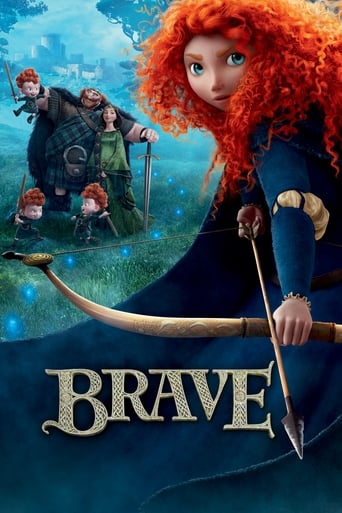
In the mystical Scottish Highlands, Merida is the princess of a kingdom ruled by King Fergus and Queen Elinor. An unruly daughter and an accomplished archer, Merida one day defies a sacred custom of the land and inadvertently brings turmoil to the kingdom. In an attempt to set things right, Merida seeks out an eccentric old Wise Woman and is granted an ill-fated wish.
7 positive9 negative1 mixed21 neutralfrom 38 commenters
Where to watch
No streaming data for this title.
41 comments on Hacker News
In the movie Brave (which my kids love), will o the wisps are featured prominently. It was a great nerd dad moment to explain the blue flame / swamp / deep forest connection to methane and peat moss. My wife cared only a little bit but the threenagers had lots of questions.
Even if Bluey was strange Australian propaganda to make fatherhood desirable and respectable, it still wins because it actually works at it.
Avoiding the "dumb sitcom dad" has been done before a few times, and well (Bob Parr of Incredibles; Stoick the Vast of How to Train Your Dragon; King Fergus of Brave could be some examples) - but Bandit just is a dad; he's not perfect, he's not brilliant - but he's there (except when he has to leave) and he loves - his children, his wife, himself.
And even though he says "I'm not taking advice from a cartoon dog" we all end up doing so.
I had the incredible good fortune to cross paths with iq at Pixar; I was an intern while he was developing the Wondermoss procedural vegetation system for Brave. A bunch of us interns were already fans of his work from the demoscene world and upon learning this, he was kind enough to put together a special lecture for the interns on procedural graphics and the work he was doing for Wondermoss. That was one of the best and most mind-blowing lectures I've ever seen- for every concept he would discuss in the lecture, he would live-code a demo in front of us (this was before ShaderToy was a thing, so live-coding was something nobody had ever really seen before), and halfway through the lecture he revealed that the text editor he was using was built on top of his realtime live editing graphics system and therefore could be live-coded as well. One of the things he showed us was an early version of what eventually became the BeautyPi tech demo [0]; keep in mind that this still looks incredible today and iq was demoing this for us interns in realtime 14 years ago.
Wondermoss was a spectacular piece of tech. Every single forest scene and every single piece of vegetation in Brave is made using Wondermoss, and it was all procedural- when you'd open up a shot from Brave in Menv30, you'd see just the characters and groundplane and very little else, and then you'd fire up the renderer and a huge vast lush forest would appear at rendertime. The even cooler thing was that since Brave was still using REYES RenderMan, iq took advantage of the REYES algorithm's streaming behavior to make Wondermoss not only generate but also discard vegetation on-the-fly, meaning that Wondermoss used vanishingly little memory. If I remember correctly, Wondermoss only added like a few dozen MB of memory usage at most to each render, which was insane since it was responsible for like 95% of the visual complexity of each frame. One fun quirk of Wondermoss was that the default random seed was iq's phone number, and that remained for quite a number of years, meaning his phone number is forever immortalized in pretty much all of Pixar's films from the 2010s.
iq is one of the smartest and most inspiring people I've ever met.
[0] https://www.youtube.com/watch?v=_9CZ9UgrcZU
I wholeheartedly disagree. Pixar does not have a monopoly on attention to detail. They're flush with cash and their leadership has decent taste.
There are so many creators putting in intense work, and doing it on low budgets. You can't claim these folks don't have attention to detail. Check out A24, low and mid and low budget films, or independent films and you'll see a wide assortment of highly meticulous storytellers.
Pixar, on the other hand, isn't low or mid budget:
Toy Story - $30 Million A Bug’s Life - $120 Million Toy Story 2 - $90 Million Monsters, Inc. - $115 Million Finding Nemo - $94 Million The Incredibles - $92 Million Cars - $120 Million Ratatouille - $150 Million WALL-E - $180 Million Up - $175 Million Toy Story 3 - $200 Million Cars 2 - $200 Million Brave - $185 Million Monsters University - $200 Million Inside Out - $175 Million The Good Dinosaur - $200 Million Finding Dory - $200 Million Cars 3 - $175 Million Coco - $175 Million Incredibles 2 - $200 Million Toy Story 4 - $200 Million Onward - $175 Million Soul - $150 Million Luca - Unknown but probably around $150 Million Turning Red - $175 Million Lightyear - $200 Million For that amount of money, they had better pay attention to detail.
Miyazaki is doing way more with much less.
Voices of a Distant Star was one person -- Shinkai. That's the kind of thing we'll see more and more of. Small creators reaching audiences and building studios. Gooseworx, psychicpebbles, Vivienne Medrano. That's the algorithm of tomorrow.
AI, as a tool, makes this more possible. One of the first people to do it successfully was Joel Haver, and he's just the first of many to come.
If there is a disagreement between the director and the studio, they will negotiate with each other about which changes to make. But the director is never cut completely out of the process.
There are a lot of directors who would disagree with you on that...
Disney is notorious for this; off the top of my head, Ant Man, Rogue One, Solo, and Brave changed directors because of disagreements with the studio in post-production. With the Marvels, it is widely known that the director did not have final cut of the film. Bryan Singer and Steven Soderbergh have been replaced on movies due to disagreements with studios after filming had started (and in both cases, the films at issue went on to be multiple-Oscar nominees). Cary Joji Fukunaga was replaced on It due to disagreements with the studio (but retained writing credit) right before filming started; and he replaced Danny Boyle on No Time to Die after Boyle was let go due to disagreements with the studio.
If the studio tries to take creative control completely away from the director, the director can petition the DGA to have his or her name removed from the film.
The director always is consulted during the edit, and in most cases works very closely with the editor. The studio may or may not insist on changes later, but there is just no universe where the editor makes changes alone with no input from the director at all. The DGA would have a fit if that happened.
This is just incorrect. Indeed, what you suggest is at odds with over a 100 years of film history...
The DGA does not have a fit over stuff like this because a director is not entitled to "complete creative control" or to "final cut" unless they negotiate for it, get themselves hired as editor on the film they direct (which would also involve them being a producer), or work with a studio that embraces the auteur school of filmmaking (in which the released film represents the director's vision of the film).
It's one thing to support the auteur school since it usually results in better films (counterpoint: most Netflix films), but it is objectively not the way most films are made.
> You're right, Leia was a much better character than Rey.
Rey's issue is what's plaguing too many female movie characters today. She had no flaws she had to overcome. She was perfect from the start and didn't have to grow. She had a few training montages in the movie, but that's about it.
In Brave for example, Merida's pride (a flaw) causes her mother to be cursed. She has to learn to accept help from others to grow.
Wall-E was made in the pre-messaging-first age.
There is a message, but the main focus is between Wall-E and EVE. They didn't add any LGBTQIA+ themes or racial issues in there, because it didn't make sense for the message - which was "take care of the environment"
Strong leading women aren't the problem either. We've had those ages ago. I think the first major one for Pixar was Brave (2012). For Disney we had Ariel, Pocahontas and Mulan in the late 1900s.
Disney's problem is that they forgot that story and characters come first, a movie doesn't have to have an overt agenda. I'd prefer the 80's tv cartoon style where they always had The Lesson in the end of the episode after He-Man spent 20 minutes beating up bad guys in the toy ad disguised as entertainment.
At some point in the 2000s Pixar shifted from making movies for everyone to making movies for certain demographics, or people with certain issues in their life. Moving, strained relationship with parent, a purpose in life etc. Not every movie resonates with everyone, but almost every movie has its defenders. Maybe Brave doesn’t work for you if you and your mom don’t have trouble. Maybe Soul doesn’t work for you if aren’t a bit down.
They are also perfectly ok making simpler movies like Luca, that aren’t trying to be some sort of epic treaties.
What Freddie is getting wrong here is projecting his ranking onto everyone else, even when he is calling out the critics as being the wrong audience for the movies. A lot of the movies aren’t made for critics, but because the director or storyteller has something really personal to say to a subset of society.
Cars 2 and The Good Dinosaur (which I’m not sure I’ve even ever finished) are their only real true misfires. A lot of their whelming movies (Onward, Lightyear) feel that way because they feel like a waste of premise and opportunity more than actually bringing bad.
de Boer claims that the trailer for Brave belies the fact that it was stuck in development hell, so much that includes content not in the movie --- but everything in that trailer is in the movie, so much so that the "mountain" Merida is seen climbing was critiqued for being Yosemite geology rather than Scottish.
I'm baffled by the claim that Ratatouille is intentionally hard to love. I think it's a telling statement. de Boer's schtick is, of course, contrarianism for its own sake (it's why so much of his writing ends up here, despite the fact that his writing beat almost never overlaps HN). It's as if he assumes that anything he likes must be an outsider pick. In the world I inhabit, Ratatouille is universally beloved, with a higher gross box office than the allegedly crowd-pleasing Cars movies or any of the Toy Story films.
The whole paragraph really comes across as a parody of the Rick and Morty copypasta, but I don't think that was deliberate.
After 2006 they were still knocking out an extremely high rate of absolutely impressive films:
Wall-E -- if you don't love this film you are possibly dead inside. It's not only absolutely beautiful and emotionally communicative, it's a deeply clever pastiche.
Up, as observed below.
Toy Story 3 came out after Up. And it is a work of acutely well-observed cinema. A staggeringly good film that should have won the Best Picture Oscar. [0]
Brave (2012) is critically neglected, too -- that is a beautiful, subtle, yes quite elusive film, despite what the article says.
And then there are films I have not seen yet but I am told are clever, inventive and beautiful -- Coco, Inside Out, Soul.
They are by any measure still a masterpiece factory. This article is lazy, toxic and cynical.
[0] edit: when I say this, I say it in the sense that surely everyone knows now that E.T. the Extra-Terrestrial should have won Best Picture, not Gandhi. Even Richard Attenborough thought this.
Yup. Even if you only look within a relatively small category of films one per year can miss a bunch. For example, consider the category of animated feature length films released after 2000 in the US, and pick one per year by picking the winner of the Academy Award for Best Animated Feature.
In 2001 you'd miss Monsters, Inc. because of Shrek.
In 2002 you'd miss Lilo & Stitch because of Spirited Away.
In 2004 you'd miss Shrek 2 because of The Incredibles.
In 2005 you'd miss Howl's Moving Castle and Corpse Bride because of Wallace & Gromit: The Curse of the Were-Rabbit.
In 2008, no Kung Fu Panda because of WALL-E.
In 2009, no Coraline or Fantastic Mr. Fox because of Up.
In 2010 you'd miss How to Train Your Dragon because of Toy Story 3.
In 2011 no Kung Fu Panda 2 because of Rango.
In 2012 no Frankenweenie, ParaNorman, The Pirates! Band of Misfits, or Wreck-it Ralph because of Brave.
In 2014 no How to Train Your Dragon 2 because of Big Hero 6.
2015 no Shaun the Sheep Movie because of Inside Out.
2016 you miss Kubo and the Two Strings and Moana because of Zootopia.
2019 No How to Train Your Dragon: The Hidden World because of Toy Story 4.
2021 you'd miss Raya and the Last Dragon and Luca because of Encanto.
Most of the winners are good...but if you just put all the above mentioned films in a pool and asked most people to pick their top 14, most would have a lot of films on their list that were not among the winners of the aforementioned years.
> They're still making good ones: Frozen, Moana, Encanto. Just watch those and pretend the rest doesn't exist.
Probably the most objective way to view this is to actually look at the list of films from any given decade and see how many flops they had [1]. There's a bias at play here: the only movies we remember Disney making a decade+ ago are the hits. We don't often remember the misses.
Apparently Disney's "Renaissance" ended with Tarzan in 1999; but here are a list of movies that have come out since the end of this golden era:
- Monsters, Inc.
- Lilo and Stitch
- Treasure Planet (a personal favorite)
- Finding Nemo
- Pirates of the Caribbean
- The Incredibles
- Ratatouille
- WALL-E
- Up
- Tangled
- Brave
- Wreck-It Ralph
- Frozen
- Inside Out
- Encanto
I'm sure there's many great ones that you might love that I'm missing. But I'd say this lineup is potentially better than the list of movies spanning The Little Mermaid to Tarzan. To the author's credit, I will say there's part of me that's nostalgic for the traditional style of 2d character animation.
[1] https://en.wikipedia.org/wiki/List_of_Walt_Disney_Pictures_films
Inside out was good, but not great, IMO.
Counter-counterpoints:
Cars 2, Brave, Monsters University, The Good Dinosaur, Finding Dory, Cars 3, Coco, Onward, Luca, Turning Red, Lightyear.
The (not very original) point is: You can no longer count on a Pixar movie being excellent.
I guess it's subjective. I found brave quite decent and there were some moving moments.
Worst for me would be Cars 2 and in the context of general films, it's still okay.
I was watching a behind the scenes featurette of Pixar's Brave and suddenly, there's Inigo! Turns out he was brought in to assist the animators with rendering the moss in the movie procedurally using a raymarching technique as he does here for the girl.
Interesting point about reviewers skewing positive for popularity. My big issue with most recommendation engines is that they're biased towards false positives rather than false negatives. The other way would lead to fewer, more focused recommendations.
In particular, I'd like to see an engine take a reviewer's dislikes into account more. If someone likes (switching to film for an accessible example) Cinderella, The Little Mermaid and Mulan, their opinion on Brave isn't going to carry much information as they're pretty indiscriminate about Disney films. But if they love Mulan, dislike Little Mermaid and hate Cinderella, their opinion on Brave is more likely to line up with my own.
In the cases of Brave and Moana at Pixar and Disney Animation respectively, the story definitely came before the tech was developed. I was an intern at Pixar during the production of Brave, and I worked on Moana, and I can say that in both cases, there was a mad scramble to develop the tech to catch up with the story. We didn't really have the water on Moana working completely correctly until like 6 months before the movie came out.
It's not like Mulan was focused on being pretty and waiting for a prince either. Or Brave(not pre-2000, just not recent), or even Pocahontas.
I feel if anything the "pretty is everything" comes from toys, rather then the movie plots themselves.
There are about 20 Marvel movies, 11 Star Wars movies, and 2 Star Wars TV shows. This is not about watching them when they come out, it's about being able to watch the entire backlog whenever I want. (Assuming they make their entire backlog available, which they should.)
Also: tons of Pixar movies. And I still haven't seen The Lion King and Aladdin. Or pretty much any Disney movie other than Brave.
If it's not your thing, that's fine, but I've got two kids, and Netflix is a bit short on movies for the whole family that are fun for both kids as well as parents. They're great at stuff for just the kids or just the parents, but for the whole family is what Pixar and Disney are good at.
From 2013, which might be why the most recent movie referenced is Brave.
If you're interested in a slightly more concrete example of the math going into Pixar movies, here's a Numberphile interview with Tony DeRose from around the same time:
https://news.ycombinator.com/item?id=8610626
> It's ridiculous movies don't tell women stories, nor show women characters; just "love interest", "plot device", etc. Even in fantasy a female lead is surrounded by a male ensemble or is a proto-male.
Looking at the Disney films made in the past decade, it appears female protagonist leads are more prevalent (e.g. Moana, Brave, Frozen, Spirited Away, etc.)
Wreck it Ralph puts the love interest relationship between Felix and Calhoun (and subverts it all over the place).
Those are all quite recent, while the historical Disney films all fall into the traditional template of male and female lead falling for each other. To the extent that Enchanted can assume the audience knows the formula that they're parodying.
There is indeed a recognition and a policy change that stories don't have to be made to fit that formula any more. And it seems that the films are exploring other affectionate relationships, such as the sisters in Frozen. Wreck it Ralph clearly has affection between Ralph and Vanellope, but it's more a parental/big-brother-little-sister thing than a romance. Brave focuses on mother/daughter. And so on.
Brave, with its tomboyish princess Merida is one.
Disney even got some flak for "glamming" her up to be like other Disney princesses [1]
[1] https://www.theguardian.com/film/2013/may/16/disney-princess-merida-makeover
here's my review from when i saw the movie:
Finally went and saw Brave. And, I have to say, I was disappointed :(
Oh, the movie certainly had its good points. It was technically gorgeous - both the artwork and the character animation were Pixar at the top of their very considerable game. And despite complaints of the story being overly Disneyfied it was satisfyingly subversive[0] of many of the tired tropes it referenced. I didn't even mind that it was predictable[1] - fairytale movies tend to be, and that is often part of their charm.
No, what ruined it for me was that it was a fundamentally boring movie. The dialogue was bland, the humour was slapsticky (which tends to fall flat for me), the moralising was heavy handed, and there was no real tension other than that required for the linear development of the plot. Even the "jokes for the adults" that have practically become de rigueur for big-budget animated movies weren't all that funny (though I did blink a bit at the Wicker Man reference).
All in all, not one of Pixar's best.
[0] http://thenewinquiry.com/essays/just-another-princess-movie/
[1] it was nice that it ended with her going her own way rather than finding a nice boy to marry, but it wasn't really what I'd call a plot twist
Cars is not a bad movie, it did very well, it was just a little below normal Pixar quality but still above most other studios work.
The good dinosaur, Brave and Monsters university all still good but not quite Pixar.
Cars two is an absolute disaster though and it's a shame it wasn't covered in the book. Something clearly went very wrong with this movie and they redid most of it in ten weeks or so I read, it seems to go against all the values and things they talk about and it does feel as if the story they tell about themselves is perhaps worked as much as the stories they make.
The science behind the movie was very clever. What has disappointed me is that Disney/Pixar keep on pushing the sexism gambit in their movies. This movie wasn't as bad as some of their others, but they are Consistently failing to address gender in a balanced way. Does anyone male in this movie do/say anything good? What about Frozen? The stupid (Wessleton) and nasty (Hans) are only male. Brave? Same thread. The kings/Princes are all obnoxious and/or stupid. Wreck-it-Ralph : Kowalski strikes Ralph across the face as a show of might and it's meant to be funny (ie. The modern assertive woman who bashes men as "humour") Several of the tinkerbell movies where ratchet & clank are the typical stupid males (and in most of them, they are almost the only males). To be fair. They do portray the southern belle as a dimwitted hick too, which is the stupid southerner prejudice emanating from the U.S. civil war. However, they did a great job with Tangled and Princess and the frog - there's a much better gender balance in those movies. It's a shame. You take your kids to see a supposedly family friendly movie and you cringe at the sexism that is pushed by the writers and directors. Do you just shrug it off, wondering if this prejudice won't rub off on your kids - or do you highlight the sexism to your kids and ask how a large studio could be so consistent in their bias, despite their deep attention to the science. I can't help feel there is more sexism and more conscious sexism than there has ever been. It really makes me sad.
There's a scene in "Brave" (the animated movie) where you see Merida fire an arrow. The scene is rendered in slow motion and you can see the arrow flex as it leaves the bow. I knew that arrows flex as they are being fired, but this was the first time I had seen it in slow motion. Comparing what I saw in the movie with this video suggests to me that the animators did a very good job of getting this detail right.
I think Wall-E was the pinnacle, and was apparently the last of the original ideas they brainstormed up in the beginning. After that was Cars 2 and Brave, which I think were perceived as ok, but not at the level of their previous films.
I would say it's debatable as to whether YouTube has been harmful. I think many aren't a fan of the licensing changes and other experience elements, but maybe those would have happened anyway.
I agree w/ Pixar to some extent, but it seems they have seen a slight decline in quality recently (Cars 2, Monsters University, Brave). I think particularly, they may be looking for more opportunities to exploit previous franchises vs. making quality films. Cars 2 was the best example of this, as was evident by the mounds of merchandise on store shelves following the release.
Again, both of these are debatable, but I still don't think you can say in either case that the acquisition was favorable to the consumer.
Brave was an exception, or a turning point depending on how you see their later releases.
A large number of Disney works have been "inspired by" other works. I'd estimate just under half, but this changes with every release. They do seem to be getting more original, but that seems to be mainly due to the Pixar team.
The quote below was from 2002 when there were a total of ~45 Disney animated feature films.
"a total of 28 films that have acknowledged sources outside of The Walt Disney Company itself, more than half of all the movies they've made to date."[1]
There are now around 79 released feature films (Based on http://everything2.com/title/Disney+Animated+Features), of which 34 (to my count) are not original so it looks like they are slowly improving.
Now they just need to stop making multiple sequels for everything...
[1]: http://everything2.com/title/How+many+Disney+movies+are+actually+original+stories%253F
Disney paid $210MM to produce _Brave_, which money went not only to creatives, animators, and movie production types, but also to software developers, testers, devops teams, and network administrators.
That all the stories occur in the same universe is a given. Oddly, The Pixar Theory gives no reference (much less credit) to the long-running proliferation of Pixar characters appearing in other Pixar movies. This includes characters from future movies, like Wall-E seen in Toy Story. The Pixar Theory, in its long-history view, fails to address proof most of the movies occur within a narrow timeframe, via facts like Heimlich (from A Bug's Life) appearing in Toy Story 2, and the Pizza Planet truck appearing in every movie (partial exception for Brave, where it appears as a carved-wood toy alongside a bas-relief of Sully).
The Pixar Theory takes a vague notion and just, as noted "post hoc, ergo proter hoc", creates an elaborate and baseless theory to justify it a la most conspiracy theories. Alas, there is a great deal of facts available to both destroy the theory as presented, and at the same time prove the "one Pixar universe" premise to far more comprehensive and compelling effect. Instead of a few vapid paragraphs, the website should be a collection of the dozens (hundreds?) of images tying all the stories together.
The worst of it was that most of the fitting wasn't necessary. There is no need for there to be a link between Up and Toy Story - both stories can exist in the same universe, as there is nothing contradictory.
In fact, the author of the page doesn't seem to want all the films to be in the same universe. S/he could more accurately be described as trying to reduce the number of "magical" artifacts necessary to explain all of the things in the films that don't exist in real life. So we have the discovery of magic in Brave, and the creation of unlimited energy / strong AI in The Incredibles, and everything else flows from that. Of course trying to tie everything to just these two root causes ironically makes them all less believable than the suspension of disbelief for each individual act of "magic".
You also have to consider that Monsters Inc. was one of the earlier Pixar movies.
The contrast to Brave isn't that extreme.
Wait, wait, stop everything.
You haven't seen the movie, so you have no first-hand knowledge of the relevant issues the co-director is trying to address. Specifically, the issue is not feminine identity as a whole (or the fact that Disney has 8-9 other princesses who have that demographic pretty much sewn up) but that one of the biggest themes in Brave is that Merida doesn't want to be the stereotypical princess that society says she has to be; she can and does choose to be the tomboy archer who goes her own way.
BUT NO! Intelligent discussion and on-topic conversation be damned, you have something to say about your five sisters and how they like to bake in sparkly clothes while you like to be manly! GREAT! GO DO THAT! NO ONE IS SAYING YOU CAN'T.
But that's not good enough. Instead, you create a contrarian strawman that has nothing to do with the OP but that riles up the internet masses who want to defend personal visions of gender identity which have never been in question. If internet comments mattered, I'd call your behavior shameful, but that'd be overselling it. Instead I'll just point out that you have no room to speak about intellectual communities if this is your modus operandi.
You are stretching on all of you examples.
The Men's Warehouse commercials are as I described before, they talk about looking good for a function - work but life also. This is the pragmatic men's marketing. It's not the 'expensive so it must be good' branding that is on a lot of female products.
When was the last Disney 'prince' movie? Aladdin? Lion King? Meanwhile, Disney has now deemed Mulan and Tinker Bell as a princesses, there is now an African-American princess (Princess and the Frog), they added another pretty, white princess (Rapunzel from Tangled), a Scottish princess (Brave) and Disney is adding a hispanic princess[1] (although light on the hispanic). Girls have been sold the knight in shining armor. Boy could care less about princesses they just want be an action hero.
Diamond advertisements that talk about 'investment' are for men, but there aren't many of those. It's all about 'forever', 'love', etc, which are emotional pleas to women.
And the Superbowl has A TON of women watching[2]. It's sexist to think otherwise. The NFL is openly courting women as a way to increase viewership[3].
[1] http://www.examiner.com/article/disney-s-princess-sofia-the-first-the-first-hispanic-disney-princess
[2] http://jamiedunham.wordpress.com/2013/02/03/marketing-to-women-women-watching-super-bowl-too/
[3] http://www.nytimes.com/2013/01/06/sports/football/nfl-hones-message-for-its-female-fans.html?_r=0
Hah. If you look for the animated Pixar movie "Brave" and look at the "More like Brave" section it suggests "Magic Mike" (Yeah the stripper dude movie). That algorithm needs work.
I can think of 4 movies I saw this year so far that I enjoyed:
1. The Dark Knight Rises
2. The Amazing Spiderman
3. Bourne Legacy
4. Brave
However, I did catch a few hidden gems I had never before seen or heard of on Netflix Instant. My absolute favorites are "Morning Glory", "The Answer Man", and "Beware the Gonzo".
I suppose it says something that Argo and Moonrise Kingdom are the only movies that I can remember really liking in 2012. Flight was also memorable, if you're into character dramas. I've also heard really good things about Searching for Sugar Man, but I didn't get a chance to see it in theaters.
Avengers was solid entertainment, but I wouldn't make a special trip to see it. Most of the other big releases with nerd draw were disappointments: Lincoln was overhyped Oscar-bait, Brave was forgettable, and the last Dark Knight movie was just bad (below average for summer movies, which is a low bar).
Playings devil's advocate: There are many ways to incentivise even complex, large scale investment absent copyright. From project finance to Kickstarter, it is well beyond self-evident. On the flip-side, the cost of supressing academic and sciendific knowledge through academic publishers dwarfs whatever entertainment value might come from their library (~12 films)[1]. I think your comments on this are too simplistic.
________
[1] Toy Story, Toy Story 2, Toy Story 3; Monsters, Inc.; Finding Nemo; The Incredibles; Ratatouille; WALL-E; Brave; A Bug's Life; Cars, Cars 2
I think they have highs and lows. Wall-E was pretty much everything I would want in a big budget movie, but it wasn't a megahit. Then I see the previews for Brave, which looks dreadfully bad, and I can't help but think the company is changing.