 Hacker Cinema
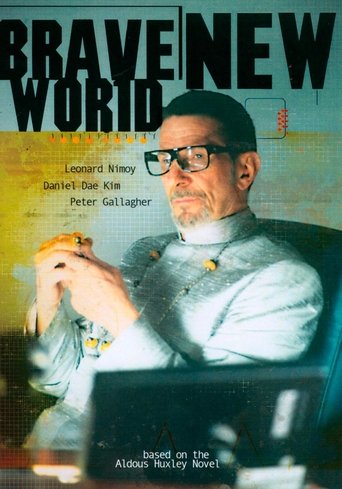
Brave New World
1998 · Film · 87 min
Directed by Leslie Libman, Larry Williams
In a futuristic totalitarian utopian society, babies are created through genetic engineering, everyone has a predestined place in society and their minds are conditioned to follow the rules. A tragic outsider jeopardizes the status quo.
1 positive1 mixed10 neutralfrom 12 commenters
Where to watch
No streaming data for this title.
12 comments on Hacker News
I'd argue that makes Black Mirror more prescient.
In the case of Black Mirror, it was a set of studies on the dangers of current and near technologies. That some of those fears are materialising not long after the episodes, is in my opinion more damning than Orwell's fears of the state which didn't really come to pass in the same way, even decades later.
I don't disagree that Nineteen Eighty-Four is essential reading however. ( I'd also add Brave New World to that list ).
I think he was inspired by Valium and other benzos. They put people into a docile, low-anxiety state, and they were popular around the time the book was written.
That's also more-or-less consistent with the implied literary reference to the Lotus Eaters, who I think are usually imagined as opium users. Opioids are different but are also downers that reduce anxiety.
Benzos later featured significantly in one of Adam Curtis' film-essays -- maybe Century of the Self, maybe another one. I'd view those films as being in a similar spirit to Brave New World.
The classic dystopias in literature described a supposedly future time, in order to criticize the present. The classics: Clockwork Orange; Farenheit 451; Brave New World; 1984.
Now there's a new trend in this genre, where a supposedly possible future time is described in order to glorify the present, and defend it against all possible change, good or bad, because "it could become worst". Handmaid's Tale is a good example. It makes catholic religion look so good it's sad. The total absence of criticism towards a religion tied with the institutional rape of thousands of children[0], and hatred of women, for instance, is absurd. And the fact is the raping is still going on as you read this. Of course this is only a single point of failure and absurdity amongst many others. Whilst Huxley, Orwell and others were driven by passion and rebellion against injustice and misery and desire to change life, low quality scripts like the one on this TV series are clearly motivated by making money while surfing/exploiting current social media cultural "trends". Disgusting.
0: https://www.bbc.com/news/world-44209971
Can't recommend enough the Intelligence Squared episode on Brave New World vs 1984
https://www.intelligencesquared.com/events/brave-new-world-vs-nineteen-eighty-four-with-adam-gopnik-and-will-self/
Soma is a fictional drug popularized in Huxley's Brave New World, and used to ritually sedate the populace in seemingly benign but pervasive manner. It's closely associated with with consumerism, in the of form of "feelies" (also from BNW), as Huxley was alive to witness the transition from silent films to "talkies", and didn't respond to the perceived gross spectacle. In my mind, soma is a generalization for all that preys upon human weakness, and for something that is justified, even by intelligent, renowned individuals, via illogicality and appeal to human nature ("it's fun", etc). Rather than consider the value of the intoxicant itself compared to the innate conscious state, you typically see defense of it and claims of its banality and harmlessness. This is cognitive dissonance and justification, nothing more.
The government wins by profiteering either way off of legalization or not. Police states enforcing the war on drugs is profit, and tax revenue from legalization is profit. The people celebrating the current trends as a win are delusional.
It's a Brave New World (by Aldous Huxley) reference. It's worth reading if you haven't.
EDIT: In the book Huxley imagines a new society. One of the hallmarks of the society is there is no pain or suffering. This is accomplished in part by Soma, a fictional drug perhaps best described as a no negative side effect tranquilizer or opiate.
EDIT EDIT: The society also removes almost all major sources of pain. A person is chemically engineered (was written before the discovery of DNA) to be happy with their job and position in life since conception. There are no parents. There is sex but no romantic love. In avoiding pain almost all the happiness in the society is superficial, coming from sex, drugs and movies. They might be happy, in the most shallow meaning of the word, but there is clearly no joy.
Some episodes are much stronger than others. I think the eye camera episode was good, because it humanizes the dystopia: it moves past abstract moralizing and unrealistic "how things could be" like in e.g. Brave New World and gives you a real human story. It feels more real than reading stories about orgy-porgies, etc. And the technology for it is basically already here.
I think Altered Carbon is a better dystopian tech story though. The actual plot is not even really the point. The setting, backdrop and society that it envisions feels more plausible than any episode of Black Mirror.
The best sci fi dystopian stories imprint our current economic and social structures onto a new future with technology: the world of Altered Carbon asks what if we had our current economic system, which creates a class of impossibly powerful oligarchs who hoard all of the world's wealth and act with impunity while the poor suffer and die, but now these technologies allow their power to extend and expand indefinitely, past death?
The crux of every tech sci fi dystopian story is the question: What if we progress technologically but refuse to progress economically or socially? What if we encourage people to study STEM and sneer at the humanities forever? What if economics is always taught as an exercise in cheerleading for our current system?
Media like this makes us think about the changes that need to be made as technology more and more amplifies the (potentially bad) choices we make about the world we want to live in.
It's easy to get caught in the echo chamber of "technology good, disruption good, gadgets fun" especially living in the tech world so I think it's great stories like these make us take a step back.
(Gattaca is a fictional movie, not a realistic outcome. What anyone thinks about it is irrelevant because it has not, will not, and could not happen, any more than Brave New World.) As far as making use of these techniques, certainly. Transhumanists, socialists, and 'liberal eugenicists' have always advocated 'seizing the means of reproduction', so to speak, but it's mostly been theoretical; modern behavioral genetics has fill in so many of the blanks that concrete discussions and analyses can be done, IVF embryo selection can be done right now, CRISPR can also be done now if you can find anything useful to do with it besides fixing rare genetic diseases, and IES and genome synthesis will be possible within the next 20 years.
This sophomoric understanding and attitude is mind boggling.
So your argument is "...but guys why would we want a utility to be treated like a utility!?"
You're entire premise is based around the idea that this regulation is fine because the "good guys" are in charge but what happens when "bad guys" are in charge. There for the only reasonable system is to limit the potential power of the "bad guys" by limiting effectiveness of government to a practically nonexistent state.
Well guess what, "bad guys" don't magically limit themselves to government.
(For the record here I'm defining "bad guys" as individuals, groups of individuals or organizations that would freely and willingly negatively affect the welfare of large groups of people for their own benefit. This could mean direct monetary gain, indirect gains from those that directly received them, societal gains, ideological or psychological gains from the feeling of imposing your will and views on others, etc. etc.)
It doesn't matter if we're talking about politics, commerce, religion, whatever. People like that are drawn to ANY institution that gives them the opportunity to advance their own interests. Hell we all do it to some degree. Some of us are obviously worse than others in both degree and extent.
The reason this regulation came about is many see the internet as a utility of great public interest. Meaning widespread, reliable, easy and cheap access to it has the potential of accelerating the growth and prosperity of our society and species as a whole. I hop I don't have to explain to you have worse off we would be without water, electricity, sewage and telephones being treated as public utilities.
In this instance that "bad guys" slithered their way not into the government side of the equation, but into business side. One of the only methods of countering "bad guys" in the market is classic free market principles. Free competition would mean "good guys" are able to enter the market and naturally drive the "bad guys" out. Invisible hand and all that jazz.
Reality does not often work like that though. It's far more complex. By using tactics to reduce competition such as buying up competitors or forcing them out of business, [mostly indirect] collusion to split up geographic markets, creating artificial barriers to entry, influencing regulation to prevent communities helping themselves, etc, they were able to carve out a pretty comfortable little position for themselves in the economy. That's not even mentioning the fact that even without all that some markets are inherently resistant to free market forces thanks to natural barriers to entry such as the the sheer difficulty and cost of laying physical lines.
Now these "bad guys" (note: obviously some excellent [mostly smaller] ISPs remain) are set up in a position to adversely affect the very prosperity of our society increasingly dependent on access to information and communication. I.e. fuck your start up and your ability to reach potential new customers because you're not peered with our "Lead Generation Package™", fuck your farm and any hope you had of learning new techniques because that site can only be reached with "Access Plus™" package, fuck xyz but please enjoy our own content network for Free™. Fuck you and whatever economic influence we might be having on your lives or businesses. Instead we're going to do all this mostly so you watch more of OUR TV SHOWS and ADVERTISEMENTS.
If i didn't find it so disturbing I would find it hilarious you used Brave New World in your argument AGAINST these regulations.
These regulation are important because with some things it doesn't matter who says them.
"DON'T FUCK WITH OUR PROSPERITY BUT FUCKING WITH PEOPLES ABILITY TO SHARE IDEAS AND INFORMATION"
That's what it comes down to and it's pretty simple.
After all if Hitler himself said "do not eat babies" you wouldn't throw your hands up in response "well looks like we need to ban any future possibility of anti baby eating rules if HITLER can say not to eat them."
If the FCC actually starts doing things you're talking THEN lets talk. It's a good thing we live in a system that lets us do that it's it?
The idea that there's some "magic bullet" that can limit the "bad guys" indefinitely is frankly juvenile at best. The idea that that "magic bullet" is limiting regulatory powers to non-existent is fucking absurd, "because "bad guys" only choose to slim their way into government" right?
The fact of the matter is the only thing that can stop "bad guys" is "good guys" having constant vigilance and a system of checks and balances that enables them to do something about it. In this case the voice of the "good guys" is being heard through sound public policy checking and balancing the power of large incumbent businesses.
While I love the movie, it is flawed:
Genetic manipulation need not result in class and genetic discrimination and eugenics existed before many advances in genetics were made.
Compare with "Brave new world": genetic manipulation as a result and a tool of a classist and discriminating society, not the cause. Of course, BNW is different in other ways.
I still love the movie because of its many other themes - bravery, perseverance, whether you should be prevented of taking risks. I would still recommend it to anyone.
Books can be worth reading without being good books, especially sci-fi. Brave New World is absurdly heavy-handed, but it's worth reading because it describes an important type of social dystopia. Honestly, I think 1984 is just as over-done, but the ideas are more significant (and relevant) than the stories or characters.
There's nothing wrong with Do Androids Dream of Electric Sheep. You're probably right that it receives outsized attention because of the movie, but it's a fine book in its own right. It's probably one of the easier PKD books to get into if you're not used to him in particular or sci-fi in general, which is reason enough to recommend it to someone.
One of the latter's more enduring motifs actually ended up as the title for the type of TV show Orwell coined the word prolefeed for...
Brave New World is probably actually the more relevant book to today's hedonistic, rampantly consumerist world. Even if the slightly tongue-in-cheek references to 'his Fordship' seem a little quaint we certainly haven't lost our tendency to worship distantly superrich media personalities. Then again, we're probably too busy checking our Facebook feeds to go back and read it