 Hacker Cinema
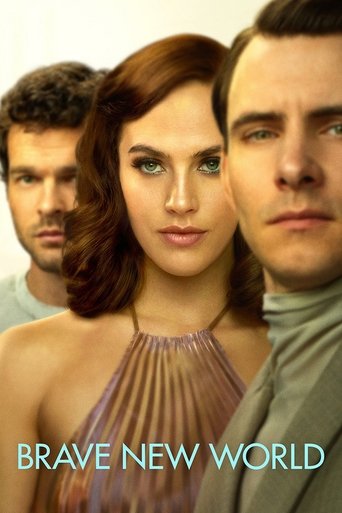
Brave New World
2020 · TV series · 1 season
Created by David Wiener, Grant Morrison, Brian Taylor
In a utopia whose perfection hinges upon control of monogamy and privacy, members of the collective begin to question the rules, putting their regimented society on a collision course with forbidden love and revolution.
3 negative1 mixed10 neutralfrom 14 commenters
Where to watch
No streaming data for this title.
17 comments on Hacker News
In one of the movies, they did clone a human, they just didn't lean into that story line. It was treated as a one-off, but the same science allowed both. (in the fictional story)
The point isn't that we'll have humans tomorrow. Just that this one step. We'll need to solve problems on simpler animals first. An egg is easier than a womb, a chicken is easier than a human. It's the start.
So yes. Brave New World isn't today. But its obvious this technology is on the same path.
>Recently, researchers have used these stem cells to create structures that seem to mimic the early development of actual human embryos. At the same time, artificial uterus technology is rapidly advancing, and other pathways may be opening to allow for the development of fetuses outside of the body.
>Such technologies, together with established genetic techniques to inhibit brain development, make it possible to envision the creation of “bodyoids”—a potentially unlimited source of human bodies, developed entirely outside of a human body from stem cells, that lack sentience or the ability to feel pain.
Where have I seen this before? Isn't this a plotline taken directly from numerous dystopian science fiction books and movies I have experienced? Life imitates art. Was this outcome inevitable? Think Aldous Huxley 'Brave New World'.
We do proper apocalyptic books and films in the UK! If you survive "Threads" and "When the wind blows", why not wash it down with some dystopia! 1984, Animal Farm, Children of men.
Other apocalypses and dystopias are available. The UK is not the sole source of them. 451F, Brave New World ...
I found this as a back-link from the TV movie of Huxley's Brave New World, https://www.huxley.net/bnw/bravenewworld.html
The problem with changing the world that was created by a writer is that the world had become so popular for a good reason.
I didn't read Dune nor Brave New World, but I loved the Dune movie and didn't enjoy Brave New World series, because it just didn't make sense. I love exact book adaptations even if I hadn't read the book.
Nature: living every day like you're in a slasher horror movie. Really, really bad. It only seems fun and wholesome to us because we're on top and almost none of us spend much time genuinely engaging with nature in even the way that an apex predator has to, let alone prey animals. And jeez, why would we? It's terrible.
Factory farm: living every day (and probably not very many of them) like you're in Saw or Cube or something. Far worse than even the pretty bad situation that is life in nature. Like, a lot worse. And that was already pretty bad.
Ethical farms, keeping backyard chickens, et c: Like living in a relatively good dystopia. Brave New World, maybe, in the best case. Logan's Run, in the worst.
,, The business model is refreshingly simple: people pay to watch shows they'll enjoy''
I believe that this is true, but I also have a feeling that the main goal for netflix is maximizing views, and not maximizing the experience per supscriber weighted by user spend.
In other words I would prefer less, but very well thought out and executed movies that focus on having a great story (like House of Cards until the main character was kicked out of the series). I would still pay the same amount of money for those few movies than a person who's binging on all new lower quality and lower budget series. I loved the movie Dune for example, where the story made sense, in opposed to Netflix's Brave new world, where even my girlfriend who read the book said that the movie doesn't make any sense, and it has nothing to do with the book itself, and totally ruined it, as the movie series had no story.
Can you tell me if Netflix focuses on total views for a movie, or rather tries to estimate the revenue by dividing user spend by the number of movies the user watched?
> If the show is not called foundation, he will probably enjoy it
I don't think so. If it wasn't called Foundation, or if I, Robot wasn't referencing Asimov's stories, or if Brave New World was called something different, they would all be lost in the quagmire of new 'blockbuster' TV shows that all the streaming networks are pushing hard. Because they're all very formulaic, optimized things where they took inspiration from endless A/B testing online, doing everything by the book, as in, there's probably a book / guide out there on how to make a TV show.
Without the name, they are bland and anonymous shows.
Meanwhile there are plenty of shows that stand on their own - this year there was Queen's Gambit, the book on which it was based on never showed up on my radar so (anecdotally) it's not carried by having a Name / Reputation. That one has been nearly 20 years in the making, too.
Thanks for that summary; I didn't know there was a Foundation TV show, and at the moment I don't care either.
It reminds me of an attempt to make a Brave New World TV show, which based on the trailer has... little to do with the original book. The book itself wasn't even a good book in terms of storytelling IMO, it was more about worldbuilding and a bleak look at a "utopian" future.
I see this even with Netflix: the movies look like they are designed for optimizing for the longest view time instead of also taking account people who are older, willing to pay for shorter view time, but well written and produced content and storyline. The last example was Brave New World where my girlfriend also read the book, and even she wasn't able to explain me the series, because it just didn't make sense (although the visuals were beautiful).
> In Brave New World, it's only a meritocracy because they've engineered human embryos to produce the different castes. In the novel, they deliberately induce fetal alcohol syndrome to stunt the intelligence of the lower classes.
They also forgoed a lot of automation and engineered society to make use of the stunted lower classes. I recall a scene where they had elevator operators, even though automatic elevators had been invented when the book was written.
> The modern reformulation would be genetic engineering or at least genetic screening. I'm sure we're not that far away from the wealthy classes testing their embryos and only implanting the ones that have the highest intelligence, least propensity for disease, etc.
That's literally the backstory of the movie Gattica. Though I think the genetic engineering in that movie controlled recombination, so engineered children got all the best genes of their parents. IIRC, people who weren't engineered (like us) lived in slums and were only given menial jobs regardless of talent.
I strongly agree with you. Brave New World is a utopian novel desperately trying to appear dystopic. With just a few small changes, to account for the existence of automation/robots/computers, the darker aspects (e.g. the population of deltas) stop being plausible within the universe.
The TV show had to invent a lot of extra nonsense to introduce conflict. Perhaps the most troubling aspect of Brave New World is that things are so stable, human needs are met so consistently, that life ceases to be a struggle; without a struggle, life becomes meaningless. That interpretation is alluded to in the TV show, but I won't spoil it.
We should be working as hard as possible to move society closer to brave new world and further from 1984.
The TV and movie industry continues to ruin the literary integrity of almost everything, despite budgets that allow great production values. Every story gets reduced to one of the conventional formulas. They couldn't even remake decent versions of the "The Andromeda Strain" or "The Day the Earth Stood Still". Did you ever see NBC's "The Martian Chronicles?", or the two versions of "Brave New World" (soon to be joined by a third version)? There are only so many Stanley Kubricks out there (currently out of stock) who are capable of doing these kinds of stories well.
Compelling. I wonder what else this could be applied to in addition to psychedelics? Anti-anxiety and other sensory affecting drugs?
If you wanna get Black Mirror-esque, perhaps a Soma-like medication from Brave New World (essentially pacifies/zombifies you by creating endless bliss) could be made. Or the "bliss" drug episode of Doctor Who.
Oh, so Second Life is still a thing? I was meaning to check it out for close to a decade now.
> Tomorrowland is a theme park. Swooping roads with no offramps. Big round unflyable craft that land in cradles. Giant tubes full of plants. It's not a working future.
Yeah, the architecture definitely isn't. It just looks nice. But that wasn't the thing I meant in my comment. I meant the underlying theme. Better future through competence, dreams and - yes - technology. And (spoilers) how all was almost lost when they unleashed the positive feedback loop of expecting dystopia and giving up. I like that movie because it's the first thing in a long time that rekindles this, perhaps childlike, positive thinking, that we can make things better.
"- Huxley's "Brave New World", Bradbury's "Fahrenheit 451", Orwell's "1984": once considered fiction, these futuristic novels are actually happening right now and they seem to be getting worse. Yes, Miss Newton?
- Can we fix it?
- Sorry?
- I get things are bad, but what are we doing to fix it?"
--
Thanks for the thoughts on urban design in other sci-fi movies. I admit I never thought much about it when I watched them; I'll likely pay more attention from now on. Also anything in Second Life you recommend checking out?
--
EDIT: Also for "commercial", it was great. I almost jumped out of my seat when I saw rockets landing old sci-fi/SpaceX style, and a launch loop just casually shooting a rocket the next moment. Sci-fi porn that scene was for sure.
Wow, how terrifying. Is this English-speaking privilege rearing its ugly head again? Re the Terry Gilliam film Brazil: yes indeed, we have arrived.
But somehow it's much more than that - we are becoming a mashup of Brazil + Brave New World. We've created colossal world bureaucracies (both government and corporate) writing and enforcing countless rules. But simultaneously, because of of perceived individual benefits offered by these bureaucracies, we have eagerly embraced a misplaced complacent acceptance of all these new rules. Boggles the mind.
In our brave new world, maybe ignorance truly is bliss.
"Moving the goalposts" implies that I established some criteria and than changed it. I did no such thing.
>Gattaca was specifically about genetic testing.
If that's how you read/watch science fiction, you're wasting your time. Gattaca and Brave New World are dystopian stories. Dystopias are not meant to precisely predict the future. They are mean to show how the future will look like if certain conditions are met. The overall reasoning matters far more than specifics.
The overall reasoning in Gattaca looks solid. And we're nowhere near the level of genetic testing/engineering technology shown in the movie. But we're getting there.
>Government involvement in the entire population taking such drugs is a crucial and explicit element of the BNW dystopia.
Where was this government involvement described?
http://www.huxley.net/soma/somaquote.html
I don't recall the book explicitly speaking about government involvement with Soma at all, aside from the implication that government approved of it. FDA approves all the anti-depressants and painkillers as well. So?