 Hacker Cinema
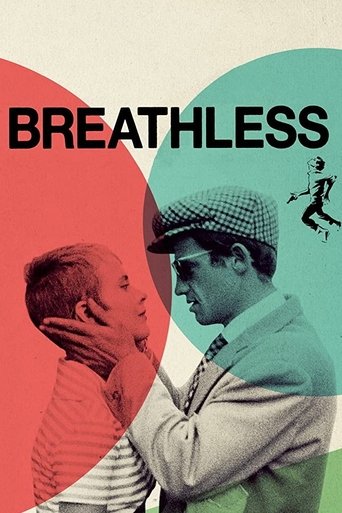
Breathless
À bout de souffle
1960 · Film · 90 min
Directed by Jean-Luc Godard
A small-time thief steals a car and impulsively murders a motorcycle policeman. Wanted by the authorities, he attempts to persuade a girl to run away to Italy with him.
9 positive2 negative1 mixed15 neutralfrom 27 commenters
Where to watch
No streaming data for this title.
31 comments on Hacker News
Top Gun: Maverick, Obsession, Project Hail Mary
Those movies might be good, but cinema are they not.
Cinema traditionally has meant movies like, À bout de souffle and Citizen Kane.
Thanks! Here's the full list: 2001: A Space Odyssey, 8½, Aguirre the Wrath of God, Ali: Fear Eats the Soul, All That Heaven Allows, Apocalypse Now, Ashes and Diamonds, A Woman Under the Influence, Barry Lyndon, Bicycle Thieves, Breathless, Casablanca, Céline and Julie Go Boating, Chinatown, Chinese Roulette, Citizen Kane, City Lights, City of Pirates, Contempt, Daisies, Damnation, Dishonored, Earth, Electra My Love, El Topo, Eraserhead, Eyes Wide Shut, Film Socialisme, Fitzcarraldo, Fuego en Castilla, Hiroshima Mon Amour, Holy Motors, Inauguration of the Pleasure Dome, In a Year with 13 Moons, India Song, Inland Empire, Irma Vep, Koyaanisqatsi, La Dolce Vita, La Jetée, Late Spring, L'Eau de la Seine, Le Voyage dans la Lune, Lolita, Los Olvidados, Lost Highway, Lucifer Rising, Man with a Movie Camera, Metropolis, Mirror, Mulholland Drive, Night Music, Ordet, Orpheus, Persona, Pickpocket, Playtime, Psycho, Rebecca, Rosemary's Baby, Rumble Fish, Scarface, Seven Samurai, Sherlock Jr., Singin' in the Rain, Stalker, Sunset Boulevard, Taste of Cherry, Taxi Driver, Testament of Orpheus, The 400 Blows, The Blood of a Poet, The Cabinet of Dr. Caligari, The Color of Pomegranates, The Green Ray, The Holy Mountain, The Isle, The Lady from Shanghai, The Night of the Hunter, The Passion of Joan of Arc, The Seventh Seal, The Spirit of the Beehive, The Tales of Hoffmann, The Tree of Life, The Turin Horse, Time of the Gypsies, Tokyo Story, Touch of Evil, Trans-Europ-Express, Ugetsu, Un Chien Andalou, Uncle Boonmee Who Can Recall His Past Lives, Vampyr, Videodrome, Wavelength, Werckmeister Harmonies, Wild Strawberries, Moonlight Sonata, Stellar, The Haunted House Biased toward European art cinema, experimental work, and directors who broke conventional narrative rules.
The most interesting part of this video to me is the editing. It feels like someone just watched Breathless by Goddard and really wanted to make a French new wave movie, but had a day job making films for IBM.
In film, I think Breathless by Godard may be seen as a dividing line, though of course it's never that simple.
For example, the closing dialogue of the French movie À bout de souffle ("Out of breath" but given the English title Breathless) is difficult to translate to English because of the ambiguous use of "dégueulasse".
https://en.wikipedia.org/wiki/Breathless_(1960_film)#Closing_dialogue
I was responding to your sentiment about how digital ruined Hollywood or whatever.
It really didn’t. It just made it easier to produce things. That’s happened a few times before in film history, and the result was always an explosion in poorly lit, poorly shot films, and then slowly a filtering out that results in the next decade or two when the good people who started then become masters.
You have this in the 1960s when the French New Wave starts using the recently invented 16mm and portable film cameras to make their films, and they make a bunch of movies which don’t look that good (for my money ‘Breathless’ has some terribly lit shots).
The same thing happens in the 1970s when cheap color film stock arrives and you have an explosion of films in general, giving birth to exploitation and drive in films, many of which are again, terribly lit and sometimes poorly shot (‘Rolling Thunder’, a lot of Sam Peckinpah)
The digital revolution didn’t “ruin things” it just made it easier. And whenever that happens you often get a glut of poorly made films, and then the best people who work on those films get better, and then the films they make in the next decade or two are astonishing and amazing.
Just saying this isn’t new. It’s a phase.
Not to contradict your experience, but to state an opposite view, Breathless is one of the worst movies I saw.
I really like Breathless, Le Mépris, and Pierrot Le Fou, this last one less often mentioned, yet super interesting.
But I don't get the trashing of the cinema that existed before Godard, as this article, following so many others, seems to want to do.
Contemporary superhero franchises are trash, certainly (at least to my eyes). But what's wrong with Casablanca (1942) or Double Indemnity (1944) for example?
Why couldn't we have both?
30 years ago I first saw Breathless, which was then 30 years old. It’s hard to believe the same time has passed. The film has stayed with me ever since as one of my favourite movies. It had such verve, style, self confidence, and a sense that it already knew it would be revolutionary. Even if Godard had stopped making movies after his first, he’d still be a legend.
I didn’t approve of what Raskolnikov did, yet I could empathize with him thanks to the writer’s prowess. I don’t see why cinema would be different than literature. The guy in Breathless was a jerk and the director failed to make the audience empathize with him.
Stiff and theatrical are better descriptors. Or mannered and a bit stilted.
I've only seen Breathless and A Band Apart. My sense is that Godard played a big part in transforming cinema from mannered to free-form. But I'd caution against framing that transition in terms of quality. Lots of stiff, theatrical movies are excellent, many of them have really good camerawork, and Godard certainly didn't invent moral ambiguity.
Indeed. And all noir films. American cinema is a lot more than just its best picture nominees. Why is OP ignoring films like Rebel Without a Cause, East of Eden, The Defiant Ones, Anatomy of a Murder, The Hustler, Paths of Glory?
I love French New Wave and Breathless is one of my favorite films, but OP overstates their case.
I didn't really care for the characters in Breathless either, but I did really enjoy seeing how avante garde (for the time) the filmmaking was with fast cuts, hand held camera, etc. It looks like a modern TV or streaming show but you have to remember this was 1960 and _no one_ was making stuff that looked like that (the big hollywood films were John Wayne westerns, huge epics like Ben Hur, etc.). It's pretty amazing that Godard pioneered a style that we all see and take for granted today.
It's been a while since I've seen it but I remember liking Masculine Feminine more than Breathless, at least liking the characters in it more. Give it a look: https://www.youtube.com/watch?v=pRiVKoW18Fw
No promises, but I would recommend trying Weekend (1967). I felt the same way about Breathless for a long time, until I watched it the third time and it just "clicked." It's easy to take that film way too seriously and miss the point.
That said, I don't really know why I've watched so many Godard films, since I almost never actually enjoy them (the reason is probably Anna Karina et al. hnngh). Still, he was undoubtedly a genius and I have the uttermost respect for his craft. RIP.
My advice: watch it like a movie that just came out, not as a “really important and heady film”. If not, you might miss the whole concept is funny - it’s about a French guy who looks like bogart who watches American films and wishes he was American, who falls in love with an American who wishes she was French.
I love Breathless but I think my interpretation is different than most - to me it’s about the meaningless of art, how the main characters drift aimlessly because they model their lives after superficial understandings of the other gleaned from media. Also there’s an artist character who iirc explicitly says that art is meaningless. But yeah its a difficult watch, it’s almost an easier watch if you watch it superficially since it’s so well shot.
It is hard to overstate how much Godard changed cinema, even in America. If you don’t believe me check for yourself. Open the best picture nominees between 55’-65’ and watch their trailers. Films like Marty/On the waterfront/12 angry men/To kill a mockingbird/The Caine Mutiny/Sweet smell of success is what movies were like in the late 50s.
The acting/writing was pompous, actors talked like reciting Shakespear. The movies were about heros of impeccable character doing heroic things and there always was a happy ending. Movie shots followed strict guidelines and the creative head of the movie was the producer while the director was akin to a contractor, someone hired to film the scenes.
Starting in the mid 60s there was a radical shift, topping the nominations we have films like Five Easy Pieces, The French Connection, The Godfather, One Flew Over the Cuckoo’s Nest, The Deer Hunter, Dog Day Afternoon, Taxi Driver etc. Actors would act and behave like normal everyday people facing everyday problems. The new Archetype is the Anti-Hero, someone with flaws/vices in their character, someone that viewers can relate to. We see the rise of the director as the auteur, the creative master of a film. Every known filmaking rule is being tested to it’s limits and broken by young experimenting directors.
The catalyst for this change was the French New Wave, a group of young filmmakers tired of the old style of cinema wanting to do films about their own life and experiences. The poster boy for the New Wave was Jean-Luc Godard starting this revolution with his 1960 film Breathless.
As always, an Ebert review will help you at least set the table for the discussion about it. https://www.rogerebert.com/reviews/great-movie-breathless-1960
I did not watch Breathless, but the feeling you describe reminds me of what I experienced watching La Piel Que Habito by Pedro Amlodóvar (a loose adaptation of a novel: Mygale by Thierry Jonquet).
It was an incredibly difficult movie for me to watch, the amount of psychological violence was so unbearable I barely made it to the end, couldn't help but think what could possibly go through the mind of the writer to give birth to such a twisted story.
(Note that Breathless has Godard for direction and screenplay but the story is Truffaut and Chabrol)
"I just talked about myself, and you, yourself. You should’ve talked about me, and me, about you."
— Michel Poiccard, Breathless (1960)
"The 1960 French crime drama film, Breathless, by Jean-Luc Godard has a very interesting idea about love. The protagonist, Michel Poiccard (Jean-Paul Belmondo), a car thief and crook, is unlikeable. He steals from helpless women as well as vulnerable men, and kills a police officer without remorse. He claims to be in love with an American, Patricia Franchini (Jean Seberg), but at one point he threatens to strangle her, and he disregards her wishes whether big or small. But he wants to be with her, and we believe him. Is this enough to be defined as love?"
From: What Is Love? The True Definition According To The Movies https://moviewise.substack.com/p/what-is-love
Try Pierrot le fou, Contempt, Alphaville... However Breathless is (one of?) the easiest of Godard's movies.
Notice that you're supposed to suffer to watch many of his movies. It's part of the experience, to prove that you're part of the intellectual elite that "gets it".
> ‘Breathless’ opened in Paris ... not in an art house but at a chain of four commercial theaters, selling 259,046 tickets in four weeks. The eventual profit was substantial, rumored to be fifty times the investment. The film's success with the public corresponded to its generally ardent and astonished critical reception ... ‘Breathless’, as a result of its extraordinary and calculated congruence with the moment, and of the fusion of its attributes with the story of its production and with the public persona of its director, was singularly identified with the media responses it generated. (Richard Brody)
What about Hitchcock? Lang? Sturges? Von Sternberg? Welles?
Directors enjoyed top-billing prior to the articles and films by the Cahiers du Cinéma critics. While they made a huge contribution to the form of cinema, how many people really saw Breathless or read Hitchcock/Truffaut?
New Hollywood was mostly egged on by whip-smart critics with a wide circulation like Andrew Sarris and Pauline Kael, who further elevated the director as artist in the public mind. The studios followed suit and thought they could make a buck with these prestige films, until there were too many self-indulgent flops.
Let me offer you some not Canal+ French films I've enjoyed: Breathless; Hiroshima Mon Amour; Diva; My Life as a Zucchini; Jeanne Dielman, 23, Quai du Commerce 1080 Bruxelles; The Rules of the Game; Last Year at Marienbad; La Collectionneuse; The Green Ray; One Sings, the Other Doesn’t; The Kid with a Bike; The 400 Blows; My Night at Maud's; The Wages of Fear.
> There's often a lot of nuance lost in translated subtitles as well.
Famously, the closing dialog for Breathless, er, À bout de souffle doesn't translate to English.
https://www.youtube.com/watch?v=peS6ADDysms
https://en.wikipedia.org/wiki/Breathless_(1960_film)#Closing_dialogue
(It should go w/o saying reading this is a small spoiler and you should most definitely see this film first if you haven't. I happen to think the American remake is trash, but my dad loves both it and the original. In any case, it is among a small handful of films that I consider perfect.)
> It is steeped in symbolism, deep metaphysics and calm, meditative, photography. All attributes that have been essentially banned from the fast food production/consumption chain that has conditioned audiences.
Whoa... this is a bold claim. I can think of western films that use techniques like this: 2001: A Space Odyssey, Thin Red Line, Breathless, anything by Bergman, and The Royal Tenenbaums, for example, and many more that employ some of those traits. Additionally, implicit in the suggestion that not having those things somehow makes it "fast food production" (and thus of low quality), is rather unfair to the many western and non-western artists who have honed they're storytelling craft in a variety of styles. I love Tarkovsky and Solaris remains one of my favorite films, but I also like suspense films like Alien or action movies like Enter the Dragon, and many others which are frenetic, scary, fun or exciting.
Humphrey Bogart is an apt comparison considering his character in Breathless explicitly copied Bogart's mannerisms. In one scene he even stares at a picture of Bogart outside a movie theater.
What I don't understand is how Netflix ended up this way. They attributed the success of a show like House of Cards to their data science capabilities - why would they produce bad movies unless that's what the data points to. Then maybe no matter what, the truth is that the content that gets eyeballs, and why Hollywood makes shallow broad movies is the same: they make money.
If you want to watch some actual quality filmmaking, visit a film festival or watch some Criterion films. Everything else will be "trash". If you want to expand your cinematic palate, explore American noir (The Maltese Falcon), melodrama (Douglas Sirk), musical (Singin' in the Rain), Western (The Good, The Bad, and The Ugly), epic (Lawrence of Arabia). Italian neorealism with The Bicycle Thief, French New Wave with Jean Luc Godard (Breathless). Want to go modern international, City of God, Gomorra, Wong Kar Wai, Park Chan Wook's Oldboy (advisory warning), or my favorite Japanese auteur Yasujiro Ozu.
Any of the above films are considered cinematic gems. Recommendations brought to you by my degree in Cinema and Cultural Studies. The true beauty of filmmaking is conversation over time. Films and directors talk to each other like authors and artists, they write love letters. They become self-aware of their medium (Fellini), "postmodern".
Great film can not fall in the limited boundaries of popular filmmaking. That's why Hollywood films tend to be so broad and shallow, to be palatable by all, no alienation, unless when it comes to race or gender. On the other hand, that problem is not unique to Hollywood or filmmaking.
Films have been speeding up for a century, in two ways. Editorial geography disappeared in the 1960s. Editorial geography example (not mine): Bogart gets phone call. Bogart gets up, walks out door. Bogart walks out door of building, gets into cab. Scene of Bogart in cab. Bogart gets out of cab, pays cabbie. Bogart walks into apartment building lobby. Pushes elevator button. Shot of elevator indicator coming down. Doors open. Bogart gets in. Shot of elevator indicator going up. Elevator doors open. Bogart gets out, walks down hall, rings doorbell. Lauren Bacall opens door. Bogart goes in. That's editorial geography. At one time, it was felt that audiences would get lost without such a sequence. Today, writers and directors would skip directly from the phone call to an interior shot of the apartment. Jean-Luc Godard's "Breathless" (1960) is said to have put an end to that.
Related to this is average shot length as a metric.[1][2] "2001" has an average shot length of 13 seconds. At the other extreme are the Bourne movies, which are now down to around 1.1 seconds per shot. James Bond movies have sped up over the years, with "Dr. No" at 7 seconds and "Die Another Day (2002)" at 2.4 seconds. This is an industry-wide trend.
Trailers are insane. Trailers routinely break the 1 second barrier today.
So there's been a speedup in two dimensions - removal of unnecessary context, and shorter shots. To a modern viewer, 2001 looks quite slow-paced.
With enough short shots, films can conceal the lack of a plot. (This is a problem with effects-heavy movies. After you leave the theater, you realize the plot made no sense. But it was a great effects demo reel.)
[1] http://www.cinemetrics.lv/database.php [2] http://unspokencinema.blogspot.com/2007/01/average-shot-length.html
> No French cinema
The following films are on Lee's list and are French:
Les 400 coups (400 Blows), Truffaut La Nuit américaine (Day for Night), Truffaut A bout du souffle (Breathless), Godard Paris brûle-t-il? (Is Paris Burning?), Clément
So 4/87 (approx 5%) of his films are French.
No French cinema? Breathless is on there, as well as 400 Blows and Day For Night.
One thing I was hoping this series would shed light on was an oddity in demographic voting patterns with the ratings system.
From my own (anecdotal) observation, there's a class of films where the 'Females 45+' rating is a big outlier in the voting, with a large proportion of '1' votes. it's as if there's a gang of a few hundred users consistently downvoting films who are classed by IMDB as being part of that demographic - I don't know if it's a default setting that some bots or trolls have used or if there really are a bunch of cinephobic old women out there just watching and hating on films, but it did spark my curiosity as to what the pattern was. It doesn't happen in every film, and it's rare that you see any other demographic sticking out like this.
The best examples are critically acclaimed films with low voter counts. More popular, or less well-received films tend to have a lot of negative noise to begin with, so the effect is less noticeable, if it's there at all.
Here's some examples:
Army of Shadows : http://www.imdb.com/title/tt0064040/ratings?ref_=tt_ov_rt
Spartacus : http://www.imdb.com/title/tt0054331/ratings?ref_=tt_ov_rt
Ikiru : http://www.imdb.com/title/tt0044741/ratings?ref_=tt_ov_rt
Passion of Joan of Arc : http://www.imdb.com/title/tt0019254/ratings?ref_=tt_ov_rt
Breathless : http://www.imdb.com/title/tt0053472/ratings?ref_=tt_ov_rt
Z : http://www.imdb.com/title/tt0065234/?ref_=fn_al_tt_2
Barry Lyndon : http://www.imdb.com/title/tt0072684/ratings?ref_=tt_ov_rt