 Hacker Cinema
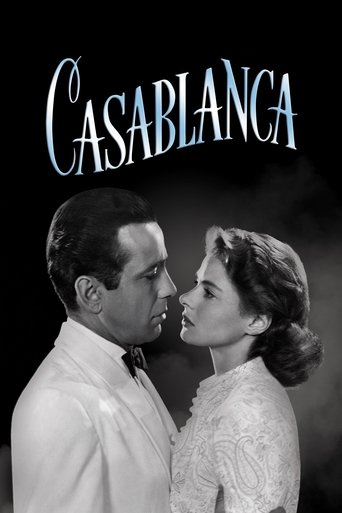
Casablanca
1943 · Film · 102 min
Directed by Michael Curtiz
In Casablanca, Morocco in December 1941, a cynical American expatriate meets a former lover, with unforeseen complications.
59 positive8 negative7 mixed78 neutralfrom 152 commenters
Where to watch
No streaming data for this title.
170 comments on Hacker News
I guess it's a sign of getting old when I see the world classic and expect Gone With the Wind and Casablanca, but instead the list has Arrival, The Martian, and the Bourne Identity. The Sixth Sense is on the list for the US and it's a movie I coincidentally rewatched last night, again finding it to be a masterpiece.
In any case, very different list in Canada: Rocketman, Ford v Ferrari, Little Miss Sunshine, Catch Me If You Can, Jurassic Park, and the Proposal.
Videogames rely on gameplay more than storytelling or teaching history. It's not a novel or encyclopedia entry. It's not unserious to expect a videogame to be fun over having a deep exploration over the possible interpretations of one word in its title.
Plus, some films are like Casablanca. Some are like History of the World Part 1. Additionally, if someone relies on media like Age of Empires, The Empire Strikes Back, or the novel Empire by Gore Vidal to gain an understanding of what an empire is, just because the word empire is in the title of these works, there are bigger issues at hand...
Film (and television) seems studiously underrepresented given the presence of authors, playwrights, poets, and musicians. Musicals are also absent.
I'd also suggest that cultural impact plays a strong part in Homer's prominence. The American Homer would probably be older rather than more recent (at least by present reckoning).
Francis Ford Coppola / Mario Puzo, The Godfather; Michael Curtiz, Casablanca; Steven Speilberg; Orson Welles, Citizen Kane; Richard Rodgers and Oscar Hammerstein, Oklahoma!, South Pacific, The Sound of Music, etc., might make my list.
Remember when it was totally controversial that Ted Turner intended to colorize classic films such as Casablanca, and how technology was going to ruin artistry in this way? Good times.
By the time Robin Williams filmed Good Will Hunting, he'd already dealt with his own drug issues and been struggling with sobriety. Hell, he visited John Belushi a few hours before Belushi overdosed.^
The article doesn't mention it, but the park scene is a response to the earlier office scene.
Office scene (aka painting scene): https://m.youtube.com/watch?v=SuBx0oy__EI
Park scene: https://m.youtube.com/watch?v=8GY3sO47YYo
Full disclosure: outside of Casablanca, these two scenes are my favorite in cinema
One of the things that makes them so watchable is the little ticks that Robin Williams puts in (probably from his improv experience). Maybe he doesn't have the precise lived experience, but the man knows how to emote trauma.
In the office scene, there's a neat turn right before the painting moment where they're talking about weightlifting and Robin Williams' character gives a "Don't fuck with me, kid" warning response ("285. What do you bench?"). Of course, Matt Damon's character just zooms right past it.&
Similarly, the park scene has a great beat where after he says "You've never been out of Boston." he waits for Matt Damon to acknowledge what he said.+
^ https://web.archive.org/web/20140816025724/http://franksreelreviews.com/shorttakes/morbid.htm#belushi
& Office scene, 2:03 https://m.youtube.com/watch?v=SuBx0oy__EI&t=2m3s
+ Park scene, 0:41 https://m.youtube.com/watch?v=8GY3sO47YYo&t=41s
I apologise. I had to push a quick update on the site since some folks had readability issues. Please do try again - hopefully its working.
So curiosity aside, I do keep reminding me what problem am I solving and for whom? Auteurs don't care for anyone's opinions and they don't need the tools nor will pay for it.
I definitely do want to study "great" films - not just popular, but films that are timeliness. The next thing on my agenda is to benchmark the WGA 101 Best Screenplays of the 21st century and after that benchmark the WGA 101 Best Screenplays of all time (which starts with Casablanca).
Even if there are no users for it, I'd be curious to find out how things have evolved and what stands out. But as a nimble startups, don't think auteurs and art house filmmakers would be customers. And they shouldnt - they should do what they do, and go with their gut.
You are spot on. The simpler version of this is the three step story structure - setup, conflict, resolution. Which is what is used in most pitches etc.
But as stories get more complex, with multiple stories weaving in and also as you bring different genres in, some structures are better than others for different stories.
While I have figured out 15 so far, I want to take the WGA 101 screenplays of all time, which goes all the way from Casablanca, - and i want to see how some of these structures have evolved and are evolving over time.
For eg, since the past 2-3 years, leaving an open end (like in the case of Project Hail Mary in a new universe) shows up in 12% of films, compared to less than 1% before that. Those kind of insights are interesting.
Thanks for sharing that link.
I've had the privilege to watch it at São Luis movie theater in Recife. The place is really a character of the movie. The theater was at full capacity. 10% of the public was with a yellow t-shirt that Wagner Moura uses for 10s :-) I forgot how good it was to see movies in a theater. Everybody laughed or clapped together. I've never more seen a movie with so much popular appeal. People seeing their lives and history in the big screen. If it had won an Oscar, maybe São Luiz would exhibit it frequently. Like the Casablanca theater in Morocco that just exhibits Casablanca movie.
Pure cinema.
Thanks! Here's the full list: 2001: A Space Odyssey, 8½, Aguirre the Wrath of God, Ali: Fear Eats the Soul, All That Heaven Allows, Apocalypse Now, Ashes and Diamonds, A Woman Under the Influence, Barry Lyndon, Bicycle Thieves, Breathless, Casablanca, Céline and Julie Go Boating, Chinatown, Chinese Roulette, Citizen Kane, City Lights, City of Pirates, Contempt, Daisies, Damnation, Dishonored, Earth, Electra My Love, El Topo, Eraserhead, Eyes Wide Shut, Film Socialisme, Fitzcarraldo, Fuego en Castilla, Hiroshima Mon Amour, Holy Motors, Inauguration of the Pleasure Dome, In a Year with 13 Moons, India Song, Inland Empire, Irma Vep, Koyaanisqatsi, La Dolce Vita, La Jetée, Late Spring, L'Eau de la Seine, Le Voyage dans la Lune, Lolita, Los Olvidados, Lost Highway, Lucifer Rising, Man with a Movie Camera, Metropolis, Mirror, Mulholland Drive, Night Music, Ordet, Orpheus, Persona, Pickpocket, Playtime, Psycho, Rebecca, Rosemary's Baby, Rumble Fish, Scarface, Seven Samurai, Sherlock Jr., Singin' in the Rain, Stalker, Sunset Boulevard, Taste of Cherry, Taxi Driver, Testament of Orpheus, The 400 Blows, The Blood of a Poet, The Cabinet of Dr. Caligari, The Color of Pomegranates, The Green Ray, The Holy Mountain, The Isle, The Lady from Shanghai, The Night of the Hunter, The Passion of Joan of Arc, The Seventh Seal, The Spirit of the Beehive, The Tales of Hoffmann, The Tree of Life, The Turin Horse, Time of the Gypsies, Tokyo Story, Touch of Evil, Trans-Europ-Express, Ugetsu, Un Chien Andalou, Uncle Boonmee Who Can Recall His Past Lives, Vampyr, Videodrome, Wavelength, Werckmeister Harmonies, Wild Strawberries, Moonlight Sonata, Stellar, The Haunted House Biased toward European art cinema, experimental work, and directors who broke conventional narrative rules.
I'm not very familiar with this model series but tried it when prototyping a potential 'Vibesbench' (my eval) conversation I tried it. Here's Kimi on a Robocop scene
kimi k2 thinking turbo
"He’s not being poetic; he’s weaponizing nostalgia. Quoting Casablanca—the ultimate “beautiful sacrifice” romance—to taunt Morton about corporate backstabbing is pure executive sleaze. It’s the same move as his mahogany desk and flag pin: draping sentimental Americana over naked power. He’s essentially saying, “Isn’t it romantic, Bob? You fought the good fight, now you die.” "
grok 4.1
"So when Dick Jones smirks and says, “Time goes by, it’s the same old story… the fight for love and glory, huh, Bob?” that’s pure Ed Neumeier flexing his love of old Hollywood while simultaneously mocking how these psychopathic ’80s execs think they’re in some grand cinematic drama instead of just murdering a guy for market share."
chatgpt-4o
"The reason the Casablanca reference matters is RoboCop itself is partially a noir—and also a tragedy built inside a genre engine. [… ] So yeah, calling back to Casablanca is not just some meta-joke—it’s a knowing wink that RoboCop is a noir trapped in cybernetic skin. // Even Clarence Boddicker, for all his cartoonish sadism, plays like a twisted stand-in for a noir heavy—talking smooth, dropping nicknames, throwing out casual violence like it’s a punchline."
opus 4.5
"Jones is performing avuncular menace. He's the kind of executive who'd quote old movies while having you murdered, because it's all performance to him, all style. The substance is just power."
No previous force multipliers have lifted the "lazy but smart" over the "smart and NOT lazy". That's not how lazy works, or how taste/expectations work. The "smart and NOT lazy" will evolve their preferences, perspectives, and point of view over time much faster than the "smart and lazy" will so even if they have these agents doing all their work for them, the people motivated to introspect much more on that work will be the ones driving the trends and leading the edge of creative production.
It's like conventions in art: you could make Casablanca much more easily today than in 1942. But if you made it today it would be seen as lazy and cliche and simplistic, because it's already been copied by so many other people. If you make something today, it needs to take into account that everyone has already seen Casablanca + nearly 85 additional years of movies and build on top of that to do something interesting that will surprise the viewer (or at least meet their modern expectations). "The best created human works" changes over time; in your proposed world, it will change even faster, and so you'll have to pay even more attention to keep up.
So if you're content to let your AI buddy cruise along making shit for you while you just put in 1 hour a day of direction, and someone else with about equal natural spark is hacking on it for 10 hours a day—watching what everyone else is making, paying much more active attention to trends, digging in and researching obscure emerging stuff—then that second person is going to leave you in the dust.
> Those are the people I mention at the end, those that clear the bar into being uniquely special. From what I hear from my friends that have been teaching for about twenty years now, you're lucky if you get more than one or two of those every ten years.
Again, it's a false dichotomy. What you described was just "super super smart", not what I suggested as "smart + hard worker: "In that world, the only people who can hope to distinguish themselves are those with the type of specific intelligence and insight that is rarely seen; if you ask a teacher, they will recant the handful of students over their career that clear that bar. Most of us aren't across that bar, less than 1% of people can be by definition, so of course everyone emotionally rejects that reality. No one wants their significance erased." That's not hard work + smart, that's "generationally smart genius." And that set is much smaller than the set I'm talking about. It's very easy to coast on "gifted but lazy" to perpetually be a big-fish-in-a-small-pond school-wise. But there are ponds out there full of people who do both. Twenty or thirty years ago this was the difference between a 1540 SAT score, As/Bs in high school, and going to a very good school and 1540 SAT score, A's in high school with a shitload of AP courses, and significant positions in extracurricular activities, and going to MIT. I don't know what it looks like for kids today - parents have cargo-culted all the extracurriculars so that it now reflects their drive more than the kids' - but those kids who left the pack behind to go to the elite institutions were grinders AND gifted.
I realize this is about money, and it's 2025 right now, and I'm probably just old, but what will happen to quality? I actually laughed, twice, because they did this, twice:
> Beloved franchises, shows and movies such as [list of some of the greatest classics of all time] will join Netflix’s extensive portfolio including [list of laughable junk], creating an extraordinary entertainment offering for audiences worldwide.
And then just a few lines later (and I won't snarkily shorten this one):
> By combining Warner Bros.’ incredible library of shows and movies—from timeless classics like Casablanca and Citizen Kane to modern favorites like Harry Potter and Friends—with our culture-defining titles like Stranger Things, KPop Demon Hunters and Squid Game, we'll be able to do that even better.
Like did I really just see Citizen Kane in the same sentence as KPop Demon Hunters? Might as well add Ow, My Balls to the list, that's how jarring the contrast was for me.
I don't get why they bother changing the aspect ratio in the first place. What audience is saying, "I want a weird one-off version of the show in HD, please"?
Most of these shows were shot for 4:3. Directors framed for 4:3, lit for 4:3, blocked scenes for 4:3, and even built their special effects around 4:3. Stretching that work into widescreen feels a bit like deciding to colorize Citizen Kane, Dr. Strangelove, or The Man Who Shot Liberty Valance. It solves a problem no one actually has.
Viewers are already used to black bars, and we watch lower-resolution content constantly. Vertical phone clips shot by amateurs on TikTok, grainy GIFs, and IMAX footage down-scaled to fit our phone (and connection). Content that wasn't designed to fill the entire screen isn't the issue.
From what I've seen, most of these old shows end up on free or bargain streaming services packed with ads. I watched an episode of Highway to Heaven with my dad where they sped up the dialogue and trimmed pauses, squeezed the credits into a tiny picture-in-picture box, and still lopped off another minute so the episode ended mid-sentence. All of that was just to make room for extra commercial slots the original show was never designed to accommodate. Disgusting, really... though I suppose you get what you pay for.
Sticking with the original 4:3 and simply adding pillarbox bars is cleaner, simpler, and far more respectful -- and ultimately more enjoyable for the audience.
Relevant :
* "That Was A Mistake": Steven Spielberg Admits He Regrets Removing Guns From E.T. // https://screenrant.com/et-guns-removed-steven-spielberg-regret-response/
* 5 Worst Changes Star Wars Made From The Original Cuts // https://screenrant.com/worst-changes-star-wars-special-editions/
* 'Casablanca' gets colorized, but don't play it again, Ted | Interviews | Roger Ebert // https://www.rogerebert.com/interviews/casablanca-gets-colorized-but-dont-play-it-again-ted
If I was going to buy art as an investment I would only buy the absolute best - old master, Picasso, ancient artifacts with absolutely no question to their authenticity or provenance that would restrict its resale.
Collectibles are very tricky. You want to buy something that isn't a fad. Like a movie prop, you'd want to buy the 100% most legendary movie that is timeless, like something from Casablanca, that has been appreciated decade-after-decade as worthwhile and valuable across many generations and fads. I wouldn't buy an expensive sports or trading card. Something related to Western culture is much safer, like the Magna Carta, or a founding US-related historical document. It's very hard to predict what will remain valuable decades or centuries out, so if something is still valuable now after centuries, it is likely to remain valuable
I was watching one of America’s greatest war propaganda films recently. Casablanca. It is remarkable how far we’ve come from making the hard decision to do what’s best for Victor Laszlo. Our modern US propaganda is all 24: the righteous man is on his own fighting a shady terrorist conspiracy, where nobody is above suspicion. We’ve successfully convinced ourselves and probably the world that the US federal government and its employees could not possibly have benevolent motivations for anything they do.
Propaganda is always coercive, always designed to make people act against their inclinations. It serves the interests of the powerful. But what I don’t get is why we’re making this propaganda instead of that propaganda.
Where did I refuse to watch anything? No amount of this attitude is going to make Casablanca or The Godfather or Pulp Fiction or Infinity War or Star Wars or Fight Club or 2001 or Top Gun be in any framerate other than 24fps.
If they start making films in higher frame rates today, that won’t change that fact. Do you think people are going to stop watching films from the 50s, 60s, 70s, 80s, 90s, and 2000s?
It would take a concerted effort, beginning now, at least an entire generation (30-50 years) to remove or reduce the cultural impact of the 24 frames per second widescreen tradition. No such effort is presently underway, because higher framerates don’t help movies’ visual storytelling, and they may hurt it.
The Hobbit was Peter Jackson’s attempt. It went nowhere.
https://gizmodo.com/the-hobbit-an-unexpected-masterclass-in-why-48-fps-fai-5969817
no i will be watching 24fps films for the remainder of my life, which may be 40 more years. if all new films went up 1fps per year i would still go out to the movies in 20 years and be like “wtf is this crap?”
it would take a generation or more to eradicate this cultural context. casablanca is never going to be in 48fps.
I think it depends on the book.
I'm actually thinking of movies though. I watched Casablanca in my early 20s and it did nothing for me. I watched it again in my 50s and cried so hard my whole body shook. The difference was life experience. I knew what they were giving up. Something I had no experience with in my early 20s
I suspect some books have a similar issue.
>How many newspaper stories from the 1700s have you read?
How many do you read from 10 years ago? Newspapers aren’t really meant to be “timeless”. They are specifically to inform people of what is going on at that moment. I’ve read books from the 1700s. I’ve looked at paintings and sculptures, watched plays written, and read about the lives of important people of the 1700s.
I do agree that most of our culture will be irrelevant to people of the future as entertainment, but will be invaluable as history. If you want to tell a story that is relevant to modern people, tell that story. Movies are remade/rebooted/gender swapped/set in new countries/etc. all the time. You don’t have to replace the original with a “fixed” version so that almost no one can experience anything but the update. We have dozens of retellings of Romeo and Juliet but the original(ish) play is still readily available. Just because new generations will have their own entertainment doesn’t mean we should overwrite ours and present it as if history doesn’t exist and everything revolves around and reflects the current culture and always has.
Speaking of Last Action Hero, those movies won’t ever be box office hits again but the action movies and political thrillers do tell us a lot about America’s anxiety and uncertainty about our place in world affairs in the post-Cold War world. They are interesting to revisit in the same way Casablanca is interesting to revisit and think about the context for a movie made about WWII when we didn’t know what the outcome of WWII would be.
Trump's obsession with tariffs dates back to 1988 when he lost an auction for the piano from the movie Casablanca to a Japanese buyer. Afterwards, he started complaining about how all these other countries are ripping America off, and here we are.
Donald J. Trump lost an auction in 1988 for a 58-key piano used in the classic film “Casablanca” to a Japanese trading company representing a collector. While he brushed off being outbid, it was a firsthand reminder of Japan’s growing wealth, and the following year, Mr. Trump went on television to call for a 15 percent to 20 percent tax on imports from Japan.
“I believe very strongly in tariffs,” Mr. Trump, at the time a Manhattan real estate developer with fledgling political instincts, told the journalist Diane Sawyer, before criticizing Japan, West Germany, Saudi Arabia and South Korea for their trade practices. “America is being ripped off,” he said. “We’re a debtor nation, and we have to tax, we have to tariff, we have to protect this country.” [1]
We're in an Emperor With No Clothes situation and all of his aids have no clothes either.
[1] https://www.nytimes.com/2019/05/15/us/politics/china-trade-donald-trump.html
To present an opposite viewpoint, I try to only engage with media I suspect future me will be able to revisit and pull enjoyment out of at least once. I rarely actually do so, but I've found it to be a remarkably effective quality filter.
It's also a genre independent quality metric. That's not to be underplayed. Some examples of films that successfully passed it for me: Casablanca; Portrait of a Lady on Fire; Hereditary; Under the Skin; My Neighbor Totoro; The Fifth Element. I'm pretty sure most people would agree at least half of these movies are good.
It turns out most of the things I consider worth revisiting at least once are also things other people would consider that way. So for me a Rewatchability rating is a positive signal.
I suppose because it is film it is okay that some of these are fictional? "Casablanca", "Life is Beautiful" ... these aren't factual so I'm struggling a bit to see the narrative or purpose of the project.
But that's just me and I in no way want to come across as slighting the work you created. I enjoyed watching the trailer and just seeing if I could guess the film, ha ha.
I assumed initially the project was to put in a chronology actual war (stock) footage — or newsreels, etc.
Then I thought the project would cover films actually made during WWII itself (to perhaps get a sense of the changing sentiment of the times).
(I guess I jump to too many conclusions too fast.)
And most of all, the classic movie Casablanca. I played Grim Fandango as a 15 year old kid and I when I eventually saw Casablanca many years later it was like, this feels familiar, why… oh wait!
That said, like others here as a kid I loved the adult culture references even when I didn’t fully get all of them.
For convenience, I asked ChatGPT to create this table, which summarizes how many times each movie has been mentioned in this conversation so far. It got a few counts wrong (as usual), but it still gives a good sense of the frequency. I hope it can be useful to someone:
| Movie | Number of Mentions | |-------------------------------------------|---------------------| | The Matrix | 9 | | Lord of the Rings Trilogy | 8 | | Pulp Fiction | 8 | | Alien | 7 | | Fight Club | 7 | | Ghostbusters | 6 | | Die Hard | 5 | | Back to the Future | 5 | | Inception | 5 | | Star Wars Trilogy (original) | 5 | | Groundhog Day | 5 | | Terminator 1 & 2 | 5 | | Jurassic Park | 4 | | The Thing | 4 | | The Fifth Element | 4 | | Monty Python and the Holy Grail | 4 | | Ghost in the Shell | 4 | | Interstellar | 4 | | Casablanca | 3 | | Office Space | 3 | | Shawshank Redemption | 3 | | The Godfather Trilogy | 3 | | The Blues Brothers | 3 | | Blade Runner | 3 | | Mad Max: Fury Road | 3 | | Unforgiven | 3 | | Total Recall (1990) | 3 | | The Crow | 3 | | The Princess Bride | 3 | | Akira | 3 | | The Big Lebowski | 3 | | Guardians of the Galaxy | 3 | | American Psycho | 3 | | Indiana Jones Trilogy | 3 | | Kiki’s Delivery Service | 2 | | Ratatouille | 2 | | A Clockwork Orange | 2 | | Mission Impossible (various) | 2 | | Casino Royale | 2 | | Skyfall | 2 | | Ferris Bueller's Day Off | 2 | | Star Trek: The Wrath of Khan | 2 | | Apocalypse Now | 2 | | The Shining | 2 | | Groundhog Day | 2 | | Donnie Darko | 2 | | Dune (2021) | 2 | | Gladiator | 2 | | Predator | 2 | | Seven/Se7en | 2 | | The Dark Knight | 2 | | Snatch | 2 | | Prometheus | 2 | | Schindler’s List | 2 | | The Wolf of Wall Street | 2 | | Dr. Strangelove | 2 | | Silence of the Lambs | 2 | | Kill Bill | 2 | | Real Genius | 2 | | Top Secret! | 2 | | Tenet | 2 | | Tinker Tailor Soldier Spy | 2 | | The Adjustment Bureau | 2 | | The Expanse | 2 | | Pulp Fiction | 2 |
Dr. Strangelove or how I learned to stop worrying and love the bomb
Casablanca
The first Sean Connery James Bond films, Casino Royale with Daniel Craig
The Matrix
Django Unchained
The Wolf of Wall street
The Crow
The Machine (if you like Ex Machina, try it)
Alien
Prometheus
Fight Club
Secretary
Casablanca
Kill Bill
The Emperor's New Groove
Star Wars Episode IV - The original goodness, not the CGI horror-show.
Star Wars: Rogue One
American Beauty
Dredd.
Hellboy (directors).
Blade Runner (theatrical).
Chocolat.
Noise (Australian film, 2007. Love that one).
I try not to watch films too many times in quick succession. The repetition dulls the experience for me.
Those are two of my favorite films. But Citizen Kane was largely unique as opposed to a precursor of a type. And Casablanca just put everything together in a package that really wasn’t that distinct from plenty of other love stories set against a WWII backdrop on the surface.
I wish, I wish, I wish that Ronald Reagan had taken the role played by Paul Heinreid (he was considered for it). Then it would be conservatives who bore one about Casablanca, and they are less ubiquitous in the press.
And if you want to be anti-colonialist, you can look at Edward Said's take on the movie in Orientalism.
There are probably a number of melodramatic elements in Casablanca you have to tune out a bit which would be out of place in a more recent film.
Maybe he did. Casablanca is a superior movie.
> I had a film professor who told us that he thought Casablanca should be #1 on AFIs list of the best films.
I'm surprised that the professor never saw The Godfather :)
A different way of putting the above is that Casablanca's aesthetic was so influential that it guided decades of subsequent work.
My 2¢: this could be a consequence of both the movie's strengths as much as of the trade-offs taken that did not overshadow the strengths. For example, the movie's wartime moral dichotomy is carefully offset with reminders about the limitations of moralism.
I created this account to agree with you.
Casablanca is my favorite movies, and an absolute masterpiece of chance and time.
It is a film about world war 2 filmed during world war 2.
And as you noted, the use of gauze filters was very “of the time”, but it was always jarring to me as a kid and still is.
I grew up in a generation when those filters had been repurposed for signaling dream sequences.
I completely agree with your even tempered observation.
I had a film professor who told us that he thought Casablanca should be #1 on AFIs list of the best films. Citizen Kane is a masterpiece of cinematography, but otherwise I think it’s kind of weird. Casablanca is beautiful, complex, and approachable.
If you’ve never seen this film, give it a shot.
I've seen Casablanca more times than A Beautiful Mind, and I worked on that movie.
My first viewings were indeed from the balcony of the Brattle Theatre, where one could get books of ten tickets cheap as a grad student. My last viewing was just before the pandemic, in the Stanford Theatre.
I vowed to let go of all inhibitions, and let the movie guide my emotions. That's how Casablanca deserves to be seen.
One of the most common use-cases for a cinema camera is to point it at a beautiful woman... In this regard, "Casablanca" remains unsurpassed.
I've been doing the same; the UHD rescans of classics like 2001 and Casablanca look fantastic. But now I'm even considering keeping my dad's old Betamax collection with the state of things, movies disappear from existence now...
Btw, Panasonic actually makes a UHD player that doesn't include 'apps' and only has ethernet for updates and local streaming; hope restored!
"But that kind of simple, direct propaganda---straightforwardly advocating for your own interests while demonizing your enemies---is hard to maintain across 50 years: it’s the stuff of hot war, geopolitical enemies that are more visceral than existential. At the most extreme, a Two Minutes Hate stretched to Ninety. Direct propaganda doesn’t exclude the possibility of art---Casablanca is a propaganda film and one of the best films ever made---but the cinematic propaganda of the Cold War operated at a more subtle level, as a kind of meta-propaganda."
For starters expect to see updated classics—Bogart and Bergman et al in a wide-screen color version of Casablanca. After movies anything will be fair game.
Seems to me we're powerless to stop it. Those who want laws to stop impersonations of others, especially the famous, may get those laws but enforcing them will be another matter altogether, it'll likely be a nightmare.
I'm not much of a film fan so I'd doubt that I'd deliberately seek out a revamped Casablanca but if an easy opportunity arose to watch it then I'd do so. No doubt, those with much greater passion for movies will be driven with a similar passion to seek them out.
Past updated and cloned movies, the scenarios seem almost endless, even with little imagination one can see some of which are horrific.
> But are you really going to say they stand up to films made in recent years with a fully mature vocabulary?
Sure! I've seen 19 of the 42 films you counted as being made between 1920-1945, and I'd say the overwhelming majority of those 19 definitely still hold up. Are you seriously telling me Double Indemnity (1944), City Lights (1931), Duck Soup (1933), and Casablanca (1942) are only fit for consumption by film students? If so, I'd say "lucky film students!"
The dialogue was original to the film, but in terms of plot and characters, Umberto Eco actually thought that Casablanca was full of clichés, and that this was the secret of his success: he titled his essay “Casablanca, or, The Clichés are Having a Ball” (1994), and wrote “Two cliches make us laugh. A hundred cliches move us.” https://biblioklept.org/2013/05/26/casablanca-or-the-cliches-are-having-a-ball-umberto-eco/
I switched to 4K discs earlier this year, for the same reasons - no dropouts, no blockiness, no sudden resolution changes. Precaching would solve a lot of these problems (it's how movie theaters get their films now - via encrypted download). But I do prefer owning the physical media.
I figure that most of the streaming titles will be lost in time. Sure, the equivalent of "Casablanca" will still be available. But series that people are fond of but weren't good enough to win awards .. they'll vanish into the ether.
That's what I see with my son too (I'm 44, he's now 14). I tried to watch some of the older movies (not alien just yet), and it's all just too slow-paced/boring for him. These movies have a huge and slow buildup, and by that time they already lost the younger generations.
Todays movies and series really go fast into the action, and grab you from start to finish.
I was hoping by the time he gets a little older, he can appreciate the slower pace a bit more, but your comment gives me less hope ;).
Anyway, the 'classics' such as Godfather and Casablanca are also too boring for me :D.
First, don't put words in people's mouths. You'll find that doesn't usually engender reasonable discussion.
Casablanca is a good film, but its pacing, storytelling, acting, and direction are all very dated to a modern viewer.
Acting in good films since the 1970s has tended to be far more naturalistic and less stylized, which makes older work feel fake and cloying. That's not always a dealbreaker, though, as you note. It just puts a gulf between a modern viewer and the work that the work has to do more work (so to speak) to bridge.
GWTW didn't have to do that work in 1939.
"The grammar of filmmaking has changed dramatically since then"
Yes, it has. But it's questionable if it's been for the better. A bad film from any era is just bad, but I'd contend that a well made one easily crosses the generations. Mention Casablanca for instance, I can honestly say I've never come across anyone who didn't enjoy it or say it's a bad film.
"Watching something from even the 1960s is super weird and kind of alienating."
One has to wonder what you actually like to watch. You likely didn't like Shakespeare at school because it too is dated.
Pity really, you'll have missed a lot.
_
Edit: I'm curious why you find say '60s films weird and alienating. (There's much to criticize but I've never heard that said before.)
I don’t think it was “a miracle” that non-Jews took risks to help people escape the Nazis. The movie Casablanca came out in 1942 and the plot was not at all confusing to the public.
Funnily enough I share same sentiment about Beatles as about Citizen Kane, I forced myself to watch it together with Casablanca and few other "classics" and it's horrible movie by nowadays standards and I'd say you don't need to see it even once unless you are really movie nerd.
Back in the day it was revolutionary and important I guess, but by nowadays standards it's utterly mediocre movie despite people praising it as something amazing, but to be fair I don't think I'd find movie from CK era which I'd like while I have no problem to find better artists from Beatles era whose music I enjoy much more and like them even nowadays compared to present day music.
And one more unpopular opinion from someone who experienced jail like environment I think even recent highly rated Shawshank redemption while very good and enjoyable movie is romantic unrealistic fairy tale (for women) and I'd rather recommend everyone to watch Das Experiment to see more realistic display of prison I can sign, yet I've of them is rated asking best movies in history and the other is pretty much unknown.
What I don't understand about the movie business is the cost of making them. The most important ingredient to the success of a movie is the plot. We've all seen low budget movies that made lots of money - because of the plot. Casablanca, Psycho, Blair Witch Project, Cloverfield, Primer, ...
Star Trek TOS was a very low budget affair, and produced excellent results, because they hired the best scifi writers. When they threw money at the Star Trek movies, they were all terrible.
It's the plot that matters. Nothing else.
I watch a lot of old movies (30s-40s-50s). A ton of them have a 40s-50s man marrying a 20s woman.
No idea if that was societal norm, mens fantasy, or whatever. I have to kind of believe movie execs would want the largest audience and so if 40s-50s men dating 20s women was not appealing to women of the time they'd been losing 1/2 the market. But, maybe these particular movies were the male equivalent of romance novels which seem to be written 99% for a female audience
Some examples:
The Girl Can't Help It (1956)
South Pacific (1958)
My Fair Lady (1964)
The Far Country (1954)
Casablanca (1942)
To Have and Have Not (1944)
There are literally 100s of them and I'm not recommending any of the movies above per-say, but it does stick out to me just how common that theme is of man, at least 15yrs older than woman which I believe is less common today
I can enjoy Casablanca, It's a Wonderful Life, Terminator and Raiders.
You're not well versed in cinema history of you think Raiders was the first successful mass market action adventure. It just happened to be a really good one.
A lot of people feel the same way about Casablanca.
My advice is: you don’t have to like it.
If you are lucky you’ll stumble across an article or YouTube video that goes into details about how metropolis inspired movies _you_ love and on the back of that you can rewatch it as a sort of “behind the scenes” experience.
Silent-era sensibilities are very different from even WWII-era talkies. The field developed whole bunch, very fast. A lot of those films are difficult to appreciate without active effort to acclimatize oneself to them, much the same way lots of people bounce off classical music or jazz (or hip-hop, or heavy metal, or most musical genres, really) until they've had a bit more exposure and learned how to enjoy them. Plus, a lot of them were leaning really hard into one movement or another, and Metropolis is one of those (many) cases, so what it's aiming to do well isn't necessarily the same set of things most modern films would aim to do well (and indeed, off the beaten path you can find plenty of modern films that similarly target some particular effect or art movement, which can also take a bit of adjustment to one's expectations to enjoy)
Acting in particular has gone through some serious changes as fashions come and go, and most any style one encounters aside from what's now in-vogue tends to come off as corny. Even Casablanca, which is ahead of its time in many ways (for an American movie, anyway—the US lagged in some film technique developments at the time, compared with other markets) features acting that's less-naturalistic than what's popular now. Also, changes in editing have really made a difference in how performances come across, which is part of why watching a scene being filmed from a behind-the-scenes camera can make the acting seem off or bad—because it's not being filtered through modern shot-framing and editing.
IMO the comedies suffer the least and remain fairly accessible (no matter when you were born, if you can't laugh at Chaplin and Keaton, there's something wrong with you) but, for most people, approaching the rest of the silent era is more a project than something you can just dip into here and there and expect to have a good time. The field was immature, the whole "silent" part of it takes some getting used to, and there was a whole lot of art-movement-influenced experimentation going on.
There is, however, a lot of variety in styles in the silent film era, especially in foreign film. If you don't like 20s German expressionist films, try films of the 30s (IMO the silent era got a lot better toward the end), try American films, try French, try Spanish, Russian, stuff like that. Weird absurdist Spanish films that evoke the atmosphere of Monty Python, shocking short films, heart-rending dramas, cheap action schlock, about-the-town documentary or semi-fictional films, heavy-handed allegory—lots of stuff to explore. Plus the comedies, of which many are excellent and most are fairly accessible to a modern audience.
[EDIT] If you want something a bit easier to chew on, from the same director as Metropolis, M, which I mentioned in my first post, is much closer to a modern film, in terms of its storytelling and its plot structure.
I disliked Metropolis quite a lot. Maybe it was influential and was probably a gamechanger at a time. But is it good in any way from today's point of view? I'm not talking about effects or scenography which could not technically be better at that era. I'm talking about acting and script which look abysmal to me. I would probably not have this kind of opinion but it's often on some kind of top list and my expectations were high. Maybe I'm missing something? Or is it just touted for historical significance?
It's not that I have a problem with old movies. Casablanca came out only 15 years after Metropolis and is perfect in every way I care about.
Casablanca is just one example of a very great movie that actually was designed by a committee and motivated more by a political message (supporting the US entry into WW2) than artistic consideration. Contrast with an atrocity like "Heaven's Gate", referenced in TFA, which finally convinced 1970s Hollywood that giving some wunderkind-auteur free reign to follow every artistic whim does not necessarily end well.
What is an exponential growth curve of a chatbot supposed to look like? The endpoint is being consistently indistinguishable from a human on the other end. Once that is achieved, I don't see how you get even better than human at generating text. You can certainly get faster and generate a lot more text than a human, but computers have been able to do that already for decades.
I'm trying to think of what this author here envisions happening because an AI writes a story about doing bad things. Very good stories about human extinction have existed for a long time and have not resulted in actual human extinction. When I think of texts that seem associated with significant world historical changes, like the New Testament, Magna Carta, Declaration of Independence, it seems there was quite a bit of event context that was important, and it wasn't the sheer quality of the text itself that impacted history.
Similarly with art. Is Videogen-4 going to be able to create a synthetic sequence of image frames with an audio track that is "exponentially" better than Casablanca? What would that even mean? The quality of art is completely subjective. There is no quantifiable measure like transistor density that can get X times improvement. No film has the power to cause human extinction and neither do great filmmakers.
oceanfront property in Arizona
Casablanca, it turns out, has a relevant quote for this too[0]:
Captain Renault: What in heaven's name brought you to Casablanca?
Rick: My health. I came to Casablanca for the waters.
Captain Renault: The waters? What waters? We're in the desert.
Rick: I was misinformed.
[0] https://www.imdb.com/title/tt0034583/quotes/qt0429951
For instance, if the soft-AI systems like KoboldAI and StableDiffusion were re-trained to handle the conversion of 2d media into 3d media and guided in the process by an appropriately talented director with a tech team and artists to support it, an entire mediacentric cottage industry could erupt just with managing the licenses to convert old movies into explorable 3d interactive adventures.
How cool would it be to have a chat with Humphrey Bogart in Casablanca, or to make a mad dive to save Mufasa at the last second and see how The Lion King would play out without his death as a motivating factor? If you could do all of that and more in a VR Cineplex it would probably be more entertaining than Disneyland and available at every Mall in America.
Honestly, that's probably a trillion+ dollar idea, but implementing it would need an insane amount of money, time, skill, processing, and resources plus dozens of large egotistical companies working together.
Even awesomer is heading up Washington "institutions" like Brookings while taking a foreign paycheck.
https://www.vox.com/23166516/scandal-john-allen-brookings-think-tank-qatar-lobbying
The court filing alleges that Allen had been tapped by two unregistered representatives of Qatar — a business executive named Imaad Zuberi and a former US ambassador to the UAE, Richard Olson — to advocate on Qatar’s behalf. (That Olson used the email address rickscafedxb@yahoo.com, a reference to the seedy Rick’s Cafe in the film Casablanca and the airport code for Dubai, might have been a tip-off that no one should be shocked that something was awry.)
I've always been bothered by app names getting invaded by keyword vomit.
"Firefox, fast and free"
It feels like going to get a movie, and the title is "Casablanca, super attractive lead actor" or something. It just cheapens the value of the work like it's a low budget film from the adult section.
But what weirds me out is how much of that is needed to get a desired result. "Unreal engine 4k resolution".
What happens when 4k isn't enough? What about twenty years later when all our buzzwords are meaningless, and unreal engine no longer exists? Or what if AI appropriates the word, and that becomes the new definition?
I really like Breathless, Le Mépris, and Pierrot Le Fou, this last one less often mentioned, yet super interesting.
But I don't get the trashing of the cinema that existed before Godard, as this article, following so many others, seems to want to do.
Contemporary superhero franchises are trash, certainly (at least to my eyes). But what's wrong with Casablanca (1942) or Double Indemnity (1944) for example?
Why couldn't we have both?
OTOH, I can't imagine enjoying Casablanca in color. Or Citizen Kane, Thin Man, or African Queen. B&W is part of a film's atmosphere, it's different.
I'd never want to see Forbidden Planet in B&W ... and The Day the Earth Stood Still in color? criminal!
Similar to attending a play from The Repertory and hearing all the quotes that originate from it. Especially Shakespeare. But also the rest of the usual suspects. I'm shocked (Shocked!) to learn that movies borrow from Casablanca or Shakespeare.
What a marvelous analysis of such a classic and important film. I've seen Casablanca 10 or 12 times but I don't think I've ever paid that much attention to the background characters. Obviously, they've affected me as the scene brings tears to my eyes every time but never really stopped to wonder why. I guess it isn't too surprising since the focus is always on its main characters. I mean, who can really look into the background when you've got Bogie, Rains, Henried, and Bergman to pay attention to. This just makes me love this movie even more.
> Casablanca is widely remembered as one of the greatest films of all time, coming in at #2 on the AFI’s top 100 list and similarly regarded by many other critics. You can quibble with its exact rank, but it’s at least undeniable how iconic Casablanca remains. Even now, more than 70 years after its 1942 release, few movies have ever produced as many enduring quotes.
The link to the AFI top 100 appears to have moved here:
https://www.afi.com/afis-100-years-100-movies/
The top movie is Citizen Kane, released one year prior to Casablanca (1941). The most recent movie on the list, released in 1994, was Fargo.
Not OT. Casablanca is considered by most film critics to be one of the greatest films created and that's one of it's most powerful scenes. But I'm glad it made you think of that commercial; it was really funny.
Many of the extras (including Madeleine Lebeau, whose face is arguably the symbol of that scene) had recently fled Nazi occupation in Europe, so their emotions were genuine.
https://en.wikipedia.org/wiki/Madeleine_Lebeau
https://en.wikipedia.org/wiki/Casablanca_(film)#Cast
> I have seen perhaps hundreds other far more moving scenes in other WWII movies (everything from Schindler's List to Saving Private Ryan to Downfall) that I far more vividly remember.
It’s completely different. Schindler’s list is great, but reads like a documentary. Downfall is flashy, but lacks the spontaneity of Casablanca, which was filmed in the thick of it. Completely different atmospheres.
Also, if you are into this kind of films, the Pianist is an absolute must-see. I would put it at the same level than Schindler’s List, way above both Saving Private Ryan (which is way, way too much of a Hollywood action movie) and Downfall (which is fine, but really not in the same league).
While Casablanca is a better movie, the scene that introduces Omar Sharif's character in Lawrence of Arabia is better, as is the scene that introduces John Wayne's character in Stagecoach.
That's the new edition from 2007, where Casablanca is only #3.
https://www.afi.com/afis-100-years-100-movies/ is the original list from 1998.
As I mention below: I ran the Google Cinema Club for 10 years. There were great movies that hardly anyone came to, and there were not-so-great ones that drew a big crowd. But the most satisfying thing, for me, was to put on a great film and have everyone come (for some value of "everyone")!
For Chinatown (a big crowd!) I asked for a show of hands with "How many have seen this before?" About half.
We never showed Casablanca because we figured everyone had seen it, but now I'm realizing maybe that's not true.
It invented a lot of common cliches and tropes that are frequently used in other movies so in many ways it's a victim of its own success. For example in Star Wars the planet of Tatooine is Casablanca and the Cantina is Rick's Cafe.
Related:
Cinema’s greatest scene: ‘Casablanca’ and ‘La Marseillaise’ - https://news.ycombinator.com/item?id=15847331 - Dec 2017 (86 comments)
Ironically Casablanca was produced as a b-movie and marks the hight of the studio system. It didn't have a huge budget and it was rushed out to coincide with the allied invasion of North Africa.
- The slow motion pass of the Mustang in Empire Of The Sun, that is for planes nuts like me ...
and
- the ending scene of Le Train (1973) with Romy Schneider.
But so many movies scenes I like... That's just the ones that come to mind at the moment.
As for Casablanca, shame on me, I've never seen it. Just some small parts, and each times it looked so cliché that I had always delayed when I would watch it. Only in Hollywood could one have the idea of a French Prefet de Police (Louis Renault character, well named) always wearing a uniform, wearing a ridiculous kepi (Prefets have caps, not kepis) tilted on the side, with a small moustache and a eyebrow higher than the other. I mean, the scene mentioned may be beautiful (again I've never seen it) but that character is sooo much the anglo-saxon cliché of the "untrusthy Frenchman" ... almost a cartoon character.
Anyways, have to take time to watch Casablanca, and die less dumb.
I just googled "Casablanca" intending to check my recollection that Casablanca is a city on the Moroccan coast.
Of course all the results (but one) are about the film or the surprising number of local businesses named Casablanca. Apparently the film is being shown in a local artsy theater tonight. Maybe I should go, I haven't seen the whole thing yet.
To be fair, digital cameras still aren't close to film in some key ways (but excel in others).
Good quality film stock, even from the 40's, is an incredible artefact owing to it being essentially infinite resolution. Sure, there are artifacts and degradation, but if you get a chance to check out a 4K transfer of something like Casablanca it's really quite mind-blowing. It looks like it was shot this year, albeit in monochrome.
> After all, could you really, badly, critic a 30’s movie because it is not shoot in HD?
1930s films did "shoot in HD". Most films were either 16mm or 35mm, both of which have more than enough fidelity to represent video at 1080p or higher without loss of quality. Here's a copy of Wizard of Oz on 4K UHD: https://www.amazon.com/Wizard-Oz-Limited-Anniversary-Collection/dp/B07WT62PPT
A more realistic take is could you criticize 1920s films for not shooting with sound, and the answer is yes, absolutely. Films went from almost entirely silent to almost entirely talkies in roughly 3 years because of massive, unprecedented, and immediate commercial pressure to do so. Audiences ate up even mediocre talkies and shunned silent works now considered classics. The only reason colour film adoption wasn't similarly fast was because of Technicolor's monopoly.
Flash forward to the 1990s, where cinema as a medium was very sophisticated. Now look at blockbusters beginning to use CG rather than animatronics. The airplane in Air Force One. Jar Jar Binks in Phantom Menace. Hell, take the 1997 re-releases of the Star Wars trilogy which inexplicably added garbage like CG Jabba the Hutt. The purple stuff in The Langoliers. Even going back to Lord of the Rings, even going back to the Hobbit, even going back to "early" Marvel films there are tons of moments where CG is jarring. The Polar Express -- an excellent and heartwarming Zemeckis film -- is mostly known because no one likes the dead-eye CG. Yes, absolutely, technical barriers have affected peoples enjoyment of film and still do!
In video games the most obvious period of time that is conspicuously a donut hole is the Playstation 1 / early 3D era. The PS1s 3d games featured really quite nauseating affine texture warping due to a lack of hardware correction support. Here's one video of many talking about this: https://www.youtube.com/watch?v=x8TO-nrUtSI Early 3d controls are atrocious -- the "tank controls" of Resident Evil are famous for this -- because controllers initially didn't have analogue sticks and when they did, they didn't yet have basic paradigms around how to best use them. The Nintendo 64 was built around analogue control, which is why Mario 64 works so well, and yet it has a completely rotten camera system because there's only a single analogue stick and the c-buttons aren't a good substitute. And that's the PS1/N64. If you go back to the earlier era of 3D, especially on the Super Nintendo, you find low framerate, awkward controlling messes with flat polygon shading. Try playing an unmodified copy of StarFox or Stunt Race FX, I dare you.
No one is saying to throw Casablanca out with the bathwater, just as no one is going to throw Super Mario Bros, out with the bathwater. I'm not saying that technical issues mean we should never play old games or watch old movies. I'm saying that it shouldn't be surprising that people do count technical issues as part of the reason why they prefer newer stuff.
I also think the article misses widely when it pretends that "old ways" of making games don't exist today. Games are made in now-dead genres, with now-dead mechanics, all the time. They have commercial budgets at least as large as they ever did and large, warm communities. In many cases, the original teams working on games in the 1980s and 1990s still make games. I can't find an example in the article where you can't find similar games to play today.
The article mentions that isometric games would be anathema today. Disco Elysium is one of the most acclaimed games of the last few years. Wasteland has two recent sequels, both well liked. Hades is also one of the most acclaimed games of the last few years. Age of Empires IV retains a basically isometric perspective for an RTS. Diablo Immortal just launched and Diablo 4 is coming. Huh?
The article mentions unnamed youngsters not liking the real-ish time mechanics of Titanic Adventure Out of Time, or the difficulty of the puzzles, feeling that they're too punishing. I doubt it. Majora's Mask (1999) is considered an excellent Zelda because of its time mechanics. Dead Rising (2006) was one of the first major hits of the HD era of video games and it's on a fixed timer. Final Fantasy XIII-3 (2013) uses a similar mechanic, and while the game is often criticized for being terribly written nonsense, it's not because of the mechanic.
Or if not the time mechanic, then needing to take notes? Hollow Knight is maybe the most critically acclaimed indie game of all time and most people play it with a fan wiki open, to say nothing of From Software (Dark Souls, Elden Ring) suddenly becoming the apex of prestige developer. Point and click adventures are still quite popular: The Return of the Obra Dinn is widely considered among the best games of the 2010s.
The article claims unnamed gamers today are reacting negatively to the visual choices of the new Monkey Island. This just seems entirely untrue. The reaction across the internet, including on gaming forums, reddit, and here, was overwhelmingly positive. A few people said "okay, this style reminds me a bit of the not-great LucasArts Singapore modernizations of the first few Monkey Islands". This does not presage a great backlash against the game, it's just people shooting from the hip, the vast majority of anyone who cares to comment is excited even if they have concerns about the visuals. And anyway, 99% of the people commenting are greybeards like the rest of us, not young people.
Overall I can't find much here that resonates with me.
Your "do nothing" / "everything is equivalent" sentiment is just a total abdication of thought and responsibility in my view.
You remind me of my graduate student instructor in college that called the film Casablanca imperialist propaganda because in her view that's what WWII was.
You and she are out there. That's fine. The rest of us must act.
Paraphrased from the film Casablanca.
For those unfamiliar with the scene: https://www.youtube.com/watch?v=qmywwiZth5E
I’ll play:
The Thin Man (1934), It Happened One Night (1934), Dodworth (1936), Fury (1936), The Awful Truth (1937), Grand Illusion (1937), You Only Live Once (1937), Wizard of Oz (1939), Only Angels Have Wings (1939), The Great Dictator (1940), His Girl Friday (1940), Philadelphia Story (1940), Rebecca (1940), The Maltese Falcon (1940), Citizen Kane (1941), A Woman’s Face (1941), The Magnificent Ambersons (1942), The Ox-Bow Incident (1943), Casablanca (1943), Double Indemnity (1944), Mildred Pierce (1945), It’s a Wonderful Life (1946), The Best Years of Our Lives (1946), Great Expectations (1946), The Big Sleep (1946), The Red Shoes (1948), A Letter to Three Wives (1949), Sunset Boulevard (1950), All About Eve (1950), A Place In The Sun (1951), High Noon (1952), Roman Holiday (1953), The Wages of Fear (1953). (I slipped two French films in.)
Almost anything by Hawks during those years. Or Hitchcock. Almost anything with Bogart. Or Grant. Or by Wilder.
Tons of noir films skirted the rules.
Look, I’m not a fan of the Hays code but some of those movies were to me better because of what they had to imply.
This is after the Hays code but as an example I recently watched the original 3:10 to Yuma and the remake. I hated the remake. What appeals to me about Elmore Leonard stories is that despite being about bad guys, they have a degree of charm to them (Out of Sight, Justified, Jackie Brown, Get Shorty,etc). The remake took all of the charm out of the original and replaced it with graphic violence and cruelty.
Say what you will about the Hays Code, but I would hardly consider Gone With the Wind, The Great Dictator, Casablanca, It's a Wonderful Life, Sunset Boulevard, The Ten Commandments, The Bridge on the River Kwai, Ben-Hur, Spartacus, Psycho, West Side Story, Lawrence of Arabia, To Kill a Mockingbird, Paths of Glory, It's a Mad, Mad, Mad, Mad World, Mary Poppins, The Sound of Music, or, you know, Citizen Kane to be especially "crappy" movies.
>This article is written like 50 years is undicipherable hieroglyphics territory.
Then again your name is Rambo, whereas the author might be some 20+ year old, for whom Rambo itself is a "classic" movie kinda like Casablanca was for us :)
I believe the lack of a moral element is due to Hollywood movies normalizing cheating. I mentioned it elsewhere in these comments, but there's a lot of celebrated cheating in widely popular movies (both classic and modern) like Casablanca, The Notebook, and Sleepless in Seattle.
Perhaps the behavior came before the movies, but I'm skeptical because it seems to be the natural behavior to avoid pursuing people in relationships (it will probably cause emotional trauma for the person in a relationship, as it would be natural to feel guilty about cheating, though I indirectly know of a person in a relationship who seemed to have felt no guilt about cheating at all).
>And for such a person, perhaps it's alien to consider that others don't suffer such a temptation.
The idea that temptation out of a relationship can be celebrated is reinforced by Hollywood movies. There's a lot of celebrated cheating in both classic and modern popular films like Casablanca, The Lady Vanishes, The Notebook, and Sleepless in Seattle.
Your view is admirable and I hope to share it, but popular movies are a strong force for people taking the opposite view as it normalizes the behavior of leaving a committed relationship for other people.
It's just an easily misremembered movie quote. When everybody remembered "Play it again, Sam," being a line from Casablanca, instead of the less pithy actual line, nobody posited that the world had changed around them. It's always struck me as an extremely self-focused view of the world to prefer the explanation that the entire universe has been changed, rather than to believe that you made the same easy-to-make mistake that millions of other people did too.
Very rare today to see a movie that stands in its own without a huge FX budget. Casablanca is my goto for when I want story over eye candy.
In case the second sentence sounds a bit enigmatic to you ("That Warners had a lucky break in the progress of world events that put the name of Casablanca on everyone’s lips is the answer to the surefire box-office smash the Hal B. Wallis production will enjoy."), here's a reddit/AskHistorian explanation:
https://www.reddit.com/r/AskHistorians/comments/r2tmw0/theres_an_old_review_for_casablanca_that_states/
A one-sentence summary would be that exactly when the movie was released, the Allied were landing in North Africa, and liberating Casablanca from the Nazis. But you would probably not regret reading the whole r/AskHistorian comment, it's a great one, like so many other comments on that subreddit.
How many movies does your avg movie goer know or can name movies from the 40s? Maybe, maybe half a dozen (it's a wonderful life, casablanca, citizen kane, Disney Fantasia and Pinocchio, and his girl Friday. I'm pretty sure your average person can name an order of magnitude more video games from pong to mario to sonic to modern day AAA games. And over time, some will have staying power, like I hope Breath of the Wild will.
A well-made film can also get away with one or two plot points that it doesn't bear to think too deeply about so long as the film as a whole is good.
The letters of transit signed by General De Gaulle[1] in Casablanca is a case in point. As someone once wrote, that would have been the equivalent of US forces being forced to accept letters of transit signed by Osama bin Laden.
[1]Maybe Peter Lorre actually says another name which would make more sense but De Gaulle is the general assumption.
It seems like the current movie business is mostly just a parasite on the back of 50 year old content (Marvel Silver age, Star Wars universe, Disney catalogs, Netflix 3rd party licensed content, et al.)
The long tail of good content is very long. I wouldn't be surprised if Casablanca still generates annual royalties in excess of it's entire original cost, 80 years later. A great movie is a piece of artwork and like the Mona Lisa centuries later, has a timeless aspect to it.
I don't disagree with Diller per se. In fact, "They ain't movies. They are some weird algorithmic process that has created things that last 100 minutes or so." is one of the best descriptions of modern film I've ever seen.
May it is just because of the limits of the article length, but I think it's far more about short form content and limits of human attention. I'd rather watch several 10-20 minute videos from niche Youtube creators in a week than one two hour movie most of the time, and I can't do both.
In that sense, Katzenberg /Quibli were probably onto something. You have to remember Diller created the anonymous content conglomerate of IAC and is commenting on Quibli from that perspective. He admits himself, at the end, that he's working on backing Broadway productions so he's not satisfied with the content landscape, either. Maybe someone will figure out what it means to make something that squares good content with the time/format demands of a modern viewer.
TL;DR: I'm sick of Fast & Furious and Marvel franchise spin offs. Feels like someone made the film analogue of discovering that kids like candy and will preferentially take it over healthier food when offered.
Right. One could fairly describe both Casablanca and Tommy Wiseau's The Room as amazing movies, but for markedly different reasons. :)
To a degree the “golden age” is as more about a certain style as it is quality. Casablanca is an entirely wonderful movie - but at the time it was just one of a fleet of films pushed through the machine. The ‘Hollywood style’ was intended to be 1) immediately legible/easy to understand for a wide audience and 2) easy to make quickly on a factory line-like studio process.
For the ultimate example of that effect, watch Casablanca if you haven’t already. The entire script feels like it’s made of movie quotes.
Two quick thoughts:
1. The results don't load for me in Firefox unless I reload the page. I can see from the network tab that the ###.json file is received, but nothing is shown. (Tested on both desktop and Firefox for Android.)
2. I think the request "Name an old movie..." undercuts the surprise factor of discovering how old the movie you picked is, which is presumably the point of the site. My first pick for an old movie was Casablanca, which is too old to even generate results. I picked Lawrence of Arabia and then Star Wars, but the comparison films (some French thing from 1903 I'd never heard of, and King Kong) only confirmed that my choices are, indeed, old. I think some other prompt would be better able to create surprise. You want people to be entering films like Avatar or Men in Black, not films they consider "old".
Except that it is impossible to find early Disney war cartoons or more importantly “Song of the South”. The absence of SOTS is truly sad as the movie created the song “zippity do da”. “Song of the South” is beyond the pale for today’s sensibility but I do think its availability should be preserved since its titular song is a cultural touchstone much like the music from “The Good, the Bad, and the Ugly” or the line ‘Here’s looking at you kid’ from “Casablanca”
It’s so hard for me to believe I was in YC over 13 years ago. I thought I was old at the time because I was 27 and most of the people there were a few years younger. I had also already had an entire career in a current field behind me at that point so while not rich, I was not living on ramen.
The part about the air conditioners was nostalgic. We were the second summer in Cambridge (07) and it was also hot. We tracked down this behemoth on Craigslist that took two of us to move. It was old. Like probably from the 80’s old. But man did that bad boy put out some cold air. We left it behind as a gift for the college kids who were renting us the apartment.
We worked so hard that at one point I (normally a very light sleeper) slept right through a fire alarm and firefighters banging on my door. I was lucky it was a false alarm.
I remember a double date dinner with Paul and Jessica and my then fiancée at a restaurant that had murals (I think of the movie Casablanca or gone with the wind). I think it was a not-well-kept secret at the time that they were dating so I didn’t tell anyone.
What a fun, interesting time that summer was. I miss all of that.
I can give you my list as I've also been watching lots of "old" movies. Though "old" can mean almost anything depending on who you ask. Note: I'm picky so while I love movies if I check my ratings (I take notes because I forget what I watched), it turns out I only like about one out of 10 movies. Or maybe to put it in a slightly better light, only 1 of 10 or so is worth recommending. Some might be okay but not okay enough to tell someone "you should seek out this movie"
Anyway, here's some from my list from the last year (the list of ones I didn't like is MUCH longer and includes many that are highly rated on IMDB)
"Now, Voyager" (1942)
"Boom Town" (1940)
"The Best Years of Our Lives" (1947)
"The Little Princess" (1939)
"Destry Rides Again" (1939)
"Baby Face" (1933)
"Adam's Rib" (1949)
"In a Lonely Place" (1950)
"It Happened One Night" (1934)
"The Woman of the Year" (1942)
"The Awful Truth" (1937)
"Broken Arrow" (1950)
"The Lady Eve" (1941)
"His Girl Friday" (1940)
"12 O'Clock High" (1949)
"You Can't Take It With You" (1938)
"The Far County" (1954)
"Random Harvest" (1942)
"The Bad and the Beautiful" (1952)
"The Philadelphia Story" (1940)
"Cry Danger" (1951)
"This Gun For Hire" (1942)
"Casablanca" (1942). I didn't get it at 23 where as I shook from crying at 50. Basically I needed to truly feel Rick's loss and what he was going through (Bogart's character). At 23 I didn't. At 50 I did. I suppose you could have similar experiences to Rick at a younger age or you could never have them and then not have it do anything for you.
I don't think any of them are "lesser known". Basically I just look up IMDB. If it's rated > 7 and sounds mildly interesting I'll take a look. Tons of them don't work for me. Those above did. As recent examples of ones that didn't "The Strange Love of Martha Ivers" (1946), "Dark Passage" (1947), "Waterloo Bridge" (1940), "The Bishop's Wife" (1947), "Spellbound" (1945), "Fort Apache" (1948). Those are just from the last 2 weeks (^^;)
I've always said Citizen Kane is the best film but Casablanca is the best screenplay.
I had a film professor who always thought that Casablanca should be number 1 on AFIs Top 100. I tend to agree with him. I think Citizen Kane is a cinematic masterpiece, but Casablanca has a much better and more coherent story.
I watched this for the first time last week and I was surprised that the plot has remained pretty novel. It's one thing to watch an old movie and recognize it for first producing a certain story (or at least capturing it on film) but I can't think of a similar story to Casablanca and that impressed me.
It was also neat to see the film shot just like a play where there are very particular sets each scene. I wish I could have the scene the original play once.
A few things I didn't like though was the flashback. There was no subtlety and poor writing. They could have started the film with their time in France. The real plot point wasn't that the two characters knew each other but _why_ she left him.
And it was also odd to me that the general was in his headquarters when he learned about the escape attempt but then showed up at the airport... without any men.
Anyway, I did enjoy the movie and am grateful to it for introducing As Time Goes By.
Mostly, at least the first run theaters. They were honestly not seeing good profits for a while, because they had to pay so much for films to the studios/distributors.
Most of the chains in my area have gone under and won't reopen, and it's difficult to see anyone getting investment for new ones any time soon - even if they came back to 100% of what they were before the pandemic, they wouldn't be a great investment.
Smaller theaters showing older movies will probably pick up, though... places where you can have a beer and watch Casablanca or a 1970s war movie, that kind of thing.
Casablanca is also my favorite. Half the lines in the film are quotable. Love the ending. It's just excellent.
I think it’s damn near impossible to pick a single favorite film, but if you put a gun to my head and force me I’ll say Casablanca every day of the week. I think it’s one of those films where I’d say it’s the exact opposite to your description of Citizen Kane; the individual components aren’t necessarily all that great if you start to examine them closely, but when it all comes together I think it’s pure cinematic gold.
I must’ve seen Casablanca a hundred times at this point, and I still laugh at the snappy exchange at the bar between Rick, Sasha and Yvonne[1], gleefully grin when Rick rigs the roulette game in favor of the young Bulgarian couple[2], get goosebumps and damn near cry when the whole place erupts in an impromptu rendition of the Marseillaise to drown out the nazi’s singing[3] etc. etc.
I’ve never actually seen Citizen Kane, but I think I’ll do so tonight prompted by your comment. I’d love to see if I agree with your assessment. Thanks!
[1]: https://m.youtube.com/watch?v=14ZnZ4-aGi0
[2]: https://m.youtube.com/watch?v=xD_bKVAZJBw
[3]: https://m.youtube.com/watch?v=ZgXw58ZP4Ss
I have never particularly enjoyed Citizen Kane. To me, and this is just my opinion, it is a film where all of the component parts—acting, cinematography, sound, etc—are brilliant, but are somehow less than the sum of their parts. If you take any individual component and focus on it you are blown away by the craftsmanship, but as a cohesive film, I feel, it just doesn’t come together as well as many of the other films often mentioned as a candidate for best film, such as Casablanca.
Obviously many others, most of whom know more than me about film, feel differently.
Hands down the best movie experience I've had was this old refurbished theater in my hometown in the 90's and early 00's. Two weekends each month they showed an old movie. Classics from Casablanca, Laurence of Arabia, Fiddler on the Roof, to The Day the Earth Stood Still, Forbidden Planet and War of The Worlds.
Tickets were $4-5, boxes of popcorn and soda's of reasonable size were a $1-2 each, all movies lead with a cartoon and had an intermission.
Best of all the ushers. They would kick you out if you made too much noise and wouldn't let you take your seat if you got up too often.
It's a real shame that movie studios have cut the theaters margin on movies so thin that the theaters can't bring their snack prices down, nor offer a better experience (like kicking people out who can't shut up).
It happens. I make Casablanca references and that's a movie my grandparents would have seen in the theater when they were young adults. Not to mention how many English phrases come from Shakespeare or the King James Bible.
> I have thousands of non-fiction (mostly self-improvement) books in my reading list on GoodReads, but almost never bother to read any.
> The last few books I read were mostly filled with fluff, anecdotes, stories, jokes, and trivialities.
> I thought that online content was roughly equivalent to 80% of what I'd get from reading actual books for 20% of the effort.
For self improvement and pop-business books, it's more like you can get 99% of the value from 5% of the effort by reading about the book, or skimming it, rather than reading it closely.
> Are books worth it?
You need to know what this "it" is first. I don't mean that flippantly. Do many people find reading books useful or enriching or valuable? Oh, yes, certainly. Now: worth what? To you? Are films worth "it"? Are Casablanca, The Seventh Seal, the Up documentary series, Manos: The Hands of Fate, Cave of Forgotten Dreams, Mars Attacks!, and Debbie does Dallas, worth "it"? Are they all replaceable with a bunch of 5- to 15-minute Youtube videos?
> Is it more true for some fields than others?
Self-improvement, pop-business/leadership books, and generally anything written to sell consulting services (there's a lot of that in both those categories) are regarded as kinda jokes. If you're looking there for wisdom you're combing the desert for a pearl.
> Is it more true for older books?
The filter is that if a book is still considered good decades, centuries, or millennia after it was written, it very probably is good. Good books somtimes don't pass this filter (these are periodically rediscovered) for various reasons. But almost no bad or low-value books pass it.
> Isn't most of the information from books freely available online?
Not at all. Start studying any topic past the surface level and the only way you'll get any further "online" is buying or pirating ebooks. Keep digging—not even that far—and you'll find some that do not exist in digital form, not even on Library Genesis. If you want to seriously learn about a topic, pick up a good academic book on it, then follow up on all the books they (very probably) mention in their introduction as other major works on the topic, and maybe also the books that book directly credits as references. Often this is a faster and more accurate way to learn what the expert consensus of "foundational" works in a topic is than trying to find that out online, let alone trying to learn the information contained in those works purely online, without books (usually impossible).
> Am I missing out?
What is "it"?
> One issue for me is that books are a very big time investment. I read very slowly and I don't remember everything I read either.
Take notes.
> Even if I wanted to read books, I just don't know which ones I should start with, out of the 1000 "must-read" books in my reading list.
Stop. Pick, like, five that seem really important or that you just most want to read. Aim for variety, don't pick five all on the same topic. Ignore the rest until you're done. Don't even think about them. If you're not going to finish five there's no damn point in maintaining and stressing out over a list of 1,000. They'll still be there when you've finished your five.
One further note: as hinted at by the movie comparison above, reading a book is a process and that process is part of the effect of the book. The time it takes, the curation or generation of material by one author or editor or a team of same working together, the focus and intention of the creators, these matter. Reading 200 blog posts is not the same experience as reading a book, even if they mostly cover the same territory. A tree can become boards, but boards cannot become a tree.
> Have you ever considered simply buying an HD/4K projector, a decent-quality screen, and a surround-sound setup?
I think you're missing the point. I have a fairly decent home cinema setup and rarely go to the cinema but there are some films that deserve viewing on the big screen. For me these are films such as Casablanca, Apocalypse Now, Alien, 2001:A Space Odyssey, Star Wars (original), Close Encounters. These were movies made where the "cinematography" had the cinema in mind, not a home cinema system (because they basically didn't exist unless you were extremely well off). Seeing these films in the cinema is, for me anyway, a genuinely different experience.
> Yes, but I think it's safe to say that there were a lot more original movies a few decades ago than there are now. Hollywood used to take more risks.
Casablanca was a remake of another Casablanca 10 years before, but I believe this previous Casablanca is now lost.
Above all else, RT needs their ranking to be perceived as legitimate. The general public knows there are a handful of old movies that should certainly be in any legitimate Top-100 list. Casablanca, Citizen Kane, The Wizard of Oz, etc. These are movies recognized by the general public as movies that are considered masterpieces. If those movies were not in the list, then the general public would not consider the list legitimate. I'm talking about people who've never seen any of those movies, but are aware of their reputations and will dismiss any Top-100 list that doesn't include those movies.
So the consequence of that is clear. If you are tasked with creating a Top-100 movie list, you better tune whatever algorithm you use to include those movies. You'll butcher your beautiful algorithm to ensure those handful of classic movies always rank high. You might go so far as to put those movies in a special list and inject them arbitrarily into your Top-100 list, circumventing the normal ranking algorithm, because having those particular movies in the Top-100 is a design requirement. It's more important that those movies be in the list than it is for your ranking algorithm be fair and unbiased.
There are still some oddities.
"How to Train Your Dragon" (2010), 99% with 206 reviews does not make the list, but many older movies, with lower scores and lower number of reviews do. E.g., "The Wizard of Oz" (1939), 98% with 111 reviews, and "It Happened One Night" (1934), 98% with 56 reviews, and "Casablanca" (1942), 97% with 79 reviews, and "Alien" (1979), 97% with 115 reviews.
It looks like the older a film is, the fewer reviews it needs backing its score to make the list.
It's also possible that the age of the review is taken into account, so that a modern review looking back on a film counts more than an older review, because that would probably be more relevant to someone today deciding what older movies to watch.
For example, take "The Good, the Bad, and the Ugly" (1966). It wasn't very well received by critics in 1966. Now, though, it's at 97% on RT, and is regular included in lists of top films (it used to be on the RT top 100, but looks like it has been pushed off).
If you consider yourself having more sophisticated, artistic taste in movies, you may reserve the term 'film' for those. For the movie snob, Casablanca is a film, Spiderman 4 is a movie. Nothing too wrong with making that separation in my mind.
I agree with the sentiment that Avengers may not be the most sophisticated movie out there. Most people know this and would agree. But randomly calling attention to it to make sure people notice that you have a sophisticated taste is a little pretentious.
Check theaters in your area that run classic films with any frequency.
The Stanford Theater in Palo Alto is a great one. Best of all, almost everyone puts their phones away without prompting. Almost everyone.
The first time I saw "Casablanca" in its entirety was as the weekly film in college, on a classroom projector and screen.
I remember being shocked and dumbfounded at the credits. "1942? This was made during the most hopeless time of the war?!"
Having mostly seen it on CRT TV screens, with their limited resolution and contrast, I was struck by the amount of detail the film captured, when I first/finally saw a restored print on a high quality, IPS high definition screen.
In the nighttime shots, the delicate and nuanced swirls of cigarette smoke through the air.
If you like "Casablanca" but don't know other films from that era, you really owe it to yourself to check them out.
You can start with Bogart, for example, a couple of other films with him that are personal favorites: "Dark Passage" and "The Big Sleep".
Some things, such a sexuality, were more nuanced (my word for the day, I guess) and implied, in those days; but don't tell me they weren't there. And in some ways things were a little more direct; adults were adults, and some of the humor along with it.
There are also any number of excellent comedies, often as sophisticated as anything we have today.
I've had a few younger friends who tell me, 'I'm not interested in that old stuff.' Until I get them to watch a prime example.
I find Casablanca, Tombstone, and The Princess Bride to be the most quotable movies I've ever seen. We had the same experience with Casablanca, some of the shots/scenes don't always pan out and the gun fights are a little hokey but the writing and story is great.
What I like about Casablanca is nobody knew they were making a classic. It was just another movie they churned out like an episode of Friends.
Maybe. But I've heard a lot of movies are great (from classics like Citizen Kane to newer movies like Lady Bird), and normally it just makes me disappointed that I don't think they're as great as they've been built up to be. Casablanca really is a great movie, that stands even without context.
You grow up hearing over and over that Casablanca is such a great movie that when you finally see it and find it to be a great movie, it’s hard to tell whether that opinion is even your own.
Step 1 - make sure everyone has a drink in their hands before each scene begins.
Step 2 - if they don't have a drink in their hands when the scene starts make sure the scene involves fixing or pouring a drink.
Casablanca is a great movie.
Apocalypse now, casablanca, bowling for columbine, etc. were made in a certain context. That context can't be captured and commercialized because history moved on and it isn't there anymore. They can't completely exist in a vacuum. When I look at today's aaa movies whether the context is lacking or the movie suffers from the formula and lack of originality or personal vision (as you point it).
I remember gummo, searching for the wrong-eyed jesus, american honey, chop shop, land of plenty and winter bones. I am pretty sure three of them will pass the test of time.
(I am not american nor living in america so I don't know the movie scene as well as the european one)
As you say, it's not perfect, but it would absolutely help us preserve culture beyond what is still classic 75+ years from now.
We have lost the vast majority of silent era films and more historical films will follow since it's illegal for you to save them to digital format without the explicit consent from the content creator. We won't lose Casablanca or The Seventh Seal since they're preserved by historical archives and companies can still make money screening them but TV-movies like Star Wars the Holiday Special is only being preserved by illegal means because nobody bothers enforcing its copyright. Sure, that movie is an abomination, but film historians 100 years from now would presumably want some proof that Lucas made it and that it really was the first appearance of Boba Fett.
I'd never read this before -- thank you! Especially liked this bit:
>But precisely because all the archetypes are here, precisely because Casablanca cites countless other films, and each actor repeats a part played on other occasions, the resonance of intertextuality plays upon the spectator. Casablanca brings with it, like a trail of perfume, other situations that the viewer brings to bear on it quite readily, taking them without realizing it from films that only appeared later
I don't see why movies should be any less "classic" than books. A Tale of Two Cities was published in 1859 and is still a classic - why not Casablanca many years after its creation?
You might be interested in this essay by Umberto Eco about Casablanca: http://xroads.virginia.edu/~drbr/eco.html
I think the author of this article is right that La Marseillaise is the most important scene in the film, but for some reason the line "I remember every detail. The Germans wore gray, you wore blue" affects me the most.
Love this scene and the movie. It's my most favorite movie. I have seen it about 40 times right now, many times in Theater.
Stanford theater in Palo Alto screens this frequently and have made many friends there at Casablanca screenings.
Another great scene is "The Beginning of a Beautiful Friendship" - https://www.youtube.com/watch?v=5kiNJcDG4E0
Well yes it's still hype. Obviously subjective in many ways. "Greatest" is nothing more than routine clickbait. Casablanca can be a great achievement without needing to call it the greatest, which is an attempt at both ending and starting an argument. Clickbait.
It's a shame that article writers can't use a sensible title such as "re-visting Casablanca's greatest scene." or similar. When the subject matter strikes a chord, that's no reason to elevate a scene's achievement relative to other cinematic scenes in other movies unrelated to war.
Yes, lists are lists. However, the DGA's list is not so different:
1. The Godfather 2. Citizen Kane 3. Lawrence of Arabia 4. 2001: A Space Odyssey 5. Casablanca
2001 falls apart with that impenetrable ending and I rather like 2001. However, I can't watch it nearly as often as any of the other movies on that list. Once a decade maybe.
> Casablanca is widely remembered as one of the greatest films of all time, coming in at #2 on the AFI’s top 100 list ...
1. CITIZEN KANE (1941) 2. CASABLANCA (1942) 3. THE GODFATHER (1972) 4. GONE WITH THE WIND (1939) 5. LAWRENCE OF ARABIA (1962)
I just don't enjoy CITIZEN KANE anymore. It's like a film school movie. I watched it maybe 10-15 times when I was younger and I just don't enjoy it anymore. Like so what? GONE WITH THE WIND is the pinnacle of Lost Cause propaganda. I enjoyed when I didn't understand it. (I'm sure glad I didn't watch Triumph of the Will when I didn't understand it.) I damn sure don't enjoy GONE WITH THE WIND now that I understand it.
But I can watch CASABLANCA, THE GODFATHER and LAWRENCE OF ARABIA over and over. And this was a good article telling me things I didn't appreciate and still I can go back and watch CASABLANCA again.
What I find fantastic about Casablanca is that while watching it, you sometimes find yourself thinking, "OMG, what a cliche!" (flashbacks, closeups, famous one liners, etc.) only to realize that it's all the movies that came after Casablanca were what made the cliches, this is the original.
Ditto. I'm not a huge cinema buff, and I was very much expecting Casablanca to feel quaint and stilted, and it really wasn't. It's fantastic.
Agreed. It's interesting to me how some cultural products are completely dated and "of their time" when you experience them decades later, whereas others remain timeless. I'm reasonably sure that Casablanca will still be receiving praising like this in the 2210s. Part of what makes it so compelling for me is exactly what the author identifies toward the end -- a lot of the actors in this movie really are WW2 refugees, and you can see it in their performances. It's impossible for me not to cry when I watch the scene in question.
I've found that a lot of "this is the best X ever" is often just hype, but when I watched Casablanca for the first time I was super happy to find out that wasn't the case for this movie.
All these years later it's still powerful, relatable, and timeless.
Great break down of this scene. It's made me want to watch it again.
I cry at this scene, every time. I start to cry thinking about it.
From the wiki, which contextualizes what I was told by my parents (who were young adults in London during the war)
Much of the emotional impact of the film has been attributed to the large proportion of European exiles and refugees who were extras or played minor roles (in addition to leading actors Paul Henreid, Conrad Veidt and Peter Lorre): such as Louis V. Arco, Trude Berliner, Ilka Grünig, Lotte Palfi, Richard Ryen, Ludwig Stössel, Hans Twardowski, and Wolfgang Zilzer. A witness to the filming of the "duel of the anthems" sequence said he saw many of the actors crying and "realized that they were all real refugees".[25] Harmetz argues that they "brought to a dozen small roles in Casablanca an understanding and a desperation that could never have come from Central Casting".[26] They were frequently cast as Nazis in war films, even though many were Jewish.
Awareness ain't everything, case in point: Millions of neo-Nazis are aware that the Holocaust happened, that still didn't and doesn't change a thing about their beliefs.
That's because it's about more than merely "being aware", it's also about taking responsibility and learning a lesson and sadly it looks like that hasn't really happened in the US yet, exemplified by statements like this one:
> If the US was really such an intolerant and unrepentant place, you wouldn't even have a debate about race.
It's funny how you think that's something positive when it's anything but. It's the year 2017, that's probably a couple of decades too late for a "race debate" which isn't even a debate at all.
What happened in Charlottesville wasn't a "debate", it was a show of force by the US American far-right, which only acts so emboldened because the US never really dealt with its race issues besides "being aware" of them and acting decades too late, Charlottesville was the result of this half-arsed behavior and I fear it won't be the only nor the last one.
> If it appears from the outside that the US sees itself in Hollywood good vs evil terms, everyone does.
The difference being that the US has such a massive and far-reaching cultural influence that the "good guy" tale ain't only influencing US Americans in their patriotism, it basically ends up brainwashing large parts of foreign populations.
Of course, Merkel believes she is on the right side, so did Hitler, so did Raegan, so did Stalin. The difference being: Merkel is at least aware that this ain't always true, due to cultural history, the same doesn't apply to the US to the same degree if at all.
The US, as a country, never has acknowledged or atoned for any "national shame", that's why "US patriots" feel so comfortable bathing in their ultra-nationalism while being hilariously unaware of how fanatic it makes them.
Yes, there are Germans who consider their own culture superior to others, the difference being: It's not socially accepted in Germany at all, people like that are usually considered bigots. This is because we Germans are not only aware of our past mistakes, we take responsibility by trying not to repeat them.
And one of the mistakes Germans made was following unfettered fanatism in the form of patriotism. Patriotism and national pride had both been major driving elements for the Nazis taking over power and being able to commit their crimes.
In that regard, the US shares many similarities with the Third Reich, more than most people would like to admit. Way too many US Americans are complicit in their countries crimes as they rather indulge in their patriotism about being "Number One" in "everything".
> US media at the same time is very ready to criticize such absurdities (see World Police, or modern political humor which is huge worldwide - Stewart, Colbert, Oliver).
I'm sure Colbert and Oliver have just as much international reach and influence as Hollywood blockbuster movies like Black Hawk Down, American Sniper, Top Gun or even Casablanca, which have been shaping world opinions about the US for decades.
> It's just annoying to hear people from outside cultures try and shrink down a nation of 50 mini-nations and 300 million people into some kind of comprehensive worldview. It's not reality.
The US ain't "50 mini-nations", the cultural, linguistical and geographical differences just don't support a statement like that. There's also a reason these states are United because they share "some kind of comprehensive worldview", which at its most basic level starts with the "American Dream" and at the extreme ends results with "America Number 1, America First" fanatics.
> I assume other countries aren't perfect places, but I'm not on French and German message boards telling Germans how they're just thieves and murderers and that's why they have been successful.
Excuse my naivety, but to me, this ain't a "US American message board", I rarely think in such terms when I'm surfing online, to me, it's foremost an English language message board devoid of any national connection. There are lots of international topics and people around here, just because somebody speaks English, or a board uses it as its language, does not make them US American.
A movie is like real estate... You make it and you can keep "renting" or selling it. Movies like 'Gone with the Wind, Casablanca, Snow White" are still making studios mad money on different delivery systems from the original theater showing on through to VHS, DVD, Blu Ray, 4000-pixels and streaming.'
These movies came out in the 1930s. They are almost 100-years old.
NetFlix got that fact pretty quickly when the studios wanted to renegotiate contracts and that is where the bulk of their money is coming from. [They are] the creator and the distributor.
edit to fix typo.
1. Casablanca the movie was timed to open in 1942 to benefit from the publicity surrounding the just-completed Allied takeover of Casablanca the city. Until November of 1942, this port city in Morocco, which was formerly a part of the French colonial empire, had been under the dual control of Nazi Germany and the Nazi-puppet government in Vichy, France, that the Germans had installed after occupying France in 1940.
2. Nowaday, the situation of Hong Kong looks like Casablanca during World War II.
Just watched the Sound of Music with Ivanka and the kids. Good movie, very successful! Shows family values and when America was great!
This is so perfectly Trump.
I've only seen it once under considerable protest and after quite a few glasses of wine, but I detested The Sound of Music. If I need "the vague threat of Nazism" and the golden age of something or other, I'll take Casablanca any day.
This article is fantastic, and really brings together the thoughts I've heard expressed about this in a way that is mostly accessible. I think it's a bit dramatic though. It seems like people in every era look back and say "Why don't we create things with the same care things were created with in the past?" The existence of the question implies that what is being made now is somehow worse than what has been made in the past.
While it's possible this is true, I think it's more likely that this is just survivor bias at work. Nobody remembers the terrible summer blockbusters from years past. This years robots destroying cities were the Westerns and Noir of years past. Everybody remembers Casablanca, and The Good, The Bad, and The Ugly, and these titanic movies overshadow the Noir and the Westerns that they were deconstructing. At some point somebody is going to make The Searchers of robots beating everyone up, and another genre will step in to the role of mass-market crap.
I think the actual argument in the case of the "BRAAM"[1] sound is that Inception is a genre defining movie, on the level of Jaws or Il Brutti. It's become a shorthand for Earth-shattering collisions, in the same way Sergio Leone's soundtracks are synonymous with the west, and the Jaws theme is synonymous with being stalked. You already hear people imitating it to give additional context to stories.
[1] Sidenote, because it bothers me: The sound seems much closer to "BWAAAAA" than "BRAAAAM". This is not important, but it bothers me.
Compare films made in the 1940's to those made in the 1910's, or earlier. Until the late 1910's, film was basically tech demo's. Brief shots of regular life, or maybe something a little titillating. No real plots or structure. By the 40's, most of the basics still in use today were established. Plot structure, as well as lots of little technical details, such as the 180 rule[1], were developed, and viewers instinctively rely on these even today.
However, film was not viewed as art in the 1940's. Stage was art. Film was just disposable mass entertainment. Studios churned out massive amounts of film and, in many cases, didn't bother to preserve anything. The idea that somebody would want to see Casablanca again in a few decades was alien. Even today, many films aren't seen as art. Somebody who says they're a lover of art films, especially Michael Bay's Transformer series, is going to be laughed at. However, nobody disputes the fact that films can be art today, thanks to classics like "Rashomon" or "Once Upon a Time in the West", and also thanks to more contemporary art films that challenge as much as they entertain, even if they may not prove to have lasting appeal.
Now take a look at the history of gaming. The early games of the 70's and 80's were, at first, basically tech demos. As the 80's wore on, game designers used challenging game mechanics to wring maximum engaged playtime out of extremely limited resources. Games like Pacman or Donkey Kong could certainly eat your time (and quarters), but they seldom provoked an emotional or intellectual response aside from frustration, not at all unlike a Michael Bay film.
We are entering an era in video gaming equivalent to film of the 1940's. The core mechanics are established and people know them. There now exist games that have appeal beyond the latest technology. If people are still playing Donkey Kong now, how long will games like the Stanley Parable hold up? Despite this, as for film in the 1940's, we still think of games as disposable and not as art. This is going to change, as it did for film, but slowly.
The important thing right now is for game producers to realize that their source code may be valuable in the future. Preserve that stuff!
[1]In many scenes with two participants, such as dialogue, duels in action scenes, etc., most film-makers avoid cutting back and forth between angles that exceed 180 degrees in difference. Breaking this rule usually confuses viewers, as it becomes unclear who is on which side.
It's an amusing little experiment but there are a number of possible factors the person running it didn't consider that, I think, are more likely than his actual conclusions.
First, there is the possibility that Casablanca is not actually a very good movie. The author of this article claims that Casablanca is "the most famous movie in the history of film." That may have been correct a generation or two ago, but in the decades since Star Wars, I think "the most famous movie" is Star Wars.
I would agree that Casablanca is a very famous movie, and a fun movie, but having seen it in the theater, I didn't think it was actually a great movie. It is a relatively small story, and lightweight, and trivializes its period and events. It's relatively low in drama, and it relies heavily on the (at the time) star power of its leads, and aside from some clever catch-phrases, it is talky and the dialogue does drag.
Just talking movies of the 1940s, I would argue that Citizen Kane (1940), The Great Dictator (1940), The Third Man (1949), The Big Sleep (1946), Rope (1948), and Miracle on 34th Street (1947) are all better movies, more artfully filmed and more memorable, although perhaps some are more kitschy and Corny than Casablanca.
Certainly, one could expect that people reading the screenplay "slush pile" for agencies ought to be familiar enough with the history of film to recognize the story of Casablanca or at least some of the catch-phrases. But I think the "gatekeepers" are actually often the most junior, least knowledgeable folks in the industry.
Wow, I must be really bored today to write all that... eating my lunch and I can't be bothered to do anything but read Hacker News : P
On the other hand, movies generally must take creative license to build up a satisfying plot within a 2-hour running time limit.
Casablanca is not a realistic portrayal of a Nazi regime and Citizen Kane doesn't tell the truth about Hearst.
The problem with Netflix, to me, is that relying on it means that I restrict myself to their very limited selection.
The only place I know where I can reliably find copies of high-quality cinema is a private torrent tracker... and some public libraries, but I don't own a DVD unit (and don't want one).
Sure, there might be some legal way to gain semi-convenient access to the library of cinematic culture, but I don't know about it. It's kind of tragic.
Like, people seriously claim Netflix as some sort of alternative to pirate copying... and I go into the Swedish Netflix and search for "Bergman" and get one result: Casablanca.
iTunes's selection is wider, but still, I search for "Tarkovsky" and there's zilch. "Ozu", nothing. "Renoir", nah. Oh, they do have one Murnau, the newly restored Nosferatu. No Eisenstein, Dreyer, or Godard. And so on.
Of course it's all because of copyright restrictions and maybe a lack of projected profits from these art films. That's exactly the point. Pirate copying is a way for people to share this material without being restricted by such tedious limitations.
It's an implied promise when someone announces they are adapting some beloved work that there will be some level of faithfulness to the source material. That is why many people pay to see it, and they have a right to be disappointed when that promise is unfulfilled. No it is not required or even possible for it to be 100% faithful, but it's ridiculous to say an adaptation should not be compared to the original. "Don't act offended by this movie of bacon cooking that is my adaptation of Casablanca. What did you expect it be exactly the same?"
Per the historical record, that "academy award winning movie from 1943" was 'Casablanca'.
For me, it was quite the opposite - when I saw Casablanca for the first time, I remembered all the scenes from it being parodied or quoted, and I thought, "so that is where those came from".
The same happened to me watching The Wizard of Oz. Suddenly I remembered all those scenes from the Simpsons which I did not get before and was like, "now I get it".
There is an episode of Star Trek DS9 where a character almost literally quotes the speech at the end of The Third Man (given, incidentally, by Orson Welles). Had I not seen The Third Man, I would have thought it was just a stupid monologue, but knowing where it came from changed the tone and gravity of that scene completely.
Shocked! I'm just shocked! Gambling at Rick's!
(Since universities have an overwhelming interest in making tons of money, this is a typical non-story-story "dog bites man". The only thing of interest is the contortions the players will go through to keep the cronyism humming along. The joke above references the movie Casablanca. Everybody knew that there was a lot of money changing hands but the official position had to be that there was total surprise when it was discovered. If you can't see the money changing hands here, you're not paying attention)
Supposedly HN likes only really highly relevant comments and viciously down votes anything else, especially jokes, and everything else, no matter how serious or relevant, by the user they are down voting.
Here I've been viciously, bitterly, attacked by some people apparently totally pissed off at me for next to nothing, a simple contribution follow up, a famous quote from the movie Casablanca, as a follow up to a post with the earlier part of that famous quote from Casablanca.
So, my post on Lagrangian relaxation, that took much of an afternoon to write, and with careful theorems and proofs, with some material not so easy to find, especially in such a succinct, careful, and complete form, and that stands to be of high interest to anyone interested in simulated annealing, gets downvoted -- a joke about my post does not, and my response to the joke post does.
HN is getting to be a very nasty place, not nearly as nice as, say, Reddit. Sorry HN.
Sam, PG, you've got a problem. You need to look at your log files and find who has decided to hate me and down vote anything I post, no matter what I write.
My post on Lagrangian relaxation is right up there in quality with some of the best expository writing in optimization, and I know enough to know. That I get down voted is the problem of HN, not my post. In the past few days, the bitter, hostile, personal attacks on me have cost me 70+ points, no doubt to the great pleasure of my attackers. I'm being bitterly attacked personally, for no good reason, and now independent of what I post.
My post did "add to the conversation" -- it was the rest of the irony of the statement I responded to and its suggestion about the OP.
It's not a "random" reference, to pop-culture or otherwise; instead it's a famous statement about public posturing and image and now solidly part of US culture and, thus, fully relevant to the OP.
If you want something that at first glance looks more serious, read my post
https://news.ycombinator.com/item?id=8920204
in this thread. There I reference Goffman, about the most serious source there is on public image. The quotes from Casablanca are nearly as good.
But if you want something much more serious, sure, see
https://news.ycombinator.com/item?id=8919311
on non-linear duality theory and Lagrangian relaxation as an improvement on simulated annealing.
"Here are your winnings, Sir"
competes with both Goffman and duality theory for relevance.
I mean, you did see the movie, right?
The movie was Casablanca.
Right after the line
> am shocked! Shocked I say
was the line
"Here are your winnings, Sir."
Someone didn't like/know that movie?
This is sarcasm. Its a direct quote from the movie Casablanca (one of the all time classics).
When ordered to shut down a bar, the police captain uses the excuse that illegal gambling is taking place in the bar. But the Captain is a frequent patron of the illicit gambling.
The exact quote is roughly
"Shocked, I say. Shocked to find that gambling has been going on in this location."
"Your winnings sir."
"Thank you."
I don't really get the every bit is precious thing when archiving film. Take the movie Casablanca, for example. Why would anyone care about more than the final cut, plus a few outtakes and screen tests? What's so precious about a blizzard of minute detail?
Gambling? At Rick's? I'm shocked, shocked to find that gambling is going on!
For those missing the reference, this is from the movie "Casablanca" It's an English idiom used when an official becomes conveniently outraged or overly surprised at something they had known was going on all along. The outrage expressed is a pro forma statement meant for public consumption -- it doesn't necessarily make sense if you examine it closely, and in fact can be quite funny given the context.
There is a generic problem here: the legislature in the United States has decided that instead of overseeing the government, it was going to grant huge swaths of power to various agencies, then swoop in for various high-profile investigations when anything went wrong. That way they get to play the hero without actually having to do a lot of work.
Well, the problem with this theory of separation of powers is that pretty soon you have dozens or hundreds of agencies, all without much adult supervision, all wanting to do more and more to "help". Without oversight, they turn to the next best thing: in-house legal advice, which tells them what is legal or not.
So now we have multiple intelligence agencies doing things their lawyers say are legal, but the majority of the American people are pretty pissed about (or getting that way).
The way to fix this is NOT to single out CIA or NSA or become outraged or not at any one incident. Geesh, there are dozens of agencies just like them that could be doing the same thing, and it's playing whack-a-mole. We need a reform of Congressional oversight, along with clear criminal laws about what can be gathered or not gathered. These agencies need guidance and oversight, not political posturing and outrage. (Although I'm never one to turn down politicians bloviating on issues I care about).
I watched Casablanca the other night.
SPOILERS
I thought about how the Gestapo had Lazlow in their midst, at the same TABLE as them, and yet didn't do anything immediately other than deny him further travel. Of course, it's a movie, but it was an interesting thought. Nowadays, if Snowden were known to be hiding in a foreigner's Moroccan cafe, we'ds drone half the building.
Also, I noticed the pride and the wonder that America inspired in the workers and patrons of Rick's. It was a symbol of freedom and opportunity. I wonder how many people see it that way now.
A coworker of mine (25ish) had seen a lot of movies, but not Casablanca. So I loaned it to him. He said "my first reaction was 'this is so cliched' and then I realized that it rather was where many cliches came from"
Not everybody is a hipster :)
I actually like the action movies where you know that the guy gets the pretty girl once he is done blowing things up. And recently the explosions have become more awesome, so I prefer the never movies.
You keep Casablanca, if you want.
Well...there's a lot of reasons...but let's shift focus from music/movies to something like photos. You can imagine how arduous it would be to maintain a database like that that even if possible from a technical standpoint, would not be an undue burden upon photo sellers/buyers. Plus, a one-stop centralized database of everyone who owns everything from "Casablanca" to "Debbie Does Dallas"? That's something that might give the database-fearing crowd some pause.
Just so you know, the phrase "shocked -- shocked! --" (which you seem to be referencing here with your invocation of "sickening -- sickening! --") is a reference to the movie Casablanca, where it is uttered cynically by a corrupt police chief who is not shocked at all as he's been participating in the illegal activity himself from the very beginning. So, if you are genuinely sickened, it's inappropriate.
P.S.
Since I've heard about Aeris being killed by Sepiroth before, I went ahead and watched it on YouTube, and I wasn't impressed. It must have been because I didn't play the game. If that scene affected you at all (if it looked like anything but cheesy crap animated with expressionless plastic dolls) it was because you were prepped by playing the game to experience that scene in a particular way. You can watch a clip of "La Strada" or "Midnight Cowboy" or "Unforgiven" or "Casablanca" out of context and at least get a sense of the emotional dynamics of the characters. That's the strength of movies. The strength of games is the immersion and feeling of personal involvement with the characters, personal involvement driven by your own actions, choices, and sacrifices. I may have felt like Ratso Rizzo was my friend, but I never picked up a john to get money for a bus ticket for us to leave town together. I may have shared Rick Blaine's feelings as he put Victor and Ilsa on the plane to Lisbon, but I didn't decide to do that. It just happened to me.
Games will always be second-rate next to movies when it comes to presenting scripted drama, but they don't have to feel that way. Aeris and Sepiroth is proof of that, I guess. Gameplay allows games to affect us in ways that movies can't and enables different and stronger emotional contexts for experiencing games as art. The art of games is in the gameplay. Detaching from gameplay is just a crutch, like filming a stage production, copying another art form because we don't understand the new one well enough yet.
"It freezes the first release as the only release for up to several generations."
This article is rather lackluster.
First, I don't see a problem with this (there is rightfully only one definite version of Casablanca or Gone with the Wind) and second I would deny that this is really an adequate description of popculture of 100 media industry: Superman was restarted/remade many times. Want to adapt/change is story? Invent your own Superhero. Can't get a license for James Bond? Get a different name for your super agent.
The movie rights for Lord of the Rings and the Hobbit were a few generations unavailable (which is a good thing because Tolkien feared a disneyfication of his books), but nothing stopped someone from dreaming up his own fantasy world/story with Orcs.
The percentage of good movies coming out of Hollywood has always been low. This idea that there was a mythical time when movies were great is nonsense.
The problem is, we tend to only remember the handful of great movies made back when. Nobody recalls the acres of dreck.
The other issue that Hollywood can't recognize a hit in the making was always true. Nobody ever thought Casablanca would be anything other than a throwaway time filler. Star Wars was a completely unanticipated hit, even by the people who made it. Etc.
Agreed. One of the things I've had increasingly reinforced as I've gotten older and experience life more is that, "Not all new things are good, and not all good things are new."
I don't necessarily need to go find "new" music in a world where Floyd's albums still exist. I don't necessarily need to go see some new movie that opens this weekend, if I'm in a world where I can just spin up Casablanca, or The Wizard of Oz, or the original Star Wars, etc. Much of the traditional big corporate publishing industries (movies, music, books, mainly) are all about churning out, promoting and profiting from new stuff. But people don't necessarily want new stuff. They want good stuff. And good old stuff (increasingly) lasts forever, and (increasingly) is increasing in total amount of back catalog to draw from. There's always more good old stuff than good new stuff, and the balance shifts increasingly to the old stuff each year. Companies like NetFlix and Apple and Amazon that make it easy to find and buy all that good old stuff, are going to having steadier profit streams, and arguably higher profit margins, than companies that try to do the big shovel-shit-but-promote-like-hell dance, because the latter business model is taking more risks and has higher operating/marginal costs.
I liked Foucault's Pendulum too, but didn't see it as anything more than an elaborate metaphor for kabbalism as intellectual cancer, although he was clearly having fun with the Holy Blood, Holy Grail stuff.
In contrast, Name of the Rose is brilliant on so many different levels, not the least being the way he pulls off the actual mystery. We can read it as a straight detective story, as a parable about faith versus reason, or on books-speaking-of-books (I remember him comparing the burning library to the burning bush as one point).
That said, have you read this essay of his on Casablanca? I've seen Passage to Marseille (the unofficial sequel to the film) and think this is one of the most fun things he has written. Not sure if it has been anthologized elsewhere:
http://andrewswebsite.net/books/eco_casablanca.html
OTOH, it kind of goes to Hickson's point that describing frames of movies to the blind is not very useful when the frame is only there to give a hint of what the movie looks like. Do I really care that Casablanca contains a shot with "a man standing next to another man looking at two other men with people in the background" or some such?
There is a significant difference between the title and what's in the poster image. One commenter on the thread pointed to the Casablanca Wikipedia page.
The "poster" image for Casablanca has an alt text: "Black-and-white film screenshot with the title of the film in fancy font. Below it is the text "A Warner Bros. - First National Picture". In the background is a crowded nightclub filled with many people." If you imagine a movie being embedded in a webpage, that might be the alt text for the poster image whereas the title might be "Casablanca".
Think about movies. The earliest movies were terrible; just technology demonstrations, but they wowed audiences at the time. By the 1920s you were starting to get some films which are still worth watching today as films rather than as historical curiosities (Metropolis, The General). By the 1940s, truly great films were being produced (Citizen Kane, Casablanca) and many would argue it's been basically a plateau ever since then... a few truly great films and a large number of quite good ones produced every decade since.
So many times! With really great movies, they get better every time I watch them. It's A Wonderful Life, The Third Man, Casablanca, and The Godfather, to name a few. Of course I want to see them again. They may not change, but I see new things and understand them more completely every time I watch them. Like all great art, good movies deserve multiple viewings. I love rereading good books for the same reason. I can't imagine only looking at a statue like the Laocoön just once, why would I feel different about a film?
Aren't they suppose to compare this year with some of the other years
Of course not. That would be mindful. This is a mindless nostalgia piece, right out of central casting.
The fun thing to do when one of these articles arrives on the radar is to see which cherry-picked "classics" are being name-checked:
"The Godfather," "Jurassic Park," "Casablanca," "Gone with the Wind," "My Fair Lady" and "The Matrix,"
These lists are always carefully constructed. In this case we have two extremely popular classics from the 1930s, generally regarded as among the best films ever made. That's to establish your street cred as someone who has actually seen some great movies. Then one film each from the 60s, 70s, early 90s, and late 90s, to ensure that every one of your readers over the age of thirty has something to be nostalgic about, and that they believe that the author is sufficiently "hip". (No sense in listing too many films from the 2000s; twentysomethings don't read newspapers.)
Then I got as far as this line:
Where once there was "Robin Hood: Prince of Thieves," there is now "Robin Hood," prince of duds.
This line is a dead giveaway, because "Prince of Thieves" was not a good movie, let alone among the best Robin Hood movies; it was redeemed only by the presence of Alan Rickman. Why, then, is the movie praised here? Because the writer really needed to write a cute sentence, reality be damned.
That's about all you need to read. The rest just wrote itself. It can read itself as well.
> "Are you that great?". No, apparently he's not.
That's not really fair - there are plenty of very good motivations for writing (and reading) fiction other than immersion in a sustained imaginative world. By that criterion, "Avatar" is a better film than than, say, "Casablanca," because James Cameron knows more about the flora of Pandora than Michael Curtiz does about Morocco.
Adams is a great writer precisely because of his lack of pretension, his humility, and his irreverence -- I'd be disappointed if he didn't regard his own work with the same outlook he had for everything else.
I can't really tell what it does just by glancing at it.
The name implies that you track movies somehow, don't know what that means. "About" says you recommend movies. That's not the same as tracking movies, but maybe you recommend them by tracking them. I'll try to log in and see.
Tried logging in with facebook connect, it just brought me to another login page. So I created an account. I liked the are you human thing.
I did NOT like being confronted with an upgrade to premium proposition as the very first thing I saw after logging in the first time. Presumptuous. Let me use the thing at least once, so I can find out what it does, much less do I want to pay for it.
I added one movie. When the popup disappeared, my dashboard still said I haven't added any movies yet. Disconcerting. Had to click Movie Log and come back to Dashboard before my newly added movie showed.
What's that box with the string of blue pearls at the top of the dashboard?
I clicked Recommendations, and based on one movie entered I got recommendations. I think it's fair that the recommendations appear random, since I only entered one movie, but you do mention "secret sauce" as part of your methods. Based on your recommendations I think your secret sauce is a RNG; I entered Casablanca and you recommended Forrest Gump, Vertigo and Watchmen, among others.
That sideways Facebook thing over on the right is irritating, it covers up your Secret Sauce speech and I have to scroll the page around to move it away from the FB tab.
Signed out.
Clicked Sign In Using Facebook at the very top of the front page, and got ... a giant pixelated blowup of the Despicable Me picture that you feature on the front page, at this url:
http://test.themovietracker.com/iphone#home
None of the links do anything useful (because I'm not an iphone?).
Clicked Sign Out and I get a blank page and no page ever loads.
Back button to front page.
Clicked Sign In top right, and just for fun clicked the fconnect button in the popup. Same result as above, some kind of iphone-centric page.
Filled in my email and password, clicked Go Inside and got a blank page at this url:
http://test.themovietracker.com/process_ajax_login
Clicked on Create a New Account, and instead of creating a new account I filled in my email/passwd. Clicked Go Inside and was informed of bad login credentials. Tried again, and got the iphone page.
Went back to the create account page and tried logging in again. iphone. So I can't get in anymore.