 Hacker Cinema
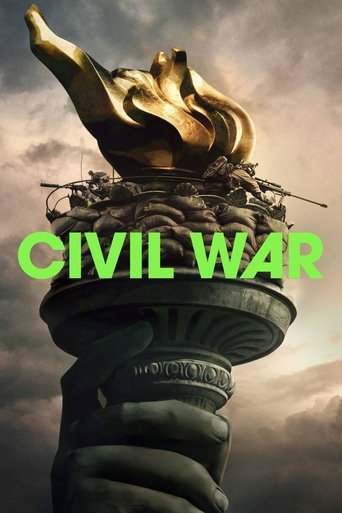
Civil War
2024 · Film · 109 min
Directed by Alex Garland
In the near future, a group of war journalists attempt to survive while reporting the truth as the United States stands on the brink of civil war.
8 positive5 negative1 mixed7 neutralfrom 21 commenters
Where to watch
No streaming data for this title.
29 comments on Hacker News
I'm not sure what 'film' America is trying to be but I've seen plenty of real life references that could have come straight from either the Handmaids Tale, Idiocracy, The Dead Zone or Civil War the past few years. Life does seem to imitate art sometimes.
For anyone that thinks a "civil war" scenario might be fun, I recommend watching Alex Garland's 'Civil War' - a highly realistic portrait of what an inter-US war would actually look like.
<< Sounds like, "What kind of American are you?" from the Jesse Plemmons character in the Alex Garland Civil War movie.
You see what you want to see, which is kinda revealing if you ask me.
<< Shouldn't the fact that ICE shot a woman trying to leave the scene be enough?
No. It is not enough. Reasonable person would be unlikely to find themselves in that position, which begs a simple question:
What was her reason for being there?
If you can answer that, we can start having a conversation. Until then, she is not some rando at the wrong place at the wrong time.
Sounds like, "What kind of American are you?" from the Jesse Plemmons character in the Alex Garland Civil War movie.
Shouldn't the fact that ICE shot a woman trying to leave the scene be enough?
I think the movie 'Civil War' by Alex Garland was too absurd to be understood by a lot of people - to me it was yelling "IT CAN HAPPEN HERE TOO"
Remember when that Civil War movie came out and everyone said its lightly sketched out back story didn't make any sense?
And now in reality we've got military deployed to "war torn" Portland due to Fox News reruns?
> and who knows what it will look like if we have some kind of civil war out of this.
I don't understand mentions of "civil war" in the public lately (there's even a Hollywood movie about it).
There is only one party controlling the armed forces. I also doubt that any high-ranking officers would take the troops they command out of the command structure and then even order them to attack the government and other troops.
Not to mention that the new administration did some cleanup among the ranks already.
The chances for enough, or any, troops breaking away from the command are very low, no?
So who is going to fight that "civil war"? It looks to me like the government has overwhelming power. At most I see some troops refuse orders to shoot at the American people, or at other troops.
Armed civilians with their puny little guns and little organization are right out as soon as any part of the military joins a fight, that's why I only mentioned the latter to begin with.
> stupid people did stupid things and then doubled down on stupidity as they went along.
You might like this review of the movie Civil War. Very well thought out review.
Alex Garland's CIVIL WAR has a clear and simple meaning
https://www.youtube.com/watch?v=sWBzZJxhQtY
I recommend the movie "Civil War" very original. Not saying that will happen but the movie is great.
We are also surrounded by unspeakable mystery and beauty. At the same time.
In the Civil War movie there’s a moment where the group is cornered by a sniper, pinned to the ground, not knowing if they’ll live beyond a few minutes or not. One of the characters looks at the flowers and the sky and is overtaken by the simple beauty of their existence. This.
We're getting deep into the hypotheticals now, but that disaster would probably also wipe out what makes California such a formidable economic powerhouse -- maybe that would be one reason California would want to ally with Texas. The disaster might also kneecap the state's ability to field an effective military via the National Guard.
But like I said, what was interesting to me about the movie was the fact that the two states were allies against the Federal government, without any mention of the modern day left vs right culture war. It's interesting to think about how such an alliance could come to be when we remove the things we suppose might spark a civil war today.
<< My point is that I found the film to be generally an affront to the suffering of people in actual, ongoing wars.
In a sense, you do have a point. I do happen to agree that it is rather hard to match the sheer.. what is a good word here.. brute reality of war. It is genuinely hard to do even with the best efforts, because, and this is kinda the point that I am slowly leading towards: that the reality has to meet the expectations of the audience.
And this is where I think you seem to fail at something you chastise the director/producer/maker(whole crew?), who made that movie. You seem to think that all wars all the same at all times; that the esperanto of violence would immediately cause a rather quick, normative default 'war' state that anyone could recognize. But you would be wrong... I don't want to bore you with the details, but just to give an idea consider the thought that it was not that long ago that soldiers wore rather colorful uniforms ( for a reason ) and it is only more recent wars that made them try to blend into environment. And this is but one, small, but visible difference, which will define how a war "looks" like.
<< It trivialized those experiences using them as a costume so american audiences could giggle in delight at the cinema without having to worry about the trappings of an actual war
Does it? I watched the movie, because I heard so many differing opinions that it got me curious. I try to abstain from most movies lately. Frankly, were it not for my wife, we wouldn't stream, but it is what it is.
But more to the point, which scene seemed trivial to you? Maybe my experience is different, because I watched it home?
On the other hand, I think, again, you misunderstand something. Just by default, most of us do make odd sounds, when were are nervous or uncomfortable ( yes, even laugh ). I do not want to assume too much, but I think even if you saw someone laugh, you might be misinterpreting something. My point is that, even if what you observed ( assuming it was observed ) is true, it is.. not the movie's fault. People's come in all shapes and sizes. I know I laughed hard that one time I thought I was close to dying.
<< And it did so all to tell a narrative that was somewhat against war-time journalism, painting their efforts as self absorbed and self serving.
I mean.. I did not get that impression, but I think that one could be safely left to interpretation.
<< I simply found the film disgusting and if people disagree with me that is fine.
I am not sure what to disagree with. That war is bad? That the movie does not capture its true horrors? That people suffer? You might be losing your point a little.
<< Of course any film about war (or perhaps any topic) could be controversial to someone.
I didn't see it as controversial. It was mildly interesting, but that was it. I personally think too many read too much into it, while Bill Hicks probably would have called it for what it is.
<< The WW2 epics starring John Wayne or Sergei Eisenstein's Alexandr Nevsky are both examples where the directors twisted every detail and used every opportunity to present a political message that the viewer may or may not agree with.
Ok. Now I know you are older than me. And to that I can only say: welcome to the cinema. It is not just WW2 movies. Everything now has a message. Sometimes, it is ridiculously overt, sometimes not.
<< My view on this is that the director of Civil War, Alex Garland, makes statements with the film that I disagree with.
Hwell, you probably should not have watched the movie or listened to him or both.
<< The movie never doubles down on anything, there is no deeper examination of the characters in the film, they just are until they aren't anymore.
Well that.. is an interesting criticism. I was going to respond reflexively, but I am going to ask you a real question that ties back to your original complaint how movies don't show the true horrors of war.
Would you agree, especially based on the lack of deeper examination phrase you used, that, the fact that all those deaths don't matter is in a sense a lot more terrifying than whatever deeper meaning you would want to add to those deaths. Meaningful death could mean immortality, but just not being there anymore is just that..
<< The president is blamed exclusively for all bad things across america. The entire movie is about how everything is the president's fault but lets interview him to see why.
Again, I think you misunderstand the audience of that movie, because that part is a very clear reflection of the real life in US.
I was going to continue, but I think it is clear that we disagree to a fair degree. Please let me know what you think. It may end up being an interesting conversation.
For the record, I was fortunate enough to not have experienced actual war, but some of family members did so I got to hear some of the stories. I am not even talking about a trained soldier doing a tour in a foreign land ( though that experience clearly gives you a close insight into what is happening in that time ). I am talking about the civilians just trying to survive.
I don't think the approach was stolen. It is fine for artists to take styles and ideas from other works and put them in their own. My point is that I found the film to be generally an affront to the suffering of people in actual, ongoing wars. It trivialized those experiences using them as a costume so american audiences could giggle in delight at the cinema without having to worry about the trappings of an actual war. And it did so all to tell a narrative that was somewhat against war-time journalism, painting their efforts as self absorbed and self serving. Like look at the way they film the death of the Kirsten Dunst, in this hero pose with camera in hand searching for the perfect picture. Contrast that to the actual life and death of someone like Viktoriia Rushchyna who was tortured and had organs removed or Shireen Abu Akleh who was allegedly shot in the head by a sniper while wearing a press vest. I simply found the film disgusting and if people disagree with me that is fine.
Of course any film about war (or perhaps any topic) could be controversial to someone. The WW2 epics starring John Wayne or Sergei Eisenstein's Alexandr Nevsky are both examples where the directors twisted every detail and used every opportunity to present a political message that the viewer may or may not agree with. My view on this is that the director of Civil War, Alex Garland, makes statements with the film that I disagree with. He seems to not see the humanity in people, at least, in my opinion. The movie never doubles down on anything, there is no deeper examination of the characters in the film, they just are until they aren't anymore. This is similar to his 2018 film Annihilation, which is essentially a retelling of J.G. Ballard's The Crystal World, and all of those characters in some way lack a humanity (although I think this works much better in this film as you discover that each character goes into the zone to find something about themselves that is missing and what defines them as human to themselves). And similar to The Beach, the novel he wrote that was turned into the movie The Beach, starring Leonardo Dicaprio about vapid westerners partying in thailand, or 28 days later, the zombie movie he wrote directed by Danny Boyle. Garland seems to see life as cheap and meaningless across the books and movies he has created. He cares more about the visual trappings of the setting he creates than the humans who live there. In the case of Civil War, I find it offensive as it uses the visual style of documentary films about ongoing wars as a costume and set dressing for his movie. And this movie comes from a culture (American) that started a war in Iraq and has done basically no introspection as to how those decisions completely changed their society into what it is today. This also influences the Civil War film. The president is blamed exclusively for all bad things across america. The entire movie is about how everything is the president's fault but lets interview him to see why.
> As I recall the battle lines were a bit awkwardly drawn for that one. The realism would increase if Cali and Texas were governed by the same party for some time in real life (as I recall they were allies in that movie).
I actually liked that little detail and don't think it's too farfetched. In real life those two states are currently on opposite sides of the political spectrum, but (iirc) we don't actually know why the civil war started in the movie and it seemed careful to avoid any kind of left vs right ideology. California and Texas both have a rich history of calls for secession from the union, and both have heavyweight economies that could allow them to stand as their own countries. I think if a civil war did break out where both states disagreed with the Federal government, they'd be more likely than you think to form an alliance.
Does that Civil War movie have a modern electrical box in the background? Because that's what it looks like to me - totally distracted me from the watch.
The movie adaptation was pretty good! Great cast, and the screenplay was written by Alex Garland (Ex Machina, 28 Days Later, Civil War, etc).
The recent Civil War movie had the president serving a 3rd term leading to 19 states seceding. How would the blue states respond to Trump ignoring the 22nd amendment?
I wonder if California were to pass Calexit in response to this administration's ongoing actions, what happens to the military bases and personnel in the state? Last year's Civil War movie by Alex Garland showed California and Texas with their own military fighting the US government. I took it to mean the military units in those states seceded with the state, instead of remaining part of the US Armed Forces.
It's wild seeing life imitating art, but the recent Civil War movie had the sitting president serving his 3rd term as to what probably caused 19 states to secede, and Trump has talked about somehow finding a way to serve a third term. One could argue that's just typical Trump bluster, like him telling people they won't have to vote again, or blue states might disappear in year. But I'm becoming more convinced he actual intends to do these things.
While we cannot predict the future, I found the movie Civil War (2024) really great and original.
Do you have any idea just how bad a violent revolution in modern day America would get? The recent Civil War movie doesn't do it justice. I'm assuming anyone advocating for this has swallowed Russian propaganda.
I watched Bowie's 'The Man Who Fell to Earth' after hearing a very wide range of opinions - love, hate, and "meh".
It's a very interesting film in somewhat the same vein as 2001 - It does not provide a narrative throughline and the conclusion is less than satisfying.
An unsatisfying narrative and conclusion is a double edged sword - it can lead people to think about the film for a longer time and ruminate on it - or it can make people angry and/or say stupid things. See also https://www.youtube.com/watch?v=URo66iLNEZw
---
I also think about Alex Garland's film 'Civil War'. It is very unsatisfying to never be told which side is the 'right' side, or what the war was about.
That unsatisfaction can make someone hate the movie, or it can be taken as commentary on war - it doesn't matter which side is right or what the fighting is for, no one wins a war. Winning a war is not morally satisfying. I think this is very very hard for Americans to understand, as our military tradition has centered on WWII.
I feel pretty confident in saying that no war that America fought after WWII has had a satisfying conclusion.
After 'Winning WWII' America also won the peace, which is actually why we can feel satisfied now. In no war before or since has America won the peace at anything close to the Post-WWII level.
Some of you act as if you really want a civil war. And I'm not at all excluding Republican voters from also acting that way. Go see the recent Civil War movie for how that might play out in today's world. It's a lose-lose across the board for everyone.
Your average war movie is much more apocalypse porn than Civil War. Civil War was a "this would suck, seriously" experience, not fantasizing & idolizing which the word porn implies.
Also, I need to immortalize a typo that I made writing the above paragraph:
Civil Warn
That's a good summary of the movie.
Maybe I'm just getting old, but I don't think that apocalypse porn helps the situation. I don't feel a need to see that new Civil War movie.
> We watch A24's Civil War the same way that Vaughan and Ballard would watch a car crash.
Civil War was a very interesting movie. The three main characters are all photographers, and the movie turns them into both the observer and the observed. This creates a distancing effect when we are confronted with the violence of war. But the movie also challenges the way we interact with war movies as a genre (many critics picked up on the Full Metal Jacket call-outs, they were so obvious).
I'm just saying, a lot to unpack in that movie.
New? No. Fully agreed.
But there's misrepresenting, and then there's "What the hell does this have to do with the movie I just watched?"
Good advertising (and I speak as an advertiser) sets up your expectations appropriately so that once you've experienced the product (in this case a movie) you leave satisfied.
Bad advertising promises you something completely different so that you leave the experience disappointed, which results in bad word of mouth.
Honestly, what none of the advertising for Civil War accomplishes (and I really liked the movie) is telling you that this is a movie about war journalism more than anything else. Yeah, there's a "this could happen here" message. But the core experience of the film is what it's like (presumably) to be a war correspondent. Didn't expect that at all going into the theatre.
Also... I loved Happy People. But yes, it's depressing. Beautifully so, but not a comedy.
“Civil War, the new Alex Garland movie” is not actually about the US Civil War. FYI.
And how exactly do you think everyone would have been ok with the US splitting into multiple countries?
The lapse of journalistic objectivity over the past ~10 years is a dead horse.
I do think we've turned a corner for the better. I haven't listened to NPR in years but the Times has improved over the past few years.
One of the themes of Civil War, the new Alex Garland movie, concerns this dynamic. See his interview in the Times: https://archive.is/pzs1a. His theory is that the press is supposed to check polarization by disseminating objective facts (which never fit one faction's worldview perfectly) and this process' failure has led to increasing polarization.