 Hacker Cinema
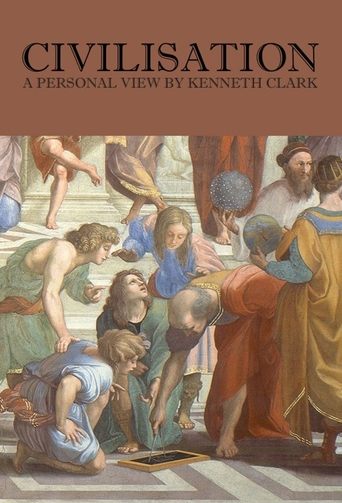
Civilisation
1969 · TV series · documentary · 50 min episodes · 1 season
Created by Kenneth Clark
Sir Kenneth Clark guides us through the ages exploring the glorious rise of civilisation in western man. Beginning with the bleakness of the dark ages to the present day, we consider civilisation's articulations and expressions in some of man's finest works of art.
9 positive1 neutralfrom 10 commenters
Where to watch
No streaming data for this title.
Videos commenters linked
From YouTube links in the comments below. Most are clips and trailers; “Full” means the uploader says so.





12 comments on Hacker News
He is far more than just a narrator. His 77-year career created and defined the wildlife/nature documentary as a genre, beginning at a time when television was so new that it really was just him and a few individuals making all the decisions. In his youth, he was given some cash and sent to travel the world in a 2-3 man team, off-grid for months, in the “Zoo Quest” series - the first time anyone had really seen animals, in the wild, on television.
Switching to a desk job, he went on to use his position in the BBC to green-light then-pioneering documentaries like “Civilisation” and “The Ascent of Man” (and still travelled occasionally for anthropological and nature documentaries, that he also green-lit) that remain a huge influence on all documentaries today.
Then in 1979, “Life on Earth” created an entirely new format of nature documentary that has only seen iterative change in the almost-50-years since. The rest, as they say, is history. He’s been heavily involved in the production of so many documentaries in the decades since, only reducing his role as he got older. Even in his 90s most of the series he narrates have short on-location sequences with him.
It’s safe to say that he, perhaps more than anyone else, created the “nature documentary” - both in experimenting with the format, and in green-lighting shows - and therefore shares a huge amount of responsibility for the many positive second order effects. Certainly in the UK, I would argue that a significant amount of public awareness of climate change comes from BBC documentaries. As attested to by others in this thread, generations of scientists and conservationists pursued their professions in part because they were inspired by him (and I can throw my own hat in the ring for this). It was also spoken about today, at his 100th birthday concert, about what an outsized influence his documentaries had on increased worldwide awareness of plastics pollution and the recent UN treaty beginning to address it.
His voice, really, is secondary to all that.
(I really would recommend reading his “Adventures of a Young Naturalist” and “Journeys to the Other Side of the World” books for anyone with an interest in this sort of stuff. They’re combined volumes of books he wrote back in the 1950s and 60s about his Zoo Quest expeditions - both a wondrous first-person view of the travels and interactions with wildlife, but also a fascinating teleportation back in time into a world where air travel and television were brand new, and all of these remote communities were near-untouched compared to today).
Sad news - I hope it continues and they manage to get someone who keeps the quality high. As others have pointed out, the thing that makes In Our Time great is it assumes the people listening are interested in learning something without pointless fluff.
I was watching the first episode of the new-ish BBC TV series Human last night and, although there was some interesting information in there, it was unbearably slow and overwrought - 20 minutes of interesting content stretched out to 60 minutes by overly dramatic speech and pointless visual interstitials with soaring music. Such a stark contrast in terms of information density if you watch the original big BBC documentary series like Life On Earth or Civilisation.
>looks like many "BBC Four Classic Documentaries Collection" programs of the last century get the same treatment
Fair enough, it may be that the warning is just a generic one slapped on all their old repeats, but I do think that commissioning a new ten minute introduction from Mary Beard is going above and beyond. I haven't seen it so didn't want to speak too much on it, but from what I gathered it's a mixture of measured praise and blame for Clarke's eurocentrism.
>I have Civilisation in hardcopy
It's a good series, I would recommend it if you haven't already seen it. (My biggest gripe with the BBC rebroadcasting it is that it prompted them to take down from youtube the copy I was in the middle of watching!) By the way, for a more xenophilic production of similar scope, you might wish to take a look at The Silk Road[0].
[0] https://en.wikipedia.org/wiki/The_Silk_Road_(Japanese_TV_series)
Seeing that this discussion is still going on (I'm impressed!) I shall provide an example which I believe fits the bill. Around the time you first asked the question I learnt that the BBC are currently re-airing a classic documentary series of theirs, Civilisation, by Kenneth Clarke. This is essentially a history of post-classical European civilisation from the end of the dark ages to the present day. The programme is what we would now call eurocentric in its focus, and it does celebrate that european culture, but it certainly doesn't denigrate any other, or claim that that of Europe is greater than any other. Nonetheless the BBC felt it necessary in rebroadcasting it to prepend a warning that the programme reflects the 'standards and attitudes of its time'[0]. What views are these which the BBC feels it necessary to disclaim? One can only assume it is the attitude of celebrating rather than denigrating western culture and history. The programme must not go out without warnings lest anyone get the impression that we appreciate our own civilisation! I believe that that can fairly be called oikophobia.
[0] https://www.spectator.co.uk/article/why-is-the-bbc-censuring-kenneth-clarks-civilisation/ They also commissioned a ten-minute preface talk by Mary Beard but as I couldn't watch this myself (it's only on the BBC iplayer for which I will not sign up) I shall refrain from comment.
As a lagniappe (not a word we have in my country, by the way), I share this rather cruel Pound story which may nonetheless, as it did me, amuse you: https://en.wikipedia.org/wiki/Auberon_Waugh#Waugh.27s_views (2nd paragraph, or look for 'Pound')
I have to put in a word for Kenneth Clark's series called Civilisation. There's also a book. You can find all the episodes on YouTube with a simple search. They have almost all of them in a playlist but for some weird reason the first episode was deleted from the playlist, but exists separately on YouTube so you can still watch all the episodes.
Connections was savvy in finding faires, working museaums, and access to the BBC's film vaults for providing much (though not all) such footage. Burke describes going to reenactment festivals to film many of the medieval life scenes.
And his journalist background and connections enabled him to have the access necessary to shoot single-take sequences such as this:
https://youtube.com/watch?v=2WoDQBhJCVQ
(Hardly the only impressive on-location scene in his work.)
Agreed with your comments on the primary importance of writing and research. I'd argue that Chris & Evan Hadfield's "Rare Earth" is getting close, Tom Scott is doing quite well, and Derrek Muller's "Veritasium" and Destin Sandlin's "Smarter Every Day" have promise.
Several YouTubers have been picked up by traditional broadcasters/production organisations, notably Hank Green ("Crash Course"), with PBS, and Emily Graslie ("Prehistoric Road Trip"), with the Chicago Field Museum. YouTube as a training and recruiting ground has merits.
One reason Connections is so hard to compare to is that it's pretty incomparable: forty years on we're still discussing it in glowing terms. It was produced by someone well-established and experienced at least within the BBC, and backed by the organisation. Notably, little from either national/public broadcasting or commercial production has even approached it. My short list includes Sagan's Cosmos, Burke's own The Day the Universe Changed, Ken Burns. Daniel Yergin's The Prize. And of course Kenneth Clarke's Civilisation and Jacob Bronowski's The Ascent of Man, which had paved the way for Burke himself. I might include Adam Curtis's works.
The role of the author or creative voice --- a Burke, Sagan, Burns, Bronowski, Clark, Curtis --- cannot be overstated. That talent seems rare, perhaps also the ability to simply get out of its way. Also realising when it's circled too hard back in on itself --- Burke had 2--3 good series in him, but he hasn't matched himself in at least three decades.
Related HN thread with additional recommendations: https://news.ycombinator.com/item?id=2698026
Part of that is a more crowded field: there's more produced, it's harder to get noticed. Part my own near-total avoidance of broadcast television. But I don't think that's all of it.
And yes my HN history shows I'm quite the fan of Burke: https://hn.algolia.com/?dateRange=all&page=0&prefix=true&query=by%3Adredmorbius%20connections%20burke%20&sort=byPopularity&type=comment
Other shows from that era worth a watch:
The Ascent of Man
Civilisation
There's also Connections series 2, although it is not as good.
Plus any of BBC Adam Curtis documentaries...
> Our affluent society allows us to specialize in what we like; allowing the best of us to create art and mathematics and make discoveries in science is as important as being a "contributing member of society".
Yes, but this stops happening when economic growth is non-existent.
The Western economy (developed countries generally), outside of Silicon Valley and a small number of bright spots, is not really growing.
First let us dispense with certain lies that nearly everybody believes.
The statistics about growth you always hear in the news or from politicians are fraudulent. All economic growth ultimately derives from technology - more output for less input or doing more with less. In the 1930s the growth statistics looked very bad but were actually better than they appeared because a host of new technologies were invented - artificial rubber, secondary oil recovery. Measuring this sort of thing is meaningless because every new invention is only discovered once. How the invention of the steam engine and vulcanized rubber impacts on the price network is unknown until it actually happens and the two inventions contribution to economic growth cannot be compared until they enter the price network egro...
The growth stats were always at best a guess at the underlying reality.
The real economy has not grown significantly since the early 70s. People who correctly point to the massive increase in computational power as marvelous should contrast that with with real energy prices in the same period. That is what the hoi polloi feel, and they are more correct about that than a supertanker packed with econometricians and politicians. This is why the hated Trump is so beloved, notice how the campaign slogan isn't 'Make America Greater', it is 'Make American Great Again'. This admission of a failure is fascinating (for a politician) and utterly ignored by the press.
I don't believe it is 'the end of the world' (there was some growth after all) but people really need to pull their heads out of the asses, academics in particular. Unless we realize there is a problem we cannot adjust our positions in order to fix it.
The fact is that the ideas in your head need to pay rent somehow.
If the net affect is that they do not, then society fragments, which is an appropriate strategy to deal with failure through complexity. I note that the Roman Empire had a very high basic literacy rate. Normal people could read and most often poor children went to a kind of elementary school.
That all got fucked when the Empire fell. It didn't happen immediately but we ultimately went 5 centuries in which only a tiny tiny elite, sometimes in the low hundreds or thousands had the ability to read and write. There is a small island off the coast of my country that held the only copies of most old Greek and Roman texts, but for that 'seedbank' saved by the monks and a passionate illiterate king (Carogolian Empire), you would know nothing of Seneca, Cicero, all the myths and legends of the Ancient World and much more besides.
Kenneth Clark did an excellent documentary on the subject if you're interested.
The episode is: Civilisation (1969) Episode 1 "The Skin of Our Teeth", from 13:35.
Things can and do go backwards.
I don't disagree! Maybe you were talking to a super-prepper.
However to play Devil's Advocate I expect you could survive Argentina/Rwanda/Georgia/Ukraine with sufficient preparation e.g. growing food underground.
It just takes an ungodly amount of money to make it work.
> I'd challenge anyone to show when such a thing has happened in history.
That's the interesting problem because I'd say (let's call it) 'cannibal holocaust' does happen with some frequency on a historical scale. It happened in my country and Russia more recently. It's rare but it does happen.
The key element I think isn't so much resources as secrecy of preparations. With sufficient resources and thought you should be able to hole up for the rest of your life.
Whether you'd want to is another issue!
You have to remember that the people who do go fully off the grid aren't all that likely to advertise themselves. I'm thinking they will mostly be dissidents or the military (for deadman's switches, secret bioweapon programs and the like). So your appeal for challengers might come up empty for reasons other than non-existence. People who do this are always going to be pretty extreme.
Here's one example: http://www.smithsonianmag.com/history/for-40-years-this-russian-family-was-cut-off-from-all-human-contact-unaware-of-world-war-ii-7354256/
I wouldn't say they were prepared with bullets and MREs per se but they certainly got off the grid. Also it is an interesting story.
Finally I offer you an example of (intellectual) survival from ancient times in my own country.
The majority of Greek texts you've heard of used to be stored in a small island off the Irish coast, protected against invaders by monks and most likely extreme isolation. If the Carolingian empire hadn't copied them from the monks you'd know next to nothing about the most major figures and events in world history.
https://en.wikipedia.org/wiki/Transmission_of_the_Greek_Classics#Early_Middle_Ages_in_the_Western_Provinces
When the Roman empire fell, knowledge of it and its predecessors was really in danger of being lost, despite what modern day hipster hun-apologists will tell you. From literacy to ... not-literacy. Without that backup beyond the furthest corner of the Empire, we'd know nothing about major figures like Seneca and Cicero.
Kenneth Clark did an excellent documentary on the subject if you're interested.
The episode is: Civilisation (1969) Episode 1 "The Skin of Our Teeth", from 13:35.
I don't know if you're familiar with Neal Stephenson's Anathem but I imagine he got a lot of inspiration from this.
Great BBC TV series from 1969, based on the book with same title:
Civilisation: A Personal View by Kenneth Clark
On youtube: http://www.youtube.com/watch?v=ElcYjCzj8oA
The Ascent of Man is utterly fantastic. It, along with Civilisation[0] and Connections[1] are among my favourite documentaries ever.
Here's an excerpt from Charlie Brooker's Screenwipe on Jacob Bronowski[2]
[0] http://en.wikipedia.org/wiki/Civilisation_(TV_series)
[1] http://en.wikipedia.org/wiki/Connections_(TV_series)
[2] https://www.youtube.com/watch?v=3bNK97nIsKs#t=141
When I was a kid, the documentary series Connections. It was the first time I'd ever seen someone follow vectors through history instead of recounting it one period at a time, like most books and classes do.
Discovering Lisp was a big one. This was in 1983, when the default programming language was Pascal. Lisp seemed (and in retrospect was) startlingly better. There was no one single book or quotation, but I remember how excited I was to get my hands on a photocopy of the InterLisp manual.
Kenneth Clark's documentary series Civilisation (and the accompanying book) impressed me a lot. In fact, it was clearly the model for Connections. I've never read anything else better about art. His ideas are extremely subversive, but few get it because he usually speaks in code. And he had access to stuff like no one else ever will again.
I also learned a lot from his book The Nude.
One of the biggest influences on my ideas about startups was an essay by TJ Rogers, the CEO of Cypress Semiconductor. I don't remember the title, but it cut through the usual corporate bullshit like a knife. For me the important thing was not just what he said, but that one could even be that candid.
Of all the books I've read in the last 5 years or so, Hardy's A Mathematician's Apology is probably the one that stuck most in my head.