 Hacker Cinema
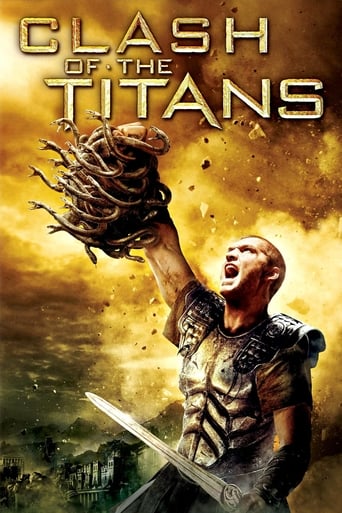
Clash of the Titans
2010 · Film · 106 min
Part of Clash of the Titans Collection
Directed by Louis Leterrier
Born of a god but raised as a man, Perseus is helpless to save his family from Hades, vengeful god of the underworld. With nothing to lose, Perseus volunteers to lead a dangerous mission to defeat Hades before he can seize power from Zeus and unleash hell on earth. Battling unholy demons and fearsome beasts, Perseus and his warriors will only survive if Perseus accepts his power as a god, defies fate and creates his own destiny.
3 negative1 neutralfrom 4 commenters
Where to watch
No streaming data for this title.
5 comments on Hacker News
Most of VFX's problem isn't technology. If you read the post, its not really mentioned.
No the main problem is indecision.
As other people have pointed out, virtual sets require a solid and stable vision of what the story and look of the movie is going to be, before filming starts.
Some film makers work like this. For example medium to high budget TV shows between 2010-2018 (before marvel basically.) Notably also chris noland.
There are numerous examples of poor planning/indecision: the two poorer modern james bonds (quantum and spectre) both started shooting before the script was fixed. So loads had to be made up in editing.
Another example is this:https://www.youtube.com/watch?v=yfVu52tZxd0 "the sand room" from prince of persia. This was designed, scripted and executed by one of the VFX houses, because the producers realised that they had no way to link the two halves of the film.
This example here: https://clash-of-the-titans.fandom.com/wiki/Deities?file=Zeus-and-the-Gods-a-top-Mount-Olympus_gallery_primary.jpg
In Clash of the titans (2010) they spent loads of money making mount olympus with a real set. Hired all the old masters. after filming, the producers were like "Nah, I don't like that, lets make it like google maps". So the set was removed (I'm not sure if it was digitally done or a reshoot).
Then Hades's cloak was a pain because the producers first wanted smoke. Then ink, then smokey ink.
As alluded to in the post, the producers can get away with this because the contract is to do as many revisions until its done. There is little to no cost hit to the producers of the film to fiddle, be indecisive or back track.
> If you mean, a choice by the team making the movie
thats art darling! exaggerated arm movements
I kid, but agree completely.
> not even about a genuine vision from the director, but rather following the fad.
I once heard about a monthly, where the exec producer's current shag was spit balling changes, expensive changes. It was great to see the faces of the VFX producer mentally totting up the cost.
Also when filming the prince of persia, the production team realised that they had a massive plot hole linking two parts of the movie, so they asked the VFX company to figure something out. From what I recall, this is the origin of this scene: https://www.youtube.com/watch?v=yfVu52tZxd0
In clash of the titans(remake), they spent a boat load of cash on a real set for mount olympus, but then decided that they wanted to make it more "google maps-y" so scrapped it and redid it in VFX.
Some films are Art, others less so. None of them are as artistic as film theory dictates.
Flying mounts are a plot failure almost every time they are brought up in fantastic stories. Most fantastic stories revolve around a perilous journey through harsh environments and monster lairs.
This happens in a good number of movies such as Clash of the Titans where they journey to get the medusa's head, but return on flying pegasus. This also happens in Dungeons & Dragons (2000).
Morale : Do not add flying mounts to your scenario, or have your characters fly all the time, otherwise it makes no sense
Actually, a lot of recent horror and sci-fi stuff is lifted from Islamic mythology (which itself is rebranded Jewish, Kanaanite and Babylonian lore.)
http://en.wikipedia.org/wiki/Gog_and_Magog
The TV show "Supernatural" heavily features themes of spirituality and daemons that are lifted from Islamic culture. The recent remake of Clash of the Titans also feature similar themes; the Jin, desert scorpions, Jin riding camels, etc.
I think it would be more accurate to say they are rarely horrible. But what does that prove? The highest selling cars rarely have less than 100hp, but that doesn't mean the public really wants to buy the car with the most power yet, by mistake, keeps buying reliable cars with high resale value.
Even if it were difficult to make a good movie (which I dispute, more or less), that doesn't explain why once the good movie is made the public would still avoid it in favor of "Clash of the Titans". The reviews are widely available.
How exactly should we determine what the public really wants than by what they go out and purchase? I just don't get what you and Eliezer are arguing from.