 Hacker Cinema
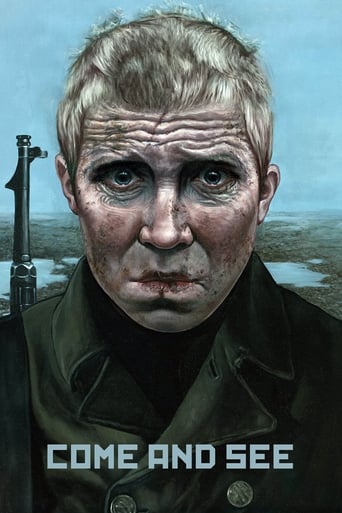
Come and See
Иди и смотри
1985 · Film · 142 min
Directed by Elem Klimov
The invasion of a village in Belarus by German forces sends young Flyora into the forest to join the weary Resistance fighters, against his family's wishes. There he meets a girl, Glasha, who accompanies him back to his village. On returning home, Flyora finds his family and fellow peasants massacred. His continued survival amidst the brutal debris of war becomes increasingly nightmarish, a battle between despair and hope.
21 positive1 mixed6 neutralfrom 28 commenters
Where to watch
No streaming data for this title.
29 comments on Hacker News
The reality that war goes hand-in-hand with sexual violence is rarely fairly portrayed in American / Hollywood media. It sickens me when I see warhounds in our government who are, by extension of campaigning for war, rooting for sexual violence against entire populations - though they might not realize it through their ignorance.
That’s why I appreciate anti-war cinema, like Come and See, which notoriously came from Belarusian screenwriters.
You should watch the 1985 film Come and See I think you would find it a mirthful romp exploring the exciting journeys that total war can take one on. One of the many themes is seeing young and old fight along side each other, sharing their experience and wisdom. Watching last night really made me wish I was still young enough to meet the age requirement!
Hopefully we can one day be as progressive as Ukraine where the median age of a solider is between 43-45 years old. The median!
The relevant film here is "Come and See" (USSR, 1985).
The quality of recommendations depends on the social circle, I guess. When the Russian Guild of Film Critics picked the 100 best movies from 1908 to 2000, "Ivan Vasilievich Changes His Profession" didn't make it to the list, but the other movies I mentioned did: https://www.imdb.com/list/ls006516589/
That list includes everything from the Wes Anderson-esque "Beware of the Car" to the gritty Western-in-the-East "White Sun of the Desert", to "Come and See", a truly disturbing war drama. Lots to choose from, and many notable omissions still remain, like the wonderful 1977 comedy "Mimino" about a rural helicopter pilot who dreams of flying large airliners, and the "Peculiarities of the National Hunt" from 1995 depicting a Finn with overly romanticized expectations coming to Russia to learn about the traditional hunting customs.
> There's no such thing as an anti-war movie as Truffaut said.
This is an absurd statement, can you expand on this?
Have you never seen The Pianist, Schindler's List, Come and See, ..?
Have you ever watched a film like Come and See, Schindlers list, Grave of the fireflies, etc…?
These movies are some of the most impactful that I have ever seen, but by no means would I rate them highly rewatchable. They are gut wrenching, and some people can only stand to watch them once, few want to rewatch them, but they are also incredible.
I also gain a lot from a rewatchable piece of content, but you might be shorting yourself by always watching things designed to tickle the dopamine receptors.
"Come and see" and "20 Days in Mariupol". Both are about wars and both affect you the way nothing else does.
The last one is a documentary about the war in Ukraine. The actual raw uninterpreted reality of things that we read about in history books or in the news changes your perspective on many things, from politics to simple things in life that we often take for granted.
News stories force an agenda on you. History books may give you some knowledge about the reality we live in today. THIS lets you live through the traumatic experience of the history books and news story events.
No: I have more access to obscure stuff than I did in the DVD era. I read Tarantino's book a few months ago and went to go watch Escape From Alcatraz. No chance in hell that Blockbuster would have had it in the 90s, took 15 seconds to pull up online. The Kurosawa films. Come And See. People have weirdly either weirdly idolized or motivated perspectives on what was easy to get access to in the physical media era.
Whatever weird niche local productions you had access to back then with "video rental clubs" I put up against Vimeo, certain that it's unlikely to be much of a contest.
It’s very good, but I didn’t find it hard to watch.
“Come and See” however I don’t want to see again, despite it possibly being the best film ever.
Good that "Come and See" is relatively high.
Certainly the best (anti)war film.
I said that American cinema is not engaging with that and never engaged - with rare exceptions.
On top of head, I think that something like Shigurui or Berserk would be great examples of art that engages with ideas and complexity. So would be Umberto Eco and the Name of the Rose, more or less. Even original Witcher books have huge amount engagement with ideas despite being meant for entertainment. The movie "Come and See" managed to make war sound not fun which is something too.
American cinema is just not about that. It is not about complexity, it is about simplifying and streamlining. Which is fine, it is just odd that someone claims opposite.
It's not on my Netflix unfortunately and I just find this Russian anti war film: https://en.m.wikipedia.org/wiki/Come_and_See
Spending 5 years in Thailand I've learned that Buddhism while funamentally different from other religions in the best ways operates just the same in practical reality. It's almost like classification and status is inherit to any group activity and not in a good way unfortunately.
To give perspective on the "dark" side of Buddhism I highly recommend "Come and See" documentary on Netflix which is hard to explain without spoilers but it's a great illustration of how everything evolves into a crab eventually.
If you enjoy classic Russian films, many of the Soviet era are available on YouTube including Stalker, Come and See and other unusual classics.
Come and See is on YouTube with English subtitles, for anyone curious. It's an excellent film.
I am not the OP but I had my view on this kind of changed by watching YouTube essay "Lies of Heroism – Redefining the Anti-War Film" [1]. Whey you think about movies like for example Enemy at the Gates, they show the gruesome reality of the battlefield, but it is usually interpreted in a way that makes the suffering feel meaningful, heroic. Contrast that with Come and See, where there is no heroism, no ultimate meaning of the suffering, just meaningless hellish nightmare.
[1] https://youtu.be/yf0G2MPBEYM
Come and See remains the most horrific film I've seen. Critically important how it shows the brutality of that war.
The Act of Killing is the most brutal documentary I've seen and in fact could not finish it. On Indonesia's executioners of communists.
For a take on the Cambodian travesty see The Killing Fields.
It's remarkable how nearly everything you just wrote applies to Belarus (with small changes):
>Pol Pot and his government were responsible for the death of 1/4 Cambodian population in a short amount of time, not counting deaths from neighboring countries.
Adolf Hitler and his government were responsible for the death of 1/4 Belarussian population (a third of them Jews) in a short span of time, not counting deaths from neighboring countries.
A lot of Belarussians joined the partisan effort, the largest guerilla warfare of that war (including the writer of Come and See, an acclaimed film about those days):
https://en.wikipedia.org/wiki/Come_and_See
The history about this period is interesting if you're looking for a good read. It's not being widely taught, even in Russian K12 education.
Both Vietnam and Belarus were liberated by the Communists across the border, who have ruled both countries until the collapse of the USSR in 1991-1992. Ever since that, both countries have been under a de-facto dictatorial rule of a former communist official (though holding "democratic elections" on paper) - Hun Sen in Cambodia, Lukashenka in Belarus.
There are many differences, of course, but there aren't many countries that lost 25% of their population to genocide, were ruled by communists after that for decades, and have been ruled by the same person since 90s.
> I had never seen a war movie produced outside of Hollywood. Or a director with primarily french influences producing a war movie.
Not sure if the stipulation is a war movie about Vietnam, or just plain a war movie. But certainly here's a list of some non-U.S. 20th century war movies, very vivid, biased towards France:
The Battle of Algiers (French, Gillo Pontecorvo, 1966)
Come and See (Russian, Elem Klimov, 1985)
Ivan's Childhood (Russian, Andrei Tarkovsky, 1962)
Beau Travail (French, Claire Denis, 1999) -- OK, soldiers but not war
Army of Shadows (French, Jean-Pierre Melville, 1969)
A Man Escaped (French, Robert Bresson, 1956) -- POW, not front lines
Little Dieter Needs To Fly (British/French/German?, Werner Herzog, 1997) -- actually relates to the war in Vietnam
I actually don't think film depends all that much on technology. True, contemporary audiences will have to learn how to watch, read, and understand silent, black & white, and early color (like Technicolor) films. But the essential pathos, invention, and artistry sip through the pores of their technical fabric.
I'd say there's probably hundreds of films that can reasonably compete to be in the top spots. Most films aren't given that chance since they aren't widely seen by critics. For example, the 1985 Soviet film 'Come and See' is an utterly stunning example of film's power to document trauma, convey another's pain, and do so in formally and visually inventive ways. It takes pathos to the extreme. I do believe it should be considered one of the greatest films for these reasons. But it only came out 35 years ago and simply has not been shown enough, so it doesn't have the canonical heft it deserves yet.
I do think the canon is important, even if it's just because it forms the foundation on which contemporary films sit (at least those with artistic pretensions). But it's important to have your own voice when watching them. I, for example, like Tokyo Story, but think Floating Weeds is the greater Ozu film, not least for it's beautiful images - it is perhaps the best-looking color film.
It's strange but when I think about Poles'e I think about 'Come and See' movie and the swamp scene https://youtu.be/Y60mnxzSD1Y?t=2992
There was something my AP literature teacher told us when someone asked why literary analysis would ever be necessary; he said something along the lines of: “math and physics might be more valuable in the job market, but if you’re ever depressed or your soul needs nourishment you’re far more likely to reach for classic literature than the math textbook.” 5 years later and I find a lot more peace and joy in pondering the topics literature is focused on; love, death, life, purpose, war, compared to sifting thru the endless news on hacker news.
Literature and the great novels have consistent themes that are unending in their search for answers, and often this evokes a deeper level of thought compared to the internet.
That said, when I do watch tv I try to stick to artistic movies or something I can learn from. Recently I watched Come and See, an excellent movie about Nazis in Belaruse. After watching it I thought this movie deserves a literary analysis of its own.
This, Kanał, and Come and See are some of the best alternatives to stereotypical US WWII films.
Another French "WWII" film with an amazing production story is Children of Paradise:
https://en.wikipedia.org/wiki/Children_of_Paradise#Production
Not a citation, but here's a soviet depiction of that time: http://www.imdb.com/title/tt0091251/
Her writing is vivid and terrifying. Her _War Does Not Have a Woman's Face_ is at the top of my list of books to unread. It's a collection of accounts from female survivors of WW2 trenches. It is not pushing a feminist narrative in traditional sense (wasn't a thing in USSR) but is haunting in its honesty. Think _Saving Private Ryan_ without the humanistic takeaway.
She's a part of Belarusian late 20th century documentary realism tradition, where authors build around authentic, traumatic biographies of the war generation. In literature, Vasil Bykau, her contemporary, even better known domestically. In cinematography, Klimov's _Come and See_ perhaps the most known work.
mainstream: American beauty, Pulp fiction, No country for old men, American History X, Saving Private Ryan, Taken, The pianist
classics: Lawrence of Arabia, The Shawshank Redemption, 2001: A Space Odyssey, Terminator I & II
hipster: Knife in the water (Polanski), Come and See (Idi i smotri - best war movie I've seen), Haute Tension (french horror movie), Requiem for a Dream, Trainspotting, City of God, Blue Is the Warmest Color, Goodbye Lenin, The cube
This is not funny. In my country Belarus every fourth person was killed by Germans and collaborators, mostly civilians. Every family lost someone. Many lost everyone. Many cities and villages vanished. If you happen to be in Belarus visit Khatyn memorial or just watch "Come and see" movie. This is something you will never forget.
http://khatyn.by/en/ http://www.imdb.com/title/tt0091251/
Thanks for suggesting to watch "I Am Cuba", I definitely will.
"The Cranes Are Flying" is an amazing movie, I totally agree. I think it is a great illustration of an idea that morally-strong and courageous people are the first ones to die in hard times.
If you like "The Ascent", I wonder if you'd also be fond of her other movies, first of all, "Ty i ya" (1971) [1] (The film has it's fair share of problems but I find the main idea behind it really powerful). I'd also recommend you to watch movies made by her husband, Elem Klimov, at least, "Come and See" [2] and "Rasputin" [3].
As about "Come and See", for me it has a somewhat personal theme: when Nazis were exterminating the people of his village near Ula, the grandfather of my ex has survived only by chance. His mother, while holding him, has jumped into the ravine before the bullets hit them.
[1] http://www.imdb.com/title/tt0067894/
[2] http://www.imdb.com/title/tt0091251/
[3] http://www.imdb.com/title/tt0081991/
There are some good Russian movies that are somewhat unknown to the Western public. For example, I wonder if any of you have seen these:
Georgiy Daneliya. "Kin-dza-dza!" (1986) [1]
Larisa Shepitko. "The Ascent" (1977) [2]
Leonid Maryagin. "Public enemy - Bukharin" (1990) [3]
Aleksey German. "Twenty Days Without War" (1977) [4]
Aleksey German. "Khrustalyov, My Car!" (1998) [5]
Stanislav Rostotskiy. "A zori zdes tikhie" (1972) [6]
Mikhail Kalatozov. "True Friends" (1954) [7]
Mikhail Kozakov. "Pokrov Gates" (1982) [8]
Georgiy Daneliya. "Osenniy marafon" (1979) [9]
Elem Klimov. "Come and See" (1985) [10]
Victor Ginzburg. "Generation П" (2011) [11]
Sergei Gerasimov. "The Journalist" (1967) [12]
(this one is Polish) Juliusz Machulski. "Sexmission" (1984) [13]
(also Polish) Krzysztof Kieslowski. "The Decalogue" (1989) [14]
[1] http://www.imdb.com/title/tt0091341/
[2] http://www.imdb.com/title/tt0075404/
[3] http://www.imdb.com/title/tt0100891/
[4] http://www.imdb.com/title/tt0074447/
[5] http://www.imdb.com/title/tt0156701/
[6] http://www.imdb.com/title/tt0068161/
[7] http://www.imdb.com/title/tt0047650/
[8] http://www.imdb.com/title/tt0083465/
[9] http://www.imdb.com/title/tt0079679/
[10] http://www.imdb.com/title/tt0091251/
[11] http://www.imdb.com/title/tt0459748/
[12] http://www.imdb.com/title/tt0062524/
[13] http://www.imdb.com/title/tt0088083/
[14] http://www.imdb.com/title/tt0092337/