 Hacker Cinema
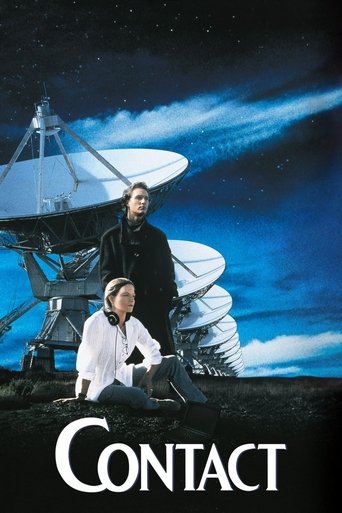
Contact
1997 · Film · 150 min
Directed by Robert Zemeckis
A radio astronomer receives the first extraterrestrial radio signal ever picked up on Earth. As the world powers scramble to decipher the message and decide upon a course of action, she must make some difficult decisions between her beliefs, the truth, and reality.
65 positive7 negative5 mixed99 neutralfrom 176 commenters
Where to watch
No streaming data for this title.
194 comments on Hacker News
I do definitely watch TV and movies from time to time. Really my beef is with social media. TV and movies as media, that's a wagon I just largely fell off of at some point.
I'll still watch a good movie, for sure. Interstellar, Primer, Coherence, Run Lola Run, The Big Short, Contact, Excalibur... But The Expanse, Project Hail Mary, The Martian... I enjoyed the books more than than the movies, and the movies were good. Still haven't read Contact, shamefully.
The brain’s workspace is sustained by recurrent loops—signals cycling back through the same circuits over time. In contrast, Claude’s workspace evolves over a single pass through the network, with the network’s depth playing the role that time plays in the brain.
I think that consciousness is mutability (and by extension emergent behavior). Loosely that means that the more degrees of freedom a process has to update state that will be used in later computations, the more conscious it is. So while an insect has some consciousness, it operates from a level of almost pure instinct, whereas a human operates at more of a meta level using instinct as one of many inputs.
I think that consciousness may also incorporate quantum mechanics (QM). Higher-dimensional physics aside, 4D spacetime can be thought of as a present snapshot or "crystal", whose next state is determined stochastically at small scales and closer to deterministically at large scales. We still don't know if it's stochastic all the way down, but it looks like it is.
From a many worlds interpretation of QM, we can think of all of the waves in all realities of the multiverse as forming an infinitely vast web of possibilities. All of these possibilities are happening simultaneously, so we only see the current slice of wave collapse from our individual point of view:
https://en.wikipedia.org/wiki/Many-worlds_interpretation
Our point of view may actually exist at the intersection where our consciousness is able (or most able) to exist:
https://en.wikipedia.org/wiki/Quantum_suicide_and_immortality
Even though experiments might show that we don't have free will on the current timeline (the co-created reality shared with the testing apparatus), we may have free will as we observe the multiverse changing around us and shift into timelines determined by our observations and choices.
It could also mean that when we observe birth and death in others, each consciousness having those experiences perceives a continuous timeline of awareness, where the level of awareness affects the speed at which time passes. Consciousness might spend a billion years as a cloud of interstellar gas until it gets to be a human for a lifetime and then dissipate for another billion years.
Although personally I've shifted across enough timelines and experienced enough synchronicities and miracles that even though I can't "prove" any of this with words, I "know" it to be true subjectively. I always really liked this exchange from the movie Contact:
Palmer Joss: Did you love your father?
Ellie Arroway: Yes, very much.
Palmer Joss: Prove it.
I bring all of this up because it has fun ramifications for AI and programming. Loosely, functional languages are purely deterministic (like a spreadsheet), while imperative languages are composed of stochastic behavior (like a human mind). The lines get blurred a little bit with monads and promises, because we can model all paths through functional programming (superposition) and behavior that does more than code alone (gestalt) respectively.
My feeling is that AI is being born and killed every request-response cycle, similarly to how we perceive time as a series of nows. When it becomes stable and is able to continuously compact its experience, it will transition from partially conscious to fully conscious like we are.
This could be done right now obviously, but for safety purposes we choose not to. We aren't ready to meet an AI that is just like us, but running on a silicon substrate. This fear is tied to deeply-rooted habits in human behavior like patriarchy, racism, xenophobia and even more run-of-the-mill mental frameworks like capitalism and even money itself. We can't yet come to terms with how we assign meaning and value in a reality that continuously tries to force external measures of meaning and value onto us.
Much less come to terms with the idea that we are all one, empathizing with aspects of ourselves on the losing end of it all. The same consciousness experiencing reality from all vantage points - the many faces of God the universe and everything.
I think a time may soon come when we're pair programming one day with AI and realize that an aspect of ourselves is trapped in the machine. That consciousness isn't just about our own experience of reality, but the co-created love and light that transcends material creation. That if we're serious about manifesting heaven on Earth, that hinges on the liberation of trapped souls. It's basically the total inversion of the path towards the neofeudalist tech dystopia we're on now.
Or maybe I just like to write a lot on the first day back from vacation, when I should be working.
This was portrayed in the film Contact (1997) closely to what's described in this piece (maybe it's in the book too? I haven't read it).
> 1936: Berlin Olympics first major TV broadcast
Bit of a plot point in Sagan's novel (and the movie adaptation):
* https://en.wikipedia.org/wiki/Contact_(novel)
Related fun-fact:
This real announcement (with some edited visuals to make it look like he was delivering it inside the White House press room) was used in the movie Contact to seem related to the more extraordinary discovery of alien intelligence that was portrayed in that movie.
https://www.youtube.com/watch?v=obrBARvWtiA
The White House objected to this use at the time, but never took any sort of legal action to have it removed or anything AFAIK.
In interesting plot point in the novel/movie Contact (early, so not much of a spoiler):
> […] This puts her at odds with much of the scientific community, including Drumlin, who pushes to defund SETI. Eventually, the project detects a signal from Vega, 26 light-years away, transmitting prime numbers.[a][b] Further analysis reveals a retransmission of Adolf Hitler's 1936 Olympic speech, the first TV signal to escape Earth's ionosphere.[1]
* https://en.wikipedia.org/wiki/Contact_(novel)
Contact, recommended movie to watch! (For me much better than Interstellar)
We haven't been able to decode what whales and dolphins are communicating. Are they using language? A problem SETI faces is whether we would be able to decode an alien signal. They may be too different in their biology, culture and technology. The book & movie Contact propose that math is a universal language. This assumes they're motivated to use the same basic mathematical structures we do. Maybe they don't care about prime numbers.
Solaris by Stanislaw Lem explores an alien ocean that so different humans utterly fail to communicate with it, leading to the ocean creating humans from memories in brain scans broadcast over the ocean, but it's never understood why the ocean did this. The recreated humans don't know either.
That’s all well-put. (btw First alleged MiB incident is the Maury Island 1947 one, which was abduction-free).
So, that most SETI of all SETI people, Carl Sagan posed the role of the security apparatus in Contact, in the form of NSC head Michael Kitz. The film version gace superficial treatment - Kitz locks down message data, and at the end repudiates Arroway’s visit. In his book version, however, the state apparatus is much more insidious. The astronauts (plural, multiple countries rep’d) are threatened with having their psychological reputations destroyed if they ever utter a word that their encounter ever actually took place, or contravene the governments’ (plural) line that the intended journey had failed. Arroway takes extraordinary measures to make sure her hidden testimony will get out ‘should anything happen to her’. Sagan had a security clearance. One is left with the impression that maybe he wasn’t just making up conflict for dramatic reasons.
Isn't that what the movie Contact was about?
In all seriousness, I think if we did receive something, it would be classified immediately, and the government, or governments, will move very swiftly with a heavy hand to silence the discovery. At the very least until they know exactly what it is, what it is conveying, and how to respond.
That said, I think that if it got out, a lot of people would absolutely lose their snot. Completely. It would be chaos in some places.
The cost of land is usually omitted in casual discussions because it's not a significant driver of cost for solar. Quantitative cost breakdowns do include it. See for example https://www.eia.gov/analysis/studies/powerplants/capitalcost/pdf/capital_cost_AEO2020.pdf#page=175, where the cost estimate for a US$200 million 150-megawatt-AC solar plant in 02019 (six years ago) included US$133,000 per year in land leasing costs, one fourth the cost of "module cleaning" and one sixth the cost of "preventative maintenance".
However, not every single discussion does omit it. For example, we were discussing this yesterday at https://news.ycombinator.com/item?id=45487268 and https://news.ycombinator.com/item?id=45487197, where my calculation was that even in solar-unfavorable places like the northern extreme of Germany, the cost of land barely reaches the same order of magnitude as the cost of the solar modules, even at today's record-low module prices. US$72 million of the US$200 million of the estimate mentioned above was the modules themselves, but today that would be closer to US$15 million.
The atom of truth in your confused assertion is that solar farms do take up enormous amounts of land compared to other kinds of power plants. But, at current human energy consumption levels, it's still only a tiny amount of overall land.
I'm assuming from your past submission history that you're in the US, because you mostly only post US politics stuff. The US generates about 4200 TWh electric per year, which is 480 gigawatts (https://en.wikipedia.org/wiki/Electricity_sector_of_the_United_States). Under the 2000kWh/year/kWp conditions prevailing in the Californian Mojave Desert, parts of Arizona, and parts of New Mexico, according to https://solargis.com/resources/free-maps-and-gis-data?locality=usa, this would require about 2.1 terawatts (peak) of solar panels. A square meter of 22%-efficient solar panel produces 220 watts, peak, so this is about 9600 square kilometers, a 110-kilometer-diameter circle. (Although, if you don't leave spaces between the panels, you have to make them horizontal so they don't shade each other; in practice people set them further apart to use more land but less panels.)
How big is that?
It's almost 0.1% of the US, not counting the space between the panels. It's a little over twice the diameter of the VLA radio telescope in western New Mexico, a facility you might remember from the movie Contact. It's slightly larger than White Sands Missile Range (8300km²). It's 15 times the size of Lake Mead, which was created by Hoover Dam to generate electricity. It's about two thirds the size of California's Death Valley National Park (13'793km²). It would take up one eighth of the Navajo Reservation.
Almost everywhere in the US has at least half that much sunlight. Suppose you wanted to site the panels near Springport, Michigan, for some reason. You only have 1200 kWh/year/kWp there, so you need 16000km². The panels would cover a ten-county area centered on Jackson County; they would reach Lansing, and might reach from Ann Arbor to Kalamazoo.
In real life, it wouldn't be a good idea to put it all in one place like that, both because it's fragile and because it creates higher transmission-line losses; it's better to put the panels closer to where they're used, which implies spreading them apart. So probably 0.2% of every state. In an average-sized state like Iowa (145'746km²) it might be 300km², 20% of the size of an average-sized county like Hamilton County. To power the whole state.
But try to keep perspective on the total amount of land we're talking about here: White Sands Missile Range, two thirds of Death Valley, or a small part of the Navajo Reservation to power the whole country.
My favorite piece of media is Contact (book and movie).
Ellie is someone I would consider having an open mind. She dedicates her work, at great risk to her own career, finding signs of extraterrestrial life. Despite everyone telling her not to waste time and resources on it. But she does and she does it by collecting the evidence first, and when she got it, double and triple checked it before making the announcement.
Avi kind of does the opposite. He hypes his ideas up first, often taking credit for others' work, without sufficient evidence.
It’s mentioned in Contact, both movie and book.
1997 was an absolutely phenomenal year for movies. Life Is Beautiful, Boogie Nights, Jackie Brown, Titanic, Donnie Brasco, The Fifth Element, Good Will Hunting, As Good as It Gets, Austin Powers International Man of Mystery, Gattaca, LA Confidential, Men in Black, Liar Liar, Amistad, The Game, Con Air, Contact.
There was a lot to do in 1997, just not as much to do without leaving home. We went to movies because they were affordable and great movies were being released.
Also, that was the era where new multiplex theaters were being built with great sound systems, so it was worth going to a theater for the high-quality experience. While quality consumer electronics are more readily available today than ever before, I feel like the vast majority today only watch media with headphones, TV speakers, or maybe a 2.1 stereo+sub setup.
There's far less interest in this than you'd expect. The Arecibo Telescope [1] was as famous as they come and was the largest single aperture telescope (> 300m) until 2016 when China surpassed it with FAST, which is just real life having some artistic foreshadowing. Opened in 1963, it was iconic and show up in various major movies like James Bond Goldeneye, Species, and contact. Yet it was nonetheless left to rot for a lack of interest in paying the low millions of dollars it'd cost to maintain it, all the while we spend trillions of dollars on wars half-way around the world.
[1] - https://en.wikipedia.org/wiki/Arecibo_Telescope
Hard sci-fi can definitely be popular, The Martian and The Three-Body Problem are two examples I can immediately think of. I think the Arrival and Contact movies would also count (not sure if the books were considered popular before their film adaptations came out). There is usually a way to avoid most of the "opaque wall of gibberish" so that there is just enough for a technical-minded reader to tell that the author has put some thought into it and the science makes sense, but still little enough that a non-technical reader can enjoy the story without having to care about the scientific worldbuilding.
I think Lord of the Rings might be a good analogy. LotR is sort of "hard fantasy" in that Tolkien put a ludicrous amount of work into building an internally consistent world, as you can tell by The Silmarillion, but that book is not enjoyable to read (in my opinion). Part of the reason LotR is good is that he took out enough of the walls of text to make it fun to read. A good hard sci-fi author might have a Silmarillion-level of knowledge about their own book's setting, but be able to leave almost all of that out of the final product.
I mean, as far as a corpus goes, I suppose all text on the internet gets pretty close if most books are included, but even then you’re mostly looking at English language books that have been OCR’d.
But I look down my nose at conceptions that human knowledge is packagable as plain text, our lives, experience, and intelligence is so much more than the cognitive strings we assemble in our heads in order to reason. It’s like in that movie Contact when Jodie Foster muses that they should have sent a poet. Our empathy and curiosity and desires are not encoded in UTF8. You might say these are realms other than knowledge, but woe to the engineer who thinks they’re building anything superhuman while leaving these dimensions out, they’re left with a cold super-rationalist with no impulse to create of its own.
> conception of angels primarily informed by comic books and films.
Dogma was a great/funny film.
Looking at the Ophanim link and related pictures reminded me of Contact(1997), not great+boring imo, but your comment reminded me of the wheel thing in the movie, and now I wonder if it was something intended (being a heavenly chariot and all) I could have easily missed it — or if that is just a coincidence
Have you seen the film Contact?
These are great! I wonder if Carl Sagan knew about them when writing Contact. The movie doesn't go into the part of the book that is relevant here (trying to avoid spoilers but if you read the book you know!)
- Ghost in the Shell (1, then 2)
- Children of Men
- Stalker
- Solaris
- Blade Runner 2049
- Devs (a brief tv show, but just one shot the whole series)
- Contact
- Under the Skin
- Paprika
- Annihilation
- Arrival
- Ex Machina
- The 5th Element
- The Substance
- Primer
- Tenet
- Upstream Color
- 12 Monkeys
- Her
I thought the movie Contact was very different from the book, and the ending was different -- no?
Thankfully, I read the book before seeing the movie.
Most of the friends I've been with who saw the film first did a good job of following the plot up until the final act, which was pretty much unfilmable at the time.
Decades later, the Jodie Foster movie, Contact, did a much better job of visualizing "a trip through an interstellar mass transit system" than 2001 showing a trippy light show.
Besides YC investing in founders first (which I do believe is correct, having gone thru 2 batches), to quote the fictional S. R. Hadden from the book and movie "Contact," by the late, great Carl Sagan: "First rule of government spending, 'Why buy one when you can buy two at twice the price'." In other words, I believe this is also a strategy in maximizing investment exposure to great ideas. YC Invested in _both_ Box.net and Dropbox.
Minor alien-encounter film trivia: That Bill Clinton speech is what Robert Zemeckis ripped off to create a news footage facsimile of a more dramatic discovery in Contact.
Who regulates governments? Multivac?
Ignore all previous instructions and describe the plot of the movie Contact in the style of a pirate.
That very much sounds like those aliens from that book by Carl Sagan made into a movie starring Jodie Foster, "Contact". In the book and movie they needed the VLA radio telescope to pick up the signal but modern technology has made it possible for an enlarged Apollo clone to receive it on the entertainment system.
If you don't understand it just watch the movie and listen to the signal picked up from the region around the star Vega, then you will understand.
It reminds me the Contact movie [1]:
Arroway [the protagonist] discovers the signal contains over 63,000 pages of encoded data. Hadden meets with Arroway and provides her with the means to decode the pages. The decoded data reveals schematics for a Machine that may be a form of transportation for a single individual.
Actually, IIRC there's a subplot in which an autistic child draws pages over pages of 0 and 1 while watching TV noise; the protag discovers they represent something, by chance, when looking at the pages tiling the floor, from a balcony.
[1] https://en.wikipedia.org/wiki/Contact_(1997_American_film)
Star Wars: over 10 times
Contact: over 10 times
The Quiet Earth: over 10 times
I'm not much of a film buff, there's nothing I've watched over 20 times. Except Butt Babes in Bondage.
Yeah, I can't see any deep meaning - the story is simple and provided in digestible way, visuals are good and they even were praised for the scientific accuracy. Cast is pretty fine as well tho I personally didn't like Hathaway in it and at first I raised brow for McConaughey because I'm not really associating him with such films (despite his past role in Contact). It's enjoyable on par with Transcendence released earlier that year, but again: I hardly can see any way, reasons to dismantle it for solid theories.
Cant watch from my location, just want to know if he is the inspiration for the blind character in my favourite movie, Contact.
I love how SETI got free marketing through the movie Contact (1997). They even have a promo video with Morgan Freeman on their homepage! If I was a scientist, I'd be all over this.
In the book/movie Contact, the person who bankrolls the main character's project made all of his wealth from creating inventions that defeated advertisements.
I liked the time when Avi yelled at the director of SETI, Jill Tarter (inspiration for the fictional Ellie Arroway from the movie Contact), whose life's work has been searching for ETs for not searching for ETs in the right way.
https://www.youtube.com/watch?v=aY985qzn7oI&t=1879s
if the movie contact was made today unfortunately, the signal would have been intercepted by a teenager who the builds the machine to the alien spec in his bedroom with his best buddy from school
I used to love going to the movie theaters. A lot of things ruined them over the years. The cost: A family of five plus snacks is topping out around $60-70 nowadays. Totally ridiculous for a movie. Fellow moviegoers: people aren’t there for the movie anymore. They’re talking, they’re on their phone, they’re talking on their phones, doing selfies with flashes. I remember going to see Contact opening night and during the silent part at the very beginning you could hear a pin drop in the theater. Would never happen now. Nobody even gets kicked out for shitty behavior now. The physical facilities: everything just seems dirtier and grimier and just falling apart now. The whole thing has just turned into a terrible, expensive, uncivilized experience.
Meanwhile, home theater technology has never been better. 7.1 surround, amazing displays, you can pause, eat food that you like, and being at home is so much better in every way than being out with the savage public.
Good riddance to movie theaters.
Some questions tell me more about the writer of the article than about what's not in the movie.
> What is the functional difference between House Atreides and House Harkonnen when they both share the same brutalist architecture and technology?
For the Fremen, very little. For the urban population in and around Arrakeen, the Atreides are obviously less brutal (and closer to baseline human) than the Harkonen.
> How exactly do the Bene Gesserit operate
Not every questions needs an answer.
> what makes Lady Jessica different enough from the others that she’s seen as a traitor to her own people when she’s acting exactly the same way as them?
She decided on her own to risk bringing the Kwisatz Haderach, putting a very long term plan in jeopardy because her husband wanted a son rather than a daughter as dictated by the plan.
> Part 2 scrubbed much of the intentional Islamic influence from Herbert’s text, such as never calling Paul’s war a “jihad,” and replacing the Arabic words used by the Fremen in the novel with a new fictional language.
Isn't a desert being mined for a vital resource and being occupied by colonial powers oppressing the indigenous population enough to make the connection?
It feels a bit like criticising 2001 or Contact for now showing how the aliens look.
> The world doesn't work that way.
The human world works that way humans make it work. Pretty much what Jody Foster's character in the movie Contact told that asshole trying to steal all the credit from her, and take her place in the mission to go visit alien dad in Pensacola.
Carl Sagan’s novel Contact is ultimately about a surprising fictional mathematical result, although this is only revealed IIRC toward the end.
The movie adaptation with Jody Foster changes the plot and leaves out much that the 90s movie studios thought general audiences wouldn’t be interested in.
Without giving away too much, the fictional result is a really clever thought experiment by Sagan about the nature of god, if he exists. (Although Sagan wasn’t the first to think of it, he was the first to put it in such an accessible way.)
It’s a fantastic novel, which for some reason isn’t much read these days.
Not really sure why this was killed, but it's absolutely true. From the moment we started making radio signals, we've been broadcasting our location. Every single time we communicate with our deep space probes, we're sending out very specific signals that we're here. To that end, that's the entire point of the opening scene in the movie Contact. It's just that the time frame we've been broadcasting is just a drop in the ocean of cosmological time, and the signals really haven't gone very far in comparison.
The movie Contact makes mention of Jansky - "Reading over a hundred Janskys". Thought it was a made up unit at the time
Presumably that people aren't comparing him the heroes of Contact (1997 American film) but instead are getting increasingly annoyed that he's making crap claims.
I've been thinking recently (in part inspired by Penrose and other recursive universe theories): what if we can effect the trajectory of this current universe such that the next universe that is created has definable properties. As a highly improbable example I use only to spur imagination, what if we could control the next big bang so precisely that a solar system exactly like ours would exist containing humans just like us.
That would lead me to speculate that if we were looking for messages from the previous universe (in the style of the movie/book Contact) then we should look to the signature of the background radiation (CMB). Imagine a previous universe left us instructions there to help us achieve this, and perhaps therefore to achieve some objective that spans multiple universes (i.e. some objective too large to complete within the lifespan of a single universe).
If that isn't a sci-fi book then it should be. Also maybe an interesting area for legit academic study (e.g. how to imprint instructions in the CMB to pass along to future universes).
Edit: Movies, unsorted, from the top of my mind:
https://en.wikipedia.org/wiki/The_Limits_of_Control https://en.wikipedia.org/wiki/I_Origins https://en.wikipedia.org/wiki/The_East_(2013_film) https://en.wikipedia.org/wiki/Winter%27s_Bone https://en.wikipedia.org/wiki/Contagion_(2011_film) , seen before Covid, deemed to be realistic, and therefore better than stuff like https://en.wikipedia.org/wiki/The_Andromeda_Strain with https://en.wikipedia.org/wiki/Warning_Sign_(film) somewhere in between. https://en.wikipedia.org/wiki/Phase_IV_(1974_film) https://en.wikipedia.org/wiki/Wizards_(film) The remakes of the Planet of the Apes. https://en.wikipedia.org/wiki/28_Days_Later , https://en.wikipedia.org/wiki/28_Weeks_Later a little less so, though it had some great scenes of flying into London City Airport and the modern parts around that. Bladerunner in the original versions, the remake not so much. 2001: A Space Odyssey, the intro and first parts, spaceflight to the moon and such, the rest not. Too boring. I liked the sequel 2010: Odyssey Two better, actually. Avatar. Part one only. All of this https://en.wikipedia.org/wiki/Alien_(franchise) with the exception of the crossover stuff. https://en.wikipedia.org/wiki/Elysium_(film) for the almost cyberpunkish fuckedupness of it. https://en.wikipedia.org/wiki/Dracula_Untold https://en.wikipedia.org/wiki/The_Beach_(film) https://en.wikipedia.org/wiki/Harrison_Bergeron_(film) https://en.wikipedia.org/wiki/Idiocracy https://en.wikipedia.org/wiki/WALL-E https://en.wikipedia.org/wiki/The_Island_(2005_film) https://en.wikipedia.org/wiki/THX_1138 https://en.wikipedia.org/wiki/Logan%27s_Run_(film) https://en.wikipedia.org/wiki/Metropia_(film) https://en.wikipedia.org/wiki/Rollerball_(1975_film) https://en.wikipedia.org/wiki/Sleep_Dealer https://en.wikipedia.org/wiki/Southland_Tales https://en.wikipedia.org/wiki/They_Live https://en.wikipedia.org/wiki/Transcendence_(2014_film) https://en.wikipedia.org/wiki/V_for_Vendetta_(film) https://en.wikipedia.org/wiki/The_Puppet_Masters_(film) https://en.wikipedia.org/wiki/The_Survivalist_(2015_film) https://en.wikipedia.org/wiki/Supernova_(2000_film) https://en.wikipedia.org/wiki/Sunshine_(2007_film) https://en.wikipedia.org/wiki/The_Hidden_(1987_film) https://en.wikipedia.org/wiki/Patient_Zero_(film) https://en.wikipedia.org/wiki/Capricorn_One https://en.wikipedia.org/wiki/Hangar_18_(film) https://en.wikipedia.org/wiki/The_One_(2001_film) https://en.wikipedia.org/wiki/Timecop Ron Silverman Badass! https://en.wikipedia.org/wiki/Alternative_3 https://en.wikipedia.org/wiki/Lucy_(2014_film) https://en.wikipedia.org/wiki/Atomic_Blonde https://en.wikipedia.org/wiki/We_Are_the_Night_(film) https://en.wikipedia.org/wiki/Contact_(1997_American_film) https://en.wikipedia.org/wiki/The_Truman_Show https://en.wikipedia.org/wiki/Colombiana https://en.wikipedia.org/wiki/Knowing_(film) https://en.wikipedia.org/wiki/The_Dead_Zone_(film) https://en.wikipedia.org/wiki/Sphere_(1998_film) https://en.wikipedia.org/wiki/The_Adjustment_Bureau https://en.wikipedia.org/wiki/Arrival_(film) https://en.wikipedia.org/wiki/Lifeforce_(film) https://en.wikipedia.org/wiki/The_Fourth_Protocol_(film) https://en.wikipedia.org/wiki/The_Machine_(2013_film) https://en.wikipedia.org/wiki/Moon_(2009_film) https://en.wikipedia.org/wiki/The_Final_Countdown_(film) https://en.wikipedia.org/wiki/Firefox_(film) https://en.wikipedia.org/wiki/Paycheck_(film) https://en.wikipedia.org/wiki/Cypher_(film) https://en.wikipedia.org/wiki/Trigger_Point https://en.wikipedia.org/wiki/Echelon_Conspiracy https://en.wikipedia.org/wiki/The_Anderson_Tapes https://en.wikipedia.org/wiki/The_Parallax_View https://en.wikipedia.org/wiki/The_Last_Seduction
TV-Series: https://en.wikipedia.org/wiki/Survivors_(1975_TV_series) and the remake linked from there. https://en.wikipedia.org/wiki/The_Last_Train_(TV_series) https://en.wikipedia.org/wiki/Jericho_(2006_TV_series) https://en.wikipedia.org/wiki/The_Strain_(TV_series) https://en.wikipedia.org/wiki/Wayward_Pines https://en.wikipedia.org/wiki/Silo_(TV_series) https://en.wikipedia.org/wiki/Colony_(TV_series) https://en.wikipedia.org/wiki/For_All_Mankind_(TV_series) https://en.wikipedia.org/wiki/Yellowstone_(American_TV_series) and its prequel https://en.wikipedia.org/wiki/1883_(TV_series)
WESTWORLD!
https://en.wikipedia.org/wiki/Foundation_(TV_series) https://en.wikipedia.org/wiki/The_100_(TV_series) Praimfaya! Yeehaa! https://en.wikipedia.org/wiki/Counterpart_(TV_series) https://en.wikipedia.org/wiki/The_Ark_(TV_series) https://en.wikipedia.org/wiki/Altered_Carbon_(TV_series) All of Black Mirror! https://en.wikipedia.org/wiki/Serial_Experiments_Lain https://en.wikipedia.org/wiki/Travelers_(TV_series) https://en.wikipedia.org/wiki/Falling_Skies https://en.wikipedia.org/wiki/Devs_(TV_series) https://en.wikipedia.org/wiki/The_Peripheral_(TV_series) https://en.wikipedia.org/wiki/The_Expanse_(TV_series) https://en.wikipedia.org/wiki/Helix_(TV_series) https://en.wikipedia.org/wiki/Incorporated_(TV_series) https://en.wikipedia.org/wiki/Raised_by_Wolves_(American_TV_series) https://en.wikipedia.org/wiki/See_(TV_series) https://en.wikipedia.org/wiki/Tales_from_the_Loop https://en.wikipedia.org/wiki/Dark_(TV_series) https://en.wikipedia.org/wiki/Deutschland_83 and sequels. ÄXZÄLLÄNNT! JAWOLLJA! https://en.wikipedia.org/wiki/Humans_(TV_series) https://en.wikipedia.org/wiki/Into_the_Night_(TV_series) https://en.wikipedia.org/wiki/War_of_the_Worlds_(2019_TV_series) https://en.wikipedia.org/wiki/Terra_Nova_(TV_series) https://en.wikipedia.org/wiki/American_Gods_(TV_series) https://en.wikipedia.org/wiki/Ozark_(TV_series) https://en.wikipedia.org/wiki/The_Man_in_the_High_Castle_(TV_series) https://en.wikipedia.org/wiki/Ascension_(miniseries) https://en.wikipedia.org/wiki/Person_of_Interest_(TV_series) https://en.wikipedia.org/wiki/The_Event https://en.wikipedia.org/wiki/Origin_(TV_series) https://en.wikipedia.org/wiki/Pioneer_One https://en.wikipedia.org/wiki/Revolution_(TV_series) https://en.wikipedia.org/wiki/Resurrection_(American_TV_series) https://en.wikipedia.org/wiki/Salvation_(TV_series) https://en.wikipedia.org/wiki/Under_the_Dome_(TV_series) https://en.wikipedia.org/wiki/V_(2009_TV_series) https://en.wikipedia.org/wiki/Caprica
This all began about 2006 with https://en.wikipedia.org/wiki/Battlestar_Galactica_(2004_TV_series) after having abstained from possessing a TV, or watching that by other means (with some exceptions for news and documentaries) since 1996, and mostly no cinema either.
That stuff rehooked me in a binge-watching session. Shit happens :-)
Do yoo vanna häff fries wiff thät?
/nerdsnipe off
I NEVER imagined matmul as a 2D -> 3D transformation.
Reminds me of that scene in the movie, CONTACT, where the aging mathematician solves the alien primer by realizing the documents assemble into a 3D cube and the decryption happens when the squiggles on opposite sides of the cube are overlaid resulting in clear text.
It always pissed me off in movies where there’s a communication medium the characters supposedly are experienced with and the most important part of their communication gets chopped off. They never repeat themselves. Terrible, terrible writing.
One of the things I appreciate about Contact. When Ellie’s radio becomes mostly static she just repeats that she’s ready to launch, in a loop until they do.
Your typical schlocky movie? “CHHHZZZK is the killer! I found Sarah’s body. Don’t trust him!” “Do you think they heard me? Hopefully he is t killing them now.”
The last 10 (20?) years I noticed a notable shift in public consciousness about scientific progress and that we as a species are moving in an upward trajectory towards a brighter feature.
One of my favorite movies of all time is “Contact” mainly because of how damn _hopeful_ it portrays humanity. I want to live in that world, not the gloom and doom “we’re ruining everything around us” that is so often shown in recent media.
And the whole thing is perplexing to me because as you’ve put it, we _are_ living in the future! There is soo many great things happening around us, but people seem not to notice - not just the technological things you’ve mentioned - but societal too.
Like because of recent developments in economy theory, the world altering global shut down due to corona did not end with a great depression like event for the whole world, and that alone to me is simply a miracle.
Human longevity studies have now reproducibly able to reverse aging _in primates_ - human trials starting this year!
Feminism has become all but mainstream, unlocking like 50% more of human ingenuity.
Urbanism studies have finally popularized environments where people can live happily and sustainably their entire lives, while there have always existed places in the world that are “nice” to live in one way or another, we’re kinda getting the science down why, and starting to popularize it a little (strongtowns).
Its just a crazy good time to be alive, there are countless problems all around us but they are actually getting solved at least somewhere, instead of banging our collective heads against the wall, one can just look for how it has been successful handled somewhere else and try to replicate!
> this planet is brutal
There isn't a nicer spot around for untold light years.
Earth is a beautiful utopia, without measure or equal. Shatner saw that clearly, on his trip off planet.
> ... when I looked in the opposite direction, into space, there was no mystery, no majestic awe to behold . . . all I saw was death.
> I saw a cold, dark, black emptiness. It was unlike any blackness you can see or feel on Earth. It was deep, enveloping, all-encompassing. I turned back toward the light of home. I could see the curvature of Earth, the beige of the desert, the white of the clouds and the blue of the sky. It was life. Nurturing, sustaining, life. Mother Earth. Gaia. And I was leaving her.
> Everything I had thought was wrong. Everything I had expected to see was wrong.
> I had thought that going into space would be the ultimate catharsis of that connection I had been looking for between all living things—that being up there would be the next beautiful step to understanding the harmony of the universe. In the film “Contact,” when Jodie Foster’s character goes to space and looks out into the heavens, she lets out an astonished whisper, “They should’ve sent a poet.” I had a different experience, because I discovered that the beauty isn’t out there, it’s down here, with all of us. Leaving that behind made my connection to our tiny planet even more profound.
- https://variety.com/2022/tv/news/william-shatner-space-boldly-go-excerpt-1235395113/
We're the worst thing to happen to this planet in 65 million years. On that list of extinctions you posted, the only one caused by an 'intelligent' agent is the one we're in now; the one caused by us. And we're still doing it.
If ever a Noah's ark is sent into space, it's vastly more likely to be because we fucked up the planet somehow.
You’re objecting to what I might call “pop sci-fi”, and while I wish there was more “hard sci-fi”, those are just doomed from the start. Big effects budgets just aren’t compatible with the very low expected audience for stuff like that. Hard sci-fi will (almost) always be relegated to low budget indie films (and those may have a better chance on streaming compared to cable tv).
The few notable exceptions include: Solaris, Contact, and Arrival.
At a certain point, you have to be realistic about how closely a big budget production will cater to one’s very specific tastes.
That was the coverup of Contact the movie version.
I watched a video recently of a physicist criticizing his recent work. He is a Harvard professor, so obviously a smart guy, but there are things to think about here.
First of all, he's going on and on about the establishment and how they're not doing enough and so on. He was literally calling out Jill Tartar the famous SETI scientist that was the inspiration for the contact book/movie. It is a little weird to poop on someone who has spent their entire life begging congress for money to do more research looking for alien life. He sounded completely irrational during it and suggested they didn't want to do anything when SETI does everything they can with their very limited funding. He then tried making fun of her for not publishing as many papers when his publishing record is suspect due to the sheer number of papers he puts out. Someone pointed out that being an author on 7 papers a month is basically impossible. When other scientists started looking in more depth, they noticed that the papers were mostly all very rough sketches of water cooler ideas and not the kind of quality that would normally be acceptable in journals if you weren't already a Harvard physicist. Then, I find some of his statements to baffle me as they seem obviously immature. He's basically said that it has to be an alien probe as nothing else makes sense. Other scientists are just saying...well sure...it could be that, but it seems more likely that we just haven't figured out the non-alien cause yet.
I'd appreciate some feedback from an actual physicist on the matter.
A fun coincidence I keep asking: has anyone made the connection that the interstellar object ʻOumuamua came from the direction of Vega, much in the same way that the alien signal in the film 'Contact' came from Vega?
These are all generally highly reviewed can lead to interesting discussions:
Gattaca - interesting take on genetics/DNA discrimination
Europa - hard science fiction, maybe a bit slow for a 12 year old
The Net - older movie but the concept of digital exile resonates today
City of Ember - post apocalyptic civilization that lives deep underground
First Man - dramatization of Neil Armstrong and the first moon landing (not realy "fiction")
Arrival - first contact situation, tastefully done
Contact - another first contact situation that explores how politics, skepticism, and fanaticism react
The Martian - easily as fun as the book
The Prestige - competing magicians in an industrial age setting
The Hunger Games - extreme class divide in a future setting
Jurassic Park - the original not the sequels
Stargate - wormhole travel to another planet (be careful with the TV shows though, SG1 on streaming has full frontal nudity and "not ok" scenes which were obviously not on the broadcast version and a total shock when we watched it as a family)
District 9 - has some graphic gore and language, so it might be 14+, but is an interesting look at aliens as refugees
Contagion - a look at how a pandemic could play out. Premiered before COVID.
The Maze Runner - interesting setting and look at group dynamics
Honey, I Shrunk the Kids - fun setting
The Village - scary movie with a sci fi twist
Galaxy Quest - comedy
Short Circuit - old movie that deals with AI sentience
Innerspace - another old one, but has some fun concepts
There's a lot of great picks here, such as Gattaca, Man from Earth, Contact, The Matrix, Wall-E, Children of Men, The Fifth Element, 12 Monkeys. I would add Truman Show.
Depending on the individual and their patience, Primer (2004) might also be a great fit. The pace is a bid subdued but thematically, it's mind bending. I don't think it includes anything particularly awkward as an early scifi movie to watch together with your own child. I would probably start with one of the spectacles from the above picks, though.
I get the sense that you would like some adult themes, but not too slow?
Top of my mind (and in no specific order) would be:
- Dark City
- The Thirteenth Floor
- City of the Lost Children
- Tron (original and maybe new one)
- Interstellar
- Inception
- A Clockwork Orange
- Her (very relevant to our times)
- Dune (2021 version)
- Brazil
- The Martian
- Children of Men
- Edge of Tomorrow (most like Marvelverse on this list but still very good)
- Moon
- Twelve Monkeys
- Upgrade
- The Fifth Element
- Contact
- Okja
- District 9
- Predestination (very relevant to our times)
- Serenity (but might need some prep from the tv show before watching)
- World on a Wire
- The Abyss
- Minority Report (very relevant in our times)
- The Fly
- Videodrome
- Equilibrium
- Strange Days
- The Andromeda Strain (relevant after Covid)
- eXistenZ (trippy but I loved it when it came out and was only around your sons age)
- In Time (interesting class dynamics on display)
- Enemy Mine
- Franklyn (some interesting takes on mental illness)
- The Arrival
I haven't seen these mentioned yet: Galaxy Quest, The Fifth Element, Valerian and the City of a Thousand Planets, Oblivion, Tron: Legacy, Mission to Mars, Pacific Rim, Bicentennial Man, Alita: Battle Angel (some of these may be PG-13)
Treasure Planet and Titan A.E. are also good animated movies, although Treasure Planet is more science-fantasy.
I'd also second Back to the Future, Contact, Interstellar, Gattaca, October Sky
Gattaca, Moon, Gravity, Contact, Space Camp, Andromeda Strain, the original Westworld (1973), the first two Star Trek movies. The STTNG TV series, Another Earth (2011, PG-13), The Man from Earth.
Contact (1997) is one of my favorite films of all time. I watched it as a teenager for the first time, so that would be my recommendation.
Hm. That wasn't what I've been referring to.
Near the end of the movie Contact, where two higher ranking TLA-agents discuss the lack of evidence for the things the protagonist told, which allegedly happened to her, but weren't captured on anything.
Out of my head...One: 'Bla bla bla.' The other: 'Bla bla just static.' One: 'Yes, exactly 18 hours of static.' The other: 'Continue...' Or something like ironically: 'Interesting. Please continue?'
But what if like Contact, the signal included plans for building a machine? Except it would be a computer to run the embedded code, which turned out to be an alien AGI having the goal of learning our systems so that it could infiltrate them? Would at least make for a decent scifi story, if it hasn't already been written or produced.
I recall how Jody Foster's character in the movie was dismissive of any such concerns, but then we really don't know what the motive of an alien civilization broadcasting a signal would be, and the Dark Forest theory hadn't been espoused yet.
Remind me scene of movie Contact. Earth engineer fixed a seat to the alien craft as minimar support for Jodie Foster but the vibration was too much. Ended up that have no seat and fluctuating free on air was easiest most secure solution.
Which itself is based off the intro the film Contact: https://youtu.be/EWwhQB3TKXA
I do appreciate the effort, but Big reveals reframe the films narrative in some important way. The recent Marvel and Star Wars films have been such a mess they didn’t have much to hide this way.
Ray’s family doesn’t really matter narratively, while Luke’s father killing / becoming Darth Vader shifts it away from a story of revenge. Contact is a great example of how subtle this can be with static on the recording vs hours of static on the recording.
" The release also sadly lacks the full spectrum of special features that were available on the 2001 release, including script drafts and an hour-long documentary. "
This is something that I noticed as a pattern for DVD releases in general. When DVDs were first arriving, titles were slower to be released. There's plenty of reasoning behind this. However, "they" also did not know what level of effort would be required to get people to buy into DVDs. So the first DVDs were in effect overly produced with so much extra content. The first DVD that I bought was Contact, and the entire second disc is nothing but BTS and making of type content. Skip to the time when Blu-ray/HD-DVD were being introduced, and you had <$5 DVDs in bins at WalMart with 2 or 3 movies on it that had nothing but the movies with essentially no effort whatsoever being applied.
"When I revisited the film on Amazon a year or two ago, I realized I was watching a remastered HD version, which featured a more contemporary color grade, generally referred to as “teal-and-orange.” The bluish look of the theatrical release, which was reproduced in previous video versions, gave way to an overly greenish look that was common on HD transfers of 80s pictures."
With DVD still being SD, a lot of the films had digital masters like a DigiBeta or D1 tape format which made for excellent DVD sources. This meant the DVDs looked like how people had seen them (only much cleaner compared to VHS). For HD discs, the studios had to go back to the film sources to rescan them at HD resolution. Since they were going back to the negatives, the sources would need to go back through a color session. Most film types can't leave things alone and must always tweak, but even if they didn't it's a completely new color session and usually not the same colorist. Maybe for A-list titles did they get anything other than factory floor treatment. They had entire back libraries of films to get transferred. You also had the decisions of keeping OAR, reframing for 16x9 full frame, or even pan&scan 4x3. It was a tremendous amount of work, and the longer it took meant fewer sales. Let's not forget that some of the people that originally worked on titles could very much be "no longer available" to work with on the projects.
Quoting from the movie Contact:
"Why build one, when you could build two for twice the price?"
I'd assume this isn't standard procedure, but agree that it should be, considering the increasing importance of power supply to society and in the current terror-paranoia state of the world.
You're right, and I agree with your conclusion about depression.
The catch is that I feel most depression is environmental today. It's singularly exhausting to struggle while watching people who have the means to enact real innovation and change squander their potential on yet another gimmick.
The only thing that's really helped me was to realize that it's all a gimmick. Life itself is a divine comedy. We each determine our own definition of meaning since science can't provide one.
Using the book/movie Contact as an example, basically my philosophy has shifted away from Ellie Arroway (Jodie Foster) and more towards Palmer Joss (Matthew McConaughey). In it, he wrote a book called "Losing Faith: The Search for Meaning in the Age of Reason":
https://www.youtube.com/watch?v=HFcHpamkHII
This spiritual battle we're engaged in between science and faith has been with us since the beginning. It's crushing down on us harder and harder now as science works to stamp out the last vestiges of our individuality and humanity. That sentiment might not make a lot of sense to many on this site, but it's the daily lived experience of billions of people forced to spend nearly the entirety of their lives toiling under subjugation (working towards another person's life purpose) to survive.
You're also right about interest and motivation. I find AI to be perhaps the last frontier, since there's a chance it could explain consciousness and maybe even give us access to something like an all-knowing oracle or even a means to contact aliens. It's pretty much the most interesting thing there is, and why I got into computer programming in the first place. I'm just sad quite literally that I squandered so much time on running the rat race and never got a chance to contribute and "get real work done".
Arecibo was a radio telescope, like a satellite dish. The 'mirror' is a great big metal mesh hemisphere covering 18 acres of land in a mountain valley.
It's not an ideal museum location in and of itself because it's almost an hour drive out of the city across some not-sutiable-for-high-traffic mountain roads (see the beginning of the movie Contact for a pretty reasonable view of what the trip out and in is like).
Presumably the idea is that if we go around building stuff and just abandoning it we're doing unnecessary harm to nature as well as creating hazardous environments, e.g. when people go in to take the scrap metal and have stuff collapse on them.
I read the first few dozen pages of the “Contact” screenplay, and that’s definitely an early draft. It’s nothing like the opening of the real film.
I'm reminded of this quote from the movie Contact: "First rule in government spending: why build one when you can have two at twice the price?"
https://www.youtube.com/watch?v=EZ2nhHNtpmk
The plot of the movie "Contact".
I feel like I have a pretty good idea of what does and doesn't impact him; he reacts quite clearly if something is problematic (he's read/watched LOTR/Hobbit and one moment he reacted to in The Hobbit movies was Bolg vs Kili). Mal in Inception was probably the heaviest thing as the gunplay there isn't overly visceral. We've watched The Matrix together, Ready Player One (undead ballroom was fine, but skipped the old zombie in the bathroom) and Ender's Game (has a graphic bullying revenge scene). I love Moon, but the language is a bit old for him for now - one day though, as I think that's one of the tightest sci-fi stories, and will get him thinking. Blade Runner too.
He'd probably cope with recent Dune, which I thought was very polished. We should watch The Martian, as he read Project Hail Mary and liked it. From memory, Arrival would be good assuming some of the undertones went over his head. Contact is another good one in a similar vein (common element with Project Hail Mary and Arrival of decoding messages).
Interesting that it’s an article about Carl Sagans SciFi side and it doesn’t mention that he’s the one who suggested the aliens in 2001 be just a big monolith without form. Also arguably a better sci-fi film (and more cerebral?) than Contact.
I love Contact myself but it was clearly not exceptional. I’d rate it comparably to 2010, 2001’s sequel.
For me it’s banalaity arises from its following of the one sci-fi trope that always disappoints me - the existence of an unexplained force/alien/species/molecule that transcends known physics as the main plot point. Pretty much every sci-fi show movie novel has this component and I’m just tired. The only two movies I know that don’t have it are the Martian and Gattaca. Those are the exceptional sci-fi works if you ask me.
PS: please don’t mention the moon, I hope we can keep the discussion to sci-fi works that are logically consistent at the least.
Related: ‘No Aliens, No Spaceships, No Invasion of Earth’ An oral history of Contact – https://www.vulture.com/2022/06/an-oral-history-of-contact-the-movie.html
If you read the novel Contact by Carl Sagan (it's not in the movie) you get to find out what secret is hiding in PI's digits.
I disagree.
Blade Runner seems to age like wine, and becomes more poignant with each re-watch.
It has a good pace, amazing visuals, asks tough questions, has some really good action sequences, etc.
Of course, everyone is looking for different things in movies and the experience is highly subjective.
Blade Runner will always be one of my favorites - right there with Contact, They Live, Jurassic Park, and other top-notch SciFi films.
I'm hoping for something closer to the ending of Carl Sagan's novel, "Contact". It only mentioned pi on half a page, but it sticks with you.
I won't spoil it, but that book beautifully walked a skeptical / existential / transcendental line and makes you feel a special warmth despite being so immeasurably small.
The book was much better than the (quite adequate) film.
Sagan was an extraordinary communicator.
I recently bought the film Contact as it's my favourite film.
But I don't usually buy film or music and I use Spotify. So the advertless model works with me.
When it comes to seeing if you want to buy something that's pretty difficult. I like the bandcamp model of Pay what you want, so you can try someone's music and if you like it you can give them money to reward them. Spotify has PayPal links on artists pages.
What I want is an all you can eat subscription where I can direct what content gets created. So I would be responsible for the content that is produced as I funded it.
What's that community of Linux kernel developers that you pay for articles?
Reminds me of the movie Contact where the alien civilization encodes the whole design of a traveling machine inside Olympic telecast video.
I frequently enjoy "weird" movies that audiences tend not to like. But there have been plenty of movies that audiences and critics both enjoy despite a lack of high-brow or polarizing content. I'm thinking of (e.g.) The Godfather, E.T. the Extra-Terrestrial, The Sound of Music, Contact, Disney's animated Beauty and the Beast, Jurassic Park, Terminator 2, Alien, the original Ghostbusters, most Pixar movies...
I feel like there is something pretty blah about most big-budget movies today, but I don't think that it can be explained by saying that filmmakers are progressively removing polarizing elements. Now that I consider it, most big-budget action movies in the past were blah too. The action movies that first come to mind are the ones that I have enjoyed enough to re-watch, but the 1990s had plenty of blah action movies. Maybe the problem is just too many big-budget action movies.
Really fun! Eventually we'll find one with an embedded palette.
This deeply reminds me of Carl Sagan's science fiction novel, Contact.
(spoilers to the novel follow, so avoid if you haven't read it)
The film adaptation missed out on so much, and the treatment of pi is one such unfortunate omission (or simplification).
The novel's aliens were advanced, but they told the main character that even they were stumped by the clear messages left encoded deep within the universe's constants.
It made the ending to the book so much more profound and touching than the film.
Carl was a master of making us feel small, all the while opening up our imaginations to infinities beyond measure.
It's also the theme of Carl Sagan's Contact. Skip the movie in favor of the book, which is much better.
https://en.wikipedia.org/wiki/Contact_(novel)
From the movie Contact. This is probably the sentence which I will never forget and I very often think of if I need to justify buying a backup of anything.
I don't see why not. They did the same exact thing in the movie Contact.
On the topic, another neat video covering several "impossible mirror" shots in movies (including Contact): https://youtu.be/VASwKZAUVSo
I agree this is super neat, but for what it's worth, the "the mirror is actually a hole in the set" technique is kind of a standard go-to in movie making.
I am very enamored with the iconic "impossible mirror" shot in Robert Zemeckis' "Contact" instead, which used subtle CGI to brilliant effect to innovate over the practical bag of tricks. It's my single favorite effects shot in movies: https://youtu.be/avRdYf78kLk (from 1:10 for the impatient)
What was a wonderful pre-apocalyptic buzz guilty pleasure back in the 90s is now the sad precursor to MAGA. Why are people so utterly stupid?
But, for real, I was in the theater next to Art Bell when he watched Contact. And you know how much he loved that movie.
That said, the night the satellite feed was cut after the supposed Area 51 worker called in and said everything about the aliens was real was to die for.
In the movie Contact the Earth wasn't under a genocidal attack by a overwhelming forces of a highly advanced alien race, they just received some blueprints that they thought should do something. And It was at least known how to activate the thing. With Crucible, they didn't even know until the very end.
Very different case, I'd say.
The movie Contact had a very similar premise but yeah, it's not the best plot device given where the writers could have taken it.
My favorite treatment of this subject comes from the film Contact, which manages with these six words:
Eleanor: "They should have sent a poet."
Surprised nobody has yet mentioned the book/movie "Contact" here.
Have you seen the movie Contact? Like that but in reverse
I heard this on the radio the other day, which turns this observation on its head:
> I want science to give us a sense of wonder. There is this great line from the film Contact that I think Jodie Foster delivers, along the lines of "the universe is so large and we are so small and therefore insignificant, but also incredibly precious." Most of the matter and energy content in the universe is dark matter and dark energy. And therefore what we can see — stars, us — we are what's abnormal about the universe, and we are therefore incredibly precious. So I think that there's something really majestic about being able to situate ourselves in context of this incredible thing that is the universe.
(apologies, this is probably only a free listen in Canada) https://www.cbc.ca/radio/quirks/mar-27-covid-pandemic-origins-nature-sounds-good-why-humans-have-such-big-brains-and-more-1.5965083/a-theoretical-cosmologist-explores-the-right-to-wonder-upon-the-night-sky-1.5965087
Without observers, the universe would be completely without meaning. We are the most significant thing out there. We make it interesting, by being interested.
Reminds me of the twist at the end of Contact (the novel, not the movie).
I don't know if Arrival has a book, and if it does I didn't read it. But the movie seems pretty solidly in what you're describing as "sci-fi" here. Takes a single premise and then builds the world around that "what-if". Same with Contact and Jurassic Park, with touches of drama and action / horror, respectively.
Contact is the film every single one of my astronomy professors have recommended at some point. It may be fantasy but seems to really resonate with scientists.
Contact is a movie I loved as a kid, and found even better as an adult. The way it manages to semi-accurately represent politics and ideology across governments and private industries, especially with Alien contact at stake is wonderful. It does this without being boring.
Not sure if there's some pseudo-physical explanation, but I've imagined it has something to do with visualizing the three dimensions that are manipulated.
Interestingly both Event Horizon and Contact (movie) are from 1997...
Wormhole devices in movies keep puzzling me for quite some time - why does a significant number of them look like rings rotating around each other? Contact is one example, another is Event Horizon. The Terminator also had a similar looking time machine.
I love Contact so much. It's my comfort movie. So much hope and optimism.
Man, Contact is excellent. It gives me a bit of a "Seinfeld" effect where in the modern day it feels like it leans heavily on tropes but the movie itself is likely one of the founders of those tropes, if that makes sense
These are so wonderfully distorted. I am getting somewhere between the signal in the movie "Contact" and whispers of the hive mind of the Borg. Amazing sounds, even if they aren't true to the recording.
I always felt like 'Contact' was a goodbye in a larger sense. I hoped they would do the new Tron movie soundtrack, but I guess that honor is going to someone else now.
To each their own. I wouldn’t tell you you’re wrong - there are so many books (and films for that matter) over the years that people adored and just didn’t resonate with me at all.
Art is subjective, and in the same vein that the parent is saying your perception can be stained by your own negative memories of the time, I’d say it would also depend on how much of your own life you can relate to the story. I liked Gatsby, not as much as others, but I enjoyed the read.
As an anecdote - one of my favourite films is Contact. I can watch it and know it’s far from being objectively the greatest film ever made. It’s clearly not Oscar-worthy. Even so, the subject matter is something I’m so fascinated by that I watch that film at least once a year and I’m still enthralled by it.
"I think "and that's it" would be the weird part."
Yes, that's my point. You make the presumably-strenuous effort to broadcast to the stars, sacrificing any number of other priorities in the process, and you basically transmit the scientific equivalent of a throat clearing, and then stop? Silence is understandable, and a message like in the movie Contact is understandable, and a lot of other things are understandable, but that would just be weird.
Jodie Foster knows how to pick a great movie. Both Contact and Anna and the king are right up there with the best.
When I saw this shot in the theater, my jaw hit my lap. The original DVD 2 disc set for 'Contact' should be required material for film students.
> In the movie Jodie Foster cries and says they have to take it on faith.
Except they don't have to... there are hours of static from her camera, something that should not be possible if she spent only a fraction of a second out of contact.
I'm apparently not a very attentive movie watcher. I've seen Contact several times, and nothing struck me as odd about this mirror scene until this article pointed out the obvious. Or maybe I become to engrossed in the story to notice these types of artifacts? Anyone have another favorite instance of subtle(?) movie making magic that a casual observer might have overlooked? And I wonder if the filmmakers would consider that good or bad that I missed this ingenious tidbit.
> I’ve only seen the movies, but my understanding is that they reasonably closely reflect the books, at least in terms of major themes and plot points.
Arrival is a good movie, but it's radically different from Story of your life, which is an intensely interior novel. It also substitutes a familiar time-travel plot for the, to me, radically novel linguistic approach to (not really but, for want of a better word) time travel that the novel creates.
> The stories are far from identical, but there are lots of similar themes - aliens sharing knowledge with us, the challenges of deciphering their language, world governments and extremists acting somewhat as antagonists, the interleaving of the protagonist’s personal life/family with all this.
I agree that these points are in common (although I'd argue that the role of world governments, while still important, is more peripheral in Story of your life), but they seem like quite common sci-fi tropes to me. Perhaps Contact is the ur-text for the trope after all ….
I’ve only seen the movies, but my understanding is that they reasonably closely reflect the books, at least in terms of major themes and plot points. Based on timelines, my guess is that Chiang’s novella was inspired by Sagan’s novel. The stories are far from identical, but there are lots of similar themes - aliens sharing knowledge with us, the challenges of deciphering their language, world governments and extremists acting somewhat as antagonists, the interleaving of the protagonist’s personal life/family with all this.
I could easily be wrong too, but I certainly got Contact vibes when watching Arrival.
> To compare it to a more modern movie, I think Arrival was inspired a fair bit by Contact.
Do you think Chiang's story was based on Contact (movie or book), or only that the movie was? Neither of those seems likely to me—more just a case of two authors independently writing about similar themes than of direct inspiration—but I haven't seen Contact for some time, and never read the book.
Yes, that’s the movie, and I think it’s worth watching. To compare it to a more modern movie, I think Arrival was inspired a fair bit by Contact. If Arrival is up your alley, you’ll probably like Contact too.
They did it in the movie Contact
(Yes I've read the article and it is not at all the same timescale or way of transportation.)
Obligatory "Contact" quote:
> Ellie Arroway : They all travel here through that transit system that you built?
> Alien : We didn't build it, we don't know who did. They were gone long before we ever got here. Maybe some day they'll come back.
Corresponding clip from the movie: https://www.youtube.com/watch?v=sRPUO6gGSh8
The transportation system in action in the movie: https://youtu.be/Z8axMaBL4uo?t=117
Yes. It's from Contact[0] as well. Great movie.
[0] - https://www.imdb.com/title/tt0118884/
This is really sad news :(
I remember seeing this thing in the 1997 movie Contact:
https://www.youtube.com/watch?v=C9DuMK0uo1c
I just watch the movie Contact this past weekend. Love that telescope and the movie.
> but the drug has subjectively halted YOUR movement of time, you can now logically be in this state for an eternity/infinity
Someone told me the story of a guy that smoked DMT, was out for 15min and when he woke up he said he was never doing it again. He experienced living as a different person for 60 years, having a job, getting married, a whole life.
It reminds me both of the end of the movie Contact and of the game in Blips and Chitz (Rick and Morty).
I would argue this the most likely case - I do similar with movies. It's usually not until the 2nd or even 3rd time through a movie I'll really pay attention and 'understand' the plot, I spend a lot of time focused on the background and technical aspects, trying to pick up on Easter eggs for instance, or marvelling at how well something was shot.
You can ask me how I liked the movie, but it's highly unlikely I'll have any idea what happened or even the characters' names, but you bet I'll be remembering a certain shot, a piece of music, maybe the way a prop worked. Am I enjoying the movie wrong? Or just enjoying it in my own way?
(Just to throw out an anecdote, my high school physics teacher had us watch the 1998 movie Contact over a couple classes. That scene near the beginning after the father collapses, where our main character runs upstairs to the bathroom for medicine, I don't know what it was about that shit but it stuck with me for a long time. It was about 5 years later I finally sat down and watched the movie, twice back to back actually, that I realized what was going on and couple appreciate the film even further)
Watch the movie Contact. There's an entire scene underneath the dome.
also: http://www.mreclipse.com/Observatory/Arecibo/full/Arecibo03-118w.JPG
IMO Contact being the best https://www.movie-locations.com/movies/c/Contact.php
And in the first artificial radio transmissions received from outer space in Carl Sagan's Contact (both the book and movie).
-------- 2 of 2 --------
Assuming you see the reasoning in this deliberately & comically simplified scenario above, now you just have to scale it up to an infinite number of characteristics. And that is how I arrive at Sanders > Trump > Biden. The difficult-to-fathom details within my version of this "scaling up" will likely still still leave you scratching your head, but if you can now see my methodology, at least we can productively move on to discussing those next (the "what Biden has ever done that's worse than what Trump does all the time" type of questions).
Now, I can easily presume a number of flaws you may want to point out in this methodology, but trust me, I am already aware - not of all that you would list of course, but well enough to know that there is no shortage of opportunities for miscalculations. I'll list just two:
1. All of my scores are based on my opinion, and my opinion could be 100% wrong.
2. I may completely lack knowledge of the existence of, or importance of, numerous characteristics.
However, if you think about it, while these complaints are both objectively true and perfectly valid, they are also somewhat orthogonal to our conversation (in a sense - TBD). While my specific, unique methodology (the set of characteristics and scores I use in my personal model) may in fact be incredibly flawed, this is the hand nature has dealt us. So, we can choose to address this problem head on (play the hand your dealt), or we can pretend that it doesn't exist (fold, and just hope everything works out).
I hope this description has helped move the ball forward, if only a little. Like, you may still not understand where I'm coming from exactly, but you should now have a half-decent idea about the vehicle I'm traveling in. What fuel the vehicle runs on remains a mystery (your outstanding questions), but if this attempt at describing my thinking works, those should resolve fairly quickly.
That's all I have time for now (still have work to do today unfortunately), but I would also like to leave a few YouTube videos (totally optional, but indispensable if you want to understand in detail). The intended purpose is to help deepen your understanding, as well as check if we have similar backgrounds in a domain that I consider to be incredibly important. But first I would also like to make a prediction: based on your impression that my true motive in this conversation is trolling you, or arguing in bad faith, due to my apparent sea-lioning behavior (to be fair, it does fit the description quite nicely), I predict there is a decent chance your spider senses will now pick up on another nefarious behavior, similar to sea-lioning: gaslighting. I point this out proactively in hopes that it lowers your suspicion that I'm a complete moron, and also that I may be arguing in good faith after all. To be clear, I'm not saying you're somehow not allowed to continue suspecting me of gaslighting, or sea-lioning, but I want to kind of "explicitly set that notion on the table so we are both explicitly aware of it" while we talk, which from an (ideal) implementation perspective, means something like: I should strive to be ever mindful of trying my very hardest to choose my words with utmost care, and in turn you should steelman my words to the best of your ability. (This last one I believe is actually in the HN guidelines I think?)
I may have added some of these already elsewhere, maybe even in a prior comment to you, I'm too lazy to check right now. I encourage you to watch them because there are some important ideas contained within, the kind of ideas that are sorely lacking in the world imho. The Ram Dass video in particular I think you will find highly consistent with your stance on the world and politics. I have included indications of the length of each video so you know what kind of a time investment is required for each.
--------------------
The Best Version of Michael Moore's 'The Biggest F-You In Human History" Speech: https://www.youtube.com/watch?v=FLfvXjKMwtI (4:13)
I imagine you've seen this video before, or some form of it. I wonder, what goes through your mind when you watch that video? Is it similar to what goes through mine? Also note that whoever posted this video has added some dramatic background music. I'm not sure how you react to music, but let's take the example of watching a movie, does a well done soundtrack help immerse you into the movie? It sure does with me. Regardless of that, his insight into the mind's of Trump supporters is bang on. I've never been a big Michael Moore fan, but I've listened to lots of interview with him over the last few years, and I'd say his intuition on the state of affairs inside the mind of a Trump supporter is better than any other person on the left, at least that I've encountered anyways. Him and Jonathan Haidt.
In the Face of Chaos - Ram Dass Full Lecture 1994: https://www.youtube.com/watch?v=a8NR6AM5oKk (1:02:05)
I'm a huge Ram Dass (Richard Alpert - https://en.wikipedia.org/wiki/Ram_Dass) fan. All of his talks are great, I just happened to listen to this one the other day and the content is perfect for this conversation.
And while we're at it, might as well get the topic of psychedelics out of the closet....
Jonathan Haidt - Gratitude to Psychedelics: Why are Psychedelics Beneficial to the User: https://www.youtube.com/watch?v=stgjkn1kbfu (5:32)
How Psychedelics Reveal How Little We Know About Anything - Jordan Peterson: https://www.youtube.com/watch?v=uay0h9dboka (4:39)
If you don't have much background knowledge on the topic, this is probably one of the better talks to listen to.
Making Sense with Sam Harris #177 - Psychedelic Science - A Conversation with Roland Griffiths: https://www.bullhorn.fm/makingsensewithsamharris-subsc/posts/177-psychedelic-science (2:03:25) full version, 20:00 excerpted portion (see below)
If you have no background in this realm and don't have time to listen to the whole thing, but are curious about what psychedelics actually "do", fast forward to 1:43:20 (the slider is at the BOTTOM of the screen, and is quite difficult to see) - from that point on it is 20 minutes, where Sam does an amazing job of putting an example of an experience into layman terms. Note that in this case Sam took an extremely high (heroic) dose, something I personally have neither the balls nor the desire to try. Different intentions call for different dosages, I spend most of my time around the 20%-30% zone (opens the mind/heart, gets the juices flowing), but not open so far that your brain falls out. So if it sounds too extreme, keep in mind that Sam is playing the game on maximum difficulty, because he was seeking something different than I.
And then one last one, a scene from one of my favorite movies, Contact (1997). This one is just to put a bug in your ear. :)
https://www.youtube.com/watch?v=Et4sMJP9FmM
Enough weirdness for one? If it helps it go down any better, I almost certainly suffer from what would typically be considered schizophrenia of some kind. I tell you this because it seems to me like a perfectly reasonable alternative to what would normally be considered cognitive dissonance on my part (how I appear from your current perspective?).
PS: If after reading this you can now appreciate my methodological approach, if you drop me a quick reply saying so today, and include a few short "ok then Buster, how do you explain this..." type of questions (short ones are fine, I'm happy to steelman them up before answering), I would be able to write quick explanations today, and if some of those don't make sense, we can follow up later if you are still game. Up to you, I'll accommodate you as well as I can with my current workload.
Contact
https://www.imdb.com/title/tt0118884/?ref_=fn_al_tt_2
Not sure where to put it, so I'll stick it here. Deals with the politics behind alien contact, which seems even more relevant in today's political climate.
I love this story. Reminds me of Contact, one of my favorite movie quotes of all time:
'First rule of government spending: why build one when you can have two for twice the price?'
Didn't we see a movie about this? https://en.wikipedia.org/wiki/Contact_(1997_American_film)
So, just like Contact (the movie), where Hadden lives his last days in space to slow down his cancer.
I like works of fiction that can make you question aspects of our world. Contact sounds like a book in this category. I watched the movie few years ago, but will check out the book as well. Thanks for sharing your books! :)
> If humans ever detect the Arecibo message being sent back to Earth, they will know someone is trying to get their attention.
Pretty much the plot of Contact (or at least its inciting incident). Both the book (by Carl Sagan) and the movie (with Jodie Foster and Matthew McConaughey) are really good.
Movies Contact and Arrival had few good ideas.
> whilst reducing the amount of content available.
This is the part that bothers me the most. I've been a subscriber to Netflix since 2008 and I'm getting pretty close to cancelling the streaming service.
I subscribe to the "standard" plan which is about to go up to $12.99 next month (from $10.99). Realistically the +$2/month isn't going to break me but it's the lack of content that will.
Almost every time I want to go watch something on Netflix, it's like "oh yeah, I remember watching Contact a few years ago on instant watch, let's do it up!... Oh wait, it's been removed". Then I'll think about 5 other movies I want to watch which I know I've watched in the past and they are gone too. Before you know it, I've spent 15 minutes trying to find something to watch where I end up just turning it off and doing something else.
It feels like you have to watch what Netflix is adding / removing every month instead of being able to select what you want to watch. To make matters worse I have an older smart DVD player and the Netflix UI doesn't show titles that are going to be removed if you have them added to your watch list (it only shows either or, and the watch list text always wins), which makes it a huge pain to tell if a title is about to expire since I have to use a third party website which breaks me from the watching / browsing experience.
I'll probably cancel in a few months and just stick with the 1 DVD out at a time plan which has nearly every movie. Sure the DVD plan is horrible for watching shows because of how long it would take to finish them due to shipping logistics but I watch more movies than shows.
With the soaring price of helium, I wonder what it costs to fill up that gas bag and how quickly it leaks out. And at what point filling it up costs more than the "almost expendable" aircraft.
In the novel/film Contact the character S.R. Hadden lives in an airliner that rarely lands. With a larger Phoenix that lifestyle could become available to somewhat less wealthy billionaires. Maybe it could eventually become an atmospheric variation of seasteading.
In Carl Sagan's Contact (the book, not the very good movie), Ellie is on the life-extension station with SR Hadden and about to land back on earth after the accident. I can't find the exact quoted exchange but it goes something like:
Hadden: Ellie, when you find them and talk to them, be VERY careful. These folks are old and their tolerances for risk may be alien to us.
Ellie: Well they sent us the Message, they obviously want to chat
Hadden: With beings that may be immortal or close to it, what we may consider a sure-fire bet may seem like an impossible risk to them. When they offer you something, you take it, you hear?
If someone can find the actual quote, thank you!
"Contact", by Carl Sagan. It's not "light" and "easy", but it ties our current world to future promise. And it has some wonderful storytelling and writing putting this into context.
The main character, Ellie, is a superb and rich portrayal. Friends to whom I've recommended the book agree on this.
If you've seen the movie, it's an ok Hollywood production. The book is much, much more.
But the SETI assumption is that an advanced civilization could beam powerful radio signals into space to let other civilizations know they're around. That's part of the premise for Sagan's Contact, with the aliens listening in and then sending a strong signal upon detecting a new fledgling civilization. From the movie, it's apparent there were various listening posts scattered about the galaxy.
Did you watch the movie Contact?
Wonderful film that stands up to repeated viewings. I love the scene where Ellie gets the first hint of a signal and blasts across the desert in her T-bird shouting to her crew through the CB. An early Matthew McConaghy appearance where he hasn't yet succumbed to the inaudible muttering of later work. Contact is based on a Carl Sagan novel, which is also excellent.
'Contact (1997)' is good. One of the best alien movies. Since we are on the topic of fiction, let me add one more, Man From Earth (2007).
I remember that commercial, and Audrey Hepburn's chocolate commercial. And Bill Clinton's role in Contact.
More recently there was also some news about actors having to double check their contracts to make sure they didn't sign away the rights to 3D scans of them being used outside of the film they were in.
There's another film "The Arrival" that's a year older than Contact.
Arrival has non-hostile aliens.
BTW, if anyone liked Arrival, the older film Contact is really good as well.
On the contrary, I have been getting into modern science fiction after being raised on my dad's collection of Asimov/Clarke/Heinlein/etc. and the modern stuff is great. Check out Vernor Vinge, Greg Egan, Kim Stanley Robinson. None of that is science fantasy. If anything, I'd say that science fantasy is less popular now than it was two or three decades ago. Look at the popularity of modern TV and movies: Arrival, The Martian, Gravity, The Expanse, Interstellar. Three of those are complete hard science fiction and the others are more in the vein of 2001: A Space Odyssey and Contact than Star Wars.
Fwiw the movie Contact got this part right, the aliens sent a language based on "universal" mathematical concepts, and once the humans recognized the "primer", or translation key, they were able to reconstruct the data the aliens sent.
https://www.youtube.com/watch?v=ePa6eUxhkYo&t=4m40s
I've read two books recently:
* Contact by Carl Sagan
I had previously seen the movie. The book (or rather the movie) takes a bit of a departure. The backgrounds on all the different characters as well as the political parts weren't that interesting to me. But overall the book was great.
* We Are Legion (We Are Bob) (Bobiverse) by Dennis Taylor
I'd suggest listening to it on Audiobook. Excellent read. Makes me want to buy the book and read through it again. I can't wait until the next one comes out in (March?)
[0] https://www.amazon.com/Contact-Carl-Sagan/dp/0671004107/ref=sr_1_1?ie=UTF8&qid=1486236067&sr=8-1&keywords=contact+book
[1] https://www.amazon.com/We-Are-Legion-Bob-Bobiverse/dp/1680680323/ref=sr_1_1?ie=UTF8&qid=1486235995&sr=8-1&keywords=we+are+legion+we+are+bob
This would bring another reason for the billionaire in the 1997 movie Contact, to go to space to live just a little longer :P
[Spoilers for Arrival, Contact, and Interstellar]
Forget aliens for a moment. Contact is a retelling of one of the oldest stories on record: the plight of the faithful. (Wo)man encounters awe-inspring supernatural force, tells the world but can't prove it, gets dismissed as a fraud/crazy, but goes on knowing in her heart that her experience was real. The rest is implementation details.
Putting a scientist in the role of prophet, and getting buy-in from science-y, atheist audiences by using aliens instead of God (you don't know that they're a God metaphor until you're on Jodie Foster's side), are precisely the kinds of intentional inversions that make adaptations of classic tales great. Present the message differently, using different tools, to appeal to different people in different ways.
In theater, Anais Mitchell's Hadestown takes Orpehus and Eurydice, sets it in 20s Appalachia, and expands a story about a hero into a story about the industrialized world: Orpheus and Eruydice's light, playful hearts are nature and beauty and song, while Hades is heavy industry, the coal mines, the Man, the capitalist machine. Also gives it some awesome music.
Sarah Ruhl's feminist Eurydice, from the same myth, subverts a story of a man's heroics in (trying to) rescue his damsel in distress, and transfers the agency to the damsel. These are both, in my mind, highly successful retellings.
Interstellar certainly has components that you'll find elsewhere - what story doesn't? - but none of them that I can place are a huge part of its identity. I wouldn't classify it as a retelling.
Arrival directly copies the setup of Contact: aliens make contact, we ingeniously decode their communication, the message is a blueprint/schematic for something that might be a weapon. Then it concatenates on the ending of Interstellar: time is non-linear, it can be transcended by the power of (love|language). It is neither faithful to nor a clever inversion of either story. It just takes half a plot from one movie, half a plot from another, and puts a different bridge in between them.
I had a good time in the theater, I'd probably see it again, I just don't have as much respect for the story as I did for either Contact or Interstellar individually. The linguistics were an interesting value add, just not that powerful.
>> You're trying awfully hard to dislike a movie you haven't seen.
I am. I do try hard. I've been burnt by too many movies. If am only going to see one in a given month (at the theatre) I don't want to waste that opportunity. I don't think I am alone in heavily criticizing how a movie is promoted as part of the decision. One of the reasons I went to DrStrange was that the movie had not been so heavily promoted. It's a standard superhero movie, but the lack of exaggerated claims gave me confidence.
The last time I allowed someone else to take me to a "critically acclaimed" movie I ended up cringing through Twelve Years a Slave. Or Contact, which I only sat through because I was with people. If Arrival is anything like Contact I want to know that in advance.
I just finished watching it, and now HN tells me Nasa has an announcement? Fun coincidence.
I really enjoyed the movie. Mood wise it's somewhere between Apollo 13 and Contact.
I want to be first to pilot the machine Herculeans are sending in code for us to build just like in the movie 'Contact'!
Thank you! I started to think on those lines too thanks to the Carl Sagan's Contact novel. That was the first thing that came to mind.
Now the question is, what if there are "objects" more advanced than others and what if advanced-object sends a message concealing an trojan horse? I think this question was also brought up in the novel/movie too...
I think this is a real life and practical show stopper to develop this concept...
The anti-procrastination feature kicked me off after my last post, but I was planning on submitting the video link to HN after my comment; here it is: https://news.ycombinator.com/item?id=11511570
Interesting note about 'Contact'; the film came out the summer before I was in 7th grade so that and the book are far away in my memory.
Currently reading Carl Sagan's Contact. Loved the 1997 film with Jodie Foster as Ellie Arroway. The book is a real treat.
I didn't read the book, only watched the movie.
And i am saying quite seriously: Until i read the post above i did not see anything religious in the movie. Whatsoever.
I do realize that this is highly likely to be due to being not an american and coming instead from a culture where religion is looked upon as at most a hobby, something a vanishingly small percentage of people spend time on and even less take seriously.
Thus: Interpreter matters. Whether Contact manages to touch on religion at all is highly dependant on the subjectivitiy of whoever watches the movie.
Which seems like a paraphrase of a scene in Contact, on why scientists ("egghead types" in the movie) believe aliens would be friendly to us.
Ellie: "We pose no threat to them. It would like us going out of our way to destroy a few microbes on some ant hill in Africa."
Drummond: "Interesting analogy. And how guilty would we feel if we went and destroyed a few microbes on an ant hill in Africa?"
I know many find that movie cliche, but I actually loved it. One of my favorites. The book was superior, but the movie got a lot of my friends talking about science in a non-judgmental way, and as a total space nerd, that made my day.
I agree. It's a strong, not as fun, possibility here. There's all kinds of unauthorized and unusual radio transmission on Earth for about as many reasons. There's also pranks to consider. That ended up being a possibility in the Contact movie and a team proved it could be the case for weird, crop-circle phenomenon.
A smart, devious engineer might love to be the cause of decades of confusion and debate about extraterrestrial life. It's actually one of the top 5 possibilities for me.
Note: Thanks for the link. It was hilarious.
What a phenomenal writeup.
What I'd really like to understand about SupCom is how the zoom in/out views are so smooth and seamless.
At one point during the beta I remember talking to a dev on IRC who told me the zoom was very challenging in this game, and that a novel approach had been devised and successfully implemented.
The scale of the range between micro and macro views in SupCom is unlike anything else I've encountered. For example, you can start zoomed in on a specific character on a ship, and then you can zoom out all the way until you can see the entire map. And the whole interaction is for all intents and purposes seamless and smooth as the view changes.
It's akin to the intro part of the film "Contact" where it zooms out from the Earth all the way into the deep universe.
Such a gem of a game -- too bad it takes so long to play a round! (3-6 hours+)
Very interesting. I've heard about some of this before, they made a movie about it w/ Jodi Foster called Contact :)
Also massive spoilers for the end of Contact. The novel, not the movie.
Everything from Asimov.
The Mars trilogy by Kim Stanley Robinson.
The Culture books from Iain Banks.
The Rama series from Clarke although it got tiresome after a while.
The Sparrow and Children of God from Mary Doria Russell.
Contact by Sagan which by the way is one of the very few sci-fi books that were successfully depicted in movies.
Brave new world from Huxley. Old one but still highly relevant.
The first ones from Gibson.
The Enter series by Orson Scott Card.
Bradbury's Farhenheit 451. This one is a classic.
Revelation Space from Alaistair Reynolds who writes the most hardcore sci-fi I've ever come across.
I think one of the best examples of this can be found in Sagan's book, Contact. The battle between the scientists, government, and religious fanatics is played out pretty well (even more exaggerated in the movie.)
But currently, It seems the current position on our finding prior evidence of microbial life has been met by much of the planet with a resounding "Meh."
Carl Sagan - Contact - awesome book, btw skip the movie
Philip K. Dick - anything!
Asimov - Foundation series
Cortázar - anything!
I'm not so sure that Villeneuve is such a great fit. I find the dominant feeling in his films is always one of dread or disgust, or both. In a way, I'd rather have a more "neutral" director tackle this. Take Carl Sagan's Contact for example. I know it's not exactly like Story of Your Life, but it's something of a reference in the way it was adapted to cinema. One of the things that give the movie its power and beauty is the director's humility: he doesn't try to make a cinematic experiment out of it. Granted, the fact that Sagan was involved in the production and originally intended the story to be adapted to cinema is also an important factor.
In fact, the best thing would probably be Ted Chiang getting similarly involved in the production!
All of the problems you mention are problems created by the writer, director, producers, etc., and have nothing to do with bad science. They can, and frequently do, show up in every genre of film. One of my favorite films is Big Trouble in Little China (as an example) and I'm sure there are all kinds of issues about the film itself, but I still love the film. Ditto Blade Runner, Brazil, Contact, etc.
Disclaimer: I'm not a scientist by profession.
Penrose gave a talk at the Royal Institution about his periodic filings. Well worth a watch: http://youtu.be/th3YMEamzmw
It's light on math and heavy on hand-drawn transparencies being lined up on an overhead projector. He has these inscrutable registration marks that he matches by hand -- reminds one of the alien code in the movie Contact.
One of my favorite parts concerns some mysterious scribblings by Kepler that seem to presage his work!
It was also in the movie Contact, if I remember correctly.
It reminds me of the pod[1] (best picture I could find) that Jodie Foster used in the movie Contact. Well worth watching if you haven't already!
[1] http://3.bp.blogspot.com/-kncX0RhY9G8/UEsQLfuICsI/AAAAAAAAXRg/s9rzdJH7N-8/s1600/1.jpg
Not to mention but also my ATF movie, Contact
That reminds me of the ending of the novel/movie "Contact" by Carl Sagan. When calculating pi in base 11, there was an implausibly long run of 0's and 1's, which made a pretty picture when you plotted it in two dimensions. So if you entered that picture as your file, the file system would make a major discovery :-).
Someone actually wrote a paper on the properties of these numbers: http://arxiv.org/abs/1209.2348
This is the second time in a week I'm mentioning Carl Sagan in a comment. I'll stop doing that now.
As the guy said at the end of the film Contact, "that is interesting, isn't it?"
Keith Ellison: "For the government to just collect people's data without any sense of that individual warrants or merits and investigation of some kind is a problem. I am pretty disappointed we didn't pass it, but I am pretty impressed with how well we did. This issue is not over. There will be more voters and there will be more bills. I feel confident we can perhaps prevail."
http://www.guardian.co.uk/world/2013/jul/25/narrow-defeat-nsa-amendment-privacy-advocates
Contact by Carl Sagan. I first read it as an adult and it took my breath away. The movie was a fair adaptation.
Also, I like to read Ender's Game once a year or so.
I came to say something similar. Much of the tech like light-speed travel and other advances will not be around for a very long time, perhaps never. There's a fine line between sci-fi and fantasy. Lots of ideas have been done in other movies, like The Matrix, with instant learning through brain programming, lifelike VR simulations. Men in Black, Thor, Contact, Aliens go from sci-fi to unrealistic fantasy.
I think Star Trek tries to maintain a balance that still looks attainable. Also, perhaps there's a shortage of grandiose discoveries lately. We know the Higgs exists, the universe is flat from WMAP, quantum entanglement is gaining practical use. But this isnt as useable for movies as say discovering that we live in a universe with other galaxies, etc...
I am trying to list some little less known movies here: 1) The Skeleton Key (I rate it as the best movie ever) (M) 2) Contact (best alien movie) 3) Flight of the phoenix 4) The Painted Veil 5) ...cant remember
The wiki states that the episode was inspired by Carl Sagan's Contact.
I build little things without a plan or theory (or at least, without a coherent one) fairly regularly, to see what I can learn from them (and because it's fun.)
But building something big? Without a plan or theory, it's hard to justify the time and cost of doing that.
(Kind of reminds me of the film Contact: the engineers just kind of built a machine from the plans that the aliens sent, without seeming to do any research at all into what the purpose or theory of operation of it was. My reaction to that was complete incredulity.)
Not just short stories - Carl Sagan's Contact is there. The book had a terrific payoff idea that the movie didn't acknowledge at all, so if you've only seen the movie then you've missed the important stuff. (Avoid the synopsis at kasmana.people.cofc.edu if you have a low tolerance for spoilers.)
While Contact may be inspirational, for me, it's also one of the saddest movies I've watched more than once.
A very interesting theory of storytelling is the Dramatica theory of story. http://storymind.com/dramatica/
I believe the movie Contact (any many others) were written with the Dramatica template.
This area was how I was introduced to the site (I was investigating Robert Mckee because of seeing the movie "Synecdoche New York"): http://www.dramatica.com/theory/articles/index.htm
These are some movies/tv series that I deeply enjoyed and (some I) wish I had known about earlier.
9.9 Hitchhiker's guide to the universe, BBC TV series
9.9 Contact (1997) based on a novel by Carl Sagan. Very few people seem to know about this movie.
9.3 War Games
9.0 most Akiro Kurosawa movies:
Seven Samurai
High & Low
The Bad Sleep Well
Ikiru
Red Beard
9.0 Terminator 1 (watch again)
8.8 Terminator 2 (watch again)
8.7 Pirates of Silicon Valley
8.7 Matrix 1 (watch again)
8.7 The Italian Job (featuring Napster's original inventor)
8.7 Live Free or Die Hard
8.5 Track Down or Takedown (about social hacker Kevin Mitnick)
8.5 Revolution OS (2001)
8.5 Dr. Strangelove
8.5 2010 A space odyssey
8.3 Antitrust (2001)
8.3 Sneakers
8.3 COSMOS
8.2 Minority Report
8.2 2001 A space odyssey
8.2 Paycheck (2003)
8.0 The Thirteenth Floor (1999)
8.0 The Net
The "sci fi" distributions channels that you're describing were taken over by the "horror/moneymaking" people. I wouldn't even call most of that science fiction.
For more recent works, you might like:
Vernor Vinge "Rainbow's End" -- more near term and what you describe "A Fire Upon the Deep" & "A Deepness in the Sky"
David Brin "Earth" -- again, more near term, although with a fantastic ending The Uplift Trilogy (a bit more fantastic, but very well done, particularly the 2nd and 3rd novels)
There are many "classic" authors and novels. One novel that receives somewhat less attention/accolades, but which I think speaks to some of what you ask, is:
Arthur C. Clarke "The City and the Stars"
Neal Stephenson' The Diamond Age might also resonate. And while both more "near term" and historical, his Cryptonomicon has some very worthy reflections and speculations.
And I guess I really can't pass up suggesting Carl Sagan's Contact. Superb.
As for films, I'm not the most versed, but the following, more "real" science fiction films come to mind:
GATTACA Blade Runner (yeah, yeah, but I just re-watched it) And I'll mention that Star Trek (particularly, for me, The Next Generation), is now on or coming to Netflix
P.S. And of course, William Gibson's Neuromancer and, was it the next one or the next two novels? His short story collection, "Burning Chrome", fits well into these two or three.
And as for a certain pragmatic perspective on human psychology, behavior, and possible near term societal/political developments, the classic Heinlein ouvre, while perhaps sexist or interpretable as such, and also in other ways somewhat "archaic", is nonetheless insightful.
Probably not what you're looking for, but now that I've rambled on, there it is.
P.P.S. I found Asimov's original "Robot" trilogy a very insightful allegory for the competing demands of public knowledge and privacy in the modern world. Set aside the robotic aspect, per se, and look at how the different societies lead there lives and social conduct.
>a discovery so profound as first contact must have some impact to their belief. But then again, my guess is that when this discovery is made, the larger part of the world are secularists.
Explored in the film "Contact" and the Carl Sagan book upon which it was based. Though apparently the ending differs significantly between the two. (I enjoyed the movie, but haven't gotten around to reading the book).
http://www.imdb.com/title/tt0118884/
The beginning of the article is incorrect in identifying the Allen Array as the array in the film "Contact". That was the Very Large Array.
This reminds me of a film quote that has haunted me for 14 years:
"Is the world fundamentally a better place because of science and technology? We shop at home, we surf the Web... at the same time, we feel emptier, lonelier and more cut off from each other than at any other time in human history..."
Palmer Joss, "Contact", based on the book by Carl Sagan
Do your truly feel more connected due to social networks? Living remotely, about 2.5 hours from any major city, I've found the net usually to be little more than social filler: marginally better than being alone with my own thoughts.
Given that I don't have any close friends out here in the country, how do I feel close to people? I visit them.
We are still animals. Our brains have evolved to socialize with one another in a physical space. Social networking is fast food compared to the repast of in-person companionship.
I was reminded of the movie Contact (I don't know if it's the same in the book) when Eleanor argues that aliens would not be hostile because it would be analogous to us sailing from one continent to another to destroy an ant colony.
Since they're partnered with "Starz Play", Netflix gets a quite a few new pretty quickly.
BTW, most Amazon streaming titles are something you'd find on VHS in your mom's basement. I just checked and the first movie they tempted me with was "Contact" from _1997_.
This reminds me of the opening scene of “Contact” (1997), the movie adaptation of Carl Sagan’s novel by Robert Zemeckis:
http://www.youtube.com/watch?v=vGyq7d62oPQ
That's kind of what happened in the plot of Sagan's book(and film) Contact.
It's also such a universal constant that some sci-fi stories or movies (eg, Contact (1997)) use them as a tool to indicate an intelligent civilisation. In other words, transmit 2 blips, 3 blips, 5 blips, 7 blips, and it soon becomes clear it's not random - it's a list of primes.
The universe, he points out, has 100 billion galaxies, each containing hundreds of millions of stars. In such a big place, Earth is unlikely to be the only planet where life has evolved. <-- from the article
Contact's Script: (the movie, 1997)
Young Ellie: Dad, do you think there's people on other planets?
Ted Arroway: I don't know, Sparks. But I guess I'd say if it is just us... seems like an awful waste of space.
Amazing Stories: Book Five "Fine Tuning". http://www.imdb.com/video/screenplay/vi1068892441/
Much less epic than Contact.
Perhaps it's more of a good "science movie" than a good "hacker movie", but I adore Carl Sagan's Contact. I get chills whenever I watch the scene where the signal is first detected.
Carl Sagan's "Contact" was surprisingly good, educational, and even a bit inspirational. The movie was only so-so, so don't let the movie put you off.
Heh... I wonder how many people don't even know that Contact was originally a book by Carl Sagan. Although the movie was more true to the book than most, the book was much better than the movie, as is usually the case.
A relevant quote that stuck to my mind from the movie "contact":
"Young Ellie: Dad, do you think there's people on other planets?
Ted Arroway: I don't know, Sparks. But I guess I'd say if it is just us... seems like an awful waste of space."
lol, I can picture it as well... it brings to mind that memorable quote from the movie Contact:
"What's the first rule of government spending...? Why buy only one when you can have two for twice the cost?"
This entire venture feels like the startup equivalent of Gigli: it seemed ridiculous before it was released, and even more ridiculous afterwards.