 Hacker Cinema
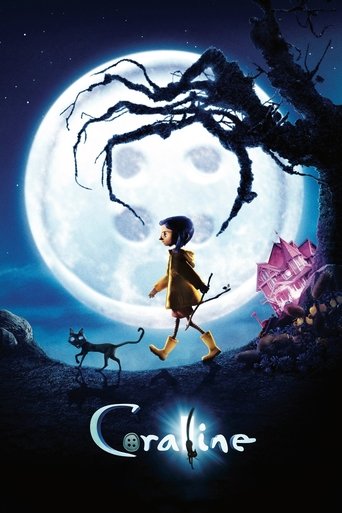
Coraline
2009 · Film · 100 min
Directed by Henry Selick
Wandering her rambling old house in her boring new town, 11-year-old Coraline discovers a hidden door to a strangely idealized version of her life. In order to stay in the fantasy, she must make a frighteningly real sacrifice.
7 positive1 mixed11 neutralfrom 19 commenters
Where to watch
No streaming data for this title.
19 comments on Hacker News
> The medium is just a medium and not why people show up.
I sort of disagree with this.
Sometimes the medium is the message. Or part of the message. Like how LAIKA studios could have made Coraline or Kubo fully in CGI, or live action, but instead chose puppets (for the most part). It matters that these are puppets and not CGI, anime-style drawings or live action people. It matters to them and it matters to me.
Not saying story doesn't matter, but in movies it's sometimes overrated. You can have a gorgeous movie with barely any plot, and it can be engaging.
> If this was the intended meaning
Directors will leave these sort of against-the-grain intepretations open for film buffs. One can similarly watch Dumbo, Encanto and Coraline as involving, past an early part of the movie, a character in the process of dying.
I'm not sure 2023 is a good year to compare against, what with the actors' and writers' unions striking for several months? If you look at the list of "2023 movies", you see titles such as Coraline (Remastered), Star Wars Episode VI, Titanic (25 yr Anniversary) and probably some others that I missed which are not really 2023 movies...
It is surely not a lightweight film with the same kind of peril as the first movie -- it's perhaps like a later book a series might be aimed at a slightly older reader. Not sure I'd show it to the youngest kids.
But it could be scarier. It could be Coraline.
No, "moe" in the Japanese sense. Typically, a petite face, large eyes dominated by enormous black pupils, etc.
The way it makes me feel is a little like the response evoked by the movie Coraline, which used dolls with big black button eyes and no noses to evoke a queasy kind of horror-lite response.
It doesn't have to be large features though, it can be exaggerated small ones too. For example, Art the Clown has a small black dot on the tip of his otherwise white nose. It's unsettling.
Yup. Even if you only look within a relatively small category of films one per year can miss a bunch. For example, consider the category of animated feature length films released after 2000 in the US, and pick one per year by picking the winner of the Academy Award for Best Animated Feature.
In 2001 you'd miss Monsters, Inc. because of Shrek.
In 2002 you'd miss Lilo & Stitch because of Spirited Away.
In 2004 you'd miss Shrek 2 because of The Incredibles.
In 2005 you'd miss Howl's Moving Castle and Corpse Bride because of Wallace & Gromit: The Curse of the Were-Rabbit.
In 2008, no Kung Fu Panda because of WALL-E.
In 2009, no Coraline or Fantastic Mr. Fox because of Up.
In 2010 you'd miss How to Train Your Dragon because of Toy Story 3.
In 2011 no Kung Fu Panda 2 because of Rango.
In 2012 no Frankenweenie, ParaNorman, The Pirates! Band of Misfits, or Wreck-it Ralph because of Brave.
In 2014 no How to Train Your Dragon 2 because of Big Hero 6.
2015 no Shaun the Sheep Movie because of Inside Out.
2016 you miss Kubo and the Two Strings and Moana because of Zootopia.
2019 No How to Train Your Dragon: The Hidden World because of Toy Story 4.
2021 you'd miss Raya and the Last Dragon and Luca because of Encanto.
Most of the winners are good...but if you just put all the above mentioned films in a pool and asked most people to pick their top 14, most would have a lot of films on their list that were not among the winners of the aforementioned years.
When digital effects and CGI began to replace stop-motion monster effects in movies, the stop motion artists screamed that art made on a computer was not art, and that their industry would be lost.
Nowadays we know better, not only is digital art accepted everywhere on earth, it's almost expected, and as for the stop-motion folks, they're still in business! Movies still come out every year, some of them with huge budgets (like Coraline) that use stop-motion because it has a certain look and feel that is all its own. AI art will only get better, but so will the ways we use it, and the people who are actually ARTISTS will be the furthest ahead, and leading the way.
What? Really?
Well, for a start, the hilarious _Good Omens: the Nice and Accurate Prophecies of Agnes Nutter, witch._ Co-written with Terry Pratchett, also a great radio serial and a wonderful TV series from about 3 years ago.
Secondly, multiple superb novels, such as _Stardust_ and _Coraline_, both adapted into successful feature films; _Neverwhere_, a low-budget British TV series; and _American Gods_, a huge, big-budget TV series.
Everything he has written has a rich vein of humour. Even perhaps the most tragic of the Sandman series, _Death: The Sound of her Wings_.
"You keep doing that, you know what you're going to get? "FAT PIGEONS!"
Yes.
None of their prior movies made money according to standard box office accounting, which requires a box office take of 2.5x the budget.
This is because budgets don't include advertising spending, and also the film companies actually only receive about 60-70 cents on the dollar of ticket sales.
The closest any of them came was Coraline, a 2.07x multiple. None of the rest even cleared 2x. Kubo barely even covered the actual budget.
It's like the dotcom boom era when companies were selling a $10 bag of dogfood for $7.
Also Phil Knight's film studio: https://en.wikipedia.org/wiki/Laika_(company) which made Coraline and Kubo.
The movie Coraline (2009) is entirely stop motion. It's a beautiful -- a technical marvel. Every object on screen was specifically made for the film. The crew used three 3D printing systems in the development and production of the film, but no CGI.
For whatever it's worth, ParaNorman totally blew my socks off in terms of being a completely non-obvious story telling approach from just about every aspect. The final sequence of the film is simultaneously terrifying and heartbreaking. They did some god damned good work on that film and on Coraline and for whatever insane backstabbing route that it came from, they are hiring people who are insanely creative storytellers in terms of writing and visual direction.
>The wrongest takeaway would be to credit Laika's new management with being anything more than turnaround artists (as opposed to film artists). Vinton was a creative visionary and always will be, money in the bank or not.
To be fair, from the article it reads like the studio was basically gutted to the core and rebuilt from scratch. They took a struggling but quirky visionary company, razed it (after it had already shrunk to less than 20% of what it had been at its peak), and turned it into what is basically a traditional Disney-style Hollywood-oriented animation studio (big movies, big budgets, big merchandise). They even dropped the original name. One has to wonder: what did Travis Knight actually keep from Vinton's old enterprise?
For the record, a huge factor in Coraline's success was its origin as a celebrated, prize-winning book from a celebrated, prize-winning literary and pop-culture demigod (Neil Gaiman) arguably at the peak of his career. Sure, adaptation and animation were good, but it wasn't exactly the hardest assignment to begin with.
>It is remarkable that Travis, through nothing more than the luck of being born who he is, manages to obtain these intangibles
Yeah, but social classes don't exist in America, right? Eh.
I expected the story to end with, "And then the billionaire's son ran the company into the ground," but it didn't.
Still, I'm skeptical to credit Travis Knight with "saving" the studio. The money and nepotism definitely rescued the studio as a profit-making enterprise.
But if the same artists had worked on the same Coraline with someone else's capital, would the outcome have been any different? Probably not. Did it matter if the money was branded Knight or someone else's?
The wrongest takeaway would be to credit Laika's new management with being anything more than turnaround artists (as opposed to film artists). Vinton was a creative visionary and always will be, money in the bank or not.
Vinton should have known what he was getting into when he took Knight's money. Of course the objective was to acquire (or in this case, inherit) Vinton's creative vision and make it Travis Knight's.
It is remarkable that Travis, through nothing more than the luck of being born who he is, manages to obtain these intangibles: Vinton's identity as an artist composed of his studio and his work.
Those interested in a positive take on 3-D might be interested in reading Thomas Elsaesser's paper, "The “Return” of 3-D: On Some of the Logics and Genealogies of the Image in the Twenty-First Century"[1]. One of his examples is the movie Coraline which uses 3-D "not in order to emphasis depth, but to construct spaces that do not follow the rules of perspective and introduce slight anomalies into it." I haven't seen the movie myself, and my only experience with modern 3-D movies is going cross-eyed watching YouTube trailers, but dismissing 3-D outright seems premature to me.
[1] http://criticalinquiry.uchicago.edu/uploads/pdf/Elsaesser.pdf
I don't like them more than 2D movies but I also don't dislike them as much as a lot of people around here seem to. How to Train Your Dragon and Coraline come to mind as a couple movies that I really loved and particularly enjoyed the 3D aspect of. I would have still liked them if they had only been available in 2D but I probably wouldn't have paid to go see them in the theater. For most people the movie theater is the only place where they can watch 3D movies. I think that a big part of the reason that we're seeing so many of them is that 3D draws more people out to the theaters.
3D seems to work significantly better on 100% animated movies. Both Coraline and UP were better with 3D than without, IMO.
There are several things that bother me with the current 3D craze.
First - and I'll admit this makes me biased - I'm blind in one eye. This means that it doesn't matter what technology they use, I'm not going to be able to see the movie in 3D.
Second, the only movie I tried to watch in 3D (in the last 10 years), was Coraline. It was a great film, but having to wear the glasses meant the film was very dark.
Third, I've yet to talk to anyone who didn't come out of the film without either a headache or at least a somewhat spacey feeling. The technology strains your eyes, and while I don't believe it causes any lasting damage, it still leaves you worn out after the film. Or maybe my friends and I are just too old.
Still, as far as I'm concerned, as long as you have to wear special glasses, 3D movies aren't likely to be considered a normal part of going to the movies.
You mean a $5 pair of red and green glasses? 3D movies for home consumption have been available for a while http://www.amazon.com/Coraline-Blu-ray-Combo-Digital-Copy/dp/B00288KNJU and 3D HDTV is expected to start in late 2010.