 Hacker Cinema
Crank
2006 · Film · 88 min
Part of Crank Collection
Directed by Brian Taylor, Mark Neveldine
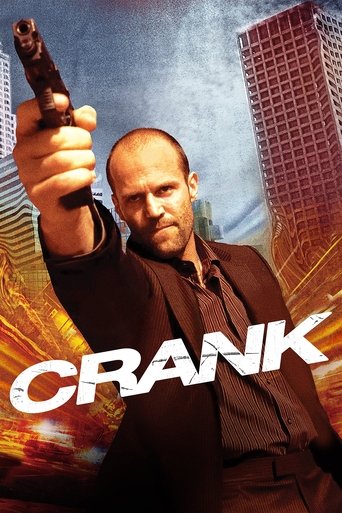
Chev Chelios, a hit man wanting to go straight, lets his latest target slip away. Then he awakes the next morning to a phone call that informs him he has been poisoned and has only an hour to live unless he keeps adrenaline coursing through his body while he searches for an antidote.
3 positive1 mixed6 neutralfrom 10 commenters
Where to watch
No streaming data for this title.
10 comments on Hacker News
First time I had a revelation that we are close to Idiocracy was when I saw the movie Crank which came out the same year. It a had vibe so close to "Ow my b*lls" movie featured in Idiocracy. And I was entertained.
Annihilation, Dark City, Riddick Chronicles, Babylon A.D., Guardians of The Galaxy, Fast and Furious, Hummingbird, Transporter, Crank, Hardcore Henry, Revolver, Lucy, Ghost in The Shell, Now you see me, Passengers, Transcendence, Maze Runner, Limitless...
I think we've had a good run; I also think it's easy to be biased and not see it because of some nostalgia-effect of sorts. If you are f.e. 30+ you might more easily dismiss a movie as Limitless or Lucy as uncredible; both are based on a common myth that we only utilize a low percentage of our brains capacity, as an example, so they are that: unrealistic. But I think that's an unfair comparison because of an inherent bias that when you think about a movie like The Matrix you don't see it with the same critical lens because you perhaps had less knowledge of the world in your earlier years. #JustAFewThoughts
I like the "Crank" potion idea, that was a bonkers action movie, and I'd love to see a modern game use those types of powerups.
> Next time you come up with that great idea, don’t Google it for a week. Let your mind fester on the idea, allow it to grow like many branches from a trunk. Jot down all of the tangentially related but equally exciting ideas that inevitably follow. Allow your mind to take the idea far into new places. No, you won’t build 90% of them, but give yourself the time to enjoy exploring the idea totally.
I can only confirm this works. Sort of.
In 2014-2015 I had an idea for a roguelike beat'em up game. Something like adding roguelike mechanics to Castle Crashers. I did google it, but there were no games like that on the market at the time, so I developed everything from scratch.
While developing I never checked Google again. And when I released the first version into Early Access in late 2016, I noticed that there are now two games in the same sub-genre that came out in the meantime. Apparently those were in development long before mine, but the developers didn't bother to tell anyone about it and they just hit the market (i.e. Steam release) one day.
Now, one of the games had a lot of ideas that I came up by myself. One of those was a magic potion called "Crank" based on the movie of same name. You have to keep moving and kill enemies or your health goes down. Exactly the same idea with the same name for the potion. I removed this feature from my game, because this other game was already out and I didn't want to be called a copycat.
But beside those few similar ideas, the rest of the development went completely separate ways. The other two games were mostly linear, mine has procedurally generated mazes to explore. The other two games allow you to carry and use one weapon, mine allows multiple. The other two games have a fixed boss at the end of each level, mine randomly picks one of 24 bosses, etc, etc.
In the end, I have built a successful product that is different enough to cater to slightly different market segment.
Had those two other games been on the market already when I started, I would have probably given up at the very start.
P.S. Sorry if my English isn't top-notch, I'm not a native speaker.
I don't think that's the case at all. Most good stories ebb and flow. It's important to give the viewer a chance to relax and build up tension before another exciting scene. But you're right, "Crank" is one of those movies that puts the peddle to the metal and doesn't let off. There is of course merit to that type of story telling as well.
I hope that a few movie directors see this app and will make it their next challenge to not allow any convenient pee break.
I guess "Crank" comes quite close.
Jonathan Haidt touches on this in "The Happiness Hypothesis", though not specifically applying it to TV watching.
There's the standard issue of measuring happiness, sure, since it's hard to find other than a self-reported subjective measurement for it.
But in general, the principle that what matters most to keep us happy is a steady "upwards trajectory" where things keeps getting somewhat better is getting quite decently researched from a lot of angles. According to Haidt, the studies he refers to in his book supports the claim that once basic needs (food, shelter) has been met, happiness deviates from a lot of what we people tend to think:
It is only mildly correlated with wealth, for example, and then largely because being wealthy allows for more opportunity for an upwards trajectory. However, people who suddenly come into wealth (e.g. lottery winners) report a lot of happiness for a short interval after winning, but then quickly return to "base level".
And another example of the "hedonic adaptation" is that while mental illness such as depression can have a long term impact on happiness, but most other illness does not. Amputees, people with long term horrible chronic illnesses, people who are told they have only a few years left to live etc., that we often feel sorry for and assume will be miserable, all tend to return to base level happiness fairly quickly on average with the exception of those with degenerative conditions that put them on an ongoing downward trajectory. In fact, some groups will tend to be more happy than typical: Those who are slowly recovering from a horrible situation, and who thus see steady improvement in their situation.
With respect to the TV example, I find it quite plausible (with the caveat that I've not read the study either), as pacing in story-telling has already follows a pattern where you set up tension, release it and slows down the story, then set up tension again, for pretty much as long as people have been telling dramatic stories.
Pretty much all movies follow a pattern with "tension release" at least once or twice before the climax as well. I remember my English teacher drawing up diagrams of pacing a bunch of movies when I was in school even.
A perfect example of the alternative - to try to maintain an upwards trajectory as much as possible - would be Crank and Crank 2 with Jason Statham (though arguable even those movies cycle through periods with "lulls" in the action, just on a very accelerated schedule), which indeed tries to keep an insane pace throughout. In those movies it's used as a gimmick (Statham needs to keep his heart going with drugs etc. in the first movie, and needs to keep an artificial heart charged in the second, with antics that in no way try to be realistic at any point), but when you contrast the start of the first movie with the latter parts of the second, you see the result: To make it feel like the pressure is "kept up" the pace keeps accelerating to absolutely ridiculous levels. It's almost tiring to watch.
That ad breaks could provide some of the function in TV programs would thus not seem strange to me at all.
> * Crank – not very known, but wow, this is the best action movie ever.
Just seconding this, in case it is not known. As action, Crank is perfect in every way. It's a shame Crank 2 went off the rails the way it did...
Opinions on some of the movies from the list I've seen:
Idiocracy – Basically an ordinary comedy, with an above average plot, but overall nothing that special or interesting. Overrated.
Fight Club – One of my favourite movies, perhaps in my top 10. Really loved it.
The Game – Another great movie from David Fincher, I love the mysterious atmosphere of his movies.
The Man From Earth. – Huge disappointment, I never understood why people like this movie. It's basically one guy telling a predictable and boring story. One of the most overrated movies ever. (I mean overrated in subjective sense obviously.)
Traffic – One of the best movies about drugs and organized crime.
Inception – Above average but overrated, logically inconsistent, nothing really special about this movie. The Cell is another movie where people enter someone else's dreams and even though it has only 6.2 on IMDB, I think I enjoyed it more. The depictions of the dreams were definitely more creative and looked more dreamy.
Of the top of my head I would recommend these:
* Something from David Lynch – Lost Highway, Blue Velvet or Mullholland Drive.
* Requiem for Dream
* Evil (2003)
* Sin City
* Crank – not very known, but wow, this is the best action movie ever.
* Elite squad – another great action movie, very realistic, borderline documentary.
You can't expect to understand a broad shift if you're only looking at the top grossing movies. That's like predicting the US economy by only looking at Bill G and Warren Buffet's asset sheets.
The Crank movies are a good example of something you couldn't really do 10 years ago. They were filmed on budgets with 10mm to 20mm. Typically a movie involving so many stunts would be far more expensive. Compare to say the Fast and Furious movies which have budgets in the 100mm range.
And while the current financial picture for the studios is hit driven, that's largely because of the high minimum cost to get a production done. As production costs fall films don't have to sell as well to be profitable, creating more of a long tail to the market.