 Hacker Cinema
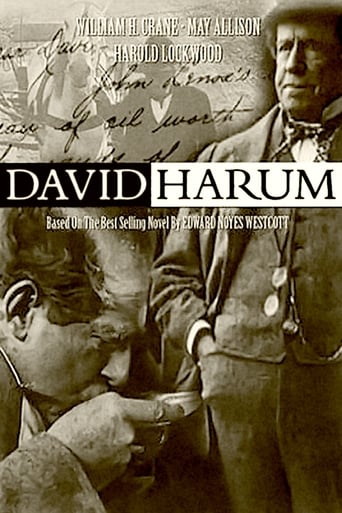
David Harum
1915 · Film · 68 min
Directed by Allan Dwan
The story of David Harum, a small-town banker, and how what he does and who he is affects the lives of everyone in his town, whether they--or he--realize it.
1 neutralfrom 1 commenter
Where to watch
No streaming data for this title.




2 comments on Hacker News
Fair enough.
The "Market for Lemons" dynamic has an earlier precursor, the horse trader. In looking up Gresham's Law references, I've run across H.L. Mencken's "Bayard vs. Lionheart" (1926), which references "David Harum". That was a novel, and film, and later (after Mencken's writing) a radio serial, about a horse trader.
Horses, as complex and nonuniform goods, had developed a reputation for unreliable and underhanded dealing. The lasting legacy of the novel itself is the expression "horse trading".
https://en.wikipedia.org/wiki/David_Harum
https://amomai.blogspot.com/2008/10/hl-mencken-bayard-vs-lionheart.html
Used car sales has its direct antecedents in horse trading and dealing.
There was a famous-for-its-time story called David Harum, (1899), made into a film in 1915, and a radio serial in the 1950s. Its principle legacy today is the use of the term "horse trading" to mean "underhanded dealing".
https://en.m.wikipedia.org/wiki/David_Harum
I'd run across it via H.L. Mencken's essay, "Bayard v. Lionheart", itself best recalled for its concluding sentence:
As democracy is perfected, the office represents, more and more closely, the inner soul of the people. We move toward a lofty ideal. On some great and glorious day the plain folks of the land will reach their heart's desire at last, and the White House will be adorned by a downright moron.
... but containing oh so much more, in the foil of a critique of the 1926 U.S. Presidential Election. Really, read it:
http://amomai.blogspot.com/2008/10/hl-mencken-bayard-vs-lionheart.html
Both used cars and horses have several characteristics in common:
* They are anti-commodities. That is, individual items for sale are highly disuniform, complex, and not readily assessed.
* They are expensive. For the ordinary consumer, they are not purchases likely to be made frequently. (A horse and a car each have fairly equivalent useful working lives: about 3-10 years, depending on use and care afforded.)
* Sellers of quality instances are much inclined to stay away from the general market. It's a case where selling to someone who is specifically aware of the qualities of what you're selling is a far better customer.
This has other cognates. Software and consulting services come to mind.
The treatment in the economic literature is somewhat disappointing. There's Ackerloff's "The Market for Lemons", of course (won him a Nobel prize), but it's a generally underserved area of theory.