 Hacker Cinema
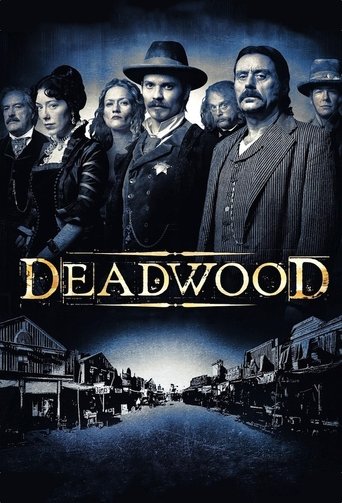
Deadwood
2004 · TV series · 3 seasons
Created by David Milch
The story of the early days of Deadwood, South Dakota; woven around actual historic events with most of the main characters based on real people. Deadwood starts as a gold mining camp and gradually turns from a lawless wild-west community into an organized wild-west civilized town. The story focuses on the real-life characters Seth Bullock and Al Swearengen.
19 positive3 mixed13 neutralfrom 35 commenters
Where to watch
No streaming data for this title.
38 comments on Hacker News
Reminds me that some day I will be prompting my own Deadwood season four because of those bastards at HBO.
It's not even about quality. I consider films like There Will Be Blood or TV shows like Deadwood to be comparable in quality to the greatest works of world literature. I've also gotten a lot of joy and entertainment out of reading crappy books.
My problem is with statements like "paper is an inferior entertainment platform". To me, this is assuming that these different media are fundamentally providing the same kind of experience, which I disagree with.
I see your point about the cognitive effort of reading, though. I guess it depends on how fluently one can read, which depends on how much exposure to books one got as a kid.
> There doesn't seem to be a lot of fiction that features the Pinkertons prominently. One exception is the (excellent) HBO TV series Deadwood.
Also any of Dashiell Hammett's Continental Op stories. The Contintental Detective Agency is the Pinkertons with the serial numbers filed off. Hammett himself worked as a Pinkerton, among other things, before he got into writing.
I got into his writing because Raymond Chandler was such a big fan as I learned from his essay The Simple Art of Murder[1]
[1] https://archive.is/fi4Wz
>There doesn't seem to be a lot of fiction that features the Pinkertons prominently. One exception is the (excellent) HBO TV series Deadwood
There's also The Tall Target, a 1951 movie that sometimes gets played on classic movie channels, which is about the "Baltimore Plot" in which Abraham Lincoln was supposedly going to be assassinated on his way to his first inauguration in 1861. Supposedly it was prevented by the Pinkertons, although historians question if any real plot was planned.
https://en.wikipedia.org/wiki/Baltimore_Plot https://en.wikipedia.org/wiki/The_Tall_Target
The Pinkertons are a fascinating period of history. "Detective agency" in the modern parlance doesn't really fit. They were a private army for the wealthy that at one time was larger than the US army.
One particularly famous incident (after the founder's death) was the Homestead strike [1]. Strike-breaking was very much in the Pinkerton's wheelhouse and it's a good example of what they were actually used for [2].
There doesn't seem to be a lot of fiction that features the Pinkertons prominently. One exception is the (excellent) HBO TV series Deadwood.
It's particularly apropos at this time because the lawless violence and organized labor suppression of the robber barons in the Pinkerton era is very much the future we are careening towards.
[1]: https://www.pbs.org/wgbh/americanexperience/features/carnegie-strike-homestead-mill/
[2]: https://allthatsinteresting.com/pinkerton-detective-agency
This really makes me want to watch a Western show or movie. I wonder if there is anything like Deadwood that I missed.
I've been watching the western TV series Deadwood (2004) and it's crazy how realistic the fights are. They're often over in an instant -- but if they go on for longer they're mostly awkward flailing on the ground. Characters are left with bruises and cuts on their face for days or longer. If they get shot in the shoulder, their arm is in a sling for several episodes. It's the polar opposite of the "cartoon" choreographed fighting you usually see in films and TV. Nothing glamorous or entertaining about it, but an important part of the story.
General interest - my favorite is Very Bad Wizards. The two hosts are university professors in psychology and philosophy. They cover all kinds of different things - usually some piece of media like a book or movie, where they will sort of analyze it deeply and just generally chat about it. They'll also often cover a silly or interesting philosophy or psychology paper as an opening segment.
They're just fun to listen to. They hardly ever touch anything political which is very refreshing. For their Patreon supporters they have also been going episode-by-episode through Deadwood, which I watched because of their coverage and think is one of the greatest TV shows ever made. Their analysis of each episode really enhanced my experience of the series. (They just finished covering the second season, so one more to go).
I also enjoy Sam Harris's podcast, been listening to him for years now. I don't listen to every single one, but he has some pretty interesting guests sometimes. I like his general "theme" of being interested in the mind, meditation, psychedelics, and also just what's going on in the world. Obviously gets much more political but not the exclusive focus of his pod.
Last, I like the Fifth Column a lot, which is an explicitly political podcast covering current events - they tend to lean a little more right than me but the overall bent of show is sorta centrist/libertarian and I think they do a pretty good job of lambasting both sides of the aisle.
I listen to a few others at varying frequencies. One other standout I'd mention is Knifepoint Horror, which releases a 20-60 minute horror story about once a month. The guy behind it has a pretty unique and interesting approach to horror fiction and I can't think of a single one I didn't enjoy.
I always looked at these kind of per-episode analyses with some skepticism, but I recently got into Deadwood as a result of Very Bad Wizard's podcast series on the show (they cover an episode about every 2 weeks as bonus patreon content for their regular podcast).
For shows that have the requisite depth to be worth the analysis, content like this turns out to be a fun way to enhance your understanding of the themes of the show. The VBW thing is behind their paywall so you'd probably have to already be a fan of the show to be convinced it's worthwhile, but their coverage really enhanced my viewing of the show (although they've only got episodes up through the first season so far, and if you start Deadwood you definitely won't be able to wait for them, it's pretty compelling).
Recently someone gave me this book called "Difficult Men" by Brett Martin. Nope wasnt about mass shootings. It was about the protagonists created in the most popular TV shows in the US and the minds of the writers behind them. So Sopranos, Mad Men, Dexter, Breaking Bad, The Wire, Deadwood, Six Feet Under etc etc. Its a super impressive and ever expanding list of writing. But the common thread is dysfunction. They are all coping badly with whatever situation they are thrown into or run into. And the costs and consequences keep building up and nothing ends too happily.
While reading it I was feeling, this too is a sort of mass attack on the minds of people. Cause its a hope and faith killer. The message is always - here is some entertaining and mesmerizing hypocrisy your small chimp brain hasn't imagined and guess what? Whatever move you make you loose. After reading that book, I see that same message in stand up comedy, in the news media, in tech and business news etc. Probably exacerbated since social media finds and amplifies such things. But I feel the messaging and signaling underneath really needs to be different.
This is kinda like what Amazon does with their channels, which is a bit clunky in various ways, but on the whole I don't hate the model. (besides the fact that the increasing fragmentation of content means I have to have a dozen subscriptions).
What I really want is some sort of meta "subscription manager" where I could mark what I'm currently watching and what I always want access to, and it could manage cancelling and uncancelling the various subscriptions that I have. Even better if it could just give me access to everything through a unified interface. I would pay for this - I think it could save a lot of money.
What I've been doing recently is whenever I sign up for a new thing, I just immediately cancel. That way when I hit the end of the month and I'm not using Peacock or Shudder or whatever other bench team service, I just won't have it any more. If I need it again, rinse and repeat.
Currently the only subscriptions I'm maintaining long-term are HBO and Disney. Disney will probably be a long-runner as long as my kids still want to use it for Bluey and the odd movie. HBO has their classic shows like The Sopranos and Deadwood, plus the Adult Swim catalogue, so they land in a good value spot for me too.
> I'm astounded that this article doesn't mention what to me seems like a no-brainer: We're in the golden age of television.
I disagree, the golden age of television was the late 90s to early 2010s, from the start of the Sopranos, to the last episode of Breaking Bad. I can’t name a series in the last 10 years that is on par with Sopranos, Six Feet Under, Mad Men, Breaking Bad, Deadwood, or The Wire.
Streaming services killed quality television, House of Cards was the beginning of the end.
You're assuming his use of copyrighted and trademarked material is authorized.
They're selling books and even soaps with "deadwood" in the name, and they / the publisher (sounds like they're both run by him?) appear to have directly lifted the photo for the cover of one of the books:
https://mzs.press/The-Last-Western-Deadwood-and-the-End-of-American-Empire-p476587251
...from here: https://deadwood.fandom.com/wiki/Deadwood_(episode)?file=Season-1-episode-1-deadwood.png
My guess is that Seitz got nailed by trademark and copyright infringement claims and is now spinning a story about how his poor poor book shop is getting screwed over by the Big Evil Corporation, as witnessed by the very histrionic language he uses in his tweets.
I'm the opposite of you. From age 20 to about age 45, I did not watch TV at all. Part of that was because I grew up in the UK, and the experience I had with the BBC (and a bit of Channel 4 and very occasionally ITV) made US TV just look stupid to me. Endless stupid ads, laugh tracks, completely unrealistic characters, dumb plots, and more endless stupid ads.
Then ... Netflix arrived. I started watching a few of the shows that people raved about from their days on network TV, and I realized that the biggest problem was ... endless stupid ads. Which Netflix did not have. I became willing to try out HBO from time to time, got in Battlestar Galactica, and of course in 2014, True Detective showed up on HBO. In 2019, I discovered Deadwood (at that point nearly a decade old), a more or less Shakespearian epic of 19th century US history. Over the past decade, I've discovered so many truly worth shows - and I haven't event started on The Wire yet!
On top of that, Netflix has given me access to several UK shows (Luther, for example, but also Grand Designs (now, thankfully, on Youtube)) that have rounded out the menu.
I understand that aesthetic choices with TV shows are very personal, but I can honestly say that I now absolutely believe that "TV" (ala the new streaming services and/or their presentation of material without ads) can be a medium for stellar story telling. I would like it if we had a few more defined "limited series" where there's a story already known, with a beginning, middle and end (True Detective and Mare of Eastttown are great examples of this (as long as they do not ruin Mare by making a sequel). And sure, there are some TV series that really would have been better as a film. Nevertheless, the ability to spend 8-16 hours with compelling characters is big positive to me.
TV shows are really pushing things too. Twenty years ago, a big budget show was a premium cable production like Deadwood ($4.5M/episode) or Rome ($8.5M/episode), but now you have mainline shows like The Crown, Stranger Things, and The Mandalorian, all costing $12M+/episode.
My other Four:
o Firefly - no brainer. Brilliant. o Battlestar Galactica - Has some issues mid-late course, but still pretty end-end enthralling. o Dark (I keep re-watching this over and over every few months. I have many notebook pages full of analysis. Seriously good SciFi for the most part.) o Altered Carbon (mostly Season 1 - but Season 2 was okay)
Big Recommendation:
Not really science fiction (even bigger themes explored) but far superior in terms of overall quality of work/screen writing, and has a similar "concept" that a lot of supposed science fiction shows have - "The Leftovers" - Which I put on my list of the 5 most brilliant things on Television (Sopranos/The Wire/Deadwood/Breaking Bad being the other 4).
I'll give a honorable mention to stuff I loved but I can't totally recommends:
o Travelers - I'm a sucker for a good Time Travel Show. o Foundation - Pretty - I watch it, but I totally would never recommend it. o Fringe - Wow - was totally into this. Definitely an acquired taste though. o Raised By Wolves - Interested in where it's going. Could entirely suck eventually I guess. o Black Mirror - Hit and miss, though hits often enough that I keep coming back to it. o WestWorld - I mean, we all watched it. Season 1 was *awesome* if you watched it in realtime and didn't read all the internet commentary when the aha moment hit you. Season 2 was pretty good as well IMHO. Season 3 was just dreck where the screen writing tanked *but* it paid an *awesome* homage to the very last of the Foundation Novels to bring it all home.
He was an amazing dude, I watched Deadwood the tv show recently and there was a guy in the show who I thought “i don’t know who that is but I think he is a big deal”. sure enough it was ricky jay!
not a master of acting like he is with sleight of hand but he does pretty well!
HBO had been doing it for a few years, with shows like The Wire and Deadwood. But Breaking Bad helped bring it to a wider audience, since AMC is basic cable rather than premium. (AMC had launched into that a year before with Mad Men, which was similarly TV as good film.)
That's.... actually movies in general (IMHO).
To me the last 20 years has been the true Golden Age of Television because streaming has enabled the rise of serialized TV as the best medium to adapt long form written content.
Movies are for comics, short stories and literary works (because they tend to be incredibly short). TV is for novels.
Like Game of Thrones would never have worked as a movie (or even a series of movies). It's just such a shame it mysteriously ended after season 6.
Back in 2006 I actually had a conversation with someone after seeing Deadwood (fantastic show BTW) where I literally said that the GRRM books should be a TV show and it would probably take the likes of HBO to do it. IIRC HBO optioned the books in 2007.
I haven't read WWZ but yeah, the movie... was not great. Like 3 things happened.
One thing I've reflected on a little bit recently ... I don't want to take a TV show as an accurate account of historical reality, but given that "Deadwood" did have quite a bit of research behind it ... when two characters in that story wanted to open a hardware store, they had to buy the land and build the store. How many people who open a retail store these days even thinking about owning the property?
Now, it's true that the commercial (retail) real estate "sector" has created a more flexible and dynamic space for retail to operate in. Sign leases for just a year in case the idea doesn't work out etc. etc.
But it has also meant (1) a more encouraging environment for retail ideas that are even more likely to fail than the average (2) when business drops (e.g. covid-19), there's still the rent to pay.
It is true that in the past, the retail store owner-operator probably didn't own the premises outright, so there's still the mortgage payment when business drops. But that was (then) an arrangement with a bank (often local) who were going to be much more likely to see the mutual benefit of finding a way to not reposess the building.
This is just another small contributing factor to the overall fragility.
Or as Al Swearengen put it on the best TV show ever, HBO's Deadwood: "Announcing your plans is a good way to hear God laugh."
> GoT is a tentpole show with a rabid audience but it's not especially good (it's no The Wire). Deadwood and the Sopranos are from a different era of TV. Veep is great, but True Detective, True Blood, Boardwalk Empire, Enlightened, and The Newsroom would all be in the middle of the pack at Netflix.
As The Dude once said "Yeah, well, that's just, like, your opinion, man"
Objectively speaking, there isn't a single Netflix-original TV show rated over 9 on IMDB: https://www.justwatch.com/us/provider/netflix/tv-shows?rating_imdb=9
Compared to 7 titles on HBO: https://www.justwatch.com/us/provider/hbo-now/tv-shows?rating_imdb=9
But I think your point is that when we're talking about "The Wire" level production, others have caught up (AMC, FX, etc) and Netflix can simply license those titles. But, there's notable downsides to that (you have to wait, there's a significant cost to purchase, etc). Also, AMC, FX, etc have yet to establish a long-term credibility for consistently creating high quality content...until they do, HBO as the "premium offering" in light of others is still there.
At the end of the day we're talking about whether HBO's content can sustain the justification of paying $15/month. You just need rabid audiences for that to happen, not "one dude on the internet thinks The Wire is greatest thing ever created".
Of all the shows you mentioned the only ones I have watched is, OITB (left it at after watching S04 I think), Master of None (both the seasons), I realise that its a drama that leans toward being a rom-com but I do not watch rom-coms at all. Kudos to Mindhunter, indeed that was entertaining and right in my ballpark. Liked House of cards till the time Spacey was there, S06 disappointed me. Season 1 of Making a Murderer was outstanding, season 2 didn't catch my interest. Also the last comedy I watched end-to-end I think was Entourage (which was produced by HBO), The Office (US) and Parks And Recreation, not surprisingly Netflix doesn't stream any of these in my region, Prime Video does the last two and Hotstar streams Entourage.
These are good shows not great ones like The Wire, The Sopranos, Mad Men, BB, Six Feet Under you know about the stuff that critics rave about etc. I don't care if Birdbox was watched by all of Netflix's subscribers, thats precisely the sort of thing that I don't watch the majority of the time, you watch that thing once and you forget that you ever watched it again. I'm now on probably my sixth or seventh rewatch of The Wire, that should tell you something about my viewing habits and why Netflix's content just doesn't work for me. I don't expect a network to consistenly churn out shows like that but at least some of the shows should be somewhere close to that level which HBO continues to do with The Deuce, Succession, True Detective(I know they fucked the dog on S02) etc.
Also you have the time to watch ALL of that, I don't. I work in tech too, I have an hour on weekdays and maybe 2-3 on weekends for leisure, so its only natural that I would be picky about what I watch, the absolute best, currently that would mean shows like The Americans, Escape from Dannemora and shows from the past like Halt and Catch Fire(from AMC), Six feet under, Deadwood which not surpisingly were also made by HBO. Netflix doesn't stream any of that.
I also don't understand how you think AMC won't exist, are they going to be insolvent ? Doesn't look like it, they have a cash-cow in The Walking Dead(I only watched till S06 then got bored) They got two of the best TV shows I liked BB and BCS, BCS is gonna kill it in the next season. They also produced The Terror, a brilliant mini-series which Netflix didn't stream as well and again Prime Video did. As a viewer I don't care about Netflix's subscriber numbers or HBO's lack thereof, I want to watch content I like which sadly Netflix doesn't produce on a consistent basis, this is entirely subjective and I realise that I might be one of the edge-cases in all the millenials when I say Netflix don't tickly my fancy.
I'm not biased towards HBO, hell HBO doesn't even stream in my country, I'm incredibly picky about what I watch since I'm short on time, Netflix churns out a LOT of shows, its only natural that some of them turn out to be brilliant and some of them indeed are, but the rest, like 90% of the shows are just average, they don't work for me, I simply do not have the time to watch them.
In that sense, Netflix is like the Y-Combinator of producing original content. You produce(invest in) hundreds of TV shows(startups) and hope one of them makes it big (becomes a unicorn) and the rest of them, well they would be probably cease to exist after some time.
Ricky was in HBO's Deadwood and was fantastic. This guy was just such a good actor in each of the movies he was in. Then I found out a while back that he was actually an incredible magician also. He's so much fun to watch... definitely a big loss for humanity.
I'm a bit surprised by that comment. I actually find Prime to have pretty good content and typically better movies than Netflix (who's movie library has been shrinking pretty drastically over the years).
If you haven't already watched it, I'd highly recommend Season 1 and 2 of "The Expanse" on Prime. There are a lot of pretty great shows on there as long as you don't rely on DC/Marvel shows for all your entertainment. Other shows that are reasonably acclaimed are:
- The Man in the High Castle
- Avatar: The Last Airbender
- The Nightmanager
- Mr. Robot
- Boardwalk Empire
- Downton Abbey
- Sneaky Pete
- Orphan Black
- Dr. Who
- Veep
- The Good Wife
- Transparent
- Hannibal
- Deadwood
- Curb your Enthusiasm
- The Wire
- Six Feet Under
- The Sopranos
I enjoyed deadwood, and I thought the story arc with The Comstock and George Hearst as a robber baron was going to have a huge payoff, but instead the series was cut short which is a huge shame.
There is just enough foolery to make it easily tier 2 for me: Francis Wolcott's story arc, Olyphant's acting, Seth Bullock's attempt at morale highground.
If folks aren't turned off by violence, profanity, and prostitution, it's definitely must watch tv.
I stopped watching Deadwood in the middle of season 2 because the acting was so bad it didn't felt real (but I liked it apart from that)
Oz is still one of my favorite tv show, it has so many good characters and the huit clos format (closed doors) is really perfect for focusing on them
The first two seasons of Deadwood were exceptional with Ian McShane being the primary reason. Season 3 started to lose something by dwelling too long on the evil George Hearst character. I'm not sure the show could have stood up a compelling complete fourth season but I really would have liked some closure instead of yanking the cord like HBO did.
I have to wonder if it's not just that the rest of the culture has washed away and this is all that's left now. There is a big hole in Houston where That Company used to be...
The cable channels now have to live on a treadmill of serialized movies cast in the Deadwood/Sopranos style or it will also wash away.
Mob justice is not law.
For an illustration of this, check out the very first scene of the TV series Deadwood. There's a lynch mob outside the sheriff's office, and they want to kill the person in the jail. The sheriff fends them off so he can legally hang him instead.
The creator originally wanted to do a series on ancient Rome, about the birthplace of civilization. The studio wanted a Western. He said, oh, perfect, that works, too.
Obviously not, since a corporation has never actually bought a city like the proposed Google buyout of Detroit. I was making a glib remark about possible downsides to a Google city.
So in that spirit: Yes, in TV shows like Deadwood and Eureka.
Maybe, maybe not. What's interesting about the HBO/Showtime/etc. model is that it specifically encourages programming diversity, as the original article discusses at least a bit. Many people are willing to pay the surplus on their cable bill just to follow their one or two favorite shows, and few of the audience watches all eight (or however many). What this means is that whereas when a network adds a new show, they're trying to maximize its viewership on its own to maximize ad revenue, HBO only cares about adding new viewers that aren't already a part of their audience -- if a new show is only of interest to people already in the target demographic of an existing show and, therefore, probably already subscribers, nobody new will subscribe and the show won't pay for itself. As an audience member of their content, then, you're not expected to watch all of the shows, but you get the opportunity to watch a few that are probably more-narrowly-tailored to your interests than would be expected of network programming.
So yes, I would like to just be able to buy Game of Thrones, but I'd also, personally, like to be able to just buy Deadwood or (on Showtime) Queer as Folk, and I think if every show had to justify itself to network executives on raw viewership numbers instead of on audience-broadening power, those shows would never get made; their audiences are too niche compared to their production costs. I certainly appreciate the opportunity to see at least some content that's not aimed primarily at 18-35-year-old straight men.
Of course, this is the kind of reasoning that justifies 100-channel cable packages instead of a-la-carte cable channels, so take what I'm saying with a grain of salt. But I think the expectation that a-la-carte show purchasing could really work, economically, is probably not realistic (and this without even getting into the issue that it'd be tough to pay for a $75-million Game of Thrones season at a dollar an episode).
The thing that bothers me most about this is I credit HBO for leading the charge with innovative content that as a whole brought TV to a much higher level. They took big chances even when it wasn't profitable to do so.
I've had a serious love affair with the network beginning with Dream On, The Larry Sanders Show, then moving on to Oz (yeah it was a 'male' soap opera I guess :), Sopranos, 6 Feet Under, Deadwood - which I didn't particularly _love_, but highly respected, and most of all The Wire (best thing to ever grace the screen IMO - they lost $$ on it throughout its run)... and then I killed my cable sub and haven't seen anything of their's since.
Now Mad Men and Breaking Bad are my two favorite shows, they're both on AMC, and I can easily purchase each season on iTunes HD for just north of $30. Every episode is available hours after they originally air. I'd pay twice that much.
Of course, the problem is HBO is just too tightly coupled to big cable. They're one of the main attractions, and as such the kickbacks they get are tied to contracts that prevent them from wresting their content to any great degree. Until this model changes, their A content won't see the light of day, and more draconian measures are likely to be put in place to thwart piracy. It's not HBO itself per-see, but HBO as a proxy for big cable; as a defense mechanism to prop up a flailing business model.
You mean except for The Sopranos, The Wire, The Shield, Mad Men, Breaking Bad, The West Wing, Six Feet Under, Dexter, BSG (gak), Friday Night Lights, Lost, Sons of Anarchy, Deadwood, Extras, Damages, Weeds (gak), House...
What's tricky about this comparison is that there's so much North American TV. A lot of it is ABC sitcoms, yes.
Thanks for the comment and sorry if my writing style's not to your liking. My post was not written to hurt anyone, quite the opposite. I have my own writing style, yes. It's not for everyone, yes. But you don't need to come here and try to organize a mob against, to try to force me to conform to your joy-sucking rules.
It's your choice and your right not to accept people who are different from yourself. God knows half of America is full of rabid, Jesus-loving attack dogs who try to force their beliefs on the rest of us. If you don't mind, however, could you please try to suffer in silence and keep your crying, bitching, and trolling to yourself. Thanks :)
BTW, if you don't like words like "ass" and "fuck" and all the rest of those naughty words that cause you cry out and try to rally a mob for a witch hunt, you might want to avoid blogs such as "500 Hats" by Dave McClure. Here's Dave's bio: http://500hats.typepad.com/500blogs/about-dave-mcclure.html here's one of his posts: http://500hats.typepad.com/500blogs/2006/11/why_you_want_yo.html and here's every post he's written with the words "ass" or "fuck" in it: http://www.google.com/search?hl=en&source=hp&q=ass+or+fuck+site%3A500hats.typepad.com&aq=f&aqi=&oq= Can you still see, or did all those naughty words blind you?
Better stay away from TechCrunch, too. That Arrington has a mouth on him! Of course, it's nothing like that Zed Shaw. Hehe, I love those guys. You know, what really burns me up, though, is little people who use words like "shit" and "fuck." Who do they think they are! We gotta teach them a lesson, don't we. We gotta stomp them back down where they belong. After all, only "important" people are allowed to use "bad" words.
Oh shit, better not read any William Shakespeare, either: http://socyberty.com/education/evolution-of-profanity-how-swear-words-came-to-be/
Damn, or watch award-winning movies, such as "Pulp Fiction," "Mystic River," "The Departed," etc. Or any of those award-winning HBO shows, such as "Sopranos," "Deadwood," "Entourage," "The Wire," etc.
Fuck, fuck, fuck, what's left for you?! Well, at least you've still got your Fox news, church, and tea party friends, right? Speaking of which, where you at the rally? I heard Palin's speech was great! She's so smart and wholesome and funny and right. I love her! She's got my vote in 2012, I've had about all the "hopey changey" stuff I can handle outta that Obama guy!
Do you now see how ridiculous your attack was, Brett? And do your employers and university (Amazon.com, Trilogy, LiquidPlanner, and Yale, if this is you: http://www.linkedin.com/in/brettbender) know you're harassing people on Hacker News when you should be working and making them look good? In both cases, probably not, but I'm not going to argue. Life's too short to waste time with miserable people. Good luck. Seriously.
Cheers!
PS: I took out the asterisks and did some polishing and now the post is making the rounds all over again. Thks.
I haven't had Cable/Satellite since 2002. I started watching all my TV on DVDs that I bought from Amazon, but then switched to iTunes around 2006.
Now it's mostly a combination of iTunes/DVD - I'm pretty certain it's less expensive than subscribing to TV.
The good part of this (and it should be emphasized) - is that you now watch for a _purpose_ - Latest episode of Lost, BSG, Dexter, Weeds, South Park, Doll House, BtVS, Angel, The Wire, DeadWood, Heroes, The Office, Dr. Horrible, Mad Men, Parks and Recreation, Castle, Californication, Dr. Who, Kings, Sarah Connor Chronicles, True Blood, Torchwood.
Any time that might have been lost to just passively watching television, news, is now, of course, lost to passively reading ycombinator, nyt, wsj, groklaw... :-)
Ars Technica recently referred to one of the moments that, according to this account, made America what it was.
They draw a parallel with current filesharing lawsuits and point out that in the past the government favoured thieves ('squatters') over the property owners.
http://arstechnica.com/tech-policy/news/2008/03/copyright-crusade.ars
It's also a minor subplot in the Deadwood TV series.
This is what I came away with after working on the Netflix dataset.
Incentives, not perceptions, are what need to be changed for realizing better recommendation engines (or collaborative filtering algorithms; whatever you call them). Negative recommendations are not a good idea. Unlike false positives, the consumer really has no way of knowing whether a negative was in reality true or false. Recommendations are also about feeding our ego , even if the engine is ultimately basing its suggestions on consumers whose tastes are very similar to yours. It is indeed magical; consumers who think they are expanding horizons by seeking out indies or documentaries on Netflix are simply discovering latent interests that have already been explored by others in your interest cluster. The author is right though; false positives are what weigh most heavily on our perceptive scales. Risk aversion ensures that people do not venture out beyond what are suggested to them (by an automated agent or friend), and collaborative filtering algorithms have a cold start problem. For a movie to appear on the radar, enough people need to have watched and expressed enjoyment. Digital filtering makes it even harder for random exploration that is needed to seed these. Failing that, you get middling recommendations like that of Netflix, where the average rating (~=3.6) is no better that what you would get without it. There is one easy way to get around the risk aversion obstacle. Offer "free" movies from a different, high variance list of movies, with "free" meaning a fourth movie on a three-per-month subscription, and variance being high on the predicted ratings of the consumer. Such an offer, while being marginally more expensive for Netflix, will allow consumers to experiment without any perceived costs (which, currently is the wait for the next Wire or Deadwood DVD you could have gotten otherwise). If I may speculate, recommendations should be about gentle, guided exploration and not avoidance.