 Hacker Cinema
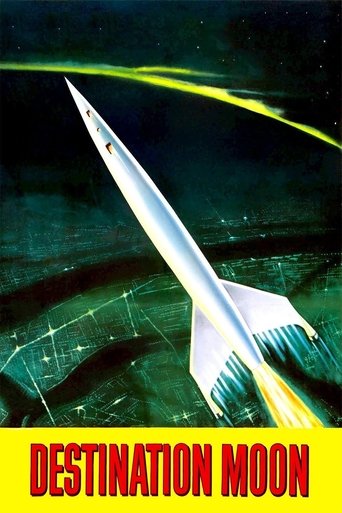
Destination Moon
1950 · Film · 91 min
Directed by Irving Pichel
A team composed of an aerospace scientist, an ex-Air Force general, and an industrialist conceives an ambitious plan to land Americans on the moon. From their base in the Mojave Desert, they construct and successfully launch a spacecraft named "Luna" that contains a cargo of four astronauts. But a critical miscalculation of needed power to escape the moon's gravitational pull may put the astronauts' lives in danger.
5 neutralfrom 5 commenters
Where to watch
No streaming data for this title.





5 comments on Hacker News
That one, about a member of Congress, has a sex scene in a hot tub. It had movie potential.
The Roy Krock movie worked because audiences understand McDonalds. Trying to explain the relationship between R&D policy and defense spending is much tougher. Although see Heinlein's "Destination Moon".
Star Trek's nonsense economy and nonsense technobabble are both symptoms of its small-c conservative roots as screen entertainment. For a series they want to introduce a gimmick one time (all you need for time travel is a special starship maneuver!) and then have everyone forget about it until the next time they wanted a time travel plot. But the real world isn't like that. You can't introduce the atomic bomb as a one-time gimmick to end World War II without it influencing the nature of war and diplomacy for all generations to come.
If you add up all the technologies demonstrated in the original Star Trek and The Next Generation, and let them play out in the imagination, you end up with something baffling, dazzling, and unrelatable to any sort of 20th century society. The problem with letting fictional technologies play out to their logical limits is that it limits the audience. The sort of people who read Greg Egan and Hannu Rajaniemi might eat it up, but those eleven people [1] aren't enough to sustain a successful media franchise. So they just introduce one bit of technological set dressing after another, not caring how it should or would influence the other bits that are already there, or the economy, or society. Because they want to maintain a sort of stasis where they are telling stories about the present with pseudo-futuristic decor.
I have said before that David Fincher's The Social Network, had it been released in 1950 instead of 2010, would have been the most prophetic science fiction movie of all time. And yet it probably would have bombed as a science fiction movie back then because it was culturally alien to 1950 and it wouldn't have slotted into the "adventure with creatures and/or gadgets" template that was popular at the time. (Well, it kind of is a story about adventures with gadgets, but it's no Destination Moon.)
[1] And I am one of the eleven!
Something to help appreciate the relation of science to youth culture in the 1950s is the popularity of sci-fi movies. Aside from rare exceptions like Destination Moon (1950), 1950s sci-fi was produced with no pedagogic intent. Studios churned out these movies because science (okay, sci-fi) was what attracted the teen market. In the 1960s, teen tastes shifted to horror and the film studios followed.
If you are interested in 1950s American sci-fi cinema, the comprehensive survey is Bill Warren's Keep Watching the Skies!: American Science Fiction Movies of the Fifties (2016).
> It might even contain ice or water
As a boy in the early seventies, reading Tintin: Destination Moon, I was always put off by the episode with the underground cave full of slippery ice. That was clearly an outdated view of lunar conditions, which somewhat dented my suspense of disbelief.
Maybe I needn't have worried.
That's nothing new. Read what Heinlein has to say about the making of Destination Moon in 1949 in his Guest of Honor Speech at the Rio de Janeiro Movie Festival twenty years later. It was published in the posthumous tribute collection, Requiem.