 Hacker Cinema
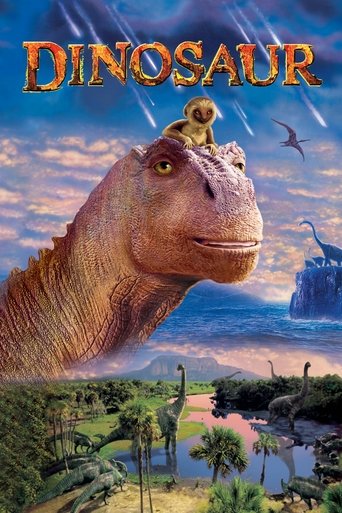
Dinosaur
2000 · Film · 82 min
Directed by Ralph Zondag, Eric Leighton
An orphaned dinosaur raised by lemurs joins an arduous trek to a sancturary after a meteorite shower destroys his family home.
1 negative2 neutralfrom 3 commenters
Where to watch
No streaming data for this title.

3 comments on Hacker News
> Then there's "it's all remakes now"—but 1) it's not,
It really is, if by "remake" you mean all ways of leveraging existing IP. Here are the top ten box office films of 2020:
* Bad Boys for Life (sequel) * Sonic the Hedgehog (videogame) * Birds of Prey (comic book) * Dolittle (book) * The Invisible Man (book) * The Call of the Wild (book) * Onward (original) * The Croods: A New Age (sequel) * Tenet (original) * Wonder Woman 1984 (sequal, comic book)
Two originals. Now go back 20 years:
* Mission: Impossible 2 (sequel) * Gladiator (book) * Cast Away (original) * What Women Want (original) * Dinosaur (original) * How the Grinch Stole Christmas (book) * Meet the Parents (remake) * The Perfect Storm (book) * X-Men (comic book) * What Lies Beneath (original)
Four originals. Go back another 10 years:
* Ghost (original) * Home Alone (original) * Pretty Woman (original) * Dances with Wolves (book) * Total Recall (short story) * Back to the Future Part III (sequel) * Die Hard 2 (sequel) * Presumed Innocent (book) * Teenage Mutant Ninja Turtles (comic book) * Kindergarten Cop (original)
Five originals. Another ten years to 1980:
* The Empire Strikes Back (sequel) * 9 to 5 (original) * Stir Crazy (original) * Airplane! (original) * Any Which Way You Can (sequel) * Private Benjamin (original) * Coal Miner's Daughter (original) * Smokey and the Bandit II (sequel) * The Blue Lagoon (book) * The Blues Brothers (SNL sketch)
Five originals again. I'm going by top box-office gross here because I think that's a good proxy for what is successful. You can look at other years, but there is a very clear (but not overwhelming) trend towards movies based on familiar content. It's not clear whether studios are leading audiences or vice versa. Probably some iterative process of both.
There's also a clear trend away from dramas. I think that's because drama (and non-slapstick comedies) tend to rely heavily on specific cultural norms for their effect which makes them translate poorly. There is a very clear trend especially in the last decade or so of Hollywood focusing on movies that will also do well in China in particular.
As someone who has legitimately tried to use Bing let me just say, Bing's issue isn't its lack of indexing. Every time you search on Google you're "teaching" Google's system what results you'll most likely want.
So for example if I search for "that movie with dinosaurs" on Bing and Google, Bing's no.1 result is an IMDB link to a movie called "Dinosaur (2000)." That's not a "stupid" suggestion, but it is still not how people use search engines. Google shows me "jurassic park" and "the land before time" neither of which contain the word "dinosaur" in the title.
That's because millions of people have likely searched "that movie with a dinosaur" and clicked on the "Jurassic Park"/"Land Before Time" links. This information cannot be gained by simply just indexing no matter how amazing your indexer is.
So let's say, theoretically, that someone stole Google's code. They then reproduced Google's infrastructure, search algorithms, and so on but WITHOUT Google's massive database of historic queries. I legitimately do not think that this company, even with all of Google's stuff could catch up with Google, because 1. Those historic queries now ARE the core of Google's results, and 2. Google will always out-pace the competition in generating new intelligent results (due to more usage).
It is a circular problem. Bing could be twice as good as Google under the covers, but it will never catch up for the reasons I said above... Ditto with DDG or anyone else.
PS - As an aside, Google's search query parsing is significantly better than Bing's when it comes to programming/technical queries. Every time a quote appears in a bing query it treats it as a literal query string, Google seems to understand the context of the double quote (i.e. that it was from the source material) and give you non-literal query string results.
Did you notice that most articles on Wikipedia, although mostly 'correct', are very dry? And this is because they try to be as 'correct' as possible. But it brings to a point where some (most??) users can't use it comfortably anymore. Think children, who are trying to find some basic information about the subject they are interested in. My 8yo recently has gone through the 'dinosaurs' stage. Drawings, books, stories, films. You think she found this fascinating: http://en.wikipedia.org/wiki/Dinosaur ?? Nope. Here comes in the federated version, with 'alternative' of the story. Tailored for the 4-10yo audience. Is it less 'correct'? Perhaps. But useful nonetheless.