 Hacker Cinema
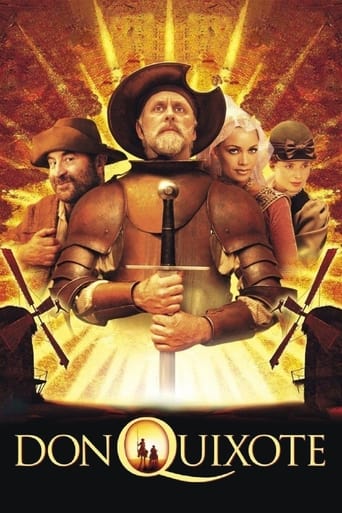
Don Quixote
2000 · Film · 139 min
Directed by Peter Yates
Adapted from the work of Miguel de Cervantes, this is the story of a hidalgo, fanatic for chivalry novels, who loses his sanity and believing to be a knight named Don Quixote de La Mancha, decides to go on imaginary adventures along with his friend, the simple farmer Sancho Panza, who becomes his squire. On their journeys, they rescue dames in distress in honorable acts and fight giants among other perils, with Don longing to be with the love of his life, lady Dulcinea, and Sancho waiting to be rewarded with an island where he's about to become a governor.
2 negative3 neutralfrom 5 commenters
Where to watch
No streaming data for this title.
5 comments on Hacker News
Cervantes was buried on April 23 but he probably died on April 22. Shakespeare almost certainly knew Cervantes beacuse there is a lost play attributed to Shakespeare based on an episode in Miguel de Cervantes's Don Quixote. Probably Cervantes never read a Shakespeare's work.
https://www.folger.edu/blogs/shakespeare-and-beyond/shakespeare-and-cervantes-400-years/
https://en.wikipedia.org/wiki/The_History_of_Cardenio
I'd argue otherwise. With electronic self-publishing, you are completely free to experiment, and have an audience potentially all over the (English-speaking) world.
But it's not going to make you world-famous, save for unique exceptional cases. It will likely will not directly bring you wealth from sales, or actually any considerable money. Ah, and the printed book is a gimmick that only a part of your audience would still appreciate; literature and paper are much like music and vinyl.
You can still become truly world-famous and well-off if your book becomes a basis of a movie, or ideally several; see e.g. Harry Potter or The Song of Fire and Ice. Granted, they not a completely realistic, but neither is Moby-Dick, or Hundred Years of Solitude, or, say, Don Quixote, which basically started the whole "novel" thing.
Also true of Also true of Lynch's version. Also true of Jodorowsky's abortive attempt.
Is it that Dune books seem slow-moving? Is it the concepts being difficult to visualize?
Also, are Dune and Don Quixote both cursed to never quite make satisfying films?
I'm a huge Welles fan, but I find it weird to talk about him as a "workaholic."
Not because he didn't spend a lot of time working (he did! Especially when he was young), but because so little of that time actually resulted in him accomplishing anything. His life story is full of half-finished and only-pushed-out-the-door-because-someone-forced-him-to projects.
Some of these are notorious, like Ambersons, but there are plenty of others. It's All True (https://en.wikipedia.org/wiki/It%27s_All_True_%28film%29), for instance, a vaguely documentary-ish film he spent two years working on in Latin America during World War 2. He shot so much film for It's All True that the studio that eventually inherited it ended up dumping hundreds of thousands of feet of the damn stuff into the ocean just to get it off their books. But even with all that time and footage, he was never able to turn out a finished film.
Or his Don Quixote (https://en.wikipedia.org/wiki/Don_Quixote_%28unfinished_film%29), which he started working on in 1955, spent more than a decade shooting, and which, unfinished and unreleased, he was still tinkering with when he died thirty years later.
Or The Other Side of the Wind (https://en.wikipedia.org/wiki/The_Other_Side_of_the_Wind), also unfinished, which was how he spent the first half of the 1970s.
Or The Big Brass Ring (http://www.amazon.com/The-Big-Brass-Ring-Screenplay/dp/094823816X), a massive, turgid lump of a screenplay that he spent years flacking around Hollywood near the end of his life. (Another director actually managed to film it in 1999. Don't worry about trying to track it down. It is terrible.)
The article doesn't mention any of these projects. In fact it really doesn't mention anything he did after Ambersons. But when he walked away from Ambersons he was only 26 years old! He had more than 40 more productive years ahead of him. While he filled those years with work, though, he lacked focus, lacked discipline, and that lack sabotaged him over and over and over again. He never learned the lesson that "great artists ship." And that's why the story of his life reads as much like a tragedy as it does a tale of genius.
The idea that a creator has an absolute moral right to control of their characters is a fairly recent one, and it certainly isn't a widely respected one -- imagine how many movies, books, etc. would have never been written if people had considered Dracula, Don Quixote, Frankenstein's Monster, Othello, etc. to be inviolable property of their authors. I don't think it's a particularly strong argument for state protection of copyright.